It’s possible that I shall make an ass of myself. But in that case one can always get out of it with a little dialectic. I have, of course, so worded my proposition as to be right either way (K.Marx, Letter to F.Engels on the Indian Mutiny)
Sunday, April 12, 2026
Shipbuilding Orderbook Hits 17-Year High Driven by Tankers Reports BIMCO
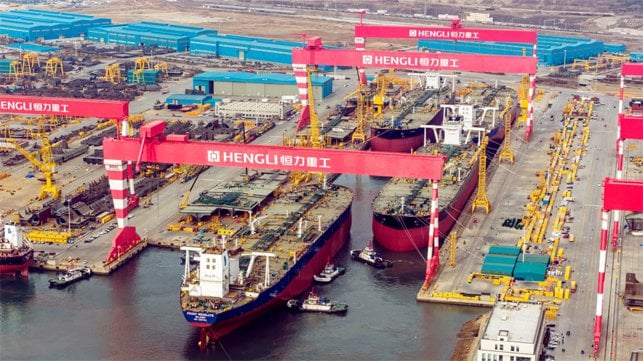
China's Hengli recently simultaneously floated four tankers as the surge in crude oil tanker oders continues to grow (Hengli)
The boom in shipbuilding orders is continuing, reaching a 17-year high, reports industry group BIMCO. While it sees a slowing in some sectors, it points to a recent surge in crude oil tanker orders coming after the container segment was already driven to new highs.
During the first quarter of 2026, newbuilding contracting has risen 40 percent year-over-year to 17.6 million Compensated Gross Tonnes (CGT). In total, it calculates the global shipping orderbook reached 191 million Compensated Gross Tonnes (CGT). BIMCO reports that this is equivalent to 17 percent of the global fleet, the highest ratio since 2011.
“So far during the 2020s, newbuilding contracting has been 47 percent higher than the average during the 2010s, driven by stronger market conditions in the larger sectors, an overall larger fleet, and an increased need for fleet renewal,” explains Filipe Gouveia, Shipping Analysis Manager at BIMCO. “This has contributed to an increase in newbuilding prices and longer lead times at shipyards, with 57 percent of contracting so far this year expected to be delivered after 2028.”
The most recent surge was driven, BIMCO reports, by a tripling of new tanker orders and a rebound in LNG tanker contracting. Overall, it calculates that tankers accounted for 32 percent of total contracting, the highest share since the second quarter of 2017. It breaks a long drought in the sector and coincides with the view that tankers have entered a strong new upcycle.
Some shipping sectors now have relatively large orderbooks BIMCO reports. The orderbook-to-fleet ratio, it points out, has risen to 22 percent for crude tankers, 19 percent for product tankers, 37 percent for containerships, and 40 percent for LNG carriers. For crude and product tankers, these newbuildings are expected to support fleet renewal, as 21 percent and 17 percent of the respective fleets are now over 20 years old, the age at which recycling is typically considered. By contrast, only 4 percent of the container fleet and 8 percent of the LNG fleet are over 25 years old, although these segments are expected to see higher demand growth.
Despite this significant yearly increase, BIMCO, however, also notes that newbuilding contracting has decreased 17 percent quarter over quarter, amid an easing in dry bulk orders. Bulker contracting spiked, it explains during the last quarter of 2025, largely due to increased orders for capesize vessels.
“In the medium term, the already swelling order books across several large shipping sectors could contribute to a slowdown in newbuilding contracting. Long lead times at shipyards and high newbuilding prices, combined with high market uncertainty concerning the Red Sea and the Strait of Hormuz sailings and alternative fuel availability, could also negatively affect contracting,” says Gouveia.
The data also highlights the ongoing concerns over geographic mix. Chinese shipyards remained the dominant choice for shipowners, says BIMCO, accounting for 70 percent of contracting in the first quarter of 2026. Korean yards captured just 20 percent, and that was mostly supported by stronger LNG tanker ordering. In contrast, contracting at Japanese yards fell 83 percent year-over-year to just 1 percent of new orders, the lowest share since at least 1996. BIMCO says this reflects limited capacity, long lead times, and reduced competitiveness.
The Japanese government has recently announced plans for a massive investment into its shipbuilding industry, while the major yards have been consolidating to improve their efficiency. South Korean yards are also moving aggressively on several fronts to stem their declines versus China, while the Trump administration and other geographies have heralded their own domestic plans to revitalize national shipbuilding.
Normal fleet renewal efforts and growing demand have also been supplemented by the growing need to address environmental issues. Despite the lack of clarity from the IMO and other regulators, companies have continued to invest in new technologies and ships able to adapt to the anticipated changes in fuels and efficiency in response to emerging regulations.
Global Cruise Outlook: New Challenges
After three blockbuster years, the industry may see slower growth in 2026
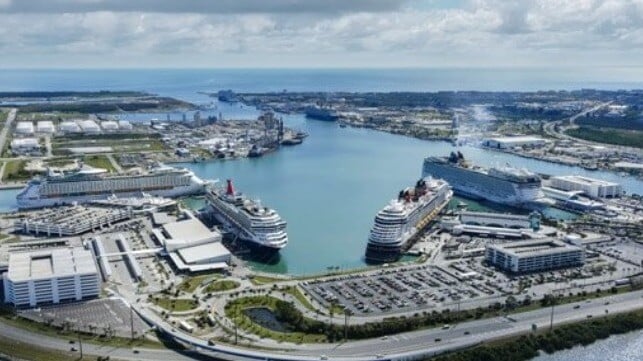
Port Canaveral emerged as the busiest homeport in 2025 handling more than 8.6 million passenger movements
(Article originally published in Jan/Feb 2026 edition.)
After rebounding from the COVID-19 pandemic with "revenge travel" driving strong growth, the cruise industry is facing new headwinds from the broader macro-environment and geopolitical pressures.
Financial analysts point to a return to more traditional growth rates while the luxury and expedition segments of the industry are taking on new importance to drive future growth.
The basic elements of cruising, a largely all-inclusive vacation that's hassle-free and offers an excellent value, remain in place and continue to gain traction with travelers. Analyst Meredith Prichard Jensen at HSBC says, "The pillars of growth remain intact, led by durable experience-led demand, a boost from private destination roll-out, and a strong value equation for the budget conscious.”
She writes in a recent report that the industry “navigated through intermittent cross currents in 2025” and ended the year outperforming the S&P 500 and the broader travel segment.
STRONG START
Further, the industry has started 2026 with a bang. Analyst Robin Farley of UBS notes that one large U.S. seller told her "wave season” is off to a strong start, in line with expectations. Farley thinks the robust booking environment of late 2025 is carrying into 2026
It's a sentiment echoed by Steve Griswold, owner of travel agency Pixie Vacations, who says cruise bookings at his agency increased in 2025 and 2026 has already exceeded 2025. The major cruise companies have stated that they're well booked through 2026 and are now releasing itineraries for 2027.
“The outdated caricature of a cruise passenger as a retired shuffleboard player is rapidly fading thanks to savvy social media and influencer campaigns,” observes HSBC's Jensen. She notes that as much as a third of the bookings are from the “new to cruise” segment. The industry has adjusted its product to compete with land-based resorts and theme parks, adding more short cruises in the broad, mass-market segment known as contemporary cruising as well as in the premium segment. However, it will have to work harder to achieve growth.
Analyst Chris Woronka of Deutsche Bank says, “There might be a bit of fatigue setting in among cruisers who have been dealing with steadily rising prices on tickets, onboard extras, and shore excursions.” He sees growth continuing at moderate levels and looks for yield growth to be “much more 'normal' in 2026.”
Driving down costs and continuing to lower financial leverage remain key goals for cruise companies. They're using advanced revenue management capabilities and enhancing/refining loyalty programs, learning from the hotel sector. There's a greater emphasis on the pre-boarding spend and high-margin activities onboard.
OVERCAPACITY
One of the big concerns emerging among analysts is the potential for overcapacity, especially in the Caribbean in the near term.
Several major new ships came online in 2025, including the MSC World America (216,638 gross tons with 6,764 passenger capacity) at its Miami homeport and Royal Caribbean's Star of the Seas (248,663 gross tons with capacity around 7,600 passengers) in Port Canaveral, Florida. Star of the Seas and her sister ship, Icon of the Seas, share the title of the world's largest cruise ship.
Norwegian Cruise Line added Norwegian Aqua (156,300 gross tons with capacity for 3,571 passengers), and Celebrity Cruises added CelebrityXcel (141,420 gross tons with accommodations for up to 3,950 passengers). Only Carnival Cruise Line was more disciplined, not introducing a newbuild last year.
Homeports benefited with Port Canaveral becoming the world's largest cruise port, handling 8.6 million passenger movements in FY 2025 and eclipsing PortMiami, the longtime leader, which handled just under that number. Newer cruise ports, including Galveston, Texas (approximately four million passenger movements), also continued their rapid growth.
Supply in the contemporary segment (mass market) continues to be slightly higher than demand, says C. Patrick Scholes of Truist Securities. In his latest report, Scholes calls it a “slight though not extreme imbalance” but believes it's leading to higher levels of promotional activity, which could erode some pricing power and impact financial results, especially net yields, in the first half of 2026.
To offset some of the softness and keep more revenue in-house, companies are stepping up their investments in private destinations. Carnival Cruise Line opened Celebration Key on Freeport in the Bahamas and is enhancing existing facilities in Honduras, while Norwegian added a pier, pool, and other amenities to its Bahamas out island, Great Stirrup Cay. Royal Caribbean International is launching private beach clubs, including its first in the Bahamas.
$70 BILLION ORDERBOOK
Reflecting the longer-term positive outlook and the mass market potential, companies continue to order ultra-large cruise ships.
Both Carnival and Norwegian confirmed orders for their first 200,000-plus gross ton ships to be built at Fincantieri in Italy. MSC expanded its order for World Class vessels to eight at Chantiers de l'Atlantique in France while Royal Caribbean has the third, fourth and fifth ships of its Icon Class under construction at Meyer Turku in Finland.
While the majority of the new ships on order will be delivered by 2030, the orderbook extends to 2036 to lock in building slots.
A total of 75 cruise ships are on order, representing more than $70 billion in investment. Almost half the orderbook, 34 cruise ships, are for the mass market and will have nearly 165,000 berths. Despite the large investments, HSBC's Jensen notes the 2026 orderbook is running less than half that of 2019.
Analysts like Jensen see a measured pace for new ship deliveries and strategic decisions to rationalize capacity. Woronka points out that across all segments of the industry the new ships are larger, improving the operating economics, while predicting, "There will eventually be a fresh round of non-core ship retirements within the next three to five years.”
BRIGHT SPOTS
One bright spot for the industry is the continued growth in the ultra-luxury segment as well as expedition cruises to exotic destinations. Norwegian Cruise Line Holdings is at the forefront, ordering the first new class of ships in 10 years for ultra-luxury Regent Seven Seas Cruises – four 77,000 gross ton ships due by 2036 – while luxury brand Oceania Cruises has ordered five 86,000 gross ton ships due between 2027 and 2037.
There's a total of 32 luxury cruise shíps on order, but Scholes points out that while the high-end luxury segment is growing, demand remains at or slightly above supply.
“Expedition and yacht-style cruising is one of the fastest-growing segments we're seeing,” adds Henry Gilroy, Executive Vice President at Internova Travel Group. “Travelers are willing to pay more for exclusivity, access, and once-in-a-lifetime experiences.”
Internova, which calls itself one of the world's largest travel service companies, recently completed an analysis of millions of travel bookings and surveyed 4,000 North American travelers. The Internova Index revealed a significant broadening of traveler interest in high-end cruises.
“One-third of travelers surveyed expressed interest in luxury yacht cruises and expedition-style voyages, with demand particularly strong among affluent and adventure-seekers,” the group reports.
Michele D'Agostino, Co-Founder of Secret Atlas, expedition micro-cruise specialists, says consumers are trading up. He sees a “durable shift toward experiences that feel scarce, real, and story-worthy” and says in 2026 “authenticity” is a differentiator “because many travelers have become allergic to anything that feels staged.”
THE "LUXURY HALO"
"The growth in ultra-luxury and destinations extends to some river cruise itineraries as well. It's also not gone unnoticed by luxury hotel brands including Ritz-Carlton, Four Seasons, Orient Express, and Aman, all of which partnered to launch branded cruise ships.
HSBC's Jensen points to the “embracing of the luxury halo" as one of the core factors driving industry growth. She expects that the entrance of the luxury hotel brands could be an “outsized catalyst for sector expansion and evolution” and help to set new "aspirational pricing” for the luxury segment.
The hotel brands have strong loyalty programs to leverage with Jensen pointing out that approximately 70 percent of Ritz-Carlton Yacht Collection's first-year bookings were "new to cruise.” Four Seasons starts cruising in March, and Orient Express Corinthian enters service in June.
Despite emerging challenges, the outlook remains very strong for the cruise industry. Analysts highlight that the “propensity to cruise” remains high as well as the recognition of the value aspects of a cruise vacation. For all its growth, however, cruising is just a small portion of the large, leisure-time travel sector, giving it extensive opportunities for continued expansion. – MarEx
Allan Jordan is the magazine's Associate Editor.
The opinions expressed herein are the author's and not necessarily those of The Maritime Executive.

No comments:
Post a Comment