Saturday, April 11, 2026


No to war, no to distortion: A critique of ‘limitless unity’ within the anti-Iran war movement


Mitra Mahmoudi

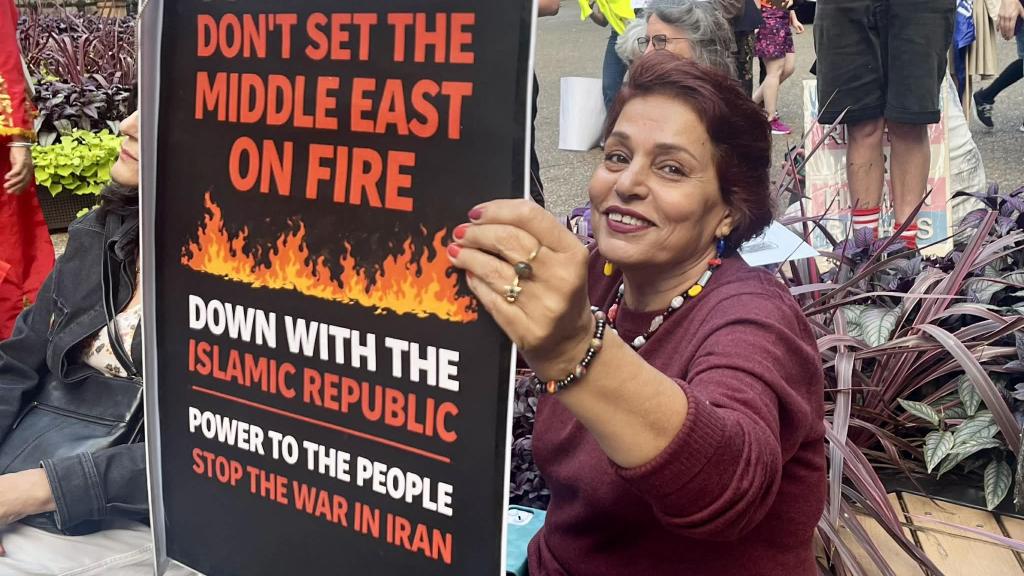
With the shadow of war and devastation continuing to loom over Iranian society, opposing any US or Israeli military intervention is an urgent humanitarian responsibility. There is no justification for bombings, killing civilians or destroying a nation’s infrastructure — this position is a non-negotiable principle.

However, a dangerous distortion is occurring: an attempt to blur political boundaries between the anti-war movement and Islamic Republic supporters in the name of “broad unity”.

Ignoring the reality of symbols

Some have argued that the Islamic Republic’s flag is a neutral symbol and that we should avoid a “flag war” by allowing regime supporters to carry them at anti-war protests. This view turns a blind eye to reality.

For millions of Iranians, this flag is not just a piece of cloth; it is a symbol of a specific socio-political ideology and a reminder of decades of repression, executions, discrimination and structural violence.

One cannot expect victims to stand alongside this symbol and treat it as if it were devoid of meaning. This is not an “emotional” issue — it is about the political and social significance of symbols.

Weakening an independent stance

Without clear political demarcation, the presence of Islamic Republic flags at anti-war protests carries a significant risk: it weakens the independent stance of “No to war, No to dictatorship.”

This intentional ambiguity creates a false impression that Iranians abroad are defending the regime. Such an approach is not just an analytical error but a political retreat.

On the other hand, the solution is not passivity or fragmenting the anti-war movement. A divided movement only serves the interests of pro-war forces.

The third path: Participation with identity

The way forward lies in a “Third Path” based on:

  • Active participation in the anti-war movement;
  • Maintaining a distinct political identity;
  • Echoing a clear and uncompromising message: “No to War, No to the Islamic Republic.”

This approach does not imply unnecessary confrontation or excluding others. Rather, it emphasises maintaining political clarity and refusing to fall into the trap of “false unity”.

Conclusion

A movement’s strength depends not only on its numbers but its ideological clarity and political integrity. A unity built upon erasing truths and denying suffering will be neither sustainable nor liberating.

Today, defending human lives, safeguarding the truth and refusing to ignore the nature of reactionary forces should be three inseparable pillars. Pursuing any one of these without the others will inevitably lead us astray.

Mitra Mahmoudi is an Iranian socialist, political activist and feminist. She is the director of Radio Avaye Zan (Voice of Women) in Sydney, Australia.


Opposing Western intervention and the Iranian regime


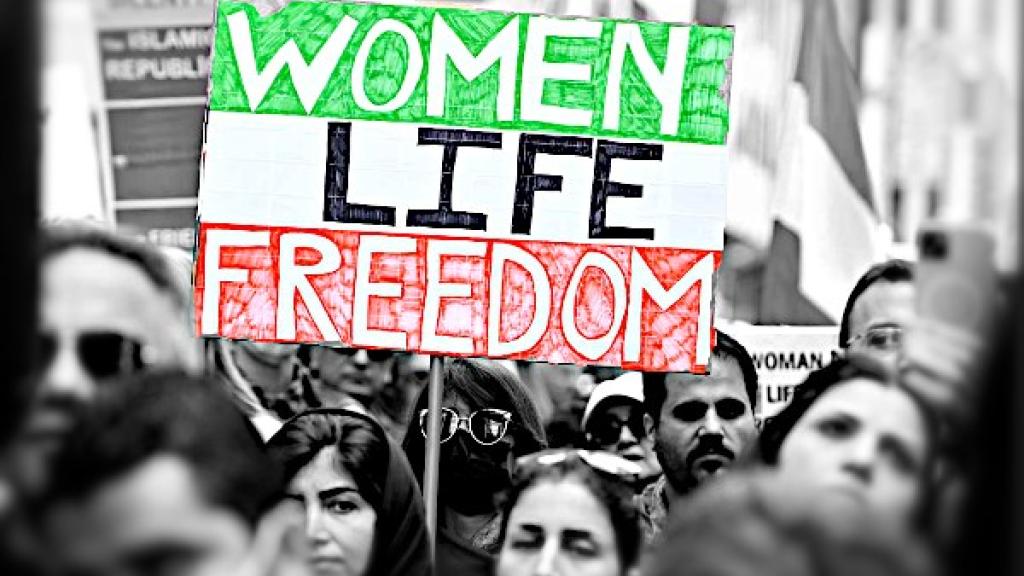
Women Life Freedom placard

First published in Turkish on the BirGün website. Translations from Socialist Project.

As the United States and Israel escalate their military campaign against Iran, the war is being justified through a familiar vocabulary: security, deterrence, and the elimination of existential threats. Yet beyond official rhetoric, the conflict is also unfolding as a battle over narratives — one shaped by media framing, digital propaganda, and deeply divided political communities.

Among the most striking features of this moment is the fragmentation of the Iranian diaspora. While some voices have openly supported military intervention in the name of “liberation,” others warn that such positions risk legitimizing a destructive external project with long-term consequences for Iranian society. At the same time, attempts to oppose both the Iranian regime and Western intervention are often marginalized, reduced to simplistic binaries that leave little room for nuance.

In this interview, award-winning Iranian-Canadian journalist and producer Samira Mohyeddin offers a critical perspective on the narratives surrounding the war, the role of social media and organized messaging, and the internal contradictions shaping diaspora politics. Drawing on historical context and contemporary developments, she challenges dominant assumptions about Iran, questions the logic of external intervention, and reflects on the political and ethical difficulties of sustaining a principled anti-war position in an increasingly polarized environment.

In his televised address on April 1, Donald Trump defended the war against Iran primarily in terms of security and stability — particularly the need to prevent nuclear escalation and eliminate perceived threats. Similar justifications have appeared across official statements and much of the media coverage. How do you interpret this narrative, and what does it obscure or leave out?

I think the primetime address that Donald Trump gave to the American public was primarily an attempt to sell this war. As you noted, he framed Iran as an imminent threat and emphasized the need to eliminate its nuclear capabilities. But what is consistently missing from media coverage is crucial context.

Back in June, during the 12-day war launched by the United States and Israel against Iran, the US used a weapon it had never deployed before in this context — a 30,000-pound bomb. Following those strikes, Trump himself stated that Iran’s nuclear capabilities had been “obliterated.”

So, the question is: are we really expected to believe that within just a few months, Iran was able to fully recover from that supposed “obliteration” and reconstitute its nuclear program? That claim simply does not hold up.

We know this in part because Rafael Grossi, the head of the International Atomic Energy Agency, stated just days after the latest escalation that Iran posed no imminent threat and was not developing a nuclear weapon. According to the IAEA, Iran was not even close to having that capability. Yet this context is largely absent from mainstream coverage.

Instead, what we are seeing is a process of manufacturing consent. The United States and Israel need to justify this war to their domestic audiences — to convince Americans why they should be paying $4 a gallon for gas. When Trump tells Americans that this war is “a great investment” for them, their children, and their grandchildren, it reveals the extent of that effort. Quite frankly, the statements he was making were laughable.

There is also a broader historical dimension that is often overlooked. Iran fought an eight-year war with Iraq — a conflict in which Iraq was backed by major Western powers, including France and Germany. Despite that, Iran did not concede even a small portion of its territory.

What people don’t understand about Iranians is that they will fight to the end. They don’t care how much infrastructure is ruined or anything. They will not give up this war to America and Israel.

Now, this next question is a little bit personal. You have also been the target of online attacks, including from pro-Israel and Zionist voices. More broadly, how do you assess the role of Zionist and pro-Israel advocacy networks and institutions in shaping media narratives about Iran in Canada and other Western contexts?

I think it would be a mistake — and a dangerous one — to dismiss the role that social media has played, both in this specific conflict and over the past decade.

Let me break your question into two parts, because the impact of propaganda directed at Iranians inside the country is crucial to understanding what is happening.

First, Israel operates a significant number of Persian-language social media accounts that are explicitly targeted at Iranians. What kind of messaging are people hearing? They are hearing messages from Benjamin Netanyahu and other officials claiming, “We are coming to rescue you. We are the only country that cares about you.” At times, Netanyahu has even delivered these messages in Persian, including through AI-assisted translation.

Alongside this, there are satellite television channels such as Iran International and Manoto TV, which for decades have pushed and promulgated a certain ideology into the country. So, there is a long-standing ecosystem of messaging that predates the current war.

And then, on the other hand, we know — from outlets like The Times of Israel and Haaretz, Israeli media outlets — that Israel has spent, this year alone, up to $250-million on social media campaigns, including paying influencers $7,000 per post. Netanyahu met with them in New York — we have the photos. These are not conspiracies; these are facts.

And they have really pushed an agenda to try and get Iranians to agree with the dropping of bombs on their heads.

You mentioned the threats I have received. When I look at many of these accounts, they are not real people. They may have two posts, ten followers — clearly inauthentic profiles. But there are so many of these accounts pushing the same messages that people stop asking basic questions: Is this a real person? Or is this a bot?

Instead, a narrative takes hold — that Iranians support the war, that they welcome these attacks. But the reality is far more complex. These campaigns rely precisely on the assumption that most people will not investigate the sources of what they are seeing.

How do you interpret the fact that parts of the Iranian diaspora, including in Canada, frame external military intervention as “liberation”? What does this reveal about diaspora politics, and what consequences might it have for struggles inside Iran?

These are great questions — really excellent questions — because I think, first of all, we are dealing with a very dangerous diaspora.

And I use the word dangerous on purpose, because they are wholly delusional. And they don’t quite understand the impact, which brings me back to the propaganda we were talking about — the effectiveness of the messaging that Israel has directed at Iranians, both inside and outside the country.

Right now, we are seeing members of the diaspora waving Israeli flags, gathering outside embassies, and thanking Donald Trump for what he is doing. Many people excuse this behavior as desperation. I disagree. I don’t think it is desperation.

I think that within parts of the community, there is a mode of thinking that is deeply authoritarian, even fascistic. And there is also a latent form of racism that is rarely acknowledged. What has emerged, in some cases, is a kind of homo-nationalism that is very fascistic at its core.

There is also a recurring idea among some Iranians that they are the exception. You hear statements like: “We are not Syria. We are not Afghanistan. We are not Iraq. We are much more sophisticated.” But what does that imply? It reflects a hierarchy — it reflects racism.

It suggests that, regardless of what external powers such as the United States or Israel want, Iranians somehow stand apart from the rest of the region. We are much more sophisticated than these people.

You also hear figures like Mark Levin saying that people in Iran are “Persian,” that they are “Western,” and that they are not like the rest of the Middle East. And some Iranians internalize and reproduce this message because it offers a sense of distinction or superiority.

A lot of Iranians get angry at me for pointing this out because there’s this idea of airing our dirty laundry in public. But I think it’s really important to call this stuff out because we’re going down a very dangerous road — very, very dangerous.

In your view, why has it become so difficult in public debate — particularly in Canadian and Western public debate — to sustain a position that both opposes Western military/imperalist intervention and critically engages with the Iranian regime? How should such a position be articulated?

It’s hard to maintain this position because it is, quite simply, a messy one.

In the media and in public discourse, there is a tendency to reduce everything to black and white. We operate in binaries. If you are against the Iranian government, then you are expected to support the war. And if you support the war, then you are aligned with Israel and the United States. There is very little room for people who reject both positions — for people like me, and what I believe is actually a silent majority.

People are afraid to speak out. It is not just about holding a principled position — it is about the consequences of doing so. People are attacked, threatened. I receive death threats and racist abuse on a daily basis. I mean, these aren’t imaginary things, right?

To take a principled stance against the decimation of your country’s infrastructure, while also recognizing that the Iranian government is authoritarian and repressive, is a very difficult balance to maintain right now. But it is one I refuse to abandon.

This is not a new phenomenon. For decades, anyone who has opposed war against Iran has been labelled “pro-regime,” accused of being paid or acting on behalf of the state. I myself have been accused of taking money from the Iranian government. It is absurd — it is almost a parody — but it remains a persistent tactic, especially within parts of the diaspora, to discredit dissenting voices.

Even when someone has consistently criticized the authoritarian nature of the Iranian government — as I have, including in publications like The Globe and Mail — it makes little difference. If you are operating within any space that has nuance or exists in shades of grey, you will be labelled as such. And the people who do this are, I’m sorry to say, very ignorant, and I don’t trust them.

There is a Persian expression — hezb-e baad, the “party of the wind” — which describes those who simply follow whichever direction the wind is blowing.

And the wind has shifted. Just a few months ago, it was strongly pro-war. But in recent days, some of those same voices have reversed their positions, as the consequences of the war become more visible.

A lot of people who were pro-war have now completely done a 180 because they’re starting to realize that with every bridge that gets bombed, with every pharmaceutical company that gets bombed, the United States, and Israel are only concerned with decimating the country of Iran.

Decimating its domestic capabilities and creating a servile client state, like they have in Syria — one that Israel can come and bomb from time to time, and that has no ability or capability to protect itself or its citizens.

You have emphasized that meaningful political change in Iran must come from within. Why do external interventions — despite being framed as supportive — tend to undermine that possibility?

There are historical precedents for this — and it has never worked. If you take a long view of Iran’s socio-political history, going back even to the Constitutional Revolution of 1905–1906, you can see that change has often emerged through internal dynamics and transnational connections within the region. People were learning from each other.

For example, in the early 1900s, Iranian women were in contact with women in India who were organizing boycotts of British cotton. Iranian women learned from that and organized boycotts of British sugar and tea. These kinds of regional exchanges were taking place, but they were never welcomed by external powers such as Britain, Russia, or later the United States.

We have also seen the consequences of external intervention elsewhere. Iraq is a clear example. The country has still not recovered from the US invasion and occupation. Do I think Saddam Hussein was a good person? Of course not. But change should have come from within Iraqi society, not through foreign intervention. It is delusional to think that meaningful change in Iran can come from the outside.

If the United States believes it can engineer transformation, we should already have seen evidence of that. We have repeatedly heard figures like Donald Trump and Benjamin Netanyahu call on Iranians to take to the streets. But how do you expect a civilian population to mobilize when 1000kg bombs are falling on them? It is simply not realistic.

What is often forgotten is that internal change has been happening. During the “Woman, Life, Freedom” movement in 2022–23, significant social transformations were taking place. These social changes — made by women — were incremental — step by step — but they were real.

More broadly, Iran today is not the same country it was in the 1980s. Despite the constraints of the political system, there have been important advances, particularly driven by society itself. Iranian women, for example, have made substantial gains. Iran ranks among the leading countries in terms of women graduating in STEM fields. And figures like Maryam Mirzakhani — the only woman to have won the Fields Medal — reflect these developments.

These changes have often occurred in spite of the state, not because of it. Yet there is a tendency in public discourse to erase them, to present Iran as a static, unchanging society. That is simply not accurate.

Look, we also need to have a long view of what democracy is. Europe had four or five hundred years to get to where it is today. How many revolutions did France go through before developing the system it has now? And we expect Iranians to catch up in 50 years? How is that possible? It’s impossible.

Iran was never left alone to do what it needed to do in order to make these advances — especially in the last few years. And now, we are going to see everything that Iranians were able to build over the past 50 years start to disappear because of this war.

At this moment — given the intensity of the war, the media environment, and the divisions within the diaspora, including in Canada — what do you see as the most dangerous misconception shaping public understanding of Iran today?

I think one of the most dangerous misconceptions is the idea that all Iranians are in favour of this war. One of the most troubling framings — especially in Western media — is the suggestion that Iranians welcome this war, that it is somehow necessary, or that people are simply helpless and waiting for external forces to intervene.

There is also this implication that Iranians themselves wanted this outcome. This is a very dangerous narrative. It’s very dangerous to say that, and it’s because, you know, as I said, we have this diaspora that, unfortunately, is going through this collective psychosis and delusion that somehow Israel and the United States are coming to help it when all they really want to do is destroy the country.

Samira Mohyeddin is an award-winning Iranian-Canadian journalist and producer. She posts on instagram/smohyeddin.

Baris Karaagac teaches international political economy and economic development at Trent University and researches European social democracy, state theory, and Turkish political economy. He is the editor of Accumulations, Crises, Struggles: Capital and Labour in Contemporary Capitalism (2013).
‘America’s not OK’: Surveys show US wellbeing in steep decline under Trump
 Common Dreams
April 10, 2026 


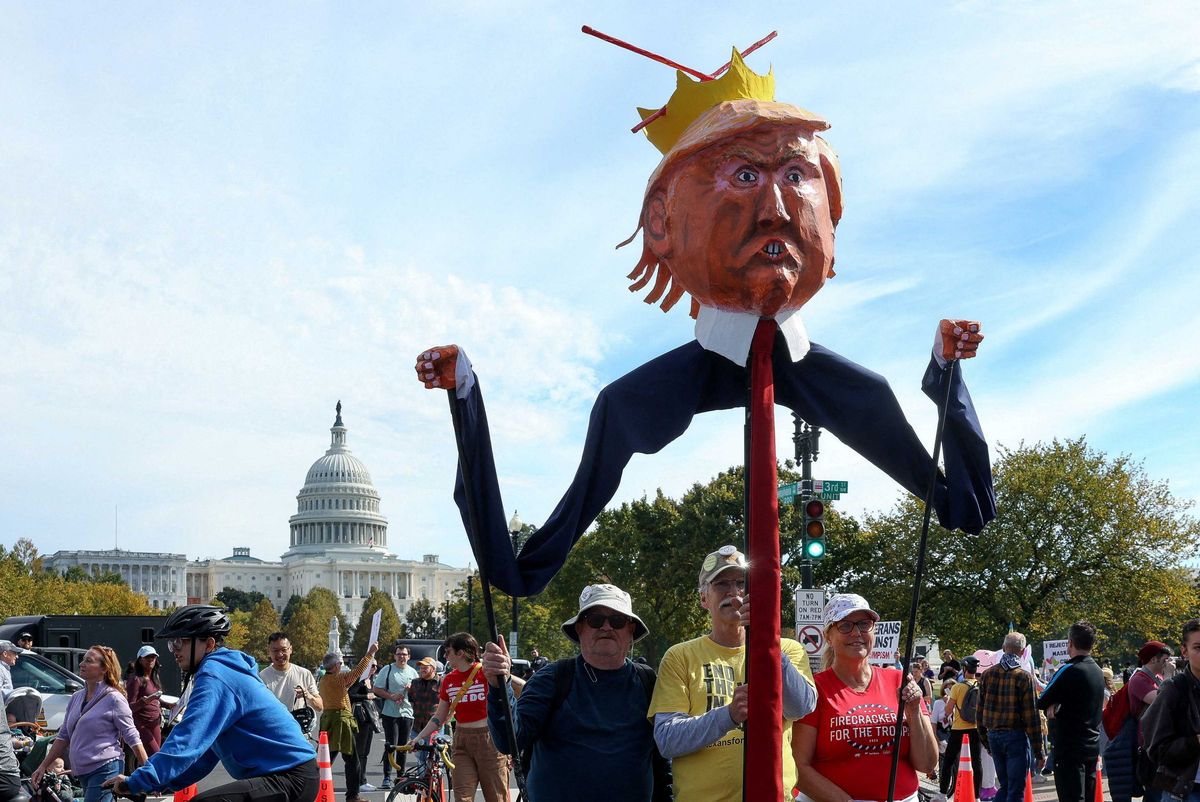
Demonstrators hold an effigy depicting U.S. President Donald Trump during a "No Kings" protest against U.S. President Donald Trump's policies, in Washington, D.C., U.S., October 18, 2025. REUTERS/Kylie Cooper


Two recently released surveys revealed a significant drop in Americans’ self-reported wellbeing as the Trump administration launches illegal and deadly military conflicts and plunges the global economy into chaos.

On Friday, the University of Michigan issued its monthly Survey of Consumers, which showed that consumer sentiment in the US hit an all-time low after dropping by 11% since March, amid President Donald Trump’s war of choice in Iran.

The drop in consumer sentiment was almost universal, the survey found, as “demographic groups across age, income, and political party all posted setbacks in sentiment, as did every component of the index, reflecting the widespread nature of this month’s fall.”

As for the reasons for the decline, the survey found “many consumers blame the Iran conflict for unfavorable changes to the economy,” such as a major spike in gas prices, which the US Bureau of Labor Statistics reported on Friday increased by more than 20% in the month since the war began.

Heather Long, chief economist at Navy Federal Credit Union, noted that the latest consumer sentiment data showed Americans are even more sour on the economy now than they were in the summer of 2022, when the economy was dealing with the highest inflation it had seen in decades.

Kendall Witmer, rapid response director of the Democratic National Committee, seized on the consumer sentiment report and accused Trump of having “tanked the economy for working families.”

“Americans are drowning under rising costs, flat wages, high unemployment, and historic layoffs,” Witmer added. “It’s no wonder they’re concerned about how they’re going to make ends meet and Trump and [Vice President] JD Vance can’t be bothered to make life more affordable for them.”

The record low in consumer sentiment comes just weeks after Gallup released its annual World Happiness Report, which showed that the US had fallen out of its rankings of the 20 happiest countries in the world.

The report says the decrease in US happiness largely came from “lower life evaluations among young adults,” and points the finger at high social media use as a key factor in making young people miserable.

Specifically, the report finds “there is now overwhelming evidence of severe and widespread direct harms (such as sextortion and cyberbullying), and compelling evidence of troubling indirect harms (such as depression and anxiety)” from social media use, adding that “the harms and risks to individual users are so diverse and vast in scope that they justify the view that social media is causing harm at a population level.”

Social media’s impact on mental health has come into focus in recent weeks with juries in multiple states finding Big Tech companies liable for creating products that harm children.

In March, a New Mexico jury found social media giant Meta liable for harming children’s mental health and safety, ordering the company to pay $375 million. A day later, a Los Angeles jury ordered Meta and Google to each pay $3 million in civil damages to a now-20-year-old woman who alleged harm and suffering caused by their products when she was an adolescent.

Journalist Derek Thompson took stock of the Gallup survey and the University of Michigan survey, as well as last year’s General Social Survey that also documented a decline in US happiness, and declared, “America is not OK.”
2.5 Million Poor Americans Have Lost Food Aid Since Trump Signed GOP’s Big Ugly Bill Into Law

“No family should have to worry about putting food on the table, but congressional Republicans have made sure that millions will,” said one critic of the GOP’s budget law.


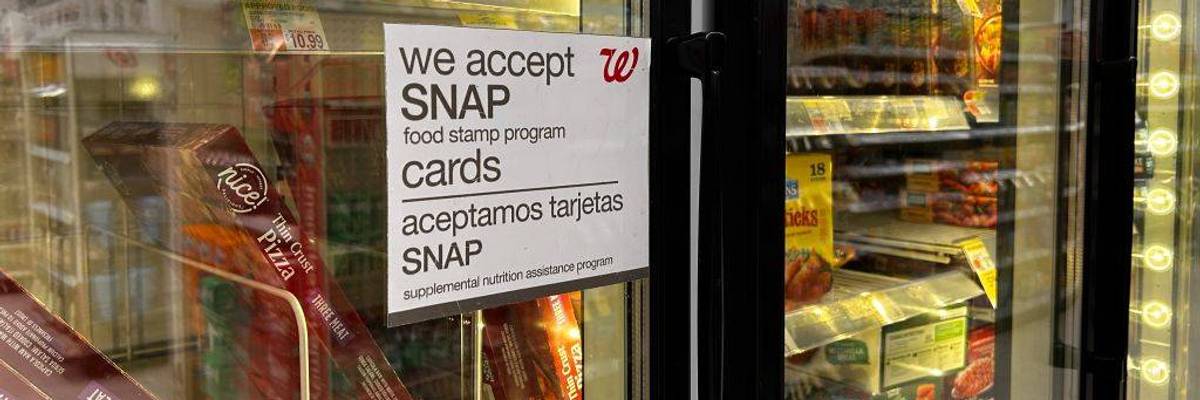
A bilingual sign on door of frozen food aisle says, “We accept SNAP food stamp cards,” at a Walgreens in Queens, New York.
(Photo by: Lindsey Nicholson/UCG/Universal Images Group via Getty Images)

Brad Reed
Apr 08, 2026
COMMON DREAMS

An analysis published Wednesday by the Center for Budget and Policy Priorities found that millions of low-income Americans have stopped participating in the Supplemental Nutrition Assistance Program ever since President Donald Trump signed the One Big Beautiful Bill Act into law last year.

According to CBPP’s analysis, SNAP participation declined by 6% between July 2025 and December 2025, with 2.5 million fewer Americans receiving benefits.

CBPP estimated that millions more will be dropped from SNAP benefits in the coming months as states adjust their budgets to remain in compliance with the law.

“Starting in 2027, most states will have to pay between 5% and 15% of SNAP benefit costs, totaling hundreds of millions of dollars a year in many states,” explained CBPP. “The magnitude of the cost shift... may incentivize states to take drastic measures to reduce their payment error rates quickly and cut program costs, even if it means delaying or improperly denying benefits to eligible people.”

In total, concluded CBPP, “we estimate that 4 million people in a typical month will lose out” on SNAP benefits “once the changes are fully implemented.”

CBPP published a separate analysis focusing specifically on Arizona, where SNAP participation has already fallen “far more than anticipated,” while warning that other states could soon see similarly steep participation drops as they rush to comply with the law.

The GOP budget law contained roughly $186 billion in cuts to SNAP over the span of a decade, which came from expanding work requirements, shifting some of the cost of the program to the states, and restricting benefit increases. As a result, millions of Americans became vulnerable to losing their benefits.

Leor Tal, campaign director at Unrig Our Economy, pointed to CBPP’s analysis as an example of the GOP waging class warfare on behalf of rich donors.

“SNAP is a lifeline for working Americans nationwide,” Tal said. “Now, that lifeline is being ripped away from millions because Republicans in Congress decided that giving tax breaks to billionaires and waging war are more important than protecting food for families. No family should have to worry about putting food on the table, but congressional Republicans have made sure that millions will.”
‘Shameful’: $4,049 of Average US Taxpayer’s Bill Last Year Went to War and Weaponry

“Our tax dollars are doing more to bomb children in Iran and other countries than to feed and educate children here.”


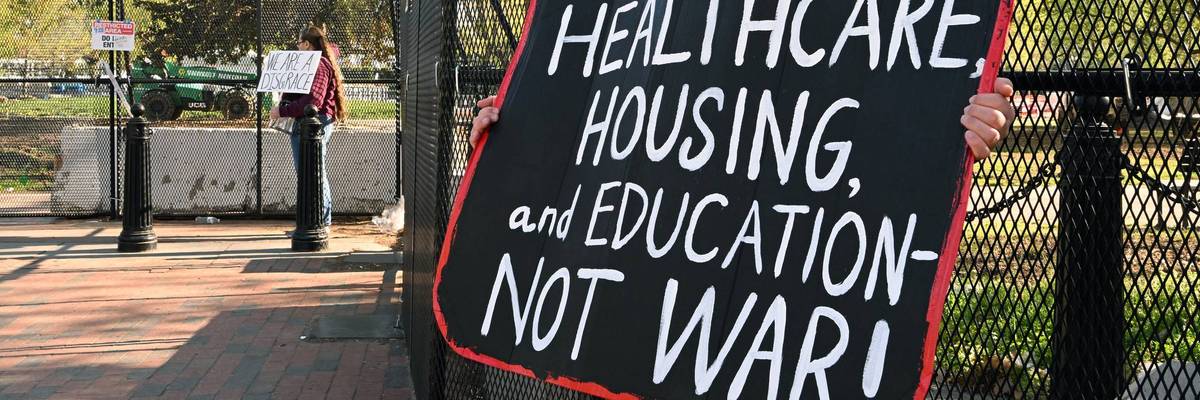
A demonstrator holds a placard in front of the White House in Washington, DC on April 7, 2026.
(Photo by Li Rui/Xinhua via Getty Images)

Jake Johnson
Apr 09, 2026
COMMON DREAMS


A new analysis released Thursday estimates that the average American taxpayer shelled out over $4,000 to the federal government last year “for militarism and its support systems” such as the Pentagon, whose already-massive annual budget is poised to surge to $1.5 trillion if President Donald Trump gets his way.

The National Priorities Project (NPP) at the Institute for Policy Studies found in its latest annual Tax Receipt report that, through their federal taxes, the average US taxpayer contributed $4,049.35 to Pentagon contractors, military personnel, nuclear weapons, aid to foreign militaries, and last year’s bombing of Iran’s nuclear energy facilities. That’s significantly more than the average US taxpayer contributed to healthcare for low-income Americans through Medicaid—$2,492.


NPP’s estimated militarism sum for last year does not include costs related to the current, massively unpopular US-Israeli war on Iran, which began on February 28, 2026 and has already cost Americans billions at the pump.

“But if we place the 2026 Iran war costs in the context of our 2025 tax receipt and put the cost at $35 billion—a line the US is likely on the verge of crossing—the average taxpayer will have paid $130 for the war on Iran, eight times more than the $16 the average taxpayer paid for a full year of home heating and energy assistance in 2025,” NPP said.

The $1,870 that the average US taxpayer paid toward Pentagon contractors in 2025 was “fifteen times as much as the $124 the average taxpayer paid for school lunches and other nutrition programs,” the analysis found.

“It’s shameful that our tax dollars are doing more to bomb children in Iran and other countries than to feed and educate children here,” said Lindsay Koshgarian, NPP’s program director. “Instead of spending even more of our hard-earned dollars on war and mass deportation, we deserve a massive reinvestment in making this country a place where we can all survive and thrive.”

“We’re facing chronic underinvestment in this country, from healthcare to education and more. That money has instead been funding a $1 trillion war machine and a class of Pentagon contractors getting rich off our tax dollars.”

NPP noted that Trump’s recent request for a $1.5 trillion US military budget for the coming fiscal year would, if approved by Congress, further drive up costs for American taxpayers.

“Our tax receipt shows why so many people in this country are struggling,” said Koshgarian. “We’re facing chronic underinvestment in this country, from healthcare to education and more. That money has instead been funding a $1 trillion war machine and a class of Pentagon contractors getting rich off our tax dollars. The good news is that if we reverse our backwards priorities, we can start to make Americans’ lives better.”

MarketWatch reported earlier this week that Americans are “increasingly saying they won’t pay their taxes this year as a political protest,” citing the illegal war on Iran and Trump’s unleashing of federal immigration agents and National Guard troops on US cities.

Activist and attorney Rachel Cohen wrote in Current Affairs magazine last month that she is not paying her federal income taxes this year, noting that “our enormous military budget is going to illegal wars of aggression in multiple hemispheres.”

“When I learned about pacifists who participated in draft refusal during the Vietnam War,” Cohen wrote, “I was confident they were doing the right thing, and that if I were similarly situated, I would have joined them.”


‘People Can’t Afford Rent,’ Critics Say as White House Boasts of Trump’s Plan for Gold-Covered Arch

“While Americans worry about skyrocketing costs and another endless war, President Trump is focused on a taxpayer-funded vanity project,” said Rep. Don Beyer.


A rendering of President Donald Trump’s proposed ‘Arch of Triumph’ in Washington, DC.
(Photo via Harrison Design / X)

Brad Reed
Apr 10, 2026
COMMON DREAMS

On the same day that the US Bureau of Labor Statistics showed that inflation spiked at its fastest monthly rate in four years, the Trump administration unveiled renderings of President Donald Trump’s proposed gold-covered 250-foot-tall arch to be built at Memorial Circle in Washington, DC.

The renderings, which were produced by architecture firm Harrison Design and posted on social media by the White House’s rapid response account, show a gigantic arch that would be flanked on its corners by four gold lions and topped by a 60-foot-tall gold statue of what appears to be an angel.

According to a Friday report in The Washington Post, some preservationists have expressed concerns that the arch, which would be more than twice the height of the Lincoln Monument, would disproportionately tower over the DC skyline, and would block views of Arlington National Cemetery.

Rep. Don Beyer (D-Va.) slammed the president for pushing construction of a gaudy gold-covered arch at a time when Americans are struggling due to the cost-of-living crisis worsened by his war in Iran.

“While Americans worry about skyrocketing costs and another endless war,” he wrote in a social media post, “President Trump is focused on a taxpayer-funded vanity project that would choke traffic, block our skyline, and tower over sacred ground where those who served our nation are buried, including my own parents and sister.”

Beyer added that the arch is “about Donald Trump’s ego,” and vowed, “we’re going to stop it.”


Rep. Katherine Clark (D-Mass.) responded to the renderings by reminding the White House that “Americans can’t afford groceries.”

Progressive activist Nina Turner had a similar reaction to Clark, posting that “people can’t afford rent” in response to the renderings.

Podcaster Brian Taylor Cohen contrasted the renderings of the arch with a statement Trump made earlier this month when he said “it’s not possible” for the federal government “to take care of daycare, Medicaid, Medicare, all these individual things,” because it needs to fund wars instead.

University of Missouri English professor Karen Piper also remarked on the opportunity cost of building the arch, along with other assorted Trump projects.

“This is why they’re going to take away your Social Security, saying we can’t afford it,” she wrote. “Ballrooms, arches, and Don Jr. draining the Treasury.”

California Gov. Gavin Newsom, who has been named as a contender for the Democratic Party’s 2028 presidential nomination, responded to the arch renderings by accusing Trump of “doing everything he can to wreck this country—this time with our nation’s capital.”

Rep. Jared Huffman (D-Calif.) took issue with the decision to inscribe the phrase “one nation under God” at the top of the arch.

“That phrase came from Cold War propaganda, not our Founders,” observed Huffman. “Trump stamping it on his vanity arch tells you everything about what this project is: a Christian nationalist monument, paid for with your tax dollars.”
US Supreme Court Is Poised to Gut Remaining Protections of the Voting Rights Act


The prohibition of racial discrimination in voting and the right to have absentee ballots counted are in grave peril.
PublishedApril 8, 2026

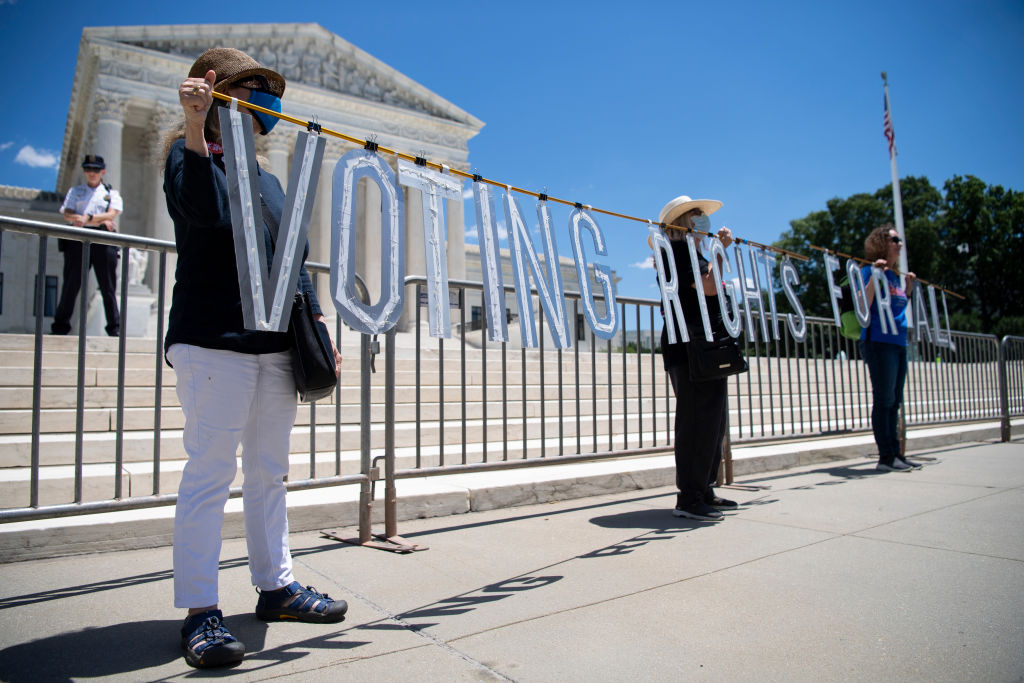
Demonstrators participate in the Moral March on Manchin and McConnell, a rally held by the Poor Peoples Campaign calling on them to eliminate the legislative filibuster and pass the "For The People" voting rights bill, outside the Supreme Court in Washington, D.C., on June 23, 2021.Caroline Brehman / CQ-Roll Call, Inc via Getty Images

The Supreme Court appears poised to deal a severe blow to the fundamental right to vote in two cases this term. Louisiana v. Callais threatens the right to vote free from racial discrimination and Watson v. Republican National Committee will test the right to have your absentee ballots counted.

On August 1, 2025, when the Supreme Court asked the parties in Callais to brief the issue of whether Section 2 of the Voting Rights Act (VRA) violates the 14th or 15th Amendment to the Constitution, alarm bells rang throughout the country.

By posing that question, the high court signaled its openness to striking down the remaining core of the VRA, which Congress enacted in 1965 to prevent racial discrimination in voting. Section 2 forbids the use of congressional maps that dilute the voting power of marginalized communities.

Section 2 was included in the VRA in order to enforce the 15th Amendment, which prohibits the government from denying or abridging the right to vote “on account of race, color, or previous condition of servitude.”

In Callais, a group of self-described “non-African American” voters claimed that the “intentional creation of a majority Black district” violated the Equal Protection Clause of the 14th Amendment.


The Supreme Court Asks Why It Shouldn’t Gut the Voting Rights Act
We may well see the elimination of the 11 Black-majority districts — all Democratic — in GOP-controlled Southern states. By Marjorie Cohn , Truthout August 29, 2025


During the oral argument on October 15, 2025, a majority of the Supreme Court appeared ready to side with the “non-African American” voters.

Moreover, at its March 23 argument in Watson, the court seemed inclined to overturn a Mississippi law that allows mail-in ballots to be counted if they are postmarked by, and received within five business days of, Election Day. Mail voting in Mississippi is limited to a few types of voters, including those with disabilities, the elderly, and people living away from home.

The Trump administration would like to prohibit mail-in ballots that aren’t received by Election Day. If the court holds that ballots must be received by Election Day, untold numbers of voters could be disenfranchised.

The “Crown Jewel of the Civil Rights Era” Is Gravely Imperiled

The Voting Rights Act — known as the “crown jewel of the civil rights era” — is in danger of being rendered null in Louisiana v. Callais.

Section 2 of the VRA prohibits any voting qualification or prerequisite to voting, or procedure or practice that “results in a denial or abridgment of the right of any citizen of the United States to vote on account of race.” That occurs when voters of color “have less opportunity than other members of the electorate to participate in the political process and to elect representatives of their choice.”

Since the Supreme Court struck down Section 5 of the VRA in 2013, Section 2 remains the only effective VRA remedy left to challenge racial discrimination in voting. Chief Justice John Roberts wrote the opinion in Shelby County v. Holder gutting Section 5, which had required federal preclearance before changes to election rules could go into effect in jurisdictions with a history of discriminatory voting practices.

But Roberts provided assurances in Shelby that Section 2 would still be available to protect voting rights. Now, the court is poised to obliterate Section 2 as well.

Congress amended Section 2 of the VRA in 1982 to provide that evidence of discriminatory intent is not necessary to prove racial discrimination; even policies that appear neutral can have a discriminatory effect (legally referred to as disparate impact) on a particular group.

The 14th Amendment’s Equal Protection Clause forbids the government from treating people differently on account of race. In the 1990s, the Supreme Court held that the government cannot use race as a predominant factor when it draws election districts unless it satisfies strict scrutiny by proving it is necessary to achieve a compelling governmental interest.

In Callais, a coalition of civil rights groups and Black voters wanted to reinstate a map that the state legislature had adopted in 2024. The map established a second majority-Black congressional district and was drawn in response to a 2022 U.S. district court ruling that a map drawn in 2020 likely violated Section 2 of the VRA.

The 2020 map included only one majority-Black district out of the state’s six congressional districts. The coalition argued that the 2020 map diluted the votes of Black residents, who comprise about one-third of Louisiana’s population.

The Fifth Circuit Court of Appeals affirmed the district court ruling that the 2020 map likely violated Section 2, and the appellate court ordered Louisiana to adopt a new map by January 15, 2024. The Louisiana Legislature then drew a map with a second majority-Black district.

In response, the “non-African American” voters challenged the 2024 map, claiming it was unconstitutional because it separated voters based primarily on race.

The Supreme Court didn’t decide the case after hearing oral arguments last term. Instead, it ordered a second round of arguments, which took place on October 15, 2025. At that proceeding, a majority of the court exhibited a willingness to eviscerate Section 2.

They may well determine that Section 2 of the VRA and the Equal Protection Clause are “in tension,” as Clarence Thomas suggested in his dissent to the ruling that held the case over to this term.

If the court adopts Thomas’s position, it would amount to a finding that disparate-impact liability under the VRA’s Section 2 is unconstitutional. That could make it harder to prove liability for violations of federal housing and employment discrimination laws, Berkeley Law School Dean Erwin Chemerinsky warned on SCOTUSblog: “Ending disparate-impact liability would be an enormous change in the law and a devastating blow to civil rights in the United States. That is why Louisiana v. Callais is potentially so important.”


Absentee Ballots Cast by Election Day Should Be Counted

The other major voting rights case on the Supreme Court’s docket presents a challenge to a Mississippi law governing the timing of mail-in ballots. In addition to Mississippi, at least 18 states and territories have laws that allow the counting of mail-in ballots postmarked by Election Day but received later. Twenty-nine states allow overseas and military ballots to be tallied if received after Election Day.

In Watson, the Republican Party of Mississippi and the Republican National Committee are challenging the Mississippi law. They argue that the state law conflicts with an 1845 federal law that established the Tuesday after the first Monday in November as “Election Day.”

A three-judge panel of the Fifth Circuit Court of Appeals agreed with the challengers that all ballots must be received by Election Day. The full appellate court affirmed that decision and the state of Mississippi appealed to the Supreme Court.

In its brief asking the high court to review the case, Mississippi officials argued that the appeals court ruling, “if left to stand — will have destabilizing nationwide ramifications” and it “would require scrapping election laws in most states.”

The Supreme Court agreed to hear the case. At oral argument, the right-wing supermajority of the court appeared to agree with the challenge to the Mississippi law. If the law is struck down, it could impact the upcoming midterm elections.

Donald Trump has long opposed mail-in voting, falsely claiming that it results in fraud and contributed to the outcome of the 2020 presidential election.

“Mail-in voting means mail-in cheating,” Trump declared during a recent appearance in Memphis, Tennessee. “I call it mail-in cheating, and we got to do something about it all.” When asked about his vote by mail in a special election in Florida, he said: “I’m president” and “I had a lot of different things” to do. Meanwhile, Trump is trying to prevent Americans from casting absentee ballots.

The high court will issue rulings in Louisiana v. Callais and Watson v. RNC by the end of June or early July. As we await their decisions, the right to vote is on the line.


This article is licensed under Creative Commons (CC BY-NC-ND 4.0), and you are free to share and republish under the terms of the license.


Marjorie Cohn
Marjorie Cohn is professor emerita at Thomas Jefferson School of Law, dean of the People’s Academy of International Law and past president of the National Lawyers Guild. She sits on the national advisory boards of Veterans For Peace and Assange Defense, and is a member of the bureau of the International Association of Democratic Lawyers and the U.S. representative to the continental advisory council of the Association of American Jurists. Her books include Drones and Targeted Killing: Legal, Moral, and Geopolitical Issues.

US-Israeli War on Iran Is Intensifying All of Global Capitalism’s Problems

This war is widening the deep systemic problems that were already present before February 28, says scholar Adam Hanieh.

By Ashley Smith , TruthoutPublishedApril 9, 2026

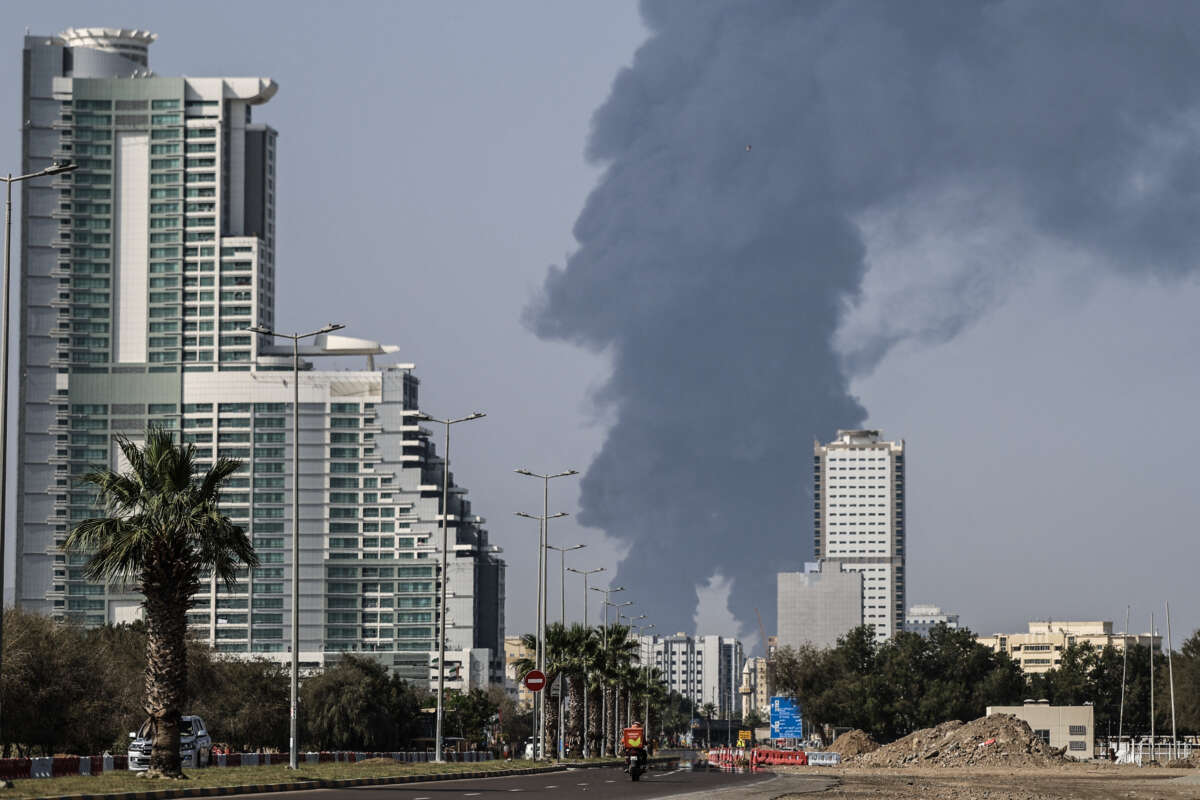
Smoke rises from the direction of an energy installation in Fujairah, United Arab Emirates, on March 14, 2026.AFP via Getty Images

On February 28, the U.S. and Israel expanded their joint genocidal war on Gaza onto Iran as well as Lebanon. After weeks of assassinations and bombing, President Donald Trump agreed to a ceasefire on April 7. This war of aggression by the U.S. and Israel is part of a continued attempt to wipe out any and all opposition to their dominance over the Middle East and its strategic energy reserves.

But they underestimated the capacity of the Iranian state. In addition to launching missile and drone attacks throughout the region, Iran blockaded the Strait of Hormuz, disrupting the production and shipment not only of fossil fuels but also an array of other commodities vital to global capitalism. With fossil fuel prices spiking and stocks crashing, Trump called off his threat to wipe out Iranian civilization and agreed to a ceasefire with Iran.

But Israel has already violated it, Iran has re-closed the Strait of Hormuz, and the ceasefire seems in jeopardy on the eve of negotiations for a settlement of the conflict in Pakistan. As a result, the world stands at the precipice of a multidimensional economic crisis.

In this interview for Truthout, Adam Hanieh discusses the U.S. and Israel’s imperialist goals, the war’s impact on the economies of the Global North and Global South, and its consequences for the geopolitical order as well as class and social struggles in the region and around the world. Hanieh is a professor in development studies and director of the SOAS Middle East Institute, University of London. He is author of Crude Capitalism: Oil, Corporate Power, and the Making of the World Market. This interview was conducted before the ceasefire and has been edited for clarity and length.

Ashley Smith: Clearly this war has been a disaster for the people of Iran. But the Iranian state has launched an asymmetric counteroffensive, targeted countries throughout the region, and shut down the Strait of Hormuz, and thereby disrupted the world economy. Why did the U.S. and Israel launch this war to begin with? What are the two states’ different war aims? How do they diverge? As the war has clearly backfired, what will they do to salvage it?

Adam Hanieh: The war needs to be placed in the wider context of a weakening of American power and a global environment marked by a range of deep political, economic, and ecological crises. Under Trump, Washington has been trying to reassert its global strength through a mix of military coercion, sanctions, tariff threats, and pressure on weaker states. In that sense, this war is not an aberration but part of a broader attempt to demonstrate that the U.S. can still dictate terms in strategically vital regions.


“Any divergence between Israel and the U.S. is more a matter of emphasis than overall strategic goals.”

The Middle East remains absolutely central here because of its importance to energy and other commodity flows, as well as its substantial financial surpluses that are reinvested globally. In 2025, nearly 15 million barrels per day of crude passed through Hormuz, about one-third of global crude trade. Most of these go eastward to China, India, and East Asia. This helps explain why Washington sees the region as a potential lever over rivals.

I don’t think there are major differences in U.S. and Israeli war aims. Both wanted to break Iran’s regional capacity, degrade its military infrastructure, and weaken the network of the various organizations aligned with Tehran across the Middle East. Lebanon is crucial in this respect, because Hezbollah has long fought against Israeli aggression — in this regard, Israel’s horrific onslaught in Lebanon has not received the attention it deserves in most media coverage.

I think any divergence between Israel and the U.S. is more a matter of emphasis than overall strategic goals. Israel tends to want a more thorough remaking of the regional balance in its favor, while the U.S. needs to consider the wider system of alliances it has built up over the decades. But the overlap is far greater than the difference.

The U.S. clearly underestimated Iran’s ability to respond asymmetrically, especially around the Strait of Hormuz. As such, Iran has not needed to “win” conventionally — by disrupting shipping, targeting energy infrastructure, and widening the field of conflict, it has shown that it can impose enormous costs on the world economy. It’s obviously very difficult to predict what the endgame will be.


“Israel’s use of mass displacement and collective punishment are now completely normalized in the eyes of the world.”

I do not think either the U.S. or Israel can easily get the clean victory they wanted, but neither can they afford to admit defeat. So perhaps the most likely outcome is a coerced and highly unstable arrangement that involves some partial reopening of Hormuz, some claim that Iran’s military capacities have been significantly degraded, and continued pressure on Iran’s regional allies, especially in Lebanon.

Israel, with the implicit greenlight from the U.S., has also launched a war on Lebanon, continued its genocide in Gaza, and escalated settlement in the West Bank. What are its aims here? What will this dimension of the war mean for the Lebanese, Palestinians, and the rest of the peoples of the region?

Away from media scrutiny, the Israeli military continues its blockade, destruction, and killing in Gaza. In the West Bank, we have seen a massive acceleration in settlement and settler violence against the Palestinian population. In Lebanon, Israel is trying to break Hezbollah and at the same time create a depopulated buffer zone in the south through bombardment, displacement, and reoccupation.

The human cost in Lebanon has been enormous, with more than a million people displaced. To put this in perspective for a U.S. audience, this is proportionally equivalent to more than the entire populations of California and Texas combined. What this really demonstrates is the ways in which Israel’s use of mass displacement and collective punishment are now completely normalized in the eyes of the world.

This war has cut off oil and natural gas supplies to the world and is dramatically impacting countries throughout the world. But too many people accept a stereotyped view of the region as just a source of fossil fuels. How have the economies of the region transformed themselves over the last few decades? How has that changed their role not only in the region, but in global capitalism?

Too many people still imagine the region, especially the Gulf countries, as simply giant oil spigots. What this misses is that the Gulf economies have fundamentally transformed over the past decade or so. They are now much more than simply producers of crude oil — they are major players in commodities (e.g. chemicals, fertilizers, and aluminium), maritime and air transport, and global finance. This is important because many of the basic inputs into global manufacturing and trade now originate in the Gulf, and what happens in the Gulf can quickly cascade through global supply chains.

One clear example is fertilizer. The Gulf produces roughly a third of global ammonia and urea, and this is crucial to food systems far beyond the region. The Middle East also accounted for more than 40 percent of global polyethylene exports last year, which is a massively important basic plastic and is why the conflict has sent shockwaves through manufacturing as well as energy markets. So, while the region is still indispensable to global energy flows, it is also deeply embedded in industrial production and the movement of goods across Asia, Africa, and Europe.

A further part of this transformation lies in the Gulf’s role within global finance. Over the last few decades, the region’s large and persistent current account surpluses have generated enormous pools of capital, much of it channeled through sovereign wealth funds, central banks, and other state-linked investment vehicles. These funds are deeply embedded in international equity markets, real estate, infrastructure, private equity, technology, and debt markets, and they have become increasingly important sources of liquidity and investment at a global scale.

These financial flows have a longer history in relation to American power. Since the 1970s, Gulf oil surpluses have played a significant role in U.S.-centered finance through what is described as petrodollar recycling: the channeling of oil revenues into dollar assets, Western banks, and U.S. financial markets. This recirculation of the Gulf’s financial surpluses helped sustain both the dollar’s international role and the wider architecture of U.S. financial power. This relationship is another reason why the Middle East is such a vital region to global capitalism.

Given all that, how will the war impact the world economy? What key industries will be impacted? How will it affect global finance and the world’s main stock markets? Where is global capitalism headed as a result?

The war is already having a major economic impact through the closure of Hormuz and damage to related energy and logistical infrastructure. This can be seen in higher oil and gas prices that are likely to persist throughout the year. Countries such as India are already increasing coal-fired power generation in anticipation of gas shortages. And of course, energy shocks feed through into the cost of transport, food, and everyday consumer prices, pushing inflation higher across the globe.


“The war has deepened an already existing turn toward more militarized states and zero-sum economic and political competition.”

There is also a substantial risk of shortages and price increases to fertilizers, chemicals, and other Gulf-produced commodities. Poorer countries are especially vulnerable here, because they have less fiscal capacity and many states in the Global South are already suffering from high levels of debt. One way this vulnerability might appear is in agriculture and food supplies. India’s domestic fertilizer industry, for instance, depends on the Gulf for nearly 80 percent of its ammonia imports; prolonged disruption of these supplies combined with higher energy costs could really impact food security in the country.

We also need to consider what a deep downturn in the Gulf might mean for the region’s migrant workforce. Migrant workers make up around half of the labor force across each of the Gulf monarchies, and millions of households in South Asia, the Middle East, and beyond depend on the remittances they send home. In an extended crisis, these workers may lose jobs, face deportation, or simply find themselves unable to keep sending money home at previous levels. A sharp fall in remittance flows would have serious effects on surrounding countries. This is exactly what happened during the 2008 global financial crisis and again during the COVID-19 pandemic. In that sense, migrant labor is one of the key channels through which crisis in the Gulf is transmitted outward to the wider global economy.

The overarching point is that this war is widening the deep systemic problems that were already present before February 28. Long before this war, global capitalism was marked by weak growth, mounting public and private debt, and overcapacity in many sectors. The war is intensifying all of these problems and pushing an already unstable system toward a much more serious breakdown. I think the possibility of a crash on the scale of 2008 or worse is very real if the war continues.

The war has undoubtedly impacted geopolitics. Already, Trump has lowered sanctions on Russian fossil fuels, enabling Russia to sustain its economy amid its imperialist war on Ukraine. What will the war mean for other great powers like China? What will this war mean for other states and their strategies and policies?

Russia has benefited directly from higher oil prices and the temporary waiving of some constraints on oil exports. That helps Moscow sustain export revenues and, by extension, its war in Ukraine. China faces a more contradictory position. On the other hand, the country has been systematically building up its oil reserves for a number of years, and its more diverse energy mix helps to insulate it from any immediate supply shock.


“Prior to the war, many countries in the Global South were already facing what is widely acknowledged as the worst debt crisis in history.”

It is noteworthy that foreign capital has been flowing into Chinese stocks and bonds over the last couple of weeks, which indicates that investors appear to view China as a relative “safe haven” at this moment. But if the war continues for a lengthy period of time, China will face difficulties because of its heavy reliance on Middle Eastern oil and gas. Chinese independent refiners are already cutting output as the prices of sanctioned Russian and Iranian crude rise and margins are squeezed.

More generally, the war has deepened an already existing turn toward more militarized states and zero-sum economic and political competition. This is because the war intersects with the wider systemic crises that I mentioned earlier, and which are forcing all states to find ways to manage and navigate global instability. This means expanding military spending, stockpiling energy and food, border securitization, and framing the control of raw materials and industrial capacity as matters of national security.

The other likely consequence is a renewed doubling down on fossil fuel production. Faced with supply disruption and price volatility, governments will move to lock themselves more deeply into existing hydrocarbon dependence. This means more oil and gas deals, the expansion of liquefied natural gas infrastructure, subsidies to domestic hydrocarbon production, and the rolling back of environmental regulations. Obviously, this just deepens the likelihood of future wars in the Middle East and elsewhere and worsens the accelerating climate emergency.

Finally, how will this war impact the people of the region, the Global South, and the Global North? How might it shape class and social struggles that have swept the world in the last couple of decades? How will ruling classes and especially the new authoritarian right in various countries likely respond?

As with all major crises, the impacts will be experienced very unequally. The most immediate and catastrophic costs are being felt in Iran and Lebanon through loss of life, displacement, destroyed infrastructure, and the massive ecological consequences of the war. For the wider Global South, the war is likely to mean higher food prices, higher transport costs, depressed trade, and worsening debt pressures.


“The key question is whether popular anger can be turned against the system that produced this crisis, rather than channeled into a politics of national chauvinism and fear.”

We need to remember that prior to the war, many countries in the Global South were already facing what is widely acknowledged as the worst debt crisis in history. In the Global North, the effects will be different but still severe. We are already seeing a renewed cost-of-living squeeze and expectations of much higher inflation over the coming year.

All of this will sharpen social antagonisms and may well open the way to renewed potential of mass protest. We should remember that the last two years have already produced a profound political radicalization among millions of people across the world, above all around the horrors of the genocide in Gaza. For many, Gaza has stripped away any lingering illusions about the existing order. It has brought into sharp relief the realities of a system that offers only war, obscene levels of inequality, climate collapse, and permanent insecurity.

Of course, this does not automatically translate into progressive politics. Crises of this kind can generate solidarity and new forms of internationalism, but they can also be seized upon by ruling classes and the authoritarian right. The danger is that a crisis produced by imperial war is re-coded as a justification for greater repression and renewed militarism. We can see this in the rush to frame the war in the language of national security. So, the key question is whether popular anger can be turned against the system that produced this crisis, rather than channeled into a politics of national chauvinism and fear.

This article is licensed under Creative Commons (CC BY-NC-ND 4.0), and you are free to share and republish under the terms of the license.

Ashley Smith


Ashley Smith is a socialist writer and activist in Burlington, Vermont. He has written in numerous publications including Truthout, The International Socialist Review, Socialist Worker, ZNet, Jacobin, New Politics, and many other online and print publications. He is currently working on a book for Haymarket Books entitled Socialism and Anti-Imperialism.
CDC Head Blocks Release of Findings Showing Strong COVID Vax Effectiveness


The report detailed how adults receiving COVID-19 vaccines saw hospitalization rates drop by 55 percent.
April 10, 2026

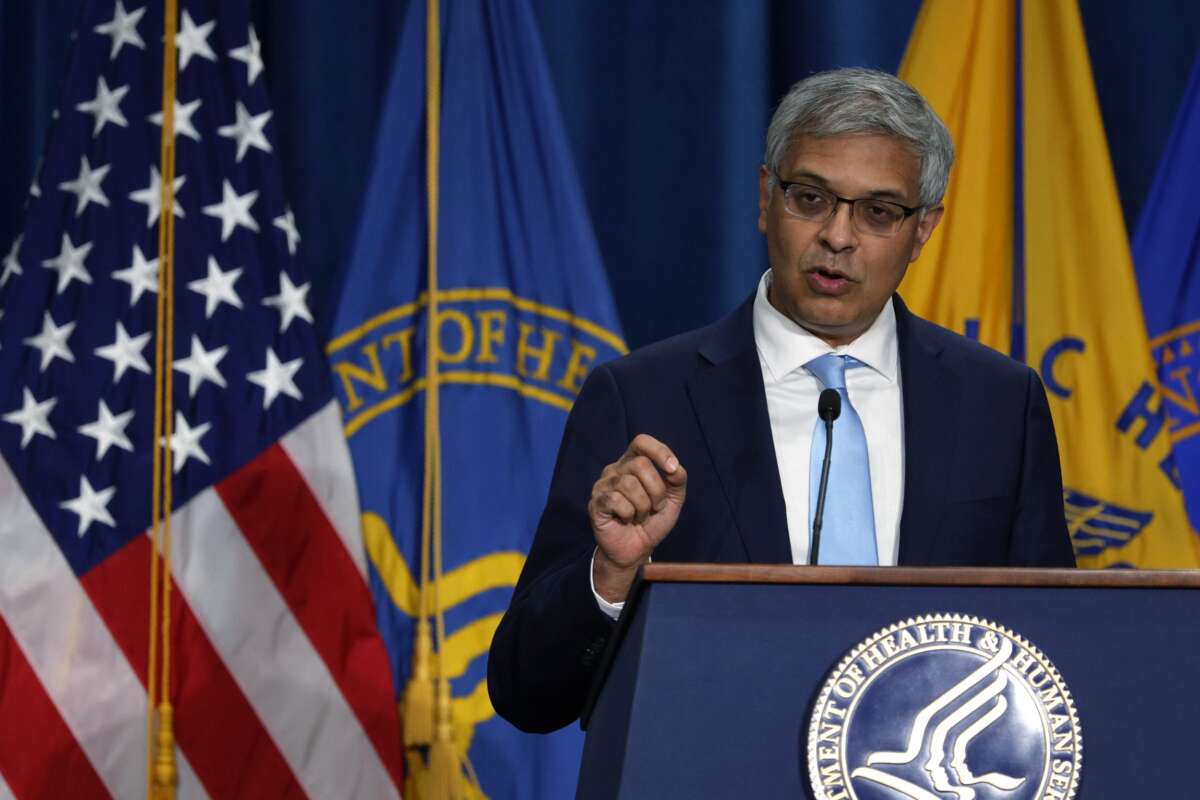
National Institutes of Health Director Jay Bhattacharya speaking on December 18, 2025 in Washington, DC.Alex Wong / Getty Images

Acting Centers for Disease Control and Prevention (CDC) Director Jay Bhattacharya, who also leads the National Institutes of Health (NIH), is reportedly delaying the publication of new findings within the health agency showcasing the strong effectiveness of COVID-19 vaccines to prevent emergency room visits and hospitalizations.

According to a report from The Washington Post, which cites two scientists with knowledge of Bhattacharya’s actions, the unpublished report examined adults who had been vaccinated between the months of September and December last year, and compared their health results to adults who didn’t get vaccinated. Among those who received vaccinations, ER and urgent care visits dropped by 50 percent, while hospitalizations overall saw a 55 percent decline.

The report has cleared the CDC’s scientific-review process, but Bhattacharya is blocking its publication over supposed concerns over its methodology, the scientists said, demanding further scrutiny. However, the report used methods that are regularly utilized by the national health agency, and a report on flu vaccines, using the same methodology as this blocked report, was published just last week.

The revelation of the delay of the report and the questionable rationale for delaying its release is raising concerns among members of the scientific community that the agency is shaping its policy due to the anti-vaccine attitudes of Bhattacharya and Department of Health and Human Services Secretary Robert F. Kennedy Jr.

Bhattacharya was picked by President Donald Trump to lead NIH last fall, a move that many public health advocates described as deeply alarming. Walker Bragman, a public health journalist, went so far as to describe Bhattacharya as Trump’s “most extreme pick” for his administration overall. He was named as acting CDC director in February due to a vacancy in that position.


FDA Announces COVID Vaccine Deaths Inquiry, Despite Evidence Showing Safety
The inquiry was spearheaded by FDA official Vinay Prasad, an anti-vaxxer who has cited little evidence for his claims. By Chris Walker , Truthout December 10, 2025


During the pandemic, Bhattacharya expressed skepticism of stay-at-home orders, worrying about the psychological effects that they would bring. Instead, before vaccines became available, he promoted so-called “natural” herd immunity, which calls for people to go about their lives as usual, with the hopes that their purposely getting infected leads to them developing their own immunity to the virus.

Such a method, if it had been carried out, would have inevitably led to more cases, hospitalizations, and ultimately deaths during the COVID crisis.

Reacting to The Washington Post report, several critics expressed concern that Bhattacharya and Kennedy were allowing their noted anti-vaccine beliefs to dictate policy rather than evidence-based studies.

“MORE evidence COVID vaccines hugely beneficial. MORE lies & spin by RFK Jr et al.,” said Timothy Caulfield, health law professor at the University of Alberta, writing on Bluesky.

“This is a clear example of putting politics over science at the cost of lives,” said science communicator and public health advocate Lucky Tran.

“This is definitely an escalation of this administration’s undermining of CDC science,” said Fiona Havers, a former adviser on vaccines at the CDC. “The fact that they are now blocking this is extremely concerning.”
Trump 'craters' a major alliance as leader now urged not to trust the US


'All doors have shut' for Trump as Europe’s rejection leaves him 'isolated and enraged'


April 10, 2026
ALTERNET

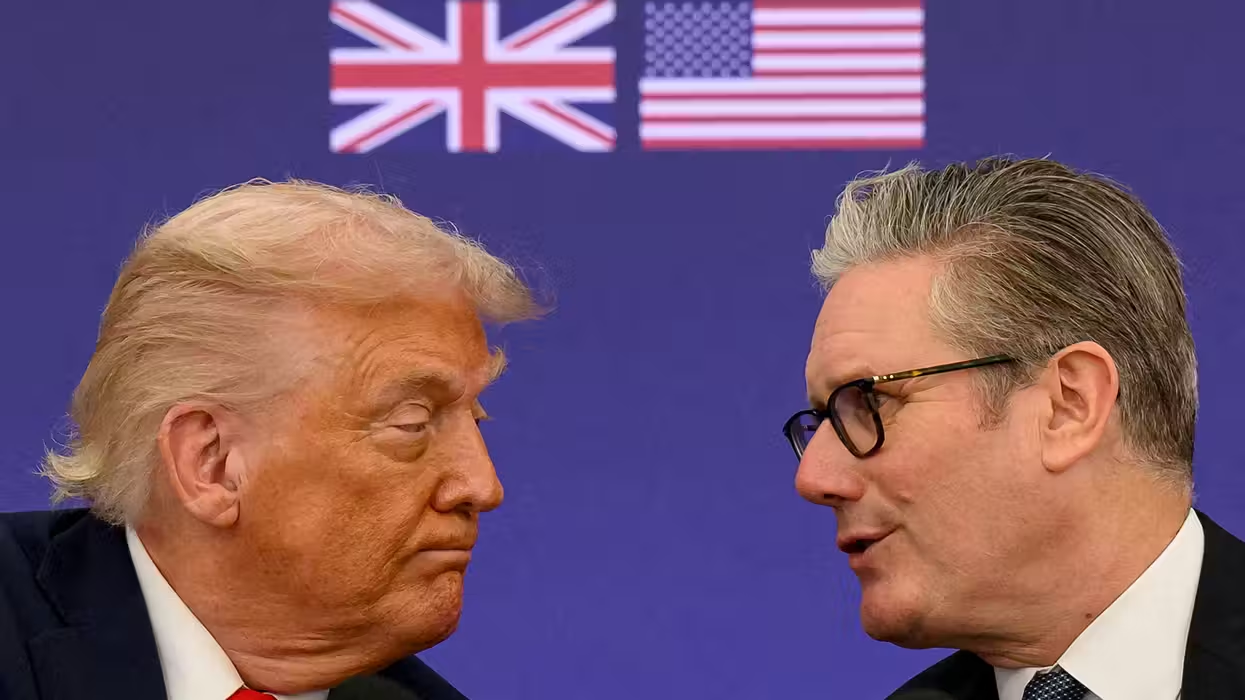
President Donald Trump's conduct has reportedly "cratered" one the most important U.S. alliances, according to the New York Times, with advisors urging "fed up" U.K. Prime Minister Keir Starmer to ditch the "special relationship" between the two countries.

In a report released on Friday, the Times said that Starmer is "looking to diversify his friend group" as Trump makes the U.S. "into an increasingly grumpy and unreliable partner for Britain." This was evident in a Thursday trip to Saudi Arabia, where he pledged "to show that we stand with our allies" in the Gulf states, only interacting with Trump near the end of the trip.

"That was no accident," Michael D. Shear, the lead U.K. correspondent for the Times, wrote. "Mr. Starmer’s new approach, which follows almost a year in which he repeatedly tried to cozy up to Mr. Trump, is part of a broader strategy to move Britain closer to partners in Europe, the Middle East and elsewhere as the relationship with the United States sours."


Despite his efforts to be "chummy" with Trump, the U.S. president has engaged in "repeated taunts and mockery" towards the U.K. This has led Starmer to alter his approach, taking a firmer stance against Trump and refusing to get involved in the Iran conflict

"I'm fed up," Starmer said in a Thursday interview, making a rare reference to Trump by name when he blamed spikes in energy costs for U.K. residents on "the actions of Putin or Trump across the world.”


In the same interview, Starmer reserved particular outrage for Trump's widely condemned Easter weekend Truth Social post threatening to wipe Iran's "whole civilization" if peace terms were not accepted soon.

“Let me be really clear about this,” the prime minister said, “They are not words I would use — ever use — because I come at this with our British values and principles.”

Peter Ricketts, "a veteran British diplomat who served as the country’s first national security adviser," also weighed in on the fraying "special relationship" this week, encouraging Starmer to outright abandon reliance on the U.S. and expand relations with Europe.


“We do have to rethink the idea that the U.S. is a reliable, trustworthy ally on which we can depend in the longer term,” Ricketts told BBC Radio. “We’ve got to get closer to the Europeans. We’ve got to work out how we live in a world where American interest has moved away from Europe.”