Tuesday, April 14, 2026

Uzbekistan

Amir Temur’s legacy re-examined as scholars highlight a 'Second Renaissance'

International conference on the heritage of Amir Temur
Copyright Islamic Civilization Center in Uzbekistan

Tamerlane by any other name
Timur - Wikipedia
Timur[b] (1320s – 17/18 February 1405), also known as Tamerlane,[c] was a Turco-Mongol conqueror, first ruler of the Timurid dynasty, and the founder of the Timurid Empire, which ruled over modern-day AfghanistanIran, and Central Asia. He was undefeated in battle and is widely regarded as one of the greatest military leaders and tacticians in history, as well as one of the most brutal and deadly.[9][10][11] Timur is also considered a great patron of the arts, for he interacted with scholars and poets such as ibn KhaldunHafez, and Hafiz-i Abru. His reign led to the Timurid Renaissance.[12]


By Dilbar Primova
Published on 

New academic research highlights the Timurid era as a structured system of scientific and cultural development. An international conference brought together global experts to reassess primary sources and expand cooperation on historical research and preservation.

International scholars are re-examining the legacy of Amir Temur, as new research shifts attention beyond military history to the scientific, cultural and institutional achievements of the Timurid era.

These debates were central to an international scientific conference titled “The Role and Significance of Amir Temur and the Timurid Civilization in World History and Culture,” held at the Islamic Civilization Center in Tashkent, marking the 690th anniversary of Temur's birth.

The event brought together more than 300 participants from over 20 countries, including historians, archaeologists and representatives of international institutions such as the Islamic World Educational, Scientific and Cultural Organization (ICESCO), the Oxford Center for Islamic Studies, the Research Centre for Islamic History, Art and Culture (IRCICA) and the Al-Furqan Foundation.

Discussions focused on governance, diplomacy, science, education and cultural development during the Timurid period, as well as its broader impact on world history.

Reframing the Timurid era

Current scholarship increasingly interprets the 14th and 15th centuries as a period of intellectual transformation, often described as a “Second Renaissance.”

Historians point to the emergence of scientific institutions, structured education systems and sustained cultural development across the Islamic world.

Uzbekistan President Shavkat Mirziyoyev visited the State Museum of the History of the Timurids Press Service of Uzbekistan's President

President Shavkat Mirziyoyev, in a formal message to participants, described the Timurid Renaissance as “one of the most remarkable periods” in the country’s history and called for deeper academic research and international cooperation. A central focus of current research is the reassessment of historical narratives and primary sources related to the Timurid era.

Scientific legacy beyond military history

Director of the Al-Furqan Islamic Heritage Foundation, Sali Shahsavari, said public understanding often overlooks the scientific dimension of the Timurid era.

“Amir Temur is known widely as a military leader, as a political leader, but very few people know the legacy that he left in the so-called Timurid era in terms of scientific development,” he said.

“We are talking about a whole reign and a whole period of scientific excellence and scientific development.”

According to Shahsavari, the Timurid period represented not only political authority but also a structured system of knowledge production that influenced scientific progress for centuries.

Historians describe the period as one of major advances in astronomy, mathematics, geography and medicine. Scholars highlight the emergence of madrassas and organised research systems that supported long-term intellectual development and the transmission of knowledge across generations.

Cultural and architectural impact

Cengiz Tomar, Deputy Director of the Research Center for Islamic History, Art and Culture (IRCICA), noted that the legacy of the period remains visible today through architecture and cultural identity.

“When we see Timurid architecture, we understand that this is a building from the Timurid period,” he explained. “

“Like Ottoman or Seljuk architecture, Timurid architecture also has its own special place in civilization.”

Historian Hilola Nazirova, a Doctor of Historical Sciences and specialist in source studies, said her research challenges long-standing interpretations of Amir Temur.

“Usually, we know Amir Temur as a conqueror, and Sharafiddin Ali Yazdi’s Zafarnama was interpreted only in a one-sided way,” she said.

Her research with Khorezmian sources and translation traditions, including Ravzat as-Safa and Turkish historical texts, uncovered a nuanced historical reality. She argues that depictions of Amir Temur as purely destructive are shaped mainly by biased historiography, and urges scholars to consult primary sources, emphasizing that the challenge lies not in a lack of sources, but their overwhelming abundance.

TURKSOY Secretary General Sultan Raev described the Timurid era as a foundational period for state-building, culture, and civilization

“He built buildings that we now proudly call Samarkand and Bukhara. It all began during the time of Amir Temur,” he said. “The legacy of Temur teaches us to love our land.”

Bedar Shayesta, Director of the Khuda Bakhsh Oriental Library, pointed to the wide scope of Timurid contributions.

“The contribution of the Timurids, especially in the field of art, culture, religion, Sufism, architecture, literature and language, poetry and philosophy, logic, as well as in the pure sciences,” she said.

Special exhibition dedicated to the legacy of Amir Temur Euronews

Also, she emphasized the long-standing historical connections between India and Uzbekistan and called for expanded academic cooperation. “There is a great connection, a strong connection between India and Uzbekistan.”

“Our institute holds one of the world’s largest collections of manuscripts on Eastern languages,” Irina Popova highlighted the importance of manuscript preservation and collaboration.

She described these collections as shared cultural resources that continue to be studied by international researchers.

From research to implementation

Following the conference, participants outlined initiatives to expand international research, strengthen academic cooperation and improve the preservation of manuscripts and cultural heritage.

Theatrical production "Wedding in Conigil". Euronews

These efforts aim to support a more systematic and globally coordinated study of the Timurid era.


Energy prices set to rise as last Gulf Tankers reach Europe, analysts say

Ships sit anchored off Dubai, United Arab Emirates, Friday, May 19, 2023.
Copyright AP Photo / Jon Gambrell

By Marta Pacheco
Published on 

Energy analysts have warned of surging energy prices beyond already elevated levels, as the last vessels carrying oil and natural gas from the Strait of Hormuz before the conflict have reached Europe. Supply forecasts for oil and gas remain optimistic as US deliveries are expected.

Europe should prepare for a renewed surge in energy prices, as the last oil and LNG tankers to depart the Strait of Hormuz before the Middle East conflict have now reached their destinations, analysts warned.

EU countries have been relying on emergency oil reserves released by the International Energy Agency on 11 March, after losing supply to Asian buyers willing to pay more for the last cargoes leaving the Strait of Hormuz. The Strait is a critical waterway that accounted for roughly one-fifth of the world's oil and LNG transit before the Middle East conflict.

The warning from analysts comes as the European Commission is set to present next week a range of measures to support citizens and industries in coping with soaring energy prices.

At the same time, the IEA's chief, Fatih Birol, has warned that the "largest energy security crisis in history" was a consequence of the vital waterway's closure, following US and Israeli military attacks against Iran on February 28.

"Europe’s gas and electricity price rises have been modest so far, but we should not expect that to continue if the strait remains closed," Elisabetta Cornago and John Springford wrote for the Centre for European Reform think tank.

Brent crude, the global benchmark for oil prices, rose to $102.02 a barrel before falling back to $98 during US afternoon trading on Monday. Natural gas, under the leading European gas benchmark, is trading at around €45/MWh, down from €74/MWh, the highest since the conflict started.

Jorge León, head of geopolitical analysis at the Norwegian consultancy Rystad Energy, explained that Europe's biggest challenge was its heavy reliance on international oil and natural gas prices: “Even receiving small quantities from the Gulf, the competitiveness of its industry is at risk.”

LNG 'remains healthy'

Despite rising prices and higher restocking needs, analysts say that natural gas pipeline supply in Europe "remains healthy" and LNG send-out is currently at levels seen in 2025.

"From an LNG perspective, even though the global LNG market has tightened significantly, we don't believe Europe is at risk of supply shortages," Ronald Pinto, LNG analyst at the global trade intelligence firm Kpler, told Euronews.

"We believe Europe will be able to import enough LNG to start next winter with sufficient gas in storage; of course, at a much higher price than previously anticipated," Pinto added.

Since the beginning of the Iran war, 277 LNG vessels have arrived in Europe, including the UK and Turkey, according to data from Kpler.

In the European Union alone, the figure reached 228 vessels, a sharp increase compared with the 150 vessels crossing the Strait daily before the war.

The last LNG tanker from Qatar arrived in Europe (UK) on 10 April.

Stranded oil and US oil

In the meantime, at least 150 laden oil tankers have been trapped in the Gulf Coast since the closure of the Strait of Hormuz.

In the most optimistic scenario, before this oil reaches countries and refineries, analysts estimate that vessels need to exit the Gulf area, sail for about 30 days, unload, return, and reload — creating a minimum 90-day delay before normal flows resume.

Since the Strait of Hormuz blockade, 21 tankers have arrived in Europe, Kpler said.

Analysts also expect "a lot of oil load for Europe" from the 68 empty tankers arriving in the US to ship it through the world, as announced by US President Donald Trump on 11 April.

"I think realistically they should arrive by 10 May approximately," Homayoun Falakshashi, energy analyst at Kpler, told Euronews.

'More defined transit' in the Strait of Hormuz

Analysts are seeing a trend gaining shape that could bring more predictability to global energy markets.

The latest insights from Kpler indicate that "a more defined transit framework is emerging" in the Strait of Hormuz amid increased uncertainty following the US's threat to block the critical energy chokepoint.

The Iranian Larak Island, located off the coast of Bandar Abbas, serves as both the administrative and enforcement centre, with vessels required to submit full details, including documentation, before being cleared to cross the Strait, Kpler said, confirming that liquid cargoes are subject to a $1 per barrel fee, payable on exit from the Gulf, reportedly in cryptocurrency.

"The process includes pilot boarding and cargo verification before onward transit. Restrictions on certain flagged or owned vessels, alongside administratively controlled traffic, point to a more regulated environment with implications for cost, compliance, and transit times," Kpler stated.

Cigarette Smoking Almost Twice As Likely For People Living With Chronic Pain

April 14, 2026
By Eurasia Review

New research from the University of Kansas shows people who experience chronic pain tend to consume cigarettes and e-cigarettes at higher rates than others. The findings, based on analysis of the National Health Interview Survey from 2014-2023, should inform therapies for both chronic pain and smoking cessation.

The study appears in the American Journal of Preventive Medicine.

“People get caught in this really vicious cycle where pain is driving smoking, smoking makes the pain worse, which makes it really hard to quit,” said co-author Jessica Powers, assistant professor of psychology at KU. “We know pain drives tobacco use. Tobacco has short-term pain-relieving properties, so a lot of people find it helpful in the moment, but it actually causes negative effects in the long term. Tobacco smoking can actually make pain worse and make you more likely to develop a chronic pain condition.”

Powers, who also serves as assistant scientist with the KU Life Span Institute’s Cofrin Logan Center for Addition Research & Treatment, said there’s a growing understanding that chronic pain relates to substance-use disorders and addiction.

“In our case, we’re seeing a lot of data showing that those with chronic pain are much more likely to use tobacco — cigarettes, e-cigarettes and other types of nicotine or tobacco products,” she said.


Powers and her colleagues analyzed responses from more than 195,600 Americans surveyed over 10 years. The key finding: Chronic pain is tied to smoking and vaping at higher rates.

“Smoking tends to make everything worse,” Powers said. “We see impacts on mental health. As a pain psychologist, when I work directly with patients, we talk about smoking as a way to cope with the lower mood that comes with living with chronic pain, not being able to get out of the house or do things that are important to them. That coping strategy tends to make everything worse. We talk about it as a cycle involving pain, addiction, mood and functioning.”

While fewer Americans are smoking overall, the reduction is declining more slowly in people with chronic pain, the study shows.

“We know that cigarette smoking rates overall are going down, which is good,” Powers said. “But what these results show is that the decline isn’t happening as fast for people with chronic pain. People with chronic pain are about twice as likely to smoke cigarettes and to use other types of tobacco products, including e-cigarettes, and to use multiple products together.”

Furthermore, the KU researcher said people with chronic pain are more likely to vape e-cigarettes.

“There’s a lot of complexity with e-cigarettes,” she said. “On the one hand, an e-cigarette is going to be a less harmful product than a combustible product. You’re not getting all the carcinogens from smoking. But we also have reason to believe that nicotine and the way it works on our pain system might also make pain worse. In folks with pain, we’re not quite sure yet what level of harm we may be seeing from e-cigarettes.”

The data also revealed more frequent or disabling pain was tied to a higher likelihood of tobacco smoking.

“You can think about this in two ways,” Powers said. “Smoking may be making pain worse and increasing the likelihood of high-impact chronic pain. At the same time, people with greater pain impact are more likely to turn to cigarettes as a way to cope. When pain interferes with seeing grandchildren or doing meaningful activities, negative mood increases. All of those things may drive further smoking as a coping mechanism.”

Powers said the takeaway from her research for clinicians and policymakers is people with chronic pain are being left behind


“We know that cigarette smoking rates overall are going down, which is good,” she said. “But what these results show is that the decline isn’t happening as fast for people with chronic pain.”

Powers’ collaborators were Julianna Lazzari and Dana Rubenstein of the Duke University School of Medicine, joined by F. Joseph McClernon and Maggie Sweitzer, also of the Duke University School of Medicine in Durham, North Carolina. Additional co-authors included Lauren Pacek of Rutgers Robert Wood Johnson Medical School in New Brunswick, New Jersey.

Moving forward, Powers thinks the results should inform clinical interventions for those living with chronic pain and looking to quit tobacco.

“I’m a licensed clinical psychologist and worked in addiction and pain settings,” she said. “When I was doing intensive outpatient treatment groups for people early in withdrawal, pain came up frequently in clinical work. The goal of my research is to develop smoking cessation interventions that incorporate pain management for people with chronic pain. We have great pain treatments and great smoking cessation treatments, but we need to put them together.”
Switzerland Wants A Global Roadmap To Phase Out Fossil Fuels – Analysis

April 14, 2026 
SwissInfo
By Luigi Jorio

The Conference on Transitioning Away from Fossil Fuels – scheduled April 24 to 29 in Santa Marta, Colombia – is the first-ever international summit dedicated solely to phasing out fossil fuels. The conference has taken on a new urgency as the conflict in the Middle East causes disruption in the oil and gas markets.
 
What is the goal of the conference on fossil fuels and who is taking part?


The conference, co-organised by Colombia and the Netherlands, aims to develop concrete solutions to accelerate the gradual elimination of fossil fuels, in line with the goal of limiting global warming to 1.5°C. The meeting seeks to define the legal tools, economic measures and social change needed to ensure a just and orderly transition.

Switzerland will take part in the conference and will be represented by the Ambassador for the Environment, Felix Wertli, the Federal Office for the Environment (FOEN) says. Another 45 countries, including fossil fuel producers such as Canada and Norway, have confirmed they will attend.

The Santa Marta summit represents a new space for dialogue and cooperation after fossil fuel discussions stalled at the most recent UN Climate Conference (COP30), held in Belém, Brazil. However, it does not intend to replace the formal UN climate negotiations (which some argue are overly influenced by oil lobbies). Its purpose is to create a complementary intergovernmental platform to support practical action by countries that wish to reduce their dependence on fossil fuels.

Why is there a conference on fossil fuel transition now?


Fossil fuels are responsible for 68% of global greenhouse gas emissions. Replacing them with cleaner alternatives such as solar and wind is essential to achieving climate goals.

At the 2023 COP in Dubai, for the first time in more than 30 years of climate negotiations, nearly 200 countries acknowledged the need to progressively reduce the consumption of oil, gas, and coal. However, no concrete progress has been made since then.

While investments in renewable energy have increased, global fossil fuel production is still projected to grow in the coming years.

Last year in Belém, more than 80 countries supported the Brazilian presidency’s idea of a global roadmap for the transition away from fossil fuels. However, the proposal did not make it into the conference’s final text. The blockage came mainly from large oil-producing states such as Saudi Arabia and Russia, as well as from China and India, which are reluctant to undertake a real and rapid shift.

To keep international pressure alive, a smaller group of countries led by Colombia and the Netherlands sought to open new diplomatic ground outside the COP negotiating process, giving rise to the Belém Declaration on a Just Transition Away from Fossil Fuels. The document acknowledges that fossil fuel production, consumption, licensing, and subsidies are incompatible with international climate goals.

The Declaration – described as historic because it was also endorsed by fossil fuel producing nations such as Mexico and Australia – laid the groundwork for the Santa Marta conference.


What is Switzerland’s position on phasing out fossil fuels?


Switzerland supports the Brazilian initiative for an international roadmap to exit fossil fuels. The roadmap should identify concrete milestones for implementing the transition, FOEN says. Switzerland is also engaged in international initiatives aimed at eliminating the billions in subsidies granted to fossil fuels.

“The conference in Santa Marta will offer an initial space to exchange views on shared challenges. It marks the beginning of a discussion that is absolutely necessary but also complex,” FOEN writes in an email.

The transition away from fossil fuels is not only a climate issue. It also requires reflection on the implications for the economy, finance, energy security and, not least, the livelihoods of the millions of people working in the fossil fuel industry.

Domestically, Switzerland aims to reach net-zero emissions by 2050. The country has not adopted an explicit ban on fossil fuels. Rather, it plans to reduce their consumption mainly by encouraging the replacement of heating systems in buildings and supporting innovative and sustainable technologies in the industrial sector.

Léonore Hälg of the Swiss Energy Foundation argues that the switch from fossil fuels (and nuclear energy) to electricity and a decreased energy demand significantly reduce Switzerland’s dependence on supplies from geopolitically unstable regions. “The current conflict in the Middle East is a perfect showcase of how powerless oil-importing countries are in reaction to price surges,” she told Swissinfo.

What impact does the Middle East conflict have on the fossil fuel phaseout?

The energy crisis triggered by the US and Israel’s attack on Iran will strengthen the calls for a global phaseout of fossil fuels, Hälg says. However, she adds, “I am not sure it will have a direct effect on countries’ short-term willingness to commit to a clear and binding roadmap for phasing out fossil fuels.”

Paola Yanguas Parra, a policy advisor at the International Institute for Sustainable Development, argues that the current crisis shows that “fossil fuels are not delivering energy security — they are undermining it.” In this sense, she tells Swissinfo, it is likely that this moment will strengthen the case for a global phaseout.

Yanguas Parra identifies two opposing trends: while some governments are expanding fossil fuel production or infrastructure in the name of energy security, others are using the shock to accelerate the shift toward cleaner and more resilient systems. “When the right incentives and political will are in place, this transition [toward renewable energy] can happen quickly,” she says, citing Uruguay’s example of achieving a near-fully renewable power system in under a decade.

Fossil fuel-producing countries, for their part, could use high oil and gas prices as an opportunity to shift courses, Yanguas Parra argues. “If managed well, revenues from high-priced periods can also help some fossil fuel exporters invest in economic diversification, workforce transition and social protection — building long-term resilience instead of deeper dependence,” she says.

What can be expected from the conference on fossil fuels?

The conference will not produce any binding agreement. However, analysts predict that it may develop a shared document on a “just, orderly, and equitable” transition away from fossil fuels, including minimum objectives and more ambitious language than that seen at previous UN climate conferences. This could serve as an initial draft of a globally shared roadmap for a gradual phaseout.

The organising committee hopes that the initial group of “willing countries” behind the Belém Declaration will expand into a broader coalition of governments, international institutions, and companies determined to lay the groundwork for moving beyond fossil fuels.


SwissInfo

swissinfo is an enterprise of the Swiss Broadcasting Corporation (SBC). Its role is to inform Swiss living abroad about events in their homeland and to raise awareness of Switzerland in other countries. swissinfo achieves this through its nine-language internet news and information platform.
An Empire Without Liberty? – OpEd


April 14, 2026
By William J. Watkins, Jr.


Since the beginning of the war, President Donald Trump has touted dismantlement of the Iranian government as the American endgame. Even as U.S. officials negotiate with their Iranian counterparts to end the fighting and restore stability to world energy markets, Trump says he still wants to see a “very serious form of a regime change” in the ultimate peace deal.

This imperial hubris is unworthy of the president of a federal republic and would cause the Founding Fathers to cringe.

While Thomas Jefferson and his contemporaries were often excited about continental prospects for the thirteen former British colonies, the “empire of liberty” as Jefferson called the American experiment was based on free and equal states and not a unitary nation-state with ambitions of directing the governments of the world.

The Founders, of course, were aware of the novelty of their experiment and that its success could provide hope for millions. In the Philadelphia Convention, James Madison asserted that “it was more than probable we are now digesting a plan which in its operation would decide for ever the fate of Republican Government.” Benjamin Franklin observed that if republican government failed in the United States, “mankind may hereafter from this unfortunate instance, despair of establishing Governments by Human wisdom and leave it to chance, war and conquest.” In his first inaugural address, George Washington declared his belief that “preservation of the sacred fire of liberty, and the destiny of the Republican model of Government, are justly considered as deeply, perhaps as finally staked, on the experiment entrusted to the hands of the American people.”

The influence the Founders sought over other nations was influence by example. They believed that political societies across the globe would seek to emulate American principles of limited government, federalism, and the rule of law. They did not expect that the chief executive, without input from the legislative branch, would bomb foreign countries and demand that new regimes be erected.

Each day the United States looks less like an “empire of liberty” and more like a plain old empire in the mode of the Romans, Ottomans, and Mongols.

Depending on how one counts, the United States maintains upwards of 750 military bases overseas. Scholars estimate that these bases “constitute 95 percent of all the military bases any country in the world maintains on any other country’s territory.” Granted, some of these instillations are tiny with few personnel. Nonetheless, the 95% figure is shocking.

Over one hundred years ago, the stalwart anti-imperialist and Yale sociologist William Graham Sumner warned that American interventionism abroad would put our system of government at risk. Just as the United States was about to go to war against Spain, Sumner cautioned that by taking away Spanish possessions on the ground that Spain was failing in her colonial mission in Cuba, the United States would “shrivel up into the same vanity and self-conceit of which Spain now presents an example.” If the United States truly believed in liberty, then Sumner suggested that it should tend to its own affairs and leave other peoples “to live out their own lives in their own way.” What would be in store for the United States if it succumbed to the temptations of interventionism? According to Sumner, “war, debt, taxation, diplomacy, a grand governmental system, pomp, glory, a big army and navy, lavish expenditures, political jobbery—in a word, imperialism.”

Listening to President Trump’s bluster as he asks Congress for $200 billion to continue his war of regime change in Iran, it is hard to disagree with Sumner that we have traded our peaceful federal republic for an avaricious empire. Congress must deny this request. The United States should serve as an empire of liberty, in Jefferson’s words, and leave the vanity of imperialism for despotic powers.


This article was originally published by The Libertarian Institute


William J. Watkins, Jr.

William J. Watkins, Jr. is a Research Fellow at The Independent Institute and author of the Independent books, Crossroads for Liberty: Recovering the Anti-Federalist Values of America’s First Constitution, Reclaiming the American Revolution: The Kentucky and Virginia Resolutions and Their Legacy, and Patent Trolls: Predatory Litigation and the Smothering of Innovation. Full Biography and Recent Publications
Hormuz And Bab Al-Mandeb: The Geopolitics Of The Twin Maritime Chokepoints – Analy


File photo of Houthi rebels patrolling near a merchant ship in Red Sea. Photo Credit: Fars News Agency


April 14, 2026 
By Amb. Prof. Mohamed A. Qubaty

How two narrow waterways linking the Gulf and the Red Sea have become pivotal nodes of geoeconomic leverage in the global economy.

In the twenty-first century, global power is increasingly shaped not only by military capabilities but also by the ability to influence the flows of energy, trade, a

Hormuz And Bab Al-Mandeb: The Geopolitics Of The Twin Maritime Chokepoints – Analysisnd supply chains that sustain the world economy. Nowhere is this transformation more visible than in the strategic maritime corridors linking the Gulf and the Red Sea.

Much of that power is concentrated in a handful of narrow maritime passages where geography compresses global commerce into strategic bottlenecks. Among the most consequential of these are the Strait of Hormuz and the Bab al-Mandeb Strait. Together they form a geostrategic system whose importance extends far beyond the Middle East.

“In an interconnected global economy, the power to disrupt a maritime chokepoint may rival the power to control a battlefield.”

In an era of intensifying geoeconomic competition, maritime chokepoints are increasingly becoming instruments of geoeconomic leverage, allowing regional actors to influence global trade routes and energy flows with effects that can reverberate across continents.

The Changing Language Of Power

For much of the twentieth century, regional conflicts in the Middle East were framed primarily in military terms. Strategic competition was expressed through conventional warfare, territorial disputes, and military alliances.

Today, however, the language of strategic pressure has evolved. In an interconnected global economy, disruption of trade routes and energy flows can generate economic shockwaves far beyond the immediate theater of conflict.

Insurance premiums rise, shipping routes shift, freight costs increase, and energy markets react instantly to signals of instability. The economic consequences often extend across continents. In this context, the strategic value of maritime geography has risen dramatically.


The Bab Al-Mandab Strait and Strait of Hormuz


Hormuz: The World’s Energy Pressure Valve

For decades the Strait of Hormuz has occupied a central place in the architecture of global energy security. A significant share of the world’s traded oil and liquefied natural gas passes through this narrow corridor linking the Persian Gulf to international markets.


Even the mere possibility of disruptions in Hormuz has historically been sufficient to trigger volatility in oil prices. In this sense, Hormuz functions not only as a transit route but also as a geoeconomic pressure valve within the global energy system.
Bab Al-Mandeb: The Southern Gate Of The Rede Sea Economy

At the southern entrance to the Red Sea lies another critical chokepoint: Bab al-Mandeb. This narrow passage links the Red Sea to the Gulf of Aden and the wider Indian Ocean, forming an essential segment of the maritime route connecting Asian manufacturing hubs with European markets via the Suez Canal.

The economic implications of disruptions in Bab al-Mandeb are therefore profound. Disturbances in this corridor can affect global container shipping networks, European energy supplies, trade flows between Asia and Europe, and insurance and freight markets.
The East-West Pipeline Paradox

Saudi Arabia’s energy infrastructure illustrates the strategic interdependence of these maritime chokepoints. In order to reduce dependence on the Strait of Hormuz, Riyadh constructed the East–West pipeline (Petroline), transporting crude oil from the Kingdom’s eastern oil fields to the Red Sea port of Yanbu.

This system was designed to ensure that Saudi exports could bypass Hormuz during periods of regional tension. Yet when oil shipped from Yanbu is destined for Asian markets, tankers must still transit through Bab al-Mandeb before reaching the Indian Ocean.

This structural reality links Hormuz and Bab al-Mandeb into a single strategic system within the maritime geography of the Arabian Peninsula.

The Twin Maritime Bottleneck Equation

Viewed through a broader geostrategic lens, the two straits function as interconnected nodes within the global energy and trade architecture.

Pressure exerted in Hormuz primarily affects Gulf oil exports. Pressure exerted in Bab al-Mandeb influences shipping routes through the Red Sea and the Suez Canal, affecting both energy shipments and global container traffic.

When tensions simultaneously affect both chokepoints, the cumulative economic impact can extend far beyond the region. Shipping costs rise, supply chains face disruption, and global markets react with volatility.

The strategic significance therefore lies less in absolute control of these waterways than in the ability to threaten disruption sufficiently to generate economic consequences.
Conclusion

In the emerging geoeconomic landscape, the significance of maritime chokepoints will only grow. Hormuz and Bab al-Mandeb are no longer merely regional waterways; they are pivotal nodes in a global system where energy security, trade flows, and geopolitical competition intersect.

Understanding the strategic interplay between these two straits — the twin maritime bottleneck equation — offers insight into how geography continues to shape power in the twenty-first century.

Amb. Prof. Mohamed A. Qubaty

Amb. Prof. Mohamed A. Qubaty is a Yemeni diplomat, academic, and former Minister of Information. He writes on Middle Eastern geopolitics, governance, and Red Sea security.


‘Clock Is Ticking’: Hormuz Disruption Raises Fears Of Global Food Crisis


April 14, 2026 
UN News
By Vibhu Mishra


The clock is ticking for global food systems as disruptions in the Strait of Hormuz threaten to choke off the flow of fuel and crucial fertilizers needed for the next planting season – also raising the risk of higher food prices and a new wave of inflation.

A fragile ceasefire between the United States and Iran has done little to restore confidence in the vital maritime corridor, where renewed tensions – including a newly announced US blockade on ships using Iranian ports – are keeping vessels idle and supply chains strained.

The Strait of Hormuz, a narrow but critical waterway, carries a significant share of the world’s energy and agricultural inputs. Disruptions since the outbreak of hostilities on 28 February are already constraining flows of oil, gas and fertilizer for newly planted staples, with ripple effects reaching far beyond the Middle East.

“We have 30-35 per cent of the crude oil, which is not moving, 20 per cent of natural gas…and between 20 to 30 per cent of other fertilizers that are not moving out,” said Máximo Torero, Chief Economist of the Food and Agriculture Organization (FAO).

“That’s the magnitude of the potential impact,” he warned.

Supply bottleneck despite ceasefire

While the ceasefire briefly raised expectations that shipping could resume, uncertainty remains high. Talks between the US and Iran, mediated by Pakistan this weekend, failed to yield any breakthrough.

Many vessels remain stranded in the Gulf, with new shipments yet to enter the corridor. Shipowners and insurers are reluctant to risk costly assets and crews amid ongoing insecurity. Even if tensions ease, it could take days or weeks for traffic to normalise.

That delay is critical, warns David Laborde, Director of Agrifood Economics Division at FAO.

Much of the cargo that left the Gulf before the crisis has already reached its destination — meaning the world is now entering a phase where supplies could begin to tighten.

“We are going to see the real stop in supply” in the days ahead, he said.


A delayed crisis – for now


Despite sharp increases in input costs, global food prices have not yet surged – a point FAO economists stress should not be mistaken for a sign of underlying stability.

The FAO’s Food Price Index for March showed only modest increases, reflecting strong global stocks and good harvests last year.

“We have enough supplies…and good stocks which allow the agri-food system…to be resilient to this shock,” Mr. Torero said.

But that buffer may be short-lived. As planting decisions are made in the coming weeks, farmers facing higher costs and limited access to fertilizers may reduce input use or shift crops – lowering yields in the next season.

“If we don’t have the inputs in the time that is needed…that implies that producers will have to produce with less inputs,” he said. “And therefore, they could have lower yields.”

That, in turn, could drive up food prices later in the year and into the next.

A chain of interdependence

The risks extend across the entire food value chain. Energy underpins everything from farm machinery to transport, while fertilizers – particularly nitrogen-based products linked to natural gas – are critical for crop yields.

The impact is global: from the US and Canada to Australia, farmers depend on stable access to energy and inputs to maintain production, while import-dependent countries – including many in Africa, such as Kenya – face heightened exposure to price shocks and supply disruptions.

Higher oil prices are also increasing incentives to divert crops such as maize, sugar and oilseeds toward biofuel production, tightening the balance between food and fuel.

“If we have rising demand because biofuels start to consume more…and lower supply because we have less input…food prices will go up,” Mr. Laborde warned.

Risks of a ‘perfect storm’

FAO economists warn the situation could deteriorate further if additional pressures emerge – including export restrictions or climate shocks such as the El Niño weather pattern.

In past crises, countries have restricted exports to protect domestic markets, exacerbating global shortages.

“We need to avoid export restrictions…especially now for fertilizers and energy,” Mr. Torero said, warning that without coordination, vulnerable countries could be priced out of essential supplies.

A global risk with local consequences

Although the crisis is centred in the Middle East, its effects are spreading rapidly. Countries in Asia and the Global South are particularly exposed due to their reliance on imported energy and fertilizers and their position in the crop calendar.

“This will start to move from east to west…but also from the south to the north,” Mr. Torero said.

The consequences are both economic and human. Higher food prices hit poorer households hardest, while rising inflation could force governments to tighten monetary policy, slowing growth and increasing debt burdens.

Farmers are also under mounting pressure. Rising input costs and uncertainty are squeezing margins and raising the risk of longer-term disruptions to production.

“When you push them too much, you may bring them into bankruptcy,” Mr. Laborde said. “And then it means there will be a supply problem…for a longer period.”

Alarm bells ringing

Across parts of Asia, early signs of disruption are already emerging.

In South Asia, rising fuel and fertilizer costs are beginning to filter into food prices and farm decisions, with import-dependent economies under mounting pressure.

In Nepal, where millions of households rely on remittances from Gulf countries, disruptions to mobility and rising transport costs are already being felt – raising concerns that what begins as an external shock could quickly translate into hardship at home.
A narrow window to act

FAO is urging governments and international financial institutions to act quickly.

Short-term priorities include avoiding trade restrictions, supporting vulnerable households through social protection, and ensuring liquidity for farmers, including through credit lines and import financing.

Longer term, the crisis underscores the need to diversify energy sources, strengthen infrastructure and reduce reliance on chokepoints like the Strait of Hormuz.

For now, FAO stresses that a full-blown food crisis is not inevitable – but the window to prevent one is rapidly closing.

“The clock is the key…Let’s avoid a perfect storm – be aware of the risks, put the right policies in place and pursue the diplomatic solutions needed to avert a food crisis we do not need,” Mr. Torero urged.


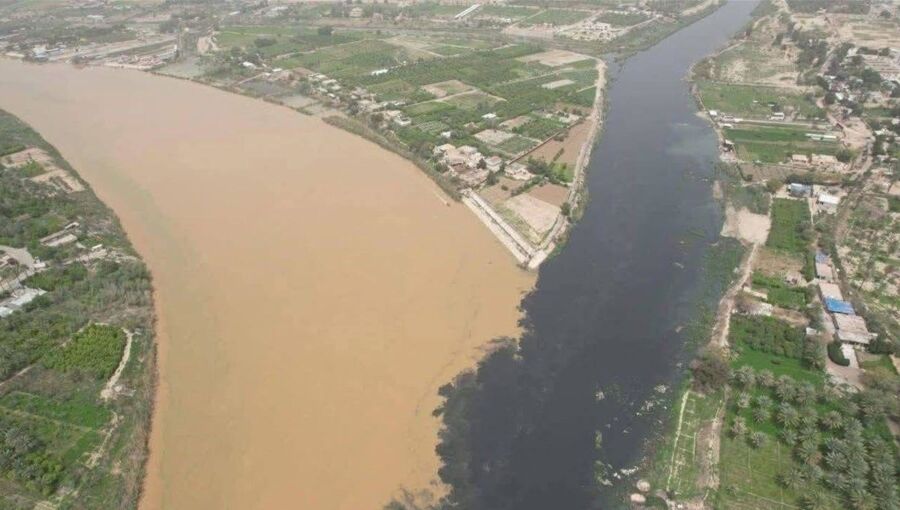
Iraq says Tigris river pollution contained after sediment surge from Diyala

Iraq says Tigris river pollution contained after sediment surge from Diyala
Iraq says Tigris river pollution contained after sediment surge from Diyala. / bne IntelliNewsFacebook
By bne IntelliNews April 14, 2026

Iraq's Environment Minister Hallo Askari has announced that authorities have contained a pollution crisis in the Tigris river caused by sediment dislodged by water releases from rivers and dams, Al Sumaria News reported on April 14, citing the Iraqi state news agency WAA.

Askari said the contamination began at the confluence of the Tigris and Diyala rivers and spread downstream to Iraq's southern provinces. Sediment deposits in the riverbed were swept up by water flows, polluting the supply.

"The ministries of environment and water resources, together with municipal authorities in the affected provinces, have managed to contain the phenomenon," al-Askari said. "We are working to prevent the pollution of river water from recurring in the future."

He added that the government was using equipment available through municipal and ministry resources to improve river conditions and enforce existing environmental regulations.

The announcement comes days after a mass fish die-off in Wasit province, where an estimated 1,000 to 1,200 tonnes of fish were lost after a surge of heavily polluted water moved downstream from the Diyala river.

According to the Iraqi Association of Fish Producers, the polluted water had accumulated over an extended period and carried concentrated waste and sediment into the Tigris, raising pollution to what it described as record levels.

Iraq's Ministry of Water Resources said on April 3 that inflows to the Tigris, Euphrates and Diyala had increased following recent rainfall and floods, raising storage levels in dams and reservoirs. The higher water volumes appear to have dislodged accumulated pollutants in the river system.

In February, the independent Green Iraq Observatory issued an urgent warning that the Tigris contained hazardous organic pollutants including polychlorinated biphenyls and volatile organic compounds, posing a direct threat to the health of millions of residents in Baghdad and several southern provinces.

Iraq's water reserves hit 80-year lows in August 2025, and the country's Ministry of Water Resources has warned the river could effectively run dry by 2040 under the combined pressure of upstream dams, climate change and pollution.

Iraq ranks as the fifth most affected country globally by climate change, with rising temperatures, falling rainfall and water shortages compounding economic, social and security risks, a senior environment official said in January.

Deputy Environment Minister Jassim Al-Falahi said at an energy conference in Baghdad that Iraq has recorded unprecedented temperature increases over the past two decades, outpacing global climate scenarios that assume a one-degree rise every 100 years.

"Iraq has effectively outpaced the world in the rate of temperature increase," Al-Falahi said, adding that even a single degree rise sharply increases demand for energy and water, with far-reaching health, social, economic and environmental consequences.

Al-Falahi said climate change has been directly linked to worsening drought, noting that rainfall has fallen by 35% over the past 30 years, based on data from international research centres. Iraq is now experiencing its fourth consecutive year of drought.

Water stress along the Euphrates River, a key lifeline for Iraq, has become a major point of tension with Turkey, which controls upstream flows. Iraqi officials say reduced releases from Turkish dams have sharply curtailed water reaching the country, worsening drought conditions and driving river levels to historic lows.

Environmental observers note that Iraq is now receiving only a fraction of its traditional share from the Tigris-Euphrates system, heightening pressure on shared water resources and prolonging negotiations over water management and cooperation.

Outgoing Prime Minister Mohammed Shia al-Sudani oversaw the signing of the executive mechanism for the framework water cooperation with Turkey in November, but officials say the country faces its worst water crisis this year amid climate change and upstream water use.