Orbán’s election defeat shakes illiberal allies in Southeast Europe
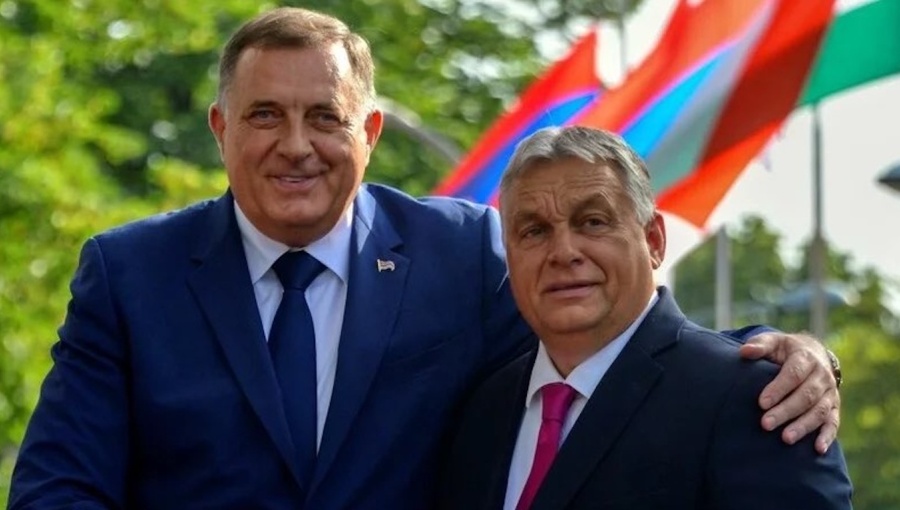
Hungarian Prime Minister Viktor Orbán conceded defeat in the April 12 election, in what looks like a potential turning point not only for Hungary’s domestic politics but also for leaders across Southeast Europe who have aligned themselves with his brand of illiberal governance.
Preliminary results showed the opposition Tisza Party, led by Peter Magyar, on course for a commanding parliamentary majority. With just over half the votes processed, projections indicated Tisza could secure 136 seats, enough for a supermajority, while Orbán’s ruling Fidesz trailed with just 56.
Magyar confirmed Orbán had acknowledged defeat, writing on Facebook that the prime minister had congratulated “our victory”. Orbán, addressing supporters along the Danube, described the outcome as a “painful and clear” result, while avoiding any direct reference to his opponent or the Tisza Party.
“Regardless of the outcome, we will continue to serve the nation,” Orbán said, pledging that Fidesz would “not abandon its supporters” and would instead focus on “recovery and rebuilding the political community” from the opposition benches. He also extended thanks to ethnic Hungarians beyond Hungary’s borders, signalling continuity in Budapest’s outreach to diaspora communities.
The result is the most significant political setback for Orbán since his return to power in 2010, and raises immediate questions about the future of a regional network of leaders and parties who have drawn ideological and, in some cases, material support from Budapest.
A regional project under strain
Over the past decade, Orbán has cultivated close ties with like-minded figures across the Western Balkans and Eastern Europe, positioning Hungary as a patron of conservative, nationalist and Eurosceptic forces in countries aspiring to join the European Union.
These relationships include Serbia’s President Aleksandar Vučić, Bosnian Serb leader Milorad Dodik, leaders of North Macedonia’s VMRO-DPMNE party and Georgia’s ruling Georgian Dream movement.
With the defeat of Poland’s Law and Justice (PiS) party in 2023, Orbán had already lost a key ally inside the EU. In response, he intensified engagement with candidate countries, seeking to build a bloc of future member states sympathetic to his vision of a more sovereign, less liberal Europe.
The strategy amounted to a long-term bet: that by supporting leaders in accession countries — politically, economically and diplomatically — Hungary could help shape the EU’s internal balance of power once those states joined.
This has included Hungarian backing Serbia’s infrastructure and energy sectors, including an oil pipeline, and emerged as one of Belgrade’s top trade partners. Orbán also consistently supported Serbia’s EU accession bid while opposing membership for Kosovo, which unilaterally declared independence from Serbia in 2008, in international institutions.
In Bosnia, Budapest provided financial backing to Republika Srpska after Germany suspended funding in protest at Dodik’s secessionist rhetoric. Hungarian officials also resisted international pressure on the Bosnian Serb leadership, even as tensions rose over the future of the fragile state.
Orbán’s government similarly maintained close ties with Georgia’s ruling party, despite widespread criticism of the 2024 general election there, and offered political protection to former North Macedonian prime minister Nikola Gruevski, who was granted asylum in Hungary after fleeing a prison sentence at home.
Critics have long argued that Orbán’s external alliances mirrored his domestic policies, accusing him of encouraging democratic backsliding among partners. His October 2024 visit to Tbilisi, days after the disputed election, for example, was widely seen as endorsing a contested result.
Serbia recalibrates
Among Orbán’s closest regional allies, Vučić moved quickly to strike a conciliatory tone with the likely new prime minister of Serbia’s neighbour.
“Congratulations to Peter Magyar on his electoral victory. I am confident that the strong cooperation between Hungary and Serbia will continue to grow,” Vučić wrote on X, adding that he was “also grateful to Viktor Orbán for helping make such relations possible”.
Serbia’s tabloid and pro-government media were far less diplomatic. Notorious tabloid Informer warned of dire consequences following Orban’s defeat, while Politika framed the outcome as the result of Western meddling and said it would accelerate Europe’s “collapse,” citing Russian official Kirill Dmitriev.
The result has prompted comparisons with Serbia’s political landscape, where Vucic has been in power for over a decade. Magyar has also drawn links, visiting Novi Sad in 2025 to criticise Vucic as Orban’s ally, while backing anti-corruption protests and advocating faster EU accession for Serbia.
The president of the Freedom and Justice Party (SSP), Dragan Đilas, congratulated Magyar and expressed hope that "freedom will soon come to Serbia." The President of the People's Movement of Serbia, Miroslav Aleksić, said the results showed that it is possible to defeat an authoritarian ruler.
Pro-government voices, however, reject parallels. Politika argued Serbia had already avoided a “Hungarian scenario” during last year’s protests. There are certainly major differences: Serbia lacks a clear political alternative to the ruling Serbian Progressive Party (SNS), while public attitudes diverge — Hungary’s electorate is broadly more anti-Russian due to its Soviet past, whereas Serbia’s is more pro-Russian and ambivalent towards the EU.
“The trouble with repeating the success of the Hungarian opposition in Serbia, as some suggest may now occur, is that the Hungarian electorate is significantly more liberal (and has been for decades) than Serbia’s,” wrote analyst Jasmin Mujanović on X.
“Orbán’s pro-Russian views were something he imposed on Hungarians. In Serbia, more than two-thirds of the population holds positive views of Moscow and its aggression against Ukraine. Vučić can still be toppled, of course, but it’s not a 1:1 comparison with Hungary.”
Separately, now Orban is now longer able to wield his veto in the EU to protect his allies, Serbia could also see a tougher line from Brussels. Orbán had often acted as a shield for Belgrade within EU debates. Without his backing, Serbia may face greater scrutiny from Brussels at a sensitive moment in its accession process.
According to comments reported by Politico days before the vote, Serbia risks losing up to €1.5bn in EU funding over concerns about judicial independence, media freedom and its ties to Russia. “We are increasingly worried about what is happening in Serbia,” EU Enlargement Commissioner Marta Kos said as quoted by Politico. “From laws that undermine the independence of the judiciary to crackdowns on protesters and recurrent meddling in independent media.”
Bosnia and beyond
In Bosnia, Dodik, another key Orbán ally, had publicly backed the Hungarian leader ahead of the vote, writing on April 10: “I wish my dear friend Viktor Orbán the best of luck and success in the upcoming elections. I am confident that the Hungarian people will once again recognise the strength of a policy that safeguards sovereignty, stability, and the future of their country. Republika Srpska stands with you.”
Orbán’s departure from power could open the door to stronger EU action against Dodik, who has faced U.S. sanctions over his secessionist agenda.
“The single biggest, most productive policy option that becomes available to the EU with Orbán out re: the Balkans is deployment of long delayed union-wide sanctions vs. Bosnian Serb secessionist Dodik,” Mujanović wrote on X. “Plenković and Fico will object but are much weaker without Orbán's support.”
In North Macedonia, the political legacy of Orbán’s alliances remains visible in the unresolved case of Gruevski, whose extradition Skopje continues to pursue after multiple failed attempts.
North Macedonia’s opposition party, Social Democratic Union of Macedonia (SDSM) said the election outcome in Hungary marks a major victory for democracy over autocracy, signalling the end of long-standing authoritarian rule in the country.
The party said the ruling VMRO-DPMNE has been left without its key ally in the European Union, adding that this could end the protection of Gruevski in Budapest and curb alleged opaque dealings and external financial influence.
“The criminal organisation VMRO is left without its only ally in the EU. No more hiding Nikola Gruevski in Budapest, no more secret business combinations, no more Chinese money coming through that regime,” SDSM said. The party said the decline of authoritarian leadership in the region could extend further, naming Vucic and North Macedonia's PM Hristijan Mickoski among those it expects to face similar political pressure.
For now, the immediate impact of Hungary’s election will depend on how quickly the incoming government reshapes foreign policy and whether it distances itself from Orbán’s network of alliances. But more broadly it is already clear: a central node in the illiberal political web in the EU’s periphery has been removed, leaving its partners to recalibrate in a more uncertain and potentially less accommodating European landscape.
A Loss For Mar-A-Lago And Moscow: Orbán’s Once Unassailable Rule In Hungary Ends – Analysis

April 14, 2026
By Balkan Insight
By Kristof Abel Tarnay
The illusion of Viktor Orban’s invincibility has been shattered. A major child abuse scandal; the poor economic performance that challenged the foundations of the Fidesz-KDNP alliance’s rule; a charismatic former insider with a well-organised party and a huge, diverse voter base which prioritised unseating the government over ideological differences – these appear to have been the ingredients necessary to oust Hungary’s populist strongman.
It is an enormous loss for Moscow and the far-right movement worldwide, while debunking the myth that Orban could not be defeated in a democratic election. Now, the new prime minister, Peter Magyar, faces numerous challenges, from reforming the poorly functioning state systems to meeting high expectations and managing the deep polarisation of the country.
It was not a surprise that in Budapest, a city which has long been a stronghold of the opposition, people celebrated the result on the streets. But there were similar scenes in Debrecen, once a power base for the ruling parties. The results map, which before was almost all the orange of Fidesz-KDNP turned mostly blue for Magyar’s Tisza party, with just several orange islands.
Crucially, Tisza won a two-thirds constitutional majority in the election, which will allow it wide latitude in dismantling Orban’s system. With almost all of the votes counted, Tisza looked set for 138 seats in the 199-seat parliament, while Orban’s Fidesz looked to have won only 55.
“Together we overthrew the Orban regime, we liberated Hungary, we took back our homeland,” Magyar said in his victory speech on Sunday.
“Our victory is visible, not from the Moon, but from every Hungarian window – whether it’s the smallest mud-brick cottage or a high-rise building,” he added, referencing Orban’s speech from 2022, when he said that they won so big it could be seen even from the Moon, but definitely from Brussels.
That was an election night that Hungarians had become used to. However, in the last two years, something major changed in the country.
A myth busted
Since Orban returned to power in 2010, after spending eight years in opposition, he won a two-thirds majority three times. The results were more and more devastating to opposition voters, making a lot of them question whether it was still possible to defeat his party in a democratic election.
The idea wasn’t baseless, since Orban and his government have done everything to cement their power. They captured most of the media, changed the election system numerous times in their favour, used state resources for campaign goals, and put loyalists into the leadership of state institutions.
Polls repeatedly showed that while in Budapest and the bigger cities previous opposition forces enjoyed some popularity, the rural areas were a massive base for Fidesz-KDNP.
As it turned out, these circumstances weren’t impossible to overcome, after several unexpected events caused a political momentum that even this well-honed political machine couldn’t stop.
Momentum started by a huge scandal
An enormous scandal that erupted in 2024, when then-president Katalin Novak was exposed for awarding a pardon to the former deputy director of a children’s home who had been convicted of helping to cover up child sexual abuse by his superior, was a key element of this change.
Besides the president, Judit Varga, Magyar’s ex-wife, was also forced to resign from being an MP and from Fidesz-KDNP’s European Parliament list, since at that time she was the justice minister who had countersigned the pardon.
After the fall of his ex-wife, Magyar went public about Fidesz’s widescale corruption, attracting huge attention. A few days later, a large protest was held in Budapest, attracting an estimated 50,000 people. This demonstration and the outrage it represented, and Magyar’s debut and the hope it gave to a lot of people – even though at first he said he didn’t want to enter the political fray – seemed to mobilise huge numbers of previously apolitical people.
The perfect storm that hit Orban’s rule also needed another huge factor: the country’s poor economic performance, including the 17.6 per cent average inflation in 2023 and economic growth of just 0.3 per cent in 2025. While “Pardongate” challenged the Christian and family-friendly foundations of the government, the economic problems questioned its ability to manage the country.
After the failures of the old opposition forces, many Hungarians, even those dissatisfied with the government, felt that there was no alternative. This feeling changed after the rapid rise of Magyar and his Tisza party, which precisely targeted conservative voters and those living in smaller settlements. It used national symbolism while being cautious with divisive topics, like the Pride march or the war in Ukraine.
Through systematically building the party organisation and its local networks, Tisza showed its emerging power by winning almost 30 per cent in the 2024 European elections, which dealt a final blow to Orban’s aura of invincibility.
It won’t be an easy ride
In comparison to Fidesz-KDNP’s campaign centred on geopolitics and the war in Ukraine, Tisza highlighted bread-and-butter issues. Besides the cost of living, it focused heavily on the state of the healthcare system and rail transport. While the party promised specific measures, like reducing taxes or increasing pensions, it is also expected to launch radical reforms of these state systems. This will likely represent one of the first significant challenges for Tisza, since major reforms take time, especially given the current state of the budget.
Tisza is also expected to work to restore democratic checks and balances, return the independence of the judicial system and state institutions, reform the electoral system, and free the state media. Governing with a two-thirds majority will be helpful in pushing through such changes, but given the historical capture of state institutions, if voters assume that Tisza will likewise try to abuse such power, it could quickly erode its popularity.
Magyar has also promised to “bring home” frozen EU funds, which is not an unrealistic goal given his party’s plans to join the European Public Prosecutor’s Office and crack down on corruption. This will help in any systemic reforms and could be a quick visible result.
While the new Hungarian government is expected to quickly restore constructive relationships with other EU member states and EU institutions, Orban’s defeat is a major setback loss for Moscow, which has lost a loyal ally inside the EU and NATO.
It also represents a big loss for far-right populists all over the globe. Despite its small size, Hungary has frequently been mentioned as a role model by MAGA Republicans. US Vice President JD Vance even tried to help Orban’s campaign in the last days. While obviously the US has more important partners in Europe, it is a significant symbolic loss for MAGA world. It is unlikely the European edition of the annual far-right CPAC gathering will even be held in Budapest next year.
It is hard to say what Viktor Orban’s next move will be. Yet it is hard to imagine that his voters do not represent a demand that will need to be met, even if it ends up being served by one or several different political forces.
In the meantime, Fidesz figures and supporters will, in Orban’s words, have to “lick their wounds” and get used to the idea of defeat.
For Fidesz-KDNP politicians and pro-government public figures, it will be hard for them to process the result, not least because in the last two years they have loudly underestimated Magyar, taunting him with insults. They should have listened to Lao Tzu: “There is no greater danger than underestimating your opponent.”
Balkan Insight
The Balkan Insight (formerly the Balkin Investigative Reporting Network, BIRN) is a close group of editors and trainers that enables journalists in the region to produce in-depth analytical and investigative journalism on complex political, economic and social themes. BIRN emerged from the Balkan programme of the Institute for War & Peace Reporting, IWPR, in 2005. The original IWPR Balkans team was mandated to localise that programme and make it sustainable, in light of changing realities in the region and the maturity of the IWPR intervention. Since then, its work in publishing, media training and public debate activities has become synonymous with quality, reliability and impartiality. A fully-independent and local network, it is now developing as an efficient and self-sustainable regional institution to enhance the capacity for journalism that pushes for public debate on European-oriented political and economic reform.
After Orbán loss, Europe’s far right reassesses MAGA endorsement

Viktor Orbán’s defeat in the Hungarian elections suggests that political endorsements from Donald Trump or JD Vance do not necessarily boost European far-right campaigns, as the MAGA message increasingly struggles to resonate in Europe.
At best, JD Vance’s pre-election visit last week to Hungary did little to help Viktor Orbán. At worst, it may have backfired, as his rival Péter Magyar secured a historic victory.
Two days after Hungary’s seismic election, which ended Viktor Orbán’s 16 years in power, parts of Europe’s far right are beginning to question the value of endorsements from Donald Trump and JD Vance.
That reassessment reflects a broader concern: Trump’s rhetoric and unpredictable geopolitical agenda are increasingly seen as a liability rather than an asset for his political allies across the Atlantic, especially close partners such as Orbán’s Fidesz party.
"Hungarians have always been very close to the United States,” French National Rally MEP Thierry Mariani told Euronews. “That is not our case.”
Fabrice Leggeri, another MEP from the National Rally called the US tariffs against Europe “punishing” and Washington’s involvement in the current war in Iran “difficult for us to comprehend.”
“We have different cultures and political traditions from those of the US,” Leggeri added.
Trump's waning appeal in Europe
JD Vance endorsed Viktor Orbán during a visit to Budapest last week, accusing “bureaucrats in Brussels” of trying to “destroy the economy of Hungary” in remarks that echoed familiar far-right themes.
Vance’s visit followed earlier endorsements—such as his backing of Germany's far -right Alternative for Germany party a year ago—which could now prove embarrassing, as sovereigntist forces quietly distance themselves from the US government.
European Parliament officials say Trump has lost appeal among nationalist movements in Europe, and upcoming domestic elections could see far-right parties downplaying their links to the MAGA movement.
Other lawmakers from the Patriots for Europe (PfE) also downplayed the impact of JD Vance’s visit, but acknowledged that Donald Trump’s actions in Venezuela and Iran appear to contradict the principle of national sovereignty long championed by far-right politicians who traditionally oppose foreign interference.
"The best way to replace non-democratic regimes around the world would be by respecting international law, and it is clear that recent strong-arm actions by the US have raised some doubts," said Paolo Borchia, an MEP from Italy’s The League.
One of the key reasons for the far right’s distancing from Trump is the ongoing war involving Iran. Many in Europe blame the US strike on Tehran for rising energy prices in Europe, which are already weighing on consumers’ purchasing power.
Another reason for that distancing is that support for far-right positions on issues such as immigration does not necessarily translate into support for the Trump administration.
Dave Sinardet, a professor of political science at the Vrije Universiteit Brussel (VUB), argued that voters in Hungary appeared more concerned with day-to-day issues affecting their lives than with the ideological battles pursued by Viktor Orbán, who has sought to portray himself and his allies as a safeguard against what he describes as migrant “invasions” and the EU’s disregard for national interests.
“Vance’s visit was likely counterproductive and certainly did not help Fidesz,” he told Euronews.
Vance and Trump’s backing of Orbán may also have reinforced perceptions of foreign interference, which the opposition has used as a campaign argument, according to Sinardet’s analysis.
“This result shows that far-right leaders should watch out for too close ties with figures like Trump and Putin,” Sinardet said, adding that it was “strongly ironic” that parties that place national sovereignty at the core of their ideology often accept outside interference in their domestic politics.
Sinardet’s comments were echoed by Theo Francken, Belgium’s Defence and Trade Minister, who wrote on X that “Vance’s support was a very foolish campaign move.”
“The MAGA crowd should really stop campaigning internationally, because everything and everyone they support ends up losing elections,” Franken wrote. His New Flemish Alliance (N-VA) party is close to Orbán’s position on migration, but rejects cooperation with Russia.
A battle lost for the far-right
With the vote in Hungary, Europe’s far right has suffered an important setback, as Viktor Orbán was by far its most prominent figure in power and a model for other leaders.
From France’s National Rally to Italy’s League and Spain’s Vox, the day after the vote has become an opportunity to praise Orbán, acknowledge that Hungary is a democracy and lash out against the European Commission.
Marine Le Pen, leader of the French far-right blamed on X the "grotesque accusations of 'dictatorship'" levelled against Orbán, "who for sixteen years defended Hungary’s freedom and sovereignty with courage and determination."
“The satisfaction expressed by the European Commission, which has continually overstepped its prerogatives and powers to the detriment of the will of the people, should worry Hungarians about the continued existence of this freedom that has been dearly defended for years,” Le Pen added.
Other far-right politicians also denounced the EU's meddling in Hungarian politics, with Alternative for Germany's MEP Petr Bystron even calling for an inquiry committee on the EU’s pressure on the Hungarian government with “freezing billions in funds and imposing financial sanctions,” he wrote in a press release.
“There has been an obscene interference by the EU in this campaign, and this will happen again”, Vox’s MEP Hermann Tertsch told Euronews.
But while being linked to the MAGA movement appears to have become politically toxic, analysts say Orbán’s defeat does not amount to a broader setback for the far right in Europe.
In Sinardet’s view, it is too early to see this as a meaningful shift, as sovereigntist forces are still gaining ground in many places, and drawing conclusions from a single election is a risky move.
He acknowledged that those political forces remain structurally strong, with representatives in government in several EU countries, including Italy, the Czech Republic and Sweden.
“Viktor Orbán's defeat is significant, but certainly it is not the end of far-right populism," Sinardet said.


