Thursday, April 16, 2026

South Africa names new US ambassador amid tense Trump ties
DW with AP, open source material
16.04.2026


South Africa has appointed a prominent Afrikaner politician, Roelf Meyer, to the ambassadorial role in Washington. This comes amid allegations from the Trump administration of a "white genocide" in the country.

Roelf Meyer has the unenviable task of repairing South Africa's ties with the Trump administration (archive image from 2018
Image: Wikus De Wet/AFP


South African President Cyril Ramaphosa has appointed veteran politician Roelf Meyer as the country's ambassador to the United States, after a year when the post was vacant amid difficult ties with Donald Trump's administration in Washington.

Ramaphosa's spokesman Vicent Magwenya announced the appointment in a message to the Associated Press and other news outlets.

"I can confirm that President Cyril Ramaphosa has appointed Mr. Roelf Meyer as South Africa's Ambassador to the US," he said, effective immediately.

Who is Roelf Meyer?

Roelf Meyer was a member of parliament from 1979 to 1997 and was minister of defense from 1991 to 1992 under the white minority government of former President F.W. De Klerk's National Party.

He was later a chief negotiator in the talks that brought an end to apartheid and led to the election of Nelson Mandela as South Africa's first Black leader in 1994.

Meyer served in Mandela's first unity government Cabinet as constitutional development minister from 1994 to 1996.

He later founded the United Democratic Movement, a center-left party that still exists in South Africa but which holds a negligible three of 400 seats in the National Assembly. Meyer is no longer a member.

Why are ties between the US and South Africa tense?

US President Donald Trump has criticized South Africa's ANC-led government and cut all financial assistance to the country. Accusing the government of allowing a "white genocide" against the minority Afrikaner group, he famously took Ramaphosa to task on the issue in front of reporters at the White House during a 2025 visit to the US.
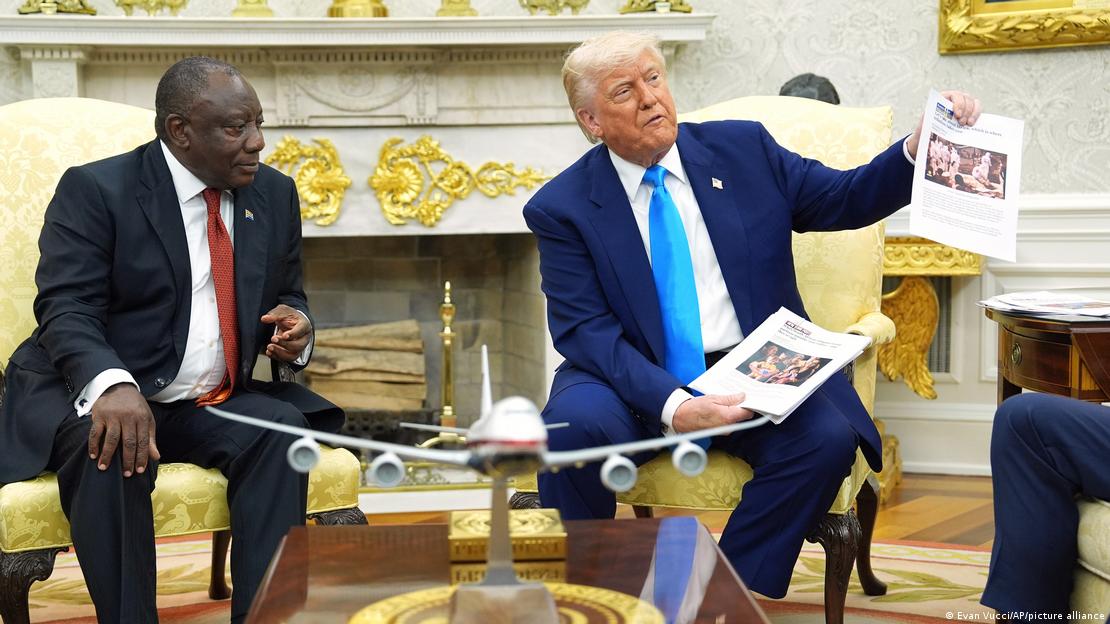
Trump used Ramaphosa's visit to the US last May to raise the issue in front of reporters
Image: Evan Vucci/AP/picture alliance

The US has also granted Afrikaners who feel persecuted in South Africa a bespoke migration and asylum procedure.

Meyer's predecessor Ebrahim Rasool was expelled in May last year after criticizing the Trump administration and its handling of South Africa, saying it was trying to "project white victimhood as a dog whistle."

The comments prompted some criticism in South Africa for breaching diplomatic norms, though they came as little surprise hailing from a diplomat who had grown up classified as "colored" under apartheid rule.

The appointment of Meyer follows soon after Ramaphosa accepted conservative activist Leo Brent Bozell III as the new US ambassador to South Africa.

The two nations also are at odds over South Africa's decision to pursue an International Court of Justice case accusing Israel of genocide against Palestinians in Gaza.

Trump boycotted the G20 Leaders Summit hosted by South Africa in 2025 and has not invited South Africa to the G20 meetings being hosted by the US in Miami in December.

Beyond this, South Africa's wealthiest and best-known white emigre, Elon Musk, has long been a staunch critic of the government in his country of origin. This criticism has amplified considerably in recent days, as Musk is upset at barriers to access for his Starlink company which he claims are racially motivated.


Edited by: Srinivas Mazumdaru

Mark Hallam News and current affairs writer and editor with DW since 2006.@marks_hallam

Venezuela's Rodriguez pushes reforms in first 100 days

Jan D. Walter
DW 04/14/2026

After the US ousted Venezuelan leader Nicolas Maduro, Washington outlined a three-phase plan. Now, 100 days into the tenure of interim President Delcy Rodriguez, the question looms: Will she allow elections?


How likely is it that Venezuela's acting President Delcy Rodriguez will lead the country into democracy
Image: Miraflores Palace/Handout/REUTERS


Following the capture of then-President Nicolas Maduro by US special forces on the morning of January 3, Venezuela's then-Vice President Delcy Rodriguez condemned the operation as a kidnapping and announced that the country would resist the United States.

However, her tone changed quickly. Just one day later, US President Donald Trump expressed confidence that Rodriguez was "essentially willing to do what we think is necessary to make Venezuela great again." And indeed, the new interim president invited the US government that very same day to "work together on a cooperative agenda." Shortly afterwards, US Secretary of State Marco Rubio unveiled a three-phase plan for cooperation.

Phase 1: Consolidation of internal power

After 100 days in office, the acting president appears to be filling the power vacuum left by Maduro's ouster, and she also seems to be fulfilling Phase 1 of Washington's plan. On January 5, with the approval of the military and the Supreme Court, Delcy Rodriguez took the oath of office before the National Assembly, which has been chaired by her brother Jorge Rodriguez since January 2021.

Through a series of personnel changes, she has been consolidating her control over key institutions such as the judiciary, the military, and the administration. Rodriguez filled at least 12 top positions within a few weeks. The most prominent shift was Foreign Minister Vladimir Padrino Lopez in March who had to step down, likely due to the debacle surrounding Maduro's capture. He was replaced by Gustavo Gonzalez Lopez, the former head of the notorious secret service agency SEBIN. Rodriguez had already appointed him as head of her personal guard in early January. A power struggle has not materialized and the Rodriguez government appears stable.

Does Caracas play by Washington's rules?

Despite numerous denials from Caracas, Venezuela's interim government is largely following Rubio's script. Even the tone toward Washington has changed.

In an interview with the Spanish newspaper El País in early April, National Assembly President and the president's brother, Jorge Rodriguez, said they were working very professionally with the US government. While he asserted that they were not receiving specific directives from Washington, it stands out that the United Socialist Party of Venezuela (PSUV) is now praising cooperation with what it used to refer to as "US imperialists" — and even signalled that the government is now open for reforms.

The US has lifted sanctions on Venezuela, and the acting president is openly calling for foreign investment to bolster the ailing economy
Image: Chico Sanchez/dpa/picture alliance


Phase 2: Economic recovery


For more than a decade, the PSUV government under Maduro had failed to curb inflation to a manageable level, let alone achieve sustainable growth for the Venezuelan economy. Within weeks, Delcy Rodriguez has now paved the way for foreign private investors to enter the Venezuelan oil sector.

In doing so, she has raised hopes at home that Venezuela's troubled economy could stabilize. Meanwhile, the US rating agency Moody's sees the country as already having a "stable outlook." In late March, Rodriguez delivered a video message at an investor conference in Miami to attract foreign capital for investments in key sectors such as oil, construction, banking, and insurance, as well as the manufacturing industry.


Poverty is the most pressing problem

However shocking the US attack on Venezuela's sovereignty may have been for many people in the country and beyond, it didn't spark major national protests. Many Venezuelans are even glad that Maduro is gone, Juan Forero, South America Bureau Chief for the Wall Street Journal, told the US magazine Americas Quarterly, after returning from Venezuela in February. In his view, many Venezuelans were hopeful that things would get better.

In a mid-2025 survey by the US institute Gallup, 64% of respondents stated that the country's economic problems were their greatest concern, which is unsurprising given the hyperinflation that has raged since 2017. Last year, the rate stood at around 500% — meaning that 100 bolivars from a January 2025 paycheck were worth only 20 bolivars by the time Maduro was ousted. Depending on the measurement, between 50% and 80% of households lived in poverty last year.

According to Gallup, only 14% of those surveyed viewed the political situation itself as their number one problem. Just 1% cited the security situation as their top priority — in a country with one of the highest murder rates in the world.

Therefore, the government is well aware that "the most important thing right now is the economy," as Congress President and the president's brother, Jorge Rodriguez, emphasized in his interview with El País in early April. When asked about democratic elections, he said that they will happen eventually, but it was too early to say when or in what form.

Meanwhile, repression continues. According to figures from the organization Foro Penal, around 500 political prisoners have been released since January. But roughly the same number remain in detention.

"The reforms so far are not necessarily aimed at opening up and democratization, but rather at keeping the interim government in power indefinitely," Victor M. Mijares, a political scientist at the University of the Andes in Bogota, Colombia, told DW.

"At the moment, the PSUV would likely have little chance of winning new elections," he said, adding that the last election victory in mid-2024 was highly controversial. According to the opposition's tally, its candidate won by a large majority. "However, a noticeable economic recovery could change their chances," Mijares said.

Also the WSJ correspondent Forero believes that Delcy Rodriguez's government is playing for time, hoping that the United States — at the latest under a new president — might lose interest in Venezuela's democratization. After all, the US has already signalled its goodwill by easing sanctions.

Secretary of State Marco Rubio (left), the son of Cuban exiles, is likely to insist on a democratic transition in Venezuela, experts sayImage: Kevin Lamarque/REUTERS


Phase 3: Will the US push for elections?


However, political scientist Mijares has doubts that such a plan could work out. For one thing, some members of the US government take the fight against socialism in Latin America very seriously, especially Secretary of State Rubio, who is the son of Cuban exiles.

"Additional pressure comes from the US business community, particularly the oil industry, which insists on the rule of law in Venezuela," Mijares said, adding that for Donald Trump, the democratization of Venezuela serves as a kind of blueprint for a "slow but less costly regime change."

At the same time, he says, the Venezuelan government finds itself in a dilemma: "Rodriguez would have to establish a legal framework to attract the necessary capital inflows, which as a transitional government, it is effectively unable to do."


This article was originally written in German.

Jan D. Walter Editor and reporter for national and international politics and member of DW's fact-checking team.
Solar power in Morocco's desert: Bold vision, mixed results

Charli Shield
DW 04/15/2026

A massive solar tower in the Moroccan desert is the beacon of an ambitious push for a clean energy future. But fossil fuels and grid constraints stand in the way.


Morocco's massive Noor concentrated solar power project is one of the region's largest renewable energy installations
Image: Xinhua/SEPCO III/picture alliance

The Moroccan city of Ouarzazate, about 200 kilometers (125 miles) southeast of Marrakech, lies on the edge of the Sahara and is known as the "door to the desert."

Ouarzazate is probably best known for the Atlas Film Studios, where blockbusters from "The Mummy" to "Gladiator" and "Game of Thrones" have been filmed. But a new industry is taking shape.

Near the city, lying on a high plateau hemmed by the Atlas Mountains, one of the world's largest solar power plants is being built. It is named Noor, meaning light in Arabic.

Stretching over nearly 500 hectares (some 1,200 acres), the solar facility produces enough energy to power more than a million homes. But this is not a typical solar farm.
Fossil fuels still dominate energy mix

Instead of commonly seen black PV panels, Noor uses concentrated solar power. A field of 2 million giant mirrors reflects the sun's rays onto a central receiver that sits at the top of a 247-meter (810-foot) tower. The concentrated sunlight melts molten salt to 600 degrees Celsius (1,112 degrees Fahrenheit). That makes steam, which spins turbines, generating electricity even hours after sunset.

In Ouarzazate, however, electricity remains expensive. Most households are not dependent on solar, but on butane gas. So why hasn't clean energy arrived for the local community?

One reason is that Morocco's energy grid is still heavily reliant on fossil fuels, and especially coal-fired power generation. Intissar Fakir, a senior fellow and founding director of the North Africa and the Sahel program at the Middle East Institute in Washington D.C. said this has slowed the nation's clean energy transition.

"Fossil fuel-generated electricity contributes about 48% of the country's energy-related greenhouse gas emissions," she said.

The number of hot days in North Africa has doubled in the last 50 years as Morocco's deserts become climate change hot spots
Image: imagoDens/Zoonar/IMAGO

Moroccans spend around $110 (€94) of their $550 average monthly income on electricity. This is in a hot and dry country, where residents rely on air conditioning or a fan to stay cool. It's regularly over 40 degrees Celsius in Ouarzazate during the summer, and the number of hot days and nights has roughly doubled in the region since the 1970s.

This expense is partly down to the fact that Morocco does not produce any fossil fuels domestically, and imports about 90% of its coal, oil and gas, Fakir explained. Energy market and price fluctuations mean fossil fuel imports consume a major portion of the national budget, making the switch away from planet-heating coal, oil and gas increasingly urgent.

Power grid limitations delays energy transition


That said, Morocco has made more progress on renewables than most North African countries.

"Even by global standards, Morocco's transition plan is pretty ambitious," said Fakir. By 2030, the country plans to be able to power its economy with 52% of renewable electricity. By 2050, it's aiming for 70% clean power capacity. And considering that the country has ample sun and coastal wind, the conditions seem right.

The Noor solar plant might be the star of Morocco's shift to renewables, but it's just one of around two dozen solar, wind and hydro megaprojects already built. Another several dozen are in the pipeline.

The country has also recently pledged to phase out coal power entirely by 2040 as part of its clean energy transition.

But it has some catching up to do. While it currently has enough renewable technology to generate 46% of its electricity, in 2023 the nation only achieved a little over half of that.

"The actual output in the country's ability to integrate what Noor produces remains quite limited," said Fakir. "Morocco still needs to invest in its grid capacity so they can integrate more of these renewable energies into daily use." This includes investment in ways to store energy.

She said more investment is also needed if the country is to realize its goal of selling its clean power abroad — especially to Europe.

"Even as solar panels and wind turbines get cheaper, building large-scale, clean energy systems like Noor still takes serious upfront investment for low income countries," she explained.
Are megaprojects the way forward for renewables?

Researchers and civil society organizations have also been critical of the government's focus on megaprojects like Noor instead of more decentralized, small-scale clean energy schemes, including rooftop PV panels for homes, businesses and farms.

Some say decentralized rooftop solar, like this unit installed on a village house in Morocco's Atlas Mountains, is a better investment than large centralized solar projects
Image: Ashley Cooper/Global Warming Images/picture alliance

One critique is that concentrated solar power is very water intensive. Its millions of mirrors need to be cleaned with water to remove sand and dust that get in the way of their ability to reflect light. In addition, a lot of grazing land was appropriated from local farmers to host Noor, with little consultation.

The project has divided locals, many of whom have seen few benefits. Imrane, an 83-year old resident, said electricity is still very expensive for villagers, adding that the solar tower's mirrors and concentrated sunlight has driven up temperatures in their villages.
As the Noor solar complex took shape in 2016, it carried the hope of a rapid energy transition
Image: FADEL SENNA/AFP/Getty Images

Fakir said that, despite the expense, the Noor solar project was an experiment.

"These are great flagship projects that prove the extent of Morocco's technical capabilities," she said. "But they also again highlight the challenge that even with these massive investments, renewables are still struggling to displace the entrenched coal and fossil fuel generation."

Edited by: Stuart Braun

This article was adapted from a DW Living Planet radio series on solar energy. To listen, click here.


Charli Shield Journalist, audio producer & host

Where is hydrogen energy useful? And where not? Report sheds light

16.04.2026, DPA

Is hydrogen energy a climate-friendly alternative or a dead end? It depends, says an analysis of more than 100 fact checks.


By Christof Rührmair

Hydrogen is becoming increasingly important as an alternative to oil and gas for energy, but whether it is really climate friendly depends on how it is produced.

The Fraunhofer Institute for Systems and Innovation Research (ISI) in Germany evaluated more than 100 fact checks about the substance and found where hydrogen will become the technology of choice, where it will not and what is needed for its success.

Hydrogen can be produced in many different ways. In the end, it is always a gas with molecules made up of two hydrogen atoms whose origin is not immediately apparent.

Where hydrogen comes from varies widely. Grey and black or brown hydrogen is produced using gas (grey) or coal (black or brown) and generates carbon dioxide (CO2).

Blue and turquoise hydrogen is also produced from gas, but the CO2 produced is either captured and stored (blue) or the carbon is produced as a solid (turquoise).

With red, orange or green hydrogen, the gas is produced by electrolysis. The key here is where the electricity comes from. The authors cite nuclear energy (red), biomass (orange) and renewable energy such as wind or solar (green).

Production method and costs are key

When it comes to hydrogen, origins matter, as today the gas is currently produced worldwide "almost entirely" from fossil sources, mainly natural gas and coal. For it to contribute meaningfully to climate protection, the share of production from climate-friendly sources would have to rise massively. The authors say sustainable hydrogen will "probably only be available on a larger scale in the 2030s."

"At present, green hydrogen in particular, produced using renewable energies, is significantly more expensive than fossil alternatives," the analysis says. The authors see grey hydrogen as the cheapest option, at $1 to $2 per kilogram. Green hydrogen currently costs around $7 to $19 per kilo and is therefore much more expensive. However, this figure is expected to fall. Forecasts differ on how quickly. The authors assume it will still be at least twice as expensive as grey hydrogen in 2030.

Today's biggest hydrogen users are refineries and plants that produce ammonia, which the authors say will remain important. They see steel production, the transport sector and the energy sector as further major future buyers.

"Hydrogen is particularly highly relevant where direct electrification reaches physical or economic limits," the authors write. In the transport sector, they see this above all in heavy goods transport, international shipping and aviation.

Lead author Nils Bittner does not believe hydrogen will be able to save gas heating. "Hydrogen heating systems are technically feasible but not cost-efficient for use in private households," he says. "For the foreseeable future, there will not be enough low-cost hydrogen available for widespread use." However, he says larger local use, such as in district heating or for combined heat and power plants could be considered depending on regional conditions.

Bittner is also sceptical about using hydrogen to store energy for the electricity supply. Producing green hydrogen with the aim of generating electricity from it again currently makes sense "only in exceptional cases due to the high conversion losses" - for example for emergency generators.

China the leader, Europe behind

There is much debate about using hydrogen-powered fuel-cell cars, with some saying they could help the climate, while others see the benefits as limited.

The authors put global hydrogen production of all types at around 100 million tons. The largest producer is China, where the gas is mainly produced using coal.

The European Union wants to produce 10 million tons of green hydrogen by 2030. Germany wants to produce about a quarter of that. However, that is not enough to cover demand.

On the industrial side, Europe would actually have a strong starting position. Europe has a "historically strong industrial base in the field of electrolysis technologies," the authors write. "Earlier analyses show that European companies at times held around 60% of global electrolyser manufacturing capacity and around 40% of the relevant patents." German companies were also very active.

But current developments point to a shift: "China in particular has significantly expanded its production capacities in recent years and has now taken on a central role in global electrolyser manufacturing."


EU approves billions in aid for energy-intensive German industry

16.04.2026, DPA


Photo: Julian Stratenschulte/dpa


By Doris Pundy, dpa

The European Commission on Thursday approved plans by the German government to support energy-intensive industries with €3.8 billion ($4.5 billion) in the coming years.

The funding is meant to temporarily relieve companies from high electricity prices in a bid to avoid moving activities outside the European Union where energy prices are often lower and environmental standards less strict, the commission said on Thursday.

The aid scheme allows eligible businesses operating in Germany to apply for relief payments and is set to support energy-intensive sectors until the end of 2028.

Beneficiaries will however be required to invest at least half of the aid received in measures aimed at reducing the company's electricity costs without increasing the use of fossil fuels.

The aid plans are linked to long-term competitiveness issues in the EU, but coincide with the recent rise in energy prices triggered by the war in Iran.

State aid in the EU is strictly regulated to ensure a level playing field between economically strong and less affluent member countries and, in many cases, requires the approval of the commission.

The commission also approved similar plans by Bulgaria for aid payments worth €334 million and by Slovenia over €90 million.

Manufacturing businesses in the EU have been under increasing pressure amid growing competition from the United States and China.

Alongside comparably high energy prices, red tape, fragmented rules across the bloc and low investments are seen as some of the reasons for the EU's faltering competitiveness.

Workers over 65 in Germany up 46% in just five years

16.04.2026, DPA


Photo: Jan Woitas/dpa

The number of people aged over 65 still in work in Germany has risen by about 46% over the past five years to around 1.9 million, official figures showed on Thursday.

The trend has been building for years, driven in part by a gradual increase in the statutory retirement age from 65 to 67, with the threshold reaching at least 66 years and two months in 2025.

Early retirement typically comes with reduced benefits, encouraging more older people to remain in the workforce.

Official figures show that 1.28 million people over 65 were registered as employed in 2020, rising steadily to 1.88 million in 2025.

Of these, 653,000 were aged 70 or older, up from 469,000 in 2020, while about 229,000 were over 75, compared with 175,000 five years earlier.

Experts cite multiple factors behind the rise, including labour shortages, personal motivation and financial necessity.

The data from the Federal Statistical Office was requested by the minor Sahra Wagenknecht Alliance (BSW) party.

Founder Sahra Wagenknecht said many older people were not working by choice but out of financial need, adding that the increase suggests hundreds of thousands of pensioners are compelled to supplement relatively low incomes.

She said Germany could look to Austria's pension system as a model, where payouts are higher on average, though contribution rates are also higher.

Despite the increase, older workers still represent a relatively small share. Around 18.4 million people in Germany were aged over 65 in 2025, while the total workforce was about 42.5 million.

Germany's Lufthansa cancels hundreds of flights as crews renew strike

16.04.2026, DPA


Photo: Hannes P. Albert/dpa


Hundreds of flights were cancelled again across Germany on Thursday as flight crew at flag carrier Lufthansa held a further round of strikes.

At the country's largest airport in Frankfurt, operator Fraport said 656 of 1,313 scheduled take-offs and landings were cancelled, with the overwhelming majority attributable to Lufthansa.

An attempt at arbitration in the deadlocked pay negotiations for pilots failed on Wednesday. Lufthansa and the pilots’ union Vereinigung Cockpit (VC) were unable to even agree on a list of issues to be resolved.

The employees’ protests overshadowed a ceremony marking the centenary of the German airline.

Flights were cancelled at the main Lufthansa airline, as well as subsidiaries Lufthansa Cargo and Lufthansa Cityline.

At the low-cost airline Eurowings, strikes were scheduled only for Thursday, while further industrial action was likely at the group's other German airlines on Friday.

A company spokesman said Eurowings is managing to operate more than 70% of its scheduled flights. While only part of the fleet is subject to German strike law, a three-digit number of pilots on German aircraft have also volunteered for duty.

New whale sighting on German-Danish border
DW 04/15/2026

A Beluga whale has made its way from the coast of Denmark towards the border with Germany, according to local media. The sighting comes after a humpback whale stranded in the Baltic Sea captivated Germany last month.

A white Beluga whale (like this one seen in Norway in 2019) has been spotted near the northern German city of Flensburg
Image: Jorgen Ree Wiig/Norwegian Directorate of Fisheries/AP/picture alliance

A white Beluga whale has been spotted in the narrow straits around the Flensburg Firth, the waterway which divides Germany from Denmark near the northern German city of Flensburg.

According to the local Nordschleswiger (North Schleswig) newspaper, a Danish publication serving Denmark's German-speaking minority in the region, the white whale was first spotted near Arosund last month and has since made its way south past the island of Als and into the firth, known as the Flensburger Förde in German or Flensborg Fjord in Danish.

Beluga whales are said to be friendly, social animals which often travel in groups. They are known for their varied methods of communication with a "language" made up of whistles, chirps and clicks, earning them the nickname "canaries of the sea."

Feeding on herring, salmon, squid and crustaceans, Beluga whales can grow up to six meters long and can weigh over a ton.

They are normally found in sub-arctic regions like Greenland and Norway, but it's not the first time that a Beluga whale has been spotted in southern Denmark, with previous sightings reported in 1903, 1964, the 1980s and 2012.

According to Danish whale researcher Carl Christian Kinze, Beluga whales like coastal areas and this particular individual will likely find its own way back out into more open waters.
What happened to 'Timmy' the humpback whale?

Unfortunately, the same couldn't be said for "Timmy" the humpback whale which has been repeatedly stranding, freeing and stranding itself again off Germany's northeastern coast for the past month, and is now to be left to die in peace after captivating the country.


Edited by: Elizabeth Schumacher


Germany expects further whale stranding's amid latest rescue attempt

16.04.2026, DPA

Photo: Philip Dulian/dpa

The environment minister of the German state of Mecklenburg-Vorpommern expects further whale strandings on German coasts in the future, after a high-profile saga involving a humpback whale that has repeatedly become stuck in the Baltic Sea.

"The next whale is bound to turn up," said Till Backhaus, before the start of a private rescue operation for the whale in the shallow waters off the small Baltic Sea island of Poel on Thursday.

The 12.35-metre animal has been stranded four times off Germany's Baltic coast since the beginning of March.

It most recently got stuck off Poel Island in the Bay of Wismar earlier this month. All rescue attempts for the struggling whale were called off, as experts said they expected the animal to die in the bay, but it has remained alive for more than a week.

Backhaus also referred to a beluga whale that has been sighted off Flensburg. "This means we will have to continue addressing the issue."

Backhaus called for inter-regional coordination to deal with future strandings, and told the television channel News5 that the Maritime Emergency Command was a suitable body for this.

The command was established by Germany's federal government and coastal states to deal with shipping accidents, and has scientists and technical resources at its disposal.

Backhaus said he had submitted a proposal concerning the issue for the conference of Germany's environment ministers in May. He was convinced that the proposal would be approved.

"Money must also be invested here," Backhaus continued, adding that the Federal Agency for Nature Conservation should "find solutions" for staffing and investment.