Saturday, April 18, 2026


Iran war energy shock drives nuclear power plans in Asia and Africa

FILE - Fishermen tether a boat on the shore near the Madras Atomic Power Station, a nuclear power facility, at Kalpakkam, in the Indian state of Tamil Nadu, Feb. 10, 2025.
Copyright AP Photo

By Una Hajdari with AP
Published on 

The Iran war has exposed the fragility of global fossil fuel supply chains. Now dozens of countries across Asia and Africa are turning to nuclear power as their answer.

The Iran war's global energy shock is pushing nations in Asia and Africa to boost nuclear power generation and accelerating atomic energy plans in countries that have never had it.

Asia, where most Middle Eastern oil and gas was headed, was hit first and hardest by disruptions to shipping routes — swiftly followed by Africa. The US and Europe are also feeling the pinch as the conflict drives up energy costs.

Countries with nuclear plants are increasing output as they scramble for short-term supplies, while non-nuclear nations are fast-tracking long-term atomic plans to guard against future fossil fuel shocks.

Nuclear power is no quick fix. Developing atomic energy can take decades, especially for newcomers. But long-term commitments made now will likely lock it into countries' future energy mixes, said Joshua Kurlantzick of the Council on Foreign Relations.

Hard-hit Asia advances on nuclear

In Asia, the war is pushing South Korea to increase nuclear output, while Taiwan is debating restarting mothballed reactors. In Africa, Kenya, Rwanda and South Africa have all affirmed support for future reactor builds.

Nuclear power harnesses the energy released when an atom's nucleus — such as uranium — splits in a process called fission. Unlike fossil fuels, it does not release carbon dioxide. But it creates potentially dangerous radioactive waste, one reason many countries remain cautious.

The war has accelerated a global "nuclear renaissance," said Rachel Bronson of the Bulletin of the Atomic Scientists, as countries seek an alternative to the risks of fossil fuel markets.

Some 31 countries use nuclear power, which provides about 10% of global electricity, according to the International Atomic Energy Agency (IAEA). Another 40 nations are either considering the technology or preparing to build a plant.

In Asia, where energy triage ranges from increased coal use to purchases of Russian crude, countries with nuclear plants are trying to squeeze more from existing reactors.

South Korea is ramping up generation and speeding maintenance at five offline reactors, with restarts planned in May.

Taiwan and Japan are reversing policies that shuttered nuclear sites after the 2011 Fukushima meltdown, triggered when an earthquake and tsunami cut power to the reactors' cooling systems.

Taiwan is considering the years-long process of restarting two reactors — requiring meticulous inspections, safety checks and control system verifications.

In Japan, since the war began, Prime Minister Takaichi Sanae has signed a $40 billion (€35bn) reactor deal with the US, a nuclear fuel recycling agreement with France and promised Indonesia nuclear cooperation.

Japan restarted the world's largest nuclear plant, Kashiwazaki-Kariwa, in January.

Renewables make more sense than nuclear for energy affordability and security, according to Michiyo Miyamoto of the US-based Institute for Energy Economics and Financial Analysis.

But historically high electricity costs, compounded by the current crisis, are swinging Japanese public opinion toward nuclear, she said

In Bangladesh, the government is racing to bring online new reactors built by Russia's state-owned Rosatom, hoping they will supply the national grid with 300 megawatts by this summer and ease pressure from gas shortfalls.

Vietnam signed a deal with Moscow in March for two Russian-designed reactors.

The Philippines, which recently declared a national energy emergency, is also considering reviving a nuclear plant built after the 1973 oil crisis that was never switched on.

"I hope we learned our lesson," said Alvie Asuncion-Astronomo of the Philippine Nuclear Research Institute. The Iran war is "providing a needed push for nuclear".

Africa voices atomic ambitions

Soaring energy prices and power shortages are fuelling public calls for nuclear cooperation across Africa, where more than 20 of the 54 countries have long-term atomic energy plans under way.

With Africa seen as a growth market, nuclear nations — including the US, Russia, China, France and South Korea — are pitching small modular reactors (SMRs) as a solution to energy shortfalls.

These compact units are cheaper than large-scale plants, but projects can still take years. Kenya plans to bring an SMR online in 2034, having started the first phase in 2009.

"Nuclear energy is no longer a distant aspiration for African countries; it is a strategic necessity," said Justus Wabuyabo of Kenya's Nuclear Power and Energy Agency last month.

At a March summit convened by the IAEA, Rwandan President Paul Kagame said Africa will be "one of the most important global markets" for smaller reactors in the years ahead.

SMRs are seen as a solution to the continent's rising electricity demand, weak grids and over-reliance on imported diesel

South Africa, which has the continent's only existing nuclear plants, wants nuclear to rise from around 5% of its energy mix to 16% by 2040.

Loyiso Tyabashe of the South African Nuclear Energy Corporation said SMRs could "fulfill our strategic objective of positioning South Africa at the forefront of advanced nuclear technologies".

US and Russia vie for influence

The energy disruptions come as competition for influence in Africa intensifies between Washington and Moscow.

Russia's Rosatom is building Egypt's first reactor and has cooperation agreements with Ethiopia, Burkina Faso, Ghana, Tanzania and Niger, spanning major projects, research centres, uranium processing facilities and training programmes.

While only Kenya and Ghana have joined an American-led modular reactor initiative, Washington is trying to catch up.

The US and South Korea sponsored a nuclear conference in Nairobi last month, where Ryan Taugher of the US State Department said Washington is working with African nations to develop secure civil nuclear reactors rapidly.

Ghana, which aims to begin building a plant in 2027, is in the market for foreign suppliers.

The risks remain

Interest is building, but risks — meltdowns, mismanaged waste and the potential path to nuclear weapons — have not gone away.

Ayumi Fukakusa of advocacy group Friends of the Earth Japan said "nuclear is very risky" and will keep countries reliant on imported fuels such as enriched uranium.

Rex Amancio of the Global Renewables Alliance said governments should stay focused on building out renewables for long-term energy security, given that nuclear sectors take years to develop.

Bronson also warned that nuclear plants are vulnerable during conflicts, citing instances where reactors were targeted during both the Iran war and the Russia-Ukraine war.

"All of this comes into the mix of how we think about energy security," she said.

"Countries are now weighing those kinds of risks against the other risks — which Asia and Africa are seeing first and foremost — about what happens when gas and oil stops."


'Boots On The Ground': Massive Attack and Tom Waits team up for powerful ICE protest song

Massive Attack and Tom Waits team up for most powerful ICE protest song yet
Copyright Press - AP Photo

By David Mouriquand
Published on 

"Across the western hemisphere, state authoritarianism and the militarisation of police forces are fusing again with neo-fascist politics." Massive Attack have teamed up with Tom Waits for a haunting and incredibly powerful protest song, titled 'Boots On The Ground'.

British trip-hop icons Massive Attack and the legendary US singer-songwriter Tom Waits have teamed up to release a powerful, politically-charged new song, titled ‘Boots On The Ground’.

The haunting track is the first new material from both Massive Attack and Tom Waits in years. It takes aim at "recent ICE raids on migrant communities & the killing of civilians that protect them", with all proceeds from the song going to the American Civil Liberties Union and the US Immigrant Defense Project.

‘Boots On The Ground’ features additional vocals from Waits’ son Casey, and begins with the heavy breathing. Massive Attack then lay a tender yet menacing soundscape beneath Waits inimitable vocals.

We trim your hedges, we fight your wars / Wait in the trenches and we're fucked till we're sore / With boots on the ground, boots on the ground...

Other lyrics include: “Now who the hell are these federal pricks? / Hiding in the Senate like a bloated-ass tick / Air-conditioned fuckstick loafers / Sittin' in a room full of army posters” and “Cold and hot as Satan's hoof / Spinning on the world, I'm hiding on a roof / I kill a brown man I never ass knew / Choked on spit and then he turned blue.”

Boots On The Ground Press


The song comes with an equally haunting video which will send chills down your spine.

The film was created by Massive Attack, made with work by US photo artist thefinaleye.

“The film that follows encapsulates his work across an epoch forming six-year period,” reads the caption. “From the murder of George Floyd in Minneapolis on 25th May 2020 to recent ICE raids on migrant communities & the killing of civilians that protect them. From the brutal state repression of public protest, to the reality of American homelessness that includes nearly 33,000 military veterans.”

The video ends by detailing those who have lost their lives to ICE and the impact of oppressive retaliation to protest.

“As of March 2026, eight people have been killed by US Immigration and Customs Enforcement (ICE) agents, or in ICE custody. Their names were: RenĂ©e Good, Alex Pretti, Geraldo Lunas Campos, Luis Gustavo Nunez Caceres, Luis Beltran Yanez Cruz, Parady La, Heber Sanchez Dominguez, and Victor Manuel Diaz.”

Check it out below:

Massive Attack’s Robert “3D” Del Naja and Grant “Daddy G” Marshal said in a press release: “It’s a career honour to collaborate with an artist of the magnitude, originality and integrity of Tom, but this track is arriving in an atmosphere of chaos. Across the western hemisphere, state authoritarianism and the militarisation of police forces are fusing again with neo-fascist politics.”

They added: “Seen within the American emergency, at home and overseas, this track contains pulses of callous impulse & abandoned mind.”

As for Waits, he revealed that he accepted the invitation to collaborate with the duo “many years ago”.

"Way back then, we sent them 'Boots On The Ground'," he said. "Their long release delay never worried me. Today, as in all of mankind's yesterdays, guarantees this song will never go out of style. Man's fiasco folly is a feast for the flies. Hence, the b-side of Massive Attack's upcoming 12 inch 'The Fly' features my appreciation for the winged nuisance."

‘Boots On The Ground’ will be released as an exclusive vinyl featuring the b-side Waits mentioned. Environmental considerations have shaped the physical release, with Massive Attack partnering with Good Neighbor on an 'EcoSonic' pressing manufactured from 100 per cent recycled PET via energy-efficient injection moulding. Recycled, FSC-certified paper stock and recycled polyethylene have been used for the sleeves and outer slipcases respectively.

Robert Del Naja before his arrest in London last weekend Screenshot X Defend Our Juries

The release of ‘Boots On The Ground’ arrives after Massive Attack recently made headlines.

Robert Del Naja was recently among 500+ people arrested at a peaceful London protest in support of Palestine Action – a move by police he called “unlawful” in a statement.

Before his arrest, Del Naja told the Press Association he wanted to attend the protest despite the consequences a potential arrest could have on his career.

He said: “Being a musician, obviously, there was a lot of trepidation around how we might not be able to travel and get visas,” adding: “But I thought ‘this is ridiculous’ and then the police making that U-turn to arrest people again, I thought that is even more ridiculous. So I’m going to hold a sign today.”

“If I get arrested, I feel very confident that if I stand up in court with the right guidance and say, ‘This was an unlawful arrest and, therefore, I don’t accept it’.”

He concluded: “I think that the actions of Palestine Action were highly patriotic because they were pretty much protecting our country from getting involved in serious war crimes and breaking international law. How much more patriotic can you be than that?”

It remains to be seen whether the band’s upcoming EU tour dates will be affected by Del Naja’s arrest, which could impact the band’s travel.

Massive Attack also joined 400 other artists in backing the No Music For Genocide campaign, which geo-blocks their work in Israel. They have boycotted performing in Israel since 1999.

The band’s last release was the 2020 ‘Eutopia’ EP, which addressed global issues such as the climate and cost-of-living crises. Their most recent full-length record remains 2010's ‘Heligoland’.

Tom Waits AP Photo

As for Tom Waits, 'Boots On The Ground' is his first new material since his 2011 album ‘Bad As Me’

Since then, he has primarily focused on acting, recently starring in 2025’s Venice-winning Father Mother Sister Brother.

There have been persistent rumours that Waits could be writing again, with the hope that the 76-year-old artist may tour once more.

Waits will release ‘Where The Willow And The Dogwood Grow’ on 29 May. It is a curated collection of covers recorded by Bruce Springsteen, Marianne Faithfull, Norah Jones, Johnny Cash and Solomon Burke.


RHETORICAL QUESTION

False prophet: Did Pete Hegseth really quote a fake Bible verse from Tarantino’s 'Pulp Fiction'?

Did Pete Hegseth really quote a fake Bible verse from Quentin Tarantino’s Pulp Fiction?
Copyright AP Photo - Miramax

By David Mouriquand
Published on 

US Secretary of War Pete Hegseth mistakenly presented the made-up scripture as genuine Bible verse - and he's being trolled for quoting the gospel of Quentin Tarantino.

Last year, we suggested (proved?) that the Trump administration may be culturally illiterate – especially when it comes to cinema.

Now, Pete Hegseth has added another stone to that dubious edifice.

The US Secretary of War, a Christian nationalist who has been referencing the Bible and Jesus Christ in several of his gung-ho / fire-and-brimstone addresses, quoted a fake Bible verse from Quentin Tarantino’s beloved classic Pulp Fiction during a prayer service at the Pentagon.

No, we’re not making this up.

Hegseth mistakenly presented the made-up scripture as genuine Bible verse – seemingly trying to outdo Samuel L. Jackson, who delivered the original lines in the 1994 film.

He set up the quote by saying it was a prayer recited by Sandy 1 - one of the US Air Force Combat Search and Rescue teams involved in the rescue of a US Air Force airman who was trapped behind enemy lines in Iran earlier this month.

“The path of the downed aviator is beset on all sides by the inequities of the selfish and the tyranny of evil man,” Hegseth dramatically recited. “Blessed is he who, in the name of camaraderie and duty, shepherds the lost through the valley of darkness, for he is truly his brother’s keeper and the finder of lost children. And I will strike down upon thee with great vengeance and furious anger those who attempt to capture and destroy my brother, and you will know my call sign is Sandy 1 when I lay my vengeance upon thee. Amen."

For comparison’s sake, here’s the iconic monologue from Pulp Fiction, in which Jackson’s character Jules Winnfield recited the fictional Biblical quote from Ezekiel 25:17 before gunning down a character: “The path of the righteous man is beset on all sides by the inequities of the selfish and the tyranny of evil men. Blessed is he who, in the name of charity and good will, shepherds the weak through the valley of darkness, for he is truly his brother’s keeper and the finder of lost children. And I will strike down upon thee with great vengeance and furious anger those who attempt to poison and destroy my brothers. And you will know my name is the Lord when I lay my vengeance upon you.”

As you can see, aside from a few military modifications on Hegseth’s part, as well as an added "Amen", it’s pretty damn similar.

Samuel L. Jackson in Pulp Fiction Mirmax


Sean Parnell, chief Pentagon spokesman, released a statement on X, writing: “Secretary Hegseth on Wednesday shared a custom prayer, referenced as the CSAR prayer, used by the brave warfighters of Sandy-1 who led the daylight rescue mission of Dude 44 Alpha out of Iran, which was obviously inspired by dialogue in Pulp Fiction. However, both the CSAR prayer and the dialogue in Pulp Fiction were reflections of the verse Ezekiel 25:17, as Secretary Hegseth clearly said in his remarks at the prayer service. Anyone saying the Secretary misquoted Ezekiel 25:17 is peddling fake news and ignorant of reality.”

For further reference, the Old Testament book of Ezekiel in the Bible’s King James version reads: “And I will execute great vengeance upon them with furious rebukes; and they shall know that I am the Lord, when I shall lay my vengeance upon them.”

So, yeah... No one is buying the Parnell's spin or "ignorant of reality" defence.

Hegseth has been trolled for quoting from the gospel of Tarantino – leading to accusations of being a “Fake Christian” and “clown”.

Check out some of the reactions to Hegseth’s blunder, which feels like an SNL cold open, including a nightmarish mock-up of the Pulp Fiction poster from Gavin Newsom:

Tarantino and Jackson haven’t responded to Hegseth’s recital. Yet. Maybe they'll get in the mood and go all "medieval on (his) ass"...


Rights groups in Sweden slam government 'honest living' proposal for migrants

Migrant pupils walk under a railway bridge in Flen, 30 August, 2018
Copyright AP Photo

By Gavin Blackburn
Published on 

The Swedish Refugee Law Centre, an organisation that provides legal assistance to asylum seekers, says the proposals will make the process for residence permits unpredictable.

Sweden's government has faced growing criticism over its plans to require migrants to adhere to "honest living," with rights groups and legal experts saying the proposed measure is discriminatory.

Sweden's government, which came to power in 2022 on pledges to get tough on immigration and crime, is trying to rapidly push through a slew of reforms ahead of legislative elections in September.

If approved by parliament, the "honest living" measure would come into force on 13 July.

Under the proposed change, the Migration Agency will consider, when granting or renewing non-EU citizens' residence permits, whether applicants have at any time posed a threat to public order or security, had extremist sympathies or links to groups advocating violence, or committed minor offences punishable by fines.

Other factors may include going into debt "without any intention or effort to repay," organised begging, committing welfare fraud or working off the books.

Those found not adhering to the "honest living" standard could face deportation.

Police escort three men from a train at Hyllie station, 17 December, 2015 AP Photo

"The consequences will be very serious" for migrants affected by the reform, John Stauffer, a legal adviser for the human rights organisation Civil Rights Defenders, told the AFP news agency.

Even a person's statements, although they in themselves should not be considered as proof of a lack of "honest living," may indicate links to "violent extremism," Ludvig Aspling, a spokesman for the anti-immigration Sweden Democrats which props up the minority right-wing government, said when the plans were announced.

"This creates a system where people, depending on their legal status and whether they are citizens or have residence permits, have different rights in our society, especially when it comes to freedom of expression," Stauffer said.

"If you are a citizen, you have broad and strongly-protected freedom of expression. If you are not a citizen, then you will have freedom of expression, but it will not be as strong," he explained.

Unpredictable processing

The proposal would make it easier to revoke immigrants' residence permits.

"It is not a human right to stay in Sweden. It is important to remember that," Migration Minister Johan Forssell told AFP.

"If you come to Sweden and you're not a citizen, it's almost like being a guest in someone's home. Then you should show that you want to become part of the country. That you make an effort, that you pull your weight, that you work," Forssell said.

The government has not yet published a definitive list of actions or behaviours that would constitute a violation of the "honest living" requirement.

The Swedish Refugee Law Centre, an organisation that provides legal assistance to asylum seekers, says the new considerations will make the process for residence permits unpredictable.


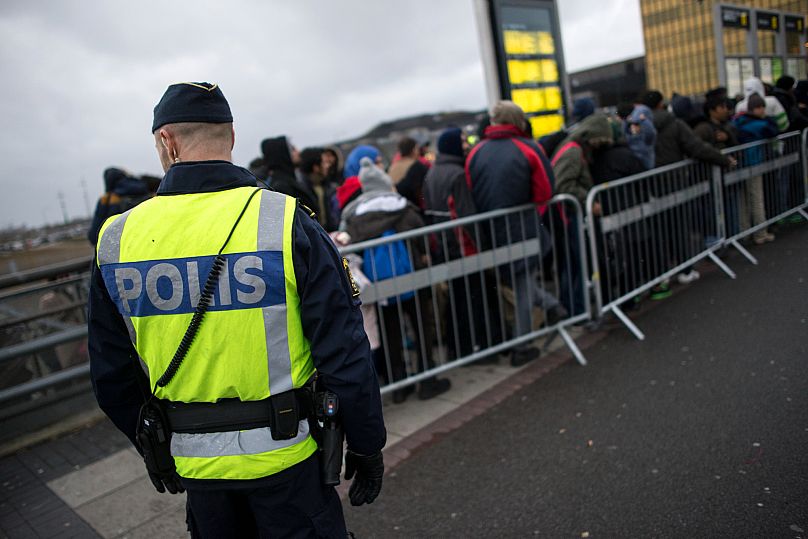
A policeman watches over a queue of newly arrived people at Hyllie station, 19 November, 2015 AP Photo

"This can also create a sense of insecurity when you don't really know how your actions in different situations might be assessed," Elias Nygren, a lawyer working for the organisation, told AFP.

Some organisations worry that certain types of activism may also be considered a breach of "honest living."

"We organise trainings in civil disobedience, that is, in non-violence and the principles that guide our actions. We are finding that this question comes up more and more often," Frida Bengtsson, head of Greenpeace Sweden, told AFP.

"Many people are dropping out because they hesitate to take action due to the current uncertainty. They don't really dare take that risk," she added.

In a satirical op-ed published in newspaper Dagens Nyheter, Swedish writer Gellert Tamas suggested some members of government take a closer look at their own past.

Some of them, he argued, would be candidates for deportation, starting with the migration minister himself.

A family from Syria sleeps outside the Swedish Migration Board in Märsta, 8 January, 2016 AP Photo

"Johan Forssell has 'clear links to an organisation promoting violence'," he wrote, citing the wording in the draft of the bill, "because of his son's former membership in the openly Nazi group Aktivklubb Sverige."

In July 2025, it emerged in the media that Forssell's then 16-year-old son was a member of Aktivklubb Sverige, which the minister said he had not been aware of.

"Forssell's defence, that 'this was about a deeply remorseful 15-year-old, who just turned 16,' would hardly have impressed in an assessment into honest living," Tamas said.

Taking control of migration

Sweden's Prime Minister told Euronews last year that there was an "absolute need to get control on migration."

He reiterated his proposal to significantly increase the amount of money Sweden offers to migrants as a financial incentive to leave the country.

Sweden's Prime Minister Ulf Kristersson arrives for the EU summit at the European Council building in Brussels, 19 March, 2026 AP Photo

The current grant is €900 per adult. However, this initiative has had limited success so far. In 2023, only one out of 70 applications was approved, according to the Swedish Migration Agency.

To reverse this trend, a new government proposal would raise the amount to €32,000, an increase of 3,400%.

Sweden began revamping its asylum policy in 2015, moving to a much stricter stance on application processing after the country hosted record numbers of asylum seekers, more than 160,000 people, from Afghanistan, Iraq and Syria.


Hardt, Michael. Multitude: war and democracy in the Age of Empire /. Michael Hardt and Antonio Negri. p. cm. Sequel to: Empire. Includes index. ISBN 1-59420 ...

Empire / Michael Hardt and Antonio Negri. p. cm. Includes bibliographical ... 4.3 The Multitude against Empire. 393. Notes. 415. Index. 473. Page 11. PREFACE.