Saturday, April 18, 2026

The Paris movement that planted the seeds of Algerian independence, a century on

In 1926, migrant workers in Paris formed a small political group named North African Star, the first movement to call for Algerian independence and freedom from French rule – decades before decolonisation became a reality.


Issued on: 17/04/2026 - 

Algeria’s national flag, featuring a red star, originated with the North African Star movement. AFP - FAYEZ NURELDINE

At the time the group came together, Algeria was part of France, while Morocco and Tunisia were French protectorates. Political and trade union activity was banned in the colonies, forcing activists to mobilise in mainland France instead.

North African Star was created by workers, mainly from Algeria, who had migrated to France, beginning as a mutual aid association defending social rights before gradually becoming political.

Abdelkader Hadj Ali led the organisation, alongside Messali Hadj, who would later become its central figure. Its structure followed labour movement models, with committees and cells, and it maintained close ties with Communist circles active in anti-colonial struggles.

The French Communist Party had created the Union Intercoloniale, a network bringing together activists from the colonies to demand political and social equality. Among them was Nguyen Ai Quoc – later known as Ho Chi Minh.

North African Star grew out of this environment.

“The idea was to say: since every path is closed to us in our country, we will form a first core in mainland France,” historian Alain Ruscio told RFI.

Under France’s admittedly limited democratic freedoms, trade union activity could not be fully banned – allowing North African workers to band together.

The rise of Messali Hadj

By 1927, the movement had adopted a clear political aim. Its programme, presented in Brussels, called for a struggle “all the way to independence”.

Relations with the Communist Party, however, soon became strained.

“They were in the same bed, but did not have the same dreams,” Ruscio said, with the Communists seeing colonial workers as a potential militant force.

French authorities too quickly saw the group as a threat. It was dissolved in 1929 for posing a danger to the state, and its members closely monitored.

Hadj, who had become the movement’s leading figure, spent 22 years under house arrest or in prison.

Born in 1898 in Tlemcen, he had served in the French army during the First World War and joined the Communist Party in his twenties, while remaining a practising Muslim.

“In Algeria, the idea that religious faith and Communist commitment were compatible was deeply rooted,” Ruscio said. Cell meetings would pause for prayer before resuming.

Hadj stood apart from other Algerian political currents, which focused on gaining equal rights within the French system. His aim was independence, led by Algerians themselves.

His influence first grew among migrants in France before reaching Algeria. In 1936, speaking in Algiers, he urged supporters to mobilise and make their voices heard across the Mediterranean.

Algerian Messali Hadj, leader of the MNA (Algerian National Movement) held under house arrest, gives a press conference 4 May 1962, in the courtyard of the Toutevoie castle in Gouvieux, near Chantilly, north of Paris. AFP

Building resistance in Paris


France's Popular Front government again dissolved North African Star on 26 January, 1937. Around 5,000 members were affected and several leaders, including Hadj, were arrested.

The Communist Party supported the decision, marking a clear break with the movement.

During the Second World War, Nazi Germany sought to court nationalist movements in the colonies, but Hadj refused any agreement with the Axis powers.

Although the organisation initially aimed to unite North Africa, it remained largely Algerian in character.

After its dissolution, it reformed under new names, including the Algerian People’s Party and later the Movement for the Triumph of Democratic Liberties.

But divisions emerged over armed struggle. Hadj rejected that path and warned it would lead to heavy losses and ultimately delay independence, Ruscio said.

When younger militants pushed towards armed action, Hadj warned them they were heading towards “a massacre, a bloodbath” and risked repeating the violence of May 1945 in eastern Algeria.
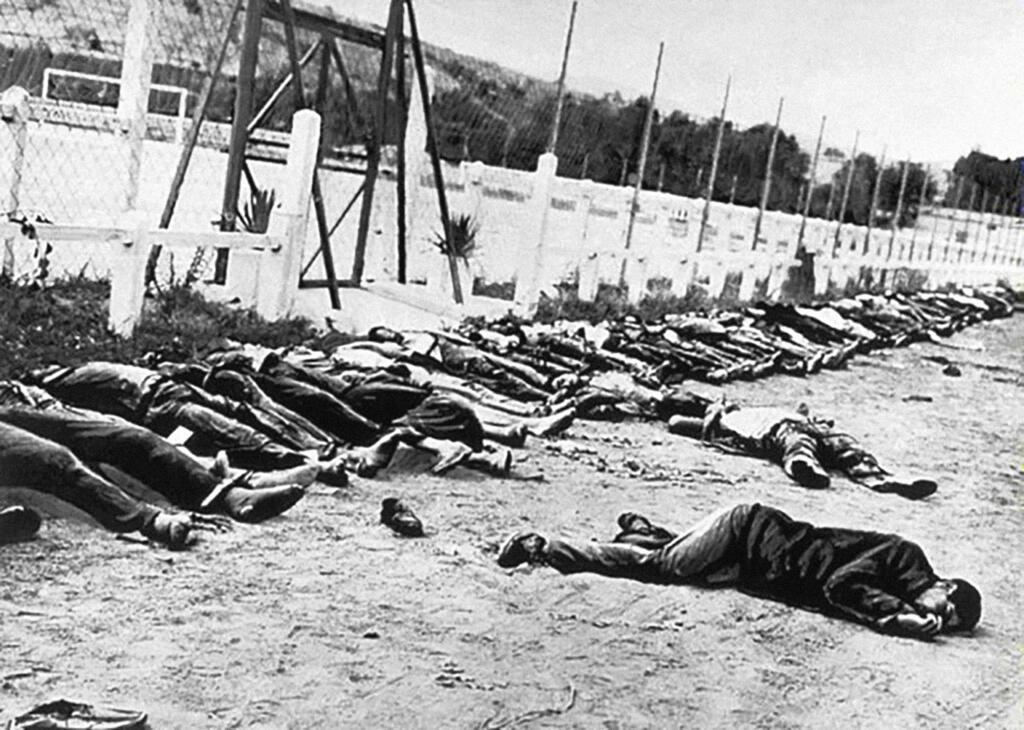
French authorities chose to violently repress the demonstration on 8 May 1945 in Setif, Algeria. © INA

Rival groups later took up arms, including the FLN, the National Liberation Front, leading to violent clashes. Nearly 4,000 deaths were recorded among Algerians in France during the war of independence.

A century after its creation, North African Star has largely faded from public memory – although its legacy remains visible in Algeria’s national flag, which originated with the movement.

This story was adapted from the original version in French by Anne Bernas.


SOUNDTRACK


EU backs Morocco autonomy plan for Western Sahara and eyes new partnership

The European Union has reaffirmed its support for Morocco’s autonomy plan for Western Sahara and is pushing for a new strategic partnership with Rabat to be finalised by the end of the year.


Issued on: 17/04/2026 - RFI

EU foreign policy chief Kaja Kallas and foreign minister Nasser Bourita have agreed to deepen their strategic partnership. AFP - ABDEL MAJID BZIOUAT

EU foreign policy chief Kaja Kallas is on a two-day visit to Rabat for talks both sides described as a moment of consolidation in EU-Morocco relations.

After meeting Moroccan Foreign Minister Nasser Bourita on Thursday, Kallas described Morocco as a “close, reliable, and strategic partner”.

She also repeated the EU’s backing for Morocco’s proposal to give Western Sahara limited self-rule, while Rabat keeps control over defence, foreign affairs and religion.

The EU aligned itself with the Moroccan autonomy plan in late January after lobbying by Emmanuel Macron and, to a lesser extent, Pedro Sánchez, according to Africa Intelligence. The support followed a similar move by the UN Security Council last October.


Autonomy plan backed


Kallas said the plan offers “a realistic and workable” way to resolve the long-running conflict.

“Recent developments, including talks facilitated by the United States in coordination with the United Nations, are encouraging,” she said.

Bourita welcomed the EU’s position, calling it “a particularly significant position and a strong signal” ahead of a UN Security Council meeting on 23-24 April, where the UN mission for Western Sahara, MINURSO, is due to be discussed.

He said Morocco’s proposal is “the only serious and credible basis” for a lasting settlement.

New partnership push

Kallas also called for the “timely finalisation” of a broad partnership between the EU and Morocco, covering trade, investment and migration. “I am confident that we will launch this partnership this year,” she said.

Morocco is the EU’s largest trading partner in North Africa and its largest foreign investor, Kallas said. Rabat is also a major energy supplier to Spain and a key partner on migration.

The EU and Morocco are close to finalising plans for a €15-20 billion rail tunnel under the Strait of Gibraltar.

Talks also covered wider global issues, including the wars in Ukraine and Gaza and instability in the Sahel.

Both sides said they remain committed to multilateralism and a rules-based international order.

Kallas and Bourita agreed to set up a security dialogue at the EU-Mediterranean Regional Security Forum later this year, focusing on counter-terrorism, maritime security and resilience against hybrid threats.
Women victims of Sudan's war bear scars of 'indescribable' violence

Sudan's civil war, now in its fourth year, has been described by the UN as the world's worst humanitarian crisis for women and girls. Sexual violence has reportedly been used as a weapon of war, notably by paramilitaries fighting the Sudanese army. RFI hears from women who have suffered or witnessed "indescribable" violence.


Issued on: 15/04/2026 - RFI

Sudanese women in the el-Geneina camp in West Darfur. © El Tayeb Siddig / Reuters

Twenty-year-old Sarah – not her real name – wears a pink floral headscarf. Her eyes fill with tears as she recounts how the war tore her family apart in her home town of Nyala in Darfur: bodies in the streets, harassment by soldiers from both sides, water and food running out within the first week.

In July 2023, her father left to look for food and never returned. Then the family home was hit by shelling.

“An artillery shell landed on our house. It killed my elder brother and our neighbour’s son," she tells RFI from the Gorom camp in South Sudan, which hosts more than 20,000 Sudanese refugees.

Left alone with her mother and her sisters, she says she was repeatedly harassed by the Rapid Support Forces (RSF). In October, paramilitaries entered their home and attacked her.

“They started with my mother, and my sister was with me. We had hidden my younger sisters behind us. They beat my mother while she was pregnant. While they were trying to assault us and hit us, my mother tried to step in to protect us. They beat her and killed her, even though she was pregnant.”

Three of Sarah’s four sisters later fled and she has had no news of them since.

As for her father, Sarah says she recognised him in a video published by the RSF after the capture of El-Fasher from the Sudanese Armed Forces (SAF) in late October 2025.

He was among prisoners being beaten and summarily executed. As she didn't see him die, she hopes he may have survived.


Witness to horror

RSF militia seized control of El-Fasher, the capital of the state of North Darfur, after more than a year of siege.

According to eyewitness reports, RSF fighters went from house to house asking residents about their ethnicity, and carrying out arrests, summary executions and rapes.

Insaf Oumar Barakat, a nurse at El-Fasher’s Saudi Hospital, managed to flee. “When the RSF entered the city, there was bombing everywhere, people were dying. I was with five women – they had just given birth at the Saudi Hospital,” she tells RFI.

“There were no roads left. People were running in every direction. In the end, only about 20 of us managed to get out of our group. There were many more of us.”

She says what the paramilitaries did to those who couldn't escape is beyond words – some torn apart by gunfire, others kidnapped, and the girls taken away and raped.

“Sometimes there were 10 soldiers on one victim. I even saw them cut off a woman’s breasts. It’s indescribable. It was on the roadside. I know a father whose daughters were raped in front of him. They told him: ‘We won’t kill you, but we will take your women’.”

Lingering nightmares

Some women victims of sexual violence have found refuge with an organisation known as Shama’a. Set up in 2007 in Khartoum by Nour Hussein Al Sewaty Mohammed, who goes by the name of Mama Nour, it provides refuge for single mothers and their children.

But when the conflict broke out between RSF and SAF, Mama Nour was forced to evacuate the women to safer ground in Wad Medani, Al Jazirah state.

Most of those she now cares for are victims of RSF.

“Some of the girls have nightmares. Others suddenly start crying – screaming in the middle of a meal, like a kind of psychotic episode,” she tells RFI. “Their whole bodies are marked – a blow here, a bite, a scratch. What they went through is not human.”

Chaima, 23, went to the shelter after being abandoned by her family in Khartoum.

“From the beginning of the war, my family left me on my own. Then the neighbours left too. Some men came and took advantage of my isolation,” she says. “I was kept prisoner for three months. They tortured me.”

She was later freed by the RSF while pregnant. She’s soon to leave Mama Nour’s shelter to get married, but she has to leave her two-year-old child behind. Mama Nour has decided to adopt him.

“This marriage now means everything to me,” Chaima says. “I will never be alone again.”

This article was based on reporting by RFI's Florence Miettaux
The French archaeologists helping war-ravaged Sudan save its heritage

The war in Sudan, now in its fourth year, has seen thousands of people killed and millions displaced. Alongside the human toll, there are concerns too for the country’s abundant archaeological sites and artefacts, at risk from trafficking and destruction. Now France is helping develop innovative tools to preserve Sudanese heritage for future generations.


Issued on: 18/04/2026 - RFI

The ancient pyramids of Meroe, in Sudan. © Faïza Drici
02:55


By: Ollia Horton

For French archaeologist Marie Millet, head of the Louvre Museum’s Department of Egyptian Antiquities, Sudan "is a country with an exceptionally rich heritage".

Like her colleagues, she is concerned by the effects of more than three years of war, which have seen museums and archaeological sites come under increasing threat from vandalism, looting and even destruction.

International organisations are now stepping up efforts to defend a heritage that is important not just for the Sudanese people, but for humanity as a whole.

Archaeological ruins of the former royal city of Meroe, in Sudan. © Marie Millet

Education in the field

Understanding the importance of preserving this heritage should start in schools, according to Millet.

Studying Sudan’s history "helps us better understand all of antiquity", she says, and connects two worlds: "Mediterranean antiquity and African antiquity, which is rarely discussed, but which truly exists."

France has a long history of collaboration with Sudan in the heritage sphere, from exploration to research grants, funding and logistical support. The Louvre is one of several bodies involved in educational projects intended to inspire the next generation to become the guardians of their own history.

"This is the only way to preserve memory and to understand that we are all truly part of a history," says Millet. "There's less division when people understand that history belongs to everyone."

Race to save Sudan's plundered heritage as museums fall victim to war

The latest innovation is the development of "educational briefcases" containing life-sized replicas of historical items, made in Paris using a 3D printer.

The first of these kits is designed to help Sudanese colleagues in the field visualise aspects of history and present them to students in a more dynamic, interactive way.

Millet says the kits are multi-sensory and represent a number of aspects of life along the Nile. "In Sudan, there are different scents – like honey, for example. There's the sound of a hippopotamus and other aspects of daily life."

The second briefcase is geared towards Sudanese archaeologists, who can use it to broaden their own understanding of history across the ages and the relationship between countries in the region through time.

The kits arrived in Sudan in January and are initially being rolled out at the University of Meroe, before being used elsewhere if the political situation allows.
An educational briefcase with replicas made by the Louvre museum in Paris, to help educate people about Sudanese heritage and ancient history. © Nicolas Bousser

Identity as a weapon


The civil war in the country, which broke out in April 2023, is being fought between the Sudanese Armed Forces (SAF), loyal to President Abdel Fattah al-Burhan, and the paramilitary Rapid Support Forces (RSF) of former officer Mohamed Hamdan Daglo – known as Hemedti.

Previously the pair had been allies who helped bring about the ousting of former leader Omar al-Bashir in 2019. With his downfall came hopes for a new phase of democracy, but this has stalled by the war being waged by the two factions.

The effects of this have extended to the country's cultural assets. When the RSF took control of the country's capital Khartoum in 2023, the Sudan National Museum was looted – with around 4,000 items stolen and some trafficked abroad.

Sudan’s war reshapes loyalties as civilians see ‘no option’ but the army

Ikhlass Abdelatif, director of the museums section of the National Corporation for Antiquities and Museums (NCAM), says the war poses a direct threat to Sudanese identity.

"This militia is using our history and our identity as weapons against Sudan. They want to change the demography and change history itself," she told RFI.

Speaking from Cairo, where NCAM has set up its headquarters in exile, she says her colleagues are busy gathering information on the ground. While a large number of looted artefacts have been recovered, many more remain unaccounted for.
A clothing pin used by ancient civilisations in Sudan. © Musée du Louvre / Christian Décamps

Rescue excavations

Compared with Egypt, whose ancient history has been a part of popular culture since colonial times, the history of Sudan is lesser known.

Millet explains that part of the mystery stems from the remoteness of sites in Sudan. "Egypt, for example, is on the Mediterranean coast. But to reach the furthest reaches of the Nile [in the 19th century], you had to travel upriver. And so it was a bit more complicated."

Millet’s latest archaeological project is focused on a site known as El-Hassa, some 180 kilometres from Khartoum. It is yet to be properly analysed, as the digs there were interrupted first by the Covid-19 pandemic, then by the civil war. Specialising in the study of ceramics, she is keen to return, having made her last visit to the site in 2022.

Archaeological digs at the site of El Hassa, Sudan. © Bernard Noel Chagny


While the regions in the north where these digs are being carried out has been less directly affected by the war, they have faced other pressures. Many people displaced by the conflict have sought refuge in the north – and are using archaeological sites to set up new housing and agriculture.

Millet notes that her colleagues have had to raise awareness about heritage and protecting it, after graffiti was seen on the pyramids of Meroe. Teams have also had to carry out last-minute rescue excavations before land was cultivated for much-needed crops and homes.

The challenge of preserving Sudan’s rich heritage for future generations
Online access

Recognising the difficulties on the ground, educational projects aimed at preserving and sharing Sudan's heritage are also being set up online, with French teams working on two virtual platforms in collaboration with Sudanese institutions.

The first makes files and documents accessible to researchers and archeology students, while the second is a virtual museum portal for the general public, which opened its first phase in January.

This has been coordinated by the French Archaeological Unit for Sudanese Antiquities, funded by France’s Ministry for Europe and Foreign Affairs and hosted by the French Culture Ministry – with a digital reconstruction of rooms and the placing of objects in chronological order carried out by the Graphic Arts and Heritage department of the Louvre.

The Kingdom of Napata gallery, as seen on the Sudan National Museum virtual portal which went online in January. © Sudan National Museum / SFDAS


The first phase has been completed, with around 500 items from prehistory to the Kingdom of Napata. The second phase – to go online later this year – will integrate new galleries, covering the kingdom of Meroe and the medieval period, as well as showcasing Franco-Sudanese cooperation on archaeological missions active before the war.

Faïza Drici, who is overseeing the development of the virtual museum, says it is also an important tool for customs authorities, the police and Interpol, allowing them to identify pieces to prevent them from being sold to traffickers.

She says the virtual museum has been met with enthusiasm by the Sudanese people, especially schoolchildren. Despite the war, school classes have continued and the teaching of the country's heritage has relied heavily on these programmes.

"One of the virtual museum's key features was its accessibility on various devices, such as smartphones," Drici said. "This allows people still in Sudan to access the museum directly on their phones."

For Drici and Millet, it is important to underline the "essential work" done in the field by the Sudanese colleagues, who not only protect digs in the field, but relay important information to others now outside the country.

"No one prevented us from continuing to work with our colleagues. So that's really what this collaboration is all about," concludes Millet. "It's a good thing. It means that, in a way, the scientific aspect prevailed over the political one."
European Union still exporting banned pesticides despite health risks

The European Union continues to export pesticides that it has banned for health and environmental reasons – sending more than 122,000 tonnes abroad in 2024, as a promised EU law to stop the trade remains stalled.


Issued on: 18/04/2026 - RFI

Pesticides banned for health and environmental risks in the European Union are still produced and exported abroad, with more than 122,000 tonnes shipped in 2024 alone.
© mladenbalinovac / iStock Image

The figures are based on export notifications filed by companies and compiled by the Swiss NGO Public Eye, offering one of the clearest pictures of the trade.

They show that exports have continued to rise in recent years, even though the European Commission pledged in 2020 to end the practice.

The issue exposes a contradiction at the heart of EU rules.

“When a product is banned, only its use is banned on European soil. But manufacturers can continue to produce these products,” Public Eye investigator Laurent Gaberell told RFI.


Part of the increase is linked to the EU banning more pesticides over time. While those substances can no longer be used on European farms, companies are still allowed to produce them and sell them abroad.

Europe is a major player in pesticide production, with a long-established chemical industry, particularly in Germany – as well as Switzerland, outside the EU.

Most of the exports are sent to developing or middle-income countries, including Brazil, India, Morocco and South Africa, where regulations are less strict and protections for farmers are weaker, Public Eye found.


'No protection, no awareness'

Pesticides removed from the European market can pollute groundwater, kill bees in large numbers, cause cancer, harm fertility or poison farmers, according to Gaberell.

In many of the countries they are exported to, farmers are exposed to serious risks when using them.

“In rural India, you see farmers applying these pesticides with no protection at all – no mask, no gloves, no goggles, often barefoot,” Gaberell said.

“These are extremely dangerous pesticides, too dangerous even for European farmers using all the protective equipment available. You can imagine the risks for Indian farmers using them with no protection at all, and often with no awareness of the dangers.”

In Brazil, aerial spraying of pesticides – banned in Europe except in limited cases – is widely used. Pesticides are released from aircraft and carried by the wind, drifting beyond the fields they are meant for. Living near farmland, or going to school nearby, can mean being exposed.


Double standard

In 2020, the European Commission promised to bring in a law banning the export of banned pesticides, but this is yet to be adopted.

Industry pressure is one reason for the delay, according to Gaberell, who also said shifting political priorities has seen the issue drop down the agenda.

“There has been strong pressure from industry. There is major resistance from the European chemical industry,” he said. “We are worried the commission may go back on its 2020 commitment.”

He said this reflects a double standard in EU policy.

“These are the most dangerous pesticides in the world... But we choose to look the other way to protect our industry.”

Europe also imports agricultural products from the countries to which it exports these dangerous pesticides – meaning they can return indirectly through imported food.

Mass drone warfare is Europe’s rising security threat

A drone in the war between Russia and Ukraine
Copyright Copyright 2026 The Associated Press. All rights reserved.

By Leticia Batista Cabanas & Elisabeth Heinz
Published on 

France has just announced an €8.5 billion investment to increase drone and missile stocks by 400 per cent before 2030. The move joins Germany’s decision to invest €10 billion in military drones and Poland’s recent “drone revolution” initiative.

Modern wars consume drones at a much higher rate than traditional ammunition. Ukraine uses approximately 9.000 drones per day, roughly 270.000 units monthly. Estimates suggest that Iran can produce approximately 400 Shahed drones per day, for a monthly capacity of up to 12.000 units.

This staggering churn is pushing the EU towards mass-scale industrial production, as existing drone stockpiles and manual manufacturing cannot keep pace with battlefield losses.

The bloc’s inability to scale production is creating a strategic dependency on external suppliers like the US or China, leaving its borders vulnerable to disposable, "cheap" warfare that the current industrial pace cannot sustain.

To counter this vulnerability, the EU has launched the 2026 European Drone Defence Initiative (EDDI), to build a multi-layered, 360-degree shield of interoperable counter-drone systems by 2027.

Complementing the EDDI is the Drone Alliance with Ukraine, which leverages battlefield-tested expertise to co-produce millions of unmanned aerial vehicles (UAVs).

Utmost strategic importance

Drones went from niche tools to key war instruments because of three advantages: low cost, constant surveillance, and precision strike capability.

In Russia’s invasion of Ukraine, both sides rely on drones for reconnaissance and targeting. Commercial quadcopters, which can cost just a few hundred euros, spot enemy positions and guide artillery in real time. This shortens the time between detection and destruction from hours to minutes. Larger systems, such as Turkey’s Bayraktar TB2, were used to destroy supply convoys and air defence systems early in the conflict, which set a new international war standard.

“Drones evolve technologically every three to six months. So, it's also challenging to buy millions of drones that will be obsolete in 12 months from now”, shared Nikolaus Lang, Global Leader at BCG Henderson Institute.

Drones are cheap to produce, but expensive to defend against. In traditional wars, destroying a target required expensive aircraft or missiles, until Ukraine showed that today, a cheap “kamikaze” drone can destroy equipment worth millions.

Russia used many Iranian Shahed drones, each relatively inexpensive, to strike Ukrainian infrastructure. But defending against them requires pricey air-defence missiles or fighter jets, which creates a strategic imbalance where the defender spends far more than the attacker.

“Europe needs cheaper and quicker solutions”, said Jamie Shea, former NATO official, Senior Fellow at Friends of Europe and Senior Advisor at the European Policy Centre in Brussels. “The EU uses very expensive means to neutralise drones. You've seen in Iran, where $3 million missiles are used to shoot down drones of just a couple of thousand dollars”, he said.

European drone investment over the last decade

Military analysts from the Centre for Strategic and International Studies describe drones as one of the most disruptive economic shifts in warfare in decades.

Drones also democratise air power. In earlier conflicts, only advanced dominated the air, but this changed during the Nagorno-Karabakh War as Azerbaijani forces used drones to systematically destroy Armenian tanks and artillery.

In the Gaza Strip, both state forces and non-state actors use modified commercial drones for surveillance and attacks. Now even relatively small or poorly equipped groups can carry out aerial operations, which lowers the barrier for effective military force.

Europe falls behind

For Europe, urgency stems from external threats and internal weaknesses. Drone incidents near critical infrastructure quadrupled between 2024 and 2025. In September, Copenhagen and Oslo closed airports after “several large drones” caused 109 cancellations and 51 reroutes. A month later, Munich Airport closed twice in 24 hours for the same reason.

The strategic concern is that the EU is not yet structured for a “drone-saturated” battlefield or security environment. Recent incidents forced costly responses: for example, in September of 2025, approximately 20 Russian drones entered Polish airspace, so NATO deployed F-35 fighter jets to neutralize the threat, which cost at least €1.2 million.

To avoid this, Shea explained that the EU should develop advanced sensor technology, including a 360-degree sensor aperture that shoots down malicious drones.

Ramping up production

The EU supplies less than 30 per cent of its own military drone needs. By comparison, China and Ukraine produce millions of units annually, while the US is scaling up to hundreds of thousands.

To address this, the Commission launched an industrial push to fundamentally restructure drone design, production, and deployment. The goal is scale: faster production cycles, higher volumes, and lower costs, because modern drone warfare is less about sophistication and more about quick, adaptable mass production.

Traditional European defence procurement is slow, often taking years from concept to deployment. This approach seeks to shorten timelines through modular designs, faster testing, and continuous upgrades, enabling rapid drone adaptation. So, the Commission introduced AGILE (fast-track funding), the EU Defence Innovation Scheme, and BraveTech EU.

Estimated percentage distribution of EU drone investments

Low-cost production is another pillar, with initiatives focused on affordability, scalability, and dual-use manufacturing. The EU is engaging civilian industries (e.g., automotive, electronics) and SMEs, which are more agile than large contractors and better suited to rapid prototyping and innovation. Funding tools will support efforts across member states.

Europe has massively levelled up its defence R&D investments, but it's still not enough, according to Lang. He pointed out that the “US invested more than $900 billion, Europe only $450 billion altogether”.

The EU will also rely on the Drone Alliance with Ukraine; a 2024 multinational military partnership created to secure Ukraine's UAV supply through constant deliveries of drones tailored to frontline requirements.

The Alliance allowed the EU to establish a network of factories for Ukrainian-designed drones on European soil. So European firms can bypass traditional bureaucracy by testing new prototypes on the front lines in weeks rather than years.

The alliance is boosted by billions from frozen Russian assets, specifically set to scale up production of low-cost autonomous systems. This collaboration wants to deliver over two million drones annually by 2030.

These initiatives should reduce dependence on non-European suppliers, alongside efforts to secure supply chains for critical drone components (like semiconductors, sensors, and communication systems) within EU borders and among trusted partners.

A key tool is the planned “EU trusted drone” label, to certify systems that meet security and reliability standards. It’s designed to guide procurement decisions, encourage the use of European-made technologies, and ultimately create a more self-sufficient and resilient drone ecosystem.

EU policy meets military drones

Russia’s violation of NATO airspace (37 times since 2022) and the war in Iran pushed the EU to start redefining its defence strategy, shifting from civil drone regulation to security measures and funding initiatives.

The Commission’s 2026 Action Plan on Drone and Counter-Drone Security addresses the use of drones in conflicts that target critical infrastructure, borders, and airspace. It targets the EU’s real-time detection capacities and develops a unified defence approach against malicious operations.

It also boosts member states’ industrial cooperation and drone markets to reduce dependence on non-EU suppliers. Investing in the small niche companies, where innovation lies, is key. “Europe needs to create greater risk, expand our venture capital market, and simplify procurement regulatory barriers”, Shea argued.

The roadmap focuses on four priorities: boosting resilience through industrial ramp-up, improving threat detection through stronger surveillance, responding and defending with a coordinated strategy, and strengthening the EU’s defence readiness.

Estimated annual drone production (EU versus Russia)

Detecting and tracking threats requires advanced AI-powered technological infrastructure. The Commission foresees accelerating technological development by using 5G networks to improve real-time threat detection.

The action plan is strong as “it identifies the problem and mobilises resources”, Shea said. Yet the EU needs to learn from Ukraine’s drone strategy: “Ukraine is doing 50 per cent of the work for us. It's developing the intelligence and offering to share sensitive data. It's also showing Europe how AI should be integrated into counter-drone technology”.

The EDDI is a key part of the action plan, and it acts as a shield for the bloc’s airspace. Through its multi-layered, interoperable system, the initiative detects, tracks and defends the EU from hybrid threats and drone incursions.

Running on AI-powered sensing and counter-drone technologies, the EDDI supports the Eastern Flank Watch, which is also part of the Commission’s Defence Readiness Roadmap 2030. It is an EU-NATO initiative to protect the EU's border with Russia and Belarus, using specialised counter-drone technologies and boosting air defence, surveillance, and rapid threat response while improving cooperation with NATO operations, such as Eastern Sentry and Baltic Air Policing.

Security and defence remain national

Though the EU is shifting towards scalable, networked, AI-driven, and mass-produced warfare equipment, defence and security remain national, meaning that member states have individual defence priorities and budgets. Fragmented national procurement practices, critical infrastructure protection, and different rules governing drone and counter-drone systems obstruct Europe’s new defence strategy.

Shea warned that Europe should establish a common legal framework so that all member states can develop and test drone technology equally.

“European states need to monitor the same airspace all the time, so that somebody in France is looking at the same air picture as somebody in Poland or Estonia”, he underlined.

Another issue? Fragmented national investments in drone innovation. “Some countries, like Denmark or Germany, have been much more upfront than others, also in forming joint ventures with Ukrainian manufacturers”, Shea said.

Likewise, 80 per cent of EU procurement is at national level. “We need many more of these initiatives to overcome the fragmentation of defence procurement”, warned Lang.

According to Shea, the EU should also eliminate bureaucratic obstacles to enable sensitive information sharing, such as drone threat intelligence and airspace monitoring, between member states.

“Drones are getting faster and sharing information is fundamental, but the EU needs to ensure safe security protocols to encourage countries to share data”.


Drone warfare: Europe’s new security threat

Euronews
Copyright Euronews

By Evi Kiorri & Mert Can Yilmaz
Updated 

Paris will quadruple its kamikaze drone arsenal by 2030, as the EU accelerates restocking efforts amid rapid advancements in drone technology. Watch the video

Ukraine forced a rewrite of Europe's defence. Drones costing a few hundred euros wiped out tanks worth millions. Iranian loitering munitions, piloted remotely and programmed to strike, broke through air defences. Missile reserves that seemed robust on paper evaporated in months.


France saw the warning signs up close. After launching air-defence missiles in the Gulf to counter Iranian drones, Paris discovered its own arsenal running critically low. In response, €8.5 billion is ringfenced for drones and missiles by 2030.

Under the Readiness 2030 plan, the European Drone Defence Initiative is deploying counter-drone systems, including electronic warfare, lasers, and mass interceptors, to neutralise low-cost threats without depleting expensive munitions.

A layered missile shield is under development to provide coverage across all ranges. MBDA has committed to increasing output by 40 percent this year. The EU's SAFE mechanism is co-financing production lines and joint procurement, with France eligible for €15 billion under the scheme.


Drone tech evolves every 3-6 months, leaving Europe buying outpaced systems

Germany Ukraine Drones
Copyright AP Photo

By Evi Kiorri
Published on 


The war in Ukraine made clear that drone technology evolves faster than governments can buy it. Can defence systems keep up?

Before Russia’s invasion, no European military fielded more than 2,000 drones. Now, both armies are burning through up to seven million units a year. Drones have vaulted from niche gadgets to the backbone of modern warfare, and Europe is racing to catch up.

The numbers alone show an extraordinary transformation. Ukraine doubled drone output from 2.2 million in 2024 to 4.5 million in 2025. But sheer volume is only half the battle. The real race is technological; the guts of these machines are obsolete almost as soon as they roll off the line.

"Drones evolve technologically every three to six months," says Nikolaus Lang, Managing Director and Senior Partner at BCG and Global Leader of the BCG Henderson Institute. "So, it's also challenging to buy millions of drones that will be obsolete in 12 months from now." This creates a procurement paradox that no ministry of defence has yet fully solved: by the time a contract is signed, the system it covers may already be outdated.

Countries like Finland are discovering how fast software, communications, navigation, and counter-jamming technologies can age out of strategic usefulness. Ukraine’s battlefield has become the world's most brutal testing ground, and Ukrainian teams have shortened their design and deployment cycles from months to weeks, allowing real-time battlefield feedback to directly inform engineering improvements in successive drone generations.

This has driven a cat-and-mouse cycle of adaptation: fibre-optic drones were something of a novelty in 2024, yet by 2025, Russian production of just one model reached at least six thousand units per month. The pace is dizzying, and Europe's traditional procurement machinery was not built for it.

The exploitation gap

Here lies Europe’s core vulnerability. The continent leads in research, churning out world-class papers in AI, quantum tech, and telecoms. But academic output does not win wars. Europe’s labs are not translating breakthroughs into battlefield systems.

"Europe is in the exploration world, and the US is in the exploitation world," Lang says. Washington has invested roughly $70 billion in defence venture capital over the last decade. Europe has invested approximately $7 billion, one-tenth. That capital gap translates directly into a capability gap. The Pentagon showcased multiple American-made drone prototypes in June 2025, built with off-the-shelf components and developed in an average of just 18 months, a process that typically takes 6 years.

The US also benefits from a single, unified procurement market worth over $900 billion annually. Europe's combined defence budgets amount to around $450 billion, but they are spread across dozens of national procurement systems. "The 900 billion is one market. The 450 billion is all the EU markets together," Lang highlights.

Today, 80% of European procurement remains at the national level, and 90% of defence R&D is funded at the national level. The result is duplication, fragmentation, and an inability to achieve the scale required to turn research into real-world capability.

Sovereignty complicates matters. Many European drones use Chinese components, a dependency that worries NATO allies and raises supply chain concerns.

A five-to-ten-year journey

Analysts agree that Europe could build a sovereign defence technology stack, but not quickly. Lang, co-author with General Lavigne, sees it taking "probably five, but more likely ten years." NATO is already establishing drone innovation hubs and joint programs to standardise swarm tactics, AI, and resilient communications.

The goal is to close the gap between Europe’s research and its slow deployment. That requires more capital for startups, faster procurement, and accepting that in drone warfare, perfect can be the enemy of timely.

"Ukraine is innovating at wartime speed," Lang warns. "Europe is still in peacetime speed." Changing that rhythm, before the next crisis forces the issue, is the defining defence challenge of this decade.


The EU is boosting drone production - is it ready for war?

Unmanned aerial vehicles in the sky in Russia
Copyright AP Photo

By Leticia Batista Cabanas
Published on 

Is the European Union doing as much as it can to protect its citizens?

Modern warfare has evolved way beyond basic weapons, and unmanned drones are now central to conflict. The EU is increasing drone production to defend Europeans against these changing threats.

Recent wars, like Ukraine and Iran, show that drones are used in large numbers and quickly depleted. But European countries still rely heavily on foreign suppliers for drones, creating strategic vulnerability.

The EU wants to reduce this dependence by building its own industrial capacity, and introducing new funding programs to support drone manufacturing, like the European Defence Industry Programme. It’s also coming up with new subsidies to boost key components used in drone systems, and faster funding mechanisms to support startups and innovation.

A key priority is drones. Drone have become a priority and the EU is rushing to develop and test new technologies, by working with partners like Ukraine, to build joint initiatives and to create a shared industrial ecosystem for production.

It’s also investing in systems to detect and stop hostile drones, and developing new standards to ensure drones are secure and reliable. Expanded surveillance programs will use drones to monitor borders and infrastructure.

Can the EU shift from regulation to large-scale production, to strengthen its defense capabilities? Our poll is anonymous and takes just a few seconds to complete. The results will feature across the EU. XL coverage -in videos, articles, and newsletters- and will help shape our reporting as we explore how Europe can secure its place in the age of artificial intelligence**.**