Sunday, April 19, 2026


Zim's Employees Go Out On Strike as Hapag Merger Moves Forward

ZIM
File image courtesy ZIM

Published Apr 17, 2026 6:29 PM by The Maritime Executive


Employees of Israeli shipping firm Zim have gone on strike to protest the labor terms of the firm's sale to Hapag-Lloyd, according to local media. Union officials told CTech that they are concerned that Hapag-Lloyd wants to offer early retirement to many longtime employees instead of keeping them on. 

On Thursday, about 900 of Zim's employees went out on strike amidst talks on a new collective bargaining agreement for the workers' union. On the side of management, Zim, Hapag-Lloyd and the Israeli investment fund FIMI are all involved in the discussion, according to Israeli business news outlet CTech. The walkout covers almost all of Zim's employees in Israel, and has reportedly shut down the carrier's local operations.

The $4.2 billion merger deal will see Hapag-Lloyd and FIMI buy all of Zim and delist it from the NYSE. Hapag will keep most of the line's global operations and chartered-in tonnage; FIMI will keep Zim's routes to and from Israel, along with its owned tonnage, preserving the carrier's national-defense role.

The sale was controversial from the start, as Zim is part of the origins, identity and security of the modern state of Israel. Critics have warned that the surviving Israeli-owned component of Zim will be too small to prosper, and that the transition will lead to downsizing and layoffs.

It is the second time that the union has initiated labor action since the deal was announced. In mid-February, the workers committee at Zim staged a "warning strike" in protest of the deal and the prospect of job losses, supported by the Histadrut (General Federation of Labor in Israel). The strike ended after the two sides agreed on a $300 million severance package for 500 affected workers. 

"ZIM is not just another company in Israel. It is a strategic asset of the State of Israel, representing a critical link in national security, in the stability of supply and in the ability to maintain trade by sea even in emergencies. Any harm to the stability of the company or to its employees means harm to the national interest of the State of Israel," said the Histadrut in a statement during the February strike.  

The union will soon have different company leadership to negotiate with. Zim CEO Eli Glickman, a previous and unsuccessful bidder for ownership of the shipping line, has announced plans to step down after a six-month notice period. The company's board is searching for a successor. In a statement, Glickman said that he, too, disagreed with the company's sale. 

"In recent months, the Board promoted a merger process with Hapag-Lloyd. While I respect this direction, after careful reflection, I concluded that I cannot continue as CEO. Leadership, to me, is not a title – it is a commitment that must align with the road ahead," he said in a statement. 


Canada Investigates Bridge Allision on the Welland Canal

Welland Canal
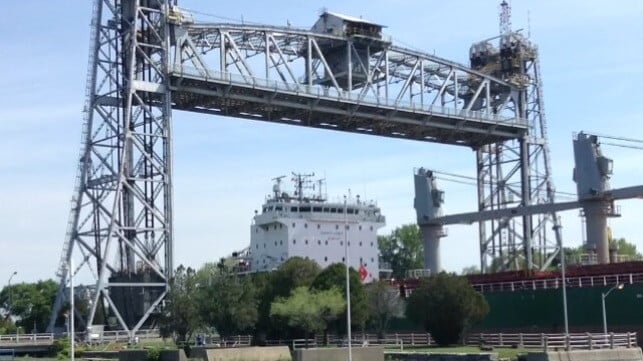
Bridge 21 (file image courtesy Cameron Whitehall / CC BY SA 4.0)

Published Apr 17, 2026 11:42 PM by The Maritime Executive


Marine investigators in Canada have launched an investigation after a general cargo vessel struck a bridge while transiting the busy Welland Canal in Port Colborne, Ontario.

The Transportation Safety Board of Canada (TSB) said it was deploying a team of investigators following the incident involving cargo vessel BBC Tokyo, which came into contact with the Clarence Street Bridge (also known as Bridge 21) while transiting the canal on April 16.

"The TSB will be gathering information and assessing the occurrence," the board said in a statement, without providing further details.

Reports in Ontario indicate the vessel made contact with the east side tower of the bridge while heading downbound in Port Colborne around noon. This prompted the St. Lawrence Seaway Management Corp. to close the bridge for several hours as a precaution.

Immediate assessments showed no major damage to the bridge, and it was reopened about 10 hours later. There were no injuries reported or impacts on the environment. Bystander photos suggest that the BBC Tokyo sustained scrapes along the starboard side. 

Owned and operated by German shipping company Briese Heavylift, the 149-meter BBC Tokyo is a multipurpose heavylift vessel that transports a wide range of cargo, including wind turbine blades. The ship is designed for specialized transport through confined waterways such as the Welland Canal.

Investigators will seek to determine the circumstances in which the vessel struck Bridge 21, one of two vertical lift bridges constructed in Port Colborne in 1929 to accommodate traffic over the canal. The construction of the Port Colborne harbor railway in the mid-1990s meant that Bridge 20, which connected Port Colborne to railway lines on the western side of the canal, was no longer necessary; it was removed in 1997.

Bridge 21, which was designed for cars and connects the east and west sides of the city, has remained in use and is one of three operating vertical lift bridges over the canal, which is part of the St. Lawrence Seaway.

The canal is a busy waterway with about 3,000 ships transporting approximately 40 million tonnes of cargo annually. It has been rebuilt many times over the years to accommodate larger vessels.

BBC Tokyo's strike on Bridge 21 is the latest incident in which a ship transiting the canal has come into contact with a bridge. In August 2001, the lake freighter Windoc collided with Bridge 11 in Allanburg, closing vessel traffic for two days. The accident destroyed the ship's wheelhouse and funnel, ignited a large fire on board, and caused minor damage to the vertical-lift bridge.

Another incident occurred in September 2015 when the cargo ship Lena J collided with Bridge 19 in Port Colborne, forcing its closure to vehicle and pedestrian traffic for months.

Top image: Bridge 21 (file image courtesy Cameron Whitehall / CC BY SA 4.0)


Can Coral be Bred for Better Tolerance to Heatwaves?

Coral bleaching
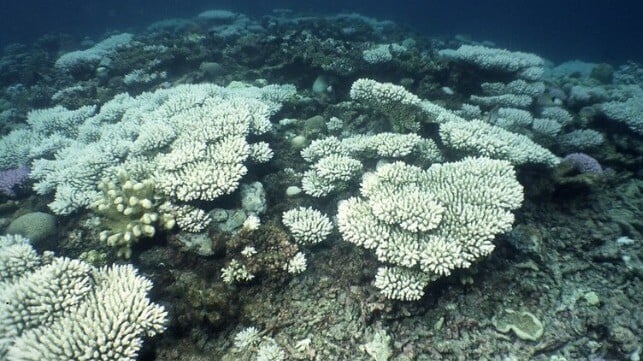
Without intervention, coral bleaching poses an existential threat to reefs

Published Apr 17, 2026 5:18 PM by The Conversation


[By Liam Lachs, Adriana Humanes and James Guest]

As global warming accelerates, extreme heatwaves are causing widespread death of tropical reef corals. Most corals rely on tiny algae cells living within their tissues that photosynthesise and produce energy. Corals use this energy to build their skeletons that create the reef structure.

In our warming world, evolution of heatwave tolerance will be critical for coral populations to persist. Natural adaptation occurs over many generations and is probably already under way. But these adaptation rates could be outpaced by ocean warming.

Scientists and reef managers are now calling for “assisted evolution” to help accelerate adaptation. One promising approach is selective breeding to enhance heatwave tolerance.

Our new study explores how such interventions could help corals withstand future heatwaves.

By examining the genetic basis of heat tolerance and other important life history traits including growth, energy reserves and reproduction, we reveal both the potential, and limits, of evolutionary adaptation to extreme heat stress. This work focuses on a captive-bred coral population we reared over eight years in Palau, an archipelago in the west Pacific.

The field of quantitative genetics can shed light on complex traits such as growth and heat tolerance, which are typically influenced by hundreds to thousands of genes. These tools can help us maximise evolutionary responses to selection, and have long been used in agriculture and animal breeding – from the crops we eat to the dogs we have at home.

Two key concepts are central. “Genetic merit” describes the value of an individual for breeding, and “genetic correlations” describe how traits share their underlying genetic basis.

Estimating these requires measuring certain traits like heat tolerance, and collecting information about relatedness among individuals, such as full- or half-siblings. But this is difficult in wild corals, which disperse widely and are typically unrelated to neighbouring individuals on the reef.

Our captive population, containing both related and unrelated individuals, provides a rare opportunity to apply quantitative genetics to adult corals.

Imagine a major heatwave has caused widespread coral mortality. Which corals should we select for propagation or breeding? dChoosing survivors seems intuitive, but survival alone does not guarantee a genetic predisposition for heat tolerance. A coral could survive by chance – perhaps it was shaded or had higher energy reserves, while all its relatives died. Selecting such individuals for breeding would fail to improve heatwave tolerance of future generations.

However, if entire families tend to survive or perish together, that indicates a genetic basis for heatwave tolerance. Using quantitative genetics in such cases can help make more informed choices.

But if no natural heatwave occurs, how can we proactively identify good corals for management? To do this, we need a proxy: an easy-to-measure trait that is genetically correlated with — and so predicts — an individual’s genetic merit for heatwave survival.

We tested coral heat tolerance under four different temperature exposures, ranging from a month-long exposure of 32.5°C to a rapid heatshock reaching 38.5°C.

These high experimental temperatures go beyond what happens in nature. As the simulated conditions grew hotter, we found ever weaker genetic correlations with marine heatwave survival. These tolerance traits exhibit somewhat distinct underlying biology, so careful trait choice is essential. Testing the wrong proxy traits to identify target corals will fail to deliver any heatwave survival enhancement.

But adaptation involves more than just heat tolerance. Individual growth, energy reserves and reproduction are all critical for healthy populations. If enhancing heat tolerance comes at the cost of traits like these, it would undermine population viability.

Encouragingly, we found no detectable negative genetic correlations among any of the traits we studied.

Matching future stress

To explore how assisted evolution could enhance heat tolerance over time, we developed a computer simulation. This showed us it was possible to reach tolerance levels capable of withstanding future heatwaves, but only under certain conditions.

Selection needed to directly target long-term heatwave survival. This meant choosing only the top 5% most tolerant corals as parents for breeding, and it had to be repeated over multiple generations.
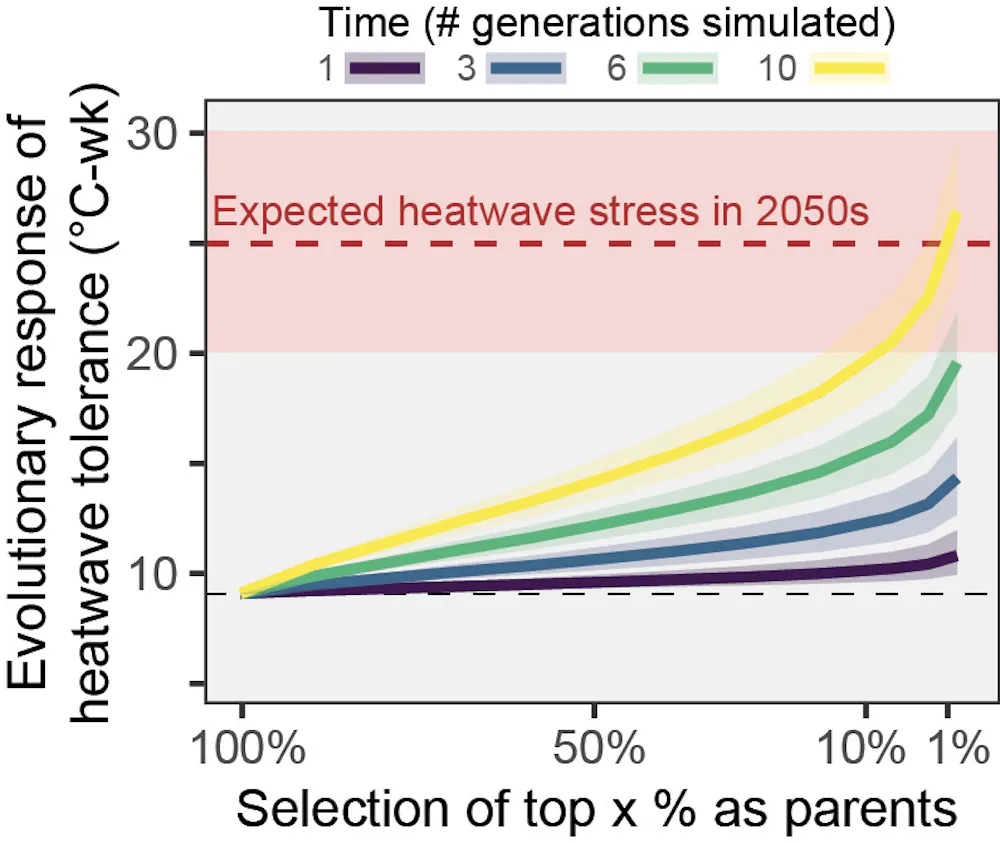
Evolution of heatwave tolerance in response to selection across ten simulated generations (blue-yellow). Expected future heatwave stress is shown in red. CC BY-NC-ND

But such intense selection introduces other challenges, such as maintaining genetic diversity and scaling up selection efforts. If we need to breed from 50 corals to maintain genetic diversity and do only top-5% selection, then we need to test 1,000 corals. That becomes logistically very challenging.

Our modelling results show assisted evolution can deliver meaningful gains in coral heatwave tolerance. But success will depend on careful trait choice and strong, sustained selection.

Reducing greenhouse gas emissions remains essential to mitigate future warming. Alongside this, strategic management of local ecosystems — from conservation to assisted evolution — will be crucial to help key species adapt and persist in our rapidly warming world.

Liam Lachs is Postdoctoral Research Associate in Climate Change Ecology and Evolution, Newcastle University.

Adriana Humanes is Postdoctoral Research Associate in Coral Reef Ecology, Newcastle University, Newcastle University.

James Guest is a Reader in Coral Reef Ecology, Newcastle University.


This article appears courtesy of The Conversation and may be found in its original form here

The Conversation

The opinions expressed herein are the author's and not necessarily those of The Maritime Executive.
More Teens Used Cannabis After Adult Recreational Use Was Legalized In California


April 19, 2026 
By Eurasia Review

Teen cannabis use in Northern California increased following the legalization of adult recreational cannabis and later declined during the COVID-19 pandemic, according to new research from Kaiser Permanente published in JAMA Network Open.

“We saw adolescent cannabis use begin to rise after legalization was passed and before retail sales began,” said lead author Kelly Young-Wolff, a research scientist with the Kaiser Permanente Division of Research. “This suggests that changes in social norms and perceptions may play an important role in shaping teen behavior.”

The study analyzed 1.3 million well-child pediatric visits among Kaiser Permanente patients aged 13 to 17 between 2011 and 2024. At each well-child visit, adolescents completed a confidential screening questionnaire that included questions about substance use.

Cannabis use among teens had been steadily declining for years prior to legalization, from 10.4% reporting past-year use in 2011 to 6.8% in 2016, the year California voters approved recreational cannabis. After legalization, rates began increasing, reaching 8.1% in 2017 and 9.5% in 2018, and continued to rise as retail sales were implemented.

The authors suggested the increase may reflect shifting perceptions and greater access. Adolescents may have viewed cannabis as more socially acceptable and less risky, alongside increased availability, lower prices, and the rise of vaping products, including flavored options.

Additional studies are needed to better understand how local cannabis policies, including retail access and advertising, affect adolescent cannabis use following state legalization, the researchers said.

The findings are consistent with national data showing declines in adolescent substance use during the pandemic. Possible contributing factors include reduced social interaction, increased parental supervision, and decreased access to substances.
Smarter Forest Practices Could Help Protect B.C. Forests From Wildfire And Climate Stress – Interview


Dr. Suzanne Simard CREDIT: Dr. Suzanne Simard


April 19, 2026
By Eurasia Review


New research from the UBC-based Mother Tree Project is shedding light on how forests respond to harvesting and climate stress, including practices aimed at reducing wildfire risk.

Dr. Suzanne Simard, a forest ecologist who leads the project, has spent more than a decade studying how Douglas fir forests recover after disturbance. The Mother Tree Project has produced multiple peer-reviewed studies, with more findings to come as the long-term research continues. Dr. Simard’s new book, When the Forest Breathes, builds on those findings and outlines a different approach to forest stewardship.

In this Q&A, she discusses what the research shows, what may need to change in B.C.’s forests, and the ideas behind her new book, which she will launch at a public Earth Day event April 22 at UBC’s Chan Centre for the Performing Arts.

What did you learn in your latest study examining thinning practices and wildfire risks near Whistler?

Many communities are thinning forests to reduce wildfire risk, often without clear evidence of the ecological trade-offs. We studied a community forest near Whistler with partners from the Lil’wat Nation and Squamish Nation to better understand those impacts.


In younger forests, careful thinning kept overall carbon levels stable in the short term and increased plant diversity, tripling the number of herb species. But it also simplified the forest structure and increased the dominance of Douglas fir. Forests made up mostly of one species are more vulnerable to pests, disease and climate stress.

More intensive clearing had much larger effects. In nearby old-growth areas, it reduced total ecosystem carbon by 42 per cent, with above-ground carbon five times lower than in intact forests.

The Mother Tree Project is designed as a 100-year study and started more than a decade ago. What have you found so far?

We compare different harvesting approaches in Douglas fir forests across B.C.’s Interior, alongside uncut areas. We track new tree growth, biodiversity and how much carbon is stored in trees and soils.

One clear pattern is that intact and lightly harvested forests store far more carbon. They also support stronger recovery over time.

We’ve also found that leaving mature trees standing—the overstory—helps forests regenerate and adapt, especially as drought becomes more common. These trees support native plant communities and reduce the spread of invasive species. By contrast, more intensive approaches can remove up to half of the carbon stored in a forest ecosystem.

How are Indigenous stewardship practices shaping what forestry could look like in B.C.?

Indigenous peoples have cared for these forests for thousands of years through systems grounded in long-term responsibility and close observation. In this work, First Nations partners are involved from the beginning—helping shape research questions, study design and how results are interpreted and applied.

What needs to change in the forestry sector?

Our research shows that more intensive approaches can disrupt the systems forests rely on to recover. Retaining mature trees and protecting soils, biodiversity and underground fungal networks are all critical, especially as climate extremes increase. It also points to the need to protect remaining intact old-growth and primary forests, which play an outsized role in storing carbon and supporting biodiversity. Equally important, we should ensure that Indigenous leadership is central to how forests are managed.


How does your new book connect to this research?

When the Forest Breathes brings together findings from the Mother Tree Project with what we’re continuing to learn about how forests function as living, connected systems. It’s also about shifting how we see forests, from resources to be extracted, to communities that sustain climate, biodiversity and human well-being.

The Earth Day event brings together science, music, Indigenous performance and legal perspectives. Why does it matter to bring these voices together now?

Science alone doesn’t always change how people relate to forests. Bringing together science, Indigenous leadership, art and music can create a deeper connection and a broader understanding of what’s at stake. It helps people see forests not just as timber, but as living systems that support communities, culture and climate.


Mining Waste Product Could Help Store Carbon Emissions

April 19, 2026 
By Eurasia Review

A new Concordia-led study suggests that iron-rich slag, one of mining’s biggest waste products could help store carbon dioxide (CO₂) emissions.

The researchers examined whether slag, a waste material generated from metal processing, can trap the greenhouse gas under realistic conditions. While scientists have long known slag can store CO₂ by forming solid minerals, most studies focus on systems that are heavily dependent on water.

This study, published in Chemical Engineering Journal, looks at what happens in conditions that are more realistic, with low-to-moderate moisture. Using slag from a Quebec smelter, the researchers placed samples in sealed containers, injected CO₂ gas and varied moisture levels, then tracked how much CO₂ remained in the air after 24 hours. They also analyzed the solids and liquids using imaging and chemical tests to identify how the carbon was stored.

The slag removed up to 99.5 per cent of CO₂ in lab tests. More notably, most of the carbon was not stored as minerals but instead attached to the slag’s surface — a process known as adsorption.

The results reveal that mineral formation need not be the only avenue for CO2 storage, while at the same time offering a better understanding of how these materials interact in more realistic environments.

The researchers believe that the approach could be integrated directly into mining operations, where large volumes of slag are already stored on-site. Captured CO₂ from nearby industrial processes could be injected into these waste piles with minimal processing, even in remote locations, turning a liability into a passive, low-maintenance carbon sink.
The Poor Did Not Start This Fire – OpEd


April 19, 2026 
By Dr. Fr. John Singarayar


(UCA News) — Stand at the edge of a paddy field in Odisha in March, and you will understand what climate change feels like from the ground.

The sun is already merciless by eight in the morning, pressing down on cracked earth that should still carry some winter moisture. The farmer who has worked this land his entire life squints at a sky that offers nothing.

The heat has arrived earlier than it used to and is sharper than it was, and it will not leave for months. A few hundred kilometers away, in a crowded Mumbai residential building, an elderly man fans himself throughout a night that refuses to cool, his heart straining against the heat the city has never recorded before.

These are not isolated stories. They are India’s new normal, and they carry a public health toll that is only beginning to be fully understood.

India is among the countries most exposed to climate-related health risks, and the reasons are structural as much as geographic.

A vast population — large numbers of whom work outdoors, live in informal settlements, or depend directly on land and water for survival — means that environmental stress translates quickly into human suffering.

When the temperature rises, it is the construction worker on an open site, the agricultural laborer bent over in a field, and the rickshaw puller navigating a concrete city who bear the first and heaviest blow.

Heat exhaustion and heatstroke are no longer occasional emergencies; they are seasonal realities in states like Rajasthan, Telangana, Andhra Pradesh, and Maharashtra, where summer temperatures now regularly breach 45 degrees Celsius.

The health consequences extend well beyond heat. Shifting rainfall patterns and warmer standing water have expanded the range and intensity of vector-borne diseases.

Dengue, once concentrated in specific urban pockets, now appears in districts that had little familiarity with it. Malaria persists stubbornly in regions where public health systems assumed it was retreating.

As flood cycles grow more unpredictable, waterborne diseases follow — cholera, typhoid, and leptospirosis spread through communities whose drainage and sanitation infrastructure were never designed for the volumes of water now arriving.

The 2023 floods in Himachal Pradesh and Sikkim were not simply weather events; they were public health crises that overwhelmed local hospitals and contaminated water sources for weeks.

Food security, which underpins everything else, is under quiet but serious pressure. India still carries one of the world’s highest burdens of child malnutrition, and climate disruption makes that burden harder to reduce. Erratic monsoons undermine staple crop yields. Coastal fishing communities along the shores of Kerala, Tamil Nadu, and Odisha are watching catches shrink as ocean temperatures rise and fish populations migrate or decline.

When nutrition falters, immunity weakens, and communities already living on the margins become more vulnerable to every other health threat the warming climate produces.

It is the tribal communities, the original inhabitants, and the rural poor who face the sharpest edge of all this. They contribute least to the emissions driving climate change, yet they live closest to the ecosystems being disrupted — forests, rivers, wetlands, and coasts whose stability their health and livelihoods depend on entirely.

When forests are cleared for mining or large infrastructure, when rivers are dammed without adequate consideration of downstream communities, the consequences land not in boardrooms but in bodies. Children go undernourished. Women walk further for water. Men seek work in cities that are themselves overheating.

Pope Francis captured this moral dimension precisely in Laudato Si’ when he wrote that the cry of the earth and the cry of the poor rise as one.

In India, that is not a metaphor. It is visible in the displacement of Indigenous families from forest land, in the saltwater seeping into the wells of Sundarbans villages as sea levels inch upward, and in the farmers of Vidarbha caught between debt and drought.


The encyclical’s concept of integral ecology — the insistence that environmental health and human health cannot be treated as separate concerns — resonates with particular force in a country where so many lives are woven directly into the fabric of the natural world.

Mental health, still insufficiently acknowledged in India’s public health conversation, adds another layer. Farmers who have lost multiple harvests carry a grief and anxiety that does not lift with the next season.

Communities repeatedly displaced by cyclones or floods lose not just property but the psychological ground of home and continuity. Young people in cities and villages alike speak of an unease about their futures that goes beyond ordinary worry.

Eco-anxiety is real, and in India, it is entangled with economic precarity in ways that make it especially difficult to absorb.

None of this is without possibility. India has shown, in solar energy expansion, in community watershed programs, and in mangrove restoration along vulnerable coastlines, that it can act with both ambition and local intelligence.

The question is whether climate action is understood and pursued as a health imperative, not merely an environmental or economic one.

Policies that reduce air pollution protect lungs. Investments in drought-resistant crops reduce malnutrition. Urban greening cools cities and improves mental well-being. These are not separate agendas. They are the same agenda.

India’s climate story is global in its causes and intensely local in its consequences. It is felt in the body of a child coughing through a haze-thickened night and in the hands of a farmer reading a sky that no longer speaks the same language.

The people least responsible for this crisis are absorbing its worst effects with the fewest resources to recover. Responding to that reality with the urgency it demands is not only a matter of smart policy. It is a matter of justice, and on that count, the world still has a great deal to answer for.

The views expressed in this article are those of the author and do not necessarily reflect the official editorial position of UCA News.

Dr. Fr. John Singarayar

Dr. Fr. John Singarayar, SVD, is a member of the Society of the Divine Word, India Mumbai Province, and holds a doctorate in Anthropology. He is the author of seven books and a regular contributor to academic conferences and scholarly publications in the fields of sociology, anthropology, tribal studies, spirituality, and mission studies. He currently serves at the Community and Human Resources Development Centre in Tala, Maharashtra.
Relocating Venice Among The Options Explored To Protect City Against Sea-Level Rise


Venice, Italy.

April 19, 2026 
By Eurasia Review


Relocating the city of Venice is among four potential options – including movable barriers, ring dikes and closing the Venetian Lagoon – that could help it adapt to future sea-level rise over the next 200 years, according a new study.

Scientists assessed existing and potential adaptation strategies for Venice against sea-level-rise projections from the Intergovernmental Panel on Climate Change’s (IPCC) Sixth Assessment Report.

Publishing their findings in the journal Scientific Reports, the authors suggest they could inform long-term planning for the city, although rapid action is essential. They also say that Venice exemplifies the challenges that many low-lying coastal areas globally – such as the Maldives, the Netherlands, and coastal cities – will face due to sea-level rise over the coming centuries.

Venice is a UNESCO World Heritage Site within the Venetian Lagoon and has flooded increasingly often over the past 150 years. The city’s current flood defences include a trio of movable barriers at the lagoon’s edge.

The team, including lead author Prof Piero Lionello of the University of Salento and co-author Prof Robert Nicholls from the University of East Anglia (UEA), estimate that, if additional measures are implemented, the existing movable barriers may be effective against sea-level rise of up to 1.25 metres. They say this benchmark is likely to be exceeded under a low-emissions scenario by 2300 due to climate change and ground subsidence.

Alternative options they explored include protecting the centre of Venice with dikes that would separate it from the rest of the lagoon; closing the lagoon with a “super levee”; or relocating the city, its residents and historic landmarks inland.

Prof Nicholls, Professor of Climate Adaptation at the Tyndall Centre for Climate Change Research at UEA, said: “Our analysis shows that there is no optimal adaptation strategy for Venice.

“Any approach taken must balance multiple factors including the wellbeing and safety of Venice’s residents, economic prosperity, the future of the lagoon’s ecosystems, heritage preservation, and the region’s traditions and culture.

“This study shows that all low-lying populated coastal areas should recognise the challenge of long-term sea-level rise and start considering adaptation implications now.”

The authors estimate that dikes may be necessary beyond 0.5 metres of sea-level rise, which may occur by 2100 under a low-emissions scenario. The closed-lagoon strategy could also be viable beyond 0.5 metres of sea-level rise, and the authors estimate that this could protect the city against sea level rise of up to 10 metres.

They propose that relocating the city may be necessary beyond 4.5 metres of sea-level rise, which is projected to occur after 2300.

The researchers used the costs of previous engineering projects – adjusted for inflation to 2024 prices – to estimate the potential costs and feasibility for each adaptation strategy.

They report that the overall cost of building Venice’s existing flood defence system was €6 billion and estimate that construction of dikes could cost between €500 million and €4.5 billion. Closing the lagoon with a super levee could initially cost more than €30 billion, while relocating the city could cost up to €100 billion.

Prof Nicholls added: “Given the high cultural value of Venice, these costs are clearly incomplete and no adaptation measure can sustain the Venice that we see today in the long-term.”

The authors also caution that, as the construction of large-scale interventions such as permanent barriers can take between 30 and 50 years, early planning is essential.


UK Awards GBP100 Million In Contracts For Prototype Fusion Plant


Tokamak Energy’s Demo4 - a complete set of HTS magnets built in a tokamak configuration (Tokamak Energy)

April 19, 2026 
By World Nuclear News


Britain’s Tokamak Energy has been named magnet systems partner for the UK’s STEP Fusion programme, while France’s Dassault Systèmes has been contracted to expand STEP’s product lifecycle management capability.

In October 2022, the West Burton coal-fired power plant site in Nottinghamshire, England, was selected to host the UK’s Spherical Tokamak for Energy Production (STEP). The demonstration plant is due to begin operating by 2040. The technical objectives of STEP are: to deliver predictable net electricity greater than 100 MW; to innovate to exploit fusion energy beyond electricity production; to ensure tritium self-sufficiency; to qualify materials and components under appropriate fusion conditions; and to develop a viable path to affordable lifecycle costs. As well as the STEP fusion facility, a skills centre and a business park are planned.

UK Fusion Energy Ltd (UKFE) – a subsidiary of the United Kingdom Atomic Energy Authority which will build the UK’s prototype fusion power plant – has now awarded a GBP70 million (USD95 million) contract covering the period up to March 2029 to Tokamak Energy after it was identified as the leading UK-based manufacturing expert with the specialist capabilities to deliver the plant’s magnets.

Under the agreement, Tokamak Energy will act as systems partner delivering eight work packages for magnets, working closely with UKFE’s integrated programme team across key areas including magnets, tokamak systems and plasma integration. Delivery will be led through TE Magnetics, Tokamak Energy’s high temperature superconducting (HTS) technologies division, which brings dedicated design, manufacturing and test capability for advanced HTS magnet systems.

The contract also provides continued use of the company’s record-breaking ST40, a compact, high field spherical tokamak that recently delivered record levels of plasma current and energy performance.


“Confirming our position in the UK’s world-leading fusion programme is a proud day for Tokamak Energy,” said the company’s CEO Warrick Matthews. “HTS magnets are a transformative technology essential for delivering energy-producing fusion devices like STEP and unlocking new levels of performance in other sectors. Our expertise and experience include operating two of the most advanced fusion machines of today and will be invaluable as we scale up in partnership towards a low-carbon, secure energy future.”

Dan Bishop, Chief Commercial Officer at UKFE, said: “This partnership is about delivering together. Tokamak Energy brings the complementary skills, facilities and experience to move at pace. Our mission to deliver the STEP programme objectives is enhanced by this partnership.”
Information management system upgrade

Meanwhile, UKFE has awarded software development company Dassault Systèmes a GBP30 million contract to expand delivery and capability within the 3DEXPERIENCE platform, a core part of STEP’s Plant Information Management System (PIMS).

The 3DEXPERIENCE platform will give STEP a single, trusted source of plant information, where technical teams and partners can design data, requirements, simulations and system models in one shared environment. This will improve engineering accuracy, reduce risk and support the smooth delivery of Britain’s first prototype fusion power plant.

The platform will also lay the foundations for the digital shadows and twins of the plant. This will enable engineers to model, test and optimise systems in a virtual environment both before physical constructions and throughout the plant’s lifecycle.

PIMS will also strengthen collaboration with partners across industry and academia, helping the UK build the capability required for future commercial fusion energy.

“This agreement marks an important milestone in the evolution of the information baseline for the STEP Prototype Fusion Power Plant at West Burton,” said Debbie Kempton, Director of Engineering Programme at UKFE. “PIMS, powered by the 3DEXPERIENCE platform, will play a critical role in creating the blueprint for future fusion power plants while enabling fast, efficient and rigorous engineering delivery. The STEP Programme is pleased to continue its collaboration with Dassault Systèmes as we work together towards the future of fusion energy.”


Patricia Verrier, Head of Engineering – Computing, Modelling and Simulation at UK Fusion Energy Ltd, added: “The 3DEXPERIENCE platform will provide the digital capability needed to deliver STEP ambition, giving us the clarity, confidence and traceability required for a project of this scale and importance. PIMS will provide a unified environment where every decision, requirement, model and simulation is connected. It will transform the way STEP Fusion designs, integrates and governs the prototype power plant.”

World Nuclear News

World Nuclear News is an online service dedicated to covering developments related to nuclear power. Established in 2007, WNN has grown rapidly to welcome over 40,000 individual readers to the website each month, while its free daily and weekly emails both reach more than 16,000 people. These figures represent a broad audience that includes not only nuclear professionals but also journalists, researchers, opinion leaders, policy-makers, and the general public.


President Trump’s Public Bible Reading Fits In With His Support For Israel’s Wars – OpEd

Image: Generated by Grok


April 19, 2026 

By Adam Dick


President Donald Trump will, via an already prepared recording, participate in the “America Reads the Bible” event scheduled to occur at the Museum of the Bible in Washington, DC on April 19-25. With the whole Bible to pick from for his reading, Trump chose a portion of the book of Second Chronicles that deals with King Solomon’s establishment of the “First Temple” and the potential for its later destruction.

The subject matter of this part of the Bible ties in with Trump’s relentless support of the Israel government in its war efforts in Gaza, Lebanon, Iran, and beyond. The connection is that among the most avid American supporters of the Israel government’s war efforts are those who are committed to helping bring about the creation of a Third Temple in Jerusalem.

The First Temple ended up being destroyed as foreshadowed in Second Chronicles. Later, a Second Temple was built and then destroyed as well.

Among some American diehard supporters of the Israel government’s wars during Trump’s second presidential administration, a key part of their basis for their support is a desire to help ensure the creation of a Third Temple in Jerusalem. They see this as a step moving things along their desired course based on reasoning related to their understanding of Hebrew of Christian theology.

Maybe Trump chose the section of the Bible he will be reading for some other reason. But, it is interesting that the reading he chose fits right in with the reasoning behind a significant portion of the Americans’ strong support for the US government providing the aid necessary for the Israel government to wage its wars.


This article was published at Ron Paul Institute

Adam Dick

Adam Dick is a Senior Fellow at Ron Paul Institute for Peace and Prosperity. Adam worked from 2003 through 2013 as a legislative aide for Rep. Ron Paul. Previously, he was a member of the Wisconsin State Board of Elections, a co-manager of Ed Thompson's 2002 Wisconsin governor campaign, and a lawyer in New York and Connecticut.