Sunday, April 19, 2026

US rejects CenterPoint’s bid to close Indiana coal plant

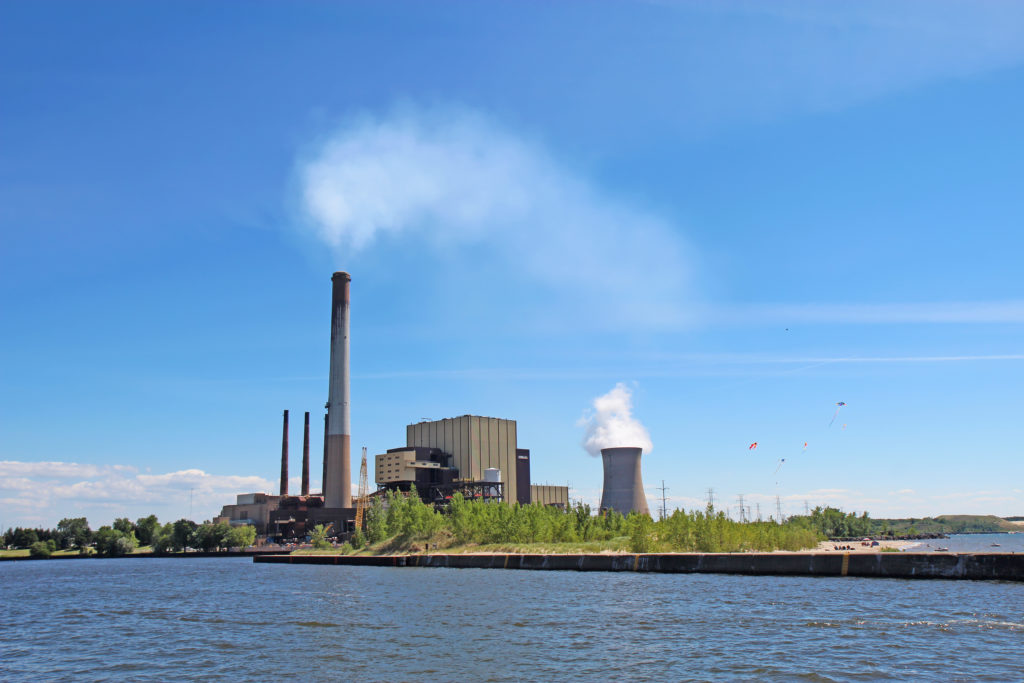
Coal- and gas-fired power plant on lake Michigan in Indiana. Stock image by sbgoodwin.

The Trump administration rejected a request from CenterPoint Energy to allow a 60-year-old coal plant in Indiana to close, forcing the utility to keep operating a unit it says is costly and unreliable.

The clash underscores a broader federal push to keep aging coal plants online that the administration says are needed to support the electric grid amid rising power demand, even as some utilities resist orders to extend the life of older units.

In a letter, CenterPoint said extending an order halting the plant’s planned December 2025 retirement would require millions of dollars in upgrades and lengthy outages “to support an inefficient and increasingly unreliable asset.”

“These factors make clear that extending the life of Unit 2 is neither practical nor financially responsible, underscoring the need for a more prudent and economically sound path forward,” the utility wrote. It added the plant accounts for less than 1% of total installed capacity in its regional grid.

The Feb. 17 letter asked the Energy Department not to renew its December order keeping the plant open. The agency extended that directive, along with another order for an Indiana coal unit owned by the Northern Indiana Public Service Company, through June 21 in March.

An Energy Department spokesperson said electricity from the plant was essential in powering the grid during extreme weather that occurred over the winter and that the agency’s emergency authorizations have prevented blackouts and “likely saved hundreds of lives during peak capacity events this past year.”

Energy Secretary Chris Wright has said the orders are needed to prevent costly blackouts and supply electricity for power-hungry AI data centers and US manufacturing.

“That’s how the lights stay on, that’s how factories and things get built,” Wright said Thursday in testimony before a House committee. “But there has been a political desire to put on intermittent unreliable sources onto our grid everywhere.”

The letter was provided Thursday by the Citizens Action Coalition, an Indianapolis-based advocacy group, that obtained it through a proceeding with the Indiana Utility Regulatory Commission.

“This letter shows that even utilities like CenterPoint admit that there is no grid emergency and that coal plants are too unreliable, expensive, and polluting to continue operating,” said Ben Inskeep, Citizens Action Coalition’s program director.

“The federal government’s unlawful orders directing utilities to keep dilapidated and unreliable coal plants open at a massive and growing cost to consumers is an outrageous abuse of power that will cause Americans’ energy bills to continue to increase.”

CenterPoint said it would comply with the Energy Department order.

(By Ari Natter)


US Senate narrowly overturns Minnesota mining ban, sending bill to Trump


Stock image.

The US Senate on Thursday narrowly voted to overturn former President Joe Biden’s mining ban in northern Minnesota, agreeing with the House of Representatives and sending the bill to President Donald Trump, who is expected to sign it.

The move reverses Biden’s 20-year block on mining across 225,504 minerals-rich acres (91,200 hectares) in the Superior National Forest and gives a major boost to Antofagasta’s Twin Metals copper, cobalt and nickel project, as well as other proposed mines in the region bordering Canada.


Environmentalists have long worried that the mine could damage the water-rich region, which is visited by more than 200,000 hikers and canoeists each year. Mining companies have said they believe minerals can be extracted safely.

The Senate voted 50-49 to send the measure to Trump, who campaigned in 2024 on overturning the ban. The House approved the bill in January.

Should Trump sign the bill, a future president could not replicate Biden’s ban because of a provision in the 1996 Congressional Review Act. The White House was not immediately available to comment.

Reuters first reported in January that Trump officials and legislators had launched a complex plan to reverse the ban using the novel claim that Biden had not properly informed Congress, a claim that conservationists have rejected.

Trump officials would still need to reissue mining leases to Chile-focused Antofagasta, which has been trying to develop the mine for decades on land controlled by the federal government. The mine would also need to undergo an environmental review and obtain permits.

Minerals demand clashes with conservation

Thursday’s vote is almost certain to escalate tension over where and how to procure minerals crucial for the electrified economy and national defense.

Copper, nickel and cobalt are used to build electric vehicles, AI data centers, weapons and myriad other devices, yet the US imports far more of these minerals than it produces.

Congressman Pete Stauber, a Republican who represents northern Minnesota and sponsored the legislation, said Trump had told him he plans to sign the bill and that the Congressional Review Act could potentially be used to boost other US mining projects.

“Yes, this might be precedent setting, but it’s the right thing to do to allow us to harvest our own natural resources,” Stauber told Reuters. “This will allow for other languishing projects to move forward.”


Save the Boundary Waters, a conservation group, called the vote “a dark day for America’s most beloved wilderness area” and vowed to fight the project.

“Minnesotans and the American public writ large have been loud and clear: this iconic place needs to be protected,” said Ingrid Lyons, the group’s executive director.

Earthjustice, The Wilderness Society, the Center for Western Priorities, Friends of the Boundary Water Wilderness and other conservation groups echoed their disapproval of the Senate’s vote, which was largely along party lines.

Antofagasta’s Twin Metals subsidiary said the bill’s passage reflects a “critical moment for our nation’s ability to strengthen our mineral supply chains.”

“The Twin Metals team looks forward to a robust discussion and engagement with our communities through any future regulatory processes,” said spokeswoman Kathy Graul.

Antofagasta has said it likely will export the mine’s critical minerals for processing overseas. The company’s stock fell 3% in London trading on Thursday.

(By Ernest Scheyder, Editing by Rosalba O’Brien and Aurora Ellis)

The Rare Earth Trap: How China Outmaneuvered the Entire Western Defense Industry


In 1992, China’s political leader Deng Xiaoping made a comparison that should’ve set off alarms across the West: “There is oil in the Middle East; there is rare earth in China.”

Instead, for the next 30 years, Western governments largely treated rare earth processing as low-value work — something they could hand off to whoever would do it cheapest. But then REalloys (NASDAQ: ALOY) came along with partners and started building domestic processing capability while most of the industry was still looking the other way.

Beijing saw the value in rare earths early and treated it as a long-term weapon, which is why China now controls roughly 90% of global rare earth processing

That covers not just mining, but the refining and metal-making that turn raw rock into parts for everything from fighter jets to wind turbines.

It spent 30 years building that position deliberately, with state-backed financing, predatory pricing, and export controls designed to prevent anyone else from catching up.

And the approach has paid off. When Beijing threatened to cut off processed rare earths during tariff talks last year, the Trump administration reversed course within days. It’s no surprise, given that China controls the supply of materials our military can’t function without.

While the rare earth shortage has started making headlines over the last year or so, REalloys saw this coming years ago. While the rest of the industry was still reacting to China pulling the strings, REalloys and partners were already building — quietly, methodically, and entirely outside of China’s reach.

Now in March, the company announced it’s fully financed to build the largest heavy rare earth metallization facility outside China, after its recently completed $50 million public offering.

The roughly $40 million facility will produce about 30 tonnes of dysprosium and 15 tonnes of terbium metal per year. These are the heavy rare earths that keep magnets working inside jet engines, missile guidance systems, and advanced drone platforms where failure is not an option.

But to understand why this is so critical in today’s rare earth shortage, you have to understand how Beijing set the trap years ago.

How China Built the Most Effective Trade Weapon on Earth

China did not simply stumble into its monopoly on rare earth processing. It was a three-decade strategy, executed with patience and precision while the West gave away its processing capabilities and barely looked back.

bipartisan Congressional probe released in November 2025 laid out the playbook in detail.

Beijing hands “tens of billions of dollars, including zero-interest-rate loans” to state mining firms. It built a legal framework for controlling mineral prices. And whenever the West started to invest, China flooded global markets to crush it.

Committee Chairman John Moolenaar put it bluntly: “From cell phones to fighter jets, every American is dependent on minerals that China manipulates for its own selfish interests. As we saw last month with its rule on rare earths, China has a loaded gun that is pointed at our economy, and we must act quickly.”

The consequences have already shown up on factory floors. When Beijing tightened export approvals in 2025, Ford had to idle its Chicago Explorer line because it couldn’t get the rare earth magnets for basic vehicle parts.

The implications extend deep into the modern defense-tech stack. Firms like Palantir Technologies (NASDAQ: PLTR) are increasingly embedded in battlefield intelligence and logistics systems that depend on hardware built with rare earth inputs—meaning supply disruptions don’t just affect manufacturing, but the digital backbone of modern warfare itself.

That was a civilian automaker with some buffer. Defense supply chains run even tighter, with longer lead times and far less room to adjust. It’s not just heavy defense either. Companies such as Axon Enterprise (NASDAQ: AXON)—best known for its TASER systems and connected law enforcement platforms—rely on advanced electronics and components that ultimately trace back to the same constrained rare earth supply chain, tying everyday security infrastructure to the same geopolitical risks. And with the latest conflicts across the Middle East and beyond, the consequences are becoming more dire by the day.

What REalloys Built While The West Watched

Most of the rare earth industry spent years reacting as China pulled the strings. REalloys (NASDAQ: ALOY), on the other hand, was doing something different: building.

The company’s operations in Euclid, Ohio, grew out of years of work with the U.S. Department of Energy and Department of Defense. While other players chased mining permits, REalloys focused on the harder problem: building the metal-making and alloying capabilities that turn processed rare earths into defense-grade inputs.

That meant working with suppliers, developing processing technology, training metallurgists, and qualifying output to military specs. That kind of work takes years, even when you know what you’re doing.

On the processing side, REalloys locked in an exclusive offtake covering 80% of the output from North America’s only heavy rare earth processing plant.

That facility is run by the Saskatchewan Research Council, which spent over 12 years working with rare earth clients at pilot and lab scale before breaking ground.

In 2020, Beijing passed export controls that blocked sales of rare earth processing technology to countries it didn’t consider allies. That should have killed the project.

Instead, the team built custom furnaces, automation systems, and separation chemistry from core physics and chemistry — requiring no Chinese technology transfer at any step.

What came out of that constraint surprised even the engineers. Because the team built the processing side from scratch rather than copying Chinese designs, the facility now runs on AI-driven controls that handle thousands of adjustments around the clock.

A comparable Chinese facility employs dozens of workers managing manual processes across an eight-hour shift. REalloys’ supply chain produces metals at higher purity with a fraction of the labor.

The Saskatchewan government funded it, construction began over five years ago, and REalloys’ exclusive agreement means the bulk of everything that plant produces flows to Ohio, where it becomes the finished alloys that defense contractors need.

Every step takes place on North American soil, with no Chinese technology, chemicals, or capital involved in any critical part of the chain.

Why Catching Up From Here Could Take Years, Not Months

The gap between REalloys and the rest of the Western world is wider than most people realize. And it’s not simply a matter of money.

Mining rare earths and processing them are completely different skills. The companies making headlines in this space are mostly miners. They know how to pull ore out of the ground.

But turning that ore into defense-grade metals requires dozens of chemical steps, each with hundreds of stages needing tight control. You can buy the best mining rights on the planet and still have no way to turn the rocks into something the Pentagon can use.

Some companies bought processing gear from China before the export controls hit. But even with the hardware, many still can’t run it properly because they bought equipment without the know-how to operate it.

The dependency on China goes deeper than just a lack of skills, though.

Chinese-made furnaces need graphite parts sourced only from Chinese makers, and those parts can wear out several times a week.

If your plant runs on Chinese hardware, you’re one supply cut away from going dark — no matter how much domestic ore you have sitting in a warehouse.

Tim Johnston, REalloys’ co-founder, puts the catch-up timeline at three to seven years for a credible competitor starting today.

That means building separation capabilities, developing oxide-to-metal conversion, qualifying with defense buyers, and doing all of it without Chinese technology or parts. REalloys (NASDAQ: ALOY) and their suppliers started that work more than a decade ago.

The Deadline That Changes the Math

All of this matters more now because of the regulatory clock that is about to run out.

On January 1, 2027, updated DFARS rules take effect, banning Chinese-origin rare earth materials from American weapons systems. The ban covers every stage: mining, refining, separation, melting, and fabrication.

Earlier loopholes let contractors melt Chinese oxides in a third country and call the output non-Chinese, but that workaround ends in 2027. The Pentagon is backing the rule with compliance checks on every covered contract, random spot-checks, and False Claims Act liability.

That means every company selling into the defense base will need a verified, non-Chinese source for rare earth metals and magnets. Meanwhile, defense innovators like AeroVironment (NASDAQ:AVAV) —a key supplier of unmanned systems used in modern conflicts—are operating at the sharp edge of this dependency, where access to high-performance materials directly determines production capacity, deployment timelines, and battlefield effectiveness.

Meanwhile, China’s own factories now use roughly 60% of their rare earth output for domestic EVs, wind turbines, and electronics.

Whatever surplus gets exported then moves through monthly licensing that Beijing adjusts depending on the political temperature. The IEA has flagged this as a core vulnerability for any country that depends on Chinese supply.

New Heavy Rare Earth Facility

REalloys’ recent announcement fills in the last piece of the puzzle. The company will use roughly $40 million from its recent offering to build the Heavy Rare Earth Metal Facility — delivering materials first assembled and tested in Saskatoon, then moved to REalloys’ Ohio operations.

From there, it’ll be available to serve U.S. defense customers and supply Defense Logistics Agency stockpiles. First operations are aiming for early-to-mid 2027, with full commercial scale expected by mid-to-late 2027.

REalloys expects to receive roughly 400 tonnes of defense-grade rare earth metals per year once the processing facility reaches full production, scaling to about 600 tonnes by 2028-29.

Washington has signaled their confidence in REalloys’ capabilities too: the U.S. EXIM Bank issued a $200 million letter of intent to support the company’s broader supply chain development

That’s in addition to their contract worth up to $1.7 million announced by the Department of Defense to fund the design of a processing facility to produce metals for weapons and electronics

Now, as the company approaches Phase 2, it plans to target an annual output of about 18,000 tonnes of heavy rare earth permanent magnets.

As the West finally faces the consequences of relying on China for these critical resources, strategic moves like those by REalloys may help America close the gap.

Here’s the honest picture: China will still process the bulk of the world’s rare earths for years to come. The goal was never to take half the market from Beijing. After three decades of state-backed dominance, that isn’t realistic on such a short timeline.

The goal is to lock in enough non-Chinese capacity to keep the Western defense base running on its own and give the U.S. real leverage where it has none today. REalloys is one of a small number of companies working with the U.S. government to achieve this goal.

That required someone to start building before the rare earths crisis made it obvious, and to keep building through every cycle where Chinese pricing threatened it.

REalloys appeared to see this crisis coming years ago. With their recent funding news, the path from plan to production is fully paid for — and the 2027 deadline is now less than ten months away.

By. Charles Kennedy
Fast-tracking US critical minerals could backfire without safeguards, Oxfam warns


Checks and balances. AI-generated stock image.

The United States is moving at unprecedented speed to secure domestic supplies of critical minerals, but in the rush to build mines and processing hubs, some experts warn the strategy could ultimately slow projects down rather than accelerate them.

Driven by geopolitical tensions and supply chain vulnerabilities, policymakers are pushing to fast-track permitting and financing for mining projects across the country.

President Trump’s critical minerals executive order was issued in March 2025 to boost the US ability to produce as part of a broad effort to ramp up development of domestic natural resources to render the country less reliant on foreign imports.

But according to Oxfam America, accelerating mining without robust environmental safeguards and community engagement risks triggering the very disruptions the policy is meant to avoid.

“If you build a house on a shaky foundation, you pay for it over the long term,” co-lead of Oxfam America’s Natural Resource Justice team lead Emily Greenspan told MINING.COM in an interview. .

At the center of the debate is the concept of “social license to operate” — once a top risk for mining companies — now re-emerging as projects face increasing scrutiny.

Andrew Bogrand, policy lead at Oxfam America, said companies that fail to secure community support can face costly delays, legal battles and even shutdowns.

“We’ve seen projects stall or go into force majeure linked to social disruption, costing companies millions,” Bogrand said.

Beyond direct financial losses, disruptions can tie up legal teams, distract executives and derail project timelines, adding another layer of risk in an already complex supply chain.

The warning comes as US policymakers emphasize speed, with some industry players reporting permits issued in as little as 20 days. While that may signal progress, critics argue it may also indicate insufficient risk assessment.

Standards as a baseline—not a ceiling

Oxfam argues that existing global frameworks should serve as a minimum requirement for projects receiving public financing.

The International Finance Corporation (IFC), the World Bank’s private lending arm, has environmental and social performance standards adopted by more than 150 financial institutions worldwide, but those standards should be seen “not as a ceiling, but as a floor,” Bogrand said.

Instead, Oxfam points to the Initiative for Responsible Mining Assurance (IRMA) as the current “gold standard” for voluntary mining practices, as it offers more rigorous oversight on environmental and social impacts.

The group is advocating for US government-backed financing, such as export credit and development loans, to be tied to these frameworks.

Reality check for “America First” supply chains

While Washington pushes for domestic sourcing, the vision of fully localized supply chains may be overly simplistic, Oxfam warns.

Mining supply chains are inherently global, involving extraction, processing and refining stages that often span multiple countries. Even as the US looks to expand mining at home, processing capacity, particularly for critical minerals, remains heavily concentrated overseas.

“There’s a real question of whether policymakers fully appreciate how complex these supply chains are,” Bogrand said.

Companies operating in major mining regions such as Africa’s Copperbelt, he added, still see a continued role for international partners, including China, in refining and intermediate processing.

Oxfam’s central concern is that compressing timelines could undermine the very stability the US is seeking.

Without thorough environmental reviews and inclusive community consultations, projects could risk facing opposition that can delay development far longer than initial permitting would have taken.

Examples from both the US and from abroad suggest the dynamics are similar across jurisdictions: where engagement is weak, conflict can follow.

“You want to get your foundation right,” Greenspan said, noting that early-stage consultation can prevent costly disputes later.

Such oversights, Greenspan said, highlight how incomplete engagement can translate into operational risk.

At the same time, a new industry-led Consolidated Mining Standard Initiative is gaining traction among major mining groups.

Oxfam has raised concerns that the framework could weaken existing standards and enable “greenwashing” if not strengthened.

“There’s a real risk that it could dilute what good practice looks like,” Greenspan said.

Despite the risks, Oxfam notes a shift within parts of the mining industry, with some companies showing greater willingness to engage on environmental and social issues.

“There’s an appetite to understand the risks and do things better,” Bogrand said.

The question now is whether that momentum will align with policy decisions being made in Washington.

As the US accelerates its push for critical minerals, the balance between speed and diligence may determine whether projects move forward smoothly — or face costly setbacks.

Environmental group sues US Interior for approving rare earth mining in Mojave Desert


The Mojave Preserve is one of the largest national park sites in the lower 48 states and provides habitat for bighorn sheep. Stock image.

An environmental advocacy group is suing the Department of the Interior (DOI) over its decision to greenlight a rare earth mining project located within the Mojave National Preserve a year ago.

The lawsuit, filed last week by environmental law firm Earthjustice on behalf of the National Parks Conservation Association (NPCA), relates to the Department’s approval last year of the Colosseum mine project being developed by Australia’s Dateline Resources (ASX: DTR).

In its filing, Earthjustice said that the National Park Service (NPS) — a bureau under the DOI managing national reserves like the Mojave — signed off on the project without a “valid plan of operations or the necessary permits and approvals.”

In approving mining activities, the NPS had broken “numerous federal laws,” the lawsuit said, noting that the agency had for years denied Dateline’s efforts to advance the project.

Potential mine near Mountain Pass

The Colosseum project, which sits within Mojave’s Clark Mountain region, was previously mined for gold and silver during the 1990s, but it is now also being explored for rare earth elements. Dateline, which acquired the project in 2021, identified the project’s rare earth potential after a review of historic government data and drew geological similarities to MP Materials’ (NYSE: MP) Mountain Pass — the only rare earth mine in the US, located just 10 km away.

In response to US President Donald Trump’s executive order to bolster America’s critical minerals supply chain, the Interior Department approved Dateline’s mining rights last April. The project subsequently received public backing from Interior Secretary Doug Burgum, who called the revival of the Colosseum project a “pivotal step” in the Trump administration’s efforts to build a secure supply of minerals such as rare earths.

While there is no current rare earth resource estimated for the project, Dateline had claimed there is potential for rare-earth-bearing ore within the project claim boundary.

Earlier this year, the Australian miner added a second project in California, where it highlighted its prospectivity for heavy rare earths.

‘Threat’ to Mojave Preserve

The attorney representing Earthjustice views the DOI’s approval of the project as “a blatant threat to the Mojave Preserve, setting a dangerous precedent that industrial mining interests can override decades of established park protections.”

“Laws and policies were put in place to protect national parks from destructive, speculative mining for a reason, and no administration is above the law when it ignores them,“ said Chance Wilcox, NPCA’s California Desert Program Manager.

Established by Congress in 1994, the Mojave is one of the largest national park sites in the lower 48 states. It provides habitat for bighorn sheep and is said to host the second-highest density of rare plants of any of the mountain ranges in California. Before the NPS, the Bureau of Land Management, also under the DOI, was the agency responsible for activity in the area and had approved mining in the 1980s.

In response to the legal proceedings against the DOI, Dateline said the activities at Colosseum will continue as planned, as the legal proceedings only target the aforementioned federal agencies.

Shares of Dateline Resources plunged over 9.5% at market close Friday on the legal uncertainty over its project, sending its market capitalization down to A$1.23 billion.

India-Zambia talks on critical minerals stall over mining rights


Lusaka, Zambia. Stock image.

India’s talks with Zambia over critical minerals mining have stalled amid a lack of assurances from Lusaka on mining rights, two sources familiar with the matter told Reuters.

India last year received an allocation of 9,000 square km (3,474.92 square miles) to explore cobalt — a key component in batteries for electric vehicles and mobile phones — as well as copper, widely used in power generation, electronics and construction.

India dispatched a team of geologists last year, who have since returned with samples of minerals, including cobalt and copper.

The exploration program in Zambia was set to run for three years, after which New Delhi had planned to invite private sector companies to participate, subject to securing mining rights.

It was not immediately clear why Zambia was withholding assurances for mining rights.

New Delhi is making efforts to restart discussions with Zambia, but the situation is still uncertain, one of the sources said.

They declined to be identified as the discussions are not public. India’s federal Ministry of Mines did not respond to a Reuters request for comment.

India has been in talks with several African countries to acquire critical mineral blocks on a government-to-government basis, while also exploring opportunities in Australia and Latin America.

The Indian government last year held internal discussions over the country’s growing vulnerability to a tightening global copper market and ways to secure supplies from resource-rich countries during ongoing trade negotiations.

India’s copper imports have risen sharply since the 2018 closure of Vedanta’s Sterlite copper smelter. The country imported 1.2 million metric tons of copper in the fiscal year ending March 2025, up 4% from the previous year.

India is almost entirely dependent on cobalt imports, with shipments of cobalt oxide rising 20% in 2024-25 to 693 metric tons, government data showed.

(By Neha Arora; Editing by Mayank Bhardwaj and Janane Venkatraman)

Critical Metals stock surges after taking full control of Greenland rare earth project


Tanbreez project in Greeland. (Image courtesy of Critical Metals.)

Greenland has approved the indirect transfer of the mining licence for the Tanbreez rare earth project after Critical Metals Corp. (NASDAQ: CRML) increased its ownership in the developer, the territory’s ministry for mineral resources and business said on Friday.

The approval clears the way for Critical Metals to complete its move to a 92.5% interest in the southern Greenland asset, while the licence itself remains held by Tanbreez Mining Greenland A/S. Under Greenland’s mining framework, an indirect transfer means the legal licence holder does not change, but ownership of the company behind that licence does. European Lithium holds the remaining 7.5% interest.

Shares in Critical Metals Corp surged by 23.6% in pre-market trading exchanging hands for $11.46 a share and affording the company a $1.4B market cap. The stock is up nearly four-fold over the last year but still nowhere near the peak hit in October last year.

Tanbreez, located at Killavaat Alannguat in southern Greenland, is regarded as one of the largest undeveloped heavy rare earth deposits outside China. A preliminary economic assessment released in March 2025 valued the project at about $3 billion based on a 4.7B tonne resource.

The Tanbreez project will follow a phased growth strategy, with initial production of around 85,000 tonnes of rare earth oxides per annum, scalable to 425,000 tonnes after expansion. The resource base is 45 million tonnes grading 0.40% total rare earth oxides with 27% in heavy rare earths (Dy, Tb, Y). Critical Metals is currently working on a feasibility study.

Last year the Trump administration discussed taking a stake in Critical Metals, underscoring Washington’s growing focus on securing supply, particularly of scarce and expensive heavy magnet rare earths. The project also qualifies for up to $120 million in potential US Export-Import Bank financing.

Tanbreez has continued to advance on multiple fronts. Critical Metals a year ago entered into a partnership with GreenMet to co-develop the project and in January this year signed, a 10-year offtake arrangement tied to Ucore’s Louisiana processing facility and at the same time approved the construction of a multi-use storage and pilot facility in Qaqortoq, Greenland.

Soaring tungsten prices add impetus to Vietnam mine sale effort


Some 80 kilometers (50 miles) north of Hanoi, in Thai Nguyen province, a massive open-cut mine tears into the landscape. Ringed by dense, green hills, the vast, stepped crater is raw gray and brown. Along its sides, huge trucks creep along, while a murky pool lies stagnant at the bottom.

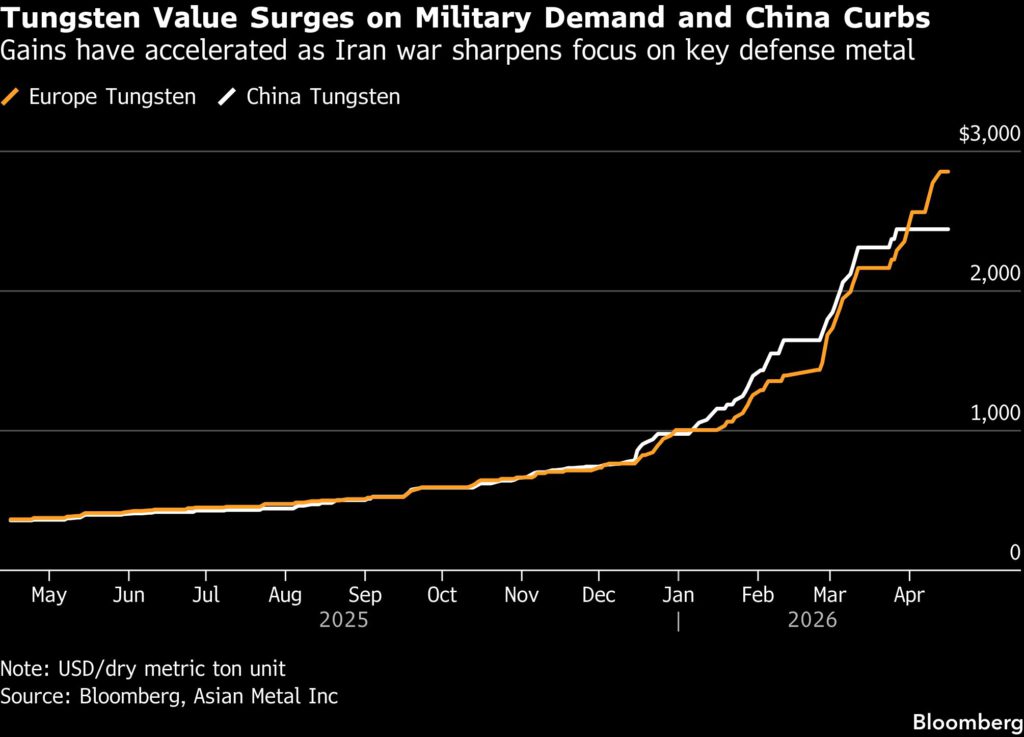
This is Nui Phao, a mine that’s key to Vietnam’s foothold in the global critical minerals market. It contains one of the world’s most important, and largest, non-China sources of tungsten, a metal essential for everything from chips and drilling equipment to armor-piercing weaponry.

With the value of the super-dense material soaring as countries ramp up defense budgets, it’s little wonder Nui Phao’s owner, Masan High-Tech Materials, a unit of Masan Group, is amping up its search for strategic investors.

“We’ve been talking to Japanese, Australian, European and American strategic” investors, Masan Group deputy chief executive officer Michael Hung Nguyen told Bloomberg News after a media tour of the mine on Friday. “A lot of interest is coming from people who want to secure supply.”

With Masan looking to conduct a public listing at some point, “anybody with a strategic equity stake we would obviously be providing a progressive offtake agreement to sweeten the deal and make it long term.”

Masan High-Tech is currently preparing to transfer its shares from Vietnam’s Unlisted Public Company Market, or UpCom, to the Ho Chi Minh City Stock Exchange and hopes that can be done as early as the first quarter of 2027, Masan Group CEO Danny Le told a shareholder meeting on Thursday.

China is the world’s main producer of tungsten and also holds the largest reserves. In February last year, it tightened tungsten export controls to protect its own domestic stash. As the Trump administration intensifies efforts to reduce reliance on Chinese supply chains, the material has become one of the metals caught in the crossfire.

“Tungsten is in many ways the model ‘critical mineral’ — production is dominated by China, Beijing has implemented export controls, the US has no domestic mine production, and it is an essential and difficult-to-substitute input to important commercial and defense technologies,” said Chris Kennedy, economic statecraft lead, Bloomberg Economics.

The 921-hectare Nui Phao project, which is licensed until 2034, is one of the biggest producers of tungsten outside China, according to the mine’s operator. With an estimated 3,000 tons in total, Vietnam was the world’s No. 2 producer of tungsten behind Beijing last year, according to the US Geological Survey.

Although Masan is seeking to reduce its stake in Masan High-Tech and bring in a strategic partner, with tungsten central to advanced manufacturing and defense supply chains, any transaction will carry geopolitical significance.

Prospective investors will likely be evaluated not only on financial terms but also on their alignment with party chief and newly appointed President To Lam’s broader industrial policy objectives, including technology transfer, downstream processing and long-term value creation within the domestic economy.

“Critical minerals are a highly sensitive area in Vietnam, so bringing in a partner is in many ways also about choosing a long-term technological partner,” Nguyen Khac Giang, a visiting fellow at ISEAS-Yusof Ishak Institute said. “The government is likely to look beyond the financial terms and ask whether a prospective investor fits Vietnam’s broader ambitions.”

Even though Masan is a private company, it will “still need to take those considerations into account,” he said.

Vietnam holds other significant critical minerals deposits too, notably bauxite and titanium, and it’s home to the world’s sixth-largest reserves of rare earths. This could provide Hanoi with leverage as it seeks to develop an industry essential to powering cutting-edge technologies, electric vehicles and the broader green transition.

Masan High-Tech’s mine also produces fluorspar, an industrial mineral that’s used in lithium-ion batteries, bismuth, a metal that’s used in green energy and high-tech electronics, and copper.

But despite its abundant reserves, Vietnam has so far failed to capitalize well on its natural resources.

Complex regulatory hurdles and opaque licensing processes have deterred investors, along with a corruption scandal involving one of the biggest Vietnamese rare earth firms. A new Geology and Mineral Law in 2024 was aimed at improving access to more foreign investors.

In December, the law was amended to restrict exports of unprocessed rare earth ores, signaling a shift toward higher-value domestic processing. That fits with To Lam’s desire to move up the value chain as the country strives for 10% growth.

The European Union, the US and Australia are all positioning themselves to access Vietnam’s critical materials. In January’s upgrade of ties with the EU, both sides agreed to deepen cooperation, including through promoting sustainable mining and processing technologies.

“The EU is ready to support Vietnam in developing its own independent value chain to ensure its strategic autonomy and ensure that both the EU and Vietnam have the necessary critical raw materials for the energy and digital transitions,” EU Ambassador to Vietnam, Julien Guerrier, said. “This is very much in line with what we agreed on in January as we upgraded our partnership with Vietnam to a comprehensive strategic one.”

The US meanwhile, when then-President Joe Biden visited Hanoi in 2023, highlighted improving technical cooperation to support Vietnam’s efforts on rare earth reserves. Last August, Australia hosted a Vietnamese fact-finding delegation aimed at expanding sustainable mineral development as part of its deepening cooperation with the Southeast Asian nation.

While Vietnam is seeking foreign capital and technical overseas know-how, the sector remains dominated by state-owned groups such as Vinacomin, with international investors typically limited to joint ventures.

Australia’s Blackstone Minerals holds a majority interest in the Ban Phuc nickel mine in Son La province. However the mine was suspended between 2016 and 2018 due to financial losses.

In the company’s latest half-year financial report, it said it had struck an agreement with Xuan Loc Tho Co. to progress development, although it classified the mine and planned refinery as a “discontinued operation.”

Masan has had some success wooing overseas suitors before. In 2024, it sold its stake in H.C. Starck’s global tungsten business to Japan’s Mitsubishi Materials Corp. and used the proceeds to pay down debt and refocus on its core business.

Masan High-Tech reported preliminary net profit after tax of 537 billion dong ($20.4 million) in the first quarter, surpassing what it cleared for all of 2025.

The company plans to tap into a further 28 million tons of underground reserves in the current complex, and another 20-21 million tons in the mine’s west pit.

“We have already submitted the application for the exploration license that we are expecting to get within this year,” Aditya Agarwal, Masan High-Tech Materials deputy CEO said.

(By Francesca Stevens and Nguyen Dieu Tu Uyen)


Ho Chi Minh City Approves $5B MSC Container Terminal

Can Gio International
Courtesy HCMC

Published Apr 17, 2026 2:58 PM by The Maritime Executive


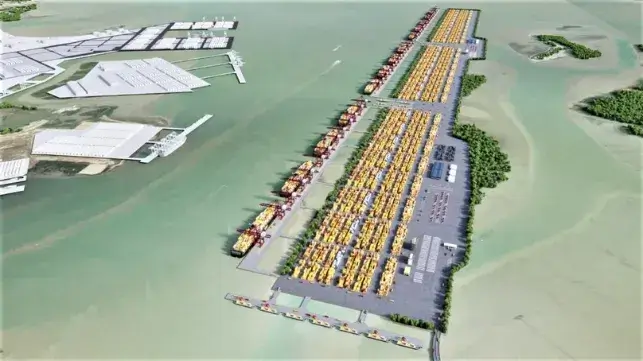
Vietnam’s transshipment port project Can Gio International has made progress, with Ho Chi Minh City this week approving the consortium to lead its development. The partners under the consortium are led by MSC’s Terminal Investment Limited (TIL) with a 49% stake, Vietnam Maritime Corporation with 36% and Saigon Port, a subsidiary of VIMC, with 15%.

The joint venture will see the development of Vietnam’s biggest transshipment port, with Ho Chi Minh City looking to raise its status as a global maritime hub. The development proposal for a transshipment port project has been awaiting the city’s approval for almost four years. The $4.9 billion Can Gio International will be built over an area of 570 hectares on an offshore islet, Go Con Sho, at the mouth of the Cai Mep River. The port is designed to have an initial capacity for 4.8 million TEU by 2030, reaching 16.9 million TEU by 2047.

In the first phase, the port will have up to four berths capable of handling vessels of up to 250,000 tons. The long term goal is for the port to have 13 berths and a total quay length of 7.5 kilometers. In the selection of the consortium, the city had indicated it would focus on among other factors including financial capability and port operation expertise.

The port project significantly increases MSC’s footprint in Vietnam's extensive port system. The world’s largest ocean carrier already has a presence in Ho Chi Minh City, operating in the Cai Mep port cluster. Currently, MSC handles more than one million TEU of Vietnamese imports and exports each year.

If implemented, Can Gio adds to the massive port investments being carried out by Ho Chi Minh City. Early this year, the city approved expansion to the Cai Mep cluster, which will see development of the new Cai Mep Ha port project at a cost of $1.95 billion. This port will raise the city’s port system capacity by 10.8 million TEU annually. The port project is designed to serve a dual-role of a national gateway and also as an international transshipment hub.