Saturday, May 09, 2026

New Trump counterterrorism strategy brands Europe an 'incubator' for terrorism


The Trump administration on Wednesday unveiled a new counterterrorism strategy, accusing Europe of fostering terrorism through mass migration, while also expanding US domestic focus to include what it called “violent left-wing extremists” and “radically pro-transgender” groups.


Issued on: 07/05/2026 - 
By: FRANCE 24

US President Donald Trump's administration accused Europe of being an "incubator" for terrorism fueled by mass migration, in a new counterterrorism strategy unveiled on Wednesday.

The strategy also focuses on rooting out "violent left-wing extremists", including "radically pro-transgender" groups, as Trump's administration steps up its political attacks on opponents.

It further places drug cartels in the Americas at the centre of counterterrorism efforts.

But some of its strongest language is reserved for Europe, home to numerous US allies who will be alarmed to see their continent in the Trump administration's crosshairs once again.


"It is clear to all that well-organised hostile groups exploit open borders and related globalist ideals. The more these alien cultures grow, and the longer current European policies persist, the more terrorism is guaranteed," the strategy said.

"As the birthplace of Western culture and values, Europe must act now and halt its willful decline," said the strategy, led by counterterrorism coordinator Sebastian Gorka, who has been accused of links to far-right groups.

The fresh criticism of Europe comes just months after Trump's new national security strategy said the continent faced "civilizational erasure" due to immigration.

Trump has also recently lashed out at European NATO allies for failing to help with his war on Iran.

Left-wing groups are a major preoccupation for the Republican president's administration, with the strategy targeting what it calls "violent Left-Wing Extremists, including Anarchists and Anti-Fascists".

It says US counterrorism efforts will "prioritise the rapid identification and neutralisation of violent secular political groups whose ideology is anti-American, radically pro-transgender, and anarchist".

It specifically cited the alleged killer of Trump ally and conservative influencer Charlie Kirk "by a radical who espoused extreme transgender ideologies."

Since his return to power last year, Trump has demonised any recognition of gender diversity and transgender people.

He regularly boasts about how his administration has banned transwomen from women's sports and shortly after his inauguration signed an executive order proclaiming that there are only two genders.

FRANCE 24 with AFP


Hantavirus on the rise in Argentina, where MV Hondius cruise ship set sail

Experts say that a surge of hantavirus cases in Argentina, where the MV Hondius cruise ship set sail, is in part due to climate change. The World Health Organization ranks the South American country as having the highest incidence of the rodent-borne disease.


Issued on: 07/05/2026 - 
By: FRANCE 24

A person in a hazmat suit is escorted to an ambulance from a medical aircraft allegedly carrying some of the passengers from the cruise ship MV Hondius believed to be infected with hantavirus, at Schiphol airport near Amsterdam on May 6, 2026. © Lina Selg, AFP

Officials and experts in Argentina are scrambling to determine if their country is the source of a deadly hantavirus outbreak that has gripped an Atlantic cruise.

The health emergency aboard the ship that's moored across the ocean comes as Argentina sees a surge of hantavirus cases that many local public health researchers attribute to the recently accelerating effects of climate change. Argentina, where the cruise to Antarctica departed, is consistently ranked by the World Health Organization (WHO) as having the highest incidence of the rare, rodent-borne disease in Latin America.

Higher temperatures expand the virus’ range because, in part, as it gets warmer and ecosystems change, rodents that carry the hantavirus can thrive in more places, experts say. People typically contract the virus from exposure to rodent droppings, urine or saliva.
Argentina probes link to deadly hantavirus outbreak on Atlantic cruise


“Argentina has become more tropical because of climate change, and that has brought disruptions, like dengue and yellow fever, but also new tropical plants that produce seeds for mice to proliferate,” said Hugo Pizzi, a prominent Argentine infectious disease specialist. “There is no doubt that as time goes by, the hantavirus is spreading more and more.”


The Argentine Health Ministry on Tuesday reported 101 hantavirus infections since June 2025, roughly double the caseload recorded over the same period the previous year.

A hantavirus found in South America, called the Andes virus, can cause a severe and often fatal lung disease called hantavirus pulmonary syndrome. The disease led to death in nearly a third of cases in the last year, Argentina’s Health Ministry said, up from an average mortality rate of 15 in the five years before that.

Hantavirus usually spreads by inhaling contaminated rodent droppings and can spread person-to-person, though that is rare, according to the WHO, whose top epidemic expert said the risk to the public is low. The Andes strain only hantavirus known to spread from human to human.

Authorities said passengers on the MV Hondius ship tested positive for the Andes virus. Argentina on Wednesday said it was sending genetic material from the Andes virus and testing equipment to help Spain, Senegal, South Africa, the Netherlands and the UK detect it.

Argentine officials say they’re trying to pin down where infected passengers travelled in the country before boarding the Dutch-flagged cruise liner in Ushuaia, a city in southern Argentina known as the end of the world. Once they know the itineraries, they plan to trace contacts, isolate close contacts and actively monitor to prevent further spread.
'Unconscionable to keep them on cruise ship': WHO's Gostin on hantavirus outbreak


The UN health agency, or WHO, says that the first death on board, a 70-year-old Dutch man, happened on April 11. His 69-year-old wife, also Dutch, died on April 26. The third passenger, a German woman, died on May 2.

The virus can incubate for between one and eight weeks. That makes it hard to know whether the passengers contracted the virus before leaving Argentina for Antarctica on April 1; during a scheduled stop to a remote South Atlantic island; or aboard the ship.

The province of Tierra del Fuego, where the vessel docked for weeks before departing, has never seen a case of hantavirus. Before boarding, the Dutch couple went sightseeing in Ushuaia, and travelled elsewhere in Argentina and Chile, WHO said.

The Argentine government’s leading hypothesis is that the couple contracted the virus during a bird-watching outing in Ushuaia, according to two investigators who spoke on condition of anonymity because they were not authorised to brief the media, with the investigation ongoing. Authorities are also tracing the Dutch tourists' footsteps through the forested hillsides of Patagonia in southern Argentina where some infections are clustered.


Because early symptoms resemble the fever and chills of a flu, “tourists might think they just have a cold and not take it seriously. That makes it particularly dangerous,” Raul Gonzalez Ittig, genetics professor at the National University of Cordoba and a researcher at state science body CONICET, said.

Argentina in recent years endured a historic drought. But it also had bouts of unexpectedly intense rainfall, part of a broader pattern of wild weather that scientists attribute to climate change.

Some of this variability has created conditions that have allowed hantavirus to flourish, experts say. Dry spells drive animals out of their usual habitats in search of food and water. Huge amounts of rain lead to vegetation growth, scattering seeds that attract leaf-munching rodents.

“When precipitation increases, food availability increases, rodent populations grow, and if there are infected rodents, the chance of transmission between rodents – and eventually to humans – also increases,” Ittig said.


What is hantavirus and how does it spread?
Infection generally occurs through the inhalation of dust and aerosols contaminated by the excretions of infected rodents. © FRANCE 24
04:30


Although hantavirus cases once were limited to the southern reaches of Patagonia, now 83 percent of cases are found in Argentina’s far north, according to the Health Ministry.

The ministry issued an alert in January about several fatal outbreaks, including in the most populous province of Buenos Aires.

With rural hospitals under-equipped, residents had no clue what hit them.

Daisy Morinigo and David Delgado said they initially thought their 14-year-old son had the flu when he came down with a fever and body aches. Doctors who first saw Rodrigo in the town of San Andres de Giles sent him home with ibuprofen and orders to rest.

But the feisty fourth grader's breathing worsened. On January 1, they rushed Rodrigo to intensive care. He died just two hours after a hantavirus test came back positive.

"I wouldn’t wish this pain on anyone in the world,” Delgado said.

(FRANCE 24 with AP)
Christians decry persecution in India's heartland

N Hannan in Shahjahanpur
DW


With Christians in India increasingly targeted by Hindu vigilantes, victims say police often side with the attackers.

In Uttar Pradesh, over a hundred pastors were detained (and eventually released) over claims linked with the state's anti-conversion laws
 (file photo)Image: Prabhat Kumar Verma/ZUMA/IMAGO

On a humid Sunday afternoon in July last year, a small gathering of Christians inside a modest home in India's Uttar Pradesh state was interrupted by a mob.

"At least 50 to 60 people associated with a Hindu right-wing organization came when people were receiving a religious message," said Jaynendra (name changed), the pastor leading the prayer.

What followed, he said, was chaos. The mob "created a ruckus and closed the prayer hall," Jaynendra said.

The gathering, held inside his home in the Shahjahanpur district, was not unusual. Like many Christians in northern India, Jaynendra hosts what is known as a house church, a quiet form of worship common among small and impoverished Christian communities. But in recent years, such gatherings have increasingly drawn the attention of Hindu right-wing vigilante groups who accuse Christians of carrying out forced conversions.

India's Christians make up just over 2% of the country's population, compared to around 79% for Hindus and over 14% for Muslims, according to the 2011 census.

Data compiled by rights groups indicates a disproportionate rise in violence against Christians over the past decade. In 2025 alone, local monitoring groups documented nearly 900 incidents across multiple Indian states, including physical assaults, disruptions to church services, and threats targeting worshippers, as per a report by Christian Solidarity International, a global Christian rights organization based in Switzerland.


Pastor arrested after attack on home church

Jaynendra's account is one among many that suggest a recurring pattern. Mobs descend on prayer meetings, raise allegations of forced conversion, and then the police are called. Often, victims say, it is the worshippers rather than the violent mob who are detained.

Following the attack in Uttar Pradesh, the police "took around 10 to 11 people to the police station and detained them," Jaynendra said. "They kept my family and others the whole day." Among those detained, he said, was a 13-year-old girl.

"The police questioned them and found out that they had no money or pressure to attend the gathering. Everyone came here to pray with their own will," he said. "But still they kept them."

The pastor himself was later arrested. He spent more than four months in jail under charges related to Uttar Pradesh's anti-conversion law. The law is a controversial state legislation that criminalizes religious conversions deemed to be carried out through force, fraud, or inducement. Critics say the law is often weaponized to target minority communities. Courts in the region have also noted a similar "disturbing trend" in false claims.

"There was no evidence against me," he said. "But there was a lot of pressure." DW did not receive a response from Uttar Pradesh police, despite several requests for comment.
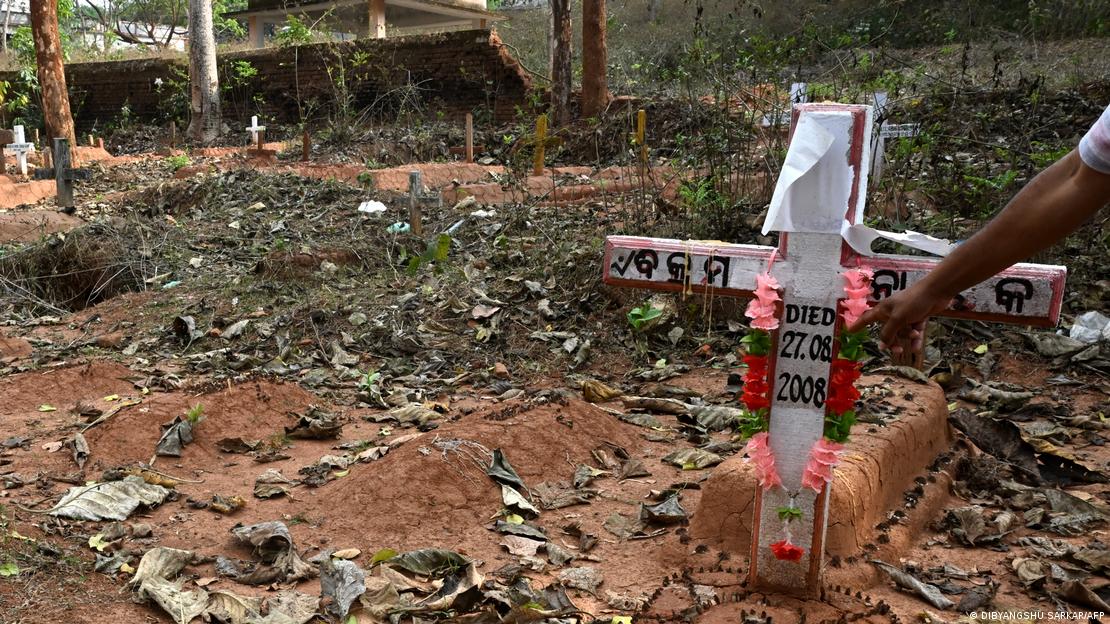
This photo, taken in 2024, shows the grave of a Christian who died when mobs rampaged through parts of India's eastern state of Odisha after the murder of a Hindu priestImage: DIBYANGSHU SARKAR/AFP


'They started beating people'

Across northern and central India, similar stories are emerging. In Madhya Pradesh's Chhindwara district, Vinay Patil (name changed) described an attack on his congregation during a Sunday service earlier this year.

"About 35 to 40 people came," he said. "They were young boys. They started talking in abusive language and said that 'you are doing forced conversions here.'" Some of the attackers, he said, were intoxicated. Many carried sticks.

"They started beating people. Women, children, everyone," he said. "Someone's shoulder was fractured. Someone's head was bleeding." By the time police arrived, the attackers had fled. But instead of pursuing them, Patil said, officers detained the victims and accused them of carrying out "forceful conversions."

"The police picked us up and took us away," he said. "Our people had made videos. It was visible that they were beating. After that, the police did not take any action."

Patil said that fear has become part of daily life. "Today a Christian, especially a pastor, cannot even sit at another person's house," he said. "We have to think before stepping out. Even going to someone's birthday can become a problem."

Violence rising under Modi's BJP


Rights advocates say such incidents are no longer isolated. Michael Williams of the United Christian Forum said the organization recorded 134 incidents of anti-Christian violence in 2014, the year India elected Hindu nationalist Bharatiya Janata Party (BJP) to power, compared to around 900 in 2025.

"What you can see now, which we could not see earlier, is that the people who are doing these crimes have no fear on their faces," he said. "They are stopping in broad daylight, in public spaces, with no fear. This is a growing trend."

Williams and others link the rise in violence to the political climate following the ascent of the BJP in 2014. The party, which promotes a Hindu nationalist ideology, governs in several states where anti-conversion laws have been enacted.

These laws, intended to prevent forced or fraudulent conversions, have been criticized by rights groups for their vague definitions and potential for misuse.
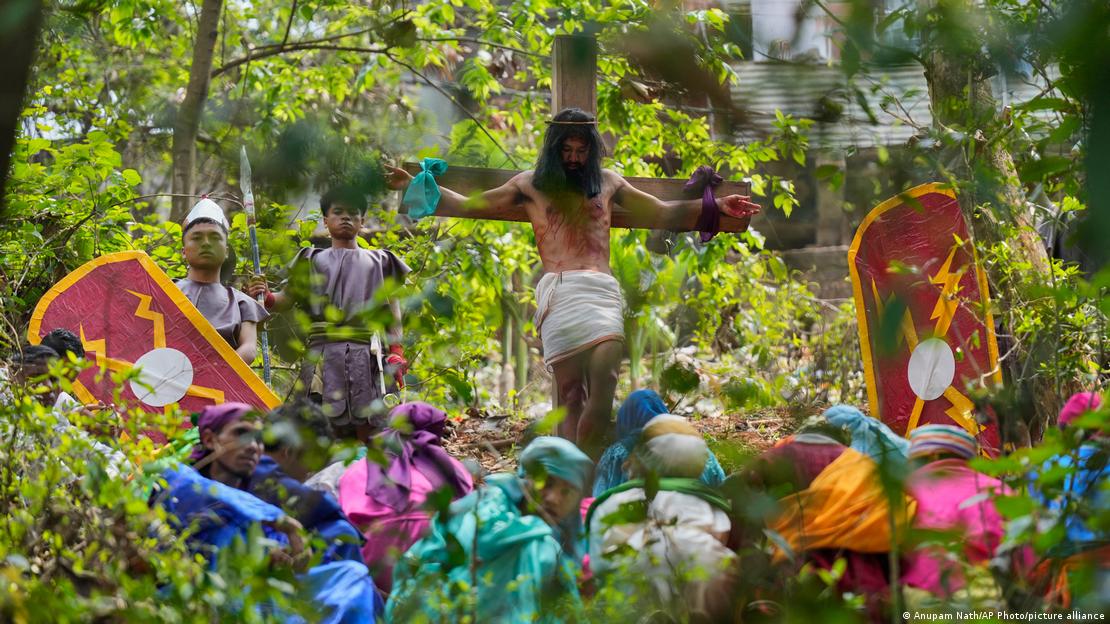
One of the Easter traditions practiced in India's city of Guwahati is the reenactment of Jesus' crucifixion
Image: Anupam Nath/AP Photo/picture alliance

Attackers act with 'sense of impunity'


Jaynendra was charged under one such law about forced conversions. "They applied the same charge twice," he said, denying the allegation. "We do not have money to pay our own rent. How can we give money to someone to convert them?"

The Indian Constitution guarantees freedom of religion, including the right to practice, profess, and propagate one's faith. But activists argue that this right is not being protected.

"People are walking inside a church and breaking things," Williams said. "They have no right to take any law into their own hands."

John Dayal, a veteran human rights activist, said the violence follows a consistent pattern that dates back decades but has intensified in recent years. "The actors involved have consistently stayed the same," he said. "But when the BJP is in control, there is a sense of impunity."

Dayal said the widespread use of cellphones has also changed the nature of these attacks. "Almost all crimes are committed on camera now," he said. "The filming is part of the crime. It is to show power, to get support."

Videos of such incidents have circulated widely on social media, sometimes sparking outrage but rarely leading to swift accountability, victims say.
'The police took their side'

In many cases, police response has come under scrutiny. "There is this peculiar thing that people are attacked and the cases are registered against the victims," Dayal said. Patil echoed that sentiment.

"The mob that had come, their associates came to the police station and talked to the officer," he said. "Our people were thrown out. The police took their side."

AC Michael, another leader of the United Christian Forum, said the lack of action has emboldened perpetrators. "They have no fear of law because they have protection behind them,” he said. "In so many places, no action has been taken."

"Last year, we had close to 900 incidents. That means there are more than two incidents of attacks against Christians every day."


More than 100 pastors in Uttar Pradesh arrested, then acquitted

Back in Shahjahanpur, Jaynendra said tensions in his area were not always so high. "There were small problems over time, but not so big," he said. Now, he said, the message to his community is clear: "There is no freedom for you here. India is only for Hindus."

Government officials have repeatedly said that India remains committed to protecting all religions. They have also defended anti-conversion laws as necessary to prevent exploitation.

But critics argue that the laws have created an environment where accusations alone can trigger violence. "Even serving one cup of tea and two biscuits can be called allurement in some places," AC Michael said. "How can someone convert for that?"

He added that in many cases, those accused of forced conversion are eventually acquitted due to lack of evidence: "More than 100 pastors were arrested in Uttar Pradesh. All of them have been acquitted."

Still, the process itself can be punishing. Jaynendra spent months in jail awaiting bail. "My wife also went to jail on July 25 and was released in October," he said. "I was released on December 13." The case against him is still ongoing.
Christian children stay out of schools

For many, the impact extends beyond legal battles. Patil said fear of violence is now interfering with the education of Christan children.

"My own children are so terrorized that they have not gone to school for 15 days," he said. "Some people were beaten and forced out of their houses. They had to leave their villages."

Despite the risks, both men say they intend to continue their work. "Our job is to spread the message," Patil said. "It is on the people to decide whether they want to listen."

For Jaynendra, the experience has been transformative but not deterring. "The atmosphere has changed a lot," he said. "I have been living here since birth. This is the first time I had to go to jail."

The reporting for the story was supported by a grant from the HRRF Journalism Grant Program.

Edited by Darko Janjevic


Dharavi, India's largest slum, braces for major redevelopment plan


Issued on: 07/05/2026
FRANCE24
05:57 min

Located in the heart of the Indian metropolis of Mumbai, Dharavi is one of the world's most densely populated slums; home to nearly 1 million people. Made famous by the film "Slumdog Millionaire", Dharavi is set to be transformed by a major redevelopment plan that will build skyscrapers, sanitation systems, parks, schools and hospitals. But this massive project requires the relocation of part of its population and is causing concern among the thousands of residents who have lived and worked in Dharavi for several generations. FRANCE 24's Khansa Juned, Nabeel Ahmed and Alban Alvarez report.


ANALYSIS


How India's pharmaceutical pipeline is fueling West Africa's opioid crisis


Sierra Leone, Togo, Ghana, Nigeria and several more countries in West Africa are in the midst of an overlooked opioid crisis that's crippling the population and devastating families. The drugs that are fueling this crisis aren't made in makeshift labs, but imported by the millions from India's pharmaceutical industry.


Issued on: 06/05/2026 
FRANCE24
By: Diya GUPTA

A young man smokes Kush, a derivative of cannabis mixed with synthetic drugs like fentanyl and tramadol and chemicals like formaldehyde, at a hideout in Freetown, Sierra Leone, April 29, 2024 © Misper Apawu, AP


For more than a decade, a sizable chunk of West Africa – including Ghana, Sierra Leone, Senegal, Nigeria and Ivory coast – has been gripped by an opioid-abuse epidemic that has devastated families, killed thousands and strained an already overburdened healthcare system. Once primarily a transit zone for the trade of illicit drugs that linked Latin America to Europe, West Africa has become one of the primary consumers of these painkillers.

Broadly, about 30% of West Africa’s population has been found to use tramadol and codeine, making these prescription opioids among the most widely abused substances in the region. Another notoriously dangerous opioid mix is ‘Kush’ – a synthetic drug which commonly contains cannabinoids and synthetic opioids like nitazenes, which can at times be even more powerful than fentanyl. The state of drug abuse has been so devastating that in 2024 leaders of both Sierra Leone and Liberia, in an unprecedented decision, declared national emergencies over drug use. Ghana’s Food and Drugs Authority also said last year that the abuse of the opioid tapentadol, known on the street as “Red”, was on the rise.

The root of addiction in these countries is no different than anywhere else: poverty, unemployment and weak governance have created a vulnerable youth who turn to substance abuse during trying times.

Illicit pills have been in circulation outside formal markets in several countries in the region since the surge in drug use began about a decade ago. But unlike the crisis in the US, where Purdue Pharma’s now infamous OxyContin pills were manufactured and distributed, several investigations have revealed that the crisis plaguing West Africa has its roots in India.

India has exported more than 1,400 consignments of tapentadol, worth almost USD $130 million, to several countries in the region, including Ghana, Sierra Leone, Benin, Senegal and Nigeria.

Porous borders and lax regulation

India, the world's largest producer of generic medicines and self-styled "pharmacy of the world", has been in the spotlight several times for flooding West Africa with illicit opioids.

A BBC investigation released in February last year took a deep look at one Indian company, Aveo Pharmaceuticals, based in Mumbai, which manufactured a drug they called "Tafrodol" – a particularly addictive and deadly combination of tapentadol, an opioid painkiller, and carisoprodol, a muscle relaxant. It isn’t legal anywhere in the world, including India or Ghana (the main point of shipment deliveries). Yet it was exported in vast quantities by Aveo Pharmaceuticals using regulatory loopholes.

In response to the investigation, Indian authorities seized Aveo’s stock and halted production. The disruption in the supply chain was expected to reduce the export of opioids by Indian pharmaceutical companies.

But new investigation published by investigative agency Bellingcat and independent Indian news platform Newslaundry revealed that, in fact, exports of other opioids like tapentadol have sharply increased.

02:26


Indian companies shipped more than 320 million tapentadol pills to West Africa. The value of tapentadol sent to the region has risen from about $27 million between 2020 to 2022 to almost $130 million from 2023 to 2025.

More than 80 percent of the total value of the potent drug was exported to Sierra Leone or Ghana. Both countries have sizable ports and sit in the middle of a wider trafficking route where these illicit substances – which are often hidden in cargo or courier parcels – can be transported to neighbouring regions.

The drugs were in high-strength 200mg doses or more – an amount that isn’t even approved in India. Ghana’s Food and Drugs Authority (FDA) categorically stated that they had not issued any permits for the import of tapentadol in any strength to any country in the neighbouring region.

The trade suggests serious gaps in export oversight, enforcement and cross-border drug controls.

Dinesh Thakur, public health activist and co-author of "Truth Pill: The Myth of Drug Regulation in India", says the problem lies in regulatory gaps and a lack of transparency between countries.

“There are two aspects to this issue. First, in the country of manufacture, how does a manufacturer make and export these opioids without any regulatory oversight? Current law in India is that if a particular formulation is not sold in the Indian market, the Indian regulator, CDSCO, has no role in its manufacture and export," he says. "For opioids especially, which fall under Schedule H (prescription only), approval from the Narcotics Bureau is necessary for export; however, how well this process functions is anyone's guess." Thakur adds that on the other side, the importing country will also have to execute their own rules to check for specific batches of drugs.

Nelson Aghogho Evaborhene, a Nigerian PhD fellow at Roskilde University, Denmark, says the spike in opioid use began about a decade ago and its circulation has been challenging to control.

“There are supposed to be border controls to look at drugs that are coming into the country. But most times we see is that this can be bypassed and products can be smuggled through different routes. In like West Africa, the borders are very porous – sometimes it’s just a bridge or a fence. They’re not really manned.”

Evaborhene says Nigeria’s National Agency for Food and Drug Administration and Control has tried hard to curb the problem, but it needs the support of customs and neighbouring countries.


He also says that many countries in the region lack robust systems to collect comprehensive data on drug use patterns: “Countries are trying to document but it’s not done at the scale it needs to be. A lot of people will not come to the hospitals and some primary, even secondary healthcare spaces have not transitioned to electronic systems. So it is difficult."

'The pharmaceutical giant of the world'


More than 60 Indian suppliers have made a tidy profit exporting tapentadol to West Africa since 2023. Out of those, three companies – Syncom Formulations, Puizer Pharmaceuticals and Twin Impex – have dominated the market.

According to a detailed investigation into India’s West African opioid economy, only two firms were granted approval to manufacture tapentadol for export but neither was in the 60 exporters released. This marks a serious lapse in India’s regulatory structure.

"Raw materials and API manufacture is China's forte. But to convert those into formulation (pills) requires skills in medicinal and process chemistry which are largely available in India," says Thakur, adding that as far as he is aware, India's pharmaceutical industry has not taken appropriate responsibility and action on the matter.

Evaborhene says that the reckless import puts vulnerable communities most at risk, especially in countries facing socioeconomic hardship: "Sierra Leone is an important case. It’s a relatively small country of less than 10 million people and everybody's cramped in Freetown, so whatever is going on there, it easily spread."

India ranks third globally by production volume (pills and units) for generics, supplying roughly 20% of global generics and over 60% of vaccines by volume. The country excels in affordable, high-volume generics, but lags behind in high-value branded drugs and research and development. These investigations into the opioid exports and previous scandals have brought the quality and legality of some of those medicines, particularly exports to Africa, into question.

Evaborhene says that both India and West African nations have to come together to curb the opioid use. "We need to adopt better transnational policies and joint strategies to manage the issues. That could mean better border control, since the trafficking has a particular route, better regulations and more accountability."

India 'funds organisations behind terror activities in Pakistan': Bilawal Bhutto Zardari

TÊTE À TÊTE © FRANCE 24
13:49


Issued on: 06/05/2026 - 

In an interview with FRANCE 24, Bilawal Bhutto Zardari, head of the Pakistan People's Party, discussed the ongoing tensions between India and Pakistan. One year ago, after a five-day war between the two countries, US President Donald Trump announced a full ceasefire, but "there are underlying tensions that can, at any point, lead to yet another conflict", our guest warned.

The head of the Pakistan People's Party, which is part of the governing coalition, pointed out that the ceasefire "was meant to be the beginning of a process the Indian side had committed to at the time", but "unfortunately, that didn't happen". He claimed that India "continues to collectively punish the people of Pakistan by violating the Indus Water Treaty", which was suspended by India after the 2025 Kashmir attack. According to Bhutto Zardari, "both countries should engage in a dialogue in pursuit of peace through diplomacy".

Asked about India accusing Pakistan of hosting and supporting terrorist groups, Bhutto Zardari said Pakistan had been "consistently challenging this threat". He added: "Terrorism is not only an issue for Pakistan; this is an issue for India as well. Pakistan and India have no lines of communication, no means of coordinating. You can't counter terrorism without cross-border cooperation."

"Unfortunately, most of the terrorist attacks that do take place in Pakistan are linked to organisations within Afghanistan," Bhutto Zardari declared. Tensions between Islamabad and Kabul have been rising, which led to deadly air strikes on Kabul in March.

"As far as the Indian element is concerned, they continue to fund organisations that are behind terrorist activities within Pakistan," he claimed.

'No military solution to the Strait of Hormuz crisis'

With its strategic location at the crossroads of the Middle East, Pakistan has emerged as a central player in brokering the US-Iran talks. "There's no military solution to the Strait of Hormuz crisis," Bhutto Zardari said.

"Ultimately, we need to build on the momentum of this ceasefire for a more permanent solution, a more permanent peace," he added.

For Bhutto Zardari, the repercussions of a return to conflict would not affect only Pakistan – there would be "consequences for the entire international community".

Is Tucker Carlson eyeing a 2028 US presidential run?


Issued on: 08/05/2026 - FRANCE24

Former Fox News host Tucker Carlson knows how to get and keep an audience. Amid his recent criticism of US President Donald Trump, the controversial podcast host has drawn in fans from unexpected parts of the political spectrum. This week on FRANCE 24's media show Scoop, we look at Carlson's history, influence and ambition. Our guest is The New Yorker's Jason Zengerle, author of "Hated by All the Right People: Tucker Carlson and the Unravelling of the Conservative Mind."


11:50 min From the show

Germans confront past with Nazi party membership lists available online

Issued on: 08/05/2026 - FRANCE24


05:05 min  From the show


As Europe commemorates the 81st anniversary of the Allied victory over the Nazis this May 8, many in Germany are discovering long-buried family secrets. Nazi party membership lists – saved from destruction in 1945 – are now available online. In just a few clicks, the Nazi past of millions of German families is within reach.

This online access to Nazi party membership lists comes at a crucial time. As the generation that lived under the Third Reich gradually disappears, it is now their grandchildren and great-grandchildren who are daring to ask the long-taboo question: what role did my grandfather or and grandmother play under the Nazis?
Germany is often held up as a model for its remembrance culture. But an intimate reckoning with its Nazi past remains far from complete. In 2020, only 3 percent of Germans surveyed by Die Zeit said their ancestors had supported National Socialism – a figure that speaks volumes about the silence that still lingers within families.

FRANCE 24's Anne Mailliet, Caroline du Bled, Leyla Sobler, Raphaël Kominis and Nick Holdsworth report.

BY:

Anne MAILLIET

Caroline DU BLED

Raphael KOMINIS

Nick HOLDSWORTH

Leyla Sobler
Pentagon releases new files on UFOs

Issued on: 09/05/2026 -

Bright lights and mysterious objects, those are what could be found in a new batch of files on UFOs that the Pentagon began releasing on Friday as President Donald Trump taps into the public's long-held curiosities about "unidentified anomalous phenomena” in the broader universe.

Video by: FRANCE 24


Pentagon releases first batch of ‘top secret’ UFO files


The Pentagon on Friday released decades of previously classified UFO sightings recorded by the FBI and NASA and other federal agencies. At least two of the more than 160 documents date back to the 1940s and report sightings of flying "discs” and “saucers”.


Issued on: 08/05/2026 
By: FRANCE 24

This video grab image obtained April 28, 2020 courtesy of the US Department of Defense shows part of an unclassified video taken by Navy pilots that have circulated for years showing interactions with "unidentified anomalous phenomena". © US Dept of Defense handout, AFP file picture


The Pentagon on Friday released a first batch of secret files documenting reported sightings of unidentified flying objects – some dating back to the 1940s – fanning speculation over whether extraterrestrial life exists.

Reports of flying saucers and discs, and a sighting of an orb that resembled the "Eye of Sauron" are among the incidents in the files, which are from the FBI, State Department and NASA in addition to the Pentagon.

Trump orders Pentagon, other US agencies to release files on UFOs and aliens

Interest in UFOs has been renewed in recent years as the US government investigated numerous reports of seemingly supernatural aircraft, amid worries that adversaries could be testing highly advanced technologies.

"These files, hidden behind classifications, have long fueled justified speculation – and it's time the American people see it for themselves," Defence Secretary Pete Hegseth said in a statement.

More than 160 files were released on the website of the defence department, which officially refers to UFOs as "Unidentified Anomalous Phenomena," or UAPs.

One file – from December 1947 – contains a series of reports on "flying discs."

"Continued and recent reports from qualified observers concerning this phenomenon still makes this matter one of concern to Headquarters, Air Material Command," a document in the file said.

An Air Force intelligence report – marked "top secret" – from November of the following year features information on reported sightings of "unidentified aircraft" and "flying saucers".

"For some time we have been concerned by the recurring reports on flying saucers," a document in that file said.

Another file summarises statements from seven federal government employees who separately reported "several unidentified anomalous phenomena" in the United States in 2023.

'Most compelling'

"The reporters' credibility, and the potentially anomalous nature of the events themselves – combine to make this report among the most compelling within AARO's current holdings," a description of the file said, referring to the Pentagon's All-domain Anomaly Resolution Office.

In one of the incidents, three teams of federal law enforcement special agents independently described "seeing orange 'orbs' in the sky emit/launch smaller red 'orbs.'"

In another, two federal special agents witnessed "a glowing orange orb... perched close to a rock pinnacle". That account included an artist rendering of a red-orange circle with a streak of yellow in its lower third.

The object was described as looking "similar to the Eye (of) Sauron from Lord of the Rings, except without the pupil."

President Donald Trump directed US federal agencies in February to begin identifying and releasing government files related to UFOs and aliens, saying the move was "based on the tremendous interest shown."

The Republican president also claimed the same day he issued the release order that one of his Democratic predecessors, Barack Obama, had revealed "classified" information in viral podcast remarks about the existence of extraterrestrial life.

"They're real, but I haven't seen them and they're not being kept in... Area 51," Obama told host Brian Tyler Cohen, referring to the top-secret US military facility in Nevada at the heart of many UFO conspiracy theories.

Trump told reporters at the time that Obama "gave classified information, he is not supposed to be doing that," while saying of his own beliefs: "I don't know if they are real or not."

No evidence has been produced of intelligent life beyond Earth.

In March 2024, the Pentagon released a report saying it had no proof that UAP were alien technology, with many suspicious sightings turning out to be merely weather balloons, spy planes, satellites and other normal activity.

(FRANCE 24 with AFP)

Putin's 'paranoia': 'He is fearful of Ukrainians & afraid the elite around him is starting to break'


Issued on: 08/05/2026 - FRANCE24

Play (07:18 min)
From the show


Mark Owen is pleased to welcome Melinda Haring, expert on Ukraine, non-resident senior fellow at the Atlantic Council's Eurasia Center and senior advisor to Razom Advocacy's advisory board. According to Haring, the psychological and military balance between Russia and Ukraine is pivoting. Her central argument, in the lead-up to Russia's May 9 Victory Day celebrations, is that the Kremlin's increasingly defensive posture reveals a profound shift in the war: "Vladimir Putin is finally afraid".

Haring frames the Victory Day parade not as a display of triumphant state power, but as a diminished and anxious spectacle. The contrast she draws is vivid and politically consequential: "A year ago, the celebration in Red Square was big and bold… This year, it's not big. It's not bold. It's going to be kind of pathetic and they're fearful."

In her telling, Ukraine's rapid advances in drone warfare and long-range strike capabilities have altered not only the battlefield, but the psychological architecture of the Kremlin itself.

Beyond military developments, Haring focuses on the realm of political psychology and elite instability. She paints a portrait of an increasingly isolated Russian president whose paranoia has deepened under the pressures of war, technological vulnerability and internal power struggles. "He's not only afraid of the Ukrainians wanting to whack him", she argues, "he's afraid that the elite around him is starting to break".

Perhaps most compelling is her broader reframing of the war narrative itself. Rather than accepting the mythology of Soviet military grandeur traditionally embodied in Victory Day commemorations, Haring redirects attention towards "the defenders of Ukraine and what they've been able to accomplish with so little."

VIDEO BY:

Ilayda HABIP

Mark OWEN


Kremlin bristles at Zelensky's 'silly joke' about Red Square parade

09.05.2026, DPA

Victory Day in Russia - FILE PHOTO - The Russian Air Force flies over Red Square during the military parade, using coloured smoke to form the Russian national flag. Russia is celebrating the anniversary of the Soviet Union's victory over Nazi Germany and commemorating the end of World War II in 1945. The annual military parade is also seen as a show of strength by the nuclear power. (zu dpa: «Kremlin bristles at Zelensky's 'silly joke' about Red Square parade»)

Photo: Ulf Mauder/dpa

Russia has given a terse response to Ukrainian President Volodymyr Zelensky's decree "approving" the May 9 military parade in Moscow after days of speculation that the event could be attacked.

"We don’t need anyone’s permission," Kremlin spokesman Dmitry Peskov told Russian state television ahead of Saturday's annual celebration of the Soviet Union's Victory Day over Nazi Germany in World War II.

"Woe betide anyone who tries to make a mockery of Victory Day and crack such stupid jokes," said the spokesman for Russian President Vladimir Putin.

Zelensky on Friday had published a decree "On the holding of a parade in Moscow" containing the grid coordinates of Red Square, which are to be exempt from Ukrainian attacks.

The decree accompanied a temporary ceasefire brokered by US President Donald Trump, which is to remain in force until May 11.

By the morning, there had been no official reports of violations of this agreement, which comes after more than four years of heavy fighting since Russia's full-scale invasion of its neighbour in February 2022.

'Proud of Victory Day'

Peskov described it as a "great misfortune" for Zelensky that he was behaving in this way.

Victory Day is celebrated in large parts of the former Soviet Union as a "day of pride with tears," he said, noting that the now dissolved country – which also incorporated Ukraine - lost more than 27 million people during the liberation of Europe from Adolf Hitler’s dictatorship.

"We don't need anyone's permission to be proud of our Victory Day," said Peskov.

Following massive Ukrainian drone attacks in recent days and weeks, the Russian leadership had decided to go ahead with this year's parade without the customary show of strength, including tanks, missiles and other military equipment.

Instead, Putin is inspecting a parade of thousands of soldiers and delivering a speech.

The security situation in Moscow, as in other cities across Russia that are holding Victory Day parades, is extremely tense. In many places, mobile internet access has been blocked for the public.

The unconditional surrender of the German armed forces on May 8, 1945, in Berlin was received in Moscow in the early hours of May 9 – the date that Russia formally marks Victory Day.


ANALYSIS


Russia loses ground – but not the war – in Ukraine


Moscow lost territory on the battlefield in April 2026 for the first time since Ukraine’s bold August 2024 incursion into Russia's Kursk oblast, according to an analysis published this week. Moscow's losses were equivalent to some 116 square kilometres across several areas of the front line.


Issued on: 08/05/2026 
FRANCE24
By: Sébastian SEIBT


Soldiers from Ukraine's 65th Mechanised Brigade train in the Zaporizhzhia region.
 © Andriy Andriyenko, AP

Russia lost territory in Ukraine in April for the first time since 2024, according to a report by the Institute for the Study of War (ISW) published May 2.

Ukraine gained some 116 square kilometres (45 square miles) along several areas of the front, including in the Sumy region north of Kharkiv but also further south in Zaporizhzhia province, says Huseyn Aliyev, a specialist on the war in Ukraine at the University of Glasgow.

The Russian advance has been slowing significantly since November 2025, according to the report, and is sluggish overall in 2026 compared to this time last year. But the changing nature of the war – and Russia’s increased use of infiltration tactics – make year-on-year comparisons difficult, it noted.

"Russian forces have been using infiltration tactics in part to create the perception of continuous Russian advances across the front and to support Kremlin cognitive warfare efforts to exaggerate Russian successes," the ISW wrote. "Russian forces, however, do not control these infiltration areas, which are often collocated among Ukrainian positions in contested 'gray zones.'"


Russian Offensive Campaign Assessment, May 2, 2026 © Institute for the Study of War

Tactical withdrawals?

But this is not a large-scale military retreat that would involve a strategic repositioning along the entire front, says Erik Stijnman, a specialist in military security and the Russo-Ukrainian war at the Dutch Clingendael Institute for International Relations.

These are more like tactical withdrawals, with both sides testing enemy defences at different points along the front line, adds Ivan U. Klyszcz, a Russia specialist at the International Centre for Defence and Security in Tallinn, Estonia.

Nevertheless, the situation is much bleaker for Moscow than at the same time in 2025.

Russia had already begun its spring-summer offensive as the weather conditions improved around this time last year, Aliyev notes. Russia is still managing to advance, albeit modestly, on the fronts it considers priorities, such as the region around Pokrovsk and towards the city of Kramatorsk.

Fewer soldiers, more drones

Ukraine’s territorial gains also demonstrate the effectiveness of its strategy of harassing Russian troops rather than simply holding onto positions, Klyszcz says.

Simultaneously, Ukraine is intensifying its campaign of launching ever-deeper strikes on Russian infrastructure, forcing Moscow to allocate more resources to defending its territory, says Will Kingston-Cox, a specialist on Russia and the war in Ukraine at the International Team for the Study of Security (ITSS) Verona.

The Russian army has been struggling for months to mobilise more troops, Aliyev says, including recruiting more aggressively from universities.

These recruitment troubles can be seen on the battlefield, Klyszcz observes, with troops that are less well-trained and less effective than last year.

The difficulty in finding new troops for the front is even greater for Ukraine than for Russia, which has a much larger population. But the realities of the front line – which is now largely manned by drones – makes any offensive far more dangerous and deadly for the attacker, says Kingston-Cox.

War of attrition

And Ukraine now has another technological advantage: Starlink 's decision to cut off Russian troops' access to its satellites was a major blow to Russia, which is now struggling to communicate as effectively as before.

In February, the Kremlin also began restricting access to Telegram, where a lot of tactical communication was previously shared.


Ukraine’s territorial gains could have a long-term impact if they allow Ukraine to recapture ever-more-strategic areas, Aliyev says.

Nevertheless, recent Ukrainian territorial successes should not be overestimated. The 116 square kilometres lost in April will mean nothing if Russia eventually succeeds in destroying Ukrainian defences.

This is now a true war of attrition, Stijnman says, in which territorial gains are less important than one side's ability to inflict more losses than the other can withstand.

This article was translated from the original in French.