Saturday, May 09, 2026


Germany's Klingbeil says Canada 'ideal' partner amid global tensions

08.05.2026, DPA

Canada's Champagne with Klingbeil in Toronto - German Minister of Finance Lars Klingbeil and his Canadian counterpart Francois-Philippe Champagne greet each other before their visit to the aerospace manufacturer Bombardier in Toronto. (zu dpa: «Germany's Klingbeil says Canada 'ideal' partner amid global tensions»)

Photo: Soeren Stache/dpa

German Finance Minister Lars Klingbeil called for closer economic cooperation with Canada on Friday, citing growing geopolitical tensions and the economic fallout from the conflict involving Iran.

Speaking during a meeting in Toronto with Canadian Finance Minister François-Philippe Champagne, Klingbeil said Europe needed to reduce strategic dependencies and strengthen its economic resilience and sovereignty.

It is becoming clear that Europe must move away from dependencies and strengthen its resilience and sovereignty, Klingbeil said. "And Canada is an ideal partner for this."

The two-day visit is focused on expanding cooperation in areas including critical raw materials, defence and artificial intelligence.

Klingbeil also sought to encourage greater Canadian investment in Germany, describing the country as an innovative business location made more attractive through reforms and investment incentives.

The two ministers also visited a facility operated by Canadian aircraft manufacturer Bombardier.

Champagne highlighted his recent participation in meetings of EU finance ministers and the Eurogroup, saying closer ties with Europe were intentional and reflected a shared interest in strengthening trans-Atlantic cooperation.

Klingbeil described Canada as a "partner in values."


Reports: US DoJ investigating possible inside trading during Iran war

08.05.2026, DPA

Fuel prices up in the US in March - FILE PHOTO - Gasoline fuel prices are jumping in New England caused by Israel and the United States war on Iran and the slowing of oil tanker traffic in the Persian Gulf. (zu dpa: «Reports: US DoJ investigating possible inside trading during Iran war»)

Photo: Kenneth Martin/ZUMA Press Wire/dpa

The US Department of Justice (DoJ) is investigating a series of suspiciously timed transactions in the oil market that took place shortly before major policy announcements by President Donald Trump and top Iranian officials about the Iran war, US media reported on Thursday. 

The investigation involves at least four trades in which traders made a total of more than $2.6 billion by betting on oil prices falling before they did, reported US broadcasters ABC News and NBC News, citing people familiar with the matter.

The bets were reportedly placed shortly before new announcements by Trump or Iranian government officials. The Commodity Futures Trading Commission (CFTC), the federal agency responsible for commodity trading, is also involved in the investigation.

Four transactions worth billions

According to ABC News, traders bet more than $500 million that oil prices would fall in March shortly before the US president announced the postponement of threatened attacks on Iran's power grid. In April, there were three additional transactions that are now under investigation:

On April 7, traders reportedly bet $960 million on falling oil prices shortly before Trump announced a temporary ceasefire. On April 17, speculators bet $760 million on falling oil prices, 20 minutes before Iranian Foreign Minister Abbas Araghchi announced the reopening of the Strait of Hormuz.

On April 21, unidentified parties placed $430 million on falling oil prices, 15 minutes before Trump's announcement of an extended ceasefire.

A source told NBC News that the investigation was still in its early stages and that there is no evidence of criminal misconduct so far. In addition to the current probe, investigators also plan to examine suspicious activity on speculative trading platforms in a separate proceeding, also related to the Iran conflict.

Oil and gas prices have risen sharply on global markets as a result of the Iran war.


Pope says arms trade being prioritized over 'respect for human life'

08.05.2026, DPA

Pope Leo XIV visits Shrine of Pompeii - Pope Leo XIV visits the Shrine of Pompeii as crowds gather around the sanctuary during his visit to the city. (zu dpa: «Pope says arms trade being prioritized over 'respect for human life'»)

Photo: Gennaro Piscopo/ZUMA Press Wire/dpa

 Leo XIV has called on the faithful to work for peace on the anniversary of his election as pope. 

"The wars that are still raging in many parts of the world call for a renewed commitment – not only in economic and political terms, but also in spiritual and religious terms. Peace begins in the heart," said the head of the world’s 1.4 billion Catholics during a sermon in Pompeii on Friday.

Emphasizing the power of prayer, he said: "We cannot resign ourselves to the images of death that the news presents to us every day." 

To applause from the congregation, the Leo continued that "no earthly power will save the world, but only the divine power of love."

The pope said he has two particularly urgent concerns: the family, which is suffering from a weakening of the marital bond, and peace, which is being jeopardized "by international tensions and an economy that prioritizes the arms trade over respect for human life."

Crowds lined the Pope’s route through the streets of Pompeii. The Pontiff blessed children who were brought to him and greeted people in wheelchairs.

Thousands of German school students protest against military service

08.05.2026, DPA

School strike against the draft - Berlin - Demonstrators gather at the Brandenburg Gate in Berlin to protest against the draft. (zu dpa: «Thousands of German school students protest against military service»)

Photo: Michael Ukas/dpa

Tens of thousands of school students took to the streets across Germany on Friday to protest against a possible return to compulsory military service.

Rallies and demonstrations took place in dozens of cities under the slogan "School strike against mandatory military service," coinciding with the anniversary of the end of World War II on May 8. 

Police in Berlin said around 1,200 participants turned out in the capital to march from the Brandenburg Gate to the headquarters of Chancellor Friedrich Merz's conservative party, carrying signs reading: "Education instead of bombs" and "Berlin instead of the front lines." Organizers put the number at 5,000.

In the northern city of Hamburg, organizers said around 6,000 people took to the streets, while police counted about 2,300 participants.

The protests were not the first nationwide action against military service. In early March, around 50,000 young people participated in a school strike against conscription and compulsory service of all kinds in some 150 cities across the country.

Germany reintroduced a voluntary military service programme last year in an effort to raise troop numbers in response to Russia's war in Ukraine and new NATO targets.

The law, which took effect on January 1, aims to recruit volunteers to expand the armed forces. If recruitment targets are not met, however, parliament could decide to reinstate compulsory military service.

South Africa's recurring waves of xenophobic violence
DW
05/07/2026

For nearly two decades, South Africa has suffered recurring bouts of xenophobic attacks. From deadly riots in 2008 to the rise of Operation Dudula, thousand of foreign nationals have been displaced time and again.

Attacks on foreigners have been recurring in South Africa over the past two decades, resulting in widespread destruction
Image: Kim Ludbrook/dpa/picture alliance


For more than two decades, South Africa has had to reckon with repeated outbreaks of anti-immigrant violence targeting mainly migrants and refugees from neighboring nations and other parts of the African continent.

Critics say that political rhetoric around immigration, combined with deep economic frustration, has helped fuel this sense of hostility toward foreigners; time and again, foreign nationals have been beaten, displaced, killed and had their businesses looted in various parts of the country.

DW takes a look at how xenophobia in South Africa has evolved over the years.
1994–2007: Rising tensions after apartheid

After the end of apartheid in 1994, South Africa became a major destination for migrants seeking work and stability. Many arrived from neighboring countries that faced economic collapse, conflict or political repression.

At the same time, South Africa struggled with soaring unemployment, inequality and increasingly poor services while the government's focus was largely on nation-building during this fresh chapter.

But while political power structures shifted, much of the country's wealth, land and major businesses have remained concentrated in the hands of a white minority, leaving the deep economic inequalities inherited by decades of segregation largely unchanged.

A 2021 World Bank study found that the richest 10% of South Africans — predominantly white — still own more than 85% of the country's wealth.

Attacks on migrants in townships started becoming more prevalent during the late 1990s and early 2000s. Foreign shop owners were accused of "stealing jobs" or undercutting local businesses, especially in the informal economy.

2008: The first explosion of attacks on foreigners


In May 2008, xenophobic violence erupted in the Alexandra township near Johannesburg before spreading across the country.

According to the UN refugee agency UNHCR, at least 62 people were killed, more than 670 injured and over 100,000 displaced during the attacks. Many of the victims were migrants from Zimbabwe, Mozambique, Malawi and Somalia.

One of the most infamous images of the violence showed Mozambican migrant Ernesto Nhamuave being burned alive by a mob in the Ramaphosa informal settlement near Boksburg.


South African President Thabo Mbeki condemned the attacks, saying at the time that no one "in our society has any right to … explain naked criminal activity by cloaking it in the garb of xenophobia."

However, Mbeki's administration was heavily criticized for this approach, with many commentators labeling his administration's frequent framing of such attacks as opportunistic criminal acts rather than the result of deep-seated anti-immigrant sentiment as "denialism."

Human Rights Watch later said the string of attacks had exposed "deep-rooted intolerance and poor local governance."


2015: Further attacks in Durban and Johannesburg


Another major wave of violence broke out in 2015, mainly in the cities of Durban and Johannesburg. Countless foreign-owned shops were looted and burned.

According to Human Rights Watch, at least seven people were killed and thousands displaced during this wave of attacks.

The violence followed controversial remarks attributed to the Zulu king, Goodwill Zwelithini, who reportedly said at the time that foreigners should "pack their bags and leave."

The late king later denied encouraging the violence.

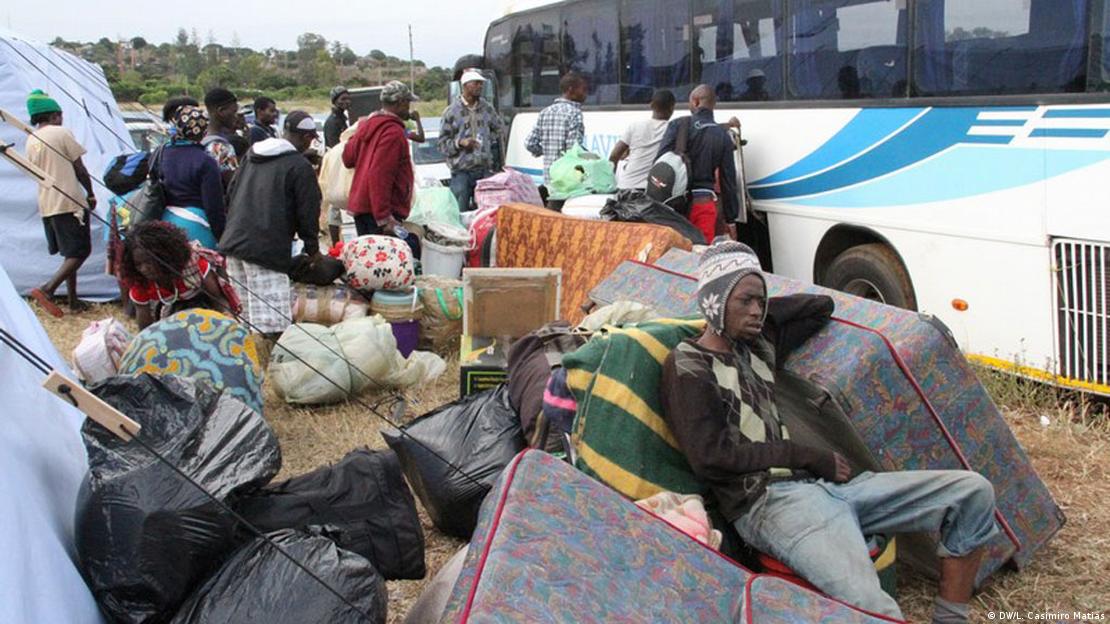
In the past, Zimbabwe has sent buses to return citizens from South AfricaI
mage: DW/L. Casimiro Matias

Several African countries organized evacuations for those wanting to leave South Africa during these turbulent times: Neighboring Zimbabwe sent buses to bring its nationals home, while Malawi and Mozambique also assisted returnees with logistics.

2019: Nigerians targeted amid diplomatic fallout


In September 2019, violence swept through parts of Johannesburg and Pretoria again.

According to South African police figures cited by Reuters, at least 12 people were killed, and hundreds of businesses looted or destroyed. Nigeria evacuated more than 500 of its citizens from South Africa.

The attacks triggered a diplomatic crisis across Africa, with Nigeria even temporarily boycotting the World Economic Forum on Africa hosted in Cape Town.

South African President Cyril Ramaphosa condemned the violence, saying that there "is no justification for any South African to attack people from other countries."

Yet critics again argued that the government continued to frame the unrest as being rooted in crime rather than calling it out as xenophobia.


2021-2022: The rise of Operation Dudula

The anti-migrant group Operation Dudula emerged in the township of Soweto in 2021, and quickly garnered national attention for its ambitions.

The group organized marches against undocumented migrants, conducted raids on businesses and accused foreigners of taking jobs from South Africans while overburdening public services.

Human rights organizations accused Operation Dudala of fueling vigilantism and xenophobia, as well as blocking foreign nationals from accessing healthcare, schools, and informal trading spaces.


Zandile Dabula, the leader of Operation Dudula, told DW at the time: "The escalating crime, drug trafficking, human trafficking, that's bad," linking these phenomena to foreign nationals while insisting that the group only sought to fight irregular immigration and crime.

The group later even registered as a political party ahead of the 2024 elections, and has been growing since, alongside other anti-migrant movements.
2024-2026: 'South Africans are not xenophobic'

Tensions around immigration have remained high, particularly against the backdrop of South Africa's escalating economic crisis: South Africa's official unemployment rate stood at nearly 33% in the first quarter of 2025, according to Statistics South Africa, while youth unemployment remained above 45%.

Fresh outbreaks of violence in 2026 have triggered protests from leaders in Ghana and Nigeria, with a renewed criticism of South Africa's handling of xenophobia. Nigeria's Foreign Minister Bianca Odumegwu-Ojukwu stressed: "Nigerian lives and businesses in SA must not continue to be put at risk.”

Nigeria has meanwhile expanded its official response to the latest attacks by announcing a "voluntary repatriation” program for its nationals after two were killed as part of the recurring violence.

South Africa's presidential spokesperson Vincent Magwenya has rejected claims that widespread xenophobia has resurfaced in the country, stating that "South Africans are not xenophobic."

He has said that what is being observed are merely "pockets of protest, which is permissible within our constitutional framework."


Why are foreigners being targeted again?


Around the world, migrants are frequently cast as scapegoats for deeper structural problems, reaching from inequality and corruption to weak economic growth and state failure.

In South Africa, this scapegoating has overwhelmingly targeted Black and African migrants, who make up more than two-thirds of South Africa's estimated 3 million foreign residents.

Many observers warn that the country's problem with xenophobic violence has become cyclical, resurfacing whenever economic or political pressures intensify and revealing how quickly hardship can be turned into hostility.

Edited by: Sertan Sanderson

Silja Fröhlich is a German journalist and TV
Fertilizer crisis: Africa's options amid the Hormuz blockade

DW
08/05/2026 

The ongoing blockade of the Strait of Hormuz is affecting African nations particularly badly. But there are potential solutions for mitigating the drastic effects on the continent in the short, medium and long term.

How can African farming communities obtain fertilizers, which are becoming scarce worldwide as part of the current crisis?
Image: Caitlin Kelly/AP Photo/picture alliance


For more than two months, there have hardly been any merchant ships passing through the Strait of Hormuz amid the ongoing blockade. Africa is being hit by the full brunt of the conflict in the Middle East, with canceled flights, long lines at petrol stations, and barren fields across the continent.

Left without access to a significant portion of their global supply chain, fertilizer industries have also been deeply affected by the crisis.

Any resumption of free maritime traffic through this strategically important strait — as was the case prior to the US-Israeli strikes on Iran earlier this year — is still a long way off; and even then, it would likely take months for markets to stabilize and for production lines and logistics to return to normal.

It's understandable that African institutions and governments are currently operating in crisis mode, with no end to the blockade in sight. Some are even looking for ways to prevent more severe consequences, such as the risk of famine or national bankruptcies.


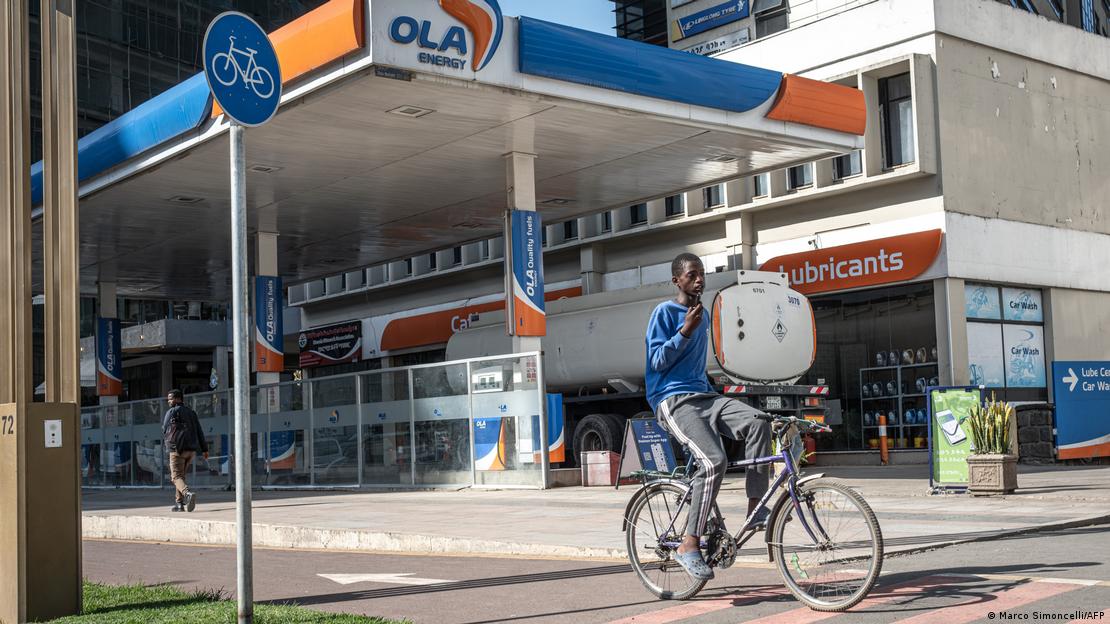
In Ethiopia, priority is given to public transportation and other critical sectors amid fuel shortageImage: Marco Simoncelli/AFP

Willy Nyamitwe, Burundi's African Union (AU) ambassador and current chair of the Permanent Committee of Ambassadors, told DW that the AU "is monitoring the situation around the Strait of Hormuz very closely because it affects a number of strategic goods that are essential to African economies."

With several African countries already deeply indebted, the prospect of inflation-driven depreciation of national currencies as a result of the Iran war could further exacerbate the situation.

"The situation is critical," said Anja Berretta, director of the Africa Economic Program at the German Konrad Adenauer Foundation in Nairobi, Kenya.

"Especially when it comes to fertilizers, we were already facing a similar situation in 2022 when Russia launched its war of aggression against Ukraine; after all, Russia and Belarus were two of the most important fertilizer producers."

The fear that famine would take hold in parts of Africa did not become reality, Berretta told DW, adding that back then, African nations responded with a flexible approach, for example by providing financial assistance through the African Development Bank.

Emergency response to fuel shortages


The shortage of fossil fuels in the current crisis has already crippled many parts of the continent.

In Ethiopia, diesel is now being prioritized for public transportation, leaving private customers without petrol; in Juba, the capital of South Sudan, rolling blackouts are being used to reduce the output of the country's oil-fired power plant.

Gambia has started subsidizing fuel with more than €5.8 million (around $6.8 million) in tax revenue, while Zimbabwe has turned to blending fossil fuels with ethanol.

Africa's aviation industry is also being hit hard by the global kerosene shortage, with flight operations affected across the continent.

Shortages and steep price hikes for chemical fertilizers have received less spotlight during the Hormuz crisis but are nevertheless equally critical.

Before the Iran war began, nearly half of the sulphur used in phosphate fertilizers globally passed through the Strait of Hormuz. The proportion was also high for the chemical precursors urea and ammonia.

The South African grain producers' association, Grain SA, reported that in April that ammonia prices were already more than 75% higher than just a year earlier. Urea was also reported to be about 60% more expensive.

Efficient short-term solutions


National emergency protocols for shortages in diesel, petrol, and kerosene have been in place in many countries since the beginning of the Iran war. However, similar solutions for fertilizers are yet to fully materialize.

An initiative spearheaded by UN Secretary-General Antonio Guterres, calling on the warring parties to allow the transit of fertilizers to developing countries through the strait, has yet to be implemented.

The model for this idea is the Black Sea Grain Initiative, which enabled the safe export of Ukrainian grain from July 2022 to July 2023 with Russia's approval to prevent food shortages.

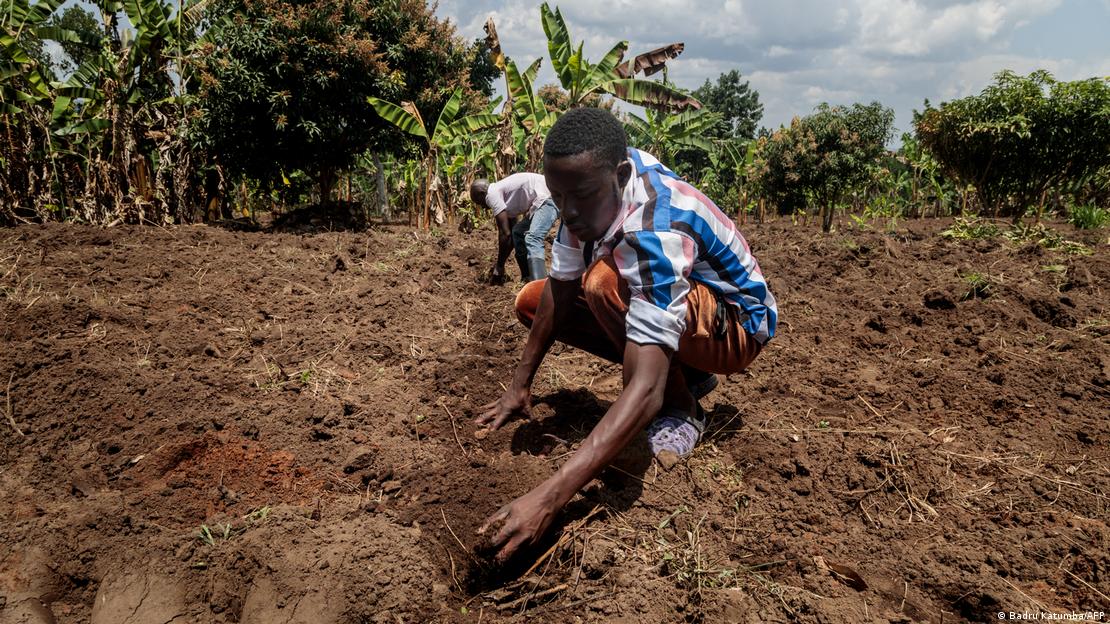
When the Ukraine war sent fertilizer markets into a tailspin in 2022, this smallholder farmer in Uganda turned to fertilizing his field with the excrement of the black soldier fly
Image: Badru Katumba/AFP

There's another quick-fix solution that has also proven effective in times of crisis: African importers could pool their fertilizer procurement efforts — in the same way that the EU leveraged its market power to secure a rapid and affordable supply of COVID-19 vaccines.

Berretta believes that this is a realistic option which would also be easy to implement: "We're not talking about technical capacities or financing; African countries would simply have to say, 'Let's do this together now.'"

Even if a comprehensive solution to this end through the AU were to fail, regional communities such as the West African ECOWAS or the East African Community could still achieve success in this area.

Based on their agricultural surface footprint, countries in sub-Saharan Africa already use fertilizer sparingly: According to data from the UN's Food and Agriculture Organization (FAO) and the World Bank, farms in the region use an average of 20.5 kilograms of fertilizer per hectare, compared to just under 144 kilograms on average globally.


This World Bank data, however, dates back to 2021, prior to the onset of the war in Ukraine, and will likely have adjusted somewhat in the past five years.

If fertilizer usage is reduced even further in Africa, there is a risk of lower yields for staples such as corn, rice and wheat leading to food inflation. Africa therefore urgently needs fertilizer supplies, as the next planting season has already begun in most places.
Long-term solutions not entirely out of reach

In order to become less susceptible to external threats like the wars in Ukraine and Iran in the long run, the most secure strategy would be to ramp up domestic fertilizer production capacities.

The current major players in this field are Morocco and Egypt, both of which have large phosphate deposits but also rely on sulphur imported from the Gulf states for production.

The Nigerian Dangote Group intends to expand production, and is planning to open new urea plants in Nigeria and Ethiopia.

Berretta thinks that the best approach is to produce and distribute fertilizers on a large industrial scale in a few select locations across Africa.

"Not every country has the ideal conditions to establish its own fertilizer production. This is where regional supply chains play a very important role; you need to identify three or four countries in a region where the conditions are such that fertilizer production can be established, and they then turn to supplying the entire region," he said.

Fewer trade barriers

This is where the African Continental Free Trade Area (AfCFTA) would come into play — because when products aren't held up at national borders for customs, the potential for private investors to step in grows significantly greater.

Although the AfCFTA has been in place since 2021, various obstacles continue to hinder the smooth cross-border movement of goods under its provisions.

"The AfCFTA is a central part of the solution," said AU Ambassador Nyamitwe. "At the African Union, we believe that through accelerated implementation of the AfCFTA, African states can build more resilient regional value chains in critical sectors such as agriculture, energy, health, and manufacturing."


This article was translated from German.

David Ehl Reporter and editor
Journalist found dead in Colombia's conflict zone

Mahima Kapoor 
DW with AFP
08/05/2026 

Mateo Perez, a 25-year-old Colombian reporter, reportedly went missing on May 5 after being detained by guerrilla members at a roadblock.


Press groups have documented an increase in threats against journalists investigating paramilitary groups and organised crime in Colombia
 [File: Antioquia department 2024 Image: Jon G. Fuller/VWPics/IMAGO


A Colombian journalist was found dead on Friday night in the country's northwestern region, an area plagued by guerrillas, drug traffickers, and illegal gold miners, President Gustavo Petro said.

The body of 25-year-old Mateo Perez was found in an area where members of the guerrilla group, Revolutionary Armed Forces of Colombia (FARC), and drug traffickers linked to the the Gulf Clan, operate.

Perez had been missing since Tuesday, when he was working in a rural area of the mountainous Antioquia department, about five hours north of the regional capital, Medellin.

President Petro blamed Perez's killing on guerrilla leader Jhon Edison Chala Torrejano in a post on X, accusing him of seeking control over illicit gold mining in the region.


"The humanitarian commission of the Red Cross and the ombudsman's office, with the support of the government, managed to enter the area and locate the body," Petro said in the post.

"The National Police has had orders for several weeks to strengthen its presence in this zone and to count on the support of the army to eradicate the groups that remain there. The action of the public forces will be effective," he said.

Press groups urge goverment to protect journalists

Perez ran an online news outlet, El Confidente de Yarumal, where his reporting focused mainly on crime, security, politics, and corruption.

The Colombia-based Foundation for Press Freedom (FLIP) said Perez had "faced legal pressures" over his "investigations into illicit economies linked to armed actors."

In a statement, FLIP urged the government to "stop being indifferent to the attacks against the press" and to adopt "real protection measures" for journalists at risk. "The murder of Mateo Pérez cannot go unpunished," the organization said.


The Committee to Protect Journalists (CPJ) said Perez had been detained by FARC members at a roadblock on May 5, citing FLIP.

"Colombian authorities must promptly investigate the death of Mateo Pérez Rueda and ensure that the perpetrators are brought to justice,” said Cristina Zahar, CPJ's Latin America program coordinator, in São Paulo.

"The state has a responsibility to guarantee secure conditions nationwide, enabling journalists to carry out their work freely and without fear of retaliation," she said.
Threats against journalists in Colombia

Since 2022, FLIP has recorded 387 attacks against the press by armed groups, with threats and forced displacement cited as the most common tactics.

FLIP said 170 journalists have been killed in Colombia for reasons related to their work since 1977, including Perez. Of those killings, 22 occurred in Antioquia, making it one of the country's deadliest departments for journalists.

Colombia has seen a surge in guerrilla attacks as the country prepares for presidential elections scheduled for May 31.

Edited by: Roshni Majumdar
Mahima Kapoor Digital journalist based in New Delhi
Anti-Christian aggressions on the rise in Jerusalem

Issued on: 03/05/2026 - 

Religious groups have documented a rise in harassment and violence against Christians in parts of Israel. One of the main flashpoints is Israeli-occupied East Jerusalem. The Old City of Jerusalem is home to some of the holiest sites in the world for Jews, Christians and Muslims.


ANALYSIS

Keeping the Lebanese army weak: A hardened US military doctrine at Israel's service


As Lebanon marks a month since “Black Wednesday”, when massive Israeli strikes killed 361 people, the international community continues to call on the Lebanese army to disarm Hezbollah. But the US legal imperative to ensure Israel has a “qualitative military edge” (QME) has kept the Lebanese military under-funded, under-equipped and unable to perform its role.


Issued on:  08/05/2026 - 
FRANCE24
By: Leela JACINTO

Two Israeli soldiers operate in southern Lebanon on April 29, 2026. © Ariel Schalit, AP

Exactly a month ago, Wissam Charaf was in Yarze, a picturesque town in the hills overlooking Beirut, when he suddenly heard the rumbling sound of an Israeli warplane just before it fired on a hill right across from where he was enjoying a break with his family from the Lebanese capital.

The warplane had struck Kayfoun, a town south of Beirut, which had been hit in the past during the waves of air strikes and bombardments Israel has conducted in Lebanon since October 2023. Charaf, like many Lebanese, had grown sickeningly accustomed to Israel’s frequent breaches of Lebanese sovereignty and airspace. So the 52-year-old filmmaker initially thought it would be more of the same in Lebanon’s new normal.

But this time, it was different. “Then there was another hit and then another hit. And then it went downwards towards Beirut, and it was like baba-baba-baba-baba-baba-baba-baba,” he said, recounting the sound of incessant, quick-fire strikes. “Under our eyes, downhill, Beirut was being bombed. It was massive. It was gigantic. It was everywhere.”

It was April 8. Black Wednesday, as the Lebanese call it. Operation Eternal Darkness as the Israeli military called it.


In just 10 minutes, the Israeli military offloaded 100 bombs across Lebanon, from Hermel in the far north, across the eastern Bekaa Valley, to Beirut on the western coast and down to the towns and villages in the country’s already battered south. The death toll on one day mounted to 361, including women and children. In a matter of minutes, Israel had carried out one of its worst mass killings in Lebanon’s history.

Amid an international outcry, diplomatic attempts to include Lebanon in the Iran ceasefire deal – which was announced by Pakistani mediators on April 8, before a US-Israeli rollback – went into high gear.

A week later, US President Donald Trump announced that the leaders of Israel and Lebanon had agreed to a 10-day truce. The US State Department brief on the ceasefire deal noted that, “All parties recognize Lebanon’s security forces as having exclusive responsibility for Lebanon’s sovereignty and national defense; no other country or group has claim to be the guarantor of Lebanon’s sovereignty.”

The long history of Israel’s entanglement with its northern neighbour has produced a diplomatic lexicon that is familiar to the Lebanese and the wider Middle Eastern public. Calls for the Lebanese security or armed forces – sometimes abbreviated to LAF – to defend Lebanon’s sovereignty dot realms of official agreements, briefings, notes and dispatches. Most bear a deceiving tone of resolution in a conflict that has defied diplomacy for decades.

Less well-known is another term, “qualitative military edge”, or QME, that has long been used in Washington policy circles. It was enshrined in US law in 2008, and guides US foreign policy to this day. QME pertains to Israel and is the underlying source, a growing number of experts say, of the bloodshed in the Middle East that shows no sign of abating.

In Lebanon, QME has a particular bearing as the country marks a month since Black Wednesday with Israel continuing to bombard Lebanon despite the shaky ceasefire, killing more than 2,700 people and displacing more than a million since the latest round of fighting re-erupted on March 2, following the outbreak of the US-Israeli war on Iran.
An Israeli military concept becomes US law

The concept to ensure Israel always has a qualitative military edge over its enemies traces its roots to the country’s first prime minister David Ben Gurion. Drawing from the lessons of the 1948 Arab-Israeli war, Ben Gurion’s 1953 defence doctrine concluded that since Israel “will continue to be quantitatively inferior vis a vis the Arab world”, the new nation “must develop a very strong qualitative edge”.

In the US, the concept did not take hold until two decades later, following the end of the 1967 war, when then-president Lyndon Johnson approved the sale of F-4 Phantom fighter jets to Israel, according to the pro-Israel think tank The Washington Institute for Near East Policy.

It was enshrined in US law in 2008 under George W. Bush’s presidency, when Congress passed the Naval Transfer Act, which requires the US to ensure that arms exports “to any country in the Middle East other than Israel shall include a determination that the sale or export… will not adversely affect Israel's qualitative military edge”.

The concept has continued to frame US legislation approving military aid to Israel through Republican and Democrat presidencies, including the 2012 US-Israeli Enhanced Security Cooperation Act, signed by Barack Obama, which mandates that the US must “help the Government of Israel preserve its qualitative military edge”.

It has ensured that Israel stands as the largest cumulative recipient of US military aid since its founding, receiving over $300 billion in assistance. Since the start of Israel’s Gaza war in October 2023, the US has enacted legislation providing at least $16.3 billion in direct military aid to Israel, according to the Washington DC-based Council on Foreign Relations.

“Initially, the idea [of QME] was simply to ensure that Israel always maintains technological and military superiority over any possible combination of regional adversaries,” explained Karim Emile Bitar, international relations professor at Beirut’s Saint Joseph University and a lecturer in Middle East studies at the Paris-based Sciences Po. “The fact that it's now embedded into US law affects arms sales and military assistance across the Middle East, including Lebanon.”

QME is “not a household concept” Bitar concedes, but it is important because “it’s one of the structural principles shaping US security architecture. It explains why some Arab states receive sophisticated weapons, those pro-US states that are very aligned with Israel, and others face major restrictions. And military aid to Lebanon has ceilings that have rarely been crossed”.

A national army weaker than a militia

In Lebanon, the flip side of Washington’s QME imperative to ensure Israel has the military edge is the enforced weakness of the Lebanese armed forces, according to many Middle East analysts.

“My critique of it [QME] is what it implies on the ground, which is this idea that we constantly hear that the Lebanese military needs to provide security in Lebanon and especially in southern Lebanon. But what we don't hear in this debate is that the Lebanese army is purposefully kept weak and under-prepared and under-equipped by the US and by Western countries that provide military aid and weapons,” said Mohamad Bazzi, director of the Hagop Kevorkian Center for Near Eastern Studies and a professor at New York University.

For more than two decades, Israel’s repeated attacks and encroachments on Lebanese territory have been aimed at fighting Hezbollah, the Shiite group with a military wing that is widely considered stronger than the Lebanese national army.

Hezbollah emerged from the 1980s Lebanese civil war – which ended with the 1990 Taif Agreement – stronger than the Lebanese national army, which had fractured along sectarian lines and dissolved during the brutal internecine conflict. At that time, Israel was still occupying southern Lebanon. Hezbollah’s supporters argued that it was the only force capable of resisting the Israeli occupation of southern Lebanon – which it did until the 2000 Israeli military withdrawal, giving the Arab world its first military victory against Israel.


While the rationale for Hezbollah retaining its weapons ended with the Israeli withdrawal, the militia group had, by then, amassed considerable firepower from its backers in Tehran. It had also made in-roads into Lebanese politics under the protection of Bashar al Assad, the strongman in neighbouring Syria. But during the Syrian civil war and Lebanon’s crippling economic crisis, the group’s popularity began to decline – including among Shiites in a deeply divided country where sectarian political parties often provide for their communities in the absence of state services.

But Hezbollah’s plummeting popularity, and the groundswell of Lebanese discontent over the extent of its state capture, has not translated into its disarmament, much less extinction.

Over the past two years, Israel has conducted massive campaigns against the group, assassinating its leader Hassan Nasrallah and top commanders. On Thursday, the Israeli military announced that it had killed ⁠a commander of ​Hezbollah’s elite Radwan force in an air strike on Beirut in the first Israeli attack on the Lebanese capital since the ceasefire agreed ​last month.

Israel today has carved ​out a self-declared buffer zone extending as deep as 10 km into southern Lebanon. The population that once lived in these areas has been displaced, and many Lebanese fear a strike at any time, anywhere as the buzz of Israeli surveillance drones offer an incessant soundtrack to their daily lives.

And yet, the Lebanese Shiite group has managed to keep up its fight against Israel. “Hezbollah still possesses capabilities, even though it has been weakened. It still possesses capabilities that in some domains surpass those of the Lebanese state. It has a large missile arsenal. It has extensive combat experience that it gained mostly in Syria when it was fighting alongside Bashar al-Assad, and it has highly motivated, ideological cadres,” said Bitar.

Coffins of Hezbollah fighters are carried on a truck during a mass funeral procession in the southern village of Kfar Sir, Lebanon on April 21, 2026 © Hassan Ammar, AP

Hezbollah fights Israel, the Lebanese army polices

As it continues to battle the IDF in southern Lebanon and launch rockets into northern Israel, Hezbollah argues that it needs to retain its weapons since it’s the only force in Lebanon that can resist Israel.

Technically, Hezbollah has a point. “If the Lebanese military was better equipped and had the resources it needs, there would be a stronger argument for disarming Hezbollah. That's the crux of this issue. It would take away Hezbollah's argument that it needs to be the one that defends Lebanon because the military isn’t capable of doing it,” explained Bazzi.

The Lebanese army today is among the world’s weakest, ranking 118 in the 2026 Global Firepower index of 145 countries. The primarily US-funded military barely has a navy, with its patrol boats conducting mostly coastguard and anti-smuggling duties. Its “air force” has long been a source of Lebanese jokes, including on social media, where wags remark about its lowly Cessna helicopters hovering below Israel’s fighter jets combing the Lebanese airspace. Defence systems, vital for a country’s security in the modern age, are absent as Israel adds layers of shields to its Iron Dome system.


Despite the quips and barbs, the national army is a beloved institution. “The Lebanese army is widely respected by most Lebanese. The Lebanese people want to empower the army. They want the army to be in charge of security,” explained Bitar.


Bazzi agrees. “The Lebanese army has been hailed as this one institution that's cross-sectarian, that's been successful, that's been rebuilt in a way that preserves the power and the interests of the Lebanese state. We've heard a lot of that. But,” he added significantly, “it's never really confronted an external enemy.”


US envoy’s ‘wild interview’


Meanwhile the US and its European allies display all the signs that they want the Lebanese army to succeed, with statements proclaiming it the sole guarantor of Lebanon’s sovereignty amid frequent calls for the Lebanese army to disarm Hezbollah.

France, Lebanon’s former colonial power, also issues statements advocating the strengthening of the country’s security forces. In March, France repeated its call to “step up support to the Lebanese Armed Forces, whose mission in this difficult context is to continue disarming Hezbollah”. A Paris summit was set for April. But it was then cancelled due to the Iran crisis.

The gap between statements and reality spilled into the open last year, when Trump’s envoy for the region, Tom Barrack, publicly expressed what many Lebanese knew but never imagined they’d hear from a US diplomat.

US envoy Tom Barrack speaks at a panel in Antalya, southern Turkey, April 17, 2026.
© Riza Ozel, AP


In what came to be called Barrack’s “wild interview”, the US envoy called for the Lebanese state to disarm Hezbollah before confessing that Washington does not want to arm the Lebanese army. “We don’t want to arm them… so they can fight Israel? I don’t think so,” Barrack said.

The clincher however came when the US diplomat noted that the Lebanese army was not going to “go knock on the door of a Shia house… and say, 'Excuse me, ma’am, can I go and take the rockets and the AK-47s out of your basement?”

Barrack’s comments, Bitar noted, were “very significant because it was a sort of acknowledgement that pushing the Lebanese army to take on Hezbollah would potentially lead to civil strife.”

More than three decades after the end of the civil war, the US still fears an injection of arms into Lebanon could set the populace at each other’s throats. Meanwhile it continues to provide Israel a qualitative military edge while the Palestinian issue remains unresolved after nearly 80 years.

A month after he watched Israeli warplanes conduct its Operation Eternal Darkness from a hill overlooking Beirut, Charaf is clear-eyed about the dismal chances for peace in his homeland. “The Lebanese army is torn between an international community that is telling them, fight Hezbollah, disarm Hezbollah, and we'll give you aid later. And the Lebanese army is saying, guys, if you want us to disarm Hezbollah, well at least give us weapons to do it,” he noted with a sigh.

“They're asking the Lebanese army somehow to obey the decisions of the Israeli army,” he added. “And they're asking the Lebanese army to do something that I would say is mission impossible.”


© France 24
02:03
FOUR YEARS LATE

CPJ demands update on US probe of journalist Abu Akleh’s killing in West Bank


The Committee to Protect Journalists (CPJ) on Thursday demanded a "public progress update" from the US Department of Justice on the investigation into the Israeli military's killing of Palestinian American journalist Shireen Abu Akleh, who was gunned down while reporting for Al Jazeera in the occupied West Bank in 2022.


Issued on: 08/05/2026 
By:FRANCE 24

A woman takes a photo of a mural dedicated to Palestinian American journalist Shireen Abu Akleh after it was unveiled in the West Bank city of Bethlehem on August 30, 2023. 
© Nasser Nasser , AP

The Committee to Protect Journalists (CPJ) on Thursday called for US authorities to relaunch their investigation into the Israeli military's killing of Palestinian American journalist Shireen Abu Akleh, who was gunned down while reporting for Al Jazeera in the occupied West Bank in 2022.

In a letter to the US Department of Justice -- which oversees the Federal Bureau of Investigation -- and FBI chief Kash Patel, the global press freedoms group demanded a "public progress update" on Abu Akleh's death.

"Although the FBI reportedly opened an investigation into her killing in November 2022, it has made no demonstrable progress," the letter noted, adding that CPJ was "not aware that any formal interviews have been conducted with witnesses despite the willingness of multiple witnesses to cooperate."


"This troubling lack of concrete progress -- four years after Abu Akleh's death -- represents a profound failure of the US government to respond promptly and impartially to the killing of one of its citizens by a foreign military."

Abu Akleh was 51 when she was fatally shot on May 11, 2022 by Israeli Defense Forces (IDF) soldiers while covering an Israeli raid on the Jenin refugee camp in the north of the occupied West Bank, CPJ said.

Then-Israeli Prime Minister Naftali Bennett initially claimed gunfire from Palestinian fighters was the likely cause of her death.

The IDF later released a statement saying it was "not possible to unequivocally determine the source of the gunfire" that killed Abu Akleh, adding there was "a high possibility that Ms. Abu Akleh was accidentally hit by IDF gunfire."
Truth in conflict

But CPJ notes that multiple independent investigations from leading news organizations "concluded that Abu Akleh was killed by IDF fire; some found evidence that she was deliberately targeted."

Abu Akleh was "a household name across the Middle East, widely respected for her courageous and in-depth reporting on Palestinian life," CPJ said, adding that she was wearing a vest marked "PRESS" and "clearly identified as press at the time of her killing."

In a separate statement Thursday, Abu Akleh's family also sought justice for violence at the veteran reporter's funeral -- Israeli police attacked her pallbearers, who nearly dropped her coffin -- saying "no one has been brought to justice, neither for her killing nor for the attack on her funeral."

"Her killing was not only a tragic loss for our family, but also a grave attack on press freedom and the fundamental right to report the truth," the family's statement said. "This ongoing impunity sends a dangerous message that journalists can be targeted without consequence."

Abu Akleh's death also made her a broader symbol of the Palestinian struggle: murals of her face adorn walls, her office's street in Ramallah was renamed in her honor and a museum was named for her.

In addition to demanding a public update on the investigation, press advocates called for the FBI to commit to a timeline to "complete a thorough criminal investigation and publicly release its findings," urging the agency to maintain an impartial and independent inquiry "free from political considerations."

CPJ said since Abu Akleh's killing, Israel has killed 258 more journalists and media workers across the Middle East, including 207 in Gaza alone.

Israel was responsible for two-thirds of journalist deaths in 2025, CPJ said.

The Israeli army rejects allegations of targeted violence, saying it does not intentionally target journalists or their families.

(FRANCE 24 with AFP)