“I do believe I’ll be . . . .having the honor of taking Cuba.”
– Donald Trump
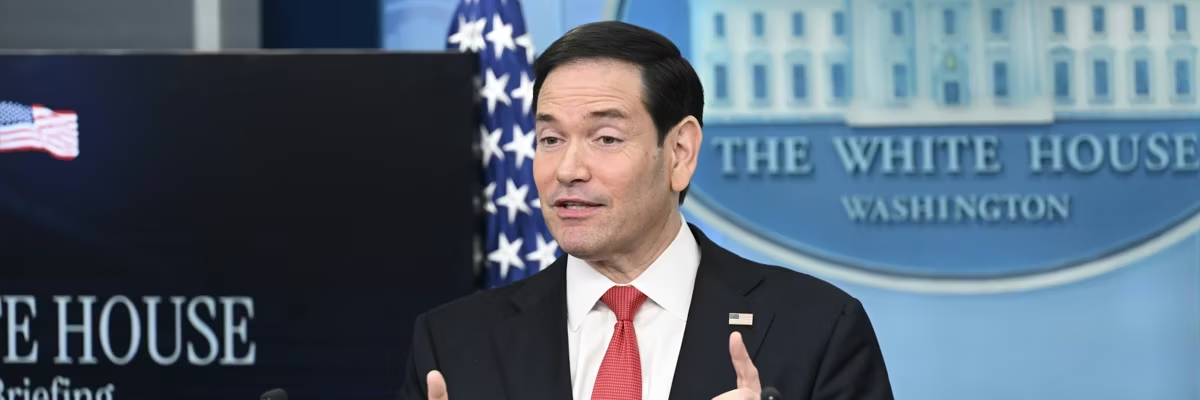
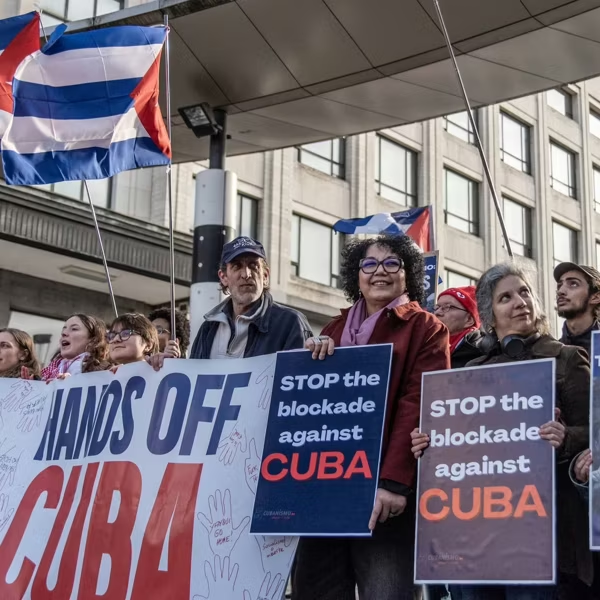
Donald Trump tightened already suffocating sanctions on Cuba on May 1, at the same time as he made renewed threats to “take” the island as soon as he finishes committing the greatest foreign policy blunder in U.S. history in Iran. The new measure to heap further unmerited suffering on Cubans was justified on the laughable pretext that their government poses an extraordinary national security threat to the United States, which, if it were true, would constitute an equally extraordinary confession of military impotence on the part of the United States.[1]
That point aside, it’s a simple historical fact that U.S. contempt for Cuban sovereignty long predates Washington’s fixation on “national security” as a pretext for its interventions, so the problem does not lie in Havana.
Over two centuries ago, Washington was already firmly opposed to independence for the island, mainly because it was “strategically situated and rich in sugar and slaves,” in the words of U.S. foreign policy expert Piero Gleijeses. Such advantages were not to be sacrificed to a heavily mixed-race population of “mongrels” achieving independence, to use the rhetoric of Manifest Destiny.[2]
Thomas Jefferson recommended that James Madison offer Napoleon a free hand in Spanish America in return for the gift of Cuba to the United States. Writing to Madison in 1823, he said that the U.S. should not go to war over the island, since “the first war on other accounts will give it to us, or the Island itself will give it to us, when able to do so,” sounding very much like Donald Trump today. Secretary of State John Quincy Adams explained Cuba’s strategic value, describing it as “an object of transcendent importance to the commercial and political interests of our Union.” He, too, favored it remain under Spanish control until it fell into U.S. hands by “the laws of political . . . gravitation,” a “ripe fruit” ready for harvest. This view was almost universal in the U.S. Executive Branch and Congress at the time.
Concern over Cuba on explicitly political grounds arose with the coming of its national liberation movement in 1868. A key concern was the movement’s democratic tendencies, which included such heresies as democracy, freedom, and equal rights for everyone, not just white property owners. This was the familiar imperial fear of a bad apple spoiling the barrel, in this case Cuban independence possibly succeeding and inspiring other colonized peoples to similarly strive for national independence. If Empire is to exist, that kind of example has to be stamped out.[3]
Some U.S. lives and property were lost in the initial stages of Cuba’s war for independence, but the real crisis came in 1873 when Spain seized the Virginius, a ship flying the U.S. flag and carrying weapons to the Cuban revolutionary forces. The Spanish executed fifty-three crew members. Hamilton Fish, President Grant’s secretary of state, resisted calls for revenge knowing that the ship had been breaking the law and wanting no part of the multiracial Cuban population. When a cabinet member raised the idea of annexing Cuba, Fish quashed the idea with a reminder that the U.S. already had terrible racial problems in “South Carolina and Mississippi.”
In the end, Spain paid an $80,000 indemnity for lives of the crew members and remained in control of Cuba when the war ended in 1878.[4]
The war did not resume in full force until 1895, when Madrid’s empire was near collapse. For years it had been forced to simultaneously fight liberation movements in Cuba and the Philippines. Its colonies on the American mainland had been liberated in 1825, but it clung hard to the islands of Cuba and Puerto Rico, the last of its colonial possessions in the Americas. Meanwhile, U.S. influence had grown to the point that it could ignore British power and conquer Cuba, just in time to prevent victory by what it openly regarded as the indigenous lesser breeds. The New York press described the latter as “ignorant niggers, half breeds, and dagoes.” General Samuel B. M. Young of the U.S. military command was of a similar view, dismissing Cuban soldiers as “a lot of degenerates,” and “no more capable of self-government than the savages of Africa.”[5]
By late 1895, the rebels claimed to have established a provisional government. But neither Grover Cleveland nor William McKinley were willing to recognize the revolutionary forces. To have done so would have released Spain from the obligation to protect $50 million in U.S. property in Cuba. The U.S. government preferred to hold “civilized” Madrid responsible for that property and U.S. lives on the island, while pressing the Spanish government to give the “uncivilized” Cuban rebels enough autonomy so they would lay down their arms.
Spain, however, refused to grant the autonomy, at least at first. Its formerly global empire had withered away to just Cuba, Puerto Rico, Guam, and the Philippines, and no Spanish government could expect to remain in power if it lost control over any of these. The Spanish took a hard line, sending 150,000 soldiers who tried to destroy rebel support by rounding up thousands of Cubans and locking them in barbed-wire concentration camps. But the revolution continued to spread, and insurgents adopted a scorched earth policy that destroyed U.S. property.
Cuban suffering was incalculable. Typhus, smallpox, and cholera stalked the island, and famine was widespread. A huge portion of the population was sunk in disease, death, and despair.[6] As Spain lost control over the deteriorating situation riots broke out in Havana in late 1897. McKinley moved a warship, the Maine, into Havana harbor to protect U.S. citizens and property. Days later an explosion sank the Maine, killing more than 268 U.S. sailors. A naval court of inquiry investigating the sinking could not determine blame for the disaster.
Nevertheless, egged on by a sensationalist press that eagerly pinned the blame on Spain, excitement for war with Madrid mounted. President McKinley opposed it, but he also wanted U.S. property in Cuba protected, the Cuban revolution prevented from turning sharply left, and restored confidence in the U.S. business community, among other concerns. These outcomes could only be achieved through war.
Two months after the blowing up of the Maine, Congress authorized it and events proceeded in rapid-fire succession. Madrid broke off relations with Washington; the jingoist press chorused, “On to Havana!”; a million men raised on romantic tales of Antietam and Gettysburg rushed to enlist; the French ambassador informed Paris that a “sort of bellicose fury has seized the American nation;” a rabid Teddy Roosevelt set off to “whip the dagoes.”[7]
U.S. and Cuban forces made quick work of the Spaniards, and yellow fever made quick work of the Americans. Cuba emerged in ruins, its agriculture and industry destroyed.
U.S. investors seized the railroads, the mines, and the sugar plantations.[8]
The events of 1898 are often said to represent the launching of U.S. empire, but in fact the U.S. was an empire from the beginning, deeply rooted in racist assumptions that make Teddy Roosevelt’s overt contempt for “dagoes” appear mild by comparison. These assumptions were on vivid display in the way black U.S. soldiers were treated by their fellow Americans as they went off to war in Cuba.
Tampa shopkeepers snarled at members of the all-black 24th Infantry, refusing to serve them on the grounds that, “We don’t sell to damned niggers!” Several officers from the all-black Eighth Illinois regiment were thrown out of a Baltimore restaurant, which wanted nothing to do with them. A brewery worker in Martinsburg, West Virginia, loudly offered his opinion to black soldiers that, “all niggers ought to go to Cuba where they’d get killed.” In Hampton, Georgia, Private James Neely of the Twenty-fifth Infantry was murdered after daring to ask for a glass of soda water in a drugstore. On the outskirts of Macon, Georgia, a sign at the entrance to a public park said simply: “No Dogs and Niggers Allowed.” Visitors to the town could also see the lynching tree where Will Singleton had recently been hanged, shot, and castrated. Implicit justification for all this was provided by the Macon press, which complained of a “riotous mood” among black troops headed for Cuba, whose contempt for Jim Crow was said to have an “unhealthy” effect on local blacks, a large number of whom worked the chain gangs.[9]
Due in no small part to such virulent racism, Cuban independence did not emerge in 1898. U.S. plantation owners had never gotten over Haiti’s having established itself as the first independent black republic in 1804, fearing the spread of revolutionary ideas into the U.S. slave population, and almost a century later the fear of Cuba’s black and mixed-race population was still palpable among U.S. leaders. They did not want black people in power just 90 miles from the United States.
So Spanish rule was replaced by U.S. rule – military occupation until 1902 – and after that de facto rule by the Platt Amendment, an agreement between Cuba and the U.S. that allowed Washington “to intervene at any time for the preservation of Cuban independence [and] the maintenance of a government adequate for the protection of life, property and individual liberty.” The Platt Amendment allowed the U.S. to acquire the naval base at Guantanamo Bay in 1903, and was used to justify four U.S. interventions before it was finally repealed in 1934.
Broken by the war, and with most of its population poor, illiterate, and ill, Cuba was left utterly dependent on the United States, which kept the island undeveloped just as Spain had done. The lucrative sugar industry was modernized and mechanized as a monopoly of the U.S., which was the dominant market and the principal investor. By the mid-1920s, the United States controlled two-thirds of Cuban agriculture. The sugar boom of that decade paid for stately public buildings and luxury homes for the wealthy, but gave nothing to the poor. U.S. firms constructed rails and roads and installed banks, electricity, and the world’s first automated telephone system, but repatriated all the profits for themselves.[10]
It took decades more of Cuba being an impoverished U.S. client state before revolution was put back on the agenda. On July 26, 1953 Fidel Castro attacked the Fort Moncada barracks at dawn with 120 young people long on guts and short on weapons. Some of them died in battle but many more were tortured to death by Fulgencio Batista’s army, which tore out the eyes of Abel Santamaría, among others.
Instead of being cowed into submission, Castro, taken prisoner, presented a forceful and unapologetic defense of the attack. The amazed judges gave him their rapt attention, hanging on every word. Claiming the ancient right of rebellion against tyranny, Castro accused Batista and his officers of butchery and betrayal, and defiantly declared that, “This island will sink in the ocean before we will consent to be anybody’s slaves . . .”
Putting forth a revolutionary program, he said that what was inconceivable was not the attack on the barracks but the failure to provide food and work for everyone:
What is inconceivable is that there should be men going to bed hungry while an inch of land remains unsown; what is inconceivable is that there should be children who die without medical care; that thirty percent of our campesinos cannot sign their names, and ninety-nine percent don’t know the history of Cuba; that most families in our countryside should be living in worse conditions than the Indians Columbus found when he discovered the most beautiful land human eyes had ever seen . . .”
From such wretchedness it is only possible to free oneself by death; and in that the state does help them: to die. Ninety percent of rural children are devoured by parasites that enter from the soil through the toenails of their unshod feet.
More than half of the best cultivated production lands are in foreign hands. In Oriente, the largest province, the lands of the United Fruit Company extend from the north coast to the south coast . . . .
Cuba continues to be a factory producing raw materials. Sugar is exported to import candies; leather exported to import shoes; iron exported to import plows. . . . [11]
On New Year’s Day 1959, the Cuban revolution triumphed, and almost immediately evoked Washington’s wrath. By late that year the CIA and the State Department agreed that Fidel Castro had to be overthrown. One reason, State Department liberals explained, was that “our business interests in Cuba have been seriously affected.” Another was the threat of a good example, i.e., the tendency of a successful revolution to inspire other subjugated peoples to challenge U.S. imperial control over their destinies. Or as the State Department concluded in November 1959:
The United States cannot hope to encourage and support sound economic policies in other Latin American countries and promote necessary private investments in Latin America if it is or appears to be simultaneously cooperating with the Castro program.
What was this program? Nationalization of a billion dollars in U.S. corporate holdings; carrying out the most extensive land reform in Latin American history; creating state cooperatives; building thousands of homes for the poor; cutting rents in half, providing jobs for the unemployed, wiping out illiteracy, vastly expanding medical and public health programs; abolishing racial discrimination; and opening the nurseries, resorts, and hotels of the rich to the entire population. This was an immensely popular set of policies, not just in Cuba, but wherever there were poor people.[12]
In elite planning circles in the U.S., however, the reaction was quite different. By October 1959, planes based in Florida were carrying out strafing and bombing attacks against the island. In December, CIA subversion was intensified, including supplying arms to guerrilla bands and sabotage of sugar mills and other economic targets. In March 1960, the Eisenhower administration formally adopted a plan to overthrow Castro in favor of a regime “more devoted to the true interests of the Cuban people and more acceptable to the U.S.,” a self-contradictory goal that was to be accomplished “in such a manner as to avoid any appearance of U.S. intervention,” due to Castro’s popularity.[13] The logic of the terror and economic strangulation was spelled out by Lester Mallory at the State Department, who wrote that “disenchantment and disaffection based on economic disaffection and hardship” should be cultivated in order to “bring about hunger, desperation, and overthrow of government.”
During the 1960 presidential campaign, Kennedy tried to be more rabidly anti-Communist than Eisenhower and Nixon, accusing them of threatening U.S. security by permitting “the Iron Curtain . . . .90 miles off the coast of the United States.” In a Cincinnati speech, he promised to overthrow the Cuban government if elected.[14]
He did his best to deliver on the promise. Sabotage, terror, and aggression sharply escalated under Kennedy, as well as devastating economic warfare that a tiny nation has no chance of withstanding for long. Havana’s dependence on the U.S. for both imports and exports was immense and could not be easily replaced, and not at all without great cost. Kennedy and his “Best and Brightest” brigade did everything they could think of to maximize Cuban suffering.
“We were hysterical about Castro at the time of the Bay of Pigs [April 1981] and thereafter,” Kennedy’s Defense Secretary Robert McNamara admitted to the Church Committee. Much of Kennedy’s Latin American policy was based on the fear that the Cuban revolution was a “virus” that would infect others and curtail U.S. hegemony in the region.[15] As a 1964 CIA report put it: “[Cuba] is being watched closely by other nations in the hemisphere and any appearance of success there would have an extensive impact on the statist trend elsewhere in the area.”[16]
Calling to mind Hitler’s rhetoric on Czechoslovakia, President Kennedy accused Cuba of being a “dagger” pointed at the United States and sent a proxy army to invade the island at the Bay of Pigs in April, 1961, while plotting Fidel Castro’s assassination.[17]Castro’s crime was having abolished capitalist control of the Cuban economy, which had terminated the Mafia-run play land that enriched foreign investors while Cuba starved.
Aside from the preposterousness of tiny Cuba posing a threat to a nuclear-armed superpower over eighty times its size, the U.S. had no legal leg to stand on. Article 15 of the Charter of the Organization of American States read: “No state or group of states has the right to intervene, directly or indirectly, for any reason whatever in the internal or external affairs of any other state.” The U.N. Charter stated: “All members shall refrain in their international relations from the threat of use of force against the territorial integrity or political independence of any state . . .”
Humiliated by the failed invasion but determined to isolate Cuba’s revolution, President Kennedy unveiled the Alliance for Progress, embracing the rhetoric of social change while expressly proscribing revolution or socialism. A major feature of the plan called for shifting the role of the Latin American military from “hemispheric defense” to “internal security,” encouraging the CIA to establish death squads under the aegis of “police training” while Kennedy rhapsodized about creating “a hemisphere where every man has enough to eat and a chance to work, where every child can learn, and every family can find decent shelter.”[18]
Washington escalated its clandestine attacks on Cuba and prepared a second American invasion. Hoping to deter the event while giving Washington a taste of its own nuclear medicine, Cuba requested that the Soviet Union install nuclear missiles on the island in the fall of 1962. When Krushchev complied, JFK opted for a game of nuclear chicken, imposing a unilateral blockade on Cuba in violation of the UN Charter, rather than negotiate a quiet solution, which he regarded as the sissy’s way out. In resolving the conflict, the U.S. did not renounce its ongoing terrorist war against the island, which included chemical and biological attacks, as well as regular attacks on Castro’s life. Cuba went into permanent military mobilization and embraced the Soviet Union, while Washington established a complete trade and credit embargo, the prescribed remedy for states that infringe on the sacred privileges of private investors.[19]
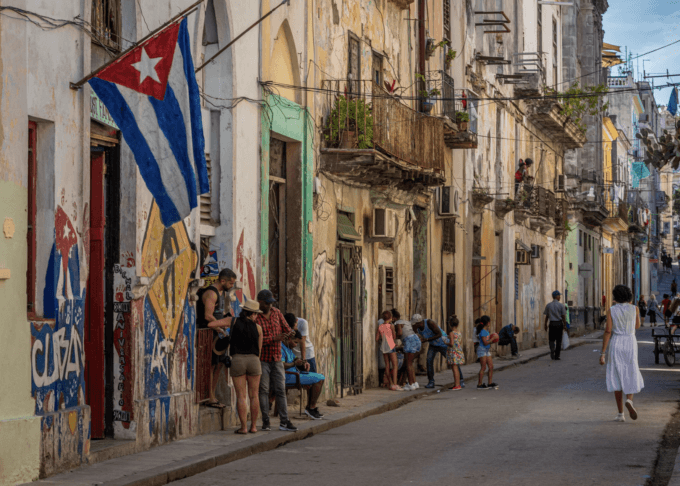
Over sixty years later, Washington is still obsessing over tiny Cuba, a health and education superpower that ended illiteracy nearly overnight at the start of its revolution, and now sends doctors all over the world to cure blindness and many other illnesses, as well as provide critical care in the wake of natural disasters, all without charge to the patients. This, while its far wealthier northern neighbor squanders trillions of dollars on endless wars and remains the world’s only developed country without universal health coverage for its people, who pay twice as much as other developed countries do for a system that delivers far worse health outcomes.
But these warped priorities are precisely the point. They are immensely profitable for the owners of the private economy, which, for some time now, has been a global economy. If these gluttonous few are to continue expanding their wealth these priorities must become everyone’s priorities, which means doing away with a revolution dedicated to what is regularly denounced as an extremist agenda by Washington.
Just what is this “extremist agenda”? In a nutshell, it’s the Cuban stance on human rights, announced by Fidel Castro in his New York City speech to the UN in 1960:
The right of the peasants to the land; the right of the workers to the fruit of their labor; the right of children to education; the right of the sick to medical treatment and hospital attention; the right of youth to work; the right of students to free education . . . ; the right of Negroes and Indians to full dignity as human beings; the right of women to civil, social and political equality; the right of the elderly to a secure old age; the right of intellectuals, artists, and scientists to fight, with their work, for a better world . . . the right of nations to their full sovereignty; the right of peoples to turn fortresses into schools, and to arm their workers, peasants, students, intellectuals, blacks, Indians, women, the young and the old, and all the oppressed and exploited people, so they themselves can defend their rights and their destiny. [20]
It is to destroy the viability of this agenda that we fight forever wars.
God Bless America.
*The halting half-measures taken towards normalizing U.S.-Cuba relations by Barack Obama did not address the criminality of longstanding U.S. policy, which he regarded – incredibly – as having been undertaken with “the best of intentions.”
Notes.
[1] . “Trump Tightens Sanctions Against Cuba, Threatens To ‘Take’ The Island,” La Jornada (Spanish), May 2, 2026
[2] Noam Chomsky, Year 501 – The Conquest Continues, (South End, 1993) p. 143.
[3] Chomsky, ibid. pps. 143-4
[4] Walter LaFeber, The American Age, (Norton, 1989) p. 163
[5] Tariq Ali, Winston Churchill – His Times, His Crimes, (Verso, 2022) p. 23: Noam Chomsky, Year 501 – The Conquest Continues, (South End, 1993) p. 144
[6] Tariq Ali, Winston Churchill – His Times, His Crimes, (Verso, 2022) p. 24; Lloyd C. Gardner, Walter F. LaFeber, Thomas J. McCormick, Creation of the American Empire, Vol. 1 (Rand McNally, 1976) p. 243
[7]Daniel B. Shirmer, Republic or Empire – American Resistance to the Philippine War (Schenkman Publishing Company, 1972) pps. 51, 55-6, 72, 83; Walter Millis, The Martial Spirit, (Literary Guild of America, 1931) pps. 108, 125, 127, 139, 147, 174, 362, 364; Claude Julien, America’s Empire, (Pantheon, 1971) pps. 55, 74; Noel J. Kent, America in 1900, (M. E. Sharpe, 2000) p. 12;
[8] Howard Zinn, A People’s History of the United States, (Harper, 1999) p. 310
[9] William B. Gatewood, Jr., Black Americans and the White Man’s Burden, 1898-1903, (University of Illinois, 1975) pps. 119-20, 140-3
[10] Mandy Macdonald, Cuba, (Kuperard, 2006) pps. 22-3
[11]Eduardo Galeano, Memory of Fire – Century of the Wind, (Pantheon, 1988) pps. 148-9
[12] Lawrence Wittner, Cold War America – From Hiroshima To Watergate, (Holt, 1978) p. 216
[13]Noam Chomsky, Year 501 – The Conquest Continues, (South End, 1993) pps. 145-6
[14]William Mandel, Saying No To Power, (Creative Arts, 1999), p. 374
[15] Noam Chomsky, Year 501 – The Conquest Continues, (South End, 1993) p. 146
[16] Quoted in Noam Chomsky, Latin America – From Colonization To Globalization, (Ocean Press, 1999), p. 70
[17]Todd Gitlin, The Sixties – Days of Hope, Days of Rage, (Bantam, 1987), p. 90
[18]Walter LaFeber, Inevitable Revolutions – The United States in Central America, (Norton, 1984) p. 151
[19]Seymour Hersh, The Dark Side of Camelot, (Little, Brown, 1997) p. 440n.; Cedric Belfrage and James Aronson, Something To Guard – The Stormy Life of the National Guardian, 1948-1967 (Columbia, 1978) p. 277; William Blum, Killing Hope – US Military and CIA Interventions Since World War II, (Common Courage, 1995) pps. 184-9
[20]Fidel Castro, Ten Days In Harlem – Fidel Castro And The Making Of The 1960s, (Faber & Faber, 2020), pps. 166-7

.JPG)