Wednesday, May 13, 2026

After Eliminating USAID, Trump Is Exploiting Need To Steal Africa’s Resources

From Ghana to South Africa, the Trump administration maliciously leverages human suffering to continue the centuries-long exploitation and systematic theft of Africa’s resources.


The Nchanga copper mine is seen near Chingola, Zambia.
(Photo by BlueSalo/ Wikipedia/ CC BY-SA 3.0)


Jordan Liz
May 13, 2026
Common Dreams

On May 4, Zambian Foreign Minister Mulambo Haimbe announced that negotiations with the US regarding critical health services and minerals have been suspended due to the Trump administration’s “unacceptable” terms.

For Haimbe, this includes: first, the Trump administration’s proposed health memorandum of understanding (MOU) requires that Zambia turn over health data to the US “in violation of our citizen’s right to privacy.”

Second, the US demands “preferential treatment of US companies over Zambia’s critical minerals.” Haimbe rejects this. He contends, “the Zambian government rightfully takes the view, first and foremost, that Zambians must have a say on how her critical minerals are used, and second that no one strategic partner is to be treated preferentially to others.”

Third, and perhaps most crucially, is “the coupling of the two agreements and frameworks to one another such that the conclusion of the minerals agreement is made conditional to the conclusion of the Health MOU.” The US is effectively demanding privileged access to Zambia’s abundant supply of copper, lithium, and cobalt—all critical for the development of AI and modern technologies—in exchange for health funding.

The only ones who benefit from forcing Zambia to trade raw minerals and data for health services are tech companies and the Trump family businesses.

This is not an isolated incident. As of March 2026, at least 24 African countries have agreed to similarly controversial health agreements with the US. Zambia, Ghana, and Zimbabwe are the only African nations thus far to reject the Trump administration’s coercive demands.

In those cases, concerns about data management and control similarly derailed negotiations. Arnold Kavaarpuo, executive director of Ghana’s Data Protection Commission, explained, “The proposed data sharing agreement looked at access not only to health data sets, but also to metadata, dashboards, reporting tools, data models, and data dictionaries.” It would have allowed up to 10 US entities access to this data without any prior approval from the Ghanese government.

Similarly, the US was demanding that Zimbabwe turn over any data it collects about pathogens causing outbreaks. Zimbabwe would not, however, be guaranteed access to any vaccines, treatments, diagnostics, or medical innovations that might result from this shared data. As Ndabaningi Nick Mangwana, permanent secretary in the Ministry of Information, Publicity, and Broadcasting Services, remarked: “In essence, our nation would provide the raw materials for scientific discovery without any assurance that the end products would be accessible to our people should a future health crisis emerge. The United States, meanwhile, was not offering reciprocal sharing of its own epidemiological data with our health authorities.”

These kinds of take-it-or-leave-it proposals represent the Trump administration’s strong-arm approach to global health funding. Instead of foreign aid, President Donald Trump offers two options: a crooked deal or death.

This has been their goal from the start. Throughout his second term, President Donald Trump has taken several measures aimed at weakening foreign aid and humanitarian programs. This includes: dismantling the US Agency for International Development (USAID); withdrawing from the World Health Organization (WHO) and 66 international organizations, including the United Nations Population Fund, which addresses sexual and reproductive health; as well as diverting funds away from the President’s Emergency Plan for AIDS Relief (PEPFAR), which supports HIV prevention, care, and treatment worldwide. Each of these actions deliberately endangers the lives of millions of people around the world—the cruelty really is the point.

From Ghana to South Africa, the Trump administration maliciously leverages human suffering to continue the centuries-long exploitation and systematic theft of Africa’s resources. Here, foreign aid has only one value: an exchange value.

Indeed, on April 27, at an event hosted at the New York Stock Exchange (NYSE) and attended by major corporations including Google, Goldman Sachs, and Palantir, US Ambassador to the UN Michael Waltz formally announced the launch of the “Trade Over Aid” initiative. This is a self-described “international economic development vision built on free markets.” It is premised on the idea that, unlike capitalism, humanitarianism and providing direct aid only create “dependency, inefficiency, and corruption.” As Waltz remarked, “free market principles remain the best proven path to lasting prosperity with better and more permanent results than any of the alternatives.”

On April 30, outgoing US Ambassador to Zambia, Michael Gonzalez, echoed these remarks. He accused the Zambian government of widespread corruption and “nationwide theft of US provided medicines.” He contended that, “For decades, the US relationship with Zambia was one centered around aid.” This “unrequited relationship” is no longer tenable—“going forward, the benefits of our relationship must be mutual.” Gonzalez continued, “We know that while you pursue a Zambia First agenda and we pursue America First, we are still able together to achieve something notably better for our countries.”

This emphasis on market solutions overlooks that capitalist exchanges always produce winners and losers. Competition, not cooperation, is the ethos of the proverbial free market. There is no “together” when “America First” is pitted against “Zambia First.” Instead of “lasting prosperity,” the only “permanent results” are widening inequalities between the haves and the have-nots.

And to be clear, the winners here are neither Americans nor Africans. Americans will be forced to bear the social, economic, and environmental costs of more data centers, AI-driven layoffs, and AI-powered surveillance. Zambia and other African nations will see their natural resources stolen and the bodies of their citizens exploited.

No, the only ones who benefit from forcing Zambia to trade raw minerals and data for health services are tech companies and the Trump family businesses. It is worth noting that Trump and his children have raked in billions from their investments in cryptocurrency, AI, and data centers.

What the Trump administration is offering is no more than colonialism dressed as humanitarianism. Foreign aid should never be manipulated for profit or political power. We must reject capitalist schemes like “Trade Over Aid.”

Instead, we must focus on building institutions that guarantee the right to healthcare for all. This is not simply an act of charity. As every pandemic makes patently clear, ensuring that everyone has access to health services benefits everyone. In the end, we must recognize that healthcare is a human right and a collective good. Ignoring this puts us all at risk.


Our work is licensed under Creative Commons (CC BY-NC-ND 3.0). Feel free to republish and share widely.


Jordan Liz
Jordan Liz is an Associate Professor of Philosophy at San José State University. He specializes in issues of race, immigration and the politics of belonging.
Full Bio >
Trump Cries ‘Virtual Treason’ as US News Outlets Detail Iran War Intel Assessments

New reporting on classified US intelligence findings undercuts the Trump administration’s repeated claims that it has obliterated Iran militarily.


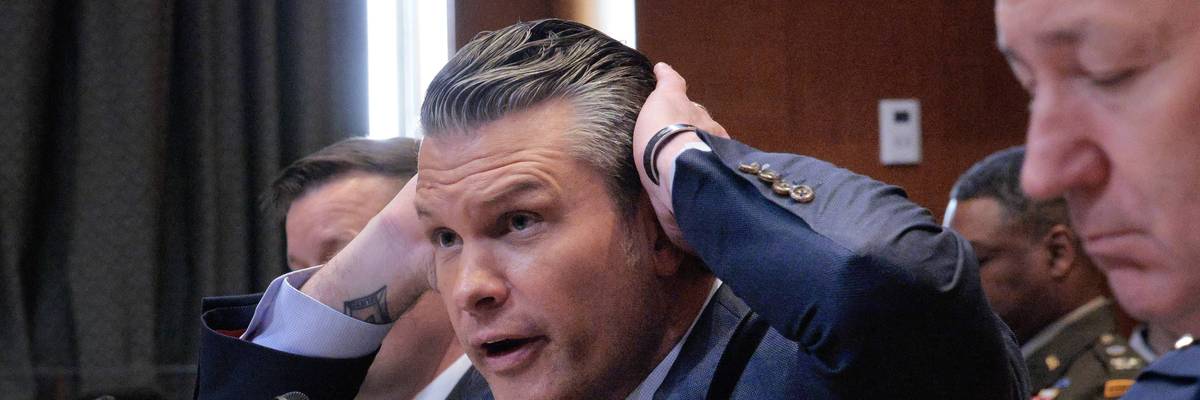
IS IT BRYLCREME OR WILDROOT?

Pentagon Secretary Pete Hegseth testifies during a US Senate hearing on May 12, 2026.
(Photo by Chip Somodevilla/Getty Images)


Jake Johnson
May 13, 2026
COMMON DREAMS

US President Donald Trump on Tuesday accused news outlets of committing “virtual treason” by reporting on classified American intelligence agency assessments showing that Iran has retained significant missile capabilities, contradicting triumphant White House claims that the Middle East country’s forces have been utterly decimated.

The New York Times reported Tuesday that the Trump administration’s “public portrayal of a shattered Iranian military is sharply at odds with what US intelligence agencies are telling policymakers behind closed doors, according to classified assessments from early this month that show Iran has regained access to most of its missile sites, launchers, and underground facilities.”

“Most alarming to some senior officials is evidence that Iran has restored operational access to 30 of the 33 missile sites it maintains along the Strait of Hormuz, which could threaten American warships and oil tankers transiting the narrow waterway,” the newspaper added.

The Times reporting came on the heels of a Washington Post story last week detailing “a confidential CIA analysis delivered to administration policymakers” concluding that Iran “can survive the US naval blockade for at least three to four months before facing more severe economic hardship.”

The Post also reported that the US intelligence community “found that Tehran retains significant ballistic missile capabilities despite weeks of intense US and Israeli bombardment.”

“Iran retains about 75% of its prewar inventories of mobile launchers and about 70% of its prewar stockpiles of missiles,” according to the Post, which cited an unnamed US official. “The official said there is evidence that the regime has been able to recover and reopen almost all of its underground storage facilities, repair some damaged missiles, and even assemble some new missiles that were nearly complete when the war began.”

In a Truth Social post late Tuesday afternoon, Trump—who has claimed that Iran has “nothing left in a military sense”—fumed that “when the Fake News says that the Iranian enemy is doing well, Militarily, against us, it’s virtual TREASON in that it is such a false, and even preposterous, statement.”

“They are aiding and abetting the enemy!” the president continued, declaring that Iran has “no Navy, their Air Force is gone, all Technology is gone, their ‘leaders’ are no longer with us, and the Country is an Economic Disaster.”

On top of intelligence assessments showing that Iran has maintained substantial military capabilities in the face of the US-Israeli onslaught, reports indicate that Iran has inflicted more damage on American military bases and other equipment than the Trump administration has publicly disclosed.

“American military bases and other equipment in the Persian Gulf region suffered extensive damage from Iranian strikes that is far worse than publicly acknowledged and is expected to cost billions of dollars to repair,” NBC News reported late last month, citing three unnamed US officials, two congressional aides, and another person familiar with the damage.

A recent Washington Post analysis of satellite imagery found that “Iranian airstrikes have damaged or destroyed at least 228 structures or pieces of equipment at US military sites across the Middle East since the war began, hitting hangars, barracks, fuel depots, aircraft, and key radar, communications, and air defense equipment,” an amount of destruction “far larger than what has been publicly acknowledged by the US government.”

Phil Gordon, a foreign policy scholar at the Brookings Institution, wrote Wednesday that, “10 weeks in, the strategic failure is undeniable” for the Trump administration in Iran.

“The risk now is that having missed the opportunity to declare victory after the first few weeks, Trump can’t accept defeat and humiliation so will keep looking for the next quick fix, thereby likely only making things worse,” Gordon warned.

The Trump administration has lashed out publicly at news outlets for reporting on assessments that run counter to the Pentagon’s rosy narrative of the illegal war’s trajectory. Pete Hegseth, the Pentagon secretary, has condemned American media outlets as “unpatriotic” and warned reporters to “think twice” before publishing classified information.

Earlier this week, The Wall Street Journal revealed that the US Justice Department subpoenaed the newspaper’s journalists in March for records related to coverage of the Iran war.

“This is the latest attack in the Trump administration’s war on press freedom,” Katie Fallow, deputy litigation director at the Knight First Amendment Institute at Columbia University, said in response to news of the subpoenas. “Time and again, the administration has shown itself willing to disregard the First Amendment and long-standing limits on the use of government power to go after news outlets that publish embarrassing or critical information about the government.”
Trump heads to China as report points to his 'American decline' undercutting his hand

Tom Boggioni
May 12, 2026 
RAW STORY


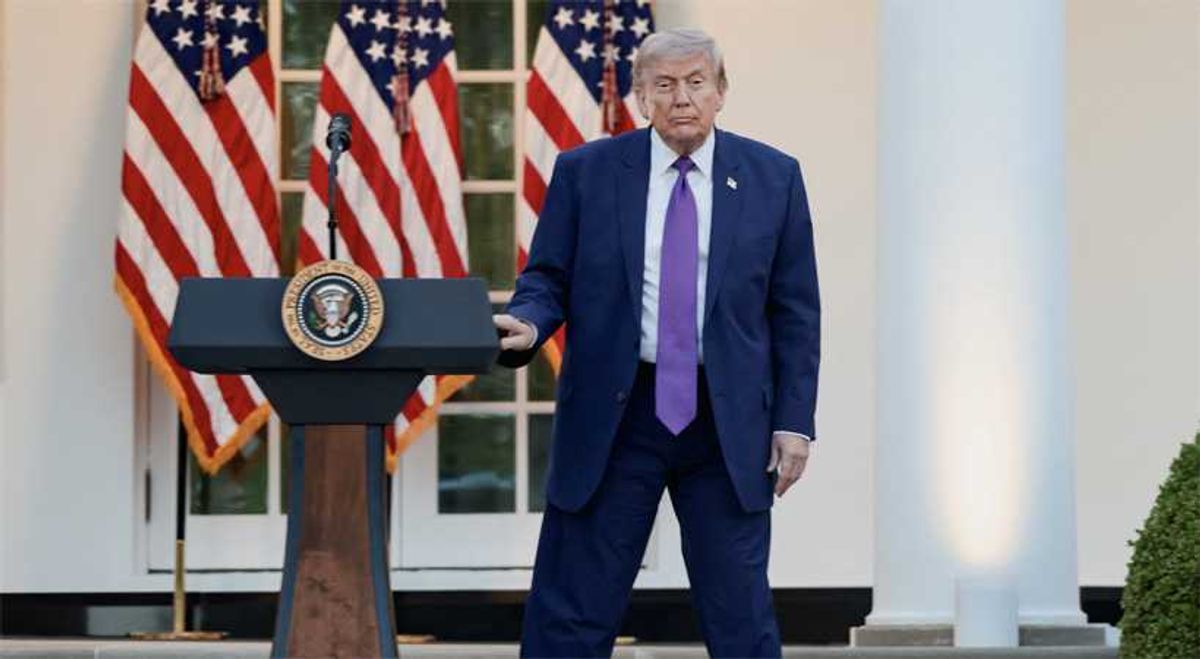
U.S. President Donald Trump after delivering remarks during his second 'Rose Garden Club' dinner in honour of Police Week at the White House in Washington, D.C., U.S., May 11, 2026. REUTERS/Evelyn Hockstein


Donald Trump's trip to Beijing to meet with Chinese leader Xi Jinping comes as the leadership of China is buoyed by an internal report that their country has seen its profile in the world rise above the US in large part due to American president.

With Reuters reporting that Trump needs some “wins” due to his horrific approval numbers at home, the New York Times is reporting that a “Beijing think tank affiliated with Renmin University published a triumphant report about Mr. Trump’s first year back in office. The report argued that his tariffs, attacks on allies, anti-immigration policies and assaults on the American political establishment had inadvertently strengthened China while weakening the United States. Its title: ‘Thank Trump.’”

According to the Times the analysis argued that Trump's erratic decision-making across domestic and foreign policy has inadvertently unified China while fracturing American institutions with the authors characterizing Trump as an "accelerator of American political decay," and the United States teetering on "Latin American-style instability."

Trump's hostility toward China, the report argued, functioned as a "reverse booster" that strengthened Beijing's strategic self-reliance. "At this turning point in history," the authors wrote, "what we hear is the heavy and haunting toll of an empire's evening bell."

In light of the current state of affairs, the Times is reporting that use of the term "American decline" in official Chinese sources nearly doubled in 2025, citing a Brookings Institution study.

Chinese scholars are openly discussing how to exploit Trump's desperation. "Only China can save Trump," said Huang Jing, a professor at Shanghai International Studies University during a late 2025 media event. With midterm elections approaching, Huang argued, Trump needs visible wins such as Chinese purchases of American soybeans, corn, and natural gas that could help Republicans in the red states the GOP relies upon.

"Since Trump, the United States has become increasingly prone to compromise," Huang reportedly advised

Chinese scholars are also strategizing about the possibility of a Republican midterm collapse. According to Wu Xinbo, a leading American studies scholar at Fudan University, if Republicans lose control of the House in November, Trump, handcuffed domestically by a Democratic-controlled House would likely lean into foreign policy legacy-building — opening the door for China's leaders to use that to their advantage, with Wu remarking, "China should make good use of this opportunity."

Blundering Trump just gave China what it always wanted: ex-GOP strategist

Bennito L. Kelty
May 12, 2026 
RAW STORY


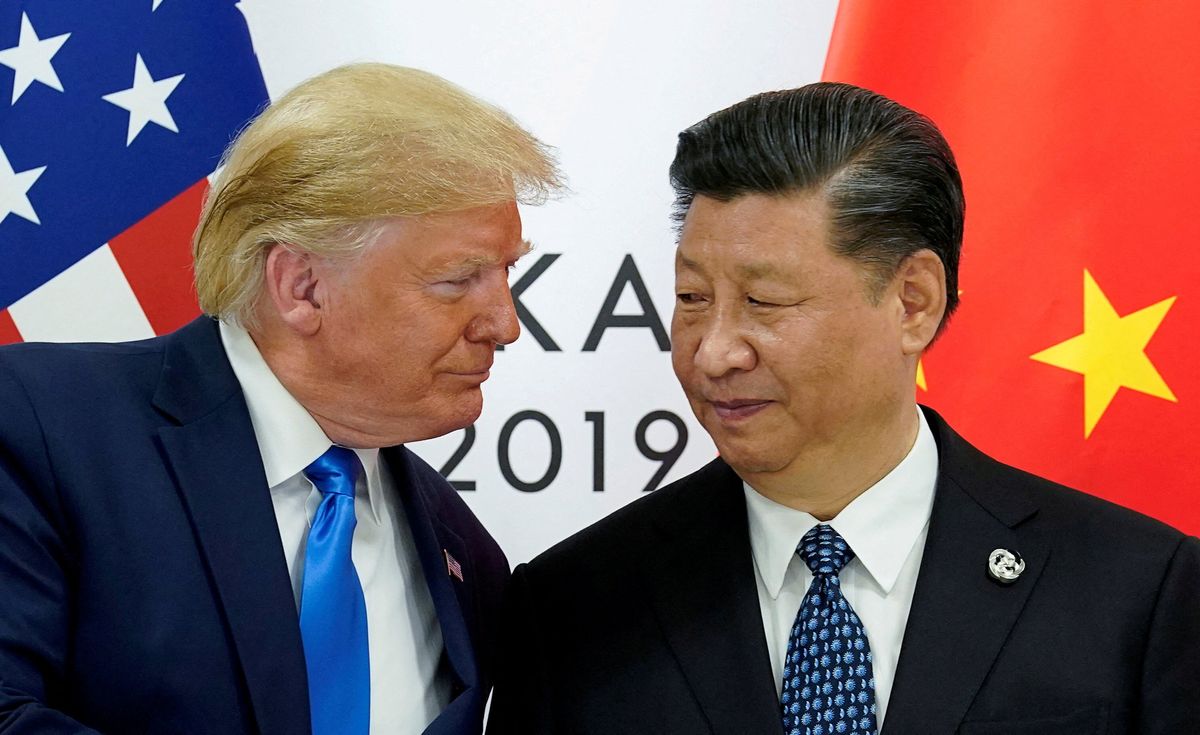
FILE PHOTO: U.S. President Donald Trump meets with China's President Xi Jinping at the start of their bilateral meeting at the G20 leaders summit in Osaka, Japan, June 29, 2019. REUTERS/Kevin Lamarque//File Photo

Trump has already delivered China's ambitions with "self-inflicted" wounds, an ex-GOP strategist warned ahead of the president's visit with the country's leader, Xi Jinping.

"China's ambitions, whether they are military or economic, have been delivered up by Donald Trump," Rick Wilson said on a Tuesday episode of his podcast. Trump was set to meet with Chinese leader Xi Jinping from May 12-15 with business leaders like Elon Musk, and Wilson noted he's going in with "cataclysmically low poll ratings" and "tremendous political weakness" amid the war in Iran.

However, while "we've lost the war in Iran," Trump started delivering "self-inflicted" wounds that benefit China's ambitions well before that, Wilson said.

"Trump starts a trade war. Almost every nation in South America is on the wrong side of Trump's trade war," Wilson explained. "What happens in South America? They cut deals with China. They're selling their products to China."

Looking at Trump's government cutbacks, Wilson said that the DOGE decision to dismantle USAID is also helping China's global standing rise above that of the United States.

"If you had gone into any African country two years ago, where there's a famine, where there's sickness, where there's poverty, where there's disease, where there's misery, you would have seen USAID workers," Wilson said. "You know what you'd see now? China. Because Elon and DOGE cut USAID and killed the program. So now those bags of food don't say, 'A gift from the people of the United States.' Now those bags of food say 'A gift from the people of the People's Republic of China.'"

Wilson predicted that as people watch Trump's visit to China, they'll see him "with a sense of discomfort, with a sense of embarrassment," even though Trump will "bluster and yell and try to pretend that he's got the strong hand here. He does not. Xi Jinping has the strong hand."

Voters Outpace Washington Hawks on China Strategy Before the May Summit

Source: Originally published by Z. Feel free to share widely.

As the diplomatic machinery in Beijing grinds into high gear for the May 14 summit between Donald Trump and Xi Jinping, a profound disconnect has emerged. While Washington’s policy corridors remain anchored to a narrative of inevitable conflict, the American public is quietly conducting a strategic pivot of its own. To understand the stakes of the summit, one must look past naval deployments in the Pacific and examine the shifting sociological foundations of American power.

Recent data suggests that the “China Hawk” consensus in the United States is facing its first major structural challenge from the electorate. According to the March 2026 Pew survey, American favorability toward China has climbed to 27 percent, nearly doubling since the post‑pandemic lows. More critically, the share of Americans who label China an “enemy” has dropped to 28 percent, down from 42 percent just two years ago. This shift is not cosmetic; it signals a deeper recalibration of how Americans view their place in a multipolar world.

First, the mechanical reality of global trade. The “de‑risking” narrative often feels disconnected from actual flows. Attempts to bypass Chinese inputs have not produced a clean exit, but a more complex dependency. We are seeing a “China Shock 2.0,” where Beijing’s dominance in high‑tech manufacturing and green energy is becoming a permanent fixture of the global baseline. Even in sectors where diversification is underway, Chinese firms remain embedded in supply chains through indirect sourcing and component dominance.

This industrial reality is now reflected in American sentiment and legal challenges. The July 2025 Chicago Council survey revealed that 53 percent of Americans favor “friendly cooperation” with China, the first such majority in seven years. This economic realism is now a necessity; with the Supreme Court’s February 2026 ruling forcing a messy recalibration of the U.S. tariff regime, the May 14 summit offers a timely exit ramp from a trade policy that is becoming as legally precarious as it is economically taxing for the average consumer.

Second, the generational shift. The International Crisis Group reports a staggering divide: only 10 percent of young Democrats and 32 percent of young Republicans view China as an enemy. For the under‑50 demographic, China is not a Cold War antagonist; it is a peer competitor that produces their technology and manages their climate future. This cohort grew up in a world where Chinese products, apps, and investments were part of daily life. Their threat perception is shaped less by ideology and more by pragmatic concerns about jobs, innovation, and climate change.

This creates a “permission space” for Trump that he lacked in 2017. If the youth vote – already disillusioned by traditional entanglements – views China as a management problem rather than a moral crusade, the political cost for Trump to strike a “grand bargain” on May 14 disappears. Washington’s hawks are effectively screaming into a demographic vacuum. The generational realignment is not just a polling quirk; it is a structural shift that will define U.S. foreign policy for the next decade.

Finally, “containment fatigue.” In Pakistan, the recent stalemate in the Islamabad Talks and subsequent naval friction in the Gulf have only deepened the American public’s wariness of open-ended regional entanglements. This same exhaustion is appearing in American polling. The public is wary of “forever competitions” that yield no domestic dividend. The containment model, once the backbone of U.S. strategy, is losing legitimacy among voters who see little payoff in endless rivalry.

When Americans look at the “Silicon Shield” of AI hardware restrictions, they see a policy that might protect national security but also inflates living costs. The counter‑intuitive conclusion is that the public is now more “Trumpian” than the politicians: they want a deal that secures interests without the baggage of ideological struggle. This fatigue is not isolationism; it is a demand for efficiency. Just as we see the drawdown of forces in Germany and the withdrawal from Ramstein, the shift in Beijing signals a broader transition: the era of the “World’s Policeman” is being replaced by the era of the “National Interest Broker.”

If the summit results in a de‑escalation of the tariff war, it will not be because of newfound trust between Trump and Xi. It will be because both leaders are staring at internal data that demands stability. Xi needs to protect export markets to manage China’s manufacturing rebound, and Trump needs a “win” that lowers inflation before the midterm season begins. Both leaders are constrained by domestic realities that push them toward compromise.

The American public is no longer the obstacle to a U.S.–China détente; they are the engine of it. The real conflict on May 14 is not between Trump and Xi, but between the American people and their own foreign policy establishment. The electorate is signaling that it wants pragmatic engagement, not ideological crusades. As we watch the motorcades in Beijing, we should remember that the most important shift isn’t occurring in the Great Hall of the People, but in the living rooms of the American Midwest. The era of the “China Enemy” is ending, replaced by the era of the “China Competitor.” It is a subtle distinction, but in geopolitics, subtleties are where deals are made. For Newsweek’s readers, the message is clear: the summit is not just about two leaders, but about how public opinion is reshaping the trajectory of U.S.–China relations.Email

Imran Khalid is a geostrategic analyst and columnist on international affairs. His work has been widely published by prestigious international news organizations and publications.

The Most Shocking Election In America

Source: More Perfect Union

We spent 4 days traveling the entire state of Maine with Graham Platner to find out if he can win.

Along the way we sat him down with Republicans and Independents. One voter told us: “We’re so tired of the establishment, and Maine is a very anti-establishment state.”

Producer and Editor: Josh Hirschfeld-Kroen
Producer and Reporter: John Russell
Videographer: Colin Bell
Supervising Producer: Meg Herschlein

Video Production Manager: Isabel Atalaya
Video Production Coordinator: Jodi Clemens
Video Production Fellow: Astrid Dong
Assistant Editor: Daria Nastasia

This article was originally published by More Perfect Union; please consider supporting the original publication, and read the original version at the link above.
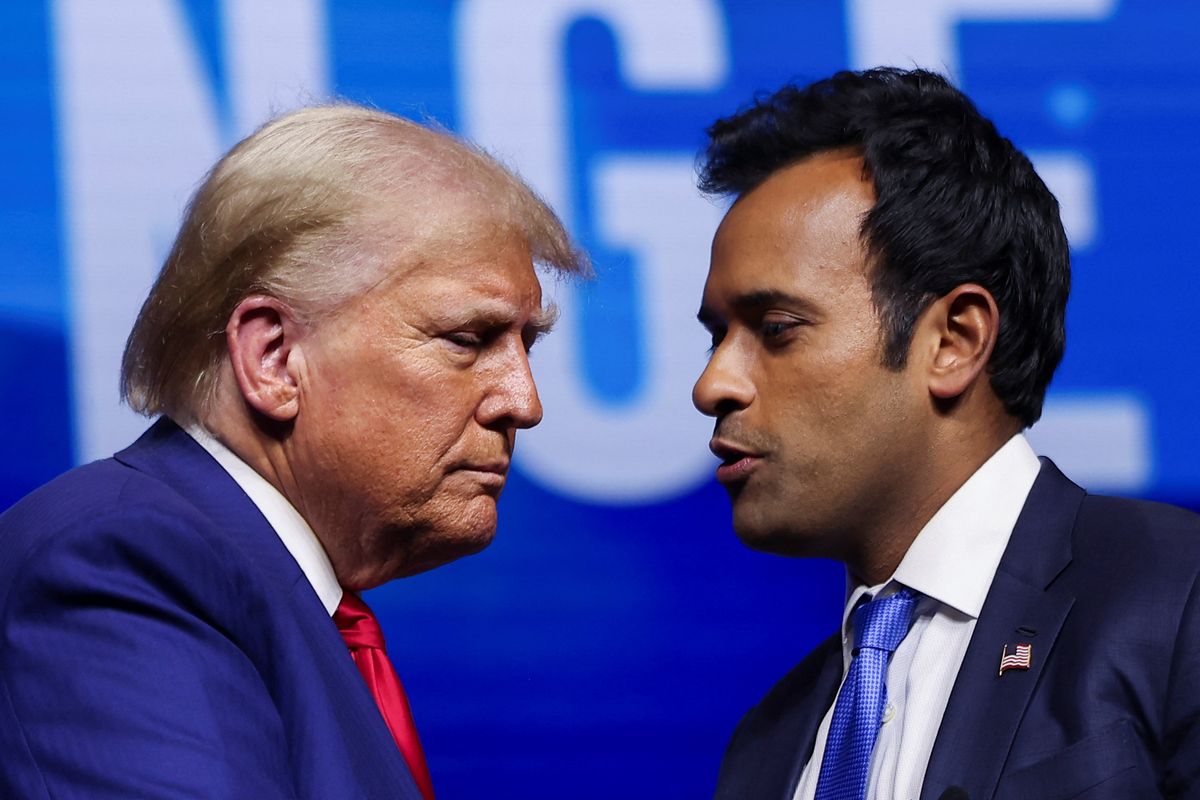
'Get out of our country!' Far-right pastor goes on racist tirade against Vivek Ramaswamy

Matthew Chapman
May 12, 2026 
RAW STORY


Businessman and former Republican presidential candidate Vivek Ramaswamy attends Republican presidential nominee and former U.S. President Donald Trump's campaign event sponsored by conservative group Turning Point Action, in Las Vegas, Nevada, U.S. October 24, 2024. REUTERS/Carlos Barria

Far-right Christian nationalist pastor Joel Webbon went on a virulently racist tirade this week, proclaiming that Ohio Republican gubernatorial candidate Vivek Ramaswamy must be "demolished" to punish the GOP and warn them off ever nominating "polytheistic, demon-worshiping, cow-worshiping, bare-feet scamming anchor baby Indians" to office again.

The clip, posted to X by Right Wing Watch, showed Webbon getting visibly animated as he worked himself up — and it comes as the GOP is increasingly fractured over Ramaswamy's candidacy. Ramaswamy was named to co-lead President Donald Trump's Department of Government Efficiency alongside Elon Musk after the 2024 election, but dropped out of the role to focus on his gubernatorial campaign.

"If he becomes the governor of Ohio, you have solidified Vivek's political career for the rest of his life in America; he's not going away," said Webbon. "This is the chance to say, no, never, ever, go back home. Get out of our country."

"You were born in America, sure, by days," he continued. "Your dad hates our country, never took the time to become a citizen. You're an anchor baby. Your family built their wealth by robbing white people with miracle drugs that you knew were not going to be viable. You became a billionaire. You paid your way onto every podcast. You've been lying, you've been deceiving, and this is not American. You are not American, you are a Hindu, you are a polytheist, you are a false idol worshipper. Go home! Get out of our country!"

Ramaswamy's father legally immigrated from India and worked as an engineer for General Electric. He has chosen not to pursue U.S. citizenship, a fact Ramaswamy has discussed publicly. There is no evidence supporting Webbon's claim that he harbors animosity toward the United States. Ramaswamy was born in Cincinnati to Indian immigrant parents who came to the country legally.

"I don't care about you quoting Thomas Jefferson, I don't care about you pretending to honor the founders," added Webbon. "This is America! We wear shoes in this country. We eat beef in this country. We worship Christ exclusively in this country. We don't rob people of their wealth in this country. Get the hell out! That is the proper response."


Webbon has previously claimed that "godly" women don't speak in public, and that it is a "failure of parental duty" not to teach white kids to avoid Black people.


Donald J. Trump Is Not a Member of the KKK—But He Sure Sounds Like One


For Trump there is absolutely no contradiction between white supremacy and the unabashed celebration of American patriotism.


Jeffrey C. Isaac
May 12, 2026
Common Dreams


“The American patriots who pledged their lives to independence in 1776 were the heirs to this majestic inheritance. Their veins ran with Anglo-Saxon courage. Their hearts beat with an English faith in standing firm for what is right, good, and true. In recent years, we’ve often heard it said that America is merely an idea, but the cause of freedom did not simply appear as an intellectual invention of 1776. The American founding was the culmination of hundreds of years of thought, struggle, sweat, blood, and sacrifice on both sides of the Atlantic.” —President Donald Trump, greeting British King Charles on April 28, 2026.

“The Declaration of Independence, the Constitution, and the Gettysburg Address are descendants of the Magna Charta— supreme symbols of Anglo-Saxon souls striving for freedom, justice, and humanity. Anglo-Saxons established this Nation, wrote its code, and sent their sons into the wilderness to gather fresh stars for the flag. . . . The making of America is fundamentally an Anglo-Saxon achievement. Anglo-Saxons brains have guided the course of the Republic. Our ideals are Anglo-Saxon, our social traditions, our standards of honor, our quality of imagination, and our indomitability.” —from “Americans Take Heed! Scum O’ The Melting Pot,” a 1921 KKK pamphlet.


Donald Trump’s most recent contribution to his year-long “America 250” celebration was truly bizarre, with British King Charles somehow serving as a symbol of the heritage for which the American Revolution was fought. That Trump simultaneously posted a photo of the two leaders, under the heading “Two Kings,” only added to the weirdness. But, as Jonathan Chait has noted, along with many others, accompanying the weirdness was something dark and dangerous—the idea that the US is an “Anglo Saxon” nation, and that the idea of “freedom” announced in the Declaration of Independence is a White, Anglo-Saxon, and Protestant idea that is “alien” to “alien” peoples and cultures.

It was thus interesting that on the same day that he feted King Charles with encomiums to their common Anglo-Saxon heritage, Trump also announced his new “America 250” commemorative passport, featuring on one side an enormous drawing of his head against the background of the Declaration, and on the other the famous John Turnbull painting of the Continental Congress. Trump’s Kim Jong Un impression notwithstanding, it is entirely fitting that he would commemorate his “America 250” vision with a passport, for the policing of borders, long with the massive campaign of immigrant kidnapping, AKA/detention, and deportation, are the hallmarks of his administration.

Trump made this commitment clear while speaking at the Republican National Convention and accepting the party’s presidential nomination on July 19, 2024, reiterating what he has been saying for well over a decade:
The greatest invasion in history is taking place right here in our country. They are coming in from every corner of the earth, not just from South America, but from Africa, Asia, Middle East. They’re coming from everywhere. They’re coming at levels that we’ve never seen before. It is an invasion indeed, and this administration does absolutely nothing to stop them. They’re coming from prisons. They’re coming from jails. They’re coming from mental institutions and insane asylums. I, you know the press is always on because I say this. Has anyone seen “The Silence of the Lambs”? The late, great Hannibal Lecter. He’d love to have you for dinner. That’s insane asylums. They’re emptying out their insane asylums. And terrorists at numbers that we’ve never seen before. Bad things are going to happen.


The Trump administration’s violent and sometimes murderous assaults on Los Angeles, Chicago, Memphis, Washington, D.C., and especially Minneapolis, began only months ago and continue still, even if in less obtrusive ways. Mass deportation is simply one element of a much broader attack on refugees and immigrants. Last November, Trump’s Department of Homeland Security announced a total ban on reviewing asylum applications. Common Dreams reports that “Not a single refugee who isn’t a white South African has been legally resettled in the United States since October, according to the State Department’s most recent arrivals report.” Meanwhile, Trump continues to disparage Somalia, its people, and Rep. Ilhan Omar (D-Minn.) in viciously racist ways, recently doubling down on his vile 2018 comment:
Why is it we only take people from shithole countries, right? Why can’t we have some people from Norway, Sweden – just a few – let us have a few. From Denmark – do you mind sending us a few people? Send us some nice people, do you mind? But we always take people from Somalia. Places that are a disaster, right? Filthy, dirty, disgusting, ridden with crime.


For Trump, there is absolutely no contradiction between white supremacy and the unabashed celebration of American patriotism. It sometimes seems as if he is single-handedly trying to validate the most radical versions of the “critical race theories” that he hates, personifying a past, and present, of exultant White supremacy.

Trump is hardly the first White supremacist to occupy the White House. And yet, in a sense, his every move confirms what Ta-Nehisi Coates observed back in 2017, in labeling him “The First White President.” “To Trump, whiteness is neither notional nor symbolic but is the very core of his power,” Coates argued. “In this, Trump is not singular. But whereas his forebears carried whiteness like an ancestral talisman, Trump cracked the glowing amulet open, releasing its eldritch energies.”

While Trump has many ideological predecessors—George Wallace springs immediately to mind—one has to go back an entire century, and to a perhaps unexpected place, to locate a public figure who so powerfully conjoins racism and xenophobia.

Back in May of 1926, the North American Review--founded by Boston Brahmin intellectuals in 1815, and widely considered the first significant literary magazine published in the US—featured just such a figure: Hiram Wesley Evans, the Vanderbilt University-educated author of a substantial, 30-page essay entitled “The Klan’s Fight for Americanism.” Evans was an up and coming public figure seeking to promote the restoration of American Greatness. He was also the Imperial Wizard and Emperor of the Knights of the Ku Klux Klan (KKK). And his essay, described by the editors as an “authoritative paper on the Ku Klux Klan by the foremost representative of that Order,” inaugurated a symposium featuring essays by four “writers of national authority”: Martin J. Scott, S.J.; Rev. Dr. Joseph Silverman, Rabbi Emeritus, Temple Emmanu-el, New York; W. E. Burghart Du Bois, National Association for the Advancement of Colored People; and William Starr Myers, Professor of Politics, Princeton University.

It may seem surprising that such an eminent journal would feature a serious symposium on the KKK centered on a substantial essay by its “Imperial Wizard and Emperor.” But indeed, the KKK—boosted by the 1915 release of D.W. Griffith’s “The Birth of a Nation,” whose legendary ending featured the glorious rescue of vulnerable Whites by heroic Klansmen on horseback—had just experienced a rebirth under the leadership of William J. Simmons. Simmons was a vicious racist. He was also a patriot, and he dedicated his organization to the “sublime principles of a pure Americanism,” and declaring that “[T]he Klan is a purely American organization assembled around the Constitution of the United States, to safeguard its provisions, advance its purposes, and perpetuate its democracy.”

As Linda Gordon notes in her 2017 classic, The Second Coming of the KKK, by the 1920’s the Klan was a nationally important organization whose reach extended far beyond the South and claimed between 4 to 6 million members. More important: “the 1920’s Klan’s program was embraced by millions who were not members, possibly even a majority of Americans. Far from appearing disreputable or extreme in its ideology, the 1920’s Klan seemed ordinary and respectable to its contemporaries.” Over the course of the decade, it elected governors in Indiana, Oklahoma, Oregon, Colorado, and Texas., and exerted influence in a range of other states from Ohio and Michigan to New York.

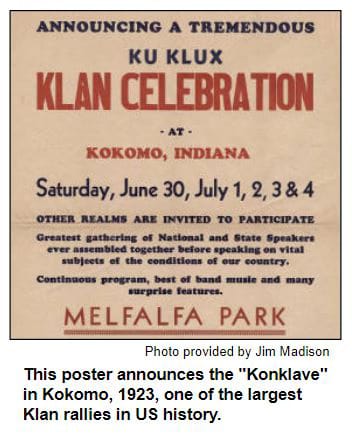
The organization was particularly strong in Indiana, where in the mid-1920’s it claimed both the state’s governor and a majority of both houses of the General Assembly. Gordon indeed opens her book by describing a 1923 Fourth of July Klan celebration that attracted thousands of supporters in Kokomo, Indiana, and which featured a speech by Indiana Grand Dragon D.C. Stephenson. The speech—entitled not “Why We Hate Blacks, Catholics, and Jews” but rather “Back to the Constitution”—declared: “We always had governed ourselves, and we always meant to. . . The American Revolution was fought for principles of self-government…then embodied in a federal constitution the like of which man never seen, are sacred now as they were then.”)


By 1923, Hiram Wesley Evans had been named Imperial Wizard of the Klan, supplanting Simmons and initiating a campaign to raise the profile and advance the political influence of the Klan. “The Klan’s Fight for Americanism” was, in effect, his vision statement. And its parallels with the rhetoric of Trump’s MAGA movement are chilling.

Evans begins by noting that while in 1915 the nation was “in the confusion of sudden awakening from the lovely dream of the melting pot, disorganized and helpless before the invasion of aliens and alien ideas. After ten years of the Klan, it is in arms for defense . . . ” The Klan, he insists, is dedicated above all to “the idea of preserving and developing America first and chiefly for the benefit of the children of the pioneers who made America, and only and definitely along the lines of the purpose and spirit of those pioneers.”

According to Evans, the Klan hates no one, and simply seeks to protect the American homeland from invaders who threaten true Americans: “We are a protest movement—protesting against being robbed . . . our great cities . . . taken over by strangers . . . the Nordic American is today a stranger in large parts of the land his fathers gave him.”

And while Evans denounces the alien hordes, he also blames “liberals” (also referred to as “Mongrelized liberals”) for the civilizational crisis at hand, insisting that liberalism “provided no defense against the alien invasion, but instead has excused it—even defended it against Americanism. Liberalism is today charged in the mind of most Americans with nothing less than national, racial, and spiritual treason.”

As America is being besieged by enemies without and within, he insists that “the Klan alone faces the invader . . . the Klan is the champion, but it is not merely an organization. It is an idea, a faith, a purpose, an organized crusade,” one that indeed has “won the leadership in the movement for Americanism.” Standing firmly “against radicalism, cosmopolitanism, and alienism of all kinds,” Evans insists that the Klan alone stands for American Greatness without apologies: “We believe, in short, that we have the right to make America American and for Americans.”

The anticipations of Trump here are striking.

Trump does not explicitly denounce Catholics, Jews, Asians, and Blacks in the manner of Evans and his turn of the 20th century Klansmen, nor does he invoke the language of “Nordic” racial superiority in the manner of Evans, who praises “the instincts of loyalty to the white race, to the traditions of America, and to the spirit of Protestantism, which has been an essential part of Americanism ever since the days of Roanoke and Plymouth Rock. They are condensed into the Klan slogan: ‘Native, white, Protestant supremacy.’”

And yet, minus the reference to “instincts of loyalty to the white race,” it is easy to imagine Trump speaking in much the same way. The distinction between real, Anglo-Saxon Americans and aliens; the contempt for people of color; the obsession with stemming a literal alien invasion; the representation of liberals and radicals as traitors to the nation—these are the core themes of Trumpism.

Trump does not wear a white robe and pointy white hat, or claim to be a Grand Wizard, or burn crosses, or talk of Nordic racial superiority. He does display a remarkable solicitude for tiki torch-bearing neo-Nazis, Confederate battle flag carriers, violent Three Percenters, and Proud Boy insurrectionists.

But Trump is no Klansman. He is the twice-elected President of the United States. And yet his defensive, xenophobic, and frankly reactionary vision of “Americanism” bears a striking resemblance to the vision put forward a century ago by the Klan—a group whose ideology was, and is, closer to the center of American politics than we might like to believe.


Contributor’s note: I would like to thank Robert Orsi and Bob Ivie for their comments on this piece.


Our work is licensed under Creative Commons (CC BY-NC-ND 3.0). Feel free to republish and share widely.


Jeffrey C. Isaac
Jeffrey C. Isaac is James H. Rudy Professor of Political Science at Indiana University, Bloomington. His books include: "Democracy in Dark Times"(1998); "The Poverty of Progressivism: The Future of American Democracy in a Time of Liberal Decline" (2003), and "Arendt, Camus, and Modern Rebellion" (1994).
Full Bio >

White Supremacy in Donald Trump’s White House

Source: Hammer and Hope

One year on, the Trump administration’s descent deeper into the gutter of racism no longer comes as a surprise. Trump’s second presidency has been devoted to demolishing anti-discrimination policies based on the absurd claim that they are unfair to white people, especially white men, who are now the real victims of racism. This is a departure for Republicans. Not that many years ago, most of them would try to co-opt the civil rights narrative as their own by claiming the U.S. had achieved the “colorblind” society that was supposedly Martin Luther King Jr.’s end goal. Thus, civil rights–era reforms were no longer necessary because the movement had succeeded.

Today, Trump and JD Vance have dropped the hollow tributes to King and replaced them with disgusting racist memes that blatantly appeal to white men to see themselves as victims of anti-discrimination policies. The point of this isn’t just to undermine the historic accomplishments of the civil rights movement. It is also to create a scapegoat for the poor and working-class whites who make up a growing section of the MAGA base to blame for declining living standards. Dismantling what remains of civil rights–era laws and policies is necessary to bury the radical legacy of the civil rights movement, which, at its core, was about more than representation in politics and business or even formal political and legal equality. It was about materially improving the lives of all Black people and ultimately of all the have-nots.

Trump’s second presidency began in January 2025 with a frenzy of executive orders, including ones attacking diversity, equity, and inclusion initiatives. Within months, this had led to purges of lawyers and federal employees charged with protecting civil rights. By December, Vance was bragging to a nearly all-white audience at a Turning Point USA conference, “In the United States of America, you don’t have to apologize for being white anymore.” His statement was so uncontroversial for the Trump administration that it barely received news coverage. In an X (formerly Twitter) post shortly before that speech, Andrea Lucas, Trump’s chair of the U.S. Equal Employment Opportunity Commission, asked, “Are you a white male who has experienced discrimination at work based on your race or sex? You may have a claim to recover money under federal civil rights laws.” Trump himself weighed in during a January New York Times interview, in which he declared that “white people were very badly treated” by the Civil Rights Act of 1964, which supposedly causes whites who “deserve to go to a college or deserve to get a job” to lose out. Trump’s white supremacy got cruder still at the start of Black History Month, when he posted a video on Truth Social in which Barack and Michelle Obama’s faces were pasted on the bodies of apes.

If the aim of this undisguised racism is to distract white working-class MAGA supporters from Trump’s abject failure to usher in a new golden age of prosperity for them, it is becoming less and less effective. In November 2024, Trump won half of all voters making $50,000 or less, according to exit polls; his approval rating among this group is now at 38 percent and dropping. Still, the relentless campaign to portray whites as the victims of Black people who got a leg up thanks to government bureaucrats and the Democratic Party has had an effect. An Associated Press–NORC poll in July 2025 found that nearly 40 percent of white adults believe diversity and equity initiatives increase discrimination against white people. A previous poll in 2022 showed that 30 percent of white Americans believe discrimination against them had increased “a lot more” in the past five years.

Many of the beliefs expressed in these polls are detached from reality. By almost any measure, working-class Black Americans continue to lag far behind their white peers. At $55,157, median Black household income in 2024 was over $30,000 less than white household income. The numbers are so skewed because Black workers earn less than white workers in nearly every major industry. Black unemployment is nearly double the rate of white unemployment. Only one in three Black families has a retirement account, compared with more than 60 percent of white families. And the value of those accounts for Blacks is lower because of racism in hiring and differences in wages and salaries over a working lifetime.

As for the favorite boogeyman of the White House, the actual record of diversity, equity, and inclusion initiatives, even in their heyday following the Black Lives Matter protests in the summer of 2020, has never been as robust and impactful as either their boosters or detractors have claimed. Indeed, before the right began its crusade against DEI, many of the biggest critics of these initiatives were people on the left who pointed out that they produced more pledges to make companies diverse than actual jobs for Blacks.

Far from replacing qualified white workers with unqualified Black ones, as Vance and Trump insist is happening, DEI initiatives typically set aspirational goals that mean little beyond a vague commitment to do better. Consider the words of billionaire Larry Fink, CEO of the investment firm BlackRock, in an open letter issued a week into the 2020 protests: “As a firm committed to racial equality, we must also consider where racial disparity exists in our own organizations and not tolerate our shortcomings. We can only heal these wounds — building a more diverse and inclusive firm and contributing to a more just society — if we talk to each other and cultivate honest, open relationships and friendships.” BlackRock increased its fraction of Black employees from 5 percent in 2020 to 8 percent by 2025, a relatively minor change and hardly evidence of Black workers replacing white ones. The company has since dismantled its DEI initiatives in response to Trump’s executive orders and legal threats against corporations that maintained such programs.

The surge of corporate initiatives spurred by the 2020 protests did cause a brief boom in the hiring of diversity specialists. Companies in the S&P 500 hired new heads of diversity at a rate of about 12 per month following George Floyd’s death — almost three times the rate of the previous 16 months. But within three years of the Floyd protests — even before the return of Trump — there was a sharp turn away from these types of hires. According to the employment website ZipRecuiter, job posts related to corporate diversity positions fell by 63 percent in 2023. Besides adding those specialists, diversity initiatives have had almost no impact on who sits in corporate boardrooms. One 2021 report found that only three Fortune 500 companies were led by a Black CEO, down from seven less than a decade previously; there have only ever been two Black women CEOs. As the report noted, “There are more CEOs named ‘John’ than female CEOs.”

Outside of employment, the record of corporate initiatives to address racism is no better. According to the McKinsey consulting firm, between May 2020, when George Floyd was murdered, and October 2022, nearly 1,400 American corporations pledged $340 billion to address racism in America. Only a fraction of the money went to addressing the overpolicing of Black people that led to Floyd’s brutal death; just eight companies made donations to Black Lives Matter organizations. Instead, most of the pledges were for investment in housing and other ventures intended to stimulate greater participation from Black consumers. For example, JPMorgan Chase’s racial equity commitment included $8 billion for 40,000 new mortgages and $4 billion to cover 20,000 refinancing agreements over five years. This and similar initiatives were basically profit-making schemes, promoted as aid and assistance. Above all, they were merely promises made by private organizations with no public mechanism for determining if the promises were kept.

In the summer of 2020 and after, it was easier to emphasize antiracism and diversity with bromides about solidarity with Black Lives Matter than to deal with the implications of the other reckoning about race and class caused by the Covid-19 pandemic. Shortly before corporate America decided to proclaim its concern about Black lives, plenty of corporations were in the news for reneging on promises to give hazard pay to the disproportionately Black and brown workers who had been designated as “essential.” The sharp turn to DEI initiatives had the added advantage of deflecting attention from the erupting class dynamics exposed in the opening months of the pandemic, when nearly 40 million people lost their jobs by some estimates, and debates raged over emergency supplemental unemployment and moratoriums on evictions. The corporate pivot to DEI emphasized vibes; pay increases, workplace safety, health care, and sick pay faded into the background.

Meanwhile, Trump and the Republican Party were honing a different narrative that would help them regain momentum after a humiliating electoral defeat in 2020: Diversity and equity initiatives were proof that the Democrats and their surrogates in corporate America were willing to put their thumbs on the scales to help Black people, even if it meant discriminating against whites.

The Republican Party’s base among poor and working-class whites has changed significantly in the past decade or so. The economic downturn in rural areas, combined with hospital closures and the growth of low-wage jobs without health insurance, has led to a much wider use of Medicaid in these areas. In 2014, the Affordable Care Act expanded Medicaid to millions of people, including low-income white Republicans. This has complicated the right’s age-old strategy of demonizing those who rely on welfare-state programs. Previously, the right wing had mostly heaped blame on “welfare queens” living high off government handouts at the expense of hard-working, tax-paying white families. But now, needing to appeal to lower-income whites who were more likely than before to rely on government programs, the right made Black professionals in both the public and private sector the new enemies. The attacks on diversity initiatives in higher education and corporate America are aimed at middle-class and upwardly mobile Black Americans. The Trump administration is inviting whites, especially white men, to blame their stagnating or declining living standards on the supposedly rising fortunes of Black people.

This narrative was used to justify the Trump administration’s assault on the federal workforce. Last May, in a memo titled “Merit Hiring Plan,” a Trump official echoed right-wing conspiracy theories about the federal government using racial quotas to guide its hiring practices. The memo explained how “the overly complex Federal hiring system overemphasized discriminatory ‘equity’ quotas and too often resulted in the hiring of unfit, unskilled bureaucrats.” Not surprisingly, the Trump layoffs within federal agencies have hit Black civil servants, particularly women, the hardest. Black women lost 318,000 jobs in the public and private sectors between February and April of last year, the only major female demographic to experience significant job losses during that period. According to The New York Times, agencies where minorities and women were the majority of the workforce, such as the Department of Education and U.S. Agency for International Development, suffered some of the largest workforce reductions, if not complete elimination. After the American Civil Liberties Union and a group of employment attorneys alleged that the Trump layoffs “disproportionately singled out federal workers who were not male or white,” in violation of Title VII of the Civil Rights Act, the Trump administration took down the website allowing the public to track the race and gender of government employees.

The claim that civil rights protections and diversity initiatives have led to the displacement of white men from the workforce is another manifestation of the right wing’s great replacement conspiracy theory. This “theory” is mostly associated with Latinos and immigration, but it was also a motivating factor in the massacres of Black people in Charleston, S.C., in 2015 and Buffalo, in 2022. Of course, the idea that Blacks are taking over and supplanting the rightful place of whites is no less absurd than the immigrant variant. Yet it serves a purpose for the MAGA right in giving white working-class and poor people a scapegoat on which to blame their deteriorating living conditions, especially now that Trump and the Republicans have been in power for a year and have achieved nothing for the “ordinary” people they claim to stand for.

If racist scapegoating can get a hearing, it is because something has happened to white working-class people, along with the rest of American workers. The causes have been widely discussed: The decline in U.S. manufacturing and erosion of union strength over decades has led to sharp declines in earning power and material deprivations across the board. To manage this decline, Americans have taken on a record $18 trillion in household debt. Meanwhile, the affordability crisis grows worse and worse.

This is the context needed to understand the economic insecurity that pervades the lives of all working-class and poor people — Black, brown, and white. During the past decade, the media began to focus on one facet of this crisis of working-class life: “deaths of despair.” In the popular view, this referred specifically to working-class whites without college degrees aged 45 to 54 who died from opioid abuse, alcoholism, or suicide. But from 2015 to 2022, the rate of “deaths of despair” among Black Americans tripled, ultimately surpassing the rate among whites. Even beyond the statistics, though, the accusation that this tragic product of social malaise and economic marginalization was somehow caused by civil rights law or diversity initiatives makes a mockery of the profound levels of hardship afflicting all working people, which have led to a decline in overall life expectancy in the U.S., sharper than any other country in the developed world.

The right wing has had help in perpetuating the idea that civil rights laws have gone too far. In the case of the Democrats, it is their silence that speaks volumes. Worried about losing potential white swing voters, the party leadership said little after the U.S. Supreme Court, now packed with right-wingers, abolished affirmative action in college admissions in 2023. They have had even less to say about Republican attacks on diversity, equity, and inclusion policies as a justification for removing civil rights protections for Black workers and students. The Democrats’ appeal to Black voters is mostly focused on the threat to voting rights. But with their silence about other issues, they give credence to the Republican talking points that antiracist protections have come at a cost for white men.

By imagining that civil rights protections take something from white men, not only are the causes of white deprivation obscured, but the role of discrimination in Black economic subordination is also lost. The 20th century civil rights struggle for Black Americans was as much about opening the robust post–World War II economy to Black workers as it was about addressing the indignity of racial insults and stigma of inferiority. Or as Martin Luther King Jr. explained in 1963, “The Negro today is not struggling for some abstract, vague rights, but for concrete and prompt improvement in his way of life. … The struggle for rights is, at bottom, a struggle for opportunities.”

The eventual passage of the 1964 Civil Rights Act removed formal legal barriers to the full participation of Black workers in the then-booming U.S. economy. But King and others recognized that more was needed to ensure equal Black participation in all aspects of the economy. They called on the federal government to be proactive in helping Black families out of the poverty imposed on them through decades of racial discrimination. As King observed:

No amount of gold could provide an adequate compensation for the exploitation and humiliation of the Negro in America down through the centuries. Not all the wealth of this affluent society could meet the bill. Yet a price can be placed on unpaid wages. The ancient common law has always provided a remedy for the appropriation of the labor of one human being by another. This law should be made to apply for American Negroes. The payment should be in the form of a massive program by the government of special, compensatory measures which could be regarded as a settlement in accordance with the accepted practice of common law.

King understood that proposing such a program for Black workers would be untenable in a world where millions of white people were also living in poverty. So in the aftermath of the 1963 March on Washington, he called instead for a “special, compensatory measure” for all the financially marginalized. He compared the scale of such a program to the GI Bill promised to veterans when they returned to the U.S. after World War II. King recognized that “millions of white poor” would also benefit from this kind of social legislation. He described poor whites as “the derivative victims” of slavery: “They are chained by the weight of discrimination, though its badge of degradation does not mark them. It corrupts their lives, frustrates their opportunities and withers their education.” Discrimination, King continued, “has confused so many by prejudice that they have supported their own oppressors.”

Some aspects of King’s insights are dated. Today, financial precarity and insecurity exist among a much wider layer of white workers, not just among those mired at the bottom. Also, King’s vision flowed from the existence of an expanding U.S. economy that created the modern white middle class. That economy no longer exists. Instead, millions of workers suffer declining living standards while historic levels of wealth are concentrated at the top of society. Racial attitudes have undoubtedly changed since 1963, though the pandering of Vance and Trump shows that racist scapegoating can still be effective. Perhaps an even bigger change is how Black American life has transformed in the past 60 years. The end of legal discrimination and federal enforcement of civil rights laws in the 1960s opened paths to upward mobility for some Black Americans. No one in King’s day would have imagined the number of Black millionaires and those making over $100,000 today. From the record number of Black Americans serving in Congress to the emergence of a small but significant Black elite, some aspects of Black life are unrecognizable compared with 60 years earlier.

But the shared reality of economic uncertainty and insecurity for millions of Black and white Americans alike — along with millions of others — provides the basis for the kind of political movement that King envisioned. Various individuals and social groups have long used race for their own objectives, whether in pursuit of reactionary or progressive goals. Today’s wealthy, Ivy League–educated white men blaming anti-discrimination policies for the declining living standards of ordinary white people is no different. Challenging this scapegoating and the destructive right-wing program it seeks to advance will require a mutual understanding of the grievances we share and a commitment to come together and fight to turn the tide against Trump.

This article was originally published by Hammer and Hope; please consider supporting the original publication, and read the original version at the link above.Email
avatar

Keeanga-Yamahtta Taylor is a co-founder of Hammer & Hope and the Hughes-Rogers Professor of African American Studies at Princeton University. She is a recipient of a MacArthur Foundation “Genius Grant” and a Guggenheim fellowship. She is the author of Race for Profit: How Banks and the Real Estate Industry Undermined Black Homeownership and From #BlackLivesMatter to Black Liberation and the editor of How We Get Free: Black Feminism and the Combahee River Collective. Race for Profit was a semi-finalist for the 2019 National Book Award and a finalist for the Pulitzer Prize in History in 2020.

Trump lashes out at Michelle Obama in inflammatory post


Nicole Charky-Chami
May 12, 2026
RAW ST0RY


President Donald Trump reacts after delivering remarks during his second 'Rose Garden Club' dinner in honour of Police Week at the White House in Washington, D.C., on May 11, 2026. REUTERS/Evelyn Hockstein

President Donald Trump got personal on Tuesday, posting a video attacking former First lady Michelle Obama and praising Vice President JD Vance.

Trump shared the video clip on his Truth Social platform. It said "watch the difference in thinking" and featured different cuts from frank conversations around parenting and life in the White House, and juxtaposed them in a split-screen targeting Obama's comments. It aimed to "contrast" Obama's statements with Vance's remarks on family life, taking a swing at the Democrat and "the perpetual victims, that the left are, where they see oppression in everything."

The president has often taken jabs at Michelle Obama and her husband, former President Barack Obama, during and prior to the 2016 presidential campaign, throughout his first presidency, and after leaving office. He has criticized their policies, statements and appearances. A post he shared in February on his Truth Social platform depicting Barack and Michelle as animals has been condemned, despite the president defending it.


Trumpland is a Man’s World

Source: TomDispatch

It’s been a tough couple of months for women officials in Washington — or, more accurately, in Trumpland. In early March (Women’s History Month, by the way), in a Truth Social post, the president fired Secretary of Homeland Security Kristi Noem, the second woman ever to hold that title. Weeks later, also in a social media post, he fired Attorney General Pam Bondi, the third woman ever to serve as head of the Department of Justice.

While in the first year of his first presidency, Trump 1.0 had fired numerous officials, this time around, Bondi and Noem, who ran the two largest law enforcement agencies in the country, were the first cabinet officials to be dismissed. Both — no surprise — were replaced by men. And just as I was writing this piece, Trump removed another female cabinet official, Secretary of Labor Lori Chavez-DeRemer. Meanwhile, speculation lingers about the possible firing of a fourth female cabinet member, Director of National Intelligence Tulsi Gabbard, the second woman to hold that job. And whether or not Gabbard is formally dismissed, she has recently been effectively sidelined, as her absence from White House meetings on the war in Iran suggests.

Notably, Noem, Bondi, Chavez-DeRemer, and Gabbard are, of course, all women. As Jasmine Crockett, a Democratic House of Representatives member from Texas, recently tweeted, “Well… first it was Kristi Noem, now it’s Pam Bondi… it would be too much like right that Pete [Hegseth] be next. I see a theme. He [Trump] will throw the incompetent women under the bus a lot faster than the incompetent men.”

Equal Opportunity Failure

Crockett has a point. Pete Hegseth’s leadership at the Department of Defense (now all too appropriately retitled the Department of War) has erased time-honored rules and norms in staggering ways. He has, for instance, drastically reduced media access to the Pentagon, purged employees who  disagreed with him, as well as those he deemed to be DEI (diversity, equity, and inclusion) appointees, and is now exerting his leadership in a war against Iran for which the exit strategy seems elusive at best, despite his assurance that, as the Guardian reported, “the U.S. would not get bogged down in the conflict.” The U.S. operation, he insisted, was not a “democracy-building exercise,” adding that ‘this is not Iraq. This is not endless.’”

Hegseth’s behavior has led Arizona Democratic Representative Yassamin Ansari to file articles of impeachment against him on six charges. They include the commission of war crimes, especially the killing of at least 165 people, including many children, at a girls’ primary school in Iran hit by a U.S. missile; negligence with sensitive information; and conducting an unauthorized war without congressional approval. In the Senate, Massachusetts Democrat Elizabeth Warren has followed up with a letter to U.S. Securities and Exchange Commission Chairman Paul Atkins asking for an investigation into whether Hegseth attempted to profit from his financial investments in the run-up to the war in Iran.

Crockett might just as easily have highlighted the wayward behavior of FBI Director Kash Patel, recently exposed in a piece in The Atlantic describing “excessive drinking” that interfered with his job (an article over which Patel immediately filed suit for $250 million in damages), or the trashing of health standards by Health and Human Resources Secretary Robert F. Kennedy, Jr.

But whatever the future of those reprehensible men in cabinet positions, it’s unfortunately difficult to defend either Bondi or Noem for their actions while in office. Like their male counterparts, both defiantly tossed professionalism and decency to the winds. Under Noem, with U.S. Immigration and Customs Enforcement (ICE) leading the way, the Department of Homeland Security (DHS) was weaponized and transformed into President Trump’s version of a homeland militia. It’s hardly a stretch to make the comparison to Hitler’s Brownshirts.

So far, in Trump’s second term in office, ICE has terrorized schools and businesses, while cruelly imprisoning migrants without due process of any sort. It has held children in detention centers under abhorrent conditions, attacked peaceful protesters, and killed citizens on the streets of America. Worse yet, Noem appropriated tens of millions of dollars to cover the costs of a pro-ICE ad featuring herself riding a horse in front of Mount Rushmore saying, “Break Our Laws, We’ll Punish You.” (Nor should we imagine that things will get any better without her.) 

Bondi’s ouster followed failures of a different order — namely, her stumbling, wildly inept efforts to fulfill Trump’s agenda. She proved unable even to make the case of Trump pal Jeffrey Epstein go away, while what she had to say when releasing documents related to him led to accusations that her statements were riddled with falsehoods. Meanwhile, prosecutions under her watch of federal prosecutor Letitia James and former FBI Director James Comey, high-priority items for the president, fell apart.

And when called before Congress to explain herself, her rank lack of civility resembled the behavior of a spoiled teenager berating her teacher, knowing that, since her parents wielded power over the school, she should fear no reprisals. Under Bondi, the sacrosanct mission of the Department of Justice as an agency independent of the White House was summarily tossed aside (as the roof-to-ground-floor Trump banner that hung from its office building demonstrated). 

Female Purges

Focusing on Noem and Bondi, however, misses the larger point. This first year of Trump 2.0 has seen women, one after another, summarily gone from their posts (some fired, some resigning) as part of a larger DEI purge. As I pointed out in a TomDispatch piece in January, the military has led the way with a full-scale attack on women. And that trend started on the administration’s very first day in office when Trump removed Linda Fagan, the first female commandant of the Coast Guard.

Fagan was, in fact, the first woman ever to serve as a military service chief and, among other things, she had exposed “Operation Fouled Anchor,” a previously covered-up investigation into sexual harassment and assault in the Coast Guard. Admiral Lisa Franchetti, the first woman to lead the Navy, was fired as well. Both have now — no surprise — been replaced by men. As it stands, there are no longer any four-star women generals in the military. And only this month, we learned that Secretary of War Hegseth had reportedly removed two women from a promotion list to become one-star Army generals. 

Outside of the Department of Defense, the resignations or firings of women in leadership positions have abounded across agencies ranging from the National Labor Relations Board to the Federal Trade Commission and the CDC.

This widespread purge of women stands in stark contrast to their presence in office during the Biden years. Under President Joe Biden, women held just under 50% of all cabinet or cabinet-level positions. And let’s not forget Kamala Harris, the first female vice-president in American history. It’s worth noting as well that, under Biden, the Deputy Attorney General and the Deputy Secretary of Defense were both women.

Trump is not unmindful of those statistics. Last year, he boasted about the presence of eight women among his 24 cabinet officers, or a third of his cabinet. As Business Insider reports, he was “thrilled to say that we have more women in our Cabinet than any Republican president in the history of our country.” Following the removal of Noem, Bondi, and Chavez-DeRemer, however, women occupy just over one-fifth of the cabinet positions — admittedly an improvement on his first term when, after two years of resignations and firings, women held only 13% of all cabinet-level positions.)

Project 2025

It’s worth noting that the path to the current backlash against women, including all the purges and punishments we’re now witnessing in real time, didn’t come about by mere happenstance. In the run-up to the 2024 election, the conservative think tank the Heritage Foundation published a Project 2025 report entitled Mandate for Leadership: The Conservative Promise, a 900-plus page blueprint for overhauling the federal bureaucracy.  It called for gutting DEI programs, eliminating and reducing the size of any offices that didn’t serve a conservative agenda, and enhancing the powers of the president. Among its many recommendations, Project 2025 touted an anti-female message, including removing “gender equality” language from government websites, emphasizing “family planning,” and recommending limitations on access to contraception and cuts to federal funding for abortions.

Although Trump repeatedly distanced himself from Project 2025, many of its recommended policies have indeed become our new reality, including matters affecting women. In the first months of Trump’s second term, images of women, as well as persons of color and LGBTQ+ individuals, were systematically erased from government websites. So, too, protections for women’s health were tossed to the winds. As the abortion rights group Reproductive Freedom for All has reported, as of January 2026, “53% of [Project 2025’s] policies attacking reproductive freedom are completed or in progress.”

And now, there is a brand-new Heritage Foundation report devoted to the need to counter the declining birth rate and the fragility of the American family. “Saving America by Saving the Family: A Foundation for the Next 20 Years” calls for the restructuring of incentives to promote childbearing and “revive the institution of marriage.” Signaling its message, the report makes the case for privileging marriage and children over career advancement and less traditional family arrangements caused by divorce and single-parenthood. While the report underscores the family roles incumbent upon both men and women, the fact is that reforms aimed at incentivizing childbearing will fall primarily on women, while those aimed at privileging childrearing over career choices would likely fall most heavily on women as well.

MS NOW’s Ali Velshi and University of Massachusetts professor Amel Ahmed summed up the report well, pointing out that its overall takeaway is: “the freedoms fought [for] and won by America’s women aren’t progress; they are the problem.”

Of course, in the era of Donald Trump, none of this should come as a surprise, not when you consider the histories of the men who are now running the show: a president who, in addition to once touting the fact that he could “grab them by the pussy,” has been convicted in E. Jean Carroll’s civil suit over accusations of sexual abuse and defamation to the tune of $83.3 million in damages, a decision  upheld by an appellate court; a secretary of war, whose earlier leadership of Concerned Veterans for America led to a report about the mistreatment of women during his time at the helm, and who was accused of sexual assault, leading to a civil suit in which he reportedly paid out damages to his 17-year old victim. And let’s not forget that Trump’s first nominee for Attorney General, Matt Gaetz, withdrew his name from consideration under a cloud of accusations of wrongful behavior, including sexual misconduct. Not to mention the shadow cast by the number of individuals within the current administration whose names are said to appear in the Epstein files.  While no formal charges of sexual misconduct have been issued against them, Commerce Secretary Howard Lutnick is reportedly being pressured to resign over his alleged ties to Epstein.

A Future Government Without Women?

It’s hard to predict which women will come under the axe from Trump and crew in the coming months. But the onslaught has understandably led women from both sides of the political spectrum to sound the alarm. Months before she announced her resignation from Congress, former Trump supporter Marjorie Taylor Greene had already expressed her own misgivings about the misogyny of the Republican leaders in Congress.

When Trump rescinded New York Congresswoman Elise Stefanik’s nomination to be the U.S. Representative to the United Nations and replaced her with Michael Waltz (who had embarrassed himself by adding a reporter to a private Signal chat about possible future strikes against the Houthis in Yemen), Greene saw it as a sign of a general trend of sidelining women. She summed it up as a case where Stefanik “gets shafted,” while Waltz “gets rewarded.” For Greene, it was proof of an overwhelming Trump administration mood of: “She’s a woman, so it was OK to do that to her somehow.”

Greene’s dissatisfaction wasn’t just over Stefanik but over the general trend that has led to only one Republican woman chairing a committee in Congress. Notably, alongside Greene, Republican representatives Nancy Mace and Laurent Boebert signed a petition pressuring the Department of Justice to release information on the Epstein files.

The signs are everywhere. Expectations are disappearing that women will hold leadership positions inside the Trump administration or in the halls of Congress (unless the Democrats win decisively in November). If you didn’t realize it before, you really can’t hide from it now. The attack on diversity in government has become pervasive and (at least as yet) is undeterred, targeting with abandon females, as well as people of color, immigrants, and critics of the president. In other words, the fate of women leaders should provide us with an insight, however dispiriting, into just how quickly the values and assumptions that guided this nation’s progress in matters of race, gender, and ethnicity for decades have disappeared. 

What once amounted to progress is indeed now seen as the problem. Nowhere is this more apparent than in the exorcising of women from the halls of government.

This article was originally published by TomDispatch; please consider supporting the original publication, and read the original version at the link above.

America’s Un-Christian Autocracy

Source: Informed Comment

The intersection of religion and politics is a sensitive realm, but the global conversation has undeniably arrived there. The recent conflict between the Pope and the US President was not a personal tiff or a celebrity feud. Fundamental principles of 21st Century authoritarianism drive explicit rejections of core Christian beliefs. Specific actions of Donald Trump that are otherwise difficult to understand fit well with these rejections. One can draw a straight line from doctrine to apostasy to behavior.

According to the philosophical godfather of 21st Century dictatorship, Carl Schmitt, politics is about the distinction of friend versus enemy, and “The political is the most intense and extreme antagonism.” He maintains this is not about mere competitors, for “the antagonist intends to negate his opponent’s way of life…” Friend and enemy “refer to the real possibility of physical killing.” This enmity is present for any group involved in politics and, implicitly, lack of intent to kill makes one politically nonexistent. (p. 26-33, Concept of the Political)

Not shrinking from the implications for Christianity, Schmitt asserts that when Jesus told his followers to love and pray for their enemies (Matthew 5:44 and Luke 6:27) he did not mean political enemies. This might pass for ordinary philosophical hairsplitting, except that the tradition includes a fairly decisive illustration of the intended meaning. Jesus is tortured to death by a foreign empire and yet, at the moment of his death, prays forgiveness for executioners who have no personal reason to kill him. Schmitt falsifies the teachings of Jesus to excuse his own concept of politics as murder delayed.

Drawing the line across to the actions of today, Mr. Trump’s sermon on hating one’s enemies was not impulsive or frivolous. At the memorial service of Charlie Kirk, one of Mr. Trump’s most valuable supporters, Erika Kirk embraced the core message of her faith by publicly forgiving her husband’s murderer. Mr. Trump essentially spit in her face, eliciting a chorus of boos from the audience by insisting that he does not forgive. He hates his enemies. Here, he gives fair warning to a key constituency. He does not need their support. Politicians need constituencies. Dictators abuse everyone.

Another core autocratic idea is that, in commanding the state, authority is all and truth nothing. In support of this Schmitt focuses on miracles as the test of sovereign power. European kings were able to perform miracles, he asserts, because they could decide what was a miracle. “Auctoritas, non Veritas. Nothing here is true: everything is command. A miracle is what the sovereign state authority commands its subject to believe to be a miracle…Miracles cease when the state forbids them.” Further, he argues that it is a mistake for government to allow people to have freedom of thought and belief even within the confines of their own private thoughts. Enforcing outward belief is not good enough. The sovereign commands even the inner lives of its subjects. (p. 54-7 The Leviathan in the State Theory of Thomas Hobbes)

When Mr. Trump depicts himself as Jesus Christ performing a healing, he is not delusional. He is claiming turf in people’s souls. If he shows himself miraculous, he is. If he says it is not a miracle, he is not backing down, but doubling down.

Religion is more than doctrine. Being spiritual, the spirit of the thing matters. Christianity is largely defined by divine forgiveness of sins, but has largely held at least the Ten Commandments (of all the many laws laid down in the Jewish tradition) to be enduring rules for earthly behavior. Some denominations hold that one is saved from sin, once and forever, at a single moment of conversion. It is hard to think of any sect or theologian that transposes this framework directly onto purely human relations. What Christian tradition permits mere mortals to forgive earthly criminals in advance of their crimes?

Yet Schmitt, having argued that all modern political thought is secularized theology, held that sovereign government essentially forgives itself for all crimes beforehand. It is the exception to all rules. (p. 1-10, Political Theology) Somehow, he still spoke as if government had some sort of responsibility, an obvious contradiction.

When the Trump administration tells ICE officers that they are completely immune from the law, it pretends to forgive their crimes in advance. When it trains them to violate the Constitution (as a former trainer, turned whistleblower, has revealed), it indoctrinates them to criminality paid for by their victims’ taxes, ordained and sanctioned from on high – but not genuinely all that high.

Mr. Trump’s proposal to erect a golden idol of himself in the land of Baal is, of course, somewhat different. No theory of dictatorship is needed to see him writing himself into the role of the villain in numerous Biblical stories.

Christianity rarely declares anything heretical in our times, but there is no better candidate than the teachings of Carl Schmitt and his acolytes. The politics of murder, the divinity of dictators, and the doctrine of permanent self-forgiveness, all clash with the faith, and are all illustrated by the current President. Implications for adherents to the theory of the exception are profound. The primary locus for promotion of this thinking in the United States is the Federalist Society. Six out of nine Supreme Court Justices are associated with Federalist. Six Justices are Catholic. Four members of the Court are both.

Still, as often happens, poets tell it better than priests, politicians, or lawyers. John Milton was a great advocate and defender of republicanism but, as a member of Oliver Cromwell’s administration, he had a front row seat on the degeneration of England’s “The Revolution of the Saints” into an outright dictatorship. Bitter years later, in his epic poem Paradise Lost, he describes how Satan, the fallen archangel, discovers his trade. Traveling across the void toward Earth, he lingered for a while in the company of Chaos and Night where he learns to sow contradiction and uncertainty, and so, “by confusion rule.”

Satan must learn the implements of chaos and darkness because, as a creature of heaven, he has no prior knowledge of what evils might plague mortal beings. His own fall was driven not by any sordid desire, but by rebellion against heaven. Like the new model dictators of the 21st Century, he was victim of the sin that came before sin. He envied God.

This article was originally published by Informed Comment; please consider supporting the original publication, and read the original version at the link above.