Showing posts sorted by relevance for query ARYANISM. Sort by date Show all posts

Friday, November 24, 2023

NOW A FULL FASCIST MOVEMENT
World Hindu Congress renounces 'Hinduism', embraces 'Hindutva', 'Hindu Dharm'

The third World Hindu Congress (WHC) adopted a declaration asserting that the word Hindutva was more accurate and renounced the word Hinduism as it includes the gamut of all that the word 'Hindu' implies.

HINDUTVA IS FASCISM HINDUISM IS ARYANISM


RSS chief Mohan Bhagwat addressing the World Hindu Congress. (Screengrab)


Press Trust of India
Bangkok,UPDATED: Nov 25, 2023
Posted By: Chingkheinganbi Mayengbam


The World Hindu Congress on Friday renounced the word Hinduism, contending that the term reflected oppressive and discriminatory and embraced Hindutva and Hindu Dharma to refer to the "eternal" religion.

The third World Hindu Congress (WHC) adopted a declaration here asserting that the word Hindutva was more accurate as it includes the gamut of all that the word 'Hindu' implies.

"In the term “Hindu Dharma”, the first word, i.e, 'Hindu' is an unbounded word. It signifies all that is Sanatan or Eternal. And then there is Dharma, which means 'That, which sustains'," read the declaration adopted at the end of the first day of deliberations of the WHC.


It said that in contrast, Hinduism is totally different because it is suffixed with an “ism”, which is a term defined as an oppressive and discriminatory attitude or belief.

"It is for such reasons that many of our elders preferred the term "Hindutva” over Hinduism as the former is a more accurate term since it includes the gamut (spectrum) of all that the word “Hindu” implies. We agree with them and should do the same," the declaration read.

The assertion in the declaration came against the backdrop of a row that erupted after DMK leaders made certain controversial remarks about Sanatan Dharma at a symposium with the theme 'Abolition of Sanatana'.


The declaration said that Hindutva was not a complicated word and simply meant Hindu-ness.

"Others have used the alternative “Sanatan Dharma”, often abbreviated as “Sanatan”. Here the term “Sanatan” works as an adjective indicating Hindu Dharma’s eternal nature," it said.


The declaration noted that many academicians and intellectuals portray Hindutva as the antithesis of Hindu Dharma, out of ignorance.

"But most are anti-Hindutva because of their visceral hatred and biases against Hindu Dharma. Many politicians driven by political agendas and personal prejudices have also joined that group, and are criticizing Sanatan Dharma, or Sanatan with increasing regularity and vitriol," it added.

The WHC condemned such attacks and urged Hindus worldwide to unite to overcome those who are engaging in such bigotry and emerge victorious.

Earlier, addressing the inaugural session of the WHC, RSS chief Mohan Bhagwat said India will show the path of happiness and satisfaction to the world which is stumbling from experiments with materialism, communism and capitalism.

He appealed to Hindus across the world to reach out to each other and connect with the world together.

"We have to reach out, connect with every Hindu. And Hindus together will connect everybody in the world. As Hindus are connected in more numbers, the process of connecting with the world has also started," Bhagwat said at the gathering of thinkers, activists, leaders, and entrepreneurs, from across the world.

The quadrennial event began with the blowing of the conch by Swami Vigyanananda, the founder and global chairman of the World Hindu Foundation with delegates from over 60 countries participating in the three-day event.

Spiritual leader Mata Amritanandmayi Devi, Vishva Hindu Parishad (VHP) General Secretary Milind Parande, WHC organising committee chair Susheel Saraff, Bharat Sevashram Sangh Working President Swami Purnatmanand, Hinduism Today-USA Publisher Satguru Bodhinatha Veylanswami among others.

Published By:
chingkheinganbi mayengbam
Published On:
Nov 25, 2023

Saturday, August 15, 2020


AUSTRALIAN ARYANISM

The Australian’s racist Kamala Harris cartoon shows why diversity in newsrooms matters

August 14, 2020 2.48am EDT

A Johannes Leak cartoon published in The Australian today, in which US Democratic presidential candidate Joe Biden is depicted calling his vice-presidential running mate Kamala Harris a “little brown girl”, has drawn widespread condemnation.

Several Australian politicians, including former Prime Minister Kevin Rudd, have described the cartoon as racist, as have a suite of journalists and media observers (ex-Labor leader Mark Latham said he loved it).

I am firmly in the camp that thinks this is a racist and sexist cartoon. As a journalism lecturer with an ongoing interest in the diversity of Australian media, I think today’s outrage shows there is still much work ahead in making newsrooms less overwhelmingly white.
Context matters

My own view is this cartoon should never have been published, and it has no place in Australian media. I’m glad to see Australian politicians and public figures coming forward and saying it’s unacceptable.


The Australian’s editor-in-chief, Chris Dore, told Guardian Australia that Leak’s cartoon “was quoting Biden’s words” from a tweet the US politician issued this week about young girls drawing inspiration from Harris.


“When Johannes used those words, expressed in a tweet by Biden yesterday, he was highlighting Biden’s language and apparent attitudes, not his own,” Dore told Guardian Australia. “The intention of the commentary in the cartoon was to ridicule racism, not perpetuate it.”

I think Dore’s explanation is unconvincing. Biden’s tweet is clearly referring to girls who look up to Harris. It’s a massive sidestep to say Biden is talking down to his recent vice-presidential pick. The contexts are totally different.


I cannot imagine The Australian published today’s cartoon without knowing it would provoke outrage - and that this outrage would delight parts of their audience. Part of the delight is in the outrage it provokes.

Read more: Australia's media has been too white for too long. This is how to bring more diversity to newsrooms
Australia looks backward

It’s hardly the first time, either, that a racist cartoon published in our mainstream media makes us look backward and out of step as a country.

Think back to the embarrassing episode of blackface on Hey Hey It’s Saturday in 2009, or Johannes Leak’s father Bill’s cartoons in the past, and the Herald Sun’s widely condemned Mark Knight cartoon depiction of Serena Williams in 2018. (It should be noted, the Press Council ruled the latter “non-racist” and Knight defended it - unconvincingly - by saying he had “absolutely no knowledge” of the Jim Crow-era cartoons of African-Americans.)

These examples show the work of making sure Australian newsrooms are diverse is ongoing.

There’s still so much room for improvement when it comes to editorial decisions, reporting and making sure we have a range of stories told about who we are as a country. That hasn’t been done well so far in Australia and cannot be done well while the media is largely dominated by white men.

As I wrote in an earlier Conversation article, despite a quarter of Australians being born overseas and nearly half having at least one parent who was born overseas, our media organisations remain blindingly white.

A 2016 PriceWaterhouseCoopers report found 82.7% of Australia’s media workers speak just one language, and speak only English at home. There’s a high prevalence of media workers in the inner Sydney suburbs, it found, concluding that a lack of diversity – in ethnicity, gender and age – is holding back industry growth.

Unless these trends are addressed, we will continue to see work like Leak’s cartoon making it through the gate.

Read more: The Herald Sun's Serena Williams cartoon draws on a long and damaging history of racist caricature
A long history

There’s a long history of racist cartoons in Australian media. What’s different is the response. Today’s cartoon has blown up on Twitter — and yes, I realise it is a place closely watched by Australian politicians and media people but largely ignored by most Australians — but at least the online outcry allows some kind of accountability.

In the past, the media could publish racist cartoons without being called to account. These days, the pushback is manifesting in real time.

Should we all have just shaken our heads and ignored it? I don’t think so. Once something like that is published, the horse has bolted and you have to respond. I think collectively ignoring a racist cartoon won’t remove its prominence or significance.

We are forced to revisit this debate every time a racist cartoon or article is published, or a racist comment put to air. I hope that by revisiting it forcefully enough and by making these points enough times, the conversation moves forward and we can make some progress. I also hope racist cartoons are never published in Australia’s mainstream media again. But I won’t be holding my breath.

Read more: Racist reporting still rife in Australian media


Author
Janak Rogers

Associate Lecturer, Broadcast Journalism, RMIT University


RMIT University provides funding as a strategic partner of The Conversation AU.

Wednesday, February 22, 2023

CASTEISM IS ARYANISM
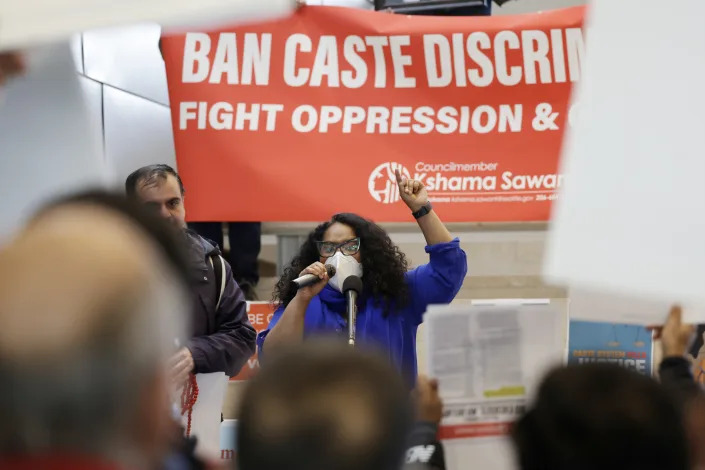
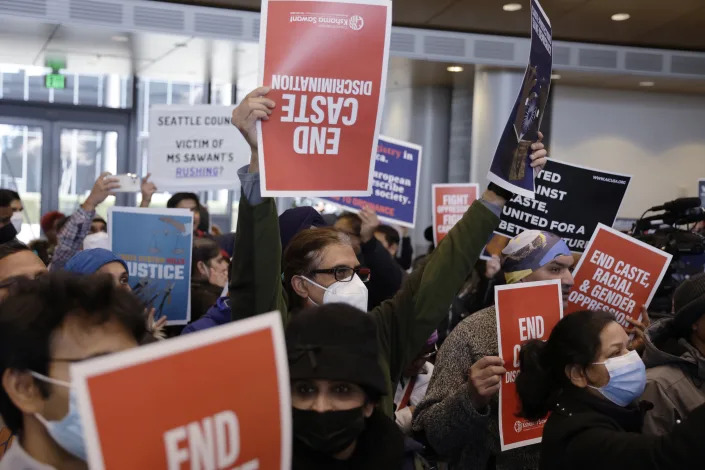
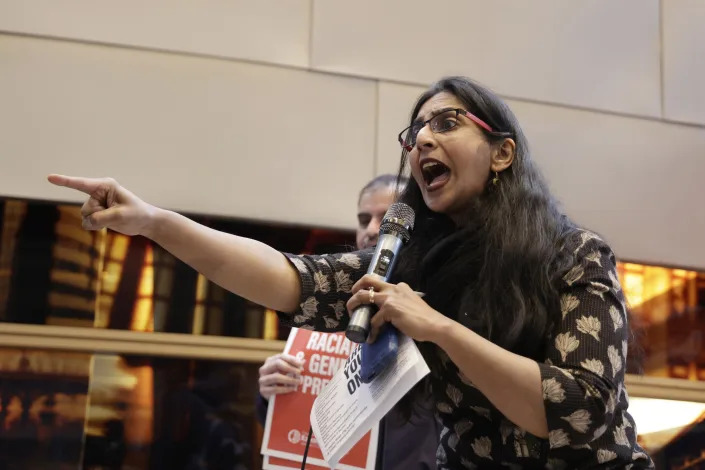
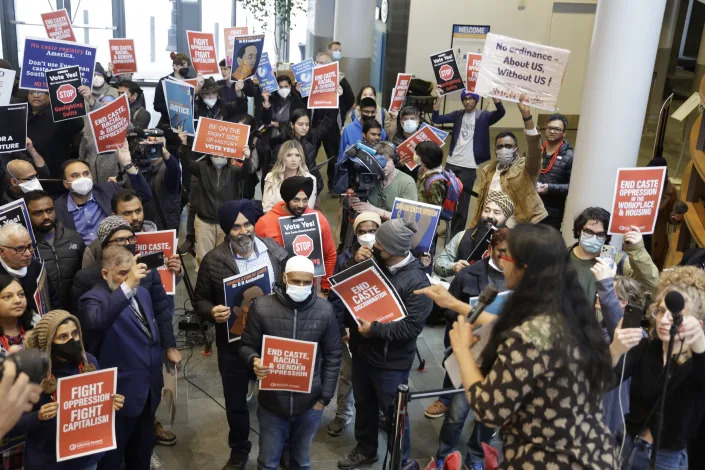
Seattle becomes first U.S. city to ban caste discrimination


DEEPA BHARATH
Tue, February 21, 2023 at 9:53 AM MST·6 min read

SEATTLE (AP) — The Seattle City Council on Tuesday added caste to the city’s anti-discrimination laws, becoming the first U.S. city to ban caste discrimination and the first in the world to pass such a law outside South Asia.

Calls to outlaw discrimination based on caste, a division of people based on birth or descent, have grown louder among South Asian diaspora communities in the United States. But the movement has been getting pushback from some Hindu Americans who argue that such legislation maligns a specific community.

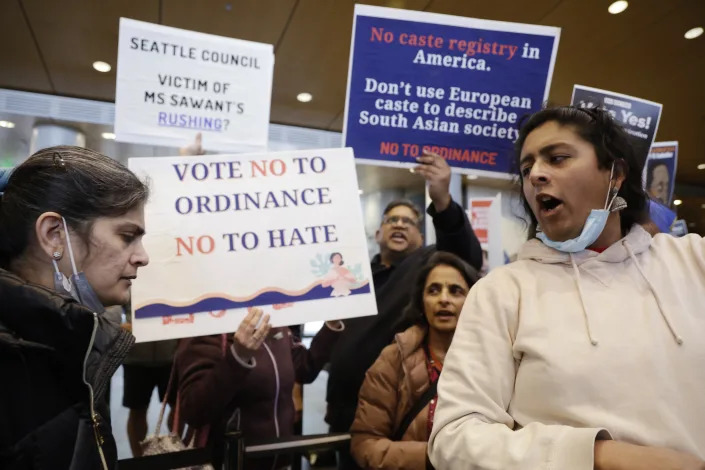
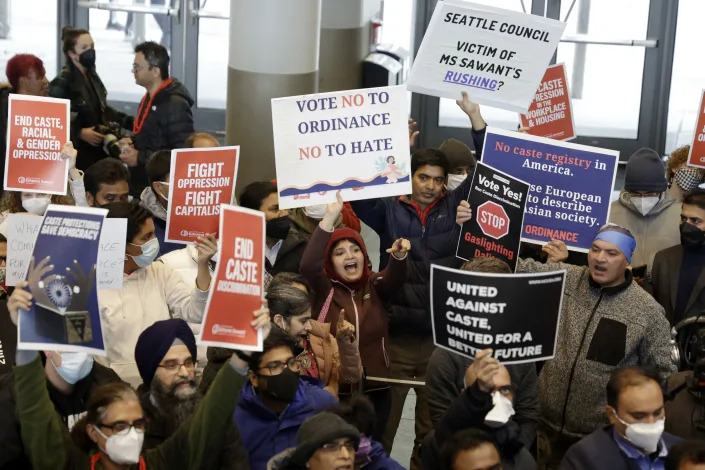
Tensions within the community were visible at Seattle City Hall on Tuesday as a noisy hearing culminated with a 6-1 vote with a majority of the council agreeing that caste discrimination crosses national and religious boundaries and that without such laws, those facing caste discrimination in the U.S. will have no protections.

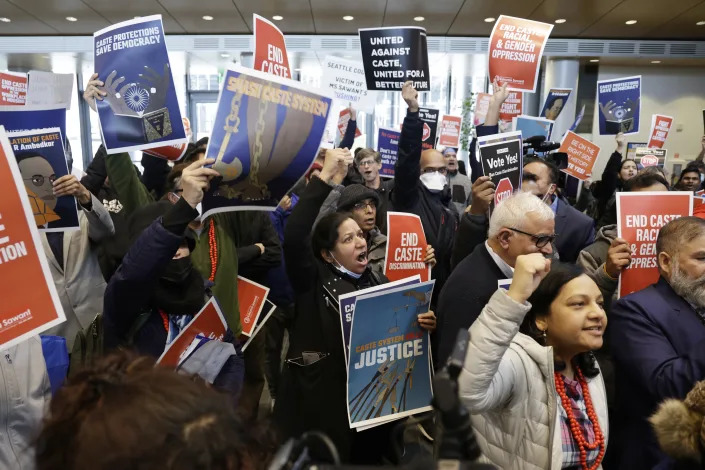
The packed room, which overflowed with activists from both sides bearing banners, chanting slogans, challenging speakers and city officials as they made their comments, laid bare stark divisions over this issue within the South Asian diaspora. A majority of those present in council chambers were supporters of the ordinance and those opposed were a vocal minority.

As council members voted in favor of the ordinance, the chamber erupted into cheers of “Jai Bhim,” which means “victory for Bhim” a rallying cry adopted by followers of B.R. Ambedkar, an Indian Dalit rights icon whose given name was Bhimrao. Dalit groups and their supporters say caste discrimination is prevalent in U.S. diaspora communities, manifesting itself in the form of social alienation and discrimination in housing, education and the tech sector where South Asians hold key roles.

Yogesh Mane, a Seattle resident who grew up as an untouchable in India, broke into tears as he heard the council's decision.

“I'm emotional because this is the first time such an ordinance has been passed anywhere in the world outside of South Asia,” he said. “It's a historic moment."

Thenmozhi Soundararajan, executive director of Oakland, California-based Equality Labs, whose advocacy work along with community partners continues to push caste discrimination laws forward, called the council vote “a culture war that has been won.”

“We got the support of over 200 organizations from Seattle and around the country,” she said. “It's a powerful message that Dalit people are not alone. The South Asian community has united to say we want to heal from the trauma of caste."

Council Member Kshama Sawant, a socialist and the only Indian American on the City Council, said the ordinance, which she proposed, does not single out one community, but it accounts for how caste discrimination crosses national and religious boundaries. Sawant said the council received over 4,000 emails in support of the ordinance.

“We've heard hundreds of gut-wrenching stories over the last few weeks showing us that caste discrimination is very real in Seattle,” she said.

Council Member Sara Nelson who cast the lone dissenting vote agreed with opponents calling the ordinance “a reckless, harmful solution to a problem for which we have no data or research.”

“This could generate more anti-Hindu discrimination and could dissuade employers from hiring South Asians,” she said. “The community that is being impacted is deeply divided on this issue.”

Nelson also said the ordinance would also get the city entangled in legal battles to which Sawant responded: “Bring it on.” Sawant said being fearful of lawsuits is not the way to effect progress or change.

Council Member Lisa Herbold questioned opponents' logic that the law singles out Hindus and people of Indian descent.

“That's like saying gender discrimination laws single out all men,” she said. “And just because we have a small population that is experiencing (caste discrimination) that doesn't make it any less important.”

Shobha Swamy, a representative of the Coalition of Hindus of North America said she was disappointed by the council deliberations and line of questioning. The group said they received a show of support from over 100 organizations.

“Due diligence wasn't done,” said Swami, who flew in from Atlanta.

C.H. Srikrishna, a San Francisco Bay Area-based tech worker, said he is worried about the ramifications this ordinance might have for the South Asian community.

“I too want discrimination to end,” he said. “But we need to first determine that widespread discrimination exists."

Srikrishna, who is Hindu, believes the ordinance does target his religion.

“When you say it originated 2,000 years ago, that is implicitly blaming Hinduism,” he said. "That bothers me. I feel betrayed.”

Sanjay Patel, a tech company owner from the Seattle area, said he never felt discriminated against in the U.S. as a member of a lower caste and that the ordinance pained him because it reminded him of a caste identity, which he thought had become obsolete.

“I fear with this law, businesses will be afraid to hire South Asians," he said.

Earlier Tuesday morning, several activists braved cold temperatures and wind gusts to line up outside City Hall so they would get a chance to speak to the council before the vote. But the council restricted public comment at the meeting where more than 300 people had requested to speak virtually and in person. They heard about half of the comments before moving on to deliberations and the vote.

The origins of the caste system in India can be traced back 3,000 years as a social hierarchy based on one’s occupation and birth. It is a system that has evolved over the centuries under Muslim and British rule. The suffering of those who are at the bottom of the caste pyramid — known as Dalits — has continued. Caste discrimination has been prohibited in India since 1948, a year after the nation’s independence from British rule.

The U.S. is the second most popular destination for Indians living abroad, according to the Migration Policy Institute, which estimates the U.S. diaspora grew from about 206,000 in 1980 to about 2.7 million in 2021. The group South Asian Americans Leading Together reports that nearly 5.4 million South Asians live in the U.S. — up from the 3.5 million counted in the 2010 census. Most trace their roots to Bangladesh, Bhutan, India, Nepal, Pakistan and Sri Lanka.

Over the past three years, several colleges and university systems have moved to prohibit caste discrimination.

In December 2019, Brandeis University near Boston became the first U.S. college to include caste in its nondiscrimination policy. The California State University System, Colby College, Brown University and the University of California, Davis have all adopted similar measures. Harvard University instituted caste protections for student workers in 2021 as part of its contract with its graduate student union.

___

Associated Press religion coverage receives support through the AP’s collaboration with The Conversation US, with funding from Lilly Endowment Inc. The AP is solely responsible for this content.


Seattle Caste DebateSupporters and opponents of a proposed ordinance to add caste to Seattle's anti-discrimination laws protest at a rally at Seattle City Hall, Tuesday, Feb. 21, 2023, in Seattle. Council Member Kshama Sawant proposed the ordinance. (AP Photo/John Froschauer)

Thursday, August 18, 2022

India: Muslim rape victim aghast at attackers' release

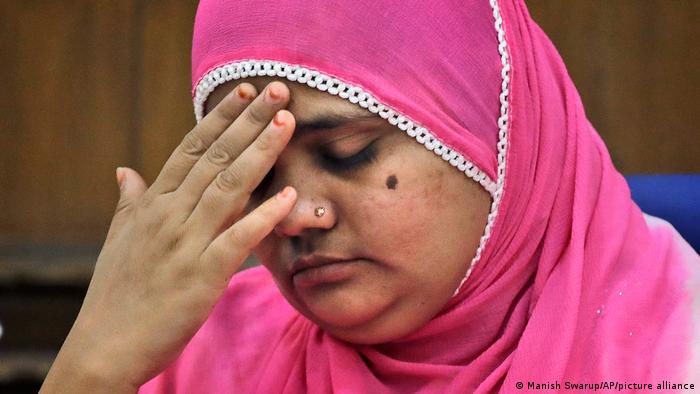
The survivor of a 2002 gang rape during communal violence in Gujarat state has said she is "bereft of words" at her attackers' release after serving 14 years in jail. 

Narendra Modi was the state's governor at the time.

HINDUTVA; ARYANISM, FASCISM,

MISOGYNY, CASTEISM, RACISM   

Bilkis Bano was the only survivor of an attack on 17 people, several of them her relatives

A Muslim woman who was gang-raped when pregnant during communal violence in India in 2002 has issued a statement via her lawyers criticizing the Gujarat state government for releasing her attackers earlier this week

Bilkis Bano, who is now in her 40s, was the only person in a group of 17 Muslims to survive the attacks. Seven of her relatives, including her then 3-year-old daughter, were killed.

She said in the statement that her attackers' release left her "bereft of words. I am still numb." 

"How can justice for a woman end like this? I trusted the highest courts in our land," Bano said in a letter published late on Wednesday, adding that authorities had not reached out to her before releasing the men. "Please undo this harm. Give me back my right to live without fear and in peace." 

A group of women also protested in New Delhi against the men's release. Maimoon Mollah of the All India Democratic Women's Association told the Associated Press news agency that they were demanding the state roll back its decision. 

"Bilkis and other survivors should be allowed to live in peace and dignity," Mollah said. 

The 2002 Gujarat attacks have an additional political significance in India, given that current Hindu nationalist Prime Minister Narendra Modi led the state at the time of the attacks.

How did authorities in Gujarat explain the release? 

Gujarat's state government, run by Modi's Bharatiya Janata Party (BJP), defended the decision to release the men by saying that they had served India's most common life imprisonment term of 14 years, among other factors. 

"The remission of the 11 convicts was considered after taking various factors like life imprisonment term in India which is typically of 14 years or more, age, behavior of the person and so on," senior Gujarat official Raj Kumar was quoted as saying by the Hindustan Times

According to Kumar, the men were eligible for release on this basis thanks to a 1992 remission policy that was in effect when they were convicted but that became defunct in 2014. Now, rape and murder are among crimes for which remission after 14 years is no longer granted to people serving a life sentence. 

The announcement of the men's release also coincided with celebrations of India's 75th anniversary of independence from colonial Britain. 

PM Modi led Gujarat state at time of the attacks

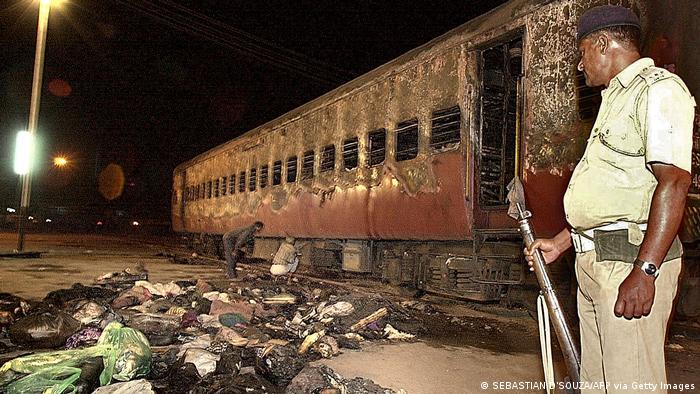
In the western state of Gujarat in 2002, the deaths of 59 Hindu pilgrims in a train fire sparked communal violence and riots targeting Muslims. 

The train fire was blamed on a Muslim mob, and dozens were later convicted for it, though its cause remains disputed. 

A policeman looks over a burnt coach and belongings of Hindu activists at Godhra station, early February 28, 2002, about 200 kilometers from Ahmadabad.

This 2002 train fire that killed more than 50 Hindus sparked riots in which about 20 times as many people died

According to the official tally, about 1,000 people, mostly Muslims, were hacked, beaten, shot or burned to death in the riots that followed. 

The riots — some of the worst communal violence in India since its independence — took place while Modi was the state's chief minister. The Hindu nationalist faced allegations of turning a blind eye to the violence, and was even refused a US visa in 2005. 

But Modi always argued that he was not complicit and did not turn a blind eye. In 2012, around a year before he was named candidate for national leader, the Indian Supreme Court declared he did not have a case to answer. 

Opposition politicians continued to pressure the government over the decision. 

The Congress Party's Rahul Gandhi, grandson of former premier Indira Gandhi, asked what message the men's release sent to women in India: "Prime Minister, the whole country is seeing the difference between your words and your deeds," he wrote on Twitter. 

Friday, August 14, 2020

Trump supporters don't understand how Kamala Harris can be both Black American and Indian American

Posted 1 day ago by Moya Lothian-McLean in news

Getty


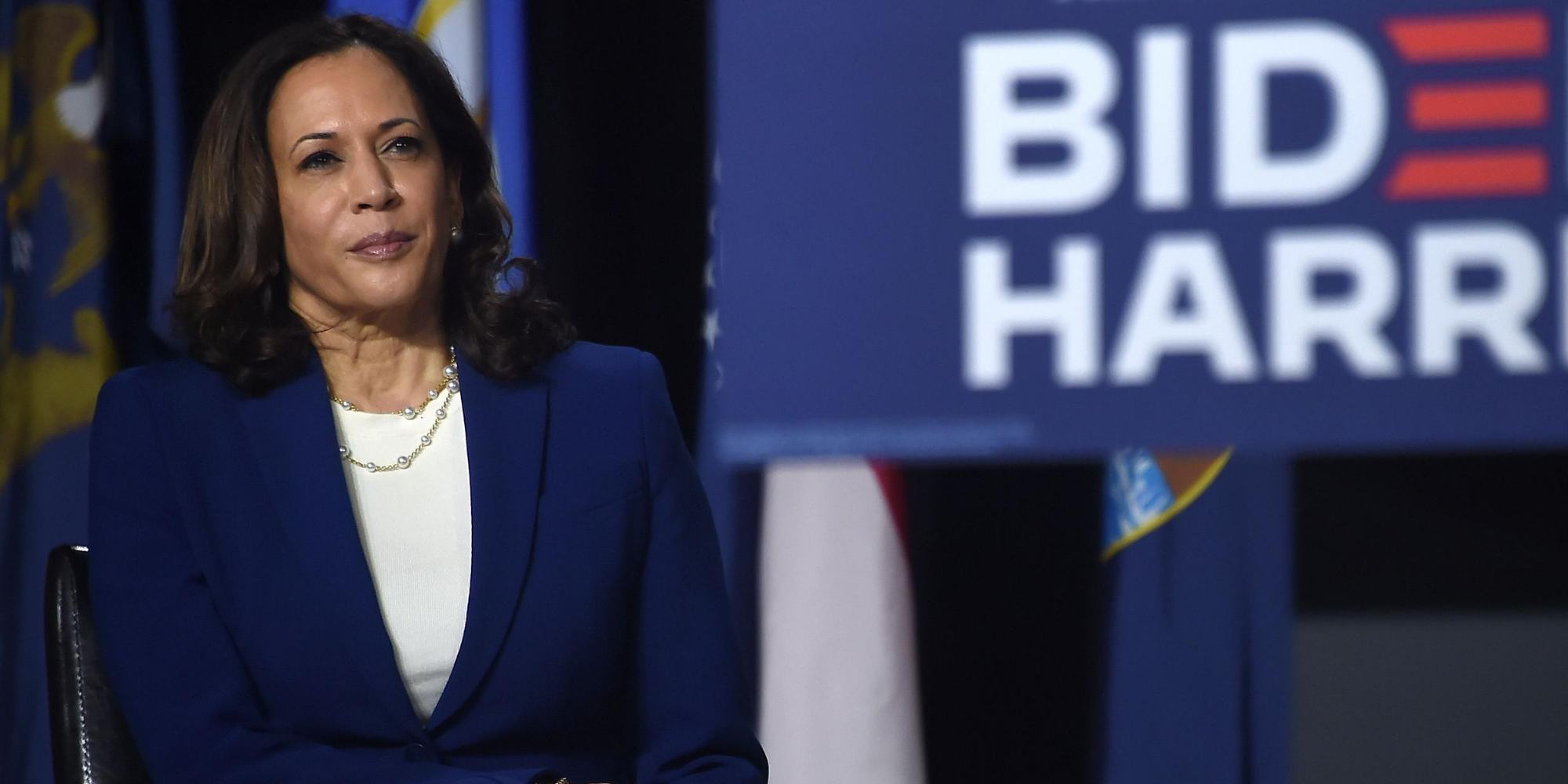
The announcement that Kamala Harris will be Joe Biden’s running mate in his bid for the presidency has spurred mixed reactions.

They mainly focus around Harris’ history as a prosecutor and whether she will win over voters or alienate them, given her past in law enforcement.

But for some Republicans, it seems Harris’ ethnicity is what’s really perplexing them.

As Forbes reports, conservatives are moving to “discredit” Harris’ identity as a Black woman because of her biracial heritage.

Harris has an Indian mother and a Jamaican father and has said in the past she was raised as Black because that’s how America would perceive her.


But now prominent Republicans are making bizarre claims about racial purity.

White conservative pundit Mark Levin opened his show by saying “Kamala Harris is not African American”.

“She is Indian and Jamaica,” he said.

“Jamaica is part of the Caribbean, India is out near China.

“Her ancestry does not go back to American slavery”.

Incredibly, Levin seems to have forgotten there was slavery in Jamaica.

Quite a lot of it in fact.

And ‘African American’ is a term that’s been met with backlash in recent years for its lack of accuracy and implication that Black Americans whose families have been in America for generations, still somehow ‘belong’ to Africa.

Other Republicans seemed to have received the same memo.

Dinesh D’Souza, who was ridiculed last week for trying to defend President Trump mispronouncing ‘Thailand’, also decided to attack Harris for her ancestry.

His gripe? That Harris’ father can trace his genealogy back to a slave owner.

According to D’Souza, this means he can question Harris’ Blackness – despite the fact it is a horribly common story among many other Black individuals in the US who are descended from slaves.

“African American in the American context generally means having a direct relationship to the experience of slavery,” D’Souza said, during an appearance on Fox News.

“Kamala Harris’ father wrote an article in a Jamaican magazine several years ago [...] that he was descended from the largest slave owner in Jamaica, a fellow named Hamilton Brown”.

So it seems having Black ancestors who were assaulted by their white ‘masters’ apparently precludes you from Blackness now.... And it didn’t stop there.

Pro-Trump pundit Candace Owens also accused Harris of “playing” the “Black card” after previously discussing her Indian American heritage.

Because, as we’ve seen, you cannot possibly be two things at once.

Or maybe it’s just too many concepts for these people to handle?

Wait until they hear about intersectionality.

IN FACT RACISM IS INHERENT IN HINDUISM WHICH IS NOW INFECTING THE INDIA BODY POLITIC, AS IS CASTISM, 19TH CENTURY ARYANISM AND NATIONALISM.

THERE ARE BLACK INDIANS AND THOSE MORE PALE, THE TAMIL OF SOUTHERN INDIA AND NORTHERN SRI LANKA ARE BLACK AND SUFFER SYSTEMIC RACISM FAMILIAR IN NORTH AMERICA.  WHICH IS WHY THE HINDU NATIONALISTS IN INDIA AND IN THE USA SUPPORT TRUMP.


Monday, October 05, 2020

India’s federal agency to probe Dalit woman’s gang rape and death
HINDUTVA 
CASTISM MISOGYNY BIGOTRY EXCEPTIONALIST ARYANISM
Uttar Pradesh state police to hand case over to Central Bureau of Investigation amid nationwide uproar over assault.

Demonstrators in New Delhi protest over the rape and death of the young Dalit woman [Adnan Abidi/Reuters]

5 Oct 2020

India’s federal investigators will take over the probe into the alleged gang rape and death of a young Dalit woman that has sparked nationwide outrage and days of protests.

A special team of the Uttar Pradesh state police that has been investigating the incident will soon be handing over to the Central Bureau of Investigation (CBI), a spokesman for the police said on Sunday.

KEEP READING
India: Dalit woman’s body taken off funeral pyre in Uttar Pradesh

The 19-year-old – who belongs to a marginalised group formerly known as “untouchables” – was assaulted in a field outside her village in the northern Uttar Pradesh’s Hathras district on September 14.

She was severely injured and died two weeks later at a hospital in the Indian capital, New Delhi.

The attack on the teenager was the latest case highlighting sexual and other forms of violence against India’s 200 million Dalits, who are on the lowest rung of the caste system and have historically faced discrimination despite laws to protect them.

Four village men, who belong the privileged and influential Thakur community, have been arrested in connection with the crime.

Five senior police officers, including the district police chief, have been suspended over the investigation amid criticism of law enforcement’s actions – including the cremation of the woman’s body in the middle of the night against the wishes of her family.

Local authorities barricaded the village after the cremation to block opposition politicians and media from meeting the victim’s family. The decision was reversed on Saturday after widespread criticism.

Meanwhile, a controversy has erupted over a government forensic lab report that backs the Uttar Pradesh police’s claim that the young woman was not raped.

Doctors who treated the woman, however, reject the report, saying the samples had been sent to the lab 11 days after she was assaulted.

Priyanka Gandhi, leader of India’s main opposition Congress party, with her supporters during a protest over the death of Dalit rape victim, in Noida on the outskirts of New Delhi [Reuters]The woman’s death has sparked protests by members of Dalit communities, rights activists and opposition political parties across India.

The decision to hand the investigation over to the CBI was announced by the Uttar Pradesh Chief Minister’s Office late on Saturday soon after opposition Congress party leaders Rahul Gandhi and Priyanka Gandhi visited the victim’s family in Hathras.

Uttar Pradesh is governed by the Hindu nationalist Bharatiya Janata Party (BJP), which also runs the federal government.

The incident came months after four men were hanged for the 2012 gang rape and murder of a student on a bus in New Delhi, a case that shook the nation.

An average of nearly 90 rapes were reported in India every day last year, according to data by the National Crime Records Bureau (NCRB), but large numbers are thought to go unreported.

In 2019, more than 500 Dalit women were raped in Uttar Pradesh alone, according to the NCRB data, while the nationwide figure for the same year was more than 3,500.

SOURCE : AL JAZEERA AND NEWS AGENCIES

Saturday, June 20, 2020

IMPERIALISM, ARYANISM, COLONIALISM 
ARE RACIST WHITE SUPREMACY

Saturday, November 05, 2022

IRONIC SINCE HINDUTVA IS ARYANISM
At UN, India votes in favor of Russian resolution on 'Combating glorification of Nazism'


ANI
6th November 2022

New York [US], November 5 (ANI): India at United Nations voted in favour of Russia's draft resolution on "Combating glorification of Nazism."Amid the spirited debate, the Third Committee of the United Nations General Assembly approved a draft resolution on combating the glorification of Nazism by a recorded vote of 105 in favour to 52 against, with 15 abstentions.

The representative of India said that the concept of Indigenous Peoples is not applicable in the country's context, adding that it joins consensus on the resolution with this understanding.

The committee approved eight draft resolutions, including Texts on Indigenous Peoples' Rights, Privacy in Digital Age, Condemning Glorification Of Nazism.

The draft resolutions covered a range of human rights issues, from the right to literacy and protection of children from sexual exploitation to matters of crime prevention and criminal justice as well as efforts to combat the glorification of Nazism.

The draft resolution had the Assembly express deep concern about glorifying the Nazi movement, neo-Nazism and former members of the Waffen SS organization, including erecting monuments and holding public demonstrations in glorifying the Nazi past.

Russian Federation's delegate voiced concern over an increase in racist and xenophobic rhetoric, calls to deport migrants and refugees, Islamophobia, Afrophobia and antisemitism, the UN said in its release.

Several delegates took to the floor to express concerns over Moscow's attempt to exploit the pretext of combating neo-Nazism to justify its brutal war against Ukraine, with Ukraine's delegate asserting that the draft has nothing in common with the genuine fight against Nazism and neo-Nazism.

Echoing his concerns, the United Kingdom's delegate stressed that the resolution is part of Moscow's attempt to justify its aggression against Ukraine by furthering lies and distorting history.

The United States' delegate called the resolution "a cynical attempt" of Moscow to further its geopolitical aims by invoking the Holocaust and Second World War. In the same vein, Australia's delegate called Moscow's weaponization of the Holocaust and Nazism unacceptable.

Meanwhile, several delegates disassociated from the amendment, which notes with alarm that the Russian Federation seeks to justify its territorial aggression against Ukraine on the purported basis of eliminating neo-Nazism. Rejecting the amendment, as it politicizes the issue of elimination of racism while introducing a narrow, country-specific approach, the delegate of the Russian Federation said that "this is a thematic resolution, not a country-resolution". (ANI)

Monday, June 30, 2025

FASCIST EUROPE

Bulgarian anti-euro campaigners set up protest camp in Sofia

SLAVIC ARYANISM

Bulgarian anti-euro campaigners set up protest camp in Sofia


Protesters against euro adoption in central Sofia. / Vazrazhdane via Facebook


By Denitsa Koseva in Sofia June 29, 2025

Bulgarian anti-euro campaigners have set up a protest camp in the centre of Sofia dubbed the ‘City of the Lev’. 

The 10-day protest was launched after Bulgaria was given a green light for eurozone entry by the European Central Bank and the European Commission, which issued positive convergence reports at the beginning of June. Bulgaria is expected to join the eurozone on January 1, 2026. 

However, Bulgaria’s adoption of the euro has faced strong opposition by the far-right pro-Russian Vazrazhdane party and President Rumen Radev. 

The Civil Committee for Protection of the Lev, in which Vazrazhdane is involved, launched the 10-day protest on June 28. Campaigners plan to block the centre of the Bulgarian capital Sofia until July 8, when the final decision on the country’s accession to the eurozone should be taken by the ECOFIN committee.

Vazrazhdane claimed in a statement on its website that Bulgarians are being forced to enter the eurozone by Brussels, and has launched a campaign under the slogan ‘The fight for the lev is the last fight for Bulgaria”.

Subsequently, the party’s leader Kostadin Kostadinov, dubbed Kostya Kopeikin because of his open pro-Russian orientation, said during a plenary parliament session that the party will destroy the eurozone from the inside.

While the protests are not expected to gather strong support, citizens of Sofia launched a petition urging the local authorities to ban the blockade of the centre, calling it a civil harassment.

Those signing the petition demand that Sofia city municipality annul its permission for the blockade and explain why it has allowed “occupation of the city by a specific political party”.

Meanwhile, Vazrazhdane initiated  a fresh no-confidence motion against the government of Prime Minister Rossen Zhelyazkov because of its eurozone entry activities and alleged failure in financial policy. As the Gerb-led ruling coalition has a comfortable majority, the vote is expected to fail.

Sunday, July 26, 2020

RIP 
Olivia de Havilland, Oscar-winning actress, dies at 104
IT SEEMS HER PASSING IS APROPOS IN THE CURRENT CULTURAL REVOLUTION AROUND RACISM, IMPERIALISM, COLONIALISM (THE BRITISH EMPIRE IN NORTH AMERICA) AKA ARYANISM & WHITE SUPREMACY
U
pdated 1:11 PM; Today 1:11 PM


FILE - In this June 18, 2016, file photo, U.S. actress Olivia de Havilland poses during an Associated Press interview, in Paris. Olivia de Havilland, Oscar-winning actress has died, aged 104 in Paris, publicist says Sunday July 26, 2020. (AP Photo/Thibault Camus, File)AP

By Associated Press

PARIS (AP) — Olivia de Havilland, the doe-eyed actress beloved to millions as the sainted Melanie Wilkes of “Gone With the Wind,” but also a two-time Oscar winner and an off-screen fighter who challenged and unchained Hollywood’s contract system, died Sunday at her home in Paris. She was 104.

Havilland, the sister of fellow Oscar winner Joan Fontaine, died peacefully of natural causes, said New York-based publicist Lisa Goldberg

De Havilland was among the last of the top screen performers from the studio era, and the last surviving lead from “Gone With the Wind,” an irony, she once noted, since the fragile, self-sacrificing Wilkes was the only major character to die in the film. The 1939 epic, based on Margaret Mitchell’s best-selling Civil War novel and winner of 10 Academy Awards, is often ranked as Hollywood’s box office champion (adjusting for inflation), although it is now widely condemned for its glorified portrait of slavery and antebellum life.


The pinnacle of producer David O. Selznick’s career, the movie had a troubled off-screen story.


Three directors worked on the film, stars Vivien Leigh and Clark Gable were far more connected on screen than off and the fourth featured performer, Leslie Howard, was openly indifferent to the role of Ashley Wilkes, Melanie’s husband. But de Havilland remembered the movie as “one of the happiest experiences I’ve ever had in my life. It was doing something I wanted to do, playing a character I loved and liked.”


During a career that spanned six decades, de Havilland also took on roles ranging from an unwed mother to a psychiatric inmate in “The Snake Pit,” a personal favorite. The dark-haired De Havilland projected both a gentle, glowing warmth and a sense of resilience and mischief that made her uncommonly appealing, leading critic James Agee to confess he was “vulnerable to Olivia de Havilland in every part of my being except the ulnar nerve.”


She was Errol Flynn’s co-star in a series of dramas, Westerns and period pieces, most memorably as Maid Marian in “The Adventures of Robin Hood.” But De Havilland also was a prototype for an actress too beautiful for her own good, typecast in sweet and romantic roles while desiring greater challenges.


Her frustration finally led her to sue Warner Bros. in 1943 when the studio tried to keep her under contract after it had expired, claiming she owed six more months because she had been suspended for refusing roles. Her friend Bette Davis was among those who had failed to get out of her contract under similar conditions in the 1930s, but de Havilland prevailed, with the California Court of Appeals ruling that no studio could extend an agreement without the performer’s consent.


The decision is still unofficially called the “De Havilland law.”


De Havilland went on to earn her own Academy Award in 1946 for her performance in “To Each His Own,” a melodrama about out-of-wedlock birth. A second Oscar came three years later for “The Heiress,” in which she portrayed a plain young homebody (as plain as it was possible to make de Havilland) opposite Montgomery Clift and Sir Ralph Richardson in an adaptation of Henry James’ “Washington Square.” In 2008, de Havilland received a National Medal of Arts and was awarded France’s Legion of Honor two years later.


She was also famous, not always for the better, as the sister of Fontaine, with whom she had a troubled relationship. In a 2016 interview, de Havilland referred to her late sister as “Dragon Lady” and said her memories of Fontaine, who died in 2013, were “multi-faceted, varying from endearing to alienating.”


“On my part, it was always loving, but sometimes estranged and, in the later years, severed,” she said. “Dragon Lady, as I eventually decided to call her, was a brilliant, multi-talented person, but with an astigmatism in her perception of people and events which often caused her to react in an unfair and even injurious way.”


De Havilland once observed that Melanie Wilkes’ happiness was sustained by a loving, secure family, a blessing that eluded the actress even in childhood.


She was born in Tokyo on July 1, 1916, the daughter of a British patent attorney. Her parents separated when she was 3, and her mother brought her and her younger sister Joan, to Saratoga, California. De Havilland’s own two marriages, to Marcus Goodrich and Pierre Galante, ended in divorce.


Her acting ambitions dated back to stage performing at Mills College in Oakland, California. While preparing for a school production of “A Midsummer Night’s Dream,” she went to Hollywood to see Max Reinhardt’s rehearsals of the same comedy. She was asked by to read for Hermia’s understudy, stayed with the production through her summer vacation and was given the role in the fall.


Warner Bros. wanted stage actors for their lavish 1935 production and chose de Havilland to co-star with Mickey Rooney, who played Puck.


“II wanted to be a stage actress,” she recalled. “Life sort of made the decision for me.”


She signed a five-year contract with the studio and went on to make “Captain Blood,” “Dodge City” and other films with Flynn, a hopeless womanizer even by Hollywood standards.


“Oh, Errol had such magnetism! There was nobody who did what he did better than he did,” said de Havilland, whose bond with the dashing actor remained, she would insist, improbably platonic. As she once explained, “We were lovers together so often on the screen that people could not accept that nothing had happened between us.”


She did date Howard Hughes and James Stewart and had an intense affair in the early ’40s with John Huston. Their relationship led to conflict with Davis, her co-star for the Huston-directed “In This Our Life”; Davis would complain that de Havilland, a supporting actress in the film, was getting greater and more flattering time on camera.


De Havilland allegedly never got along with Fontaine, a feud magnified by the 1941 Oscar race that placed her against her sister for best actress honors. Fontaine was nominated for the Hitchcock thriller “Suspicion” while de Havilland was cited for “Hold Back the Dawn, a drama co-written by Billy Wilder and starring de Havilland as a school teacher wooed by the unscrupulous Charles Boyer.


Asked by a gossip columnist if they ever fought, de Havilland responded, “Of course, we fight. What two sisters don’t battle?” Like a good Warner Bros soap opera, their relationship was a juicy narrative of supposed slights and snubs, from de Havilland reportedly refusing to congratulate Fontaine for winning the Oscar to Fontaine making a cutting crack about de Havilland’s poor choice of agents and husbands.


Though she once filmed as many as three pictures a year, her career slowed in middle age. She made several movies for television, including “Roots” and “Charles and Diana,” in which she portrayed the Queen Mother. She also co-starred with Davis in the macabre camp classic “Hush ... Hush, Sweet Charlotte” and was menaced by a young James Caan in the 1964 chiller “Lady in a Cage,” condemning her tormenter as “one of the many bits of offal produced by the welfare state.”


In 2009, she narrated a documentary about Alzheimer’s, “I Remember Better When I Paint.” Catherine Zeta-Jones played de Havilland in the 2017 FX miniseries about Davis and Joan Crawford, but de Havilland objected to being portrayed as a gossip and sued FX. The case was dismissed.


Despite her chronic stage fright, she did summer stock in Westport, Connecticut, and Easthampton, New York. Moviemaking, she said, produced a different kind of anxiety: “The first day of making a film I feel, `Why did I ever get mixed up in this profession? I have no talent; this time they’ll find out.‘”


___


Italie reported from New York. Former Associated Press Writer Dolores Barclay contributed to this report.

Saturday, November 20, 2021

HINDUISM IS ARYANISM
UC Davis adds caste to its anti- discrimination policy


This photo provided by the University of California, Davis shows the university campus in Davis, Calif., on April 3, 2015. The university has added caste, a millennia-old concept that assigns people in South Asia their social statuses at birth, to its anti-discrimination policy. Under UC Davis' policy amended in September, students or staff who face discrimination or harassment for their perceived castes can now file complaints that could result in formal investigations. 
(Chris Di Dio/University of California, Davis via AP)More


Thu, November 18, 2021,

DAVIS, Calif. (AP) — The University of California, Davis, has added caste to its anti-discrimination policy after students said they have seen discrimination take place at the university based on the South Asian practice of assigning people their social status at birth.

Under UC Davis’ policy, which was amended in September, students or staff who face discrimination or harassment for their perceived castes can now file complaints that could result in formal investigations, the San Francisco Chronicle reported Wednesday.

The Northern California university may be the first public institution to address caste discrimination, which was largely imported from South Asia.


“The significance of adding caste … is it ensures that the communities most impacted and most vulnerable to this type of discrimination or harassment know that the university recognizes the harm caused,” Danésha Nichols, director of UC Davis’ Harassment & Discrimination Assistance and Prevention Program, told the newspaper.

Students started pushing for the change after receiving insulting memes in their group chats and overhearing South Asian students ask each other what caste they belonged to before picking roommates, the newspaper reported.

Estimated to be thousands of years old, caste is rooted in India’s Hindu scripture. It long placed Dalits at the bottom of a social hierarchy, once terming them “untouchables.” Inequities and violence against Dalits have persisted even though India banned caste discrimination in 1950.

The practice has traveled outside of India to Bhutan, Nepal, Pakistan, Sri Lanka and Myanmar, and occurs among Hindus, Muslims, Sikhs, Jains, Christians and Buddhists, said Anjali Arondekar, a professor and co-director of the Center for South Asian Studies at University of California, Santa Cruz told the newspaper.

“Caste is really about labor segmentation and sustained inequality through the years — millenniums, really,” she said.

India’s caste system, which assigns people their social statuses at birth, places Dalits, once called “untouchables,” at the bottom of its social hierarchy that can determine where they live, what schools they can attend, what jobs they can get and where they marry.

Last year, California regulators sued Cisco Systems, saying an engineer faced discrimination at the company’s Silicon Valley headquarters because he is a Dalit Indian.

The engineer worked on a team at Cisco’s San Jose headquarters with Indians who all immigrated to the U.S. as adults, and all of whom were of high caste, according to the lawsuit filed by the California Department of Fair Employment and Housing.

The “higher caste supervisors and co-workers imported the discriminatory system’s practices into their team and Cisco’s workplace,” the lawsuit said, and that the company did not “substantiate any caste-based or related discrimination or retaliation."

Cisco Systems Inc., a major supplier of computer networking gear that makes the internet work, has said it would defend against the allegations in the complaint.

Caste is often based on a person's last names, the village or town a person comes from, and from their religious and social practices.

Prem Pariyar, a 37-year-old graduate student at California State University, East Bay, said his family would be physically assaulted because of their lower caste in his home country of Nepal. He said the last thing he expected was to face casteism when he moved to the U.S. in 2015.


But he faced it when interacting with other South Asians in the Bay Area — at his restaurant job, at the university, at community events and at dinner parties.

“Some will ask me my last name under the pretense of getting to know me, but are really trying to find out about my caste. Others have served me meals in separate plates and utensils after they find out I’m Dalit,” Pariyar said.

He started organizing with other CSU students around the issue and their efforts led the Cal State Student Association, which represents all 23 CSU campuses, to recognize caste as a protected category this year. But the CSU school system itself has not made any changes to its discrimination policy. Pariyar was also part of the UC Davis campaign.

UC Davis' policy change feels like a big step for those trying to get caste discrimination recognized across the U.S.

“It is an issue, it’s here and it’s time to deal with it,” he said.

SEE


Saturday, March 13, 2021

ARYANISM IS CASTISM, RACISM, FACISM, HINDUTVA 
Silk slaves: India's bonded laborers are forced to work to pay off debts

By Sugam Pokharel and Tom Page, CNN
3/13/2021

The state of Karnataka, located in southwest India, is known for its silk. Mulberry trees grow in abundance, feeding silkworms and a centuries-old textile industry. But while silkworms prosper here, many people in the industry do not

.
© Sugam Pokharel/CNN

In India, the average silk worker is paid less than $3 a day -- small compensation for an industry estimated to be valued at over $14 billion globally. Part of the workforce is trapped in bonded labor, a form of modern-day slavery in which people work in often terrible conditions to pay off debt.

© Sugam Pokharel/CNN Kiran Kamal Prasad, founder of Jeevika.


Bonded labor was made illegal in India in 1976, but it never went away. A 2018 report estimated around 8 million people in India were unpaid workers or held in debt bondage, though some campaigners believe the true figure is much higher. Exactly how many are involved in the silk industry is unknown.

In January 2020, the CNN Freedom Project visited Sidlaghatta, a silk hub some 65 kilometers northeast of Bangalore, Karnataka, and met Hadia and Naseeba. This mother and daughter were forced by their "master" to work 11 hours a day, for which they earned just 200 rupees (about $2.75) to repay a 100,000-rupee (about $1,370) loan that had since doubled in size.

© Sugam Pokharel/CNN Naseeba (left) and Hadia (right), photographed in January 2020.

Naseeba had been working for three years in a silk factory, her mother nine years, boiling silkworm cocoons and removing the threads from which silk is made. The steam was foul and their hands bled, she said.

Read: More on modern-day slavery from the CNN Freedom Project

"(The master) came and he said to my mother, if you will not repay the money then we'll have a rich man and you will have to go and sleep with that man," said Naseeba.

"I'm afraid of the owner, because he has given us (a) home to live in," she added. "Where should we go? We cannot go anywhere. We don't know what he will do with us after (sees) this video."


Hadia and Naseeba concealed their faces on camera and agreed to be identified by CNN only after they had received their release certificates.

In India, bonded laborers can approach authorities requesting a certificate of release. If an investigation finds their case to be genuine, they are issued the certificate, which proves their debt is cancelled and entitles them to government assistance. The process can be lengthy -- sometimes taking years -- and can require bonded laborers to come forward to authorities in the face of social pressures and intimidation.

Sunday, August 14, 2022

Caste in California: Tech giants confront ancient Indian hierarchy
HINDUTVA ARYANISM IS CASTEISM & RACISM 

By Paresh Dave


Guests arrive for at the Steve Jobs Theater for an Apple event at their headquarters in Cupertino, California, U.S. September 10, 2019.
REUTERS/Stephen Lam/File Photo


OAKLAND, Calif, Aug 15 (Reuters) - America's tech giants are taking a modern-day crash course in India's ancient caste system, with Apple (AAPL.O) emerging as an early leader in policies to rid Silicon Valley of a rigid hierarchy that's segregated Indians for generations.

Apple, the world's biggest listed company, updated its general employee conduct policy about two years ago to explicitly prohibit discrimination on the basis of caste, which it added alongside existing categories such as race, religion, gender, age and ancestry.

The inclusion of the new category, which hasn't been previously reported, goes beyond U.S. discrimination laws, which do not explicitly ban casteism.

The update came after the tech sector - which counts India as its top source of skilled foreign workers - received a wake-up call in June 2020 when California's employment regulator sued Cisco Systems (CSCO.O) on behalf of a low-caste engineer who accused two higher-caste bosses of blocking his career.

Cisco, which denies wrongdoing, says an internal probe found no evidence of discrimination and that some of the allegations are baseless because caste is not a legally "protected class" in California. This month an appeals panel rejected the networking company's bid to push the case to private arbitration, meaning a public court case could come as early as next year. read more

The dispute - the first U.S. employment lawsuit about alleged casteism - has forced Big Tech to confront a millennia-old hierarchy where Indians' social position has been based on family lineage, from the top Brahmin "priestly" class to the Dalits, shunned as "untouchables" and consigned to menial labor.

Since the suit was filed, several activist and employee groups have begun seeking updated U.S. discrimination legislation - and have also called on tech companies to change their own policies to help fill the void and deter casteism.

Their efforts have produced patchy results, according to a Reuters review of policy across the U.S. industry, which employs hundreds of thousands of workers from India.

"I am not surprised that the policies would be inconsistent because that's almost what you would expect when the law is not clear," said Kevin Brown, a University of South Carolina law professor studying caste issues, citing uncertainty among executives over whether caste would ultimately make it into U.S. statutes.

"I could imagine that parts of ... (an) organization are saying this makes sense, and other parts are saying we don't think taking a stance makes sense."

Apple's main internal policy on workplace conduct, which was seen by Reuters, added reference to caste in the equal employment opportunity and anti-harassment sections after September 2020.

Apple confirmed that it "updated language a couple of years ago to reinforce that we prohibit discrimination or harassment based on caste." It added that training provided to staff also explicitly mentions caste.

"Our teams assess our policies, training, processes and resources on an ongoing basis to ensure that they are comprehensive," it said. "We have a diverse and global team, and are proud that our policies and actions reflect that."

Elsewhere in tech, IBM told Reuters that it added caste, which was already in India-specific policies, to its global discrimination rules after the Cisco lawsuit was filed, though it declined to give a specific date or a rationale.

IBM's only training that mentions caste is for managers in India, the company added.

Several companies do not specifically reference caste in their main global policy, including Amazon (AMZN.O), Dell (DELL.N), Facebook owner Meta (META.O), Microsoft (MSFT.O) and Google (GOOGL.O). Reuters reviewed each of the policies, some of which are only published internally to employees.

The companies all told Reuters that they have zero tolerance for caste prejudice and, apart from Meta which did not elaborate, said such bias would fall under existing bans on discrimination by categories such as ancestry and national originon policy.

CASTEISM OUTLAWED IN INDIA

Caste discrimination was outlawed in India over 70 years ago, yet bias persists, according to several studies in recent years, including one that found Dalit people were underrepresented in higher-paying jobs. Debate over the hierarchy is contentious in India and abroad, with the issue intertwined with religion, and some people saying discrimination is now rare.

Government policies reserving seats for lower-caste students at top Indian universities have helped many land tech jobs in the West in recent years.

Reuters spoke to about two dozen Dalit tech workers in the United States who said discrimination had followed them overseas. They said that caste cues, including their last names, hometowns, diets or religious practices, had led to colleagues bypassing them in hiring, promotions and social activities.

Reuters could not independently verify the allegations of the workers, who all spoke on condition of anonymity, saying they feared harming their careers. Two said they had quit their jobs over what they viewed as casteism.

Some staff groups, including the Alphabet Workers Union (AWU) at Google's parent company, say explicit mention of caste in corporate rules would open the door to companies investing in areas such as data collection and training at the same levels as they do to protect other groups.

"Significant caste discrimination exists in the United States," said Mayuri Raja, a Google software engineer who is a member of the AWU and advocates for lower-caste colleagues.

Over 1,600 Google workers demanded the addition of caste to the main workplace code of conduct worldwide in a petition, seen by Reuters, which they emailed to CEO Sundar Pichai last month and resent last week after no response.

Google reiterated to Reuters that caste discrimination fell under national origin, ancestry and ethnic discrimination. It declined to elaborate further on its policies.

'NOT GOOD FOR BUSINESS'

Adding caste to a general code of conduct is not unheard of.

The World Wide Web Consortium, an industry standards body partly based in Massachusetts, introduced it in July 2020. California State University and the state Democratic Party have followed over the past two years.

In May this year, California's employment regulator, the Civil Rights Department, added caste to its example equal employment opportunity policy for employers.

Yet the move by Apple, a $2.8 trillion behemoth with more than 165,000 full-time employees globally, looms large.

The iPhone maker's fair hiring policy now states that Apple "does not discriminate in recruiting, training, hiring, or promoting on the basis of" 18 categories, including "race, color, ancestry, national origin, caste, religion, creed, age" plus disability, sexual orientation and gender identity.

By contrast, many employers are hesitant to go beyond laws with their primary policies, according to three employment attorneys including Koray Bulut, a partner at Goodwin Procter.

"Most companies simply quote from the federal and state statutes that list the protected categories," Bulut said.

Some companies have, however, gone further in secondary policies that govern limited operations or serve only as loose guidelines.

Caste is explicitly written into Dell's Global Social Media Policy, for example, and in Amazon sustainability team's Global Human Rights Principles and Google's code of conduct for suppliers.

Amazon and Dell confirmed they had also begun mentioning caste in anti-bias presentations for at least some new hires outside India. They declined to specify when, why and how broadly they made the addition, though Dell said it made the change after the Cisco lawsuit was filed.

The companies' presentations include explanations of caste as an unwanted social structure that exists in parts of the world, according to a Reuters review of some of the online training, with the Dell material referencing a recent lawsuit "from the headlines."

John-Paul Singh Deol, lead employment attorney at Dhillon Law Group in San Francisco, said that only including caste in training and guidelines amounted to "giving lip service" to the issue because their legal force is questionable.

This characterization was rejected by Janine Yancey, CEO of Emtrain, which sells anti-bias training to about 550 employers, and a longtime employment attorney.

"No company wants to have employee turnover, lack of productivity and conflict - that's just not good for business," she said.

Yet explicitly referencing caste would likely invite an increased number of HR complaints alleging it as a bias, Yancey added.

"Whenever you're going to call out something specifically, you're exponentially increasing your caseload," she said.

Apple declined to say whether any complaints had been brought under its caste provision.

South Carolina law professor Brown expects no immediate resolution to the debate over of whether companies should reference caste.

"This is an issue that ultimately will be resolved by the courts," he said. "The area right now is unsettled."


Reporting by Paresh Dave; Additional reporting by Kanishka Singh in Washington and Sudarshan Varadhan in New Delhi; Editing by Kenneth Li and Pravin Char

Our Standards: The Thomson Reuters Trust Principles.


Paresh Dave
Thomson Reuters
San Francisco Bay Area-based tech reporter covering Google and the rest of Alphabet Inc. Joined Reuters in 2017 after four years at the Los Angeles Times focused on the local tech industry.


LA REVUE GAUCHE - Left Comment: Hinduism Is Fascism