Showing posts sorted by relevance for query SPACE JUNK. Sort by date Show all posts

Thursday, February 03, 2022

27,000 man-made objects in Earth orbit, and counting: Space junk is here to stay

Space junk includes old satellites, rocket bodies, and fragments of exploded or decaying spacecraft

Press Trust of IndiaFebruary 02, 2022 

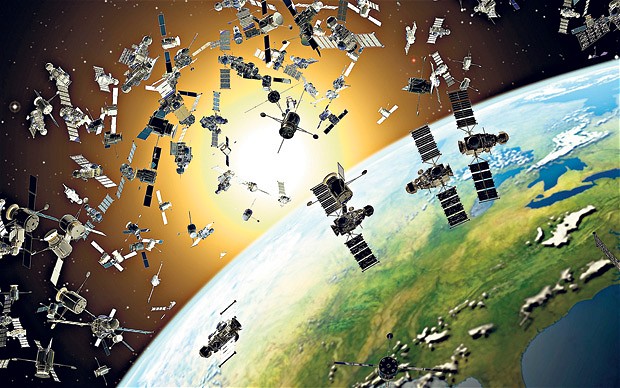
Representational image. News18

    Adelaide: The US Vanguard 1 satellite and the rocket stage that delivered it to orbit in 1958 are pieces of cultural heritage. They date from a time when humans first attained the capability of reaching beyond our home planet to the stars. They also have the dubious honour of being the first space junk'.

    NASA estimates there are around 27,000 human-made objects larger than 10 centimetres that can be classified as space junk that is, they do not have a useful purpose, either now or in the foreseeable future. These include old satellites, rocket bodies, and fragments of exploded or decaying spacecraft. The smaller bits, down to dust grain-size, number in the millions.

    The problem is that collisions between this high-speed trash create more space junk. The worst-case scenario is known as Kessler Syndrome, an unstoppable cascade of collisions that could make parts of Earth orbit unusable.

    It's an increasingly pressing situation as private corporations like SpaceX are slated to launch up to 100,000 new satellites by the end of the decade. Anti-satellite missiles, like the one tested by Russia in 2021, can add hundreds to thousands of new debris pieces in one event.

    One of the big problems is we don't know enough about where what and how much space junk there is. This means we don't always know when a piece of space junk is about to collide with something, or how far we really are from Kessler Syndrome. This is a problem firstly, of observation and tracking, and secondly, of modelling and simulation of this highly complex data.

    Lots of blind spots' are yet to be covered, like the tiny fragments and dust, and the higher orbits which are difficult to see from Earth's surface. Adding new instruments and techniques for observing space junk will address this.

    For example, LeoLabs built a new space radar in New Zealand in 2019, picking up some of the blind spots in the Pacific region. HEO Robotics is developing observing capabilities in Earth orbit which can monitor the condition of spacecraft.

    An increasingly popular approach is space traffic management. This aims to use space more efficiently and sustainably by coordinating and sharing information, such as that needed to avoid collisions, at the international and agency level.

    International cooperation, of course, is an essential part of the solution. The Interagency Space Debris Coordination Committee (IADC) facilitates cooperation in space debris research, and monitors the progress of ongoing cooperative activities. The IADC recommends each mission has a debris mitigation management plan.

    The UN through the Office of Outer Space Affairs and the Committee on the Peaceful Uses of Outer Space is also a key international organisation.

    The UN released the Guidelines for the Long-term Sustainability of Outer Space Activities in 2018. Among other things, the guidelines emphasise the role of national governments in ensuring satellite operators under their jurisdiction don't contribute to the debris problem.

    The UN, NASA and European Space Agency have had guidelines on design for minimising debris for nearly thirty years. The recommendations for end-of-life planning state that no spacecraft should remain in its mission orbit for longer than 25 years. Many think even this is too long.

    Another end-of-life strategy is to passivate' a spacecraft. Here, all of the fuel, battery power, and high-pressure liquids are expended or exhausted, to reduce the risk of explosion.

    But by some estimates, up to 60 percent of all new satellites launched don't comply with debris mitigation guidelines. It seems the incentives to preserve space for future generations aren't yet enough to sway commercial and government operators.

    So what about cleaning up orbit? How can we remove the junk that is already up there?

    Natural decay is the do-nothing strategy. Earth's atmosphere acts as a space junk waste management system by dragging objects into it, where friction and compression heat them to a burning point.

    Eventually, everything below about 1,000 kilometres will get dragged back in.
    The problem, of course, is that we keep adding new stuff, and it could be hundreds or even thousands of years before some junk re-enters.

    Additionally, there's growing evidence that this is not the ideal solution it appears. The incineration creates alumina and soot particulates that cause the Earth's protective ozone layer to decay a problem we thought we'd already solved.

    Options for active removal include nudging objects into the atmosphere, or pushing them to less congested orbits, also known as graveyard orbits, where they aren't such a collision risk a choice of down or up.

    Methods which have been proposed or are under development include nets, harpoons, lasers, tethers, sails and specialised vehicles. In 2019, Surrey Satellite Technology (SSTL) successfully tested a harpoon for space junk capture in orbit.

    The leaders in this field are Singapore-based Astroscale. In collaboration with SSTL, they launched the Elsa-d system in March 2021. Elsa-d is testing rendezvous manoeuvres needed to dock with space junk and then remove it.

    Another project is the Swiss ClearSpace1. Under contract to the European Space Agency, they are developing a spider-clawed spacecraft to grab and de-orbit old satellites. It's planned for launch in 2025.

    Getting rid of old space junk doesn't have to mean destruction. Recycling could give space junk a purpose making it a resource rather than rubbish. For example, old satellites aren't always dead'. They may have power and communications and could be repurposed to do new science.

    The materials could be recycled into rocket fuel, technology which Neumann Space is developing in Australia, or scavenged for building materials. Old rocket bodies, one of the most dangerous classes of junk, could be turned into space habitats or laboratories.

    However, passivation reduces the potential for repurposing a satellite or rocket body. Refuelling on-orbit is a way to extend the usable life of a spacecraft, and a number of companies are working on this technology.

    Another promising direction is thinking creatively about new materials. A Japanese project has been looking at wood as housing for small, short-lived low Earth orbit satellites. Wood won't last as long in orbit as the usual spacecraft materials and does not create alumina or soot when it burns in the upper atmosphere.

    The problem with any successful technology for removing an old spacecraft from orbit is that it's also effectively an anti-satellite weapon. This means treading very carefully indeed to avoid the situation that no-one wants war in space.

    Earth orbit is a classic example of the tragedy of the commons', where maximising national, or commercial, gain ruins the resource for all users. It's important to remember that not everyone is equally responsible for creating space junk. Most of it belongs to the US, Russia and China. But the advent of the private mega constellations is likely to change that.

    One thing is clear: orbital space is never going to return to its pre-1957 pristine state. Space junk is here to stay.


    Sunday, January 14, 2024

    CAPITALI$M IN SPACE
    Waste of space: The danger posed by orbital junk


    Tali Fraser
    POLITICS HOME
    @TaliFraser
    13 January, 2024


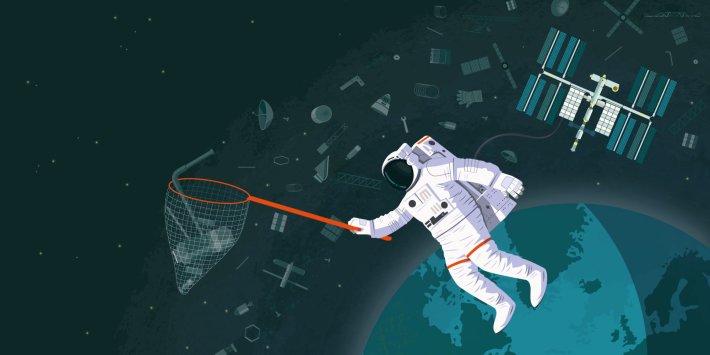
    Sending satellites and other objects into space is getting ever easier and cheaper but, as Tali Fraser reports, the mess left behind is dangerous and without action is posing an ever greater risk. Illustration by Tracy Worrall

    It started with a single glove in 1965. Approaching 60 years later there are around 130 million pieces of humanity’s detritus circling our planet. 

    Of the objects in Earth’s orbit, 75 per cent are said to be “space junk”, from old satellites to spacecraft – and almost every space mission has the ability to produce more, leaving low-Earth orbit (LEO) looking like a landfill. 

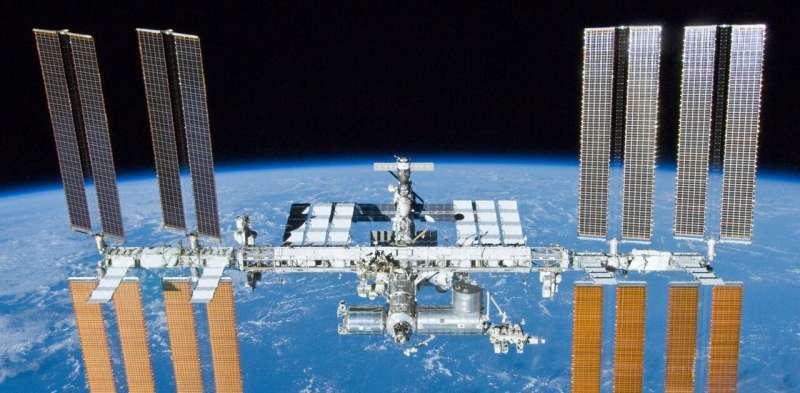
    The astronauts of the International Space Station (ISS) have enough to consider without the worry of coming under attack from thousands of pieces of tiny space shrapnel. But that possibility is rapidly increasing as the amount of “space junk” continues to grow following the launch of several multi-satellites constellations. 

    Only 33,000 items of “space junk” are trackable, the rest being too small to monitor – and it is this smaller, untrackable, “junk” that poses the greatest threat to the ISS, which is unable to manoeuvre around them. 

    “That region is quite benign but it’s also becoming much more congested and busy because of the way in which we’re building up the large constellations.” 

    These satellite constellations, such as the near 5,000 satellites of Elon Musk’s SpaceX company Starlink, increase the number of orbital objects, the occurrence of collisions and the amount of debris left in space. 

    Astronauts have created their own space junk, too. After NASA’s Ed White dropped his right glove in 1965 and became the first space litterer, there has been a tool bag left behind on a space walk last year, a camera that drifted away during a 2007 space walk, a spatula and even an Andy Warhol drawing (left behind by the Apollo 12 mission). 

    It’s becoming much more congested and busy because of the way in which we’re building up the large constellations

    Chair of the Space APPG Mark Garnier MP succinctly explains the human nature of “space junk”: “We’re one of nine planets, orbiting one of a billion stars in the galaxy, and there are a trillion galaxies out there, but sure enough, humans can mess up the space around our planet! And if you get too much junk out there, you won’t be able to get through it.” 

    The fear of growing space debris is spelled out in the Kessler Syndrome, named after the former NASA scientist Donald Kessler, who in a 1978 paper described a scenario where LEO becomes so crowded, with collisions occurring so often, that it makes orbital space unusable. 

    Space debris expert Chantal Cappelletti says: “The main problem is that in space there is no real law. There is some agreement amongst some countries, but with others there is nothing.” 

    The major accepted rule, assistant professor Cappelletti highlights, emerged from the Inter-Agency Space Debris Coordination Committee and says that decommissioned satellites should deorbit within 25 years to reduce atmospheric density. 

    UK science minister Andrew Griffith tells The House: “Space debris is quite dangerous. We’ve seen quite a lot of near misses in space, it can obscure the view of satellites, it can jeopardise certain orbital positions.” 

    Anything orbiting earth moves quickly, with space debris being no different – travelling at roughly 10 kilometres per second. If a satellite is hit by something the size of a tennis ball, that could destroy it completely. 

    The International Space Station (Geopix / Alamy Stock Photo)
    The International Space Station (Geopix / Alamy Stock Photo)

    Even a one-centimetre object – the size of a Cheerio – could disable critical instruments on the International Space Station, and anything larger could penetrate its protective shields. There are around 670,000 objects larger than a Cheerio in space. 

    What exactly would “space sustainability”, as it is billed in the UK’s space strategy, involve to clear up “space junk”? “One of the clear things is you need to be able to track it,” Griffith adds, something the UK has the potential to be a “world leader” on. For example, British-based company ODIN Space was recently able to demonstrate the tracking of tiny pieces of space junk, too small to register using existing methods, while in orbit. 

    “We have really positioned ourselves to be world leaders in this field. Definitely more so than the US, Russia and China, who are the leading sources of space debris,” says Professor Lewis. 

    “But we have to bring everybody along with us. That’s one of the most difficult things.” 

    There are two main approaches to dealing with space debris. One is to stop it at the source and try to prevent or mitigate the creation of any new debris. For example, designing spacecraft not to release any parts when they’re operating, avoid blowing up as far as possible and, when the mission is finished, removing any debris. The second option is to remove current space debris, which is often referred to as remediation or active debris removal.  

    Garnier advocates for “deorbiting”, to take derelict satellites and other space debris out of orbit, alongside extending the life of a spacecraft and the development of new electric plasma technology in the UK. 

    While Cappelletti adds: “Something we have done in the past was to have an autonomous system because it is possible, when launching a satellite, that it fails for some reason. If there is a way the deployment system can open in any case and deorbit, you can prevent having a very overcrowded low-Earth orbit.” 

    Companies are informing regulation, too. The Earth Space Sustainability Initiative (ESSI), an organisation that Professor Lewis is a member of, produced a memorandum of principles setting out a vision for space sustainability.  

    They set a goal of having 30 companies sign the memorandum – which calls for limiting further generation of debris, waste and pollution in space, alongside enabling measures to remedy the impacts that have already taken place – but got the backing of 130.  

    Professor Lewis says: “Regulation needs to be approached in a way that is driven by industry consensus. Gone are the days where governments use space exclusively.” 

    But governments are taking certain measures into their own hands as well, with the US in recent months issuing its first ever fine ($150,000) to a company for its space junk, after Dish Network failed to move an old satellite far enough away from others in use. 

    It is a move that Cappelletti supports for dealing with private companies but warns against a blanking fine system that would “jeopardise” research in space from other sectors like universities.  

    The main problem is that in space there is no real law. There is some agreement amongst some countries, but with others there is nothing

    Updating the technology used in space is often flagged as another way to tackle a further increase in space debris. “We’re designing spacecrafts more or less the same way we’ve been designing for many years and they may sometimes blow up,” Professor Lewis says. 

    “There is an argument for saying that we need to rethink how we design and operate spacecraft so that we essentially have a circular economy in space where we reuse and repurpose things.” 

    Garnier agrees there is a need for “longevity” and flags that there are people working on technology where “if the spacecraft is valuable enough, a probe goes up the engine belt, and can attach another spacecraft to it, which can then continue to fly around”. 

    The best solution may turn out to be pleasingly low-tech, wooden satellites – developed by NASA and Japanese scientists – that would burn up and become a gas upon re-entering the atmosphere where the metal ones would become fine particles, leaving no litter. 

    Saturday, August 26, 2023

    Space Debris Destroys Spacecraft Designed To Remove Space Debris


    By Charlene Badasie | Published 

    Star Wars: The Empire Strikes Back

    Space debris has struck a spacecraft that was specifically engineered to tackle the growing issue of space junk. On August 10, the United States 18th Space Defense Squadron alerted ESA’s Space Debris Office about the discovery of fresh objects near a payload adapter. Known as VESPA, the adapter had been left in orbit after the launch of a Vega rocket from ESA’s spaceport in Kourou, French Guiana, in 2013

    According to the ESA, VESPA is characterized as a conical upper section of a payload adapter responsible for deploying satellites like Proba-V, VNREDSat-1, and ESTCube-1 into Earth’s orbit. The newly detected space debris is suspected to originate from the VESPA adapter, which presently orbits at an altitude of 660 km at perigee, 790 km at apogee, and an inclination of 98.72 degrees.

    ClearSpace-1 Mission

    This payload adapter has taken center stage as the target of the forthcoming ClearSpace-1 active space debris removal (ADR) mission. As the inaugural endeavor of its kind, the ClearSpace-1 mission aims to extract an existing defunct object from orbit using intricate, closely controlled capture operations. The ESA engaged the services of the Swiss start-up ClearSpace to execute the mission.

    The primary objectives include showcasing the requisite technology for effective space debris removal and taking the initial strides toward establishing a robust and sustainable commercial space ecosystem. Preliminary assessments point towards a probable hypervelocity collision with a small, untracked object as the likely trigger for the event.

    space debris

    This impact led to the release of space debris fragments, albeit with relatively low energy. Fortunately, the enhanced risk of collision with other missions is projected to be minimal. Responding proactively, the US 18th Space Defense Squadron conducted further tracking exercises.

    The chief concern posed by larger space debris objects lies in their propensity to disintegrate into swarms of smaller fragments, each capable of inflicting substantial harm on operational satellites.

    Other independent observations were undertaken by the TIRA system from Germany’s Fraunhofer Institute for High-Frequency Physics and Radar Techniques and the European Optical Network members from Poland (under ESA contract). These joint efforts confirmed the structural integrity of the main VESPA object, indicating no notable changes to its orbital trajectory.

    Despite the space debris setback, the development of the ClearSpace-1 mission is progressing according to the original plan. As additional data regarding the event is examined, the ESA and its industrial collaborators are meticulously evaluating the potential implications for the mission. A comprehensive analysis is expected to last for several weeks.

    This unfortunate fragmentation event underscores the significance of the ClearSpace-1 mission. The chief concern posed by larger space debris objects lies in their propensity to disintegrate into swarms of smaller fragments, each capable of inflicting substantial harm on operational satellites. Counteracting this trend necessitates an immediate reduction in the generation of new space junk

    The newly detected space debris is suspected to originate from the VESPA adapter, responsible for deploying satellites.

    Space debris mitigation involves designing satellites that generate less debris, controlled re-entry, and debris removal missions. International cooperation through organizations like the United Nations Office for Outer Space Affairs and the Inter-Agency Space Debris Coordination Committee aids in guideline formation.

    However, cleaning up existing space debris is complex due to technical and legal challenges. With increasing space activities, addressing the growing volume of space junk is vital for long-term orbital sustainability, demanding responsible practices, innovation, and global collaboration.


    Some space junk just got smacked by more

     space junk, complicating cleanup


    The European Space Agency hopes to demonstrate space

     junk removal in 2026—but now they have to recalibrate

     after their target got hit with debris.

    BY ANDREW PAUL | PUBLISHED AUG 25, 2023 


    It's even more cluttered up there than it looks. ESA

    Having already done a decent job of it here on Earth, humans are well on their way to polluting the skies just beyond our atmosphere. After nearly 70 years of modern rocketry and satellite projects, there are literally millions of centimeter-and-larger discarded objects orbiting the planet—alongside an estimated 130 million tinier bits of space trash. Cleaning up all that debris is already presenting a challenge for experts and legislatorsReportedly, it’s gotten so bad that pilot projects can’t even get off the ground without being forced to recalibrate their objectives.

    According to the European Space Agency working alongside Swiss startup ClearSpace, project planners will need to alter their proof-of-concept “derelict object” removal mission currently scheduled for 2026. The reason? It appears the space junk intended for capture and controlled deorbiting has been hit by another piece of space junk. ESA and ClearSpace representatives estimate the most likely cause is a “hypervelocity impact of a small, untracked object” that slammed into their 113kg, two-meter-wide rocket debris target first jettisoned during a 2013 ESA mission. Although the collision appears to have resulted in a “low-energy release of new fragments,” the team’s preliminary assessment indicates a “negligible” increase in collision risks for future missions.


    [Related: “How harpoons, magnets, and ion blasts could help us clean up space junk.”]

    The ClearSpace-1 mission team is currently continuing as planned as more data is collected on their slightly banged-up target, while a full analysis isn’t expected for at least “several weeks.” Until then, ClearSpace and the ESA are treating the new complication as a fine example of why such projects are already so necessary.

    “This fragmentation event underlines the relevance of the ClearSpace-1 mission. The most significant threat posed by larger objects of space debris is that they fragment into clouds of smaller objects that can each cause significant damage to active satellites,” ESA reps explained. “To minimize the number of fragmentation events, we must urgently reduce the creation of new space debris and begin actively mitigating the impact of existing objects.”

    As Universe Today also notes, fast-tracking these projects is incredibly important in order to avoid what is known as the “Kessler cascade” or “Kessler syndrome.” In these scenarios, the orbital space above Earth becomes so junky that debris collisions are essentially impossible to avoid, thus producing more debris, which begets more collisions, and so forth. Like our other pollution-based problems here on Earth, it’s difficult to estimate a time frame for an exact tipping point—but suffice to say, agencies like the ESA will know it when they see it. Barring additional orbital shenanigans, here’s to hoping projects like ClearSpace-1 will achieve their goals and get much-needed space cleanup underway.

    Update August 25, 2023 9:17am: In a statement provided to PopSci, P.J. Blount, Cardiff University law lecturer and executive secretary for the International Institute of Space Law wrote:

    “Space debris is an increasing problem that puts the benefits we receive from space at risk. Reducing the overall amount of debris will be critical to avoiding the onset Kessler syndrome. This will need to be a global effort, which will require coordination and cooperation of the major space powers. In the near term, it is unlikely that we will see new international law emerge to help address this issue. National level legislation, might help to alleviate some pressures operators face but will not be able to sufficiently address the debris problem without a global effort.”


    Andrew Paul is Popular Science's staff writer covering tech news. Previously, he was a regular contributor to The A.V. Club and Input, and has had recent work also featured by Rolling Stone, Fangoria, GQ, Slate, NBC, as well as McSweeney's Internet Tendency. He lives outside Indianapolis.


    Monday, November 15, 2021


    A chunk of Chinese satellite almost hit the International Space Station: The space junk problem is getting worse

    A chunk of Chinese satellite almost hit the International Space Station — the space junk problem is getting worse
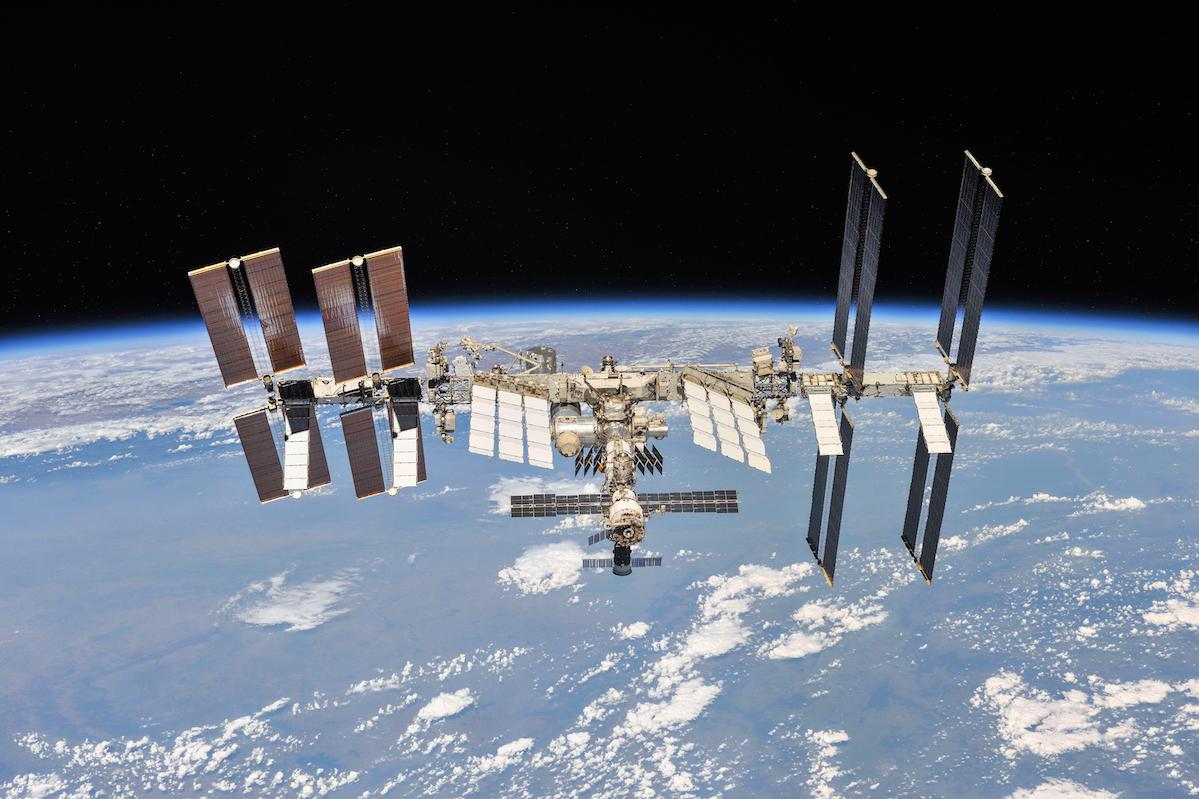
    Credit: NASA / Boeing

    Earlier this week, the International Space Station (ISS) was forced to maneouvre out of the way of a potential collision with space junk. With a crew of astronauts and cosmonauts on board, this required an urgent change of orbit on November 11.

    Over the station's 23-year orbital lifetime, there have been about 30 close encounters with  requiring evasive action. Three of these near-misses occurred in 2020. In May this year there was a hit: a tiny piece of  punched a 5mm hole in the ISS's Canadian-built robot arm.

    This week's incident involved a piece of debris from the defunct Fengyun-1C weather satellite, destroyed in 2007 by a Chinese anti-satellite missile test. The satellite exploded into more than 3,500 pieces of debris, most of which are still orbiting. Many have now fallen into the ISS's orbital region.

    To avoid the collision, a Russian Progress supply spacecraft docked to the station fired its rockets for just over six minutes. This changed the ISS's speed by 0.7 meters per second and raised its , already more than 400km high, by about 1.2km.

    Orbit is getting crowded

    Space debris has become a major concern for all satellites orbiting the Earth, not just the football-field-sized ISS. As well as notable satellites such as the smaller Chinese Tiangong space station and the Hubble Space Telescope, there are thousands of others.

    As the largest inhabited space station, the ISS is the most vulnerable target. It orbits at 7.66 kilometers a second, fast enough to travel from Perth to Brisbane in under eight minutes.

    A collision at that speed with even a small piece of debris could produce serious damage. What counts is the relative speed of the  and the junk, so some collisions could be slower while others could be faster and do even more damage.

    As low Earth orbit becomes increasingly crowded, there is more and more to run into. There are already almost 5,000 satellites currently operating, with many more on the way

    SpaceX alone will soon have more than 2,000 Starlink internet satellites in orbit, on its way to an initial goal of 12,000 and perhaps eventually 40,000.

    A chunk of Chinese satellite almost hit the International Space Station — the space junk problem is getting worse
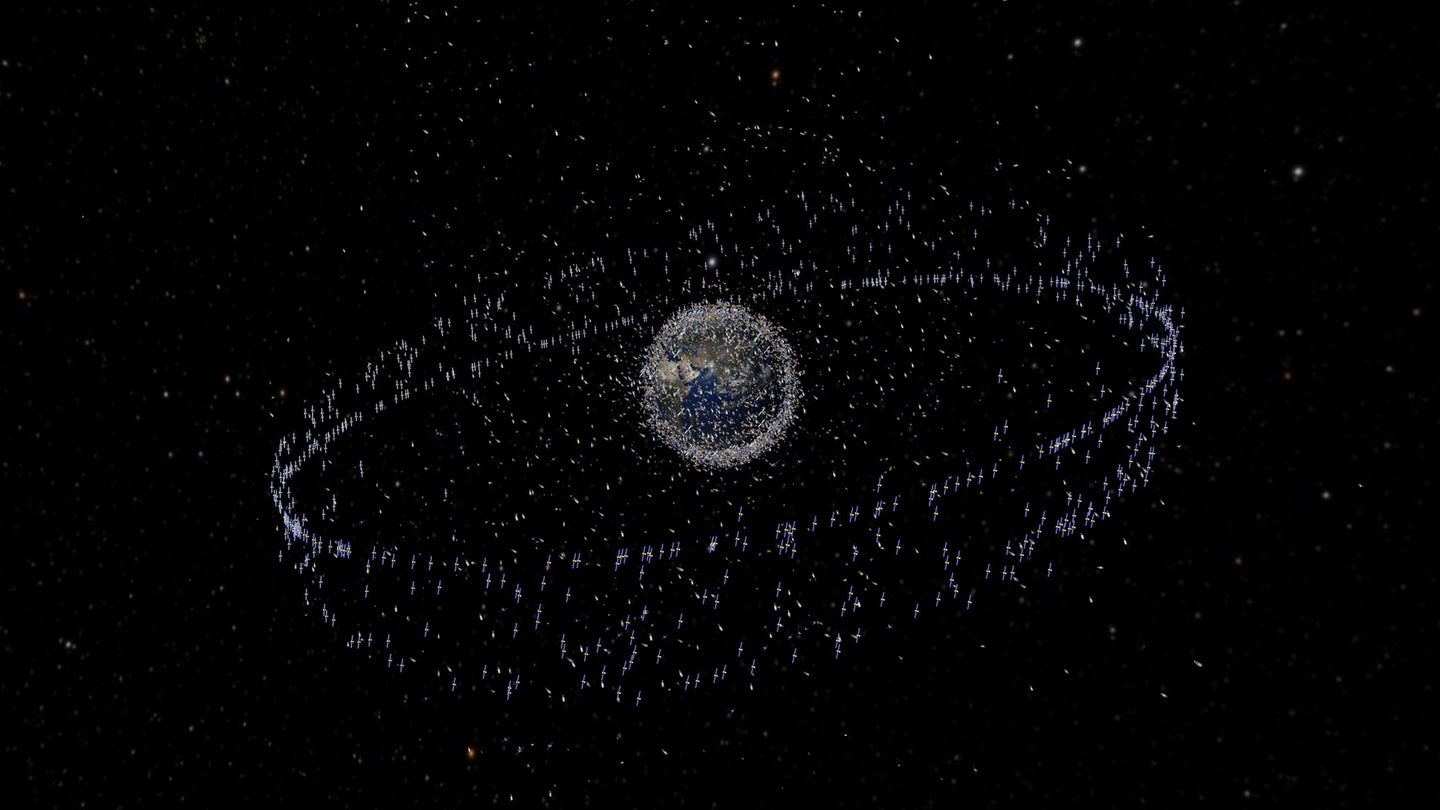
    The European Space Agency estimates there are around 36,500 objects larger than 10cm
     in orbit around Earth. Credit: ESA

    A rising tide of junk

    If it was only the satellites themselves in orbit, it might not be so bad. But according to the European Space Agency's Space Debris Office, there are estimated to be about 36,500 orbiting artificial objects larger than 10cm across, such as defunct satellites and rocket stages. There are also around a million between 1cm and 10cm, and 330 million measuring 1mm to 1cm.

    Most of these items are in low Earth orbit. Because of the  involved, even a speck of paint can pit an ISS window and a marble-sized object could penetrate a pressurized module.

    The ISS modules are somewhat protected by multi-layer shielding to lessen the probability of a puncture and depressurisation. But there remains a risk that such an event could occur before the ISS reaches the end of its lifetime around the end of the decade.

    Watching the skies

    Of course, no one has the technology to track every piece of , and we also don't possess the ability to eliminate all that junk. Nevertheless, possible methods for removing larger pieces from orbit are being investigated.

    Meanwhile, nearly 30,000 pieces larger than 10cm are being tracked by organizations around the world such as the US Space Surveillance Network.

    Here in Australia,  tracking is an area of increasing activity. Multiple organizations are involved, including the Australian Space AgencyElectro Optic Systems, the ANU Institute for Space, the Space Surveillance Radar System, the Industrial Sciences Group, and the Australian Institute for Machine Learning with funding from the SmartSat CRC. In addition, the German Aerospace Center (DLR) has a SMARTnet facility at the University of Southern Queensland's Mt Kent Observatory dedicated to monitoring geostationary orbit at a height of around 36,000km—the home of many communication satellites, including those used by Australia.

    One way or another, we will eventually have to clean up our  neighborhood if we want to continue to benefit from the nearest regions of the "final frontier."

    Space junk: Houston, we have a problem

    Provided by The Conversation 

    This article is republished from The Conversation under a Creative Commons license. Read the original article.The Conversation

    Tuesday, September 19, 2023

    Space junk in Earth orbit and on the moon will increase with future missions − but nobody's in charge of cleaning it up

    Chris Impey
    SPACE.COM

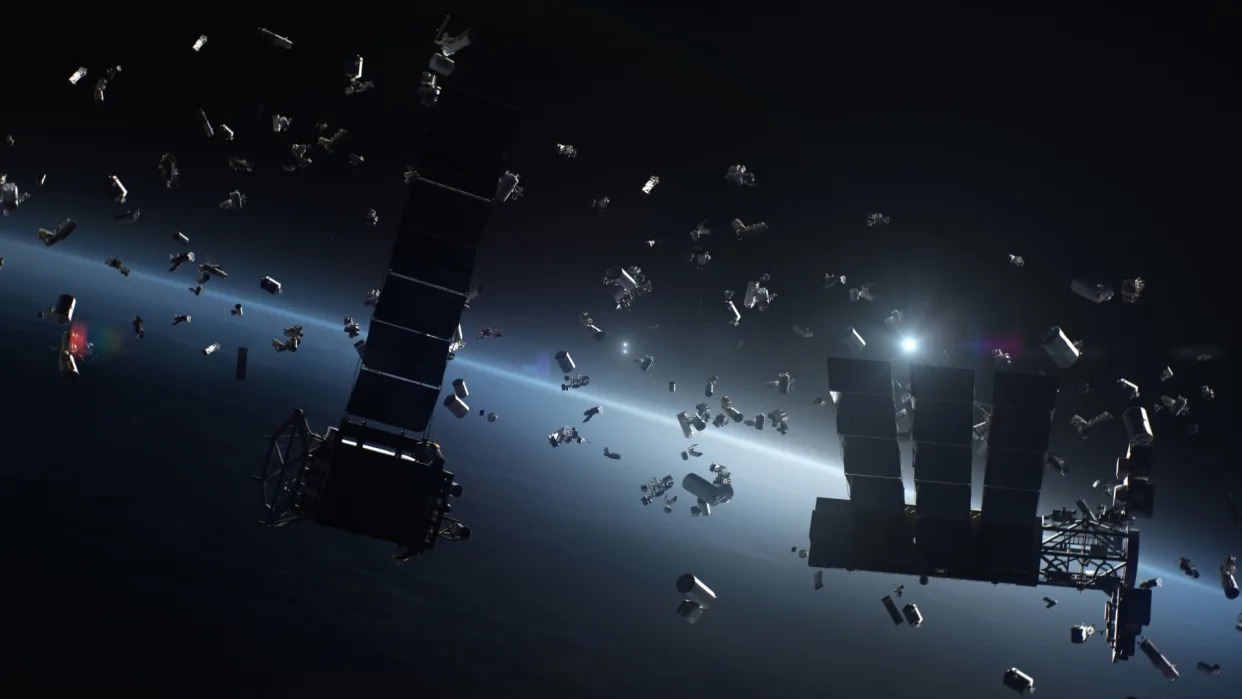
    An illustration of Earth orbit overcrowded with space junk and orbital debris.

    This article was originally published at The Conversation. The publication contributed the article to Space.com's Expert Voices: Op-Ed & Insights.

    Chris Impey is a University Distinguished Professor of Astronomy at the University of Arizona.


    There's a lot of trash on the moon right now – including nearly 100 bags of human waste – and with countries around the globe traveling to the moon, there's going to be a lot more, both on the lunar surface and in Earth's orbit.

    In August 2023, Russia's Luna-25 probe crashed into the moon's surface, while India's Chandrayann-3 mission successfully landed in the southern polar region, making India the fourth country to land on the moon.

    With more countries landing on the moon, people back on Earth will have to think about what happens to all the landers, waste and miscellaneous debris left on the lunar surface and in orbit.

    Related: Taking out the trash: Here's how private companies could be vital for space debris removal

    I'm a professor of astronomy who has written a book about the future of space travel, articles about our future off-Earth, conflict in space, space congestion and the ethics of space exploration. Like many other space experts, I'm concerned about the lack of governance around space debris.
    Space is getting crowded

    People think of space as vast and empty, but the near-Earth environment is starting to get crowded. As many as 100 lunar missions are planned over the next decade by governments and private companies like SpaceX and Blue Origin.

    Near-Earth orbit is even more congested than the space between Earth and the moon. It's from 100 to 500 miles straight up, compared with 240,000 miles to the moon. Currently there are nearly 7,700 satellites within a few hundred miles of the Earth. That number could grow to several hundred thousand by 2027. Many of these satellites will be used to deliver internet to developing countries or to monitor agriculture and climate on Earth. Companies like SpaceX have dramatically lowered launch costs, driving this wave of activity.

    "It's going to be like an interstate highway, at rush hour in a snowstorm, with everyone driving much too fast," space launch expert Johnathan McDowell told Space.com


    people celebrating

    The problem of space junk

    All this activity creates hazards and debris. Humans have left a lot of junk on the moon, including spacecraft remains like rocket boosters from over 50 crashed landings, nearly 100 bags of human waste and miscellaneous objects like a feather, golf balls and boots. It adds up to around 200 tons of our trash.

    Since no one owns the moon, no one is responsible for keeping it clean and tidy.

    The clutter in Earth's orbit includes defunct spacecraft, spent rocket boosters and items discarded by astronauts such as a glove, a wrench and a toothbrush. It also includes tiny pieces of debris like paint flecks.

    There are around 23,000 objects larger than 10 cm (4 inches) and about 100 million pieces of debris larger than 1 mm (0.04 inches). Tiny pieces of junk might not seem like a big issue, but that debris is moving at 15,000 mph (24,140 km/h), ten times faster than a bullet. At that speed, even a fleck of paint can puncture a spacesuit or destroy a sensitive piece of electronics.

    In 1978, NASA scientist Donald Kessler described a scenario where collisions between orbiting pieces of debris create more debris, and the amount of debris grows exponentially, potentially rendering near-Earth orbit unusable. Experts call this the "Kessler syndrome."

    Nobody is in charge up there

    The United Nations Outer Space Treaty of 1967 says that no country can "own" the moon or any part of it, and that celestial bodies should only be used for peaceful purposes. But the treaty is mute about companies and individuals, and it says nothing about how space resources can and can't be used.

    The United Nations Moon Agreement of 1979 held that the moon and its natural resources are the common heritage of humanity. However, the United States, Russia and China never signed it, and in 2016 the U.S. Congress created a law that unleashed the American commercial space industry with very few restrictions.

    Because of its lack of regulation, space junk is an example of a "tragedy of the commons," where many interests have access to a common resource, and it may become depleted and unusable to everyone, because no interest can stop another from overexploiting the resource.

    Scientists argue that to avoid a tragedy of the commons, the orbital space environment should be seen as a global commons worthy of protection by the United Nations. The lead author of a Nature article arguing for a global commons filed an amicus brief – a type of outside comment offering support or expertise – on a case that went to the U.S. Court of Appeals for the District of Columbia Circuit in late 2021.

    The author and his research collaborators argued that U.S. environmental regulations should apply to the licensing of space launches. However, the court declined to rule on the environmental issue because it said the group lacked standing.

    National geopolitical and commercial interests will likely take precedence over interplanetary conservation efforts unless the United Nations acts. A new treaty may emerge from the work of the U.N. Office for Outer Space Affairs, which in May 2023 generated a policy document to address the sustainable development of activities in space.

    Related Stories:

    2 big pieces of space junk nearly collide in orbital 'bad neighborhood'

    Clearspace-1 space debris cleanup target in orbit just got struck by space debris

    Private company wants to clean up space junk with 'capture bags' in Earth orbit

    The U.N. can regulate the activities of only its member states, but it has a project to help member states craft national-level policies that advance the goals of sustainable development.

    NASA has created and signed the Artemis Accords, broad but nonbinding principles for cooperating peacefully in space. They have been signed by 28 countries, but the list does not include China or Russia. Private companies are not party to the accords either, and some space entrepreneurs have deep pockets and big ambitions.

    The lack of regulation and the current gold rush approach to space exploration mean that space junk and waste will continue to accumulate, as will the related problems and dangers.

    This article is republished from The Conversation under a Creative Commons license. Read the original article.

    Follow all of the Expert Voices issues and debates — and become part of the discussion — on Facebook and Twitter. The views expressed are those of the author and do not necessarily reflect the views of the publisher.


    Wednesday, August 03, 2022

    AUG. 3, 2022

    SpaceX rocket debris lands in sheep paddock, Australian Space Agency confirms

    NOT THE CHINESE ROCKET
    A piece of space junk was found in a sheep paddock in the NSW Snowy Mountains.
    (ABC South East NSW: Adriane Reardon)

    The Australian Space Agency has confirmed debris found in the NSW Snowy Mountains belongs to SpaceX.

    Key points:Three pieces of debris have so far been located

    Snowy Mountains residents have been told more pieces could be found

    People are being told to contact a hotline if they do find more


    Three pieces of space junk have so far been found in the region, which are considered to be the biggest pieces found in Australia since 1979.

    Two pieces were inspected by technical experts from the Australian Space Agency and NSW Police on Saturday.

    Police have since confirmed they were also aware of the third piece being found in the region.

    This piece of space junk is estimated to be up to three metres long. 
    (ABC South East NSW: Adriane Reardon)

    Authorities believed the space debris belonged to SpaceX but had been awaiting confirmation.

    "The agency has confirmed the debris is from a SpaceX mission and continues to engage with our counterparts in the US, as well as other parts of the Commonwealth and local authorities as appropriate," an Australian Space Agency spokesperson said.

    "The agency is operating under the Australian Government Space Re-entry Debris Plan which outlines roles and responsibilities for key Australian government agencies and committees in supporting the response to space re-entry debris."

    This third piece of space junk was also found in the NSW Snowy Mountains, near Jindabyne.(Supplied: Nick Lodge)

    It comes after locals reported hearing a loud boom on July 9, which was considered to have been caused by the SpaceX Dragon spacecraft, which was launched in November 2020, re-entering Earth's atmosphere.

    Locals in the regions are being told that there's a possibility more pieces could still be found.

    "If the community spots any further suspected debris they should not attempt to handle it or retrieve it," the agency said.

    "They should contact the SpaceX Debris Hotline at 1-866-623-0234 or at recovery@spacex.com."

    So what happens now?

    While the space debris is expected to remain at the properties where they were found for now, the pieces could eventually be returned to US soil.

    Australian National University's Institute of Space deputy director Cassandra Steer said there was an obligation under international space law to repatriate any debris to the country from where it originated.

    Cassandra Steer is a space law lecturer and mission specialist at ANU's Institute of Space.(Supplied: ANU)

    "Any space object, or part thereof, has to be repatriated, and I'm sure that's what's going to happen in this case as well," she said.

    "Unless SpaceX says that it wants no part in the costs associated with it, and it would like to donate the debris to science, that's quite possible.

    "But it should be sent back to the US."

    Dr Steer said it was significant that there was confirmation the debris belonged to SpaceX.

    "We have clarity in terms of lines of responsibilities," she said.

    "The US is liable for any damage that is caused by this space debris ... and Australia could go to the US and seek some form of compensation if there are any costs involved in cleaning it up."
    Farmers Mick Miners and Jock Wallace, along with astrophysicist Brad Tucker, have visited where the first two pieces of junk were found.
    (ABC South East NSW: Adriane Reardon)

    But she was confident the situation would be resolved amicably.

    "Clearly this is not going to turn into a horrible diplomatic event; the US is one of our closest allies and partners," she said.

    "But there does need to be a government-to-government response in to how to deal with this.

    "Thankfully in this situation it doesn't look like there's huge, enormous damage so hopefully it can be sorted out very amicably and without any international diplomatic incident."

    SpaceX has been contacted for comment.

    Space junk has landed at two properties in the NSW Snowy Mountains.

    Thursday, November 11, 2021

    MORE STUFF IN SPACE
    The US Space Force Has Detected an Unknown Object Orbiting Near China's Satellite

    And it 'appears to be a deliberate synchronization'.


    By Brad Bergan Nov 10, 2021 

    China's Long March-3B vehicle rocketing to space.
    CCTV / YouTube

    China's satellite might have a companion.

    The U.S. Space Force has detected a mysterious object orbiting in parallel with China's new Shijian-21 spacecraft, according to an initial report from SpaceNews.

    And, since it might be moving under its own power, we're still not clear on what it is. But we have several theories about what it might be, from a new space junk device to the latest exhibition of space war tactics.
    China's space junk-cleaning satellite might have a companion

    China's Shijian-21 satellite was launched into space atop a Long March-3B rocket, back on Oct. 23. At the time, China's state-run news agency Xinhua said its spacecraft "entered the planned orbit successfully", and would "be mainly used to test and verify space debris mitigation technologies." There's not much to parse in this announcement with relevance to the newly-detected object, but China isn't usually very forthcoming about space endeavors. But on Nov. 3, the U.S. military began to monitor an unidentified object orbiting in parallel with Shijian-21, and the Space Force's 18th Space Control Squadron categorized the detection as an "apogee kick motor", dubbing it 2021-094C.

    An apogee kick motor is typically used to lift payloads into operational orbits, including geostationary orbits (GEO). When they're finished with them, satellites sometimes kick their apogee kick motors away, but this is "pretty rare", and "almost always done by launching to the GEO graveyard, ejecting the motor, and then lowering the payload into GEO proper," said Jonathan McDowell of the Harvard-Smithsonian Center for Astrophysics, in a Gizmodo report. Graveyard orbits are where the lion's share of space junk resides, where satellites go after they've outlived their usefulness. This is typically deliberate, so the risk of in-space collisions is reduced as the volume of blindingly fast bits of debris becomes more abundant in orbital space.

    Unknown object's motion 'appears to be a deliberate synchronization'


    GEO is a special case of orbital trajectories, where satellites assume an orbit that moves in synchrony with the geographical location on Earth below. This makes them appear to "stand still" to observers on the ground, despite how fast they are still moving through space. Satellites are typically installed in these comparatively high orbits to provide telecommunications or weather data for a specific region of Earth. But ejecting an object from a satellite in GEO "is a bad idea and very rare," added McDowell in the report, since this heightens the risk of a subsequent collision with other satellites and equipment in GEO or lower trajectories.

    However, nobody said it had to be an apogee kick motor, and the evidence suggests it's actually something else. As of writing, it's "currently unknown whether the object is an [apogee kick motor], an object possibly related to space debris mitigation tests, or part of potential counterspace operation tests," wrote SpaceNews in their report. "The object could be used to test rendezvous and proximity operations, refueling experiments or manipulation using a robotic arm or other means." Both Shijian-21 and 2021-094C are still orbiting the Earth roughly 50 miles (80 km) above nominal GEO, "which is well within the band" typically employed to relocate GEO satellites, added McDowell in the report. They're roughly 37 miles (60 km) apart, and this "appears to be a deliberate synchronization," said McDowell to Gizmodo, which doesn't fit the Space Force's apogee kick motor designation. "If you just ejected and said bye-bye, you'd expect a steadily increasing separation," he added. And after renewed interest in monitoring space war tactics amid rising tensions between China and the U.S., we can be certain that the superpowers of the world are monitoring this situation very closely.

    Space Station Will Make an Emergency Maneuver After Detection of Threatening Space Junk


    A fragment from a Chinese weather satellite will come to within 2,000 feet of the ISS, prompting the orbital relocation.

    By George Dvorsky

    The International Space Station as seen from Soyuz MS-18 spacecraft on 28 September 2021.Image: Roscosmos

    An impromptu “space debris evasion maneuver” has been scheduled to prevent errant space junk from slamming into the International Space Station, in what is becoming an increasingly routine procedure.

    Preliminary calculations suggest the space junk will come to within 1,970 feet (600 meters) of the International Space Station on Thursday, November 11 at approximately 8:00 p.m. ET (Friday, November 12 at 4:00 a.m. Moscow time), according to Russian space agency Roscosmos. That’s too close for comfort, requiring the ISS to be positioned farther away from the danger zone. The maneuver is scheduled for Wednesday at 3:15 p.m. ET (11:15 p.m. Moscow time).

    “The impact probability and risk to the International Space Station is very low,” a spokesperson from NASA explained in an email, adding that “the maneuver is a standard space station maneuver and does not require the crew to take any specific action.”

    The sudden need to relocate the ISS is not expected to affect the launch of Crew-3, which blasts off later today from Kennedy Space Center in Florida, as NASA officials noted yesterday during the pre-flight news conference.

    The offending chunk of junk is a remnant of the Fengyun-1C spacecraft. China deliberately destroyed its own weather satellite in January 2007 as part of an anti-satellite missile test. The event prompted howls of outrage, as experts criticized China for contributing to the militarization of space and for deliberately producing a dangerous cloud of orbital debris. A fictional version of this event was portrayed in the 2013 film Gravity, in which a rapidly expanding cloud of debris, accidentally caused by Russia shooting down a defunct spy satellite, destroyed the ISS.

    To keep that story rooted in fiction, flight controllers plan to move the ISS by igniting the engines of Russia’s Progress MS-18 transport vehicle, currently docked to the station. The chosen impulse strength will move the space station at a rate of 2.3 feet per second (0.7 meters per second) for six minutes, according to Roscosmos. The maneuver will increase the space station’s altitude by 4,068 feet (1,240 meters), placing it in an operational orbit some 262 miles (421 km) above Earth.

    The ISS has performed 29 avoidance maneuvers over the past 22 years, including three in 2020. The most recent happened on September 22, 2020, when space junk belonging to a Japanese rocket stage threatened to pass within 0.86 miles (1.39 kilometers) of the orbital outpost.

    It’s an upward trend that’s likely to get worse over time, as satellites increasingly enter low Earth orbit and as the volume of orbital debris likewise increases—and as we continue to drag our collective feet and neglect to do anything meaningful, such as limiting the objects allowed in space or funding the development of satellites capable of cleaning up our orbital mess.

    Correction: A previous version of this post incorrectly identified the Progress MS-18 as a Soyuz MS-18.

    More: Space Force detects mystery object in orbit alongside Chinese satellite.


    WHO YA GONNA CALL?