Nora Barrows-Friedman
6 March 2026
ELECTRONIC INTAFADA
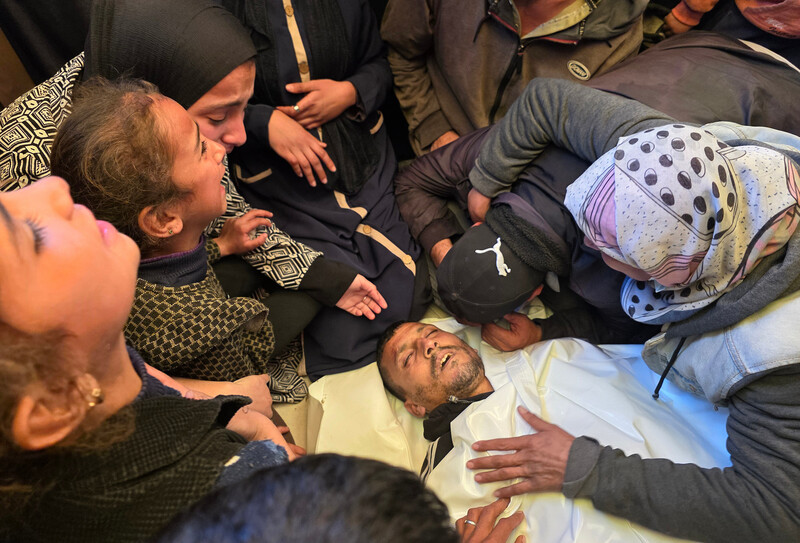
Palestinians mourn over Montaser Samour, who was killed in an Israeli attack on the town of Bani Suheila, east of Khan Younis, on 4 March. Tariq MohammadAPA images
The following is from the news roundup during the 5 March livestream. Watch the entire episode here.
Israeli forces continued to violate the fraudulent ceasefire in Gaza this week, killing Palestinians and reimposing a total closure of the crossings to humanitarian aid, food, fuel and medicine.
In the town of Bani Suheila near Khan Younis on Wednesday, Israeli soldiers shot and killed two Palestinians, Montaser Samour and Maher Samour. According to local news sources, an Israeli military unit abducted the two men and took them across the so-called yellow line, detained them, and shot them.
Reporter Tamer Qeshta captured video footage and eyewitness testimony from residents who said that the Israeli army returned Montaser Samour’s body riddled with bullets, while Maher Samour was shot and killed in what witnesses described as a field execution.
The news agency Anadolu reported that earlier in the day, heavy gunfire from Israeli military vehicles stationed east of the so-called yellow line was reported in those areas near Khan Younis, and that Israeli artillery also targeted neighborhoods east of Gaza City while Israeli gunboats fired toward the coastline.
Last week – early on 27 February – Israeli warplanes targeted a Palestinian police checkpoint at the entrance to the Bureij refugee camp in central Gaza, killing at least one police officer and injuring another, according to the Palestinian interior and national security ministry.
The health ministry in Gaza reported on 4 March that since the so-called ceasefire went into effect nearly five months ago, at least 633 Palestinians have been killed and more than 1,700 have been injured.
In the same time period, the health ministry stated that more than 750 bodies of Palestinians have been recovered from underneath the rubble after more than two years of genocide.
The civil defense corps in northern Gaza stated this week that they had finished a nine-day operation that they called the Dignity of Martyrs campaign, in which they recovered 93 bodies of Palestinians killed in Israeli airstrikes and buried beneath collapsed homes.
In the absence of heavy equipment and fuel to operate machinery, which continue to be blocked by the Israelis, the civil defense workers used their hands and simple tools to retrieve the human remains. The civil defense said that more than 500 bodies remain under the rubble, denying surviving family members the dignity of properly burying their loved ones.
Civil defense worker Mohammad Abu Loay filmed himself and his colleagues working tirelessly in the mountains of rubble, and said that they are working to renew the campaign in order to retrieve all of the bodies in the area.
Crossings closed
In the immediate aftermath of the US-Israeli attacks on Iran that began over the weekend, the Israeli government and military closed all of the crossings into and out of Gaza, further exacerbating the humanitarian and infrastructure crisis.
On Tuesday, the Kerem Shalom crossing in the south of Gaza was partially opened, but all other crossings have remained closed, including the Rafah crossing at the Egyptian border which had been partially reopened since early February and was used for people returning to Gaza and medical evacuations from Gaza.
In addition, according to the Tel Aviv newspaper Haaretz, the Allenby crossing between Jordan and the West Bank has likewise been closed to goods and humanitarian aid following a decision by the Israel Airports Authority, which oversees the crossing.
Writing in the Los Angeles Times this week, Amed Khan of the eponymous humanitarian aid organization the Amed Khan Foundation stated, “For more than five months, 15,000 boxes of children’s cold medicine and other vital medicines meant for kids in the Gaza Strip have been sitting in a warehouse, awaiting approval from Israeli authorities that never seems to come.”
“To Israeli officials, the cold medicine I am trying to deliver is a potential weapon,” he adds.
“Israeli officials fear that Hamas will steal the bottles and transform the small amounts of glycerin in the medicine to make explosives, despite there being no evidence that armed groups in Gaza have done or could do this. Israel has refused to clarify what percentage of glycerin would be allowed, so we can’t even source an alternative that would be assured of clearance. The medicine remains in a warehouse while children in Gaza continue to die because they can’t get basic treatments.”
Meanwhile, the United Nations humanitarian office stated that between the October 2025 so-called ceasefire and mid-February, “an additional 853 people have reportedly acquired new disabilities. This includes 496 new amputations, 186 spinal cord injuries and 171 traumatic brain injuries.”
The UN added that despite rising needs, assistive products – including prosthetics – continue to be classified by the Israeli authorities as “dual use” items, which severely restricts their entry into the Gaza Strip.
During this period, the UN stated, “only 300 artificial limbs were allowed to enter Gaza under the Health Cluster framework, while the cumulative number of amputations since October 2023 now exceeds 5,000, in addition to the 496 new amputations recorded since the ceasefire.”
Shelter materials are also being heavily restricted by Israel. According to the UN spokesperson Stephane Dujarric on Wednesday, if the rainy season continues, hundreds of thousands of people whose homes have been destroyed remain at risk of flooding in their dilapidated tents.
Dujarric said that eight temporary relocation sites have been established in Gaza, but critical materials remain out of reach.
“We and our partners still do not have the tools and the materials to make shelters that are longer lasting,” he said, noting that “the entry of these supplies continues to be heavily restricted, and they’re difficult to find on the local markets.”
Such supplies, Dujarric added, “include toolkits, timber and cement to repair homes, and heavy machinery to clear rubble and to make more space for dignified housing.”
The following is from the news roundup during the 5 March livestream. Watch the entire episode here.
Israeli forces continued to violate the fraudulent ceasefire in Gaza this week, killing Palestinians and reimposing a total closure of the crossings to humanitarian aid, food, fuel and medicine.
In the town of Bani Suheila near Khan Younis on Wednesday, Israeli soldiers shot and killed two Palestinians, Montaser Samour and Maher Samour. According to local news sources, an Israeli military unit abducted the two men and took them across the so-called yellow line, detained them, and shot them.
Reporter Tamer Qeshta captured video footage and eyewitness testimony from residents who said that the Israeli army returned Montaser Samour’s body riddled with bullets, while Maher Samour was shot and killed in what witnesses described as a field execution.
The news agency Anadolu reported that earlier in the day, heavy gunfire from Israeli military vehicles stationed east of the so-called yellow line was reported in those areas near Khan Younis, and that Israeli artillery also targeted neighborhoods east of Gaza City while Israeli gunboats fired toward the coastline.
Last week – early on 27 February – Israeli warplanes targeted a Palestinian police checkpoint at the entrance to the Bureij refugee camp in central Gaza, killing at least one police officer and injuring another, according to the Palestinian interior and national security ministry.
The health ministry in Gaza reported on 4 March that since the so-called ceasefire went into effect nearly five months ago, at least 633 Palestinians have been killed and more than 1,700 have been injured.
In the same time period, the health ministry stated that more than 750 bodies of Palestinians have been recovered from underneath the rubble after more than two years of genocide.
The civil defense corps in northern Gaza stated this week that they had finished a nine-day operation that they called the Dignity of Martyrs campaign, in which they recovered 93 bodies of Palestinians killed in Israeli airstrikes and buried beneath collapsed homes.
In the absence of heavy equipment and fuel to operate machinery, which continue to be blocked by the Israelis, the civil defense workers used their hands and simple tools to retrieve the human remains. The civil defense said that more than 500 bodies remain under the rubble, denying surviving family members the dignity of properly burying their loved ones.
Civil defense worker Mohammad Abu Loay filmed himself and his colleagues working tirelessly in the mountains of rubble, and said that they are working to renew the campaign in order to retrieve all of the bodies in the area.
Crossings closed
In the immediate aftermath of the US-Israeli attacks on Iran that began over the weekend, the Israeli government and military closed all of the crossings into and out of Gaza, further exacerbating the humanitarian and infrastructure crisis.
On Tuesday, the Kerem Shalom crossing in the south of Gaza was partially opened, but all other crossings have remained closed, including the Rafah crossing at the Egyptian border which had been partially reopened since early February and was used for people returning to Gaza and medical evacuations from Gaza.
In addition, according to the Tel Aviv newspaper Haaretz, the Allenby crossing between Jordan and the West Bank has likewise been closed to goods and humanitarian aid following a decision by the Israel Airports Authority, which oversees the crossing.
Writing in the Los Angeles Times this week, Amed Khan of the eponymous humanitarian aid organization the Amed Khan Foundation stated, “For more than five months, 15,000 boxes of children’s cold medicine and other vital medicines meant for kids in the Gaza Strip have been sitting in a warehouse, awaiting approval from Israeli authorities that never seems to come.”
“To Israeli officials, the cold medicine I am trying to deliver is a potential weapon,” he adds.
“Israeli officials fear that Hamas will steal the bottles and transform the small amounts of glycerin in the medicine to make explosives, despite there being no evidence that armed groups in Gaza have done or could do this. Israel has refused to clarify what percentage of glycerin would be allowed, so we can’t even source an alternative that would be assured of clearance. The medicine remains in a warehouse while children in Gaza continue to die because they can’t get basic treatments.”
Meanwhile, the United Nations humanitarian office stated that between the October 2025 so-called ceasefire and mid-February, “an additional 853 people have reportedly acquired new disabilities. This includes 496 new amputations, 186 spinal cord injuries and 171 traumatic brain injuries.”
The UN added that despite rising needs, assistive products – including prosthetics – continue to be classified by the Israeli authorities as “dual use” items, which severely restricts their entry into the Gaza Strip.
During this period, the UN stated, “only 300 artificial limbs were allowed to enter Gaza under the Health Cluster framework, while the cumulative number of amputations since October 2023 now exceeds 5,000, in addition to the 496 new amputations recorded since the ceasefire.”
Shelter materials are also being heavily restricted by Israel. According to the UN spokesperson Stephane Dujarric on Wednesday, if the rainy season continues, hundreds of thousands of people whose homes have been destroyed remain at risk of flooding in their dilapidated tents.
Dujarric said that eight temporary relocation sites have been established in Gaza, but critical materials remain out of reach.
“We and our partners still do not have the tools and the materials to make shelters that are longer lasting,” he said, noting that “the entry of these supplies continues to be heavily restricted, and they’re difficult to find on the local markets.”
Such supplies, Dujarric added, “include toolkits, timber and cement to repair homes, and heavy machinery to clear rubble and to make more space for dignified housing.”
Two men killed in West Bank
Turning to the occupied West Bank, dozens of Israeli settlers attacked the village of Qaryut, near Nablus in the north, on Tuesday.
One of the attacking settlers is a reservist soldier who shot and killed two Palestinian men. Muhammad Taha Muammar was shot in the head and his brother Fahim Taha Muammar was shot in his lower body.
Eyewitnesses reported that armed settlers carrying rifles and iron bars stormed homes in the southern part of the village and opened fire on residents. At least three other people were injured in the attack, according to Middle East Monitor, including a 30-year-old man with a shoulder wound, a 32-year-old man with a knee injury, and a 15-year-old boy who sustained a gunshot wound to the shoulder.
Also on Tuesday, Israeli forces opened fire on a Palestinian man and a child in the Askar refugee camp east of Nablus, on the second consecutive day of invasions and raids by the army.
The Palestine Red Crescent Society reported that its teams treated a 20-year-old young man who was shot in the foot with live bullets, and an 11-year-old child who was shot in the hand.
The army conducted home raids and subjected residents to interrogations, the local Wafa news agency reported.
On Wednesday, Wafa reported that Israeli soldiers shot and injured five Palestinians in Jenin during an invasion in the central part of the city. A medical source at Al-Razi Hospital in Jenin told the news agency that among the injured was a young man who was shot in the back, with the bullet exiting through his chest, leaving him in critical condition.
And in Jerusalem, Israeli occupation authorities closed the Al-Aqsa Mosque compound since the US and Israel launched attacks on Iran, preventing worshippers from entering the mosque and the surrounding courtyards during Ramadan.
Israeli forces have imposed an almost-complete closure of the occupied West Bank since Saturday’s attacks on Iran, locking barriers and gates and closing all checkpoints “until further notice,” as COGAT, the Israeli military’s bureaucratic wing, said on 28 February.
Highlighting reclamation
Finally, as we always do, we wanted to highlight people expressing joy, determination and reclamation across Palestine and around the world.
In Gaza, the paracycling team and mutual aid organization Gaza Sunbirds rehabilitated an area in the Bureij refugee camp in central Gaza to build a volleyball court for the children.
“Fifty two percent of our land is now occupied, We’re here at the yellow line in Bureij camp claiming our streets through sports and tradition! This volleyball court is one of many activities we have planned to bring sports to every corner of the Strip. Ramadan Kareem to you all from Gaza,” the Sunbirds say.
Palestinian man killed in West Bank amid escalating Israeli settler attacks
A young Palestinian man was killed and his brother seriously injured after extremist settlers opened fire in the Masafer Yatta area
The New Arab Staff
07 March, 2026
A young Palestinian man was killed and his brother seriously wounded by settler gunfire on Saturday evening as Israeli settler extremists continue to target residents in the occupied West Bank.
The incident occurred after settlers released their livestock on land owned by the residents of the Al-Rakhim area of Masafer Yatta, south of Hebron, activist Osama Makhmara told The New Arab's sister site Al Araby Al Jadeed.
They then opened fire at the two brothers, Amir and Khaled Mohammad Hussein Shanaran, leaving both seriously injured, he said. The Palestinian health ministry later said that Amir died of his injuries.
Meanwhile, Palestinian families began leaving their homes in the village of Al-Aqaba east of Tubas in the northern West Bank on Saturday amid escalating settler attacks in the Jordan Valley.
Hassan Mleihat, the general supervisor of the Al-Baidar human rights organisation, told Al-Araby Al Jadeed that six Palestinian families had packed their belongings and begun leaving the area as a result of the attacks.
Mleihat said that settlers had attacked shepherds in the village on Friday and stole sheep from them.
The departure of families comes a day after 13 other Palestinian families from the Bedouin community of Al-Shakara, east of the town of Duma south of Nablus, were forced to leave their homes under escalating attacks by settlers.
Settler violence against Palestinians in the West Bank has surged since Israel launched its war on Gaza in October 2023.
More than 800 Palestinians have been displaced due to settler attacks this year alone, according to UN data.
Night-time raids by masked settlers have become a common intimidation tactic as the Israeli far-right looks to deepen its control over the territory.
At least 86 instances of settler violence were documented by the UN between 3-16 February, leading to the displacement of 146 Palestinians and the injury of 64.
A young Palestinian man was killed and his brother seriously injured after extremist settlers opened fire in the Masafer Yatta area
The New Arab Staff
07 March, 2026
A young Palestinian man was killed and his brother seriously wounded by settler gunfire on Saturday evening as Israeli settler extremists continue to target residents in the occupied West Bank.
The incident occurred after settlers released their livestock on land owned by the residents of the Al-Rakhim area of Masafer Yatta, south of Hebron, activist Osama Makhmara told The New Arab's sister site Al Araby Al Jadeed.
They then opened fire at the two brothers, Amir and Khaled Mohammad Hussein Shanaran, leaving both seriously injured, he said. The Palestinian health ministry later said that Amir died of his injuries.
Meanwhile, Palestinian families began leaving their homes in the village of Al-Aqaba east of Tubas in the northern West Bank on Saturday amid escalating settler attacks in the Jordan Valley.
Hassan Mleihat, the general supervisor of the Al-Baidar human rights organisation, told Al-Araby Al Jadeed that six Palestinian families had packed their belongings and begun leaving the area as a result of the attacks.
Mleihat said that settlers had attacked shepherds in the village on Friday and stole sheep from them.
The departure of families comes a day after 13 other Palestinian families from the Bedouin community of Al-Shakara, east of the town of Duma south of Nablus, were forced to leave their homes under escalating attacks by settlers.
Settler violence against Palestinians in the West Bank has surged since Israel launched its war on Gaza in October 2023.
More than 800 Palestinians have been displaced due to settler attacks this year alone, according to UN data.
Night-time raids by masked settlers have become a common intimidation tactic as the Israeli far-right looks to deepen its control over the territory.
At least 86 instances of settler violence were documented by the UN between 3-16 February, leading to the displacement of 146 Palestinians and the injury of 64.

No comments:
Post a Comment