Michael F. Brown
ELECTRONIC INTAFADA
6 March 2026
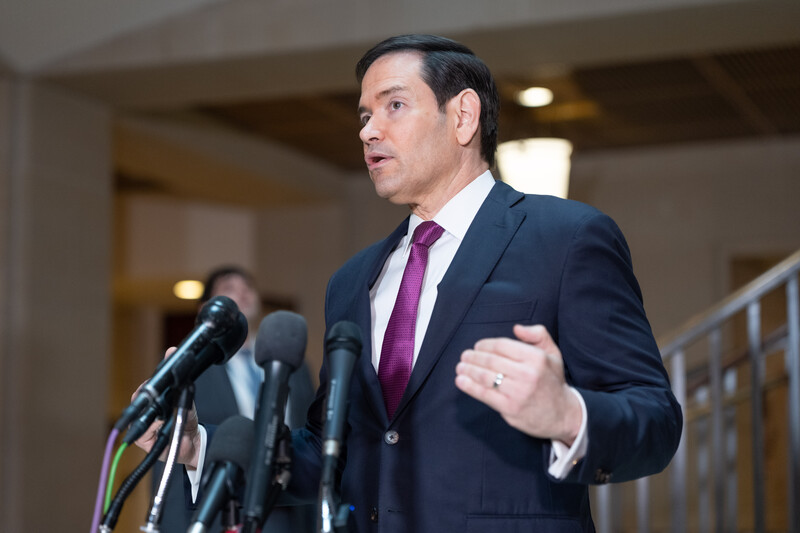
Secretary of State Marco Rubio addressed journalists about the US-Israeli war against Iran, 2 March. Aaron SchwartzSIPA USA
Did Israeli Prime Minister Benjamin Netanyahu drag President Donald Trump and the United States into an unpopular war with Iran on behalf of the historically unpopular actions of his country, following more than two years of genocide in Gaza and decades of apartheid between the Jordan River and the Mediterranean Sea?
On Sunday, Netanyahu, who faces a warrant for his arrest from the International Criminal Court for crimes against humanity, said of the war with Iran: “We are also bringing to this campaign the assistance of the United States, my friend, US President Donald Trump, and the US military. This coalition of forces allows us to do what I have yearned to do for 40 years: Smite the terror regime hip and thigh. This is what I promised – and this is what we shall do.”
He seems to be boasting to his constituents, I delivered the Americans. This sounds very much like a man who hopes to win yet another election having burnished his credentials on occupation, war crimes and genocide.
The very next day, Monday, Secretary of State Marco Rubio cited Israel’s actions as pushing the US to war with Iran.
According to Rubio, “We knew that there was going to be an Israeli action, we knew that that would precipitate an attack against American forces, and we knew that if we didn’t preemptively go after them before they launched those attacks, we would suffer higher casualties.”
CNN’s Anderson Cooper played a different relevant clip from Rubio for New York Times columnist Thomas Friedman and CNN’s Fareed Zakaria later on Monday.
“There absolutely was an imminent threat,” said Rubio. “And the imminent threat was that we knew that if Iran was attacked, and we believe[d] they would be attacked, that they would immediately come after us. And we were not going to sit there and absorb a blow before we responded. Because the Department of War assessed that if we did that, if we waited for them to hit us first after they were attacked, and by someone else, Israel attacked them, they hit us first, and we waited for them to hit us, we would suffer more casualties and more deaths.”
Friedman described the comment as “chilling,” but seemed reluctant to grapple with the suggestion Israel pushed the US into war.
“I can’t even repeat the logic of what he was saying. I mean, if Iran was attacked, I assume by Israel, and then it launched missiles, what, against the continental United States? I mean, that’s a guy looking for an ex post facto rationale. And that’s chilling.”
Zakaria was even more hesitant to grapple with the substance of Rubio’s assertion, declaring it to be anti-Semitic.
“Honestly, it gives credence to the worst kind of anti-Semitic tropes, which say that Israel has gotten us into this war, that we ended up being dragged into this.”
But this is a form of anti-Semitism from Zakaria. Nobody credible is saying that the Jewish people dragged the US into war.
The question is whether the prime minister of Israel – a country which does not represent all Jews – dragged the US toward war. Rubio should not be accused of anti-Semitism for indicating Israel pushed the US into war with Iran if that’s how Netanyahu’s role appeared to him, before he walked it back following an outcry that put the White House on the defensive.
What Rubio can be accused of is delivering a very unclear message.
Later in his remarks, Rubio indicated that the US would have gone to war eventually anyway, though that suggests a total lack of confidence in his own diplomatic skills. And the very next afternoon he was emphatic in denying he said what he said, claiming it was “false” and a misrepresentative clip. “Did we go in because of Israel? … I said, no, I told you this had to happen anyway,” he told journalists was what he intended to convey the previous day.
Yet Republican Mike Johnson of Louisiana, speaker of the House of Representatives, had used very similar language to Rubio’s initial wording in describing why the US had gone to war with Iran. “If Israel fired upon Iran and took action against Iran to take out the missiles, then they [the Iranians] would have immediately retaliated against US personnel and assets.”
During his clean-up press conference on Tuesday, Rubio was clearly trying to catch up with Trump who earlier in the day had tried to alter Rubio’s narrative by insisting, “If anything, I might’ve forced Israel’s hand.”
The president’s walkback of Rubio’s comment is unsurprising. Trump is concerned he might look weak before those MAGA supporters dismayed and furious at his reversal of a repeated campaign pledge not to start new wars.
Incoherence and cautious Democratic criticism
The Trump administration since Saturday has ricocheted wildly in laying out different war-time goals. As Washington Post journalist Josh Rogin said on CNN Monday night, Trump “said we want regime change, we don’t want regime change. He said we know the people that were going to replace the ayatollah, then he said, we killed the people who are going to replace the ayatollah, so we don’t know them. He said, we want the people of Iran to rise up and free themselves and fight the regime, and then he said, we’re happy to work with the regime remnants, if somebody emerges.”
Democratic Senator Mark Warner, the top Democrat on the Intelligence Committee, speaking Tuesday on the PBS News Hour, appeared exhausted and conveyed frustration that the Trump administration had provided four shifting reasons for launching the “war of choice”: Iran’s nuclear capability, the threat of ballistic missiles, the determination to destroy the Iranian navy and regime change.
Karoline Leavitt, the White House press secretary, on Wednesday didn’t present regime change as a reason for the war, but otherwise did note the same goals attributed to the administration by Warner. However, she also cited the additional goal of stopping what she called “the [Iranian] regime’s terrorist proxies in the region.” Her comment ignored the reality that armed resistance groups supported by Iran actually have their own independent goals of fighting Israeli occupation and war crimes.
She denied knowledge of any US involvement in the massacre of scores of Iranian schoolgirls at the outset of the US-Israeli war of aggression, stating instead that an investigation is underway and seeming to indirectly hint at the possibility of Iranian responsibility. She said nothing about possible Israeli involvement.
Asked explicitly in a follow-up question about the possibility of Israeli responsibility for the schoolgirls’ deaths, Leavitt again said nothing about Israel, only reiterating an investigation by the Department of War is taking place.
CNN’s Erin Burnett on Wednesday evening stated it was the US military that had been attacking – “working” was her euphemism – the south of Iran and therefore more likely culpable for that deadly school incident than Israel. Her guest, Ophir Falk, foreign policy adviser to Netanyahu, claimed, “I can tell you 100 percent, 100 percent sure that the American military did not intentionally kill civilians. I can tell you that for 100 percent.”
Seeking to exonerate Israel’s US ally and cast doubt on previous Israeli war crimes in Gaza, Falk added, “from what I understand, those were Iranian missiles that misfired and there’s like about 30 percent of those missiles [that] are misfiring. So that’s not something strange. We saw that a number of times in Gaza,” attributing misfires there to Hamas.
He, too, referred to Hamas as a “proxy” rather than an autonomous group fighting occupation, apartheid and genocide from the tiny strip of land to which over 2 million Palestinians are confined due to the ethnic cleansing carried out by Zionist militias and the Israeli army in 1948.
The US military is certainly slow-walking its investigation of the massacre which occurred on Saturday – even as compelling evidence has emerged indicating US military culpability.
Burnett did not respond to The Electronic Intifada as to whether she would cover the new reports indicating that Falk’s claim about culpability was incorrect. Other journalists at CNN did report on the matter.
Rubio’s remarks parsed
Secretary of State Rubio’s remarks suggesting Israel dragged the US to war in Iran continued to receive intense focus as the week progressed.
Professor John Mearsheimer, co-author of The Israel Lobby and US Foreign Policy, asserted in an email this week describing one of his speaking engagements that “the Trump administration was dragged into this war by Israel and its enormously powerful lobby in the US … It is clear from listening to and reading the discourse on the internet that many Americans understand that this is another war for Israel. Iran was no threat to the US and there was no reason for Trump to attack it.”
Israel lobby group AIPAC was keen to see action taken against Iran before the war even began on 28 February with the assassination of Ayatollah Ali Khamenei. On Saturday, the group praised the joint attack, calling it “decisive action against the terror-supporting regime in Iran.”
Senator Warner also denied that there had been any showing that Iran posed an imminent threat to the United States in the briefings he had attended. Trump has been widely criticized for saying he acted on the “feeling” that Iran was preparing to attack the US first.
Warner stressed that “this is a war of choice brought by Donald Trump.”
Crucially, he added, “In many ways, and I say this as a strong supporter of Israel, the timing of this war was dictated by Bibi Netanyahu. And while I support Israel, I think at the end of the day, when American interests were at stake, when we’ve lost six soldiers at this point, we have to show the direct immediate risks to America. That was not the case.”
Other Democrats also spoke out against Trump’s failure to stand up to Israel.
Democrats were not the only ones speaking out against Trump. Conservative MAGA supporters – past and present – expressed enormous frustration throughout the week, indicating that this was not what they signed up for when voting for Trump.
Republican Congressman Thomas Massie of Kentucky, a target of Trump’s ire due to his efforts to get the Epstein files released, also expressed his opposition. He cosponsored with Congressman Ro Khanna of California a War Powers Act resolution – defeated Thursday with four Democrats crossing party lines – which would have required Trump to go to Congress for authorization of his war with Iran.
What happened to Trump?
I am inclined to believe Rubio and Johnson when in an honest moment they pointed to Israel as having pushed the US into this. But it’s also the case that Trump has previously shown himself willing to stand up to Netanyahu on Gaza, any further Israeli assassination attempts in Qatar and a plan to assassinate Ayatollah Ali Khamenei last year.
What’s changed? Trump, after all, has agency.
Presumably he’s not any more susceptible to pressure from Netanyahu than he was during his first term.
Unsurprisingly, Netanyahu and his ambassador to the US, Yechiel Leiter, both rejected the notion that Israel pushed Trump into war.
Leiter called the claim that Israel “dragged” the US into the war “poppycock” and “nonsense.” Netanyahu termed it “ridiculous.”
Such responses were obviously going to happen.
What seems plausible is that Trump became enthralled by the might of the US military following the quick high of the Venezuela invasion. Trump, seeing this success, became more inclined to accept the arguments of Netanyahu – surely not new to him – that the US military, in conjunction with Israel’s military, could bring a great victory to him in Iran.
Trump’s hubris, newfound infatuation with military “solutions,” belligerent immaturity, lack of historical understanding and his colonial mindset – he wants to help pick a new Iranian leader – all led him to break with his previous self. For all his faults, and they’re legion, Trump had seemed to comprehend that a new war in the Middle East was extremely ill advised as previous ones had been fraught, deadly and enormously expensive.
Today, that all lies in tatters.
More than 1,000 Iranians have since been killed along with six members of the US military. Trump, at this point, seems well on the path to tearing Iran apart and leaving behind a destroyed state. The wider region is also in peril as are numerous economies.
The good sense of Trump’s “no new wars” pledge has been replaced by the bellicose leader many feared was very much inside of Trump all along. That killer instinct won out over a degree of military caution and his fixation on extractive economic growth, particularly for the most wealthy.
Joe Biden’s Democrats buoyed the genocide in Gaza. Now Trump’s Republicans are boosting a war of aggression and war crimes in Iran.
American voters sick of war and the misery it brings to them – and to people around the world – have limited voting options with major parties such as these.
Played?
Democratic voters are pushing presidential candidates on Palestinian rights, but would be wise to consider if they’re being played – as Trump did with his less bellicose supporters – by the likes of California Governor Gavin Newsom who, following the US-Israeli attack on Iran, has rightly questioned US military support for Israel and raised the reality of Israeli apartheid.
After all, just weeks ago Newsom agreed with anti-Palestinian commentator Ben Shapiro that there has been no genocide in Gaza.
The effort to hold Democrats accountable ahead of the 2026 midterms and in the 2028 presidential election remains an uncertain, but crucial undertaking.
The effort to hold Democrats accountable ahead of the 2026 midterms and in the 2028 presidential election remains an uncertain, but crucial undertaking.

No comments:
Post a Comment