$1 Billion Daily Cost of Trump’s Iran War Could Fund Food Aid, Healthcare for Tens of Millions
“Medicare for All, or endless foreign wars?” asked Democratic US Senate candidate Graham Platner. “Anyone in the House or Senate giving the wrong answer should lose their seat.”
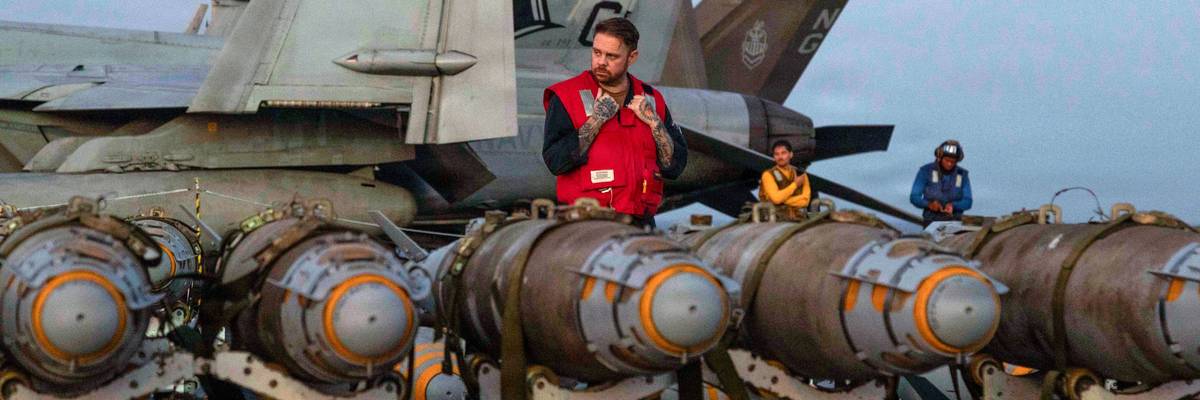
US sailors transfer ordnance on the flight deck of the Nimitz-class aircraft carrier USS Abraham Lincoln on February 27, 2026 in the Arabian Sea.
(Photo: US Central Command via Getty Images)
Jake Johnson
Mar 06, 2026
COMMON DREAMS
The daily price tag of US President Donald Trump’s illegal war on Iran would be enough to cover the daily costs of federal nutrition assistance for more than 40 million Americans, as well as daily Medicaid costs for the roughly 16 million people expected to lose health coverage due to the Republican budget package that Trump signed into law last year.
That’s according to an analysis published Thursday by the National Priorities Project (NPP), which noted that—on an annual basis—the estimated $1 billion-per-day cost of the US war on Iran is “higher than the appropriated budget of any federal agency except the Pentagon itself.”
“That money could cover the things we need here at home,” wrote NPP’s Alliyah Lusuegro and Lindsay Koshgarian. “The tradeoff is clear: the Trump administration—backed by several members of Congress—is cutting healthcare and food assistance for millions of families while spending $1 billion a day on this emerging war.”
“The question isn’t whether the money exists—it’s what we choose to spend it on,” they wrote.
In a social media post on Friday, Democratic US Senate candidate Graham Platner—a veteran of the Iraq and Afghanistan wars—posed what he characterized as a “simple question” to members of Congress: “Medicare for All, or endless foreign wars?”
“Anyone in the House or Senate giving the wrong answer,” Platner added, “should lose their seat.”
“The cost of the war in Iraq ended up being almost $3 trillion. This could be astronomical, easily.”
The Pentagon’s early estimate of the Iran war’s cost was first reported by Atlantic journalist Nancy Youssef, who cited an unnamed congressional official.
In a separate analysis released earlier this week, the Center for Strategic and International Studies put the cost of the first 100 hours of the Iran war at $3.7 billion, or $891.4 million per day. The Pentagon is reportedly planning to ask Congress to approve at least $50 billion in supplemental funding for the war, a historically unpopular assault that lawmakers did not authorize.
“Without support from the American people, Donald Trump led the country into a reckless war with Iran that has taken the lives of six service members and injured several others,” said Kendall Witmer, rapid response director for the Democratic National Committee. “Now, the White House is scrambling to come up with a plan as the cost of Trump’s war skyrockets. Working families are already struggling with soaring prices and a hollowed-out job market—they can’t afford Trump’s war of choice.”
On Thursday, Rep. Brendan Boyle (D-Pa.) asked the nonpartisan Congressional Budget Office to conduct a thorough analysis of the financial costs of the Iran war, including scenarios in which the assault drags on for more than five weeks and the US launches a ground invasion.
“Taxpayers deserve a nonpartisan estimate of the financial and economic impact of President Trump’s reckless war in Iran that has already led to the tragic deaths of American servicemembers,” said Boyle. “American families don’t want billions of dollars wasted on an unnecessary war—they want lower costs and affordable healthcare.”
Koshgarian of NPP told CNN that the costs of war are “highly unpredictable, and so we won’t know the cost of it until it’s over.”
“The cost of the war in Iraq ended up being almost $3 trillion,” Koshgarian said. “This could be astronomical, easily.”
“Medicare for All, or endless foreign wars?” asked Democratic US Senate candidate Graham Platner. “Anyone in the House or Senate giving the wrong answer should lose their seat.”
US sailors transfer ordnance on the flight deck of the Nimitz-class aircraft carrier USS Abraham Lincoln on February 27, 2026 in the Arabian Sea.
(Photo: US Central Command via Getty Images)
Jake Johnson
Mar 06, 2026
COMMON DREAMS
The daily price tag of US President Donald Trump’s illegal war on Iran would be enough to cover the daily costs of federal nutrition assistance for more than 40 million Americans, as well as daily Medicaid costs for the roughly 16 million people expected to lose health coverage due to the Republican budget package that Trump signed into law last year.
That’s according to an analysis published Thursday by the National Priorities Project (NPP), which noted that—on an annual basis—the estimated $1 billion-per-day cost of the US war on Iran is “higher than the appropriated budget of any federal agency except the Pentagon itself.”
“That money could cover the things we need here at home,” wrote NPP’s Alliyah Lusuegro and Lindsay Koshgarian. “The tradeoff is clear: the Trump administration—backed by several members of Congress—is cutting healthcare and food assistance for millions of families while spending $1 billion a day on this emerging war.”
“The question isn’t whether the money exists—it’s what we choose to spend it on,” they wrote.
In a social media post on Friday, Democratic US Senate candidate Graham Platner—a veteran of the Iraq and Afghanistan wars—posed what he characterized as a “simple question” to members of Congress: “Medicare for All, or endless foreign wars?”
“Anyone in the House or Senate giving the wrong answer,” Platner added, “should lose their seat.”
“The cost of the war in Iraq ended up being almost $3 trillion. This could be astronomical, easily.”
The Pentagon’s early estimate of the Iran war’s cost was first reported by Atlantic journalist Nancy Youssef, who cited an unnamed congressional official.
In a separate analysis released earlier this week, the Center for Strategic and International Studies put the cost of the first 100 hours of the Iran war at $3.7 billion, or $891.4 million per day. The Pentagon is reportedly planning to ask Congress to approve at least $50 billion in supplemental funding for the war, a historically unpopular assault that lawmakers did not authorize.
“Without support from the American people, Donald Trump led the country into a reckless war with Iran that has taken the lives of six service members and injured several others,” said Kendall Witmer, rapid response director for the Democratic National Committee. “Now, the White House is scrambling to come up with a plan as the cost of Trump’s war skyrockets. Working families are already struggling with soaring prices and a hollowed-out job market—they can’t afford Trump’s war of choice.”
On Thursday, Rep. Brendan Boyle (D-Pa.) asked the nonpartisan Congressional Budget Office to conduct a thorough analysis of the financial costs of the Iran war, including scenarios in which the assault drags on for more than five weeks and the US launches a ground invasion.
“Taxpayers deserve a nonpartisan estimate of the financial and economic impact of President Trump’s reckless war in Iran that has already led to the tragic deaths of American servicemembers,” said Boyle. “American families don’t want billions of dollars wasted on an unnecessary war—they want lower costs and affordable healthcare.”
Koshgarian of NPP told CNN that the costs of war are “highly unpredictable, and so we won’t know the cost of it until it’s over.”
“The cost of the war in Iraq ended up being almost $3 trillion,” Koshgarian said. “This could be astronomical, easily.”
‘Operation Epic Fury’ burns an estimated $5.82 billion in just 100 hours
March 6, 2026
March 6, 2026
Middle East Monitor

U.S. Navy warplane takes off from the aircraft carrier USS Abraham Lincoln during Operation Epic Fury targeting Iran in the Gulf of Oman, on March 01, 2026. [U.S. Navy / Handout – Anadolu Agency]
The first 100 hours of “Operation Epic Fury” have cost US forces at least an estimated $5.82 billion, or about 0.69% of the entire 2026 US defense budget, according to data compiled by Anadolu.
Anadolu estimates that the US spent $779 million in the first 24 hours of the operation. As operations have continued, the total operational cost of US offensives has tallied to approximately $3.3 billion, with figures from the Center for Strategic and International Studies showing a similar total.
In addition to operational costs, the US has lost significant military assets in Iran’s retaliatory strikes. According to estimates by Anadolu, the US has already lost roughly $2.52 billion.
US asset losses
The primary contributor to the losses is a US AN/FPS-132 early warning radar system at Al-Udeid Air Base in Qatar, valued at $1.1 billion, which was struck by an Iranian missile on Saturday. Qatar confirmed that the radar was hit and damaged.
On Sunday, three F-15E Strike Eagles were lost in a friendly fire incident involving Kuwaiti air defenses. While all six aircrew survived, the planes did not — with the cost of replacing them estimated at $282 million.
US officials speaking to CBS News said that three MQ-9 Reaper Surveillance and Attack Drones belonging to the US Air Force have been downed so far, at an estimated cost of $90 million.
During its initial attack on Saturday, Iran struck the US Navy’s Fifth Fleet headquarters in Manama, Bahrain, destroying two satellite communications terminals and several large buildings.
Open-source intelligence reports identified the targeted SATCOM terminals as AN/GSC-52Bs, with an estimated cost of $20 million, factoring in deployment and installation costs.
In addition to the SATCOM terminals lost in Bahrain, satellite imagery analyzed by the New York Times of Camp Arifjan in Kuwait, shows three more radomes destroyed, adding roughly $30 million in costs.
Since initial reports of a destroyed AN/TPY-2 radar component of the THAAD Anti-Ballistic Missile (ABM) System deployed at Al-Ruwais Industrial City in the United Arab Emirates, at least one other AN/TPY-2 system in Muwaffaq Salti Air Base in Jordan appears to have been destroyed. The damaged radar components are estimated to be worth $500 million each. There are also reports that another system has been hit in the UAE, however, there has been no official confirmation or satellite imagery to support this claim.
Altogether, Iran has damaged an estimated $2.52 billion worth of US military assets in the region.
US offensive costs
According to analysis by the CSIS, Anadolu’s initial estimate of $779 million appears to represent roughly a daily expenditure for US forces.
CSIS estimates it will cost $3.1 billion to replenish the US munitions inventory on a like-for-like basis for the first 100 hours, with the costs increasing by $758.1 million per day.
As the USS Abraham Lincoln and USS Gerald R. Ford remain in the region with their contingent of destroyers and littoral combat ships, they continue to expend an estimated $15 million a day.
US defensive systems were also heavily used to intercept Iranian attacks. According to estimates by the Payne Institute, the US has fired approximately 180 SM-2/SM-3/SM-6 naval interceptors, 90 Patriot PAC-2/PAC-3 missiles, and 40 THAAD interceptors.
U.S. Navy warplane takes off from the aircraft carrier USS Abraham Lincoln during Operation Epic Fury targeting Iran in the Gulf of Oman, on March 01, 2026. [U.S. Navy / Handout – Anadolu Agency]
The first 100 hours of “Operation Epic Fury” have cost US forces at least an estimated $5.82 billion, or about 0.69% of the entire 2026 US defense budget, according to data compiled by Anadolu.
Anadolu estimates that the US spent $779 million in the first 24 hours of the operation. As operations have continued, the total operational cost of US offensives has tallied to approximately $3.3 billion, with figures from the Center for Strategic and International Studies showing a similar total.
In addition to operational costs, the US has lost significant military assets in Iran’s retaliatory strikes. According to estimates by Anadolu, the US has already lost roughly $2.52 billion.
US asset losses
The primary contributor to the losses is a US AN/FPS-132 early warning radar system at Al-Udeid Air Base in Qatar, valued at $1.1 billion, which was struck by an Iranian missile on Saturday. Qatar confirmed that the radar was hit and damaged.
On Sunday, three F-15E Strike Eagles were lost in a friendly fire incident involving Kuwaiti air defenses. While all six aircrew survived, the planes did not — with the cost of replacing them estimated at $282 million.
US officials speaking to CBS News said that three MQ-9 Reaper Surveillance and Attack Drones belonging to the US Air Force have been downed so far, at an estimated cost of $90 million.
During its initial attack on Saturday, Iran struck the US Navy’s Fifth Fleet headquarters in Manama, Bahrain, destroying two satellite communications terminals and several large buildings.
Open-source intelligence reports identified the targeted SATCOM terminals as AN/GSC-52Bs, with an estimated cost of $20 million, factoring in deployment and installation costs.
In addition to the SATCOM terminals lost in Bahrain, satellite imagery analyzed by the New York Times of Camp Arifjan in Kuwait, shows three more radomes destroyed, adding roughly $30 million in costs.
Since initial reports of a destroyed AN/TPY-2 radar component of the THAAD Anti-Ballistic Missile (ABM) System deployed at Al-Ruwais Industrial City in the United Arab Emirates, at least one other AN/TPY-2 system in Muwaffaq Salti Air Base in Jordan appears to have been destroyed. The damaged radar components are estimated to be worth $500 million each. There are also reports that another system has been hit in the UAE, however, there has been no official confirmation or satellite imagery to support this claim.
Altogether, Iran has damaged an estimated $2.52 billion worth of US military assets in the region.
US offensive costs
According to analysis by the CSIS, Anadolu’s initial estimate of $779 million appears to represent roughly a daily expenditure for US forces.
CSIS estimates it will cost $3.1 billion to replenish the US munitions inventory on a like-for-like basis for the first 100 hours, with the costs increasing by $758.1 million per day.
As the USS Abraham Lincoln and USS Gerald R. Ford remain in the region with their contingent of destroyers and littoral combat ships, they continue to expend an estimated $15 million a day.
US defensive systems were also heavily used to intercept Iranian attacks. According to estimates by the Payne Institute, the US has fired approximately 180 SM-2/SM-3/SM-6 naval interceptors, 90 Patriot PAC-2/PAC-3 missiles, and 40 THAAD interceptors.
Thanks to Trump’s Iran War, US LNG Giants Could See $20 Billion in Monthly Windfall Profits
“Oil and gas companies may achieve huge windfall profits in a year that previously looked far less lucrative for them, and billions of people could see their energy bills soar,” warned one campaigner.
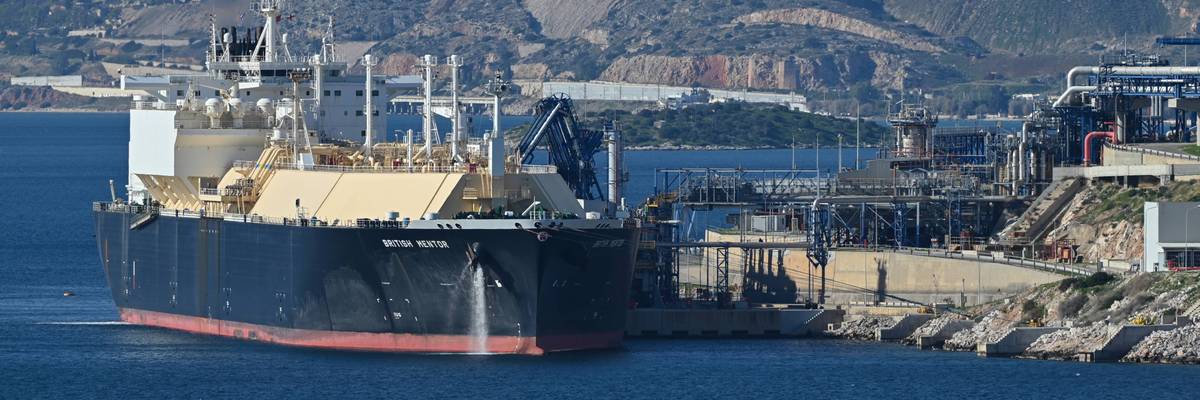
The liquefied natural gas tanker British Mentor unloads US LNG at the Revithoussa terminal near Athens, in Megara, Greece, on December 27, 2025.
(Photo by Nicolas Koutsokostas/NurPhoto via Getty Images)
Jessica Corbett
Mar 04, 2026
COMMON DREAMS
From declaring an energy emergency and ditching global climate initiatives to abducting the Venezuelan leader to seize control of the country’s nationalized oil industry, President Donald Trump has taken various actions to serve his fossil fuel donors since returning to power last year. Now, his and Israel’s war on Iran could soon lead to US liquefied natural gas giants pocketing tens of billions in windfall profits.
“The Persian Gulf has some of the world’s largest oil and gas producers,” Oil Change International research co-director Lorne Stockman explained in a Tuesday blog post, “and a large proportion of that production, around 20% of global petroleum, must pass through a relatively narrow corridor controlled by Iran to reach global markets: the Strait of Hormuz,” between the Persian Gulf and the Gulf of Oman.
Stockman—whose advocacy group works to expose the costs of fossil fuels and facilitate a just transition to clean energy—noted that “crude oil, refined petroleum products, and liquefied natural gas (LNG) traverse the strait in vast quantities every day. But not since Saturday. With missiles, fighter jets, and drones circling, shipping has ground to a halt, and Iran reportedly threatened to close the strait by force on Monday.”
Based on ship-tracking data from MarineTraffic, Reuters estimated Wednesday that “at least 200 ships, including oil and liquefied natural gas tankers as well as cargo ships, remained at anchor in open waters off the coast of major Gulf producers including Iraq, Saudi Arabia, and Qatar,” and “hundreds of other vessels remained outside Hormuz unable to reach ports.”
Stockman warned that “depending on how long the violence and its atrocious human toll continues—Trump said it may take weeks until his undefined objectives are achieved—this will have huge implications for energy markets. Oil and gas companies may achieve huge windfall profits in a year that previously looked far less lucrative for them, and billions of people could see their energy bills soar.”
Since Trump and Israeli Benjamin Netanyahu launched “Operation Epic Fury” on Saturday, over 1,000 people had been killed as of Wednesday, according to the Iranian government, and oil prices have surged—highlighting how, as Greenpeace International executive director Mads Christensen put it earlier this week, “as long as our world runs on oil and gas, our peace, security and our pockets will always be at the mercy of geopolitics.”
Qatar exports about 20% of the global LNG supply, second only to the United States. All of that LNG goes through the Strait of Hormuz. An Iranian drone attack on Monday targeted Qatari LNG facilities, leading state-owned QatarEnergy to declare force majeure on exports. Two unnamed sources told Reuters that QE “will fully shut down gas liquefaction on Wednesday,” and “it may take at least a month to return to normal production volumes.”
The Qatari shutdown is expected to boost the US LNG industry, which exported about 108 million metric tons last year. Already, shares of the two largest LNG producers in the United States, Cheniere and Venture Global, have surged.
“We’ve got an acute contraction of global LNG supply,” Alex Munton, an expert on natural gas markets at consulting firm Rapidan Energy, told CNBC. “The world is now down 20% from where it was, and that leaves the world short.”
As CNBC reported Tuesday:
US producers can’t ramp LNG production beyond current levels, Munton said. “They’re basically running at capacity,” he said.
But since their customer contracts don’t have fixed destinations, they can reroute LNG to meet demand, he said. The flexible capacity at US LNG producers like Venture and Cheniere plays a crucial role in moments of crisis, the analyst said. It’s a unique feature of the US LNG industry, he added.
“The volumes are able to reroute to where the demand is greatest,” Munton said. “We saw this in 2022 after Russia’s invasion of Ukraine. Suddenly, Europe was left short, and it was able to call on US LNG and utilize the inherent flexibility of US LNG.
US LNG cannot replace lost supply from Qatar, but buyers who really need the gas and are willing to pay a high enough price will get it, Munton said.
Seb Kennedy, the energy journalist and market analyst behind the newsletter Energy Flux, estimated Wednesday that “American LNG exports could generate up to $4 billion in windfall profits if the force majeure remains in effect for one month. This figure could rise as high as $20 billion per month if the market is deprived of Qatari supply until the summer.”
“Over the first four months, US LNG profits could reach more than $33 billion above the pre-Iran average. Over eight months, that figure rises to $108 billion,” he continued. “And if, in an extreme scenario, Qatari LNG is shut-in for a full year, the excess profits raining down on US LNG exports could stack up to almost $170 billion—a figure that would represent one of the most concentrated commodity windfalls of the post-2000 era.”
“To put that in context, the 12-month Ukraine war windfall accruing to US LNG exporters, from August 2021 through August 2022, is estimated at $84 billion,” Kennedy noted. “Iran could, in certain circumstances, eclipse that total in just over six months.”
“Oil and gas companies may achieve huge windfall profits in a year that previously looked far less lucrative for them, and billions of people could see their energy bills soar,” warned one campaigner.
The liquefied natural gas tanker British Mentor unloads US LNG at the Revithoussa terminal near Athens, in Megara, Greece, on December 27, 2025.
(Photo by Nicolas Koutsokostas/NurPhoto via Getty Images)
Jessica Corbett
Mar 04, 2026
COMMON DREAMS
From declaring an energy emergency and ditching global climate initiatives to abducting the Venezuelan leader to seize control of the country’s nationalized oil industry, President Donald Trump has taken various actions to serve his fossil fuel donors since returning to power last year. Now, his and Israel’s war on Iran could soon lead to US liquefied natural gas giants pocketing tens of billions in windfall profits.
“The Persian Gulf has some of the world’s largest oil and gas producers,” Oil Change International research co-director Lorne Stockman explained in a Tuesday blog post, “and a large proportion of that production, around 20% of global petroleum, must pass through a relatively narrow corridor controlled by Iran to reach global markets: the Strait of Hormuz,” between the Persian Gulf and the Gulf of Oman.
Stockman—whose advocacy group works to expose the costs of fossil fuels and facilitate a just transition to clean energy—noted that “crude oil, refined petroleum products, and liquefied natural gas (LNG) traverse the strait in vast quantities every day. But not since Saturday. With missiles, fighter jets, and drones circling, shipping has ground to a halt, and Iran reportedly threatened to close the strait by force on Monday.”
Based on ship-tracking data from MarineTraffic, Reuters estimated Wednesday that “at least 200 ships, including oil and liquefied natural gas tankers as well as cargo ships, remained at anchor in open waters off the coast of major Gulf producers including Iraq, Saudi Arabia, and Qatar,” and “hundreds of other vessels remained outside Hormuz unable to reach ports.”
Stockman warned that “depending on how long the violence and its atrocious human toll continues—Trump said it may take weeks until his undefined objectives are achieved—this will have huge implications for energy markets. Oil and gas companies may achieve huge windfall profits in a year that previously looked far less lucrative for them, and billions of people could see their energy bills soar.”
Since Trump and Israeli Benjamin Netanyahu launched “Operation Epic Fury” on Saturday, over 1,000 people had been killed as of Wednesday, according to the Iranian government, and oil prices have surged—highlighting how, as Greenpeace International executive director Mads Christensen put it earlier this week, “as long as our world runs on oil and gas, our peace, security and our pockets will always be at the mercy of geopolitics.”
Qatar exports about 20% of the global LNG supply, second only to the United States. All of that LNG goes through the Strait of Hormuz. An Iranian drone attack on Monday targeted Qatari LNG facilities, leading state-owned QatarEnergy to declare force majeure on exports. Two unnamed sources told Reuters that QE “will fully shut down gas liquefaction on Wednesday,” and “it may take at least a month to return to normal production volumes.”
The Qatari shutdown is expected to boost the US LNG industry, which exported about 108 million metric tons last year. Already, shares of the two largest LNG producers in the United States, Cheniere and Venture Global, have surged.
“We’ve got an acute contraction of global LNG supply,” Alex Munton, an expert on natural gas markets at consulting firm Rapidan Energy, told CNBC. “The world is now down 20% from where it was, and that leaves the world short.”
As CNBC reported Tuesday:
US producers can’t ramp LNG production beyond current levels, Munton said. “They’re basically running at capacity,” he said.
But since their customer contracts don’t have fixed destinations, they can reroute LNG to meet demand, he said. The flexible capacity at US LNG producers like Venture and Cheniere plays a crucial role in moments of crisis, the analyst said. It’s a unique feature of the US LNG industry, he added.
“The volumes are able to reroute to where the demand is greatest,” Munton said. “We saw this in 2022 after Russia’s invasion of Ukraine. Suddenly, Europe was left short, and it was able to call on US LNG and utilize the inherent flexibility of US LNG.
US LNG cannot replace lost supply from Qatar, but buyers who really need the gas and are willing to pay a high enough price will get it, Munton said.
Seb Kennedy, the energy journalist and market analyst behind the newsletter Energy Flux, estimated Wednesday that “American LNG exports could generate up to $4 billion in windfall profits if the force majeure remains in effect for one month. This figure could rise as high as $20 billion per month if the market is deprived of Qatari supply until the summer.”
“Over the first four months, US LNG profits could reach more than $33 billion above the pre-Iran average. Over eight months, that figure rises to $108 billion,” he continued. “And if, in an extreme scenario, Qatari LNG is shut-in for a full year, the excess profits raining down on US LNG exports could stack up to almost $170 billion—a figure that would represent one of the most concentrated commodity windfalls of the post-2000 era.”
“To put that in context, the 12-month Ukraine war windfall accruing to US LNG exporters, from August 2021 through August 2022, is estimated at $84 billion,” Kennedy noted. “Iran could, in certain circumstances, eclipse that total in just over six months.”
As the US Senate prepared for a vote on a war powers resolution that is not expected to pass but would swiftly halt Trump’s assault on Iran, Defense Secretary Pete Hegseth said Wednesday that the war could last at least eight weeks. He also announced that an American submarine fired a torpedo that sank an Iranian naval ship off the coast of Sri Lanka.
On Tuesday, Trump had responded to Iran’s attempt to shut down the Strait of Hormuz with a post on his Truth Social platform: “Effective IMMEDIATELY, I have ordered the United States Development Finance Corporation (DFC) to provide, at a very reasonable price, political risk insurance and guarantees for the Financial Security of ALL Maritime Trade, especially Energy, traveling through the Gulf. This will be available to all Shipping Lines. If necessary, the United States Navy will begin escorting tankers through the Strait of Hormuz, as soon as possible. No matter what, the United States will ensure the FREE FLOW of ENERGY to the WORLD. The United States’ ECONOMIC and MILITARY MIGHT is the GREATEST ON EARTH—More actions to come.”
However, as the New York Times highlighted Wednesday, “shipping company officials and analysts are skeptical” of Trump’s promised fixes, and “some industry executives also worried how quickly these could get up and running.”
For example, Helima Croft, the global head of commodity strategy at RBC Capital Markets, wrote to clients on Tuesday that “we think the insurance proposal is likely in a concepts-of-a-plan stage,” and she questioned whether there are enough US naval assets in the region to actually provide escorts.
On Tuesday, Trump had responded to Iran’s attempt to shut down the Strait of Hormuz with a post on his Truth Social platform: “Effective IMMEDIATELY, I have ordered the United States Development Finance Corporation (DFC) to provide, at a very reasonable price, political risk insurance and guarantees for the Financial Security of ALL Maritime Trade, especially Energy, traveling through the Gulf. This will be available to all Shipping Lines. If necessary, the United States Navy will begin escorting tankers through the Strait of Hormuz, as soon as possible. No matter what, the United States will ensure the FREE FLOW of ENERGY to the WORLD. The United States’ ECONOMIC and MILITARY MIGHT is the GREATEST ON EARTH—More actions to come.”
However, as the New York Times highlighted Wednesday, “shipping company officials and analysts are skeptical” of Trump’s promised fixes, and “some industry executives also worried how quickly these could get up and running.”
For example, Helima Croft, the global head of commodity strategy at RBC Capital Markets, wrote to clients on Tuesday that “we think the insurance proposal is likely in a concepts-of-a-plan stage,” and she questioned whether there are enough US naval assets in the region to actually provide escorts.

No comments:
Post a Comment