Three US states pave way for new nuclear
Legislation lifting a long-standing nuclear moratorium has been signed in New Jersey; legislation to incentivise nuclear construction has been signed in Kentucky; and in Texas, applications have opened for USD350 million of funding appropriated by the state to boost advanced nuclear construction.
_49500.jpg)
New Jersey Governor Mikie Sherrill signed the legislation to remove the permitting hurdle that has created a de facto moratorium and announced the launch of the state's new Nuclear Task Force after a tour of PSEG's Salem nuclear power plant.
"For costs to come down, we need more energy supply. New Jersey is well-positioned to be a leader in next-generation nuclear energy to help bring that supply, and we are open for business," Sherrill said. "By lifting outdated barriers and bringing together leaders across government, industry, and labour, we're setting the stage for our state to pursue new advanced nuclear power. This will help New Jersey secure a stronger, cleaner, more affordable, and reliable energy future - while keeping the state at the forefront of innovation, job creation, and economic growth."
A nuclear moratorium is a state-imposed ban or restriction on building new nuclear capacity, but how this looks varies from state to state: for example, a state might set conditions related to legislative approvals, voter consent, or waste disposal requirements before construction can begin. According to the US Nuclear Energy Institute, eight US states - California, Hawaii, Maine, Massachusetts, Minnesota, Oregon, Rhode Island and Vermont - have long-standing nuclear moratoriums. Connecticut has partially lifted its moratorium, and while New York conditionally lifted its moratorium many years ago a specific moratorium remains in parts of Long Island.
New Jersey's Coastal Area Facility Review Act blocks new permits for the construction and operation of new nuclear energy facilities by requiring an approved method by the Nuclear Regulatory Commission (NRC) for radioactive waste disposal, which New Jersey says is an outdated standard that cannot be met. The new legislation - S3870/A4528 - resolves the issue by allowing the commissioner of New Jersey's Department of Environmental Protection to approve permits that are "based on safe, NRC-compliant waste storage", removing the de facto moratorium and clearing the path for new nuclear energy development.
The newly formed Nuclear Task Force, co-chaired by Elizabeth Noll, Senior Strategist for Energy at the Office of the Governor, and Christine Guhl-Sadovy, President of the New Jersey Board of Public Utilities, will be organised across five focus areas - Financing, Supply Chains and Technology Development, Workforce Growth and Training, Regulatory and Permitting Framework, and Public Trust and Confidence - with the goal of ensuring that New Jersey is "ready to capture the benefits of new nuclear power, while maintaining the highest standards of public safety and transparency."
Two nuclear power plants - the two-unit Salem and the single-unit Hope Creek, all owned by PSEG - currently provide around 42% of New Jersey's electricity.
Kentucky incentives
Legislation signed by Governor Andy Beshear on 8 April establishes the Kentucky Nuclear Energy Development Authority and, under it, the Nuclear Reactor Site Readiness Pilot Program "to facilitate the application for and procurement of early site permits, construction permits, or combined operating licences from the NRC for the siting of new nuclear energy generating facilities".
Beshear said Senate Bill 57 would potentially lead to lower utility rates for Kentuckians over the long term. "Every step makes a difference when it comes to helping our people save their hard-earned dollars," he said.
Kentucky does not currently have any nuclear generation capacity.
Texas funding
Texas has issued a request for applications for USD350 million of funding appropriated to the Texas Advanced Nuclear Development Fund (TANDF). Applications are being accepted for the TANDF's Advanced Nuclear Construction Reimbursement Program and Project Design and Supply Chain Reimbursement Program.
The fund is under the Texas Advanced Nuclear Energy Office (TANEO), which was established by the Texas legislature to provide strategic leadership for the advanced nuclear industry and associated supply chain industries in Texas and to promote the development of advanced nuclear reactors in the state, amongst other things.
Eligible applicants must be businesses, nonprofit organisations, and governmental entities, including institutions of higher education "that have - or reasonably expect to have - a docketed construction permit or licence application for the project at the NRC on or before 1 December 2026". Applications are due by mid-May.
Production begins at US uranium project
_99627.jpg)
In-situ recovery - or ISR - is a method of mining uranium by dissolving and recovering it via wells. It is also known as in-situ leaching. Ground water fortified with a complexing agent, and often with an oxidant (such as gaseous oxygen), is introduced into the orebody to dissolve the uranium from the sandstone host. The uranium-bearing before being recovered and processed into yellowcake.
Uranium Energy Corp (UEC) has two ISR hub and spoke platforms in South Texas and Wyoming, with a central processing plant as the "hub" with several ISR uranium projects providing "spokes". Production from Burke Hollow will be processed at the company's Hobson Central Processing Plant, which is licensed to produce up to 4 million pounds of uranium per year.
"The startup of Burke Hollow is a significant achievement for UEC, advancing the project from a grassroots discovery in 2012 to production in 2026," UEC President and CEO Amir Adnani said. "With two ISR operations now producing, and our Ludeman ISR project planned for startup in 2027, we are building a scalable, multi-faceted platform supported by the largest uranium resource base in the United States."
According to UEC, Burke Hollow is the largest ISR uranium discovery in the USA in the past decade, with significant long-term development potential: only about half of the property, which covers some 20,000 acres (over 8,000 hectares) has been explored to date. The estimated mineral resource for the project is currently 6,155,000 pounds U3O8 (2,368 tU) in the measured and indicated category, plus 4,883,000 pounds U3O8 of inferred resources.
Production was able to start following the receipt of final approvals from the Texas Commission on Environmental Quality (TCEQ). Craig Wall, UEC's Vice President, Environmental, Health & Safety, Texas said the commission's approval, coming after more than a decade of exploration, permitting and development, "reflects the strength of our technical and operational execution. We appreciate the collaboration and professionalism of the TCEQ throughout the process and look forward to continuing to work with them as the project advances."
UEC's South Texas team will now focus on ramping operations and constructing additional wellfields across the project.
In addition to the largest uranium resource base in the USA, with 12 million pounds per year of uranium production capacity across its Wyoming and South Texas hub-and-spoke ISR operations, UEC also controls extensive land and resource portfolios in Canada's Athabasca Basin, including the Roughrider Project in Saskatchewan. The company is also pursuing domestic refining and conversion capabilities in the USA through its United States Uranium Refining & Conversion Corp subsidiary.
New Korean reactor cleared for start up
_51808.jpg)
In January 2014, the government authorised construction of two APR1400 units as Saeul units 3 and 4 (formerly known as Shin Kori 5 and 6). Construction was originally scheduled to start in September 2014, but was then delayed. The regulator issued a construction licence in June 2016, and site works began immediately. Construction of unit 3 commenced in April 2017. However, following the change in government in June 2017, Korea Hydro & Nuclear Power (KHNP) decided to suspend work for three months. In October 2017, a government-organised committee voted 59.5% in favour of resuming construction of the two units. The committee stated that stability of power supply had been cited as a primary reason for the choice in survey responses. In September 2018, construction of unit 4 commenced.
Prior to the delay, commercial operation of the units was due in March 2021 and March 2022, respectively. In late December 2025 the Nuclear Safety and Security Commission (NSSC) issued an operating licence for Saeul 3, with fuel loading and approximately eight months of testing to follow. Commercial operation is expected around August 2026. Saeul 4 is expected to follow in late 2026.
"Since the operating licence was issued last year, the NSSC has been conducting pre-operational inspections (5 stages) on Saeul unit 3," the regulator said. "During this process, inspections were conducted on items that must be performed before criticality, such as nuclear fuel loading inspections and high-temperature functional tests. As a result, it was confirmed that reactor criticality can be safely achieved."
The NSSC said it plans to finally confirm the safety of the unit by conducting follow-up inspections, including power increase tests, from the time Saeul 3 achieves first criticality - a sustained chain reaction - until it enters commercial operation.
Once commercially operational, Saeul 3 will account for about 1.7% of South Korea's total power generation and 37% of Ulsan's electricity demand.
South Korea has four operational APR1400 units - Saeul units 1 and 2 (formerly Shin Kori 3 and 4) and Shin Hanul units 1 and 2, plus the APR1400s under construction as Saeul units 3 and 4. Four APR1400 units have also been built at the Barakah nuclear power plant in the UAE, which are all now in commercial operation.
Dismantling of reactor channels to begin at second Ignalina unit
_42265.jpg)
In accordance with the approved technical design, the steam-water discharge piping at the top of the reactor and the water supply piping at the bottom of the reactor, as well as other related systems and their components, will be dismantled, and initial treatment of radioactive waste will be carried out. The project also includes the dismantling of the fuel channels and the reactor control and safety channels located within the reactor.
Altra - the Lithuanian state-owned company leading the decommissioning of the Ignalina plant - said dismantling work is scheduled to begin at the end of 2026. Until then, the company will carry out preparatory work: installation of engineering systems, testing of remote control equipment, and upgrading and adaption of the radioactive waste management infrastructure to handle the waste generated during this project.
"The dismantling of the reactor channels of the first power unit has been completed, therefore the permit for the second unit paves the way for a consistent continuation of the dismantling process of both reactors," Altra said.
_ab8bcb93.jpg)
(Image: Altra)
"Nobody in the world has ever dismantled a power plant of this size and radiation contamination," said Altra CEO Linas Baužys. "The transition to the second unit is a significant step forward in implementing the mega-project for decommissioning the Ignalina nuclear power plant. We have dismantled two-thirds of the first reactor with our own forces - the most complex and radiation-hazardous dismantling of the reactor cores remains, for which we will use external contractors. Our experience with the first unit allows us to confidently move on to the dismantling stages of the second unit. We are carrying out some of the work using remote and robotic technologies to ensure the highest safety standards."
The dismantling of unnecessary systems and equipment at the power plant has been carried out since 2010, and the overall dismantling progress has already reached 45.7%, Altra said. It is planned that the final dismantling of the reactors, including the dismantling of the most complex reactor cores, will take place by 2043, and all decommissioning-related work will be completed by 2050, with the final cleaning of the reactor buildings.
This year, Altra also plans to carry out dismantling and decontamination works on the steam drum separators of both power units of the Ignalina plant. There are eight such devices - metal cylinders with a diameter of almost 3 metres and a length of about 30 metres - in both power units of the plant, the total weight of which exceeds 6,000 tonnes. In November 2024, US-based company Amentum was awarded a contract worth an estimated EUR5.5 million (USD6.5 million) to consult for the first-of-a-kind dismantling of steam drum separators at Ignalina units 1 and 2.
Lithuania assumed ownership of the two RBMK-1500 units - light-water, graphite-moderated reactors, similar to those at Chernobyl - in 1991, after the collapse of the Soviet Union. It agreed to shut down the Ignalina plant as a condition of its accession to the European Union, with unit 1 shutting down in December 2004 and unit 2 in December 2009. The reactors are expected to be fully decommissioned by 2038, with most of the cost of the decommissioning being funded by the European Union via the European Bank for Reconstruction and Development and other funds.
ČEZ eyeing 80-year operation of Dukovany units
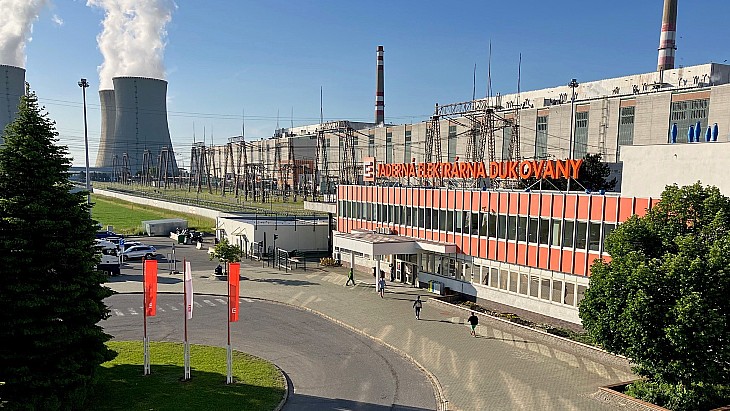
ČEZ currently operates four VVER-440 units at Dukovany, which began operating between 1985 and 1987. Their output has gradually been increased from the original 440 MWe to 512 MWe through extensive modernisations. Ongoing modernisation work aims to ensure the units can operate for at least 60 years, to 2045-2047.
A CZK407 billion (USD19.6 billion) contract was signed with Korea Hydro & Nuclear Power last year for two of its APR1000 reactors near the existing Dukovany units. The aim is to start construction in 2029. Two more units at the Temelín plant are also being considered. There are also developing plans for small modular reactors in the country.
"We have planned to operate our nuclear power plants for about 60 years so far and we are convinced every day that they are in excellent condition," said ČEZ CEO Daniel Beneš. "Current economic and safety analyses confirm that it will be possible to operate Dukovany for longer. Eighty-year operation is becoming a trend in the world, and a number of units have already been licensed for 80 years of operation. We see this as realistic for us as well, provided of course that the condition of the equipment and the safety of operation are regularly evaluated. Of course, this will not affect the project to build a new nuclear power plant at Dukovany and other small modular reactors. Electricity consumption will grow rapidly, and the Czech Republic will need as much emission-free electricity as possible."
ČEZ said it regularly evaluates the future operation of its nuclear power plants using a technology and financial model, which assesses the technical condition of key components and the expected development of electricity prices and other inputs. "These analyses also indicate that the long-term operation of the Dukovany nuclear power plant is very well feasible," it said.
"Every year we evaluate the conditions for further operation in great detail, and all key decisions are supervised by the State Office for Nuclear Safety," said Bohdan Zronek, Director of ČEZ's nuclear energy division. "In ten-year cycles, our nuclear power plants undergo detailed and demanding 'periodic safety assessments'. Rigorous preparation and perfect knowledge of the condition of the plant is a prerequisite for any decision."
The company noted that 80 years of operation encompasses extensive capital projects and upgrade programmes. These include, for example, the renewal of some elements of the engine rooms - generators as well as other large units, the reconstruction of selected piping routes, valves and electrical elements as well as the gradual introduction of new control and safety systems.
ČEZ said the extended operation of the Dukovany plant "is a step that significantly strengthens the energy security of the Czech Republic and confirms ČEZ's long-term strategy as a stable and reliable supplier of low-emission electricity, even in times of dynamic changes on the energy market."
The company said analyses are now being carried out on the potential extension of the Temelín plant's operation. Two VVER-1000 units are in operation at Temelín, which came into operation in 2000 and 2002. The capacity of the two units has increased from the original 1,000 MWe per unit to 1,086 MWe.
(Image: Ministry of Industry and Trade)
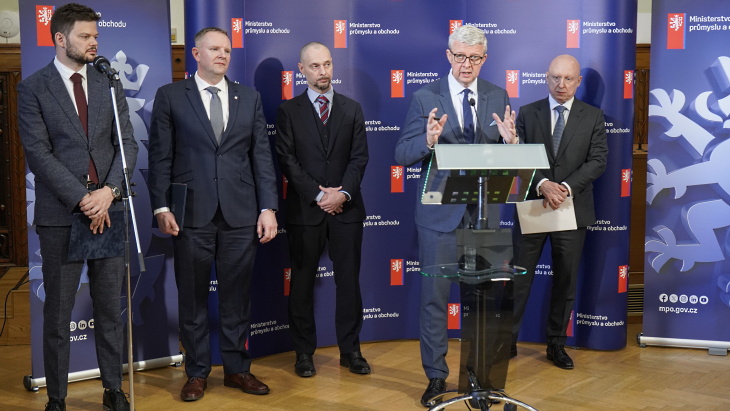
At a press conference to announce the possible extension of the operation of the Dukovany units, Minister of Industry and Trade Karel Havlíček said: "We must decide on future energy sources at the same time as how long we can safely and effectively operate the existing ones, especially nuclear units. The operation of Dukovany for up to 80 years is not a replacement for new units, but their logical addition within the framework of the Czech energy strategy. The Czech Republic has extraordinary know-how in nuclear energy and we can operate our power plants safely, efficiently and with a high degree of reliability. Therefore, it makes sense to prepare for the long-term operation of Dukovany up to the 80-year mark. At the same time, however, this does not change the need to continue the construction of new nuclear sources and the preparation of small modular reactors, because the Czech Republic will need stable, safe and competitive electricity in the maximum possible volume."
Štěpán Kochánek, Chairman of the State Office for Nuclear Safety, added: "The service life of nuclear power plants in the Czech Republic is not strictly limited to a specific number of years. Simply put, it is governed by the condition of safety-relevant components. Extension of operation is possible only if the operator proves that the facility meets all safety requirements, has managed the aging management of the facility and the technical condition corresponds to current standards, and at the same time has the necessary personnel resources to ensure continued operation. We will always assess every step and every submitted assessment very strictly and in detail."
First criticality for Indian fast breeder reactor
The initiation of a controlled nuclear fission chain reaction at the Prototype Fast Breeder Reactor sees India move into the second stage of a three-stage nuclear programme which ultimately aims to achieve a closed fuel cycle using the country's abundant thorium.
_47469.jpg)
The 500 MWe Prototype Fast Breeder Reactor (PFBR) at Kalkpakkam in Tamil Nadu attained first criticality on 6 April at 08:25 pm, the Department of Atomic Energy (DAE) announced, with the milestone marking "a significant step toward strengthening India's long-term energy security and advancing its indigenous nuclear technology capabilities."
The PFBR technology was designed and developed by the DAE's Indira Gandhi Centre for Atomic Research (IGCAR). The reactor was built and commissioned by Bharatiya Nabhikiya Vidyut Nigam Ltd (BHAVINI), a government enterprise under the DAE. Construction began in 2004, with an original expected completion date of 2010. India's Atomic Energy Regulatory Board officially granted permission for the First Approach to Criticality - including the loading of fuel into the reactor core and the start of low power physics experiments - in mid-2024. Last August, Minister of State Jitendra Singh told India's parliament that delays in completion of the project had been mainly due to "first-of-a-kind technological issues" during the commissioning process.
The attainment of first criticality "follows the successful completion of all stipulated safety requirements, with clearance granted by the Atomic Energy Regulatory Board (AERB) after rigorous review," BHAVINI said.
"Today, India takes a defining step in its civil nuclear journey, advancing the second stage of its nuclear programme," Prime Minister Narendra Modi said on social media, adding that the PFBR "reflects the depth of our scientific capability and the strength of our engineering enterprise. It is a decisive step towards harnessing our vast thorium reserves in the third stage of the programme. A proud moment for India."
The PFBR uses uranium-plutonium mixed oxide, or MOX, fuel surrounded by a 'blanket' of uranium-238, which, through neutron absorption, is converted into fissile plutonium-239. This enables the reactor to generate more fuel than it consumes - it 'breeds' fuel. The PFBR is also designed to use thorium-232 in the blanket, which can be transmuted into fissile uranium-233.
"This unique capability significantly enhances the utilisation of nuclear fuel resources and enables the country to extract far greater energy from its limited uranium reserves while also preparing for large-scale use of thorium in the future," BHAVINI said. The fast breeder programme "strengthens strategic capabilities in nuclear fuel cycle technologies, advanced materials, reactor physics and large-scale engineering," and the knowledge and infrastructure developed through the programme "will support future reactor designs and next-generation nuclear technologies".
Fast breeder reactors form the second stage of India's three-stage nuclear programme, using plutonium recovered from the reprocessing of used fuel from the pressurised heavy water and light water reactors that form the first stage of the programme. The third stage envisages using advanced heavy water reactors to burn thorium-plutonium fuels and breed fissile uranium-233, achieving a thorium-based closed nuclear fuel cycle.
According to World Nuclear Association information, some 20 fast neutron reactors, including some that have supplied electricity commercially, have operated around the world since the 1950s - although not all have been breeders.
India currently has about 7,900 MW of nuclear generation from 24 operable nuclear power plants, and is planning a large expansion of its nuclear capacity. The country says that 17 nuclear power reactors with a total of 13,100 MW capacity are either under construction (7) or under pre-project activities (10). It is aiming to reach a nuclear energy capacity of about 100 GW by 2047 as part of its Viksit Bharat development strategy.
EDF, NTPC sign MoU to explore new Indian nuclear projects
_2_59089.jpg)
The MoU was signed following approval from Indian ministries and government departments, NTPC said. It establishes a framework for both companies to jointly assess the feasibility and approach for collaboration, including understanding EDF’s EPR technology and its suitability for Indian requirements, exploring opportunities to maximise localisation for large-scale deployment, examining economic and tariff aspects, developing human resource capabilities through training programmes, evaluating potential project sites, and providing technical support as mutually agreed.
"This initiative aligns with NTPC’s strategy to expand into clean, reliable energy and contribute to India’s long-term energy security," NTPC said.
The MoU was signed by Arnada Prasad Samal, CGM (Nuclear Cell), on behalf of NTPC, and Vakisasi Ramany, Senior Vice President, International Nuclear Development, on behalf of EDF.
NTPC is a Public Sector Undertaking under India's Ministry of Power. It currently operates more than 89 GW of installed capacity, with another 32 GW under construction, with a target to reach 149 GW of total capacity by 2032, including 60 GW from renewable energy sources, with a balanced mix of thermal, hydro, solar, and wind power plants, ensuring supply of reliable, affordable, and sustainable electricity to the country.
Proposals for six EPR units at Jaitapur have long featured in India's energy plans, under the control of Nuclear Power Corporation of India Ltd (NPCIL).
Restrictions under Indian law have in the past presented a barrier to the participation of private companies like NTPC in nuclear power projects, but in 2024, the Indian government approved the creation of Anushakti Vidhyut Nigam Ltd (Ashvini), a joint venture between NPCIL and NTPC, to construct, own and operate nuclear power plants in India. The joint venture is now developing two Indian-designed 700 MWe pressurised heavy water reactors, Mahi Banswara Rajasthan Atomic Nuclear Power Project units 1 and 2, for which excavation works began in late March. The Sustainable Harnessing and Advancement of Nuclear Energy for Transforming India (SHANTI) Act 2025 - enacted at the end of last year - opens up India's nuclear sector to participation from private companies, including in plant operations, power generation, equipment manufacturing, and selected activities such as nuclear fuel fabrication.
Study highlights opportunities for Dutch nuclear supply chain
_89551.jpg)
The study - conducted by Tractebel and Technopolis and commissioned by the Province of Zeeland, Impuls Zeeland and VNO NCW Brabant Zeeland - outlines how companies in Zeeland, one of the preferred locations for new nuclear reactors, can position themselves within the nuclear supply chain and benefit from future investments.
Conducted between July 2025 and January 2026, the analysis explored prospects primarily for large nuclear new build projects, as well as for small modular reactors (SMRs) and the lifetime extension of the existing Borssele nuclear power plant.
The study identified 130 Zeeland businesses that could potentially supply nuclear projects, mostly as component suppliers and subcontractors. "Opportunities are strongest in construction, infrastructure, and transport & logistics, and during early construction phases and site clearance/landscaping," it says. "As a first estimate, local involvement could account for roughly 15% of total plant costs."
The direct economic potential for the business sector in Zeeland is estimated to be between EUR3.1 and EUR4.6 billion over a 12-year construction period. Direct economic benefits emerge from the direct supply to nuclear power plants, whether under construction or in operation. "The actual order size that can land in Zeeland will strongly depend on various factors, including the technology vendor chosen," the report says. "This estimate should therefore be considered a first estimate based on best available data and assumptions at this stage of the nuclear new-build project in the Netherlands." The indirect economic potential (resulting from regional spending of businesses directly involved in the supply chain and of on-site workers or visitors) for the business sector in Zeeland is estimated to be around EUR1 billion.
"Given the opportunities for Zeeland businesses in the nuclear supply chain, we recommend positioning Zeeland as a hotspot for nuclear energy and actively promoting its businesses in new-build projects," the study says." Stakeholders should be informed about nuclear developments, supply opportunities, and requirements, while businesses should be connected regionally, nationally, and internationally, and regional and national governments should align business support activities. Support should be provided to establish the right ecosystem for Zeeland companies to enter the nuclear domain, including further developing and implementing the proposed roadmap, backed by public and private investments.
"To facilitate this, we recommend establishing the Nuclear Delta platform, a public-private initiative bringing together businesses, government, and education institutions. The Province of Zeeland, Impuls Zeeland and VNO-NCW Brabant-Zeeland can play a part in this as well. Additionally, clear agreements with the national government should be made on conditions for hosting a new nuclear power plant, ensuring maximum economic benefit for regional businesses and reinforcing Zeeland’s ambitions as a nuclear energy hotspot."
The Netherlands currently has one 485 MWe (net) pressurised water reactor at Borssele - operated by EPZ - which has been in operation since 1973 and accounts for about 3% of the country's total electricity generation.
In December 2021, the Netherlands' new coalition government placed nuclear power at the heart of its climate and energy policy. In addition to keeping the Borssele plant in operation for longer, the government also called for the construction of new reactors. Based on preliminary plans, two new reactors will be completed around 2035 and each will have a capacity of 1,000-1,650 MWe. The two reactors would provide 9-13% of the country's electricity production in 2035. The cabinet announced in December 2022 that it currently sees Borssele as the most suitable location for the construction of the new reactors. Three other locations are also being considered for the reactors: the Tweede Maasvlakte near Rotterdam, Terneuzen in Zeeland and Eemshaven in Groningen. A location selection is expected in September of this year. The government is also taking steps to prepare the Netherlands for the possible deployment of SMRs.

No comments:
Post a Comment