Showing posts sorted by relevance for query DRONE. Sort by date Show all posts

Wednesday, July 07, 2021

Israel’s Drone Swarm Over Gaza Should Worry Everyone

It’s time global leaders set new rules for these future weapons already being using to kill.
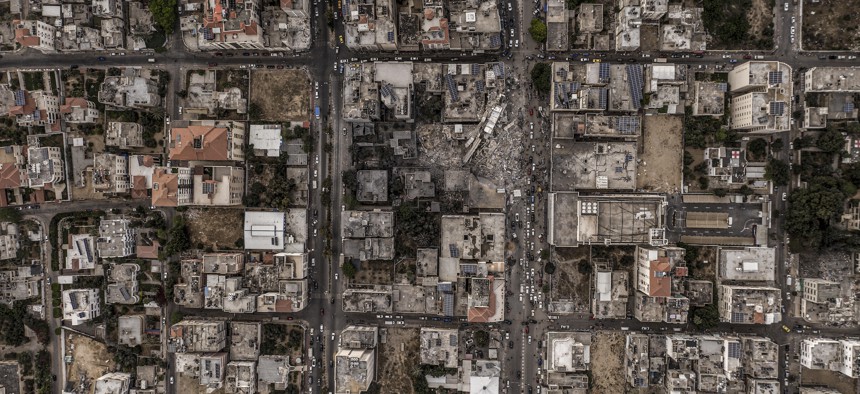


A drone views of the ruins of buildings in Gaza city that was levelled by an Israeli air strike during the recent military conflict between Israel and Palestinian ruled by Hamas on June 11, 2021. 
MAJDI FATHI/NURPHOTO VIA GETTY IMAGES


BY ZAK KALLENBORN
JULY 7, 2021 

DEFENSEONE.COM


In a world first, Israel used a true drone swarm in combat during the conflict in May with Hamas in Gaza. It was a significant new benchmark in drone technology, and it should be a wakeup call for the United States and its allies to mitigate the risk these weapons create for national defense and global stability.

Israel’s use of them is just the beginning. Reporting does not suggest the Israeli Defense Forces deployed any particularly sophisticated capability. It seems a small number of drones manufactured by Elbit Systems coordinated searches, but they were used in coordination with mortars and ground-based missiles to strike “dozens” of targets miles away from the border, reportedly. The drones helped expose enemy hiding spots, relayed information back to an app, which processed the data along with other intelligence information. Future swarms will not be so simple.

Often the phrase “drone swarm” means multiple drones being used at once. But in a true drone swarm, the drones communicate and collaborate, making collective decisions about where to go and what to do. In a militarized drone swarm, instead of 10 or 100 distinct drones, the swarm forms a single, integrated weapon system guided by some form of artificial intelligence.

So, drone swarms are here, and we should be worried. But how best to reduce the risk these weapons pose?

The United States should lead the global community in a new conversation to discuss and debate whether new norms or international treaties are needed specifically to govern and limit the use of drone swarms. Current proposals to ban autonomous weapons outright would cover autonomous drone swarms; however, such a treaty would not likely cover the drone swarm Israel used. Despite some media reports to the contrary, there is no indication the swarm made autonomous decisions on who to kill (whether a small, human-controlled swarm like this should be banned is a different issue). And it’s unlikely the great powers will agree to a broad prohibition autonomous weapons. Narrow restrictions on high-risk autonomous weapons like anti-personnel drone swarms may have more appeal, particularly if they create asymmetric effects that threaten, but not help, great powers.

Related articles


The Pentagon Wants AI-Driven Drone Swarms for Search and Rescue Ops

The U.S. Military’s Drone Swarm Strategy Just Passed a Key Test

Pentagon Wants More Money for Lasers To Defend Against Missiles, Drone Swarms

Global militaries should expand work to develop, test, and share counter-swarm technology. Effective counter-drone systems need to be low cost, quick recharging, and able to hit multiple targets at once. Such systems should be deployed around high-risk target areas, like airports, critical infrastructure, and heads of state. As the threat is fundamentally international, states should also provide their cutting-edge counter-swarm capabilities to partners and allies who are at risk.

Keeping drone swarms from the hands of terrorists will require a separate effort. States may adopt measures akin to United Nations Security Council Resolution 1540 on preventing terrorist acquisition of chemical, biological, radiological, and nuclear weapons that apply to drone swarms (or just expand UNSCR 1540). Local, national, and international law enforcement agencies should also search for indicators of terrorists seeking drone swarm capabilities, such as large drone purchases and known extremist work to develop or modify drone control systems.

In recent years, the threat of drone swarms has grown alongside their increasing sophistication. In 2016, the Department of Defense launched 103 Perdix drones out of three F/A-18 Super Hornets. The drones operated using a “collective brain,” gathering into various formations, flying across a test battlefield, and reforming into new configurations. Notably, the system was designed by students at the Massachusetts Institute of Technology. If drone swarms are simple enough students can make them, conflict zones across the world can expect to see them soon. In the past year, China, France, India, Spain, South Africa, the United States, and the United Kingdom have all unveiled or tested new drone swarm programs.

Global proliferation of drone swarms creates risks of instability. In the Nagorno-Karabakh conflict last year, Azeri use of drones contributed significantly to a rapid Armenian surrender (other factors no doubt helped too). A swarm amplifies such effects with more drones, using more complex tactics that can overwhelm existing defenses. It’s a concern the U.S. military has studied for a decade already. A 2012 study by the Naval Postgraduate School simulated eight drones attacking a U.S. Navy destroyer, finding four drones would hit the ship. Terrorists may also see great appeal in drone swarms as a more accessible air force to overcome ground-based defenses, and carry out attacks on critical infrastructure and VIPs.

Drone swarms create risks akin to traditional weapons of mass destruction. As drone swarms scale into super-swarms of 1,000 or even up to a million drones, no human could plausibly have meaningful control. That’s a problem, autonomous weapons can only make limited judgments on the civilian or military nature of their targets. The difference of a single pixel can change a stealth bomber into a dog. Errors may mean dead civilians or friendly soldiers, and accidental conflict escalation.

The reality is that virtually no current counter-drone systems are designed for counter-swarm operations. Current detections systems cannot necessarily accommodate multiple drones. They could overwhelm interdiction systems, which contain limited or slow-to-shoot interceptors. And the drone swarm may simply be too spread out. Of course, new counter-drone systems like the Air Force’s microwave-based THOR system, low cost per shot defenses like lasers, and counter-swarm swarms may eventually prove effective. While these defenses may protect great powers, smaller states and civilians are likely to be more vulnerable.

The increased autonomy of a drone swarm allows states to use many more drones at once. Human cognition limits simultaneous drone operation, because it is difficult to monitor operations of many drones, ensure they do not collide, and still achieve mission objectives. But the military is working to overcome human limitations. In one 2008 study, a single operator could handle only four drones without significant losses to mission effectiveness. By 2018, the U.S. military’s Defense Advanced Research Projects Agency, or DARPA, confirmed a human could control an entire drone swarm telepathically, using a single microchip implanted in their brain.

The military value of drone swarms stems from enabling complexity and flexibility. Current swarms use typically small, homogenous drones. Future swarms may be of different sizes, equipped with an array of different interchangeable sensors, weapons, and other payloads. That enables combined armed tactics, where drones strike with multiple weapons from multiple angles: one may spray bullets, while another sprays a chemical weapons agent. Swarms may also have adaptive properties such as self-healing, where the swarm modifies itself to accommodate the loss of some members, or self-destruction, to complete one-way missions. Drone swarms will also likely be increasingly integrated into some form of drone mothership (and perhaps integrated into an even larger mothership in a “turducken of lethality.”)

Drone swarms are not science fiction. The technology is here, and spreading fast.

Zachary Kallenborn is a national / homeland security consultant, specializing in unmanned systems, drone swarms, homeland security, weapons of mass destruction (WMD), and WMD terrorism.

Monday, June 01, 2026

DRONES

Catching the unknown: The drone designed to hunt other drones

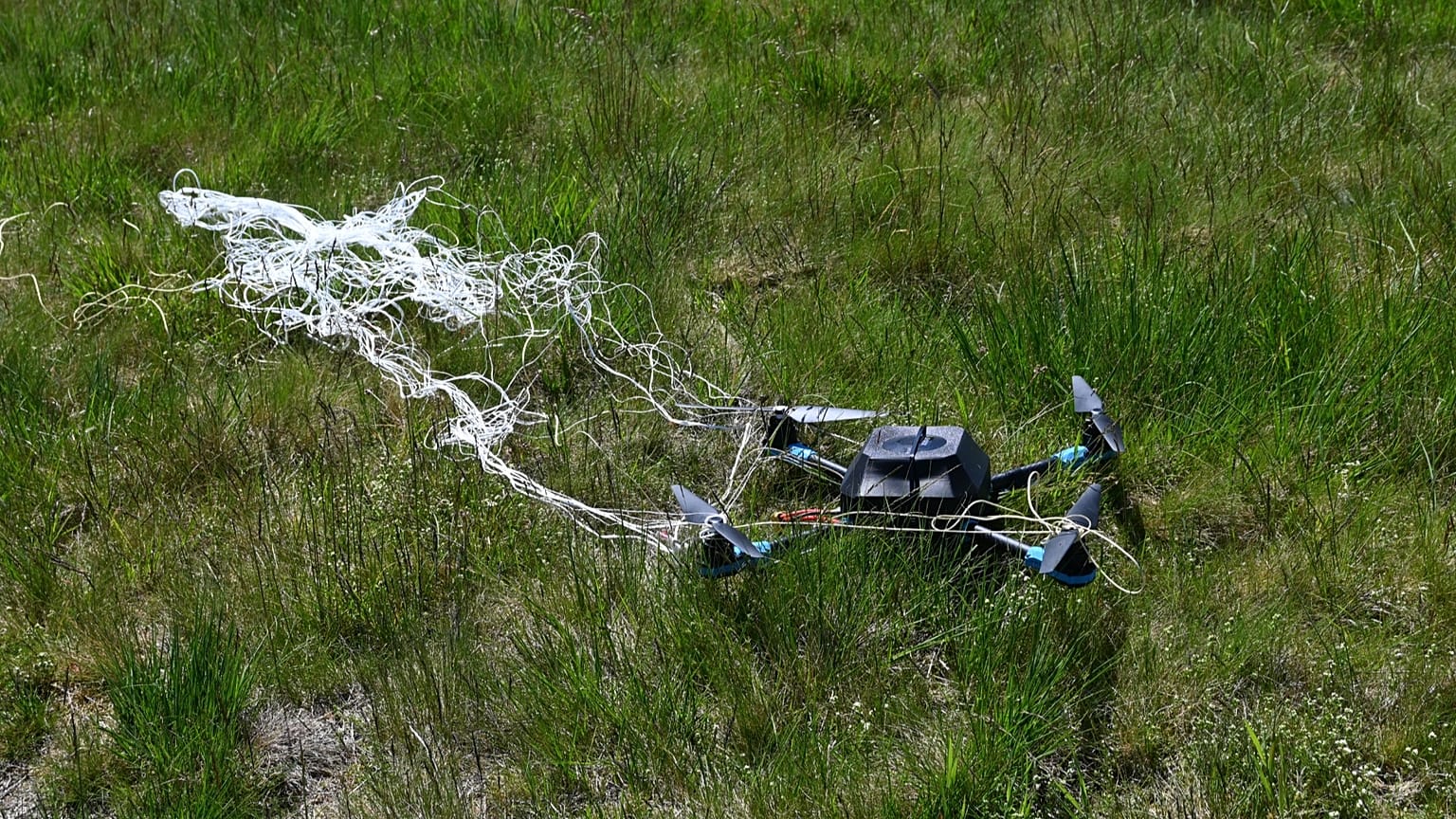
A captured drone, 28/05/2026
Copyright Johanna Urbancik/ Euronews

By Johanna Urbancik
Published on


After repeated drone sightings at airports and critical infrastructure sites, a German company believes it has found a way to identify who is behind them.

A suspected drone sighting brought disruption to Munich airport on Saturday morning, with around 26 flights reportedly diverted and further delays affecting departures. It's the latest in a growing number of drone incidents at German airports.

Figures from Germany's air navigation service, Deutsche Flugsicherung (DFS), show that 37 drone sightings were recorded in the first three months of this year alone. Yet one question often goes unanswered: who was flying them?

In most cases, investigators are unable to determine whether a drone was being operated by a hobbyist, an irresponsible pilot or someone with more hostile intentions.

Without recovering the aircraft or identifying its operator, establishing where it came from is often impossible.

The answer? A drone 'hunter'

One German company believes it has found a way to solve the problem. Working alongside US radar manufacturer Echodyne, Argus Interception has developed a system designed to hunt down rogue drones and catch them in mid-air.

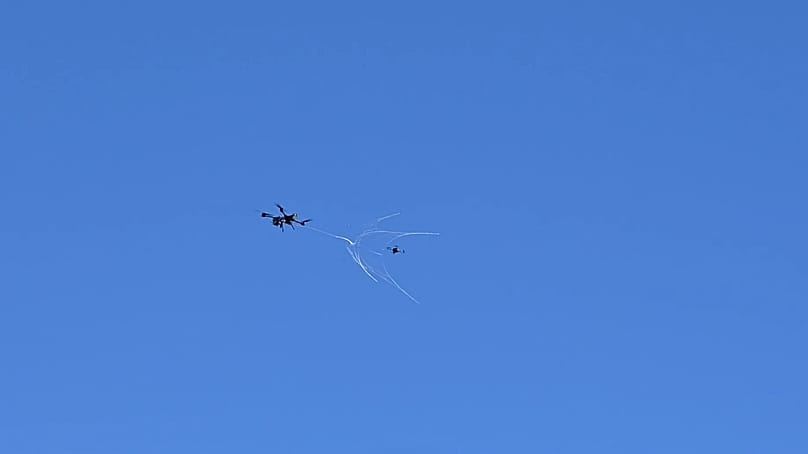
Rather than shooting a target down, the company's A1-Falke interceptor fires a net intended to bring the aircraft safely to the ground. The idea is not only to avoid debris falling onto people or property below, but also to recover the drone intact so it can later be examined by investigators.

The drone capture, 28/05/2026 Johanna Urbancik/ Euronews

To improve the chances of a successful interception, the drone carries two net payloads, allowing operators a second attempt if the first misses.

At an exclusive demonstration attended by Euronews and a small group of journalists near Hamburg, the companies put the system to the test. A target drone was launched across a training ground before the A1-Falke was sent in pursuit. Moments later came a loud bang. Seconds after that, the target was caught in the interceptor's net.

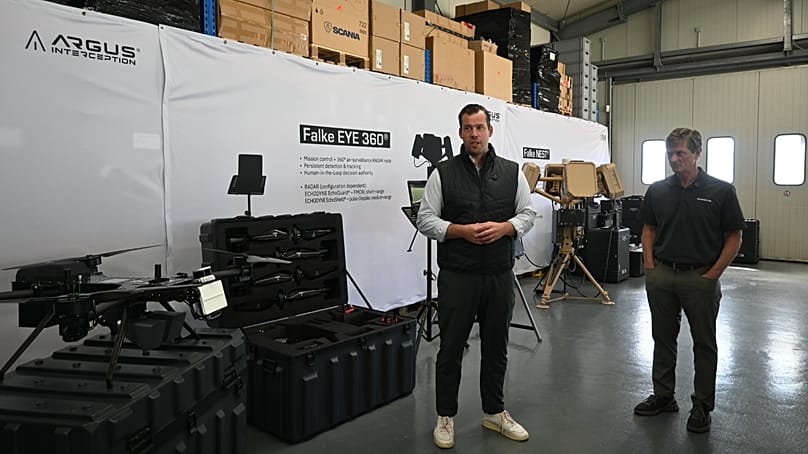
Sven Steingräber, co-founder of Argus Interception, says the system was designed for situations where shooting a drone down is not an option, such as near airports, critical infrastructure or in densely populated urban areas.

"We set out to address a capability gap," he said. The aim, he argues, is to respond to drone incursions proportionately while avoiding collateral damage. "Our net system allows us to capture the drone, transport it away and place it exactly where we want it," Steingräber added. "That way, we can avoid harm to bystanders as well as damage to property."

In built-up, urban areas, he argued, that distinction matters.

Steingräber and Frankenberg at the Argus Interception factory Johanna Urbancik/ Euronews


How does the system work?

In simple terms, Echodyne provides the eyes, while Argus provides the interceptor.

The two companies play different roles within the same system. While Echodyne's radars monitor the airspace and detect suspicious aircraft, Argus' A1-Falke is responsible for the interception itself.

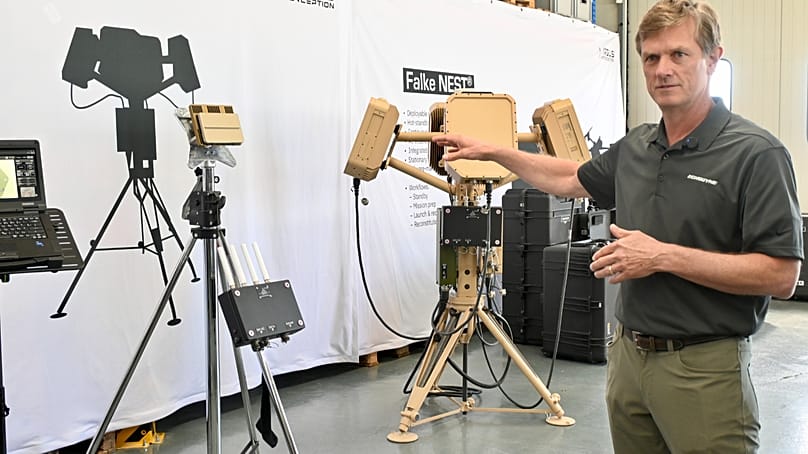
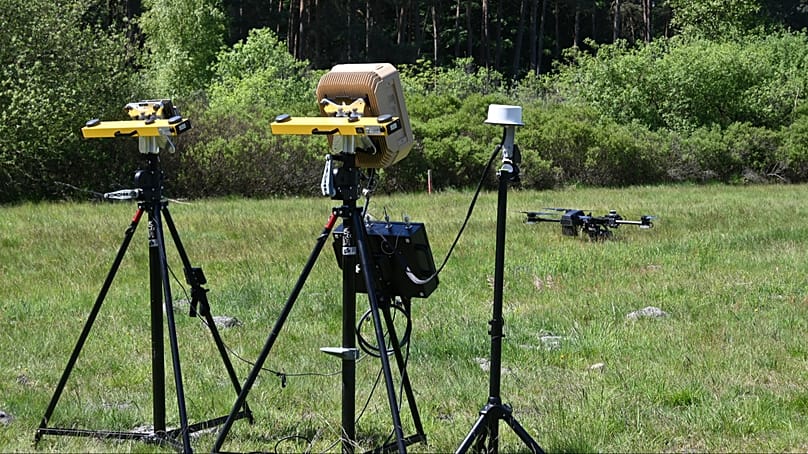
"You saw a couple of different radar systems on the ground," Echodyne chief executive Eben Frankenberg told Euronews. The larger system, known as EchoShield, is responsible for "detecting an initial drone flying into the area" before "tracking it with very high fidelity and sending that data to the command and control centre."

A smaller radar, EchoGuard, performs the same role, but at shorter ranges. Once a target has been identified, its position is passed to the interceptor. The A1-Falke then takes over. Mounted on the drone itself is a radar called EchoFlight, which performs what Frankenberg describes as "air-to-air tracking."

Echodyne CEO Eben Frankenberg next to a radar system. Johanna Urbancik/ Euronews


"So once the interceptor drone is in the air, then it's going to go find the intruder drone and then start tracking it," he said. "And so the interceptor drone can then follow it," Frankenberg said.

The A1-Falke is then sent in pursuit. Designed to catch rather than destroy its target, the drone fires a net intended to entangle the aircraft and bring it safely to the ground.

To increase the chances of a successful interception, it carries two net payloads, allowing operators a second attempt if the first misses. The drone itself is piloted from the ground. While artificial intelligence assists with the operation, the final decisions remain in human hands.

A growing security concern

Steingräber argued that many people still underestimate the potential threat posed by drones flying over sensitive sites. "Modern wars often don't begin with the first shot being fired, but with the gathering of information," he told Euronews. Many people, he said, are unaware that intelligence collected by a drone today could have significant consequences at a later stage.

"Such drone flights over critical infrastructure can have major consequences," Steingräber said. "Operational procedures are filmed, supply routes are mapped and critical points are assessed for an adversary, allowing them to strike more effectively because they already have the information."

Reports of drones flying over critical infrastructure, airports and military sites in Germany have become more frequent since Russia's full-scale invasion of Ukraine. Until recently, responsibility for dealing with such incidents rested largely with the police. The German army was generally limited to responding to drone activity over its own facilities.

Radar and drone, near Hamburg, 28/05/2026 Johanna Urbancik/ Euronews


That changed last year when Germany amended its Aviation Security Act. While primary responsibility still lies with the police, the armed forces can now provide support if requested by state authorities and if the available civilian resources are deemed insufficient.

Some in the industry argue that the current framework leaves operators of critical infrastructure with few tools to respond to suspicious drone activity. They are calling for facilities such as airports, energy sites and other sensitive locations to be given greater scope to use counter-drone systems themselves.

One example is the net-based interceptor demonstrated to Euronews near Hamburg, which is designed to capture a drone rather than destroy it. As it carries no live ammunition and is not classified as a weapon, operators could deploy the drone themselves, bring an intruding aircraft down and have it examined afterwards.


‘Much better defence’ required to avert Russian drones, former Romanian NATO official tells Euronews


Euronews

By Méabh Mc Mahon & Angela Skujins
Published on

Exclusive: Former NATO Deputy Secretary-General Mircea Geoană has warned that the military alliance needed stronger low-altitude military capabilities to shoot down drones, as seen with the incursion late last week in Romania that has left the country in "shock".

Former North Atlantic Treaty Organisation (NATO) Deputy Secretary General, Mircea Geoană, said that much better defences were required by Europe to ward off drones – and the Romanian city of Galați still lives in a state of "shock" following an incursion by a Russian drone carrying explosives on Friday.

Late last week an unmanned aerial vehicle crashed into a residential building in the Romanian south-eastern port city near the border of Ukraine, sparking a fire and injuring two people.

The Romanian government blamed Moscow for the incident and declared the Russian consul in Constanța a persona non grata while closing the consulate.

In recent weeks, several drones have entered European airspace, causing concern across the Baltics. However, this is the first incident in which Romanians have been injured.

“The shock of the Russian incursion and explosion on a block of apartments in Galați is still here with us,” Geoană said in comments to Euronews’ Europe Today programme on Monday.

“Galați is a big city, an industrial city on the Danube. On the other side of the river, there is Ukraine, and Russia is constantly attacking infrastructure on the Ukrainian side,” he said.

Russian President Vladimir Putin has rejected blame for the drone crash, while the country's deputy chair of Russia's Security Council, Dmitry Medvedev inferred more drones would continue to stray into European skies. "The peaceful sleep is over," he said.

“Concern” within Bucharest had cumulated over more than four years of Russia’s full-scale invasion of Ukraine due to the country’s proximity to the battlefield, said Geoană, who served within NATO's upper echelons between 2019 and 2024. He also served as Romanian Foreign Minister from 2000 to 2004.

A Romanian fighter jet of NATO's Baltic Air Policing Mission successfully shot down a stray drone that entered Estonia’s airspace on 19 May. Asked why this did not occur in Romania on Friday, Geoană said the military did not “have enough time or space to shoot”.

Romania’s Ministry of Defence did scramble two F-16 fighter jets to respond to the aircraft, however Romania’s General Gheorghe Maxim said the forces had insufficient time – only four minutes – to shoot it down.

The incident has further underlined the need for NATO to better equip itself against the form of modern warfare that occurs in low-altitude, Geoană said.

“We have to do a much better effort to try to find the right kind of air and missile defence for NATO in general,” he explained.

“For mid-altitude and high altitude, let's say there are some things in place: Patriot missiles, F-16 things, F-35 NATO operations."

“For this basically low altitude things… you can acquire them, the only thing is that you have to put your right priorities in the right place.”


Russia fired record 8,150 drones at Ukraine

in May: AFP analysis

Kyiv (Ukraine) (AFP) – Russia fired a record number of long-range drones at Ukraine in May, an AFP analysis of Ukrainian air force data showed Monday, as Kyiv appealled to allies for air defence support.


Issued on: 01/06/2026 - RFI

A Russian drone flies above Kyiv during an attack on May 24 © Genya SAVILOV / AFP


Russia launched 8,150 long-range drones in May, according to a compilation of daily air force reports, up to 24 percent on the number fired in April.

Kyiv has developed a robust network of air defence systems across the country that is capable of downing most drones, but it still relies on Western allies to down Russian missiles.

The new record barrage comes after a three-day truce last month raised hopes for broader peace efforts but Kyiv and Moscow accused each other of violations and stepped up their long-range attacks.

Russia also fired 211 missiles in May, among the highest monthly figures, at a time when Kyiv called on the United States for urgent help with supplies of ammunition for its Patriot anti-missile systems.

Russia lauched one of its worst attacks on the capital in months in May, when a missile slammed into a residential building, as part of a barrage that killed two dozen people.

Moscow last month also deployed its nuclear-capable ballistic missile -- dubbed Oreshnik -- for only the third time of the invasion.

Kyiv intercepted about 91 percent of all incoming drones and missiles in May, according to air force data.
One Russian drone attack in May partially destroyed this Kyiv apartment block © Roman PILIPEY / AFP


That points to how Ukraine has pioneered systems to intercept long-range drones but remains heavily reliant on Western allies to counter missiles.

Ukrainian officials have repeatedly warned that stocks of anti-missile systems and ammunition are running low.

President Volodymyr Zelensky appealed directly to US President Donald Trump last month for help downing Russian missiles.

The deficits have been exacerbated by the war in the Middle East, which saw US allies expend huge quantities of air defence ammunition protecting sites in the Gulf.

Trump re-entered the White House last year vowing to quickly end the Ukraine war, but talks stalled as the Moscow and Kyiv remain at odds over Russia's territorial demands.

Diplomatic efforts further derailed after Washington's attention turned to the US-Israeli war on Iran that erupted on February 28.

© 2026 AFP

Ukraine: How a kamikaze drone partially operated by AI is attacking Russian convoys

Drones piloted by artificial intelligence are now being deployed on the Ukrainian front lines, and while there has been much talk about them, there is still much that remains unknown. The US-made Hornet Drone, which is partially guided by AI, is at the centre of a new Ukrainian strategy to target Russian logistics.


Issued on: 01/06/2026 
By:The FRANCE 24 Observers/Guillaume MAURICE

This video, shared online by the Azov Brigade of the National Guard of Ukraine on April 16, 2026, shows a Russian truck being hit by a Ukrainian Hornet drone that’s piloted by AI. A red square marks the drone’s potential target. © X / azov_media

For the past few months, a drone has been prowling Russian logistics routes. The Hornet, which the Russians call the "Martian-2", is a mid-range kamikaze drone partially piloted by artificial intelligence.

The drone – which is built of polystyrene, has a 2-metre wingspan and a range of more than 100 km – costs $6,000 USD. It can hit a target at a speed of 200 km/h and can carry a 4.5kg payload. After the drone is launched using a catapult, it flies using an electric propeller motor, which means that it is nearly silent, according to Russian sources. It is piloted using two cameras.

The US-designed Hornet was developed by the American company Perennial Autonomy, which was founded and financed by former Google CEO, Eric Schmidt. This drone is frequently used in US Army training exercises. However, in July 2025, Perennial Autonomy – then called Swift Beat – made a deal to supply Ukraine with drones. Ukrainian President Volodymyr Zelensky announced on May 5 that Ukraine had quadrupled its number of mid-range strikes, meaning those beyond 20 kilometres, between February and April 2026.

This shows a Hornet drone on its launcher. © US Army


Once the drone is in Russian-occupied territory, it can apparently pilot itself using artificial intelligence, a system that makes it less vulnerable to Russian signal jamming.


The drone is said to be able to automatically identify its targets before striking. It is, however, very difficult to know the precise role played by artificial intelligence in the decision taken to strike. Our team contacted Perennial Autonomy, who did not want to comment on the drone’s piloting system. The Ukrainian Army did not respond to our questions.

Elite Ukrainian units like the Azov and Khartia Brigades have been posting images of Hornet drones striking Russian supply convoys. On his Telegram channel, Russian military blogger Alexander Kharchenko admitted that Russian “logistics is seriously disrupted”. He said that the Hornet is allowing Ukrainians to strike at an unprecedented distance: “Until recently, the guys were easily carrying out patrols 50 kilometres from the frontlines. But now, this area is under fire by the Hornets.”
‘The drone approaches its target silently, we don’t have time to react’

In video after video, the same scene repeats over and over. The drone flies over the area, spots a Russian truck or another piece of equipment and marks its target with a red square. Then, it hurtles toward its target to detonate.


This video shows a Russian truck being targeted by a Hornet flown by the Azov brigade. © X / azov_media


On Telegram, another Russian military blogger described how Hornet drones work: “In most cases, the drone flies at a low altitude (around 200 m) all along our roads. It identifies its target and attacks. The drone approaches its target silently, most of the time, we don’t have time to react.”

This video, posted on April 16, 2026 by the Azov Brigade of the National Guard of Ukraine shows eight successive strikes on Russian equipment. X / azov_media
A drone striking behind the lines

On May 8, the Azov Brigade deployed a Hornet drone in the Ukrainian city of Mariupol, which is occupied by the Russians. They flew over the edges of the city, which is more than 100 kilometres from any Ukrainian positions.


This video, published by the Azov Brigade on May 9, 2026, shows a Hornet drone flying over the occupied city of Mariupol, which is more than 100 km from Ukrainian positions. X / azov_media

This shows a Hornet drone deployed by the Azov Brigade of the National Guard of Ukraine flying over the gates of the city of Mariupol, which is occupied by Russian troops. Location: 47°13'21.08"N 47°13'21.08"N © X / azov_media


It’s not the first time that a Hornet has flown so far: according to an analysis by the FRANCE 24 Observers, out of 13 videos of drone strikes posted online by different Ukrainian units, nine of them took place more than 80 kilometres from the front line.

George Barros, director of innovation at the Institute for the Study of War, says that the Hornet is partially guided using artificial intelligence:


"Once the Hornet enters Russian territory, its partial AI guidance allows it to independently select its target. Even without a connection to the pilot, the drone can recognise a Russian truck or armoured vehicle. This makes it resistant to jamming, since it no longer depends entirely on the signal used by the pilot to guide it.

The Hornet is also capable of flying autonomously during the final meters of the attack thanks to artificial intelligence. This is particularly useful because some Russian vehicles are equipped with jammers. However, the precise role of AI in the drone’s operation remains unclear.“

According to the researcher, this system enables the drone to strike far behind Russian lines, most notably in the Mariupol region:


“Mariupol is a major logistical hub, with numerous highways connecting southern Ukraine to the Donetsk region. Large numbers of troops and significant quantities of ammunition transit through this area.

Using small FPV-type kamikaze drones, the Ukrainians were already able to strike Russian positions located up to 30 kilometres from the front line. With missiles and long-range drones, they can hit Russian refineries hundreds — even thousands — of kilometres away.

But there is an operational gap between 30 km and 120 km that allows the Russians to deploy their logistics and prepare their assaults. It is within this space, referred to as the ‘intermediate depth,’ that the Ukrainians are trying to operate.”
When a Russian organisation is able to study the drone

Russian Telegram channel Ghost_Malleus_Maleficarum, which specialises in the technical analysis of Ukrainian drones, reported that the Hornet has a “success rate above 80%”. Meaning that volunteers from the Coordination Centre for Assistance to Novorossiya (KCPN), an organisation that trains Russian soldiers in operating drones, were thrilled to get their hands on a downed drone that they could study. Volunteers from this organisation wrote a 100-page report on the components of a Hornet drone.
In their report, KCPN analyses the components that make up Hornet drones in great detail. 
© kcpn.info


The document describes the drone’s ability to use artificial intelligence and mentions that they contain Qualcomm processors, a unit capable of processing data from several cameras present on the engine using artificial intelligence.

Russian military blogger UAVDEV reported that the signal enabling a pilot to remotely control the drone is hidden amongst civilian wifi traffic, which enables it to circumnavigate Russian electronic war systems that don’t jam non-military wifi.

These photos, taken by Russians, show the antennas in the drone’s wings. 
© kcpn.info


Russian military bloggers admit that the drone detectors currently used by the Russian army have blind spots that include the radio frequencies used by the Hornet. KCPN reported that the Ukrainians obtained and analysed Russian detectors, enabling them to adapt this new wave of Ukrainian drones. The report castigates the designers of the Russian jammers, who aren’t admitting their failures to stop Ukrainian drones.

But Barros says that electronic warfare alone is not sufficient to counter the threat of drones.

“Jammers cannot be 100% effective against drones. They can only operate on limited frequencies — it is impossible to jam every frequency at once. A jammer can only disrupt signals within a limited geographical area determined by its range, so choices have to be made. These systems also cannot operate continuously around the clock because they need to be recharged.

There is no miracle solution. The Russians will have to adapt the entirety of their logistics and supply train if they want to protect the rear."

This article has been translated from the original in French by Brenna Daldorph.


Monday, September 16, 2024


From Ukraine To Myanmar, Drone Warfare Marks A Paradigm Shift – Analysis

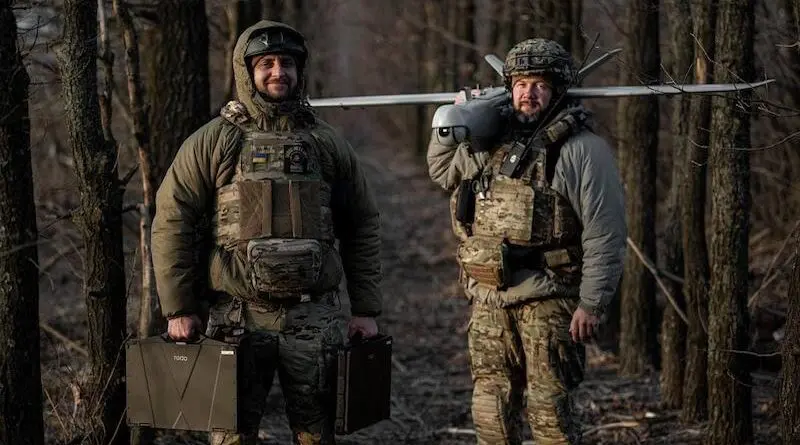
Ukrainian soldiers pose with a drone. Photo Credit: Anton Sheveliov, Ukraine Ministry of Defence

By 

By Antonio Graceffo

On September 10, Ukrainian forces launched the largest drone attack of the war to date, targeting Moscow with 144 drones. The assault resulted in 20 drones being shot down, while several multi-story residential buildings near Moscow were set ablaze. Flights from Russia’s most important airports were temporarily suspended. In response, Russia launched a retaliatory strike using 46 drones.

The strikes from both sides highlight a now indisputable fact: drone warfare is playing a determining role in the Ukraine war.

Armed drones, or Unmanned Aerial Vehicles (UAVs), are pilotless aircraft used to locate, monitor, and strike targets, including individuals and equipment. Since the September 11 attacks, the United States has significantly expanded its use of UAVs for global counterterrorism missions. Drones have key advantages over manned weapons. They can stay airborne for over 14 hours, compared to under four hours for manned aircraft like the F-16, allowing for continuous surveillance without risking pilot safety. Additionally, drones offer near-instant responsiveness, with missiles striking targets within seconds, unlike slower manned systems, such as the 1998 cruise missile strike on Osama bin Laden, which relied on hours-old intelligence.

There is much discussion in the US defense establishment regarding the use of drones, drone policy and how they should be incorporated into military strategy. According to the Marine Corps University, in order to calculate the effectiveness of a drone strike, several factors must be considered, including Tactical Military Effectiveness (TME), Operational Military Effectiveness (OME), and Strategic Military Effectiveness (SME). TME assesses how well the drone strike achieves its immediate objective, such as neutralizing a specific target. OME evaluates the broader impact on military operations, such as troop movements or operational coordination. Lastly, SME considers the long-term consequences of drone warfare, including the effects of drone strikes on enemy leadership, public opinion, and international relations. All three factors are critical in ensuring that drone strikes align with both short-term and long-term military objectives.

Drones are being deployed in large numbers in the Ukraine war, having already played a major role in the battles between Armenian and Azerbaijani forces in Nagorno-Karabakh. They are also becoming an increasingly key platform in the Myanmar civil war and conflicts across the Middle East. Advanced militaries, including the Pentagon, are closely monitoring these theaters to refine their own drone strategies. For example, recently the U.S. released a ‘drone hellscape strategy’ for the defense of Taiwan, while China has been conducting simulations of a drone-only attack on the island. Yet even the world’s most advanced militaries seem to lack a definitive approach to drone warfare. And, ironically, they continue to learn valuable lessons from underfunded and undertrained rebels in other far-flung global conflicts.

Drone warfare in the Myanmar civil war

The Free Burma Rangers, a frontline aid group in the Myanmar civil war, has been reporting on the increasing incidence of drone warfare in the conflict. On September 6, 2024, a Tatmadaw drone strike resulted in the deaths of four civilians—two men and two women, and one person was also wounded in the attack. Another drone dropped a handmade bomb on a civilian home in Loi Lem Lay Village, Karenni State. During the same incident, a Tatmadaw drone with six propellers experienced mechanical issues while flying over the battlefield and was subsequently captured by the Karenni Nationalities Defence Force (KNDF), a pro-democracy ethnic army. Taken together, these incidents underscore how drone warfare is still in its tactical infancy, with numerous failed deployments, and how payloads and weaponization are often being improvised by soldiers on the ground.

Other rebel armies in the Myanmar civil war, particularly the People’s Defense Forces (PDF), have developed their own drone units. For instance, a PDF unit reportedly carried out 125 drone strikes during the Battle of Loikaw in Kayah State. Another unit claims responsibility for around 80 drone strikes last year, resulting in the deaths of 80 to 100 junta troops. These forces are either manufacturing their own drones or repurposing civilian models by adding deployable explosives. The drones are inexpensive, widely available, and highly effective. Even the junta, supported by China and Russia, has adopted similar tactics by attaching mortar shells to their drones, while ethnic armiesoften use homemade explosives based on mortar shells captured from the Tatmadaw. These devices can range from 40 to 60mm, carry up to 2.5 kg of explosives and shrapnel, and are capable of killing or injuring anyone within a 100-meter radius in open terrain.

FPV drones a game-changer in the Ukraine war

In addition to homemade and modified drones, first-person view (FPV) drones can cost around $500 USD each, while reconnaissance drones equipped with advanced cameras can run into the thousands. Ukraine is deploying these drones at a rate of 100,000 per month, with plans to produce one million FPV drones in 2024. For a sense of just how important drones have become in the Ukraine war, consider the fact that this figure far exceeds the number of artillery shells supplied by the entire European Union over the past year.

FPV drones, launched from improvised platforms, can fly between 5 and 20 kilometers depending on their size, battery, and payload. Controlled by a soldier using a headset for a first-person view, with another providing guidance via maps on a tablet, these drones are often used to target vulnerable points such as tank hatches or engines. Their real-time video feed, transmitted through goggles or a headset similar to VR gaming, gives the operator precise control, especially in complex environments like urban warfare or dense terrain. FPV drones are effective for reconnaissance, targeted strikes, and even suicide missions, where they carry explosives and fly directly into a target. Unlike planes or helicopters, they are not hindered by anti-aircraft systems near the front lines. In fact, a $500 FPV drone can target the open hatch of a Russian tank worth millions of dollars, demonstrating their cost-effectiveness in modern warfare.

The rise of counter-drone and jamming technologies

As drone warfare becomes increasingly common on the battlefield, a need arises for effective drone jamming technologies. While Russian, Ukrainian, and other armies have access to jammers, ethnic armies in Myanmar lack them almost entirely. Jammers start at $2,400, but many cheap, commercially available models are essentially useless due to significant design flaws. Some have fixed antennae that point upward, despite attacks coming from the side, and many generate excessive heat without proper cooling. This raises concerns about their effectiveness in harsh environments, such as the deserts of the Middle East or the humid jungles of Myanmar.

Moreover, electronic jamming devices work on specific frequencies and drone pilots are adapting by switching to less commonly used ones. To counter this, new technologies like pocket-sized “tenchies” and backpack electronic warfare (EW) systems have emerged, jamming signals across a broader 720-1,050 MHz range, making them more effective against Russian drones. Despite Ukraine’s deployment of these newer jammers, Russia’s use of hunter-killer drone systems like the Orlan-10 for spotting and the Lancet for strikes, along with missile-equipped Orion drones, continue to challenge Ukraine’s drone defenses.

In response, Ukraine has created the Unmanned Systems Force (USF), a military branch dedicated to drone warfare. Additionally, semi-autonomous drones using AI are being developed to bypass jamming altogether. We remain in the nascent stages of drone warfare, where evolution is playing out in real time via innovations on the battlefield. In this sense, US defense spending in Ukraine is serving as an investment in research and development for the drone wars of tomorrow.


Geopolitical Monitor

Geopoliticalmonitor.com is an open-source intelligence collection and forecasting service, providing research, analysis and up to date coverage on situations and events that have a substantive impact on political, military and economic affairs.