Showing posts sorted by relevance for query GIANT SQUID. Sort by date Show all posts

Sunday, August 22, 2021


World's most elusive giant squid could be monogamous, female corpse hints


By Stephanie Pappas 3 days ago

Squid was embedded with sperm from a single male.


A female giant squid caught in a net off Kyoto had dozens of sperm packets from a single male embedded in her muscles
. (Image credit: Miyazu Energy Aquarium)

A female of the world's largest squid — sometimes called the "kraken" after the mythological sea monster — that was caught off the coast of Japan apparently had just one amorous encounter in her lifetime.

The female had sperm packets from just one male giant squid embedded in her body, which surprised researchers. Because giant squid are solitary creatures that probably run across potential mates only occasionally, scientists expected that females would opportunistically collect and store sperm from multiple males over time.

"We were almost confident that they are promiscuous," said Noritaka Hirohashi, a biologist at Shimane University in Japan. "We just wanted to know how many males are involved in copulation. So this is totally unexpected."


Related: Release the kraken! Giant squid photos


Mysterious mating

Hirohashi and his colleagues study reproduction and sperm biology in several squid species, but the most mysterious of all is Architeuthis dux, the giant squid. Rarely seen alive, the giant squid has a life cycle shrouded in deep ocean mystery. Video of living giant squid in their natural habitats has been captured only twice. The only thing researchers know about these mysterious creatures' mating habits is that female giant squid are sometimes found with large sperm packets known as spermatangia embedded in their muscles. Researchers writing in a 1997 paper in the journal Nature posited that male giant squid probably use their "muscular elongate penis" to inject the sperm packets into the females.

How sperm meets egg from there isn't entirely clear. It's possible that the female releases chemical cues that activate the sperm when she's ready to spawn, or perhaps she releases her eggs in such a way that they trail along the sperm packets as they leave her body. Squid females do have organs near the mouth called seminal receptacles, where some species storm sperm, and it's possible that in those species, the embedded sperm can travel over the skin to these receptacles.

Knowing that witnessing two giant squid mating is highly unlikely, Hirohashi and his team developed a window into the process, using genetics. Examining squid specimens from fisheries and museum archives, they pinpointed some segments of the giant squid genome that would distinguish one set of squid DNA from another. Think of it like a squid paternity test: Any sperm packets found on a female can be tested to see if they came from multiple males and, if so, how many.

The researchers are always on the lookout for sperm-spangled females. They send out flyers to local museums, fisheries and aquariums, asking them to alert the research lab if a giant squid specimen turns up. In February 2020, they got good news.

"In this case, we found [a] Yahoo News [article] telling that the giant squid was caught," Hirohashi wrote in an email to Live Science.

Saving sperm


The spermatangia, or sperm packets, embedded in the upper layer of muscle on the female giant squid. No one knows how the sperm get to the eggs to fertilize them. (Image credit: Miyazu Energy Aquarium)

The specimen was a female, with a mantle, or main body, 5.25 feet (1.6 meters) long. It was missing a pair of tentacles and one eye but still weighed 257 pounds (116.6 kilograms). The squid had been caught in a fisher's net in Kyoto and was displayed at the Miyazu Energy Aquarium before being dissected.


When Hirohashi's team examined the body, they found that the squid was just reaching maturity and that it had squiggly spermatangia 3.9 inches (10 centimeters) long embedded in five separate locations: three places on the squid's mantle, one by an arm and one on the head. Each location hosted at least 10 spermatangia. Some were near gashes that may have been caused by a mating male's beak.


Genetic analysis of the spermatangia revealed that each and every one came from the same male. This was shocking to the research team; giant squid are often found bearing sperm packets, in a way that suggests that males aren't particularly picky. Spermatangia have been found on immature females, perhaps as a way for males to make their sperm available after the female matures, and even on males, perhaps because males are willing to try anything (or perhaps because they sometimes accidentally self-fertilize). All of the evidence pointed to a species that would mate first and ask questions later.

RELATED CONTENT


Animal sex: 7 tales of naughty acts from the wild

Gallery: Vampire squid from hell

Under the sea: A squid album

The specimen, of course, is just one female, so more research is needed to see if monogamy is the norm among giant squid females. It's possible that this female had simply only encountered one male before she was entangled in the net that ended her life, the researchers wrote in the September issue of the journal Deep Sea Research Part 1. Or perhaps it is typical for females to mate with just one male. The gashes might be part of the males' strategy for ensuring other males don't move in, perhaps by limiting a female's life span after mating so that she doesn't have time to collect more sperm. Or, the researchers speculated, the aggression and injuries could spur the females to mature and spawn so that the sperm is speedily fertilized.

The next step is to study the spermatangia of more specimens, Hirohashi said. And researchers need to figure out how the stored sperm reaches the eggs, which are not deposited particularly close to the spermatangia. Researchers also need to figure out basically everything else about this elusive creature, including its life span, migration and habitats, he added.

"Kids ask these questions at the aquarium, so we must answer," Hirohashi said.

Originally published on Live Science

Monday, January 20, 2020


Revealed: The Mysterious, Legendary Giant Squid’s Genome


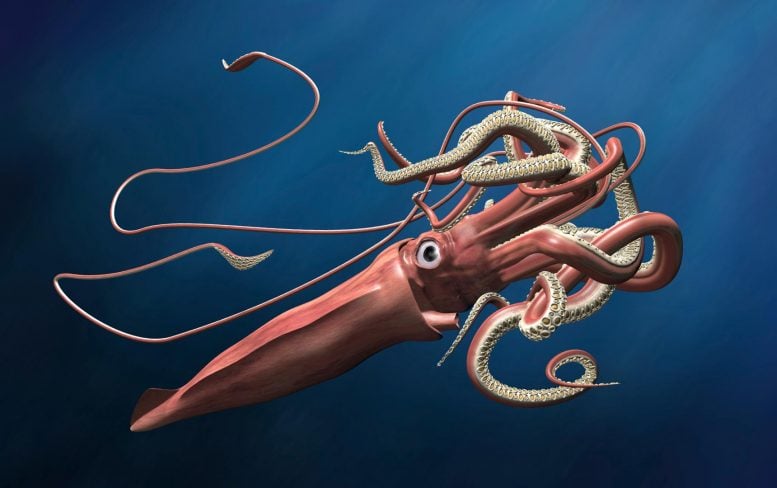
Giant Squid Illustration
How did the monstrous giant squid – reaching school-bus size, with eyes as big as dinner plates and tentacles that can snatch prey 10 yards away – get so scarily big?
Today, important clues about the anatomy and evolution of the mysterious giant squid (Architeuthis dux) are revealed through publication of its full genome sequence by a University of Copenhagen-led team that includes scientist Caroline Albertin of the Marine Biological Laboratory (MBL), Woods Hole.
Giant squid are rarely sighted and have never been caught and kept alive, meaning their biology (even how they reproduce) is still largely a mystery. The genome sequence can provide important insight.
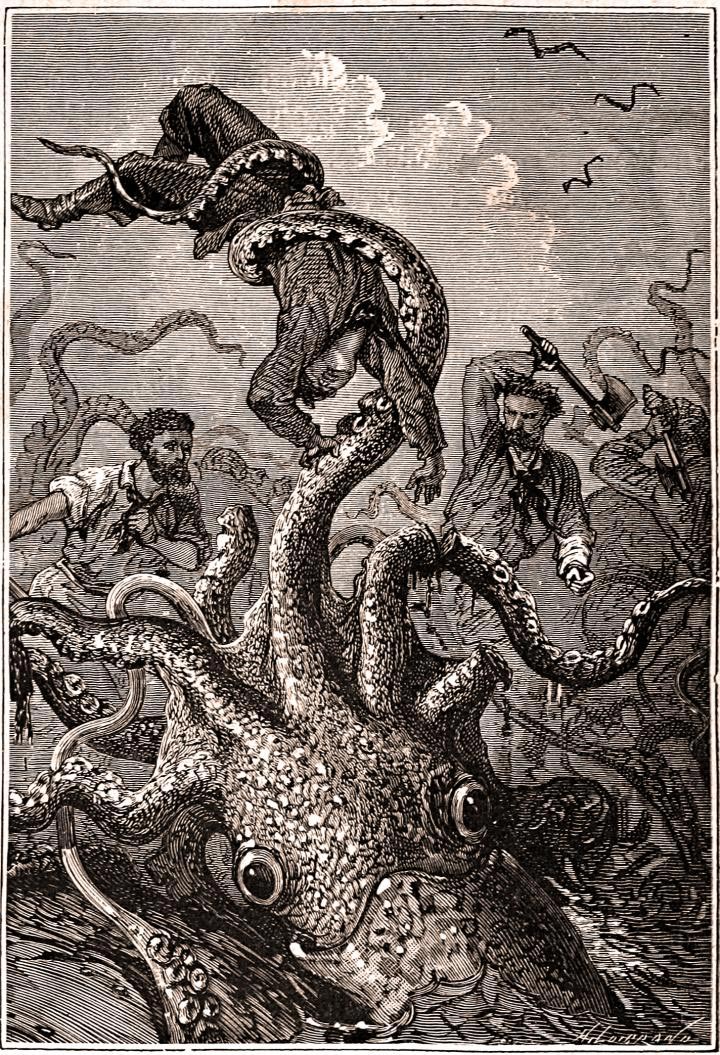
Giant Squid Captures Sailor
The giant squid has long been a subject of horror lore. In this original illustration from Jules Verne’s ‘20,000 Leagues Under the Sea,’ a giant squid grasps a helpless sailor. Credit: Alphonse de Neuville
“In terms of their genes, we found the giant squid look a lot like other animals. This means we can study these truly bizarre animals to learn more about ourselves,” says Albertin, who in 2015 led the team that sequenced the first genome of a cephalopod (the group that includes squid, octopus, cuttlefish, and nautilus).
Led by Rute da Fonseca at University of Copenhagen, the team discovered that the giant squid genome is big: with an estimated 2.7 billion DNA base pairs, it’s about 90 percent the size of the human genome.
Albertin analyzed several ancient, well-known gene families in the giant squid, drawing comparisons with the four other cephalopod species that have been sequenced and with the human genome.
She found that important developmental genes in almost all animals (Hox and Wnt) were present in single copies only in the giant squid genome. That means this gigantic, invertebrate creature – long a source of sea-monster lore – did NOT get so big through whole-genome duplication, a strategy that evolution took long ago to increase the size of vertebrates.
So, knowing how this squid species got so giant awaits further probing of its genome.
“A genome is a first step for answering a lot of questions about the biology of these very weird animals,” Albertin said, such as how they acquired the largest brain among the invertebrates, their sophisticated behaviors and agility, and their incredible skill at instantaneous camouflage.
“While cephalopods have many complex and elaborate features, they are thought to have evolved independently of the vertebrates. By comparing their genomes we can ask, ‘Are cephalopods and vertebrates built the same way or are they built differently?'” Albertin says.
Albertin also identified more than 100 genes in the protocadherin family – typically not found in abundance in invertebrates – in the giant squid genome.
“Protocadherins are thought to be important in wiring up a complicated brain correctly,” she says. “They were thought they were a vertebrate innovation, so we were really surprised when we found more than 100 of them in the octopus genome (in 2015). That seemed like a smoking gun to how you make a complicated brain. And we have found a similar expansion of protocadherins in the giant squid, as well.”
Lastly, she analyzed a gene family that (so far) is unique to cephalopods, called reflectins. “Reflectins encode a protein that is involved in making iridescence. Color is an important part of camouflage, so we are trying to understand what this gene family is doing and how it works,” Albertin says.
“Having this giant squid genome is an important node in helping us understand what makes a cephalopod a cephalopod. And it also can help us understand how new and novel genes arise in evolution and development.”
Reference: “A draft genome sequence of the elusive giant squid, Architeuthis dux” by Rute R da Fonseca, Alvarina Couto, Andre M Machado, Brona Brejova, Carolin B Albertin, Filipe Silva, Paul Gardner, Tobias Baril, Alex Hayward, Alexandre Campos, Ângela M Ribeiro, Inigo Barrio-Hernandez, Henk-Jan Hoving, Ricardo Tafur-Jimenez, Chong Chu, Barbara Frazão, Bent Petersen, Fernando Peñaloza, Francesco Musacchia, Graham C Alexander, Jr, Hugo Osório, Inger Winkelmann, Oleg Simakov, Simon Rasmussen, M Ziaur Rahman, Davide Pisani, Jakob Vinther, Erich Jarvis, Guojie Zhang, Jan M Strugnell, L Filipe C Castro, Olivier Fedrigo, Mateus Patricio, Qiye Li, Sara Rocha, Agostinho Antunes, Yufeng Wu, Bin Ma, Remo Sanges, Tomas Vinar, Blagoy Blagoev, Thomas Sicheritz-Ponten, Rasmus Nielsen and M Thomas P Gilbert, 16 January 2020, GigaScience.
DOI: 10.1093/gigascience/giz152

Study Reveals That Giant Squid Throughout the World Are Genetically Similar


Study Reveals Population Structure of the Giant Squid Architeuthis
Study reveals that giant squid such as this one are genetically similar throughout the world. David Paul/Museum Victoria
In a newly published study, researchers examine the mitochondrial genome diversity of 43 giant squid samples collected from across the range of the species, finding that there is only one global species of giant squid, Architeuthis.
The giant squid is one of the most enigmatic animals on the planet. It is extremely rarely seen, except as the remains of animals that have been washed ashore, and placed in the formalin or ethanol collections of museums. But now, researchers at the University of Copenhagen leading an international team, have discovered that no matter where in the world they are found, the fabled animals are so closely related at the genetic level that they represent a single, global population, and thus despite previous statements to the contrary, a single species worldwide. Thus the circle, that was first opened in 1857 by the famous Danish naturalist Japetus Steenstrup as he first described the animal, can be closed. It was Steenstrup that realized this beast was the same animal that in the past gave rise to centuries of sailors tails, and even in more recent became immortalized by writers such as Jules Verne and Herman Melville, by demonstrating that the monster was based in reality, and gave it the latin name Architeuthis dux.
It was less than 1 year ago, that the giant squid, Architeuthis dux, was first filmed alive in its natural element. Taken at a depth of 630m and after 100 missions and 400 hours of filming, the footage was captured by a small submarine lying off the Japanese island of Chichi Jima – near to the famous Iwo Jima that was the scene of some of the bloodiest fighting between Japan and the USA in the Second World War.
Now, PhD student Inger Winkelmann and her supervisor Professor Tom Gilbert, from the Basic Research Center in GeoGenetics at the Natural History Museum of Denmark, Copenhagen University, have managed to place new bricks into the puzzle of this giant 10 armed invertebrate, that is credibly believed to grow up to 13 meters long and way over 900 kg.
And the two scientists conclusions are: No matter what a sample looks like, its one species all over the deep oceans of the planet.
Sinking to the depths
PhD student Inger Winkelmann says about these findings, that are published in the esteemed British journal, the Proceedings of the Royal Society B:
– We have analysed DNA from the remains of 43 giant squid collected from all over the world. The results show, that the animal is genetically nearly identical all over the planet, and shows no evidence of living in geographically structured populations. We suggest that one possible explanation for this is that although evidence suggests the adults remain in relatively restricted geographic regions, the young that live on the ocean’s surfaces must drift in the currents globally. Once they reach a large enough size to survive the depths, we believe they dive to the nearest suitable deep waters, and there the cycle begins again. Nevertheless, we still lack a huge amount of knowledge about these creatures. How big a range to they really inhabit as adults? Have they in the past been threatened by things such as climate change, and the populations of their natural enemies, such as the planet’s largest toothed whale, the sperm whale that can grow up to 20 m in length and 50 tons? And at an even more basic level…how old do they even get and how quickly do they grow?
The kraken and the seamonk
These new results about the mysterious giant squid are released, fittingly enough, on the 200th anniversary of the Danish naturalist and polymath, Japetus Steenstrup (born in 1813).
At the age of 44, in 1857, it was Steenstrup who saw that many of the monsters of sea-legend were related to fragments that he had been sent of what appeared to be a giant squid, and in doing so described the species for the first time and removed any hope that sea monsters such as the Kraken and sea-monk really existed (although nevertheless, similar monsters still inspired beasts in literature and even films throughout the 20th century, including Tolkein’s Lord of the Rings in 1957).
Professor Tom Gilbert, who lead the team that undertook the research, says:
– It has been tremendous to apply the latest techniques in genetic and computational analyses, to follow up on Steenstrup’s scientific research 146 years after he started it. But its also been a fantastic experience to work with the giant squid as a species, because of its legendary status as a seamonster. But despite our findings, I have no doubt that these myths and legends will continue get today’s children to open their eyes up – so they will be just as big as the real giant squid is equipped with to navigate the depths.
The work was undertaken in collaboration with researchers around the world, including scientists in Australia, New Zealand, Japan, Spain, Portugal, USA and Ireland.
Publication: Inger Winkelmann, et al., “Mitochondrial genome diversity and population structure of the giant squid Architeuthis: genetics sheds new light on one of the most enigmatic marine species,” Proc. R. Soc. B 22 May 2013 vol. 280 no. 1759; doi: 10.1098/rspb.2013.0273
Image: David Paul/Museum Victoria


Friday, February 21, 2020

IFLScience logo

Giant Squid And Glow-In-The-Dark Sharks Captured By Researchers Off New Zealand

AS GIANT SQUIDS GO, AT JUST 4 METERS, THIS WAS PROBABLY A JUVENILE. PHOTO: BRIT FINUCCI/NIWA


By Katy Evans 18 FEB 2020

If you’re going to find strange creatures of the deep it’ll be off the coast of New Zealand, where legendary giants have long roamed.

So it shouldn’t be too much of a surprise to learn that researchers exploring New Zealand’s deep waters on the hunt for elusive glow-in-the-dark sharks and hoki managed to catch an unexpected hitchhiker: a 4-meter (13-foot) giant squid.

Researchers aboard the New Zealand-based National Institute of Water and Atmospheric Research Ltd (NIWA) research vessel Tangaroa were on an expedition to survey hoki, New Zealand’s most valuable commercial fish, in the Chatham Rise – an area of ocean floor to the east of New Zealand that makes up part of the "lost continent" of Zealandia.

At 7.30am on the morning of January 21, scientists were hauling up their trawler net from a depth of 442 meters (1,450 feet) when they were surprised to spot tentacles in amongst their catch. Large tentacles.

According to voyage leader and NIWA fisheries scientist Darren Stevens, who was on watch, it took six members of staff to lift the giant squid out of the net. Despite the squid being 4 meters long and weighing about 110 kilograms (240 pounds), Stevens said he thought the squid was “on the smallish side,” compared to other behemoths caught.


Darren Stevens measures the squid, finds it "on the smallish side". Photo: Brit Finucci, NIWA

Though giant squids are very rare, they can be found around the world, from Japan to the Gulf of Mexico, but they most often seem to crop up around New Zealand waters.

“New Zealand is kind of the giant squid capital of the world – anywhere else a giant squid is caught in a net would be a massive deal. But there’s been a few caught off New Zealand," Stevens said in a statement.

“It’s only the second one I’ve ever seen. I’ve been on about 40 trips on Tangaroa, and most surveys are about a month, and I’ve only ever seen two. That’s pretty rare.”

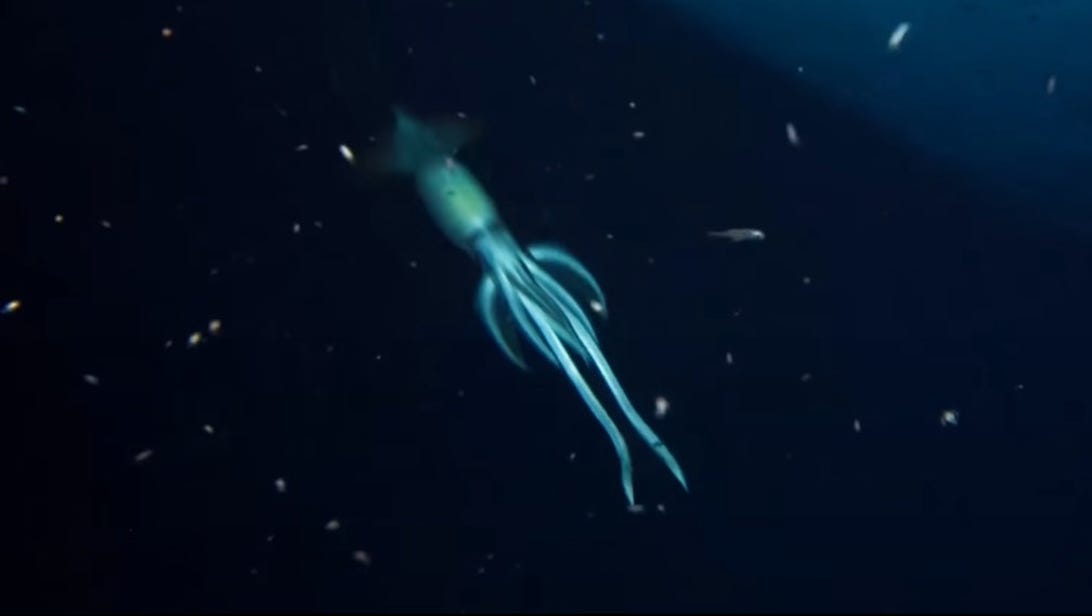
With eight arms, and two long tentacles tipped with sharp suckers, often twice the length of the rest of the squid, two giant eyes (the largest in the animal kingdom at 25 centimeters/10 inches) and a sharp beak that can devour fish and other squids, Architeuthis dux is the stuff of legends.


I've got my eye on you. Photo: Brit Finucci, NIWA

Because New Zealand actually hosts other giant squid specimens, the researchers onboard only took scientific samples of the valuable bits – the head, eyes, reproductive organs, and stomach. A tiny bone structure in its head will be used to try and age the squid, something there is no way of doing yet.

“We took the stomach because virtually nothing is known about a giant squid’s diet because every time people seem to catch one, there's very rarely anything in their stomachs,” Stevens said.

“Getting two giant squid eyes is apparently enough for a scientific paper. They're really rare, and you need a fresh one. So it was a really unique set of circumstances to get two fresh eyes.”

While the squid was fortuitous, Dr Jérôme Mallefet of UCLouvain, Belgium – the world's leading expert on bioluminescent sharks – was determined to capture and photograph glow-in-the-dark sharks. He even set up a darkroom aboard the RV Tangaroa in anticipation, and was rewarded handsomely with the first evidence of bioluminescent sharks in New Zealand waters.

Seal shark [left] and lucifer dogfish [right]. Photo: Dr J.Mallefet FNRS, Belgium

According to Dr Mallefet, 11 percent of known shark species can produce bioluminescent light, living in near-total darkness at more than 200 meters (656 feet) down. He photographed the southern lantern shark, lucifer dogfish, and seal shark, all of which emit a blue light (though some sharks emit green), as shorter wavelengths travel well through deep waters.

We shouldn't really be surprised that both the Kraken and creatures that glow live in the waters surrounding New Zealand. Its land creatures have always erred on the side of unusual too.

---30---
 

Thursday, October 06, 2022

CTHULHU KRAKEN STUDIES
Giant Squids Washed Ashore Give Scientists New Clues

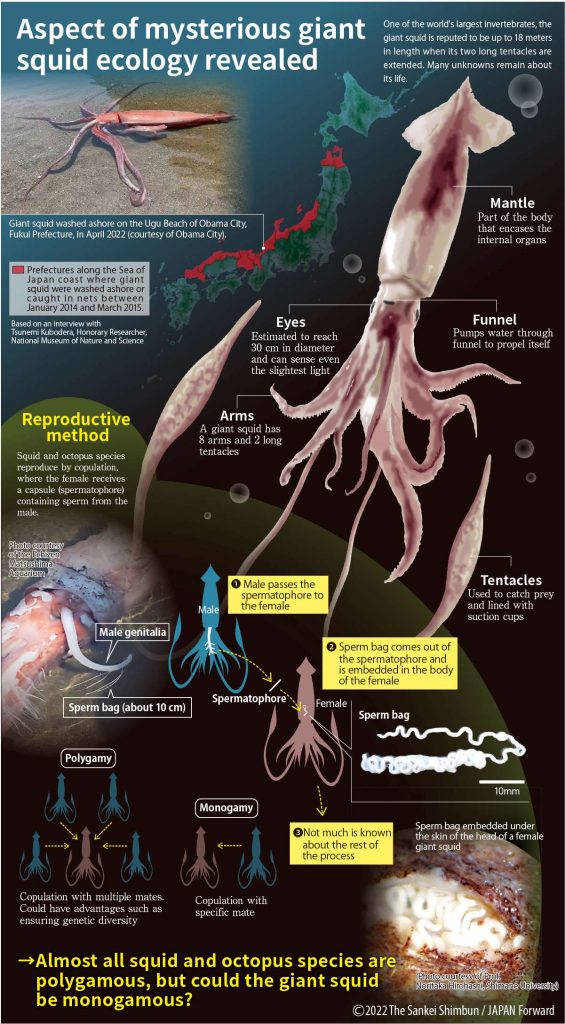
Giant squids washed ashore on the Sea of Japan coast are providing researchers with new insights into how this mysterious marine animal mates and reproduces.


on October 6, 2022
By Saki Maehara
JAPAN FORWARD
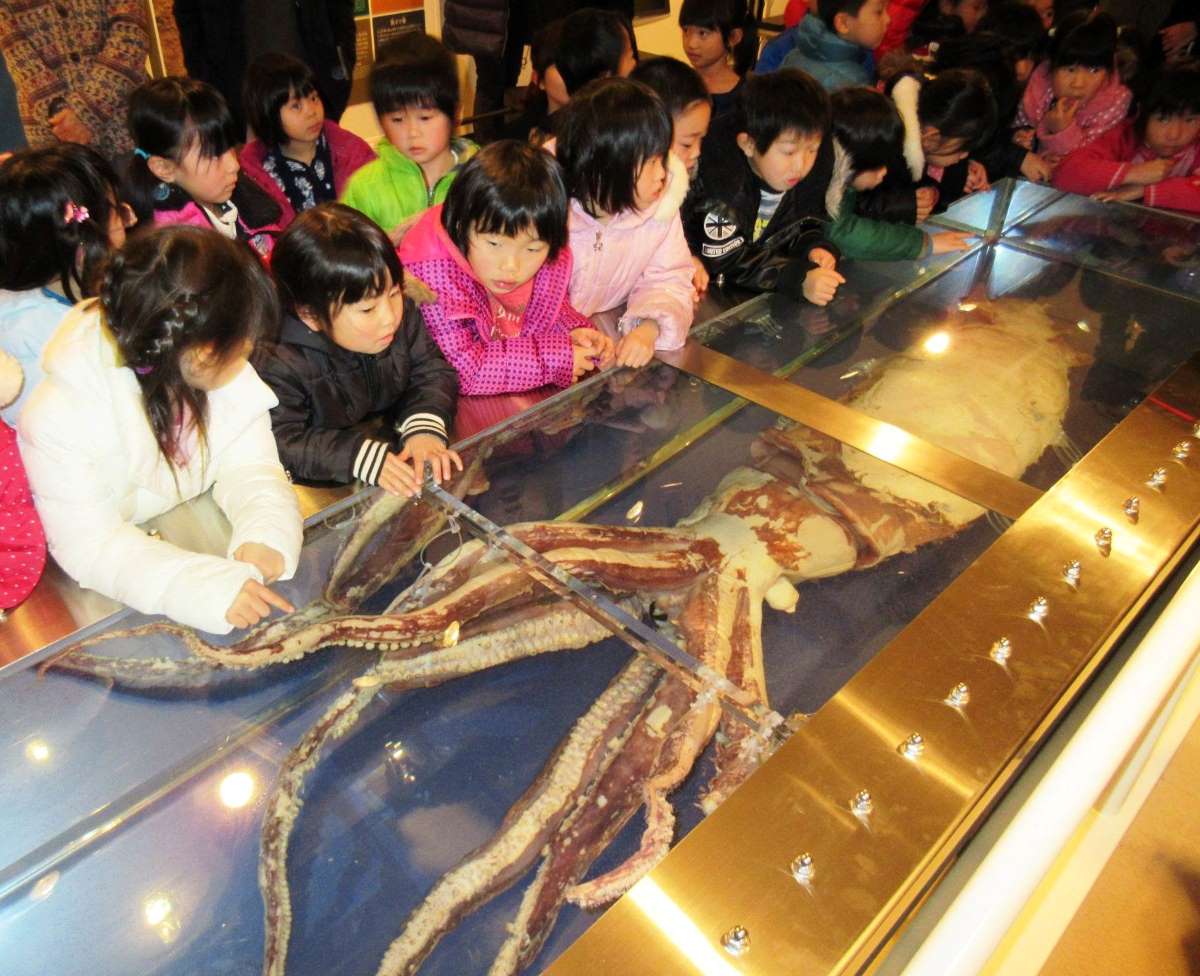
Children observing giant squid specimen at San-in Kaigan Geopark Sea and Earth Nature Museum in Iwami Town, Tottori Prefecture, February 2, 2016.

The giant squid is one of the world's largest invertebrates that lives in the deep sea. It is believed to be the origin of the legend of "Kraken," a monster feared by sailors in the age of sea exploration.

Although the animal remains shrouded in mystery, recent research analyzing individuals that have drifted ashore on the Sea of Japan coast has revealed a unique reproductive method that differs from that of other squids.

There is still much to learn about this giant creature that lurks in the depths of the sea.
Giants Washing Ashore

In April of this year, a local fisherman discovered a large red squid drifting in the sea at Ugu Beach in Obama City of Fukui Prefecture.

A city official who rushed to the site upon hearing the news found a giant squid measuring 3.35 meters in length. It had washed ashore, but its arms were still flapping.

One resident among those gathered on the beach remarked in awe, "It was huge." Another noted, "It's rare to see one alive." Later, at the Echizen Matsushima Aquarium (Sakai City, Fukui Prefecture), children were able to see the squid on display.

Giant squid are often found washed ashore on the coasts of Japan. With their two long tentacles extended, they can reach up to 18 meters in length.


Another aspect of the mysterious giant squid is revealed.

The deep sea is broadly defined as depths over 200 meters. But according to Tsunemi Kubodera, 71, a marine biologist and honorary researcher at the National Museum of Nature and Science, giant squid mainly live in middle layers of the ocean between 600 to 1,000 meters.

Read the rest of this article here to find out more on the biology of the giant squid. And find more great articles on the environment and the challenges of achieving the SDGs, on our new website Japan 2 Earth, sparking a transition on the environment and SDGs.

Friday, January 20, 2023

WATCH: Divers record rare sea creature video off the coast of Japan

Video has surfaced of a giant squid swimming off the coast of Japan, marking a rare sighting and footage of these elusive creatures.

Yosuke Tanaka, 41, encountered the 8-foot-long squid while diving with his wife Miki, 34, off the western coast of Japan. The couple, who operate a diving business in Toyooka city, found out about the squid from a fishing equipment vendor who spotted it in a bay, Japan Times reported.

Tanaka and Miki took a boat out in search of the creature, staying near the shoreline as they scoured the bay.

"I could see its tentacles moving. I thought it would be dangerous to be grabbed hard by them and taken off somewhere," Tanaka told the Times.

"We didn’t see the kinds of agile movements that many fish and marine creatures normally show," he added. "Its tentacles and fins were moving very slowly."

Yosuke Tanaka, 41, encountered the 8-foot-long squid while diving with his wife Miki, 34, off the western coast of Japan.

The footage, posted to Viral Press, shows the giant squid floating near the surface, its tentacles drifting behind it while the couple swim nearby. The squid seems either unaware or undisturbed by their presence.

An honorary researcher at the National Museum of Nature and Science in Tokyo told NHK news that the squid was likely around 1 or 2 years old, based on its size. A giant squid can grow as long as 39 feet.

While diving off Queensland, Australia, in 2018, Jay Wink, owner and operator of Abc Scuba Diving Port Douglas, captured this image of what seems to be strings of squid eggs held together by a gelatinous material.

The sheer size of the animal struck Tanaka, and he said he couldn’t help thinking about stories of squids fighting with whales. He assured that the experience would remain with him, saying it was "very exciting" and "there is nothing rarer than this."

Giant squids have occasionally appeared along Japan’s coast, with the last known sighting in March 2022. Most of what scientists have learned about giant squids comes from the stomachs of sperm whales, one of the squid’s chief predators.


In a rare event, a live giant squid (Architeuthis dux) is hauled to the surface on a baited hook in Japan. The giant squid can be 40 feet long tip-to-tail and weigh nearly a ton. (Tsunemi Kubodera)

A study estimated that sperm whales feed upon up to 131 million giant squids each year, Newsweek reported. The animals are most commonly found around New Zealand and Japan, as well as the North Atlantic and waters around Africa.


Monday, October 11, 2021

#KRAKEN #CRYPTID #CRYPTOZOOLOGY

Giant 'mystery creature' filmed by scientists exploring Red Sea shipwreck

Talk about a real-life Squid Game.


Amanda Kooser
Oct. 10, 2021 

This deep-sea animal surprised OceanX scientists when they spotted it 
on camera while investigating a shipwreck in the Red Sea.
Video screenshot by Amanda Kooser/CNET

It's cool enough to find a shipwreck. It's even better to spot a massive, mysterious sea creature hanging out with the wreck. That's what happened to the crew of the OceanX OceanXplorer research vessel during an expedition in the Red Sea in late 2020.

A year later, OceanX is revealing more information about the remarkable animal that swam past its remote-vehicle camera as it examined the wreck of the passenger ship Pella at a depth of nearly 2,800 feet (850 meters).

Zoologist and squid expert Mike Vecchione studied the footage and suggested that despite its size, the animal was not an infamous "giant squid" due to its body proportions and shape of its fins. Vecchione identified it as a jumbo example of a purpleback flying squid.

An OceanX video posted on Wednesday shows the fast-moving animal and Vecchione's analysis.


OceanX science program lead Mattie Rodrigue described seeing the squid -- which she estimated was larger than a human being -- for the first time as it swam past the bow of the wreck. "I was frozen in absolute shock," she said.

The researchers spotted either the same squid or others like it during subsequent dives. Vecchione said they represent "the giant form" of the purpleback flying squid.

OceanX is focused on ocean research, exploration, outreach and protection. The Red Sea mission's goal was to answer the question: "How do species in the Red Sea thrive where others would die?" Researchers discovered large animals, like the squid, as well as sites with climate-change resistant corals.

While the creature Rodrigue observed wasn't a legendary giant squid, it was a stunning and unexpected sight. A true wonder of the deep.

Thursday, November 12, 2020

Rare Bigfin Squid in Australian waters

Scientists record some striking footage.

Australia is home to a host of weird and wonderful creatures, and now it can add the rare Bigfin Squid to its inventory.


Credit: Matthew Marrison (MNF)

Scientists aboard a deep-sea research voyage led by the national science agency CSIRO have recorded five individuals in the Great Australian Bight at depths of up to three kilometres.

It’s a first for Australian waters, and one of only a dozen confirmed sightings worldwide.

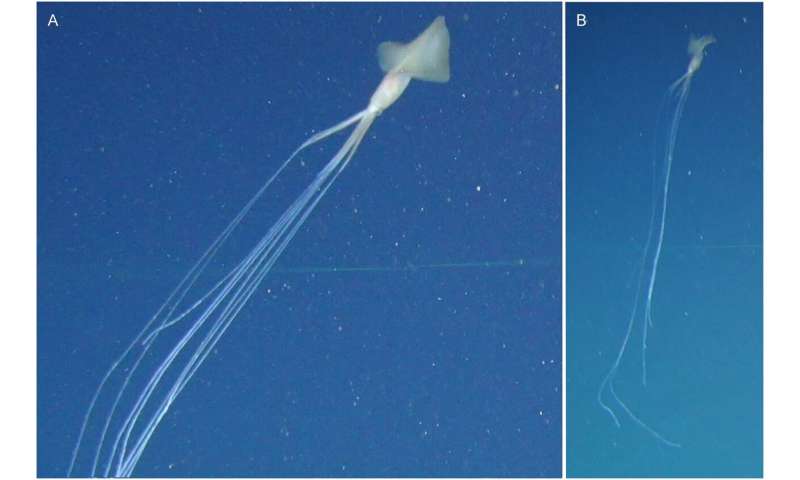
Alongside its large fins, the appropriately named Bigfin Squid (family Magnapinnidae) has striking long arm and tentacle filaments.

“Differences in their appearance meant we were able to confirm they were five separate individuals, rather than the same squid multiple times, and although the surveys covered a relatively large area, the squid were actually found clustered close together,” says marine scientist Deborah Osterhage.

From the recordings, the team was able to measure the length of one squid, finding its tentacle filaments were more than 11 times their body length.

They also observed their colours and behaviours, including filament coiling behaviour which has not previously been seen in squids.

The findings are reported in the journal PLOS ONE.


Five Enormous Rarely Seen Squid Have Been Spotted In Australian Waters


THIS FLOCK OF NOODLES HAS NEVER BEFORE BEEN SEEN IN AUSTRALIAN WATERS. 
CSIRO, OSTERHAGE ET AL. PLOS ONE, 2020


By Rachael Funnell11 NOV 2020, 19:00


The ocean is home to some absolute whoppers and some of the largest creatures are also the most elusive. One such giant is the bigfin squid that belongs to the family Magnapinnidae, a group of deep-sea squid with large fins and long, noodly arms and tentacles. It has only been spotted in the flesh on a handful of occasions. Now, new research published in the journal PLOS One details the incredible discovery of five bigfin squid in the Great Australian Bight, the first time they’ve been seen in Australian waters.

Previous reports of these ocean giants have always been of a single individual, so to capture five of these on camera was a big deal for the team from Australia’s national science agency, CSIRO. Though they weren’t spotted all at once, the bigfins have small differences in their appearance, which made it easy for the team to recognize they were five different animals and not just one camera-hungry squid. All five were seen at depths of 2 to 3 kilometers (around 1.5 miles) over a 25-hour period but were within 300 meters (984 feet) of one another, constituting a veritable crowd for an animal that’s never been seen with a party of more than one.
Bigfins have modestly sized bodies compared to their incredible long tentacle filaments. Osterhage et al. (PLOS ONE, 2020) 
VIDEO https://www.iflscience.com/plants-and-animals/five-enormous-rarely-seen-squid-have-been-spotted-in-australian-waters/

The first-of-its-kind discovery offered a unique opportunity to shine some light on these creatures of the deep, and the team were able to get an accurate reading on their size for the first time. Previous in-situ attempts to measure them have involved using nearby objects of known length, such as the arm of a submersible, but this new research used lasers to get a more accurate picture of their size. The results? The largest individual was over 1.8 meters (almost 6 feet) long with a maximum tentacle length of almost 11 times its body size. The animal was mostly white at the tips of its arms and tentacles but was sporting a mix of brown, orange, and pink hues towards its upper limbs, mantle, and fins. The researchers also spotted a behavior never before observed in squid, as a bigfin adopted a raised arm posture known as the ‘elbow’ pose.


“We filmed the five bigfin squid in depths of 2 to 3 kilometers using a towed camera system and remotely operated vehicles (ROVs),” said marine scientist Deborah Osterhage from CSIRO in an email to IFLScience. “We were doing image-based surveys to find out more about the deep-sea environment in the Great Australian Bight. The first two were seen in the towed camera footage when it was watched back onshore in the video lab. We recognized them as bigfin squid and knew how rare it was to see them, so in the subsequent ROV survey we really kept an eye out for them. We were lucky enough to see three more and were able to watch in real-time on the ship while the ROV filmed them — pretty exciting!

“Little is known of bigfin squid, and many other deep-sea cephalopods, largely due to the inaccessibility of their vast yet little explored deep-sea environments and there is much more to learn about the deep-sea and the incredible animals that live there. So, for bigfin squid we need to wait for more sightings, or more ideally an adult specimen in good condition — which has never been collected before.”

Multiple sightings of mysterious bigfin squid documented in the Great Australian Bight

by Bob Yirka , Phys.org
Sighting 3: ROV images of a Magnapinna squid at a depth of 3060 m. (A) Close view of the Magnapinna squid encountered 5.3 m above the seafloor with proximal arms/tentacles seen slightly opened and fins undulating slowly. (B) Full extent of arms/tentacles, the longest being approximately 1680 mm. Credit: PLOS ONE (2020). DOI: 10.1371/journal.pone.0241066

A team of researchers from the CSIRO Energy, Commonwealth Scientific and Industrial Research Organization and Museums Victoria has documented multiple sightings of bigfin squid in the depths of the Great Australian Bight. In their paper published in PLOS ONE, the group describes their study of the unique creatures and what they learned about them.


Bigfin squid live deep in the ocean and are noteworthy for several reasons. The first is that they are rarely seen in the wild—researchers have documented just 12 sightings. They also have unique fins that jut out from the side of the head at an angle that resembles Dumbo's ears—and they serve the same purpose, though in the water instead of the air. They also have long tentacles that are multiple times longer than their bodies. And they live thousands of meters deep in the ocean.

Because of their remoteness, little is known about the bigfin squid other than their general physical attributes. This sighting is the first in the Great Australian Bight (the huge open bay on the country's southern coast). Additionally, this is the first time the squid has been observed in a group of sorts. Though hundreds of meters apart, they were apparently sharing parts of the ocean. Squid are typically loners.

Another first was taking laser measurements of one specimen: a bigfin squid with a body (mantle) that was 15 centimeters long. More impressive were its tentacles, which were measured at 1.8 meters. All previous measurements of bigfin squid had been estimates based on background information such as other fish in the vicinity.


PlaySighting 5 of Magnapinna sp. in the GAB. This video was taken by ROV on 25 March 2017 at a depth of approximately 3056 m. Blue boxes are present in the lower corners to mask embedded logos in accordance with publishing requirements. Credit: PLOS ONE (2020).
 DOI: 10.1371/journal.pone.0241066

The researchers found the squid while they were conducting underwater surveys in the Bight. When they came across the first specimen, they deployed further tools to get a better look. They used both remotely operated underwater vehicles and towed cameras. In all, they carried out over 40 hours of underwater observations at depths ranging from 950 to 2400 meters below the surface—and wound up getting footage of five of the rare squid.


Explore further  Did a shark clash with large squid and live to tell the tale?

More information: Deborah Osterhage et al. Multiple observations of Bigfin Squid (Magnapinna sp.) in the Great Australian Bight reveal distribution patterns, morphological characteristics, and rarely seen behavior, PLOS ONE (2020). 

Journal information: PLoS ONE

Friday, December 24, 2021

Scientists Unearth a Ginormous Triassic Sea Monster That Once Roamed The 'Superocean'


(Stephanie Abramowicz/Natural History Museum)

LAURA GEGGEL, LIVE SCIENCE
24 DECEMBER 2021

A sea monster that lived during the early dinosaur age is so unexpectedly colossal, it reveals that its kind grew to gigantic sizes extremely quickly, evolutionarily speaking at least.

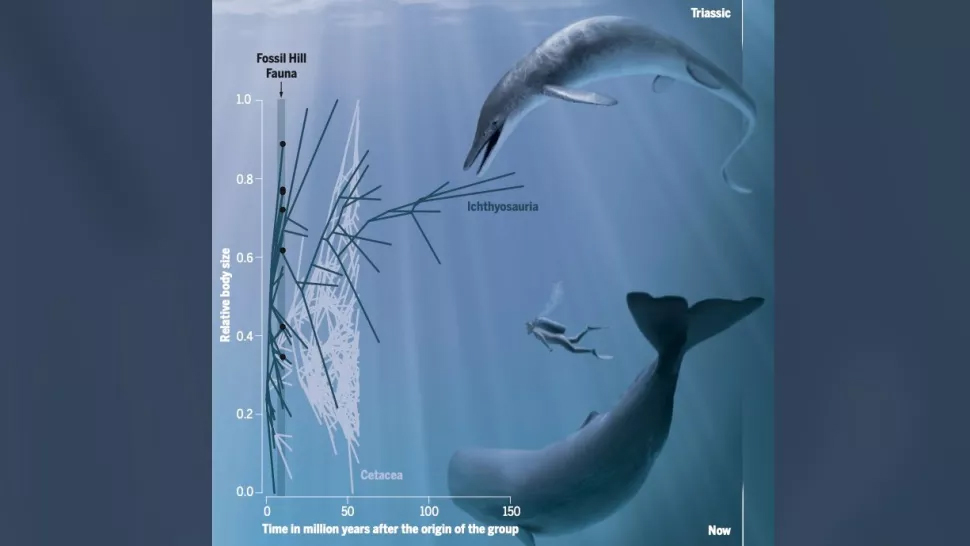
The discovery suggests that such ichthyosaurs – a group of fish-shaped marine reptiles that inhabited the dinosaur-era seas – grew to enormous sizes in a span of only 2.5 million years, the new study finds.

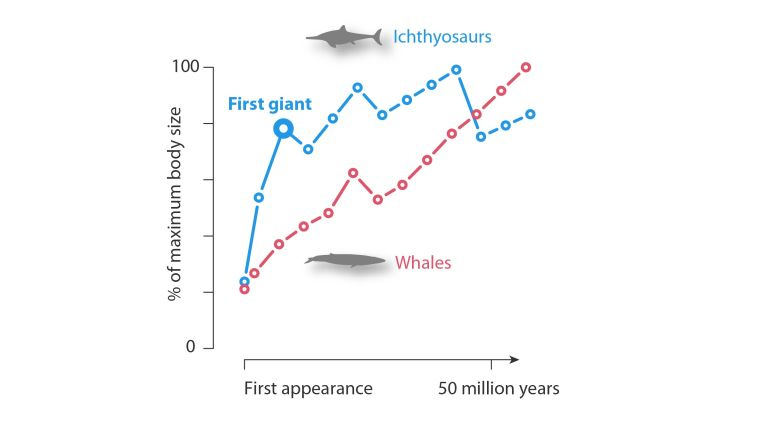
To put that in context, it took whales about 90 percent of their 55 million-year history to reach the huge sizes that ichthyosaurs evolved to in the first 1 percent of their 150 million-year history, the researchers said.

"We have discovered that ichthyosaurs evolved gigantism much faster than whales, in a time where the world was recovering from devastating extinction [at the end of the Permian period]," study senior researcher Lars Schmitz, an associate professor of biology at Scripps College in Claremont, California, told Live Science in an email.

"It is a nice glimmer of hope and a sign of the resilience of life – if environmental conditions are right, evolution can happen very fast, and life can bounce back."

(Lars Schmitz)

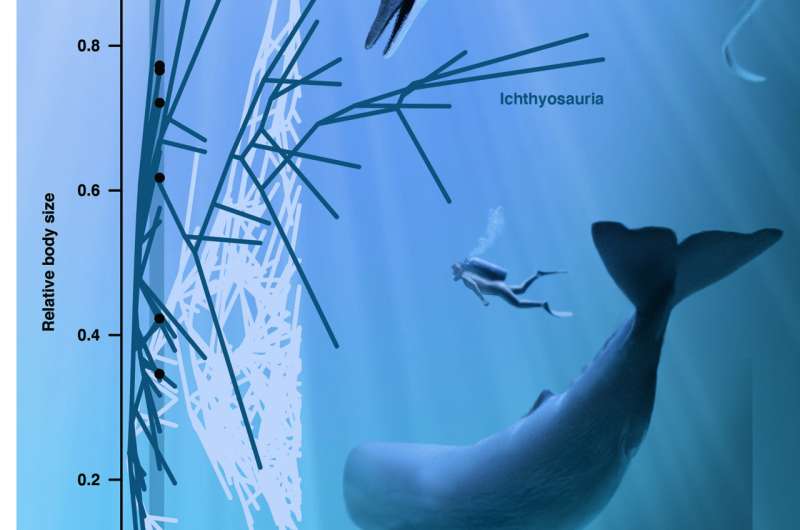
Above: Ichthyosaurs evolved their large body sizes much quicker than whales. The curves depict the trajectory of the largest body size, expressed in percentage of the largest size ever reached, for ichthyosaurs and whales. The ichthyosaur curve is initially much steeper than the corresponding curve for whales.

Related: Image gallery: Ancient monsters of the sea

Researchers first noticed the ancient ichthyosaur's fossils in 1998, embedded in the rocks of the Augusta Mountains of northwestern Nevada.

"Only a few vertebrae were sticking out of the rock, but it was clear the animal was large," Schmitz said.

But it wasn't until 2015, with the help of a helicopter, that they were able to fully excavate the individual – whose surviving fossils include a skull, shoulder, and flipper-like appendage – and airlift it to the Natural History Museum of Los Angeles County, where it was prepared and analyzed.

The team named the new species Cymbospondylus youngorum, they reported online Thursday (Dec. 23) in the journal Science. This big-jawed marine reptile lived 247 million years ago during the Triassic period. Like other creatures from that time, it was weird.

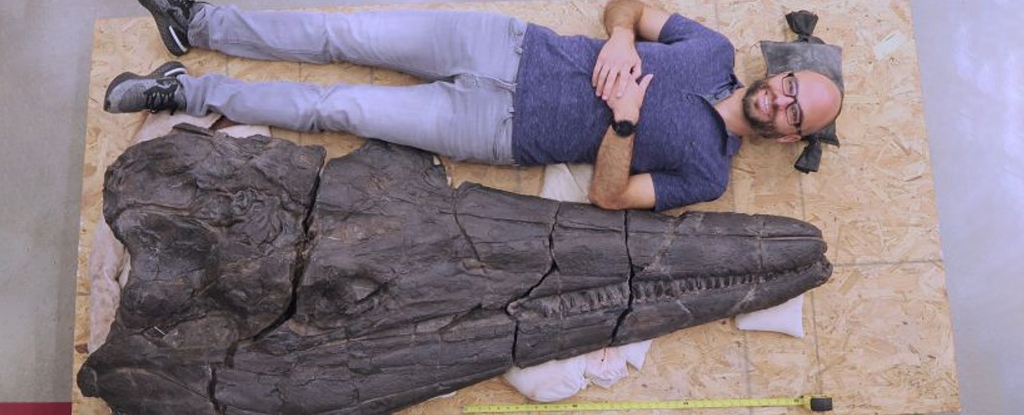
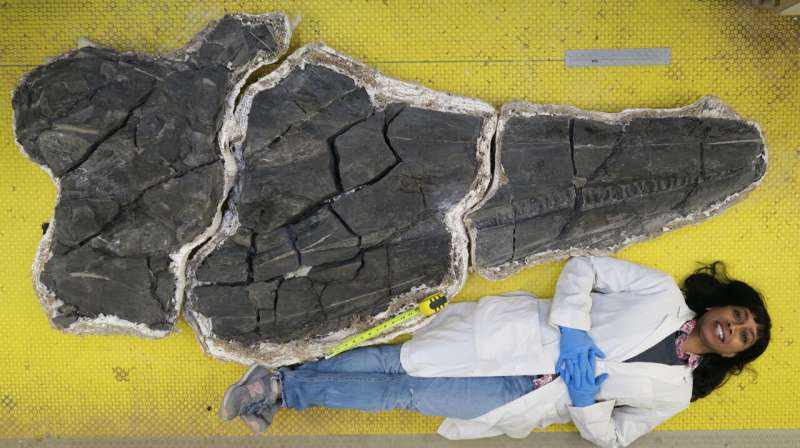
The new ichthyosaurs skull with a human for scale. (Martin Sander)
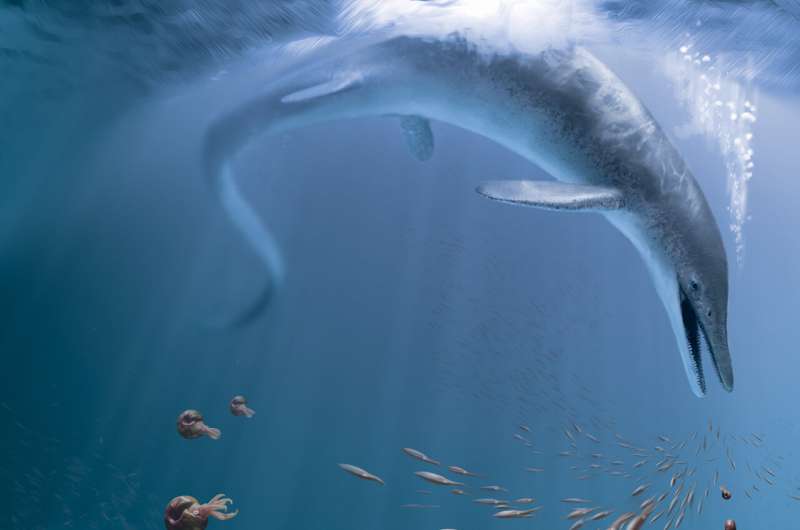
"Imagine a sea-dragon-like animal: streamlined body, quite long, with limbs modified to fins, and a long tail," Schmitz said. With a nearly 6.5-foot-long (2 meters) skull, this full-grown C. youngorum would have measured over 55 feet (17 m), or longer than a semitrailer, the researchers found.

When the 45-ton (41 metric tons) C. youngorum was alive, C. youngorum would have lived in the Panthalassic Ocean, a so-called superocean, off the west coast of North America, Schmitz said.

Based on its size and tooth shape, C. youngorum likely ate smaller ichthyosaurs, fish, and possibly squid, he added.

(Georg Oleschinski, courtesy of the University of Bonn)

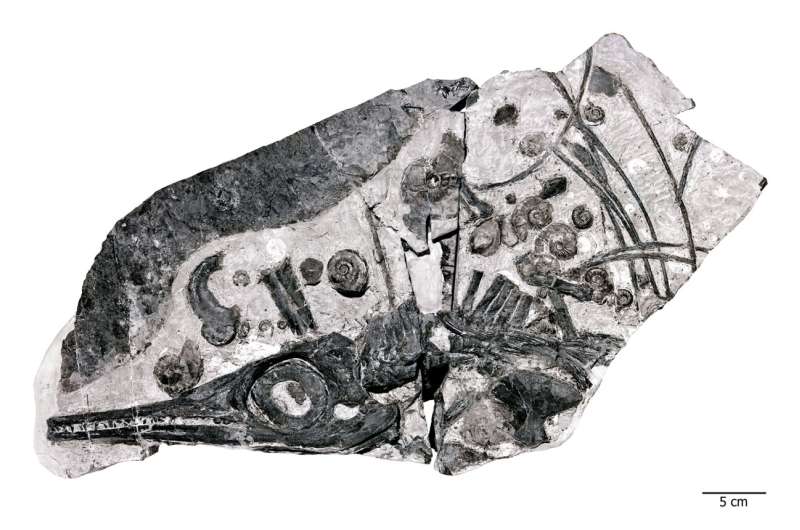
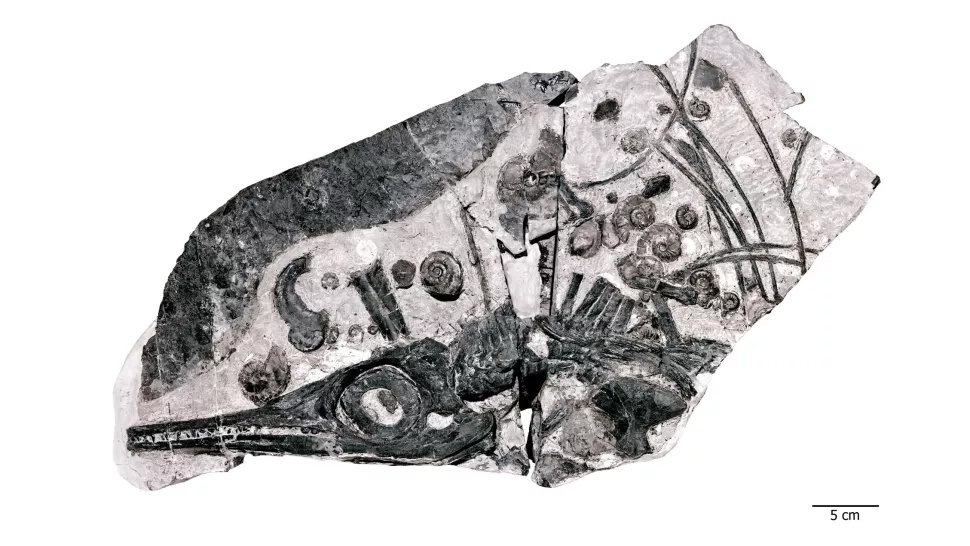
Above: The Fossil Hill fauna of Nevada not only includes the new giant species but also a number of other ichthyosaurs, such as this small (=30 cm skull length) Phalarodon. This specimen also includes examples of the very abundant ammonite fossils that are associated with the ichthyosaurs.

There are many huge beasts that lived during the dinosaur era, but C. youngorum stands out for several reasons. For instance, C. youngorum lived just 5 million years after "the Great Dying," a mass extinction event that occurred 252 million years ago at the end of the Permian period, which killed about 90 percent of the world's species.

That makes the ichthyosaur's huge size all the more impressive, as it took about 9 million years for life on Earth to recover from that extinction, a 2012 study in the journal Nature Geoscience found.

However, there was a diversification boom of marine mollusks known as ammonoids within 1 million to 3 million years of the mass extinction, the 2012 study found.

It appears that ichthyosaurs' venture into gigantism was, in part, due to chowing down on the early Triassic boom of ammonites, as well as jawless eel-like conodonts that filled the ecological void following the mass extinction, the researchers of the new study said.

In contrast, whales got big by eating highly productive primary producers, such as plankton; but these were absent in dinosaur-age food webs, study co-author Eva Maria Griebeler, an evolutionary ecologist at the Johannes Gutenberg University of Mainz in Germany, said in a statement.

(Stephanie Abramowicz/Natural History Museum)

Above: Direct comparison of two ocean giants from different epochs side by side: The Triassic C. youngorum (the new species described in the paper) versus. today's sperm whale, with a human for scale.

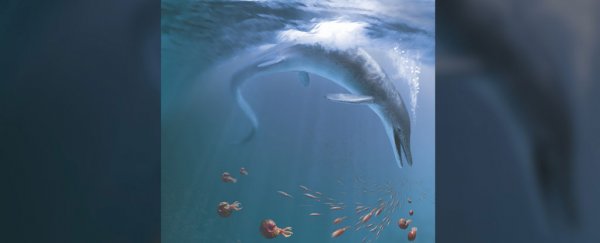
Despite the whales' and ichthyosaurs' different paths and timetables toward achieving gigantism, the groups have a few similarities. For instance, there is a connection between large size and raptorial hunting, just like sperm whales dive to hunt giant squid, as well as a connection between large size and tooth loss, just like the giant filter-feeding whales that are toothless, the researchers said.


"This new fossil impressively documents the fast-track evolution of gigantism in ichthyosaurs," Schmitz said. In contrast, whales "took a different route to gigantism, much more prolonged and not nearly as fast.

"Ichthyosaur history tells us ocean giants are not guaranteed features of marine ecosystems, which is a valuable lesson for all of us in the Anthropocene," paleontologists Lene Delsett and Nicholas Pyenson, who weren't involved with the research wrote in a related Perspective published in the same issue of Science.

Related content:

Image gallery: Photos reveal prehistoric sea monster

In images: Graveyard of ichthyosaur fossils in Chile

Photos: Uncovering One of the largest plesiosaurs on record

This article was originally published by Live Science. Read the original article here.

Earth's first-known giant was as big as a sperm whale

Earth's first giant
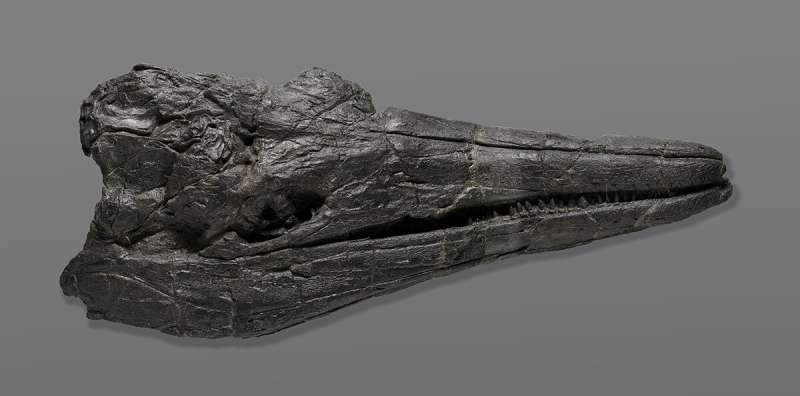
The skull of the first giant creature to ever inhabit the Earth, the ichthyosaur 
Cymbospondylus youngorum, currently on display at the Natural History Museum 
of Los Angeles County. Credit: Natalja Kent / Natural History Museum of Los Angeles County

The two-meter skull of a newly discovered species of giant ichthyosaur, the earliest known, is shedding new light on the marine reptiles' rapid growth into behemoths of the Dinosaurian oceans, and helping us better understand the journey of modern cetaceans (whales and dolphins) to becoming the largest animals to ever inhabit the Earth.

While  ruled the land, ichthyosaurs and other aquatic reptiles (that were emphatically not dinosaurs) ruled the waves, reaching similarly gargantuan sizes and species diversity. Evolving fins and hydrodynamic body-shapes seen in both fish and whales, ichthyosaurs swam the ancient oceans for nearly the entirety of the Age of Dinosaurs.

"Ichthyosaurs derive from an as yet unknown group of land-living reptiles and were air-breathing themselves," says lead author Dr. Martin Sander, paleontologist at the University of Bonn and Research Associate with the Dinosaur Institute at the Natural History Museum of Los Angeles County (NHM). "From the first skeleton discoveries in southern England and Germany over 250 years ago, these 'fish-saurians' were among the first large fossil reptiles known to science, long before the dinosaurs, and they have captured the popular imagination ever since."

Earth's first giant
A life recreation of C. youngorum stalking the Nevadan oceans of the Late Triassic 
246 million years ago. Credit: Stephanie Abramowicz / Natural History Museum of 
Los Angeles County

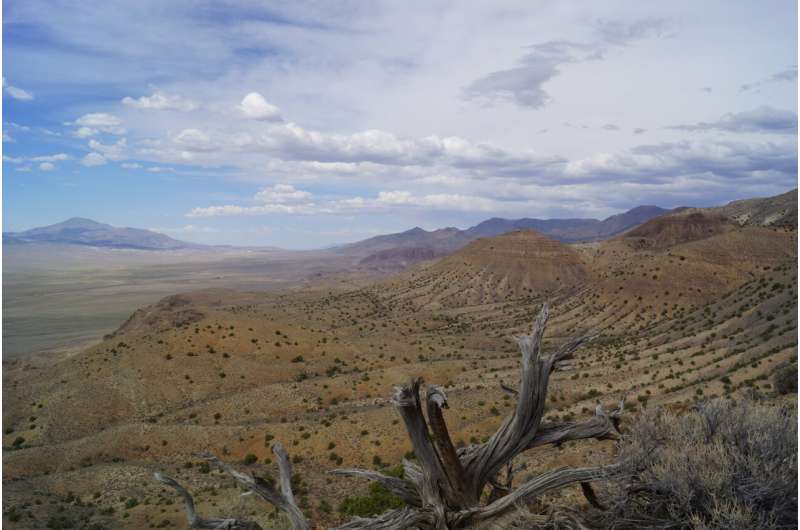
Excavated from a rock unit called the Fossil Hill Member in the Augusta Mountains of Nevada, the well-preserved skull, along with part of the backbone, shoulder, and forefin, date back to the Middle Triassic (247.2-237 million years ago), representing the earliest case of an  reaching epic proportions. As big as a large  at more than 17 meters (55.78 feet) long, the newly named Cymbospondylus youngorum is the largest animal yet discovered from that time period, on land or in the sea. In fact, it was the first giant creature to ever inhabit the Earth that we know of.

"The importance of the find was not immediately apparent," notes Dr. Sander, "because only a few vertebrae were exposed on the side of the canyon. However, the anatomy of the vertebrae suggested that the front end of the animal might still be hidden in the rocks. Then, one cold September day in 2011, the crew needed a warm-up and tested this suggestion by excavation, finding the skull, forelimbs, and chest region."

The new name for the species, C. youngorum, honors a happy coincidence, the sponsoring of the fieldwork by Great Basin Brewery of Reno, owned and operated by Tom and Bonda Young, the inventors of the locally famous Icky beer which features an ichthyosaur on its label.

In other mountain ranges of Nevada, paleontologists have been recovering fossils from the Fossil Hill Member's limestone, shale, and siltstone since 1902, opening a window into the Triassic. The mountains connect our present to ancient oceans and have produced many species of ammonites, shelled ancestors of modern cephalopods like cuttlefish and octopuses, as well as marine reptiles. All these animal specimens are collectively known as the Fossil Hill Fauna, representing many of C. youngorum's prey and competitors.

Earth's first giant
Owing to their remote location, fossils have only recently been discovered in the Augusta
 Mountains. An international team of scientists led by Dr. Sander began collecting on public
 lands there 30 years ago, with fossil finds being accessioned to the Natural History
 Museum of Los Angeles County since 2008. Credit: Lars Schmitz

C. youngorum stalked the oceans some 246 million years ago, or only about three million years after the first ichthyosaurs got their fins wet, an amazingly short time to get this big. The elongated snout and conical teeth suggest that C. youngorum preyed on squid and fish, but its size meant that it could have hunted smaller and juvenile  as well.

The giant predator probably had some hefty competition. Through sophisticated computational modeling, the authors examined the likely energy running through the Fossil Hill Fauna's food web, recreating the ancient environment through data, finding that marine food webs were able to support a few more colossal meat-eating ichthyosaurs. Ichthyosaurs of different sizes and survival strategies proliferated, comparable to modern cetaceans'— from relatively small dolphins to massive filter-feeding baleen whales, and giant squid-hunting sperm whales.

Co-author and ecological modeler Dr. Eva Maria Griebeler from the University of Mainz in Germany, notes, "Due to their large size and resulting energy demands, the densities of the largest ichthyosaurs from the Fossil Hill Fauna including C. youngourum must have been substantially lower than suggested by our field census. The ecological functioning of this food web from ecological modeling was very exciting as modern highly productive primary producers were absent in Mesozoic food webs and were an important driver in the size evolution of whales."

Earth's first giant
Natural History Museum of Los Angeles County Dinosaur Institute volunteer Viji Shook
 lying next to the skull of Cymbospondylus youngorum for scale, during the preparation of
 the specimen. Credit: Martin Sander / Natural History Museum of Los Angeles County

Whales and ichthyosaurs share more than a size range. They have similar body plans, and both initially arose after mass extinctions. These similarities make them scientifically valuable for comparative study. The authors combined computer modeling and traditional paleontology to study how these marine animals reached record-setting sizes independently.

"One rather unique aspect of this project is the integrative nature of our approach. We first had to describe the anatomy of the giant skull in detail and determine how this animal is related to other ichthyosaurs," says senior author Dr. Lars Schmitz, Associate Professor of Biology at Scripps College and Dinosaur Institute Research Associate. "We did not stop there, as we wanted to understand the significance of the new discovery in the context of the large-scale evolutionary pattern of ichthyosaur and whale body sizes, and how the fossil ecosystem of the Fossil Hill Fauna may have functioned. Both the evolutionary and ecological analyses required a substantial amount of computation, ultimately leading to a confluence of modeling with traditional paleontology."

Earth's first giant
An ichthyosaur fossil surrounded by the shells of ammonites, the food source that possibly 
fueled their growth to huge. Credit: Georg Oleschinski / University of Bonn, Germany.

They found that while both cetaceans and ichthyosaurs evolved very large body sizes, their respective evolutionary trajectories toward gigantism were different. Ichthyosaurs had an initial boom in size, becoming giants early on in their evolutionary history, while whales took much longer to reach the outer limits of huge. They found a connection between large size and raptorial hunting—think of a sperm whale diving down to hunt giant squid—and a connection between large size and a loss of teeth—think of the giant filter-feeding whales that are the largest animals ever to live on Earth.

Ichthyosaurs' initial foray into gigantism was likely thanks to the boom in ammonites and jawless eel-like conodonts filling the ecological void following the end-Permian mass extinction. While their evolutionary routes were different, both whales and ichthyosaurs relied on exploiting niches in the food chain to make it really big.

Earth's first giant
A figure from the text comparing C. youngorum to a modern sperm whale as well as rates 
of body size evolution over time between ichthyosaurs and cetaceans. The lines trending 
towards the top indicate larger body sizes whereas those towards the bottom are smaller
 sizes. Time is displayed as starting from the point of origin of the group until their extinction 
(for ichthyosaurs) or present (for whales). Credit: Stephanie Abramowicz / Natural History 
Museum of Los Angeles County

"As researchers, we often talk about similarities between ichthyosaurs and cetaceans, but rarely dive into the details. That's one way this study stands out, as it allowed us to explore and gain some additional insight into body size evolution within these groups of marine tetrapods," says NHM's Associate Curator of Mammalogy (Marine Mammals), Dr. Jorge Velez-Juarbe. "Another interesting aspect is that Cymbospondylus youngorum and the rest of the Fossil Hill Fauna are a testament to the resilience of life in the oceans after the worst mass extinction in Earth's history. You can say this is the first big splash for tetrapods in the oceans."

C. youngorum will be permanently housed at the Natural History Museum of Los Angeles County, where it is currently on view.Extinct swordfish-shaped marine reptile discovered

More information: P. Martin Sander et al, Early giant reveals faster evolution of large size in ichthyosaurs than in cetaceans, Science (2021). DOI: 10.1126/science.abf5787

Lene Liebe Delsett et al, Early and fast rise of Mesozoic ocean giants, Science (2021). DOI: 10.1126/science.abm3751 , www.science.org/doi/10.1126/science.abm3751

Journal information: Science 

Provided by Natural History Museum of Los Angeles County