Showing posts sorted by relevance for query MV Sounion. Sort by date Show all posts

Tuesday, September 17, 2024

Disaster averted in Red Sea as burning tanker saved

David Gritten
BBC News


The EU naval mission said it provided protection for the salvage operation


A burning oil tanker that was attacked by Yemen’s Houthi movement has been towed to a safe area in the Red Sea without any spill, an EU naval mission says.

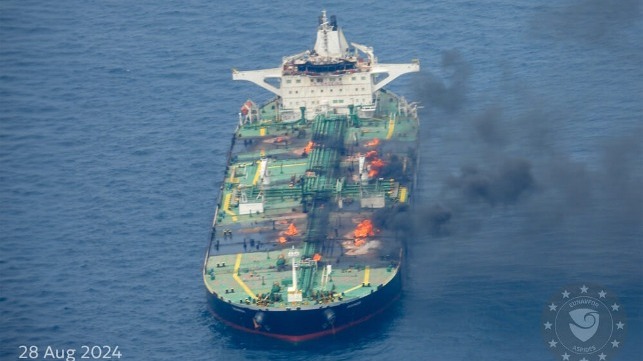
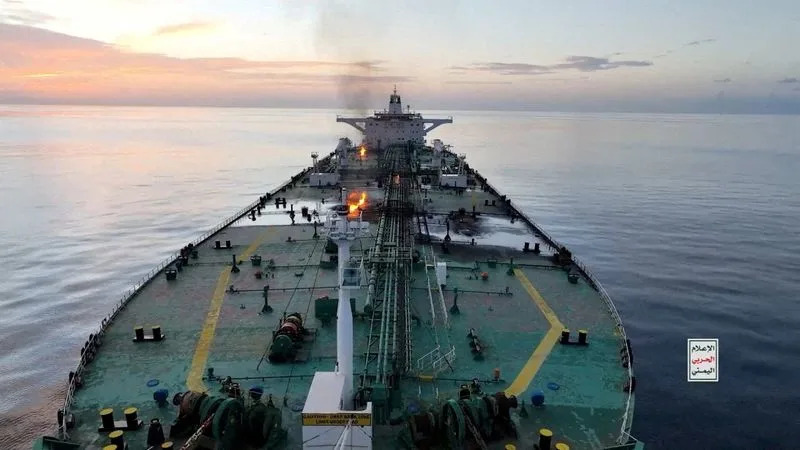
The Greek-owned and flagged MV Sounion, carrying about a million barrels of crude, was abandoned by its crew after being hit by missiles on 21 August. Houthi fighters later detonated explosives on board, sparking several fires.

A photo released on Monday night showed three vessels belonging to what the EU mission described as “private stakeholders” carrying out the salvage operation, protected by a warship.

The Sounion’s destination was not given, but Saudi Arabia has reportedly offered to help the salvagers offload its oil.


“The completion of this phase of the salvage operation is the result of a comprehensive approach and close co-operation between all stakeholders committed to prevent an environmental disaster affecting the whole region,” the EU’s Operation Aspides said on X.

A potential spill from the Sounion could be almost four times larger than the 1989 Exxon Valdez disaster, which saw 2,100km (1,300 miles) of coastline contaminated after a tanker ran aground off Alaska, according to the US.

The Iran-backed Houthis said at the end of August that they had agreed to allow the Sounion to be towed away from Yemen after being contacted by “several international parties”.

They also stressed that the attack on the tanker showed their “seriousness in targeting any ship that violates the Yemeni embargo”.

The Houthis have repeatedly targeted commercial shipping in the Red Sea and Gulf of Aden since November, sinking two vessels, seizing another and causing the deaths of at least four crew members.

They say they are acting in support of the Palestinians in the war between Israel and Hamas in the Gaza Strip. They have claimed - often falsely - that they are targeting ships only linked to Israel, the US or the UK.

They have not been deterred by the deployment of Western warships to protect merchant vessels, nor by US and British air strikes on territory they control in north-western Yemen.

Israel also bombed Yemen in retaliation for a deadly drone strike on Tel Aviv, and it has vowed to make the Houthis pay a “heavy price” for a missile attack on Sunday.

In a separate development on Monday, the Houthis said they had shot down a US-made MQ-9 Reaper drone over Yemen’s Dhamar province and released videos which they said showed the charred wreckage on the ground. The US military said it was aware of the claim.


Thursday, August 22, 2024

Oil tanker ‘Sounion’ 'poses environmental risk' after Red Sea attack

August 22, 2024 

An abandoned oil tanker, at risk of sinking due to poor maintenance, is anchored off Yemen’s southern port city of Aden on July 21, 2021

 [SALEH OBAIDI/AFP via Getty Images]

A Greek-flagged oil tanker carrying 150,000 tonnes of crude that was evacuated by its crew after being attacked in the Red Sea now poses an environmental hazard, the EU’s Red Sea naval mission “Aspides” said on Thursday, Reuters reports.

“Sounion” was targeted on Wednesday by multiple projectiles off Yemen’s port city of Hudaydah, where the Houthis have been attacking ships in solidarity with Palestinians in the war between Israel and Palestine in Gaza.

“Carrying 150,000 tonnes of crude oil, the MV SOUNION now represents a navigational and environmental hazard,” “Aspides” said in a post on social media platform X.

The Houthis, who control Yemen’s most populous regions, have yet to claim responsibility for the attack.

The “Sounion” was the third vessel operated by Athens-based Delta Tankers to be attacked in the Red Sea this month. The attack caused a fire onboard, which was extinguished by the crew, Delta Tankers said in a statement.

The United Kingdom Maritime Trade Operations (UKMTO) agency reported on Wednesday that the attack led to the loss of engine power. The vessel was now anchored between Yemen and Eritrea, a maritime security source told Reuters on Thursday.

Delta Tankers said it is working on a plan to move “Sounion” to a safer destination for further checks and repairs.

The EU Red Sea naval mission said it responded to a request from the captain of the “Sounion” and dispatched a ship to rescue the crew to Djibouti, the “Aspides” said.

“While approaching the area, the EUNAVFOR ASPIDES ship destroyed an Unmanned Surface Vessel (USV) that posed an imminent threat to the ship and the crew,” “Aspides” added.

The Greek shipping ministry said the vessel was sailing from Iraq to Agioi Theodoroi in Greece with a crew of two Russians and 23 Filipinos.

In dozens of attacks in the Red Sea since November, the Houthis have sunk two vessels and seized another, killed at least three sailors and upended global trade by forcing ship owners to avoid the popular Suez Canal trade shortcut.

In another incident on Thursday, a vessel reported an explosion close to it that caused minor damage after an encounter with an uncrewed vessel, 57 nautical miles south of Yemen’s port of Aden, the UKMTO said. The vessel and its crew were safe and it was proceeding to its next port of call.

Greek Shipping Minister, Christos Stylianidis, condemned on Wednesday the attack on the “Sounion”, saying it was “a flagrant violation of international law and a serious threat to the safety of international shipping”

Greek-flagged oil tanker drifting ablaze in Red Sea after apparent Houthi attack


Sounion’s 25 sailors rescued after worst assault by Yemeni group since Israel struck Hodeida in July in response to Tel Aviv drone; 2nd ship attacked in Aden Gulf, no damage

By Jon Gambrell
Today, 

Armed Yemenis lift placards and flags during a rally in the Houthi-controlled capital Sanaa in solidarity with Palestinians amid the war in Gaza, August 16, 2024. (Abdallah Adel / AFP)


DUBAI, United Arab Emirates (AP) — A Greek-flagged oil tanker traveling through the Red Sea came under repeated attack Wednesday, leaving the vessel “not under command” and drifting ablaze after an assault suspected to have been carried out by Yemen’s Houthi rebels, the British military said.

The crew of the Sounion, made up of two Russians and 23 Filipinos, abandoned the vessel and was rescued by the European Unions’s Red Sea naval mission “Aspides,” an official in the mission told Reuters on Thursday.

The attack, the most serious in the Red Sea in weeks, comes during a monthslong campaign by Houthis targeting ships over the Israel-Hamas war in the Gaza Strip that has disrupted a trade route through which $1 trillion in cargo typically passes each year.

In the attack, men on small boats first opened fire with small arms about 140 kilometers (90 miles) west of the rebel-held Yemeni port city of Hodeida, the British military’s United Kingdom Maritime Trade Operations center said.

Four projectiles also hit the ship, it added. It wasn’t immediately clear if that meant drones or missiles.

“The vessel reports being not under command,” the UKMTO said, likely meaning it lost all power. “No casualties reported.” Later, the UKMTO warned that the ship was drifting while on fire in the Red Sea.


The Greek shipping ministry later identified the vessel as the tanker Sounion, with 25 crew members on board at the time of the attack as it traveled from Iraq to Cyprus.

Later Wednesday, the UKMTO reported a second ship being targeted in the Gulf of Aden by three explosions that occurred in the water close to it, though they caused no damage. That ship, the Wind I, came under attack again Thursday with two more explosions striking in the water, the UKMTO said.

The Houthis did not immediately claim responsibility for the attacks, though it can take them hours or even days before they acknowledge their assaults. However, they did acknowledge US airstrikes in Hodeida, which the American military’s Central Command said destroyed a Houthi surface-to-air missile and radar system.

The Houthis have targeted more than 80 vessels with missiles and drones since the war in Gaza was sparked by Hamas’s thousands-strong October 7 assault on southern Israel that left nearly 1,200 people dead and saw 251 kidnapped. Since November, the Yemeni rebels have also seized one vessel and sank two in the campaign that also killed four sailors.

Other missiles and drones have either been intercepted by a US-led coalition in the Red Sea or failed to reach their targets.

The Houthis maintain that they target ships linked to Israel, the United States or the UK to force an end to Israel’s war against Hamas in Gaza. However, many of the ships attacked have little or no connection to the conflict, including some bound for Iran.
The Houthis have also launched drones and missiles toward Israel, including an attack on July 19 that killed one person and wounded 10 others in Tel Aviv. Israel responded the next day with airstrikes on Hodeida that hit fuel depots and electrical stations, killing and wounding a number of people, the rebels say.

After the strikes, the Houthis paused their attacks until August 3, when they hit a Liberian-flagged container ship traveling through the Gulf of Aden. A Liberian-flagged oil tanker came under a particularly intense series of attacks beginning August 8, likely carried out by the rebels. A similar attack happened on August 13.

The last three recent attacks, including Wednesday’s, targeted vessels associated with Delta Tankers, a Greek company.

As Iran threatens to retaliate against Israel over the July 31 assassination of Hamas leader Ismail Haniyeh in Tehran — which Israel neither confirmed nor denied carrying out — the US military told the USS Abraham Lincoln aircraft carrier strike group to sail more quickly to the area.

Early Thursday, the US military’s Central Command said the Lincoln had reached the Mideast’s waters, without elaborating.
America has also ordered the USS Georgia-guided missile submarine into the Mideast, while the USS Theodore Roosevelt aircraft carrier strike group was in the Gulf of Oman.

Additional F-22 fighter jets have flown into the region and the USS Wasp, a large amphibious assault ship carrying F-35 fighter jets, is in the Mediterranean Sea.

Reuters and Times of Israel staff contributed to this report.


French destroyer rescues 29 mariners from oil tanker attacked in Red Sea

French destroyer rescues 29 mariners from oil tanker attacked in Red Sea
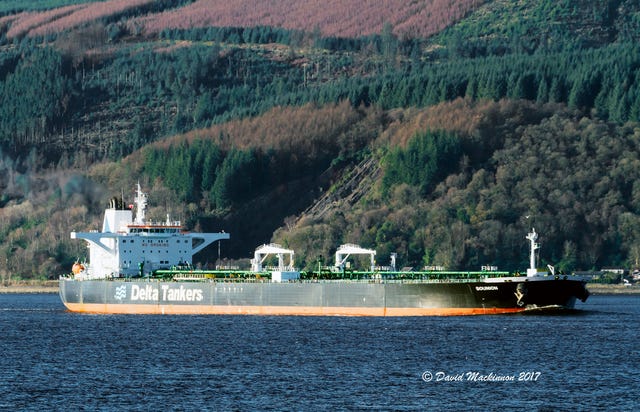
The Greek-flagged oil tanker Sounion was under attack (David Mackinnon via AP)

A French destroyer has rescued 29 mariners from an oil tanker that came under repeated attack in the Red Sea, officials said on Thursday.

Yemen’s Houthi rebels are suspected to have carried out the assault on the Sounion. The attack, the most serious in the Red Sea in weeks, comes during a months-long campaign by Houthis targeting ships over the Israel-Hamas war in the Gaza Strip that has disrupted trade routes.

The Sounion is now at anchor in the Red Sea and no longer drifting, the European Union’s Operation Aspides said. However, it was not clear if the vessel was still on fire. The vessel had been staffed by a crew of Filipinos and Russians.

Military officials did not name the French destroyer involved in the rescue.

In the attack on Wednesday, men on small boats first opened fire with small arms about 90 miles west of the rebel-held Yemeni port city of Hodeida, the British military’s United Kingdom Maritime Trade Operations centre said.

Houthi rebels are suspected to have carried out the assault on the Sounion (David Mackinnon via AP)

Four projectiles also hit the ship, it added.

The Houthis did not immediately claim responsibility for the attacks, though it can take them hours or even days before they acknowledge their assaults. However, they did acknowledge US air strikes in Hodeida that the American military’s Central Command said destroyed a Houthi surface-to-air missile and radar system.

The Houthis have targeted more than 80 vessels with missiles and drones since the war in Gaza started in October. They seized one vessel and sank two in the campaign that also killed four sailors.

Other missiles and drones have either been intercepted by a US-led coalition in the Red Sea or failed to reach their targets.

The rebels maintain that they target ships linked to Israel, the United States or the UK to force an end to Israel’s war against Hamas in Gaza. However, many of the ships attacked have little or no connection to the conflict, including some bound for Iran.

As Iran threatens to retaliate against Israel over the assassination of Hamas leader Ismail Haniyeh in Tehran, the US military told the USS Abraham Lincoln aircraft carrier strike group to sail more quickly to the area. Early on Thursday, the US military’s Central Command said the Lincoln had reached the Middle East’s waters, without elaborating.

America has also ordered the USS Georgia-guided missile submarine into the Middle East, while the USS Theodore Roosevelt aircraft carrier strike group was in the Gulf of Oman.

Wednesday, November 05, 2025


UN Report Details Houthis' Attack Capabilities

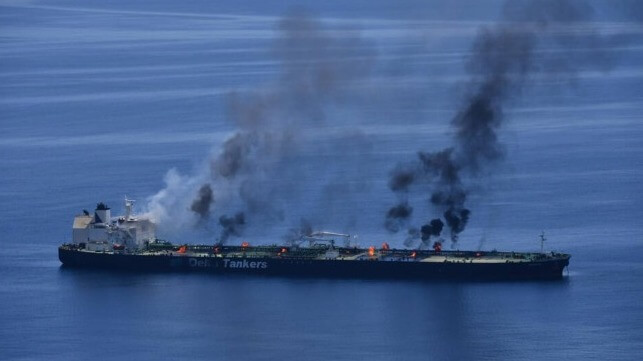
Sounion on fire
Courtesy EUNAVFOR

Published Nov 4, 2025 7:34 PM by The Maritime Executive


The annual report of the Panel of Experts on Yemen has an established reputation for producing carefully researched and well-substantiated information, and this latest report identifies that sanctions imposed on the Houthis have been relatively ineffective in constraining their ability to purchase equipment needed to mount their attacks on shipping.

The report identifies an increase in arms shipment seizures, which it attributes mostly to the closure of port facilities in Houthi controlled areas following US and Israeli attacks. Consignments have been diverted from Hodeidah to Aden instead, and material seized which the Houthis had been attempting to smuggle through border controls with false customs declarations hidden in nondescript containers. Although still dazed after the 12-Day War, Iran still seems to be supporting the Houthis.

The experts assess that Israeli, UK and US strikes over the summer have depleted stocks of missiles and drones, and killed a number of technical experts, but that sufficient capability and expertise remains for the Houthis to continue their campaign - though the attrition was no doubt a factor in the Houthis agreeing to pause their attacks following Omani mediation. A tangible consequence of the air strikes had been the erosion of trust between Houthi leaders, who fear strikes had been aided by some amongst their number, suspicions which have led to increased surveillance and arrests.

In terms of Houthi attacks, the UN experts counted 101 ballistic missiles fired at Israel, of which 57 were intercepted, 38 failed and four impacted in Israel. Most were launched from Sa‘dah and Amran Governorates. IRGC Quds Force Brigadier Abdulreza Shalai has now apparently left, but other IRGC and Hezbollah members remain in Yemen to assist the Houthis with these missile and drone operations.

At sea, 25 vessels were attacked, nine of which were merchant vessels. MV Eternity C (IMO 9588249), MV Magic Seas (IMO 9736169) and MV Sounion (IMO 9312145) were sunk and suffered casualties, the crew of MV Galaxy Leader (IMO 9237307) taken hostage were released, and MV Cordelia Moon (IMO 9297888, now MV Walrus) was damaged by a planted explosive device. 

These attacks have generally followed the same pattern; the target is surrounded by armed groups in small boats and attacked with drones, bringing it to a halt. It is then attacked with ballistic missiles whose targeting mechanisms are insufficiently sophisticated to be able to hit moving targets. The attack on the MV Minervagracht (IMO 9571521) in the Gulf of Aden on September 29, post the cut-off period for the UN report, suggests that this particular technical limitation may have been overcome, and that the Houthis are now able to engage fast-moving targets.

The report details extensive links between the Houthis and Al Shabaab terrorists in Somalia.  The Houthis provide arms and training, Al Shabaab facilitate use of Somali ports for shipments of arms to the Houthis. Al Shabaab militants are trained by the Houthis in Yemen. This cooperation exists notwithstanding that the two groups are at opposite ends of the Shi'a-Sunni extremist divide.

The report also details how the "Houthis have a child recruitment strategy which combines ideological indoctrination, militarized education and selective access to aid," and how this is "reshaping Yemeni society to produce a generation of loyal, uneducated fighters."

In summary, the capability of the Houthis to mount attacks on maritime targets associated with Israel in particular and the West generally has been reduced but not destroyed, which has prompted the Houthis to pause to restock. The ideological determination to carry on the war remains undiminished, and has perhaps been enhanced by identifying external enemies that can act as a focus for patriotic ardor; in this context, the Houthis talk of an entirely fictitious "17 nation anti-Houthi coalition." 

There is some disunity in Houthi ranks, and the internal security crackdown can be expected to diminish operational efficiency - frightening some into withdrawal and disabling some competent leaders falsely accused. The Houthi capability and intent remains therefore more or less intact; what is more uncertain is if the Houthis can maintain the unity of their coalition, and whether those they wish to target will allow them to spread their influence and continue to threaten innocent passage.

Tuesday, September 03, 2024

ECOCIDE

Salvage operation for burning oil tanker in Red Sea to commence


Salvage operations of the immobilized MV Delta Sounion are to commence with support from the European Union's maritime military operation in the Red Sea. 


Photo courtesy of Eunavfor Aspides/X


Sept. 2 (UPI) -- A salvage operation for an immobilized and burning oil tanker in the Red Sea where Houthi rebels have been attacking commercial and military vessels is about to commence, Europe's military mission in the region said Monday.

The Greek-owned and Greek-flagged MV Delta Sounion with some 1 million barrels of crude oil on board was attacked by the Iran proxy militia early Aug. 21 as it was en route from Iraq to Greece via the Red Sea.

Its crew of two Russian and 23 Filipino sailors was evacuated, and the ship was abandoned. At least five fires have since been observed burning on the vessel around the hatches of its oil tanks, with officials warning the ship and its oil contents pose not only an environmental but navigational hazard.

Pentagon officials late last month said previous salvage operations were thwarted by Houthi threats of attack while voicing concern that the vessel appears to be leaking oil.

Related
UKMTO: Merchant vessel struck by 2 projectiles in Red Sea
Pentagon: Houthi-attacked tanker is leaking oil
EU military operation rescues crew of Greek oil tanker hit by Red Sea attack

Eunavfor Aspides, the European Union's military operation in the Red Sea, maintains that there is no visible sign of an oil spill.

On Monday, it announced that salvage operations conducted by third parties were to begin, though specifics were scant.

The EU military mission said in a statement that it will provide tug boats for the operation and "facilitate their efforts to prevent an environmental disaster."

It said that the vessel poses "a significant environmental threat" due to the quantity of oil it is holding.

Embolden by Israel's war in Gaza, the Houthis of Yemen have since mid-November been enforcing a military blockage of the Red Sea and Gulf of Aden by attacking merchant vessels as well as U.S. and British military ships that attempt to transit the all-important trade route.

The Iran proxy militia claims the blockade is in solidarity with the Palestinian people of Gaza.

The Houthis have seized at least one ship, sunk two and killed four sailors amid its roughly 150 attacks on vessels during its blockade.

The announcement came as two unidentified merchant vessels in the Red Sea were hit, according to the United Kingdom Maritime Trade Operations.

One was struck by two projectiles early Monday about 70 nautical miles northwest of Saleef, Yemen. The second was struct about five hours later near the first attack, about 58 nautical miles west of Al Hudaydah, Yemen.

Neither vessel suffered casualties and both were continuing to transit to their next port of call.


UKMTO: Merchant vessel struck by 2 projectiles in Red Sea

Sept. 2, 2024 


Another merchant vessel was seemingly attack in the Red Sea, the United Kingdom Trade Organization said Monday. Image courtesy of United Kingdom Trade Organization/Release

Sept. 2 (UPI) -- A merchant vessel transiting the Red Sea where the Houthi Rebels of Yemen have been attacking ships was struck by two unknown projectiles early Monday, the United Kingdom Maritime Trade Operations said in an advisory note.

The maritime observation agency said the vessel was hit about 70 nautical miles northwest of Saleef, Yemen. A third explosion was also reported in close proximity to the vessel.

"Damage control is underway," the agency said, citing the ship's master.

No casualties were reported onboard and the ship is proceeding to its next port of call, it said.

The ship was not identified.

The Iran-backed Houthis, embolden by Israel's war against Hamas, have been enforcing a military blockade of the Red Sea and Gulf of Aden since Mid-November, attacking vessels that transit the region. they claim it is in solidarity with the Palestinian people of Gaza where Israel is waging war against the other Iran proxy militia.

The rebels have seized one vessel, sunken two and killed at least four sailors amid the blockade, which has seen the Houthis launch some 150 attacks at commercial and military ships.

Salvage Plan Prepared as Greecearns of Oil Leak from Soun

burning oil tanker
Sounion continues to burn with images appearing to show an oil leak (EUNAVFOR Aspides)

Published Aug 30, 2024 1:28 PM by The Maritime Executive


The salvage plan is being prepared with a salvage team organized as they race against time to prevent an environmental disaster in the Red Sea from the burning Greek tanker Sounion. After contradictory statements and images from the various authorities regarding a possible leak, Greece submitted an urgent notice to the International Maritime Organization late on Thursday, August 29.

“According to a satellite image obtained evening hours of 29 August 2024 by the Satellite Services of European Maritime Safety Agency (EMSA), a potential spill of about 2.2 nautical miles length has been detected. The position of the oil spill matches with the location of the ship,” said the urgent notice from the Director General for Shipping of Greece.

The vessel is loaded with 150,000 tons of crude oil and the fires started by the Houthi appear to be spreading to additional tanks based on the images. However, there has been some speculation that the first oil leaks might be from the bunkers and the damaged engine room of the vessel. The Houthis’ video showed several holes above the waterline in the hull from the series of attacks. 


The Dutch company Boskalis confirmed that it “has been asked to help salvage the tanker Sounion,” according to a report in the Dutch newspaper De Telegraaf. A spokesperson for Boskalis said that SMIT is capable of carrying out such a salvage but noted the dangers from the Houthi attacks and unrest in the region. In addition to the fires that were set in the tanks, there are fears that there could be additional explosives on the Sounion

Boskalis’s SMIT salvage group undertook the operation aboard the FSO Safer in the same region before the hostilities. They successfully transferred the oil to a new tanker and cleaned the FSO Safer in preparation for its removal for scrapping. The UN operation however was not completed because of a need for additional funds and the start of the attacks by the Houthis in November 2023.

Salvage teams are expected to approach the Sounion and begin a survey to confirm the plan which would either focus on a ship-to-ship transfer or attempting to move the tanker. Reuters is quoting unnamed sources saying the first efforts could begin over the weekend. 

“Greece urges all nations and all actors involved to assist in preventing the environmental hazard and resolving the situation the soonest possible,” says the statement attributed to Rear Admiral H.C.G. Lagadianos Nikolaos.

Greek Foreign Minister Georgios Gerapetritis told reporters that he spoke with the Saudi Arabian Foreign Minister and that they were coordinating efforts. Bloomberg is reporting that Saudi Arabia would oversee the transfer of the oil while both Bloomberg and Reuters are saying the tanker will be moved to Djibouti. 

The Houthis said on Thursday that they would permit a salvage attempted but denied a statement from Iran that there would be a ceasefire. As if to prove the point, late on Friday the Houthis fired two missiles at an unidentified merchant ship in the Gulf of Aden. Reports to UKMTO said the first landed in the water 50 meters from the bow and a second was to the stern of the vessel. The ship was not hit and continuing on course. 


Houthis Step Up Attacks After Denying Iran’s Statement Last Week of 

shuttle tanker
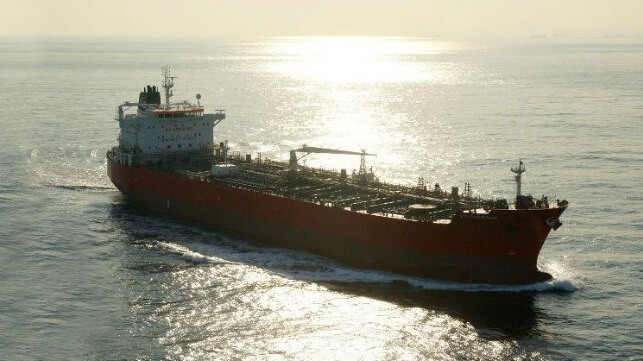
A Greek-managed shuttle tanker appears to have been today's primary target as the Houthis stepped up their attacks (file photo)

Published Sep 2, 2024 12:18 PM by The Maritime Executive


Several vessels have come under attack from the Houthis after the militant group denied last week a statement from Iran that there would be a pause to salvage the burning Greek tanker Sounion. The Houthis have vowed not to interrupt the salvage effort, but said they would continue targeting other ships.

Today’s primary target appears to be a Greek-owned, Panama-registered shuttle tanker transiting south in the Red Sea. The vessel, Blue Lagoon I (148,533 dwt) reported being hit by two projectiles which were later confirmed to be missiles. The tanker was displaying a message on its AIS saying it was carrying a Russian-origin cargo and coming from the Russian terminal of Ust-Luga on the Baltic Sea.

The vessel was proceeding but the UK Maritime Trade Operations said that “damage control” was underway. The tanker was approximately 70 nautical miles northwest of Saleef, Yemen. Later it was reported that there was a third explosion near the vessel. UKMTO was informed there are no causalities. The speculation is that the vessel was targeted because its managers, Sea Trade Marine of Greece, have sent other vessels to Israel.

Following the targeting of the Blue Lagoon I, a Saudi-owned and registered tanker, Amjad (298,886 dwt) northbound in the Red Sea reported it was hit by an aerial drone. The crude oil tanker which is loaded with as much as two million barrels of oil is managed by Bahri and was transmitting its AIS signal. It was near the Blue Lagoon I prompting speculation that it was not the target for the attack. The vessel reported it was proceeding.

Late on Friday, the Houthis also resumed attacks on a Liberian-registered, Greek-managed containership. The vessel, Groton, was first attacked on August 3 sustaining damage and diverting to Djibouti. Shortly after departing Djibouti while the vessel was 130 nautical miles east of Aden, Yemen two missiles exploded near the vessel late on Friday night, August 29. Unconfirmed reports are that the vessel might have again experienced minor damage.

The Houthis took responsibility for Friday’s attack on the Groton highlighting that they were continuing to target the same ship because of the shipping company’s business with Israel. The Houthis late on Monday also highlighted the attack on the Blue Lagoon I as part of their campaign against companies working with Israel. There was no mention of the drone strike on the Saudi vessel.

U.S. Central Command also issued a series of updates on new intercepts. On August 31, they said an aerial drone and an uncrewed surface boat had been destroyed. The previous day they said two aerial drones had been intercepted and the day before that an aerial drone and a missile. These were the first intercepts announced by CENTCOM since August 23.

This latest wave comes as unconfirmed reports from Greece said the salvage efforts of the Sounion commenced midday on Monday, September 2. The reports indicated three warships from the EUNAVFOR Aspides operation are positioning to protect the Sounion and two tugs were due to arrive at the burning tanker later in the day on Monday. The tow is expected to proceed slowly with the speculation being that they will go to Djibouti, but for security reasons, few details are being released.

Tuesday, June 17, 2025


Diversifying Threats to Maritime Security in the Western Indian Ocean

Pirate interdiction
File image courtesy EUNAVFOR Operation Atalanta

Published Jun 17, 2025 11:57 AM by CIMSEC


[By Captain Harifidy A. Alex Ralaiarivony]

The WIO region serves as an essential gateway linking Asia, the Pacific, and the Middle East, occupying a central position in the world’s economic and strategic balance. This criticality is underscored by the significant maritime traffic transiting through or operating within the region, including major routes and chokepoints like the Red Sea, Bab-El-Mandeb Strait, and the Strait of Hormuz. This latter alone sees the passage of 20.9 million barrels of crude oil and 130 ships daily, highlighting the region’s importance for global energy exports.

The year 2024 demonstrated a notable intensification in the complexity and diversity of threats to maritime security in this vital area. While traditional concerns such as illicit trafficking (drugs, arms, human beings) and illegal fishing persist, new challenges, particularly the Houthi attacks in the Red Sea and a re-emergence of maritime piracy, demanded significant attention. The RMIFC, through its fundamental missions of collecting and disseminating critical maritime information, actively participated in regional operations to respond to these challenges. 

The overall number of maritime security events recorded within the RMIFC’s area of interest has shown a steady increase over the past eight years, from 640 events in 2017 to 1145 events in 2024.

Key elements contributing to the RMIFC’s ability to address these events include the expansion of its information exchange processes and efforts to build and maintain information sharing networks. The regional maritime security architecture, comprising regional (RMIFC and Regional Centre for Operational Co-ordination [RCOC]) and national centers and liaison officers, interacts with international communities and benefits from technical support and cooperation.

Building on the foundation of the Program for the Promotion of Maritime Security (MASE) (2010-2023), which enhanced maritime security and created an enabling environment for economic development, the current EU-funded Safe Seas Africa Program (SSA) (signed July 2024) aims to consolidate and expand these achievements by strengthening the regional architecture, capacities of information centers, operational coordination, and national centers. The RMIFC’s main objectives include processing maritime information to create Maritime Situational Awareness and a Comprehensive Regional Maritime Picture, supporting regional maritime operations, serving as an information sharing platform, promoting cooperation, and contributing to reports and studies.

Salient Threats in 2024 

While all maritime security threats in the Eastern and Southern Africa and the Indian Ocean (ESA-IO) region warrant attention, some demonstrated particular salience in 2024. 

Maritime Extension of Conflicts (Red Sea Crisis) 

This category saw the most significant increase in 2024, accounting for 128 out of 175 total acts of violence at sea, compared to only 69 incidents of maritime violence in 2023.4 The crisis stemmed from Houthi attacks starting in November 2023. These attacks initially targeted Israeli-linked vessels but expanded to include vessels of US and UK interest following airstrikes against the Houthis, and eventually, other vessels without clear affiliation.

The main modes of action identified include pretending to be Yemeni authorities, using unmanned aerial vehicles (UAVs or drones), manned skiffs with weapons, and anti-ship missiles (terminal guided and ballistic). While the effectiveness of these methods was estimated to be less than 10%, they caused serious consequences, including fatalities and severe damage to vessels. This maritime extension of the conflict is undeniably the most salient new kinetic threat due to its direct impact on international shipping and the sheer volume of incidents recorded in this category. 

Piracy 

Potentially linked to the unrest caused by the Houthi attacks and the subsequent reorientation of naval resources, piracy showed a concerning resurgence in 2024. While the phenomenon remains below the endemic levels of 2008-2013, 18 incidents classified as piracy were recorded in 2024, a sharp increase compared to previous years, and a notable rise since late 2023.

This resurgence, particularly in the Somali Basin, reintroduces a threat that had been strongly contained for years, opening a window of opportunity for pirate networks. The pirates’ strategy involves hijacking fishing dhows to use as mother ships to attack larger vessels up to 600 nautical miles or more off the coast. The report notes that most pirated vessels did not have Private Armed Security Teams (PAST). 

Maritime Incidents 

While not inherently criminal, the significant increase in maritime incidents in 2024 highlights a critical safety and security challenge. A total of 512 maritime incident events were recorded, a 20% increase compared to 426 in 2023. This surge was particularly notable in the sub-categories related to pollution and accidents. Increased traffic, potentially due to the re-routing around the Cape of Good Hope, and the use of vessels in poor condition navigating bad weather, are identified as main factors contributing to incidents and loss of life.

Suspicious Activity Reporting (SAR) and Medical Evaluation (MEDEVAC) operations also saw a considerable increase (8% and 16% respectively), indicating increased demands on response capabilities. The potential for major oil spills, such as the threat posed by the attack on MV Sounion, remains a high-risk incident within this category.

Illicit Trafficking 

Illicit trafficking, particularly of drugs and arms, continues to pose a significant and persistent challenge to regional stability. While the total quantity of drugs seized (42.24 tons) was significantly lower in 2024 compared to the preceding years (over 100 tons in 2021-2023), the number of drug smuggling incidents (127) remains high.

This paradox is partly attributed to the Red Sea crisis diverting naval resources traditionally engaged in counter-narcotics missions. The northern Indian Ocean is the primary area for seizures, linked to proximity to production areas, though transshipments occur along routes towards the East African coast. Six cases of weapon and drone trafficking were documented, including arms destined for Houthi rebels.

Illegal, Unreported and Unregulated (IUU) Fishing 

IUU fishing is recognized as a major and ongoing challenge that threatens marine ecosystems, the blue economy, food security, and can contribute to social conflict and fuel criminal networks. The RMIFC recorded 69 incidents related to IUU fishing in 2024.10 While the total number is lower than trafficking incidents, the persistent nature and widespread environmental and economic impacts make it highly salient, particularly for coastal African states dependent on marine resources. IUU fishing also may contribute to the resurgence of piracy. 

Other Threats (Terrorism, Cybercrime) 

Maritime terrorism incidents recorded in 2024 were few (2 events in Mozambique) but involved kidnappings and arrests of suspected terrorists near coastal areas, indicating insurgents maintain freedom of movement by boat in certain regions. Maritime cybercrime saw only one recorded event (hacking of the US Fifth Fleet), but the report highlights significant potential vulnerabilities in ports, vessels, and data systems, with potential for major disruption and financial loss.

Impacts Extending into Africa and Beyond 

The impacts of these maritime security threats extend significantly into African coastal states and have broader international consequences. The most direct and widespread economic impact in 2024 stemmed from the Red Sea crisis. The reorientation of shipping flows towards the Cape of Good Hope disrupted usual routes. This has resulted in a very sharp increase in insurance premiums, a lengthening of sea routes by almost 10 days (reducing vessel and container availability), and a collapse in revenues for Egypt from the Suez Canal transit. The maritime sector has been forced to reorganize permanently, with new alliances and logistics hubs emerging, suggesting a return to previous traffic levels is not expected soon.

Piracy resurgence also increases costs for security, insurance, and potential ransom payments. IUU fishing losses, estimated at millions of dollars per year, harm local economies and prevent job creation in the blue economy. Illicit trafficking, particularly of drugs and arms, fuels terrorist and criminal networks and undermines regional stability. Arms trafficking linked to conflict zones further destabilizes the region, while ransom money from piracy can influence local politics and increase criminal activities. Weak governance and lawlessness in turn can enable criminal groups, including pirates, to gain control over institutions. Injury, loss of life, and environmental degradation result from all of these threats. 

Response Strategies: Direct, Multilateral, and Mitigation

Effectively addressing these diverse threats requires a comprehensive approach involving actions at national, regional, and international levels. National governments and their maritime agencies play a crucial role in responding directly to threats within their jurisdiction or involving their flagged vessels through law enforcement and patrols and strengthening laws and regulations. National maritime agencies conduct SAR and MEDEVAC operations, directly saving lives at sea. Anti-pollution teams respond to spills. Campaigns to inform local communities about risks and engage them in conservation are direct local actions. Implementing robust cybersecurity systems, training staff, and developing incident response plans are direct actions for shipping companies and ports. Merchant vessels can adhere to Best Management Practices (BMP) (version 5 recommended for piracy) and employ Private Armed Security Teams (PAST).

Going beyond national responses, given the transnational nature of most maritime threats, multilateral cooperation is critical to successful mitigation. The Regional Maritime Security Architecture in the WIO region is built on this principle. The Regional Maritime Information Fusion Centre (RMIFC) is central to the regional mechanism, enabling information exchange and coordination. Its ability to fuse data from various sources is key to building maritime situational awareness for both national and international agencies. The European Union’s SafeSeas Africa (SSA) program specifically supports these centers.15 Programs like MASE and SSA aim to strengthen the technical, material, and human capacities of regional and national centers. Workshops and Tabletop exercises enhance collaboration and information sharing frameworks.

RCOC and international partners collaborate on joint operations targeting specific threats. Multinational forces like the Combined Maritime Force (CMF) and the Combined Task Force (CTF) 150 that operates underneath it, conduct counter-narcotics operations. EUNAVFOR operations (ATALANTA, ASPIDES) respond to piracy and the Red Sea crisis.

Private industry plays a role as well. Shipping interests have re-routed traffic around the Cape of Good Hope to mitigate the risk in the Red Sea, though this is not without its own set of challenges. The permanent reorganization of the maritime industry with new alliances and logistics hubs is a form of long-term adaptation. Increased insurance premiums are a market-based mitigation of financial risk. Adherence to safety regulations and BMP5 mitigates the risk of incidents and piracy. 

Putting all these together, strengthening early warning systems and climate change adaptation mitigate the impact of natural events, which can exacerbate other vulnerabilities. Improving information sharing and coordination of operations mitigates the potential for major maritime disasters, even if incidents occur. While complex, addressing underlying factors such as poverty, lawlessness, and IUU fishing (by strengthening governance, promoting sustainable practices, developing the blue economy) can help mitigate the conditions that fuel piracy and trafficking. Efforts to reduce the demand for illegal wildlife products also contribute to mitigation. Developing and strengthening oil spill contingency plans (regional and national) and having trained response teams in place are key to mitigating the environmental damage from pollution incidents. Waste reduction initiatives and clean-up campaigns mitigate the impact of marine litter on ecosystems like coral reefs.

Conclusion 

The maritime security landscape in the WIO region is dynamic and increasingly challenging. The RMIFC Activity Report 2024 clearly illustrates that while persistent threats like IUU fishing and illicit trafficking remain significant, the resurgence of piracy and, particularly, the maritime extension of regional conflicts in the Red Sea introduced critical new dimensions in 2024. These threats have profound and far-reaching impacts, affecting economic stability, human safety, environmental health, and regional governance across Africa and beyond. The Red Sea crisis dominated in terms of direct kinetic attacks and immediate global economic disruption in 2024, while IUU fishing and illicit trafficking represent high-volume, persistent challenges that fuel criminal networks and undermine long-term sustainability. The increase in maritime incidents highlights the growing pressures on safety and response capabilities in busy waterways, exacerbated by re-routing. 

Responding effectively requires a multi-pronged approach. Direct actions by national forces and ship operators are essential for immediate response and deterrence. However, the transnational nature of these threats mandates robust multilateral cooperation through established Regional Maritime Security Architecture mechanisms like the RMIFC and RCOC, supported by international partners and joint operations. Furthermore, strategies focused on mitigation are necessary to address the broader consequences of these threats, from economic disruption and pollution to the underlying conditions that enable criminal activity. 

Future policy actions should prioritize sustaining and enhancing the regional maritime security architecture, fostering information sharing and coordination, building national capacities, and ensuring resources are available to address both persistent challenges and emerging crises. Continued vigilance and collaborative action, informed by timely and comprehensive data from centers like the RMIFC, are paramount to safeguarding the vital maritime domain of the WIO region for the benefit of all stakeholders.

Captain Harifidy A. Alex Ralaiarivony is the director of the Regional Maritime Information Fusion Center in Antanarivo, Madagascar. He is the former Head of International Relations in the Madagascar Ministry of Defence. Captain Ralaiarivony holds a Master 2 (M2) in Strategy, Defense, Security and Conflict and Disaster Management from the Center for Research and Political and Strategic Studies – University of Yaoundé II (Centre de Recherche et d’Etudes Politiques et Stratégiques -Université de Yaoundé II); earned a Secondary Military Teaching Certificate from the International Higher War School of Yaoundé (Ecole Superieure Internationale de Guerre de Yaoundé), and a Naval Higher Studies Diploma from the French Naval Academy. He is currently pursuing a degree in international law, international economics, and politics at the Center for Diplomatic and Strategic Studies in Madagascar.

This article appears courtesy of CIMSEC and may be found in its original form here, including extensive footnotes. 

The opinions expressed herein are the author's and not necessarily those of The Maritime Executive.

Thursday, October 03, 2024

CHEEKY BUGGERS

Prepare for attack, with best regards: Houthis issue email alert to shipping fleets


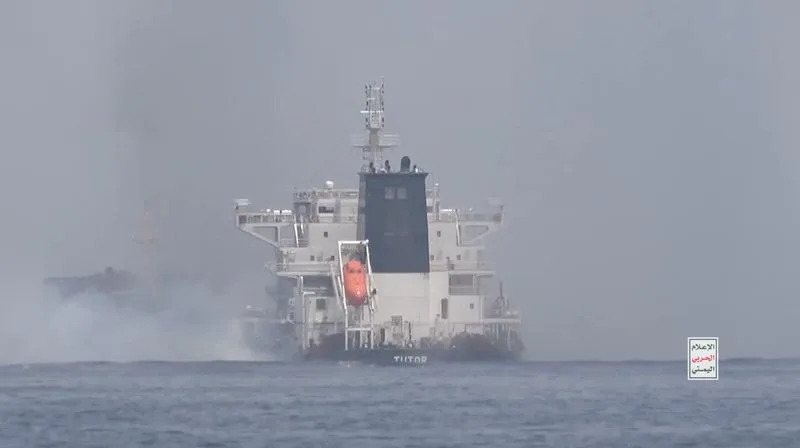
Smoke rises after an explosion on a ship that Houthis say is an attack by them on Greek-owned MV Tutor in the Red Sea


By Renee Maltezou, Jonathan Saul

Updated Thu, October 3, 2024 

ATHENS/LONDON (Reuters) -On a warm spring night in Athens, shortly before midnight, a senior executive at a Greek shipping company noticed an unusual email had landed in his personal inbox.

The message, which was also sent to the manager's business email address, warned that one of the company's vessels travelling through the Red Sea was at risk of being attacked by Yemen's Iranian-backed Houthi militia.

The Greek-managed ship had violated a Houthi-imposed transit ban by docking at an Israeli port and would be "directly targeted by the Yemeni Armed Forces in any area they deem appropriate," read the message, written in English and reviewed by Reuters.

"You bear the responsibility and consequences of including the vessel in the ban list," said the email, signed by the Yemen-based Humanitarian Operations Coordination Center (HOCC), a body set up in February to liaise between Houthi forces and commercial shipping operators.

The Houthis have carried out nearly 100 attacks on ships crossing the Red Sea since November, acting in solidarity with Palestinians in Israel's year-long war in Gaza. They have sunk two vessels, seized another and killed at least four seafarers.

The email, received at the end of May, warned of "sanctions" for the entire company's fleet if the vessel continued "to violate the ban criteria and enter the ports of the usurping Israeli entity".

The executive and the company declined to be named for safety reasons.

The warning message was the first of more than a dozen increasingly menacing emails sent to at least six Greek shipping companies since May amid rising geopolitical tension in the Middle East, according to six industry sources with direct knowledge of the emails and two with indirect knowledge.

Since last year, the Houthis have been firing missiles, sending armed drones and launching boats laden with explosives at commercial ships with ties to Israeli, U.S. and UK entities.

The email campaign, which has not been previously reported, indicates that Houthi rebels are casting their net wider and targeting Greek merchant ships with little or no connection to Israel.

The threats were also, for the first time in recent months, directed at entire fleets, increasing the risks for those vessels still trying to cross the Red Sea.

"Your ships breached the decision of Yemen Armed Forces," read a separate email sent in June from a Yemeni government web domain to the first company weeks later and to another Greek shipping company, which also declined to be named. "Therefore, punishments will be imposed on all vessels of your company ... Best Regards, Yemen Navy."

Yemen, which lies at the entrance to the Red Sea, has been embroiled in years of civil war. In 2014, the Houthis took control of the capital, Sanaa, and ousted the internationally recognized government. In January, the United States put the Houthis back on its list of terrorist groups.

Contacted by Reuters, Houthi officials declined to confirm they had sent the emails or provide any additional comment, saying that was classified military information.

Reuters could not determine whether the emails had been also sent to other foreign shipping companies.

Greek-owned ships, which represent one of the largest fleets in the world, comprise nearly 30% of the attacks carried out by Houthi forces to early September, according to Lloyd's List Intelligence data that did not specify whether those ships had any ties with Israel.

In August, the Houthi militia - which is part of Iran's Axis of Resistance alliance of anti-Israel irregular armed groups - attacked the Sounion tanker leaving it on fire for weeks before it could be towed to a safer area.

The strikes have prompted many cargoes to take a much longer route around Africa. Traffic through the Suez Canal has fallen from around 2,000 transits per month before November 2023 to around 800 in August, Lloyd's List Intelligence data showed.

Tensions in the Middle East reached a new peak on Tuesday as Iran hit Israel with more than 180 missiles in retaliation for the killing of militant leaders in Lebanon, including Hezbollah leader Sayyed Hassan Nasrallah on Friday.

NEW PHASE

The European Union's naval force Aspides, which has helped more than 200 ships to sail safely through the Red Sea, confirmed the evolution of Houthis' tactics in a closed door meeting with shipping companies in early September, according to a document reviewed by Reuters.

In the document, shared with shipping companies, Aspides said the Houthis' decision to extend warnings to entire fleets marked the beginning of the "fourth phase" of their military campaign in the Red Sea.

Aspides also urged ship owners to switch off their Automatic Identification System (AIS) transponders, which shows a vessel's position and acts as a navigational aid to nearby ships, saying they had to "shut it off or be shot".

Aspides said the Houthis' missile strikes had 75% accuracy when aimed at vessels operating with the AIS tracking system on. But 96% of attacks missed when AIS was off, according to the same briefing.

"Aspides are aware of those emails," its operational commander, Rear Admiral Vasileios Gryparis, told Reuters, adding that any response should be carefully considered and that companies are strongly advised to alert their security experts if contacted before sailing.

"In particular, for the HOCC, the advice or guidance is not to respond to VHF calls and e-mails from “Yemeni Navy” or the “Humanitarian Operations Command Center” (HOCC)."

The Houthis' email campaign began in February with messages sent to shipowners, insurance companies and the main seafarers union from HOCC.

These initial emails, two of which were seen by Reuters, alerted the industry the Houthis had imposed a Red Sea travel ban on certain vessels, although they did not explicitly warn companies of an imminent attack.

The messages sent after May were more menacing.

At least two Greek-operated shipping companies that received email threats have decided to end such journeys via the Red Sea, two sources with direct knowledge told Reuters, declining to identify the companies for security reasons.

An executive at a third shipping company, which has also received a letter, said they decided to end business with Israel in order to be able to continue to use the Red Sea route.

"If safe transit through the Red Sea cannot be guaranteed, companies have a duty to act – even if that means delaying their delivery windows," said Stephen Cotton, General Secretary of the International Transport Workers' Federation, the leading union organisation for seafarers, which received an email from HOCC in February. "The lives of the seafarers depend on it."

The email campaign has increased alarm among shipping companies. Insurance costs for Western ship owners' have already jumped because of the Houthi's attacks, with some insurers suspending cover altogether, the sources told Reuters.

Greece-based Conbulk Shipmanagement Corporation stopped Red Sea voyages after its vessel MV Groton was attacked twice in August.

"No (Conbulk) vessel is trading in the Red Sea. It mainly has to do with the crew safety. Once the crew is in danger, all the discussion stops," Conbulk Shipmanagement CEO Dimitris Dalakouras told a Capital Link shipping conference in London on Sept. 10.

Torben Kolln, managing director of German-based container shipping group Leonhardt & Blumberg, said the Red Sea and wider Gulf of Aden was a "no go" area for their fleet.

Contacted by Reuters, the companies did not respond to a request for comment on whether they had been targeted by the Houthi email campaign.

Some companies continue to cross the Red Sea due to binding long-term agreements with charterers or because they need to transfer goods in that particular area. The Red Sea remains the fastest way to bring goods to consumers in Europe and Asia.

The Houthis have not stopped all traffic and the majority of Chinese and Russian-owned ships - which they do not see as affiliated with Israel - are able to sail through unhindered with lower insurance costs.

"We are re-assuring the ships belonging to companies that have no connection with the Israeli enemy that they are safe and have freedom (of movement) and (to) keep the AIS devices going on all the time," according to an audio recording of a Houthi message broadcast to ships in the Red Sea in September shared with Reuters.

"Thank you for your cooperation. Out."

(Reporting by Renee Maltezou and Jonathan Saul; Additional reporting Yannis Souliotis in Athens and Mohamed Ghobari in Aden; Editing by Lisa Jucca)