It’s possible that I shall make an ass of myself. But in that case one can always get out of it with a little dialectic. I have, of course, so worded my proposition as to be right either way (K.Marx, Letter to F.Engels on the Indian Mutiny)
Ukraine will resume drone strikes on Russian refineries after Russia kept hitting energy infrastructure and killing civilians in Ukraine despite U.S. President Trump’s claim of an “energy ceasefire”, Ukrainian President Volodymyr Zelenskyy told the Financial Times.
In the interview in London, the Ukrainian President told FT he had ordered a pause in strikes on Russian refineries for three days to comply with the U.S. wishes. Meanwhile, Russia continued to strike Ukraine’s energy infrastructure and kill civilians, Zelenskyy said.
“The block [on attacking refineries] is out. We’re done,” the Ukrainian President told FT, while also criticizing the U.S. eagerness to agree business deals with Russia, including in the energy sector.
Zelenskyy has for days insisted that Russia isn’t sticking to any “energy truce” and continues to target with ballistic missiles energy infrastructure—“the very infrastructure covered by the ceasefire announced by the American President.”
A strike early on Wednesday on Ukraine’s energy and critical infrastructure in Kyiv, the Kyiv region, and Kharkiv “was entirely deliberate and demonstrative in its scale – Russia has never before shown such ostentatious disrespect toward the United States,” Zelenskyy posted on X yesterday.
In the interview with FT, the Ukrainian President also expressed his frustration with the “dangerous” withdrawal of U.S. intelligence and the simultaneous weakening of Elon Musk’s Starlink satellite communications across Ukraine.
President Trump has pressured Zelenskyy to stop hitting Russian oil refineries, because part of the global diesel crunch is the lack of Russian exports. The other major driver of record-high diesel prices and the highest-ever October gasoline prices in the U.S. is, of course, the war in Iran President Trump chose to engage in early this year.
Early on Thursday, crude oil prices fell by about 1% in Asian trading as reports emerged that President Trump was considering lifting sanctions on tankers used to transport oil and fuels from Venezuela, Russia, and Iran in a bid to ease a deepening tanker crunch.
By Tsvetana Paraskova for Oilprice.com
Copper price forecasts lifted for 2026 but tariff “collapse” still on the table
Copper pulled back from a three-week high on Wednesday after US inflation data put a Federal Reserve rate hike this month back on the table, and word of a preliminary deal to avert a strike at BHP’s Escondida, the world’s largest copper mine, took some of the supply premium out of the price.
Comex copper for December delivery traded at $6.6695 a pound (about $14,704 a tonne) late morning in New York, down 0.8%, after touching $6.7890 earlier in the session. The most-active contract’s record settlement of $6.89 was set on September 9, the day before a report that the White House tariff plan had stalled knocked more than 5% off the price.
In London, three-month copper climbed as far as $14,700 a tonne, its highest since September 23, before easing to $14,532 by early afternoon. Cash copper settled at a record $14,822 on Monday and $14,741 on Tuesday, and LME inventories have fallen for seven straight sessions to 229,650 tonnes.
US consumer prices accelerated in September on a surge in gasoline costs, and the CME’s FedWatch tool put the odds of a quarter-point hike at the Fed’s late-October meeting at about 44%, double the day before, Reuters reported. New York Fed President John Williams said he still sees one more hike this year.
Two sources told Reuters that Escondida’s supervisors’ union and the company had reached a preliminary agreement, which members were voting on Wednesday morning, and a union leader told Bloomberg a deal was “virtually done”. Unions at Antofagasta’s Centinela returned to talks on Tuesday after a week-long stoppage, while the open pit at Codelco’s El Teniente remains shut after a deadly landslide.
Click on chart for live prices.
Copper’s 2026 advance has forecasters raising their numbers for the second time in three months, and with the metal averaging $13,471 a tonne for the year to date, the 2026 revisions mostly bring the sheet into line with the tape.
Macquarie now has copper averaging $13,573 this year, BMO Capital Markets $13,619 and BMI, a unit of Fitch Solutions, $13,500, up from the $12,700 it moved to in July. The differences open up from next year, and they come down to how much of the 1.5 to 2 million tonnes of copper now sitting in the United States is counted as surplus.
“The great copper gamble”
Macquarie, which in July called the rally “running ahead of reality”, has lifted its 2027 average by 14% to $12,750 and pushed the cycle low to $12,000 in the fourth quarter of next year from $11,000 a quarter earlier, while its long-term price rises to $10,500 a tonne in 2025 dollars.
Prices “have disconnected from the fundamentals and could arguably move higher or lower depending on the outcome of the Section 232,” the bank’s strategists write in a quarterly compendium whose copper chapter is headed “The great copper gamble”, listing the metal among its preferred commodities for the next six to nine months “but very binary”.
The fundamentals as Macquarie counts them are a 223,000-tonne surplus this year after a 531,000-tonne disruption allowance, and surpluses averaging more than 700,000 tonnes a year from 2027 as mine supply grows 4.9% next year and 4.3% in 2028, with Collahuasi, Grasberg, Kamoa-Kakula and Centinela ramping up, Tia Maria starting and Cobre Panama back in full from mid-2027.
Global demand growth slows to 1.5% in 2027 on its numbers, with none at all in China, where construction-related copper use is shrinking 9% a year and air conditioner makers are “again looking at aluminium substitution.”
Visible stocks worldwide are up 300,000 tonnes this year, but that is the US build; everywhere else they are down 168,000 tonnes, and Macquarie says sentiment will not turn until LME and Shanghai inventories start rising again, either quickly on a tariff decision or gradually as its forecast surpluses feed through.
Macquarie’s four tariff scenarios run from a January 1 that passes with no announcement at all, which it rates most likely, to a definitive decision against a duty, which it rates least likely: “the CME price will most likely collapse, taking the LME price with it, and the arb will invert,” with surplus US stocks reappearing in LME warehouses in the US and Asia.
A tariff announced six to eight weeks ahead of implementation would pull a last wave of metal into the US and leave the rest of the world “very tight”, while a formal six-month delay would see the spread fade as it did for platinum and palladium after the critical minerals decision.
Expectations are also growing that a scrap export ban will be folded into any decision; an immediate ban would take about 600,000 tonnes a year of contained copper off the world market.
“Has the market misread US inventory?”
BMO Capital Markets arrives at a very different place from a similar starting point. Its quarterly price deck, published two days before Macquarie’s, raises its long-term copper price by 47% to $16,000 a tonne in real terms, or $18,000 nominal by 2030, with $14,675 for 2027 and $16,000 for 2028, and the bank puts itself 46% above consensus on the long-term number. Its market balance is close to balanced throughout: an 83,000-tonne surplus this year, then small deficits from 2027.
The argument turns on what the US hoard, now close to 2 million tonnes on BMO’s estimate, or about a year of American consumption, actually represents. China’s refined copper imports have run below trend and its exports above trend since the tariff trade began, a cumulative swing of about 1.6 million tonnes on a net basis, which BMO reads as Beijing allowing its strategic reserve to run down while Washington built one.
“Instead of there being a build in above ground inventory over the last 2 years, there has been a geographical redistribution from ‘not visible’ to ‘visible’, meaning today’s price of ~$14,500-15,000/t is fundamentally supported,” the bank writes. Had China bid for metal alongside the US, “copper prices today would in fact be much, much higher,” and at some point China will want to restock.
BMO expects no tariff decision before the US midterms in November, which may see copper “pause for breath” and keep the Comex-LME spread narrow, but says investors it talks to are coming around to the view that the US stockpile “could simply stay in situ for many more years.”
Rising dependence on scrap, with China’s secondary refined output heading for 3.3 million tonnes this year from 2.8 million, is the other leg of its case: scrap is the marginal unit, and it only comes out at higher prices.
BMI sits between the two. It still views the rally “as having extended beyond what fundamentals alone would suggest” and has the market in a 43,000-tonne surplus this year, but has cut its 2026 mine supply growth forecast to 1.1% from 2.4% with Chilean output down 4%, and expects a deficit from 2027 that widens to 1.7 million tonnes by 2035 as demand grows 3% to 4% a year on grids, EVs and data centres.
Its 2027 forecast is $12,900, rising to $15,000 in 2029 and an unchanged $17,000 in 2035. The International Copper Study Group, meeting this week, lifted its 2026 surplus to 104,000 tonnes and kept 2027 at 368,000 tonnes.
The arb has gone, the metal has not
The spread that built the US stockpile has all but disappeared on a spot basis. Comex October copper at $6.62 a pound trades below LME cash, which at Tuesday’s $14,741 works out to $6.69, and John Gross of The Copper Journal calculates the month-to-date average has flipped to an 85-point LME premium from a 17-cent Comex premium in June.
Most of that is London’s doing: the backwardation that put cash $164.50 over three months at Monday’s settlement, since narrowed to $115.50, reflects how little spot metal is left outside the US.
Aurubis, Europe’s largest copper producer, has offered customers a record premium of $347 a tonne for 2027 supply, 10% above this year’s level, Benchmark Minerals reported, and a company spokesperson told Bloomberg that “a lot of material has relocated to the US, leaving warehouses quite empty.”
Further down the curve the premium survives. December Comex at $14,704 a tonne sits about $170 over LME three-month, which Macquarie read at the end of September as the market pricing a 10% chance of a 15% duty (on Wednesday’s prices the same arithmetic gives about 8%).
That is too little to pull fresh shipments across the Atlantic, but enough to keep what is already there in place as long as the Comex curve pays traders to hold it. The tonnes still arriving are cargo booked months ago: Comex stocks rose another 6,500 tonnes last week to 713,000 tonnes, with 100,000 tonnes of African and South American copper due through October.
Deutsche Bank takes the stockpiling argument furthest. Daniel Ghali, the bank’s new head of metals research, told the Wall Street Journal that with China adding to its strategic reserve for decades and the tariff threat pulling metal into American sheds, the two countries could be sitting on 71% of the world’s supply by the end of the year. On that trajectory copper “simply won’t be available” to users elsewhere by the end of 2028, an outcome averted only by prices high enough to force substitution into aluminium.
He sees $10 a pound, or $22,050 a tonne, in the second quarter of 2027, almost 50% above current levels. Even a decision against tariffs may not free the metal, he told the paper, since the LME has warehouses in the US and copper may simply be shuffled between American sites rather than leave the country.
Gross points to copper’s premium over aluminium, which hit a record $5.08 a pound in September, more than double its July 2022 low. “Clearly, this rising premium cannot continue indefinitely, but who among us will step forward to say it’s at the top?” he writes. His September monthly report makes the longer point: China consumed 58.9% of the world’s refined copper last year, up from 12.4% in 2000. “There are too many copper eggs in China’s basket.”
Miners still pricing $5 copper
Copper producers fell with the metal on Wednesday, Lundin Mining down 3.9%, Freeport-McMoRan 3.7%, Southern Copper 3.3% and Teck Resources 2.9%, but the year has been kind. Southern Copper is up 44.1% in 2026, taking its market value to $169 billion, with Glencore ahead 38.6%, BHP 38.0% and Freeport 37.4% at a $100 billion valuation. Teck has gained 36.1% and Anglo American 29.2%. Lundin has managed 13.0%, Antofagasta 7.5% with Centinela on strike, and First Quantum 3.0%.
RBC Capital Markets calculates that North American copper producers at 1.0 times net asset value imply a copper price of $5.03 a pound, from $5.98 for Freeport down to $3.96 for Ivanhoe Mines, against a futures price near $6.70. The group trades at 0.9 times net asset value, in line with its 10-year average.
Escondida supervisors, about 1,020 workers at the world’s largest copper mine, said they would strike at 8 a.m. local time Wednesday, a week after workers walked out at Centinela.
Chile’s August copper output fell 12.8% to 369,500 tons, the lowest monthly total since February 2011, and a fatal landslide hit Codelco’s El Teniente on Sunday.
The IEA still sees primary copper supply about 25% short of requirements by 2035, while Peru targets $33 billion in mining investment and Argentina’s Vicuña aims for a final investment decision by year-end.
Supervisors at BHP’s Escondida, the world’s largest copper mine, said they would strike at 8 a.m. local time Wednesday after government-led mediation failed to produce a contract. The union represents about 1,020 workers at a mine that supplies roughly a quarter of Chile’s copper, and the stoppage follows a walkout at Antofagasta’s Centinela that began Oct. 7. Both land as governments across the Andes ask miners for far more copper, not less.
Demand will not wait
S&P Global projects that copper demand will climb from 28 million metric tons in 2025 to 42 million tons by 2040, with AI data centers and defense each roughly tripling their consumption, and it warns that supply could fall 10 million tons short. The IEA still sees primary supply about 25% short of requirements in 2035, down from a 30% gap in last year’s edition.
Copper runs through grids, electric vehicles, wind and solar farms and the AI data center buildout, which S&P says could account for 14% of U.S. power demand by 2030, so a shortfall in the metal reaches well beyond mining. BloombergNEF has warned that a tight market could bring cost inflation or delays for electrification projects. Peru is targeting at least $33 billion in mining investment over five years, and Chile’s pipeline tops $100 billion over the decade.
Chile keeps losing output
Chile’s copper output fell 12.8% in August from a year earlier to 369,500 tons, the lowest monthly figure since February 2011, according to national statistics data reported by Bloomberg. On Sunday, heavy rain triggered a landslide at Codelco’s El Teniente mine that killed two contractors and led the company to partially suspend operations, and El Niño could bring more rain to Chile and Peru in the months ahead.
Cochilco expects national production to fall 2.6% this year to 5.27 million tons before recovering to 5.55 million in 2027. TD Securities analysts said strike votes, worker fatalities and operational disruptions have helped “maintain a supply-risk premium,” and copper has held close to its September record high.
China’s acid squeeze
Morgan Stanley estimated in April that 1.1 million tons of Chile’s annual leached copper output, more than half its refined production, could be exposed to a Chinese ban on sulphuric acid exports. Miners use the acid to leach metal from ore, and Chinese customs data showed shipments to Chile fell to zero in March, with Beijing reportedly planning a full halt from May.
Permits and protests
Permitting in Chile can take as long as 12 years in some cases, according to GlobalData, and President José Antonio Kast ordered ministers in March to clear 50 pending claims tied to about $16 billion in projects. In Peru, President Keiko Fujimori’s government wants to authorize 240 exploration and extraction projects this year, yet the Observatory of Mining Conflicts counts nearly 200 social conflicts nationwide, 64 of them tied to mining and other environmental disputes, and says most of the main mining regions voted against her.
Argentina starts from zero
Argentina has not produced copper since the Alumbrera mine closed in 2018, which makes Vicuña, the BHP and Lundin Mining venture, its biggest test. The project received the top tier of RIGI benefits this year, and its backers are targeting a final investment decision on a $7.1 billion first phase before year-end, with first copper planned for 2030.
In April, a judge in neighboring La Rioja ordered a 30-day suspension and blocked machinery from using an access road through the province, saying the province had been left out of the environmental assessment. A San Juan court allowed work to continue days later.
The tentative deal followed last-minute talks after earlier negotiations failed. (Image: Screenshot from TRT World | YouTube)
BHP (ASX, LON: BHP) and the supervisors’ union at its Escondida mine in Chile have reached a preliminary agreement to avert a strike at the world’s largest copper operation.
Members of Union No. 2 will vote online on the mining company’s latest proposal between 9:15 a.m. and 11:30 a.m. local time. If they reject it, the work stoppage would begin on Thursday, October 15, at 8:00 a.m., local newspaper La Tercera reported.
The tentative agreement emerged from last-minute negotiations after earlier contract talks failed to produce a deal.
The prospect of a shutdown had supported copper prices amid concerns that lost production at Escondida could tighten global supplies. A ratified agreement would remove one immediate threat to output, although Chile’s copper industry faces mounting operational and environmental risks.
Mounting disruptions
Labour disputes, operational setbacks and extreme weather linked to a stronger-than-expected El Niño are testing Chile’s copper producers, adding uncertainty to supply forecasts as analysts question the sustainability of recent price gains.
A deadly snow avalanche at Codelco’s El Teniente mine over the weekend halted production at an open-pit section of the operation. El Teniente is the world’s largest underground copper mine and the state-owned producer’s biggest operation.
The incident adds to concerns highlighted in an early October study by GEM Mining Consulting, which estimated that an average 5.2% of production at Chile’s largest copper mines was vulnerable to strikes, severe weather, accidents and geological problems.
El Teniente, Escondida among riskiest
GEM’s Production-at-Risk Index assessed 14 major copper operations against eight threats, assigning risk scores ranging from 2.6% to 9%.
El Teniente ranked as the most exposed operation, with 9% of production at risk, followed by Los Pelambres at 8% and Escondida at 7.5%. Nine of the mines assessed had at least one threat classified as high risk.
The findings suggest that even if Escondida’s tentative labour deal is ratified, Chilean copper production remains vulnerable to disruptions beyond collective bargaining.
Iran Claims Containership Hit Mine and Sank in Strait of Hormuz
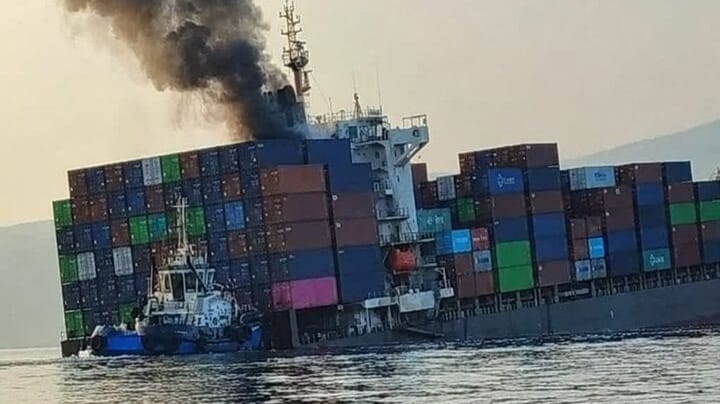
Iran released by the IRGC Navy claiming the containership struck a mine in the Strait of Hormuz (Mehr -CC BY 4.0)
The Islamic Revolutionary Guard Corps Navy released images on Wednesday morning, October 14, claiming that a containership had struck a mine while traveling on an “illegal and dangerous” route through the Strait of Hormuz. The cause of the incident has not been confirmed, but the sinking of the vessel is being widely reported after Iran struck a total of four vessels in the past hours.
UK Maritime Trade Operations reported that it had received information that two container vessels had been struck, but both reports said there was minor damage to the ships. The vessels were not identified, but one was said to be a 50,000-tonne containership and the second was identified as a 19,000-tonne containership, with the reports saying both were struck by unidentified projectiles.
The vessel seen with containers strewn in the water in the Iranian images is being identified as the GFS Pride (39,446 dwt), built in 2008, and operated by a company based in Dubai. The vessel was registered in Singapore with a capacity of 2,824 TEU.
According to the Iranian statement, the vessel “exploded and caught fire” after striking a mine. They made no mention of the crew or any rescue efforts.
It is one of two containerships from the same company that were reported to have been struck. The other, GFS Giselle (54,117 dwt), was built in 2015 and also registered in Singapore. It has a capacity of 4,370 TEU. Both vessels’ last registered position on GPS was in the Fujairah Anchorage nearly two weeks ago.
Singapore's Maritime and Ports Authority issued a statement confirming the attack on both vessels and that the GFS Pride has sunk. It said all 21 crew members were safely evacuated while calling the attacks "unprovoked, unjustifiable, and a breach of international law." It said the GFS Giselle had been able to proceed to a safe anchorage and that all 22 crewmembers were safe.
A third container vessel, operated by Safeen Feeders (part of AD Ports Group), was also reported to have been targeted. The 23,500 dwt Al Saadiyat, registered in the Marshall Islands, has a capacity of 1,730 TEU. The product tanker Alfonso was also reportedly targeted overnight. The 38,842-dwt tanker is also managed from Dubai and registered in Barbados.
The reports of the strikes came as Iran renewed its pronouncements, claiming to have deployed operational units in “a new formation” east of the Strait of Hormuz. It also claimed to have acquired “more advanced weapons” in recent weeks, saying it was ready to take on the U.S. Navy. It threatened any U.S. warships, and specifically the carriers, if they attempted to approach the Strait of Hormuz.
The IRGC Navy earlier this week issued a warning that “A horrific fire is the inevitable fate of every rogue tanker that seeks to disregard the security and regulations of the Strait of Hormuz.”
CENTCOM responded with another of its “fact check” statements refuting the Iranian claims of control of the Strait of Hormuz. It asserts the “IRGC’s navy commander has no navy,” while claiming 19 million barrels of crude oil passed through the Strait yesterday. It did not address the increased strikes by Iran against shipping.
Separately, the security consultancy Vanguard Tech is reporting that the bulker Cape Dao (170,000 dwt) is reported to be sinking after an unsuccessful salvage attempt. The vessel, which is managed from the UAE and registered in Antigua & Barbuda, was struck on September 23. One seafarer was killed in the strike, which took place 15 nautical miles northeast of Khasab, Oman.
U.S. Forces Destroy a Dhow Suspected of Conducting Surveillance for Iran
The U.S. military claims that Iran has been using scouts embedded in the boat traffic in and around Hormuz for spotting and targeting vessels, including American warships. Human spotters help offset the loss of Iran's coastal radars, which U.S. forces have targeted and destroyed on multiple occasions, a military official confirmed to Reuters.
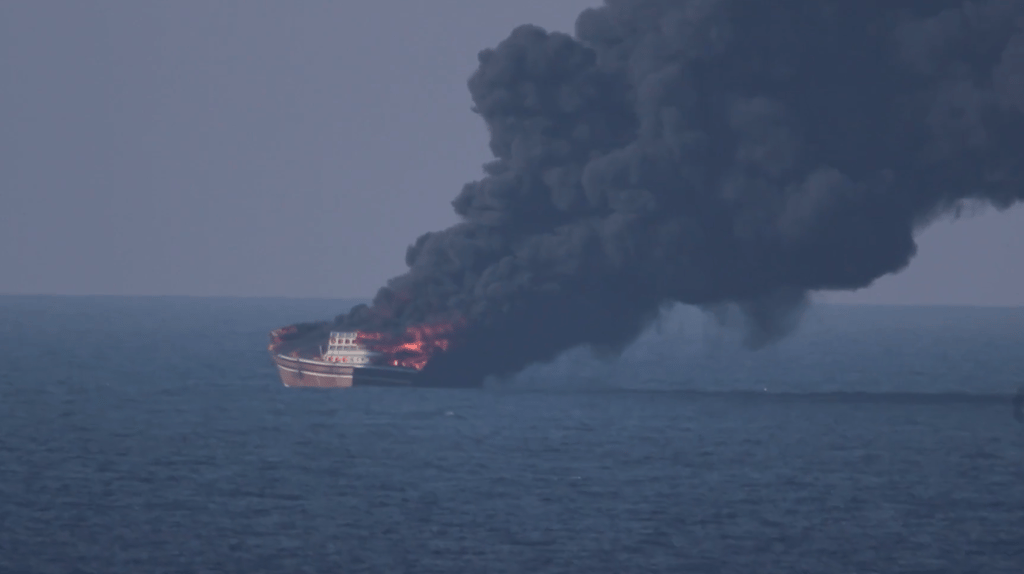
According to CENTCOM, U.S. forces intercepted and destroyed an Iranian-linked dhow on October 6. The vessel had been watching U.S. Navy ships in the Gulf of Oman, the command said. Two U.S. Marine Corps Apaches used missiles to damage the boat and set it on fire. Prior to destroying the vessel, Navy servicemembers retrieved the crew, and Central Command is working on repatriating the evacuees.
An American military official confirmed to Reuters that Iran is using spotters on smaller craft to assist its targeting at sea. Countless dhows and small craft use the waters of the Arabian Gulf, Strait of Hormuz and Gulf of Oman for commerce, smuggling and fishing - providing plenty of civilian traffic in which IRGC-affiliated personnel can hide.
The destruction of the dhow on October 6 does not appear to have slowed the pace of the Iranian attacks on shipping in and around the strait. Six merchant ships were attacked on Sunday alone, and four more on Tuesday, including a small container ship that was hit and sunk within the strait. Separately, a bulker that was hit on September 23 succumbed to flooding and sank on Tuesday.
North Korea Tests Sub-Launched "Strategic" Cruise Missile
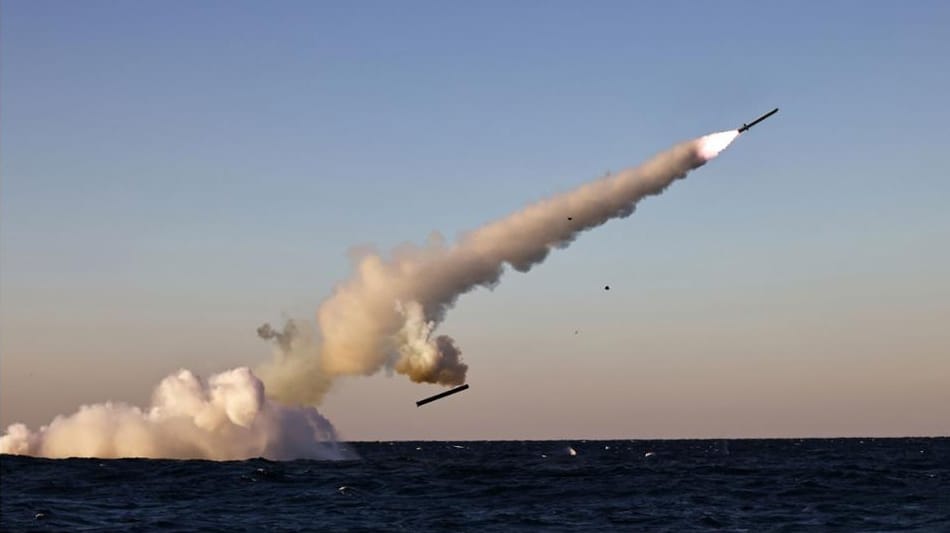
On Wednesday, North Korean forces tested two different types of missiles that can be launched from underwater, according to Pyongyang's state-owned media. If effective in operation, the submarine-launched missiles would give the North a way to conduct attacks with less notice, and would provide a strike or counterstrike capability that is harder to target and eliminate.
"The test-fire aimed to examine the current mobilized posture of the underwater combat systems and contributed to getting the Navy skilled in performing its strategic missions and showcasing high reliability, trustworthiness and ability of the war deterrents of the DPRK," state outlet KCNA said in a statement.
KCNA's phrasing is official language, and the inclusion of the word "strategic" in the event description suggests to analysts that the missiles may be nuclear-capable. The outlet described the devices as "strategic cruise missiles," and official photos depicted the missiles on a horizontal flight path.
While KCNA published an accompanying image of a submarine, it is not known whether the North possesses an operational sub with the capability to launch missiles of this type. North Korea has been known to conduct submerged missile launch testing with a purpose-built submersible launch platform.
North Korea has previously tested one type of submarine-launched cruise missile, the Pulhwasal-3-31, last seen in January 2024. It unclear how closely the two devices tested this week were related to the previously-disclosed model.
In a statement Monday, U.S. Pacific Command confirmed that North Korea had test-launched two ballistic missiles and said that the event did not pose a threat. The command has not yet commented on the claimed cruise missile launch.
North Korea spends an estimated 25 percent of GDP on defense, more than any other nation outside of an active conflict zone, and has long emphasized development of its nuclear weapons program. In recent years it has invested heavily in its naval capabilities, including two destroyers fitted for ballistic missiles. It has a strong defense relationship with Russia, and is believed to be receiving some degree of military technical assistance in exchange for munitions and manpower for the front in Ukraine.
Wednesday, October 14, 2026
Infographic guide to Russia and Ukraine's missile and drone arsenals
Russia and Ukraine's strike arsenals compared, class by class, in nine charts / bne IntelliNews
By Ben Aris in Berlin October 13, 2026
Four years into the full-scale war, Russia and Ukraine are fighting with arsenals that barely resemble each other. This guide sets the two side by side, class by class, in nine charts. As the brutal tit-for-tat missile war escalates, Russia still massively outguns Ukraine in almost all classes of missile and drone, as Kyiv's air defences dwindle.
Ukraine has won the drone war on volume. It built 2.2mn drones in 2024 and roughly 4mn in 2025, and President Volodymyr Zelenskiy now puts output at about 10mn a year with a target of 20mn. Fire Point alone claimed in July 2026 to be turning out "hundreds a day" of its FP-1 and FP-2 deep-strike drones.
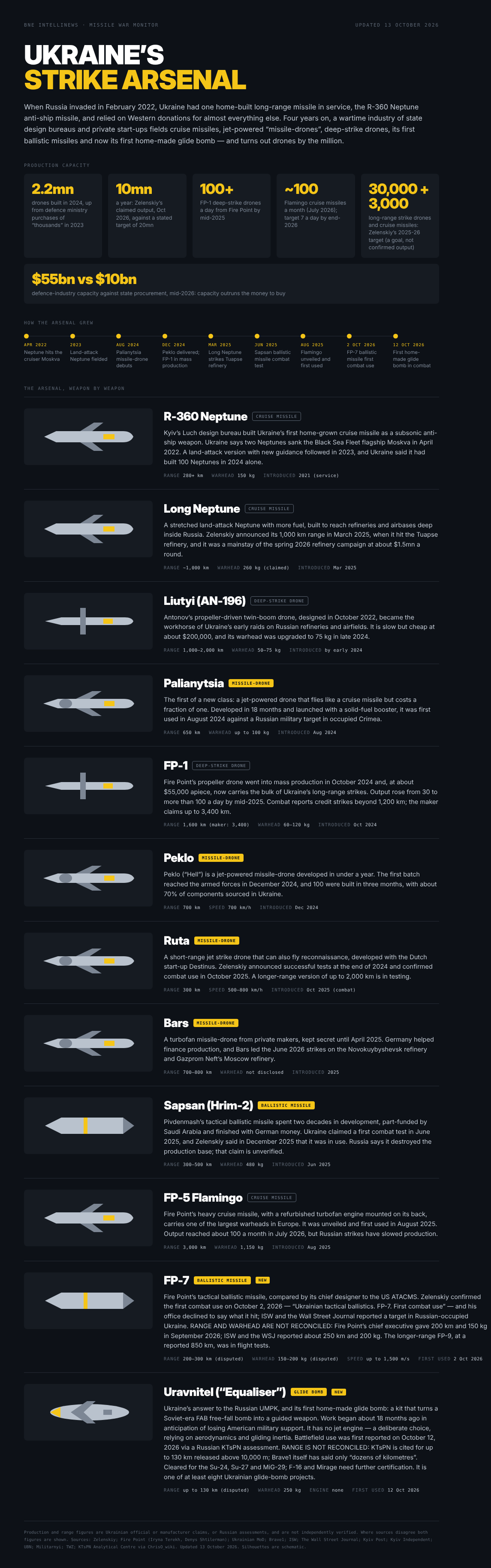
Ukraine has far fewer missiles than drones. Its whole missile inventory rests on a handful of programmes, most younger than the war: the R-360 Neptune it went to war with, a stretched land-attack version that reached Russian refineries from March 2025, the FP-5 Flamingo at a claimed 100 a month, and a ballistic effort — the Sapsan, and the FP-7, which Zelenskiy confirmed in combat for the first time on October 2, 2026. The longer-range FP-9, at a reported 850 km, is in flight tests. Zelenskiy's own 2025-26 target, 30,000 long-range strike drones against 3,000 cruise missiles, says it in his own numbers: ten drones for every missile. The twelve weapons below now include the FP-7 ballistic missile and the Uravnitel glide bomb, both of which entered combat this month.
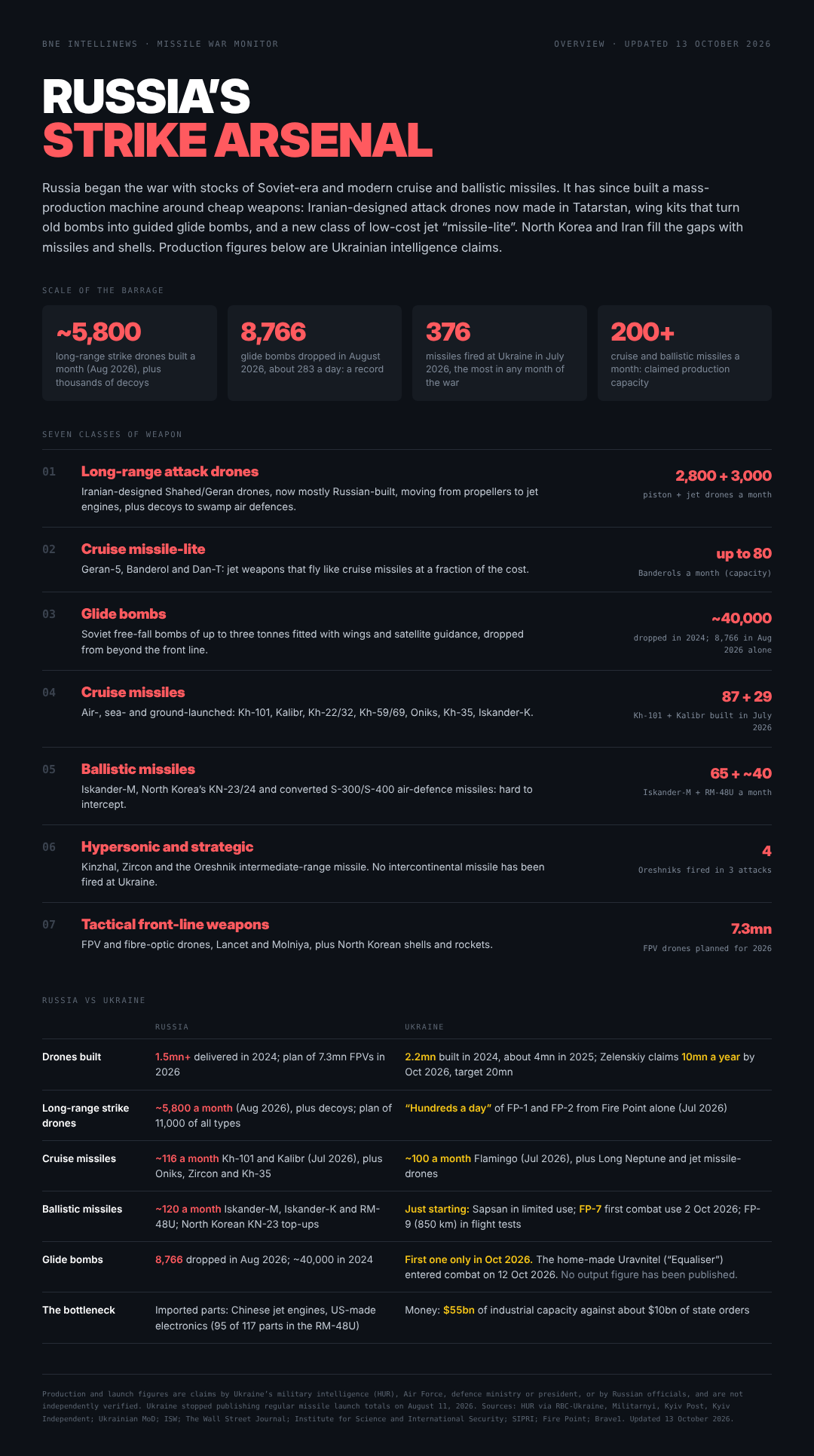
Russia has both, and far more of the expensive half. Ukrainian military intelligence put Russian output in July 2026 at 87 Kh-101 and 29 Kalibr cruise missiles, 65 Iskander-M ballistic missiles against a plan of 60, and about 40 RM-48U, retired S-400 air-defence missiles converted to hit ground targets. Russia claims capacity for more than 200 cruise and ballistic missiles a month, and fired 376 at Ukraine in July 2026, the most of any month of the war. Its cheapest weapon is cheaper still: 8,766 glide bombs were dropped in August 2026, about 283 a day, converted from Soviet stock for about $25,000 a kit and have a devastating payload of up to one tonne of explosives - about twenty times more than the average drone can carry.
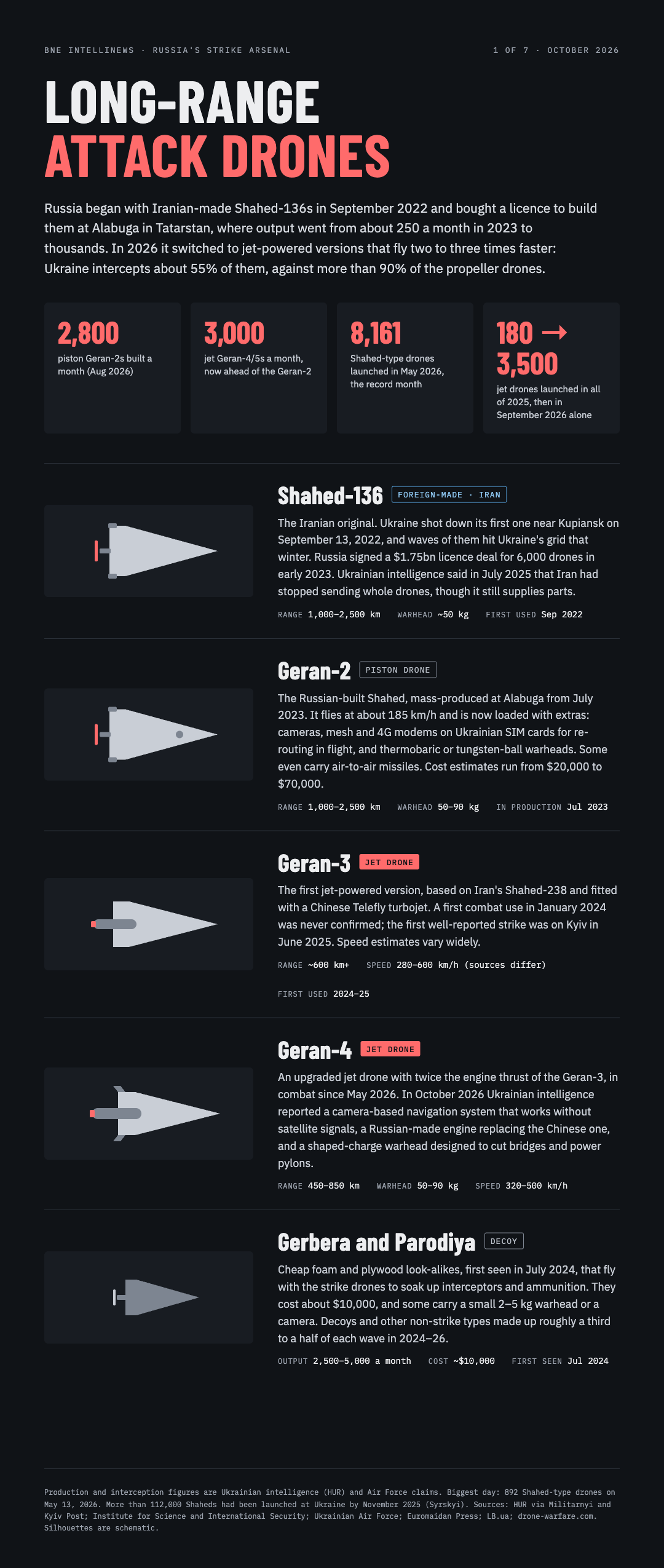
The gap that has closed is the technological one - in Russia's favour. For three years its long-range drones were slow Iranian-designed Shaheds built under licence at Alabuga, and Ukraine shot down more than 90% of them. In 2026 Russia switched to jet-powered versions that fly two to three times faster, and Ukraine now intercepts about 55%. The scale of the switch is the story: 180 jet drones were launched in the whole of 2025, and 3,500 in September 2026 alone. Russia now builds about 3,000 jet Geran-4s and -5s a month against 2,800 piston Geran-2s.
The bottlenecks differ too. Russia's is supply — Chinese jet engines and Western electronics, with Ukraine claiming 95 of the 117 electronic parts in the RM-48U are US-made. Ukraine's is money: about $55bn of industrial capacity in mid-2026 against roughly $10bn of state orders.
A caveat that applies to the infographics below: production, stockpile and interception numbers in this guide are claims by Ukraine's military intelligence (HUR), Air Force, defence ministry or president, or by Russian officials and manufacturers. None is independently verified, both sides have reasons to shade them, and Ukraine stopped publishing regular missile launch totals on August 11, 2026. Where sources disagree, both figures are shown rather than averaged.
Russia's strike arsenal: the overview
Seven classes of weapon, from $10,000 decoys to intermediate-range ballistic missiles that cost millions of dollars to make, and how the two arsenals compare line by line.
Russia's strike arsenal: seven classes of weapon, production rates and a line-by-line comparison with Ukraine. Figures are Ukrainian intelligence claims unless stated.
Ukraine's strike arsenal: the overview
Ukraine went to war with one home-built long-range missile in service. Four years on it fields cruise missiles, a new class of jet "missile-drones", deep-strike drones and its first ballistic missiles — almost all of it designed and built since February 2022.
Ukraine's strike arsenal: 12 weapons from the R-360 Neptune to the FP-7 ballistic missile, with the timeline of how the arsenal was built. Figures are Ukrainian official claims.
1. Long-range attack drones
This is the weapon that defines the nightly barrage. Russia began in September 2022 with Iranian-made Shahed-136s, then bought the licence and built its own at Alabuga, where output went from about 250 a month in 2023 to thousands. Iran had stopped shipping whole drones by July 2025, Ukrainian intelligence says, though it still supplies parts. The decisive change is the engine: the jet-powered Geran-3, -4 and -5 fly far faster than the piston Geran-2 and are much harder to shoot down. Roughly a third to a half of each wave is not a weapon at all but a Gerbera or Parodiya decoy — foam and plywood look-alikes costing about $10,000, flown to soak up interceptors.
Long-range attack drones: from the Iranian Shahed-136 to the jet-powered Geran-4, plus the decoys that fly with them.
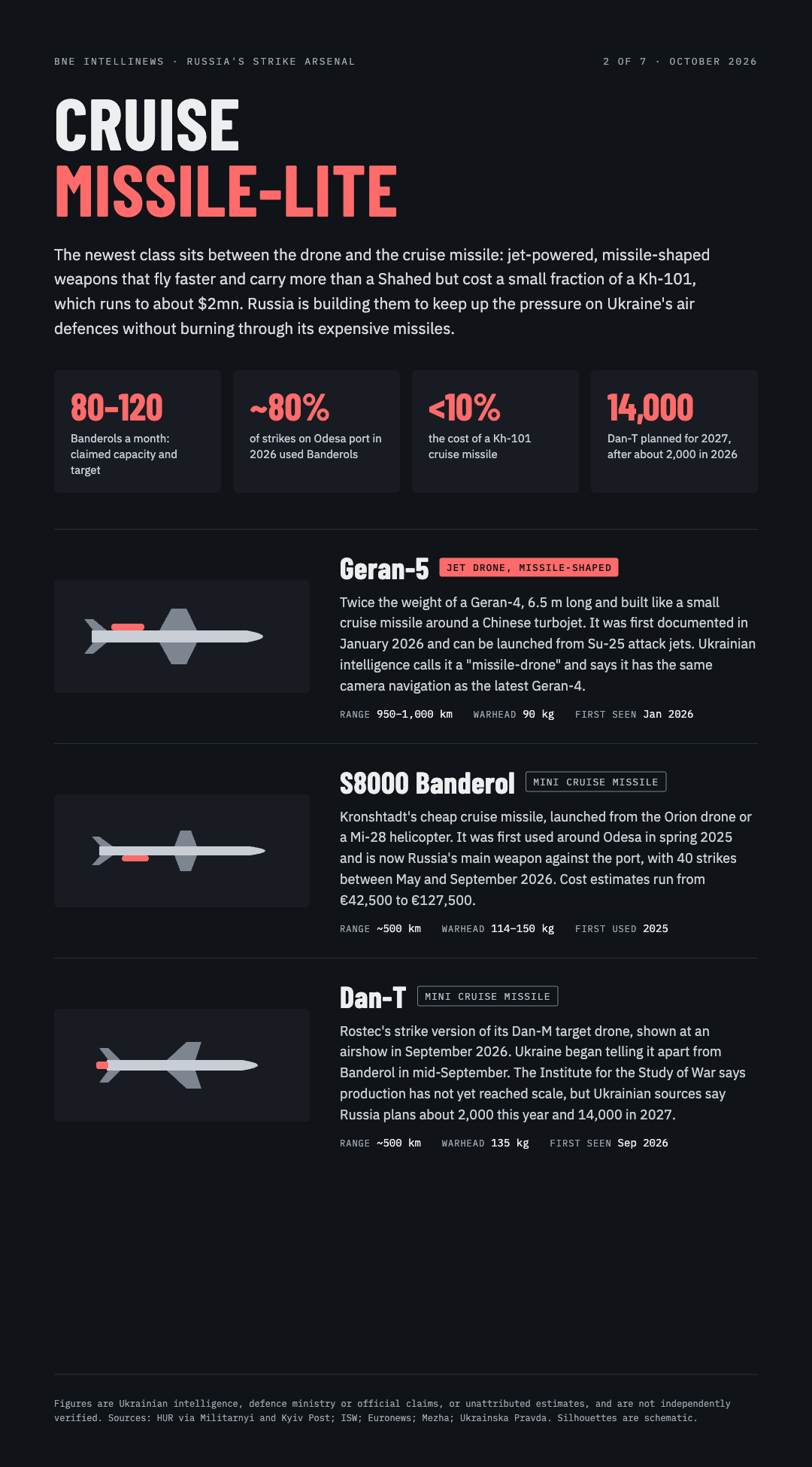
2. Cruise missile-lite
The newest class, and the one that explains how Russia keeps up the pressure without spending its missile stock. These are jet-powered, missile-shaped weapons that fly faster and carry more than a Shahed, but cost under a tenth of a Kh-101's roughly $2mn. The S8000 Banderol has become Russia's main weapon against Odesa, used in about 80% of strikes on the port in 2026. The Dan-T, a strike version of a Rostec target drone shown at an airshow in September 2026, has not reached scale by the Institute for the Study of War's assessment, but Ukrainian sources say Russia plans about 2,000 this year and 14,000 in 2027.
Cruise missile-lite: the Geran-5, S8000 Banderol and Dan-T — jet weapons at a fraction of a cruise missile's cost.
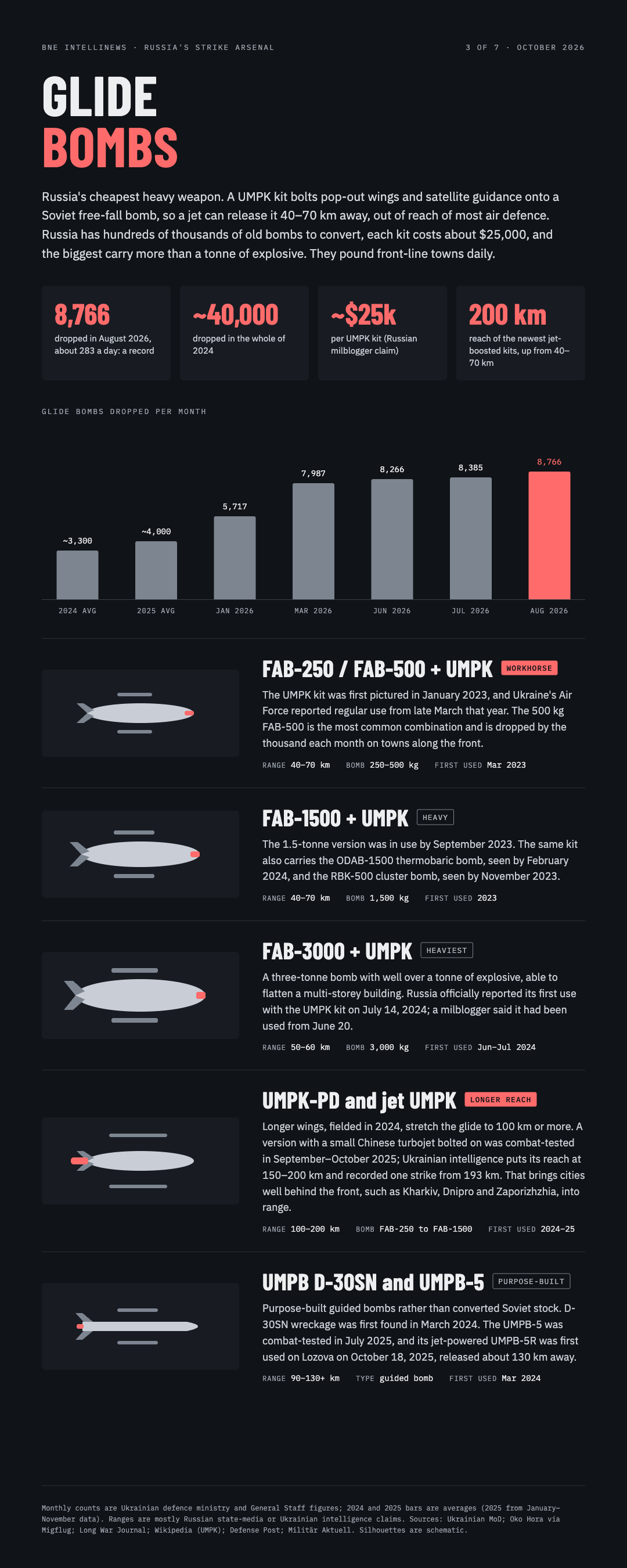
3. Glide bombs
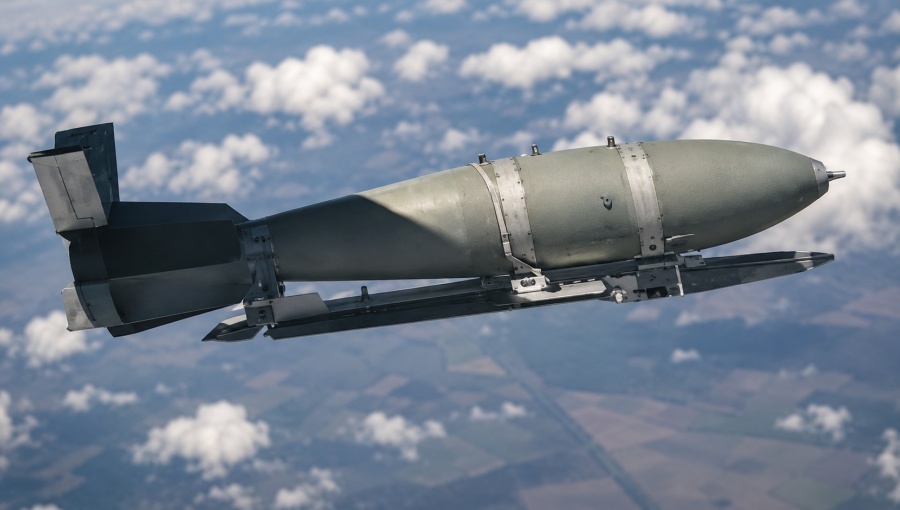
Russia's cheapest heavy weapon, and the one that grinds down front-line towns. A UMPK kit bolts pop-out wings and satellite guidance onto a Soviet free-fall bomb, so an aircraft can release it 40-70 km away, outside most air defence. Russia has hundreds of thousands of old bombs to convert and each kit costs about $25,000. The volume has climbed every year — about 3,300 a month on average in 2024, 8,766 in August 2026 alone — and so has the reach: jet-boosted kits now fly 150-200 km, which brings Kharkiv, Dnipro and Zaporizhzhia within range. Ukraine has no equivalent at scale: it fielded its first domestic glide bomb, the 250 kg Uravnitel or "Equaliser", only this month, and has published no output figure.
Glide bombs: the UMPK kit and the bombs it converts, and the monthly count climbing to a record 8,766 in August 2026.
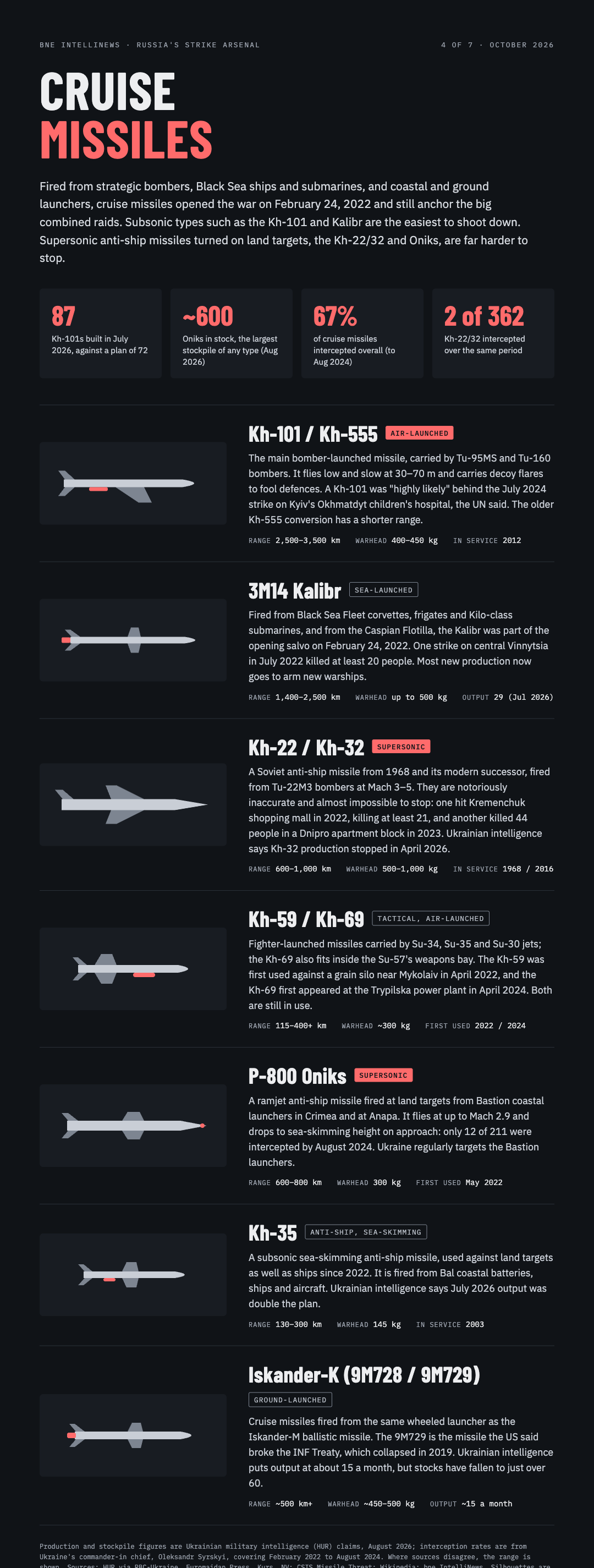
4. Cruise missiles
The weapons that opened the war on February 24, 2022 and still anchor the big combined raids, fired from strategic bombers, Black Sea ships and submarines, and coastal and ground launchers. The division that matters is speed. Subsonic types such as the Kh-101 and Kalibr are the easiest things in the Russian arsenal to shoot down, and Ukraine intercepted 67% of all cruise missiles to August 2024. The supersonic anti-ship missiles turned on land targets are a different problem: just two of 362 Kh-22/32s were intercepted over the same period, and only 12 of 211 P-800 Oniks.
Cruise missiles: Kh-101, Kalibr, the supersonic Kh-22/32 and Oniks, Kh-59/69, Kh-35 and the ground-launched Iskander-K.
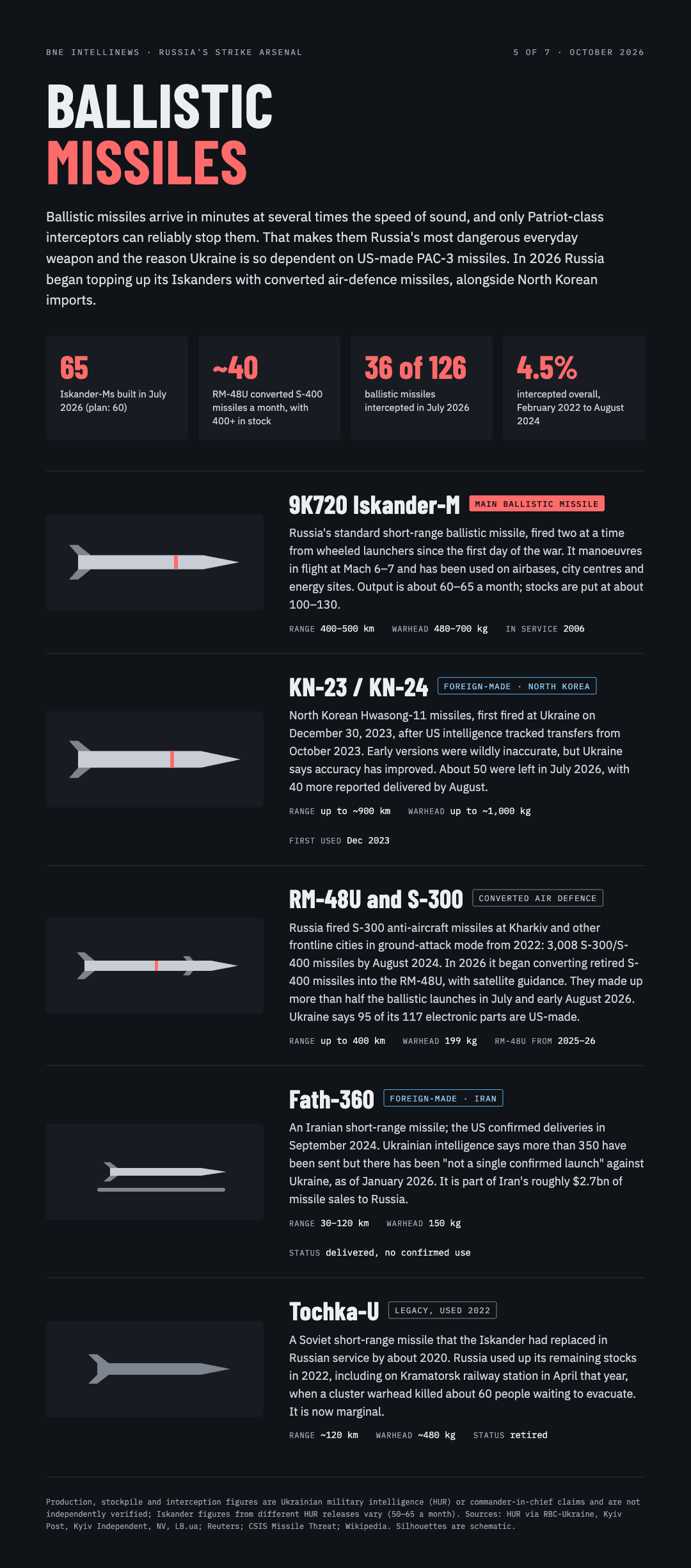
5. Ballistic missiles
Russia's most dangerous everyday weapon, and the reason Ukraine is so dependent on US-made Patriot interceptors: ballistic missiles arrive in minutes at several times the speed of sound, and only Patriot-class systems reliably stop them. Just 4.5% were intercepted between February 2022 and August 2024. This is also where Russia's foreign suppliers show up most clearly. North Korea's KN-23 and KN-24 have been fired at Ukraine since December 30, 2023; accuracy was poor at first and Ukraine says it has improved, with about 50 left in July 2026 and 40 more delivered by August. Iran's Fath-360 was confirmed delivered in September 2024 — more than 350 of them, part of roughly $2.7bn of Iranian missile sales — but Ukrainian intelligence reported "not a single confirmed launch" as of January 2026. Russia has also started converting retired S-400s into the ground-attack RM-48U, which made up more than half its ballistic launches in July and early August 2026.
Ballistic missiles: the Iskander-M, North Korea's KN-23/24, converted S-300/S-400 air-defence missiles, Iran's Fath-360 and the legacy Tochka-U.
6. Hypersonic and strategic
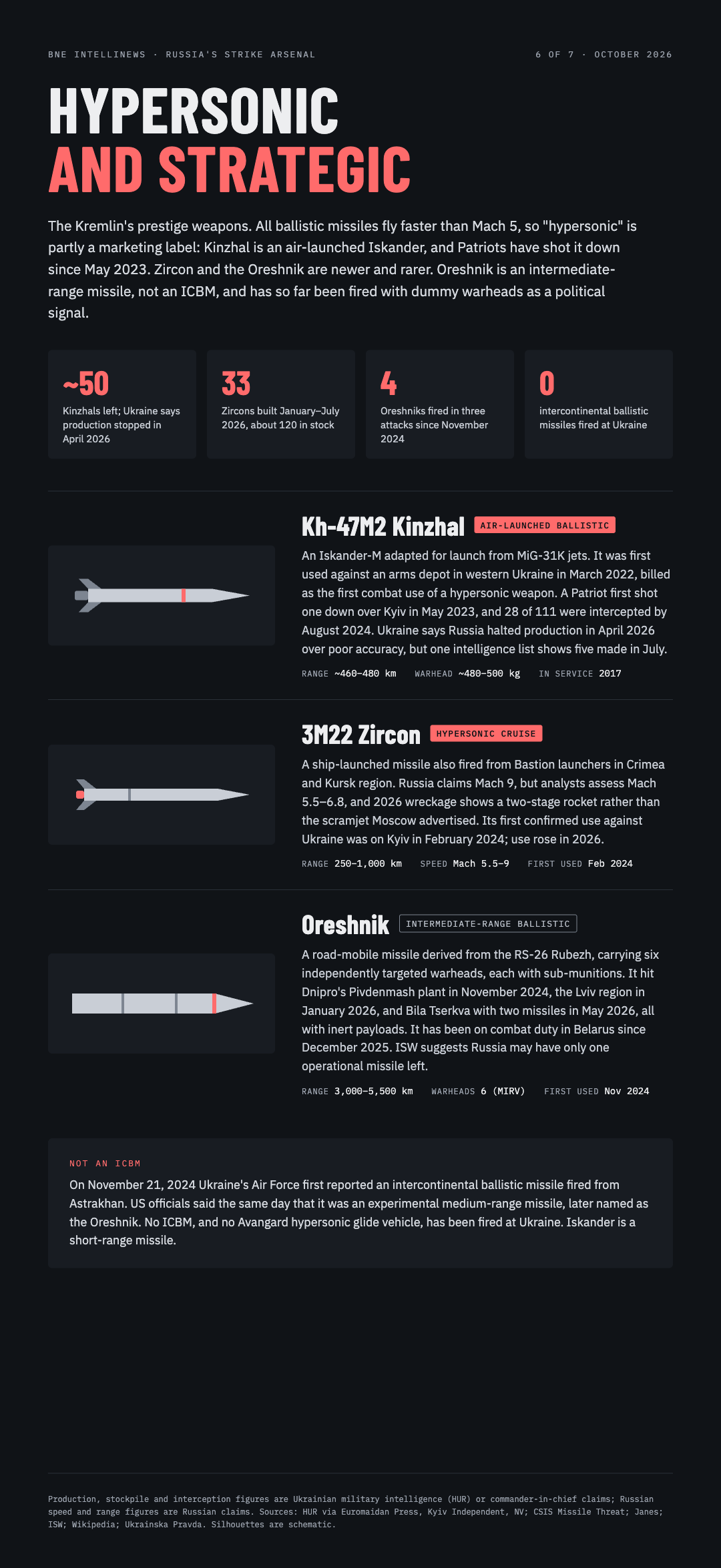
The Kremlin's prestige weapons, and the class where the rhetoric most outruns the hardware. All ballistic missiles fly faster than Mach 5, so "hypersonic" is partly a marketing label: the Kinzhal is an air-launched Iskander, and Patriots have been shooting it down since May 2023. Ukraine says Kinzhal production stopped in April 2026 over poor accuracy. The Oreshnik is an intermediate-range missile, not an intercontinental one, and all four fired so far carried inert payloads — political signals rather than strikes: no intercontinental ballistic missile has ever been fired at Ukraine, despite reports to the contary.
Hypersonic and strategic: Kinzhal, Zircon and the Oreshnik — and why none of them is an ICBM.
7. Tactical front-line weapons
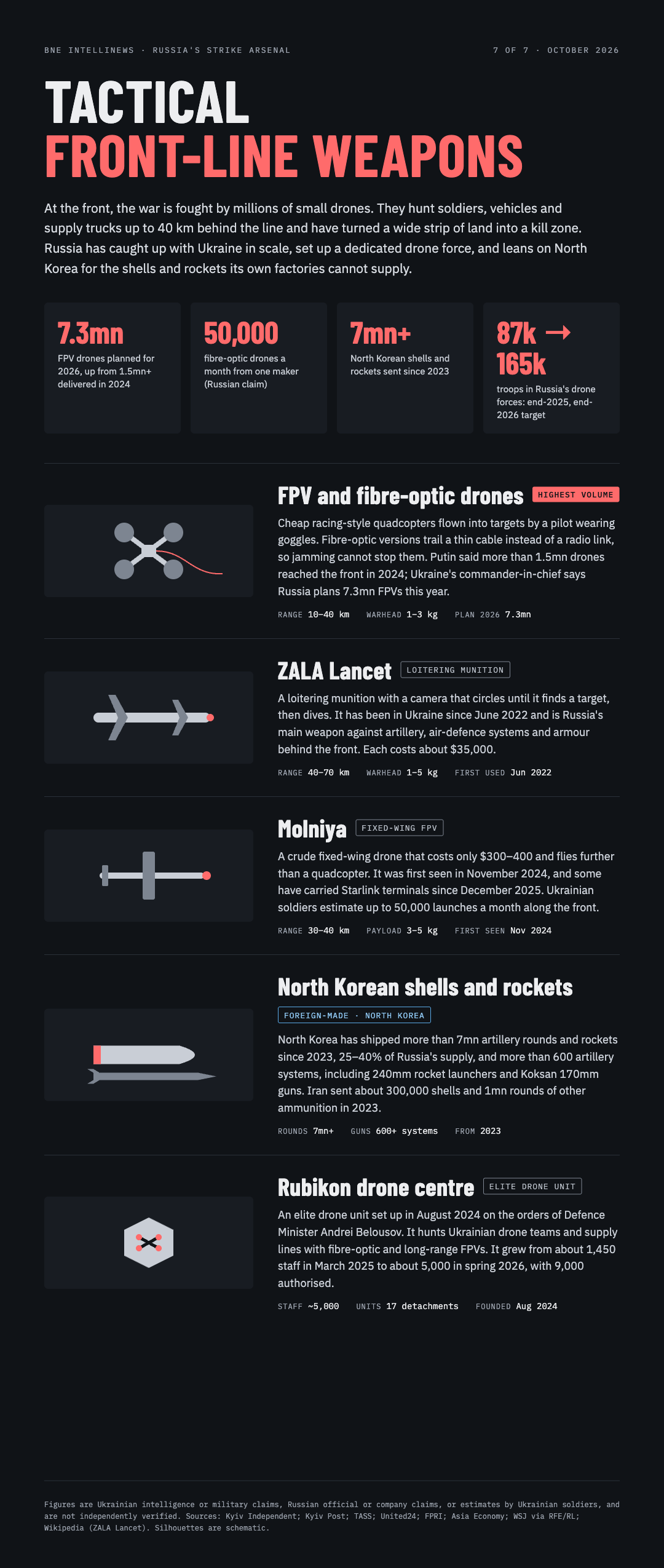
At the front the war is fought by millions of small drones that hunt soldiers, vehicles and supply trucks up to 40 km behind the line, turning a wide strip of land into a kill zone. This is the class where Russia has caught up with Ukraine on scale: more than 1.5mn drones reached the front in 2024 by Putin's account, and Ukraine's commander-in-chief says Russia plans 7.3mn FPVs this year. Russia has also built the institutions to go with the hardware — the Rubikon centre, set up in August 2024, grew from about 1,450 staff to roughly 5,000 by spring 2026 and hunts Ukrainian drone teams — while its drone forces are set to roughly double to 165,000 troops by the end of 2026. Artillery is where it leans hardest on allies: North Korea has shipped more than 7mn shells and rockets since 2023, between a quarter and 40% of Russian supply, plus more than 600 artillery systems.
Tactical front-line weapons: FPV and fibre-optic drones, the Lancet and Molniya, North Korean shells and the Rubikon drone centre.
This article was produced with the help of IntelliNews Lambda analytical tool