Monday, February 10, 2020

‘Clothing designed to become garbage’ — Fashion industry grapples with pollution, waste issues

PUBLISHED SAT, FEB 8 2020 

KEY POINTS

The $2.5 trillion fashion industry is one of the biggest polluters and the second-biggest consumer of water.
The major issue is that most of the fabrics in cheap garments are synthetics and polyesters, which are derived from oil and petroleum production.
Unlike wool or cotton, synthetic particles don’t biodegrade. So when clothes are dumped into a landfill, toxic synthetic fibers pollute water sources.
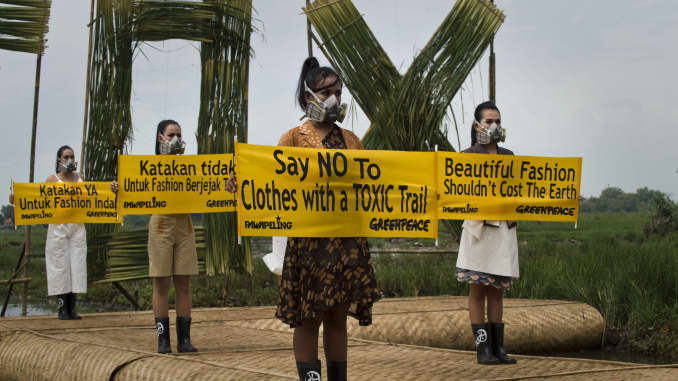


Protesters display banners during a fashion show in a polluted river basin planted mostly with rice in Rancaekek district near Citarum river located in western Java island as part of a campaign by environmental organization Greenpeace for top international fashion brands to remove toxic chemicals from their supply chains in Indonesia and address water pollution.
Romeo Gacad | Getty Images


Hannah George grew up shopping at the malls in Ithaca, New York, where she stocked up on the latest affordable trends at retailers such as H&M and Forever 21.

The 25-year-old abruptly stopped, however, when she went to college and learned about fashion industry pollution, a major driver of climate change. She shifted toward buying used clothes at the local thrift shops, actively avoided synthetic, petroleum-based fabrics and began investing in clothes made to last.


“I realized how I was supporting the industry with my dollars,” George said. “It was a shift for me. I looked at what my philosophy for clothing should be — a long-term part of my life, not just something for the night out.”

Growing calls for sustainable clothing that’s less harmful to the environment could be a catalyst for change in the fashion industry. Sixty-two percent of Gen Z consumers, those who were born after 1995, prefer to buy from sustainable brands, according to one recent survey.

Consumer pressure over the industry’s pollution has led companies such as Nike and H&M to announce plans to reduce carbon emissions or use more recycled materials in clothing. Meanwhile, larger retailers are getting into used clothing as the secondhand market booms. Nordstrom last week launched a resale shop, citing consumer demand for more sustainable options.

But despite talk of shifting toward more sustainable production, the global fashion industry’s greenhouse gas emissions are on track to surge more than 50% by 2030 as global demand for apparel rises.

“Fashion is on par to become a quarter of the global footprint of carbon. That’s astounding,” said Michael Stanley-Jones, co-secretary of the UN Alliance for Sustainable Fashion. “The industry isn’t headed in the right direction.”


“The urge to sell more and more, produce more and get consumers to buy more is still the DNA of the industry. Clothes have a short life span and end up in a garbage dump,” he added. “That has to change.”

The $2.5 trillion fashion industry comprises roughly 10% of global greenhouse gas emissions — more than all international flights and shipping in total, according to the United Nations Environment Program. It’s also the second-biggest consumer of water globally, enough to meet the needs of 5 million people every year.

Fast fashion is a major culprit. Large, low-cost global clothing brands are consistently ramping up production and inventory turnover to offer consumers new designs and collections every few weeks, rather than every season.
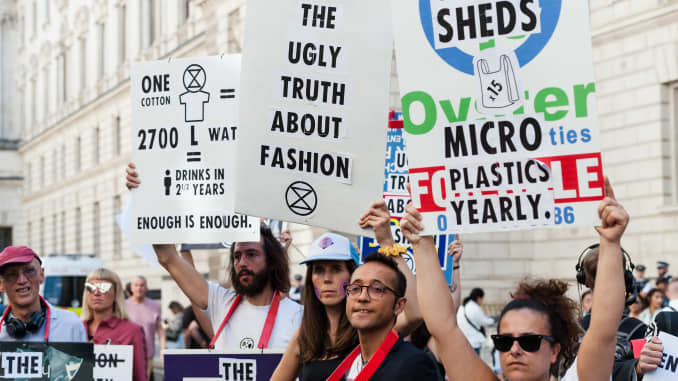
Extinction Rebellion activists demonstrate outside the Foreign Office ahead of Victoria Beckham’s show at the London Fashion Week on 15 September, 2019 in London, England.
Wiktor Szymanowicz | Getty Images


As a result, consumers regularly shop for new looks and treat the cheap garments as essentially disposable, throwing them out after no more than 10 wears.

Between 2000 and 2015, the fashion industry doubled production. The average shopper bought 60% more clothing, too, but kept each product for about half as long, according to research from consulting firm McKinsey.

The major issue is that most of the fibers in these cheap garments are synthetics and polyesters, which are derived from oil and petroleum production.

Unlike wool or cotton, synthetic particles don’t biodegrade. So when clothes are dumped into a landfill, toxic synthetic fibers pollute water sources.

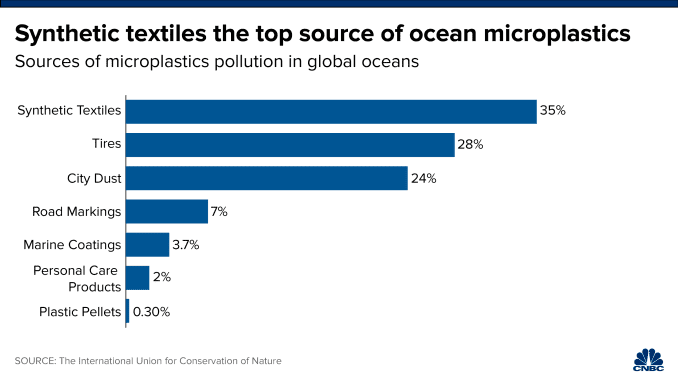
When the clothing is washed, microplastic fibers will shed off and inundate the water supply and food chain.

The chemicals used in producing and dying these fabrics harm the environment, too. In fact, the problem is so pervasive that the Environmental Protection Agency considers many textile manufacturing facilities to be hazardous waste facilities.

“Consumers might think they are getting something for nearly nothing — clothing designed to become garbage — but they should ask, what are the real costs of the product?” said Stanley-Jones. “The real cost of production of these products involves pollution that affects your health and costs the national health system.”
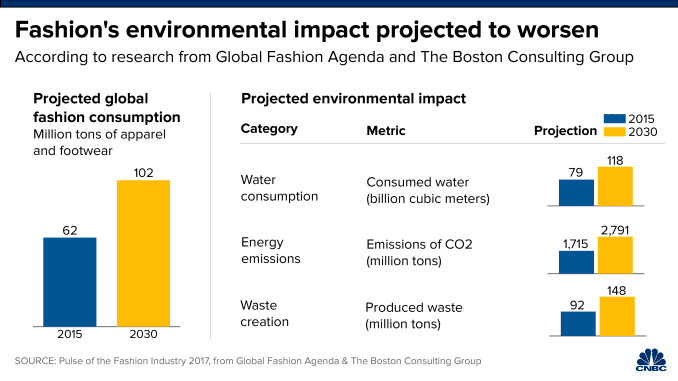


The production of synthetic textiles is accelerating as the demand for cheap clothes continues to rise. And in turn, the amount of textiles that are filling landfills is skyrocketing.

In the U.S., people on average produce about 75 pounds of textile waste each year, according to EPA data.

Garment waste is not only a sustainability issue but an economic problem, too. The Ellen MacArthur Foundation estimates that about $500 billion is lost each year as a result of clothing being thrown out instead of being reused or recycled.


A push for sustainable clothing


“2019 was a year of waking up to the urgency of the sustainability issue, and 2020 is a pivotal year for those who can demonstrate impact, and those who will be left behind,” said John Thorbeck, chairman of consultancy Chainge Capital and a former industry executive.

But it’s a complicated shift, considering that many customers also expect a level of speed and price for clothing in line with the fast-fashion companies that are making products for impact, not longevity.

In the midst of public backlash against cheap, throwaway products, many retailers say they are addressing sustainability. Some companies have started addressing textile waste and synthetic fabrics that don’t biodegrade and looking at ways of sustainably sourcing fabrics and recovering or recycling clothing.

For instance, fast-fashion brands H&M and Zara, which sell low-priced items in large amounts, have both raced to make a sustainability remittance.

H&M has a garment collection initiative that allows customers to drop off used clothing in its stores for reuse and recycling. About 57% of its materials are currently either recycled or sourced in a more sustainable way, an increase from 35% in one year, a company spokesperson told CNBC. The company’s goal is to have all materials recycled or sourced sustainably by 2030.

Inditex, the retail giant that owns Zara, announced that all of its clothes will be organic, sustainable or recycled by 2025, and that renewable sources will power 80% of energy used by the corporation’s distribution centers, stores and offices.
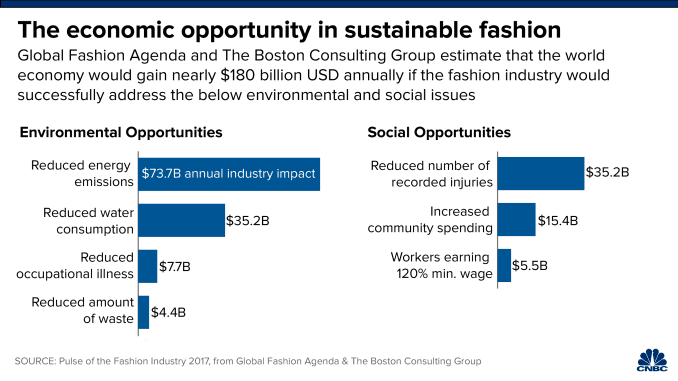
However, these sustainability initiatives have been met with some skepticism, with critics pointing out that the business model of fast fashion and sustainability are simply incompatible.

The argument is that when a business is built on such a fast turnover of styles, the production of those garments is extremely energy intensive, regardless of whether the companies have more environmentally friendly stores or materials.

For their part, consumers can help to lower their clothing footprint by reading clothing labels and researching how the products were made before purchasing them, as well as buying used clothing on shopping apps or in thrift stores.

“The consumer is not just looking for a perfect blouse but a company that is actually contributing to a better world. It’s part of a brand identity and a story they will tell,” Thorbeck said.

— Charts by CNBC’s Nate Rattner
350 .org / Flickr / CC BY-NC-SA 2.0
By Julia Conley
In addition to having a disproportionate impact on marginalized communities around the globe which have contributed the least to climate-warming fossil fuel emissions, the climate crisis has exacerbated the human rights violations already perpetrated by the fossil fuel industry, according to a new report.
The grassroots climate action group 350.org examined ten global communities which have suffered from heavy pollution, deforestation, displacement, and other violations as multinational corporations like Chevron and Shell — in addition to smaller fossil fuel entities and corrupt governments — have placed profits over human rights.
"The pollution and contamination often caused by fossil fuel industry activities mainly affect the poorest populations, as well as the climate crisis," said Aaron Packard, manager of the Climate Defenders program at 350.org, in a statement. "Vulnerable communities are being doubly exposed to losses or scarcity of land, fish stocks and water, for example."
350.org surveyed the region of Ogoniland in Nigeria, where Shell Oil has dumped an estimated nine to 13 million barrels of crude oil into the Niger Delta since 1958.
The company's activities in Ogoniland have led to polluted air and water as well as decimated natural habitats, violating the rights of the 832,000 people who live there.
The local government has also worked with Shell to suppress the right of people in Ogoniland to fight against the pollution.
"Protests against widespread and persistent oil pollution have been brutally repressed, with loss of life and a series of other egregious human rights violations," the report reads. "Victims of severe human rights abuses associated with oil extraction in the Niger Delta are still awaiting for remediation of the harm caused to their lands, water, and livelihood, in spite of multiple victories before courts and human rights bodies."
Shell's activities in the Niger Delta are just one example of how the fossil fuel industry has led to an estimated 45,000 premature deaths due to pollution, crop losses resulting from drought and other climate extremes, and other environmental results of the carbon emissions.
The report also points to coal power plants in the Muğla region of Turkey, where companies have done "severe environmental harm" since 1983. Emissions from the plants have been linked to premature deaths from heart disease, respiratory disease, and cancer, while the companies have forced communities to leave the area as they ramp up their operations.
The European Court of Human Rights recognized in 2005 that the communities had a right to bring legal action against the plants, but the companies have not ceased their extraction of coal and the resulting pollution. Governments, 350.org wrote, must pass legislation to rein in the fossil fuel industry.
The recognition by courts of human rights is "no replacement for effective legislation concerning environmental harm," the report states, "and human rights remedies are no replacement for effective preventive and remedial measures against environmental harm caused by fossil fuel companies."
Other cases detailed in the report include threats to water security in Australia and the contamination of rivers and fish stocks in indigenous territories in the Ecuadorian Amazon.
"Even in the face of the clearest scientific evidence that burning fossil fuels is literally setting the planet on fire, this sector continues to invest in the same old model and often misinforms society about the climate crisis and its causes," said Packard. "In doing so, companies are actively disregarding the right of entire populations to a healthy environment, sufficient and quality food, and a political and social scenario of stability."
Reposted with permission from Common Dreams.

David McNew / Getty Images
By Fabian Schmidt
The simple mouth and nose protector — a mask made of a rather thin paper fleece, which is knotted behind the head with ribbons - was formerly used almost exclusively in operating theaters.
Doctors and assistants wear this mouthguard primarily to prevent their patients on the operating table from being infected with germs and pathogens. If the wearer of the mask coughs or sneezes, for example, most of the droplets from the mouth and throat get caught in the mask.
In the long run, however, this only works if the mask is changed regularly and disposed of hygienically and safely. In surgery, doctors must change their mask at least every two hours. If, on the other hand, a mask of this type is worn repeatedly, it quickly loses its effectiveness.

How Much Protection Does the Mask Provide?

The wearer of the mask can protect himself against droplet and smear infections, but only to a very limited extent. Although the virus usually enters the body through the mouth or eyes — if there are no open wounds — the hands play the most important role in transporting the virus.
If you decide to wear a mask, you should probably also opt for protective goggles. The surgical masks, albeit less effective in keeping the viruses out, merely function as a constant reminder not to touch your nose with your hands when it itches. Neither should you rub your eyes.

Half Masks Offer Better Protection

In addition to surgical masks, which look more like multi-layer disposable kitchen towels, there are also half masks with a real filter effect. These are more familiar to those who work in dusty environments or with aerosols. They are available either as disposable masks, usually made of strong pressed cellulose with a filter element and an exhalation valve, or as plastic masks in which a suitable filter is then inserted.
In the European Union these types of masks are divided into three FFP protection classes (filtering face piece). Although masks of protection level FFP1 are still better than surgical masks, they do not offer the desired protection against viruses. They are intended for carpenters, for example, who work at a band saw with a vacuum extraction system. Workmen may wear them to catch the coarser dust, which the vacuum cleaner is unable to catch. Or a bricklayer can put them on before mixing cement with a trowel, kicking up some dust.
Only FFP-3 class masks effectively protect the wearer from droplet aerosols, protein molecules, viruses, bacteria, fungi and spores, and even from highly dangerous dusts such as asbestos fibers.

If a Mask is Needed — Then it Needs to Be the Right One

Such high-quality filter masks can protect the wearer — unlike simple surgical masks — from infection due to their design. In other words, also from a highly infectious pathogen such as measles or tuberculosis.
But here too, protection only works if many other protective measures are taken at the same time: Strict hygiene when putting on a mask, protective goggles, gloves and plastic apron or overall, proper disposal of possibly contaminated disposable items and regular hand washing. In addition, the surroundings must always be systematically disinfected.
These masks - together with all other protective clothing — are therefore used in quarantine stations, for example, where patients who are already infected are cared for. The medical staff has to put on and take off all the protective clothing, including the protective mask, at considerable expense.
For traveling in public transport or working at a keyboard at alternating workstations, which happen to be among the worst germinators of all, this effort would be completely disproportionate.

And What About Tear Gas?

The demonstrators in Hong Kong also wore a variety of different protective masks - from simple surgical masks to half masks with filters.
Surgical masks are probably only effective in concealing the demonstrators' identity. However, when the police fire tear gas grenades that spray an aerosol, only FFP-3 filters can provide some protection. To prevent the tear gas from getting into the eyes, airtight protective goggles are absolutely necessary.
However, occupational safety filters from the hardware store do not offer any real protection. A proper full face gas mask with a military NBC filter would do the job.
And of course this also provides good protection against viruses. But in everyday life nobody wants to walk around like this.

Best Protection: Don't forget to Wash Your Hands

All masks and goggles are of little use if the most important hygienic principles are neglected. For example, if you come home after a long bus or train ride, where you touched handrails and handles, take off the mask and scratch your nose, You could have left out the protective mask just as well.
It's the same at work: if you have been typing on the computer keyboard all morning and then go to lunch without washing your hands first, you take a considerable risk. Then, wearing a mask at the computer workstation would have been of little use either.
Reposted with permission from Deutsche Welle.

6 Changes in Society Could Rapidly Pave the Way to a Sustainable Future, Study Finds

CLIMATE
People taking a break in German park landscape on top of modern office complex (composite image). EschCollection / Stone / Getty Images
  • Despite efforts to achieve net-zero by 2050, global emissions are still rising.
  • A new study suggests ways to fast-track efforts to decarbonize the planet.
  • Building a business case for sustainable energy could drive the transition.
It's not too late to stop climate change. According to new research, decarbonizing fast enough to stabilize the climate and fast-track the planet to net-zero rests on all of us changing how we think and act — and doing it fast.

The report, published in Proceedings of the National Academy of Sciences of the United States (PNAS), identifies six "tipping dynamics," or interventions, that could act as catalysts to bring about rapid societal and technological change towards a sustainable future.
The study highlights the importance of intervening to make fossil fuels less economically — and morally — attractive. A step-change of this kind could bring about tipping points that divert investment and consumer demand away from fossil fuels towards more sustainable energy sources.
It says this can be done by:
  • Removing fossil-fuel subsidies and boosting incentives to move to decentralized energy systems and make clean energy production and storage systems more economically competitive.
  • Encouraging financial markets to divest of assets linked to fossil fuels, to divert investment towards less-polluting technologies, leaving investors keen to avoid the prospect of holding 'stranded assets' tied to fossil fuels.
  • Building sustainable cities powered by renewable energy.
  • Revealing the "moral implications" of fossil fuels.
  • Disclosing greenhouse gas emissions information.
  • Strengthening climate education and engagement.
While awareness of the climate emergency is growing, global efforts to reduce carbon emissions are not moving fast enough to avoid irreversible damage to the planet.
Moving from the fossil fuels that drive global warming to cleaner energy sources, such as wind or solar power, is at the heart of global efforts to decarbonize. Yet emissions from power generation continue to increase.
Energy-related carbon dioxide emissions worldwide (in gigatonnes). CC

Carbon dioxide emissions from the energy sector have more than doubled since the 1970s and remain on an upward trajectory.
Once we reach a point where sustainable energy generates higher financial returns than coal and oil, the world should reach the critical mass needed to halt increasing CO2 emissions levels, and begin to reverse the trend.

Think Again


But building a business case for clean energy is only one part of the challenge. The study also identifies the importance of changing social values and behavior.

Progress in combating climate change rests on converting awareness of the problem into action, so the transition to a carbon-free lifestyle is made easy for the global population to achieve.

For this to happen, a new world view is needed that embraces a climate-friendly and sustainable stance, which demands a fundamental overhaul of existing social, political and economic norms. And this new perception needs to be contagious so it is adopted globally.

The paper's authors suggest greater transparency could produce tipping points that change what's considered normal or acceptable, by revealing the moral implications of fossil fuels and disclosing greenhouse gas emissions information. At the same time strengthening climate education and engagement among the global population.

Climate action was a key theme at the World Economic Forum Annual Meeting 2020 in Davos. Klaus Schwab, the Forum's Founder and Executive Chairman, and the heads of Bank of America and Royal DSM, sent a letter to all summit participants asking companies and investors to make a commitment to act on climate change, which is more urgently needed than ever before. The Forum's ongoing work on climate change includes Mission Possible, a platform to help industries make the transition to net-zero greenhouse gas emissions by 2050.

The climate challenges facing the planet transcend national boundaries, requiring urgent action from policy-makers, businesses, organizations and communities to speed up the transition to a net-zero future.
Reposted with permission from World Economic Forum.

Canadians with lifelong disabilities can lose disability tax credit


BY ERICA ALINI GLOBAL NEWS Posted February 8, 2020

THE WAR AMPS HAS A GOOD MANUAL ON FILING FOR DISABILITY TAX CREDIT DO'S AND DON'TS I WAS GIVEN A COPY WHEN I WAS IN THE GLENROSE RECOVERING FROM MY AMPUTATION

Some Canadian workers who develop a disability may lose their employer disability benefits after a few years, even if they haven't made a full recovery. Global News money reporter Erica Alini explains how you can protect yourself from that risk


When Robert Morley got the news that his application for the federal disability tax credit (DTC) had been denied in December 2019, he felt a mix of emotions, he said.


“On the one hand, I wasn’t at all surprised. On the other, I had kind of hoped that [since] I’ve been approved once, they would know I have the disability.”


Morley, 49, was diagnosed with myalgic encephalomyelitis, commonly known as chronic fatigue syndrome, in 2010. The condition means even the small, routine tasks of everyday living leave him utterly exhausted and in need of prolonged rest, he said.


“If I shower, I have to take a break,” he said. “If I cook a meal, I have to take a break. I can’t go out. I can’t see friends.”


And the illness makes him unable to work, he said.


But it wasn’t until 2015, after a byzantine bureaucratic process and multiple initial denials, that the Canada Revenue Agency (CRA) approved him for the DTC, a non-refundable credit for people with disabilities and their families.


At the time, the agency made the approval retroactive to the 2006 tax year, when Morley’s condition started.


“I felt stressed about this all year, knowing the difficulty we had the first time.”


The credit works out to around $1,500 to $2,000 per year, a significant amount for the couple, who lives on Patrick’s modest income as a communications coordinator at a non-profit, Morley said.


READ MORE: The CRA makes it so hard to get the disability tax credit, many don’t even try


Despite their apprehension, the couple had held out hope their second time applying for the credit would go smoothly. After all, the CRA had already approved Morley once, and his doctor agreed the condition had not improved since then.

Instead, their application was denied. In August, the couple received a first denial letter from the CRA, stating: “Although we do not question the seriousness of your medical condition, we must base the decision on the specific eligibility criteria in the Income Tax Act.”


“Based on the information we received,” the letter continues, “you do not meet the eligibility criteria because the cumulative effect of your restrictions is not equivalent to a marked restriction in one basic activity of daily living.”


READ MORE: The disability tax credit was an explosive issue for the Liberals. Will the next government fix it?


That obscure language is familiar to anyone who’s been dealing with the DTC.


Canadians with disabilities have to pay a physician or other qualified health professional to certify that they are “markedly” restricted in at least one activity of daily living all or most of the time, or that the cumulative effect of restrictions across several activities is equivalent to being markedly restricted on one basic activity. (Those who require life-sustaining therapy at least three times a week, for a total of at least 14 hours a week, also qualify for the credit.)


A copy of Morley’s DTC application viewed by Global News shows his doctor deemed that while he doesn’t meet the bar for a “marked restriction,” the sum of his symptoms — which include cognitive impairment and difficulty walking — is equivalent to a marked restriction.


2:47Verdun woman denied disability insurance Verdun woman denied disability insurance


Accessing the DTC is a struggle, experts say, especially for those with ‘invisible disabilities’


Being approved for the DTC once does not guarantee reapproval, even for disabilities that are widely known to be lifelong conditions, said Jennifer Zwicker, director of health policy at the University of Calgary’s School of Public Policy.


Families with dependents with autism, for example, are often asked to reapply for the DTC every few years, Zwicker said.

“It’s concerning because it’s not like autism is going to go away.”In general, qualifying for the DTC has become significantly harder over the past five years or so, said Jason Heath, a financial planner in Thornhill, Ont., who’s helped many clients apply for the credit.

“It was very common in the past for a child with a learning disability, for example, to qualify for the disability tax credit,” he said.

While the rules for accessing the DTC haven’t changed, the way the CRA interprets them seems to have become stricter, he added.

A 2018 paper co-authored by Zwicker found that only 40 per cent of adults who live with a severe disability in Canada use the DTC. The study also suggested the rules used by the CRA to assess eligibility for the credit are likely one of the main reasons for the poor uptake.

READ MORE: Canada’s disability tax credit program needs major overhaul, Senate committee urges

The application form has a check-the-box format that doesn’t fit the reality of many disabilities, the report suggested. Physicians sometimes struggle to describe how the applicant’s disability affects their daily lives, and sometimes they receive confusing follow-up requests from the CRA for additional information, according to the report.

There is also a lack of consistency and transparency in how the tax agency reviews applications.

In Morley’s case, documents reviewed by Global News show doctors struggling to fill the forms correctly. Morley also said the CRA failed to notify him of follow-up requests to the physicians, which made it difficult for him to ensure additional information would be sent back to the agency by the deadline.

People with so-called “invisible disabilities” are especially likely to struggle to access the DTC, both Zwicker and Heath said.

Those who are deemed ineligible are denied not only the possibility to pay lower taxes but also access to a number of other, often more financially significant benefits.

Among them is the Registered Disability Savings Plan (RDSP), a registered savings plan that’s eligible for a lifetime maximum of up to $70,000 in government matching grants and $20,000 in government bonds.

2:13Moncton man with diabetes denied disability tax credit Moncton man with diabetes denied disability tax credit


Change afoot in Ottawa


The good news for Morley and others in a similar situation is Ottawa has taken steps to address the issues around the DTC.


In its 2019 budget, the Trudeau government proposed to axe a rule that requires those who lose their eligibility for the DTC to close their RDSP and return to the government any grants or bonds received in the previous 10 years.


STORY CONTINUES BELOW ADVERTISEMENT


The new rules “intended to come into effect on January 1, 2021, and would become law when the enabling legislation receives Royal Assent,” a spokesperson at the Ministry of Finance told Global News via email.


In the meantime, RDSP issues aren’t required to close an RDSP account simply because its beneficiary is no longer eligible for the DTC, the ministry also said.


Still, those who lose eligibility for the DTC still stand to lose access to any future government RDSP contributions.


READ MORE: Cancer patient was cut off from work disability benefits for 10 months — his story has warning for everyone


Efforts are underway to improve the DTC application and review process as well.


In 2017, public outcry over denials of DTC prompted the Liberal government to reinstate the Disability Advisory Committee (DAC), a body tasked with providing advice to the CRA that was disbanded by the Harper government in 2006.


Last year, the committee published a report with detailed recommendations for an overhaul of the DTC, including rewriting the eligibility criteria, streamlining the application process and making the tax credit refundable.


The report also notes: “a particular concern is a notable increase in the rejections of individuals reapplying for the DTC after receiving it for 5, 10, and 20-plus years, even though their medical condition remains the same.”


READ MORE: ‘I couldn’t believe it’ — why disability claims for mental health are often a struggle


While some of the committee’s recommendations require legislative action, the CRA told Global News it’s on track to implement most, if not all, of the recommended administrative changes by the spring of 2020.


“The CRA is proud to support the important work of the Disability Advisory Committee and is committed to providing open, transparent and ongoing communications to Canadians on the progress made by the Committee to help improve the lives of Canadians living with disabilities,” the agency said via email.


Among the changes already adopted are a redesigned application form, the ability to file electronically and a new “navigator” role to liaise among the applicant, the CRA, and medical practitioners.


For his part, Morley said he and Patrick are planning to take their case to the Tax Court of Canada.


“There’s something so desperately wrong here.”


© 2020 Global News, a division of Corus Entertainment Inc.
Alberta nurses union says rollback talk from province is a 'powder keg'

The province is eyeing sweeping reforms on health delivery


Alberta's nursing pay, benefits and work rules are front and centre as Premier Jason Kenney's government is eyeing sweeping reforms on health delivery, including fundamental changes to how nurses are paid and deployed. (Canadian Press)

The head of the United Nurses of Alberta says she has not seen such regressive contract demands from the province since the strike year of 1988, and says some nurses are wondering if history is going to repeat itself.
"The last time I saw the magnitude of rollbacks tabled by an employer with us was in fact the 1988 round of bargaining," Heather Smith said in an interview. "It's kind of a powder keg."
Alberta's nursing pay, benefits and work rules are front and centre as Premier Jason Kenney's government is eyeing sweeping reforms on health delivery, including fundamental changes to how nurses are paid and deployed.


Asked if strike is a possibility, Smith replied: "Any decision will be [up to the] rank and file, but I do know that it is a subject of a lot of conversations in workplaces.
"Certainly, any time I meet with nurses that is a question that comes up: is this round of bargaining going to end in a strike?"

Heather Smith, president of the United Nurses of Alberta, said she hasn't seen such regressive contract demands from the province in more than 30 years. (CBC)
Alberta's government and its nurses have been locking horns over issues at the contract table and over a benchmark report released last week that calls on Alberta to re-examine wages, benefits, staffing roles and ratios for nurses.
In the current round of bargaining which began last month, the UNA says the government is proposing no wage increases over the next four years along with reductions to overtime, holiday and premium pay.
There would also be reductions in worker scheduling rights and benefits, including eliminating designated rest days for part-timers.
The UNA, which represents 29,000 nurses, has proposed two per cent wage hikes in each of the first two years along with other changes.


Last week, Health Minister Tyler Shandro released 57 recommendations made by Ernst & Young on ways to save money and make the health-delivery system more efficient.
Alberta Health Services, the arm of government tasked with delivering front-line care, is set to come back in mid-May with an implementation plan.
The report says registered nurses make on average just over $94,000 a year, about seven per cent more than the Canadian average, but by working extra shifts and with other premium pay they can earn substantially more.
It found that two-thirds of registered nurses are casual or part-time and that this high number, coupled with attendant pay and scheduling benefits, is not cost-effective and causes scheduling problems.
It says Alberta has higher nursing staffing levels than comparable jurisdictions and that highly skilled staff are being used in situations where lesser skilled staff would do, such as keeping watch on at-risk patients.
Smith says salaries across many professions in Alberta, not just nurses, are higher than average.

Health Minister Tyler Shandro said 'I think at the end of the day we're going to have an agreement that works in the best interests of patients.' (CBC)
Shandro stressed much work remains.
"We need to continue to have dialogues with our unions, especially the UNA," Shandro told reporters on Thursday.
"To the extent that any of these recommendations are brought up by either us or them at the negotiating table, I encourage everybody to be able to talk about these issues openly."
"I think at the end of the day we're going to have an agreement that works in the best interests of patients."
Opposition NDP Leader Rachel Notley said the government is "trying to carve out $600 million out of the system on the backs of nurses."
"If you replace nurses with folks with lower levels of education and expertise, what is that going to mean? Lower quality of care. And that is exactly the thing that Jason Kenney promised Albertans that he would not impose on them," she said

RELATED STORIES
'Significant changes': Alberta eyeing major reforms to health system in 2020

AHS review finds ways to save up to $1.9B — next up is deciding which measures to implement


Winnipeg's Palestinian community protest recent deal by Donald Trump


NOW PLAYING

People in Winnipeg took to the street to protest a recent peace deal made by Donald Trump. CTV's Mason Depatie has more.


WINNIPEG -- A group of Winnipeggers took to the streets Sunday to protest a deal made by U.S. President Donald Trump.

More than 50 people attended a rally focused on the recent peace deal created by the United States and Israel.
Trump's self-proclaimed "deal of the century" calls on Palestine to recognize Jerusalem as the capital of Israel.

READ MORE: Trump Mideast plan cheers Israelis, angers Palestinians

The organizer of the rally and native Palestinian, Rafe Abdulla, doesn't agree with Trump.

"We are the people who live in that area since thousands of years. We have our roots, our land, our homes," said Abdulla.

The peace deal also takes away the right of return from Palestinians and sides Israel on many key issues.

"I think there is lots of Canadians who understand and they don't like the deal," he added.

At the rally, a petition calling for the Canadian government to intervene circulated.

"Everybody I've talked to has signed it. There are probably 40-50 people here. I expect all 40-50 signatures," said Harold Shuster from the Independent Jewish Voices of Winnipeg.

"We need [the government] to stand up and forcefully say that this peace plan is a no go."

François-Philippe Champagne, foreign affairs minister, issued this statement when the deal was announced:

“Canada has long maintained that peace can only be achieved through direct negotiations between the parties. We urge the parties to create the conditions for such negotiations to take place," the statement said.

The statement goes on to say, “Canada reaffirms its readiness to support meaningful dialogue between the parties toward a negotiated and viable two-state solution.”

As for Abdulla, any action opposing the deal is welcome. "This is not a deal. What we need is quality, we need justice and we need to live in peace," he said.


Cree version of 'O Canada' sung at Oilers game by Indigenous teen
 February 8, 2020

Indigenous teen sings anthem in Cree for Oilers


NOW PLAYING


As CTV Edmonton's Nicole Weisberg reports, a Samson Cree Nation teen sang 'O Canada' in Cree and English for Saturday's Oilers game


EDMONTON -- Singing Canada's national anthem in English and Cree at the Edmonton Oilers game on Saturday was an "amazing and breathtaking" moment for an Alberta teen.


Kiya Bruno, a 14-year-old from the Samson Cree Nation in Maskwacis, was asked by the NHL team to perform as part of the celebration of the 20th Scotiabank Hockey Day in Canada, hosted by Yellowknife.

"There was a lot of people in the crowd and at the end they started singing along and I heard people cheering as well," Bruno told CTV News Edmonton.

"That was cool."

Bruno is no stranger to large stadiums: In June, she was asked to take her Cree version of "O Canada" to Rogers Centre for a Blue Jays game. 

READ MORE: Edmonton's Kiya Bruno bringing her version of 'O Canada' to the big leagues

It was how the Oilers learned of the young singer, said Edmonton Oilers Hockey Club spokesperson Shawn May.

"We saw that Kiya Bruno sang the anthem for the Blue Jays on Canada Day last year in an English/Cree rendition. So we reached out to them to provide us with her contact info," May explained.

"She is from Samson Cree Nation (south of Westaskiwin) so she’s considered a local in a way."

Bruno said she was shocked when her mom first received the request, as she had never imagined singing for her NHL pick, but quickly excited.

"I'm glad I was able to represent Indigenous peoples across Treaty 6 territory, and just people who speak Cree in general and other Indigenous people."

According to May, Bruno's rendition was the first time the anthem was sung in Cree at Rogers Place.

Samson Cree Nation is about 90 kilometres south of Edmonton.

Deltaport shut down by protesters supporting Wet’suwet’en as blockades continue in B.C.


BY SEAN BOYNTON GLOBAL NEWS
Posted February 9, 2020 1:17 pm


WATCH: Rallies and protests held around B.C. in support of Wet'suwet'en blockade (Aired Feb. 7)

Workers at Canada’s busiest port got an unexpected day off Sunday, as protesters supporting Wet’suwet’en pipeline opponents blocked access to Deltaport.

The protest group organized by Red Braid Alliance for Decolonial Socialism descended on the Roberts Bank access road to the port near Delta, B.C. Saturday night and remained there overnight into Sunday.

“We’re part of a nationwide movement to shut down Canada in solidarity with Wet’suwet’en,” organizer Isabel Krupp said.

“More than $1 billion of commerce moves through Deltaport every year. We’re shutting it all down. There’s no commercial traffic going in or out of Deltaport today.”


READ MORE: B.C. pipeline protests halt VIA trains in eastern Ontario for 3rd full day

Krupp says the group plans to remain at the port until the RCMP leave the site of the Wet’suwet’en blockade camp in northern B.C., which is attempting to stop work on the Coastal GasLink pipeline.
STORY CONTINUES BELOW ADVERTISEMENT


Those looking to start their shift at Deltaport Sunday morning were told to turn back. According to organizers, workers are respecting the blockade and are treating it like a picket line, saying they won’t cross.


Morning shift is here. Brad, who gifted us with sage, has gone and come back with coffee and doughnuts. Other workers came up (a bit prickly) to ask what we’re doing. After we explained, they said “well we want people to respect our picket lines so we should respect yours” pic.twitter.com/ldkRHmuGVw

— Red Braid Alliance for Decolonial Socialism (@stopdisplacemnt) February 9, 2020


ILWU Local 502 approached our barricade with a message of solidarity and told us they will not cross our picket line. There would normally be 300 workers at the Deltaport, but not today – the port is closed!#DeltaportBlockade #WetsuwetenStrong #ShutDownCanada pic.twitter.com/H45PRNQ2I6

— Red Braid Alliance for Decolonial Socialism (@stopdisplacemnt) February 9, 2020

Global News has reached out to the workers’ union, ILWU LOCAL 502, and the Port of Vancouver for more information.

Krupp says the group allowed workers ending their shift Saturday night to leave the port, but only after explaining their message to each of those workers.


READ MORE: Wet’suwet’en supporters block Port of Vancouver for 3rd straight day, stalling port traffic

“Most of them were receptive, and most of them understood the need for working-class solidarity with Indigenous struggles for sovereignty,” she said.

She estimates roughly 250 to 300 workers trying to enter the port were denied access Sunday morning.

Delta Police vehicles could be seen on-site, and Krupp says the protesters have been threatened with arrest. So far, no arrests have been reported.

1:51RCMP make more arrests at Coastal GasLink protest site RCMP make more arrests at Coastal GasLink protest site

Police spokesperson Cris Leykauf said police are monitoring the protest while talking to workers and Global Container Terminals about impacts.
“We’re really there to ensure the safety of the public, the safety of the protesters, and also [safety] for police,” she said. “Our officers have been engaged in a dialogue with the demonstrators, and that dialogue is continuing.”

Leykauf said around 1 p.m. that she couldn’t speculate to how long the protest could last.

Sunday also saw the fourth straight day of demonstrators blocking entrances to the Port of Vancouver, stalling truck traffic attempting to enter and leave the port.
STORY CONTINUES BELOW ADVERTISEMENT


Vancouver police said the intersections of Clark Drive and East Hastings Street, and Powell Street and Heatley Avenue were closed. The Commissioner Street entrance to the port was also blocked, but the McGill off-ramps are open to traffic.


#VanTraffic: The intersections of Clark and Hastings, and Powell and Heatley, are still blocked to all traffic. The Commissioner Street access to the port is also blocked, but McGill is currently open.

— Vancouver Police (@VancouverPD) February 9, 2020

Saturday saw a long lineup of trucks looking to enter the port spill onto the off-ramp and onto Highway 1, creating heavy delays.

The Port of Vancouver says the days of protests in both Vancouver and Delta have created “significant impacts” to port operations, but adds the specific impacts won’t be known until later in the week.

A large group of protesters also staged a rally at Vancouver City Hall Sunday afternoon, with people calling for the RCMP to withdraw from Wet’suwet’en territory.
STORY CONTINUES BELOW ADVERTISEMENT


One speaker urged protesters to call Premier John Horgan’s phone number, which she read out to the crowd.


READ MORE: 11 more arrests made as RCMP expand enforcement area for Wet’suwet’en pipeline opponents

Horgan has repeatedly said the Coastal GasLink pipeline is provincially approved and permitted, and says the opponents are in violation of Canadian law by blocking construction.

The protesters later marched from City Hall and closed down traffic as they took over the intersection of Broadway and Cambie Street for roughly two hours.

2:03RCMP arrest more Coastal GasLink opponents RCMP arrest more Coastal GasLink opponents

In Victoria, a group of Indigenous youth has refused to move from the steps of the B.C. legislature since Thursday, and have set up a tent city on the legislature lawn.

Those inside the legislature tell Global News that a constantly-burning ceremonial flame at the growing protest site has become a health and safety concern, with smoke filling the offices in the building.

The tent city is also threatening to disrupt the scheduled throne speech on Tuesday.

On Saturday, Swedish climate change activist Greta Thunberg showed her support for the protesters on social media.

Indigenous rights = Climate justice#WetsuwetenStrong #KeepItInTheGround https://t.co/1kYNumyoQT

— Greta Thunberg (@GretaThunberg) February 8, 2020


Further east, demonstrators blocked VIA Rail access in Ontario for the third straight day, along with another rail line in Toronto.

The protests follow a youth-led blockade of the Swartz Bay ferry terminal and occupations of two ministers’ offices last month.


READ MORE: Indigenous youth occupy B.C. legislature steps in support of Wet’suwet’en hereditary chiefs

Protesters are ramping up demonstrations across B.C. and elsewhere in Canada this week in solidarity with members of the Wet’suwet’en Nation, who have been facing off with RCMP since Thursday.

Over 20 arrests have been made by police, who are enforcing a court injunction against the opponents who have dug in near Houston, B.C.

The $6.6-billion Coastal GasLink is intended to carry natural gas from northeastern B.C. to a massive new Liquefied Natural Gas (LNG) export facility near Kitimat.

Twenty elected Indigenous councils along the route have signed agreements with the company, but opponents say only the hereditary chiefs have authority over unceded traditional territory.