Monday, February 10, 2020

New Catalyst Could Make Fossil Fuel Industry Much Cleaner, Greener

Step one: Slash fossil fuel refinery emissions. Step two: Kickstart new renewables.


By Caroline Delbert  Feb 7, 2020
FUNFUNPHOTOGETTY IMAGES

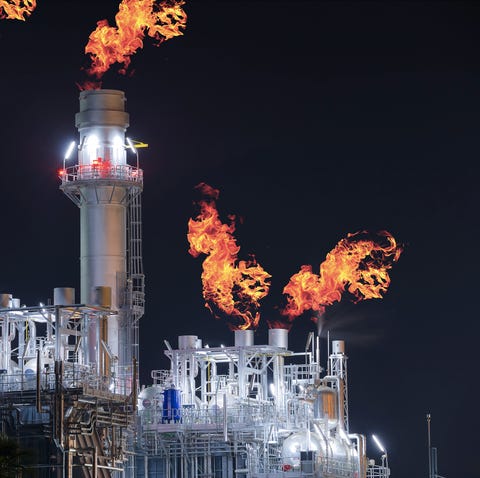
A new way to make efficient, high-acidity catalyst material could decrease fossil fuel refinery emissions.
The process can benefit the fossil fuel industry, but may also enable new renewable fuel sources.
The key is increasing aluminum in order to boost reactive Brønsted acid sites.

Scientists in Australia say they’re working on an oil-refinement catalyst material that could create 28 percent less carbon dioxide than what the industry relies on now. The difference is all in the mix, with more acidity that increases how active the catalyst substance is.

Petrochemicals can be refined in one of a few different processes, and this catalyst is used in the process known as cracking. The process dates back over 100 years, when a Standard Oil chemist discovered thermal cracking, where heating alone is used to break big hydrocarbons into smaller ones: oils, diesel and gas, petroleum coke, and gases like propane.

Adding a catalyst, which began in the 1920s, makes for a more efficient process with higher-quality outcomes, and scientists have continued to make better catalyst materials, formats, and applications. The reason lead was originally added to gasoline was to raise octane and reduce engine knocking. The development of better catalysts over time increases octane on the front end, making it easier first to phase out lead and later to continue to make smaller, more efficient engines.

The University of Sydney team began with amorphous silica-aluminas (ASAs), which are one of the most widely used catalysts in petrochemical refining today. During the cracking process, a lot of carbon dioxide is released, and higher-temperature cracking furnaces must periodically be cleared of coke residue, which also produces carbon dioxide.

“Estimates suggest 20 to 30 percent of crude oil is transferred to waste and further burnt in the chemical process, making oil refineries the second largest source of greenhouse gases behind power plants,” the press release reads. A more efficient catalyst could reduce both emissions waste and just raw materials waste.

The catalyst these researchers developed works by increasing the presence of a specific element called a Brønsted acid sites (BAS) within a particular ASA formulation. “The lower performance of ASA in many catalytic applications is widely attributed to their moderate Brønsted acidity,” the team writes in its paper. So increasing that acidity can make catalysts better.

But how can we do that? The secret is in boosting a specific chemical component. “The formation of BAS in silica-aluminas is based on aluminum centers distributed in the silica framework or network,” the team explains. “The study revealed that compared to the widely accepted model of one Al center, two proximate Al centers can significantly boost its acid strength.”

There are many required next steps for this research to become practical. Identifying even a really promising chemical mechanism is just one important but tiny piece. Scientists first have to be able to make the materials at scale for even one petrochemical refinery plant, let alone enough to be impactful on the world’s refining emissions.

But these researchers point out that a high-efficiency, high-acidity catalyst could open up entire new avenues of refinement with biomass and other renewable energy that isn’t feasible with lower-efficiency catalysts. The researchers say that in a near future where we’ll continue to rely on fossil fuels and traditional refineries for at least a while longer, we might as well invest in making them cleaner and better.

---30---

Bahraini protest movement urges civil disobedience on uprising anniversary
Sunday, 09 February 2020 
In this file picture, a protester waves a Bahraini flag as he flashes a victory sign during an anti-regime protest organized by Bahrain's main opposition group al-Wefaq, in the village of Daih, north of the capital Manama. (Photo by Reuters)

A Bahraini opposition protest movement has called for nationwide dissidence on the eve of the ninth anniversary of the popular uprising against the Al Khalifah regime.

The February 14 Youth Coalition, named after the date of the beginning of the popular uprising against the Manama regime, demanded the action to start as of the evening of Wednesday, February 12, until the evening of Friday, February 14.

The opposition movement outlined some acts of civil disobedience as school strike on Thursday, and local residents switching off the lights of their houses at eight o’clock in the evening for two consecutive nights.
O
Bahrain summons, detains another Shia cleric as crackdown persistsBahraini officials arrest a Shia cleric as a heavy crackdown against members of the religious community persists in the kingdom.

The February 14 Youth Coalition then urged Bahraini shop owners to shutter their stores as of eight o'clock in the evening on Wednesday, and re-open them on Friday sunset, not to travel along King Fahd Causeway, which connects Bahrain to Saudi Arabia, on February 13 and 14, and to boycott shopping mall on the mentioned days.

It also called on Bahraini people from all walks of life to participate actively in the diverse popular movement as well as various peaceful demonstrations.

Thousands of anti-regime protesters have held demonstrations in Bahrain on an almost daily basis ever since a popular uprising began in the country in mid-February 2011.

PressTV-Al-Wefaq demands release of sick Bahrian prisonersDozens of Bahrain’s prisoners-of-conscience have been languishing in the Kingdom’s notorious prisons for years.

They are demanding that the Al Khalifah regime relinquish power and allow a just system representing all Bahrainis to be established. Manama has gone to great lengths to clamp down on any sign of dissent. On March 14, 2011, troops from Saudi Arabia and the United Arab Emirates were deployed to assist Bahrain in its crackdown.

On March 5, 2017, Bahrain’s parliament approved the trial of civilians at military tribunals in a measure blasted by human rights campaigners as being tantamount to imposition of an undeclared martial law countrywide.

Bahraini King Hamad bin Isa Al Khalifah ratified the constitutional amendment on April 3, 2017.

Amnesty intl' calls for urgent action over Bahrain executions

Wednesday, 15 January 2020 Bianca Rahimi Press TV, London

Mohammad Ramadan and Hussein Mousa are accused of being involved in the explosion in al-Dair on 14 February 2014. But they say they were tortured for days, hung from the ceiling and beaten with iron rods and batons. They claim the guard’s also threatened to subject their families to torture and rape; guards trained by British instructors.

Because of its alleged complicity in their torture, the UK intervened on Christmas day 2018, preventing their execution. Amnesty International and Reprieve say Westminster must intervene again. But will it?

Ramadan and Mousa’s fourth Death penalty appeal hearing was scheduled for Christmas day 2019, but was delayed. On the 8th of January the death penalties were upheld.

Bahrain has the largest number of political prisoners per capita in the world. Britain has spent at least 5,000,000 pounds on Bahrain’s justice system since 2012, on the pretext of helping improve its abysmal human rights record.

But human rights charities like Reprieve say the UK has failed to investigate alleged torture and Manama is not feeling any pressure to stop the abuse.

The fact is that torture and questionable court proceedings are common in Bahrain and observers say that if foreign governments and rights organizations do not intervene regularly, the situation will only get worse.
Homeless US student population 'highest in over a decade': Study
Tuesday, 04 February 2020
 

A homeless man sleeps on a sidewalk on October 18, 2018 in Philadelphia, Pennsylvania. (AFP photo)

A new study shows the population of homeless students in the United States has reached the highest level in over a decade.

More than one and a half million public school students said they were homeless during the 2017-18 school year, according to the report from the National Center for Homeless Education .

Most of the 1.5 million homeless schoolchildren stayed with other families or friends. But 7 percent lived in abandoned buildings or cars.

The data shows an increase of over 100 percent in the number of homeless reported over a dozen years ago.

“The ripple effect here is real,” Dr. Megan Sandel, a director of the Grow Clinic at the Boston Medical Center, told the New York Times.

Sandel said housing instability was associated with developmental delays in children and children in fair or poor health.

Students living in unsheltered places also saw an increase of nearly 140 percent.

The study found that the crisis was often caused by fluctuating economic conditions, unaffordable housing, and drug addiction.

Despite the rising numbers, experts suggest that many families still refrain from reporting homelessness.

Meanwhile, homelessness for common public is also growing in large American cities mainly as a result of rising rent prices, despite a drop in the number of people living on streets across most of the US.

US homelessness surges across West Coast: ReportMany cities on the US West Coast are struggling with acute homelessness amid an unprecedented level of poverty and hardship in the region, a new report suggeest.

The incidence of homelessness is growing faster in the least affordable rental housing markets and cities with skyrocketing home prices, including New York City, Los Angeles, San Francisco and Washington, DC, according to the study by Zillow, an online real estate database company.


Is This The Death Knell For Nuclear?

By Haley Zaremba - Jan 18, 2020


It’s nearly impossible to discuss climate change and the future of the energy industry without discussing nuclear energy. Nuclear energy produces zero carbon emissions, it’s ultra-efficient, it’s already in widespread use, and could be scaled up to meet much more of our global energy needs with relative ease, but it is, and will likely always be, an extremely divisive solution.

For all its virtues, nuclear energy certainly has its fair share of drawbacks. It may not emit greenhouse gases, but what it does produce is deadly nuclear waste that remains radioactive for up to millions of years and we still don’t really know what to do with it other than hold onto it in ever-growing storage spaces. And then there are the horror stories that keep civilians and politicians alike wary if not outright antagonistic toward the technology. Chernobyl, Fukushima, and Three Mile Island loom large in our collective doomsday consciousness, and not without good reason.

We’re still dealing with the aftermath of these nuclear disasters. Japan is in many ways still reeling from 2011’s Fukushima nuclear disaster and recently even threatened to throw radioactive water into the Pacific Ocean or letting it evaporate into the air because they are running out of storage space for the wastewater they have been using to keep the damaged Fukushima reactors from overheating again. So yeah, nuclear isn’t perfect.

Because of all of these reasons, as well as financial burden, nuclear energy has been on the decline in much of the world (with some notable exceptions in the nuclear-friendly administrations in China and Russia). This is not new news. Now, however, Chatham House, the UK's Royal Institution of International Affairs, has taken things a step further by taking the official stance that nuclear will never be a serious contender as a solution to catastrophic climate change. Related: Bearish Sentiment Returns To Oil Markets

As paraphrased by environmental news site EcoWatch, the energy experts at Chatham House “agreed that despite continued enthusiasm from the industry, and from some politicians, the number of nuclear power stations under construction worldwide would not be enough to replace those closing down.” The consensus was that this is nuclear’s swan song, and we are now unequivocally entering the era of wind and solar power.

These conclusions were arrived at during a summit convened to discuss the findings of the World Nuclear Industry Status Report 2019, which concluded that “money spent on building and running nuclear power stations was diverting cash away from much better ways of tackling climate change.”

This echoes the sentiment of many other climate and energy experts, who have long been sounding the alarm bells that renewable energy is not being built up or invested in with nearly enough urgency. Last year the International Energy Agency announced that renewables growth has slumped, and that our current renewable growth rate of 18o GW of added renewable capacity per year is “only around 60 percent of the net additions needed each year to meet long-term climate goals”.

The International Renewable Energy Agency (Irena) did the math, calculating exactly how much renewable energy will need to be installed by 2030 if the world has any hope of meeting the goals set by the Paris climate agreement, and they found that “7.7TW of operational renewable capacity will be needed by 2030 if the world is to limit global warming to ‘well below’ 2C above pre-industrial levels, in line with the Paris Climate Agreement,” according to reporting by Wind Power Monthly. “However, at present, countries’ nationally determined contributions (NDCs) amount to 3.2TW of renewable installations by 2030, up from 2.3TW currently deployed.”

The World Nuclear Industry Status Report succinctly sums up the situation while sounding the death knell for nuclear: "Stabilising the climate is urgent, nuclear power is slow. It meets no technical or operational need that these low-carbon competitors cannot meet better, cheaper, and faster."

By Haley Zaremba for Oilprice.com


The Unexpected Consequences Of Germany’s Anti-Nuclear Push

By Irina Slav - Jan 14, 2020


Germany, the poster child for renewable energy, sourcing close to half of its electricity from renewable sources, plans to close all of its nuclear power plants by 2022. Its coal-fired plants, meanwhile, will be operating until 2038. According to a study from the U.S. non-profit National Bureau of Economic Research, Germany is paying dearly for this nuclear phase-out--with human lives.

The study looked at electricity generation data between 2011 and 2017 to assess the costs and benefits of the nuclear phase-out, which was triggered by the Fukushima disaster in 2011 and which to this day enjoys the support of all parliamentary powers in Europe’s largest economy. It just so happens that some costs may be higher than anticipated.

The shutting down of nuclear plants naturally requires the replacement of this capacity with something else. Despite its reputation as a leader in solar and wind, Germany has had to resort to more natural gas-powered generation and, quite importantly, more coal generation. As of mid-2019, coal accounted for almost 30 percent of Germany’s energy mix, with nuclear at 13.1 percent and gas at 9.3 percent.

The authors of the NBER study have calculated that “the social cost of the phase-out to German producers and consumers is $12 billion per year (2017 USD). The vast majority of these costs fall on consumers.”

But what are these social costs--exactly?

“Specifically,” the authors wrote, “over 70% of the cost of the nuclear phase-out is due to the increased mortality risk from local air pollution exposure as a consequence of producing electricity by burning fossil fuels rather than utilizing nuclear sources.”Related: Is This The Start Of A New Offshore Oil & Gas Boom?


The culprit is coal. According to the study, some 1,100 people die because of the pollution from coal power generation every year. This, the authors say, is a lot worse than even the most pessimistic cost estimates of so-called “nuclear accident risk” and not just that: 1,100 deaths annually from coal-related pollution is worse even when you include the costs of nuclear waste disposal in the equation.

The results of the study, which used machine learning to analyze the data, surprised the authors. The cost of human lives had not been expected to be the largest cost associated with the nuclear phase-out.

“Despite this, most of the discussion of the phase-out, both at the time and since, has focused on electricity prices and carbon emissions – air pollution has been a second order consideration at best,” one of the authors, economist Steven Jarvis, told Forbes.

Just two decades ago, air pollution was a top concern for many environmentalists. Now, carbon emissions and their effect on climate seem to have taken over the environmental narrative and, as the research from NBER suggests, this is leading to neglecting important issues. Meanwhile, there are voices—and some of them are authoritative voices—that are warning a full transition to a zero-emission economy is impossible without nuclear power, which is virtually emission-free once a plant begins operating.

None other than the International Energy Agency—a staunch supporter of renewables—said in a report last year that the phase-out of nuclear capacity not just in Germany but everywhere could end up costing more than just increased carbon emissions as the shortfall in electricity output would need to be filled with fossil fuel generation capacity, just like it is filled in Germany.

Why can't renewables fill the gap? Here’s what the IEA had to say:

“If other low-carbon sources, namely wind and solar PV, are to fill the shortfall in nuclear, their deployment would have to accelerate to an unprecedented level. In the past 20 years, wind and solar PV capacity has increased by about 580 gigawatts in advanced economies. But over the next 20 years, nearly five times that amount would need to be added. Such a drastic increase in renewable power generation would create serious challenges in integrating the new sources into the broader energy system.”Related: Are Oil Prices Still Too High?

Translation: we are not adding wind and solar fast enough and we can never add them fast enough without risking a grid meltdown.

Even Germany’s fellow EU members recognize the importance of nuclear power. Leaving aside France, where it is the single largest source of energy, accounting for 60 percent of electricity generation, the EU members agreed in December to include nuclear power in their comprehensive climate change fighting plan, which the union voted on at the end of the year.

“Nuclear energy is clean energy,” the Czech Prime Minister, Andrej Babis, said at the time. “I don’t know why people have a problem with this.”

The reason so many people have a problem with nuclear is, of course, obvious. Actually, there are two reasons: Chernobyl and Fukushima. One might reasonably argue that two accidents for all the years nuclear power has been used for peaceful purposes by dozens of nuclear plants make the risk of a full meltdown a small one, but statistics is one thing--fear is an entirely different matter.

The problem with nuclear plants, in most opponents’ minds, is that a meltdown may be rare, but when it does happen, it is far more disastrous than a blackout caused by a slump in solar energy production, for example.

There is no way to remove the risk of a nuclear reactor meltdown entirely. Reactor makers are perfecting their technology, enhancing safety features, and making sure the risk will be minimal, but the risk remains, deterring politicians--those in the ultimate decision-making position--to make a pragmatic decision that, as the NBER research suggests, could actually save lives.

By Irina Slav for Oilprice.com


The World Can’t Let Nuclear Energy Die
Despite wavering public sentiment and…

The Biggest Challenges Facing America’s Nuclear Sector=


GLOBAL RISK INSIGHTS

GlobalRiskInsights.com provides the web’s best political risk analysis for businesses and investors. Our contributors are some of the brightest minds in economics, politics, finance, and…

Nuclear Is Japan’s Only Choice For Energy Independence


Japan has adopted a peaceful approach towards nuclear technology, limiting it to the use of supplying electricity. This is despite being the only nation to have suffered devastating effects of nuclear warfare. However, the 2011 tsunami triggered an accident at the Fukushima nuclear plant and dramatically changed public sentiment with widespread protests calling for the abandonment of this energy source. The balance between these demands and the use of reliable and affordable energy supply is significantly conditioning Japanese politics.


Energy security in Japan

Japan relied heavily on imports of fossil fuels while recovering from WWII. This vulnerability became critical in the wake of the 1973 oil crisis and led to diversification in Japan’s energy mix towards a significant use of nuclear energy.

This trend was sustained during the following decades and even increased at the beginning of the 21st century due to environmental concerns. For example, in 2008, the Ministry of Economy, Trade and Industry (METI) set the goal of reducing CO2 emissions by 54 percent by 2050, and 90 percent by 2100. This would lead to nuclear power contributing around 60 percent of primary energy consumption by 2100 and being responsible for 51 percent of emission reduction.

However, in July 2011, after the Fukushima accident, the Japanese government decided to shut down all its nuclear power plants. As a consequence by February 2012, electricity costs increased by 15 percent.

Figure: The trend of Power Generation Costs (Total for 12 Companies)


(Click to enlarge)


The cut in nuclear plants affected Japan’s trade balance. Between 2011 and 2013, the cost of importing energy resources into Japan was $40 trillion, and the total trade deficit between April 2011 and March 2014 was $227 billion. As a result, the government was forced to adopt the 4th Strategic Energy Plan in 2014 and declare that nuclear energy was a vital energy source that would continue being used under optimal security conditions to achieve a stable and affordable energy supply.

So, energy security is Japan’s main geopolitical concerns. As an island nation without indigenous energy sources, Japan relies heavily on imported fossil fuels. This overreliance on imports endangers the country’s energy system if a geopolitical event disrupts shipping to East Asia. The most likely disruptive events being a war between the United States and Iran, an open conflict with China over the Senkaku islands, or an attack (conventional or nuclear) from North Korea.

Japan’s energy future and the problem of public opinion

However, the most severe challenge facing policy-makers and the nuclear industry in Japan is the loss of public confidence in this type of energy. For instance, the 2015 Japan Atomic Energy Relations Organization (JAERO) survey found that 47.9 percent of respondents want nuclear power abolished gradually. 14.8 percent think it should be halted immediately. Only 10.1 percent said that the use of atomic energy should be maintained and 1.7 percent said it should increase.

These opinions have a bigger eco in the countryside where mayors or prefecture’s chief have informal veto power on the reopening of nuclear power plants, which at the same times is highly conditioned by electoral dynamics and popular support.

In 2013, Abe’s government created the Nuclear Regulation Authority (NRA), an agency with an independent decision-making authority based on scientific and technological data, to develop new safety standards and boost public confidence for the nuclear reactors reopening process. Related: Oil Prices Set For Worst Weekly Drop In Five Weeks

However, faith in nuclear energy has not been restored. According to a more recent JAERO study, the ratio of the public who trust the nuclear industry is 1.2 percent, and those who do not is 22.0 percent. The reasons for these figures are the lack of information disclosure, insufficient preparation and management on safety, and the perceived lack of honesty from industrials and public officials.

The problem of nuclear waste

The Japanese government must also find safe ways to manage stocks of irradiated nuclear fuel. By the end of 2016, Japan had 14,000 tons of spent nuclear fuel stored in nuclear power plants, filling about 70 percent of its on-site storage capacity. The law requires reprocessing of spent fuel to recover its plutonium and uranium content. But fuel storage in Rokkasho, Japan’s only commercial reprocessing plant, is nearly full, causing potential risks derived from the lack of storage space, such as the need to stop uranium reprocessing or halting nuclear power plants activity increasing like that Japan’s energy vulnerability.

Other risks derived from excessive storage and conservation conditions can be leaks of irradiated particles, which represent a threat to public health. That’s why the construction of an interim storage facility in Mutsu is planned, however, in the medium term this problem will force Japan to move spent fuel to dry cask storage, and in the long term, it will need to increase this capacity and find a candidate site for final disposal of spent fuel.

Japan also has nearly 48 tons of separated plutonium. Just one tone of separated plutonium is enough material to manufacture more than 120 nuclear weapons. Many countries have expressed concern about Japan’s plans to store plutonium and use it as nuclear fuel. Some, such as China, fear that Japan may use the material to produce nuclear weapons rapidly. Consequently, maintaining this policy could increase security concerns and regional tensions, and could stimulate an arms race in East Asia.

The geopolitics of nuclear energy

Although only nine of Japan’s 38 commercial reactors are currently functioning, the government and the nuclear industry hope to be able to solve much of the problems associated with this sector by exporting energy and infrastructures to foreign markets. For the Japanese government, this is a critical component of its program to boost economic growth, and for the Japanese nuclear industry, this is the last hope to do business after Fukushima.

Companies like Toshiba, Hitachi and Mitsubishi, entered foreign markets with the help and support of the Japanese government. Japan’s public-private partnership to build nuclear power plants is a lucrative opportunity that could position Japan as one of the world’s leading energy suppliers in the future. After all, nuclear power is in demand in countries such as Turkey, Poland, Bangladesh, Pakistan and Argentina, that are eager to reduce CO2 emissions and increase their energy security.Related: China’s Fight Against Pollution To Generate Billions In Extra Solar Income

At the same time, demand for reactors appears to be stable worldwide. In particular, China and Russia have been vigorously entering foreign markets in recent years through their state-owned companies. For example, Rosatom announced last year that it had acquired contracts to build 35 new reactors, 67 percent of the world total. Chinese and Russian state-owned companies have been supplying nuclear material at lower costs than Japanese and Western ones, which has pushed up fossil fuel prices and raised national security concerns in many countries. This is why in 2017 a memorandum of understanding was signed between Japan and the United States to promote the global leadership role of both countries in the field of civil nuclear energy to counter Chinese and Russian dominance of the global nuclear energy market.

General assessment and foresight

Since Fukushima, the reopening of nuclear power plants in Japan has become more difficult in many ways. The Japanese government has adopted much stricter safety measures, and the nuclear industry has had to fight tirelessly to regain the confidence of the Japanese people.

In the coming years, the public acceptance of nuclear energy among Japanese local and regional leaders will be highly likely for environmental and employment reasons. However, the process of recovering Japan’s public support for nuclear energy is expected to take several years. The Nuclear Regulation Authority appears to be a credible and effective voice for public acceptance of the reopening of nuclear power plants. However, it is essential that this agency maintains its role as an impartial, fact-based entity to maintain its credibility with opponents of nuclear energy.

On the other hand, Japan will need to make significant strategic efforts to develop alternative energy sources. To bring its energy self-sufficiency rate back to the 2010 level or even higher, an optimal combination of renewable and nuclear energy is imperative.

By Global Risk Insights
Ottawa Prepares Lifeline For Alberta If It Rejects Major Oil Project

By Irina Slav - Feb 07, 2020


The federal Canadian government is preparing a financial aid package for Alberta in case it decides against a controversial large-scale oil sands project, Reuters reports, citing sources close to the cabinet.

“Rejecting Teck without providing Alberta something in return would be political suicide,” one of the sources said. This means the government must be prepared to compensate the oil province to dull the pain.


Teck Resources’ Frontier oil sands project, valued at some $15.7 billion (C$20.6 billion) will produce some 260,000 bpd of crude oil at peak production and will have a productive life of 40 years.It is as controversial as any new oil sands project would be under a Liberal government that has pledged to do more about climate change, but for Alberta it is essential not just as a job creator but as an indicator of this government’s readiness to support—or defeat—Alberta’s oil industry as a whole.

The Liberals would be careful to do the latter, the Reuters sources said, after they lost all seats in Alberta at last year’s election precisely because of their negative attitude to new energy projects that have depressed the oil industry in the province.

Yet there is little wiggle room. As one analyst put it right after the elections, “We have got a Liberal minority and the balance of power shifts to the NDP and the Greens, who are completely opposed to any progressive energy policies.”

This means it is quite likely that Ottawa would reject the Frontier project, angering Alberta. The implications of such a development are grim for the oil province but none too rosy for the Liberals either; they would have to find a way to make up for their decision on Frontier in a way that would satisfy Alberta.

It’s worth noting, however, that even if the federal government approves the Frontier project, Teck might decide to shelve it: when it proposed the development, oil was trading much higher than it is trading now, casting a shadow over the economic viability of the project.

By Irina Slav for Oilprice.com
Could This Be The Decade Of Green Hydrogen?
By Tsvetana Paraskova - Feb 08, 2020


The pressure on the energy industry to curb carbon emissions while simultaneously meeting growing global demand has drawn attention to alternatives to fossil fuels.

Of those alternatives, renewable energy is already making steady progress in electricity generation capacity, while another source of energy—hydrogen—is also gaining momentum and is being touted as a key fuel in the energy transition.

Hydrogen has the potential to become a key clean fuel source in the future that could help reduce greenhouse gas emissions—this could be the perfect solution to supplying growing amounts of low-carbon fuel and energy.

But not all hydrogen is created equal. There’s the so-called ‘grey’ hydrogen made from coal and natural gas, and this is nearly all the hydrogen currently produced in the world. Hydrogen production from natural gas emits CO2 every year equivalent to the CO2 emissions of the United Kingdom and Indonesia combined.

Then there’s ‘blue’ hydrogen, produced from natural gas with carbon capture and storage (CCS). Oil and gas supermajor BP says that blue hydrogen is currently the lowest-cost source of low carbon hydrogen at scale.


And finally, there’s the zero-emission hydrogen, the so-called ‘green’ hydrogen, produced using renewable energy with water electrolysis.
This is the hydrogen of the future and its development is set for a massive uptake in the next decade, enabled by ambitious climate goals and actions across major economies and by the continuously declining costs of renewables, proponents of the green hydrogen say.

Yet, massive investments and unprecedented policy support will be necessary to scale up green hydrogen production and make it cost-efficient.

According to the Hydrogen Council, a global CEO-level advisory body, the continuous scale up of hydrogen production and distribution could lead to a 50-percent decline in costs by 2030 for many hydrogen applications, making green hydrogen competitive with other low-carbon alternatives and, in some cases, even conventional options.

However, US$70 billion of investment will be needed to make hydrogen cost-competitive, the council says.

“Realising this ambitious vision for hydrogen’s role in the future of energy is far from automatic and requires investment above and beyond current commitments,” the Hydrogen Council said in its ‘Path to hydrogen competitiveness’ report last month.

In hydrogen production alone, achieving cost-competitive green hydrogen from electrolysis requires the deployment of aggregated 70 GW of electrolyser capacity, with an implied cumulative funding gap with ‘grey’ hydrogen production of U$20 billion. In transport and in heating for buildings and industry the investments needed are US$30 billion and US$17 billion, respectively, the report notes.

The cost of hydrogen is expected to drop drastically and imminently, and it’s up to policy-makers and investors to jump start this transition now, Hydrogen Council co-chairs Benoît Potier and Euisun Chung wrote last month.

While the US$70-billion investment in making hydrogen competitive looks huge, it is just a fraction of annual global spending on energy, accounting for less than 5 percent of that, Potier and Chung say.

A recent analysis by Wood Makenzie showed that green hydrogen costs could reach parity by 2030 in Australia, Germany, and Japan based on US$30 per megawatt-hour for renewables.

Globally, over US$3.5 billion worth of projects are in the pipeline for commissioning by 2025, WoodMac has estimated.

“Green hydrogen is a clean energy carrier and can decarbonise ‘difficult sectors’ such as steel, cement, chemicals, heating and heavy-duty trucking. It can also tackle the intermittency of renewables by diverting excess supply during the day to produce hydrogen that can be stored for use in the evening when demand is high,” Prakash Sharma, Head of Markets and Transitions in Asia Pacific at Wood Mackenzie, says.

The International Renewable Energy Agency (IRENA) believes that green hydrogen could play a central role in the global energy system and estimates that it could account for 8 percent of global energy consumption by 2050.

“Falling renewable power cost and falling capital cost for electrolyzers is creating an economic case for green hydrogen,” IRENA says.

Declining renewables costs and growing pressure for climate action could help the green hydrogen momentum going, but it will take a lot of investment and policy support to make green hydrogen a scaled-up competitive source of zero-emission energy.

By Tsvetana Paraskova for Oilprice.com

FBI says neo-Nazis pose equal threat to US as Daesh

Police escorted masked members of a white nationalist group on a march through Washington's National Mall on Saturday, February 8, 2020. (Reuters photo)
The rise of violence by neo-Nazi and white supremacists in the US is now as significant a threat to the country as foreign terrorist organizations such as Daesh (ISIL), according to the FBI.
The threat of anti-government and far-right groups has risen to a "national threat priority" for 2020, FBI Director Christopher Wray told the Judiciary Committee of the US House of Representatives.
Racially and ethnically motivated extremists pose a "steady threat of violence and economic harm" to the US, Wray said.
The FBI director said his agency is "most concerned about lone offender attacks" which have "served as the dominant lethal mode" for domestic terror incidents.
In 2019, the FBI made 107 domestic terrorism arrests, on pace with the number of arrests it made for international terrorism.
In the same year, the FBI announced the launch of a Domestic Terrorism-Hate Crimes Fusion Cell, which allows the organization to allocate as much resources to combat domestic terrorism as it does to combat other terror-linked groups.
The US Department of Homeland Security, which oversees the FBI, recently recognized white nationalism as a significant domestic threat.
On Saturday, more than 100 members of a white nationalist group held a rally in Washington.

d members of a white natMaskeionalist group march on Saturday, February 8, 2020. (Photo via news2share.com)
Members of the Patriot Front, dressed in khaki pants and caps, blue jackets and white face masks, shouted "Reclaim America!" and "Life, liberty, victory!" video of the march showed.
In his State of the Union address Tuesday night, President Donald Trump said the US will continue to fight against what he called "radical Islamic terrorism" but did not mention the terror threat fueled by white nationalist and other domestic terror groups.
Since his election, polling has shown Americans wary of Trump when it comes to race. A Pew Research Center poll last year showed 56% of Americans believe Trump has made race relations worse.
Americans gave similarly poor assessments of the president’s impact on specific racial, ethnic and religious minorities. Nearly 6 in 10 considered Trump’s actions to be bad for Hispanics and Muslims, and about half said they were bad for African Americans, according to a February 2018 poll from the AP-NORC Center for Public Affairs Research.

Trump takes credit for quitting Iran deal as ‘most important’ thing he did for Israel

 Wednesday, 29 January 2020

US President Donald Trump admits he quit the Iran nuclear deal for the sake of Israel, asserting that the move was “perhaps the most important” thing he has done for the Zionist regime.

In a joint press conference with Israeli Prime Minister Benjamin Netanyahu in Washington, DC, on Tuesday, Trump enumerated his pro-Israeli moves, branding withdrawal from the internationally backed deal as the most significant thing he has done for the regime.
“As everyone knows I have done a lot for Israel; moving the United States embassy to Jerusalem [al-Quds], recognizing the Golan Heights, and frankly perhaps most importantly, getting out of the terrible Iran nuclear deal,” said the US president to a roaring pro-Israel audience at the White House.
Pulling the US out of the Iran nuclear agreement in 2018 is has led to more tensions and instability in West Asia.
Trump’s also move originates from his animosity with former President Barrack Obama who was in office, when the Joint Comprehensive Plan of Action (JCPOA) was clinched.
Trump took credit for quitting the Iran deal and turning his back to other US allies such as Britain, France and Germany, while unveiling his long awaited “peace plan” for the Israeli-Palestinian conflict.
Tehran has joined Palestinian leaders in denouncing the so-called deal of the century, which is blatantly in favor of Tel Aviv and bold in negating Palestinians their legal rights.

Superpowers Face Off For Space Supremacy


One year ago in January, a Chinese robot landed on the dark side of the moon. Since then, the Chang’e 4 probe and the Yutu-2 rover it carried onboard have been busy photographing and scanning minerals, growing yeast, hatching fruit-fly eggs, and cultivating cotton, potato, and rapeseeds in the moon’s low gravity, according to the Daily Beast.

Now, China’s National Space Administration is quietly planning to launch yet another probe into space. Chang’e 5 could blast off as early as this year.

Last year, TMU reported that the Yutu-2 rover came across a strange “gel-like” substance which the Chinese began to study extensively.

The Chinese space agency has continued to work on its Tiangong 3 space station and is planning on testing a new manned spacecraft for deep-space missions. That permanent station will reach orbit aboard the country’s new Long March 5B rocket in the first half of 2020, AFP reported. The mission will not be associated with the International Space Station.

It is worth noting that China and Europe both planned on building a moon base together in a move of “international collaboration” back in 2017. Europe and Russia are also eyeing plans to send a probe to the dark side of the moon to determine if they should build a moon base on the far side of the lunar surface.

And the U.S. hasn’t been quiet when it comes to the space race either with the introduction of Space Force and plans of its own for a joint base with Russia.

For the U.S., this space race to build a moon base is nothing new. A project known as Horizon was supposedly a plan drawn up in the 1950s that seemingly depicts the blueprints for a base on the moon. Project Horizon sought to establish a stationary Army control base on the moon by 1966 but the operation was allegedly shut down and canceled and the idea never materialized further.

It was reported in a joint announcement by NASA and Russia’s Roscosmos State Corporation for Space Activities that the U.S. and Russia wanted to build a “moon base” the same year that Europe and China announced their cooperation. However, the current plan with Russia resembles another previous proposal called the Manned Orbiting Laboratory (MOL) which ironically was suggested during the Cold War. Russia and the U.S. now seek to revive that plan with a base that will orbit the moon similar to how the International Space Station moves around Earth.

The MOL ran from December 1963 until its alleged cancellation in June 1969. Its mission was to use an elite corps of secret U.S. astronauts to gather intelligence on the Soviets during the Cold War.Related: Coronavirus Pushes China Jet Fuel Sales Down 25%

NASA and the Russian space agency Roscosmos stated the partnership was for human exploration of the moon and deep space. Both agencies signed a joint statement on the collaborative effort. It all stemmed from NASA’s “deep-space gateway” concept, a mission architecture designed to send astronauts into lunar orbit by 2020.

“This plan challenges our current capabilities in human spaceflight and will benefit from engagement by multiple countries and U.S. industry,” NASA officials said in a statement at the time.

NASA also had plans leak last year showing that they wanted to develop their own lunar surface base, which is now being threatened by a U.S. House panel.

The status of plans between Russia and the U.S. as well as China and Europe are currently public and either could be canceled for reasons of political tensions or something else before they see the light of day.

“China, the United States, Russia and Europe are all discussing whether to build a research base or a research station on the moon,” Wu Yanhua, deputy chief commander of China’s Lunar Exploration Program said.

The bigger worry isn’t space exploration - it is weaponizing space. The New York Times reported in 2015 that space could be the next war zone, warning about the implications of weaponizing space in an opinion piece literally titled “Preventing A Space War.”

By Zerohedge.com
After Three Record Breaking Years, Is The U.S. Wind Energy Boom Over?
By Irina Slav - Feb 06, 2020  


In 2019, the U.S. wind power industry recorded its third record-breaking installation year in a row, with new wind capacity hitting 9.14 GW. To date, there are another 44 GW under construction or in advanced development. Yet there are clouds on the horizon: competition from gas and solar, and the phase-out of the production tax credit that has driven the industry’s growth until now.

The Energy Information Administration is rather pessimistic about the immediate future of U.S. wind power. In a report from March last year, the agency cautioned that wind power installation additions could slow down in the next few years as the expiry of the PTC leads to higher costs. Another factor that will affect new additions is the fact that the best sites for onshore wind farms are already taken. Yet over the long term, the EIA said it expected wind to regain its popularity because of the continued fall in turbine installation costs.

Some expect the popularity growth to come much earlier. Maxx Chatsko from the Motley Fool, for example, earlier this week wrote in an article that investors may soon begin flocking back to wind after a so-called wind drought appears to have subsided.

In the first half of 2019, Chatsko wrote, electricity produced by onshore wind farms in the United States was just 1.6 percent more than the electricity produced from onshore wind in the first half of 2018. This disappointing number was attributed to what the industry calls lower wind resources, meaning there was less wind blowing where there were wind farms. In the second half of 2019, however, electricity output from onshore wind farms rose by 22.4 percent from a year earlier, signaling what could be the end of the wind drought.

Meanwhile, wind farm developers are in a rush to add as many megawatts of new capacity as they can before the production tax credit expires at the end of this year. In fact, the EIA said last month that wind installations will dominate new power generation capacity additions this year as a whole. Wind and solar together will account for a whopping 76 percent of all new capacity additions, the agency added.

Some 18.5 GW of new wind power capacity is slated to come online this year. After that, however, new additions will likely decline until the industry handles the end of the production tax credit. But, as Forbes’ Joshua Rhodes noted in a recent overview of the state of U.S. wind and the challenges it faces, renewable portfolio standards could mitigate the effect of the PTC expiry. Specifically, these could extend to offshore wind in the next few years, Rhodes said, which would spur faster growth in that segment.

Renewable portfolio standards could support wind continually: there are already 39 states enforcing these standards, which require that a certain portion of the state’s power must come from renewable sources, and some are even committing to 100 percent renewable power, Zoe Dawson wrote in an article for the Council on Foreign Relations. The number of these states is still small but it is growing. All these commitments could provide a significant push for more wind power capacity. The question is, will the officials making the commitments succeed in seeing them through.

It’s election year and anything could happen, including changes in state governments that could lead to a change in climate commitments. Then there is the solar challenge: solar is in many places cheaper than wind and it is likely to continue getting even cheaper as the sector works on cutting costs while maintaining or even enhancing efficiency. Lastly, there is the wind drought problem. It could happen again. Potentially serious as these challenges are, industry observers seem to believe the industry is strong enough to deal with them and keep growing even if it suffers temporary setback if production tax credits are not renewed yet again.

By Irina Slav for Oilprice.com