Monday, February 10, 2020


For Thousands of Years, Quarantines Have Tried to Keep Out Disease
TOPICS:Georgia State University Public Health The Conversation Virology

By LESLIE S. LEIGHTON, GEORGIA STATE UNIVERSITY FEBRUARY 7, 2020



Quarantines have tried to keep out disease for thousands of years, being used long before germs were understood.

The recent global spread of a deadly coronavirus originating in Wuhan, China, has led world leaders to invoke an ancient tradition to control the spread of illness: quarantine.

The practice is first recorded in the Old Testament where several verses mandate isolation for those with leprosy. Ancient civilizations relied on isolating the sick, well before the actual microbial causes of disease were known. In times when treatments for illnesses were rare and public health measures few, physicians and lay leaders, beginning as early as the ancient Greeks, turned to quarantine to contain a scourge.

In January, Chinese authorities attempted to lock down millions of residents of Wuhan and the surrounding area, to try to keep the new coronavirus from spreading outward. The country’s neighbors are closing borders, airlines are canceling flights, and nations are advising their citizens against traveling to China, a modern instance of the old impulse to restrict people’s movements in order to stop disease transmission.

U.S. authorities are holding travelers returning from China in isolation for two weeks as an effort to halt coronavirus’ spread. Always at the center of the policy of quarantine is the tension between individual civil liberties and protection of the public at risk.
Keeping contagion at bay

The meaning of quarantine has evolved from its original definition “as the detention and segregation of subjects suspected to carry a contagious disease.”

Now it represents a period of isolation for persons or animals with a contagious disease – or who may have been exposed but aren’t yet sick. Although in the past it may have been a self-imposed or voluntary separation from society, in more recent times quarantine has come to represent a compulsory action enforced by health authorities.

Leprosy, mentioned in both Old and New testaments, is the first documented disease for which quarantine was imposed. In the Middle Ages, leper colonies, administered by the Catholic Church, sprung up throughout the world. Although the causative agent of leprosy – the bacterium Mycobacterium leprae – was not discovered until 1873, its disfiguring and incurable nature made civilizations wrongly believe it was easily spread.

The plague of the 14th century gave rise to the modern concept of quarantine. The Black Death first appeared in Europe in 1347. Over the course of four years, it would kill between 40 million and 50 million people in Europe and somewhere between 75 million and 200 million worldwide.


Now part of Croatia, Ragusa was in the Venetian Republic when it invented the 40-day quarantine to try to keep the plague out.

In 1377, the seaport in Ragusa, modern day Dubrovnik, issued a “trentina” – derived from the Italian word for 30 (trenta). Ships traveling from areas with high rates of plague were required to stay offshore for 30 days before docking. Anyone onboard who was healthy at the end of the waiting period was presumed unlikely to spread the infection and allowed onshore.

Thirty was eventually extended to 40 days, giving rise to the term quarantine, from the Italian word for 40 (quaranta). It was in Ragusa that the first law to enforce the act of quarantine was implemented.

Over time, variations in the nature and regulation of quarantine emerged. Port officials asked travelers to certify they hadn’t been to areas with severe disease outbreaks, before allowing them to enter. In the 19th century, quarantine was abused for political and economic reasons, leading to the call for international conferences to standardize quarantine practices. Cholera epidemics throughout the early 19th century made clear the lack of any uniformity of policy.
Imported to America

The United States has also had its share of epidemics, beginning in 1793, with the outbreak of yellow fever in Philadelphia. A series of further disease outbreaks led Congress in 1878 to pass laws that mandated involvement of the federal government in quarantine. The arrival of cholera to the United States, in 1892, prompted even greater regulation.
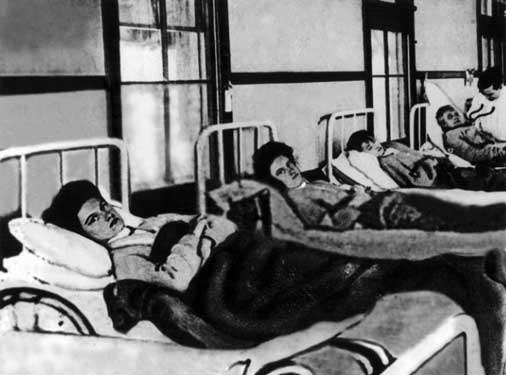

Officials quarantined ‘Typhoid’ Mary Mallon in a hospital.

Perhaps the best known example of quarantine in American history, pitting an individual’s civil liberties against public protection, is the story of Mary Mallon, aka “Typhoid Mary.” An asymptomatic carrier of typhoid fever in the early 20th century, she never felt sick but nevertheless spread the disease to families for whom she worked as a cook.

Officials quarantined Mary on North Brother Island in New York City. Released after three years, she promised never to cook for anyone again. Breaking her vow and continuing to spread the disease, she was returned to North Brother Island, where she remained for the remainder of her life in isolation.

More recently, in 2007, public health officials quarantined a 31-year-old Atlanta attorney, Andrew Speaker, who was infected with a drug-resistant form of tuberculosis. His case grabbed international attention when he traveled to Europe, despite knowing he had and could spread this form of TB. Fearing quarantine in Italy, he returned to the United States, where he was apprehended by federal authorities and quarantined at a medical center in Denver, where he also received treatment. Following release, deemed no longer contagious, he was required to report to local health officials five days a week through the end of his treatment.

Quarantine today continues as a public health measure to limit the spread of contagious disease, including not just coronavirus, but Ebola, flu, and SARS.

Its stigma has largely been removed by emphasizing not only the benefits of quarantine to society, by removing contagious individuals from the general population, but also the benefit of treatment to those who are ill.

In the United States, where the Constitution guarantees personal rights, it’s a serious decision to restrict an individual’s freedom of travel and compel medical treatment. And quarantine is not an ironclad way to prevent the spread of disease. But it can be a useful tool for public health officials working to stop the spread of a contagious disease.

Written by Leslie S. Leighton, Visiting Lecturer of History at Georgia State University.

Originally published on The Conversation.

'

"The Masque of the Red Death", originally published as "The Mask of the Red Death: A Fantasy", is a short story by American writer Edgar Allan Poe, first published in 1842. The story follows Prince Prospero's attempts to avoid a dangerous plague, known as the Red Death, by hiding in his abbey.
Genre: Short story
Characters: Prospero
Author: Edgar Allan Poe

Web results

The red death had long devastated the country. No pestilence had ever been so fatal, or so hideous. Blood was its Avatar and its seal -- the madness and the ...


Image result for e a poe the masque of the red death movie
The Masque of the Red Death is a 1964 horror film directed by Roger Corman and starring Vincent Price. The story follows a prince who terrorizes a plague-ridden peasantry while merrymaking in a lonely castle with his jaded courtiers.
Directed by: Roger Corman
Actor: Vincent Price
Genre: Horror

Potency Confusion as Few Consumers Understand THC Levels in Cannabis Edibles
TOPICS:Addiction Cannabis Marijuana Public Health University Of Waterloo

By UNIVERSITY OF WATERLOO FEBRUARY 7, 2020


Most cannabis consumers do not understand what the THC numbers on packages of cannabis edibles really mean.

Few cannabis consumers understand what the THC numbers on packages of cannabis edibles really mean, according to a new University of Waterloo study.

The study, which surveyed nearly 1,000 Canadians aged 16 to 30, found that most consumers could not identify whether a cannabis edible contained ‘low’ or ‘high’ levels of THC based on the label.

The researchers also found that descriptive information, such as symbols and words, are more effective in helping consumers understand THC potency and approximate serving sizes for cannabis products.

“Using THC numbers to express potency of cannabis products has little or no meaning to most young Canadians,” said David Hammond of Waterloo’s School of Public Health and Health Systems. “We’ve known for many years that people struggle to understand the numbers on the back of food packages and cigarette packages. Consumers seem to have equal or even more difficulty with THC numbers, which are used to indicate the potency of cannabis products.”

He added, “Effective THC labeling and packaging could help reduce to accidental over-consumption of cannabis edibles and adverse events, which have increased in jurisdictions that have legalized recreational cannabis.”

Health Canada currently requires cannabis packages to list the ingredients, product type, potency and other essential information, including weight in grams, and percentage of THC (or CBD, depending on the product), but not symbols or intuitive labeling on THC levels.

The researchers conducted two experiments with 870 Canadians aged 16-30 in 2017: The first investigated whether consumers could understand how many servings there were in a package, and the second examined if consumers could identify how potent the product was.

The study found approximately 6 percent of consumers could correctly identify serving size on products that had no label, or only listed the weight. Seventy-seven percent could identify the serving when the dosage was listed.

The study also found that a ‘traffic light’ system, which uses traffic light colors to indicate potency, allowed two-thirds of respondents to identify products with high levels of THC, compared to 33 percent of respondents who only used numerical THC information.

In 2018, Statistics Canada found that 32 percent of cannabis users consumed edibles.

“New regulations that limit cannabis edibles to a maximum of 10 mg per package are particularly important given that most consumers do not understand THC numbers,” Hammond said. “However, the findings suggest that consumers will need easier-to-understand THC information for other products, including oils, concentrates and dried flower.”

The study, “Cannabis labelling and consumer understanding of THC levels and serving sizes,” was published in the Journal of Drug and Alcohol Dependence, and co-authored by Cesar Leos-Toro, Geoffrey Fong, Samantha Meyer and David Hammond, all at the University of Waterloo.

Reference: “Cannabis labelling and consumer understanding of THC levels and serving sizes” by Cesar Leos-Toro, Geoffrey T. Fong, Samantha B. Meyer and David Hammond, 7 February 2020, Journal of Drug and Alcohol Dependence.
DOI: 10.1016/j.drugalcdep.2020.107843

Here’s How We Can Feed the World Without Wrecking the Planet – Comprehensive Solution

Sustainable Food System Map
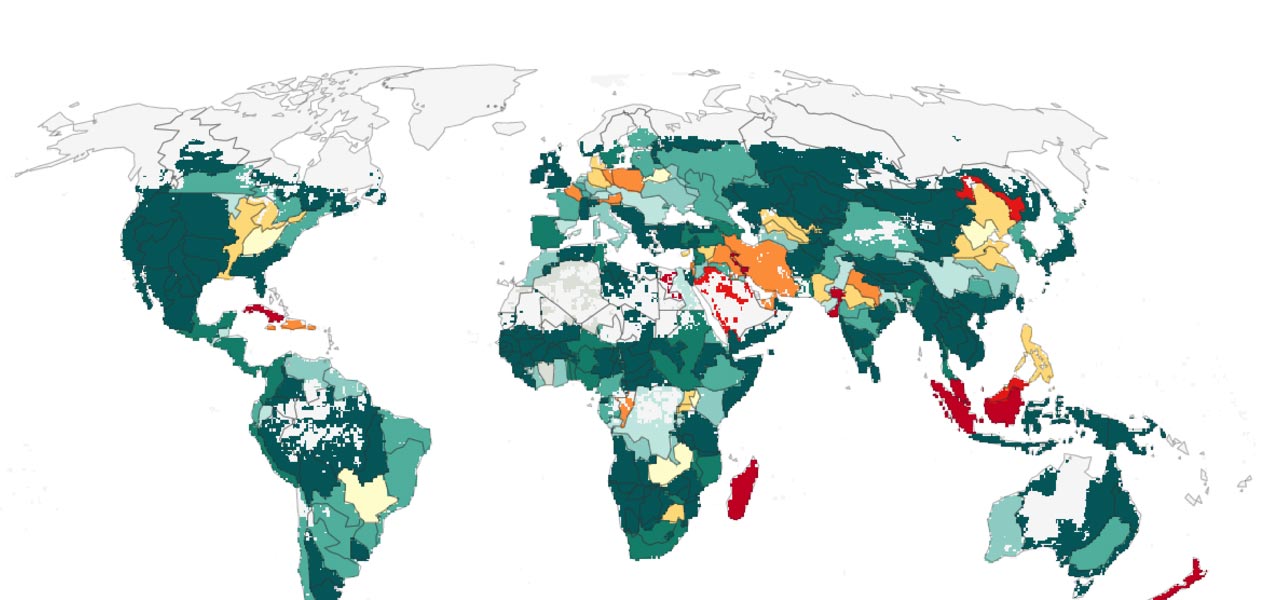
The potential for sustainable food system: Increases in calorie supply above current levels are possible in the green-colored areas; decreases due to overly detrimental food production are shown in red. Credit: Gerten et al. 2020
Almost half of current food production is harmful to our planet – causing biodiversity loss, ecosystem degradation and water stress. But as world population continues to grow, can that last?
An international study now suggests a comprehensive solution package for feeding 10 billion people within our planet’s environmental boundaries.
Supplying a sufficient and healthy diet for every person whilst keeping our biosphere largely intact will require no less than a technological and socio-cultural U-turn. It includes adopting radically different ways of farming, reduction of food waste, and dietary changes.
“When looking at the status of planet Earth and the influence of current global agriculture practices upon it, there’s a lot of reason to worry, but also reason for hope – if we see decisive actions very soon,” Dieter Gerten says, lead author from PIK and professor at Humboldt University of Berlin.
“Currently, almost half of global food production relies on crossing Earth’s environmental boundaries. We appropriate too much land for crops and livestock, fertilize too heavily and irrigate too extensively. To solve this issue in the face of a still growing world population, we collectively need to rethink how to produce food. Excitingly, our research shows that such transformations will make it possible to provide enough food for up to 10 billion people.”
The researchers ask the question how many people could be fed while keeping a strict standard of environmental sustainability worldwide. These environmental capacities are defined in terms of a set of planetary boundaries – advisable limits to human interference with processes that regulate the state of the planet. The present study accounts for four of nine boundaries most relevant for agriculture: Biosphere integrity, land-system change, freshwater use, and nitrogen flows. Based on a sophisticated simulation model, these boundaries are scrutinized globally at a new level of spatial and process detail. This analysis demonstrates where and how many boundaries are being violated by current food production and in which ways this development could be reverted through adopting more sustainable forms of agriculture.

Globally differentiated picture: In some regions, less would be more

The encouraging result is that, in theory, 10.2 billion people can be fed without compromising the Earth system. This leads to very interesting conclusions, as Johan Rockström, director of PIK points out: “We find that currently, agriculture in many regions is using too much water, land, or fertilizer. Production in these regions thus needs to be brought into line with environmental sustainability. Yet, there are huge opportunities to sustainably increase agricultural production in these and other regions. This goes for large parts of Sub-Saharan Africa, for example, where more efficient water and nutrient management could strongly improve yields.”
As a side effect, such more sustainable agriculture can increase overall climate resilience and adaptability while also limiting global warming. In other places, however, farming is so far off local and Earth’s limits that even more sustainable systems could not completely balance the pressure on the environment, such as in parts of the Middle East, Indonesia, and to some extent in Central Europe. Even after recalibrating agricultural production, international trade will remain a key element of a sustainably fed world.

Hard to chew: Dietary changes needed

Importantly, there is the consumers’ end, too. Large-scale dietary changes seem to be inevitable for turning the tide to a sustainable food supply. For example, regarding China’s currently rising meat consumption, parts of animal proteins would need to be substituted by more legumes and other vegetables. “Changes like this might seem hard to chew at first. But in the long run, dietary changes towards a more sustainable mix on your plate will not only benefit the planet, but also people’s health”, adds Vera Heck from PIK. Another crucial factor is reducing food loss. In line with scenarios adopted in the present study, the most recent IPCC Special Report on land use found that currently, up to 30 percent of all food produced is lost to waste. “This situation clearly calls for resolute policy measures to set incentives right on both the producers’ and consumers’ ends”, Heck further lays out.
Perhaps the most sensitive and challenging implication of the study relates to land. “Anything involving land tends to be complex and contested in practice because people’s livelihoods and outlook depend on it. Transitioning to more sustainable land use and management is therefore a demanding challenge to policy-making. Key to success is that the regions affected need to see clear benefits for their development. Then there is a real chance that support for new directions will grow fast enough for stabilizing the Earth system”, says Wolfgang Lucht, co-chair for Earth System Analysis at PIK and co-author of the study.
Reference: “Feeding ten billion people is possible within four terrestrial planetary boundaries” by Dieter Gerten, Vera Heck, Jonas Jägermeyr, Benjamin Leon Bodirsky, Ingo Fetzer, Mika Jalava, Matti Kummu, Wolfgang Lucht, Johan Rockström, Sibyll Schaphoff and Hans Joachim Schellnhuber, 20 January 2020, Nature Sustainability.
DOI 10.1038/s41893-019-0465-1
The study was led by researchers from the Potsdam Institute for Climate Impact Research (PIK). Aalto University researchers; Professor Matti Kummu and Mika Jalava, Postdoctoral Researcher, are from the Water and Environmental Engineering research group