It’s possible that I shall make an ass of myself. But in that case one can always get out of it with a little dialectic. I have, of course, so worded my proposition as to be right either way (K.Marx, Letter to F.Engels on the Indian Mutiny)
Wednesday, June 10, 2020
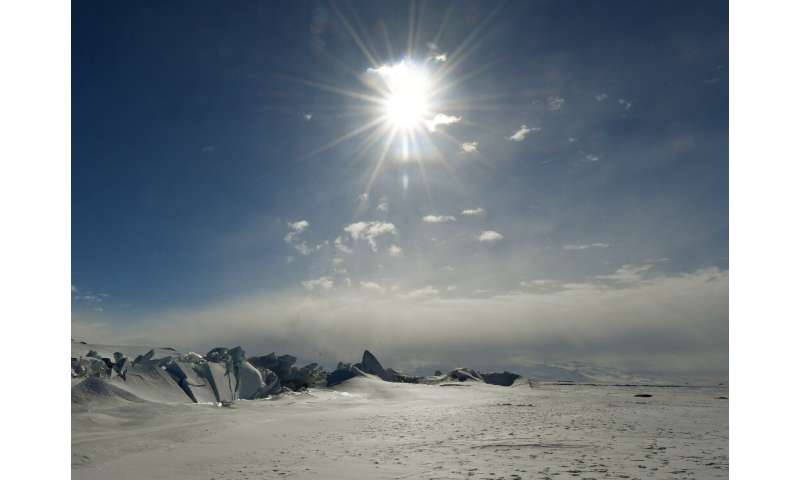
Antarctic projects trimmed over virus fears
According to reports, the number of projects was being cut from 36 to 13 across the upcoming research season
Antarctica New Zealand is committed to maintaining and enhancing the quality of New Zealand's Antarctic scientific research. Credit: Handout.
It may be the most desolate and uninhabitable place on the planet, but New Zealand is taking steps to ensure that Antarctica stays free of the deadly virus, Covid-19.
Antarctica New Zealand, the government agency that does environmental research on the desolate landmass and the Southern Ocean, said Tuesday it would reduce its scientific projects in Antarctica to keep the continent free from Covid-19, CGTN.com reported.
Limiting the number of people visiting was key to stopping the spread of the coronavirus, the agency said, addding it had decided to support “only long-term science monitoring, essential operational activity and planned maintenance this season” at its Scott Base.
According to reports, the number of projects was being cut from 36 to 13 across the upcoming research season from October to March, CGTN.com reported.
Antarctica New Zealand is committed to maintaining and enhancing the quality of Antarctic scientific research, chief executive Sarah Williamson stated.
However, current circumstances meant their ability to support science was extremely limited this season, she added.
Antarctica New Zealand said it was developing a managed isolation plan with multiple government agencies to ensure COVID-19 does not reach the continent, CGTN.com reported.
Scott Base is New Zealand’s only Antarctic research station and is 3,800 kilometres (2,360 miles) south of Christchurch and 1,350 kilometers (840 miles) from the South Pole, according to Antarctica New Zealand.
Usually, up to 86 scientists, staff and visitors can stay there at any one time, CGTN.com reported.
New Zealand has recorded a total of 1,504 confirmed and 22 deaths.
Meanwhile, more than 7.13 million people have been reported to be infected with the new coronavirus globally and 406,913 have died, according to latest data from Johns Hopkins University.
New Zealand cuts research to keep Antarctica virus free
Antarctica New Zealand said it was developing a managed isolation plan with multiple government agencies to ensure COVID-19 does not reach the continent
New Zealand said Tuesday it will reduce its scientific projects in Antarctica to keep the virtually uninhabited continent free from COVID-19.
Antarctica New Zealand, the government agency that does environmental research on the desolate landmass and the Southern Ocean, said limiting the number of people visiting was key to stopping the spread of the coronavirus.
The agency said it had decided to support "only long-term science monitoring, essential operational activity and planned maintenance this season" at its Scott Base after consulting other research programmes in the region.
According to reports, the number of projects was being cut from 36 to 13 across the upcoming research season from October to March.
"Antarctica New Zealand is committed to maintaining and enhancing the quality of New Zealand's Antarctic scientific research," Chief Executive Sarah Williamson said.
"However, current circumstances dictate that our ability to support science is extremely limited this season."
Antarctica New Zealand said it was developing a managed isolation plan with multiple government agencies to ensure COVID-19 does not reach the continent.
Scott Base is New Zealand's only Antarctic research station and is 3,800 kilometres (2,360 miles) south of Christchurch and 1350 km (840 miles) from the South Pole, according to Antarctica New Zealand.
Up to 86 scientists, staff and visitors can usually stay there at any one time
One of the residents of the Mariana Trench, the Deep Sea Anglerfish. Credit: Handout.
“Haidou-1” has set a new Chinese record for the world’s deepest dive, reaching a depth of 10,907 metres under the Pacific Ocean surface of the Mariana Trench, the deepest area in the world.
The unmanned submersible also collected samples from the deep sea and took high-definition images of the geological environment, India TV News reported.
Members of the expedition team from the Shenyang Institute of Automation with the Chinese Academy of Sciences said that the vehicle exceeded 10,000 meters four times at the Challenger Deep in the Mariana Trench during the trip, state-run Xinhua news agency reported.
The team left for the expedition on April 23 and returned to the northeast China province of Liaoning on Monday.
During the deep-sea diving operation, researchers tested high-precision depth detection, machine hand operation, acoustic detection and positioning, and high-definition video transmission.
The submersible collected samples from the deep sea and captured high-definition images of the geological environment, the report said.
China in recent years has stepped up efforts to develop deep sea technology to explore mining of rich natural resources from the sea bed.
During a four-hour exploration of the Mariana Trench in April of 2019, retired naval officer Victor Vescovo piloted his submarine to 10,927 meters (35,849 feet) below the sea’s surface, making it the deepest dive on record.
While Vescovo potentially discovered four new species, he also found a plastic bag and candy wrappers.
About 8 million tons of plastic are thrown into the ocean every year, mostly washed into the sea by rivers. There will be more plastic than fish in the sea by 2050 if current trends continue, according to the United Nations.
China’s unnamed submersible Haidou-1 reportedly dived to a depth of 10,907 meters at the world’s deepest ocean point. Credit: Handout.
Why Duterte wants to extend his Covid-19 emergency Philippine leader aims to expand and extend emergency powers in move that is as much about politics as health
Philippine leader Rodrigo Duterte takes questions while wearing surgical mask on April 8, 2020. Photo: Facebook
MANILA – The Covid-19 pandemic has been a boon for authoritarian leaders in Southeast Asia who have leveraged emergency rule provisions for their own political ends.
Nowhere is that more apparent than in the Philippines, where President Rodrigo Duterte has fully exploited the ongoing public health crisis to consolidate more power.
With a soldier-backed nationwide lockdown and bans on protests in the name of social distancing, critic say the Filipino leader is arguably trying to impose a permanent state of emergency in the democratic nation.
For years, the tough-taking president has warned for various reasons he would impose martial law in Manila and other major cities, similar to the hard curbs on civil liberties he imposed on the southern island of Mindanao in the name of fighting terrorism.
Since gaining emergency powers to combat the Covid-19 crisis in March, Duterte has presided over a broad crackdown on critical voices, shut down the country’s largest news broadcaster and is now railroading through Congress a sweeping anti-terror bill which would allow for warrantless arrests and curb free speech.
With the Philippine legislature now in recess, Duterte is angling to extend his emergency powers for the foreseeable future.
The Philippines has recorded nearly 23,000 Covid-19 infections and just over 1,000 deaths, putting its outbreak in the middle of the pack in Southeast Asia in terms of severity.
As the Philippines moves closer to 2022 presidential elections, the Filipino leader is in an ever-stronger position to hammer and harass the opposition and install a successor to his liking, including possibly his daughter or son in a dynastic handover.
Under the Covid-19 combating Bayanihan to Heal as One Act, Duterte was handed unprecedented powers to “move, decide and act freely for the best interest of the Filipino people during this health crisis.”
Workers in hazmat suits disinfect a road in San Juan City, Philippines on March 19, 2020. Photo: NurPhoto via AFP Forum/Lisa Marie David
Section 6(6) of the new law greenlighted heavy penalties, including two months imprisonment and up to US$20,0000 (1 million peso) fines, for anyone who dared to “create, perpetuate, or spread false information” without clearly defining the term.
A wave of warrantless arrests has followed, with as many as 41,000 Filipinos facing various punishments Some have even been forced into animal cages and others forced to sit under a scorching sun for allegedly violating the lockdown regulations.
Dozens of netizens have also faced subpoenas by intelligence and other state agencies for supposedly spreading false information, which has increasingly come to cover mere criticism of the president and his government’s policies.
Duterte’s extraordinary special powers were supposed to last for only three months under the emergency law. Despite easing lockdowns in Metro Manila and other major cities, his government is seeking to extend emergency measures set to expire on June 24.
“It’s not a preference. But I think it definitely is necessary to give us at least 90 days,” presidential spokesman Harry Roque told the media in late May, arguing that the virus crisis will persist without the discovery and distribution of a vaccine.
“Of course, extraordinary power is something that is reserved for extraordinary circumstances. But the problem here with Covid-19 is without the vaccine, we’ll never go back to normal and it’s still extraordinary,” Duterte’s spokesman added.
The presidential palace has claimed that without emergency powers and additional funds it will struggle to provide economic assistance to distressed communities, compensate and protect health workers, and step up its public health campaign.
Security personnel hold up placards reminding people to stay at home amid concerns of the spread of the Covid-19 coronavirus in Manila on March 31, 2020. Photo: AFP/Maria Tan
As such, Duterte’s legislative allies have pushed for various bills which would not only extend emergency rule but also expand the president’s powers.
In the Senate, the Bayanihan to Recover as One bill is set to augment up to 30 special powers already granted to the president, as well as allocate an additional $2.8 billion (140 billion pesos) to support his government’s policies.
The senators, however, have made it clear that new powers will be conditional upon improvements in public health policies, most especially the need for mass virus testing to be “conducted immediately” in priority areas.
The proposed legislation also calls on the government to improve and expand its performance in at least 15 different areas, including economic assistance to small and medium enterprises, students and teachers, as well as health workers.
Crucially, however, senators also want punitive provisions contained in the existing emergency measures to be struck from the books. Senate Minority Leader Franklin Drilon, for one, has accused the government of abusing its special powers.
“The Bayanihan Act is not a penal statute per se, the principal purpose of the law is to address an emergency and not punish a crime,” Drilon said while decrying the surge in warrantless arrests and excessive punishment against alleged violators.
“They are violating the quarantine rules by looking for food, they are looking for jobs. The quarantine violators are motivated and driven by reasons of hunger and by reasons of income and not because they are criminals,” he added.
A woman waiting for relief goods to be placed on chairs designated for households in a low income community in Metro-Manila. Photo: EPA via AFP Forum
The Senate adjourned on June 4 after a second reading of the Bayanihan to Recover as One Act’s second bill, meaning it’s passage will have to wait at least until Congress reconvenes in July.
That raises questions about whether Duterte’s emergency rule can legally continue after June 24. His supporters argue that the government can temporarily extend his special powers until legislators reconvene next month in the name of containing the virus.
Constitutional experts have questioned that rationale, however.
Leading legal scholar Dan Gatmaytan, for one, has argued that the Philippine Constitution “does not provide for an [automatic] extension of powers” and that if “an emergency measure is still needed, Congress can always re-enact such a law when [it] reconvenes.”
A monumental lobbying battle over US foreign policy
By MORGAN PALUMBO And JESSICA DRAPER JUNE 10, 2020 (FILES) A file picture taken on July 9, 2019 shows US President Donald Trump meeting with the Emir of Qatar Sheikh Tamim bin Hamad al-Thani in the Oval Office at the White House in Washington on July 9, 2019. -A bitter feud between Qatar and a Saudi-led alliance began three years ago this month. Photo: AFP / Nicholas Kamm It was a bare-knuckle brawl of the first order. It took place in Washington, DC, and it resulted in a KO. The winners? Lobbyists and the defense industry. The loser? The United States. And, odds on, you didn’t even know that it happened.
Few Americans did, which is why it’s worth telling the story of how Saudi, Emirati and Qatari money flooded the nation’s capital and, in the process, American policy went down for the count.
The fight began three years ago this month. Sure, the pugilists hadn’t really liked each other that much before then, but what happened was the foreign-policy equivalent of a sucker punch.
On the morning of June 5, 2017, Saudi Arabia, the United Arab Emirates, Egypt and Bahrain announced they were severing diplomatic ties with Qatar, the small but wealthy emirate in the Persian Gulf, and establishing a land, air and sea blockade of their regional rival, purportedly because of its ties to terrorism.
The move stunned the Qataris, who responded in ways that would later become familiar during the Covid-19 pandemic – by emptying supermarket shelves and hoarding essentials they worried would quickly run out. Their initial fears were not unwarranted, as their neighbors, Saudi Arabia and the UAE, were even reported to be planning to launch a military invasion of Qatar in the weeks to come, one that would be thwarted only by the strong objections of the US secretary of state at the time, Rex Tillerson.
To make sense of this now three-year-old conflict, which made political footballs out of aspects of US policy in the Middle East ranging from the war in Yemen to the more than 10,000 American military personnel stationed in Qatar, means refocusing on Washington and the extraordinary influence operations the Saudis, Emiratis and Qataris ran there.
That, in turn, means analyzing Foreign Agents Registration Act (FARA) documents filed by firms representing all three countries since the spat began.
Do that and you’ll come across a no-punches-barred bout of lobbying in the US capital that would have made Rocky envious. The Saudis come out swinging
The stage had been set for the blockade of Qatar seven months before it began when Donald Trump was elected president of the United States. Just as his victory shocked the American public, so it caught many foreign governments off guard.
In response, they quickly sought out the services of anyone with ties to the incoming administration and the Republican-controlled Congress.
The Saudis and Emiratis were no exception. In 2016, both countries had reported spending a little more than US$10 million on FARA-registered lobbying firms. By the end of 2017, UAE spending had nearly doubled to $19.5 million, while the Saudis’ had soared to $27.3 million.
In the months following Donald Trump’s November election triumph, the Saudis, for instance, added several firms with ties to him or the Republicans to an already sizable list of companies registered under FARA as representing their interests.
For example, they brought on the CGCN Group, whose president and chief policy officer, Michael Catanzaro, was on Trump’s transition team and then served in his administration.
To court the Republican Congress, they hired the McKeon Group, run by former Republican congressman Buck McKeon, who had previously served as chairman of the House Armed Services Committee.
And that was just registered foreign agents. A number of actors who had not registered under FARA were actively pushing the Saudi and Emirati agendas, chief among them Elliott Broidy and George Nader.
Broidy, a top fundraiser for Trump’s campaign, and Nader, his business partner, already had a wide range of interests in both Saudi Arabia and the UAE. To help secure them, the two men embarked on a campaign to turn the new president and the Republican establishment against Qatar.
One result was a Broidy-inspired, UAE-funded anti-Qatar conference hosted in May 2017 by a prominent Washington think-tank, the Foundation for Defense of Democracies. It conveniently offered Republican congressman Ed Royce a platform to discuss his plans to introduce a bill, HR 2712, that would label Qatar a state sponsor of terrorism. It was to be introduced in the House of Representatives only two days after the conference ended.
Qatar, mind you, had been a US ally in the Middle East and was the home of Al Udeid Air Base, where more than 10,000 American soldiers are still stationed. So that bill represented a striking development in American-Qatari relations and was a clearly traceable result of Saudi and UAE lobbying efforts.
The unregistered influence of players like Broidy and Nader was evidently backed by other FARA-registered Saudi and UAE foreign agents actively pushing the bill.
For example, Qorvis Communications, a longtime public relations mouthpiece for the Saudis, circulated a document titled “Qatar’s History of Funding Terrorism and Extremism,” claiming that country was funding al-Nusra, Hamas, the Muslim Brotherhood and other groups. (Not surprisingly, it included a supportive quote from David Weinberg, a senior fellow at the Foundation for Defense of Democracies.)
While that anti-Qatar crusade was ramping up in Washington, the president was being wooed by the Saudi royals in Riyadh on his first official trip abroad. They gave him the literal royal treatment and their efforts appeared to pay off when, just a day after the blockade began, Trump tweeted: “During my recent trip to the Middle East I stated that there can no longer be funding of Radical Ideology. Leaders pointed to Qatar – look!”
A week after the imposition of the blockade, the Emirati ambassador to the United States, Yousef al-Otaiba, wrote a Wall Street Journal op-ed calling for Al Udeid Air Base to be moved to the UAE, a development the Qataris feared could open the door for an eventual invasion of their country.
However, this Saudi and Emirati onslaught did not go unanswered. Qatar strikes back
Tamim bin Hamad Al Thani, the emir of Qatar, was caught flat-footed by the influence operations of the Saudis and the United Arab Emirates.
The year before Donald Trump became president, the Qataris had spent just $2.7 million on lobbying and public relations firms, less than a third of what the Saudis and UAE paid out, according to FARA records. But they now moved swiftly to shore up their country’s image as a crucial American ally.
They went on an instant hiring spree, scooping up lobbying and public-relations firms with close ties to Trump and congressional Republicans. Only two days after the blockade began, for instance, they signed a deal with the law firm of former US attorney general John Ashcroft, paying $2.5 million for just its first 90 days of work.
They also quickly obtained the services of Stonington Strategies. Headed by Nick Muzin, who had worked on Trump’s election campaign, the firm promptly set out to court 250 Trump “influencers,” as Julie Bykowicz of the Wall Street Journal reported.
Among others, Stonington’s campaign sought to woo prominent Fox News personalities Trump paid special attention to like former Arkansas governor Mike Huckabee. He was paid $50,000 to travel to Qatar just months later.
In September 2017, the Qataris also hired Bluefront Strategies to craft a comprehensive multimedia operation, which was to include commercials on all the major US news networks, as well as digital and printed ads in an array of prominent publications, and a “Lift the Blockade” campaign on social media.
Meanwhile, ads on Google and YouTube were to highlight the illegality of the blockade and the country’s contributions to fighting terrorism.
Bluefront Strategies was to influence public opinion before the next session of the UN General Assembly that month. Qatar and its proxies then used the campaign “to target key decision-makers attending the General Assembly, including Trump” to gain support on that most global of stages.
Its agents weren’t just playing defense, either. They actively attacked the Saudi lobby. For example, Barry Bennett of Avenue Strategies, a PR firm they hired, sent a letter to the assistant attorney general for national security accusing Saudi Arabia and the Saudi American Public Relation Affairs Committee (SAPRAC) of FARA violations in their funding of an expensive media campaign meant to connect Qatar’s leaders with violent extremism and acts of terror.
Such counterpunches proved remarkably successful. SAPRAC eventually felt obliged to register with FARA. Meanwhile, Huckabee tweeted: “Just back from a few days in surprisingly beautiful, modern, and hospitable Doha, Qatar.”
Finally, at that UN meeting, President Trump actually sat down with Emir Tamim of Qatar and said: “We’ve been friends a long time … I have a very strong feeling [the Qatar diplomatic crisis] will be solved quickly.” They both then emphasized the “tremendous” and “strong” relationship between their countries.
The Qataris next mounted a concerted defense against HR 2712. Lobbying firms they hired, particularly Avenue Strategies and Husch Blackwell, launched a multifaceted campaign to prevent that legislation from passing. Elliott Broidy even claimed in a lawsuit that the Qatari government and several of its lobbyists had hacked his email account and distributed private emails of his to members of Congress in an attempt to discredit his work for the Saudis.
In November 2017, Barry Bennett of Avenue Strategies went on the attack, using a powerful weapon in Washington politics: Israel. He distributed a letter to members of Congress written by a former high-ranking official in the Israeli national-security establishment explicitly stating that Qatar had not provided military support to Hamas, as HR 2712 claimed it had.
Three months later, Husch Blackwell all but threatened Congress and the Trump administration with the cancellation of a $6.2 billion Boeing contract to sell F-15 fighters to the Qatari military (and the potential loss of thousands of associated jobs) if the bill passed and sanctions were imposed on that country.
All of this was linked to a concerted effort by Qatari agents to contact “nearly two dozen House offices, including then House majority leader Kevin McCarthy,” to prevent the bill’s passage, according to a report by the Foreign Influence Transparency Initiative at the Center for International Policy where the writers of this article work.
Ultimately, HR 2712 died a slow death in Congress and never became law. The Saudi war in Yemen
Just as Qatar started to turn the tide in the fight for influence in Washington, the Saudis and their allies faced another problem: Congress began moving to sever support for the Saudi-led war in Yemen. On February 28, 2018, Senator Bernie Sanders introduced a joint resolution to withdraw US support for that war.
According to FARA filings, Brownstein Hyatt Farber Schreck, LLP, representing the Saudi Ministry of Foreign Affairs, contacted several members of the Senate Committee on Foreign Relations, particularly Democrats, presumably to persuade them to vote against the measure.
That March, the firm sent out dozens of emails to members of Congress, inviting them to a gala dinner with the key Saudi royal, Crown Prince Mohammad bin Salman.
According to the invitation from the CGCN Group, another FARA-registered firm representing the Saudis, the “KSA [Kingdom of Saudi Arabia]-USA Partnership Gala Dinner,” was to emphasize the “enduring defense and counter-terrorism cooperation” and “historic alliance” between the two countries. It would end up taking place just two days after the Senate voted to table Sanders’ bill.
Emirati lobbyists similarly reached out to Congress to maintain support for their role in that war. Hagir Elawad & Associates, for example, distributed an op-ed written by the UAE minister of state for foreign affairs justifying the war, as well as a letter written by that country’s ambassador, Yousef Al Otaiba, to 50 congressional contacts defending the Saudi-led coalition’s efforts to avoid civilian casualties and arguing that “the United States has a clear stake in the coalition’s success in Yemen.”
When that conflict began, Qatar was still a member of the coalition, but the imposition of the blockade led it to withdraw its forces from Yemen. Qatari officials then used the country’s media empire, centered on the broadcaster Al Jazeera, to highlight the disastrous aspects of the ongoing war.
In doing so, they provided the Saudis and Emiratis with yet another reason to focus their own influence machines on both Qatar’s and Al Jazeera’s destruction. (That network’s closure was, in fact, one of the original 13 demands the Saudis and Emiratis had made for lifting the blockade.)
From the moment it was founded in 1996, Al Jazeera had been an instrument of Qatari soft power, so it was hardly surprising that the UAE had long pressured members of the US Congress to force the network to register under FARA as a foreign agent. And Emirati lobbying efforts were not in vain.
In early March 2018, 19 members of Congress signed and sent a letter to then-attorney general Jeff Sessions urging the Justice Department to demand that Al Jazeera be registered under FARA. Another such letter sent to the Justice Department in June 2019 by six senators and two representatives asked “why Al Jazeera and its employees have not been required to register.”
According to FARA filings, all but one of those congressional representatives had either received campaign contributions from or been contacted by a Saudi or Emirati lobbying firm. Al Jazeera, however, has yet to register. The murder of Jamal Khashoggi
Despite the efforts of Saudi and Emirati lobbyists in the early months of 2018, the emir of Qatar still managed to land an invitation to the Oval Office. At their meeting that April 10, Trump again described Tamim as a “friend” and a “great gentleman” as well. The emir, in turn, thanked Trump for “supporting us during this blockade.”
If Trump’s cozying up to him was a setback for the Saudis, the murder of critic and Washington Post contributing columnist Jamal Khashoggi nearly did in the Saudi lobbying juggernaut as well. The US Central Intelligence Agency later confirmed that the crown prince himself had ordered that Saudi citizen’s assassination at the country’s consulate in Istanbul, Turkey.
As a result, some lobbying firms cut ties with the kingdom and its influence on Capitol Hill waned, as did positive public opinion about Saudi Arabia. In December 2018, the Senate passed the Sanders bill to end support for the war in Yemen.
Both houses of Congress also passed a War Powers resolution to end involvement in that conflict, a historic congressional move in this century, even if later vetoed by President Trump (as were a series of attempts to block his treasured arms sales to Saudi Arabia and the United Arab Emirates).
Given Trump’s unyielding support for the Saudis and Emiratis as especially lucrative customers for America’s defense industry, the Qataris have clearly decided to crib the Saudi playbook.
In May, that country purchased 24 Apache helicopters for $3 billion and, a few months later, agreed to pay for and manage a $1.8 billion expansion of Al Udeid Air Base to ensure the American military’s continued presence for the foreseeable future. In doing so, Qatar was visibly at work co-opting two of the most powerful lobbies in Washington: the military and the weapons makers. And the winners are …
Though Qatar faced a near-existential threat to its survival when the blockade began, three years later it’s not only surviving, but thriving thanks significantly to its influence operations in Washington. The Qataris have helped immeasurably to deepen economic, diplomatic and military relations between the two countries.
Meanwhile, the emir’s rivals in Riyadh not only failed to make their blockade a success, but saw their influence wane appreciably in the US as they stumbled from one public relations fiasco to the next. Even their staunchest defender, Donald Trump, recently threatened to sever US military support for the kingdom if the Saudi royals didn’t end their oil war with Russia (which they promptly did).
In truth, however, the real loser in this struggle for influence hasn’t been Saudi Arabia or the Emiratis, it has been the United States. After all, the efforts of both sides to deepen their ties with the military-industrial complex (reinforcing the hyper-militarization of US foreign policy) and increase their sway in Congress have ensured that the real interests of the US played second fiddle to those of Middle Eastern despots.
Certainly, their acts helped ensure near historic levels of arms sales to the region, while prolonging the wars in Yemen and Syria, and so contributing to death and devastation on an almost unimaginable scale.
None of this had anything to do with the real interests of Americans, unless you mean the arms industry and K Street lobbyists who have been the only clear American winners in this never-ending PR war in Washington. In the process, those three Persian Gulf states have delivered a genuine knockout blow to the very idea that US foreign policy should be driven by national – not special – interests.
This article appeared previously at TomDispatch. Read the original here.
Copyright 2020 Morgan Palumbo and Jessica Draper
UN warns pandemic could spark global food crisis
UN Secretary-General Antonio Guterres calls for immediate action to address expanding nutrition insecurity
ALL REVOLUTIONS HAVE BEGUN AS BREAD RIOTS
A FOOD CRISIS IS THE GROUNDS FOR A WORLD REVOLUTION
Volunteers of the Lagos Food Bank offload packed boxes of food and other relief materials upon their arrival at the venue for distribution for those in need at Ikotun Egbe, in Alimosho Community area of Nigeria's Lagos State on June 7, 2020. Photo: NurPhoto
The world is facing an “impending global food emergency” that could impact hundreds of millions of people as the coronavirus pandemic threatens already strained supply chains, UN Secretary-General Antonio Guterres warned Tuesday.
“Our food systems are failing, and the Covid-19 pandemic is making things worse,” the UN chief said in a statement accompanying a report by the world body.
“More than 820 million people are hungry,” he said. “Some 144 million children under the age of five are stunted – more than one in five children worldwide.”
He warned that “this year, some 49 million extra people may fall into extreme poverty due to the Covid-19 crisis.
“The number of people who are acutely food or nutrition insecure will rapidly expand,” he said.
“Unless immediate action is taken, it is increasingly clear that there is an impending global food emergency that could have long-term impacts on hundreds of millions of children and adults.”
Guterres called for better protection for workers in the food sector, for humanitarian aid deliveries to be safeguarded and for support for food producers and distributors to avoid interruptions to the supply chain.
He also wanted more emphasis placed on nutritional programs, including aid to children who lack access to school meals.
The UN chief said it was possible to develop healthy and nutritional food to help eradicate world hunger.
In April, the UN raised the alarm about a potential explosion in the number of people at severe risk of hunger because of the coronavirus pandemic.
– AFP
China’s rise and the legacy of Deng Xiaoping Xi is haunted by the fall of the Soviet Union but his inflexible approach won't let new leaders adapt to change By SAMO BURJA JUNE 9, 2020
Combination portrait of Chinese leader Xi Jinping and former leader Deng Xiaoping. Image: Facebook/Getty
American elites have woken up to Beijing’s threat to global US hegemony. Now questions about China and its institutions are on everyone’s mind. Will its economy continue to expand or will it stagnate? Exactly how communist is China anyway? How stable is the regime? In sum, where is China going?
To answer these vital questions, we must examine the origins of China’s current institutional and ideological structure, which was shaped primarily by Deng Xiaoping during his leadership of the country from about 1980 to 1992. Xi Jinping inherited this structure and has not fundamentally changed it.
The future of China will follow the tracks Deng set down, through a series of institutional reforms that enabled the country’s tremendous drive for growth. As the foundations of this reform decay, so will the growth, eventually leading China into stagnation unless another successful reform is undertaken, which neither Xi nor his successors appear capable of.
Deng had two key objectives in pursuing this growth: to ensure the survival of the communist regime and to improve China’s geopolitical position. He succeeded with honors on both counts, because he understood that achieving those two objectives required dealing with a key constraint: is it possible to open up trade without ceding power to the outside world?
The political limits of trade
China’s history had shown that trade and subjugation can go hand in hand. Centuries earlier, the Ming dynasty broke trade agreements imposed by the Mongol leader Altan Khan, fearing that their gains would be outstripped by rising Mongol power. In doing so, they knew that a relative advantage is often more politically important than an absolute one. Deng knew this history well, and so his central concern was retaining sovereignty.
Scholars and decision makers today take the stability of the political system for granted and believe the market is more fundamental than other social infrastructure. In fact, the opposite is true. Societies need a large and very effective bureaucracy, either a military or a private one, to establish and maintain a market. If a government has to choose between growth and sustaining itself, it is perfectly happy to forgo growth altogether, as North Korea demonstrates today. Over the long run, a stable society also needs live players to repair the institutions that enable markets. Every garden needs a fence, but even with a fence weeds can grow. Similarly, the market doesn’t maintain itself. It doesn’t correct for violations of market norms, like dishonest advertising or sabotaging competitors. The market mechanism is also bad at removing government distortions of various kinds. The government game isn’t made obsolete by the markets game.
Deng’s refounding
As a student of contemporary capitalism, Deng closely observed Singapore’s development, which showed that a culturally Chinese society had the prerequisite social technologies to productively use markets. Second, he understood that with the right trade approach China could maintain sovereignty and keep out American political influences.
Third, he solved the problem of ideological legitimacy. How do you bring about market reforms in a communist state? In this effort, Deng was helped by Party disillusionment with the Maoist approach to development and politics.
Part of this disillusionment came from the failure of Mao Zedong’s economic policies, but it had a deeper source. Mao was a better revolutionary than governor. Once in power, problems caused by his poor governance led to deadly contests with rising rivals such as Peng Dehuai and Liu Shaoqi.
After winning the Chinese Civil War, Mao was swamped by court politics and the simultaneous responsibility for handling China’s massive internal problems. The only way he could return to uncontested power was to carry out another revolution. The Cultural Revolution was Mao’s second revolution, intended to return him to a dominant position.
This ploy ultimately failed. In the early 1970s, Mao had a falling-out with his chosen successor and key deputy for the Cultural Revolution, Lin Biao, who allegedly attempted a coup and died under suspicious circumstances in 1971.
Afterward, Mao retreated into paranoid isolation. By his 1972 meeting with Richard Nixon and Henry Kissinger, Mao was little more than a prisoner in a golden cage. He had also become very dismissive of his ideological thinking, telling his visitors, “Those writings of mine aren’t anything. There is nothing instructive in what I wrote.”
To Nixon’s protest that “the Chairman’s writings moved a nation and have changed the world,” Mao responded, “I haven’t been able to change it. I’ve only been able to change a few places in the vicinity of Beijing.”
Deng saw the dysfunction in Josef Stalin’s and Mao’s regimes and concluded that the cult of personality was to blame. However, he didn’t pursue a policy similar to Nikita Khrushchev’s de-Stalinization, which he thought weakened the Soviet state. Rather than demonize Mao, he merely allowed the clear failures of the party to work in his favor, and made it clear that Mao’s misguided strategies would not be repeated.
Deng simultaneously refounded the Communist Party of China’s principles of succession. He proposed rotating leadership, so that the most ambitious party officials would have an opportunity to change the party’s dominant ideological and policy position. He also proposed a generational theory of government – that every generation should get a chance at the helm of the country. These changes lessened intra-party conflict, allowing the CPC to turn its energies towards expansion.
Xi’s China
Xi Jinping came of age during Deng’s reforms and witnessed the collapse of the Soviet Union. These two experiences profoundly shaped his world view. Xi is haunted by the collapse of the Soviet Union as much as Russian President Vladimir Putin, who called it “the greatest geopolitical catastrophe of the century.”
A similar fall from power would likely result in a potentially violent fragmentation of the country, hence Xi’s focus on preventing China’s peripheral provinces, like Tibet and Xinjiang, from breaking away. These are parts of the country with a low population and bad logistics, where it would be easy to supply weaponry. Xinjiang could easily become China’s Afghanistan.
The New York Times recently published documents apparently showing that the oppressive policies in Xinjiang are in fact coming from the top down, rather than the bottom-up initiative of local administrators, and this is why – stability at any price. In fact, CPC officials sometimes object to these directives and are subject to disciplinary measures.
Xi is trying to circumvent normal controls established by Deng because he believes that, without such circumvention, ideological failure is inevitable, and it is this failure that represents the greatest threat to the CPC.
In a 2013 speech to China’s National Congress, he highlighted the Soviet Union’s failure to compete ideologically as the cause of its collapse. Key Soviet officials were ideologically demoralized. Without belief in Marxism, they were not motivated to sustain it actively, only passively. The machinery of state became brittle, first cracking rather than bending under strain. Xi blames Western intellectual subversion for this ideological failure. He is determined not to let China suffer the same fate. Xi has suppressed any dissent from this interpretation, at the same time doubling down on improving Marxist education. One of the problems he faces is that, rather unsurprisingly, when young people study Marxism they tend to decide that they need to organize unions and fight the central government.
The ideology on which the Communist Party is built, when applied, gives a blueprint for local troublemaking and revolutionary activity. This is the fundamental problem of revolutionary ideologies. The methods to get you into government are not necessarily the methods that result in good government.
A future of stagnation
The continued success of China under Xi stems from his continuity with Deng and his deep appreciation for the country’s fragility. However, I see no evidence that the generation of leaders after Xi retains this knowledge or strong motivation, so I expect a succession failure.
Xi has made the CPC more closed for people with his skill and ambition who might be concerned for the future of the party. There is less generational cycling and fewer opportunities to dissent from the center. It has become commonplace for rising or independent players, whether truly guilty or truly innocent, to be crushed through engineered corruption scandals.
Moreover, Xi has no known protege to be his successor. This means that after Xi leaves office the government either will be in bureaucratic autopilot or undergo a revolution.
It is also possible that a capable successor emerges as a surprise, as happened with Vladimir Putin’s ascent to the Russian presidency, but I think the former is far more likely. If so, about 20 years after Xi leaves office, China will enter a period of stagnation like that in the contemporary US, which will continue until the regime is sufficiently withered that a major reform is attempted.
Given China’s strict bureaucracy and high degree of technological sophistication, it may well take a century after Xi’s departure before a reform is possible. The contemporary US period of stagnation has lasted for about 50 years since the 1970s, with no clear end in sight.
America was a lot less bureaucratically and technologically sophisticated than modern China when it entered this period of stagnation. If a future reform fails it could, like Mikhail Gorbachev’s reforms, lead to state collapse.
SAMO BURJA
Samo Burja is the founder of Bismarck Analysis, a consulting firm that investigates the political and institutional landscape of society. He is a research fellow at the Long Now Foundation and a senior research fellow in political science at the Foresight Institute. You can follow him on Twitter @samoburja. More by Samo Burja
The arrival of the novel coronavirus and subsequent shutdowns of economies across the globe have caused hardships not seen in generations. But for business professors, it's also a once-in-a-generation research opportunity.
USC Marshall Assistant Professor of Marketing and Kenneth King Stonier Assistant Professor of Business Administration Davide Proserpio was one of the first academics to study the sharing economy as he completed his Ph.D. Today he is considered a leading expert in the so-called "gig" economy. We asked him five questions about how the COVID-19 pandemic and resultant shutdown are affecting the sector.
Q: Describe your expertise with researching the "gig" economy? How did you get interested? Can you point to interesting findings from your research?
I started working on the topic of the sharing economy during my second year as a Ph.D. student (2012). At the time, Airbnb was still a small and not very popular startup, and I started using it both as a traveler (a guest) and a host (I was a host for almost three years in Cambridge, Massachusetts). Noticing the fast pace at which it was growing, we (my advisor and another Ph.D. student) decided to start collecting data from the platform, because it represented a new business model, and we thought we could find an interesting research question to study.
After a few months of data collection and some analyses that ended up with nothing concrete, we decided to study whether Airbnb had an impact on the hotel industry. It seemed such a natural question to study, and we were surprised (and happy) to find no research on the topic.
We started analyzing Airbnb and hotel data at the beginning of 2013, and we had a draft of our first paper on the sharing economy by the end of 2013. In it, we analyze Airbnb's entry into the state of Texas. We estimated that in Austin, where Airbnb supply was the highest, the causal impact on hotel revenue was in the 8 to 10% range; moreover, we showed that the impact of Airbnb was non-uniform, with lower-priced hotels and those hotels not catering to business travelers being the most affected. We were among the first academics studying the sharing economy, and today this paper is my most cited work.
Q: Uber, Airbnb, all are taking ugly hits. What will these businesses have to do to survive the pandemic...and future ones?
Companies like Uber and Airbnb had to react very quickly to the changes imposed by the current pandemic. They all tried to implement changes aimed at ensuring user safety so that people would continue to use their services. However, despite these changes, the lockdown imposed in many cities around the world made some of these services very hard, if not impossible, to use.
One of the industries most affected by the pandemic is the travel industry, which directly affected short-term rental companies like Airbnb. Improving safety measures did not help in this case because most people on lockdown are not allowed to travel these days, so many Airbnb hosts converted their properties to long-term rentals, where risks associated with infections are considered much lower and where there is still demand (despite the pandemic, people need a place to live).
However, there is a problem with this switch: the long-term rental market is likely to be less profitable than the short-term. This means the move to the long-term rental market might be just a short-term effect of the pandemic, because many hosts may have the capital to survive a couple of months earning less revenue. However, if conditions don't improve soon, many hosts—especially those that are financially constrained—may be forced to sell their properties, and this could put Airbnb in a difficult position.
Q: If such companies are forced to change their business models to to be more employee-friendly (sick leave, health care, higher wages, etc.), what changes then ripple out into the larger economy?
This is an interesting question. I think more and more people might decide to participate in this economy so we might see an increase in substitution between traditional 9-to-5 jobs and gig work. In turn, this might lead to the disappearance of certain types of jobs that require low to no skills.
Competition between the sharing economy and incumbents might also become stronger, so whether incumbents will survey this type of change is hard to predict; for example, if Uber drivers get the same benefits of a traditional taxi driver, the motivations to participate in the traditional economy may decrease substantially.
Q: What's the silver lining here? For investors? Employees?
Employees might end up getting better working conditions and benefits. This is because sharing economy companies need to step up and guarantee their workers safer conditions and likely better benefits if they want to survive and, hopefully, recover fast once the pandemic is over (these companies need people willing to work for them once the pandemic is over).
The pandemic exposed the weaknesses of the sharing economy, and investors have seen how fragile many of these companies are, so they probably are wondering whether their investments are going to end up being a bad decision.
Q: Does this pandemic portend the end for the gig economy? If not, what does a gig economy look like, circa 2025, in your thinking?
Some platforms that are not very popular may disappear, but the whole concept of the sharing economy will survive along with the best players, such as Uber and Airbnb. The pandemic reminded these companies that without their users, they are not worth a penny. So I hope that this will fundamentally change the way they are treating their workers.Airbnb to offer housing to 100,000 crisis responders
Scientists at Nanyang Technological University, Singapore (NTU Singapore) and the Harvard T. H. Chan School of Public Health (HSPH) have found that people who hold negative opinions of genetically-modified (GM) food are likely to feel the same about nano-enabled food—food with nano-additives to enhance flavour, nutrition or prolong shelf life.
In a survey of 1,000 respondents led by NTU comprising adult Singaporeans and permanent residents, close to a third found GM food unappealing, and their negative feelings influenced how they viewed nano-enabled food. Over a third felt neutral about GM food, while the remaining respondents welcomed it.
While the study focused specifically on reactions towards nano-enabled foods, lead investigator and NTU Associate Professor Shirley Ho said that the "spillover effect" they observed from GM food to nano-enabled food could possibly extend to other novel food technologies as well, given that mental associations that people make between similar technologies have shown to influence their behaviour towards a newer technology. This represents a cause for concern for policy makers as Singapore invests in food science and technology as one of its strategies to bolster food security.
With the COVID-19 outbreak extending into the second quarter of the year, the Food and Agriculture Organisation of the United Nations has warned of global disruption in food supply brought about by movement restrictions and border controls in a protracted crisis.
The global pandemic has thrust the issue of food security and the necessity to explore cutting edge research in novel food technologies into the spotlight, said Assoc Prof Ho of NTU's Wee Kim Wee School of Communication and Information.
"The COVID-19 pandemic has highlighted the importance of food security for a small country like Singapore, which imports more than 90 percent of its food consumed in the country. We don't have the problem of disrupted food supply yet, but we have to anticipate the possibility," said Assoc Prof Ho.
"Our study is a timely examination of the public's reactions towards novel food technologies. We may soon be able to make food last longer with the help of science, or dine on lab-cultured meat, but all these would be futile if a sizeable group of people reject these new food innovations."
"This study highlights the challenge in communicating safety of new food technologies as innovations advance to meet global food needs for a growing world population," added Dr. K. Viswanath, Lee Kum Kee Professor of Health Communication at Harvard T.H. Chan School of Public Health and a co-author on the paper.
The study was published in the Journal of Communication on 5 June.
Tech-enabled food doesn't go down well with some Singaporeans
To study public opinion on engineered food, the NTU-Harvard team first surveyed 1,000 Singapore citizens and permanent residents on their thoughts on GM food—for example, asking whether they consider it to be delightful, nutritious, fresh and appealing.
Close to a third, or 305 respondents, showed unfavourable attitudes towards GM food.
The team then investigated how the respondents' pre-existing attitudes towards GM food affected their feelings about nano-enabled food, and found that those who had unfavourable attitudes towards GM food were also unfavourable about nano-enabled food—what the scientists called a spillover effect.
The scientists also found that participants who were unfavourable towards technology-enabled food may not be swayed to do the same after watching others eat this food.
Assoc Prof Ho, who is also NTU's Research Director for Arts, Humanities, Education and Social Sciences, explained: "This spillover effect could potentially be due to a general rejection of technology-enabled food and other notions associated with it. The mental associations that people make between similar technologies may influence their behaviours toward a newer technology. This is especially so in cases where the technology from which people draw cues is socially contestable."
More information: Past debates, fresh impact on nano-enabled food: A multi-group comparison of presumed media influence model based on spillover effects of attitude toward genetically-modified food, Journal of Communication. Publisher: Oxford University Press, DOI: 10.1093/joc/jqaa019
Statistics show a sharp decline in the number of fisher households from 2 million in 2000 to just 966,000 in 2016. Credit: Shutterstock
Indonesia's status as a maritime country seemingly does not guarantee that its fishers live prosperously. My recent study, analysing data from the 2017 National Socioeconomic Survey (SUSENAS), shows fishers are one of the poorest professions in Indonesia.
As many as 11.34% of people in Indonesia's fisheries sector are classified as poor. That's a higher rate than in other sectors such as restaurant services (5.56%), building construction (9.86%) and waste sorting (9.62%).
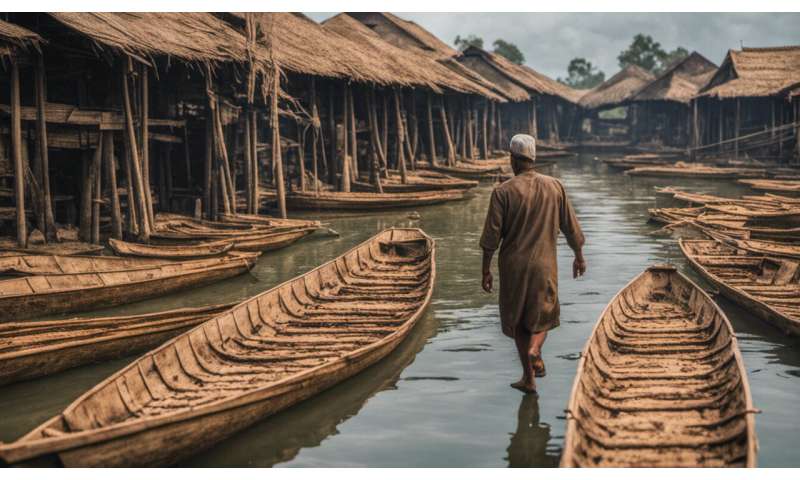
As a result, the number of young people who want to work as fishers has declined. Data from the Indonesian Statistics Bureau (BPS) show a sharp decrease in households involved in capture fisheries, from 2 million in 2000 to 966,000 in 2016.
This has occurred not only in Indonesia but also in other parts of the world. In 2016, the Food and Agriculture Organisation (FAO) reported a continuous decline of workers in the capture fisheries sector. In Europe, the number of fishers fell from 779,000 to 413,00 between 2000 and 2013. A similar trend can be seen in North America and Oceania.
A number of scholars argue that low income, extreme weather at sea and being far away from family for a long time have turned the profession into one that is dangerous and unattractive.
However, research I conducted in 2018 found this does not apply to Indonesian fishers. Amid poverty and uncertainty about catches, Indonesian fishers seem to be happier than other professions in the agriculture sector.
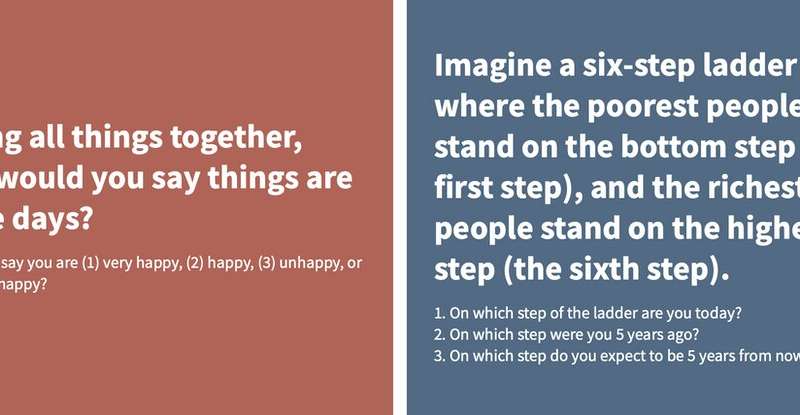
Examples of survey question on subjective well-being from the IFLS questionnaire. Credit: Anna, et al. 2018
Measuring the happiness of fishers
Our team conducted a statistical analysis of the welfare status of fishers, represented by socioeconomic data from the 2012 and 2015 Indonesian Family Life Survey (IFLS).
The IFLS questionnaire also contained an open survey for fishers, asking them how happy they felt or would feel at present, five years ago and five years ahead.
Even though they are one of the most likely to slide under the poverty line, our analysis concludes there is no strong evidence that fishers are less happy than those in other professions.
Instead, many other aspects displayed a stronger correlation to happiness rather than just their status as fishers—such as education level, marriage status and health condition.
One reason that might explain this result is the nature of their profession, which allows them to enjoy more time outdoors, on the open sea.
Past studies suggest aspects such as "adventure", "freedom" and "activities in nature" act as a form of therapy for fishers.
The open sea can be a form of therapy for fishers. Credit: Shutterstock
For instance, research from the University of Rhode Island found roaming in calm seas helped fishers in the Caribbean—such as those in Cuba and Haiti—develop very good social relations and a healthy mental state.
Another study, by researchers at East Carolina University in the United States, describes how many former fishers in Puerto Rico chose to return to work in the open sea as a form of therapy after feeling exhausted by years spent in administrative jobs.
Particularly for Indonesian fishers who employ workers, this "therapy" seems to have a stronger effect as they have to work less and can spend more time enjoying nature.
In our survey, fishers also showed higher optimism than other professions in the agriculture sector about their projected economic situation in five years' time.
The above factors might explain why, even in poverty, Indonesian fishers still perceive their living conditions as being on par with other professions, perhaps even one that is worth pursuing for years to come.
The future of the fishery sector
However happy Indonesian fishers are, statistics still show fewer and fewer people are choosing fisheries as a profession.
Without small-scale fisheries protection, fishing vessels from large industries (more than 10 GT) can reduce the income of traditional fishers. Credit: Shutterstock
This means the government has the important task of increasing the welfare of fishers for the sake of this profession's future.
If the government fails to pay attention to this, large fishing vessels will continue to exploit Indonesian waters, which ultimately reduces the catch of traditional fishers.
Government support to increase fishers' welfare—for instance, by providing insurance for small-scale fishers – is also a must for this highly uncertain profession.
Being a fisher might be a happy job, but it would be meaningless if no one is left to continue this profession in the future.