Wednesday, June 10, 2020


Columbus statue beheaded in Boston, another toppled in Richmond

Anti-racism protesters in Virginia toppled a Christopher Columbus statue, set it on fire, and then threw into a lake, decrying the explorer as a symbol of genocide. Another Columbus statue was beheaded in Boston.


Two statues of Christopher Columbus, the explorer whose journey to the Americas linked Europe with the New World, were attacked amid wide-spread anti-racism protests across the US.

Authorities in Boston, Massachusetts, launched a probe on Wednesday after the statue of Columbus was beheaded. The head of the marble statue was found near the monument, in the Boston park that is named after the historical figure.

"We don't condone vandalism, and it needs to stop," said Boston Mayor Martin J. Walsh, adding that the statue had been targeted by vandals several times in recent years. However, he also said the authorities would remove the statue from the park and store it while reviewing possible restoration.

In 2004, the statue was marked with red paint and the word "murderer", while the slogan "Black Lives Matter" and red paint appeared on it in 2015, according to the Boston Globe newspaper.

The officials would take time to "assess the historic meaning of the statue" in light of the racism debate, Walsh told reporters, referring to the outrage sparked by the killing of African-American George Floyd.

Hours before, protesters in Richmond, Virginia tore down a different statue of Christopher Columbus, set it on fire, and eventually threw into into a lake. They also placed a sign reading "Columbus represents genocide" on the pedestal.


A statue in Virgina was torn town, set ablaze and dropped in a lake

Explorer's dark legacy

Columbus has long been praised as a daring explorer and the discoverer of the Americas whose 1492 journey paved the way to the creation of the US less than two centuries later. In recent years however, more and more activists point to his enslavement, exploitation and bloody suppression of native Americans. Many view Columbus as the first of many European colonizers who conducted a centuries-long campaign of genocide and war against the native population. The calls to abolish Columbus Day, the US national holiday held in October, are also growing more prominent.

The attacks on the statue in Richmond comes only days after protesters toppled statue of General Williams Carter Wickham, a military leader who fought for the pro-slavery Confederacy in the US Civil War during the weekend. Other statues have also been targeted by protesters outside the US, including one dedicated to Bristol merchant and slave trader Edward Colston in the UK, and the statue of Belgian King Leopold II, responsible for the atrocities that claimed millions of lives in Congo, in Antwerp.

dj/aw (Reuters, dpa, AP)


Date 10.06.2020
Keywords US, Black Lives Matter, protests, Columbus, statue, racism

Permalink https://p.dw.com/p/3dc7M
Belgium: King Leopold II statue removed in Antwerp after anti-racism protests

The statue was daubed with paint during protests over the weekend. The monument to the former king has long been a target due to his brutal rule in Belgium's African colonies


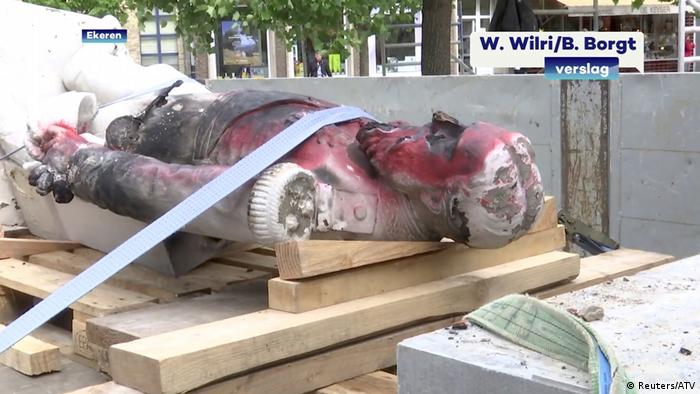
A statue of King Leopold II in the Belgian town of Antwerp was removed on Tuesday with its long-term future set for a museum, just days after being daubed with paint by anti-racism protesters.

Statues of Leopold have long been criticized by activists because of the former king's brutal rule in Belgium's former African colonies.

This particular monument next to a church in the Antwerp district of Ekeren became a target for protesters over the weekend.

The figure in the port city will not be returning to its pedestal and instead "become part of the museum collection," Johan Vermant, a spokesman for Antwerp's mayor Bart de Wever, said. And "because of the renovation work planned for 2023 in the square in which it was placed, the statue will not be replaced."

The statue was defaced during protests sparked after the killing of George Floyd two weeks that begun in the United States but have since spread across the globe, reaching Belgium last week.

Another statue of the king, in the park of the Africa Museum, in Tervuren, just outside Brussels, was found sprayed with graffiti on Tuesday.

Deaths in Congo

Meanwhile, an online petition against the memory of Leopold passed 64,000 signatures on Tuesday. It has been suggested he was responsible for the deaths of more than 10 million Congolese people during his 23-year reign over the central African country.

Indeed, Congo was Leopold's personal fiefdom from 1885 to 1908. Adam Hochschild, the US author of the best-selling book "King Leopold's Ghost," concluded that roughly half the population died under the Belgian monarch's rule.

Another petition wanting to keep the statue of Leopold in Antwerp, insisting he was not a "slave king," passed the 8,000 mark. It said that Leopold should not be held accountable for the actions of those running the colony.

Bristol statue


Edward Colston was a 17th century slave trader who played a major role in the development of the city of Bristol

Belgium was not the only European country to debate colonial statues in recent days.

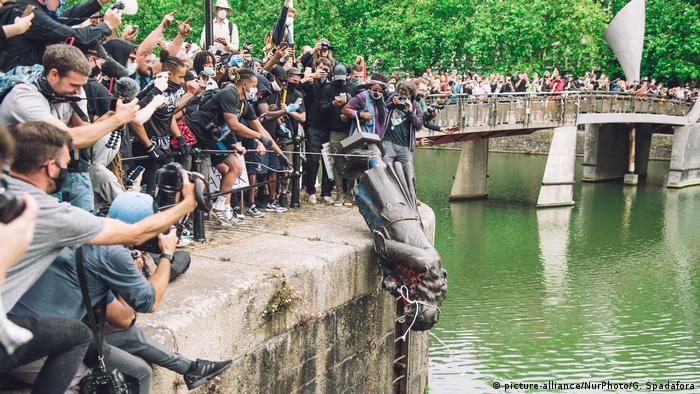
An effigy to the slave trader George Colston was toppled in the British city of Bristol on Sunday and tossed into ariver, prompting the mayor of London to order a review of the capital's statues and street names.

Sadiq Khan said he was setting up a review to evaluate the British capital's monuments and ensure they reflect its diversity.

"It is an uncomfortable truth that our nation and city owes a large part of its wealth to its role in the slave trade and while this is reflected in our public realm, the contribution of many of our communities to life in our capital has been willfully ignored,'' Khan said.

A statue of Robert Milligan, an 18th century slave trader, was also removed from its plinth outside a London museum on Tuesday.


jsi/aw (AFP, Reuters)


Read more: Will cities in Belgium take down statues of Leopold II


Watch Video https://p.dw.com/p/3dY8T
Slave trader's statue toppled in UK anti-racism protests

DW RECOMMENDS

Belgium's revamped Africa Museum faces a dark colonial legacy

Members of Belgium's African diaspora are critical of the newly reopened Africa Museum, saying it reinforces colonial cultural norms despite a five-year rehabilitation. Other Belgians say it's a step to reconciliation. (08.12.2018)


Racism on the rise in Germany

As Black Lives Matter protests persist worldwide, a German study reveals that discrimination against people based on their ethnic origin has increased. The report warns of serious consequences for society. (09.06.2020)


Date 09.06.2020
Keywords Belgium, Black Lives Matter, racism, Antwerp, King Leopold II
Brazil reports even more deforestation after revising data

Amazon deforestation rose by 34.4% year-on-year in Brazil, the country's space agency INPE has said, revising its numbers based on satellite observation. The latest data does not include last year's forest fires.


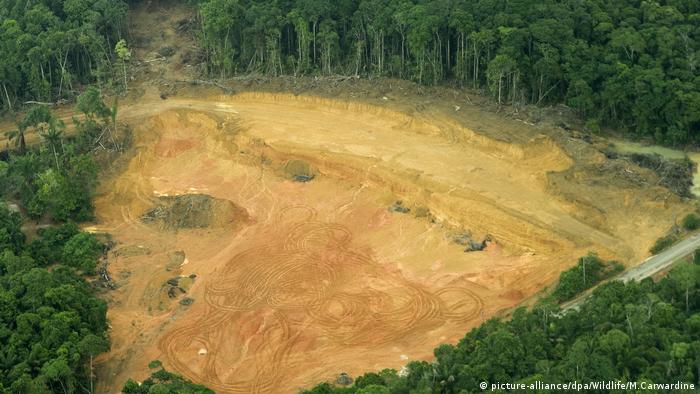
Brazil lost 10,129 square kilometres (3,911 square miles) of its rainforest between August 2018 and July 2019, the country's official space research agency INPE said on Wednesday. The latest satellite data also shows a rise of 34.4% compared to the same period a year before.

After analyzing the data, the agency revised its figures and raised its estimate by nearly 5% compared to an earlier report.

The area of Amazon felled between August 2018 and July last year is roughly equal to the nation of Lebanon by surface area — or roughly eight times the size of Rio de Janeiro. Researchers say this is the highest level of deforestation seen since 2008.

Many experts accuse the right-wing government of President Jair Bolsonaro of encouraging illegal loggers, gold miners, ranchers and land speculators to clear the forest. Bolsonaro has urged the development of the region, which plays a global role in absorbing CO2 from the atmosphere, as a way to lift it out of poverty.

Blaming DiCaprio

Last July, after INPE data showed the scope of deforestation, Bolsonaro slammed it as a "lie" and accused the agency then-head Ricardo Galvao of "being at the service of some nongovernmental organization" and trying to besmirch his government. Galvaro was subsequently ousted as the head of the institute in August 2019. Just weeks later, Bolsonaro said forest fires "may have been initiated by NGOs" who wanted to cause problems in the country. He did not provide evidence and instead said the suspicion was based on his personal feeling. In November, Bolsonaro accused Hollywood actor and environmental activist Leonardo DiCaprio of "collaborating with the burning of the Amazon" by paying money to groups that, according to Bolsonaro, started the fires.

The government's response to last year's devastating forest fires also caused clashes between Bolsonaro and several European nations, including Germany.

Bolsonaro deployed Brazil's military to protect the rainforest last month. The mandate for troops' deployment was set to expire later on Wednesday, but experts believe it would be renewed for at least another 30 days.

dj/msh (Reuters, KNA)


Watch video 
https://p.dw.com/p/3dbUo
Brazil puts economy over the rain forest

Date 10.06.2020
Related Subjects Amazon, Deforestation, Brazil, Jair Bolsonaro
Keywords Brazil, deforestation, Amazon, Jair Bolsonaro, INPE

Permalink 

Anniversary protests as Hong Kong democracy movement faces triple threat

AFP / ANTHONY WALLACEDefiant crowds a few-thousand strong gathered evening in the city's upmarket Central district to march and chant slogans
Several thousand demonstrators marched in Hong Kong on Tuesday evening -- defying authorities a year after huge pro-democracy protests erupted -- as the movement struggles in the face of arrests, coronavirus bans on crowds and a looming national security law.
Seven months of massive and often violent rallies kicked off on June 9 last year when as many as a million people took to the streets to oppose a bill allowing extraditions to mainland China.
As city leaders dug in, battles between police and protesters became routine, leaving the financial hub's reputation for stability in tatters and swathes of the population in open revolt against Beijing's rule.
A year later, protesters are on the back foot with Beijing planning to impose a sweeping law banning subversion, secession, terrorism and foreign interference.
Anti-virus measures also forbid more than eight people gathering in public.
Small rallies still flare up, however.
Defiant crowds a few thousand strong gathered on Tuesday evening in the city's upmarket Central district to march and chant slogans.
Riot police were quick to charge and fire pepper spray to disperse the crowds in a series of small cat and mouse confrontations, with at least 25 arrests made throughout the evening.
"We have been through a lot," a 23-year-old protester who gave his first name as Michael, told AFP.
AFP / Anthony WALLACERiot police stand guard ahead of a pro-democracy march in the Central district of Hong Kong
"But I still have to show my position, come out and tell the regime that we haven't forgotten."
Earlier Tuesday, organisers of last year's huge rallies called on the government to lift legitimate protest restrictions on a city now largely free of coronavirus infections.
"This movement has not finished," said Jimmy Sham of the Civil Human Rights group, which espouses non-violence.
But city leader Carrie Lam, an unpopular pro-Beijing appointee, said the protests must end.
"Hong Kong cannot afford such chaos," she said, adding residents needed to prove Hong Kong people "are reasonable and sensible citizens of the People's Republic of China" if they want their freedoms and autonomy to continue.
- 'Forced loyalty' -
Under a deal signed with Britain ahead of the 1997 handover, China agreed to let Hong Kong keep certain freedoms and autonomy for 50 years.
AFP / John SAEKIA year of turmoil in Hong Kong
But protests over the last decade have been fuelled by fears those freedoms are being prematurely curtailed, something Beijing denies.
Analysts say the space for dissent has rapidly diminished in the last year.
"I don't think the passion has subsided much, but the problem is that many actions are now not allowed," Leung Kai-chi, an analyst at the Chinese University of Hong Kong (CUHK), told AFP.
Beyond a withdrawal of the extradition bill, the informal and largely leaderless protest movement's core demands -- such as universal suffrage and an inquiry into police tactics -- have been rejected.
AFP / Anthony WALLACEProtesters held brief evening rallies in Hong Kong but were dispersed by riot police
China's planned national security law -- which will bypass the city's legislature once written -- has pushed anxieties further.
Opponents fear the law will bring mainland-style political oppression to the business hub given similar anti-subversion laws are routinely used to stamp out dissent over the border.
"First (Beijing) loses the hearts and minds of Hong Kong's people and then it seeks to force them to be loyal," said Kong Tsung-gan, an activist who has published three books on the protest movement.
Beijing says the law will only target "a small minority" and will restore business confidence.
Over the last year, around 9,000 people have been arrested and more than 500 people have been charged with rioting -- facing up to 10 years in jail if convicted.
The protest movement was already on the back foot before emergency coronavirus laws banned gatherings of more than eight people.
Still, demonstrations have resurfaced since the security law plans were announced -- including tens of thousands defying a ban on a June 4 gathering to mark the anniversary of the 1989 Tiananmen crackdown.

Tragic yarn: India-China border spat hits global cashmere production

AFP/File / Noemi CASSANELLIWool from pashmina goats, reared by nomads in Ladakh, is the most expensive and coveted cashmere in the world
The world is heading for a shortage of the highly prized and super-soft cashmere wool as pashmina goats that live on the "roof of the world" become caught up in the fractious border dispute between nuclear neighbours India and China.
Wool from pashmina goats, reared by nomads in the inhospitable high-altitude cold desert region of Ladakh, is the most expensive and coveted cashmere in the world.
But the shaggy creatures that provide the yarn are being pushed out of their grazing lands in the tussle between the world's two most-populous nations, causing the death of tens of thousands of kids this season, locals and officials said.
"In about three years when the newborn goats would have started yielding pashmina we'll see a significant drop in production," Sonam Tsering of the All Changtang Pashmina Growers Cooperative Marketing Society told AFP.
There have been numerous face-offs and brawls between Chinese and Indian soldiers over their 3,500-kilometre (2,200-mile) frontier, which has never been properly demarcated.
The latest is concentrated in the Ladakh region, just opposite Tibet, with Indian officials claiming Chinese troops encroached over the boundary in recent weeks.
The alleged movements came after military fisticuffs at the eastern part of the border near Sikkim in May.
- 'Newborns dead' -
Some traditional grazing land is lost to China each year, Tsering said.
AFP /Disputed Kashmir
But this year, even the main winter grazing areas near KakJung, Tum Tselay, Chumar, Damchok and Korzok are out of bounds amid the heightened tensions, he added.
"It's devastating. The PLA (China's People's Liberation Army) used to encroach into our side by the metres, but this time they have come inside several kilometres," said Jurmet, a former elected official who has only one name.
"It was breeding season for the goats. Around 85 percent of their newborns died this year because large herds were pushed out into the cold from the grazing lands (in February)," he told AFP over the phone from Leh, the region's capital city.
Tsering said Indian soldiers were blocking the animals from entering areas deemed as sensitive, while herders told him the Chinese army was pushing Tibetan nomads into their grazing areas.
AFP/File / Noemi CASSANELLIThe shaggy creatures that provide the yarn are being pushed out of their grazing lands in the tussle between China and India
Half a dozen residents involved with goat herding who AFP spoke to said that until a few years ago, they would cross over the frozen Indus river for grazing during the winter, but those areas were now being encroached by China.
Meanwhile, communicating with the herders -- whose satellite phones provided by Indian officials have been withdrawn in recent years -- has become difficult, said Jurmet.
- Vital industry -
AFP/File / Noemi CASSANELLIMore than 1,000 families of nomadic Changpa herders roam the vast Changtang plateau grazing thousands of animals
The huge number of deaths -- in the tens of thousands according to a local Indian official who spoke to AFP on condition of anonymity -- could devastate the sector in the coming years.
The goats yield some 50 tonnes of the finest and most expensive feather-light cashmere wool each year, supporting the vital handicrafts industry in Kashmir that employs thousands of people.
Most of the wool is woven into yarn and exquisite shawls sold the world over from luxury store Harrods in London to the Dubai Mall in the United Arab Emirates, and can cost up to US$800 for one scarf.
More than 1,000 families of nomadic Changpa herders roam the vast Changtang plateau at over 5,000 metres (16,400 feet), grazing some 300,000 Pashmina goats, black yaks and horses through the summer months.
They move to the slightly lower altitude grazing lands straddling Tibet and along the mighty Indus river during harsh winter months of December to February when temperatures drop up to minus 50 degrees Celsius (minus 58 degrees Fahrenheit).
AFP/File / Noemi CASSANELLIThe military tensions are the latest blow for the herders, who are already reeling from the impact of climate change
The military tensions are the latest blow for the herders, who are already reeling from the impact of climate change which has made winters harsher and summers drier.
Some have even abandoned their generations-long way of life to migrate to towns in Ladakh in search of other sources of income.
DISARM POLICE!
Eyeing US, New Zealand drops plans for armed police patrols

AFP/File / Sanka VIDANAGAMA
New Zealand police usually operate without firearms but trialled armed patrols after a lone gunman murdered 51 Muslim worshippers in Christchurch in March 2019

New Zealand police on Tuesday scrapped plans for armed patrols prompted by last year's Christchurch mosque shootings, after criticism the change would lead to a US-style militarisation of the force.

Police in the South Pacific nation usually operate without firearms but trialled armed patrols after a lone gunman murdered 51 Muslim worshippers in Christchurch in March 2019.


At the time, police said the worst mass shooting in modern New Zealand history meant "our operating environment has changed" and they needed the ability to rapidly deploy armed officers to high-risk incidents.

The move was met with unease among sections of the New Zealand public unused to seeing armed officers, particularly the Maori and Pacific communities, which argued they were the most likely to come into contact with firearm-toting officers.

Green Party co-leader Marama Davidson, whose background is Maori, said last week that the patrols made her fearful about the safety of her two sons.

"We only have to look to the United States to see how violent things can get under a militarised police force," she said in an open letter to Commissioner of Police Andrew Coster.


"This is especially so for minorities and communities of colour."

Prime Minister Jacinda Ardern had also said she was "totally opposed to the routine arming of the police", although she argued the patrols were an operational matter for the force.

Coster announced Tuesday that the armed patrols would not continue, saying police had listened to feedback from the community.

"It is clear through the course of the trial that armed response teams do not align well with the style of policing that New Zealanders expect," he said.

Coster said he was committed to police remaining "generally unarmed" and operating with public support.

"How the public feels is important -- we police with the consent of the public, and that is a privilege," he said.

Policing methods worldwide are under the spotlight after African-American man George Floyd was killed while being arrested in the United States, sparking civil rights protests around the globe.

New Zealand tightened its firearms laws after the Christchurch shootings -- including a ban on military-style semi-automatic rifles -- with police overseeing a major gun buyback that saw 56,000 weapons handed in.

Figures vary considerably but gun control advocates put the number of firearms in private hands in the United States at 393 million, or 1.2 for every person, whereas New Zealand has about 1.5 million, or 0.3 per person.

Christchurch shooter Brenton Tarrant is being held in a high-security jail after pleading guilty to 51 charges of murder, 40 of attempted murder and one of terrorism.

The Australian, a self-avowed white supremacist, is yet to be sentenced because of delays in the court system caused by the coronavirus pandemic.
Protests leave permanent imprint on Hong Kong's streets

AFP / Anthony WALLACE
Signs of the unrest can still be seen throughout Hong Kong

Torn up paving stones filled-in with concrete, cages erected over bridges and security guards on campus entrances -- protests have left a permanent imprint on Hong Kong's streets after a year of tumult.

One year ago, on June 9, a record-breaking crowd of some one million marched through the international finance hub demanding the withdrawal of an unpopular bill allowing extraditions to the authoritarian mainland.

As city leaders dug in, the movement snowballed into a popular revolt against Beijing's rule with huge rallies and clashes with police raging for seven straight months.


AFP / Anthony WALLACE
As Hong Kong's leaders dug in, the movement snowballed into a popular revolt against Beijing's rule
Mass arrests and a coronavirus ban on public gatherings have enforced calm for much of this year and Beijing is now planning to impose a new law for the finance hub targeting subversion, secession, terrorism and foreign interference.

But signs of the unrest can still be seen throughout the metropolis.

Hong Kong Polytechnic University was the scene of the most sustained clashes between protesters and police back in November.

Now the imposing red brick campus is ringed by yellow water-filled security barriers and guards who check the identities of those entering.

FP / Anthony WALLACE
ThroughAout the city concrete remains daubed with anti-government slogans before it had time to dry

Similar barriers have been thrown up around Hong Kong's legislature, neighbourhood police stations, government ministries and Beijing's offices in the city.

Police now rarely patrol in less than groups of four, some swapping their blue uniforms for green riot overalls and helmets.

Many Chinese owned companies and businesses deemed sympathetic to Beijing have kept the wooden protective hoarding over their storefronts after dozens of shops were trashed by protesters.

- 'Ideas are indestructible' -

AFP / Anthony WALLACE
Barriers have been thrown up around Hong Kong's legislature, police stations, government ministries and Beijing's offices in the city
All across the city, paving that was dug up to throw at police or delay their advances have been filled in with concrete, some of it daubed with anti-government slogans before it had time to dry.

And many pedestrian bridges over busy roads are clad in metal cages after protesters disrupted highways by throwing objects from above.

"Throughout the 2019 protests, protesters 'deconstructed' the city's fabric, subverting the urban infrastructure to put it in service of their protest," Antony Dapiran, a Hong Kong lawyer who has written books about the city's protest movements, told AFP.

AFP / Anthony WALLACE
One of Hong Kong's remaining 'Lennon Walls' which show notes in support of the pro-democracy protests

"The Hong Kong government, when it became familiar with the protesters' tactics, begun to take countermeasures, stripping the city of the urban hardware that the protesters so readily recontextualised for the purposes of their barricade resistance," he added.

Some of that hardware has begun returning.

For months, streets were largely stripped of metal security barriers separating the busy roads from the pavements.]

AFP / Anthony WALLACE
Pedestrian bridges over busy roads are clad in metal cages after protesters disrupted highways by throwing objects from above

Protesters became expert at using wrenches and drills to dismantle the structures in seconds to add to their barricades.

But in recent weeks, new barriers have sprung up, their shiny metal frames yet to be weathered by the sub-tropical heat.

So-called "Lennon Walls" -- filled with pro-democracy posters and colourful notes -- remain standing in some neighbourhoods where anti-government sentiment runs high.

Others have been scrubbed down and painted over, often by municipal workers playing whack-a-mole with the graffiti, others by gangs of pro-government supporters.

AFP / Anthony WALLACE
Hong Kong's municipal workers play whack-a-mole with the pro-democracy graffiti that still appears in parts of the city
But Dapiran said scrubbing people's memories will be much harder.

"The Lennon Wall was transformed from a site to an idea, an instrument and expression of protest, and became as a result significantly more powerful and enduring -- and, ultimately, indestructible," he said.
Huge fire breaks out at India gas well blowout


AFP / Partha Sarathi DASThe explosion sent bright orange flames and huge, black plumes of smoke high into the sky in India's Assam state

A huge fire broke out at an oil field near popular ecotourism spots in northeastern India on Tuesday, after gas that had spewed for two weeks from a blown-out well ignited, officials said.

The gas well at an oil field managed by state-owned Oil India started leaking in late May in Tinsukia district of Assam state, and the firm said late last week gas was still flowing "uncontrollably".

Tuesday's explosion sent bright orange flames and huge, black plumes of smoke high into the sky, visible 10 kilometres (six miles) from the oil field, locals told AFP.

"While the clearing operations were on at the well site, the well caught fire," Oil India said in a statement, adding that a firefighter suffered "minor injuries".
Around 200 engineers and workers -- including a team of experts who arrived from Singapore on Monday -- are trying to stem the leak within four weeks, the company added.

Villagers fled in fear, and said five of their homes had caught fire.

"The situation is very bad. It is spreading. I knew it was going to happen," local environmentalist Niranta Gohain told AFP over the phone from the site.

The company called for help from the army after locals allegedly attacked its vehicles after Tuesday's explosion, spokesman Tridiv Hazarika said.

Water was being pumped to the well over the past two weeks to prevent the gas catching fire.


AFP / Partha Sarathi DAS
Indian policemen ask people to move to a safer location following the explosion at a facility operated by the state-owned Oil India Limited (OIL) in Tinsukia district in Assam state

Assam's Chief Minister Sarbananda Sonowal said firefighters, police and the army were being sent to the site, which is 500 kilometres east of Guwahati, the state's biggest city.

Environmentalists were increasingly worried about the impact of the gas leak.

The well was producing 100,000 standard cubic metres per day (SCMD) of gas from a depth of 3,870 metres (4,234 yards) before the blowout in May, according to Oil India.

Just one kilometre from the field is Maguri-Motapung wetlands, an ecotourism site. State-owned sanctuary Dibru Saikhowa National Park -- renowned for migratory birds -- is about 2.5 kilometres away.

Authorities had established an exclusion zone of 1.5 kilometres and about 2,500 people had been evacuated from their homes.

Officials Monday ordered a probe into the deaths of five people from the areas surrounding the field, although the district administration said a preliminary investigation suggested they died of natural causes.

'Gone with the Wind' removed from HBO Max after racism protests

 
AFP/File / GABRIEL BOUYSMultiple Oscar-winning US Civil War epic 'Gone with the Wind,' based on the novel by Margaret Mitchell, remains the highest-grossing movie of all time adjusted for inflation

"Gone with the Wind" was removed from the HBO Max streaming platform Tuesday, as mass protests against racism and police brutality prompt television networks to reassess their offerings.

The multiple Oscar-winning US Civil War epic released in 1939 remains the highest-grossing movie of all time adjusted for inflation, but its depiction of contented slaves and heroic slaveholders has garnered criticism.

"'Gone With The Wind' is a product of its time and depicts some of the ethnic and racial prejudices that have, unfortunately, been commonplace in American society," an HBO Max spokesperson said in a statement to AFP.

"These racist depictions were wrong then and are wrong today, and we felt that to keep this title up without an explanation and a denouncement of those depictions would be irresponsible."

Demonstrations have swept the United States since the May 25 killing of African American George Floyd while in police custody, with calls growing for police reform and the broader removal of symbols of a racist legacy, including monuments to the slave-holding Confederacy.

Floyd died last month as a white Minneapolis officer pressed a knee into his neck for almost nine minutes. The officer has been charged with second-degree murder.

"12 Years A Slave" writer John Ridley said in a Los Angeles Times op-ed Monday that "Gone with the Wind" must be removed as it "doesn't just 'fall short' with regard to representation" but ignores the horrors of slavery and perpetuates "some of the most painful stereotypes of people of color."

The film will return to the recently launched streaming platform at a later date, along with a discussion of its historical context, the company said.

No edits will be made, "because to do otherwise would be the same as claiming these prejudices never existed."

"If we are to create a more just, equitable and inclusive future, we must first acknowledge and understand our history."

- 'Normalized injustice' -

Meanwhile Tuesday, long-running reality series "Cops" was canceled by Paramount Network.

The show followed real-life US officers on duty for over three decades, but had been accused of glamorizing aspects of policing and distorting issues such as race.
AFP/File / Olivier DOULIERY

The long-running law enforcement reality TV series 'Cops' has been cancelled in the wake of mass protests against police brutality

"'Cops' is not on the Paramount Network and we don't have any current or future plans for it to return," a network spokesperson told US media Tuesday.

Police shows -- both reality and scripted -- are among the most-watched on US television but have come under scrutiny.

Civil rights group Color of Change, which campaigned against the show for its depiction of suspects and alleged masking of racism in police forces, welcomed the news Tuesday.

"For 30 years, #COPS has normalized injustice and misrepresented crime, policing and race," tweeted president Rashad Robinson.


"But it's far from the only crime TV show to do so."

Dan Taberski, whose podcast "Running from Cops" claimed the show allowed police to remove unflattering material during editing, said he was "hopeful its cancellation 31 years later is a sign of positive change to come."

Popular reality cop show "Live PD" has also been removed from schedules, while Jessica Alba-starring scripted procedural "LA's Finest" saw its season premiere delayed Monday.

And in the UK, the BBC said it had pulled sketch show "Little Britain" -- which features scenes where white actors wear makeup to portray characters from other ethnic backgrounds -- from its iPlayer streaming service.

"Times have changed since Little Britain first aired so it is not currently available on BBC iPlayer," a spokesperson for the national broadcaster said Tuesday.

Philippine journalist Ressa scared but strong ahead of verdict

AFP / Ted ALJIBEMaria Ressa outside court in 2018
High-profile Philippine journalist Maria Ressa says the libel charge that could see her jailed next week is a government ploy to intimidate all critical voices, but she refuses to be silenced and still holds out hope of winning.
In an exclusive video interview with AFP ahead of Monday's verdict that could see her sentenced for up to 12 years, Ressa admitted being scared but also continued to speak defiantly.
"I've been the cautionary tale: be quiet or you're next... that's part of the reason why I have been targeted," said Ressa, 56, the co-founder of news site Rappler and a former CNN journalist.
"It's a chilling effect... not just to me and to Rappler, but to journalists and to anyone who asks critical questions."
Monday's verdict will decide a case that stems from a businessman's complaint in 2017 over a Rappler story five years earlier about his alleged ties to a then-judge on the nation's top court.
Government investigators initially dismissed the businessman's allegation.
But state prosecutors later revived the case using a controversial cyber crime statute aimed at online offences ranging from stalking to child pornography.
AFP / John SAEKIMaria Ressa
Authorities say they have not targeted Ressa for her work and are simply enforcing the law.
But press and media watchdogs say the case against Ressa is in retaliation for Rappler's independent reporting on President Rodrigo Duterte and his administration.
The website's journalists have cast a harsh light on Duterte's anti-drugs crackdown, which has killed thousands and drawn international censure despite being backed by many Filipinos.
Another one of the most prominent critics of Duterte's narco war, Senator Leila de Lima, has been in jail for three years over drug allegations that she says are trumped up.
Ressa's libel case is among a string of criminal charges that have hit her and Rappler since last year, many of which stem from allegations over how the site raised investment money.
- 'Embracing my fear' -
The multiple moves against Rappler have drawn international concern and made Ressa a cause celebre globally for people standing up against authoritarian governments.
Time magazine named Ressa a Person of the Year in 2018.
Rights watchdogs say the Duterte government has in recent weeks stepped up its campaign to silence dissent in other ways, with the nation's top broadcaster -- ABS-CBN -- shutdown.
Lawmkers also this month passed the Anti-Terrorism Act of 2020, which allows warrantless arrests, weeks of detention without charge and other measures that critics fear could be used to crack down on peaceful government opponents.
Ressa said Duterte had cemented himself as the most powerful Filipino leader since dictator Ferdinand Marcos, whose two decades in power ended in a famous "people power" uprising in 1986.
"We could even say more powerful than Marcos because he (Duterte) was able to declare martial law without even declaring martial law," Ressa said, referring to the Anti-Terrorism Act.
Ressa, who served as CNN's bureau chief in Manila and Jakarta during a nearly 35-year career, said waiting for Monday's verdict was proving an emotional challenge.
AFP / Ted ALJIBERessa (C) speaks during a 2018 protest on press freedom along with fellow journalists in Manila
"I am going to embrace my fear. I have to be ready and that starts in my head. That starts with my ability to be okay with the worst-case scenario," she said from her Manila home.
"I don't want to be surprised."
The independence of the judicial system in the Philippines, which has long had a reputation for corruption, has been further eroded during Duterte's four years in power, according to rights groups.
But Ressa said individual people who make up the court system and their desire "to be guided by the spirit of the law" still give her reason for optimism.
Regardless of the pressure from the highest levels of power to convict, it is up to the judge to make the final decision.
"I'm hoping. All I can do is hope," Ressa said.