Tuesday, May 18, 2021


A Shortage of Workers in the US? Not So Fast
By Rob Garver
VOA
May 15, 2021 


FILE - A hiring sign is displayed outside a restaurant during the COVID-19 pandemic in Glenview, Ill., May 8, 2021.


On the surface, the surprise announcement Thursday from the U.S. Centers for Disease Control and Prevention that it would reverse mask mandates and limits on gathering sizes for people vaccinated against COVID-19 looks like great news both for Americans looking for work and for those employed and looking for a pay increase.

News stories across the country have been full of business owners and executives bemoaning their inability to fill open positions in recent weeks.

Restaurants and travel and entertainment companies, in particular, were preparing for a ramp up in business by scrambling to bring in more staff, and the news from the CDC, some said, just gave further impetus to a welcome trend.
FILE - Guests walk along Main Street USA at Disneyland in Anaheim, Calif., April 30, 2021. Los Angeles and San Francisco have reopened more businesses under California's least restrictive coronavirus safety rules.

Disney CEO: CDC change is ‘big catalyst’

In an interview with Bloomberg television, Bob Chapek, CEO of the Walt Disney Company, said that the CDC announcement would go a long way toward getting the company’s theme park business back to normal and getting the company’s theme park workers back on the job.

“We are really encouraged by what we're seeing in terms of not only current attendance but forward bookings,” he said. “Today, with the CDC guidance in terms of relaxation of a mask requirement, we think it's again going to be a big catalyst for growth and actually being able to put the number of people in our parks that we're more accustomed to. So it's very, very positive. Our future bookings are working really great in Walt Disney World. In fact, they're already back up to fiscal year 2019 levels.”

The announcement came at the same time that Amazon announced that it would be hiring 75,000 people in the U.S. and Canada in the coming months, in some cases offering $1,000 signing bonuses and additional $100 bonuses for workers with proof of their COVID-19 vaccinations.

Chain restaurants like McDonald’s and Chipotle have also begun offering wage increases and hiring bonuses to lure people back into the workforce.
FILE - Hiring signs are posted outside a gas station in Cranberry Township, Butler County, Pa., May 5, 2021.

Supply vs. demand

The laws of supply and demand suggest that companies competing for scarce workers will have to pay more to attract the help they need, which is good news for the labor force. However, the impact on wages might not be as pronounced as current levels of employer desperation suggest.

That’s because while the new CDC guidance is likely to boost demand for labor, it could also have the countervailing effect of expanding supply, said Elise Gould, senior economist at the Economic Policy Institute in Washington.

It is important to remember that there are between 9 million and 11 million fewer jobs in the United States now than there would have been if the economy had not been sidelined by the pandemic last year. The workers who held those jobs may have disappeared from the workforce, but they haven’t disappeared.

Essentially, as the danger of being infected by the coronavirus declines, multiple factors contribute to a more willing labor force.

“What is also happening is that schools are opening up — that makes more people able to enter the workforce,” she said. “And more people are getting vaccinated. That means that more people feel safe reentering the workforce.”


FILE - Job seekers enter the New Hampshire Works employment security center, May 10, 2021, in Manchester. States are pushing the unemployed to get back to work to help businesses find the workers they need to emerge from the COVID recession.

A resurgent workforce

Gould and other economists believe that as the country approaches something like pre-pandemic normalcy, many of those workers will move back into actively seeking employment, easing the supply-demand mismatch currently plaguing U.S. firms.

So while there may be some temporary efforts by employers to attract workers, it is by no means certain that a reinvigoration of the economy over the next few months will result in large or lasting gains for the labor force.

“Maybe for a time we're seeing a bit of an increase in wages,” Gould said. “Particularly in leisure and hospitality — you're not seeing it across the economy. If employers have to entice those workers in a tighter economy, they would certainly have to provide better working conditions, better wages and better benefits. But it's hard to see that there's going to be that much pressure.”

She said, “It's hard to imagine a normal labor market when you have such a huge, huge number of unemployed, predominantly lower-wage workers, in these kinds of sectors. Employers will be able to find people to hire as those things are resolved.”

FILE - Crystal Dvorak shops at WinCo Foods, May, 7, 2021, in Billings, Mont. Dvorak was getting ingredients to make a soup with potatoes and onions she got from a food bank after recently losing her job as an audiologist.

Another contributing factor to a growing workforce is likely to be the decision by governors in more than two dozen states to eliminate the federal unemployment insurance subsidy that has added $300 per week to the benefits that out-of-work Americans are receiving. Although there is no hard evidence the supplement is keeping a large percentage of workers on the sidelines, for a certain percentage of workers on the margins, the difference could be decisive in sending them back to the workforce.

So any workers looking to leverage the current labor shortage for better pay or conditions may be in a position to do so for the time being, but that window is expected to start closing soon.


IRGC Quds Force cmdr., Hamas chief discuss latest development on Gaza

  
IRGC Quds Force cmdr., Hamas chief discuss latest development on Gaza

IRGC Quds Force Commander Brigadier General Esmail Ghaani held a phone talk with the Political Leader of Palestinian Islamic Resistance Movement (Hamas) Ismail Haniyeh on Sat. to discuss the latest developments on Gaza.

AhlulBayt News Agency (ABNA): IRGC Quds Force Commander Brigadier General Esmail Ghaani held a phone talk with the Political Leader of Palestinian Islamic Resistance Movement (Hamas) Ismail Haniyeh on Sat. to discuss the latest developments on Gaza.

During the phone talk, Brigadier General Ghaani hailed the unique and successful response of the resistance movement to the aggression of the Zionist regime’s military forces and the defense of the Palestinian nation.

The commander of IRGC Quds Force strongly condemned the brutality of the occupying regime of Israel.

For his part, Hamas Political Leader Haniyeh said that the battle of Quds was the battle of all children of the Palestinian nation and praised Iran's position in support of the Palestinian people.

The clashes between the Palestinian Islamic Resistance Movement, Hamas, and the Zionist regime broke out on Monday after the end of the resistance movement’s deadline to Tel Aviv over the need for an end to the Zionist regime's aggression on the occupied lands and territories as well as Al-Aqsa Mosque.

While the Zionist regime continues to kill the Palestinian people in front of the eyes of the world, the United States and European countries have thrown their weights behind the fake regime of Israel.

According to the Civil Defense Organization in Gaza, the number of Palestinian people martyred since the beginning of the Zionist regime's attacks and bombings against various parts of Gaza until today has hit more than 140 people including 39 children and 22 women.

ARYAN NATIONALIST HINDUISM IS FASCISM

Indian mosque bulldozed in defiance of high court order


Local officials in Uttar Pradesh demolish mosque that had stood since time of British rule


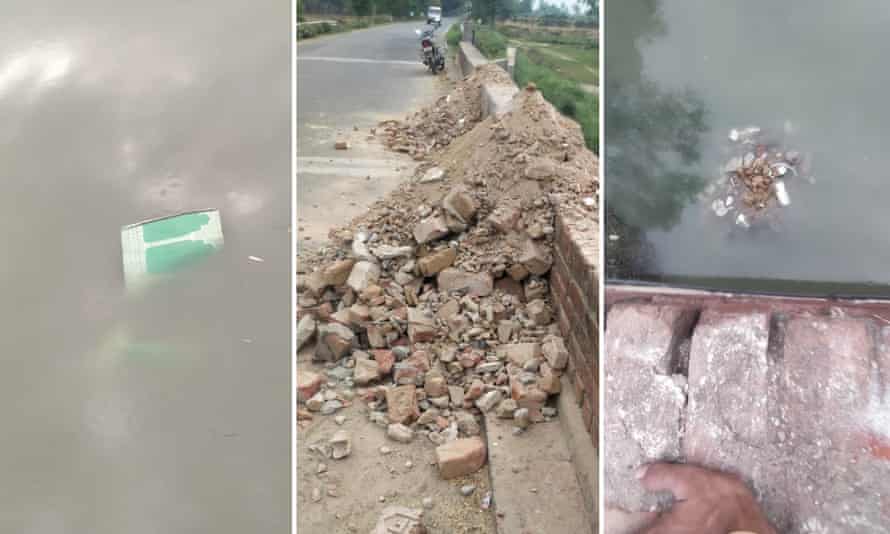
Images of rubble taken in the aftermath of the destruction 
of the mosque in Ram Sanehi Ghat, Uttar Pradesh, India. Photograph: Supplied


Hannah Ellis-Petersen and Mohammad Sartaj Alam
Tue 18 May 2021

A local administration in the Indian state of Uttar Pradesh has defied a state high court order and bulldozed a mosque, in one of the most inflammatory actions taken against a Muslim place of worship since the demolition of the Babri Mosque by a mob of Hindu nationalist rioters in 1992.

The mosque, in the city of Ram Sanehi Ghat in Uttar Pradesh, had stood for at least six decades, since the time of British rule, according to documents held by its committee.

On Monday, police and security services moved into the area and cleared it of people, then brought in bulldozers and demolished the mosque. Debris was then thrown into a river. Security services have been deployed to prevent anyone coming within a mile of where the mosque stood.

The state government of Uttar Pradesh is controlled by the Hindu nationalist Bharatiya Janata party (BJP), which also governs at national level. The chief minister is a hardline Hindu nationalist called Yogi Adityanath, who is known for his vitriol against Muslims. He has made speeches laced with Islamophobia, referred to Muslims as terrorists, and passed legislation openly discriminatory to Muslims.

A local imam, Maulana Abdul Mustafa, who is on the mosque committee, said the mosque was “hundreds of years old” and that “thousands of people have been coming here five times a day to offer namaz [prayer]”.

“All Muslims were scared, so no one went near the mosque or dared to protest when the mosque was being demolished. Even today, several dozen people are leaving their homes and hiding in other areas out of the fear of the police.”

Adarsh Singh, a district magistrate, said: “I do not know any mosque. I know there was an illegal structure. The Uttar Pradesh high court declared it illegal. That’s why the regional senior district magistrate took action. I will not say anything else.”

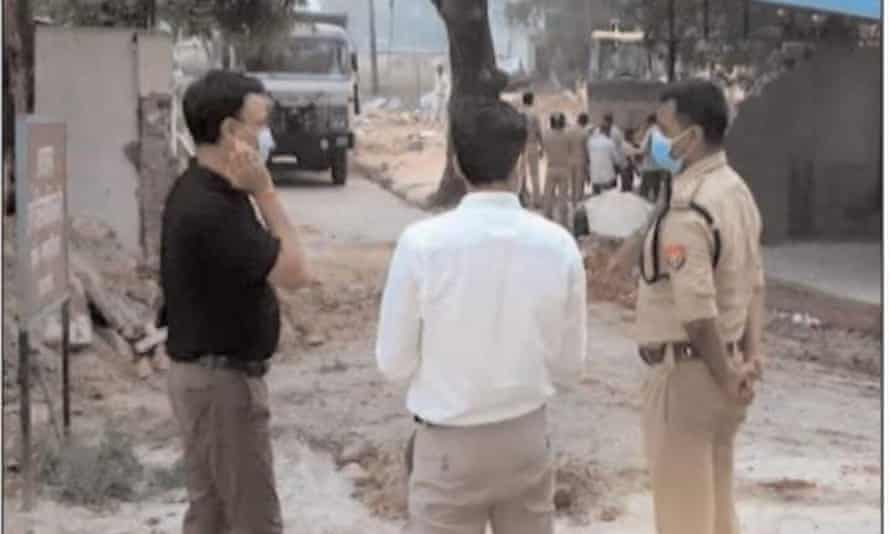
The scene after the demolition of the mosque. Photograph: Supplied

The demolition was in violation of a high court order issued on 24 April, which stated that the mosque building should be protected from any eviction or demolition until 31 May.

The mosque’s presence has been contested by the local administration, which on 15 March issued a “show cause” notice to the mosque committee asking it to explain how the building’s location was chosen and citing an intention to demolish it on the grounds that there were illegal structures on the land.

The mosque committee sent a detailed response, including documents demonstrating the building had an electricity connection from 1959, but the local administration did not take the response on to official record.

On 18 March, the mosque committee went to the Uttar Pradesh high court citing concerns that the mosque faced “imminent demolition”, and an order was given for the local administration to file a reply about the grounds on which it had established that the mosque had been illegally built and was obstructing traffic, even though the structure did not sit on a road.

However, in the following days, the local administration began building a permanent structure to block access to the mosque.

On 19 March, local Muslims were prevented from entering the mosque for Friday prayers, causing tension and protests in the area. Over 35 local Muslims who were protesting were arrested and put in jail, where many are still held, and police reports were filed against the demonstrators.

The mosque committee became concerned at the actions of the local administration, and in April filed a public interest litigation in the high court. In a further ruling on 24 April, the high court ordered that “any orders of eviction, dispossession or demolition …shall remain in abeyance until 31.05.21”.

However, the administration went ahead with the demolition of the mosque on Monday. Local Muslims in the area, including members of the mosque committee, said they had gone into hiding over fears they would be targeted and arrested.

The district where the mosque is located is adjacent to Ayodhya, where the Babri Mosque stood before its demolition in 1992. In a significant court ruling in 2019, judges declared that the land legally belonged to Hindus, rather than Muslims, and a new Ram Temple is under construction on the site where the Babri Mosque stood formerly.


‘It’s hard to look at’: Donald Trump makes National Portrait Gallery debut


Photo of ex-president will make way for a painted portrait as gallery says Trump’s team is considering artists
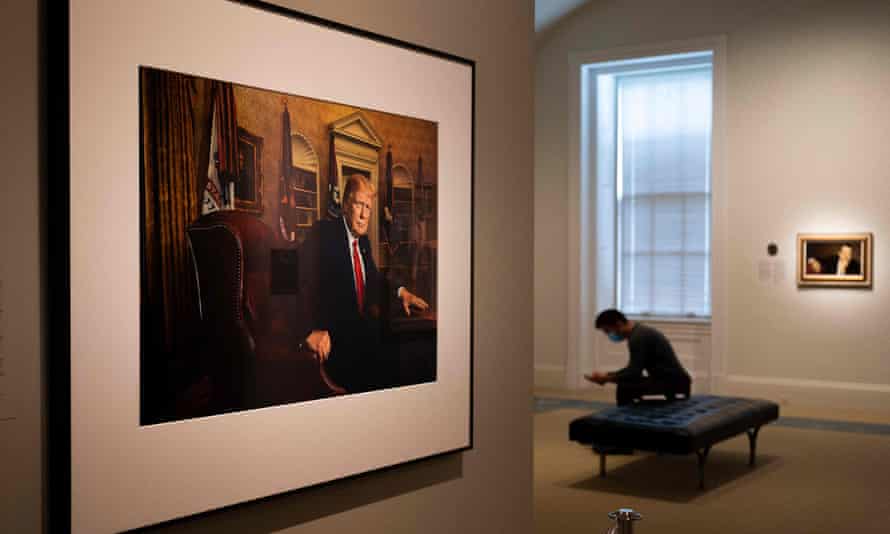
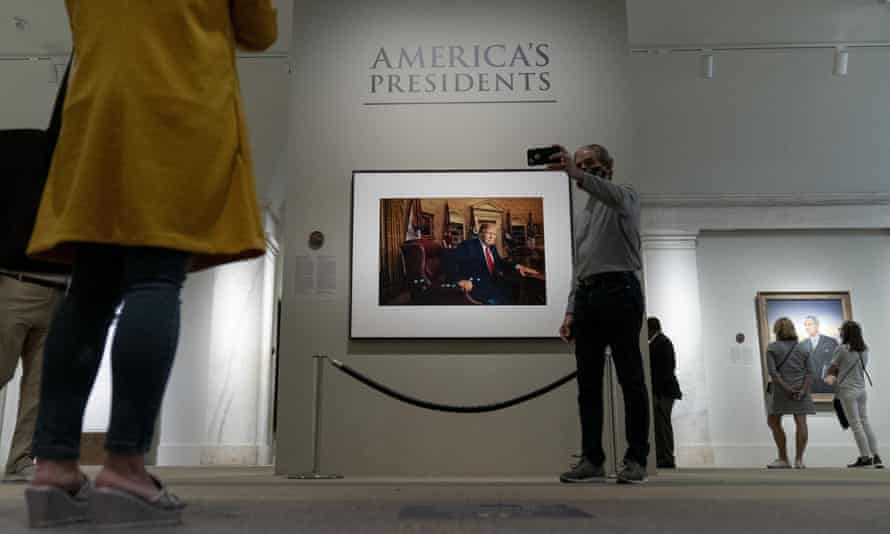
A photo of Donald Trump at the National Portrait Gallery in Washington DC. Photograph: Jim Watson/AFP/Getty Images


David Smith in Washington
@smithinamerica
THE GUARDIAN
Fri 14 May 2021 

A picture is worth a thousand tweets. Donald Trump gained immortality of sorts on Friday when he made his debut at the National Portrait Gallery in Washington. But he also ran into some “good trouble”.


Rightwingers tried to discredit Trump ‘foes’ with honey trap plot – report

Canny curators have placed the 45th president face-to-face with a painting of John Lewis, the late congressman and civil rights hero whose habit of making what he called “good trouble” included boycotting Trump’s inauguration.

“Keeping him honest!” remarked Eric Bargeron, 40, a book editor from Columbia, South Carolina, as he observed Lewis in an exhibition called The Struggle for Justice, staring across the room at Trump in the popular America’s Presidents show.

The photo of Trump was taken by New York–based Pari Dukovic for Time magazine on 17 June 2019, the day before the president officially announced he would seek re-election. It shows him sitting at the Resolute Desk in the Oval Office, wearing his trademark long red tie.

A man takes a selfie with the photo of Trump at the National Portrait Gallery. Photograph: Andrew Harnik/AP

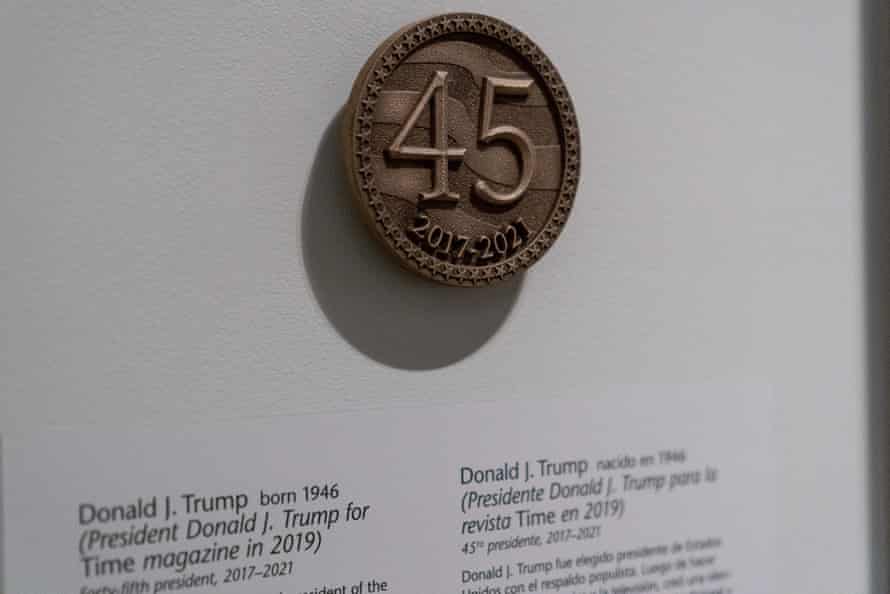
The picture is accompanied by a caption in neutral museum language, noting that Trump was elected “after tapping into populist American sentiment” and that he “put forth an ‘America First’ agenda”. It records his two impeachments and says the coronavirus pandemic “became a key issue during his re-election campaign”.
Advertisement

The caption adds: “Trump did not concede [defeat], and a mob of his supporters, who refused to accept the results, attacked the US Capitol complex on 6 January 2021, when Congress was working to certify [Joe] Biden’s win.”

The caption also appears in Spanish, a policy rarely seen at the Trump White House.

In another symbolic twist, the Trump picture has supplanted Kehinde Wiley’s portrait of Barack Obama, which is embarking on a year-long, five-city tour. Trump is now back-to-back with the famous Hope poster featuring Obama, by the artist Shepard Fairey.

The gallery, part of the Smithsonian Institution, reopened to timed pass holders on Friday after a six-month pandemic shutdown. It includes a special exhibition of portraits of first ladies, from Martha Washington to Melania Trump.

A trickle of visitors made their way to see Trump, whose likeness never quite made it to Mount Rushmore, join the pantheon of George Washington, Abraham Lincoln and Franklin Roosevelt on the gallery walls.

Ben Freedman, a British documentary maker based in Louisville, Kentucky, was celebrating his 40th birthday but did not see Trump at first.

“I deliberately averted my eyes,” he said. “It’s cool they put Obama behind the bad guy.”

A bronze-looking emblem with the number 45 is visible next to the photo of Trump. Photograph: Andrew Harnik/AP

Freedman made a noble sacrifice for the Guardian, walking across the room to study the Trump portrait.

“He looks like an insecure man holding the desk to believe in himself,” he reported. “He doesn’t look very humble.”

Fellow Brit Fran McDonald, a professor at the University of Louisville, agreed: “It’s hard to look at. I started to take a picture of it and then decided I don’t want it on my phone. I’m so relieved we don’t have to look at him or listen to him any more. It was a relentless assault on the senses to have him in the 24-hour news cycle.”

The gallery draws visitors from all over America but judging by Friday’s crowd there will be few Trump worshippers eager to turn this into a “Make America Great Again” shrine ahead of a potential White House run in 2024.

Kevin Newman, 38, a police sergeant from Chicago, said he was “not a fan” of Trump.

“I was interested in how they would portray him because he was a controversial president,” he said. “They have made him look good. If they had made him look bad it would have inflamed the controversy. They didn’t make him look orange.”

The photo will make way for a painted portrait – the gallery says Trump’s team is considering artists. Newman added: “He obviously cares very much about his image so it be interesting to see who he picks.”

Trump could look to the 1968 painting of Richard Nixon for a template. The artist, Norman Rockwell, admitted that, finding Nixon’s appearance elusive, he decided to err on the side of flattery.

Meg Krilov and James Fogel were visiting from Trump’s birthplace, New York. Krilov, 65, a retired physician, said of his portrait: “He looks very unhappy. I don’t think he really wanted to be president. He wanted to be king.”

Her husband Fogel, 70, a retired judge, added: “He was treasonous. He tried to overthrow the government. And I guess he’s still trying.”

Did it feel strange to see a former reality TV host, credibly accused of paying off a porn star, enshrined in the same room as Lyndon Johnson and George HW Bush?

“It felt strange the entire time,” Fogel said. “It continues to feel strange.”

A raid, a march, a court case: how Israel spiralled into a deadly conflict

Emma Graham-Harrison Harriet Sherwood and Sufian Tahain Jerusalem 
THE GUARDIAN 16/5/2021

Abd al-Fattah Iskafi, 71, has lived in his house on a tree-lined street near the historic Damascus Gate entrance to Jerusalem’s Old City since he was six years old. But he has spent decades locked in a court battle with hardline Jewish settlers over whether he has the right to stay.

Families in his Sheikh Jarrah neighbourhood who also face losing their homes have been “destroyed psychologically” by the long legal fight, he says. But as lawyers prepared this month for a final showdown in Israel’s highest court, fallout from the case spread far beyond their neighbourhood.

For many Palestinians, the battle has become emblematic of what they see as a campaign to force them out of East Jerusalem. Anger at potential evictions fuelled broader tensions that over the last week exploded into communal violence inside Israel and a new war with Hamas.

Two different religious calendars and the slow-moving wheels of court bureaucracy all conspired to make 10 May a deadly flashpoint
 Provided by The Guardian The funeral of an Israeli soldier Omer Tabib, 21, in Elyakim in northern Israel, on May 13. Photograph: AFP/Getty Images

That day, Israel’s supreme court was due to hear the Sheikh Jarrah case. Also on that Monday, the 28th day of the Hebrew month of Iyer, Israeli nationalists were planning to hold a controversial annual “Jerusalem Day” march through Muslim quarters of the Old City, marking Israel’s capture of Jerusalem during the Six Day war in 1967
.
© Photograph: Nasser Nasser/AP The funeral of Husam Asayra, 20, in the West Bank village of Asira al-Qibliya, near Nablus, on May 15.

Meanwhile Muslims were nearing the end of the holy month of Ramadan, with large crowds gathered every night to pray and celebrate in the Haram al-Sharif compound, site of the al-Aqsa mosque, known to Jews as the Temple Mount.


Fury and grief over the evictions, the decision to ban traditional Ramadan gatherings in the square beside Damascus Gate, and other incidents including riots by the far-right Jewish group Lehava, had spurred weeks of clashes between Palestinians and police in the city, including at one of the most sacred sites in Islam.

“[Violence at] al-Aqsa mosque is probably the number one reason for most of the escalation,” said Raviv Drucker, a political analyst for Channel 13 television. “Even though Israel is aware of the sensitivity of the place, for some reason we make the same mistake over and over again. To break into the mosque with grenades and all of these things, it adds to the fire when you have this tension all around, of Ramadan, and Eid al-Fitr and Jerusalem Day, all together.”

There were tensions among Jewish Israelis too. A TikTok video of a Palestinian teen hitting a Jewish man on a train had gone viral in mid-April, generating copycat attacks and widespread outrage.

The court hearing on Sheikh Jarrah was ultimately delayed, when the state attorney general made a last-minute request for more time to study the case. It looked like a tacit step back from the government’s insistence that the case was just a “real-estate dispute between private parties”. The Jerusalem Day march was also re-routed from Muslim areas by police, after appeals from both the military and the Shin Bet security agency. But by then the spiral of violence had gathered a momentum of its own.

Video: Israeli and Palestinian officials address UN (Sky News)

Early on Monday, Israeli police stormed the Haram al-Sharif compound, firing stun grenades and teargas and clashing with Palestinians inside following days of worsening violence. That evening Hamas fired rockets into Israel from Gaza, just minutes after passing an ultimatum for Israel to withdraw its security forces from the Haram al-Sharif compound and Sheikh Jarrah. The group’s military wing claimed it struck Jerusalem in response to Israel’s “crimes and aggression in the Holy City, and its harassment of our people in Sheikh Jarrah and al-Aqsa mosque”.

© Provided by The Guardian A fire rages at sunrise in Khan Yunis following an Israeli airstrike on targets in the southern Gaza strip, early on May 12. Photograph: AFP/Getty Images

The Sheikh Jarrah case is incendiary for many Palestinians because would-be settlers cite an Israeli law allowing Jews to reclaim ownership of property lost before 1948. Palestinians have no equivalent legal means to reclaim property that became part of the state of Israel at the same time. “The law is written to privilege Jews over non-Jews. It is house-by-house, neighbourhood-by-neighbourhood apartheid,” said Yousef Munayyer, a Palestinian political analyst.

The families at the heart of the dispute have lived there since the 1950s, after being forced to abandon or flee their homes in the fighting that preceded the declaration of the state of Israel in 1948. They were rehoused in Sheikh Jarrah by the UN.

“The settlers are thieves supported by the government. We will not leave our homes,” said Muhammad al-Sabbagh, 71, a plumber who has lived in Sheikh Jarrah for 56 years.

That anger, and resentment of life as second-class citizens, also contributed to an unprecedented and devastating wave of communal violence that erupted in Israeli towns with mixed Jewish and Arab populations over the last week. It included mobs rampaging through businesses and destroying places of worship, street beatings and attempted raids on homes. It was a disturbing new dimension to a conflict whose other aspects, including Israeli airstrikes on Gaza and rockets from Gaza falling into Israel, have played out before during previous outbreaks of hostilities.

© Provided by The Guardian Palestinians clash with Israeli security forces at the Al Aqsa Mosque compound in Jerusalem’s Old City on May 10. Photograph: Mahmoud Illean/AP

Rights groups in Israel have long documented systemic discrimination against Palestinian citizens of the country. Most live in Arab-majority towns that are poorly resourced, with higher levels of unemployment and overcrowded housing. In 2018, the Knesset passed a “Jewish nation-state” law, which declared only Jews had the right to self-determination in Israel and stripped Arabic of its status as an official language alongside Hebrew.

At the time, Ayman Odeh, the head of the Israeli Arab Joint List group of parties, said the Knesset had passed “a law of Jewish supremacy and told us that we will always be second-class citizens”. Before a general election the following year, prime minister Benjamin Netanyahu wrote on Instagram: “Israel is not a state of all its citizens … Israel is the nation-state of the Jewish people – and them alone.” Yet nearly two million Israelis, or 20% of the population, are Palestinian – mainly Muslim, but some Christians and some Druze. Nearly all are descendants of people who remained in Israel after the state was declared in May 1948. Most were offered citizenship of the new state.

They have family in the occupied West Bank, East Jerusalem, Gaza or among the refugee communities of Jordan, Lebanon and elsewhere.

Many fear the wounds of communal violence will take years to heal, but Prof Gideon Rahat, senior fellow in the political reform programme at the Israel Democracy Institute, said the attacks had horrified most of Israeli society, and he believed deep economic integration would help restore faith between communities.

“We are mixed in everyday life more than ever before, and most of the people are not part of this violence,” Rahat said, citing demonstrations against the violence by both Jews and Arabs and a range of politicians speaking out. “Even people from the right wing are trying to put the fire out. Of course the extreme right are happy about the situation as they want to have a zero-sum game, but many of the other forces are trying.”

© Provided by The Guardian Israeli settlers take cover as projectiles are thrown at them in the Sheikh Jarrah neighbourhood of occupied east Jerusalem, on May 5. Photograph: Emmanuel Dunand/AFP/Getty Images

Even without the fallout from communal violence, the conflict has reshaped the Israeli political landscape overnight.

Long-serving prime minister Netanyahu was on the brink of losing his post to a nearly formed coalition government, after failing to secure a majority in the fourth general election in two years. The deal being brokered by Yair Lapid, centrist leader of the opposition, would have brought an Arab Israeli party into government for the first time in Israel’s history. The negotiations have all but collapsed; the Islamist party Raam has withdrawn.

The conflict has also partly neutralised Benny Gantz, who is defence minister but also one of Netanyahu’s main rivals for power and key to any coalition. He is now focused on the military campaign, and working closely with the prime minister.

“Netanyahu was days away from getting ousted. [The new coalition] was already set up and ready to go,” said Drucker, the Channel 13 analyst.

“Surely this escalation served him very, very well, because this government that was formed just collapsed. And he will be staying in office in the coming months, maybe for a few years.”
KASHMIR IS INDIA'S GAZA
India police jail 21 Kashmiris amid pro-Palestinian rallies

SRINAGAR, India (AP) — Police in Indian-controlled Kashmir said Saturday that 21 people were arrested for disturbing public order by expressing solidarity with Palestinians and holding protests against Israel’s military offensive in Gaza.
© Provided by The Canadian Press

Police said in a statement they were keeping a “close watch on elements who are attempting to leverage the unfortunate situation in Palestine to disturb public peace and order” in Kashmir. The statement said police were “sensitive to public anguish” but wouldn't allow those sentiments to "trigger violence, lawlessness and disorder.”


The Muslim-majority Himalayan region of Kashmir is divided between India and Pakistan and claimed by both in its entirety. Kashmiris have long shown strong solidarity with Palestinians and have often staged anti-Israel protests when fighting broke out in Gaza.

Police inspector-general Vijay Kumar told reporters that 20 people were arrested in Srinagar, the region’s main city, and one from a village in southern Kashmir.

A police officer, speaking anonymously in line with department policy, said the 21 were arrested for social media posts, taking part in anti-Israel protests and making graffiti in solidarity with Palestinians in Gaza and Jerusalem.

Some of the arrested could be soon released after “counseling and assurances from their parents that they would desist from such acts in future,” the officer said.

The officer said the arrested include Sarjan Barkati, a Muslim cleric and a prominent anti-India activist, as well as an artist. The artist was arrested for painting pro-Palestinian graffiti on a bridge in Srinagar on Friday showing a woman wearing a scarf made of a Palestinian flag and a tear tricking from her eye, with the words: “WE ARE PALESTINE.” The graffiti was later painted over by police.

Since Monday, Israel has pounded the Gaza Strip with airstrikes and Palestinian militants have fired hundreds of rockets into Israel. The latest round of fighting between the bitter enemies has already begun to resemble — and even exceed — a devastating 50-day war in 2014.

During that war, large anti-Israel protests erupted in Kashmir, which often morphed into clashes with demands of an end of India’s rule over the region and causing dozens of casualties.

Relations between Hindu-majority India and Israel have long been viewed with suspicion and hostility in Kashmir, and Israel has also emerged as a key arms supplier to India.

Aijaz Hussain, The Associated Press  16/5/2021
Bangladesh arrests journalist known for unearthing graft

DHAKA, Bangladesh (AP) — A journalist in Bangladesh known for her strong reporting on official corruption was arrested on charges of violating a colonial-era official secrets act which carries a possible death penalty, authorities said Tuesday.© Provided by The Canadian Press

Rozina Islam, a senior reporter for the leading Prothom Alo newspaper, allegedly used her cellphone without permission to photograph documents related to government negotiations to buy coronavirus vaccines while she waited in the room of an official involved in the process, according to case documents seen by The Associated Press.

Islam is known for reporting on corruption involving the Ministry of Health and others. Several of her recent stories have drawn attention to the millions of dollars spent procuring health equipment to deal with the coronavirus pandemic.

She was held for more than five hours late Monday in the room of a personal assistant of the secretary of the Ministry of Health, said her sister, Sabina Parvin. Her family said she was physically and mentally harassed while being held.

Islam was then handed over to police and faces charges under the Penal Code and Official Secrets Act for alleged theft and photographing of sensitive state documents, said Harun-or-Rashid, an additional deputy commissioner of Dhaka Metropolitan Police.

The charges carry a possible death penalty, the New York-based Committee to Protect Journalists said in a statement.

Maidul Islam Prodhan, a spokesman for the health ministry, said Islam took photos of “important” documents.

“She was also taking away some documents. An additional secretary and a policeman challenged her at the time. Later, the policewomen were called in,” he said.

On Tuesday, she appeared in court, where police sought to hold her for interrogation for five days and defense lawyers sought her release on bail. The magistrate rejected both appeals and sent her to jail until her next court appearance on Thursday, defense lawyer Ehsanul Haque Shomaji said.

Journalists groups in Bangladesh and the CPJ demanded her release.

“We are deeply alarmed that Bangladesh officials detained a journalist and filed a complaint under a draconian colonial-era law that carries ridiculously harsh penalties,” said Aliya Iftikhar, CPJ’s senior Asia researcher.

“Bangladesh police and authorities should recognize that Rozina Islam is a journalist whose work is a public service and should immediately drop the case against her and allow her to go free.”

Earlier this month, the New York-based group Human Rights Watch said Bangladeshi journalists are risking arbitrary arrest, torture and harassment under a widely used Digital Security Act.

It said at least 247 journalists were reportedly subjected to attacks, harassment and intimidation by state officials and others affiliated with the government in 2020. More than 900 cases were filed under the Digital Security Act, with nearly 1,000 people charged and 353 detained, many of them journalists, it said.

Julhas Alam, The Associated Press


Amazon is in talks to buy MGM for $9 billion
The Information and Variety are both reporting the talks


James Bond, The Handmaid’s Tale, Rocky, Stargate, Robocop, Legally Blonde, Vikings, a historic catalog of films dating back many decades, an array of production and distribution companies, and the content network Epix — these are the things that Amazon might own if it buys storied film giant MGM for billions of dollars in the very near future.


Amazon has reportedly offered $9 billion for the company, according to Variety, following a scoop from The Information earlier in the day that suggested a range of $7-10 billion for a potential deal, and Variety suggests that $9 billion was also the amount that MGM was reportedly hoping to get.

Between those factors, the fact that MGM has been up for sale since December 2020, and the jealousy that comes with the sudden impending existence of a new media giant earlier today as AT&T spins off WarnerMedia and combines it with Discovery, it wouldn’t be very surprising if Amazon and MGM made a deal. The Information was slightly less bullish in its report today, though, writing that “The status of Amazon’s discussions with MGM is unclear and it’s possible no deal will result.”

In December, The Guardian reported that MGM has a library of 4,000 films and 17,000 hours of TV. James Bond
Breakthrough neural interface reads handwriting from paralyzed man’s brain
Chris Davies
May 12, 2021,
SLASHGEAR


A groundbreaking brain-computer interface has allowed a paralyzed man to “type” at 90 characters per minute, with new research suggesting an incredible leap ahead in communication is possible for those using a “brain to text” system. Rather than attempt to make a virtual keyboard usable by reading the brain’s neural activity, the team responsible for the breakthrough focused on tracking imaginary handwriting.

Existing systems that track the brain’s activity and map that to a computer have typically relied upon the thoughts associated with arm movements. By tracking those, even if the arm itself can’t move, they can be mapped to highlighting keys on a virtual keyboard or another kind of interface.

While it works, it’s speed-limited. Current systems allow for around 40 characters per minute via brain computer interface (BCI), according to Krishna Shenoy, a Howard Hughes Medical Institute Investigator at Stanford University who, with Stanford neurosurgeon Jaimie Henderson, authored this new study. Instead of arm movements, they looked at brain activity when people imagine handwriting

Turns out, according to HHMI research specialist and neuroscientist Frank Willett, who worked on the project, imagining letters that would be handwritten results in highly distinctive activity patterns. An algorithm trained to recognize those, then, can be much faster than the existing BCI system.

The study subject was a 65 year old man who, after a spinal cord injury, had been left paralyzed from the neck down. He had two sensors implanted into the part of the brain that typically controls the hand and arm. Linked to a computer, when he imagined writing letters as if with a pen on paper, the algorithms could convert those impulses into digital text.


“With this system, the man could copy sentences and answer questions at a rate similar to that of someone his age typing on a smartphone,” the researchers say. In fact, he was able to produce text at 90 characters per minute, almost twice the rate of existing BCI systems.

The aim is to include mental handwriting as one input option, alongside rather than replacing existing point-and-click navigation. The team responsible for the new BCI has also worked on speech decoding, and they envisage a unified system that would support a number of different input modalities that collectively taps the speed and accuracy advantages of each.

Next, the group plans to work with another participant who is unable to speak, as the abilities of the system in development are rounded out. While it’s too early for a production version of the BCI, the goal is to eventually allow paralyzed users the ability to communicate in real-time ways rather than force them to pick through more time-consuming interfaces.

UPDATE
Myanmar junta attacks western town that resisted coup

BANGKOK (AP) — The U.S. and British embassies in Myanmar expressed concern about reports of fierce government attacks on a town in western Chin state, where the ruling junta declared martial law because of armed resistance to military rule.

Provided by The Canadian Press

The fighting began around 6 a.m. Saturday when government troops reinforced by helicopters began shelling the western part of the town of Mindat, destroying several homes, said a spokesman of the Chinland Defence Force. It is a locally formed militia group opposed to the February coup that ousted the elected government of Aung San Suu Kyi.

Helicopters also took part in the attack, according to the spokesman, who spoke on condition of anonymity for security reasons.

“Mindat town is now under siege and is bracing for an all-out assault by the junta troops from air and by land,” said a statement by the Chin Human Rights Organization.

The shadow National Unity Government, set up by lawmakers who were blocked by the army from taking their seats in Parliament, warned that “within the next 48 hours, Mindat can potentially become a battleground and thousands of people are facing the danger of being displaced.” Many have already left the town of about 50,000 people, said a resident contacted by phone who was also fleeing.

The Mindat Township People’s Administration, another opposition grouping, claimed that 15 young men had been seized by government troops and used as human shields. It said at least five defenders of the town had been killed in clashes and at least 10 others wounded.

None of these details could be independently verified, but a Myanmar state television broadcast Saturday night reported that fighting was going on, and acknowledged the town’s defenders have been putting up stiff resistance against the army.

“The military’s use of weapons of war against civilians, including this week in Mindat, is a further demonstration of the depths the regime will sink to to hold onto power,” the British Embassy said on Twitter. “We call on the military to cease violence against civilians.”

The U.S. Embassy said it was “aware of increasing violence in Mindat, including reports of the military shooting civilians,” and urged that evidence of atrocities be sent to U.N. investigators.

Detailed tallies compiled by several different watchdog groups say government security forces have killed upwards of 750 protesters and bystanders as they have tried to suppress opposition to the military’s seizure of power. In April, security forces were accused of killing more than 80 people in one day to destroy street barricades that militants had set up as strongholds in the city of Bago.

In many or most cases, police and soldiers were trying to break up peaceful protests, though as they increased the use of lethal force, some protesters fought back in self-defense. In recent weeks there has been an upsurge in small bombings in many cities, mostly causing little damage and few casualties.

The junta says the death toll is less than 300, and the use of force was justified to quash what it calls riots.

Mindat’s resisters are only lightly armed, mostly with a traditional type of single-shot hunting rifle, but the territory around the town is mountainous and wooded, favoring defenders over attackers.

The report on state television MRTV listed past attacks on government forces and installations, most recently on Thursday, when it claimed a force of about 100 blocked security forces from entering the town, destroying one vehicle and leaving an unspecified number of security forces dead and missing.

In a later attack, it said, an even bigger force was said to have launched an attack from the city on security forces patrolling nearby, destroying six vehicles and causing an unspecified number of government casualties.

The opposition government earlier this month announced a plan to unify groups such as the Chinland Defense Force into a national “People’s Defense Force,” which would serve as a precursor to a “Federal Union Army” of democratic forces including ethnic minorities.

Khin Ma Ma Myo, deputy defense minister of the shadow government, said one of the duties of the People’s Defense Force is to protect the resistance movement from military attacks and violence instigated by the junta.

Grant Peck, The Associated Press
16/5/2021