Tuesday, July 13, 2021


Is Duterte squandering The Hague victory to appease Beijing?


Experts say China’s gains in South China Sea ‘impossible’ to reverse while urging the Philippines to boost military capability and alliances.
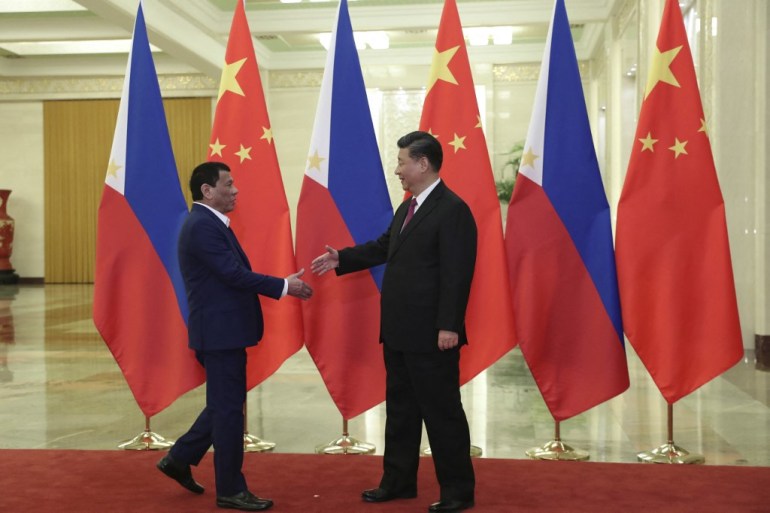

Chinese President Xi Jinping greets his Philippine counterpart Rodrigo Duterte
 during the latter's visit to Beijing in 2019 [File: Kenzaburo Fukuhara/AFP]

In the days leading up to the fifth anniversary on Monday of The Hague’s 2016 ruling that rejected China’s historical claim to most of the disputed South China Sea, the Philippines’ often abrasive Foreign Affairs Secretary Teodoro Locsin Jr sounded celebratory, hailing the occasion as “a milestone in the corpus of international law”.

“The Philippines is proud to have contributed to the international rules-based order,” he said of Manila’s role in challenging Beijing before the Permanent Court of Arbitration.

In a dig at China, Locsin said that the decision “dashed among others a nine-dash line; and any expectation that possession is nine-tenths of the law.”

Locsin then cited Philippine President Rodrigo Duterte’s videotaped message at the UN General Assembly, in which the Filipino leader said the case was now “beyond compromise and beyond the reach of passing governments to dilute, diminish or abandon”.

But since taking office in 2016, Duterte has usually been less assertive – failing to challenge China’s moves to expand its maritime dominance in the region despite the landmark victory – and foreign policy experts said his “defeatist rhetoric” has compromised the country’s integrity and diminished its legal standing.

“Manila certainly missed a chance to echo a consistent unified narrative on its claims … which Beijing saw as an opportunity to flex its muscles and build the largest coast guard and maritime militia for its strategic advantage,” said Chester Cabalza, president and founder of Manila-based think-tank International Development and Security Cooperation

“Instead, Filipinos heard defeatist rhetoric from the commander-in-chief as he kept mum on continuous Chinese incursions into the Philippines’ exclusive economic zone (EEZ),” he told Al Jazeera.

Collin Koh, research fellow at Singapore’s Institute of Defence and Strategic Studies, said the Duterte administration “squandered the opportunity” in emphasising the significance of the decision “whether it ought to be doing it alone or in concert with like-minded external parties” such as the Association of Southeast Asian Nations (ASEAN) and the United States.

‘Victory Day’

It was in July 2016, less than two weeks into the Duterte presidency when The Hague tribunal concluded, based on the United Nations Convention on the Law of the Sea (UNCLOS), that China’s assertion of historic rights within its “nine-dash line” and maritime entitlements over most of the South China Sea had “no legal basis”.

The ruling also affirmed the Philippines’ jurisdiction over its exclusive economic zone (EEZ), which stretches 200 nautical miles (370km) from its coast. As such, China’s fishing activities and construction of artificial islands within that area were deemed an infringement of Philippine sovereign rights. The Philippines refers to that particular area as the West Philippine Sea.

Moreover, the court ruled that of all disputed South China Sea features – even those controlled by Beijing – none were considered “habitable” and able to sustain economic activity in its original form, and therefore were not entitled to an EEZ – thus clearly falling within Philippine EEZ.

Protesters descend on the Chinese consulate in Manila in 2019 to oppose the Asian superpower’s growing sway in the Philippines, and as tensions rise over Beijing’s presence in the disputed South China sea 
[File: Ted Aljibe/AFP]
To commemorate the ruling this year, Philippine Senator Risa Hontiveros has proposed that the country declare July 12 as the National West Philippine Sea Victory Day.

In a statement sent to Al Jazeera, she said Duterte’s predecessor, Benigno Aquino III – who died last month – should also be commended for his decision to take on China and secure a “landmark legal victory”.

“Even when the Philippines was going against the Goliath that is China, he pursued the case merely on the principle that it was the right thing to do.”

Protests are also expected on Monday outside China’s diplomatic mission in Manila.

China has said repeatedly that it does not recognise the 2016 ruling, and has continued to expand its artificial islands in Mischief Reef, as well as in Scarborough Shoal, which Manila lost to Beijing in 2012.

Duterte’s gambit

Campaigning for the presidency in 2016, Duterte charmed voters with his hardline stance on China. In one campaign swing, he promised to ride a jet ski in the South China Sea and challenge the Chinese incursion in Philippine waters. He said he always wanted to die a hero.

But as soon as he became president, Duterte started to backpedal on his promises, saying the Philippines cannot afford to take on China because a confrontation would only lead to bloodshed.

In a Talk to Al Jazeera interview in October 2016, Duterte also said that his jet ski remark was a “hyperbole” and that he did not even know how to swim. He later said it was all “a joke” to show his “bravado”, and that only “stupid” people would believe it.

In a stunning admission in June 2019, Duterte said he had reached a verbal agreement with Chinese President Xi Jinping in 2016 allowing China to fish within the Philippines’s EEZ, despite a constitutional mandate that the state must protect its marine wealth, including its EEZ, and “reserve its use and enjoyment exclusively to Filipino citizens”.

In recent months, Chinese vessels, believed to be manned by Chinese maritime militia personnel, were seen in the South China Sea within the Philippines’ EEZ [File: Philippine Coast Guard/Handout via Reuters]
“It was a mutual agreement,” Duterte explained. “Let’s give way to each other. You fish there, I fish here.”

In several public remarks, Duterte has emphasised that better relations with China have brought economic dividends to the Philippines, through direct investments, financial assistance and loans

Salvador Panelo, who was Duterte’s spokesman at the time, defended the deal saying that while it was “verbal” it was still “valid and binding”.

But Panelo’s replacement, Harry Roque, said this April that there was “no truth” to the deal and that it was “quite simply conjecture”.

“No such treaty or agreement exists between the Philippines and China,” Roque said, explaining that even a fishing agreement “can only be done through a treaty” and in “written form”.

‘Swarming’

Amid the Duterte administration’s diplomatic dithering, the situation in the South China Sea came to a head earlier this year, when several reports revealed that hundreds of Chinese vessels had gathered within the Philippine EEZ.

The “swarming incident” has since been repeated several times, prompting several diplomatic protests by Manila, which denounced Beijing’s “blatant disregard” of its commitment “to promote peace and stability in the region”.

In May, the presence of hundreds of Chinese vessels so exasperated Locsin, the Philippines’ top diplomat, that he fired an expletive-laden statement on social media.

“China, my friend, how politely can I put it? Let me see… O… GET THE F*** OUT,” Locsin wrote on Twitter.

According to reports, Manila has filed more than 120 diplomatic protests with China over incidents in the disputed waters since 2016.

Still, Duterte has remained reluctant to confront China.

In recent months, he has said that he wants to maintain friendly ties with China, citing Manila’s “debt of gratitude” for Beijing’s help in providing coronavirus vaccines. He has also banned his Cabinet from speaking about the South China Sea, after key security and diplomatic officials criticised China for the swarming.

But despite Duterte’s efforts to cosy up to Beijing, observers say China has only been further “emboldened”, and the growing tension has now left Manila with no choice but to step up its action to assert its rightful place in the South China Sea.

Cabalza, the security analyst based in Manila, said that now is not the time for the Duterte administration to be “flip-flopping on foreign policy”, urging a “more strategic” approach that balances the country’s economic and security interests.

“China’s art of war and deception should not be taken for granted.”

He urged the Philippines to “fast-track” its military modernisation programme “to increase its presence in the aerial and maritime domains” and halt the Chinese incursions.

“If Manila seriously considers balanced and fearless engagement with Beijing, it needs to capacitate on strengthening a robust national security infrastructure that deals with China’s grey zone strategy and massive disinformation,” he said, adding that Manila should also continue filing diplomatic protests every time an incursion happens.

South China Sea ‘fait accompli’

Koh, the foreign affairs analyst from Singapore’s S Rajaratnam School of International Studies, also noted how the Philippines has lagged over the years in “building up the stick” in terms of military capacity to carry out “more vigorously” maritime patrols within its EEZ.

That could have been partly addressed by Manila if Duterte had not gone out of his way to gradually undermine its decades-long alliance with the US, Koh said. Since the beginning of his presidency, Duterte has shown his disdain towards the US, even making the unsubstantiated claim that he could be a target of the CIA.

“The open expression of desire to prioritise ties with Beijing – even at the expense of the 2016 award, the lack of political will to maintain persistent maritime presence and the alliance relationship with the US would have had the combined effect of emboldening Beijing,” he explained to Al Jazeera.

With the progress China made in fortifying its artificial islands in the South China Sea, it will be “impossible to even envisage” that it would “willingly relinquish those possessions” within the Philippines’ EEZ, Koh said.

“There’s no way to reverse the fait accompli short of evicting the Chinese from those artificial outposts by use of force, which would mean war.”

Without resorting to armed conflict, it is still possible for the Philippines to assert its maritime sovereignty and rights by putting “a principled and consistent stance” on the issue, Koh added.

He says the Philippines should pursue daily maritime law enforcement actions and patrols of its EEZ.

“The recent Philippine Coast Guard challenge and dispersal of Chinese and other foreign fishing vessels in the Philippine EEZ, around Sabina Shoal and Marie Louise Bank, is a good example,” Koh said.

“These actions may not compel China to reverse its acts in the South China Sea, but at the very least may help deter Beijing from thinking of more drastic actions to further undermine the status quo.”

In May, Chinese vessels also left Sabina Shoal, after the Philippines issued a radio challenge.

Hontiveros, an opposition senator and critic of Duterte’s South China Sea policy said the radio challenges showed that “the Philippines can assert our ownership of the West Philippine Sea without resorting to war.”

As a middle power caught in the increasingly heated rivalry between China and the US, the lesson for Manila is to pursue an independent foreign policy, according to Cabalza, the foreign affairs expert who has also studied at the National Defence University in Beijing

“Manila should choose its own national interest. It takes courage to depend on its own capability and build it with a vision to protect the country’s own sovereignty and territorial integrity.”


SOURCE: AL JAZEERA

New West-Burnaby NDP MP submits motion to halt Trans Mountain project

New Westminster-Burnaby MP Peter Julian has submitted motion M-94 calling on the federal government to “immediately stop” construction of the Trans Mountain pipeline project, which terminates in Burnaby.

Jul 8, 2021 9:39 AM By: Chris Campbell

This photo shows workers creating a tunnel.Trans Mountain


New Westminster-Burnaby MP Peter Julian has submitted motion M-94 calling on the federal government to “immediately stop” construction of the Trans Mountain pipeline project, which terminates in Burnaby.

The NDP MP also called on the parliamentary budget officer to conduct an “ongoing and thorough” review of the financial viability of the pipeline expansion.

"It's crystal clear that the government made a bad decision in buying this pipeline and defending it to the hilt,” said Julian, in a statement. “It's a project that undermines our efforts to reduce GHGs, it's a project that doesn't create sustainable jobs, it puts our environment, our municipalities and our communities at risk. Furthermore, it is clear that this project represents a net financial loss for the government. In other words, no matter what the Liberals say, this project is a money pit that does not reflect our commitment to an energy transition.”

The motion was put forward at the urging of Tim Takaro, a Vancouver-area doctor who occupies a tree in Burnaby on a rotating basis to protest the project, including the cutting of trees.

Trans Mountain recently restarted the process of cutting down more than 1,300 trees and clearing brush in Burnaby along the Brunette River after a stop-work order was issued due to concerns about birds nesting in the area. Trans Mountain has also starting building a tunnel that will run from Burnaby Mountain to the Westridge Marine Terminal on Burrard Inlet.

“The Prime Minister has no credibility when he announced last April that he wanted to further reduce GHGs," said Julian, "while his government continues to support a dirty oil project that jeopardizes Canada’s commitments to the Paris Climate Agreement, makes no economic sense, and displays an alarming lack of respect for Indigenous Peoples’ Title and Rights.
From solar flares to Aurora Borealis: Best shots from the Astronomy Photographer of the Year Awards

By Jutalla Coulibaly-WillisUpdated 11/07/2021

Copyright Zhang Xiao

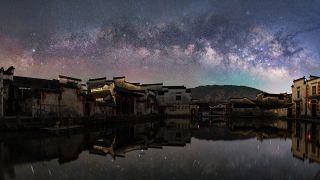
The shortlist for 2021’s Astronomy Photographer of the Year has been unveiled by Royal Museums Greenwich. From radiant Lunar Halos in Sweden to California Nebulas, this year’s selection is more dazzling than ever.

The competition, now in its 13th year, is widely considered the leading astrophotography competition on the globe.

Commissioned by the Royal Observatory Greenwich in association with BBC Sky at Night Magazine and with 4500 entries spanning 75 countries, making the shortlist is a prestigious feat.

SEE


EGEB: World’s largest offshore wind turbines chosen for first commercial project

Michelle Lewis
- Jul. 12th 2021 


Vestas 15MWs have a potential buyer

In February, as Electrek reported, Danish wind turbine manufacturer Vestas announced the launch of its new offshore wind turbine – the V236-15.0MW. It stole the title from US conglomerate GE’s 14MW Haliade-X to become the world’s largest offshore wind turbine.

And now, German energy company EnBW has pre-selected the massive Vestas turbines for He Dreiht, a 900 megawatt, subsidy-free offshore wind farm in the German North Sea. It would be the first commercial deployment of the Vestas 15MW wind turbines if the pre-selection is upgraded to an unconditional order.

EnBW secured the rights for He Dreiht in Germany’s first offshore wind tender in 2017.

A single V236-15.0 MW is capable of producing 80 GWh per year, depending on site-specific conditions. The rotor diameter is 236 meters (774 feet). One turbine will sweep an area of 470,845 square feet (43,743 square meters) and will have capacity to power 20,000 households.

Turbine installation is due to begin in the second quarter of 2025, with full park commissioning anticipated for the fourth quarter of the same year.

Nova Scotia: 80% renewables by 2030

Nova Scotia premier Iain Rankin announced on Saturday that he wants 80% of Nova Scotia’s energy to come from renewables by 2030. He also announced that a Request for Proposals (RFP) will be issued for renewables to supply 10% of the Canadian province’s electricity.

The RFP results are expected to get the province to 70% of renewable electricity, with the remaining 10% of the target to be reached by 2030.


The RFP seeks 350 megawatts of electricity from renewables. It would reduce Nova Scotia’s greenhouse gas emissions by more than 1 million tonnes each year, create 4,000 jobs mostly in rural areas, and generate more than $550 million in the construction sector.

A press release from the province states that wind is now the cheapest source of electrical energy in Canada.

Photo: Courtesy of Vestas Wind Systems A/S
Nova Scotia reaches tentative agreement with health care unions, avoiding strike

Allan April
CTVNewsAtlantic.ca writer
@AllanAprilCTV
 Wednesday, July 7, 2021 

NSGEU President Jason MacLean speaks at a news conference in Dartmouth, N.S., on June 18, 2019.

HALIFAX -- Nova Scotia has reached a tentative agreement with the unions representing many of the province’s health care workers, avoiding a potential strike.

In a release, the Health Care Council of Unions says a tenatative agreement was reached with Nova Scotia Health and the IWK late Tuesday.

That tentative agreement will now be brought forward to the almost 7,500 members from the NSGEU, CUPE and Unifor for a ratification vote.

“This agreement includes a wage offer and language improvements that are reasonable and recognize the significant contributions health care workers make each and every day,” said NSGEU President Jason MacLean in a release.

The committee representing the unions is recommending ratification of the agreement, and has suspended the strike vote that started on Monday.

Details of the agreement will not be shared until members have had the opportunity to review and vote on the agreement.

“After five days of conciliation, we believe the deal put on the table late Tuesday afternoon was one that indeed was enough to reverse the decision to ask our membership to contemplate strike action,” added Les Duff, Acting President of Local 8920.

When CTV News spoke to the union leaders on Monday, they said that wages were their number one priority, and that they were asking for annual raises of three per cent for the next four years.

“I’m pleased that the bargaining committee was able to reach a tentative agreement to bring back to these members who have been on the frontline of the pandemic for more than a year now,” added Unifor Atlantic Regional Director Linda MacNeil.

The Health Care Council of Unions bargaining committee is made up of six members from NSGEU, three from CUPE and one from Unifor.
Revolutionising Lebanon’s agriculture sector as food runs out

Lebanon’s farming industry has gone underfunded and underdeveloped for many years, hindered by a lack of modern equipment and inefficient production techniques
.

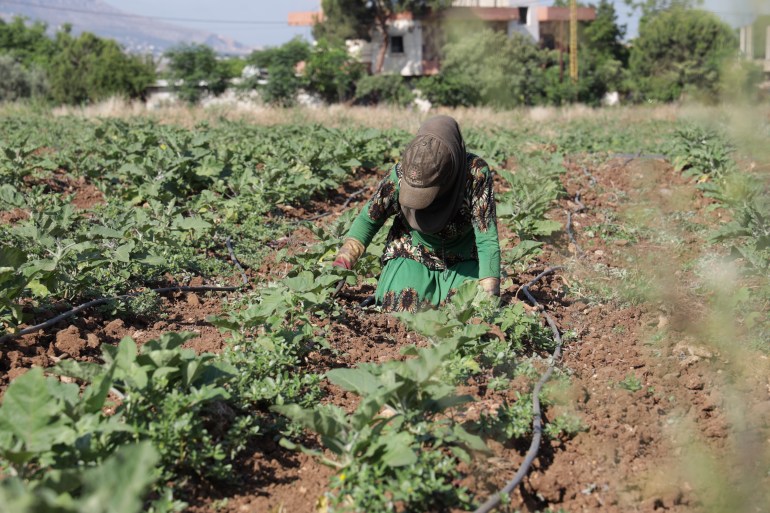
An agricultural worker checks cucumber plants in a newly built greenhouse 
[Courtesy: Anera]

By Robert McKelvey
6 Jul 2021

Beirut, Lebanon – As time runs out for government subsidies in Lebanon, the troubled country faces an uphill battle to keep its population fed as food prices continue to rise, driven up by an ever-deepening liquidity crisis and a severe dependency on imported foreign goods.

Despite having the highest proportion of arable land in the Arab world with more than 200,000 hectares (494,000 acres), Lebanon’s own agricultural sector has gone underfunded and underdeveloped for many years, hindered by a lack of modern equipment and inefficient production techniques.

KEEP READING


Lebanon days away from ‘social explosion’, PM Diab warns

Now, with Lebanese farmers unable to even cover their own operating costs and the government paralysed by political deadlock, international NGOs such as Anera have been forced to upscale their aid programmes to fight back against the rapid socioeconomic decline.

“I think that Lebanon is a rich country that has not been developed to its potential, and not just in the agricultural sector,” Samar El Yassir, Anera’s Lebanon country director, told Al Jazeera.

“With the bad governance we have instead of optimising our resources many times we are diminishing [them].

“Our interventions are at a grassroots, community level and not a policy level. There is not a government to influence. We are trying to find ways to build resilience and sustain these communities through these crises.”
Farm workers tend to newly planted fields 
[Courtesy: Anera]

Infrastructure non-existent

In happier times, some of Lebanon’s farmers made a tidy profit selling produce to foreign markets. However, this has led to a system of diminishing returns as those markets have become inaccessible.


Saudi Arabia suspended all imports of Lebanese fruit and vegetables back in April after a shipment of pomegranates was found to have been used to smuggle millions of Captagon pills into the kingdom, cutting off an important revenue stream and tainting the image of Lebanese produce internationally.

“Lebanon grows quality produce that sells at high prices in the Gulf region,” said Serene Dardari, Anera’s communication and outreach manager.

“When agricultural exports fetch high prices, Lebanon imports the same products from other neighbouring countries in order to benefit from the price difference and taxations, which is not really a sustainable economic system.

“Infrastructure and technological support is weak or nonexistent,” she continued. “Water supplies are in constant shortage due to a crucial lack of dams, which would otherwise allow for the use of surplus rainwater for irrigation and other functions, despite Lebanon having the highest rainfall levels in the region.”

Anera is working closely with farmers to improve both the quality and quantity of their crops [Courtesy: Anera]

In Lebanon’s coastal Akkar district, one of the country’s most fertile regions, Anera has been providing farmers with tools and technical assistance, as well as high-quality seeds and pesticides, while also helping them to take on additional agricultural workers, many of whom are Syrian migrants

This then allows farmers to expand their farmland and establish new plastic greenhouses and irrigation tubing systems, also provided by Anera.

“Many of our rivers are polluted and much of the land is not used properly,” explained Yassir. “We are teaching farmers how to do irrigation with water that isn’t polluted and with good practices. The hope is that this will not only improve their incomes, but also the quality of the food they produce.”

Dardari added: “The driving notion behind this is to teach a man how to fish rather than to give him one. By increasing the farmers’ capacities, as well as both the quantity and quality of their yields, we are trying to minimise their dependency on aid.”

With this scheme, the NGO hopes to provide a model for a more productive and profitable agriculture industry. This would allow Anera – as well as other organisations and local communities – to further build upon this for the future with an approach scalable to the resources available.
Fears of ‘brain drain’

In order for this development to continue in a meaningful and long-lasting way, a new generation of farmers is required to carry it forward. With so many Lebanese graduates and professionals leaving the country in search of a better life elsewhere, that may prove difficult.

“What concerns me as [both] a Lebanese and a development professional in this country is the ‘brain drain’ across all sectors,” lamented Yassir.

“One of Lebanon’s many resources is its people. [We] have access to good education, so we [need to] utilise these talents.”

A farmer displays freshly picked cucumbers [Courtesy: Anera]


Fortunately, Anera may have found a potential solution to this issue by offering young people a chance to try out farm work for themselves, synergising with their other development initiatives.

“We are investing in training youths in agriculture, placing them with different farmers so they can gain more experience while also helping these farmers,” said Yassir. “We are also helping them set up their own small agricultural practices on their own land.

“Lebanon has fallen and we need youth and communities to build it again,” she added. “Lebanon needs a government that is able to enact the reforms that are currently holding back foreign aid.”


By cultivating interest in the field among the younger generation, the NGO said it will come to appreciate the need for sustainable agriculture and possibilities it can offer as a potential career path.

With fuel subsidies also coming to their end, many in Lebanon are bracing for further dramatic increases in food prices, as farmers require large volumes of fuel to operate their machines and transport their goods to market.


By Jove! Stunning New Images Show Jupiter’s Great Red Spot, Superstorms, and Gargantuan Cyclones

Three Views of Jupiter

Three images of Jupiter show the gas giant in three different types of light — infrared, visible, and ultraviolet. The image on the left was taken in infrared by the Near-InfraRed Imager (NIRI) instrument at Gemini North in Hawaiʻi, the northern member of the international Gemini Observatory, a Program of NSF’s NOIRLab. The center image was taken in visible light by the Wide Field Camera 3 on the Hubble Space Telescope. The image on the right was taken in ultraviolet light by Hubble’s Wide Field Camera 3. All of the observations were taken on 11 January 2017. Credit: International Gemini Observatory/NOIRLab/NSF/AURA/NASA/ESA, M.H. Wong and I. de Pater (UC Berkeley) et al.

Stunning new images of Jupiter from Gemini North and the NASA/ESA Hubble Space Telescope showcase the planet at infrared, visible, and ultraviolet wavelengths of light. These views reveal details in atmospheric features such as the Great Red Spot, superstorms, and gargantuan cyclones stretching across the planet’s disk. Three interactive images allow you to compare observations of Jupiter at these different wavelengths and explore the gas giant’s clouds yourself!

Three striking new images of Jupiter show the stately gas giant at three different types of light — infrared, visible, and ultraviolet. The visible and ultraviolet views were captured by the Wide Field Camera 3 on the Hubble Space Telescope, while the infrared image comes from the Near-InfraRed Imager (NIRI) instrument at Gemini North in Hawaiʻi, the northern member of the international Gemini Observatory, a Program of NSF’s NOIRLab. All of the observations were taken simultaneously (at 15:41 Universal Time) on January 11, 2017.

These three portraits highlight the key advantage of multiwavelength astronomy: viewing planets and other astronomical objects at different wavelengths of light allows scientists to glean otherwise unavailable insights. In the case of Jupiter, the planet has a vastly different appearance in the infrared, visible, and ultraviolet observations. The planet’s Great Red Spot — the famous persistent storm system large enough to swallow the Earth whole — is a prominent feature of the visible and ultraviolet images, but it is almost invisible at infrared wavelengths. Jupiter’s counter-rotating bands of clouds, on the contrary, are clearly visible in all three views.

Gemini North Infrared View of Jupiter

This infrared view of Jupiter was created from data captured on 11 January 2017 with the Near-InfraRed Imager (NIRI) instrument at Gemini North in Hawaiʻi, the northern member of the international Gemini Observatory, a Program of NSF’s NOIRLab. It is actually a mosaic of individual frames that were combined to produce a global portrait of the planet. In the image warmer areas appear bright, including four large hot spots that appear in a row just north of the equator. South of the equator, the oval-shaped and cloud-covered Great Red Spot appears dark. Credit: International Gemini Observatory/NOIRLab/NSF/AURA, M.H. Wong (UC Berkeley) et al., Acknowledgments: M. Zamani

Observing the Great Red Spot at multiple wavelengths yields other surprises — the dark region in the infrared image is larger than the corresponding red oval in the visible image. This discrepancy arises because different structures are revealed by different wavelengths; the infrared observations show areas covered with thick clouds, while the visible and ultraviolet observations show the locations of chromophores — the particles that give the Great Red Spot its distinctive hue by absorbing blue and ultraviolet light.

Hubble Visible View of Jupiter

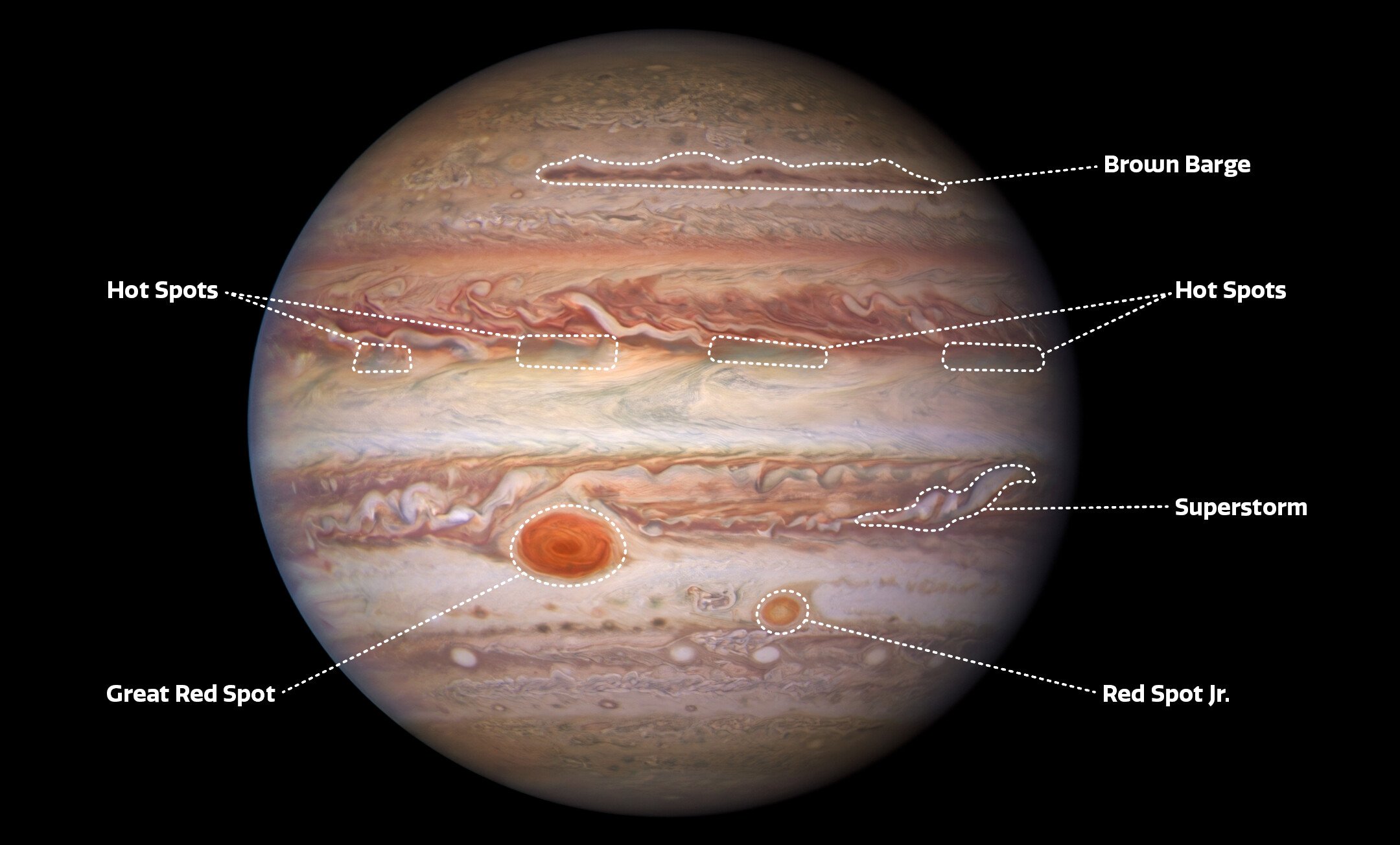
This visible-light image of Jupiter was created from data captured on 11 January 2017 using the Wide Field Camera 3 on the Hubble Space Telescope. Near the top, a long brown feature called a ‘brown barge’ extends 72,000 kilometers (nearly 45,000 miles) in the east-west direction. The Great Red Spot stands out prominently in the lower left, while the smaller feature nicknamed Red Spot Jr. (known to Jovian scientists as Oval BA) appears to its lower right. Credit: NASA/ESA/NOIRLab/NSF/AURA/M.H. Wong and I. de Pater (UC Berkeley) et al.
Acknowledgments: M. Zamani

The Great Red Spot isn’t the only storm system visible in these images. The region sometimes nicknamed Red Spot Jr. (known to Jovian scientists as Oval BA) appears in both the visible and ultraviolet observations.[1] This storm — to the bottom right of its larger counterpart — formed from the merger of three similar-sized storms in 2000.[2] In the visible-wavelength image, it has a clearly defined red outer rim with a white center. In the infrared, however, Red Spot Jr. is invisible, lost in the larger band of cooler clouds, which appear dark in the infrared view. Like the Great Red Spot, Red Spot Jr. is colored by chromophores that absorb solar radiation at both ultraviolet and blue wavelengths, giving it a red color in visible observations and a dark appearance at ultraviolet wavelengths. Just above Red Spot Jr. in the visible observations, a Jovian superstorm appears as a diagonal white streak extending toward the right side of Jupiter’s disk.

Hubble Ultraviolet View of Jupiter

This ultraviolet image of Jupiter was created from data captured on 11 January 2017 using the Wide Field Camera 3 on the Hubble Space Telescope. The Great Red Spot and Red Spot Jr. (also known as Oval BA) absorb ultraviolet radiation from the Sun and therefore appear dark in this view. Credit: NASA/ESA/NOIRLab/NSF/AURA/M.H. Wong and I. de Pater (UC Berkeley) et al., Acknowledgments: M. Zamani

One atmospheric phenomenon that does feature prominently at infrared wavelengths is a bright streak in the northern hemisphere of Jupiter. This feature — a cyclonic vortex or perhaps a series of vortices — extends 72,000 kilometers (nearly 45,000 miles) in the east-west direction. At visible wavelengths the cyclone appears dark brown, leading to these types of features being called ‘brown barges’ in images from NASA’s Voyager spacecraft. At ultraviolet wavelengths, however, the feature is barely visible underneath a layer of stratospheric haze, which becomes increasingly dark toward the north pole.

Similarly, lined up below the brown barge, four large ‘hot spots’ appear bright in the infrared image but dark in both the visible and ultraviolet views. Astronomers discovered such features when they observed Jupiter in infrared wavelengths for the first time in the 1960s.

As well as providing a beautiful scenic tour of Jupiter, these observations provide insights about the planet’s atmosphere, with each wavelength probing different layers of cloud and haze particles. A team of astronomers used the telescope data to analyze the cloud structure within areas of Jupiter where NASA’s Juno spacecraft detected radio signals coming from lightning activity.

Labeled Image of Jupiter

Labels added to this visible-light Hubble Space Telescope image of Jupiter point out several atmospheric features on the planet, including a ‘brown barge’, four hot spots (which appear bright in the infrared image from Gemini North), a superstorm, the Great Red Spot, and Red Spot Jr. (also known as Oval BA). Credit: NASA/ESA/NOIRLab/NSF/AURA/M.H. Wong and I. de Pater (UC Berkeley) et al.

The scientific story behind these striking images is told in full in a new NOIRLab Stories blog post. As well as discovering the science behind these images, we invite you to inspect observations of Jupiter at home! Three interactive images let you compare observations of Jupiter at different wavelengths and peer beneath the gas giant’s clouds:

“The Gemini North observations were made possible by the telescope’s location within the Maunakea Science Reserve, adjacent to the summit of Maunakea,” acknowledges the observation team’s leader, Mike Wong of the University of California, Berkeley. “We are grateful for the privilege of observing Ka‘awela (Jupiter) from a place that is unique in both its astronomical quality and its cultural significance.”

More information on the infrared observations from Gemini is provided in the article Gemini Gets Lucky and Takes a Deep Dive Into Jupiter’s Clouds.

Notes

  1. While it appears red in Hubble’s visible-light image of Jupiter taken in January 2017, Red Spot Jr. does not always appear red. It was white when it first formed but turned red several years later. It has changed color since then and once again appears white.
  2. The three storms that merged to form Red Spot Jr. in 2000 were similar in size to each other and similar in size to Red Spot Jr. Interestingly, Red Spot Jr. did not become much larger than any of the three individual storms after they merged.

References

“High-resolution UV/Optical/IR Imaging of Jupiter in 2016–2019” by Michael H. Wong, Amy A. Simon, Joshua W. Tollefson, Imke de Pater, Megan N. Barnett, Andrew I. Hsu, Andrew W. Stephens, Glenn S. Orton, Scott W. Fleming, Charles Goullaud, William Januszewski, Anthony Roman, Gordon L. Bjoraker, Sushil K. Atreya, Alberto Adriani and Leigh N. Fletcher, 1 April 2020, The Astrophysical Journal Supplement Series.
DOI: 10.3847/1538-4365/ab775f

“First ALMA Millimeter-wavelength Maps of Jupiter, with a Multiwavelength Study of Convection” by Imke de Pater, R. J. Sault, Chris Moeckel, Arielle Moullet, Michael H. Wong, Charles Goullaud, David DeBoer, Bryan J. Butler, Gordon Bjoraker, Máté Ádámkovics, Richard Cosentino, Padraig T. Donnelly, Leigh N. Fletcher, Yasumasa Kasaba, Glenn S. Orton, John H. Rogers, James A. Sinclair and Eric Villard, 9 September 2019, The Astronomical Journal.
DOI: 10.3847/1538-3881/ab3643

More information

NSF’s NOIRLab (National Optical-Infrared Astronomy Research Laboratory), the US center for ground-based optical-infrared astronomy, operates the international Gemini Observatory (a facility of NSF, NRC–Canada, ANID–Chile, MCTIC–Brazil, MINCyT–Argentina, and KASI–Republic of Korea), Kitt Peak National Observatory (KPNO), Cerro Tololo Inter-American Observatory (CTIO), the Community Science and Data Center (CSDC), and Vera C. Rubin Observatory (in cooperation with DOE’s SLAC National Accelerator Laboratory). It is managed by the Association of Universities for Research in Astronomy (AURA) under a cooperative agreement with NSF and is headquartered in Tucson, Arizona. The astronomical community is honored to have the opportunity to conduct astronomical research on Iolkam Du’ag (Kitt Peak) in Arizona, on Maunakea in Hawaiʻi, and on Cerro Tololo and Cerro Pachón in Chile. We recognize and acknowledge the very significant cultural role and reverence that these sites have to the Tohono O’odham Nation, to the Native Hawaiian community, and to the local communities in Chile, respectively.

The Hubble Space Telescope is a project of international cooperation between NASA and the European Space Agency (ESA). NASA’s Goddard Space Flight Center in Greenbelt, Maryland, manages the telescope. The Space Telescope Science Institute (STScI) in Baltimore, Maryland, conducts Hubble science operations. STScI is operated for NASA by AURA.


Dutch study finds commercial support for nuclear new build

08 July 2021


Market participants - such as contractors, operators and suppliers - would invest in the construction of new nuclear generating capacity in the Netherlands provided the government contributes to the cost and there is public support, a report by consultancy firm KPMG indicates. In response to the study, demissionary Minister for Economic Affairs Dilan Yesilgöz-Zegerius has requested a study into the possibility of including nuclear power in the country's plans for meeting energy and climate goals.

(Image: KPMG)

A motion was adopted in the House of Representatives on 17 September 2020 in response to a motion by Klaas Dijkhoff - former leader of the People's Party for Freedom and Democracy - who asked the cabinet to investigate the conditions under which market parties are prepared to invest in nuclear power plants in the Netherlands, what public support is required for this, and in which regions there would be interest in hosting a nuclear power plant. The Ministry of Economic Affairs and Climate Policy subsequently asked KPMG to conduct a market consultation on nuclear energy in the Netherlands.

KPGM began work on the study on 8 February this year. It interviewed 41 national and international market participants, including contractors, core technology suppliers, operators, decommissioning specialists and financiers. Interviews were also conducted with 14 Dutch regions. Publicly-available information sources were also consulted.

Proven technology preferred


The consultation found most of the potentially involved companies emphasised the importance of choosing a proven reactor technology that meets applicable safety requirements. Small modular reactors (SMRs) are seen as an interesting option, but these are not yet commercially available. An SMR based on a generation III+ reactor design is expected to take about 10 years to licence and build, but a proven design will only become available in 2027-2035 at the earliest, the study found.

The market participants said Generation IV reactors have potential benefits in terms of safety and/or waste, but are not expected to be commercialised until after 2040, as a result of which they will come to market too late to achieve the 2050 climate target. Market parties therefore indicated broadly that the Netherlands should opt for a Generation III+ reactor now and in due course for a Generation IV reactor once the technology has been proven.

The study found that market participants consider stable government policy with regards to nuclear energy a pre-condition for nuclear new build. They said the substantial financing size, substantial risks and lead time mean government involvement seems inevitable. This could be by providing guarantees to financing risks.

KPMG found that provincial authorities in the province of Zeeland - where the country's only operating nuclear power plant, Borssele, is located - were in favour of another plant being built. In addition, the province of Noord-Brabant said the construction of a plant there would be negotiable under certain conditions.

Furthermore, there was wide support for the Borssele plant, whose 485 MWe (net) pressurised water reactor is currently scheduled to shut down in 2033, to be kept online longer as it is economically profitable and nuclear knowledge would be preserved. However, it still needs to be investigated what investments will be required for this.

Further studies


In response to KPMG's report, Minister for Economic Affairs Dilan Yesilgöz-Zegerius yesterday wrote to the House of Representatives saying she has requested a study examining how nuclear energy can play a role alongside other sustainable energy sources, such as solar and wind, for the period 2030 to 2050 and beyond.

She said she is also exploring how the country's Nuclear Energy Act can be amended to keep the Borssele plant in operation for longer. This is at the request of the House of Representatives, following a motion by Agnes Mulder and Mark Harbers.

"We do not have the luxury of excluding a sustainable energy source," Yesilgöz-Zegerius said. "The Netherlands wants to emit less CO2 and generate more sustainable energy. To achieve our climate goals, we will have to pull out all the stops, including nuclear energy if it is profitable and safe. That is why I also want to look at how we can maintain and strengthen the nuclear knowledge we have in the Netherlands. We must keep all options open."

Nuclear power currently has a small role in the Dutch electricity supply, with the Borssele plant - which began operating in 1973 - providing about 3% of total generation.

Last year, EPZ - operator of the Borssele nuclear power plant - called for an extension to its operation beyond 2033 and/or the construction of two new large reactors at the site in order to help the Netherlands meet its energy and climate goals.

The KPGM report (in Dutch) can be downloaded here.

Researched and written by World Nuclear News

Agreement on IAEA monitoring of Fukushima water release

09 July 2021

The scope of technical assistance the International Atomic Energy Agency (IAEA) will provide in monitoring and reviewing the planned discharge of treated water stored at the Fukushima Daiichi nuclear power plant site has been agreed. The Terms of Reference defining the objective of the IAEA's assistance, how it will be implemented and its organisational arrangements were signed yesterday by the agency and the Japanese government.

Tanks of treated water at the Fukushima Daiichi site (Image: Tepco)

The document was signed by IAEA Deputy Director General Lydie Evrard, who heads the agency's Department of Nuclear Safety and Security, and Ambassador Takeshi Hikihara, Japan's permanent representative to the international organisations in Vienna.

At the Fukushima Daiichi site, contaminated water is treated by the Advanced Liquid Processing System (ALPS), which removes most of the radioactive contamination, with the exception of tritium. This treated water is currently stored in tanks on-site. The total tank storage capacity amounts to about 1.37 million cubic metres and all the tanks are expected to be full around the summer of 2022.

In April, the Japanese government announced its formal decision that the treated water stored at the Fukushima Daiichi site will be discharged into the sea. The basic policy calls for the ALPS-treated water to be discharged "on the condition that full compliance with the laws and regulations is observed, and measures to minimise adverse impacts on reputation are thoroughly implemented".

After its announcement, the Japanese government requested assistance from the IAEA to review the country's plans and activities against international safety standards and also to support and be present during environmental monitoring operations there. The IAEA has said Japan's chosen disposal method is both technically feasible and in line with international practice.

"The signing of the Terms of Reference marks an important step as the document sets out the broad framework for how the IAEA will support Japan when it implements its plan to gradually release the treated water in a safe and transparent way," the IAEA said. "The agency's involvement before, during and after the water disposal will provide confidence - in Japan and beyond - that it takes place in line with the international safety standards which aim to protect people and the environment."

The IAEA said the signing of the document allows it to plan and implement a detailed programme of activities including review missions, in line with relevant IAEA safety standards and guidance. The first mission is expected to travel to Japan later this year.

Under the agreed terms, the IAEA will examine key safety elements of Japan's discharge plan, including: the radiological characterisation of the water to be discharged; safety related aspects of the water discharge process; the environmental monitoring associated with the discharge; the assessment of the radiological environmental impact related to ensuring the protection of people and environment; and, regulatory control including authorisation, inspection and review and assessment.

An IAEA Task Force will implement the assistance to Japan, which will include advice by a group of internationally recognised experts from Member States, including members from the region, under the authority of the IAEA Secretariat.

Japan intends to start releasing the treated water in about two years' time, and the entire operation could last for decades.

Tokyo Electric Power Company, operator of the Fukushima Daiichi plant, said it will "continue to move forward with suitable handling of ALPS-treated water based on the advice, etc. received during this review".

"The IAEA will play a vital role in monitoring and reviewing Japan's implementation of its plan," said IAEA Director General Rafael Mariano Grossi. "As the eyes of the international community, IAEA experts will be able to verify that the water discharge is conducted safely. This is of paramount importance to reassure people in Japan and elsewhere in the world, especially in neighbouring countries, that the water poses no threat to them."

Researched and written by World Nuclear News