Wednesday, July 14, 2021

 VELIKOVSKY WAS RIGHT

Physicists describe sun's electric field
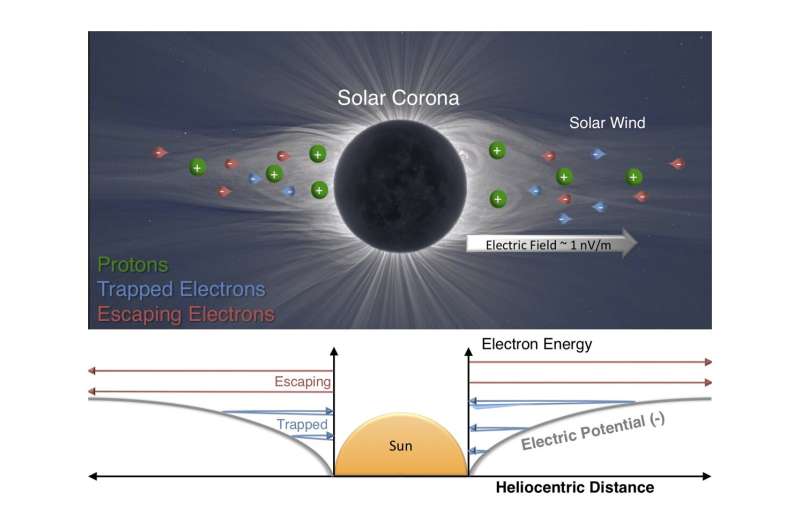
Physicists describe sun's electric field
University of Iowa physicists have gained new insights about the sun's electric field. The researchers measured electrons streaming from the sun, a main constituent of the solar wind, to determine the boundary in energy between electrons that escape the sun's clutches and those that don't. Credit: Jasper Halekas lab, University of Iowa

As the Parker Solar Probe ventures closer to the sun, we are learning new things about our home star.

In a new study, physicists led by the University of Iowa report the first definitive measurements of the sun's , and how the electric field interacts with the solar wind, the fast-flowing current of charged particles that can affect activities on Earth, from satellites to telecommunications.

The physicists calculated the distribution of electrons within the sun's electric field, a feat made possible by the fact that the Parker Solar Probe jetted within 0.1 astronomical units (AU), or a mere 9 million miles, from the sun—closer than any spacecraft has approached. From the electrons' distribution, the physicists were able to discern the size, breadth, and scope of the sun's electric field more clearly than had been done before.

"The key point I would make is you can't make these measurements far away from the sun. You can only make them when you get close," says Jasper Halekas, associate professor in the Department of Physics and Astronomy at Iowa and the study's corresponding author. "It's like trying to understand a waterfall by looking at the river a mile downstream. The measurements we made at 0.1 AU, we're actually in the waterfall. The solar wind is still accelerating at that point. It's really just an awesome environment to be in."

The sun's electric field arises from the interaction of protons and electrons generated when  are stripped apart in the intense heat generated by fusion deep within the sun. In this environment, electrons, with masses 1,800 times less than that of protons, are blown outward, less constrained by gravity than their weightier  siblings. But the protons, with their , exert some control, reining in some electrons due to the familiar attraction forces of oppositely charged particles.

"Electrons are trying to escape, but protons are trying to pull them back. And that is the electric field," says Halekas, a co-investigator for the Solar Wind Electrons, Alphas, and Protons instrument aboard the Parker Solar Probe, the NASA-led mission that launched in August 2018. "If there were no electric field, all the electrons would rush away and be gone. But the electric field keeps it all together as one homogenous flow."

Now, imagine the sun's electric field as an immense bowl and the electrons as marbles rolling up the sides at differing speeds. Some of the electrons, or marbles in this metaphor, are zippy enough to cross over the lip of the bowl, while others don't accelerate enough and eventually roll back toward the bowl's base.

"We are measuring the ones that come back and not the ones that don't come back," Halekas says. "There's basically a boundary in energy there between the ones that escape the bowl and the ones that don't, which can be measured. Since we're close enough to the sun, we can make accurate measurements of electrons' distribution before collisions occur further out that distort the boundary and obscure the imprint of the electric field."

From those measurements the physicists can learn more about the solar wind, the million-mile-per-hour jet of plasma from the sun that washes over the Earth and other planets in the solar system. What they found is the sun's electric field exertsr on how much of the acceleration is provided by the sun's electric field," Halekas says. "It looks like it's a small part of the total. It's not the main thing that gives the solar  its kick. That then points to other mechanisms that might be giving the  most of its kick."

The paper, "The sunward electron deficit: A telltale sign of the sun's electric potential," was published online July 14 in The Astrophysical Journal.

Physicists describe sun's electric field

UNIVERSITY OF IOWA

Research News

IMAGE

IMAGE: UNIVERSITY OF IOWA PHYSICISTS HAVE GAINED NEW INSIGHTS ABOUT THE SUN'S ELECTRIC FIELD. THE RESEARCHERS MEASURED ELECTRONS STREAMING FROM THE SUN, A MAIN CONSTITUENT OF THE SOLAR WIND, TO DETERMINE... view more 

CREDIT: JASPER HALEKAS LAB, UNIVERSITY OF IOWA

As the Parker Solar Probe ventures closer to the sun, we are learning new things about our home star.

In a new study, physicists led by the University of Iowa report the first definitive measurements of the sun's electric field, and how the electric field interacts with the solar wind, the fast-flowing current of charged particles that can affect activities on Earth, from satellites to telecommunications.

The physicists calculated the distribution of electrons within the sun's electric field, a feat made possible by the fact that the Parker Solar Probe jetted within 0.1 astronomical units (AU), or a mere 9 million miles, from the sun--closer than any spacecraft has approached. From the electrons' distribution, the physicists were able to discern the size, breadth, and scope of the sun's electric field more clearly than had been done before.

"The key point I would make is you can't make these measurements far away from the sun. You can only make them when you get close," says Jasper Halekas, associate professor in the Department of Physics and Astronomy at Iowa and the study's corresponding author. "It's like trying to understand a waterfall by looking at the river a mile downstream. The measurements we made at 0.1 AU, we're actually in the waterfall. The solar wind is still accelerating at that point. It's really just an awesome environment to be in."

The sun's electric field arises from the interaction of protons and electrons generated when hydrogen atoms are stripped apart in the intense heat generated by fusion deep within the sun. In this environment, electrons, with masses 1,800 times less than that of protons, are blown outward, less constrained by gravity than their weightier proton siblings. But the protons, with their positive charge, exert some control, reining in some electrons due to the familiar attraction forces of oppositely charged particles.

"Electrons are trying to escape, but protons are trying to pull them back. And that is the electric field," says Halekas, a co-investigator for the Solar Wind Electrons, Alphas, and Protons instrument aboard the Parker Solar Probe, the NASA-led mission that launched in August 2018. "If there were no electric field, all the electrons would rush away and be gone. But the electric field keeps it all together as one homogenous flow."

Now, imagine the sun's electric field as an immense bowl and the electrons as marbles rolling up the sides at differing speeds. Some of the electrons, or marbles in this metaphor, are zippy enough to cross over the lip of the bowl, while others don't accelerate enough and eventually roll back toward the bowl's base.

"We are measuring the ones that come back and not the ones that don't come back," Halekas says. "There's basically a boundary in energy there between the ones that escape the bowl and the ones that don't, which can be measured. Since we're close enough to the sun, we can make accurate measurements of electrons' distribution before collisions occur further out that distort the boundary and obscure the imprint of the electric field."

From those measurements the physicists can learn more about the solar wind, the million-mile-per-hour jet of plasma from the sun that washes over the Earth and other planets in the solar system. What they found is the sun's electric field exerts some influence over the solar wind, but less than had been thought.

"We can now put a number on how much of the acceleration is provided by the sun's electric field," Halekas says. "It looks like it's a small part of the total. It's not the main thing that gives the solar wind its kick. That then points to other mechanisms that might be giving the solar wind most of its kick."

The paper, "The sunward electron deficit: A telltale sign of the sun's electric potential," was published online July 14 in The Astrophysical Journal.

###

Contributing authors include Laura Bercic, from University College London; Phyllis Whittlesey, Davin Larson, Marc Pulupa, and Stuart Bale, from the University of California, Berkeley; Matthieu Berthomier, from the University of Paris-Saclay; Justin Kasper, of the University of Michigan and the Smithsonian Astrophysical Observatory; Anthony Case and Michael Stevens, of the Smithsonian Astrophysical Observatory; and Robert MacDowall, of NASA Goddard Space Flight Center.

NASA funded the research.


Elon Musk Is Correct, I Am Specifically Attacking Space Itself and Not Just His Mars Colonization Project

Elon Musk is defending space against "those who attack space." Here are some counterpoints.


Tom McKay


Billionaire Tesla and SpaceX CEO Elon Musk has big plans to abandon our endangered species and colonize Mars, under the theory that a planet whose conditions are inimically hostile to human life will make us less endangered. Fair enough.

To this end, SpaceX is developing the Starship, a prototype rocket that could one day ferry colonists from our doomed world to the Red Planet and is currently slated for its first orbital flight as soon as the next few months. Not everyone is particularly on board with Musk’s Mars ambitions, citing everything from the colonial perspective that seems inherent to the idea to whether any sort of large-scale settlement of the planet is even possible, at least in the foreseeable future.

Musk has some thoughts on this. In a strange, poem-like tweet on Monday, the billionaire wrote that perhaps these critics just don’t see that “space represents hope for so many people.”

In Musk’s telling, these undefined critics are attacking the ephemeral concept of space (referring, presumably, to the interstellar void of the cosmos rather than the spatial dimensions that comprise our reality). In this, he is broadly wrong, as critics of Musk mostly fall into two camps: those attacking the systemic inequality that allows him to amass billions for his planetary escape pod while children starve elsewhere, and those attacking his erratic personality in the hopes Tesla stock will fall.

However, he is not completely wrong. I am attacking space. I will not rest until space knows exactly what kind of piece of shit it is. Give me an army, my compatriots, and I would invade space and raze it to the ground.

Why do I hate space so? Let me count the ways:


It is very cold.

If you die in space, over a very long period of time all of the matter inside you slowly breaks apart and spreads out real far, becoming more space. Space thinks it is better than us.
Weightlessness is briefly cool until you spill or vomit anything whatsoever, which you will, constantly.
Also, the food sucks.

Space is all the matter that couldn’t get its shit together after the Big Bang.

While backwards time travel seems to be impossible, superluminal space travel does allow for forwards time travel, which means it’s possible a future Elon Musk could return from space on a periodic basis to torment your children, and your children’s children, and your grandchildren’s children, and so forth.

 This is space’s fault.

In the above scenario, Musk could also get into politics and it’s not clear what that means for term limits.

My colleague Whitney Kimball points out that from a grammatical perspective, hate is a verb, and space is a non-entity and therefore cannot be a direct object, thus it is incorrect to say you hate space. While this argument seems ludicrous to me, considering it at all was in and of itself extremely annoying.
Star Trek: Enterprise was set in space.

My dad said he was just going out for cigarettes and would be back in a few minutes, but it turns out he was secretly the captain of the Event Horizon, which went into space and never came back.

You can’t actually go into space. You bring a tiny, rocket-powered can or impermeable suit filled with parts of Earth with you, and stay inside it, or you die.

Space is a construct of our limited perception. In reality, space is made of tiny little fundamental particles called spacinos, which are sentient, predatory, and hate us. Read more about this theory on my blog.

It contains the Moon, which I also hate.

In conclusion, space has social, economic, and political effects. Its chief export is deadly meteorites and high-energy gamma-ray bursts. 

Fuck space.


Tom McKay
Tom covers tech, politics, online extremism, and oddities for Gizmodo. His work has appeared on Mic, Yahoo News, AOL, HuffPo, Business Insider, Snoop Dogg's Merry Jane, Wonkette and The Daily Banter.
A strange meteorite unlocks clues about the origins of our solar system

Scientists studied an unusual meteorite to learn about the burst of UV light that shone on our future planets


By MATTHEW ROZSA
PUBLISHED JULY 8, 2021
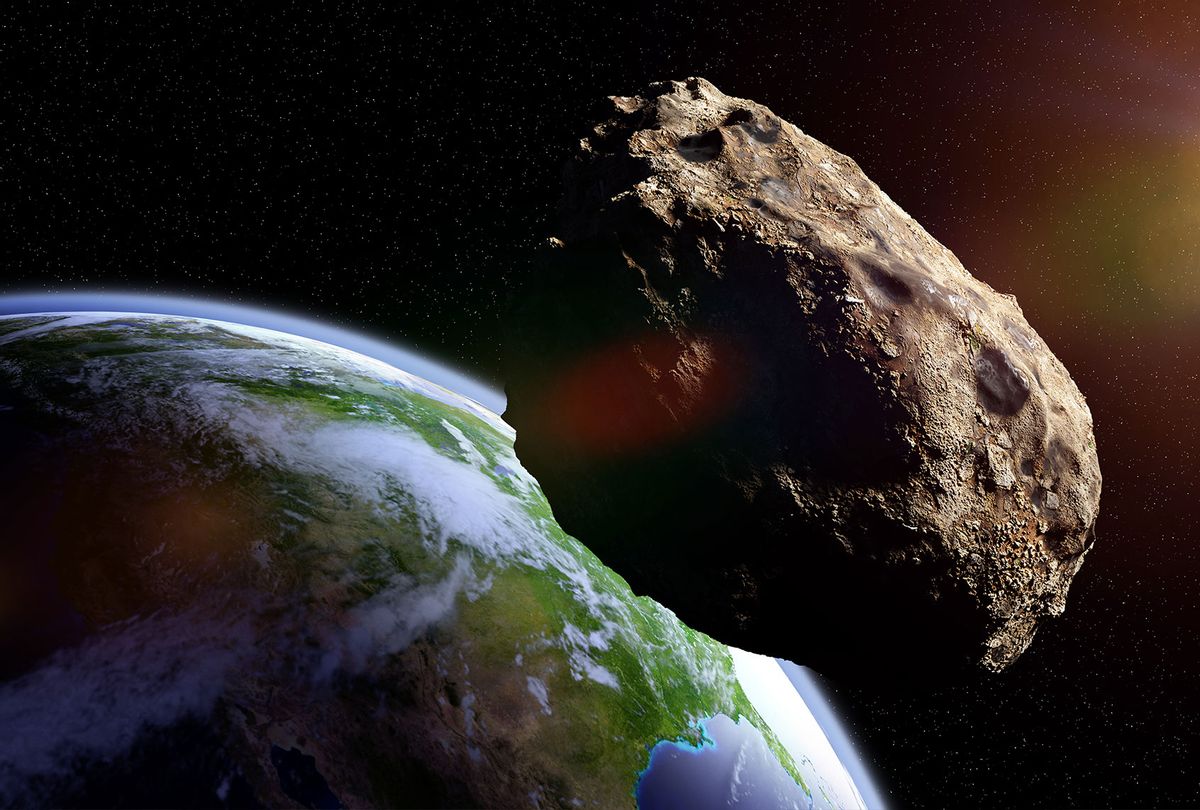
Meteorite in orbit (Getty Images)

Most scientists dream of having a "Eureka!" moment — that precious instant when you realize you have discovered something new, wonderful and significant.

In movies, we imagine it occurring with a swell of epic music and perhaps some well-timed lightning strikes. As Professor Ryan C. Ogliore of Washington University in St. Louis tells it, however, the team of scientists he was on had a more anticlimactic build-up to their breakthrough.

"The first thing you think is, 'Oh, there's something we're doing wrong,'" Ogliore explained. "So we change things around and look at it again. If the weird thing is still there, then you think you have something good."

To be thorough, Ogliore and his team tested the anomalies they were studying in a number of different ways, but over and over again their research yielded the same hopeful conclusion.

"That when I was really confident that this was the right answer," Ogliore recalled.
Advertisement:

Their finding? Ogliore — working alongside his colleagues Lionel G. Vacher (who led the team), Clive Jones, Nan Liu and David A. Fike — had studied an ancient meteorite and learned that a long-dead massive star played an instrumental role in the creation of our solar system. It's a discovery they say could be used to someday find the building blocks of life in other solar systems.

Some background: After NASA's 2011 Genesis mission brought back solar wind samples, scientists discovered that oxygen isotopes on the Sun differ from those found on Earth. The most likely explanation was that the cosmic material, which would later form into our planets, was pounded by a burst of ultraviolet light.

But where did that light come from? Scientists have been at a loss to explain their findings — until now.

Vacher, Ogliore and their team of researchers found the answer in Acfer 094, a piece of an ancient asteroid found as a meteorite in Algeria more than 30 years ago. In addition to being one of the oldest meteorites ever discovered, it is also the only meteorite that contains cosmic symplectite — or very heavy oxygen isotopes.

Ogliore then came up with the idea of measuring sulfur isotopes in the cosmic symplectite to study the ancient ultraviolet radiation that accompanied the birth of our universe.

Their breakthrough, as published in the journal Geochimica et Cosmochimica Acta, was the discovery that the light did not match the UV spectrum that would have come from our young sun — meaning the light had to have come from a nearby star.

"We conclude that the Sun's stellar neighbors, likely O and B stars in a massive-star-forming region, affected the composition of the Solar System's primordial building blocks," the authors wrote in the study. They concluded by pointing out that the isotope anomalies are not consistent with the type of ultraviolet irradiation of the gaseous hydrogen sulfide produced by the young Sun. It is, however, consistent with irradiation of hydrogen sulfide from nearby massive stars.
Advertisement:


That is why they believe that "a plausible scenario for the Sun's birth environment" is that it happened in "a large stellar cluster with at least one massive star (type O or B) in its vicinity."

As Ogliore explained to Salon, this is a very big deal.

"I think the goal of what I do and what scientists like me do is to understand the formation of the solar system," Ogliore observed. "We know that formation of planetary systems like our own is not rare in the galaxy. I think understanding the formation of our solar system gives us an understanding of this general property. That's super important because there is probably life out there too, in those other planetary systems."

MATTHEW ROZSA

Matthew Rozsa is a staff writer for Salon. He holds an MA in History from Rutgers University-Newark and is ABD in his PhD program in History at Lehigh University. His work has appeared in Mic, Quartz and MSNBC.
NASA uncovers hidden system of mysteriously draining lakes under Antarctica

The lakes grow and shrink beneath the ice.

By Stephanie Pappas - Live Science Contributor 
\
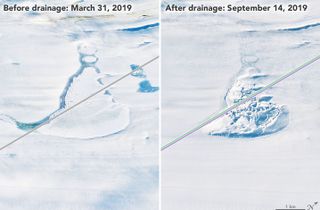
Changes in the ice surface of the Amery Ice Shelf in Antarctica reveal the rapid draining of a lake deep below in 2019. (Image credit: NASA Earth Observatory)

Scientists have discovered two new lakes buried deep beneath the Antarctic Ice Sheet.

These hidden gems of frigid water are part of a vast network of ever-changing lakes hidden beneath 1.2 to 2.5 miles (2 to 4 kilometers) of ice on the southernmost continent. These lakes fill and drain over and over again in largely mysterious cycles that may influence how fast the ice sheet moves and how and where meltwater reaches the Southern Ocean. This flow, in turn, can change the currents in the Southern Ocean and potentially affect ocean circulation worldwide.

"It's not just the ice sheet we're talking about," study leader Matthew Siegfried, a geophysicist at the Colorado School of Mines, said in a statement. "We're really talking about a water system that is connected to the whole Earth system."

Related: Photos of Antarctica: The ice-covered bottom of the world

Hidden water

The lakes sit at the bottom of the ice sheet, where the ice meets the rocky Antarctic continent. Unlike in Greenland, where meltwater flows from the ice surface through crevasses and holes called moulins, Antarctica's lakes form from beneath the ice, probably as a result of pressure, friction and perhaps geothermal heat.

This water system was largely invisible until the advent of NASA's ICESat mission in 2003. The ICESat satellite used lasers to precisely measure the elevation of Antarctic ice. In 2007, Scripps Institution of Oceanography glaciologist Helen Amanda Fricker connected the elevation changes measured by ICESat to the dynamics of the lakes deep beneath the ice surface. As the lakes drain and fill, the ice above rises and falls, offering hints as to what's happening below.


Fricker's breakthrough opened up the possibility of tracking the lake system over time. ICESat, however, collected data for only six years. Its European Space Agency equivalent, CryoSat-2, collected similar data starting in 2010 but over a broader area and with less precision. In September 2018, NASA launched a new satellite, ICESat-2, which collects the highest-precision data yet.

"ICESat-2 is like putting on your glasses after using ICESat: The data are such high precision that we can really start to map out the lake boundaries on the surface," Siegfried said.

A dynamic system

In the new study, Siegfried and Fricker combined data from ICESat, CryoSat-2 and ICESat-2 to trace changes in the subglacial lake system from October 2003 to July 2020. They focused on three areas with good satellite coverage and known active lakes: the boundary between the Mercer and Whillans ice streams in West Antarctica; the lower MacAyeal Ice Stream, also in West Antarctica; and the upper Academy Glacier in East Antarctica.

At the Mercer and Whillans boundary, the researchers found two new lakes, which they dubbed the Lower Conway Subglacial Lake and the Lower Mercer Subglacial Lake. They also found that what was thought to be one lake under the MacAyeal ice stream was actually two.

Over time, these lakes experienced major change. The lakes beneath the Mercer and Whillans ice stream boundary are currently undergoing their third period of drainage in 17 years. Meanwhile, all of the lakes beneath the MacAyeal ice stream have followed their own patterns of draining and filling. The lowermost lake went through four fill-drain events during the study period, each taking only about a year to complete. The second lake drained between 2014 and 2015 and is currently filling up again, while the third lake drained just slightly between 2016 and 2017. Meanwhile, the lakes beneath Academy Glacier drained between 2009 and 2018.

All of these changes are puzzle pieces in scientists' understanding of the speed and direction of Antarctica's ice sheet flow. Already, researchers are finding the links between the under-ice lakes and the ocean: In January, a study co-authored by Fricker found that the drainage of one lake on the Amery Ice Shelf in East Antarctica flushed as much as 198 billion gallons (750 billion liters) into the ocean in only three days, Live Science reported at the time.

The new study was published July 7 in the journal Geophysical Research Letters.

Originally published on Live Science


Galactic gamma ray bursts predicted last year show up on schedule

Galactic gamma ray bursts predicted last year show up on schedule
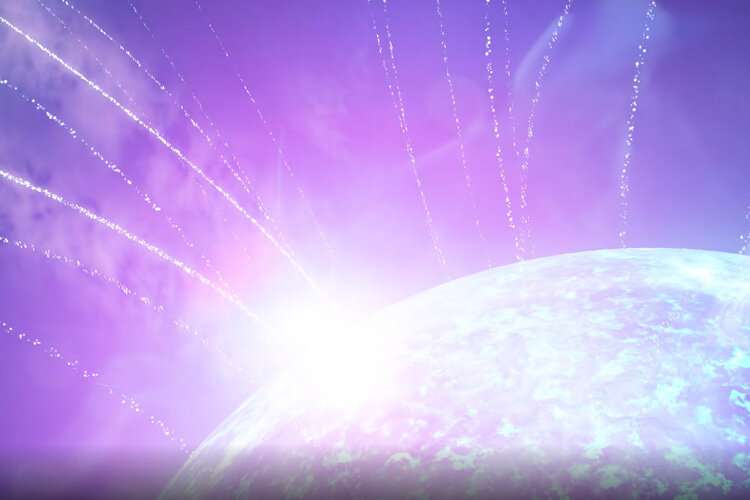
An artist’s depiction of a hiccup in the magnetic field of a magnetar — a highly magnetized neutron star — that produces a powerful gamma ray burst visible from across the galaxy. UC Berkeley physicists have found an unusual pattern to these bursts that could help pin down the precise mechanism triggering the hiccups and generating the soft gamma bursts. Credit: NASA’s Goddard Space Flight Center/Chris Smith, USRA/GESTAR

Magnetars are bizarre objects—massive, spinning neutron stars with magnetic fields among the most powerful known, capable of shooting off brief bursts of radio waves so bright they're visible across the universe.

A team of astrophysicists has now found another peculiarity of magnetars: They can emit bursts of low energy gamma rays in a pattern never before seen in any other .

It's unclear why this should be, but magnetars themselves are poorly understood, with dozens of theories about how they produce radio and gamma ray bursts. The recognition of this unusual pattern of gamma ray activity could help theorists figure out the mechanisms involved.

"Magnetars, which are connected with  and soft gamma repeaters, have something periodic going on, on top of randomness," said astrophysicist Bruce Grossan, an astrophysicist at the University of California, Berkeley's Space Sciences Laboratory (SSL). "This is another mystery on top of the mystery of how the bursts are produced."

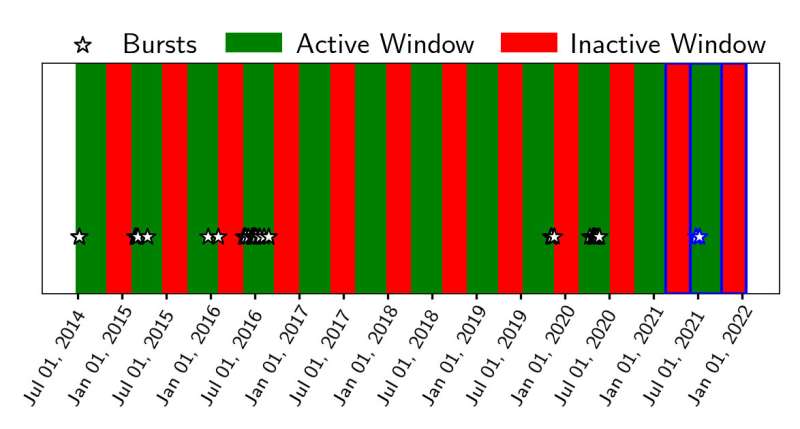
The researchers—Grossan and theoretical physicist and cosmologist Eric Linder from SSL and the Berkeley Center for Cosmological Physics and postdoctoral fellow Mikhail Denissenya from Nazarbayev University in Kazakhstan—discovered the pattern last year in bursts from a soft gamma repeater, SGR1935+2154, that is a magnetar, a prolific source of soft or lower energy gamma ray bursts and the only known source of fast radio bursts within our Milky Way galaxy. They found that the object emits bursts randomly, but only within regular four-month windows of time, each active window separated by three months of inactivity.

On March 19, the team uploaded a preprint claiming "periodic windowed behavior" in soft gamma bursts from SGR1935+2154 and predicted that these bursts would start up again after June 1—following a three month hiatus—and could occur throughout a four-month window ending Oct. 7.

On June 24, three weeks into the window of activity, the first new burst from SGR1935+2154 was observed after the predicted three month gap, and nearly a dozen more bursts have been observed since, including one on July 6, the day the paper was published online in the journal Physical Review D.

"These new bursts within this window means that our prediction is dead on," said Grossan, who studies high energy astronomical transients. "Probably more important is that no bursts were detected between the windows since we first published our preprint."

Linder likens the non-detection of bursts in three-month windows to a key clue—the "curious incident" that a guard dog did not bark in the nighttime—that allowed Sherlock Holmes to solve a murder in the short story "The Adventure of Silver Blaze".

"Missing or occasional data is a nightmare for any scientist," noted Denissenya, the first author of the paper and a member of the Energetic Cosmos Laboratory at Nazarbayev University that was founded several years ago by Grossan, Linder and UC Berkeley cosmologist and Nobel laureate George Smoot. "In our case, it was crucial to realize that missing bursts or no bursts at all carry information."

The confirmation of their prediction startled and thrilled the researchers, who think this may be a novel example of a phenomenon—periodic windowed behavior—that could characterize emissions from other astronomical objects.

Galactic gamma ray bursts predicted last year show up on schedule
Since 2014, a magnetar in our galaxy (SGR1935+2154) has been emitting bursts of soft gamma rays (black stars). UC Berkeley scientists concluded that they occurred only within certain windows of time (green stripes) but were somehow blocked during intervening windows (red). They used this pattern to predict renewed bursts starting after June 1, 2021 (stripes outlined in blue at right), and since June 24, more than a dozen have been detected (blue stars): right on schedule. Credit: Mikhail Denissenya

Mining data from 27-year-old satellite

Within the last year, researchers suggested that the emission of fast radio bursts—which typically last a few thousandths of a second—from distant galaxies might be clustered in a periodic windowed pattern. But the data were intermittent, and the statistical and computational tools to firmly establish such a claim with sparse data were not well developed.

Grossan convinced Linder to explore whether advanced techniques and tools could be used to demonstrate that periodically windowed—but random, as well, within an activity window—behavior was present in the soft  data of the SGR1935+2154 magnetar. The Konus instrument aboard the WIND spacecraft, launched in 1994, has recorded soft gamma ray bursts from that object—which also exhibits fast radio bursts—since 2014 and likely never missed a bright one.

Linder, a member of the Supernova Cosmology Project based at Lawrence Berkeley National Laboratory, had used advanced statistical techniques to study the clustering in space of galaxies in the universe, and he and Denissenya adapted these techniques to analyze the clustering of bursts in time. Their analysis, the first to use such techniques for repeated events, showed an unusual windowed periodicity distinct from the very precise repetition produced by bodies rotating or in orbit, which most astronomers think of when they think of periodic behavior.

"So far, we have observed bursts over 10 windowed periods since 2014, and the probability is 3 in 10,000 that while we think it is periodic windowed, it is actually random," he said, meaning there's a 99.97% chance they're right. He noted that a Monte Carlo simulation indicated that the chance they're seeing a pattern that isn't really there is likely well under 1 in a billion.

The recent observation of five bursts within their predicted window, seen by WIND and other spacecraft monitoring gamma ray bursts, adds to their confidence. However, a single future burst observed outside the window would disprove the whole theory, or cause them to redo their analysis completely.

"The most intriguing and fun part for me was to make predictions that could be tested in the sky. We then ran simulations against real and random patterns and found it really did tell us about the bursts," Denissenya said.

As for what causes this pattern, Grossan and Linder can only guess. Soft gamma ray bursts from magnetars are thought to involve starquakes, perhaps triggered by interactions between the neutron star's crust and its intense magnetic field. Magnetars rotate once every few seconds, and if the rotation is accompanied by a precession—a wobble in the rotation—that might make the source of burst emission point to Earth only within a certain window. Another possibility, Grossan said, is that a dense, rotating cloud of obscuring material surrounds the magnetar but has a hole that only periodically allows bursts to come out and reach Earth.

"At this stage of our knowledge of these sources, we can't really say which it is," Grossan said. "This is a rich phenomenon that will likely be studied for some time."

Linder agrees and points out that the advances were made by the cross-pollination of techniques from high energy astrophysics observations and theoretical cosmology.

"UC Berkeley is a great place where diverse scientists can come together," he said. "They will continue to watch and learn and even 'listen' with their instruments for more dogs in the night."


Explore further

X-ray and radio bursts detected from magnetar 1E 1547.0–5408

More information: Mikhail Denissenya et al, Distinguishing time clustering of astrophysical bursts, Physical Review D (2021). DOI: 10.1103/PhysRevD.104.023007
Journal information: Physical Review D 


When You're Hacked or Under Attack, Here's the Help You Can Expect: None

Internet service providers, crypto currency exchanges, and the police should want to help when you've been hacked.

When You're Hacked or Under Attack, Here's the Help You Can Expect: None
Marcia Wendorf

In early July, a group of hackers known as REvil targeted Kaseya Ltd. in a widespread ransomware attack. Kaseya's VSA software is used by many companies to provide computer management services – resulting in an easy gateway to even more potential victims. 

REvil claims to have infected a total of 1 million computers, but many cybersecurity experts believe that's a vast overestimate, citing the number closer to 40,000 computers worldwide. Those computers are tied to organizations including a large New Jersey educational services company, an outpatient surgical center in South Carolina, and one of Sweden's largest grocery chains, Coop. 

This supply-chain attack is being called the largest and most significant in history, and the hackers are demanding a $70 million Bitcoin payment as ransom. While the ransom has reportedly not been paid, Kaseya's customers are on the slow road to recovery – thanks in part to swift responses from the FBI, President Joe Biden, and CISA


It's evident that, when an attack or hack occurs, large companies and utilities have significant support. But, around the world, individuals are fighting their own personal wars against hackers and other forms of corruption. Often, they aren't offered the same resources. This is the story of one of those victims.

Over the same weekend, Kaseya was hacked, George* was facing his own cyber attack – and finding it almost impossible to get help. 

The first attack 

Things started going wrong long before the July 4th holiday weekend.

On April 25, 2021, George* checked his bank balance and noticed a pending withdrawal in the amount of $700 payable to the cryptocurrency and money exchange site Uphold. George logged into his Uphold account and found that someone had purchased the cryptocurrencies Dogecoin and Ethereum with the money.

George called his bank and had them place a cancel order on the $700 transaction. He then sent a customer support ticket to Uphold, asking them to stop the transaction and letting them know that his account on their site, and possibly the accounts of others, had been compromised.

Additionally, George filed a complaint with the FBI's cybersecurity reporting site ic3.gov and thought no more of the matter. 

The second attack

On July 2, 2021, George received an email from the cryptocurrency exchange site Bittrex, informing him that someone had recently logged into his account. George hadn't been on Bittrex in a while; however, when he logged in, he saw that someone had sold all of the Bitcoin he held on the site and converted it into the cryptocurrency Tether. That person had then transferred the cryptocurrency to an address outside of Bittrex, making it unrecoverable.

Hacker's Bitrex login
Hacker's Bittrex login Source: Marcia Wendorf

The third attack

The day after the theft on Bitrex, George logged into Facebook and found that a page he had set up for a potential new business had been commandeered, and now displayed text written in the Cyrillic alphabet. George was so alarmed by this that he deleted the page – so unfortunately we can't show you what it looked like.

Even more incredibly, whoever had commandeered George's page was attempting to set up a Facebook ads campaign. Fortunately, Facebook had noticed something amiss and had balked at the attempt. The hacker then responded via email, stating that he had provided all the necessary documentation.  George immediately changed his Facebook password, and he set up two-factor authentication on the site.

How did this happen?

Like many of us, George uses his email address and the same password on multiple sites. For example:
Username: george@examplecompany.com
Password: Fred (the name of George's first dog).

If one of those sites gets hacked, or the user is a victim of phishing, then hackers the world over have that combination of username and password, which they are free to try out on multiple other sites. To see if your information has been compromised, you can go to a site such as Have I Been Pwned?  

Here are just some of the data breaches that might have exposed George's email and password combination:

Data breaches at George's sites
Data breaches at George's sites. Source: Have I Been Pwned?

While the amount that was stolen from Bitrex wasn't large, George states that he felt like someone had come into his home and stolen from him. He immediately began checking the logins on all his accounts, especially those that involved documents or money.

That's when he says he found that his OneDrive cloud storage account had been accessed from the same IP address that had accessed Bittrex. Microsoft OneDrive is a file hosting and synchronization service that is operated by Microsoft as part of its web version of Office, and it is ubiquitous on Windows devices.

George's OneDrive account contained files that included many of his passwords, banking information, and tax returns.

Tracing Vlad's IP address
Tracing Hacker's IP address. Source: Marcia Wendorf

George was able to see the Internet Protocol (IP) address from which the hacker was operating, and he traced it to the internet service provider (ISP) Midcontinent Communications, which is based in Sioux Falls, South Dakota. 

Of course, tracing the IP address doesn't mean that the hacker is physically located somewhere near Topeka, Kansas, he could be using a Virtual Private Network (VPN) and be located anywhere in the world. He could also have taken over a legitimate user's computer, making it a "zombie," and be using it to launch his attacks.

Midcontinent Communications
Midcontinent Communications. Source: Marcia Wendorf

On July 5, 2021, on George's behalf, we contacted Midcontinent Communications through their online chat forum, where we were able to interact with a representative. 

Interesting Engineering: I have a security issue coming from Midco, before I report it to the Sioux Falls police and the FBI, I wanted to talk to someone at your company.

Roz (Midcontinent Communications): Hi, this is Roz with Midco! That's definitely not good that you're having security issues with us. I can absolutely do my best to help, may I know who I'm speaking with?

IE: [George's] computer was hacked starting in June from an IP address traceable to Midco. Just three days ago, [George] experienced the hacker stealing money out of one of [his] accounts. I have screen grabs of the hacker's activity.

R(MC): That's awful! I'm sorry to hear that you're being targeted like this. In this situation, the best thing to do is to file a police report, as we're not allowed to divulge information about other people's IP addresses unless it's to the police for an open case. Once we've been contacted by the police about the situation, we'll be able to take action from there.

IE: Roz, are you telling me that Midco doesn't have a Security Division that deals with this sort of thing?

R(MC): We absolutely have a security division, but it's policy to only accept information requests and take action based on police reports, as people have tried to commit fraudulent activity about such things in the past.

However, when the Sioux City Police Department was contacted, they stated that they don't handle cybercrimes and that George's only recourse was to file a report on the FBI's ic3.gov website.

This raised an obvious question: If the Sioux City Police Department doesn't handle cybercrimes, how exactly is a police report to be filed so that Midcontinent Communications can begin to examine the alleged hacker's behavior?

Another question is: How many other of Midcontinent's accounts have been hacked?

Who is responsible?

For this article, we attempted to reach Midcontinent Communications for comment but were unable to reach anyone via phone after the initial online chat. Their virtual assistant feature provided the following:

Midco: Hi, I'm Midco's virtual assistant. I'm here to help! I'd like to get to know you better. What’s your first name?

Interesting Engineering: I chatted with Roz on July 5, 2021. I'm a journalist with Interesting Engineering. We have a story coming out tomorrow in which we mention Midco, and I'm reaching out to someone at Midco for comment.

M: Are you currently a Midco customer? Select one:

IE: No

M: Got it! Are you inquiring about services at your home or business? Select one:

IE: Neither.

M: Sorry. I didn't quite understand. (I'm still learning. 😃) What would you like to do?

IE: I would like to speak to someone.

M: Got it. Let’s get you to the next available expert. 😀

No one responded from that point on, confirming that some companies make it extremely difficult to speak to one of their human representatives. If companies, such as Midcontinent Communications, make it impossible to report hacking coming from one of the IP addresses they administer, that leaves everyone in jeopardy.

If local police departments fail to take a police report, or even an informational report, much less follow up on cases of theft by identify theft, more people will lose more money. We reached out to the Sioux Falls Police Department for comment on this article, and we spoke to the Front Desk Information Officer. When asked if he had any comment, he said, "No", then he refused to provide either his name or his badge number.

What you can do

While George reached out to us, he is certainly not the only one who is experiencing personal hacks and cyber attacks. According to Have I Been Pwned? 11,417,410,545 accounts have been compromised. Further, a Clark School study at the University of Maryland hacks occur every 39 seconds on average, affecting one in three Americans annually.

If you believe any of your accounts have been compromised, it's best to change your passwords, alert your banks, and be sure you've set up two-factor authentication. Proactively, learn how to spot a phishing attack, get a password manager, and scan your devices for viruses. 

We're all vulnerable to cyber attacks – just like George. His story is unfortunately far from unique. More than ever, we need to look out for ourselves to avoid a similar fate. Especially if we can't get the help we need.

*Names have been changed to protect the identities of the individuals in this story. 

A Small 'Wobble' in the Moon's Orbit Could Fuel Rapid Flooding in the 2030s

And we'd better start planning now, before it's too late.

By Brad Bergan
Jul 12, 202

Honolulu flooded from high tides.Hawaii Sea Grant King Tides Project

It can always get worse.

And in recent years, we've seen climate change increase the number and strength of hurricanes, in addition to other seriously damaging weather events globally. But something else, more gradual yet still worrying is on the horizon, and it could change the shape of life on the coasts of the U.S.

Combined with rising sea levels due to global warming, the moon's lunar cycle will amplify low and high tides in the late 2030s, which could lead to serious coastal flooding throughout the U.S., according to a recent study published in the journal Nature Climate Change.

And we'd better start planning now, before it's too late.

Sea levels may rise 12 ft higher than 2000 levels by 2100


In coastal areas, high-tide floods (also termed "nuisance floods"), happen once the tides rise roughly 2 ft (0.6 m) higher than the daily average for high tides, which leads to flooding in streets, or through storm drains. These floods are less serious than major catastrophic events we typically associate with major climate events, but they still have a serious effect on societ
In 2019, more than 600 such floods happened in the U.S., but a new study from NASA suggests that nuisance floods will likely grow in frequency by the 2030s, and will involve most of the U.S. coastline inundated with four times the number of high-tide flood days each year for a full decade, or longer. Longer coastal flood seasons will cause serious disruptions to lives and livelihoods, especially if communities don't immediately start planning for the eventuality, warn the researchers of the study. "It's the accumulated effect over time that will have an impact," said Assistant Professor Phil Thompson of the University of Hawaii in a NASA blog post. "If it floods 10 or 15 times a month, a business can't keep operating with its parking lot under water."

"People lose their jobs because they can't get to work," said Thompson. "Seeping cesspools become a public health issue." And there are multiple causes behind this development, the first of which is, predictably, the sea level rise from global climate change. Glacial ice continues to melt at a record rate, dumping colossal volumes of meltwater into the ocean. This has increased average sea levels by roughly 8 to 9 inches (21 to 24 cm) since the year 1880, and roughly a third of that increase happened in the last 25 years. If trends continue, sea levels could rise 1 to 12 ft (0.3 to 2.5 m) higher than where they were in 2000, by 2100. Of course, this in part could change depending on whether humans sufficiently reduce greenhouse gas emissions in the near future.

The moon will amplify high and low tides in the 2030s


However, the moon, too, could play a vital role in the exacerbation of flooding in the 2030s, when its orbit's "wobble", which is due to a change in its relative position to Earth every 18.6 years, could amplify the cycle of high and low tides, making lower tides lower and higher tides higher. As of writing, we're already in a tide-amplifying cycle of the moon, and the next one will happen in the mid-2030s — when worldwide sea levels will already have increased enough for these amplified tides to create a perfect storm of tide-raising forces, where the combined effect of the lunar cycle and climate change-linked sea-level rise would exacerbate high-tide flooding throughout the entire coastline of the United States. In just 14 years, high-tide flooding will shift "from a regional issue to a national issue with a majority of U.S. coastlines being affected," said the study authors.

This is a scary development, but it's important to note that we still have time to minimize the damage from potentially devastating flooding due to the combined effects of lunar cycles and sea-level rise. Perhaps not enough to avoid the rising waters altogether, but planning for it, financially, in terms of infrastructure, where you live, and social support systems (personal or top-down governance) is crucial. And with a little more than a decade to go, most of us can prepare adequately. If we decide to take it seriously.