Monday, February 28, 2022

Data scientist builds a detailed network map of 'The Witcher'
Data scientist builds a detailed network map of the Witcher
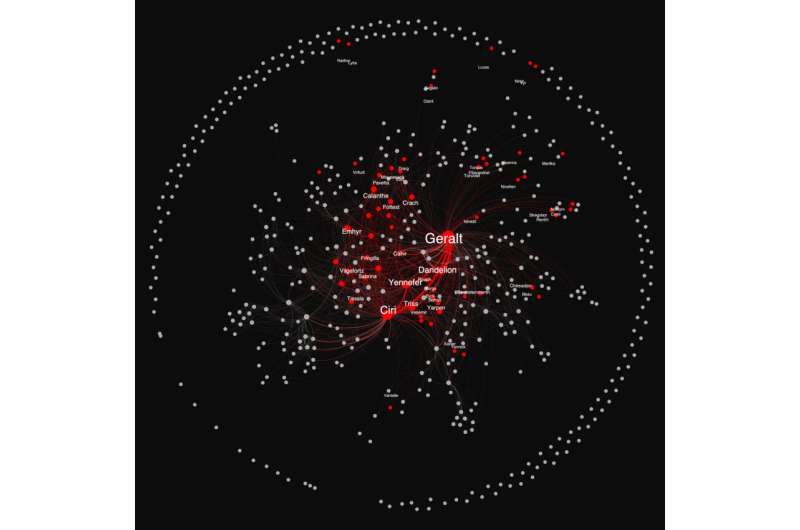
The social map of The Witcher. Characters are represented by nodes, their size
 corresponding to their node degree (the number of connections), and their 
coloring and labeling show those individuals who have already appeared in the
 first season of The Witcher’s Netflix TV adaptation (red) from the rest of the
 characters yet to appear (gray). The network links are proportional to the 
number of times two characters were mentioned within a five-sentence distance
 from each other in the novel. Credit: Milán Janosov.

"The Witcher," a fantasy novel series by Andrzej Sapkowski, has become increasingly popular, following the release of several videogames and a spin-off series by Netflix. The latest season of the show, uploaded on Netflix in December 2021, was watched by users worldwide for 2.2 billion minutes in its debut week alone.

Milán Janosov, lead scientist at Datopolis with a Ph.D. in Network Science from Central European University recently tried to summarize the plot and  relationships in "The Witcher" using . In a paper published on Nightingale, arXiv and ResearchGate, he introduced the first visual  map outlining the hidden patterns, storylines and character relationships in the fantasy series.

"I started reading "'The Witcher' early last year, shortly after I got hooked to the Netflix show, and the storyline just sucked me in," Janosov told TechXplore. "It was a somewhat similar experience to watching 'Game of Thrones' a few years ago, which had also inspired one of my research articles. When I was about to finish watching the new season of Witcher, I started to wonder how I could get more out of this."

Although "The Witcher" videogames are also highly popular and iconic, Janosov was more drawn to the storylines and relationships outlined in the books and Netflix series. On a quest to understand the iconic series' world more in depth, he thus set out to create a social map of 'The Witcher.'"

The first step for his research was to collect data that he could then use to create the network map. He started by looking at the Netflix show's subtitles, but soon realized that he would need more than that and decided to analyze the whole text of the book series, too.

"To build a network, I also needed a complete list of the characters who appeared in the series," Janosov said. "After collecting these initial pieces of information, my job was fairly simple. I wrote a computer program that screened through every single sentence of all the books and took a note every time it matched a character's name into a sentence."

Using his computer program, Janosov derived the mentions for every character in sentences. This allowed him to determine how close or far two characters were, in terms of how often they were mentioned in similar parts of the texts (e.g., whether two characters were mentioned in the same sentence, two sentences apart, and so on).

"As it turns out, these proximities are pretty good indicators of whether two characters have actually met or were featured in the same plots," Janosov said.

Data scientist builds a detailed network map of the WitcherThe social map of The Witcher. Characters are represented by nodes, their size 

corresponding to their degree centrality, and their colors encode the network communities

 to which they belong. The network links are proportional to the number of times two

 characters were mentioned within a five-sentence distance from each other in the novel. 

The most significant 50 individuals are labeled. Credit: Milán Janosov.

After looking at the proximity between character mentions, Janosov defined the elements in his network. More specifically, he decided to represent every character with a node, linking nodes when characters were mentioned in the same "context" or part of the text.

"While context is relatively easy to interpret for humans, for a computer, it is not that simple," Janosov explained. "So to capture the context of the characters mentioned, I assumed that two characters were mentioned in the same context as they were not mentioned further than five sentences from each other. While the number five is somewhat arbitrary, it was chosen for the sake of simplicty (and OCD-friendliness), because three, four or even six sentence-distances lead to very similar results too, also staying consistent for example with the typical paragraph lengths in written text."

Janosov's paper is a valuable example of how network science can be used to reveal hidden patterns in large amounts of unstructured data, such as texts, novels, or movie scripts. After reading books or other texts that are thousands of pages long, humans can get a general idea of how a story is structured. However, they will generally be unable to memorize all the characters and remember all details of the plot.

If they were to draw a map of the story, therefore, this map would most likely be biased. In contrast, network science tools can help to summarize a saga or book series in a quantitive and objective way.

"I was surprised and excited to see the different plots clustered into network communities," Janosov said. "You know that kind of Eureka moment when suddenly everything starts to make sense—who met whom, who is together, where the main conflicts and smaller spin-off plots fold out, etc., almost like in a detective movie. At this point,the skeptic may ask—why would we care so much about a fantasy novel? While the example of 'The Witcher' is certainly fun, it indeed does not seem to bear that crucial practical importance at first."

While the network map of "The Witcher" resulting from this study and other maps that Janosov created in the past are unique and interesting, his work is merely an example of how network science could be implemented in the real-world. In fact, similar data analysis tools could also be used to summarize other networks in the real world.

"In our daily lives, we are surrounded by social networks: our friends on social media, our colleagues at work, friends from school, family, sports and hobbies, and many more," Janosov said. "All these social systems are intertwined by networks of which we almost always only have a partial and subjective understanding. To overcome this lack of knowledge and sparsity of information, network science comes really handy as it provides a set of tools and a framework of thinking that can help us better understand these social networks we participate in daily, just as it helped to clear the fog around 'The Witcher.'"

Network science tools like the ones employed by Janosov could also be applied (or are already in use) in a series of real-world settings. For instance, they could be used by HR specialists to design better work environments or enhance collaboration between co-workers, by scientific organizations to optimize the sharing of research funding across different research groups, or even to analyze and improve international trade and telecommunications.

"As the Academy Awards are coming next month, I am now thinking to revisit my previous research capturing the role of luck in the success of films and music, to see how much luck counts this year," Janosov added.Turning an analysis of Asimov's Foundation into art

More information: A network map of the Witcher. arXiv: 2202.00235 [physics.soc-ph]. arxiv.org/abs/2202.00235nightingaledvs.com/a-network-map-of-the-witcher/

© 2022 Science X Network

Drowned Stone Age fisherman examined with forensic method that could rewrite prehistory

Human bones dating to the Stone Age found in what is now northern Chile are the remains of a fisherman who died by drowning, scientists have discovered.
© Provided by Live Science Archaeologists unearthed the skeleton in a 
coastal area near Chile's Atacama Desert.

Mindy Weisberger 

The man lived about 5,000 years ago, and he was around 35 to 45 years old when he died. Scientists found the skeleton in a mass burial in the coastal region of Copaca near the Atacama Desert, and the grave held four individuals: three adults (two males and one female) and one child.

The man would have been about 5 feet, 3 inches (1.6 meters) tall when alive, and his remains showed signs of degenerative diseases and metabolic stress, researchers reported in the April 2022 issue of the Journal of Archaeological Science. The bones revealed traces of osteoarthritis in his back and both elbows; the back of his skull had evidence of healed injuries from blunt trauma; his teeth and jaws were marred by tartar, periodontal disease and abscesses; and lesions in his eye sockets hinted at an iron deficiency caused by ingesting a parasite found in marine animals, according to the study.

Other marks on the arm and leg bones where muscles were once attached told of repetitive activities related to fishing, such as rowing, harpooning and squatting to harvest shellfish. If the individual was a fisherman, perhaps he died by drowning, the researchers proposed.

When forensic teams examine modern skeletons that were found without any soft tissue attached, experts can confirm drowning as the cause of death by looking inside large bones for delicate microscopic algae, called diatoms, which live in watery habitats and soil. When a person drowns, inhaled water can enter the bloodstream and travel throughout the body after the lungs rupture, even reaching the "closed system" of bone marrow through capillaries, the authors reported. Looking at diatom species in bone marrow can thereby reveal if the person ingested salt water. However, this method had never been used to examine ancient bones.

Algae, sponge spines and parasitic eggs


For the new study, the scientists decided that the modern diatom test was too "chemically aggressive," and in removing bone marrow from samples, it also destroyed small particles and organisms that weren't diatoms. Such particles could be highly significant for analyzing Stone Age bones, according to the study. The researchers therefore adopted "a less aggressive process" that eliminated residual bone marrow in their samples, while preserving a wider range of microscopic material absorbed by the marrow, which could then be detected by scanning electron microscopy (SEM).

Their SEM scans revealed a microorganism jackpot. While there was no marine material clinging to the outside of the bones, the scans showed that the marrow contained plenty of tiny ocean fossils, including algae, parasitic eggs and broken sponge structures called spicules. This variety of marine life deep inside the man's bones suggests that he died by drowning in salt water.

It's possible that the cause of death was a natural disaster, as the geologic record in this coastal region of Chile preserves evidence of powerful tsunamis dating to around 5,000 years ago, the scientists reported. But with ample skeletal evidence that the person was a fisherman, the more likely explanation is that he died during a fishing accident, they said. Damage to the skeleton — missing shoulder joints, cervical vertebrae that were replaced with shells and a broken ribcage — could have happened when waves pummeled the drowned man's body and then washed it ashore, the researchers explained.

As to why the man was buried in a mass grave, "what we can assess from similar contexts is that they probably belonged to the same family group," said lead study author Pedro Andrade, an archaeologist and a professor of anthropology at the University of Concepción in Chile. The individuals likely shared an ancestor but weren't immediate family members, as the dates of the skeletons spanned about 100 years, Andrade told Live Science in an email.

By expanding the range of the modern diatom test to include a broader selection of microscopic marine life in their search through the interior cavities of prehistoric bones, "we've cracked open a whole new way to do things," study co-author James Goff, a visiting professor in the School of Ocean and Earth Science at the University of Southampton in the United Kingdom, said in a statement.

"This can help us understand much more about how tough it was living by the coast in prehistoric days — and how people there were affected by catastrophic events, just as we are today," Goff said.

Applying this method across other archaeological sites in coastal areas with mass graves could offer game-changing insight into how ancient people survived — and often died — while living under potentially perilous conditions, Andrade told Live Science.

While there are many coastal mass burial sites worldwide that have been investigated by scientists, "the fundamental question of what caused so many deaths has not been addressed," Goff added.

Originally published on Live Science.
Dying for makeup: Lead cosmetics poisoned 18th-century European socialites in search of whiter skin


An actor wearing a contemporary version of 18th-century lead-based makeup. (Shutterstock)

THE CONVERSATION
Published: February 27, 2022


Eighteenth-century socialites have been depicted as vain, silly women who were poisoned by their white lead makeup. The Countess of Coventry, Maria Gunning — a society hostess reknowned for her beauty — is said to have refused to stop wearing foundation containing white lead, even as she lay dying. Why would women of that era knowingly choose to wear makeup that was killing them? Was beauty worth dying for? Or was the makeup not to blame?

I am a scientist who has been studying lead poisoning for 30 years, with a particular interest in women’s exposure to lead. My research shows that women metabolize lead differently from men, women exposed to lead as children have elevated blood lead levels 20 years later, and women exposed to lead are at risk of hypertension and early menopause.

The stories about white lead makeup poisoning did not make sense to me, so two years ago, I decided to start studying these cosmetics.
Dying to be Beautiful: Exploring the look and toxicity of 18th century makeup.
Historical techniques

My research group makes white lead makeup from recipes dating from the 16th to 19th centuries. If you look around the makeup counters of a department store, you will see words such as “illuminate,” “radiance,” “glow” and “luminous.” You’ll also see products that promise to reduce shine or blur imperfections. These modern products change the way light is reflected from the skin, which is perceived as enhancing beauty.

Join thousands of Canadians who subscribe to free evidence-based news.Get newsletter

We wanted to know if white lead makeup had some of these properties, so we studied the colour and level of light reflected by the makeup using an optical spectrometer.

Our most surprising finding has been that white lead makeup can look quite pretty and natural. It does not look like the bright white mask that we have seen depicted on screens and stages — it is generally much more subtle and sophisticated.

We test the makeup on ethically sourced pigskin. The pigs we use have a pale complexion that is very close to the lightest colour of human skin, which burns easily and does not tan well. The white lead makeup usually does not change the colour of this skin much at all.
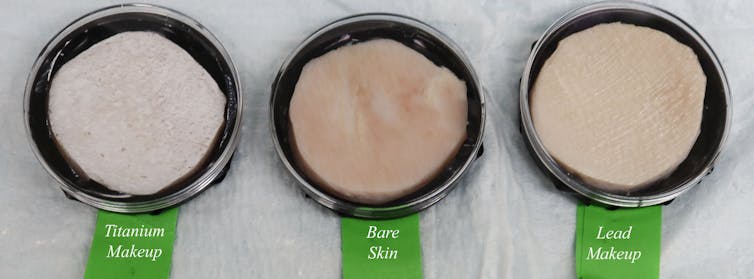
A comparison of bare skin with makeup made with white lead and with titanium dioxide replacing the lead carbonate. Modern recipes that use a titanium replacement look whiter and more opaque than the ‘softer’ yellow-white of lead makeup. (F.E. McNeill), Author provided

Titanium oxide is the modern substitute for white lead. When we used titanium oxide in the makeup recipes, the colour change was dramatic. There was a shift towards blue, and the makeup appeared startlingly white. Actors wearing makeup formulations made from old white lead recipes with a titanium substitute are wearing the wrong colour.
Colour changes

We tested different historical makeup recipes to see how the colour would be affected. One recipe made no measurable change to the colour, while another changed yellow tones slightly. Adding a yellow tone to pale skin is perceived as more attractive, due to its connection to fruit and vegetable consumption. A third makeup mixture reduced redness in the skin, something that today’s colour-correcting foundation makeup attempts to correct.

All the white lead makeups we tested increased the amount of light the skin reflected — referred to as its reflectance. Skin becomes less reflective as women age, and more reflective skin is associated with a youthful complexion.

Specifically, the makeups increased the diffuse reflectance of the skin. Light reflection occurs in two ways. First, light can reflect, as from a mirror. It comes in at an angle and is reflected at that same angle. We call this specular reflection. Objects with a high specular reflection look glossy or shiny.

Second, light can reflect or scatter off rough surfaces in several directions. This is diffuse reflection. Objects with high diffuse reflection look blurred or slightly out-of-focus. The increased diffuse reflectance from the white lead makeup gives the skin a “softer” appearance, blurring blemishes — another effect produced by modern cosmetics.

The recipes we re-create in our lab create a soft-focus look that blurs wrinkles and blemishes, or the look of a youthful, dewy complexion.
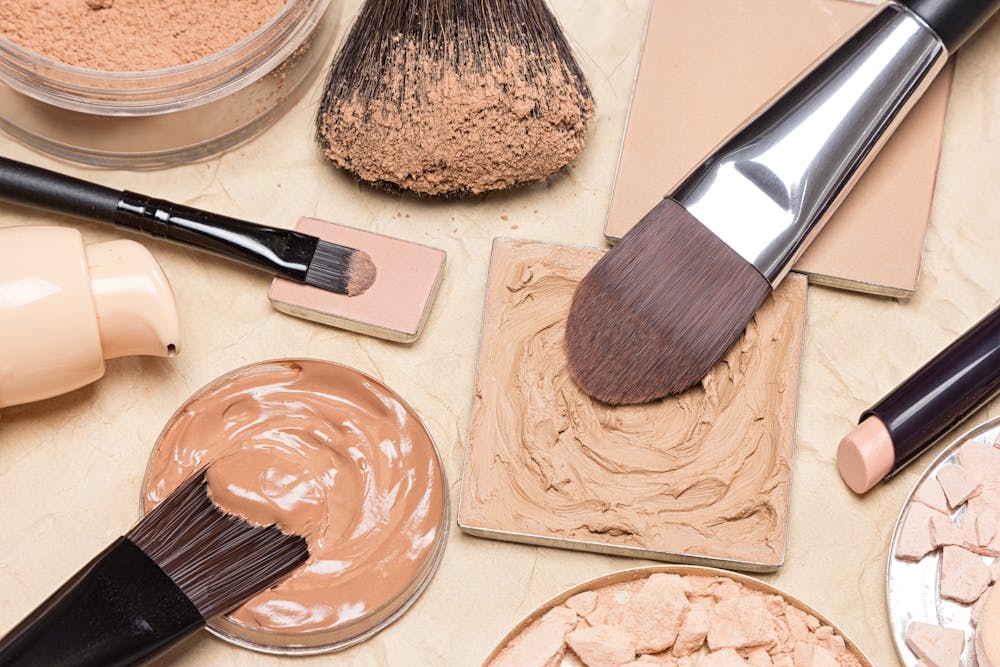
Modern makeup promotes even skin tone and a glow, achieved by altering the skin’s reflectance. (Shutterstock)

The ugly price of beauty


However, prettiness does come with an ugly side: the celebration of white skin. While the overall measured colour shifts on pale skin are small, spectral changes do make the skin look lighter. These were products that would have enhanced the whiteness of skin.

Historians, anthropologists and sociologists have long studied skin whitening and the reasons people may choose to do this. Our science shows how white lead makeup could achieve this in a subtle way, like an earlier version of “no-makeup” makeup.

We have also been testing whether some makeup formulations allow lead to be absorbed through the skin. White lead cannot be absorbed easily through skin, it is only toxic if eaten or inhaled. However, if the makeup formulations changed the form of the lead, or softened the outer layer of the skin, some lead could diffuse through. This would make those makeup formulations more poisonous.

Our research is showing some evidence of differences in skin absorbance, meaning some recipes were more toxic than others. It is possible that some recipes could have been used with little problem. Other recipes, which made young women deathly ill, were probably so poisonous because the lead was absorbed through the skin.

So far, our research suggests that most white lead makeup recipes probably didn’t kill 18th century socialites by being absorbed through the skin. But some recipes were more toxic than others.

The most toxic mixture we have observed so far is the very simple formulation said to have been used by England’s Queen Elizabeth I: a mixture of white lead and vinegar. This mixture passed lead through the skin in much higher quantities than other recipes. This raises the question of whether it is worth revisiting whether some of Elizabeth I’s health problems were due to, or exacerbated by, lead poisoning.

Author
Fiona E. McNeill
Professor, Physics and Astronomy, McMaster University
Disclosure statement
Fiona E. McNeill receives funding from the Natural Sciences and Engineering Research Council of Canada.


Organ transplants from pigs: Medical miracle or pandemic in the making?

The Conversation
February 27, 2022

Funny pigs in sty leaning on wall (Shutterstock)

Three out of four new diseases are zoonotic, meaning they have evolved to infect new host species. For example, a mutated bird-flu virus may jump from wild birds to free-range domestic poultry and then to humans who are in contact with poultry. Similar pathways have led to infection by the pathogens that cause Ebola, Zika, HIV, Lyme disease and likely COVID-19.

If a new medical technology increased the risk of a new zoonotic pandemic — however marginally — how would society decide the balance of risk and benefit? If you needed new lungs that were only available in another country, would a health prohibition on the transplant in your own country stop you?

New developments in organ transplant technology may have streamlined a pathway for new zoonotic diseases, but the biotechnology innovators and medical research institutes have not engaged the public on the risks. Failing to do so may jeopardize the potential of a promising therapy.

Xenotransplantation


Over 4,400 Canadians are waitlisted for the lifesaving transplant of a new kidney, liver or lung. In 2019, 250 died waiting. In the United States and elsewhere, the supply gap is more extreme and high hopes ride on xenotransplantation: the transplanting of cells, tissues or organs from animals.

Pre-clinical trials of organ transplants from pigs have addressed the technical barriers to xenotransplantation, reducing the likelihood of rejection. Last summer, Maryland School of Medicine surgeons reported the 31-day survival of a baboon after receiving a lung from a genetically modified pig.

Weeks later, a team at New York University transplanted a kidney from a genetically modified pig into a brain-dead person. In December 2021, surgeons at Maryland School of Medicine transplanted a genetically modified pig heart into a living 57-year-old man.

All projects were approved under U.S. Food and Drug Administration (FDA) regulations, and corporate funding was supplemented by the U.S. National Institutes of Health. The next step with the FDA is to approve clinical trials. Normalization of xenotransplantation could happen before there is informed public acceptance of the benefits and risks.
A potential zoonotic pathway

As a developmental geneticist, it has been exciting to track these advances. The revolution in designer gene editing (known as CRISPR-Cas9) makes this stunning progress possible. CRISPR allows molecules on the surface of pig cells to be modified so the human immune system will not trigger tissue rejection.


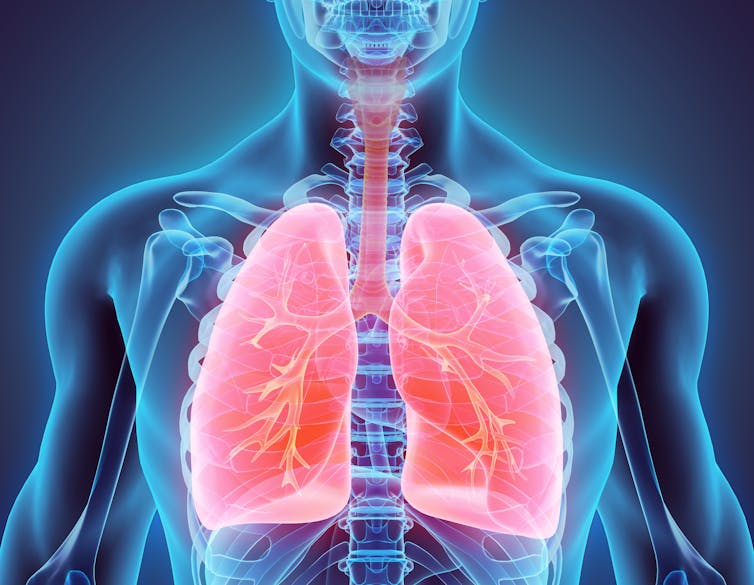
Zoonotic bacteria and viruses enter most readily through the delicate surfaces of the respiratory tract.
(Shutterstock)

To prevent human transplant recipients from being infected with pig retroviruses (viruses that can integrate their genetic material into the host’s cells), the retroviruses hiding in the pig genome have been removed by CRISPR editing. The risk of transferring a disease directly from a genetically modified donor pig to the human host is negligible.

However, disease-free transplanted pig organs could become infected after transplantation. Zoonotic bacteria and viruses enter hosts most readily through the delicate surfaces of the respiratory tract, as with COVID-19. Living pig cells in a transplanted lung could readily be infected by an inhaled pig virus, including a novel virus from a wild animal host that has evolved to infect pigs.

After entering the human body, a replicating zoonotic virus could generate millions of mutations a day, because their mechanism for gene copying is naturally error prone. A pig virus replicating in a lung transplanted into a human could produce variants that may be capable of recognizing and infecting human cells. Although likely a rare event, it is not impossible that this could trigger a new zoonotic pandemic.

Risk, fear and polarization

The scenario described above could evoke risk and fear from a complex new medical technology. It parallels the thinking involved in vaccine hesitancy or the distrust of genetically modified foods. Both are well anchored in today’s political culture. In both cases, citizens increasingly demand prior consent and the choice to opt out — despite possible risks to public health. Vaccine hesitancy has increased the death toll from COVID-19 and delayed economic recovery from the pandemic.

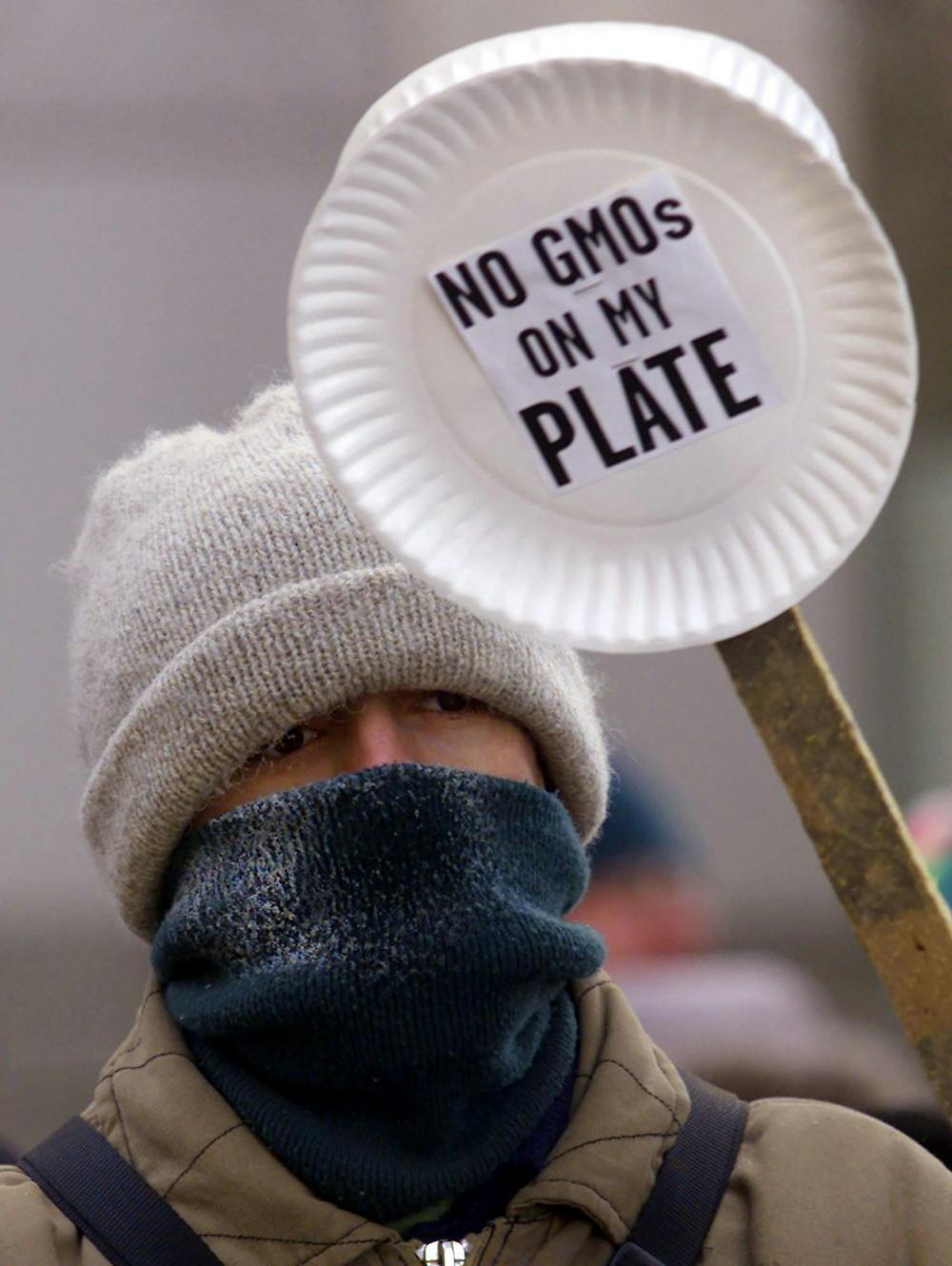
In contrast, distrust of the industrialization of food has discouraged introduction of genetically modified foods that enhance nutrition or sustain agricultural productivity in a warming climate. Consumers question whether genetically modified organisms (GMOs) exist for public benefit or for corporate profit.


GMO IS OMG BACKWARDS


Distrust of the industrialization of food has discouraged introduction of GMO foods.
(CP PHOTO/Paul Chiasson)

Increasingly, health issues such as vaccination, vaping or genetic testing generate highly polarized platforms for misinformation, debate and political leverage. Social media algorithms amplify extreme positions and elicit strong emotional reactions at the expense of the middle ground. When communications from the scientific community are reactive, poorly targeted or unintelligible to the average person, the influence of science in the policy process is diminished.

In 2022, progress in xenotransplant technology makes good news stories. Immense pressure to resolve the growing organ shortage for transplantation may tempt the biotechnology business and public regulators to be insufficiently critical as they seek permission to proceed with clinical studies. They must prepare for the nature and scale of backlash from those tired of experts and mistrustful of corporate motivation and institutional authority.

Concern about zoonosis from transplants was voiced over twenty years ago, long before CRISPR transformed the field. Since then, there appear to be no hard facts or even a call for research on zoonotic infection through xenotransplants after transplantation. Bioethicists are flagging the issue now, but the silence about xenotransplant zoonosis from biotechnology corporations and their affiliated preclinical research institutes leaves an open door to a narrative motivated by skepticism and distrust. It is incumbent on them to lead a public dialogue on managing the risk of novel zoonotic diseases arising from infection after transplantation.

J Roger Jacobs, Professor, Department of Biology, McMaster University


This article is republished from The Conversation under a Creative Commons license. Read the original article.


BATTLE OF THE BULGE REDUX
Georgian oil tanker refuses to refuel Russian ship: 'You have oars — row'

Sarah K. Burris
February 27, 2022


Voice Of America reporter Fatima Tils posted a video showing a Georgian oil tanker refusing to help refuel Russian ships.

According to the video, the Russian ship asked to be refueled, begging, "Come on, let's leave politics aside." The Georgian ship refused, echoing the military message from those who refused to surrender to Russia on Snake Island.

The first few days of the Russian military strikes, the Russian military told the soldiers over an announcement to surrender. The Ukrainian military members replied, "Go f*ck yourself."

The sentiment was echoed this weekend from the Georgians as well. "Russian ship, go f*ck yourself. Glory to Ukraine!"

They went on to tell the Russian ship that they have oars and could row their ship instead.

The Wall Street Journal reported Sunday morning that Russia was forced to send three massive natural gas tanker ships near a Kaliningrad outpost that was behind NATO lines so they could refuel.


"It is an apparent move to maintain fuel supplies to the tiny militarized region in case conflict severs pipeline flows," the report explained.

See the video of the ship's communication below:


Hackers say they changed the call sign for Putin's yacht with a special message to him
RAW STORY
February 27, 2022

Vladimir Putin's yacht, Graceful, appears to have a different call sign on a few yacht tracking websites.

As Russian oligarch yachts are being tracked around the world, Putin's luxury boat typically has the call sign UBGV8, according to FleetMon.


But on another website, MarineTraffic, Bloomberg reporter Ryan Gallagher and Good Pillow CEO William LeGate noticed that someone changed the call sign to FCKPTN and its current maritime position is "Hell."

Gallagher tweeted that it was an offshoot group from the hackers Anonymous known as The Anon Leaks,

They "told me they did it by manipulating the maritime 'Automatic Identification System,' which is used to track ship locations," he tweeted. "They said they wanted to put the yacht in the scope of sanction packages as well as 'put a little smile on some faces for a short period in these dark times.'"

The website VesselTracker lists the call sign as ANONYMO.

The yacht left Germany in early February after there were warnings of sanctions.


‘Absolutely hammered’: Watch this shocking video of an annihilated Russian armored convoy

Bob Brigham
February 28, 2022

www.youtube.com

CNN senior international correspondent Matthew Chance aired an amazing video on Monday of a Russian armored convoy that had been annihilated during Vladimir Putin's invasion of Ukraine.

"Right within the past few hours there has been a ferocious battle here on the outskirts of Kyiv," he reported. "And this is one of those Russian, Soviet-era vehicles, which is completely burned out."

"You can see this is a bridge actually. There's an access point to the northwest of Kyiv, the Ukrainian capital and the Russian column that has come down here has been absolutely hammered," he reported.

He reported Ukrainian commanders said they had been using western anti-tank missiles to attack Russian troops.

"Obviously we're still in a very exposed situation right now. There is debris everywhere, the twisted metal of these vehicles. This is obviously just a truck carrying supplies. We saw the armored vehicle in front there. I mean, looking around -- look at this what kind of munitions does it take to do that to a car, to a vehicle? You know, I know that I've been speaking to the local Ukrainian commanders here, they've been saying they were using western anti-tank missiles to attack these columns."

"Look, so recent the battle, this vehicle is still smoking," he reported. "There's still smoke coming out of the back of that, ammunition boxes on the ground," he reported. "A real scene of devastation along this bridge."

Watch:
Ukrainian LGBTQ activists worry 'Russia will kill them' if Putin is victorious

Matthew Chapman
February 28, 2022

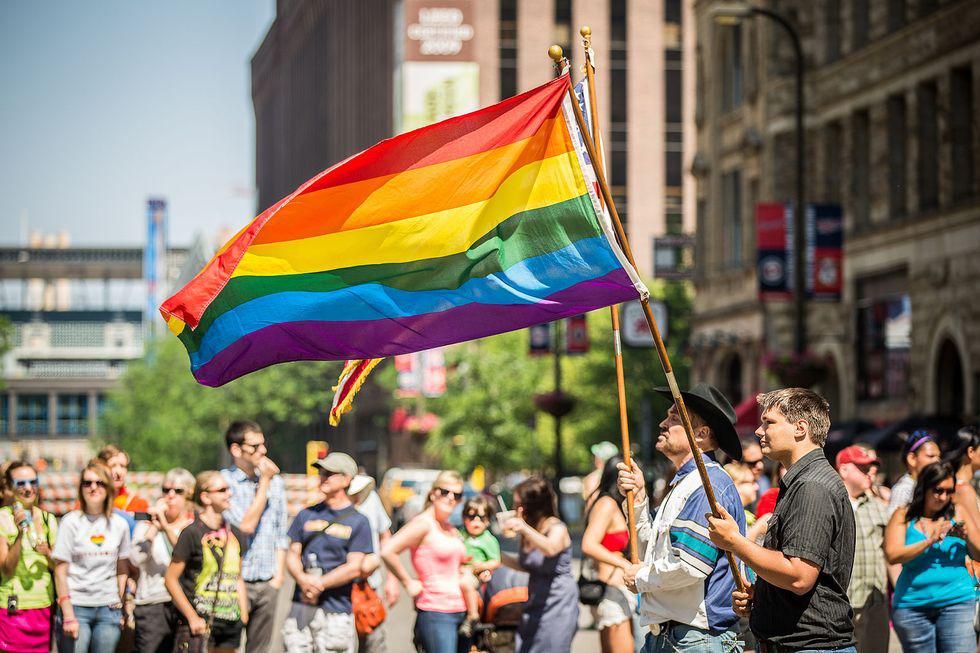
LGBTQ advocates wave a rainbow flag (Wikimedia Commons)

On Monday, writing for Newsweek, Alex Rouhandeh broke down one of the lesser-discussed potential consequences of Russia toppling the government of Ukraine: a new era of repression for LGBTQ communities in Eastern Europe.

"Although not an international leader in the advancement of LGBTQ+ rights, Ukraine has taken significant steps over the past decade to better the lives of its queer citizens. In 2015 it implemented anti-discrimination employment laws, and in 2016 it began allowing gay and bisexual men to donate blood, all part of an effort to become a more equitable state," wrote Rouhandeh. "In contrast, Russia has moved in the opposite direction. In 2013, it banned same-sex couples from adopting Russian children, and in 2020 it outlawed same-sex marriage. The Kremlin has also cracked down on the ability of LGBTQ+ activists to organize, and has permitted law enforcement in the Chechnya region to carry out violent campaigns against the community."

Experts in the region fear things could get much worse if Russia is successful in seizing Ukraine and installing a puppet state.

"Bogdan Globa, who heads the nonprofit LGBTQ Ukrainians in America, fears the individuals who've spent years fighting for these advancements could become Putin's first targets," said the report. "'LGBT activists usually are the same people who care about human rights,' Globa told Newsweek. 'They are people who work locally but travel internationally to speak with media.'" He added: "Russia will kill them. Because after they will take over Ukraine, they will need to install their puppet government to control territory, and human rights activists are the people who prevent that control."

Putin's harsh treatment of queer communities has caught the attention of the American Right — some of whom have actually cited this as an argument for why we should switch sides to support Russia in the war. Former Trump adviser Steve Bannon, for instance, said on his War Room show that Russia deserves U.S. support because it is "anti-woke" and "doesn't have Pride flags."


Dee Snider dissects twisted logic of anti-maskers vs. sovereignty defenders in Ukraine for use of ‘We’re Not Gonna Take It’

2022/2/28 
© New York Daily News
Ukrainian servicemen get ready to repel an attack in Ukraine's Lugansk region on Feb. 24, 2022. - Anatolii Stepanov/AFP/Getty Images North America/TNS

Twisted Sister’s Dee Snider is busy untangling the logic employed by people who don’t understand why the rock band’s iconic hit “We’re Not Gonna Take It” would be sanctioned for use by the Ukrainian resistance as they fight off Russian aggression and not for use by anti-maskers.

“People are asking me why I endorsed the use of ‘We’re Not Gonna Take It’ for the Ukrainian people and did not for the anti-maskers,” Snider said in a tweet, after endorsing the song’s use as a rallying cry in the face of the unprovoked invasion. “Well, one use is for a righteous battle against oppression; the other is an infantile feet stomping against an inconvenience.”

In September 2020, the heavy metal band frontman blasted anti-maskers for appropriating his 1984 hit song after a flash mob descended on a Target store in Fort Lauderdale, Florida.

“No, these selfish a— do not have my permission or blessing to use my song for their moronic cause,” he tweeted at the time.

Flash forward to 2022, when Russia’s President Vladimir Putin started bombarding a defiant Ukraine, whose citizens have been fighting in the streets. In doing so, Snider invoked his own heritage.

“I absolutely approve of Ukrainians using ‘We’re Not Gonna Take It’ as their battle cry,” he said on Twitter. “My grandfather was Ukrainian, before it was swallowed up by the USSR after WW2. This can’t happen to these people again! F— Russia.”


Canadian parliament member calls out Lauren Boebert for calling on US to invade Canada

Sarah K. Burris
February 27, 2022

Lauren Boebert (Screen Grab)

Rep. Lauren Boebert (R-CO) spoke to Fox while at CPAC on Sunday and claimed that the United States has no business being involved in the invasion of Ukraine. Instead, she believes that the U.S. should move into Canada and "liberate" them.

"But we also have neighbors to the north who need freedom and who need to be liberated and we need that right here at home," she added.

It prompted Canadians to lash out with disapproval, including Canadian officials. MP Anthony Housefather invited Boebert to call him so he could talk to her about what Canada is and believe. Boebert's information about Canada appears to be focused on the so-called "freedom convoy," of anti-vaccine truck drivers


Former US Ambassador to Canada Bruce Heyman similarly spoke out against Boebert, calling her "reckless" and "dangerous." He explained that she "crosses every line of diplomacy and decency.


IT'S BEEN TRIED

Before 'Stop the Steal' there was 'Free, white and over 21'

Yvette Lagonterie, Salon
February 28, 2022

Trump supporters at Stop the Steal rally outside Minnesota State Capitol.
 (Photo credit: Chad Davis)

It was late when we returned to the hotel. We parked the rental cars in the back lot, nearest the entrance that opened to the shortest walk to our block of rooms. A sign posted on that door directed that the rear entrance not be used after 9 p.m. My coworkers were fatigued from a long workday followed by an evening out with drinks. One objected to walking around the building to the front of the hotel. While we all stood in the dark, she exclaimed that we should disregard the sign because, after all, "We are free, White, and over 21." The ease with which the phrase fell from her mouth left no doubt that she had uttered it comfortably many times before. However, on that occasion, her mouth spoke before her mind caught up.

I was the only one who did not fit her description. I was born with a permanent early summer tan and tight curl to my hair. Her declaration of privilege was based on her membership in a group to which I do not belong. Admittedly, after dusk and from a distance, my African ancestry might not be noticed. That was not the case that evening; these colleagues knew me. Everyone grew silent. The offender noticed the change in the group's disposition. Then, as responsible U.S. Department of Justice employees in town on official business, we all walked to the front door.

Thirty years later, the "free, White, and over 21" mentality was well represented among those who stormed the U.S. Capitol on January 6, 2021. After Trump told them "we will stop the steal" a mob broke through the doors of the Capitol Building with a fearlessness stemming from the belief that the rules do not apply to them. Jenna Ryan, who recorded herself participating in the insurrection, paraphrased this slogan when she proclaimed on her Twitter account that she would not go to jail because she is blond and has white skin.

"Free, white, and over 21" sought to overturn an election, to deny the majority of American voters their will. They failed. Their state-level elected adherents are now legislating restrictions calculated to diminish ballot access to minority voters. This is not a new assault on a multi-racial democracy; it is just the latest chapter.

The slogan "Free, white, and 21" was reportedly popularized in the 1820s during the movement to extend the vote to men who were not property owners. Including "white" in their chant was a pledge to white supremacy. In several states, free African American men who met the property requirements had the right to vote during the nation's early years. However, even as the white proletariat was gaining the franchise, it was being stripped from people of color in some of those states — New Jersey in 1807, Maryland in 1810, North Carolina in 1835 and Pennsylvania in 1838.


New York's original state constitution did not prohibit suffrage to free people of color. The Democratic-Republican party was concerned that free Negros overwhelmingly voted for the Federalist party. In 1811, an act to prevent fraud at elections was passed. Section III specified onerous and costly documentation requirements specifically for Negros. Ten years later, in 1821, New York State reduced the property requirement for White males, but increased it for African Americans

The Fifteenth Amendment to the U.S. Constitution, ratified in 1870, prohibited the denial or abridgment of any citizen's right to vote based on race, color or previous condition of servitude. Nevertheless, those who were "free, white, and over 21" in the Southern states quickly established repugnant clauses that did not mention race or servitude, but used other text to precisely deny African Americans their right to vote.

Judicial and legislative initiatives failed to overcome the Southern insistence on preserving white supremacy through voter suppression, fierce segregation and mob violence. The infamous white supremacist, South Carolina Sen. Strom Thurmond, hypocritically argued against federal laws to outlaw discrimination at the polls and elsewhere, saying that it was not the government's place to regulate human behavior. Thurmond knew well that the South was firmly in the business of policing human behavior through thousands of racially oppressive Jim Crow laws.

It took a brilliant organizer, thousands of activists, the martyrdom of too many, and the mettle of one president to finally achieve the Voting Rights Act (VRA) of 1965. The VRA was Dr. Martin Luther King's great legislative accomplishment. Its impact has been monumental. Dr. King famously said that the arc of the moral universe is long, but it bends towards justice. But justice's opponents sometimes manage to twist the arc. We must not let it bend back in the direction of injustice.

"Black Americans vote at the same rate as Americans." When Senate Minority Leader Mitch McConnell made this Freudian slip on January 19, 2022, his mouth may have been speaking before his mind caught up. Who does McConnell view as Americans? Besides, the rising African American voting rate appears to be the "problem" many of Senator McConnell's GOP colleagues across our nation are trying to "solve." That was the finding of the federal appeals court in 2016 when it struck down the North Carolina voter identification law. The court's decision stated that provisions of the North Carolina law deliberately "target African-Americans with almost surgical precision" in order to suppress Black voter turnout.

McConnell's impolitic reasoning was his justification for opposing the John Lewis Voting Rights bill. But his claim is incorrect. According to the Brennan Center for Justice, 62.6% of the Black American electorate voted in 2020, compared to 70.9% of White Americans. The eight percentage point gap is the widest difference between White and Black voter turn-out in a presidential election since 1996. The gap is even wider when the 70.9% White voter turn-out is compared to the 58.4% for all non-white voters (Black, Latino and Asian).

Black voter turnout swelled in 2008 when Barack Obama was elected. A surge of restrictive legislation and electoral changes were introduced by many states in response. The 1965 Voting Rights Act included a formidable provision requiring that electoral changes in states with a history of discouraging African American suffrage be cleared by the U.S. Justice Department (DOJ) before implementation. Shelby County, Alabama, did not want its desired changes subject to clearance, thus sued the U.S. Justice Department. The U.S. Supreme Court's 2013 decision in Shelby County v Holder struck down the 1965 Act's essential preclearance requirement. Following the removal of that DOJ review, the surge became a storm. For example, over 1,000 polling sites have been selectively closed in the states once subject to oversight.

Who deserves to vote? Everyone who is eligible. How should elections be administered? By making it as easy as possible for every eligible citizen who wants a voice in the nation's future to vote. What do you think? Honest and accurate information should be widely available to help each of us make our decisions. What is not democracy is the effort to limit the franchise to only those who agree with you — or look like you.

From the mid-1800s through the 1950s, "Free, white, and over 21" was a catchphrase commonly included in books and movie scripts. In the 20th century, white protagonists frequently claimed these three attributes as the evidence of their freedom to do as they please. In the 1959 apocalyptic film, "The World, the Flesh, and the Devil," Harry Belafonte's character Ralph and Inger Stevens' character Sarah found themselves the last survivors of a nuclear blast. At one point, Sarah declared to Ralph "I am free, white, and over 21." Belafonte's Ralph replied to his new friend that her carefree toss of that expression "was like an arrow in my guts."

Although the phrase has gone underground, the sentiment has not. The discriminatory intent of many recently enacted and proposed state laws and directives is transparent. The right to vote must be protected from those who strive to limit it, again.