Monday, February 28, 2022

T. rex may have had 2 equally terrifying sibling species, new research suggests

Few dinosaurs exude the same mystique as Tyrannosaurus rex, but the tyrant lizard king that once roamed across North America might have been misunderstood.
© Gabbro / Alamy Stock Photo The fossil skeleton of famous "Sue" the T. rex is shown at Chicago's Field Museum. The fossil is named after collector Sue Hendrickson, who discovered it in 1990.

By Katie Hunt, CNN 

A new analysis of the bones and teeth of 37 T. rex specimens suggests that the dinosaur might need to be regrouped into three separate species -- with the fearsome predator that lived 90 million to 66 million years ago potentially getting two sibling species: tyrant lizard queen and tyrant lizard emperor.

The study, published in the journal Evolutionary Biology, said it had long been recognized that the "stoutness" of adult Tyrannosaur skeletons varied considerably. This had been explained by sex differences -- with female T. rex perhaps more petite than their male counterparts. Alternatively, it could be explained by developmental stages, or simply individual variation in traits.

Other differences include its banana-size teeth -- some T. rex jaws have a single D-shaped incisor that is substantially smaller than the next tooth, while others have two of these smaller D-shaped teeth.

The researchers compared the length and circumference of the femur, or thigh bone, of 24 T. rex specimens. They also measured the base of the teeth or space in the jaw to understand if 12 of the dinosaurs had one or two slender incisor teeth. The study team's conclusion was that T. rex was not a single, unchanging dinosaur but may have had two equally terrifying sibling species.

"All three species were 6-7 tonnes with similar skulls and bodies. It would be like the difference between being attacked by a lion or tiger. Not much," said study author Gregory Paul, the author of "The Princeton Field Guide to Dinosaurs."

The differences were "subtle," similar to how "skeletons of lion (Panthera leo) and tiger (Panthera tigris) are hard to tell apart even among experts," he said.

Fossil variation vs. distinct species

However, other paleontologists disagreed with the findings.

"I understand the temptation to divide T. rex into different species, because there is some variation in the fossil bones that we have. But ultimately, to me, this variation is very minor and not indicative of meaningful biological separation of distinct species that can be defined based on clear, explicit, consistent differences," said Steve Brusatte, professor and Personal Chair of Palaeontology and Evolution at the University of Edinburgh's School of Geosciences, via email.

"Dividing T. rex into three species based on measurements from 38 bones just isn't a strong enough case for me."

Thomas Carr, an associate professor of biology and director of the Carthage Institute of Paleontology at Carthage College in Kenosha, Wisconsin, said the features identified by the researchers "represent meaningless variation, not biological signal." A study he conducted on variation in T. rex skeletons published in 2020 did not reveal different species.


'T. rex to me'

The study authors said the more robust Tyrannosaurs in their sample outnumbered the "gracile" or slender ones 2 to 1, and such a large disparity could not be explained by the small sample size, nor could it be a sex-based difference, which would result in a more even split.

The variation in leg bones was also unrelated to developmental stages, they added, because the more robust femurs were found in some juvenile dinosaurs two-thirds the size of an adult, while the slender leg bones were also found in some full adult-size specimens.

When it came to teeth structure, specimens with one incisor tooth were correlated with often having more slender leg bones -- although they only had leg bone measurements for 12 dinosaurs.

While the authors conceded that the data "do not meet the ideal proof" of three separate species, they said their study indicated there were three recognizable "morphotypes" within the Tyrannosaurs they studied.

These were the already famed Tyrannosaurus rex (tyrant lizard king) with robust features and one smaller incisor; another stout dinosaur sporting two incisor teeth, which the researchers called Tyrannosaurus imperator (tyrant lizard emperor), and a third, more slender Tyrannosaur they named Tyrannosaurus regina (tyrant lizard queen).

"The full expectation is that these new taxa will be tested and, if necessary, accordingly revised as additional specimens and analysis come to light," the study said.

Placing animals that went extinct tens of millions of years ago into strictly defined categories is inevitably challenging, but the authors said they hoped their work would frame and focus future research. But Brusatte at the University of Edinburgh said he was unconvinced.

"Fundamentally this comes down to the age-old debate about lumping vs. splitting when classifying species. It's hard to define a species, even for animals today, and these fossils have no genetic evidence that can test whether there were truly separate populations.

"Until I see much stronger evidence, these are all still T. rex to me, and that's what I'll be calling them."
Al Franken Says Trump Re-Election Will Spell End for U.S. Democracy: 'It'll Be a Dictatorship'


Al Franken, the comedian, former U.S. senator and dedicated podcaster, has laid out a dire future for the country while revisiting the topic of Donald Trump as president of the United States.

© Provided by TheWrap al franken


Jeremy Bailey

Franken, speaking on The Al Franken Podcast, broached the topic in trademark form, sarcastically looking back at the Trump administration's early fumbling of the inauguration's crowd size and Trump adviser Kellyanne Conway's references to "alternative facts" — before he looked into the future, which he predicts will be bleak.

"And by the way, when you say kids will look up and see Donald Trump's picture as president, they'll see Donald Trump, then they'll see [Joe] Biden, and then they'll see Donald Trump again," Franken said. "And he'll still be president when these kids are in school.

"Because, that's it. It's over. It'll be a dictatorship. It'll be an authoritarian regime. We won't have a democratic election. It'll be like Hungary, and it'll all be fraud."

Trump has not committed to running in 2024 but has continued to weigh in on hot-button political issues through statements released to the media (he is banned from Twitter) and in speeches such as Saturday's, when he defended his praise of Russian President Vladimir Putin while calling Ukrainian President Volodymyr Zelensky "a brave man" amid a stout effort by his country to resist invading Russian forces.

Franken, meanwhile, has not ruled out a return to the U.S. Senate despite his 2017 resignation.

The former Minnesota Democrat and "Saturday Night Live" alum launched his podcast a year after resigning under pressure in December 2017, after several women accused him of inappropriate physical contact, including kisses. Franken has said he regrets the decision to quit, blaming Senate Majority Leader Chuck Schumer.

"I wanted due process, but I had 36 colleagues and a majority leader who wouldn't give it to me, so it was impossible. But you do have some regrets," he told The Republican. "It was a very weird, tough situation at that moment … I love the Senate. I love the work that I did."

Franken has since returned to comedy, including a stand-up tour that attempted to "make a difference satirically," he said.

"Because I believe comedy and satire is a very valid way -- and sometimes almost a more productive way -- of affecting public opinion," Franken said.
Scientists uncover the largest crater on Earth under 100,000 years old


A crescent-shaped crater in Northeast China holds the record as the largest impact crater on Earth that formed in the last 100,000 years.
© Provided by Live Science Satellite photo of a newfound impact crater in northeast China

Nicoletta Lanese 

Prior to 2020, the only other impact crater ever discovered in China was found in Xiuyan county of the coastal province of Liaoning, according to a statement from the NASA Earth Observatory. Then, in July 2021, scientists confirmed that a geological structure in the Lesser Xing'an mountain range had formed as a result of a space rock striking Earth. The team published a description of the newfound impact crater that month in the journal Meteoritics and Planetary Science.

The Yilan crater measures about 1.15 miles (1.85 kilometers) across and likely formed about 46,000 to 53,000 years ago, based on radiocarbon dating of charcoal and organic lake sediments from the site, the NASA statement says. Researchers collected these sediment samples by extracting a drillcore from the center of the crater, Forbes reported.

Related: Crash! 10 biggest impact craters on Earth

Beneath more than 328 feet (100 meters) of layered lake and swamp sediments lay a nearly 1,000-foot-thick (320 m) slab of brecciated granite, which is granite made up of many rocky fragments cemented together in a matrix, the team found. This rock bears telltale scars of having been struck by a meteorite.

For example, fragments of the rock show signs of having melted and recrystallized during the impact, as the granite rapidly heated and then cooled off. Other fragments of the rock escaped this melting process, and instead contain "shocked" quartz that shattered in a distinct pattern when the space rock crashed down, according to Forbes.

The team also uncovered teardrop-shaped glass fragments and pieces of glass pierced with tiny holes made by gas bubbles; both of these features also indicate that a high-intensity impact took place there, according to the NASA statement.

A portion of the Yilan crater's southern rim is missing, so the geological structure looks crescent-shaped from above, the Global Times reported. Such crescent-shaped impact craters are relatively rare on Earth, Chen Ming, one of the authors of the article and a research fellow from the Guangzhou Institute of Geochemistry, told the Global Times. In October 2021, the Landsat-8 satellite captured a striking snapshot of the crater's northern rim, and scientists are now investigating how and when the southern rim disappeared, according to the NASA statement.

The so-called Meteor Crater in Arizona previously held the record for largest impact crater less than 100,000 years old; it's about 49,000 to 50,000 years old and measures 0.75 miles (1.2 km) in diameter. The Xiuyan crater, by comparison, measures 1.1 miles (1.8 km) across, but its age is unknown, Forbes reported.

Originally published on Live Science.
Russia threatens retaliation after 'hostile' Ottawa protest

National Post Staff

After hundreds of protesters gathered outside the Russian Embassy in Ottawa on Sunday to show their support for Ukraine, Russia’s foreign ministry demanded that Canada keep its diplomats safe — and threatened retaliation if they failed to do so.

© Provided by National Post A large group of people gathered outside the Russian Embassy in Sandy Hill, Ottawa to stand united with Ukrainians and protest the Russia invasion of Ukraine, Sunday, February 27, 2022.

The protesters, who then made their way to city hall, were called hostile in a statement by Russia’s foreign ministry. Russia called in Canada’s ambassador to Moscow to lodge a formal protest, Reuters reported.


Russia’s foreign ministry also said the country reserves the right to take action if Ottawa does not keep its diplomatic staff safe.

As well as the Ottawa embassy, it said Ukrainian supporters were also protesting outside two other consulates.

Crowds of protesters gathered outside the Russian consulate office on Saturday in Montreal. A group of people also gathered outside of Toronto’s Russian consulate office on Saturday in support of Ukrainians.

A larger gathering of Ukraine supporters was held in Toronto on Sunday, where Deputy Prime Minister Chrystia Freeland, who has Ukranian roots, addressed the crowd.

“I want all these oligarchs to understand, and the Russian people, that Russia has a choice. If Russia continues this barbaric war, the West is united, the West is relentless, we will cut the Russian economy off from our own.”

Freeland went on to praise the brave leaders of Ukraine for taking a courageous stand. “They need weapons to fight that fight. I’m so proud that Canada sent lethal aide before this war started, and with our allies are going to continue supporting that Ukrainian war effort.”

Over the weekend Canada banned Russian commercial airlines from its airspace, and backed Western allies in widespread banking and economic sanctions against Russia. Canada also took steps to remove state-owned broadcaster Russian Today (RT) from its airwaves.

Rogers Communications Inc., BCE Inc. and Telus Corp. said late Sunday that RT will no longer be available to their customers.

Canada is also cautioning its citizens to avoid non-essential travel to Russia.

On Monday, Russia also complained to the U.S. ambassador to Moscow over what it described as “hostile” protests near its diplomatic facilities in the United States and told Washington to ensure the safety of its staff, Russia’s foreign ministry said.

Russian Deputy Foreign Minister Sergei Ryabkov made the comments to U.S. ambassador John Sullivan at a meeting in Moscow. They also discussed other bilateral issues, the foreign ministry said.

With additional reporting from Reuters and Bloomberg
ROFLMAO KETTLE CALLING POT BLACK
Donald Trump takes aim at Justin Trudeau, accuses him of undermining democracy

Michelle Butterfield 

Former U.S. president Donald Trump has taken aim at Prime Minister Justin Trudeau, telling his supporters that if they want to fight for democracy abroad, “they should start with the democracy that is under threat right next door, a place called Canada.”

© Getty Images Speaking to a Conservative Political Action Conference (CPAC) crowd Saturday night, Donald Trump accused Justin Trudeau of "woke tyranny."

Speaking to a Conservative Political Action Conference (CPAC) crowd Saturday night, Trump accused Trudeau of "woke tyranny."

“The radical left is trying to replace American democracy with woke tyranny,” Trump told his supporters in Orlando, Fla.

“They want to do the same thing to America that Trudeau has been doing to Canada — and much, much worse," he continued, bringing the audience to its feet.

His accusations come at a time when truckers are making their way across the United States in their own "Freedom Convoy"-style protest.

Video: ‘He understood that I didn’t play games. This wouldn’t have happened:’ Trump on Putin

“A line has been crossed: you are either with the peaceful truckers, or you are with the left-wing fascists and that’s what’s been happening,” Trump continued.

Trudeau was the first Canadian prime minister to invoke the Emergencies Act, granting the government unprecedented powers to remove the occupation of truckers and protestors that set up camp in downtown Ottawa in late January and stayed for weeks.

Trudeau's decision to invoke the act has caused consternation with some of America's conservative pundits, who have said what's happening with their northern neighbour deserves more attention than the Russian invasion of Ukraine.

“We have a crisis at the southern border, a fascist up north literally reenacting empower Palpatine’s speech, and instead of *that*, we are supposed to care about a turf war over some street corners in the Far East,” far-right personality Mike Cernovich tweeted on Sunday, comparing Trudeau to the sadistic and self-serving Star Wars emperor.

Republican congresswoman Lauren Boebert also came under fire over the weekend for comparing the situation in Ukraine to the clearing of the truckers' protest.

"We also have neighbours to the north who need freedom and who need to be liberated," she said in an interview with Fox News personalities Kayleigh McEnany and Pete Hegseth, during their coverage of the CPAC on Sunday.

Boebert made the comments after Hegseth called Trudeau an “autocrat” for dismantling the Ottawa occupation.

She also said that President Joe Biden is "jealous" of the control that "tyrant Trudeau" has.

Read more:
‘Very unlikely’ assets of most small-time donors to Freedom Convoy would be frozen, MPs told

Bruce Heyman, former U.S. ambassador to Canada under Barack Obama, said the congresswoman’s remarks were “reckless, dangerous and [crossed] every line of diplomacy and decency. Boebert would have been expelled from the Republican party before Trump but [is] now the darling of CPAC.

“Canada is our best friend, best trading partner, closest ally and should be treated as such,” he tweeted.
Trudeau has not yet publicly responded to any of the remarks or accusations made by Trump.

Over the past week, Trump has publicly praised the actions of Russian President Vladimir Putin, whose armed forces continue to pummel Ukrainian cities, according to multiple videos and accounts from the ground in Europe.

As invading Russian troops battled with Ukrainian forces, Trump described Putin as “smart.”

“Of course he’s smart,” Trump said in his remarks Saturday, doubling down on praise of the Russian leader that many other Republicans have avoided after the invasion. “But the real problem is our leaders are dumb. Dumb. So dumb.”

-- With a file from The Associated Press

A new way to control atomic interactions

A new way to control atomic interactions
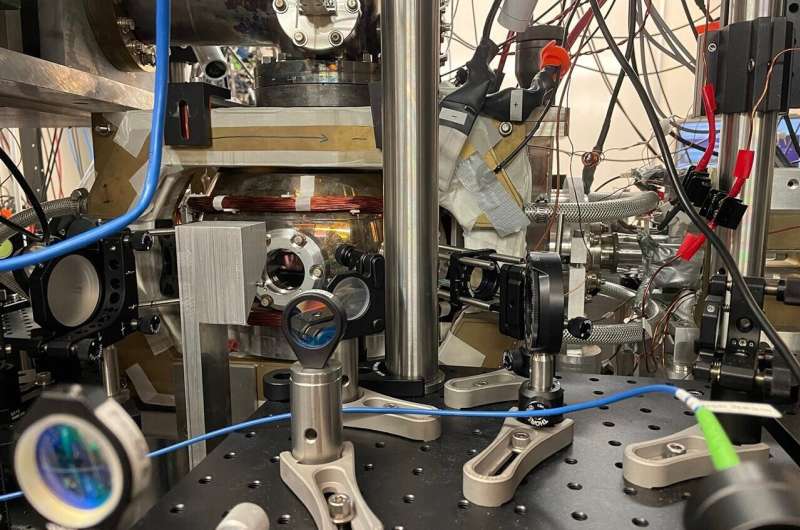
Image of the vacuum chamber on the optical table where the Stanford research team used precisely delivered light and magnetic fields to program a straight line of atoms into treelike shapes, a twisted loop called a Möbius strip and other patterns. Credit: Monika Schleier-Smith

In a new study, Stanford researchers demonstrate how to manipulate atoms so they interact with an unprecedented degree of control. Using precisely delivered light and magnetic fields, the researchers programmed a straight line of atoms into treelike shapes, a twisted loop called a Möbius strip and other patterns.

These shapes were produced not by physically moving the atoms, but by controlling the way atoms exchange particles and "sync up" to share certain properties. By carefully manipulating these interactions, researchers can generate a vast range of geometries. Importantly, they found that atoms at the far ends of the straight line could be programmed to interact just as strongly as the atoms located right next to each other at the center of the line. To the researchers' knowledge, the ability to program nonlocal interactions to this degree, irrespective of the atoms' actual spatial locations, had never been demonstrated before.

The findings could prove a key step forward in the development of advanced technologies for computation and simulation based on the laws of quantum mechanics—the mathematical description of how particles move and interact on the atomic scale.

"In this paper, we've demonstrated a whole new level of control over the programmability of interactions in a quantum mechanical system," said study senior author Monika Schleier-Smith, the Nina C. Crocker Faculty Scholar and associate professor in the Department of Physics in Stanford's School of Humanities and Sciences. "It's an important milestone that we've long been working towards, while at the same time it's a starting point for new opportunities."

The study published Dec. 22 in the journal Nature.

Two graduate students, Avikar Periwal and Eric Cooper, as well as a postdoctoral scholar, Philipp Kunkel, are co-lead authors of the paper. Periwal, Cooper and Kunkel are researchers in Schleier-Smith's lab at Stanford.

"Avikar, Eric and Philipp worked tremendously well together as a team in running the experiments, devising clever ways of analyzing and visualizing the data and developing the theoretical models," said Schleier-Smith. "We're all very excited about these results."

"We chose some simple geometries, like rings and disconnected chains, just as proof of principle, but we also formed more complex geometries including ladder-like structures and treelike interactions, which have applications to open problems in physics," Periwal, Cooper and Kunkel said in a group statement.

Syncing up atoms on command

Periwal, Cooper, Kunkel and colleagues performed experiments for the study on apparatuses known as optical tables, a pair of which dominate the floorspace in Schleier-Smith's lab. The tables are inset with intricate arrays of electronic components strung together by multicolored wires. At the heart of one optical table is a vacuum chamber, consisting of a metallic cylinder studded with porthole windows. A pump expels all air from this chamber so that no other atoms can disturb the small bunches of rubidium atoms carefully placed inside it. The Stanford researchers beamed lasers into this airless chamber to trap the rubidium atoms, slowing the atoms' movement and cooling them down to within whiskers of absolute zero—the lowest temperature theoretically possible where particle movement comes to a virtual standstill. The extremely cold realm just above absolute zero is where quantum mechanical effects can dominate over those of classical physics, and thus where the atoms can be quantum mechanically manipulated.

Shining light through the bunches of atoms in this way also serves as a means of getting the atoms to "talk" to each other. As the light strikes each atom, it conveys information between them, generating patterns called "correlations" wherein every atom shares a certain desired quantum mechanical property. An example of a quantum mechanical property is the total angular momentum, known as the spin of an atom and which can have values of, for example, +1, 0 or –1.

Researchers at Stanford and elsewhere have correlated atomic networks before using systems of laser-cooled atoms, but, until recently, only two basic kinds of atomic networks could be made. In one, called an all-to-all network, every atom talks to every other atom. The second kind of network operates on what's known as a nearest neighbor principle, where laser-suspended atoms interact most strongly with adjacent atoms.

In this new study, the Stanford researchers debut a far more dynamic method that conveys information over specific distances between discrete groups of atoms. This way, spatial location does not matter, and a vastly richer set of correlations can be programmed.

"With an all-to-all network, it's like I'm sending a worldwide bulletin to everyone, while in a nearest-neighbor network, it's like I'm only talking to the person who lives next door," said Schleier-Smith. "With the programmability that we have now demonstrated in our lab, it's like I'm picking up a phone and dialing the exact person I want to talk to located anywhere in the world."

The researchers succeeded in creating these nonlocal interactions and correlations by controlling the frequencies of light shone at the trapped bunches of rubidium atoms and varying the strength of an applied  in the optical table. As the magnetic field strengthened in intensity from one end of the vacuum chamber to the other, it caused each bunch of atoms along the line to spin a bit faster than the prior, neighboring bunch. Although each atomic bunch had a unique rotation rate, every so often, certain bunches would nonetheless periodically arrive at the same orientation—rather like how a row of clocks with progressively faster-spinning hands will still momentarily read off the same times. The researchers used light to selectively enable and measure interactions between these momentarily synced-up atomic clouds. Overall, using a straight line of 18 clouds of atoms, the researchers could generate interactions between clouds at any specified set of distances along the line.

"The ability to generate and control these kinds of nonlocal interactions is powerful," Schleier-Smith added. "It fundamentally changes the way information can travel and the quantum systems we can engineer."

Benefitting from versatile control

One of the many applications of the Stanford team's work is the crafting of optimization algorithms for quantum computers—machines that rely on the laws of quantum mechanics for crunching numbers. Quantum computing has applications in artificial intelligence, machine learning, cybersecurity, financial modeling, drug development, climate change forecasting, logistics and scheduling optimization. For example, quantum computer-tailored algorithms could efficiently solve scheduling problems by finding the shortest possible routes for deliveries, or optimal scheduling of university classes so the greatest number of students can attend.

Another highly promising application is testing out theories of quantum gravity. The treelike shapes in this study were expressly designed for this purpose—they serve as basic models of space-time curved by a hypothetical new concept of gravity based on quantum mechanical principles that would revamp our understanding of gravity as described in Albert Einstein's theory of relativity. A similar approach can also be applied to investigate the light-trapping, ultra-dense cosmic objects called black holes.

Schleier-Smith and colleagues are now working on showing that their experiments can produce quantum entanglement, where quantum states among  are correlated in a manner that can be harnessed for applications ranging from ultraprecise sensors to quantum computation.

"We made a lot of progress with this study and we're looking to build on it," said Schleier-Smith. "Our work demonstrates a new level of control that can help bridge the gap, in several areas of physics, between elegant theoretical ideas and actual experiments."Chaining atoms together yields quantum storage

More information: Avikar Periwal et al, Programmable interactions and emergent geometry in an array of atom clouds, Nature (2021). DOI: 10.1038/s41586-021-04156-0

Journal information: Nature 

Provided by Stanford University 

Kilonova afterglow potentially spotted for first time

Kilonova afterglow potentially spotted for first time
An artist’s conception illustrates the aftermath of a 'kilonova,' a powerful event
 that happens when two neutron stars merge. Credit: NASA/CXC/M. Weiss

For the first time, Northwestern University-led astronomers may have detected an afterglow from a kilonova

 occurs when two —some of the densest objects in the universe—merge to create a blast 1,000 times brighter than a classical nova. In this case, a narrow, off-axis jet of high-energy particles accompanied the merger event, dubbed GW170817. Three-and-a-half years after the merger, the jet faded away, revealing a new source of mysterious X-rays.

As the leading explanation for the new X-ray source, astrophysicists believe expanding debris from the merger generated a shock—similar to the sonic boom from a supersonic plane. This shock then heated surrounding materials, which generated X-ray emissions, known as a kilonova afterglow. An alternative explanation is materials falling toward a black hole—formed as a result of the neutron star merger—caused the X-rays.

Either scenario would be a first for the field. The study was published today (Feb. 28), in The Astrophysical Journal Letters.

"We have entered uncharted territory here in studying the aftermath of a neutron star merger," said Northwestern's Aprajita Hajela, who led the new study. "We are looking at something new and extraordinary for the very first time. This gives us an opportunity to study and understand new physical processes, which have not before been observed."

Hajela is a graduate student at Northwestern's Center for Interdisciplinary Exploration and Research in Astrophysics (CIERA) and in the Department of Physics and Astronomy in the Weinberg College of Arts and Sciences.

On Aug. 17, 2017, GW170817 made history as the first neutron-star merger detected by both  and electromagnetic radiation (or light). Since then, astronomers have been using telescopes around the world and in space to study the event across the electromagnetic spectrum.

Using NASA's Chandra X-ray Observatory, astronomers observed X-ray emissions from a jet moving very close to the speed of light produced by the neutron star merger. Starting in early 2018, the jet's X-ray emission steadily faded as the jet continued to slow and expand. Hajela and her team then noticed from March 2020 until the end of 2020, the decline in brightness stopped, and the X-ray emission was approximately constant in brightness.

This was a significant clue.

"The fact that the X-rays stopped fading quickly was our best evidence yet that something in addition to a jet is being detected in X-rays in this source," said Raffaella Margutti, astrophysicist at the University of California at Berkeley and a senior author of the study. "A completely different source of X-rays appears to be needed to explain what we're seeing."

The researchers believe a kilonova afterglow or black hole are likely behind the X-rays. Neither scenario has ever before been observed.

"This would either be the first time we've seen a kilonova afterglow or the first time we've seen material falling onto a black hole after a neutron star merger," said study co-author Joe Bright, also from the University of California at Berkeley. "Either outcome would be extremely exciting."

To distinguish between the two explanations, astronomers will keep monitoring GW170817 in X-rays and radio waves. If it is a kilonova afterglow, the X-ray and radio emissions are expected to get brighter over the next few months or years. If the explanation involves matter falling onto a newly formed black hole, then the X-ray output should stay steady or decline rapidly, and no radio emission will be detected over time.

"Further study of GW170817 could have far-reaching implications," said study co-author Kate Alexander, a CIERA postdoctoral fellow at Northwestern. "The detection of a kilonova afterglow would imply that the merger did not immediately produce a black hole. Alternatively, this object may offer astronomers a chance to study how matter falls onto a black hole a few years after its birth."Astronomers find x-rays lingering years after landmark neutron star collision

More information: The emergence of a new source of X-rays from the binary neutron star merger GW170817, arXiv:2104.02070 [astro-ph.HE] arxiv.org/abs/2104.02070

Journal information: Astrophysical Journal Letters , Astrophysical Journal 

Provided by Northwestern University 


New lightweight super material could battle bullets, deflect space debris

bullet
Credit: CC0 Public Domain

University of Wisconsin–Madison engineers have created a nanofiber material that outperforms its widely used counterparts—including steel plates and Kevlar fabric—in protecting against high-speed projectile impacts.

Basically, it's better than bulletproof.

"Our nanofiber mats exhibit protective properties that far surpass other material systems at much lighter weight," says Ramathasan Thevamaran, a UW–Madison assistant professor of engineering physics who led the research.

He and his collaborators detailed the advance in a paper published recently in the journal ACS Nano.

To create the material, Thevamaran and postdoctoral researcher Jizhe Cai mixed multi-walled carbon nanotubes—carbon cylinders just one atom thick in each layer—with Kevlar nanofibers. The resulting nanofiber mats are superior at dissipating energy from the impact of tiny projectiles moving faster than the speed of sound.

The advance lays the groundwork for carbon nanotube use in lightweight, high-performance armor materials, for example, in bulletproof vests to better protect the wearer or in shields around spacecraft to mitigate damage from flying high-speed microdebris.

"Nano-fibrous materials are very attractive for protective applications because nanoscale fibers have outstanding strength, toughness, and stiffness compared to macroscale fibers," Thevamaran says. "Carbon nanotube mats have shown the best energy absorption so far, and we wanted to see if we could further improve their performance."

They found the right chemistry. The team synthesized Kevlar nanofibers and incorporated a tiny amount of them into their  mats, which created hydrogen bonds between the fibers. Those hydrogen bonds modified the interactions between the nanofibers and, along with just the right mixture of Kevlar nanofibers and carbon nanotubes, caused a dramatic leap in the overall material's performance.

"The hydrogen bond is a dynamic bond, which means it can continuously break and re-form again, allowing it to dissipate a high amount of energy through this dynamic process," Thevamaran says. "In addition,  provide more stiffness to that interaction, which strengthens and stiffens the nanofiber mat. When we modified the interfacial interactions in our mats by adding Kevlar nanofibers, we were able to achieve nearly 100% improvement in energy dissipation performance at certain supersonic impact velocities."

Bring on the bullets. The researchers tested their new material using a laser-induced microprojectile impact testing system in Thevamaran's lab. One of only a handful like it in the United States, the system uses lasers to shoot micro-bullets into the material samples.

"Our system is designed such that we can actually pick a single bullet under a microscope and shoot it against the target in a very controlled way, with a very controlled velocity that can be varied from 100 meters per second all the way to over 1 kilometer per second," Thevamaran says. "This allowed us to conduct experiments at a  where we could observe the material's response—as the hydrogen bond interactions happen."

In addition to its impact resistance, another advantage of the new nanofiber material is that, like Kevlar, it is stable at both very high and very low temperatures, making it useful for applications in a wide range of extreme environments.

Synthesis of diamond-like carbon nanofiber film

More information: Jizhe Cai et al, Extreme Dynamic Performance of Nanofiber Mats under Supersonic Impacts Mediated by Interfacial Hydrogen Bonds, ACS Nano (2021). DOI: 10.1021/acsnano.1c07465

Journal information: ACS Nano 

Provided by University of Wisconsin-Madison 

Social networking for fossils shows community impacts of mass extinctions

Social Networking for Fossils Shows Community Impacts of Mass Extinctions | Jackson School of Geosciences
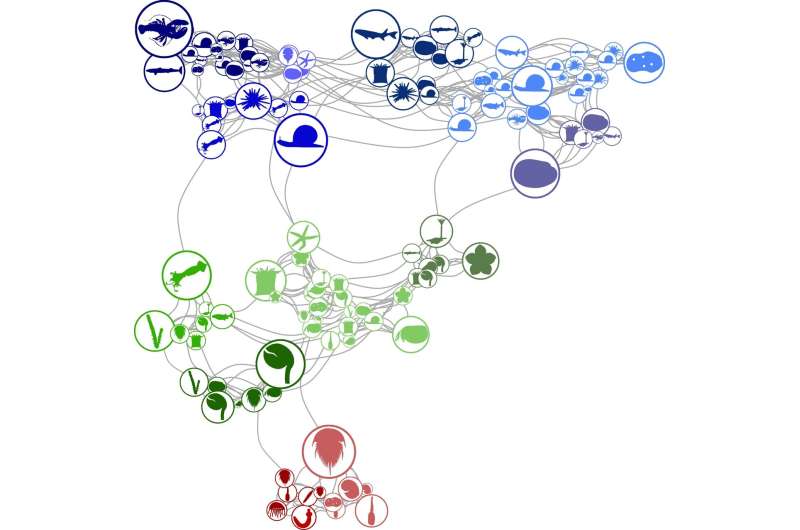
An example of network with connections between various forms of ancient sea life. This 
chart is a teaching tool and is not the actual network constructed by researchers in the 
study. Credit: Drew Muscente.

By applying an algorithm akin to what Facebook uses to make friend suggestions, researchers have identified communities of ancient life in the fossil record and tracked how their numbers changed through each of the planet's mass extinctions.

As expected, the number of communities—a group of different species living in the same general area—dropped during mass extinction events. But the rate at which communities disappeared did not always track with the overall loss of life and biodiversity during an extinction, a result that suggests that the ecological impacts of an extinction are not always linked with the number of species that perish.

"There have been times in our history where there have been major events that saw tremendous changes in communities, but very few species disappeared," said lead author Drew Muscente, who conducted the study when he was a postdoctoral researcher at The University of Texas at Austin's Jackson School of Geosciences. "And there have been events where many species had disappeared and communities and ecosystems were barely affected at all."

Muscente is now an assistant professor at Cornell College. The study was recently published in the journal Geology.

The results underscore the importance of studying communities to get a broader perspective on environmental change—both in the past and in the present.

"We try to understand how changes in these communities lead to fundamental transformation of entire ecosystems," said coauthor Rowan Martindale, an associate professor at the Jackson School.

Identifying communities in the  is notoriously difficult. Most research on paleocommunities focuses on comparing samples and collections of fossils that have been taken from rocks of various ages and locations. And although conventional computational methods can be used to group samples into paleocommunities, they work best with relatively small datasets of only a few hundred or thousand fossil collections. Due to this limitation, the conventional methods can only be applied to data from specific regions and time periods, as opposed to the entire record.

The researchers were able to overcome these challenges and examine the entire fossil record by applying a community detection algorithm based on  methods. Social media companies are known for using these sorts of methods to connect users, but they are becoming increasingly applied across a range of scientific disciplines.

Social Networking for Fossils Shows Community Impacts of Mass Extinctions | Jackson School of Geosciences
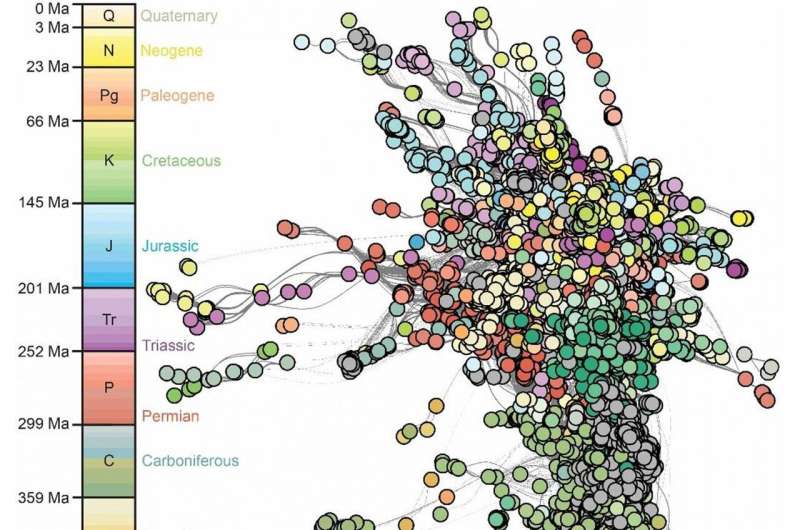
The researchers analyzed connections between 124,605 fossil collections, representing the
 entire history of marine animal life, and found that they can be grouped into 3,937
 paleocommunities (shown here as colored dots). Credit: Muscente et al.

According to Muscente, this study is the first time that network analysis has been applied to detect paleocommunities throughout the entire  record of marine —from when animal life first appeared to the current geologic era.

Matthew Clapham, a paleobiology professor at the University of California Santa Cruz who was not involved with the study, said that another advantage of the network analysis method is the emphasis on visualizing connections, rather than just the types of animals present in an ecosystem.

"It brings the analysis closer to the way that the communities actually worked because communities and interactions between species are networks," he said.

Drawing on a database of 124,605 collections of marine animal fossils from around the world, and representing 25,749 living and extinct animal groups, or genera, the algorithm identified more than 47 million links between these samples and organized them into 3,937 distinct paleocommunities.

The study tracked the communities and biodiversity over the past 541 million years. The research showed that while  took a toll on both, the degree of decline sometimes differed.

Some extinctions affected communities more than biodiversity. Some affected biodiversity more than communities. And some affected both about the same.

Furthermore, the researchers did not find a link between the cause of an extinction and whether it took a great toll on communities or biodiversity.

The results indicate that the larger ecological impacts of extinction are more about which species are lost rather than the number of species lost. If an environment's key players are preserved, communities can remain intact. But if too many of these players are removed, the community crumbles with it.

Muscente said he hopes that the network analysis methods first applied in this study can be improved and used to study modern ecosystems.

"I'd like to try and bridge the gap from the rock record to the present," he said.

Predator species help to buffer climate change impacts on biodiversity

More information: A.D. Muscente et al, Appearance and disappearance rates of Phanerozoic marine animal paleocommunities, Geology (2021). DOI: 10.1130/G49371.1

Journal information: Geology 

Provided by University of Texas at Austin 

Rise of termite clone queendoms offers clue to curb invasions


Preventing a homeowner headache

Peer-Reviewed Publication

UNIVERSITY OF SYDNEY

Drywood termites 

IMAGE: AN ALL-FEMALE DRYWOOD TERMITE COLONY view more 

CREDIT: TOMONARI NOZAKI

Four years ago, entomologists at the University of Sydney discovered the existence of all-female, forest-dwelling drywood termite colonies in Japan. Now, they have determined how they evolved, and the implications of insect ‘girl power’ for established termite species (hint: they’re bad).

Their new research shows all-female colonies of drywood termites (Glyptotermes nakajimai) developed through unwitting human-assisted hybridisation some time in the last century. Females from one lineage mated with males from another, as one lineage was unknowingly moved from a smaller island to mainland Japan, likely via boat. Their hybrid offspring are more genetically diverse, and likely to be more robust.

In addition to stronger offspring, the all-female colonies can clone themselves and do not require a male to procreate, resulting in double the amount of breeding. According to the researchers, this is bad news for the incumbent, non-hybrid species, which can be outcompeted by its hybrid relatives.

It’s also potentially bad news for property owners. Drywood termites, as their name suggests, do not require moist conditions to burrow into and eat wooden beams, walls, floors or furniture, and are commonly moved around the world by trade, opening the door to hybridisation events. Once an infestation occurs, it can be difficult to eradicate, potentially leading to structural damage to a building, or even collapse.

Professor Nathan Lo, who led the study with University of Sydney Postdoctoral Fellow Toshihisa Yashiro, said his findings have implications for biosecurity: “Our study highlights the importance of making sure termites from overseas are not permitted to establish themselves. If they were to hybridise with local termites, it might lead to even nastier lineages of termites for homeowners to deal with.”

‘Really weird’ males

Aside from discerning how the female colonies evolved, the researchers also studied several drywood termite colonies with males and females, which contained a quirk: the sperm of males consisted of either 15 Y or 15 X chromosomes, out of a total of 17. In most species, including humans, male sperm have only a single Y or X chromosome (out of 23, in the case of humans).

“It’s really weird,” said Professor Lo, who posits that this occurred out of necessity.

“Termite offspring can inherit nests from their parents, saving them the trouble of venturing into the dangers of the outside world, burrowing into wood, and creating their own nests. The problem with nest inheritance is that it results in a lot of inbreeding – sisters mate with brothers, and offspring may even mate with parents.

“As a solution, male termites probably evolved to have multiple Y chromosomes, making them harbour more genetic diversity than females. So, even if a sister and brother mate, they can produce viable offspring.”

The researchers say that this chromosomal pattern is found in some other organisms, including plants and huntsman spiders, but not usually to the extremes found in drywood termites.

About the study

The results have been published in the high-impact journal Proceedings of the National Academy of Sciences. Termites were collected and preserved by Dr Yashiro prior to undertaking his fellowship in Professor Lo’s lab in Sydney, and DNA was analysed in Australia using nuclear SNP and mitochondrial markers. Chromosome analyses were performed using DNA stains and fluorescence microscopy.