It’s possible that I shall make an ass of myself. But in that case one can always get out of it with a little dialectic. I have, of course, so worded my proposition as to be right either way (K.Marx, Letter to F.Engels on the Indian Mutiny)
Wednesday, March 16, 2022
Indigenous communities ink Coastal GasLink option deals with TC Energy
By Amanda Stephenson The Canadian Press Posted March 9, 2022 A number of First Nations have become part-owners of a controversial pipeline in Northern B.C.. The equity stake in the Coastal GasLink project could be worth millions. But as Ted Chernecki reports, this still doesn't ensure clear-sailing for the energy project.
Sixteen Indigenous communities along the Coastal GasLink pipeline route have signed option agreements with TC Energy Corp. for an equity stake in the project, a move that one Indigenous leader hopes will set a precedent for future energy infrastructure projects in Canada.
In an interview Wednesday, Chief Corinna Leween of the Cheslatta Carrier Nation — whose traditional lands are located northwest of Prince George, B.C., along the pipeline’s corridor — said the agreements are an “historic milestone” for Indigenous communities.
Coastal gaslink indigenous communities agreement
“This is what we’ve been striving for, to finally have a say and make informed business decisions that will benefit our communities back home,” said Leween.
“A lot of our Nations are still living in poverty, Third World poverty, and not having access to capital or the infrastructure dollars that are needed to do the development of our communities. We are hoping that this will help alleviate it.”
The signing of the agreements was announced Wednesday by TC Energy, the Calgary-based company currently constructing the Coastal GasLink pipeline. In all, 16 communities — represented by two groups, the CGL First Nations Limited Partnership and the FN CGL Pipeline Limited Partnership — have signed on for the option of a 10 per cent equity stake in the project.
Financial terms of the agreements were not disclosed. The equity options are exercisable once the pipeline begins commercial service, with a target date of 2023.
RCMP could have at least two suspects in violent attack on Coastal GasLink employeesRCMP could have at least two suspects in violent attack on Coastal GasLink employees – Feb 23, 2022
Tiffany Murray, director of Indigenous relations for Coastal GasLink, said the equity option was offered to all 20 First Nations along the pipeline route with which TC Energy currently has existing project agreements.
The existing agreements provide for various long-term benefits for Indigenous communities, such as employment and contracting opportunities for the life of the project.
“When we negotiated the agreements initially, that was sort of the intent of what the overall benefits would be,” Murray said. “But when we went through the process to sell down equity back in 2019, we heard from these communities that they had interest in being equity owners as well.”
Global investment firm KKR and the Alberta Investment Management Corp., as well as TC Energy, are the other equity owners of Coastal GasLink. KKR and AIMCO acquired their combined 65 per cent stake in late 2019.
The Coastal GasLink pipeline, which is currently more than 60 per cent complete, will carry natural gas across 670 kilometres from the Groundbirch area west of Dawson Creek, B.C., to a liquefied natural gas export facility being constructed by LNG Canada and its partners near Kitimat, B.C.
While many Indigenous people support the project, Coastal GasLink has been strongly opposed by others.
In early 2020, opposition by Wet’suwet’en hereditary chiefs over the pipeline being built in their territory in northwestern B.C. set off Canada-wide rail blockades by their supporters that stalled parts of the country’s economy.
“We continue to really seek to engage with Wet’suwet’en, and seek those opportunities to better understand concerns and interests as it relates to the project,” Murray said. “I would say it continues as a work in progress . . . to find ways to come to solutions or address concerns as best we can.”
UK
Carbon dioxide will have to be removed from air to achieve 1.5C, says report
Offset markets have important role as switching to renewable energy alone not enough, according to thinktank
Adair Turner, chair of the Energy Transitions Commission thinktank, says carbon offset markets should not be shunned because of earlier mismanagement.
Removing carbon dioxide from the air will now be essential if there is to be any chance of meeting global climate targets, a thinktank has warned.
Carbon offset markets will need to be tidied up and managed properly, as offsets will form a critical route to limiting global heating to 1.5C in line with scientific warnings, according to the Energy Transitions Commission, as switching to renewable energy alone will not produce enough carbon savings. Other methods, such as tree planting and carbon capture and storage, will also be critical.
Lord Adair Turner, the former head of the CBI and ex-chair of the UK government’s Committee on Climate Change and now chair of the Energy Transitions Commission, said carbon offsets and carbon markets were viewed with suspicion as they had been subject to mismanagement and abuse, but that well-functioning markets were possible.
“We would encourage the tidying up of what has been an area with loose standards and loose claims,” Turner said. “It would be very unfortunate to take the past problems of the carbon markets and use that to say we should not use them at all. This is potentially a very large flow of money. So we should try to make sure that financial flow, which is valuable, is provided.”
The Guardian and others have uncovered numerous instances of questionable benefits from carbon offsets offered for sale on the voluntary carbon markets, so-called because they are not formally regulated by governments.
The Energy Transitions Commission report, entitled Mind the Gap: How Carbon Dioxide Removals Must Complement Deep Decarbonisation to Keep 1.5°C Alive, examined ways of removing carbon from the air after it is emitted, in contrast to renewable energy which removes the need to emit carbon dioxide in the first place. Technologies to remove carbon dioxide, such as carbon capture and storage which requires liquefying the gas and pumping it into underground caverns, and direct air capture, using chemicals to suck carbon from the air, are still expensive.
Turner warned that these technologies should not be seen as a “get out of jail free card”, which companies and others could rely on to avoid having to switch to renewable energy or finding other ways of cutting their greenhouse gas emissions. Carbon removal could not be enough on its own, but would be needed to supplement green energy, he said.
A carbon capture and storage facility in Fort Saskatchewan, Alberta, Canada. Photograph: Todd Korol/Reuters
An alternative to using these technologies is to grow trees, which absorb carbon dioxide from the air as they grow, and which scientists have said must form a key part of any strategy to tackle the climate crisis. Funding to grow forests will be hard to achieve without the use of carbon offsets, Turner said.
The ETC report found that more than $200bn (£183bn) a year in total funding would be needed to remove enough carbon to stay within 1.5C, which over the next three decades would amount to about 0.25% of global GDP.
The markets for carbon offsets today reduce global emissions by only about 0.1%, according to the ETC. Companies alone would be unlikely to fund the removals needed, and government assistance would also be needed, the report found.
Turner said carbon markets should be better regulated, to ensure that the cash they can generate is directed towards projects that provide genuine reductions in greenhouse gas emissions. That could be achieved by modelling the markets on existing financial trading, and by using modern monitoring techniques such as satellites to verify that emissions reductions have taken place, or that trees and forests were still standing.
The next instalment of the landmark four-part report by the Intergovernmental Panel on Climate Change, the body of the world’s leading climate scientists, is to be published next month. That section of the sixth assessment report, the latest comprehensive update of human knowledge of the climate crisis, drawing on the work of thousands of scientists over the past eight years, will contain sections examining carbon removal technologies and the potential for all carbon-cutting methods, from renewable energy to tree-planting.
New sabre-tooth predator precedes cats by millions of years
ANOTHER AMAZING FIND FROM THE MUSEUM STORAGE ROOM
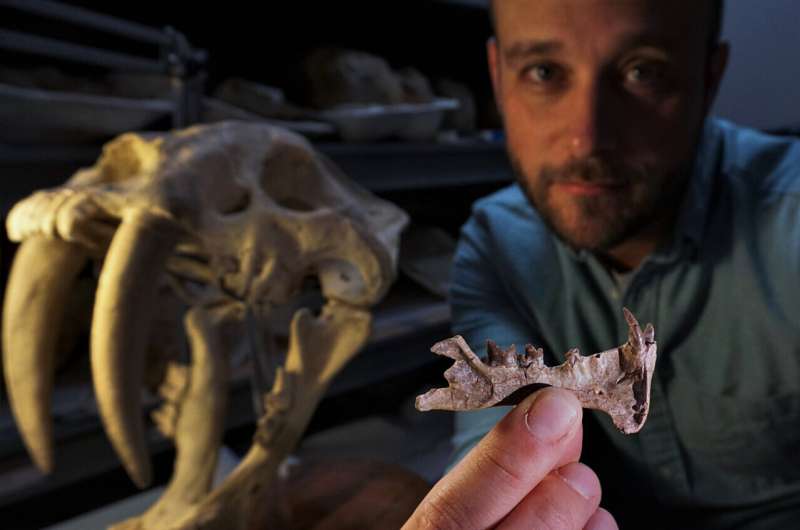
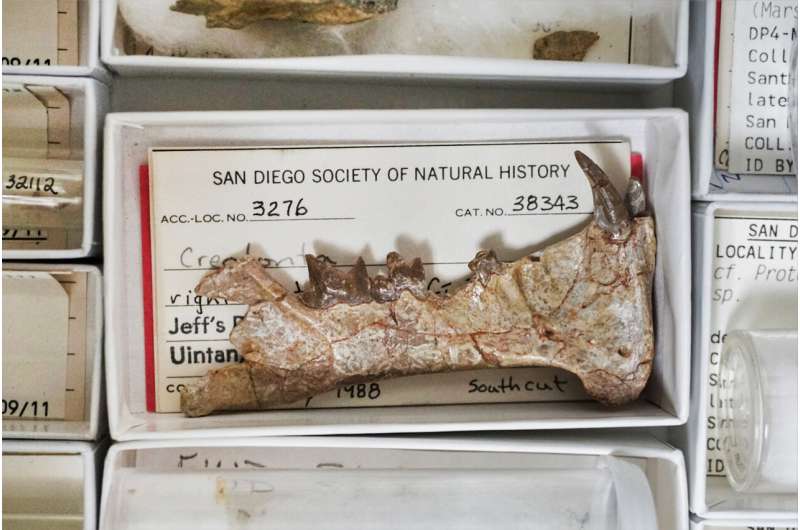
Dr. Ashley Poust, a post-doctoral researcher at The Nat, has just described what is now the earliest known cat-like predator in North America, west of the Rocky Mountains. The fossil in his hand belonged to Diegoaelurus, a bobcat-sized carnivore that lived around 42 million years ago. Diegoaelurus was much smaller than the commonly known Smilodon, or sabre-tooth cat, seen in the background. Smilodon evolved roughly 40 million years after Diegoaelurus went extinct, but both animals were saber-toothed, hyper-carnivorous predators, meaning their diets consisted almost entirely of meat. Diegoaelurus and its few relatives, from Wyoming and China, were the first predators to evolve sabre-teeth, though several other unrelated animals developed this adaptation much later in time. Credit: San Diego Natural History Museum.
The fossil, housed in the San Diego Natural History Museum's paleontology collection, offers a window into what the Earth was like during the Eocene Period, more than 40 million years ago. The specimen includes a lower jaw and well-preserved teeth, giving us new information about the behavior and evolution of some of the first mammals to have an exclusively meat-based diet.
"Today, the ability to eat an all-meat diet, also called hypercarnivory, isn't uncommon. Tigers do it, polar bears can do it. If you have a house cat, you may even have a hypercarnivore at home. But 42 million years ago, mammals were only just figuring out how to survive on meat alone," said Dr. Ashley Poust, postdoctoral researcher at the San Diego Natural History Museum (The Nat). "One big advance was to evolve specialized teeth for slicing flesh—which is something we see in this newly described specimen."
This early meat-eating predator is part of a mysterious group of animals called Machaeroidines. Now completely extinct, they were not closely related to today's living carnivores. "We know so little about Machaeroidines, so every new discovery greatly expands our picture of them," said coauthor Dr. Shawn Zack of the University of Arizona College of Medicine. "This relatively complete, well-preserved Diegoaelurus fossil is especially useful because the teeth let us infer the diet and start to understand how Machaeroidines are related to each other," said Zack.
Zack, Poust, and their third coauthor Hugh Wagner, also from The Nat, named the predator Diegoaelurus vanvalkenburghae. The name honors San Diego County where the specimen was found and scientist Blaire Van Valkenburgh, past president of the Society of Vertebrate Paleontology, whose foundational work on the evolution of carnivores influenced this research.
Diegoalerus with fossil. All photos should be credited to San Diego Natural History Museum. Credit: San Diego Natural History Museum
About the discovery
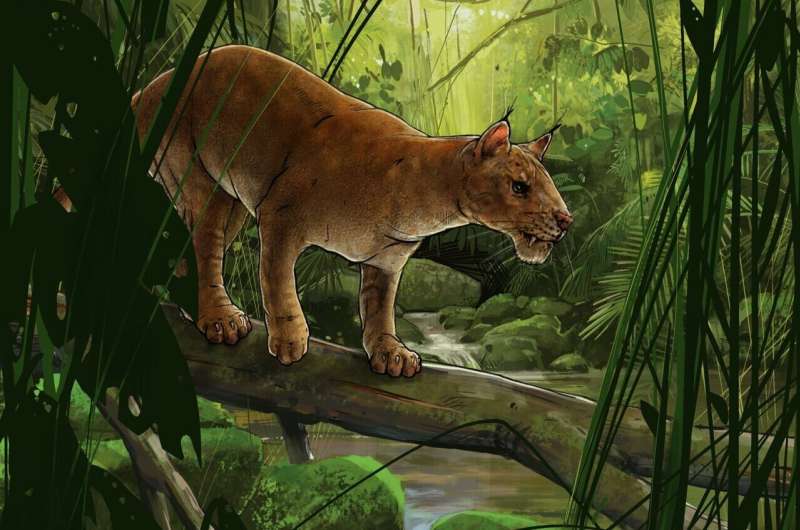
D. vanvalkenburghae was about the size of a bobcat, but with a downturned bony chin to protect its long upper sabre teeth. It would have been a powerful and relatively new kind of hunter.
"Nothing like this had existed in mammals before," said Poust. "A few mammal ancestors had long fangs, but Diegoaelurus and its few relatives represent the first cat-like approach to an all-meat diet, with sabre-teeth in front and slicing scissor teeth called carnassials in the back. It's a potent combination that several animal groups have independently evolved in the millions of years since."
This animal and its relatives represent a sort of evolutionary experiment, a first stab at hypercarnivory—a lifestyle that is followed today by true cats. With only a handful of fossil specimens from Wyoming and Asia, the machaeroidines are so poorly understood that scientists weren't even sure if there were multiple species living within the same time period. "This fossil finding shows that machaeroidines were more diverse than we thought," says Zack. "We already knew there was a large form, Apataelurus, which lived in eastern Utah. Now we have this smaller form, and it lived at approximately the same time. It raises the possibility that there may more out there to find."
In addition to this overlapping existence, Poust points out they may have coexisted with other sabre-toothed animals. "Diegoaleurus, though old, is the most recent of these machaeroidine predators. That puts it within striking distance of the time that the next cat-like animals arrived in North America, the nimravids or sabre-tooth false-cats," he said. "Did these groups ever meet, or even compete for space and prey? We don't know yet, but San Diego is proving to be a surprisingly important place for carnivore evolution."
The Diegoaelurus jawbone fossil has been in The Nat's collection since 1988. It was recovered from a construction site in Oceanside by the museum's PaleoServices team. When this carnivorous animal was alive 42 million years ago, San Diego was covered in rainforests populated by many small, unusual rodents, marsupials, primates and hooved mammals. Credit: San Diego Natural History Museum
About the Santiago Formation
The fossil comes from San Diego County in southern California, at a location first discovered in the 1980s by a local 12-year-old boy. Since then, "Jeff's Discovery Site" has become an important fossil bed within a larger group of rocks called the Santiago Formation. Fossils of an entire ecosystem have been discovered in these 42 million-year-old rocks, painting a picture of a very different San Diego than the one we know today. Though largely inaccessible, these important fossil beds are occasionally exposed by construction projects and road expansions, allowing scientists from The Nat to keep digging for evidence of California's ancient, tropical past.
"Not only was San Diego further south due to tectonic plate movements, but the Eocene was a wetter, warmer world," said Poust. "The Santiago Formation fossils show us a forested, wet California where tiny rhinos, early tapirs, and strange sheep-like, herbivorous oreodonts grazed under trees while unusual primates and marsupials clung to the canopy above. This richness of prey species would have been a smorgasbord for Diegoaelurus, allowing it to live the life of a specialized hunter before most other mammals."
The article, "Diegoaelurus, a new machaeroidine (Oxyaenidae) from the Santiago Formation (late Uintan) of southern California and the relationships of Machaeroidinae, the oldest group of sabertooth mammals," is published in PeerJ.
About the 3D model
The jaw of the newly named meat-eater is available to view in 3D for free on the San Diego Natural History Museum's website.
More information:Shawn P. Zack et al, Diegoaelurus, a new machaeroidine (Oxyaenidae) from the Santiago Formation (late Uintan) of southern California and the relationships of Machaeroidinae, the oldest group of sabertooth mammals,PeerJ(2022).DOI: 10.7717/peerj.13032
An unidentified fossil collected more than three decades ago was actually a mysterious species of saber-toothed carnivore that once stalked prey through the ancient rainforests of Southern California.
The fossil includes a near-complete lower jawbone and a set of well-preserved teeth, according to a new study, published Tuesday (March 15) in the journal PeerJ. Paleontologists at the San Diego Natural History Museum (The Nat) originally collected the specimen in 1988 from a site known as the Santiago Formation in Oceanside, a city in San Diego County, California. The geological formation is estimated to be about 42 million years old, so fossils from the site date back to the Eocene epoch (55.8 million to 33.9 million years ago), according to the American Museum of Natural History.
When the fossilized jawbone was initially discovered, "it had been very properly identified as a meat-eating animal," said study co-author Ashley Poust, a postdoctoral researcher in vertebrate paleontology at the Nat. The specimen bears "big, slicing, scissoring teeth" that are ideally suited for shredding fresh meat, rather than for crunching through nuts or gnawing on bones, for instance, Poust said. Sponsored Links
The museum paleontologists originally thought these formidable teeth might belong to a nimravid, a type of cat-like hypercarnivore, an animal whose diet consisted mostly of meat. The nimravids are often called "false saber-toothed cats," as they resemble the famous felines but don't belong to the Felidae family as true cats do, Live Science previously reported.
However, study co-author Hugh Wagner, a paleontologist at the Nat, later suggested that the jawbone might belong to a more mysterious group of hypercarnivores with scant representation in the fossil record: the machaeroidines. Remains of these strange beasts have been uncovered only at select sites in Asia and North America, and prior to the new study, only 14 specimens had ever been found, according to the PeerJ report. The now-extinct group includes the earliest known saber-toothed mammalian carnivores, which are not closely related to any living carnivores.
Two of these specimens — a partial skeleton and a jawbone — were discovered in Wyoming and Utah and described in priorpapers by the study's co-first author Shawn Zack, an assistant professor at the University of Arizona College of Medicine and an expert in ancient carnivores. For the new paper, Zack, Poust and Wagner teamed up to reexamine the perplexing carnivore jawbone in the Nat's collection and determine, once and for all, whether it belonged to a machaeroidine.
The team snapped photos of the fossil from many angles in order to construct a detailed 3D model of the bone and teeth, and after a thorough examination, they confirmed that the specimen was not only a machaeroidine, but a never-before-seen genus and species of machaeroidine.
They named the newfound creature Diegoaelurus vanvalkenburghae in honor of San Diego County, where the specimen was found, and scientist Blaire Van Valkenburgh, a past president of the Society of Vertebrate Paleontology whose work greatly influenced scientists' understanding of carnivore evolution.
"Finding this particular group was pretty surprising," because no other machaeroidine specimens in the U.S. had been found west of the Rocky Mountains, Poust told Live Science. "We didn't know that these occurred out here at all."
Based on the size of the jawbone, the researchers determined that D. vanvalkenburghae was about the size of a bobcat, according to the study. The animal carried blade-like, slicing teeth in the back of its mouth and had "sort of reduced teeth in the front — it's totally lost the first [tooth] behind its lower canine," Poust said. Modern cats also have this gap behind their lower canines, to make space for their large upper canines to bite down, he noted. In addition to this gap, D. vanvalkenburghae had a downturned, bony chin that also would have helped to accommodate its impressive saber teeth.
About 42 million years ago, D. vanvalkenburghae would have lived in a very different environment than can be found in San Diego County today, Poust noted.
The Eocene kicked off with a period of extensive warming, which fueled the growth of hot, humid rainforests around the world, according to the American Museum of Natural History. Fossils recovered from Santiago Formation suggest that the lush rainforests of ancient Southern California were once home to lemur-like primates, marsupials, boar-size tapirs and tiny rhinos. In theory, D. vanvalkenburghae may have preyed on these animals, although the predator's exact diet is unknown, Poust said.
The new species helps fill out the sparse machaeroidine fossil record, but it also raises new questions about the cat-like predators, Poust said.
For example, did D. vanvalkenburghae ever coexist and compete for prey with nimravids? The oldest nimravid remains found in the U.S. are roughly 5 million years younger than the newly identified D. vanvalkenburghae fossil, so it would partially depend on when the machaeroidine went extinct. The exact timing and reason for this extinction also remain mysterious, although it's clear that machaeroidines died out many millions of years before the emergence of true saber-toothed cats (Smilodon), Poust noted.
Originally published on Live Science.
The spectre of Donald Trump hangs over the federal Conservative leadership race
The spectre of Donald Trump hangs over the federal Conservative leadership race
Two vastly different ideological camps have emerged among the frontrunners, with the party more divided than ever
Which brings us to the Conservative party’s current leadership race.It is pretty clear that the party is as divided as ever. It’s equally evident where the main combatants intend to fish for votes: Pierre Poilievre is casting his line in waters occupied by the more right-wing elements of the party, in many respects the CPC’s base, while former federal Conservative party leader Jean Charest and Brampton, Ont., Mayor Patrick Brown intend to look for votes among moderates. (Yes, there are others in the race but unless another big name enters the fray, these are the three we will most likely be talking about until the vote on Sept. 10).
Already, Mr. Poilievre and his campaign team have signalled they have come to play, with hard-hitting ads that attempt to define both Mr. Charest and Mr. Brown as policy flip-floppers who will betray the party grassroots. It’s a charge that detractors of Erin O’Toole used effectively to undermine and ultimately end his leadership. It may be a deadly weapon for Mr. Poilievre as well.
Ultimately, it will come down to what type of person party supporters want as their flag-bearer: a centrist conservative such as Mr. Charest or Mr. Brown? Or a slick, take-no-prisoners, loose-with-the-facts populist like Mr. Poilievre, who will move the party to the ideological right?
Make no mistake: Mr. Poilievre is going after those CPC supporters who would pick a Trump ticket over a Biden one. If you’re looking for them, many can be found at any of these pop-up “freedom” rallies you see across the country. They were the ones flying Trump flags at the trucker convoy that squatted in the city of Ottawa for three weeks before being forced out. It’s why Mr. Poilievre reached out to them to offer his encouragement and support at the time, despite the havoc and hardship they were causing to residents of the capital.
A large percentage of these folks can be found in Alberta and Saskatchewan, two provinces Mr. Poilievre hopes to own come the convention. He likely will. His angry, divisive style of politics sells well on the Prairies, where hatred for Prime Minister Justin Trudeau runs high. Mr. Poilievre is happy to stoke and foment that dissent even if it entails propagating ridiculous conspiracy theories – another page he’s ripped out of the Trump playbook.
Mr. Poilievre’s latest is spreading spurious claims about the World Economic Forum (which Mr. Trudeau and Deputy Prime Minister Chrystia Freeland have attended), characterizing it as a cabal of elites conjuring a world in which the little people own nothing and learn to be happy with it.
“Maybe that’s why the [federal] government is inflating home prices,” Mr. Poilievre suggests in a campaign video.This is not only dishonest, it’s also dangerous – these tactics are precisely why we see the rage that we do in many parts of the country. headtopics.com
Given the starkly different views that the two main camps in this race represent (Brown/Charest vs. Poilievre) it’s difficult to say what the CPC will look like once the dust settles. Are the more mainstream, temperate party members going to be okay with someone like Mr. Poilievre, who seems increasingly comfortable resorting to the type of dishonest, coercive methods for which Republicans south of the border have become known?
The choice in this leadership contest is so stark it’s reasonable to ask: can the CPC survive once it’s all over?
Can a chess grandmaster save the world? by Frederic Friedel
3/14/2022 – Cobicistat is a drug that was originally devised for HIV/AIDS therapy. Now a new study shows that it can inhibit the replication of SARS-CoV-2 – which would mean we could have a powerful therapeutical drug against Covid-19. Very encouraging news – but why are we reporting this on a chess news page? Because one of the virologists working on the project happens to be a chess grandmaster. Here's his story. | Photos Lara Gallucci.
Iart Luca Shytaj
He was born in Albania (Tirana) in 1986. His parents moved to Italy when he was six years old and he became an Italian citizen in 2007.
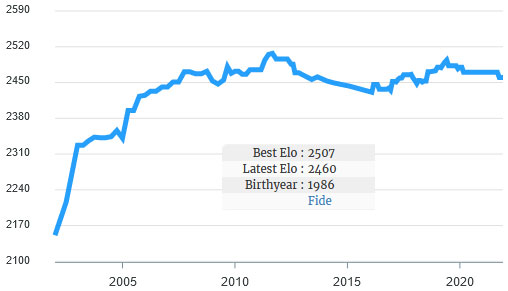
Luca (as he is known to friends) is a very strong player who won the Albanian Chess Championship in 2003 and represented Albania twice in Olympiads (Calvia 2004 and Turin 2006) and Italy once in an Olympiad (Dresden 2008 – the picture above, by Cathy Rogers, was taken there) and once in a European Team Championship (Novi Sad 2009).
He won the Albanian Championship (2003), the Italian Rapid Championship (2009), and the Italian Team Championship in 2016 playing for the Fischer Chieti team.
Luca was awarded the title in October 2018, the 14th Italian player to achieve the title of GM.
In the scientific field Luca holds a master degree in Genetics and Molecular Biology (from the “La Sapienza” University in Rome). He obtained a PhD in “Medical Microbiology, Immunology and Infectious Diseases,” working on an HIV cure project under the supervision of Andrea Savarino. Later he performed his research at the Italian Institute of Health in Rome and at Heidelberg University in Germany. He is currently a visiting Professor at the Federal University of Sao Paulo in Brazil.
When I showed Luca the click-bait title of my article, he asked me if I knew Betteridge's law, which states that "any headline that ends in a question mark can be answered by the word no". I definitely hope that this is not the case here. I have urged Luca to abandon his attempts to rearrange little pieces of wood on a checkered board slightly better than other people, and concentrate on the more urgent global tasks that need to be solved. Cobicistat
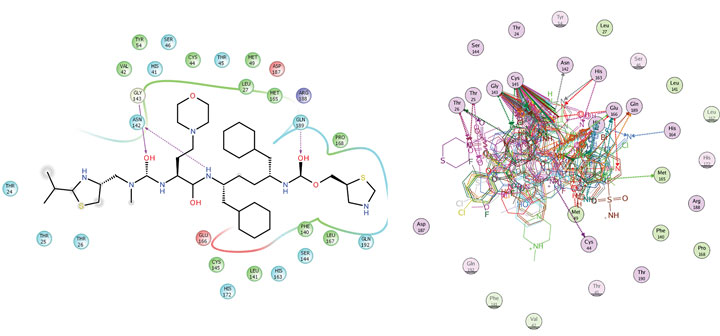
Luca and his team have been working on Cobicistat, a drug used in HIV/AIDS therapy, showing that it could have an effect against COVID-19. That is the result of a study, until now conducted only in vitro and in an animal model, published in the journal of the American Society of Microbiology, mBio.
The international team of authors proved that Cobicistat inhibits the replication of SARS-CoV-2 with a different mechanism from those of the drugs currently used, i.e. by blocking the fusion of the virus to its target cells. Furthermore, the drug can attenuate the progression of the disease in a hamster animal model (Mesocricetus auratus), by enhancing the effect of another drug previously tested against COVID, i.e. Remdesivir.
If you are interested in the details of the research, the article on COVID is now published and free to read:
Combinations of direct-acting antivirals are needed to minimize drug resistance mutations and stably suppress replication of RNA viruses.
Currently, there are limited therapeutic options against the severe acute respiratory syndrome coronavirus 2 (SARS-CoV-2), and testing of a number of drug regimens has led to conflicting results.
Here, we show that cobicistat, which is an FDA-approved drug booster that blocks the activity of the drug-metabolizing proteins cytochrome P450-3As (CYP3As) and P-glycoprotein (P-gp), inhibits SARS-CoV-2 replication. Two independent cell-to-cell membrane fusion assays showed that the antiviral effect of cobicistat is exerted through inhibition of spike protein-mediated membrane fusion. In line with this, incubation with low-micromolar concentrations of cobicistat decreased viral replication in three different cell lines including cells of lung and gut origin.
When cobicistat was used in combination with remdesivir, a synergistic effect on the inhibition of viral replication was observed in cell lines and in a primary human colon organoid. This was consistent with the effects of cobicistat on two of its known targets, CYP3A4 and P-gp, the silencing of which boosted the in vitro antiviral activity of remdesivir in a cobicistat-like manner.
When administered in vivo to Syrian hamsters at a high dose, cobicistat decreased viral load and mitigated clinical progression. These data highlight cobicistat as a therapeutic candidate for treating SARS-CoV-2 infection and as a potential building block of combination therapies for COVID-19.
Editor-in-Chief emeritus of the ChessBase News page.
Studied Philosophy and Linguistics at the University of Hamburg and Oxford, graduating with a thesis on speech act theory and moral language. He started a university career but switched to science journalism, producing documentaries for German TV. In 1986 he co-founded ChessBase.
Transport Canada investigating whether Freedom Convoy supporters aboard flight were screened for vaccination
Transport Canada is looking into a chartered flight that brought supporters of the so-called Freedom Convoy from Western Canada to Ottawa last month, to ensure passengers were properly screened for COVID-19 vaccination.
According to one of the passengers on the flight, some of those aboard were not vaccinated, an apparent violation of the federal government mandate requiring most air and rail passengers to produce proof of vaccination before travel.
“Transport Canada has been made aware of the incident and is following up with the air operator to ensure compliance,” Transport Canada spokesperson Sau Sau Liu said in an email.
At a bail hearing for protest organizer Tamara Lich last month, her husband Dwayne testified that he arrived in Ottawa on Feb. 2 aboard a “private jet,” with the expense covered by a benefactor he identified only as “Joseph.”
In fact, the aircraft they travelled on was far less grand – a twin-engine turbo-prop with limited range that had to make multiple stops on the way to Ottawa.
“That plane was not a super powerful private jet that propelled us through space and time in luxury,” said Chad Eros, an accountant from Saskatchewan who travelled to Ottawa to help the protesters deal with issues involving the GoFundMe crowdsource funding drive.
Eros now identifies himself as “acting co-president, Freedom 2022 Human Rights and Freedoms,” the federal corporation he set up to receive crowdsource funding.
In a Facebook video, Eros said he helped arrange the flight to bring lawyers who were also helping the convoy to Ottawa. He said he had suggested using a chartered flight because some of those coming to the Ottawa protest couldn’t fly on a commercial flight due the vaccine mandate put in place by the federal government last fall.
“They didn’t even know how they were going to get out to Ottawa because a lot of them weren’t vaccinated,” he said.
In fact, according to Transport Canada, passengers flying on chartered flights from most Canadian airports must provide proof of COVID-19 vaccination before boarding, with some exceptions for remote communities.
“Charter flights are included in the vaccine requirement—they carry commercial passengers, and the rules apply to passengers and crew,” Transport Canada said in an email.
Other charter companies contacted by CTV News said they require proof-of-vaccination, even on private charters.
Several lawyers from the Edmonton-based Justice Centre for Constitutional Freedom came to Ottawa during the protests to represent protest organizers.
Eros said the charter company was supportive of the protest.
“They were willing to fly us out at super-reduced rates, basically for fuel,” he said in the video.
Eros said the company had been hurt by the vaccination mandate and had been forced to shut down half its business.
He described a flight that made a stop in Medicine Hat, Alta., to pick up Dwayne Lich, then went on to Saskatoon, Sask., before making a last-minute detour – heading south to Regina to pick Eros up, then flying on to Ontario.
Flight records obtained by CTV News show the same route on that date was flown by an aircraft operated by Northern Air Charter (P.R.) Inc., an air operator based in Peace River, Alberta.
The company’s Beech Super King Air 200 left from Calgary early in the morning on February 2, then headed to Edmonton, Medicine Hat, Saskatoon, Regina, Winnipeg, and Thunder Bay, before arriving in Ottawa at 10:05 pm, 13 hours later.
Northern Air’s president, Nathan Hilman, did not respond to repeated phone calls, emails, and a fax requesting comment.
In addition to its charters, the company had provided scheduled service from Peace River to destinations in Western Canada, but temporarily suspended the routes due to the pandemic, according to its website.
Chad Eros also did not respond to CTV News’ questions about the flight and who funded its cost.
CRIMINAL CAPITALI$M Lebanon judge freezes assets of five banks and members of their boards - document BEIRUT (Reuters) - A Lebanese judge froze the assets of five top banks and members of their boards while she investigates transactions they undertook with the country's central bank, a judicial document showed on Monday.
The asset freeze against Bank of Beirut, Bank Audi, SGBL, Blom Bank and Bankmed applies to properties, vehicles and shares in companies owned by the banks or the members of their boards.
She has not charged any of the parties mentioned with any crime.
Raya Hassan, chairman of the board of Bankmed, declined to comment, as did Blom Bank chairman Saad Azhari and a spokesperson for Bank Audi.
Bank of Beirut and SGBL did not immediately respond to requests for comment.
Judge Ghada Aoun on Thursday issued travel bans against the heads of the boards of the five Lebanese banks as a precautionary measure while she carried out her probe, she told Reuters.
(Reporting by Timour Azhari; Writing by Nadine Awadalla; Editing by Jon Boyle and Barbara Lewis)
P3
Ontario Teachers' fund gains 11.1% on private equity, resources
Layan Odeh, Bloomberg News
Mar 14, 2022
The CN Tower stands among buildings in the downtown skyline in this aerial photograph taken above Toronto, Ontario, Canada, on Monday, Oct. 2, 2017. , Photographer: James MacDonald/Bloomberg
Ontario Teachers’ Pension Plan returned 11 per cent last year, helped by big gains in private equity and natural resources investments that mitigated losses in its bond portfolio.
The fund outperformed its benchmark by 2.3 percentage points, lifting assets under management to $241.6 billion (US$189.2 billion), the Toronto-based pension manager said Monday in a statement.
The fund told third-party managers that it has no desire to be exposed to Russia, Chief Executive Officer Jo Taylor said in an interview, adding that the firm’s indirect exposure to the country is less than CUS$50 million. Ontario Teachers’ also is ensuring its portfolio companies comply with the sanctions imposed on Russia, he said.
Private equity holdings advanced 29 per cent, while resources returned 28 per cent. The fund’s private investments in resources include royalties on metals, mining, energy as well agricultural assets, Chief Investment Officer Ziad Hindo said in the interview.
The pension fund said its efforts to balance and diversify its portfolio through increasing allocations to credit, real assets and inflation-sensitive investments proved timely, and that it’s positioned to weather the impacts of higher prices.
Ontario Teachers’ made almost 50 deals for private assets last year, including a 40% stake in Finland’s largest electricity distributor and 50% of a U.S. solar and energy storage portfolio from NextEra Energy.
Teachers’ committed US$5 billion in energy transition assets, pushing its green portfolio to $30 billion.
PPP
PUBLIC PENSIONS FUND PRIVATIZATION
Ontario Premier Ford announces largest expansion of medical education in 10 years
Ontario Premier Doug Ford announced the creation of an additional 160 undergrad positions and 295 post-grad positions in the medical field during an announcement in Brampton, Ont. on Tuesday. The positions will be added across the province's six medical schools over the next five years. This is said to be the largest expansion of medical education in a decade. Ford made the announcement alongside Deputy Premier Christine Elliott and Minister of Colleges and Universities Jill Dunlop. “We’ve already shored up domestic production of critical supplies like PPE and have added thousands more hospital beds. Now, building on our work to recruit and retain nurses and personal support workers, we’re launching the largest expansion of medical education in ten years,” said Ford. For more info, please go to https://globalnews.ca/news/8682406/on...
Doug Ford’s government is quietly privatizing health care
On the cusp of an election, Ford may play down plans for privatizing hospitals. But it is his record, not his words, that is important.
That offhand reference to “independent health facilities” sounds a whole lot better than this:
“We will award public funds to private, for-profit hospitals and clinics, knowing that these private facilities are associated with worse care, higher costs and more deaths.”
Again, words matter. What the plan said: Innovative channels and alternative health facilities. What it means: For-profit clinics and hospitals.
All these euphemisms suggest the premier is finding it difficult to claim the private sector does things better, possibly because it virtually never does. During COVID, many Ontarians watched in horror as deaths in for-profit long-term-care homes rose to five times those in publicly owned homes — while company CEOs and shareholders profited.
Ford’s privatization agenda follows the standard playbook: Defund. Disable. Destroy. Once resource-starved public services no longer work well, respond to public anger — then transfer ownership to private capital. Per capita, Ontario now has the lowest health care and hospital funding, and the fewest hospital beds and nurses, of any province. Yet provincial revenues are $19.5 billion higher than estimated a year ago, providing plenty to spend on public services, if the will were there.
Worse, private hospitals come with another price tag: poor care and higher rates of death. Unsurprisingly, Ford is reluctant openly to state: “In private hospitals, more of you will die.” But an analysis of over 26,000 hospitals and 38 million patients found that, compared to not-for-profit hospitals, care in private hospitals carries a significantly increased risk of death. This is also true for private for-profit hemodialysis clinics.
In both settings, profits trump standards of care. Private hospitals employ fewer skilled personnel, a practice strongly associated with hospital mortality. Private hemodialysis clinics hire technicians over nurses, use (and often reuse) single-use equipment, and profit by shortening dialysis times, associated with higher mortality.
Think this couldn’t happen in Canada? At private Ontario pain and colonoscopy clinics, many failing safety standards and a series of medical and surgical disasters — including life-threatening, permanent complications — went unreported for years before exposure by the Toronto Star.
And speaking once more of words, Ford likes to campaign on the slogan “For the People.” But the People deserve the indisputable evidence: For-profit hospitals and clinics translate as worse health outcomes, increased suffering and avoidable deaths — and benefit only the wealthy.
In this election, “For some of the people, but not for you” are the words that matter.
Dr. Nancy Olivieri is a physician and professor at the University of Toronto. Michael Hurley is president, Ontario Council of Hospital Unions and a member of CUPE’s National Executive Board. Natalie Mehra is executive director, Ontario Health Coalition.
‘We are seeing the creation of a two-tier system of health care in Ontario’
WATERLOO REGION — A provincewide call to action on the alleged privatization of health care will see a series of emergency summits held across Ontario over the next month.
Kicking off next week in Ottawa and running in 20 different cities across the province over March and April, the Ontario Health Coalition — a network of over 400 member organizations including seniors’ groups, unions and non-profit community agencies — will host a series of summits to launch the “biggest fightback we have ever mounted.”
The Waterloo Region Health Coalition — the region’s local chapter — will host its summit on April 5, with a series of keynote speakers set to address the “subtle privatization” of the public health-care system.
“There is this relentless and ongoing strategy by the Conservative government to privatize the public health care system,” said Jim Stewart, co-chair of the Waterloo Region Health Coalition. “How they do it is they make these very quiet announcements, they pass legislation, and what occurs is the breaking down of our public health-care infrastructure.”
The summit is timed to roll out in the lead-up to the upcoming provincial election, when Conservative Premier Doug Ford will look to win a second term in office when voters head to the polls on June 2.
The organization said it intends to “set the threat to our public health care as a key election issue and push all political parties to make commitments to safeguard public health care, stop privatization and address the urgent needs to improve care and staffing,” in a release sent out on Monday.
It is not the first time the coalition has voiced its concerns on the privatization issue. With the decimation of long-term care homes during the COVID-19 pandemic, the group has long called for the province to allocate more resources to its publicly funded homes.
The province has been in the process of awarding 30-year capital funding deals and operational licenses for 30,000 new long-term care beds and upgrading thousands more outdated long-term care beds.
For-profit, non-profit and municipal-run organizations providing long-term care have been able to apply for the bed allocations.
However, in a report released last November, the coalition found most of the bed licenses in progress — over 16,000 — were being awarded to for-profit homes. They found almost 14,000 of the in-progress beds were going to non-profit and municipal homes.
Stewart is also concerned with the growth of for-profit private clinics, which he said will move resources for diagnostic and surgical floors away from public hospitals to private spaces.
The long-term impact, he said, is longer wait times for patients to enter and move through the health-care system, and fewer resources to treat them once they’re there.
“Ultimately, we are seeing the creation of a two-tier system of health care in Ontario,” he said. “We are terrified that private clinics and private hospitals are going to be established, and we know these facilities just don’t do a better job, moving resources away from a public model that desperately needs it.”
Those interested in taking part in the summit can register in advance online. The speaker series will include patient advocates, a member of the Ontario Nurses Association and an Ontario health-care investigative researcher.





.jpeg)