Wednesday, March 16, 2022

First-of-its-kind research reveals rapid changes to the Arctic seafloor as submerged permafrost thaws
First-of-its-kind research reveals rapid changes to the Arctic seafloor as submerged permafrost thaws
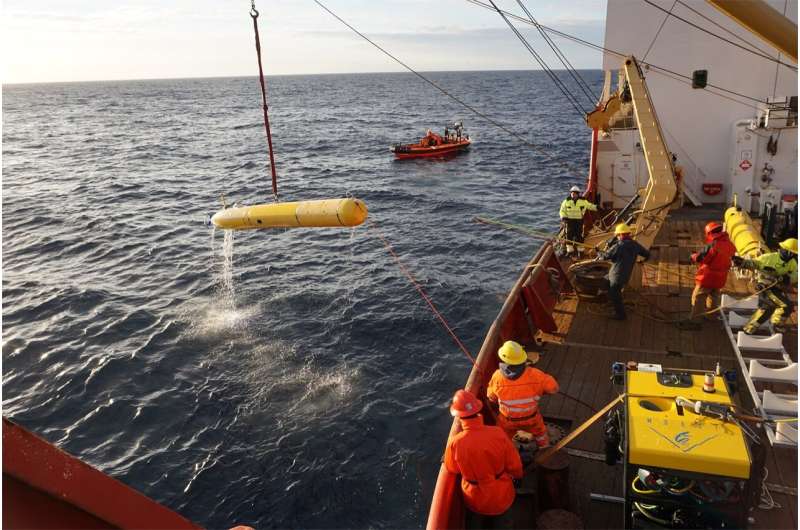
MBARI’s autonomous underwater vehicle (AUV) is recovered after completing a successful
 seafloor mapping mission in the Arctic Ocean. The remotely operated vehicle (ROV, 
foreground) is used to conduct visual surveys of the newly mapped seafloor. 
Credit: Charlie Paull © 2016 MBARI

A new study from MBARI researchers and their collaborators is the first to document how the thawing of permafrost, submerged underwater at the edge of the Arctic Ocean, is affecting the seafloor. The study was published in the Proceedings of the National Academy of Sciences on March 14, 2022.

Numerous peer-reviewed studies show that thawing permafrost creates unstable land which negatively impacts important Arctic infrastructure, such as roads, train tracks, buildings, and airports. This infrastructure is expensive to repair, and the impacts and costs are expected to continue increasing.

Using advanced underwater mapping technology, MBARI researchers and their collaborators revealed that dramatic changes are happening to the  as a result of thawing permafrost. In some areas, deep sinkholes have formed, some larger than a city block of six-story buildings. In other areas, ice-filled hills called pingos have risen from the seafloor.

"We know that big changes are happening across the Arctic landscape, but this is the first time we've been able to deploy technology to see that changes are happening offshore too," said Charlie Paull, a geologist at MBARI and one of the lead authors of the study. "This groundbreaking research has revealed how the thawing of submarine permafrost can be detected, and then monitored once baselines are established."

While the degradation of terrestrial Arctic permafrost is attributed in part to increases in mean annual temperature from human-driven climate change, the changes the research team has documented on the seafloor associated with submarine permafrost derive from much older, slower climatic shifts related to our emergence from the last ice age. Similar changes appear to have been happening along the seaward edge of the former permafrost for thousands of years.

"There isn't a lot of long-term data for the seafloor temperature in this region, but the data we do have aren't showing a warming trend. The changes to seafloor terrain are instead being driven by heat carried in slowly moving groundwater systems," explained Paull.
First-of-its-kind research reveals rapid changes to the Arctic seafloor as submerged permafrost thaws
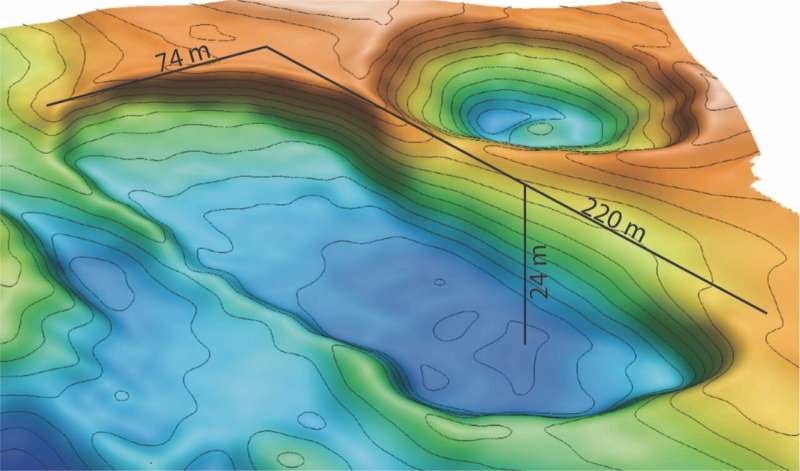
Repeated mapping surveys with MBARI’s autonomous underwater vehicles (AUVs) 
revealed a massive sinkhole developed over just nine years.
 Credit: Eve Lundsten © 2022 MBARI

"This research was made possible through international collaboration over the past decade that has provided access to modern marine research platforms such as MBARI's autonomous robotic technology and icebreakers operated by the Canadian Coast Guard and the Korean Polar Research Institute," said Scott Dallimore, a research scientist with the Geological Survey of Canada, Natural Resources Canada, who led the study with Paull. "The Government of Canada and the Inuvialuit people who live on the coast of the Beaufort Sea highly value this research as the complex processes described have implications for the assessment of geohazards, creation of unique marine habitat, and our understanding of biogeochemical processes."

Background

The Canadian Beaufort Sea, a remote area of the Arctic, has only recently become accessible to scientists as  drives the retreat of sea ice.

Since 2003, MBARI has been part of an  to study the seafloor of the Canadian Beaufort Sea with the Geological Survey of Canada, the Department of Fisheries and Oceans Canada, and since 2013, with the Korean Polar Research Institute.

MBARI used autonomous underwater vehicles (AUVs) and ship-based sonar to map the bathymetry of the seafloor down to a resolution of a one-meter square grid, or roughly the size of a dinner table.

Paull and the team of researchers will return to the Arctic this summer aboard the R/V Araon, a Korean icebreaker. This trip with MBARI's long-time Canadian and Korean collaborators—along with the addition of the United States Naval Research Laboratory—will help refine our understanding of the decay of submarine .

Two of MBARI's AUVs will map the seafloor in remarkable detail and MBARI's MiniROV—a portable remotely operated vehicle—will enable further exploration and sampling to complement the mapping surveys.Researchers discover mysterious holes in the seafloor off Central California

More information: Rapid seafloor changes associated with the degradation of Arctic submarine permafrost, Proceedings of the National Academy of Sciences (2022). DOI: 10.1073/pnas.2119105119

Journal information: Proceedings of the National Academy of Sciences 

Provided by Monterey Bay Aquarium Research Institute 

Melting Permafrost Is Creating Giant Craters And Hills On The Arctic Seafloor


By Stephen Luntz

15 MAR 2022, 08:36


Submarine surveys of the seafloor beneath the Arctic Ocean have revealed deep craters appearing off the Canadian coastline. The scientists involved attribute these to gasses released as permafrost melts. The causes, so far, lie long before humans started messing with the planet’s thermostat, but that could be about to change.

For millions of years, soil has been frozen solid over large areas of the planet, both on land and under the ocean, even where snow melts at the surface to leave no permanent ice sheet. Known as permafrost, this frozen layer traps billions of tonnes of carbon dioxide and methane. It is thought the sudden melting of similar areas around 55 million years ago set off the Palaeocene-Eocene Thermal Maximum, when temperatures rose sharply over the space of a few thousand years.

Now the permafrost is melting again, revealed in plumes of bubbles coming to the surface in shallow oceans, the collapsing of Arctic roadsruined scientific equipment, and great craters that suddenly appeared in Siberia. For the first time, scientists have revealed in Proceedings of the National Academy of Sciences what all this is doing to part of the Arctic Ocean’s seafloor.

Dr Charles Paull of Monterey Bay Aquarium Research Institute and co-authors ran four surveys of the storied Beaufort Sea between 2010 and 2019 using autonomous underwater vehicles assisted by icebreakers at the surface. They restricted their observations to depths between 120 and 150 meters (400-500 feet) as in most places this captures the permafrost's outer margin.

The paper reports numerous steep-sided depressions up to 28 meters (92 feet), along with ice-filled hills up to 100 meters (330 feet) wide known as pingos. Some of these, including a deep depression 225 meters (738 feet) long and 95 meters (312 feet) across, appeared between successive surveys, rather than being long-standing features. Others expanded in the time the team were watching.

The depressions are the result of groundwater ascending up the continental slope. Sometimes the groundwater freezes from contact with colder material, causing the ground surface to heave upwards and produce pingos.

“We know that big changes are happening across the Arctic landscape, but this is the first time we’ve been able to deploy technology to see that changes are happening offshore too,” Paull said in a statement. “This groundbreaking research has revealed how the thawing of submarine permafrost can be detected, and then monitored once baselines are established.”

The research was possible because the Beaufort Sea, once too icebound for research like this, is melting fast. That trend is, the authors agree, a consequence of human emissions of Greenhouse gases. The same goes for the widespread disappearance of permafrost on land.

However, the extra heat those gasses put into the global system has yet to penetrate to the depths Paull and co-authors were studying. Here, temperatures operate on a much slower cycle, buffered by so much water, and are still responding to the warming that took place as the last glacial era ended. At the current rate, it would take more than a thousand years to produce the topography the team observed.

“There isn’t a lot of long-term data for the seafloor temperature in this region, but the data we do have aren’t showing a warming trend,” Paull said. “The changes to seafloor terrain are instead being driven by heat carried in slowly moving groundwater systems.”

The natural melting of Ice Age permafrost releases gasses that warm the planet, part of a reinforcing interglacial era cycle, but the effect is slow enough to present little problem for humans or other species. As human-induced atmospheric heat permeates the oceans at these levels things could accelerate dramatically, and the authors see their work as establishing a baseline so we know if that occurs.


Giant, 90ft Deep Craters Are Appearing on the Arctic Seafloor

ON 3/14/22 

Enormous craters measuring 90 feet in depth have appeared on the seafloor of the Arctic Ocean.

The craters, scientists say, are forming as a result of thawing submerged permafrost on the edge of the Beaufort Sea in northern Canada, with retreating glaciers from the last ice age driving the change and not recent climate warming.

Permafrost is ground that is permanently frozen—in some cases for hundreds of thousands of years. In the Arctic, which is warming faster than any other region of Earth, permafrost is thawing, causing the ground to become unstable.

As the soil thaws, organic matter trapped within starts to break down, causing the release of methane and other greenhouse gasses. As these gasses are released, pressure builds.

On land, the impact is clear. In Siberia, there is footage showing the land wobbling "like jelly" beneath people's feet.

Eventually, when the pressure reaches a tipping point, the land explodes, leaving massive craters behind. One person who witnessed this happening described it as being "as if the earth was breathing."


What happens when permafrost on the bottom of the sea thaws is less clear, however.

In 2019, scientists in Siberia discovered a patch of ocean where the sea was "boiling" with methane, with concentrations of the gas around seven times higher than the global average.

Two years earlier, a different team of researchers found evidence of huge craters—some over 3,000 feet wide—on the floor of the Barents Sea, north of Norway and Russia. They said these craters had formed as a result of methane explosions that took place thousands of years earlier
.
To better understand what impact thawing permafrost is having beneath the ocean, researchers led by Charles K. Paull, a senior scientist at California's Monterey Bay Aquarium Research Institute, used advanced mapping technology to observe changes to the seafloor over the course of a decade.

They conducted surveys in the Beaufort Sea between 2010 and 2019 to map topographical changes resulting from thawing permafrost.

Findings showed that at depths between around 400 and 500 feet, huge depressions with steep sides were forming. The largest was 90 feet deep. Their findings are published in scientific journal PNAS.

Paull told Newsweek they were shocked at their findings, with the craters far larger than they had anticipated.

He said the team does not believe the craters formed in explosive events: "The evidence suggests that the submarine features we observed forming are essentially sink-holes and retreating scarps, collapsing into void space left behind by the thawing of ice-rich permafrost."

Unlike terrestrial permafrost, climate change is not driving the seafloor to thaw. Instead, the shift is the result of older climatic shifts relating to the end of the last ice age, around 11,700 years ago. Heat is being carried to the permafrost via slow-moving groundwater systems.

The team plans to return to the Arctic this summer to look more closely at the decaying seafloor permafrost.

Julian Murton, Professor of Permafrost Science at the U.K.'s University of Sussex, who was not involved in the study, told Newsweek he was surprised at how quickly the seafloor topography had changed.

"Some changes are as rapid or even more rapid than the better-known landsurface topographic changes driven by thaw of ice-rich permafrost in the Arctic," he said. "I had assumed that thermal inertia associated with thick relict permafrost and with overlying seawater led to slow changes in seafloor topography.

"Clearly this assumption is shown to be wrong, at least locally, by this fascinating, high-resolution study."

Paull said the longer term consequences of seafloor permafrost thaw is unclear: "Since some methane is trapped in permafrost, thawing permafrost inevitably releases methane, an important greenhouse gas," he said.

"However, we don't have data to understand whether the rate of methane release from decaying submarine permafrost has changed in recent times in this area.

"The changes we've documented derive from much older, slower climatic shifts related to Earth's emergence from the last ice age, and appear to have been happening along the edge of the permafrost for thousands of years. Whether anthropogenic climate change will accelerate the process remains unknown."

Researchers observed huge sinkholes appearing on the ocean floor over a nine-year survey


Ban Ki-moon warns UK against fracking as world stands at ‘dangerous’ point

Former UN secretary general says countries face stark choices brought on by the war in Ukraine

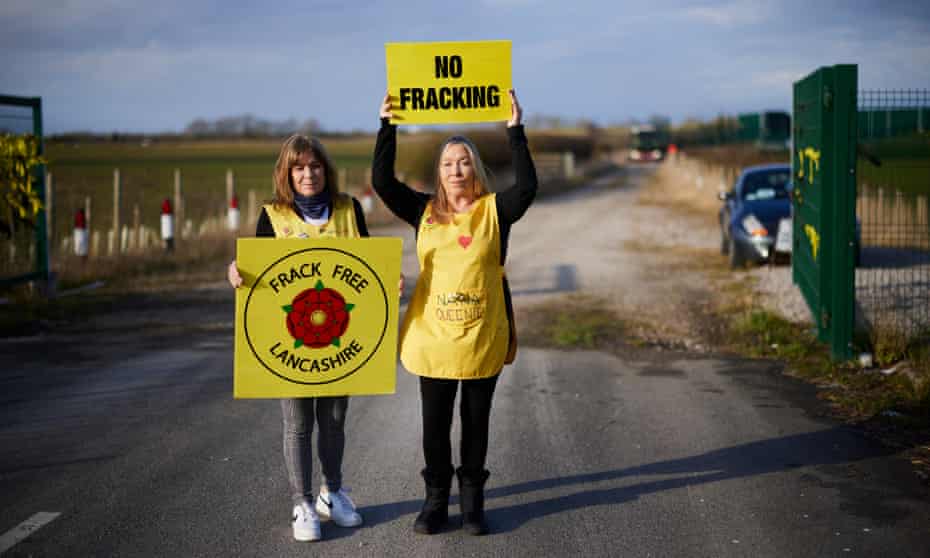
Sisters Julie Daniels and Tina Rothery campaign against Cuardrilla’s Preston New Road test site near Blackpool. 
Photograph: Christopher Thomond/The Guardian

Fiona Harvey 
Environment correspondent
Sun 13 Mar 2022 15.42 GMT

The former UN secretary general has warned the UK against fracking, as the world stands at a “dangerous” point in the climate crisis, brought on by the invasion of Ukraine.

Ban Ki-moon, now deputy chair of the Elders group of former world statespeople and public figures, said countries faced stark choices as a result of the Ukraine war and energy crisis, and must embrace renewable energy instead of returning to fossil fuels.

“I think it’s dangerous – just look at the IPCC [Intergovernmental Panel on Climate Change] report,” he said, referring to the latest warning from scientists last month. “There is no time for us to lose. Even under normal conditions [before the Ukraine war] we were far behind the pace.”

He called on the Russian president, Vladimir Putin, to end the war. “President Putin, if he is a man of global vision, or humanity, or compassion, he must stop. Whatever grievances he may have and concerns he may have, he can negotiate later rather than killing people.”

He warned that the Ukraine war, as well as being “outrageous in the 21st century”, would have an impact on the climate crisis. Governments should not try to secure greater supplies of fossil fuels, he urged, as they sought alternatives to imports of Russian oil and gas, on which the EU, the US and the UK have now placed restrictions.

“This [war] will impact the international community’s effort to address climate issues, and the pandemic issues,” he said in an interview. “I am concerned that some European countries are even now considering how to address oil and energy shortages [by seeking] exports of some other [sources of] gas or oil. In the UK, there is some idea of releasing the ban on fracking. These are very short term, unproductive ideas.”

Fracking in the UK would be “not a good idea”, he added. “It’s very short term gain that will lose the long term interest of humanity. I hope the politicians have some longer vision for the benefit of the whole world.”

The UK government signalled this week that fracking was still a possibility, though an unlikely one. Ministers have come under pressure to back fracking, from some backbenchers and sections of the media, even though it is unlikely to be economically viable and would do nothing to ease the current crisis as it would take years to produce any gas.

Meanwhile, the EU set out plans last week to cut dependency on Russian oil and gas by two-thirds by the end of this year. Some of the slack will be taken up by seeking other suppliers, such as shipments of liquefied natural gas (LNG), and by an expansion of renewable energy and push for greater energy efficiency.

But expanding domestic fossil fuels, such as coal, may also be seen as a possibility if Vladimir Putin goes further and cuts off more supplies to Europe. Ban said that Germany, which has been phasing out coal, should not return to fossil fuels: “Germany is the biggest economic power in Europe – they should not take this as a kind of short term political gain.”

Ban also urged countries to consider nuclear energy, which he said would be a “wise choice”. He said: “There has been some debate and controversy on whether to use nuclear energy or not. But if we use a good energy mix, with renewable energy, nuclear energy and other clean sources of energy, that’s the way we can meet the target of carbon neutrality … We have to use nuclear energy.”

The war in Ukraine would affect preparations for Cop27, the next UN climate summit, set to take place in Egypt this November, he warned. “This is an issue for humanity and our planet Earth. This has nothing to do with politics,” said Ban. “But in reality this may be affected [by the war in Ukraine].”

Ban visited the UK on Friday to give a lecture at the Oxford Centre for Islamic Studies and speak to Alok Sharma, the UK president of Cop26 who will continue to lead the UN negotiations until this November, but their meeting had to take place online because Sharma has contracted Covid-19.

Ban urged rich countries to prepare for Cop27 by providing more financial assistance to developing world governments to adapt to the impacts of climate breakdown, such as extreme weather, droughts, floods, heatwaves and sea level rises. “World leaders should really feel a sense of global responsibility, global justice and global humanity, and a sense of compassion for those people [affected by climate breakdown],” he said.

“We have to listen to the recommendations of the IPCC and the scientists. It’s much more important than politics,” he said.

Ban also said he was angry at countries’ handling of the Covid-19 pandemic in its early stages, seeing a “lack of multilateralism” in the approach countries took after the outbreak was confirmed. He was also scathing about the role of the World Bank in the pandemic, saying it had not done enough.

“This is a serious issue, this is a lack of multilateralism. So I am, as a former secretary general, really angry that we should suffer like this, because the initial preventive measures have not been taken properly,” he said.

This article was amended on 14 March 2022 to locate Ban Ki-moon’s lecture at the Oxford Centre for Islamic Studies rather than the University of Oxford.
Blow to fracking in England as only five of 138 MPs in target areas voice support

Exclusive: Survey in constituencies with fracking potential show MPs against it or wary of commenting
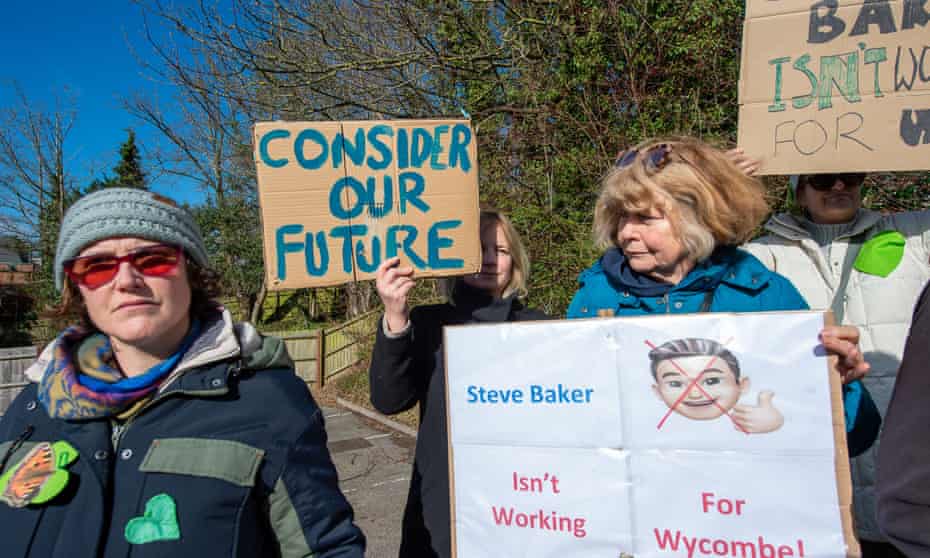
Members of the Steve Baker Watch protesting against the MP’s views outside the Conservative Association in High Wycombe in February. Baker has complained of ‘hysterical misinformation’ over fracking.
 Photograph: Maureen McLean/Rex/Shutterstock


Helena Horton and Damian Carrington
Tue 15 Mar 2022

The prospect of fracking in England has been dealt another blow as only a handful of MPs for constituencies with exploration licences support the measure in their area, the Guardian can reveal.

When asked if they would support fracking in their constituencies, only five of the 138 MPs said they would. Forty one said they would be against it, while the rest did not reply, or declined to comment.

Many of the areas where fracking could be a possibility are in the “red wall”, with Conservative MPs representing those seats perhaps aware that their position could be difficult come the next general election.

One such MP, Alexander Stafford, won the 2019 election in Rother Valley, in South Yorkshire, a seat that had been Labour since it was created in 1918.

He said he was “very much against” fracking in his area, adding: “It is yesterday’s technology and will not solve our cost problems. It will take far too long to roll out. We must wean ourselves off hydrocarbons – which leave us in hock to awful dictators like Putin, or at the mercy of fluctuating international energy prices.”

At the other end of England, seats in largely Tory areas, including Surrey, Sussex and Dorset are covered by fracking licences.

Mims Davies, employment minister and MP for Mid Sussex, was clear there was no local support for fracking in her constituency or other affected areas.

She said: “I believe that shale gas exploration should only proceed with local support and as long as it is safe and environmentally responsible to the nearby communities. Alongside my own concerns about the potential impact of this type of drilling in special areas like Mid Sussex, I have previously written on behalf, and in support, of my deeply worried constituents in Cuckfield, regarding planning matters at a controversial site in the small village of Balcombe. This site is just outside of my constituency but in the Mid Sussex district.”

Environmental campaigners expressed alarm last week when the government indicated it would look again at fracking, a controversial technique designed to recover gas and oil from shale rock. Boris Johnson’s spokesperson said “all options”, including fracking, would be considered before the energy strategy, expected in the coming days, was completed.

This came after a group of backbench Conservative MPs, including members of the Net Zero Scrutiny Group, lobbied for the government to change its stance on fracking, and last week hosted members of the shale gas industry in parliament.

Steve Baker, a trustee of the climate sceptic Global Warming Policy Foundation, told reporters: “Under the government’s plans, we will need vast quantities of gas even as renewables are ramped up. It is time for all of us to listen to facts, not scare stories. The shale gas industry needs a level playing field and an end to hysterical misinformation.”

But he is unlikely to find support from colleagues in the areas covered by active onshore exploration licences, of which his constituency, Wycombe, is not one.

Local communities have protested strongly and often successfully against past fracking attempts in Lancashire, Yorkshire, Cheshire and Sussex. Their concerns included the climate crisis, earth tremors and high levels of HGV traffic – 50 a day at one proposed site, and fears of water, air and noise pollution. The problem of the disposal of contaminated water from wells has also been raised.

Fracking is not only politically difficult. Experts say that it could also be almost impossible to produce enough energy to justify the environmental and climate damage. The areas being considered for fracking are those rich in shale rocks. The Bowland shale rocks, in northern England, were formed more than 300m years ago as sediments, and organic material was buried in an ocean basin. Tectonic activity since then has folded the rocks towards the UK’s east and west coasts, making them more accessible.

But though this area contains shale gas, scientists say it will be very difficult to extract. The tectonic activity has left a complex geological situation, which makes the shales significantly harder to exploit than the simpler formations in the US. “We have the wrong kind of geology, small geological basins rather than vast tracts of identical geology,” said Prof Jon Gluyas, an energy specialist at Durham University. “We also have, to put it bluntly, the wrong kind of shale.” UK shales are rich in soft clays that do not support fractures well, unlike the “crispy” shale in the US.


In southern England, the shale in the Weald basin is also of marine origin but formed between 200m and 145m years ago. The rocks could only produce shale oil, not gas, as they have not been buried deeply enough, and overall the British Geological Survey does not consider the basin a strong prospect.

A firm figure for how much gas could be produced by fracking is unknown, and scores of wells would need to be drilled to find out. The best current estimate indicates about five years’ worth at the UK’s current usage, though some people in the industry cite a figure of 50 years. UK shale gas production would not be able to dent the global price of gas, even if thousands of wells were drilled over the next decade, and some would be likely to be exported.

Most experts say increasing the energy efficiency of homes and producing more cheap wind and solar power are the fastest and most effective way to deal with the energy and climate crises.

Third Energy, one the main companies that had pursued fracking, now has “absolutely no interest in fossil gas” and is targeting renewable energy and using its wells to test the burial of carbon dioxide. Another high-profile firm, Cuadrilla, will need to begin permanently sealing up its two wells in Lancashire this week to meet a legal deadline. “The inconvenient fact, like it or not, is that the UK has not discovered any good shale for onshore gas production,” said Prof Stuart Haszeldine, at the University of Edinburgh.

A government spokesperson did not rule out resuming support for fracking. They said: “In light of Russia’s unjustified invasion of Ukraine and rising global gas prices, it’s right we move away from dependence on Russian gas and increase our self-reliance in our energy security. We are considering all our options. We will set out an energy supply strategy which will supercharge our renewable energy and nuclear capacity as well as supporting our North Sea oil and gas industry.”

The spokesperson said gas produced by the UK typically had a lower environmental footprint than imports of liquid natural gas from abroad.

 Saskatchewan

U of S research seeks to convert agriculture, forestry leftovers into fuel

Natural gas from plant matter is seen as less harmful to the environment because it's made from material that naturally emits methane as it decays.

Article content

Tonnes of biomass from Saskatchewan’s farming and forestry sectors are left to decay naturally each year. Dr. Ajay Dalai, a professor at the University of Saskatchewan’s College of Engineering, is working with Calgary-based company Tidewater Renewables on a three-year project looking at ways to convert it into methane.

The resulting product, known as renewable natural gas or biomethane, is identical to the methane in natural gas used for generating heat and power. He spoke to Postmedia News about his work.

Q: Why would we want to make methane out of biomass when we know methane is one of the worst contributors to climate change?

A:  What happens when we have bioresidue either from forestry or from agriculture, we store that carbon and then carbon eventually degrades to produce methane, and that methane has 21 times more greenhouse gas effect than carbon dioxide. So if we harvest that carbon as biomethane and utilize it, we not only utilize that for energy but also prevent it to rot and produce the natural methane that is emitted by itself. So why not take that solid carbon, produce biomethane, utilize that for energy and then emit it as CO2?

And when you burn biomethane, for example at a power plant, then it produces carbon dioxide that can be captured more easily and, I think, can be stored underground if necessary. There are ways to use that carbon dioxide — making some chemicals, for example — rather than letting the biomass rot on its own and produce methane that has no value to anyone but also creates a problem for the environment.

Q: What’s the goal of your project?

A: I think the economics really dictates which way the industry goes. I think the goal here is to provide a technology that can compete with the natural gas processing industry to see if it makes sense to increase the biomethane into that (natural gas) network. So, I think the economics will dictate, the technology will dictate (the industry) and that’s where our focus is: what we can do to compete with natural gas and get biomethane from the biomass that we have on the ground?

Advertisement 3

Article content

Q: If all goes well, how long do you think it would take for a biomethane industry to form here?

No matter what technology we develop, it has to be scaled up in a pilot plant to generate more reliable data that is needed for further scaling up in industry. So there are a few steps in between.

We’re looking at about three years to generate some meaningful data and make reasonable recommendations for industry to take it and make a pilot plant, and then look at the economics at that point and then move forward. So, I think we’re looking at at least five to 10 years down the road that something may come up with this industry.

I think for an industry to exist, or to take data from a lab and make money, it typically takes five to 10 years. So I think that’s what timeline we’re looking at.

Strongest low on Earth last weekend was a record-breaker in Canada

Monday, March 14th 2022, 8:59 pm - A powerful system that pushed across Eastern Canada last weekend underwent rapid intensification, enough so to set new records at three stations and bring the lowest pressure on Earth at the time to a part of the region.

Not a common occurrence when a part of Canada has experienced the lowest pressure on the planet at any given time, but that's what happened on the weekend.

A powerful low-pressure system that pushed across Eastern Canada underwent rapid intensification, breaking three records -- two monthly and one all-time.

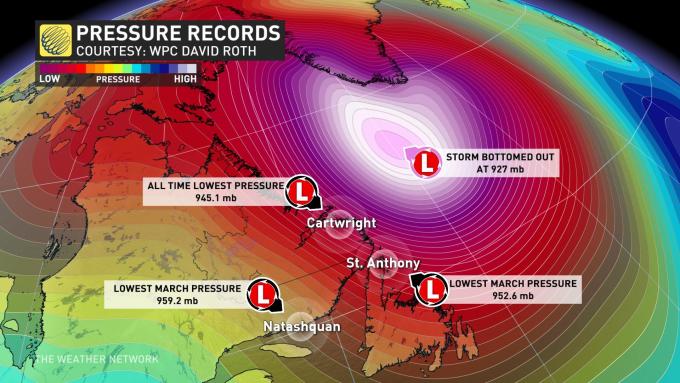
At one point on the weekend, the low bottomed out at a reading of 927 millibars just north of Labrador in the Atlantic Ocean, away from any stations.

PRESSURERECORD

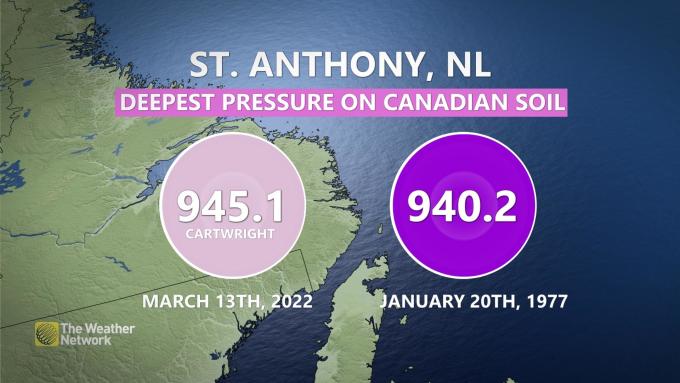
The new Canadian low-pressure records were in St. Anthony, N.L. (monthly; 952.6 mb), Natashquan, Que. (monthly; 959.2 mb) and Cartwright, N.L. (all-time; 945.1 mb). Natashquan's new record occurred at 11:35 p.m. on Saturday, March 12, while St. Anthony and Cartwright was observed on Sunday, March 13.

Meanwhile, a few other stations came close to breaking the record, but didn't quite make it.

STATIONS REPORTING LOW PRESSURES

The following stations recorded low pressures on the weekend, with the locales marked with * having established a new record.

  • Hopedale, N.L. -- 952.2 mb (March record), 970 mb (March 2022)
  • St. Anthony, N.L. -- 957.5 mb (March record), 952.6 mb (March 2022)*
  • Gander, N.L. -- 954.1 mb (March record), 963.1 mb (March 2022)
  • Cartwright, N.L. -- (March record not known) 945.1 mb (March 2022)*
  • Natashquan, Que. -- 962 mb (March record), 959.2 mb (March 2022)*
  • Sept-ÃŽles, Que. -- 970.5 mb (March record), 974.2 mb (March 2022)
  • Gaspé Peninsula, Que. -- 966.3 mb (March record), 968.7 mb (March 2022)

PRESSURE2

Gaspé Peninsula did not manage to set a new record, but if the system had tracked 100 kilometres farther to the west it might have happened as the centre of the low was down to 965 mb when it passed by

At the time, there was another major storm in the Northern Hemisphere, south of Alaska, but it didn't compare "pressure-wise" to the Atlantic Canada low, according to Kevin MacKay, a meteorologist at The Weather Network.

"This was the strongest storm on the planet [last] weekend," said MacKay.

HOW DOES IT COMPARE TO HIGH-PRESSURE RECORDS?

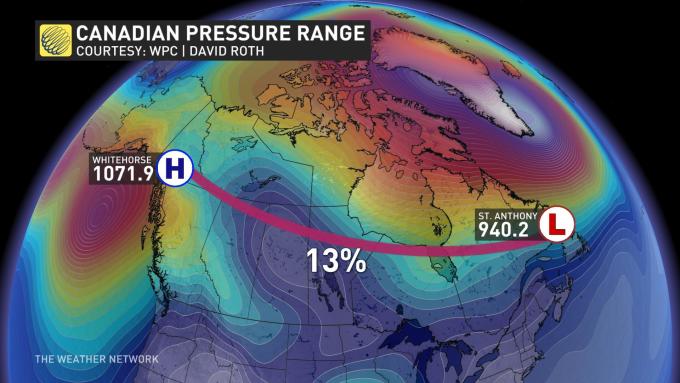
On the opposite end of the country, Whitehorse, Yukon, recorded its highest pressure of 1071.9 mb in February 1989. Meanwhile, the Canadian record for the lowest pressure observed belongs to Newfoundland's St. Anthony, dropping to 940.2 mb on Jan. 20. 1977.

PRESSURERECORDS

Tyler Hamilton, a meteorologist at The Weather Network, highlighted a memorable low-pressure event on Oct. 24, 2021 in the Pacific Northwest. The significant windstorm generated a pressure of 942 mb, costing millions of dollars in damage along the West Coast, stretching towards California.

To put Canada's current low-pressure record into perspective, a Category 3 hurricane can generate a low pressure from 945-964 millibars, while a Category 4 can drop the levels to within the 920-944 millibars range.

If last weekend's storm recorded the 927 mb figure over St. Anthony or Cartwright in Newfoundland, it would have generated a new all-time Canadian record for a low pressure.

With files from Matthew Grinter, Kevin MacKay and Tyler Hamilton, meteorologists at The Weather Network.

Follow Nathan Howes on Twitter.

Visit our Complete Guide to Spring 2022 for an in-depth look at the Spring Forecast, tips to plan for it and much more!

Anonymous declared a 'cyber war' against Russia. Here are the results

Monica Buchanan Pitrelli 1 hr ago

More than three weeks ago, a popular Twitter account named "Anonymous" declared that the shadowy activist group was waging a "cyber war" against Russia.
Since then, the account has claimed responsibility for disabling prominent Russian government, news and corporate websites and leaking data from entities such as Roskomnadzor, the federal agency responsible for censoring Russian media.

© Provided by CNBC Though a flood of claims by hacking groups followed Russia's invasion of Ukraine, one study shows most made by Anonymous check out.

More than three weeks ago, a popular Twitter account named "Anonymous" declared that the shadowy activist group was waging a "cyber war" against Russia.

Since then, the account — which has more than 7.9 million followers, with some 500,000 gained since Russia's invasion of Ukraine — has claimed responsibility for disabling prominent Russian government, news and corporate websites and leaking data from entities such as Roskomnadzor, the federal agency responsible for censoring Russian media.

But is any of that true?


It appears it is, says Jeremiah Fowler, a co-founder of the cybersecurity company Security Discovery, who worked with researchers at the web company Website Planet to attempt to verify the group's claims.

"Anonymous has proven to be a very capable group that has penetrated some high value targets, records and databases in the Russian Federation," he wrote in a report summarizing the findings.

Hacked databases

Of 100 Russian databases that were analyzed, 92 had been compromised, said Fowler.

They belonged to retailers, Russian internet providers and intergovernmental websites, including the Commonwealth of Independent States, or CIS, an organization made up of Russia and other former Soviet nations that was created in 1991 following the fall of the Soviet Union.

Many CIS files were erased, hundreds of folders were renamed to "putin_stop_this_war" and email addresses and administrative credentials were exposed, said Fowler, who likened it to 2020's malicious "MeowBot" attacks, which "had no purpose except for a malicious script that wiped out data and renamed all the files."

Another hacked database contained more than 270,000 names and email addresses.

"We know for a fact that hackers found and probably accessed these systems," said Fowler. "We do not know if data was downloaded or what the hackers plan to do with this information."

Other databases contained security information, internal passwords and a "very large number" of secret keys, which unlock encrypted data, said Fowler.

As to whether this was the work of Anonymous, Fowler said he followed Anonymous' claims "and the timeline matches perfect," he said.
Hacked TV broadcasts and websites

The Twitter account, named @YourAnonNews, has also claimed to have hacked into Russian state TV stations.

"I would mark that as true if I were a factchecker," said Fowler. "My partner at Security Discovery, Bob Diachenko, actually captured a state news live feed from a website and filmed the screen, so we were able to validate that they had hacked at least one live feed [with] a pro-Ukrainian message in Russian."

© Provided by CNBC The English-language Russian news website RT

The account has also claimed to have disrupted websites of major Russian organizations and media agencies, such as the energy company Gazprom and state-sponsored news agency RT.

"Many of these agencies have admitted that they were attacked," said Fowler.

He called denial of service attacks — which aim to disable websites by flooding them with traffic — "super easy." Those websites, and many others, have been shuttered at various points in recent weeks, but they are also reportedly being targeted by other groups as well, including some 310,000 digital volunteers who have signed up for the "IT Army of Ukraine" Telegram account.

False claims by other groups

Fowler said he didn't find any instances where Anonymous had overstated its claims.

But that is happening with other hacktivist groups, said Lotem Finkelstein, head of threat intelligence and research at the cybersecurity company Check Point Software Technologies.

In recent weeks, a pro-Ukrainian group claimed it breached a Russian nuclear reactor, and a pro-Russian group said it shut down Anonymous' website. Check Point concluded both claims were false.

"As there is no real official Anonymous website, this attack … appears to be more of a morale booster for the pro-Russian side, and a publicity event," CPR said, a fact which did not go unnoticed by Anonymous affiliates, who mocked the claim on social media.

Groups are making fake claims by posting old or publicly available information to gain popularity or glory, said Finkelstein.

Fowler said he feels Anonymous is, however, dedicated more to the "cause" than to notoriety.

"In what I saw in these databases, it was more about the messaging than saying 'hey, you know, Anonymous troop No. 21, group five, did this,'" he said. "It was more about the end result."

A cyber 'Robin Hood'

Hacktivists who conduct offensive cyber warfare-like activities without government authority are engaging in criminal acts, said Paul de Souza, the founder of the non-profit Cyber Security Forum Initiative.

Despite this, many social media users are cheering Anonymous' efforts on, with many posts receiving thousands of likes and messages of support.

"They're almost like a cyber Robin Hood, when it comes to causes that people really care about, that no one else can really do anything about," said Fowler. "You want action now, you want justice now, and I think groups like Anonymous and hacktivists give people that immediate satisfaction."

Many hacktivist groups have strong values, said Marianne Bailey, a cybersecurity partner at the consulting firm Guidehouse and former cybersecurity executive with the U.S. National Security Agency. Cyber activism is a low-cost way for them to influence governmental and corporate actions, she said.

"It is protesting in the 21st century," said Bailey.

Read more

'For the first time in history anyone can join a war': Volunteers join Russia-Ukraine cyber fight

Global hacking group Anonymous launches ‘cyber war’ against Russia

Yet cheering them on can be dangerous in the "fog of war," she said.

"A cyberattack has the potential for such an immediate impact, in most cases well before any accurate attribution can be determined," she said. "A cyber strike back or even kinetic strike back could be directed to the wrong place. And what if that misattribution is intentional? What if someone makes the attack appear from a specific country when that's not true?"

She said cyber warfare can be cheaper, easier, more effective and easier to deny than traditional military warfare, and that it will only increase with time.

"With more devices connected to this global digital ecosystem the opportunity for impact continues to expand," she said. "It will undoubtedly be used more often in future conflicts."

Union has yet to issue strike notice against CP in Canada (updated and corrected)

By | March 15, 2022

Teamsters Canada Rail Conference must provide 72-hour notice before walkout


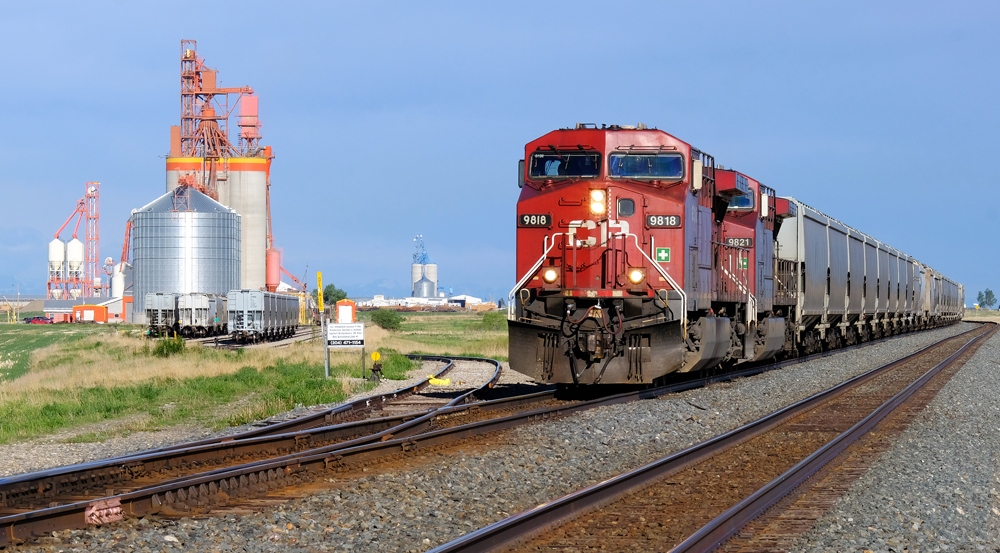
Train of hopper cars with grain elevator in background
An empty Canadian Pacific grain train delivers hoppers to the Pioneer and Cargill elevators at Carsland, Alberta, on June 7, 2021. The Canadian agriculture industry is concerned about the impact of a potential strike. (Jerry Clement)

CALGARY — While Canadian Pacific workers in Canada have authorized a strike that could have begun as soon as tonight, their union has yet to provide the 72-hour notice necessary before walking out.

Canadian agriculture and industry remain concerned about the potential impact of a walkout, and the railroad says on its website that a strike “will impact virtually all commodities within the Canadian supply chain, thereby crippling the performance of Canada’s trade-dependent economy.”

The Teamsters Canada Rail Conference said earlier this month that 96% of its members had voted to authorize a strike, and at the time said union members should be prepared for a walkout as soon as 12:01 a.m. on March 16 [see “Teamsters Canada vote approves strike …,” Trains News Wire, March 3, 2022]. The union represents more than 3,000 CP engineers, conductors, crew members and yard personnel.

The union had requested mediation in December and filed an unfair labor practice complaint with the Canadian Industrial Relations Board in January. Mediation is ongoing, the website Western Producer reports.

The last three negotiations with the Teamsters have resulted in work stoppages, most recently in 2018, when an agreement was reached hours after the walkout began. CP says it has not had a strike involving any other union since 2011.

The Canadian Press reports that Fertilizer Canada, a trade group representing manufacturers and wholesale and retail distributors of fertilizer, says a strike could be “crippling” during farmers’ spring seeding season. Some 75% of fertilizer used by Canadian farmers is shipped by rail, and no transportation option has the capacity or can pick up the rail share on short notice.

The world’s largest fertilizer firm, Nutrien, previously asked the Canadian government to take action to prevent a strike [see “Fertilizer firm asks Canadian government to block rail strike,” News Wire, March 4, 2022].

Cattle producers are also saying they face a feed shortage as a result of a drought that led to reduced crop yields last summer, and have been relying on CP for shipments of corn from the U.S.

The president of the Canadian Manufacturers and Exporters association says 90% of its members have experienced supply-chain issues over the last 12 months and cannot afford another interruption.

Even U.S. legislators are asking the Canadian government to act. In a letter today to Canadian Prime Minister Justin Trudeau, U.S. Sen. Kevin Cramer (R-N.D.) has asked  Trudeau and his cabinet to block the strike, citing both the fertilizer issue and CP’s business moving crude oil from Alberta to U.S. refineries. “Shutting down North America’s essential rail supply chain would create a capacity crisis … that will have a profound impact on our nation’s agriculture and energy industries.”

The letter was cosigned by Sens. Steve Daines (R-Mont.), Mike Braun (R-Ind.), and John Hoeven (R-N.D.)

— Updates and corrects to note strike cannot begin tonight; additional details added at 11:55 a.m. CDT.

In Hay River, pond hockey reflects a climate crisis

Published: March 14, 2022 


An Edmonton Oilers mainstay of the 1980s, Craig MacTavish grew up playing pond hockey in London, Ontario, where he honed his skills and developed a love for the sport.

Hockey players at the 2022 Polar Pond Hockey tournament in Hay River. 
Emily Blake/Cabin Radio

MacTavish’s route into the game may not exist much longer. As the climate changes, Canada’s ability to sustain outdoor hockey is measurably decreasing. (Environmental scientists even track conditions at hundreds of backyard rinks.)

“That’s how you get good,” MacTavish, now 63, said of outdoor makeshift rinks as he attended Hay River’s Polar Pond Hockey this past weekend.

“You’re handling the puck, you’re outdoors, there’s lots of camaraderie, lots of competition … It’s something really deeply rooted in the fabric of Canadians.”

The disappearance of outdoor rinks is of such concern in Canada that a program part-funded by the federal government, the Climate and Sport Initiative, has begun backing Save Pond Hockey events devoted to educating people about the climate crisis through sport. Though Polar Pond Hockey has existed in its own right for years, this year’s event also carried the Save Pond Hockey banner.

Bruce Dudley, representing the Climate and Sport Initiative, recalled a conversation with Wayne Gretzky about backyard rinks.

“He spent the entire time talking about when he was a kid and what it meant to him and his dad,” Dudley said.

“It was relationship-building, it was social skills-building and it was hockey skills-building.”
 
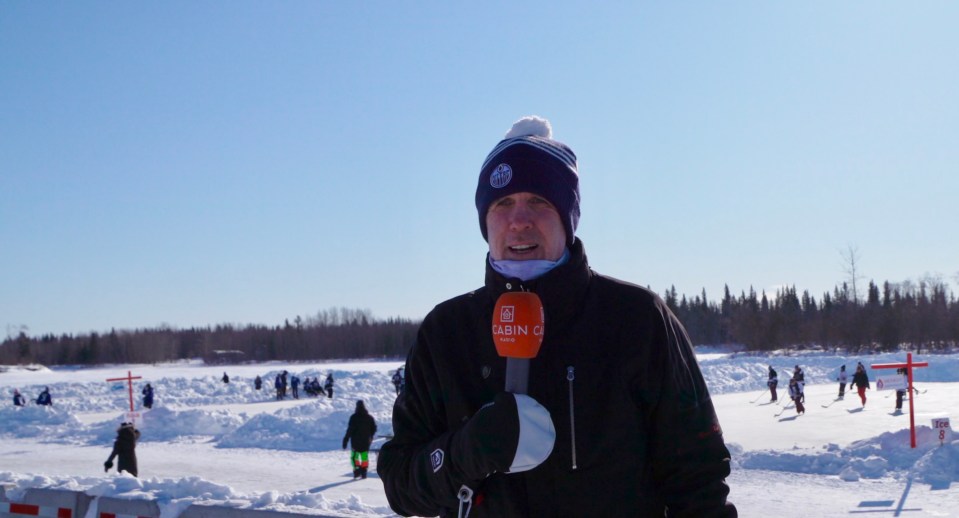
Craig MacTavish in Hay River. Emily Blake/Cabin Radio
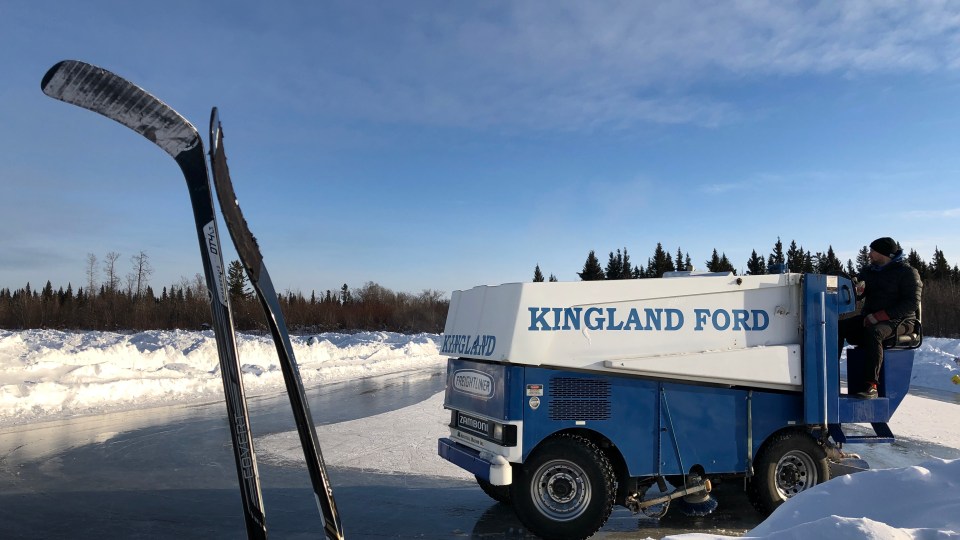
A Zamboni clears the ice at Polar Pond Hockey. Emily Blake/Cabin Radio
A photo posted to Facebook by Polar Pond Hockey organizers in March 2019, when warm weather melted the ice and forced the tournament’s abandonment.

Outdoor rinks occupy a nostalgic place in Canadian hearts. They look good. They are central to the nation’s winter-sports narrative. But Dudley argues they’re also community hubs that help kids whose families can’t afford access to other recreational sport, or who live in rural areas without facilities.

“We’re concerned that our children, or our children’s children, aren’t going to enjoy the same benefits from outdoor hockey that we did,” he said.

In Hay River, Polar Pond Hockey was cancelled by unseasonably warm weather in 2019. This year, the Arctic Energy Alliance – an NWT not-for-profit that helps residents and businesses reduce emissions and access clean-energy rebates – ran a climate and energy fair and hosted a tour of nearby energy projects.

“The North is going to see climate change first-hand,” said Terry Rowe, organizer of the tournament.

“Our water levels are rising from year to year. We had flooding last year in Old Town and it seems to be a normal thing where we don’t have clean water, because the water levels were too high.”


Save Pond Hockey began in Finland seven years ago and now coordinates pond hockey tournaments across the globe, donating a share of profits from each event to climate action.

Two other Save Pond Hockey tournaments scheduled for other parts of Canada earlier this year were cancelled because of Covid-19, making Hay River’s event the first to be held in the country.

Funds raised in Hay River will help to pay for an electric Zamboni at the town’s recreation centre.


From Helsinki to Hay River, N.W.T., a pond hockey tournament with a global goal

A pond hockey tournament that originated in Helsinki, Finland, raises money for organizations counteracting climate change. Its first Canadian iteration will take place in Hay River, N.W.T.

PETER MARTEN
SPECIAL TO THE GLOBE AND MAILPUBLISHED MARCH 13, 2022
From coast to coast, TO COAST,  pond hockey is a winter tradition for Canadians.
NATHAN DENETTE/THE CANADIAN PRESS

It’s an inspiring scene: In Helsinki, Finland, on an ice sheet the size of a football field, nine different four-on-four hockey games are happening.

The sounds echo on a cold, sunny morning: the clack of sticks on pucks, the swish of skaters turning. From atop a mountain of plowed snow from a recent storm, you can see all the action. This is a Save Pond Hockey tournament, one of several in Finland this season.

Founded in 2015, the Save Pond Hockey concept sees its breakthrough in Canada this year, in a collaboration with the Polar Pond Hockey tournament in Hay River, N.W.T., with the finals on Sunday, March 13. The Canadian organization, like its Finnish counterpart, aims to raise money and awareness of the fight against climate change. Save Pond Hockey was already a Canadian-Finnish joint venture of sorts; the co-founders are Svante Suominen of Finland and Steve Baynes of Vancouver.

Back in 2011, Suominen was a university student in Helsinki. He’d played competitive hockey as a teenager, but eventually quit. Wanting to get some exercise, he now mobilized a few buddies to play shinny at an outdoor rink.

“I started inviting all my friends and friends of friends,” he said. “We went every Monday evening, and I realized there were more people coming all the time.”

He calls it “a new start for my relationship with hockey.” He enjoyed the easygoing atmosphere of pond hockey – a term for any informal outdoor hockey, whether or not it involves a lake.

“We had so many different types of people playing together,” he said. “There was something really magical about it.”

Baynes, a stay-at-home dad at the moment, arrived in Helsinki in 2012 after two years studying corporate sustainability in Jyväskylä, in central Finland. A former classmate invited him to join the Monday games.

The players used to discuss how climate change was shortening the outdoor hockey season. Baynes had studied climate issues, and some of the others also got interested. Many remembered longer, colder winters from their childhoods – it seemed obvious that winter was changing.

They started wondering how hockey players could help fight climate change. The result emerged in 2015, when they held the first Save Pond Hockey tournament in Helsinki, aiming to make some noise about climate issues.


The President of Finland, Sauli Niinistö, plays ice hockey at the Save Pond Hockey tournament in Helsinki, Finland on Feb. 15, 2020.MIKKO STIG/GETTY IMAGES

Participation has since multiplied and nine cities around the country have hosted tournaments. In 2022, the Helsinki edition boasted 39 teams in three divisions: casual, competitive and company.

The tournaments’ profits, a grand total of more than $101,000 dollars since 2015, go to organizations counteracting climate change – everything from carbon-offset programs to wetlands restoration projects.

To attract audiences and further boost climate awareness, each Save Pond Hockey tournament opens with an exhibition game featuring hockey heroes such as former NHL players and stars from the women’s and men’s national teams. Niklas Hagman and Esa Tikkanen played this year in Helsinki, and others have included Jari Kurri and Saku Koivu. Canadian embassy staff has also joined the exhibition games.

The president of Finland, Sauli Niinistö, has participated several times. In February, 2012, shortly after he was elected to his first term, he went skating at the rink where Suominen and his friends were playing their weekly shinny.

“I was like, what, is that the president?” said Suominen. “I just went over and asked, ‘Hey, Mr. President, would you like to join our game?’ He replied, ‘Yeah, okay. Let’s play.’”
People play pond hockey on Brown's Inlet in Ottawa, on Christmas Day 2021.JUSTIN TANG/THE CANADIAN PRESS

When Save Pond Hockey held its first tournament, Suominen invited Niinistö, reminding him that they had played together. “I love living in a country and a city where that is possible,” said Suominen.

Baynes often refers to Save Pond Hockey as a movement. “Everybody’s welcome to come out and play,” he said.

Päivi Antila has been a regular at Save Pond Hockey’s Monday sessions ever since she happened to join one of their games last winter. “They’re a friendly bunch,” she said. “They consciously try to make people feel welcome.”

She’d seen them once at a climate demonstration, waving signs attached to hockey sticks, of course.

Another player is Paul Mélois, whose mother is from Montreal and whose father is French. He grew up in southern France but remembers skating outdoors during his family’s visits to Canada.

One January evening, Mélois could be found helping Baynes clear a rink on the sea ice beside the Finnish capital. Most outdoor rinks in Helsinki are artificially cooled, but during a long cold spell, connoisseurs venture out to make an all-natural playing surface.

After hours of shovelling, scraping and flooding, they finished the rink in the wee hours of the morning. About 20 friends came to play the next afternoon. “I could barely play because I was so sore [from the shovelling],” said Baynes, “but it was still super-fun.”


People play pond hockey at Vanier Park in Vancouver, after unseasonably cold temperatures caused the pond to freeze over in December 2021.
DARRYL DYCK/THE CANADIAN PRESS

People crossing a nearby pedestrian bridge got a great view. Within a few days, the temperature fluctuated and the window of opportunity for playing on natural ice was over. “Those windows used to be much larger in the past,” said Baynes.

Hay River, N.W.T., the first Canadian location to hold a tournament connected with Save Pond Hockey, rarely experiences such challenges. The town first organized Polar Pond Hockey in 2008, but one year, 2019, was unseasonably warm, reaching 13 degrees in March. “We had to cancel the event,” said Terry Rowe, head of the Polar Pond Hockey organization, “which was obviously [due to] some sort of climate change.” This year he expects about 35 teams, ten of them in the women’s division.

Save Pond Hockey and Hay River connected through Canada’s Climate and Sport Initiative, which took applications from Canadian towns seeking to host Save Pond Hockey events. Penticton, B.C., and Stonewall, Man., were also slated for this winter, but had to cancel because of COVID-19 restrictions.

For Polar Pond Hockey, adding Save Pond Hockey to its event means greater emphasis on climate. Proceeds from an auction and a climate change and energy fair will help Hay River purchase an electric Zamboni.

Just like their Finnish counterparts, they’re holding an exhibition all-star game to raise awareness. The roster includes Meghan Agosta, Craig MacTavish, Andrew Ference and Curtis Glencross, along with locally known players.

Sea ice that slowed the flow of Antarctic glaciers abruptly shatters in three days

Sea ice that slowed the flow of Antarctic glaciers abruptly shatters in three days
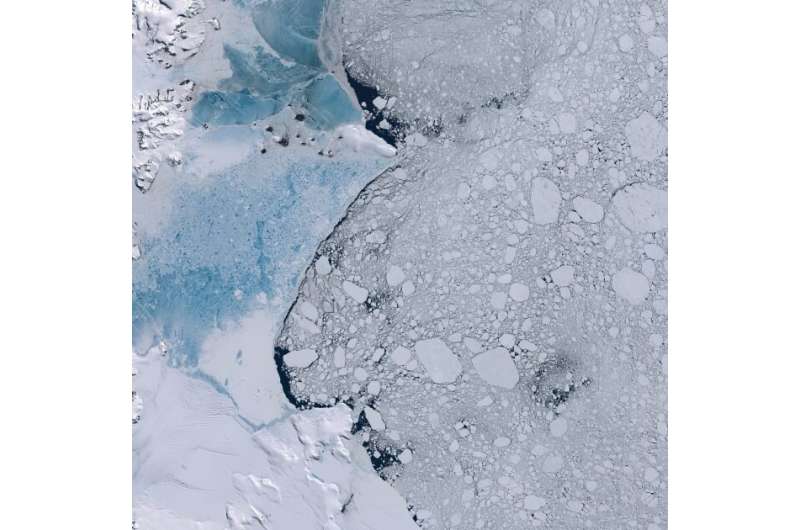
Remnants of the Larsen-B ice shelf, filled in with seasonal ice in January 2016. Until
 January 2022, sea ice helped to buttress the nearby glaciers, slowing their flow into the 
sea. Credit: O.V.E.R.V.I.E.W.

In just three days in late January, a mass of ice the size of Philadelphia fragmented from the Larsen-B embayment on the Antarctic Peninsula and floated away, after persisting there for more than a decade. NASA satellites captured the break-up between January 19 and 21, and with it saw calving of icebergs from Crane Glacier and its neighbors as the sea ice no longer buttressed their fronts. Now more vulnerable to melting and acceleration into the ocean, the glaciers that line the Antarctic Peninsula could add directly to sea level.

The Larsen Ice Shelf is situated along the northeast part of the Antarctic Peninsula, in the Weddell Sea. It is divided into four regions that occupy distinct embayments along the coastline, termed Larsen A, B, C and D running north to south, each of which has undergone its own changes in the last few decades. The great mass of the ice shelf holds back the flow of many glaciers from the steep mountains towards the sea, where they contribute to  rise. Larsen-A was the first to disintegrate in 1995, followed by the abrupt partial collapse of Larsen-B in 2002. Larsen-C was the fourth largest Antarctic ice shelf as of July 2017, when a giant iceberg, named A68, calved from it, drawing worldwide attention to the region. Being furthest south, and hence least subject to warming, the only portion to be considered relatively stable is Larsen-D.

The loss of 3,250 square kilometers of ice from the Larsen B ice shelf in 2002 has been blamed on warmer ocean waters that melted it from below, and on the presence of meltwater on its surface, which also accelerated the loss of ice. With only a remnant portion left behind following the collapse, this section was much less stable and vulnerable to further disintegration. It grew thinner, which allowed glaciers on the landward side to flow faster. Sea ice formed in the newly opened area each winter, but it was not until 2011 that the sea ice remained year round, and did not melt the following spring. Between 2011 and 2022, the glaciers were somewhat stabilized because the remnant ice-shelf and sea ice that was permanent and attached, fast to the land, blocking their path into the ocean. But this large expanse shattered within three days in January, captured by NASA's Terra and Aqua satellites.

Sea ice that slowed the flow of Antarctic glaciers abruptly shatters in three days
Satellite image of the Larsen-B ice shelf collapsing in 2002. Credit Oregon State University/Flickr

Stef Lhermitte, a professor at TU Delft, who specializes in geoscience and , explained to GlacierHub that "[it's] difficult to tell what actually caused the disintegration as the sea ice was already showing cracks prior to the breakup." Others have suggested warmer summer temperatures and foehn winds that carried warm and wet air to the region are partly responsible. The breakup of annual sea ice also occurred earlier than usual this year, which would have also helped destabilize the ice. Nonetheless, "such rapid breakups are often typical for fast ice, as fast ice is often a frozen collection of loose sea ice segments. Once this breaks, it quickly disintegrates," Lhermitte added.

The recent break-up of ice in the Larsen-B embayment is important because the large glaciers that were buttressed by the ice are now exposed to the sea. Unlike sea ice and melt from an ice shelf, glaciers add directly to sea level. Although sea ice frozen to land is not as effective as holding back the flow of glaciers than the original ice shelf that was once present in the Larsen-B embayment, it has played a role in minimizing contributions to sea level rise from the Antarctic Peninsula over the last decade.

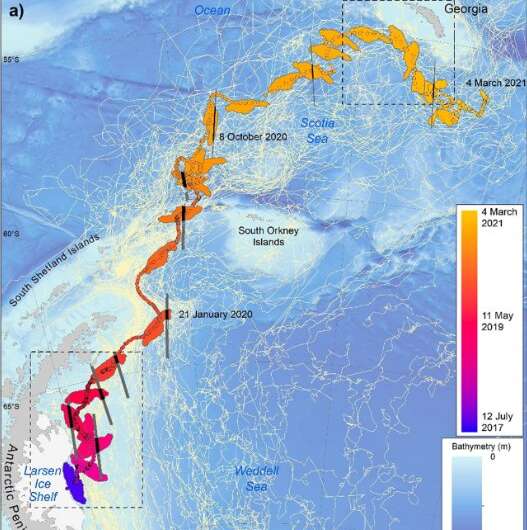
At the same time as scientists watched the breakup at Larsen-B, a new study was published that details the life cycle of the huge iceberg that calved from Larsen-C in 2017, A68. It was the sixth largest iceberg ever documented by satellite observations, comparable to the size of Delaware when it first broke from the ice shelf. A68 ceased to exist after three-and-a-half years, when it underwent rapid disintegration near the South Georgia Islands east of the southern tip of South America in January 2021.

Sea ice that slowed the flow of Antarctic glaciers abruptly shatters in three days
The path of the A68 iceberg between July 2017 and March 2021. As it drifted in the vicinity of the South Georgia islands, it is estimated to have dumped 152 billion tonnes of fresh water and nutrients into the surrounding ocean. (As seen in Figure 1). Credit: Laura Gerrish

Study lead author, Anne Braakmann-Folgmann, who has researched A68, explains that concerns were raised when it calved because "it reduced the remaining ice shelf area by a significant amount [and] Larsen-A and -B had already disintegrated." Iceberg calving is known to influence the stability of the parent ice shelf that it leaves behind, but since 2017, what is left of Larsen-C has remained stable.

With warming temperatures and changing climatic patterns, notable events along the Larsen ice shelf are predicted to occur more frequently. Scientists are able to track each section of the Larsen Ice Shelf closely, documenting  collapse, growth of sea ice and the long survival of giant icebergs which threaten distant areas. As warming continues, questions prevail over how long the Larsen-D portion will remain stable. Its location closer to the South Pole has protected it from the impacts of climate change—so far. Reducing emissions is not only important for ice on the Antarctic Peninsula, but for the larger East and West Antarctic ice sheets, too.

Image: Antarctica's changing Larsen Ice Shelf

More information: A. Braakmann-Folgmann et al, Observing the disintegration of the A68A iceberg from space, Remote Sensing of Environment (2022). DOI: 10.1016/j.rse.2021.112855

Provided by Earth Institute at Columbia University 

This story is republished courtesy of Earth Institute, Columbia University http://blogs.ei.columbia.edu.

Arctic Ice Already Thinning at a 'Frightening Rate', Satellites Reveal

(NASA/Kathryn Hansen)

DAVID NIELD
15 MARCH 2022

New satellite data has revealed the Arctic is melting at a "frightening rate" due to the excess heat caused by human greenhouse gas emissions.

End-of-season Arctic multiyear sea ice – the ice that persists over several years – was roughly 50 centimeters (1.6 feet) thinner in 2021 than it was in 2019, the figures show, a drop of around 16 percent in just three years. It's being replaced by less permanent seasonal sea ice that melts completely every summer.

Over the past 18 years, Arctic Ocean winter sea ice has lost one-third of its volume – a staggering figure that may have been underestimated in the past, says the research. It's the first study to use years of satellite data to estimate both ice thickness and the depth of snow on top.

"Arctic snow depth, sea ice thickness and volume are three very challenging measurements to obtain," says polar scientist Ron Kwok, from the University of Washington.

"The key takeaway for me is the remarkable loss of Arctic winter sea ice volume – one-third of the winter ice volume lost over just 18 years – that accompanied a widely reported loss of old, thick Arctic sea ice and decline in end-of-summer ice extent."

The data comes from the ICESat-2 and radar CryoSat-2 satellites orbiting Earth.

What makes the study important is the way it combines the LiDAR technology of ICESat-2, which was launched three years ago, and the radar technology of CryoSat-2. While LiDAR uses laser pulses and radar uses radio waves, they're both detecting objects (in this case snow and ice) based on the reflections being bounced back at them.

Without this data, judging ice thickness is tricky, because of the way that snow can weigh ice down and change how it floats in the ocean. By using climate records to estimate snow depth in the past, scientists have been overestimating sea ice thickness by up to 20 percent or 20 centimeters (0.7 feet), the study suggests.

Multiyear ice is known to be thicker and therefore more resistant to melting than seasonal ice – you can think of it as sort of a reservoir for the Arctic.

As it becomes depleted and gets replaced by seasonal ice, the overall thickness and volume of Arctic sea ice is expected to quickly decrease as well.

"We weren't really expecting to see this decline, for the ice to be this much thinner in just three short years," says polar scientist Sahra Kacimi, from the Jet Propulsion Laboratory at the California Institute of Technology.

Combining previous records from the older ICESat satellite to look back 18 years, the researchers estimate that around 6,000 cubic kilometers (1,439 cubic miles) of winter ice volume has been lost across that time span.

That the last three years has seen a sharp drop is also concerning. Less ice means massive disruption for ecosystems. It could eventually alter the pivotal ocean currents we all rely on, and most likely also accelerate the climate change that's happening all around us.

Reducing our fossil fuel emissions is the only way we can stop this and we can all still play a more powerful role than we probably realize. Even our perceptions can make a difference.

Meanwhile, it's promising that the newer ICESat-2 satellite, launched in 2018, is working as intended, and we're getting more data back about Arctic ice levels than ever before – even if it makes for grim reading.

"Current models predict that by the mid-century we can expect ice-free summers in the Arctic, when the older ice, thick enough to survive the melt season, is gone," says Kacimi.

The research has been published in Geophysical Research Letters.