Friday, April 15, 2022

FBI says North Korean hackers stole more than $800 million in cryptocurrency in single hack


By CNN Apr 15, 2022

The FBI has blamed hackers associated with the North Korean government for stealing more than $810 million in cryptocurrency last month from a video gaming company, the latest in a string of audacious cyber heists tied to Pyongyang.

"Through our investigation we were able to confirm Lazarus Group and APT38, cyber actors associated with the DPRK, are responsible for the theft of US$620 million in Ethereum reported on March 29th," the FBI said in a statement.

"DPRK" is an abbreviation for North Korea's official name, the Democratic People's Republic of Korea, and Ethereum is a technology platform associated with a type of cryptocurrency.

The FBI has blamed hackers associated with the North Korean government for stealing more than $810 million in cryptocurrency. (Getty)
The FBI was referring to the recent hack of a computer network used by Axie Infinity, a video game that allows players to earn cryptocurrency.
Sky Mavis, the company that created Axie Infinity, announced on March 29 that unidentified hackers had stolen the equivalent of roughly $810 million — valued at the time of the hack's discovery, on March 23 from a "bridge," or network that allows users to send cryptocurrency from one blockchain to another.
The US Treasury Department on Thursday sanctioned Lazarus Group, a wide swath of hackers believed to work on behalf of the North Korean government.

Treasury sanctioned the specific "wallet", or cryptocurrency address, that was used to cash out on the Axie Infinity hack.

Cyberattacks have been an important source of revenue for the North Korean regime for years as its leader, Kim Jong Un, has continued to pursue nuclear weapons, according to a United Nations panel and outside cybersecurity experts.

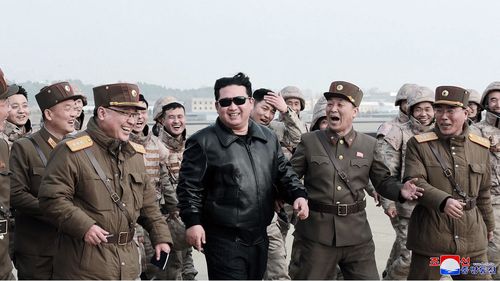
North Korean leader AND FASHIONISTA  Kim Jong-un. 
(AFP via Getty Images)

North Korea last month fired what is believed to be its first intercontinental ballistic missile in more than four years.

Lazarus Group has stolen an estimated $2.4 billion worth of cryptocurrency in recent years, according to Chainalysis, a firm that tracks digital currency transactions.

"A hack of a cryptocurrency business, unlike a retailer, for example, is essentially bank robbery at the speed of the internet and funds North Korea's destabilising activity and weapons proliferation," said Ari Redbord, head of legal affairs at TRM Labs, a firm that investigates financial crime.

"As long as they are successful and profitable, they will not stop."

While many cybersecurity analysts' attention has been on Russian hacking in light of the war in Ukraine, suspected North Korean hackers have been far from quiet.


Scams to watch out for
View Gallery

Researchers at Google last month disclosed two different alleged North Korean hacking campaigns targeting US media and IT organisations, and cryptocurrency and financial technology sectors.
Google has a policy of notifying users who are targeted by state-sponsored hackers.

Shane Huntley, who leads Google's Threat Analysis Group, said that if a Google user has "any link to being involved in Bitcoin or cryptocurrency" and they get a warning about state-backed hacking from Google, it almost always ends up being North Korean activity.

"It seems to be an ongoing strategy for them to supplement and make money through this activity," Mr Huntley said.

 DICTATORSHIP IS NO LAUGHING MATTER

North Korea Bans Laughing And More For 11 Days

You will be taken away if you flout the rules.


Jasmine Turner
December 16th, 2021

North Korea is reported to have banned laughing for 11 days, as part of a long mourning for the 10th death anniversary of their previous leader, Kim Jong Il. Not only has laughing been banned, but displays of happiness, shopping and drinking have also been banned.

Citizens are not allowed to partake in leisure activities, and on the day of the death anniversary itself, grocery stands are not allowed to operate either. People who do not look to be “sufficiently mourning” will also be penalized and taken away. Anyone seen to have been flouting these rules can be taken away without warning and treated as ideological criminals.

Kim Jong Il ruled North Korea from 1994 to 2011 before being succeeded by his youngest son, Kim Jong Un. His death is registered as December 17, 2011.
FEMINISM
The Witch’s Tale: Women In Indian Horror Films

The ghost as the empowered woman is a new theme in Hindi horror movies

Photograph: Shutterstock


Rakhi Bose
UPDATED: 08 APR 2022 

Chutni Mahato lived to tell her tale—branded a witch in her in-laws’ village in Jharkhand’s Seraikela-Kharsawan district, stripped and paraded naked and forced to drink urine. Once a woman is branded a witch—a superstition rife in many states in India—her chance of survival is very low; lynching of women over suspicion of witchcraft is widely prevalent in many parts. But Mahato managed to escape. That was 1995. She is now an activist battling such social evils. In 2019, Mahato won the Padma Shri—India’s fourth-highest civilian honour—for helping nearly 150 women, all victims of witch-hunting and persecution.

A few years before she was honoured, a film purportedly inspired by her life was released. But Kaala Sach: The Black Truth turned out to be the typical Bollywood horror fare—instead of depicting her empowerment, the film is full of scenes of sexual violence, its dialogues replete with expletives and innuendos. Mahato does not know about the film but says they can’t do justice to the struggle faced by women branded witches and hunted down by an unforgiving society. “They (films) show witches with bulging eyes, with feet turned backward and matted hair. She is in search of men to seduce and children whose blood she can d­rink,” Mahato tells Outlook over the phone. “In real life, though, ‘witches’ are not demons but women just like you and me,” she adds.

ALSO READ: Horror As The Theme Of Our Lives

For decades, Hindi horror films stuck to a hackneyed characterisation of women—sexist and mis­ogynistic. Be it as the ‘ghost’ or a living character, women have only pandered to the voyeuristic desires of the male audience. And one of the most common and often misrepresented sub-genres within the horror universe in India has been the daayan film and the rape-revenge genre where a pious or pure woman becomes impure due to the wrongs done to her by men and turns into an all-powerful, bloodthirsty demon. Popular films like Chudail (1991), Khoon Ki Pyaasi, (1996) and Khoon Ki Pyaasi Daayan (1998)—with their exp­loitative storylines and focus on women’s bodies as objects of lust—nevertheless laid the groundwork for later films like Raagini MMS (2011), Ek Thi Dayan (2013), Pari (2018) and Bulbbul (2020) which strived to subvert the trope of the witch to depict powerful, feminist women and themes of violence against women. While many films followed the ‘sexploitation’ sub-genre, some of them, in their own right, paved the way for more layered women characters in horror films.
Another Aspect That Outlined The Narrative Of Women In Indian Horror Films Is An Exp­ression Of Internalised Cultural Beliefs, Mythology And Pop Culture.

Horror film buff and author Aditi Sen, however, has an interesting take on the Hindi films of the ’80s, when the Ramsay brothers’ sex-horror films had acquired cult status. Sen, a history professor at Queen’s University and a researcher on South Asian horror cinema, argues that while the films were definitely exploitative and objectifying women for eyeballs, they were also giving glimpses of women with more agency and independence. “In Purana Mandir (1984), for instance, a group of men and women go to an abandoned place for a weekend of casual sex with their partners. That’s unthinkable in a mainstream Hindi film of the time, for women to have that kind of freedom,” says Sen.

ALSO READ: How OTT Turned Into A Game-changer For Horror Movies

In 2002, the film Raaz was one of the biggest runaway hits of the year. Though the film did not have the traditional witch, it developed a different kind of woman fiend—the lonely woman spirit who is just looking for love. It was a more boisterous, sexualised reincarnation of the ‘lonely, lovelorn woman ghost’ of the sixties who wore a white saree and sought men who reminded her of her estranged lover. Sen, who has written a chapter on the film in the 2020 book Bollywood Horrors, says Raaz was a turning point. “It reinforced beliefs about women being tasked with the job of ‘fixing’ men and accepting their follies, but also opened a starting point for more films that showed wom­en not just as accessories but movers of the plot.”

Another aspect, Sen says, that outlined the narrative of women in Indian horror films is an exp­ression of the country’s internalised cultural beliefs, mythology and pop culture. In Raaz, for instance, Bipasha Basu—the wife—is the Devi while the ghost—the other woman—is a wronged woman or chudail. The ‘Devi’ can only obliterate the evil spi­rit by giving her a proper funeral. In later dep­ic­tions of the daayan or chudail, filmmakers have used the daayan as a twisted allegory for the div­ine. “It is because filmmakers (and all men) know the power of Shakti and that no man can actually stand up to it. None of the films, of course, have shown a near accurate representation of witches, even though in India, witches are as old as gods,” says Anubhuti Dalal, 42, who lives in Delhi and claims to be a tantrika. “I am what they sometimes call a dakini. I belong to the Aghori clan of tantriks,” she says. A practitioner of tantra, an ancient sect of Hinduism that predates the age of “organised religion”, as Dalal puts it, she and other dakinis like her worship the Dasha Maha Vidya—a pantheon of 10 feminine energies, each representing a form of the supreme goddess. In ancient texts, the dakini is defined as a ‘fiendish’ spirit who worships Kali.

ALSO READ: The Horror Of The Haunted House And Lonely People

In India, Dalal explains, the reason why women are repeatedly depicted as horrible, monstrous entities in the form of a chudail or daayan can be traced to the fear and patriarchy of Bra­hmins. Accepting the power of the woman as a divine healer meant accepting the power of her wrath. “When it comes to the battle between Mahakaal and Mahakali, the goddess will always win. Brah­mins and all men know that. Perhaps that is why they have always picked up their pitchforks and torches to behead and burn the ‘witch’. Bec­ause deep down they know they can’t kill the wit­ch just as they can’t kill the goddess,” she says. A slew of recent Bollywood filmmakers seem to have picked up on that trend.

In 2018, Amar Kaushik’s film Stree stumped aud­iences with its feminist horror-comedy approach to the witch. The film retold an old folk story abo­ut a witch who roamed the streets hunting young men with not-so-subtle subversions in gender roles. The witch in Stree, for instance, sought consent from her male victims before seducing them. In 2020, debut filmmaker Anvita Dutt’s horror film Bulbbul won two Filmfare OTT awards and accolades for retelling the story of the vigilante daayan who employs her own brand of justice system to punish those who hurt her, and the drivers of patriarchy. In both films, the witch in the end becomes a metaphor for power.

ALSO READ: Fatal Attraction: In Horror, Our Lives Are Redeemed

Film writer Amborish Roychowdhury feels that while sexual violence has been an ill-used trope in Bollywood horror films in the past, it continues to be a popular theme in horror films as it is a living reality for most women. “Horror is one of the mo­st expressive genres of film. I think filmmakers today are realising the potential of the platform to tell powerful stories about women and violence is a big part of many women’s lives,” he says. “Here lies the credit and intent of the filmmakers—are they using it as a bit to draw in audiences or are they using it to make audiences uncomfortable and ask questions about the society they live in?”

Away from the world of films, Aloka Kujur lives in the land of so-called witches. “In Jharkhand, daayan pratha is still a relevant practice and every year, hundreds of women are persecuted and even killed in the name of being a witch,” Kujur, who works for the rights of such women under the Adivasi Jan Adhikar Manch, tells Outlook. In Jharkhand, most of these cases are rel­ated to property disputes. “Women who have property and are single or elderly are often the target of such tactics, often by relatives and neighbours who want to usurp her property.” Kujur, however, says that films like Bulbbul that romanticise the daayan are equally bad as the B-grade films. She explains that in states like Jharkhand and Chhattisgarh, tales of the witch are much more believable as they are deeply woven into the social fabric. “These films reinforce the idea of daayan and chudail.”

(This appeared in the print edition as "The Witch’s Tale")

ALSO READ

The Ghost As A Metaphor In Bengali Cinema

The ‘Spirit’Of Filmmaking

Resident Evil: The Zombie Apocalypse In Goa

Skin-Deep Scary: The Cult Of Sleaze As Horror

An Allegory Written In Blood

Brothers Grim: When Indian Horror Was The Ramsays Genre

Of Aflatoons And Djinns

Meet The Desi Ghostbusters

A Shadowy Hand: Kashmir’s Tryst With Horror

The Horror! The Horror!

Fear Of The Dark: Life As A Ramsay

Ghost Diary: Journey To The World Of Spirits
Women's Solidarity Through Witchcraft

The concept of the ‘witch’ draws from the European Wicca traditions. Wicca is a Neo-pagan religion that was introduced to the world in a codified form in 1945 by former British civil servant Gerald Gardner.


Witches through the ages Shutterstock


Outlook Web Desk
UPDATED: 13 APR 2022 

We have all grown up with images of the scraggly witch on a broomstick in a pointy witch’s hat. Or the Indian witch or ‘dayan’ with bulging eyes, reversed foot and knotted unruly hair. The myth of witches has existed in India ever since time immemorial. Be it the ‘chudail’ or ‘Pichal Pairi’ of North India, Pishachini or Petni of West Bengal, or simply ‘Dayan’, the idea of the witch in either a demonic form or in the form of an evil priestess has been popularised in countless folk tales, films and pulp fiction horror stories. But much of the representation of witches in Indian films and literature is largely inaccurate. This is due to reasons — one is the misunderstanding of witches and witchcraft, and the second is patriarchy. Nevertheless, witches have usually been the demon of choice when it came to feminists representing themselves through the horror metaphor.

The concept of the ‘witch’ draws from the European Wicca traditions. Wicca is a Neo-pagan religion that was introduced to the world in a codified form in 1945 by former British civil servant Gerald Gardner. However, its origins can be traced to pre-Christian times. It encompasses various denominations and sects that are based on witchcraft and the duo theistic worship of the Supreme Gods and God. The religion is characterised by various rituals and was the first to formally acknowledge the pagan community of witches (men and women) that existed and practised for ‘Witchcraft’. While the community represented more than just witches, later representation in pop culture associating Wicca with cauldron swilling pagan witches further solidified the idea of Wiccan witches. Many followers of Wicca claim to believe in “magic” as a science. As performative magician and occultist Alistair Crowley had put it, magic is “the science and art of causing change to occur in conformity with will”.

The Witch’s Tale: Women In Indian Horror Films


In 1968, a manifesto by a women's group called WITCH read, "Witches have always been women who dared to be: groovy, courageous, aggressive, intelligent, nonconformist, explorative, curious, independent, sexually liberated, revolutionary...You are a witch by being female, untamed, angry, joyous and immortal". Thus witches have been a socio-political statement for women as much as a horror staple.

There is a thriving Wiccan witch community in India. The country’s first noted openly Wiccan witch was Ipsita Ray Chakravarty, daughter of a diplomat who grew up in Canada. According to interviews, she felt her first supernatural experience at the age of 10. In the late 80s, Chakravarty started speaking about the ancient tradition of witchcraft in India and has often spoken sternly against the representation of witches in Indian films as monstrous ‘dayans’.

The Wiccan tradition is what gives us the witch on a broomstick with a pointy hat trope. Today, many women in India claim Ito follow witchcraft. A thriving community of Wiccan witches on social media exists in which women not only talk about their experiences with witchcraft but also sell ‘magical’ items like totems, spells, incantations, even wands. The Harry Potter series of books also brought a new perspective on witches for urban Indian audiences who came face to face with anthropomorphised teen witches and wizards.

Nevertheless, the myth of the ‘Daayan’, the desi and monstrous version of the witch has remained popular in Indian horror films. Recent retellings o the witch’s tale have seen writers and directors experiment with themes of sexual violence and patriarchy to subvert the horror plots creating ‘daayans’ out of victims of patriarchy.

But the witch’s influence in Indian films and literature goes further back than just fiction or folk tales. In India, witchcraft is deeply rooted in Vedic Hindu religion. Witchcraft - or tantra Sadhna, is a pre-Vedic tradition part of the Tantra sect of Hinduism. Its followers, called Tantriks and Tantrikas, as often associated with witchcraft. While the men have been termed ‘sadhu’ or ascetic, however, women have often been dubbed as ‘witches’.

In fact, Daakinis and tantrikas were among the original healers before organised religion. According to Anubhuti Dalal, a practising Tantrik, daakinis have the ability to use magic, concoct potions and use their knowledge of herbs and poisons to heal people of both physical, and mental and metaphysical afflictions. They could make women stay young forever and make men fall in love. They could fix a broken heart or heal an infected body. This kind of manifestation of women’s power to manipulate energy has been recorded across the world including in Europe where a community of pagan witches have long existed under the Wiccan tradition. Witch societies are today studied through a feminist lens in that they have historically provided a safe space for women that organised religion could not provide.

In that way, the Indian Tantrik tradition has been similar to Wicca in providing a safe space and sisterhood to women within the community. Witches or practitioners of witchcraft often have their own language and ways of communication.

“A village daakini, before anything, is a friend of the persecuted women. She was supposed to be the custodian of women’s rights at a time when women had no representation. She could punish men for their wrong-doings, set things right for the woman at her household and empower them with justice,” adds Dalal. Dakinis, like Wiccan witches, are also known to be great doctors. Researchers of Wiccan witch rituals found that the ‘spells’ and recipes used by witches often use scary code names for herbs and plants. Newt’s eyes and dogs’ tongue - the famous ingredients used by Macbeth’s witches, for instance, actually refer to mustard seeds and the highly toxic plant houdstounge.

The Modern Witch Trials era in the West during which scores of women were burnt at the stake across England and other Anglo-Saxon countries vilified witches as sorceresses worshipping the Horned God. Later, Gardern's reiteration of Wicca brought forth evidence of the worship of the Mother Goddess - representing life and fertility - thus helping pagan witches destigmatise their image and move away from the Shakespearean representation of evil witches to a more free-spirited, pagan witch who used magic for good rather than evil.

Both Dalal and Wiccan witches like Ipsita have objected to the representation of witches in India. The skewed narratives of women in Indian (as well as Western) horror films and literature is an expression of the internalised cultural beliefs, mythology and pop culture. But today, women writers and filmmakers have tried to take over the genre and write stories that depict the witch not as a monster but as an avenger and vigilante. The change in tonality can be seen as a reflection of the growing empowerment of women and acknowledgement of culture and mythology as important building blocks of gender roles.


INDIA
'Angrez Chudail' And 'Nakalchi Bhoot': The Ghosts Of Shimla Live On


The former British capital, Shimla in Himachal Pradesh is home to many legends and lore of ghosts of former Imperialists haunting the streets of the hill town to this day,

The Ghosts of Shimla Babli Thakur


Ashwani Sharma
UPDATED: 13 APR 2022

Just as he parked his car on a narrow, lonely, forested road leading to Shimla’s leading boarding school, Ankur Chauhan, 28, felt a hand grip his collar from behind, even as he knew there was no one else sitting back .

“I remember the touch on my shoulder. It was a human hand, a real one. But who was it in my car? I knew there was no one else except me in the vehicle. For moments, I swear, I was numb and shivering down my legs in shock. I shouted out loud – who is in there, come out, come out!” Chauhan recalls as he narrates his horrifying encounter with a “ghost” some years back.

It had been around 11.30 pm and the night was dark. He had joyfully taken his US-returnee former schoolmate Piyush on an evening drive for a quick drink in the car - a school time nostalgia from Shimla streets and secluded meeting corners, where they used to invite their girlfriends away from everyone’s eyes.

While in the boarding school, where he and Piyush studied, Ankur had heard dozens of tales about ‘english ghosts’—the spirit of white men and women - former imperialists, haunting old Shimla schools, most of which were set up by the British.

One most frequently talked about ghost story was about an ‘english ghost’ often visiting the chemistry lab of the school, and another of a another headless man—a Prince visiting another school to offer flowers to girls. Several such scary tales of haunted Shimla buildings of colonial era have persisted in the former colonial city for decades.

But, for Ankur, an alumni of Bishop Cotton School (BCS) and now an entrepreneur in the health care sector, this was the 'supernatural' encounter. That's when he realised that the "dark world of phantoms" is very much here.

This is what Rudyard Kipling wrote about them in “My Own True Ghost Story" about the many spirits wandering around hills of Shimla, Mussoorie and Murree.

“Nearly every other station owns a ghost. There are said to be two at Simla, not counting the woman , who blows the bellows at Syree dak-bungalow on the Old Road," Kipling wrote about sundry ghosts who allegedly still haunt the erstwhile summer capital.

Veteran writer Ruskin Bond also brought-out horrifying tales of native Ghosts in his book “Ghost Stories from the Raj”--- recently adapted for a digital series titled Parchayee.

In 2005, Minakshi Chaudhry, Shimla’s own young author and former journalist, went on exploring some of the haunted settings of Shimla hills and brought out two books –a collection of 35 popular tales based on direct personal experiences of people, authentic folklores and her own spine–chilling adventures with the spirits in Shimla. Ruskin Bond wrote a foreword for her first book which became a best seller in the town.

“Whether ghosts exist or not, I can’t say. Yet, after visiting myriad 'haunted' places—even during the night, and listening to real stories of people as part of my research, I can say there is usually some iota of reality behind native folktales or legends. There is, however, no archived evidence of documentation on it,” Minakshi admits.

But ghosts, she observes, are not all bad. They have their own problems and seem to represent an aspect of human struggle that is as relevant in life as in death. With Shimla remaining under the British till 1948, the town's colonial hangover is still potent and many find it natural to believe that the spirits of the former rulers may still be wandering the streets of their former 'summer capital'. But, none of these ghosts or supernatural spirits in the living memory of Shimla residents has been known to harm anyone. What makes them scary is the fact that they were real people who once lived and walked these very streets, unlike characters of myths from fiction.

Speaking about her book, Meenakshi says, “There are enduring stories about unrequited love and the idea of spectral romance - like the story about a young girl who died in an accident, leaving her romance unfulfilled. Or the one about the ghost of Viceregal Lodge - a Prince who haunted a local school with a red rose, looking for his lady love. Then there were stories of the Angrez Churail (English witch) - a woman on a rickshaw (a common site in Shimla during colonial days) and a Nakalchi bhoot (copycat ghost) -- always trying to imitate human actions. Every story I write is an ode to the city's nostalgia and the authentic folk tales of these hills.”

While ghosts have not troubled her, Meenakshi however, has often had unpleasant experiences with humans in her quest for the macabre. Her search for untold tales of horror and the unknown have often led her to people who were either unwilling to share the anecdotes or embarrassed to admit they had seen a ghost on their property for fear of ostracisation.

“I faced a lot of public ire and unexpected angry reactions from the families and occupants of some of the private spaces believed to be frequented by ghosts. One of the families I went to interview set their ferocious dogs on me. Employees at a central government-owned British era heritage building detained me for hours till they checked my credentials with Shimla’s Deputy Commissioner, under whom my husband (an IAS officer) had worked as they mistook me for a spy talking about ghosts” she narrates.

While Kipling in his book had admitted that no native ghost has yet been authentically reported to have frightened an Englishman, both local and Desi ghosts are popular in Himachali folktales.

“There are, in this land, ghosts who take the form of fat, cold, pobby corpses, and hide in trees near the roadside till a traveler passes…They wander along the pathways at dusk, or hide in the crops near a village, and call seductively. Their feet are turned backwards that all sober men may recognize them," one of the descriptions go.

In her horror stories, Minakshi Chaudhry talks about haunted houses, schools, rivulets, cemeteries and fascinating mountains with snowy peaks and pine-covered valleys. It seems that though the British left the country after Independence, left their ghost behind.

Shimla–born retired IPS officer Balbir Thakur also recollects his two encounters with a supernatural spirit—‘Bansheera’ when his late father and former DySP was posted at Junga—a sub-urban town and headquarter of the Central Striking Reserve Force (CSRF) police battalion .

“I was returning home after watching two back-to-back films at Shimla’s Rivoli and Regal cinemas – both don't exist anymore now. It was almost nearing midnight when I reached Down-Kothi—a haunted site, little short of Junga. I had heard several local accounts from a few cops who used to frequently travel between Shimla and Junga," he recounts .

That night, Thakur spotted a tall, faceless man walking next to him. Initially, he thought it was a native, or some battalion personnel returning to the CSRF HQ from Shimla. The next moment, however, the man mysteriously disappeared, almost as if he was gobbled up by the darkness. Within seconds,it reemerged and started suspiciously walking towards him.

“Startled, I screamed, 'who are you? What the hell are you doing out here?' After this I ran almost at bullet's speed towards home, shivering and sweating. The moment I stepped inside my house, I fell unconscious to the floor. My mother who later called a local ghost-buster or some oracle and relieved me of evil spirit,” Thakur recalls.

Another most talked about haunted place in Shimla is “Chudail Baudi”, a wayside place between Chotta Shimla and St.Bedes’ college Nav Bahar on Shimla's Carter Road. Locals claim that any car or vehicle that crosses this space is automatically slowed down and an old woman with her feet turned backwards stops the cars to ask for a lift. If ignored, the woman leaps into the car anyway.

“We had heard such stories, but not any first-hand account has been reported so so far during the past three-decades of my being in Shimla” says a fruit seller at Chhota Shimla.

A few years ago, the Himachal Pradesh government rolled out a plan to compile all spooky tales of the town, based on folklore and personal experiences of the locals. The book was intended to compile these haunted attractions of the heritage town for attracting tourists. The plan never took off.

Yet the tourists visiting Shimla do pick up Meenakshi Chaudhry and Ruskin Bond books on ghost stories from a leading bookshops and the tales of the 'English ghosts' of Shimla live on.

New Orleans Mamas Normalized Breastfeeding During Mardi Gras Season


Carmen Green
MADAMENOIR
Tue, April 12, 2022

Breastfeeding
Source: Photo by Mehmet Turgut Kirkgoz / Pexel

The City of New Orleans rejoiced when Mayor Latoya Cantrell announced that Mardi Gras was on for 2022. The annual Carnival celebration was passed over in 2021, due the COVID-19 outbreak that sacrificed so many lives. The appropriate public health measure put in place required cancellation of gatherings statewide. This year was refreshing, but one of the best parts was a focus on breastfeeding. Several mamas were breastfeeding in the parade crowds. The temperature swung and the breasts hung, signaling a cultural shift. The moment also proved birthing people in New Orleans are not scared of social stigma, ogling eyes or negative comments. —And though New Orleans is pretty much the most progressive city in the state of Louisiana, it’s rare to see people breastfeeding at parades.

RELATED CONTENT: BLACK BREASTFEEDING WEEK: So Many Women Like Me, Who Want To Be Able To Breastfeed But Can’t


The cultural shift towards public breastfeeding is a strategic win on behalf of advocacy from organizations like Healthy Start and the network of Baby Cafe’s. Impact from waves of collaborative federal and philanthropic funding partnerships have included the Institute for Women Ethnic Studies, National Birth Equity Collaborative and the city-wide Maternal & Child Health Coalition. The past 3-5 years of funding still doesn’t touch the decade of work Sista Midwife Productions and Birthmark Doula Collective has invested into changing the landscape for mamas in the city through programming, community building, holding mamas and catching babies.

Laissez les bon lait rouler—Let the good milk roll!

The joy that comes from bearing witness to the progress of the painstaking work from the birthing community to undo generations of harm and misinformation that convinced Black women that breastfeeding is not for us. The organizations mentioned may not have legacy funding and are working hard to sustain staff while doing this culture-shifting work. Funding cycles take these leaders on a ride chasing the dragon—or rather chasing the float—of fleeting resources. Some prefer to be unbothered and unattached to these temporary waves of funding. The movement of breastfeeding in New Orleans has been led by birth workers and organizations but most importantly, the mamas in the community are creating the experience they want.

Regardless if the shift has come from community-led funding or sheer feminine will, the results are visible. Shout out to new mamas in 2022.

“This is my baby’s first Mardi Gras!” left many mamas lips, while holding 18-month-old toddlers. “Happy Mardi Gras Baby!”

RELATED CONTENT: BLACK BREASTFEEDING WEEK: Black Women Have Been Doing It For The Culture Since Day One


Black Maternal Health Week runs April 11-April 17. Register for National Birth Equity Coalition’s rundown of events and workshops at birthequity.org/BMHW22.


Black Maternal Health Week

Source: Courtesy of NBEC / NBEC
ANTI-ABORTION IS CLASS WAR
The pandemic baby bust never happened — millions of women couldn't get birth control or an abortion


Jason Lalljee
April 14, 2022

doble-d/Getty Images


A large decline in births is typical of recessions and public health crises, but there wasn't one during COVID-19.

That's because Trump-era policies and reduced healthcare access meant people couldn't get birth control or abortions.


Low-income and minority women are seeing their access reduced the most.


There was less of a baby bust than expected because of COVID-19 — but that doesn't reflect changing family planning dynamics in the United States.

Instead, it's indicative of shrinking access to abortions and birth control across the country, especially for low-income women.

That's according to a recent paper published by the National Bureau for Economic Research, which found that the 2020 COVID-19 recession was much different than earlier recessions, in that the number of babies born barely changed. The Brookings Institute predicted in 2020 that the pandemic would likely lead to a large, lasting baby bust, projecting 300,000 to 500,000 fewer births in 2021. In reality, there were only 60,000 fewer babies born because of the pandemic.


The NBER researchers found that because access to contraception and abortion fell in 2020 as reproductive health centers temporarily closed or reduced their capacity, low-income women are especially experiencing a "large increase in unplanned births."

That's as the pandemic has made having children less financially feasible for struggling households. During 2020, poverty increased across the US, and a third of American women said they wanted to delay pregnancy or have fewer children because of the coronavirus pandemic, according to a 2020 Guttmacher Institute survey of 2,000 people. Minority, low-income, and queer women were especially likely to say their family planning goals had changed.

Revisions that former President Donald Trump made to Title X, the country's only national, federally funded family planning program, also limited the number of abortions low-income women had during the pandemic, the researchers said. And the surge of new abortion restrictions across mostly Republican-led states over the last few months may make reproductive healthcare access even more difficult over the next few years.

"In short, at the same time changes in the economy reduced the demand for children, the supply of contraceptives and access to abortion fell and likely moderated the baby bust," the researchers wrote.

Trump-era policies kept people from accessing abortions


Many episodes throughout US history show that pregnancies and birth rates fall in response to financial uncertainty and economic downturns, the researchers wrote. Citing the Guttmacher Institute survey, they say that it shouldn't have been any different during COVID, when people planned to put the brakes on having kids.

Birth rates also tend to drop during public health crises, like during the Spanish Flu. The pandemic's economic turmoil fused with a health one, which led experts to believe that the impact on births would be even greater.

That was evidenced as recently as the Great Recession less than two decades ago. In 2012, the number of babies born dropped 9% compared to 2007, accounting for about 400,000 fewer births that year.

But it was harder for women to access reproductive services during the pandemic, especially low-income and minority women. Part of the reason was logistical: health care centers canceled or limited appointments in accordance with social distancing guidelines, and patients chose to limit in-person interactions.

But part of the reason is that women receiving subsidized health care through the Title X Public Health Care Service Act saw restricted access to reproductive services. The Trump Administration changed national guidelines in 2019, pulling funding for providers who referred patients to abortion providers, and requiring that recipients of federal funds physically separate sites that provide non-abortion reproductive health services from those that provide abortions.

The Title X changes under Trump led more than 1,000 health care centers in 34 states to withdraw from Title X funding — sites that had served more than 1.5 million patients in the year before the rule took effect, according to the National Family Planning and Reproductive Health Association.

And near-total abortion bans that have been introduced in 30 states this year are all but assured to take the choice to have children out of the hands of many more people.

Read the original article on Business Insider
Africa’s Most Controversial Oil Pipeline Is Hanging In The Balance


Editor OilPrice.com
Thu, April 14, 2022

After years in the works, the fight over the East Africa oil pipeline continues. Environmentalists and local communities have long been battling against the proposed construction of a major pipeline running from Uganda to Tanzania. But oil majors working in the region believe it could dramatically enhance the region’s export routes, making it possible for landlocked Uganda to transport its crude more easily. But the pipeline continues to face major hurdles, with doubts over whether it will ever be finished.

The East African Crude Oil Pipeline (EACOP) is expected to be the world’s longest electrically heated oil pipeline, measuring 1440km and running from western Uganda to the Indian Ocean port of Tanga in Tanzania. TotalEnergies and China National Offshore Oil Corporation Ltd (CNOOC) originally expected to invest $3.5 billion in the EACOP, working with operators in the two countries - the Uganda National Oil Company (UNOC) and Tanzania Petroleum Development Corporation (TPDC). If completed, the pipeline could transport as much as 1 billion bpd of crude across the countries.

In late March, things were looking promising for Total as construction appeared imminent. The signing of a $10 billion final investment decision made its construction that much more likely. British energy firm Tullow Oil first discovered recoverable oil in Uganda in the Lake Albert basin in 2006 and TotalEnergies purchased Tullow’s stake in the region in 2020 but was unable to find suitable funding for the EACOP project until now.

However, there is significant opposition from locals, with 260 community groups across Uganda, Tanzania, and neighboring countries drawing awareness to the situation globally with the campaign #StopEACOP. Public protests, legal action, and media attention have helped delay the works for the last two years.

People are mainly concerned about the environmental impact of building such large-scale oil infrastructure. In early April, the UN Intergovernmental Panel on Climate Change stated that we can’t afford to build more fossil fuel infrastructure, drawing attention to major project proposals such as the EACOP. Estimates suggest that the pipeline could produce as much as 36 million tonnes of CO2 every year, around seven times Uganda’s annual emissions.

The more imminent impact of the pipeline is the displacement of up to 1,400 households, with inadequate compensation being offered. In addition, the destruction of wildlife habitats across the two countries seems inevitable, with the pipeline running through several major areas of endangered wildlife.

As Total continues with plans to go ahead with the pipeline, it has a limited window of time in which the world will accept this kind of major fossil fuel project. With oil demand still high and sanctions on Russia highlighting our dependence on the black gold, even now, Total may be able to gain enough support to see the project through. But as several oil majors and governments introduce ambitious climate targets for the end of the decade, this window is growing ever smaller.

The cancellation of the Keystone XL pipeline in 2020 demonstrates the sentiment felt by governments in approaching long-term oil and gas projects, with mounting public pressure to make the shift away from fossil fuels to renewable alternatives within the decade.

And the EACOP is hitting more hurdles, as insurers refuse to cover the pipeline, giving the negative long-term impact on the environment as the main reason. Multinational insurance firm, Munich Re, refused to insure it due to its potential harm to the climate. And, this week, major oil and gas insurer Allianz said it would not insure the pipeline, stating “Allianz is not providing direct insurance to the East African Crude Oil Pipeline project, as it neither meets our climate ambition nor falls within our ESG risk profile.”

Zurich, Axa, SCOR, Swiss Re, and Hannover Re have all also refused to insure the project, following pressure from the “StopEacop” alliance. The alliance also targeted several banks to encourage them to refuse to fund the project, including HSBC, Credit Suisse, Barclays, and BNP Paribas. Omar Elmawi, StopEacop campaign coordinator said “It is now official, 7 out of the 15 (re)insurers we have approached have concluded that Eacop is a huge risk for them to underwrite.”

But, despite hurdles, Uganda is largely in favor of the pipeline, as it could help further develop its oil industry and have a positive spillover effect on the national economy. Politicians have made grand promises about what the construction of the EACOP would mean for the country. With Uganda and Tanzania sharing a 30 percent stake in the pipeline, it would see some revenue coming back into the two countries. It could also lead to significant job creation.

Despite notable opposition, TotalEnergies continues to push for the construction of the EACOP, following two years of planning and fundraising. While several community groups and international organizations are opposed to the construction of new large-scale fossil fuel infrastructure, the government of Uganda sees great potential for the development of the industry to support the national economy. However, Total will have to gain approval and insurance fast if it hopes to see the EACOP development come to fruition.

By Felicity Bradstock for Oilprice.com
Brokers using this controversial practice are ‘skimming rent, getting rich’: Michael Lewis

Max Zahn with Andy Serwer
Thu, April 14, 2022, 10:53 AM

Shares of trading platform Robinhood (HOOD) have plummeted nearly 35% so far this year, taking a 5% tumble last Friday alone after Goldman Sachs issued a Sell rating and raised concerns about soft user growth.

The company's revenue prospects could dim further if the Securities and Exchange Commission banned the controversial practice of payment for order flow, David Trainer, the CEO of investment research firm New Constructs, told Forbes.

High-profile proponents of regulating the practice abound, including best-selling author Michael Lewis.

In a new interview, Lewis said the SEC should make a "big change" on payment for order flow. Lewis, whose landmark 2014 book "Flash Boys" drew attention to the lucrative use of high frequency trading on Wall Street, said that brokers who use payment for order flow are "skimming rent" and "getting rich."

When accepting payment for order flow, brokers accept smaller price improvement for trades in exchange for higher payments from the market makers that fulfill the trades — a practice that can amount to a small surcharge for traders, effectively nullifying the commission-free trading promised by some brokers.

"It's really true that it's cheaper to trade in the stock market now than it was a long time ago, when you paid a broker a ridiculous commission to execute your trade," Lewis says.

To be sure, Robinhood is hardly the only broker that accepts payment for order flow. E-Trade, TD Ameritrade, and Charles Schwab (SCHW) are among those that deploy the practice.

"But it's also really true that those pennies are unnecessary, and that when you add them up across the whole market, it is billions of dollars, and you have people getting rich in this way," he adds. "These are examples of success to the rest of society, when really what they're just doing is skimming rent."

Last May, SEC Chair Gary Gensler hinted at potential new rules that would apply to Robinhood, market maker Citadel Securities, and others. In turn, Gensler told Baron's three months later that a ban on payment for order flow was "on the table."

Gensler reiterated his openness to a ban on payment for order flow in remarks to Yahoo Finance's Brian Cheung in October.


The logo of Robinhood Markets, Inc. is seen at a pop-up event on Wall Street after the company's IPO in New York City, U.S., July 29, 2021. REUTERS/Andrew Kelly

"Do they have the political will to shut it down?" Lewis asks. "The last two administrations — this one and the last one — have been poking around at this trying to figure out what you do about payment for order flow."

Payment for order flow revenue for the top four brokerage firms — TD Ameritrade, Robinhood, E-Trade and Charles Schwab — nearly tripled in 2020, jumping from $892 million to nearly $2.5 billion, according to Data from Alphacution previously cited by Yahoo Finance.

"I don't think anybody really has any illusions about exactly about what's going on," Lewis says.
Declassified government data reveals an interstellar object that exploded over Earth


By Joshua Hawkins
BGR
April 13th, 2022 


Back in 2014, a fireball exploded in the skies over Papua New Guinea. At the time, scientists believed that the object was a small meteorite measuring around 1.5 feet across. It slammed into the Earth’s atmosphere at more than 130,000 mph (roughly 210,000 km/h). Because the object’s speed exceeded the average velocity of meteors found within our solar system, a group of scientists conducted a study on the object in 2019. They found that it was most likely the first interstellar object we had identified.

However, the group never published their paper in a peer-reviewed journal. Instead, it has been available in the preprint database arXiv since its publishing. The reasoning behind this delay is because the data needed to verify the study’s position The team argued that the meteor’s speed, as well as the trajectory that it traveled, proved that it had originated somewhere beyond our solar system.

Unfortunately, the scientists never had the paper reviewed by peers. That’s because the U.S. government considered the data needed to verify the claims classified. At least, until now.

On April 6, 2022, Lt. Gen. John E. Shaw, the commander of the USSC, shared a memo on Twitter. The memo says that the analysis by the scientists in 2019 was “sufficiently accurate to confirm an interstellar trajectory.” That makes it the first interstellar object that we’ve identified to date.

It’s a huge step forward, and the confirmation retroactively makes the 2014 meteor even more important than it might have already been. In fact, it currently predates what we believed to be the first interstellar object, a comet named ‘Oumuamua. In fact, it predates it by almost three years.

Of course, there’s no telling what other kinds of interstellar objects are out there that we have yet to find. We still have a lot of space to explore, even inside our own solar system. As such, we could find other interstellar objects waiting to be discovered.

Of course, this isn’t the only interstellar object we have discovered so far. As noted above, scientists previously discovered ‘Oumuamua, a cigar-shaped object moving far too fast to have originated inside of our solar system. Unlike the meteor, though, ‘Oumuamua was spotted far from Earth. And, NASA says it is already speeding away from our solar system.

Scientists believe ‘Oumuamua is a comet because of how quickly it is moving, as well as how much it continued to accelerate on its own. However, because it is so far away from Earth, and moving outside of our solar system, it’s impossible to know for sure.

Still, knowing that there are interstellar objects entering our solar system from beyond the edges of space as we know it is both terrifying and exhilarating. As scientists continue to explore space and search for alien life, there’s no telling what we’ll find as our spacecraft branch out into the more unknown parts of our universe.