Tuesday, May 17, 2022

McDonald's announces it's leaving Russia entirely after 3 decades

The fast-food giant has said it was leaving because of the "unpredictable operating environment" and "humanitarian" reasons. McDonald's was quick to set up shop in the Soviet Union in the waning embers of the Cold War.



McDonald's will no longer serve its Russian customers, after over 30 years of business

America's fast-food giant McDonald's rolled out on Monday the process to sell its hundreds of restaurants in Russia, joining scores of Western companies who are exiting the Russian market amid international sanctions.

"The humanitarian crisis caused by the war in Ukraine, and the precipitating unpredictable operating environment, have led McDonald's to conclude that continued ownership of the business in Russia is no longer tenable," the Chicago-based company said.

McDonald's had already announced the temporary closure of its some 850 restaurants in Russia in March, soon after Russia's invasion of Ukraine.

But Monday's move draws the curtain on the company's activities in Russia for good, after more than 30 years of operation.

The company said it was looking for a Russian buyer to hire its 62,000 employees and pay them until the sale is finalized. It has yet to identify a potential buyer.
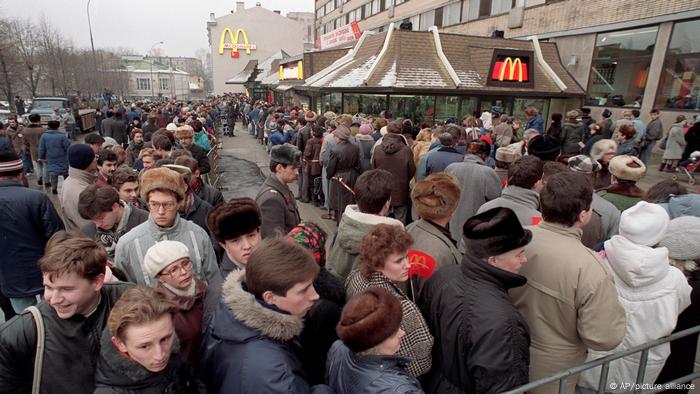

McDonald's opening day in Moscow in 1990 drew enormous crowds and queues

McDonald's first restaurant in Russia opened in the middle of Moscow over three decades ago, soon after the fall of the Berlin Wall and before the dissolution of the Soviet Union. Many at the time saw this as a symbol of the melting Cold War tensions between the US and the Soviet Union.

Values and 'commitment to global community'

In a statement, McDonald's CEO Chris Kempczinski addressed the difficulty the company faced when making the decision to leave, saying that McDonald's felt a "dedication and loyalty" to the tens of thousands of employees and hundreds of Russian suppliers.

"However, we have a commitment to our global community and must remain steadfast in our values. And our commitment to our values means that we can no longer keep the arches shining there," he said.

The global fast-food chain' unmistakable "arches" (two in yellow combining to make an M shape), which have long served as the restaurant's trademark brand, will no longer be available for use after the sale, alongside the McDonald's name, logo or menu.

Yet one company in Russia is trying to keep that logo, only with a small change. A company calling itself Uncle Vanya, after the Chekov play, is trying to trademark the McDonald's arches turned on their side to create what looks like a B in the Roman alphabet but represents a V sound in Russian, to symbolize the name Uncle Vanya. The company is thought to be a likely candidate to seek to purchase some or all McDonald's facilities in Russia.

rmt/msh (dpa, AP, AFP)


Dozens hurt in clashes at Palestinian funeral in Jerusalem

Dozens hurt in clashes at Palestinian funeral in Jerusalem

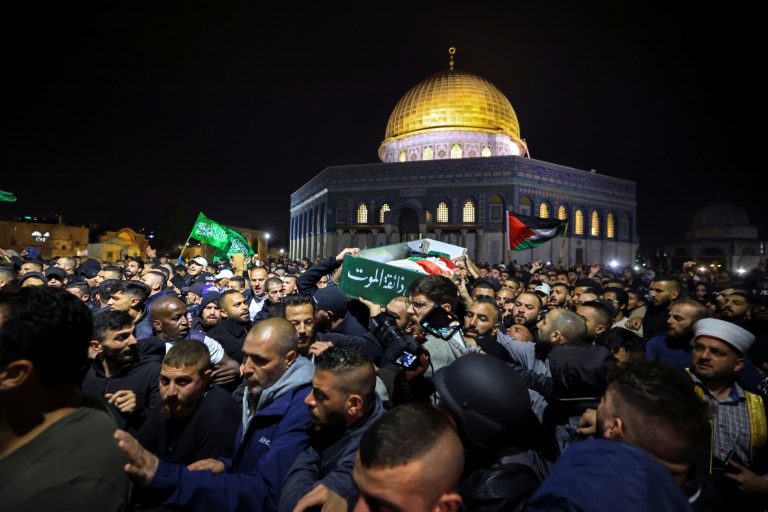
Palestinian mourners carry the body of Walid al-Sharif in front of the Dome of the Rock mosque at the Al-Aqsa compound

Jerusalem – More than 70 Palestinians were wounded in overnight clashes with Israeli forces at a Jerusalem funeral, Palestinian medics said Tuesday, in unrest that police said included “violent riots” which threatened officers’ lives.

The unrest unfolded as Palestinians were burying Walid al-Sharif, 23, who died on Saturday of wounds suffered during clashes last month at Jerusalem’s flashpoint Al-Aqsa mosque compound.

The Palestinian Red Crescent said the injuries occurred “during clashes with occupation forces”, with Israeli police firing rubber bullets and stun grenades, in and around Israeli-annexed east Jerusalem’s Old City.

Sharif’s body was carried by mourners across the Al-Aqsa compound and brought through the Old City’s Herod Gate, before burial at a nearby cemetery.

Police said “violent disturbances occurred both during and after the funeral, including in the cemetery itself.” Six officers were injured.

Israeli “forces acted resolutely against hundreds of lawbreakers and violent rioters who… took violent actions against the forces endangering their lives,” a police statement said.

Palestinians were “hurling stones, bottles, bricks and other heavy objects, as well as firing fireworks at the forces,” it added.

The Palestinian Prisoner’s Club advocacy group said more than 50 people were arrested.

Police put the arrest figure at 15.

The clashes erupted days after a police raid on the funeral procession of veteran Al Jazeera reporter Shireen Abu Akleh, who was shot dead during an Israeli army raid in the West Bank.

Palestinians and the TV network said Israeli troops killed her, while Israel said Palestinian gunfire may have been to blame.

Anger over her death was compounded Friday when baton-wielding Israeli police in annexed east Jerusalem beat pallbearers carrying Abu Akleh’s coffin which was covered by a Palestinian flag.

Israeli police have said they will investigate the raid carried out by officers on the funeral procession as Abu Akleh’s body emerged from St. Joseph’s, a Catholic hospital in east Jerusalem.

The chaotic incident has been strongly condemned around the world, including by the United States, European Union, United Nations and the Vatican.

Chile redeploys army to restive southern region


Soldiers are deployed to Temuco in Araucania in October last year 
(AFP/Mario QUILODRAN)

Tue, May 17, 2022, 1:10 AM·1 min read

Chile ordered the redeployment of its military to the Araucania region in the south of the country Monday, in the face of mounting violence linked to territorial claims by the Mapuche indigenous group.

"We have decided to use all tools to guarantee security," said interior minister Izkia Siches after announcing the move.

Soldiers were deployed to Araucania and to towns in the neighboring Biobio region in October last year on the orders of conservative then-president Sebastian Pinera.

New leader Gabriel Boric promised to withdraw the soldiers while campaigning for the presidency earlier this year and the process began on March 27.


But after attempting in vain to win approval from Congress for an "intermediate" deployment -- and in the face of a surge in arson -- he was forced to reimpose emergency measures.

Siches said the government would pursue a policy of dialogue with the Mapuche community and continue its land purchases in the area while maintaining the state of emergency.

Some communities in southern Chile have for decades demanded the return of lands they argue belong to them by virtue of ancestral rights -- lands which are mainly held by forestry companies and farmers.

Radical indigenous groups have claimed responsibility for some attacks in the area, though there are also reports of vigilante groups dedicated to lumber theft and petty crime operating in the region.

pa/gm/mlb/ob/oho/axn
Waiting for the water train in scorching India


A local pond near Pali that was long the main source of water for both residents and their livestock has been dry for almost two years (AFP/Prakash SINGH)More

Aishwarya KUMAR
Tue, May 17, 2022, 

Afroz misses school every day to spend hours waiting with a handcart full of containers for a special train bringing precious water to people suffering a heatwave in India's desert state of Rajasthan.

Temperatures often exceed 45 degrees Celsius (113 Fahrenheit) here, but this year the heat came early in what many experts say is more proof of climate change making life unbearable for India's 1.4 billion people.

"It's always been very hot here and we have always struggled for water," Afroz, 13, told AFP as he waited in Pali district for the second time that day for the special train.

"But I don't remember filling up containers in April."

For more than three weeks now, the 40-wagon train -- carrying some 2 million litres -- has been the only source of water for thousands of people in the district.

- Untreated -


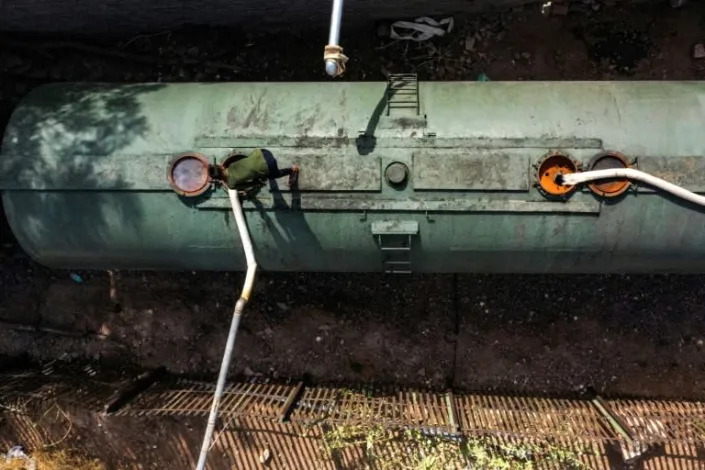
Every day, dozens of people -- mostly women and children -- jostle with blue plastic jerry cans and metal pots to fill from hoses gushing water out of the army-green train into an underground tank.

Water has been dispatched by train to Pali before, but according to local railway officials, the shortage this year was already critical in April so they started early.

The wagons -- filled in Jodhpur, around 65 kilometres (40 miles) away -- are first emptied into cement storage tanks, from which the water is sent to a treatment plant for filtering and distribution.

But for Afroz's family and many others like them, life is easier if they fill directly from the storage tanks, despite the water being untreated.

That their children skip school at times to ensure there is water in the house is what hits the families the most.

"I can't ask the breadwinner of the family to help me. Otherwise, we'll be struggling for both food and water," Afroz's mother Noor Jahan said as she filled up an aluminium pot.

"It is affecting my child's education, but what do I do? I cannot carry all these containers on my own," she told AFP.

- Cracked feet -

Hundreds of millions of people in South Asia have been sweltering in an early summer heatwave in recent weeks, with India seeing its warmest March on record.

In India and Pakistan, "more intense heat waves of longer durations and occurring at a higher frequency are projected", the Intergovernmental Panel on Climate Change (IPCC) said in a recent landmark report.

The "cascading impacts" of heatwaves on agricultural output, water, energy supplies and other sectors are already apparent, World Meteorological Organization chief Petteri Taalas said this month.

On Friday, India banned wheat exports -- needed to help fill a supply gap due to the Ukraine war -- in part due to the heat wilting crops.

Together, high humidity and heat can create "wet-bulb temperatures" so vicious that sweating no longer cools people down, potentially killing a healthy adult within hours.

"I have already made three trips from my house in the last one hour. And I'm the only one who can do it," said Laxmi, another woman collecting water, pointing to cracks on her feet.

"We have no direct water to our homes and it is so hot. What are we supposed to do if something happens to us while we walk up and down to fetch water?"

- 'Extreme depletion' -


In 2019, Prime Minister Narendra Modi launched an ambitious Jal Jeevan (Water Life) Mission, promising a functional tap connection to all households in rural India by 2024.

But less than 50 percent of the population has access to safely managed drinking water, according to UNICEF, with two-thirds of India's 718 districts affected by "extreme water depletion".

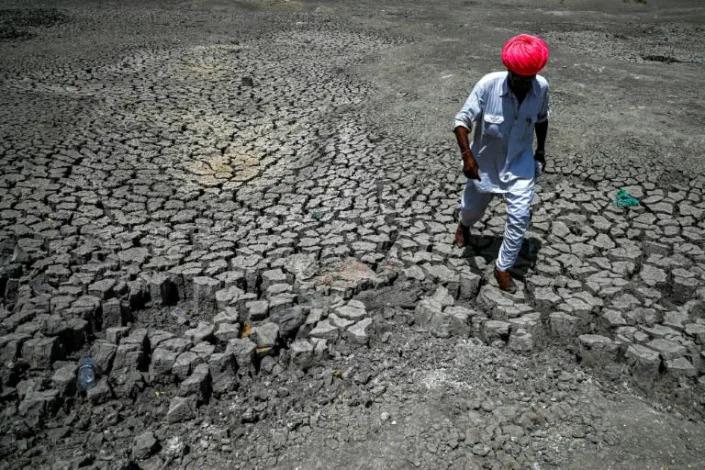
A little further from Pali, 68-year-old Shivaram walked on the cracked bottom of a dried-out pond in Bandai village, his bright-pink turban protecting his head from the scorching sun.

The pond -- which was the main source of water for both residents and their animals – has been dry for almost two years because of low rainfall. The shells of dead turtles litter the cracked mud.

"Farmers have been severely impacted," Shivaram said. "Some of our animals have died too."

ash/stu/smw/qan

'Dancing, not war': Signs of normality in Ukraine's shattered Kharkiv

'Dancing, not war': Signs of normality in Ukraine's shattered KharkivTowering apartment blocks were shelled by Russian troops (AFP/Dimitar DILKOFF)

Patrick FORT
Tue, May 17, 2022, 2:07 AM·4 min read


Three women plant flowers on a roundabout in central Kharkiv, while not far away men fill sandbags for a defensive barrier on the north of the city, the side closest to Russia.

It is a stark illustration of how people in the war-battered city in the north east are attempting to recapture some essence of normal life, even though Russian aggression lurks not far away.

Kharkiv, the regional capital, has been battered by the conflict, enduring an assault by Moscow's forces lasting several days and fighting in its suburbs, before weathering regular salvoes of shelling.

But the noose around Ukraine's second-largest city has been loosening in recent days, even as the war rages elsewhere.

However, much local infrastructure has been ruined and many residents have yet to return.

"We are trying to keep the city alive," a city hall spokeswoman told AFP.

The city of 1.5 million people in peacetime "is huge and some people can't move or go to work without buses", she said, explaining that some routes had restarted.

The spokeswoman said the mayor had neither encouraged nor dissuaded residents from returning.

"The situation is different in every district," she said.

At Kharkiv's railway station, many people who fled in February at the start of Russia's invasion are returning.

Some areas have been hard hit.

In the northeastern Saltivka district, towering apartment blocks were shelled by Russian troops who came from Belgorod, a Russian town on the other side of the border.

- 'State of shock' -

Cashier Iana, 49, and her husband contemplate the damage to their flat that now overlooks a void since the facade was blasted away.

Iana's husband entered through the roof, lowering himself down with a rope.

"He got in and it was horrible," she said.

"Even the rescue services told us that it will be demolished. When rescue workers climbed up to eighth floor, they said that the floor and the walls were shaking."

"I don't want to leave Kharkiv. I was born here and my son grew up here... Our parents received this house in 1975.

"Obviously we can't leave it to our children. We must overcome this ordeal and continue to live. What else can we do?"

Oleksandr Vendland, a 45-year-old widower, visits his ravaged apartment, including the bedroom of his two daughters aged eight and 14.

A pink bag, a large stuffed toy and child's drawings now speckle the rubble.

Vendland, who sent his daughters to family in Germany, said it would now be "impossible" for children to live in the city.

"They need food, education. There is nothing here. No medicine. It is very hard to find it," he said, calling for outside aid to ensure the city's survival.

He complained that only volunteers were visible in Kharkiv, demanding to know where government support was.


- 'Symbol of Kharkiv' -

Sporadic gunfire continues to hit the area, causing unease among the returned residents, Vendland said.

Water leaks from pipes shattered by explosions. Electricity, gas and water technicians work around the clock to restore utilities.

"No holidays in times of war!" said Sergei Oleshko, an electrical engineer working on fallen power lines.

"We're not soldiers but here we are! We're a bit scared with the shelling continuing."

In the city centre, helmeted architects and experts sporting bullet-proof vests are already assessing the local government headquarters, blueprints and hammers in hand.

Located on the central Freedom Square, the monumental 1950s building was struck by a missile on March 1. The video of the powerful strike was seen worldwide.

"We were evacuated before, thank God," said Konstantin Isayev, 46, a manager as he visited his former office while workers cleared rubble nearby.

Isayev said he has resumed work elsewhere but that he hoped to return to the ravaged site soon.

"For now, we only do expert evaluations," said Anatoliy Butenko.

"We look for all the damage. I think we will not be able to restore it in one year. I think it will take up to two... It's the symbol of Kharkiv."

Before a night-time curfew comes into force, music-lovers gather at a cultural centre for a concert -- the first in the city in months.

"We want to dance every day. We want to come back to slow dancing, not war," said Yevgen, a guitarist in a local ska band.


US urges India to reverse ban on wheat exports

Linda Thomas-Greenfield, Washington's top diplomat to the UN, said India's wheat export ban would worsen global shortages 
(AFP/SPENCER PLATT) 

Tue, May 17, 2022,
The United States hopes India will reverse its ban on wheat exports, Washington's top diplomat to the United Nations said Monday, warning the move would worsen global shortages of the commodity.

"We're encouraging countries not to restrict exports because we think any restrictions on exports will exacerbate the food shortages," Linda Thomas-Greenfield said during a ministerial gathering on food security ahead of a meeting of the UN Security Council.

The UN meeting -- to be chaired by US Secretary of State Antony Blinken -- will include Vellamvelly Muraleedharan, India's minister of state for external affairs.

India holds a non-permanent seat on the UN Security Council.

"We hope that (India) can, as they hear the concerns being raised by other countries, that they would reconsider that position," Thomas-Greenfield said.

India, the world's second-largest producer of wheat, on Saturday announced it would ban exports without special authorisation from the government in the face of falling production caused primarily by an extreme heatwave.

New Delhi -- which had previously pledged to supply wheat to countries once dependent on exports from Ukraine -- said it wanted to ensure "food security" for India's 1.4 billion people.

Blinken is on Wednesday set to hold another UN meeting also related to food security.

That session aims to "bring countries together to look at what countries might be able to help fill the gap" in wheat supplies caused by Russia's invasion of Ukraine -- two major exporters of the commodity, said Thomas-Greenfield.

The talks would also identify "countries who need the support from countries who can fill the gap," she added.

The United States could be included in these countries, she said, adding that discussions were already underway with American farmers on the topic.

Wheat prices hit a record high in the European market Monday in the wake of India's decision.


French city allows burkinis in swimming pools in controversial change

The French city of Grenoble on Monday authorised the wearing of the so-called "burkini" by Muslim women in state-run swimming pools, reigniting one of France's most contentious debates on religious dress.

© Fethi Belaid, AFP

The all-in-one swimsuit, used by some Muslim women to cover their bodies and hair while bathing, has become a controversial talking point during the holiday season in recent years.

Seen as a symbol of creeping Islamism by its critics and an affront to France's secular traditions, many right-wingers and some feminists would like to ban it outright.

It is prohibited in most state-run pools -- for hygiene, not religious reasons -- where strict swimwear rules apply to all, including men who are required to wear tight-fitting trunks.

The move applies across the board, meaning men will able to wear long shorts and women can also bathe topless in the Alpine city's pools.

Grenoble's mayor, Eric Piolle, one of the country's highest profile Green politicians who leads a broad left-wing coalition at the city council, has championed the move but run into a fierce campaign of opposition.

He managed to rally enough votes at a city council meeting to approve the measure, despite not having the support of his own EELV party which distanced itself from the measure.

It was carried by the slimmest of margins with 29 votes for, 27 against and 2 abstentions after two-and-a-half hours of tense debates.

"All we want is for women and men to be able to dress how they want," Piolle told broadcaster RMC Monday.

Opponents see it differently, including the influential conservative head of the wider Auvergne-Rhone-Alpes region, Laurent Wauquiez, who has promised to withdraw funding from the city.

"I am convinced that what Mr Piolle is defending is a dreadful dead-end for our country," Wauquiez said at the beginning of May, accusing him of "doing deals with political Islam" to "buy votes".

At the council meeting the former right-wing mayor Alain Carignon urged a local referendum on the issue.

"You can't force through such a sensitive subject. You have no legitimacy, you weren't elected for that," he said.

'Harm to Republican values'

The regional spat has put the burkini back in the headlines nationally, animating French talk shows and the political class ahead of parliamentary elections next month.

The issue of how people dress for the pool touches on highly sensitive topics in France, including fears about the influence of Islam and threats to the country's cherished secularism.

"It seems to me that [mayor Piolle] doesn't realise the harm he is doing to our Republican values," Prisca Thevenot, a spokeswoman for President Emmanuel Macron's party, told Radio J on Monday.

"This would be breaking with the rules to respond to political desires based on religion," she added.

Attempts by several local mayors in the south of France to ban the burkini on Mediterranean beaches in the summer of 2016 kicked off the first firestorm around the bathing suit.

The rules, introduced after a string of terror attacks in France, were eventually struck down as discriminatory.

Three years later, a group of women in Grenoble caused a splash by forcing their way into a pool with burkinis, leading the prime minister at the time to insist that the rules should be followed.

French sports brand Decathlon also found itself at the centre of a similar row in 2019 when it announced plans to sell a "sports hijab" enabling Muslim women to cover their hair while running.

Grenoble is not be the first to change its rules, however.

The northwestern city of Rennes quietly updated its pool code in 2019 to allow burkinis and other types of swimwear.

The debate about the burkini comes as French Muslim women footballers are battling to overturn a ban on the wearing of religious symbols during competitive matches.

The French Football Federation currently prevents players from playing while wearing "ostentatious" religious symbols such as the Muslim hijab or the Jewish kippa.

A women's collective known as "les Hijabeuses" launched a legal challenge to the rules in November last year.

(AFP)
COMMODITY FETISHISM

Macklowe art collection becomes most expensive ever sold at auction


Andy Warhol’s “Self Portrait” during a press preview on May 6, 2022 for the Macklowe Collection at Sotheby's in New York 
(AFP/TIMOTHY A. CLARY)

Mon, May 16, 2022, 8:02 PM·1 min read

The famed Macklowe collection, subject of a bitter divorce battle between a New York property developer and his ex-wife, became the most expensive art collection ever sold at auction Monday.

Sotheby's sold its second offering of works from the collection for $246.1 million, bringing the total value of the group of paintings to $922.2 million, a spokesman told AFP.

That exceeds the $835.1 million that the Rockefeller collection sold for in 2018, then the highest total ever made by a single private collection at auction.

Among the highlights of Monday evening's sale were Mark Rothko's "Untitled," which fetched $48 million and Gerhard Richter's "Seestück"", which went for $30.2 million.

Andy Warhol's "Self Portrait" sold for $18.7 million while Willem de Kooning's "Untitled" went for $17.8 million.

Sotheby's won the rights to sell the Macklowe works back in September. It sold 35 of the pieces in November for $676.1 million before selling the remaining 30 on Monday.

Sotheby's had described the paintings as the "most significant collection of modern and contemporary art to ever appear on the market."

During divorce proceedings, Harry Macklowe and his ex-wife Linda had been unable to agree on how much the vast collection was worth.

A New York judge ruled in 2018 that the they should sell all 65 works and split the profits.

pdh/jh
Indonesians celebrate Vesak at world's largest Buddhist temple


The procession and countdown to Vesak were livestreamed for those who were not able to attend 
(AFP/JUNI KRISWANTO)

Mon, May 16, 2022, 

Hundreds of lanterns were released into the sky by Indonesian Buddhists celebrating Vesak day at the temple of Borobudur for the first time since the coronavirus pandemic hit the country.

More than a thousand Buddhists from across the archipelago gathered at the largest Buddhist temple in the world, situated in Magelang, Central Java, to commemorate the birth, enlightenment and death of Buddha Siddharta Gautama.

Celebrations on Monday night included prayers and meditation, collecting holy water and the release of flying lanterns symbolising the letting go of negativity.

"This is the first time we were able to hold the celebration since the pandemic started, since we are still in the middle of the pandemic, we limited the number of participants to only 1,200 people," Eric Fernardo, the spokesman for the event, told AFP on Monday.

Only those who received an invitation and a double dose of a Covid-19 vaccine were allowed to enter the sprawling complex of Borobudur to join the ceremonies.

Before the pandemic, the event was usually attended by more than 20,000 people from across the Muslim-majority country and other places.

"After two years of not being able to celebrate Vesak Day here, now we finally can, even though not exactly like before the pandemic as there still are restrictions, but I'm so happy", Christina, a 20-year-old Buddhist who goes by one name, told AFP.

"We can still feel the enthusiasm and excitement, even though the number of attendees are limited," added the student from Jakarta, the Indonesian capital.

Despite the restrictions and stringent health protocols, monks and worshippers reverently followed the three-day procession and ceremonies, including the ritual to collect holy water from the pristine springs at Jumprit in nearby Temanggung district.

The procession and the countdown to Vesak, just before midnight on Monday, were also livestreamed for those who did not have an invitation to attend the event.

Indonesian Buddhists account for less than one percent of the country's more than 270 million people.

Built in the ninth century, the Borobudur Temple was abandoned when the Hindu kingdoms of Java island declined and a majority of Javanese began to convert to Islam.

Buried under volcanic ash and hidden in the jungle, the temple's existence was largely forgotten until the 19th century. It has undergone a major restoration and is today a UNESCO world heritage site.

Str-dsa/lgo/aha
Algerian rapper Soolking plays Harlem's Apollo during debut US tour


As his merengue-inflected single "Suavemente" once again topped France's songs chart, Algerian rapper Soolking was stateside, delighting fans and wooing new followers with his blend of rap and Maghrebian folk music
 (AFP/Angela Weiss)


Maggy DONALDSON
Mon, May 16, 2022,

As his merengue-inflected single "Suavemente" once again topped France's songs chart, Algerian rapper Soolking was stateside, delighting fans and wooing new followers with his blend of rap and Maghrebian folk music.

Already acclaimed in the Francophone world, the Algerian rapper Soolking this year set his sights on North America, where he played historic venues including New York's Apollo and the Globe Theatre in Los Angeles.

"I never thought that one day I would come here to sing," the artist born Abderraouf Derradji told AFP backstage ahead of his set at Harlem's esteemed venue, which launched the careers of icons including Billie Holiday and Aretha Franklin, and where James Brown recorded a groundbreaking live album.

"It's a mythical hall like Paris' Olympia... where so many legendary artists have performed," said Soolking, wearing oval sunglasses and a black beanie.

"It's an honor for me; it's cool."

Born and raised in a suburb of Algiers, the 32-year-old was born to a percussionist father and at a young age began playing music and learning dance.

He first moved to France in 2008, but returned to Algeria to be in the rap group Africa Jungle, with whom he released two albums: "Ched Rohek" and "Eclipse."

The artist returned to France several years later, launching a solo career in 2016, adopting the moniker Soolking and starting to play small venues and drop music online.

He went viral shortly thereafter after performing his song "Guerilla" -- a track about his experience immigrating without papers -- on the popular French radio Show "Planet Rap."

- 'Representing for Algeria' -

With two successful albums under his belt and another on the way, Soolking embarked this spring on a North American tour that along with New York and Los Angeles included dates in Montreal, Houston, Chicago and Washington.

The artist who sings in both French and Arabic is interested in expanding his global reach but isn't terribly concerned with where his fans come from: "The most important thing is my fans."

"In my country of origin, there's people who listen to me and people who don't listen to me," the rapper continued. "I'm going to look for what's human, because in the end, music is feeling."

As evidenced by his first New York show, Soolking had broken ground in the United States long before he played any of its stages: fans danced and sang along at the Apollo, waving Algerian flags and illuminating their phones.

"It's just amazing to see someone from our country in New York City and their name in lights," said 26-year-old Sarah Hammadi, one of four cousins who traveled from New Jersey to catch the show.

"It's amazing -- he's really representing for Algeria."

"It just feels like you're back at home," seconded her cousin Dilia, 18. "He's such a pop icon in our country... it just brings warmth to our heart."

mdo/caw