Thursday, July 06, 2023

Spanish minister proposes €20,000 ‘universal inheritance’ from age of 18

Story by Sam Jones in Madrid • Yesterday 
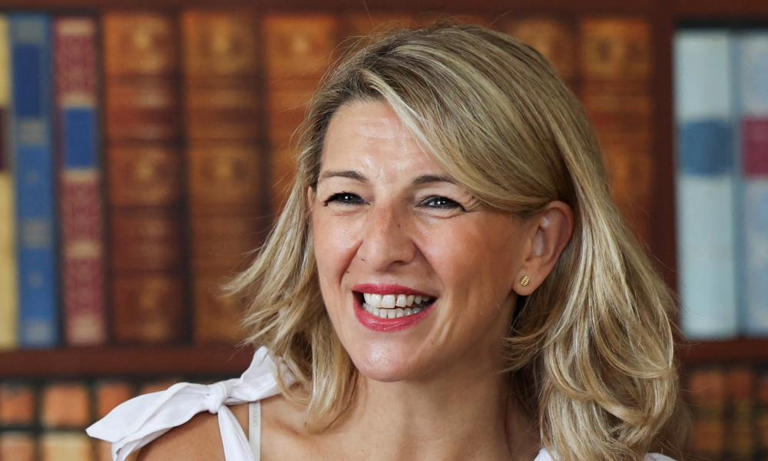
Photograph: Isabel Infantes/Reuters© Provided by The Guardian

Spain’s leftwing labour minister, Yolanda Díaz, has proposed a scheme to tackle social inequality by giving every young person in the country €20,000 (£17,000) to be spent on study, training or setting up a business once they reach the age of 18.

According to Díaz’s Sumar platform, which announced the policy before Spain’s snap general election on 23 July, the initiative would cost €10bn, which would be raised by taxing the rich.

Sumar said the aim was to guarantee “equality of opportunity” regardless of people’s family backgrounds or earnings. The payments, which would begin at the age of 18 and continue until the age of 23, would be accompanied by administrative support to help people study, train or establish their own business.

“It’s about letting young people have a future and giving them the chance to study or start a business without that having to depend on their surnames or the family they are from,” Díaz told a gathering of foreign correspondents in Madrid on Wednesday afternoon.

“That’s why we’re proposing that people will be given €20,000 when they turn 18 so that they can develop, whether that’s by studying or by setting up a business. That’s what’s at stake on 23 July.”

Díaz confirmed that the policy – called the “universal inheritance” – would be available to all young Spaniards regardless of their economic circumstances and would be funded by taxing people earning more than €3m a year. Sumar estimates it would cost 0.8% of Spain’s GDP.

The minister, who was raised in a staunchly communist household, said she had been unable to follow her own dreams of becoming an employment inspector because there was not enough money for her to spend years studying.

“Becoming an employment inspector in Spain would have taken about five years,” she said. “I’m not an employment inspector because I’m the daughter of working-class parents and I could never have allowed myself to do that. This is a redistributive measure that will allow the young people of our country to have a future regardless of their surname.”

Sumar’s proposal has raised eyebrows on both sides of Spain’s political divide. Nadia Calviño, the economy minister in the socialist-led coalition government, questioned how the policy would work in practice.

“Anyone who proposes giving subsidies or grants without any kind of restrictions when it comes to income levels or aims needs to explain how it would be financed because we’re going to have to carry on with a responsible fiscal policy over the coming years,” Calviño told the Onda Cero radio station on Monday.

The opposition conservative People’s party (PP), which is leading the socialists in the polls but which is expected to have to rely on the support of the far-right Vox party to form a government if it wins the election – was blunter still.

A PP spokesperson accused Sumar of getting her priorities badly wrong and suggested the government focus on other problems in a country where they said “27% of the population is at risk of social exclusion, where the unemployment rate is the highest in Europe, where families can’t make it to the end of the month and where self-employed people are struggling to stay afloat”.
‘Not my King!’: Protesters in Scotland boo, heckle King Charles
NOT MINE EITHER
Story by Michelle Butterfield • Yesterday

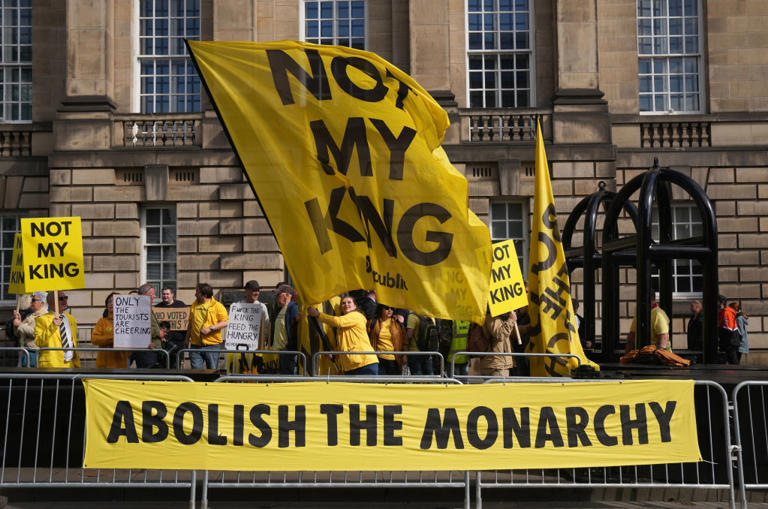
Anti-monarchy protesters gathered near St Giles' Cathedral along the Royal Mile ahead of a National Service of Thanksgiving and Dedication to the Coronation Of King Charles III and Queen Camilla on Wednesday in Edinburgh, Scotland. Anti-monarchy groups, including Republic and Our Republic, scheduled the protests to disrupt ceremonial events to mark King Charles III's coronation.
© Danny Lawson / Pool / Getty Images

Anti-monarchist protesters gathered in Scotland on Wednesday to boo, yell and chant "not my King" ahead of King Charles' thanksgiving service in Edinburgh.

A service of dedication for King Charles and Queen Camilla, as a way to mark the coronation, took place at St Giles' Cathedral, where Charles was presented with the country's crown jewels.

Hundreds turned up Wednesday afternoon along the Royal Mile leading to the cathedral with yellow placards, loudly expressing their displeasure with the royal visitors.

Police Scotland confirmed that two women, aged 20 and 21, were arrested during the protest for allegedly trying to climb over a safety barrier on the Royal Mile.

The protests took place during Scotland's Royal Week, or "Holyrood Week," which marks Charles' first since becoming King. The occasion will be marked by several celebrations, including a 21-gun salute, a flypast and a procession through the streets of Edinburgh.

One of the groups involved in the demonstrations was Republic, a pressure group campaigning for the abolition of the monarchy.


Republic tweeted Wednesday that its members would protest outside the police department until those arrested were released, and later confirmed that the anti-monarchists were let go from the station with police warnings.


Protester Evie Smith, who lives on the Royal Mile, told SkyNews that while she's in favour of the monarchy, she wants to see the British Royal Family put more money "back into the country."

"Some people can't even afford a Sunday dinner. Others like nurses are also looking for better pay," she told the outlet.

"I would like to see [the Royals] give significantly more back, as well as all the billionaires."

Grant McKenzie, a member of Republic, told Good Morning Scotland that protesters are upset with the amount of money being spent on pomp and pageantry.

"It's being forced upon us. We've got an unprecedented cost of living crisis," he said.

"I don't think the public in the U.K. are particularly interested in their taxpayer money being put towards a parade up and down the Royal Mile in Edinburgh. It's tone-deaf.

"Of course, people are going to be able to enjoy it if that's what they want to do. Protests by their very nature are disruptive. We will be making ourselves visible and heard."

The co-leaders of the Scottish Green Party declined their invitations to the service, and Member of the Scottish Parliament, Patrick Harvie, said that the service is akin to a "Game Of Thrones-style cosplay exercise," reports Yahoo U.K.

Speaking to a rally outside the Scottish Parliament organized by another group called One Republic, Harvie said, "It is fundamentally at odds with the kind of modern and democratic society we are trying to build here."

He added afterwards: "I recognize there is going to be disruption when there is a major event on. But let’s think about how a modern, democratic head of state would go about their business in Scotland.

"It wouldn’t have this level of pomp and ceremony and rigmarole."


Greta Thunberg charged with disobeying police during climate protest: report

Story by Kathryn Mannie • Yesterday 

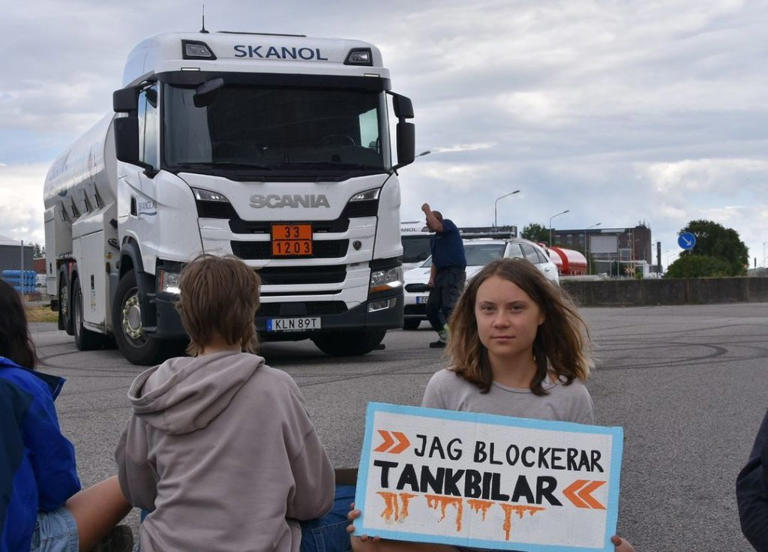
Photo of climate activist Greta Thunberg during a June 19 demonstration that reportedly led to her being charged by Swedish authorities for disobeying police orders.© Greta Thunberg/Instagram

Climate activist Greta Thunberg, 20, has reportedly been charged with disobeying a police order in her home country of Sweden after she was photographed being hauled away from a climate protest by two officers.

The incident occurred on June 19, when a group of young climate activists blocked oil tankers from driving down a road at the port of Malmo, a city in southern Sweden. Thunberg wrote in an Instagram post that day saying demonstrators had blocked the road for three days.

"The climate crisis is already a matter of life and death for countless people. We choose to not be bystanders, and instead physically stop the fossil fuel infrastructure. We are reclaiming the future," she wrote alongside photos of young people sitting in a line along a road.

Local daily newspaper Sydsvenskan was the first to report that Thunberg had been charged by police in connection with the demonstration.


Police told the outlet that about thirty trucks were prevented from driving down the road. When police deemed the protest was causing too much of a disturbance, they ordered that protesters move their demonstration to a nearby lawn.

"Everyone was informed individually and it was also filmed by a police officer when this was done," the police external commander in charge of the scene told Sydsvenskan.

Four of the nine protesters who were blocking the road refused to move, including Thunberg. Photos taken at the scene show two police officers escorting Thunberg arm-in-arm away from the road. One photo showed the 20-year-old climate activist's feet fully off the ground as she was hauled away.


If convicted for disobeying a police order, Thunberg can be handed a fine or up to six months in prison. At least one other climate activist was also charged in Malmo district court, Sydsvenskan reported.

"You have the freedom to demonstrate, but you must not demonstrate in such a way that it causes disturbances for others," prosecutor Charlotte Ottosen said, according to Sydsvenskan.

The Swedish central prosecutor's press office could not immediately confirm the report. Thunberg's representatives could not be reached.

Video: Greta Thunberg says energy firms throwing people ‘under the bus’ for their own gain

Wednesday, July 05, 2023

Rights group reports allegations of dozens of abuses in critical minerals supply chains

AP • Yesterday 


HANOI, Vietnam (AP) — A human rights advocacy group says it found allegations of dozens of labor and environmental abuses by Chinese-invested companies involved in mining or processing minerals used in renewable energy.

The report released Thursday by the Business and Human Rights Resource Center in London says it found 102 cases of alleged abuses in all phases of using such minerals: from initial explorations and licensing to mining and processing.

The report studied supply chains for nine minerals — cobalt, copper, lithium, manganese, nickel, zinc, aluminum, chromium and the so-called rare earth elements. All are vital for high-tech products such as solar panels and batteries for electric vehicles.

Indonesia, with 27 cases, had the highest, followed by Peru with 16 and the Democratic Republic of Congo with 12, Myanmar with 11, and Zimbabwe with 7.

Over two-thirds involved human rights violations, with Indigenous communities the most affected.

Many projects invested in or operated by Chinese companies were located in countries that had mineral wealth but “limited options for victims to seek remedy.”

To limit global warming to 1.5 degrees Celsius, the global guardrail set by the 2015 Paris climate agreement, the world needs to triple its clean energy capacity by 2030 from where it was last year, according to the International Energy Agency. That has triggered a scramble for so-called “transition minerals” like cobalt, copper, lithium and zinc that are needed in clean energy technologies.

China isn't the only one — a separate tracker from the advocacy group notes similar alleged abuses by companies based out of the U.S., Australia, the U.K. and Canada — but it plays a vital role in mining, processing, and refining these minerals, as well as making solar panels, wind turbines and electric vehicle batteries. So its companies are central to ensuring equity and fairness in the world’s transition away from fossil fuels.

“The bottom line is if the energy transition is not fair, it will not be as fast as it needs to be and we will fail to meet our climate deadlines,” said Betty Yolanda, the organization’s Director of Regional Programs.

Climate change has an inordinate impact on the world's poor, who have done the least to contribute to warming and now are bearing the brunt of the negative impacts of mining the minerals needed for the transition to renewables, she said, speaking on behalf of the authors of the report.

The report's authors did not want to be identified publicly because of fears of retaliation.

Rich countries like Australia that have abundant mineral wealth don't need foreign investments for extraction, though projects often do involve foreign investors. But copper-rich developing nations like Peru and nickel-exporting countries like Indonesia and the Philippines increasingly rely on Chinese investment and know-how to mine and process those minerals, generally with fewer regulatory safeguards.

“This is the time to not do the same mistakes of the past. The renewable energy transition must be done in a just and equitable way,” said Eric Ngang, global policy adviser for the Natural Resources and Governance Department of Global Witness, a UK-based non-profit not involved in the report.

Weak legal safeguards against such abuses facilitate corrupt practices that benefit companies and dishonest politicians at the expense of the environment and human rights.

About 42% of the human rights allegations detailed in the report were concentrated in Asia & the Pacific, 27% were in Latin America and 24% in Africa. More than half were cases of environmental damage, often loss of access to safe water supplies. More than a third involved allegations workers’ rights were violated, with the majority linked to health and safety risks at work.

Those are likely the “tip of the iceberg,” Yolanda said, since the report relies on publicly available information about alleged abuses committed by companies, cases where civil society has taken action, or where attacks against activists have been reported. “It is most difficult to receive information from countries with very little civic freedom and from conflict zones,” she added.

The report noted that improved safeguards are crucial as countries increasingly try to keep some of the value from their mineral wealth at home by requiring miners and companies downstream in the supply chain to build smelters and other infrastructure. For instance, Indonesia, which has the world's largest nickel supply, is trying to set itself up as a hub for making electric vehicles and also make nickel-based batteries to create a complete nickel supply chain that involves Chinese investments.

Without safeguards, these ambitions “may be frightfully compromised” by the harm done to people and the environment, the report said.

Only 7 of the 39 Chinese mining companies mentioned in the report had published human rights policies and despite transparency commitments, only 4 of the 22 companies in the sector approached with the allegations responded to the Business and Human Rights Resource Center, the report said. The report doesn't explicitly state what those responses were, apart from a November 2022 response from China's Huayou Cobalt to allegations of environmental damage where it “responded by partly admitting social and environmental challenges and explaining its labor due diligence measures.”

China lacks laws to regulate the impacts of Chinese overseas businesses and supply chains and policies on such issues are mostly voluntary. Such problems are being addressed in the U.S. and Europe and the report said Japan and South Korea increasingly are making human rights and environmental due diligence a part of their regulatory frameworks.

___

Associated Press climate and environmental coverage receives support from several private foundations. See more about AP’s climate initiative here. The AP is solely responsible for all content.

Aniruddha Ghosal, The Associated Press
UN: Millions left with no aid as West Africa suffers worst hunger crisis in 10 years

• Yesterday 

ABUJA, Nigeria (AP) — The U.N. World Food Program said Wednesday that millions of hungry people in West Africa are without aid as the agency struggles with limited funding to respond to the region’s worst hunger crisis in a decade.

Nearly half of the 11.6 million people targeted for food aid during the June to August lean season are not receiving any assistance, the agency said in a statement. It warned that hundreds of thousands of people are at risk of joining armed groups, getting married early or engaging in “survival sex” in their desperation to survive.

“We’re in a tragic situation. During this year’s lean season, millions of families will lack sufficient food reserves to sustain them until the next harvests in September," said Margot Vandervelden, WFP interim regional director for Western Africa. "We must take immediate action to prevent a massive slide into catastrophic hunger,” she said.

Long before last year’s flooding and Russia’s war in Ukraine, West Africa already was facing its worst food crisis in 10 years with more than 27 million hungry people mainly as a result of conflicts but also due to drought and the economic impacts of the COVID-19 pandemic.

Food insecurity in West and Central Africa is now affecting 47.2 million people in this year's lean season which is when hunger peaks, the WFP said, with women and children the most vulnerable groups.

“Malnutrition rates have also surged, with 16.5 million children under 5 set to be acutely malnourished this year – an 83 percent rise from the 2015-2022 average,” the agency said.

In central Sahel countries of Mali, Burkina Faso, and Niger where jihadists have become increasingly deadly, U.N. agencies estimate that the number of people fleeing violence there has nearly quadrupled from 30,000 in January to 110,000 people in June.

“We need a twin-track approach to stop hunger in the Sahel – we must address acute hunger through humanitarian assistance while tackling the structural causes of food insecurity by increasing investments in resilient food systems and expanding government social protection programmes,” Vandervelden added.

Chinedu Asadu, The Associated Press
A 'double punch' of solar storms could smash into Earth and spark widespread auroras this week

Story by Robert Lea • SPACE.COM -  Yesterday 

© NASA

While the U.S. celebrated Independence Day on July 4, the sun held its own, more powerful firework display.

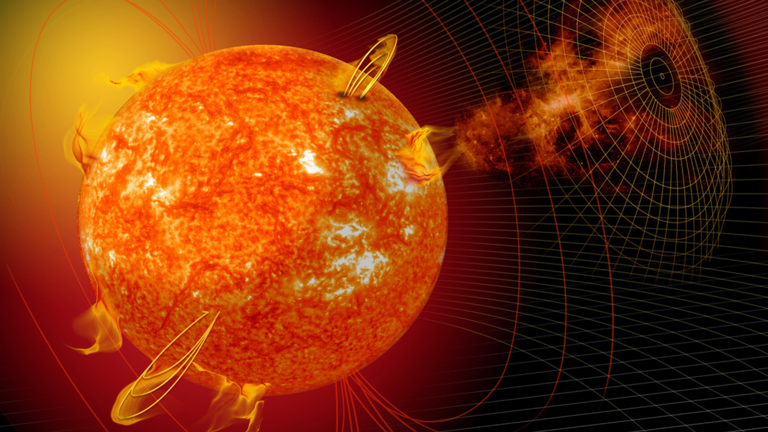
The stellar fireworks came in the form of two solar storms, or coronal mass ejections (CMEs), that are partly directed at Earth and were observed by NASA's Solar and Heliospheric Observatory (SOHO) that orbits our star. CMEs can contain as much as a billion tons of plasma made up of charged particles and thus carry with them their own magnetic fields.

NASA has projected that the massive ejection of ionized gas called plasma will impact Earth by Friday (July 7). When the charged particles within CMEs strike the magnetic field of our planet, the magnetosphere, they can give rise to large disturbances called geomagnetic storms.

These storms can, in turn, disrupt power and communication infrastructure here on the surface of Earth in addition to affecting satellites, which could adversely influence services such as the global positioning system (GPS).

Related: Sun breaks out with record number of sunspots, sparking solar storm concerns

Space Weather physicist Tamitha Skov shared footage of both CMEs recorded by the SOHO's Large Angle and Spectrometric Coronagraph Experiment (LASCO) on her Twitter feed. Skov wrote: "Our #Sun celebrates #July4 with its own special fireworks! We have two partly Earth-directed #solarstorms (aka CMEs) on their way. The second storm will catch up to the first giving us a 1,2-punch. Model predictions show impact likely July 7. I'll post NASA model runs next"

As promised, the space weather expert shared models of both CMEs, created by NASA's Chris Stubenrauch, describing the outflows of stellar matter as a "double punch" of solar storms.

The first tweet showed the initial CME, which NASA predicted is slower and will arrive before 8 am (EDT) on Friday and will head mostly to the northeast.

The second CME is hurtling through space more rapidly and will result in what Skov described as more of a "direct hit" on Earth, with it veering slightly southward. It should arrive in the early hours of July 7.

She added that the CMEs have the possibility of triggering a G-1 level geomagnetic storm, defined by the National Oceanic and Atmospheric Administration (NOAA) as minor events that can, nonetheless, give rise to power grid fluctuations and impact spacecraft operations.

While the fireworks of Independence Day are long over, the CMEs could also result in another spectacular light show, this time high in the atmosphere over Earth. When charged particles travel down the magnetic field lines in Earth's magnetosphere, they create bright, colorful displays called auroras. These are usually only visible at high latitudes on Earth near the poles, but these powerful CMEs could give rise to auroras that are visible at lower mid-latitudes.

The NOAA adds that auroras connected to G-1 geomagnetic storms can often be seen in the U.S. as far south as Michigan and Maine.
Earth, Canada's North shatter temperature records as heat skyrockets

Story by Nathan Howes • Yesterday 

Well, that's exactly what we had in far Northern Canada.

The Weather Network
Record for hottest day ever broken one day later, what's behind the heat? 
Duration 0:51   View on Watch
 

Earth, Canada's North shatter temperature records as heat skyrockets
© Provided by The Weather Network

Temperature records seem to topple quite frequently in our current climate, so these latest feats, while impressive, shouldn't come as too much of a surprise.

With places in Northern Canada enduring unusual heat at the moment, enough to topple all-time highs, the globe just shattered daily average records for the hottest days ever.

SEE ALSO: Why extreme heat is one of the world’s deadliest weather disasters

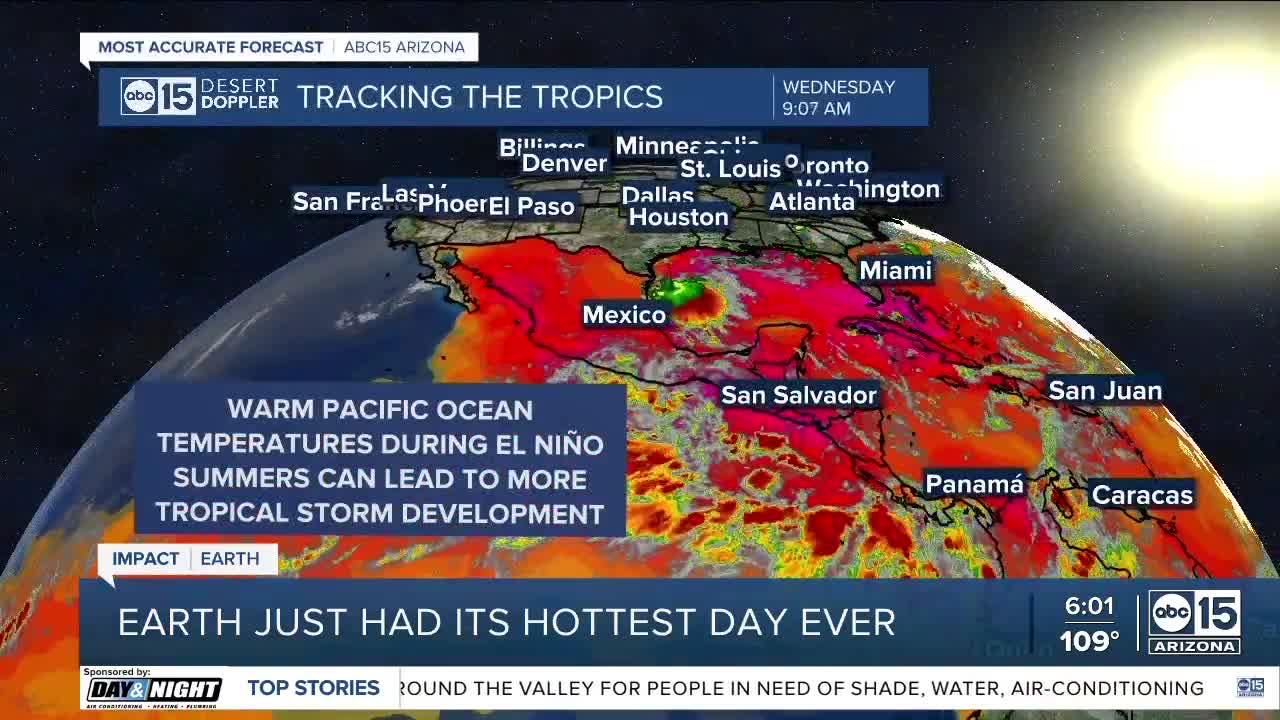
The global average temperature hit 17.01°C on Monday, making it the warmest day across the world on record. It was a feat never reported in history, but the record was short-lived. Just a mere 24 hours later, the world did it again. Tuesday’s average median hit 17.18°C -- raising the heat bar even higher.

Several heat waves contributing to record warmth across the globe

Hot temperatures are pretty commonplace across Southern Canada in the summer, but when the heat starts setting records in the Far North, that certainly makes it conversation-worthy.

Several global heat waves contributed to the latest record on Tuesday, July 4, including a notable accomplishment in Canada. Regions you wouldn't have thought of soared into the country's hot spots while crushing all-time heat records.

For these records, you will have to head north, way north. We're talking about near the Arctic Ocean in northern Quebec. Kuujjuarapik’s temperature beat every other Canadian community with 34.7°C. Meanwhile, not too far away, Kuujjuaq crushed its 76-year-old, all-time heat record by more than eight degrees.


Earth, Canada's North shatter temperature records as heat skyrockets
© Provided by The Weather Network

Rivière aux Feuilles (Leaf River), Que., and Inuvik, N.W.T., also claimed all-time heat records, with temperatures in the low 30s recorded.

"It is July and national temperatures tend to peak in this month, but these temperatures this far north are simply unheard of," said Rachel Modestino, a meteorologist at The Weather Network. "Remember, these regions average around 17°C at this time of year. Nearly double was recorded on Tuesday."

Canada isn't the only country on the receiving end of the heat. The southern U.S. has experienced an intense heat dome in recent weeks and China has seen temperatures soar above 35°C. Elsewhere, North Africa has seen temperatures approach 50°C, parts of the Ukraine have recorded abnormal warmth and even Antarctica has documented anomalously high temperatures.

More heat to come in parts of Canada this week

Northern Quebec will continue to see unseasonably warm temperatures for the next few days, a pattern that will also be felt in southern sections of Canada.


Earth, Canada's North shatter temperature records as heat skyrockets© Provided by The Weather Network

Temperatures in the 30s and humidex values approaching the 40s will slowly creep east in Ontario and Quebec, eventually reaching Atlantic Canada this week. Southern B.C. will also pick up 30-degree temperatures heading into Friday, which is five to 10 degrees above normal for most.

El Niño and climate change could spell more record-shattering temperatures

El Niño is here, and by all accounts, it looks to grow stronger in the weeks and months ahead, affecting weather patterns across the globe.

It’s not shaping up to be a marginal event, either. Forecasters see an 84 per cent chance of this turning into “at least” a moderate El Niño or stronger, and better-than-even odds of a strong El Niño developing by the fall or winter months.


Earth, Canada's North shatter temperature records as heat skyrockets
© Provided by The Weather Network

On top of the impacts from El Niño, climate change has been pointed to as a culprit for the extreme heat. These two factors will only work to exacerbate the intensifying heat and increase the likelihood of more temperature records falling.

The extreme temperatures also highlight the sluggish speed at which countries are making progress on reducing emissions.

"Unfortunately, it promises to only be the first in a series of new records set this year as increasing emissions of [carbon dioxide] and greenhouse gasses, coupled with a growing El Nino event, push temperatures to new highs," said Zeke Hausfather, a research scientist at Berkeley Earth, in a statement quoted and reported by Reuters.

WATCH: Earth's hottest day on record just happened
While you are likely enjoying a beautiful Holiday Monday,
Duration 1:05  View on Watch


With files from Rachel Modestino, a meteorologist at The Weather Network, Dennis Mersereau, a digital reporter at The Weather Network, and Reuters.

Follow Nathan Howes on Twitter.

 Drought conditions prompt agricultural disasters across Alberta: “Throwing away a lifetime”

Global News

Jul 5, 2023  #GlobalNews #alberta #drought

Hot, dry weather is causing drought conditions for Canadian farms, with some communities declaring agricultural disasters. 

More municipalities could soon follow, as meteorologists expect heat records to be broken this summer due to the return of the El Niño weather phenomenon. 

Heather Yourex-West speaks with some Alberta farmers about their struggles this season and their fears of their financial future.


'Agricultural disaster' declared in parts of Alberta after years of drought

CBC News: The National
 Jul 4, 2023  #Alberta #Farming #CBCNews
Farmers and ranchers in parts of Alberta are struggling after four years of drought, with no end in sight. Some are being forced to abandon crops or sell off livestock because of the lack of water.


Alberta Premier Smith says she feels 'vindicated' after CBC posts editor's note on Coutts stories

Story by Darren Major • Yesterday 

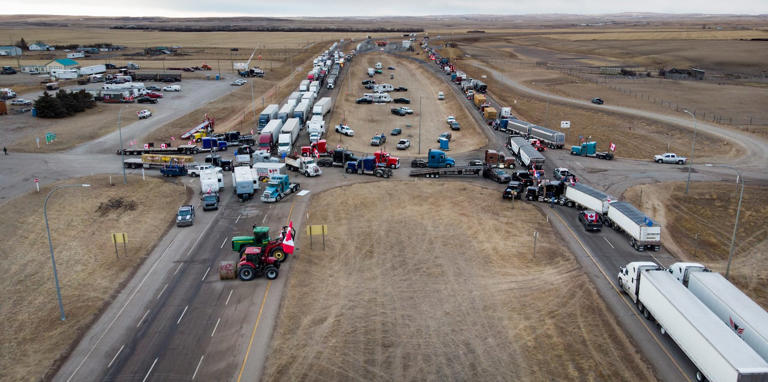
Alberta Premier Danielle Smith says she feels "vindicated" after CBC News added an editor's note to stories that previously reported, citing sources, her office directly emailed Crown prosecutors about criminal cases against participants in the 2022 Coutts, Alta., protests that blockaded the Canada-U.S. border.

The editor's note says that following a review of its journalism, the sources could not confirm the existence of the alleged emails between her office and prosecutors. CBC News said sources still insisted prosecutors felt political pressure regarding the cases.

"Journalism is an integral part of our society and all I've ever asked for is fair, accurate and balanced coverage," Smith said in a tweet on Wednesday.

"I've been vindicated, as has my office," she said.

In a story published in January, CBC News reported that Crown prosecutors felt political pressure from the premier's office related to their assessment and prosecution of cases linked to the blockades at Coutts. The story referred to emails allegedly sent from the premier's office to the Alberta Crown Prosecution Service.

Following an investigation into the matter, Alberta's ethics commissioner Marguerite Trussler said she found "no evidence of such an email" and concluded that no one from the premier's office directly emailed prosecutors about any of the cases.

Trussler did conclude, however, that Smith contravened the Conflicts of Interest Act by talking to then-justice minister Tyler Shandro about one of the cases — an action for which Smith apologized.

Following Trussler's report, CBC News went back and re-interviewed sources. Those sources could not confirm the existence of direct emails but insisted that prosecutors felt political pressure.


Anti-COVID-19 vaccine mandate demonstrators gather as a truck convoy blocks the highway at the busy U.S. border crossing in Coutts, Alta., on Jan. 31, 2022. (Jeff McIntosh/The Canadian Press via AP)© Provided by cbc.ca

CBC News has removed references to direct contact by email in the original story and added an editor's note to signal that change.

"CBC News regrets reporting direct contact by email," the note reads.

An earlier editorial note added the day after the original story was published specified that CBC News had not seen copies of the alleged emails.

Since the story was published in January, Smith has denied the existence of the alleged emails. She threatened to sue CBC if it didn't retract the story and apologize.

"I have been clear that neither I, nor anyone within my staff, have contacted any Crown prosecutors, as has been alleged," Smith said at a news conference in April.

In Wednesday's tweet, Smith said she now considers the matter "closed."

In a December interview with Rebel News, Smith questioned whether pursuing the Coutts cases was in the public interest and if there was a reasonable likelihood of conviction.

"I've put it to the prosecutors and I've asked them to do a review of the cases with those two things in mind. And I'm hopeful that we'll see a true turning of the page," she said.

In a leaked phone conversation from January between Smith and Artur Pawlowski — a controversial Calgary street pastor who was facing charges in relation to the Coutts protests — Smith said she already had been having "almost weekly" communications with justice department officials.

During the phone call, Smith also said that the rules confine her to asking those officials about only two things: the reasonable likelihood of convictions and whether proceeding would be in the public interest.


Preacher Artur Pawlowski addresses media and supporters outside the Lethbridge courthouse on May 2, 2023 after he was found guilty on three counts in relation to inciting the Coutts border blockade. (Ose Irete/CBC)© Provided by cbc.ca

In the recording, Smith assured Pawlowski she would continue to push his case internally.

Smith denied that she or her office engaged in any inappropriate conduct after the recording was leaked.

"As I have previously stated, I had my staff work with the Ministry of Justice to determine if anything could be done to grant amnesty for those charged with non-violent, non-firearms COVID-related charges," Smith said in a tweet citing CBC's reporting about the leaked phone call.

"As also indicated previously in multiple interviews, I received a legal brief from the Ministry of Justice recommending against pursuing amnesty further as several matters involving this issue were and still are before the courts. I have followed that advice."

In May, Pawlowski was found guilty of mischief for encouraging truckers to continue blocking the Canada-U.S. border crossing at Coutts during the 2022 protest.
5 Alberta LPNs’ fight to be classified as ‘direct nurses’ continues as some unions push back

Story by Destiny Meilleur • Yesterday 

A nurse prepares a vaccine. .© GAC

Agroup of five licensed practical nurses (LPNs) pushing to have their jobs reclassified as direct nurses is now waiting to hear from the Alberta Labour Relations Board (ALRB) on where their fight goes next.

LPNs for Change is the name of the group of nurses. The group's members are working to have their job classifications changed from auxiliary nurses to direct nurses.

Members of LPNs for Change along with union officials met with officials at the Alberta Labour Relations Board (ALRB) on Tuesday so the board could decide if there was enough information to move forward to set a hearing date to determine if LPNs should be reclassified as direct nurses.

The ALRB determined that it needs more responses and evidence in order to schedule a hearing date.

If the ALRB decides a hearing will be held, the hearing date will be determined after the unions that oppose the job reclassification have provided a list of written objections and the group of LPNs provides a written response to the unions.

Following the written responses, the ALRB will determine if the case will be dismissed or not.

LPNs for Change

LPNs for Change was formed in May 2022 when LPNs were asked to vote on their latest contracts by the Alberta Union of Provincial Employees (AUPE).

LPNs for Change's members say their roles have changed drastically over the years and that they now provide direct care to patients.

Direct nurses provide bedside nursing and utilize the standard nursing process: assessment, diagnosis, planning, implementation and evaluation.

The group submitted an application regarding the matter to the ALRB.


LPNs for Change said its application asks to reclassify the positions of 11,800 nurses from auxiliary nursing, a classification it considers similar to a health-care aide or a nurse's helper, to direct nursing.

“Why are we not with the rest of the nurses?” was the question that Ginny Wong said she asked herself when she helped form LPNs for Change. “LPNs have always been left behind in terms of what we really should be represented by and how we should be represented.

“People have started questioning whether or not we are in the right bargaining unit.”

The group says it wants to make it clear its members understand the difference between LPNs and registered nurses (RNs). It also notes its members have respect for RNs and in no way mean to diminish their jobs or position.

“We don't even expect to ever be paid as (RNs are),” said Quintin Martin, another co-founder of LPNs for Change. “We're doing this because we provide direct nursing and we have for a long time.

“We want to be recognized as direct nursing care.”

Wong said she believes reclassifying LPNs would provide those nurses with a much-needed confidence boost.

“With the reclassification, we can get the recognition and acknowledgment that we so deserve," she said. "So then we can build our confidence in saying, 'We're nurses (and) we are providing the direct nursing care because that's what we do day in and day out.

“We are so used to being the second-class (nurse) that we even say that ourselves. In nursing, confidence is really important. We have the skill, we have the education. (But) we need the confidence to properly perform our duty."

Unions weigh in on push for reclassification

A number of unions that operate in Alberta have made statements regarding the application, and in one case a union has asked for the application to be thrown out entirely.

The AUPE, which represents most LPNs in Alberta, issued a statement regarding the matter on May 31, saying it believes “the application is without merit, is doomed to fail and is a colossal waste of the resources.”

The union has asked the ALRB to dismiss the case.

The AUPE said the group that filed the application represents only a small number of nurses who do not or should not be speaking for all nurses.

“It is notable that the applicants here are only five LPNs,” the AUPE said. “They explicitly do not purport to speak on behalf of any other LPNs.

“It would be problematic to permit five individuals to upset long-established and stable bargaining units.”

The AUPE also questioned whether reclassifying LPNs would actually address concerns regarding morale and wages.

The United Steelworkers (USW) union said it agrees with the AUPE’s position.

"Our position is that this application is without merit,” the USW said in a written statement on June 9.

“There is no reasonable prospect the application will succeed and no basis for proceeding with full hearing."

However, the United Nurses of Alberta (UNA) has said it agrees with the application and believes the nurses’ argument is valid.

“UNA believes LPNs clearly provide direct nursing care and belong in the ‘direct nursing’ bargaining unit, along with registered nurses and registered psychiatric nurses, who also provide direct nursing care,” the union said.

The UNA also said while it had no part in the application, it supports the movement and encourages the LPNs to keep pushing.

The UNA voicing its support for the group of LPNs has been met with criticism from others in the labour movement, who say they believe the UNA may be trying to bring members of other unions into its organization.

The Canadian Union of Public Employees (CUPE) says it has filed a complaint with the Canadian Labour Congress to voice its concerns.

The UNA said that these claims are untrue and that it did nothing wrong by submitting a letter voicing its support of the LPN group's application.

David Harrigan, the UNA's director of labour relations, said he finds it very odd that CUPE would even make such a claim.

"It's not terribly unusual to have little jurisdictional issues where one union says, you know, 'That person should be in my bargaining unit and not that bargaining unit,'" he said.

The UNA said its opinion has not changed since more than 10 years ago when it first attempted to reclassify a small group of LPNs and the ALRB dismissed its attempt.

The two biggest employers of LPNs in Alberta -- Alberta Health Services and Covenant Health -- have both decided to remain neutral on the matter.

What’s next?


The AUPE is holding telephone town halls for its members later this week to have a "conversation about (LPNs) and the important work (they) do."

The AUPE and the other objecting unions have until mid-August to provide written reason as to why the application should be dismissed.

The LPNs will then have two weeks to provide written responses to the arguments for dismissal.

The ALRB will then make a decision on whether there will be a hearing or if the case will be dismissed.

LPNs for Change is asking Alberta LPNs to send the group a list of what tasks they complete in their jobs. LPNs for Change also wants RNs and patients who believe LPNs' jobs involve direct nursing to send letters to the group explaining what LPNs do.

If there is a hearing to determine if the LPNs will be reclassified as direct nurses, LPNs for Change said it suspects that would take place sometime in the fall.

If the reclassification application is successful, LPNs for Change said LPNs would have three options: stay in the AUPE, be moved to the UNA or a new union would be formed -- a decision that would be based on a vote of all Alberta LPNs.

Harrigan said he believes it is very unlikely the LPNs would form their own union.

"I expect if they're reclassified, there would then be a vote of all of the nurses: the RNs, RPNs (registered psychiatric nurses) and the LPNs," he said. "And there would likely be a vote to see for that group who they wanted as their union."

Video: UCP changes regulations so Alberta LPNs can do more