Tuesday, August 15, 2023

Ruling out nuclear power 'would be irresponsible,' Quebec energy minister says

Hydro-Québec is evaluating the Gentilly-2 power plant and the potential of nuclear power to meet energy needs, but nothing is decided yet, Pierre Fitzgibbon says.
Article content

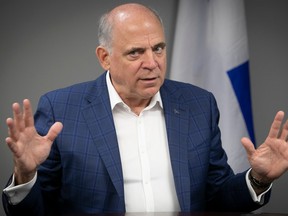
Quebec Energy Minister Pierre Fitzgibbon is not closing the door on nuclear energy and says all renewable energy sources should be studied.

Closing the door to nuclear “would be irresponsible,” but projects for new energy sources must be “socially acceptable and economically profitable,” he said on the sidelines of a news conference Monday morning in Montreal.

Advertisement 2

Hydro-Québec is evaluating the current state of the Gentilly-2 power plant, which closed in 2012, in order to “feed into its reflections on Quebec’s future energy supply.” The news has created strong reactions from experts who believe that nuclear power is not the preferred solution in Quebec.

But Fitzgibbon insisted on clarifying the intentions of the Crown corporation.

The new CEO of Hydro-Québec, Michael Sabia, “is currently looking at the imbalance” between energy supply and demand in Quebec, “and he said to himself that we have to look at the energy sources available, which includes nuclear, but we are far from having decided. No decision has been made, neither by Hydro-Québec nor by the government,” Fitzgibbon said.

The decision concerning nuclear “may be in a year or two, or three years, or never,” and “socially, if ever we went to nuclear, there is communication work to be done.”

A new nuclear technology

Fitzgibbon continued: “Sabia asked, ‘Is it possible to see if there are things we can do for Gentilly-2 on the site?’ but we are not talking about putting CANDU reactors from the ’60s. At this time, experts will look to see if there are any possibilities.”

Advertisement 3

Article content

CANDU reactors produce a large amount of nuclear waste and their operations involve hazards related to radioactivity.

Fitzgibbon made more than one reference to small modular reactors (SMRs).

“Since CANDU, 60 years have passed, so are there new technologies?” he said, adding “there are 77 SMRs in the world that are in development, but there are none in operation, so it is premature to conclude that we can go nuclear at reasonable costs and for environmental purposes where people will be comfortable.”

However, Fitzgibbon added, the government will closely monitor the development of these new nuclear power-generation technologies.

“It takes more renewable energy if we want increased industrial development in Quebec,” he said. “The question is going to be: At what price can we create new renewable energies, and is this price acceptable to companies?”

Hydro-Québec mulls reviving province's nuclear reactor, 10 years after shutdown

Public utility confirms assessment of plant's current condition is underway

An aerial photo of a nuclear plant.
Gentilly-2, Quebec's only nuclear power plant, located near Trois-Rivières, was shut down in 2012. (Hydro-Québec)

In its quest to increase electricity production in Quebec, Hydro-Québec is contemplating a move back to nuclear power. 

The government-run utility confirmed Thursday that it is considering the revival of Gentilly-2, the province's only nuclear power plant, which was shut down in 2012. 

"An assessment of the plant's current condition is underway," a Hydro-Québec spokesperson said in a statement.

The company says it's hoping to "inform our thinking on Quebec's future energy supply," considering it's globally analyzing the various options for increasing electricity production to decarbonize Quebec.

"Given the anticipated situation of energy in Quebec in the next few years, it would be irresponsible at this time to exclude certain energy sources and premature to draw any conclusions," the spokesperson, Maxence Huard-Lefebvre, said.

The public utility confirmed that the assessment was requested by Hydro-Québec's new CEO, Michael Sabia, who in interviews after his appointment made it clear he was open to nuclear power in Quebec.

This assessment, first reported by the Journal de Montréal, comes more than 10 years after Pauline Marois's Parti Québécois government decided to mothball the plant, located near Bécancour, Que., about 150 kilometres northeast of Montreal. 

The reactor, with a power of 675 megawatts, had been in commercial operation since 1983 before it was decommissioned, following the Fukushima disaster in Japan in 2011.

The plant employed some 800 people and generated approximately two per cent of all the electricity produced in Quebec at the time.

Its closure was slated to cost $1.8 billion over a period of more than 50 years.

Gentilly-2 is one of five nuclear power plants in Canada. The other four are still in operation. Ontario owns three of them — in Bruce, Pickering and Darlington — and is considering building a new one.

The fifth, Point Lepreau, is in New Brunswick. However, the government is considering financing the construction of new, smaller reactors.

But at a moment when the world — and many Canadians — are sharply divided over whether nuclear power is an essential ingredient for solving climate change, reviving Gentilly-2 will likely stir up controversy.

People wearing gas masks and holding up a sign in French that reads, "Shut down Gentilly."
The goverment faced intense pressure to decommission Gentilly-2 after the Fukushima accident in 2011. (Graham Hughes/The Canadian Press)

Surge in demand for electricity looms 

Quebec currently enjoys inexpensive power through the Churchill Falls contract with Newfoundland and Labrador. It pays 0.2 cents a kilowatt-hour and sells it to Quebecers for 7.3 cents.

That power accounts for about 15 per cent of Quebec's energy.

But with the contract ending in 2041, Premier François Legault is already setting his sights on alternative energy sources in the event that tariffs imposed in a new contract are no longer advantageous.

A week after Hydro-Québec CEO Sophie Brochu unexpectedly resigned in January, Legault repeated his intention to have Hydro-Québec build a new dam to meet the province's growing energy needs. 

But the social acceptability of building more dams is questionable. 

aerial view of hydro-electric dam
The La Romaine 3 dam at the Mista camp on the La Romaine 3 hydro-electric plant, the last dam built by Quebec. It's not clear if building another would be feasible but demand for electricity is rising. (Jacques Boissinot/The Canadian Press)

The province's latest dam construction project — La Romaine 4 — cost $7 billion and produces  power for more than 10 cents a kilowatt-hour.

HEC Prof. Sylvain Audette, an associate member of the Research Chair in Energy Sector Management, thinks Quebec should evaluate harnessing nuclear energy, as other provinces have done, to meet the spike in demand for electricity, especially to heat households in winter. 

"I'm not for or against nuclear, but I think it's a good idea to look at it and see if it can solve some problems that we will have in the future," he said. 

Quebec must also look to find green energy sources if it hopes to reach its GHG emissions reductions targets. 

By 2030, the province needs to reduce its emissions by 35 to 45 per cent below the 1990 levels. It hopes to achieve carbon neutrality by 2050.

Need for nuclear energy not proven, critics say

Jean-Pierre Finet, an analyst from the Regroupement des organismes environnementaux en énergie, says that Quebec and Ottawa labelling nuclear energy as clean is a misrepresentation. 

"It is completely dirty," Finet said. "Considering the potential for energy savings that we have, considering also the wind energy potential, the government hasn't done its homework about adding new renewable energy on the grid." 

Anne-Céline Guyon of Nature Québec emphasized that Hydro-Québec has done nothing to demonstrate a need for nuclear energy in the province.

"There is electrification to be done, but we know that there is first energy sobriety work to be done and energy efficiency work to be done before producing electricity from new sources," she said. 

Pointing to ongoing debate about a proposed waste disposal facility at Chalk River, Finet and Guyon are particularly concerned with nuclear accidents and radioactive contamination.

Martine Ouellet, who was responsible for Hydro-Québec as minister of natural resources at the time of the plant's closure in 2012, took offence at the company's use of the energy transition to justify a return to nuclear power.

"It's pure greenwashing," she said, when reached by email Thursday. 

"It's mind-boggling to see a Hydro-Québec CEO, [nine days after] taking office, wanting to relaunch nuclear power in Quebec. And all wrapped up in false pretences," said Ouellet, who has founded the Climat Québec party and will be a candidate in the upcoming byelection in the Jean-Talon riding.

Grey haired man speaks into microphone, profile shot.
Caisse de dépôt et placement du Québec president and CEO Michael Sabia speaks during a business luncheon in Montreal on Nov. 28, 2019. (Graham Hughes, The Canadian Press)

Haroun Bouazzi, the Québec Solidaire MNA responsible for energy, says it's high time the new Hydro-Québec CEO presents his vision of Quebec's energy future to a parliamentary committee, seeing as he has yet to propose an energy transition plan.

"We made the collective choice to get out of nuclear power in Quebec," Bouazzi said in a statement. "It is worrisome that Michael Sabia and Pierre Fitzgibbon want to reopen the file today without having demonstrated that it is necessary to meet our ecological transition objectives, without the slightest public debate." 

Rather than an energy transition plan, Finet added the province needs an "energy revolution," which would entail the government updating the construction code and implementing a home energy rating system to optimize the energy performance of buildings. 

"Quebec is not an all-you-can-eat buffet where you can come and just take all the resources you want," he said. "We don't have to say yes to every request for energy, and we also have to better manage what we have at the moment."

wind farm
Apuiat, a joint venture between three Innu communities and Boralex Inc., would generate 200 megawatts of electricity. But a final agreement with Hydro-Québec to buy the energy has been put off until after the Quebec election. (Radio-Canada)

No preference, says Ottawa

Canada's minister of the environment and climate change, Steven Guilbeault, unveiled Ottawa's draft net-zero electricity regulations on Thursday, which include nuclear power, and with which electricity producers will have to comply as of 2035.

Asked about Hydro-Québec's possible move back to nuclear power, Guilbeault, a former Greenpeace activist, said he found no problem with it.

"The federal government has no technological preference in terms of non-emitting [greenhouse gas] technology," he said.

"We don't dictate to the provinces or territories what type of non-emitting technology they should use. It's up to the provinces and territories to decide." 

That said, Guilbeault noted there are less expensive technologies that can also be considered, such as solar and wind power.

with files from Steve Rukavina and Radio-Canada's Alexandre Duval


THE COLONY  VS.  THE COLONIZER
A Women's World Cup semifinal is the here and now for the Australia-England rivalry, not the Ashes

The Canadian Press
Tue, August 15, 2023 


BRISBANE, Australia (AP) — This is Australia’s Matildas against England’s Lionesses. The Women’s World Cup semifinals. The here and the now.

Both teams want to be clear, it’s not one of those clashes for the Ashes that have come to represent an intense international sporting rivalry dating back to the 1800s.

That began with the burning of some bails — small wooden pegs that sit atop cricket stumps — after a team of English gentry lost to a squad of colonial upstarts from Australia.

This is about an Australia team led by superstar striker Sam Kerr — who has been injured for most of the tournament but will play some part in the game — against England defender Millie Bright and her European champions.

Kerr and Bright are teammates at Chelsea and have combined to win titles for the London-based club, but they're playing off here for a spot in the World Cup final against Spain.

England lost semifinals at the 2015 and 2019 Women’s World Cups. Australia is into the final four for the first time, and aiming to be just the second host to win the title on home soil.

Women’s soccer has been making its own history in England, where the Lionesses’ run to the European Championship title in 2022 captured the nation’s attention. And it’s making history in Australia, where the Matildas have twice attracted crowds exceeding 75,000 in this tournament and will again on Wednesday night.

The 7-6 penalty shootout win over fifth-ranked France last Saturday in Brisbane was the highest-rating program on Australian television in 2023. Local media reported that the shootout pulled the biggest domestic audience for a sports event since the 2000 Sydney Olympics.

As much as fans and the media have tried to frame it a fresh chapter in the Ashes, an England squad with a Dutch head coach and a Matildas roster with a Swedish head coach have repeatedly said their biggest rivalries in women’s soccer extend well beyond these two countries.

As soon as England had clinched a 2-1 comeback win over Colombia in the quarterfinals to ensure a match against Australia, coach Sarina Wiegman was asked what she knew about the Ashes rivalry. She said she’d check with the team and staff.

On Tuesday, at a pre-match news conference in Sydney that ran into the 21st minute of Spain's 2-1 semifinal win over Sweden in New Zealand, Wiegman said the feedback related to cricket and rugby and netball, and “we didn’t feel that rivalry that much.”

Bright said she couldn’t think of a previous England vs. Australia encounter, in any sport, sticking in her memory. What she's looking forward to is playing in front of a capacity crowd at Stadium Australia, despite knowing her opposition will have overwhelming support.

“As an England team there’s always pressure and it's something you embrace,” she said. “We've experienced moments like this, tense environments, big stadium, big crowd. We do thrive in those moments."

Bright recalled the extra lift big crowds gave England in the European Championship.

“It’s the semifinal. It’s the World Cup,” she said. “You want that environment, you want it to be intense, you want it to be noisy.”

England's only loss under Wiegman, who guided the Netherlands to the final in 2019, was against Australia in a friendly in April.

For 10th-ranked Australia, that 2-0 away win was part of a sequence that also included wins over Spain and France that boosted confidence.

While England went through the group stage with wins over Haiti, Denmark and China, and then beat Nigeria in a penalty shootout, the Australians had to rebound after losing 3-2 in the group stage and then having to beat Olympic champion Canada for a place in the knockout rounds.

The Matildas beat Canada 4-0, and then Denmark and France.

Tony Gustavsson, who was an assistant coach with the title-winning United States team in 2019, said No. 4-ranked England would probably start as the favorite with the bookmakers.

“If you look at rankings, they’re favorites. If you look at where their players play, they have starting players in top clubs and top leagues all over the world — not just 11, they have like 15, 16,” Gustavsson said. "If you look at resources financially, obviously they are a massive favorite going into this game.

“One thing that we have that they don’t have is the support and the belief from the fans," he said, "and that itself is going to be massive tomorrow.”

What Australia also has is an energized Kerr, who missed the group stage because of calf muscle injury she sustained on the eve of the tournament, and a team that has grown in stature because of her absence.

“The way she pushed through was fantastic and impressive both from a mental and physical aspect," Gustavsson said of Kerr's role as a second-half substitute against France. “She trained today, so she’s available.”

The Matildas have also played down the Ashes context of the showdown, but goalkeeper Mackenzie Arnold, the star of the shootout win over France, eventually responded after a repeated line of questioning about how it might feel being knocked out by England.

“Being knocked out by anyone is kind of unthinkable,” Arnold said. “There’s probably a lot of English people that would love to see us knocked out by England, but I think there’s more Australians that would love to see England knocked out by us.”

Spain beats Sweden 2-1 with last-minute goal and advances to its first Women's World Cup final

The Canadian Press
Tue, August 15, 2023


AUCKLAND, New Zealand (AP) — Spain will play for its first Women's World Cup championship after Olga Carmona's goal in the 89th minute lifted La Roja to a 2-1 victory over Sweden in the Tuesday semifinal.

Spain, which overcame last year's near mutiny by its players against coach Jorge Vilda, will play the winner of tournament co-host Australia and England on Sunday in the final in Sydney.

The controversy surrounding Spain dates to last September, when 15 players signed a letter complaining about Vilda and the conditions for the the national team. Three of those players are on this World Cup team, and Vilda a day before the game against Sweden praised the Spanish federation for its support.

Now, La Roja has a chance to become a first-time World Cup champion.

“This is a historic day,” said Vilda. “We’re in the final, that’s what we wanted.”

He again thanked the federation and its leadership for the support that has Spain one win away from the World Cup.

“The end result is a learning process which has made us all stronger in my opinion, and to leave it archived in the past and think about the future,” Vilda said through a translator. “And to think that we’re here because we deserve it.”

Carmona's goal capped a flurry of late scoring that saw Sweden tie the game, then Spain win it 90 seconds later on the surprise score.

Salma Paralluelo, the 19-year-old super-sub who also scored the game-winner in Spain’s 2-1 extra-time quarterfinals victory over the Netherlands, scored in the 81st minute to put Spain up 1-0. She gestured for the crowd to cheer, and the crowd thought it was celebrating Spain's decider.

But the celebration was brief. Rebecca Blomqvist tied it for Sweden in the 88th.

Then, just 90 seconds later, Carmona beat Sweden goalkeeper Zecira Musovic with the game-winner.

“It was really, really really crazy," Spanish defender Irene Paredes said. “After scoring the first one it was like, ‘OK, this is the end, we have to keep this score.’ But they scored quite fast and I was like, `What the hell happened?' But we had confidence that we could create something else."

Sweden has now lost in four of five semifinals and will try to finish third for a fourth time.

“I have to watch the game, I really do, before I can make any assessments,” said Sweden coach Peter Gerhardsson. “Right now I am full of emotions. It is is the third loss in the semifinals. I think everyone just feels sadness and huge disappointment.”

Paralluelo became just the second teenager to score in a Women’s World Cup semifinal after Kara Lang of Canada in 2003, also against Sweden

“It was a magic moment. It is something very unique when I scored the first goal. To be able to repeat is really incredible," Paraluello said.

Spain is playing in only its third World Cup. Four years ago, La Roja advanced to the knockout round but lost to eventual champions the United States.

“Now it’s the final. I think we have to do what we’ve done in every match,” said Paralluelo. “We’ve overcome every challenge and now we face the ultimate challenge, the big one”

The Swedes have never won a World Cup. They were the 2003 runner-up and have finished third three times. Sweden won silver medals at the Tokyo Olympics two years ago, and at the 2016 Games in Brazil.

“I’m tired of crying big tournament tears,” said Kosovare Asllani. Sweden also lost in the semifinals of the Euros last September.

The Swedes swept their opponents in the group stage before knocking out two-time reigning champion the United States on a penalty shootout after a scoreless draw.

Sweden then got by previously unbeaten Japan 2-1 in the quarterfinals.

Spain fell to second in its group after a blowout loss to Japan, but rallied to beat Switzerland 5-1 and the Netherlands 2-1 to reach the semifinals. It was La Roja’s first appearance in a major semifinal since the 1997 European Championships.

Spain’s two-time Ballon d’Or winner Alexia Putellas made her third start of the World Cup. Putellas ruptured her ACL last summer and has been working her way back to full fitness. She came off the bench in the team’s last two matches.

Putellas, who replaced Esther Gonzalez in the starting 11, was subbed off in the 57th minute for teenage Paralluelo, who has now scored in two straight games.

Spain dominated possession and had the better chances in the first half. Carmona’s blast from the top of the box was a low shot went just wide. Sweden’s defense, which had allowed just two goals in the tournament, held.

Putellas nutmegged Filippa Angeldal before delivering a cross in the 35th minute but Magdalena Eriksson was there to clear it away.

Spain goalkeeper Cata Coll dove to save Fridolina Rolfo’s shot late in the half, then punched the ball away on a corner kick to keep the game scoreless at the half.

Sweden had energy to start the second half but Spain still had chances. Paralleulo’s header in the 63rd minute sailed over the goal.

Alba Redondo was on the ground in front of the goal but got a foot on the ball and appeared to score in the 71st minute, but she was just wide and the ball was caught up in the side netting.

There were a few tense moments when Paralluelo’s goal was checked by video review, but it was awarded.

After Carmona's goal, Spain's players piled on top of her near their bench.

There were 43,217 fans on hand for the match at Auckland’s Eden Park.

___

AP World Cup coverage: https://apnews.com/hub/fifa-womens-world-cup

Anne M. Peterson, The Associated Press
Canadian corporate ethics czar launches China forced-labour probe into Ralph Lauren

The Canadian Press
Tue, August 15, 2023 


Ottawa's corporate-ethics watchdog has announced an investigation into fashion company Ralph Lauren over the alleged use of forced labour in its supply chains.

Sheri Meyerhoffer, who is the Canadian Ombudsperson for Responsible Enterprise, says it's not clear whether the company is doing enough to weed out components linked to the mistreatment of China's Uyghur minority.

Her report says that in response to her inquiries, Ralph Lauren insisted it's an American company that isn't subject to a Canadian probe before detailing its measures to prevent mistreatment.

Meyerhoffer has also asked Toronto-based mining company GobiMin to improve its policies to prevent the possible use of forced labour in its supply chains.

All four of the initial assessments the ombudsperson has announced so far relate to China's Xinjiang region, where most of the country's Uyghur population lives and where Beijing insists it has never allowed the use of forced labour.

Today's reports mark the third and fourth initial assessments by the ombudsperson, all of which relate to China's Xinjiang region.

Meyerhoffer's office was opened in 2018, and critics say it lacks the tools it needs to be effective, such as being able to compel documents and testimony.

The Canadian Press has reached out to Ralph Lauren and GobiMin for comment.

This report by The Canadian Press was first published Aug. 15, 2023.

Dylan Robertson, The Canadian Press
Ontario elementary, secondary teachers to hold strike votes

The Canadian Press
Mon, August 14, 2023 


TORONTO — Public elementary and high school teachers in Ontario are taking a step toward a strike, with their unions announcing Monday that they will be asking members to vote in favour of walkouts.

The president of the Elementary Teachers' Federation of Ontario told members at the union’s annual general meeting that the union has come to the bargaining table with proposals on special education, class sizes, violence in schools and wages that keep up with inflation.

In response, she said, the government has “refused to meaningfully engage” and has put forward proposals that are tantamount to cuts to salaries, benefits and working conditions.

“We have reached a tipping point,” Karen Brown said in a speech.

“ETFO’s patience has run out. Our members’ patience has run out. We now need to pressure this government to come to the table and start to bargain with us seriously.”

Brown said ETFO will be holding meetings starting mid-September for central strike votes and that the union will be asking members for a strike mandate.

“Based on what I have been hearing from members across the province recently, there is no doubt in my mind that the delegates at this annual meeting and that our 83,000 members want to send this government a strong and united message – enough is enough,” Brown said.

The Ontario Secondary School Teachers' Federation said it, too, will hold strike votes this fall.

The union told its members in a memo obtained Monday by The Canadian Press that the government has shown "little interest in engaging in substantive negotiations" and little progress has been made.

"It is well past time for this government to come to the table willing to conclude a deal to ensure students in Ontario can learn and grow in a world-renowned public education system," the union wrote in a memo.

"A strong strike mandate will demonstrate our unity and determination to achieve fair and favourable terms for our members and students."

Education Minister Stephen Lecce criticized the steps taken by the unions, saying they rejected private mediation in order to reach deals.

"Threatening another strike and creating anxiety for parents and students just weeks before the start of the school year is unnecessary and unfair," he wrote in a statement.

The union representing teachers in the French public system said it is focused on negotiations to get the best possible deal, but also expressed frustration with the process.

"Like our colleagues in other teaching unions, we find it unacceptable that the pace of negotiations is so slow and that our members are starting the new school year without a work contract," AEFO president Anne Vinet-Roy wrote in a statement.

"We are therefore constantly evaluating all possible options to move negotiations forward more quickly. AEFO members and our school communities deserve no less."

ETFO filed a complaint last week with the Ontario Labour Relations Board accusing the province of failing to act in good faith during bargaining because of new requirements for student early reading screenings the government announced this summer.

ETFO argues that a memo requiring elementary school teachers to conduct mandatory early reading screenings twice a year for students in year two of Kindergarten through Grade 2 violates good faith duties because early reading screening is a subject of central bargaining.

The Ministry of Education has said the new instructions were developed with feedback from all unions and the education sector.

Brown said members are asking questions such as: what does the screener look like, who created it, how and when will training happen, and who will input the data?

All four major teachers’ unions have been in bargaining with the government and school boards since last summer, and now with just a few weeks before the start of a new school year, none have indicated they are close to a deal.

OSSTF has just one more day of talks scheduled so far.

President Karen Littlewood has said it seems like Lecce just wants the teachers to sign the same deal that education workers represented by the Canadian Union of Public Employees received last year.

CUPE said the deal came with a $1-per-hour raise each year, or about 3.59 per cent annually, for the average worker.

The government's original offer to CUPE contained raises of two per cent a year for workers making less than $40,000 and 1.25 per cent for all others.

This will be the first contract for teachers since being subject to a wage restraint law for three years known as Bill 124. That law capped salary increases for teachers and other public sector workers to one per cent a year for three years.

It was ruled unconstitutional by an Ontario court, but the government has appealed.

This report by The Canadian Press was first published Aug. 14, 2023.

Allison Jones, The Canadian Press

Note to readers: This is a corrected story. An earlier version suggested the elementary teachers' union was urging a strike. In fact, they are urging votes in favour of a strike mandate.
TORY GOVT WANTS TO PRIVATIZE
Manitoba minister attacks NDP and union in video about liquor stores strike


The Canadian Press
Mon, August 14, 2023 


WINNIPEG — Manitoba's minister responsible for the province's liquor and lotteries corporation says people who are upset they can't buy alcohol due to a strike by staff at Crown-owned liquor stores should blame "the NDP and their union friends."

Andrew Smith's comments were contained in a video that was posted Friday to the governing Progressive Conservatives' Facebook page, where he said the Opposition prevented passage of government legislation that would have allowed more private liquor sales.

"It's summertime. We know that everyone likes a nice cold drink. But unfortunately that's not going to be possible this weekend thanks to the NDP and their union friends," Smith said in the video.

"You could have had alcohol purchases in grocery stores, your local corner store. These types of changes were made possible by our PC government, but unfortunately the NDP delayed that legislation."

All Liquor Marts in Manitoba except two in Winnipeg were to be closed over the weekend due to an ongoing labour dispute. Some 1,400 workers who have been without a collective agreement for more than a year started a provincewide strike last week after the Crown-owned Manitoba Liquor and Lotteries shuttered more of its locations as contract talks stalled.

The workers had been holding short-term strikes since July, but decided to ramp up efforts after Manitoba Liquor and Lotteries failed to meet their requests.

Earlier this year, the New Democrats used procedural rules in the legislature to delay passage of two liquor bills beyond the summer break.

One of the bills would pave the way for a pilot project in which liquor would be available in more retail environments such as corner stores or grocery stores. The second bill would allow private beer vendors and specialty wine stores to sell a wider range of alcohol products.

"(NDP Leader) Wab Kinew and the union bosses don't want you, the consumer, to have choice," Smith said in Friday's video, which featured him opening a beverage at the end of it.

Under legislature rules, the Opposition can delay up to five bills beyond the summer break. Normally, that pushes back the bills' passage until the fall. But with an election this year, the delayed bills may not come to a final vote.

Voters head to the polls in a provincial election on Oct. 3, and parties are already making statements about their platforms.

Kinew posted a short video statement on Sunday saying Premier Heather Stefanson could end the strike today.

"If I were the premier of Manitoba, I would ensure that you, the people of Manitoba get your beer. And I would ensure that people who serve it to you are paid a fair wage. It's that simple," Kinew said in the video.

Smith's video appeared to conflict with remarks reported in other media by Stefanson on Friday, in which she accused the striking workers' union of "politicizing" the issue. An interview request to Smith was passed on to the PC Party, which did not immediately respond to a request for comment on Monday.

The president of the Manitoba Government and General Employees' Union said last week the latest contract offer was for four years with two per cent wage hikes each year and some wage adjustments to compensate for minimum wage in the province going up to $15.30 this fall.

Christopher Adams, an adjunct professor of political studies at the University of Manitoba, said the PCs have been focusing on the NDP's ties to organized labour, and the strike at liquor stores is one that affects people closely.

Adams said a lot of people view two per cent annual increases as small compared to inflation, but those opinions could change if the strike continues.

"It depends how the middle class will perceive it over the next month," Adams said. "And I think the longer it goes for, the more chance it will start bending towards the PC's side of things as people become more affected by the strike."

Lisa Naylor, the NDP critic for Manitoba Liquor and Lotteries, said her party delayed the legislation that would have allowed more private liquor sales because it felt the issue needed more study.

Naylor said there were concerns about alcohol being available for sale in corner stores such as 7-Eleven, where families shop.

"I think Manitobans are losing patience with a government that is so bent on interfering in the fair bargaining process and doesn't care about workers, and continues to pick fights with workers, especially low-paid workers," Naylor said in an interview.

"So far, folks are supporting the workers. That's what we just keep seeing everywhere."

—By Rob Drinkwater in Edmonton.

This report by The Canadian Press was first published Aug. 14, 2023.

The Canadian Press
Museum to honor Navajo Code Talkers is about $40 million shy of reality


Tue, August 15, 2023 

SANTA FE, N.M. (AP) — A museum in New Mexico to honor the Navajo Code Talkers is about $40 million shy of becoming a reality, according to organizers.

The state put $6.4 million in capital outlay funds toward the project this year, but the museum’s organizers face a significant financial climb before doors can open, the Santa Fe New Mexican reported Tuesday.

“Our capacity is severely limited,” said Regan Hawthorne, CEO of the Navajo Code Talkers Museum. “We’re still fledgling. We’re still gaining momentum in finding our identity.”

Hawthorne’s late father, Roy Hawthorne, was a Marine who served as a Code Talker on South Pacific islands from 1942 to 1945.

The complex, unbreakable code was developed by an original group of 29 Navajo Marines in 1942. They used it in combat communications in Pacific campaigns during World War II and helped U.S. forces gain ground and victories.

Only three of the original Navajo Code Talkers are still alive.

The Chevron Mining Co. donated more than 200 acres in McKinley County in 2009 for a Code Talkers museum, but the project has not gained much momentum since then.

Regan Hawthorne said the museum’s leaders have to finalize a deal with the Navajo Nation on the land for the museum.

To avoid a problem with the state’s anti-donation clause, he said, museum leaders are working on a deal to give or sell the land to the tribe.

Regan Hawthorne added that finding funding has been challenging, in part because of confusion over the land and museum organizers' lack of an office where they can meet people and solicit financial support.

The tribe celebrates the Code Talkers every Aug. 14 and have done so since 1982, when President Ronald Reagan proclaimed the date as National Navajo Code Talkers Day.

On Monday, the 25th Navajo Nation Council paid tribute to the Code Talkers again at an event held at the Navajo Veterans Memorial Park in Window Rock, Arizona.

The Associated Press

Georgia’s indictment of Trump is a confirmation of states’ rights, a favorite cause of Republicans since Reagan

Stefanie Lindquist, Foundation Professor of Law and Political Science, Arizona State University
Mon, August 14, 2023 

Fulton County Sheriff officers block off a street in front of the Fulton County Courthouse on August 14, 2023 in Atlanta, Georgia. Joe Raedle/Getty Images

For the past 50 years, Republican policymakers and judges have sought to bolster federalism in the United States. Since Ronald Reagan’s first inaugural address in 1981, Republicans have been calling for policymakers to rein in the federal government in favor of devolving more power to the states.

Contrary to what it sounds like, “federalism” does not mean a strong central government. Instead, it refers to a system of government in which the people may be regulated by both the federal and state governments.

Reagan succinctly expressed it in his 1981 inaugural speech: “It is my intention to curb the size and influence of the Federal establishment and to demand recognition of the distinction between the powers granted to the Federal Government and those reserved to the States or to the people.”


All U.S. citizens are actually citizens of two separate governments: They are citizens of the United States as well as citizens of the state in which they live. And they are subject to two systems of law as a result.

The Framers valued federalism – and the division of power between different levels of government – as a bulwark against tyranny and a protector of liberty.

But this division of power has doubled the trouble for the leading Republican in the country: former president and likely GOP presidential nominee Donald Trump, who now stands indicted on 13 criminal counts by a Fulton County, Georgia, grand jury for “knowingly and willfully” joining “a conspiracy to unlawfully change the outcome of the election.” Eighteen others were also indicted on a variety of charges related to the attempt to overturn the election.

Fulton County District Attorney Fani Willis in an April 19, 2023, portrait in Atlanta. AP Photo/Brynn Anderson, File

Prosecutions by ‘separate sovereign governments’

With federalism come two sources of law – state and federal – which creates a complex web of regulations that can lead to criminal charges at both the state and federal levels, even for the same behavior.

While this may sound like a violation of the constitutional ban on double jeopardy, that constitutional protection only applies to repeated prosecutions by the same sovereign government. The state and federal governments are separate sovereign governments.

The federal government may criminalize behavior within the constraints imposed by the U.S. Constitution that limit federal power. Most federal crimes involve some form of interstate travel or transactions, for example. But the states’ criminal codes may often regulate the same behavior or additional behaviors with different standards and different penalties.

For example, when Timothy McVeigh blew up the federal building in Oklahoma City in 1995, he was subject to prosecution by both state and federal officials for violations of the laws of both governments.

McVeigh committed federal crimes, such as use of a weapon of mass destruction on federal property and the murder of federal law enforcement officers. The state of Oklahoma [could also have prosecuted him] for violating Oklahoma murder statutes, among other state criminal violations, although once McVeigh was convicted and sentenced to death in a federal trial, Oklahoma prosecutors did not ultimately seek to bring a case against him.

Donald Trump is now experiencing the full weight of a system of government in which criminal law is produced and enforced by law enforcement agencies and prosecutors across 50 states and by one powerful central government.


Fulton County Court Clerk Che Alexander arrives with indictments for Superior Court Judge Robert McBurney on August 14, 2023 in Atlanta, Georgia. Megan Varner/Getty Images


The ‘very essence’ of federalism

Trump’s activities in Georgia and New York may be prosecuted independently by state prosecutors – district attorneys and state attorneys general – under those states’ criminal codes.

At the same time, many of the facts implicated in the Georgia and New York cases could contribute to, or be relevant to, federal criminal prosecutions as well.

Prosecutions at both levels represent the very essence of federalism in action.

Usually in such circumstances, state and federal prosecutors must negotiate with one another about who will bring their prosecutions first, and how the state and federal trials will be managed and accommodated by each government.

But no matter what, neither set of officials has the power to deny the other the chance to prosecute a defendant who has violated the laws of their respective jurisdictions.

There is abundant irony in the fact that federalism – championed by Republicans and conservative judges for decades – now has come to haunt the leading Republican for the U.S. presidency.

And even more ironic is that even if he becomes president again, Donald Trump will not have the authority to pardon himself – if that is even constitutional – or anyone else for the violation of state crimes.

Presidential pardon authority extends to federal crimes alone.

This article is republished from The Conversation, an independent nonprofit news site dedicated to sharing ideas from academic experts.

Amanda Marcotte
Tue, August 15, 2023 

Joe Raedle/Getty Images


Let's hope Georgia Republicans remember the manners their mamas taught them, because if Fulton County District Attorney Fani Willis succeeds in her mission of punishing Donald Trump, they owe her a big pile of thank-you cards. I recommend 11,780 cards, one for every vote that Trump demanded that Georgia Secretary State Brad Raffensperger "find" during their infamous phone conversation on Jan. 2, 2021. They should probably include some bouquets of flowers and perhaps a peach cobbler or two. As Republican leaders on the ground in Georgia are no doubt aware, if Trump doesn't pay for his crimes, they could very well find themselves once again being told by their party leader: Break the law for me, or lose your political career.

On Monday, the grand jury convened by Willis pushed late into the night before returning a startling, sweeping 98-page racketeering indictment that names Trump and 18 other felony defendants (as well as more than two dozen unindicted co-conspirators and "others not named"). Willis has outlined a large-scale conspiracy intended to keep Trump in power after losing the 2020 presidential election. The indictment names an all-star roster of well-known Trump confidants and advisers — including Rudy Giuliani, John Eastman, Mark Meadows, Jeff Clark, Jenna Ellis and Sidney Powell — as well as lower-level Georgia Republicans allegedly involved in the "fake elector" scheme or in breaching the voting systems in a rural county.

It's not just Democrats who seem to feel giddy about this. Some Georgia Republicans appear to be quietly celebrating the potential downfall of a man who seemed determined to rope all of them into a dangerous criminal conspiracy. After all, these are people, as the Washington Post reported Monday, who heard Donald Trump Jr. present them with a choice: Risk prison for his dad or face the destruction of their careers.

While major players in national Republican politics, including House Speaker Kevin McCarthy, have decided to die on the hill of defending Trump, many state Republican leaders in Georgia (and lots of other places) seem more interested to see Trump behind bars and out of their lives for good. Willis' indictments appear to rest heavily on the testimony of state and local Republicans, some of whom were seen going in and out of the Atlanta courtroom Monday. In front of a jury and the nation, this makes it a lot tougher for Trump and his supporters to sell the "partisan witch hunt" narrative. One of those GOP witnesses, former Lt. Gov. Geoff Duncan, seems especially clear-headed about the fact that Trump is a parasite on his party's hide, and will suck them dry if he's not forcibly removed.

Want more Amanda Marcotte on politics? Subscribe to her newsletter Standing Room Only.

"As Republicans we need to take our medicine and realize the election wasn't rigged," Duncan told Atlanta Journal-Constitution reporter Greg Bluestein, after giving testimony before the grand jury Monday. "Donald Trump was the worst candidate ever, in the history of our party. Even worse than Herschel Walker. And now we are going to have to pivot from there."

Duncan's optimism that his party can "pivot" away from Trump and recover from the MAGA infection anytime soon may be overly optimistic. All he needs to do is look at the immense power that an insurrection-friendly member of Congress from his state, Marjorie Taylor Greene, has amassed in the GOP Congress. Republicans have turned against democracy not just because of Donald Trump, but because of their own growing awareness that right's political agenda is widely unpopular among most Americans.

We can all agree with Duncan, however, that it would be nice if Trump were too busy serving time to run for president.

During the coup, one quote from an anonymous Republican official became immediately infamous as a symptom for the party's failure to take Trump's fascist yearnings seriously: "What is the downside for humoring him for this little bit of time? No one seriously thinks the results will change."

But it's the second part of the quote that came to mind for me during the coverage of these indictments: "He went golfing this weekend. It's not like he's plotting how to prevent Joe Biden from taking power on Jan. 20. He's tweeting about filing some lawsuits, those lawsuits will fail, then he'll tweet some more about how the election was stolen, and then he'll leave."

Yeah, that's not how it went, is it?

We've since learned how much Trump did to try to overturn the results of the election. The evidence that's been released paints a picture of a man singularly obsessed with leading this coup. He worked the phones relentlessly, pressuring state and local officials to break the law for him. He held multiple scheming meetings with his co-conspirators. He badgered Vice President Mike Pence on Christmas Day to steal the election for him. He falsified documents, including a notarized document appealing to Justice Clarence Thomas to halt the electoral vote count. Trump worked harder on his coup, it's fair to say, than he has ever done in either politics or business.

Details like this offer some insight into why Duncan and other Republicans are pinning their hopes on this indictment being the event that finally break the spell Trump holds over the GOP base. It's not just that a possible trial of Trump and the other defendants in Georgia would almost entirely feature Republican witnesses, undermining Trump's efforts to paint this as Democratic persecution. The high drama of the evening was also a reminder of one big difference between Georgia's state courts and the federal courts in which special counsel Jack Smith must work: Cameras. Federal courts hate 'em, but Georgia has them.

Yes, the early part of the evening was a bit underwhelming as Judge Robert McBurney received the indictment, flipped through its pages and then joke to reporters in the room, "Was it all that you hoped it would be?" But when Willis' 98-page whopper finally dropped shortly after 11 p.m., it was worth the wait. And there were the cameras, which weren't present for any of the federal court proceedings. This trial, if it actually goes forward at some point in our lifetimes, will likely be on live TV.

Trump has benefited from the camera-free atmosphere of his previous indictments, including the one he faced in New York, which tends not to permit cameras in the courtroom. We got just one set of photos from that arraignment, showing Trump's grumpy-defendant face, and that was it in terms of evocative imagery. That essentially creates an information vacuum Trump and his propagandists can fill with lies.

As we saw in the House Jan. 6 committee hearings last summer, the wiggle-and-lie games that Trump and his apologists play gets a lot more difficult when they're faced with televised testimony and evidence. Trump's dramatic self-own during his deposition in E. Jean Carroll's civil suit was more of the same. The bullshit train tends to go off the rails during cross-examination. It's entirely possible that relentless trial coverage, full of videos and screen captures that make clear how guilty Trump and his allies are, could do real damage to the MAGA tribe's efforts to keep pretending their man is the innocent victim of a witch hunt.

For the purposes of the anti-MAGA majority, TV may not matter, beyond the emotional satisfaction of watching Trump make poop-face expressions, day after day, as he faces the possibility of real accountability. MAGA is a movement based more on the rising bitterness of a shrinking right wing minority than on Donald Trump's alleged personal charisma. If Trump disappears tomorrow, all those folks would still be out there.

You can see why Republicans like Geoff Duncan, who still have hopes of salvaging their party, feel like they can see daylight at last. For them, Trump's criminal conduct is the biggest threat. After all, in a purple state like Georgia (which has many deep-red regions) Republicans do just fine with the democratic system. They still win elections much of the time — Georgia has two Democratic senators, but the GOP holds the state house and controls the state legislature, and generally doesn't need to worry about going to jail. Trump has threatened to destroy all that, pretty much permanently.

So, hey, Republicans: Don't sign the card if you're feeling shy, but send Fani Willis flowers, chocolates and a really nice thank-you card. She's put a tremendous amount of work into saving your party from itself. She deserves it.

AAA is offering a new game-changing service for drivers with electric vehicles: ‘I would like to see this expand more’

Jane Donohue
Mon, August 14, 2023


Demand for electric vehicles is at an all-time high as drivers are recognizing the benefits for their wallets and the environment.

To answer this demand, AAA has partnered with Blink Charging, a designer and manufacturer of EV charging stations, to provide more charging options for AAA members.

Of the company’s many services, its roadside assistance is perhaps the most well known. AAA members can request towing, tire changes, winching, and a variety of other roadside services from local providers contracted by AAA.

Now, under the new partnership, Blink Charging will supply these providers and AAA branch offices with EV charging stations. The partnership will apply to 60,000 locations across the country.

AAA has already been working to expand its offerings to EV drivers. In December, the group announced that trucks in 15 cities would be equipped with mobile EV charging stations to give drivers the boost they needed to reach the nearest charging station.

The partnership is a win-win. AAA can provide better assistance to EV drivers, and EV owners concerned about their vehicle running out of charge on the road can feel assured that the nearest charging station is never far away.

One of the most common reasons people don’t buy EVs is because they experience “range anxiety” — the fear of running out of charge. As charging stations become more widespread, drivers can put that worry to rest and make the switch.

Even taking into account the electricity used for charging, EVs create less planet-overheating carbon pollution than vehicles with combustion engines. More EV drivers means less harmful pollution in our atmosphere.

Regarding the partnership, Michael Battaglia, Blink’s chief revenue officer, said in a statement: “As EVs become increasingly commonplace, there is a growing demand for charging services with roadside assistance. Teaming up with AAA presents a great solution.”

Drivers were excited to hear about AAA’s new offerings for EVs and hoped the program would become widespread.

“This is great,” one person commented on Electrek’s article reporting the news. “I would like to see this expand more.”

“Trucks with mobile chargers are a great idea,” another added. “We need those trucks in rural areas where there aren’t many chargers.”
Evergrande’s EV Maker Soars on $500 Million Stake Sale Deal

Anne Riley Moffat and Craig Trudell
Mon, August 14, 2023 


(Bloomberg) -- The electric-vehicle unit of defaulted property developer China Evergrande Group agreed to sell a roughly 28% stake to Dubai-based startup NWTN Inc., sending the carmaker’s shares soaring Tuesday on expectations the deal could keep it in business.

NWTN will invest $500 million in China Evergrande New Energy Vehicle Group Ltd. in exchange for shares and a majority of the EV maker’s board, the companies announced Monday. The transaction is subject to conditions including Evergrande Group’s debt restructuring, as well as regulatory and shareholder approvals.

Evergrande NEV jumped as much as 47% in Hong Kong trading Tuesday, paring the gain to 21% as of 9:50 a.m. local time.

In its first report of financial results in two years, Evergrande NEV last month posted an $11.7 billion loss for 2021 and 2022 and warned of its ability to continue as a going concern. NWTN, founded by Chinese entrepreneur Alan Nan Wu, said it believes the automaker can help meet demand for EVs in the Middle East, including the United Arab Emirates.

The companies expect the deal to close in the fourth quarter.

Evergrande NEV stock is an important part of the wider group’s debt restructuring, which is among the largest ever in China. Evergrande has proposed that creditors can choose to receive a combination of new debt and instruments tied to the shares of its property-services unit, its EV division or the builder itself.

At its peak valuation in April 2021, Evergrande NEV was worth more than Ford Motor Co. and General Motors Co., despite not yet having started sales. It began delivering electric sport utility vehicles late last year.