Thursday, August 24, 2023

More people are getting gender-affirming care, under attack in many states. Few are kids

Ken Alltucker, USA TODAY
Updated Wed, August 23, 2023 


The number of people seeking gender-affirming surgeries such as breast and chest operations or genital reconstruction nearly tripled during the three years before the coronavirus pandemic, a new study shows.

The study tracked more than 48,000 patients who had operations in hospitals and same-day surgery centers from 2016 through 2020, the most recent data available. The number of patients getting these operations nearly tripled from 4,552 in 2016 to 13,011 in 2019, before decreasing slightly in 2020 amid the coronavirus restrictions that postponed or halted many types of non-emergency operations, according to the study published Wednesday in JAMA Network Open.

Gender-affirming surgeries were most popular with young adults; more than 25,000 people ages 19 to 30 received these procedures. Fewer than 8% of patients − a total of 3,678 − were 12- to 18-year-olds, a group scrutinized by lawmakers pursuing restrictions mainly in conservative states.

Banned: Gender-affirming care for minors no longer allowed in North Carolina

Insurance coverage, awareness, satisfaction drive gender operations

Dr. Jason D. Wright, the study's lead author and an associate professor of gynecologic oncology at Columbia University, said the purpose of the study was to get an accurate count on such operations at hospitals and outpatient surgery centers.

The researchers sifted through databases to find people diagnosed with gender identity disorder, transsexualism or a personal history of sex reassignment. From there, researchers tracked whether those patients sought a range of gender-affirming surgeries.

More than half of the people in the study had breast and chest procedures, making it the most common type of gender-affirming operation. More than 1 in 3 people received genital reconstruction − a category that included any surgical intervention of the male or female genital tract. Others sought facial and cosmetic procedures such as hair removal, hair transplants, liposuction and collagen injections.

Gender-affirming surgeries are becoming more common as insurers offer more robust coverage. About 3 in 5 patients were covered by a private insurance plan, and 1 in 4 had Medicaid, the government health insurance plan for low-income and disabled residents.

People are also more aware these surgeries are available, Wright said.

"More patients have had access to these procedures," Wright said. "Not only are most of these procedures very safe from a complication standpoint, but they're also associated with favorable outcomes with relatively high rates of patient satisfaction."

Proud purple to angry red: These Florida residents feel unwelcome in 'new' Florida

22 states restrict gender-affirming care for minors

Last week, North Carolina Republican state lawmakers overrode Democratic Gov. Roy Cooper’s veto and passed legislation barring surgical gender-transition procedures to anyone under 18, with some exceptions. The legislation, which takes effect immediately, also prohibits medical professionals from providing hormone therapy puberty-blocking drugs.

Minors who had begun treatment before Aug. 1 may continue receiving that care if their doctors deem it medically necessary and their parents consent.

Louisiana, Texas, Missouri, Florida and Nebraska are among states that passed legislation restricting gender-reassignment operations among minors or limiting other gender-affirming care. In all, 22 states have restrictions on gender-affirming operations or related care for transgender minors.

"These are happening in conservative, Republican-led states. The language being used to promote the policies is around protection," said Lindsey Dawson, associate director of HIV policy and director of LGBTQ+ health policy for KFF, a nonpartisan health foundation. "But really, the policies target gender-diverse young people and aim to restrict providers from delivering what is widely considered best-practice medical care."

Wright said the study provides data on how frequently gender-affirming surgeries are performed and requested − important information for doctors to consider when discussing care with patients.

"More patients are asking for information about these services," Wright said. "As these procedures become more common, we need to have the expertise to care for transgender populations who are interested in surgery."

Contributing: The Associated Press

This article originally appeared on USA TODAY: Gender-affirming surgeries nearly triple as states enact restrictions


CAPITAL STRIKE
US companies may delay Colombia investments over government comments, industry body says

Reuters
Wed, August 23, 2023 

Ricardo Triana, director of the Council of American Businesses (CEA), poses for a photo in Bogota


BOGOTA (Reuters) - U.S companies operating in Colombia are not looking to pull out of the South American country, but comments and plans put forward by the government could see them postpone investment decisions, a business association said on Wednesday.

Last week President Gustavo Petro, Colombia's first leftist leader, said he would renegotiate Colombia's free trade agreement with the United States, though two of his ministers later made comments suggesting a softer stance.

The situation is being watched closely by U.S companies, said Lorena Guarnizo, head of corporate matters for the industry group the Council of American Companies.

That kind of comment "quickly results in a postponement to an investment decision or it can slow down that type of thing a bit," she said.

Foreign direct investment in Colombia hit $8.53 billion between January and July, up 22.6% versus the year-earlier period, according to preliminary figures from Colombia's central bank.

"The message from the companies is that they're still in the country, they're still committed to Colombia, no one is saying they want to leave," said Ricardo Triana, director of the CEA.

But companies are trying to establish lines of communication with the Petro administration to work out where they can keep growing and investing, Triana added.

Petro's government is pushing controversial health and pension reforms in Congress and looking to resubmit a labor reform that was rejected during the previous legislative session.

The potential health reform, which seeks to expand access and raise healthcare worker salaries, is especially relevant to some 25 U.S. healthcare companies which belong to CEA, Triana said.

"There's obviously uncertainty regarding this health reform, how it will turn out, what will be approved," he said, adding that a lack of regulatory leadership was also cause for concern.

Colombia's INVIMA food and drugs regulator has not had a director for more than a year, Triana said.

"They are topics that definitely worry the sector," he added.

(Reporting by Nelson Bocanegra; Writing by Oliver Griffin; Editing by Rosalba O'Brien)

Coup in Niger leads to misleading claims about uranium exports to the West

Fikayo OWOEYE / SUY Kahofi / Gaëlle GEOFFROY / AFP Nigeria / AFP Ivory Coast
Tue, August 22, 2023 

Backers of Niger's coup in July 2023 quickly stepped into the fray on social media and used the upheaval to take potshots at Western powerhouses. Some claimed the new regime leaders and their counterparts in Burkina Faso halted uranium exports to former colonial master France, as well as the United States. French posts also accused the European state of extracting the heavy metal in Niger for free. However, the claims are either misleading or baseless. Mining of uranium for export markets, including France, continue in Niger, according to French company Orano. Financial statements also show annual benefits flowing to Niger’s government in the form of taxes and dividends. The same is not true for Burkina Faso, where uranium mining does not exist.

"Now we are talking... Finally its happening (sic),” reads a Facebook post published on August 2, 2023, which has since gathered more than 2,600 shares.

It features a TikTok video captioned "Niger ... stop all exporting of uranium and gold to France".

A screenshot showing the false video, taken on August 19, 2023

Soldiers led by former presidential guard commander General Abdourahamane Tiani ousted Mohamed Bazoum, the democratically-elected Nigerien leader, on July 26, 2023 (archived here).


The Economic Community of West African States (ECOWAS), chaired by Nigerian President Bola Tinubu, gave the new military chiefs a seven-day ultimatum to reinstate Bazoum or risk reprisal. After the 6 August deadline passed, leaders of ECOWAS ordered the activation of a "standby force" for possible use in Niger (archived here ).

At their last meeting in Ghana on August 18, 2023, ECOWAS confirmed it had reached an agreement (archived here) on a "D-day" for a possible military intervention to restore civil rule if diplomatic efforts failed.

France has also given its backing, saying it will support efforts to overturn Niger’s coup (archived here).
Uranium claims

The clip starts with a protester saying that Nigeriens must be allowed to do what they want and that "outsiders must not impose people upon us to manage us". Another protester said the military bases of France, US, Canada and Italy in Niger were not needed.

Other people in the footage urge coup leaders to stand up to foreign threats.

The narrator in the video accuses French President Emmanuel Macron of seeking only to safeguard French interests in Niger. Another interviewee, Swazi-born South African youth activist Mcebo Dlamini, said that terminating exports including uranium to France would have no impact on Niger as the country was not benefitting from the mines.

Similar claims were made here on Facebook and TikTok.

Other posts like this Facebook one claimed that Burkina Faso’s military leader Ibrahim Traore had banned the export of uranium to France and the US.


A screenshot showing the false post, taken August 22, 2023

Neighboring Burkina Faso experienced its second coup last year (archived here) when 34-year-old Traore declared himself leader in September 2022. Traore has continued to show solidarity (archived here) with Niger’s coup generals and together with Mali, has deployed warplanes to defend against any ECOWAS response (archived here).

But the claims are misleading or outright false.
Uranium in Niger

Niger is the world’s seventh-biggest producer of uranium (archived here) mined near the towns of Arlit and Akokan, 900 kilometres northeast of the capital Niamey.

The country’s first commercial uranium mining began in 1971, according to the World Nuclear Association (archived here). The radioactive metal is the most widely used component for nuclear energy.

French nuclear fuel firm Orano (formerly Areva) said its uranium operations in Niger had not been disrupted by the crisis.

“Activities and operations are continuing at the Arlit and Akokan sites and at the headquarters in Niamey,” the company said in an email response to AFP Fact Check, adding that a partnership agreement signed with the government on May 4, 2023 was still in place (archived here).

Meanwhile, no official announcement about halting uranium mining in Niger has been made by the country’s new regime.
Annual revenues for Niger

The second claim that exploration has been beneficial only to the French government is untrue.

A page from the Nigerien presidency’s website -- which is no longer active but was archived at the end of July 2023, shows that from 2016 to 2020 -- the government received an average revenue from the two mines amounting to 170 billion Franc CFA ($282 million).

"This is without counting the dividends from the sale of the share taken by the Société de Patrimoine des Mines du Niger (SOPAMIN) which is a function of its participation in the shares of these two mining companies and many others," indicates the text, without specifying the amounts.

A screenshot showing revenue to Niger from Uranium exploration as show by the Nigerien presidency website

An Extractive Industries Transparency Initiative report on Niger produced in 2020 by the multi-party initiative and US firm BDO ( archive here) and published in French in December 2022 ( archived link ) gives further indications on uranium-linked payments received by the Nigerien state.

Page 28 shows that Orano subsidiaries Somaïr and Cominak together paid the government 20 billion CFA ($300 million). Orano Mining paid over 55 million CFA.

AFP debunked this part of the claim in French here.

In 2022, the French group paid the government of Niger close to 10 billion CFA Francs, including approximately 1.5 billion CFA francs in taxes and a little more than 4 billion CFA francs in royalties, according to the year’s financial statements (archived here)

A screenshot showing the CSR to governments by Orano, taken on August 19, 2023
No uranium in Burkina Faso

The claim that Burkina Faso has banned the export of uranium to France and the US is also false.

The World Nuclear Association has not listed Burkina Faso as one of the countries where uranium is mined (archived here).

A screenshot showing countries with uranium deposits by the World Nuclear Association

A 2020 report by the International Atomic Energy Agency (IAEA) notes that no uranium has been produced in Burkina Faso, and there are no plans to develop nuclear-generating capacity (archived here).

AFP has verified several viral claims in the context of the crisis in Niger, including here and here.
Thailand's Thaksin moved to hospital after exile return arrest

AFP
Tue, August 22, 2023

Former Thai Prime Minister Thaksin Shinawatra greets his supporters on Tuesday after returning from 15 years in exile (Manan VATSYAYANA)

Thailand's former premier Thaksin Shinawatra was moved from prison to a police hospital on Wednesday, officials said, a day after he was jailed on his return from 15 years in exile.

The 74-year-old, twice Thai prime minister and ousted in a 2006 coup, is suffering from multiple health complaints, officials said, and was moved from prison quarantine to a police hospital shortly after midnight.

Thaksin's homecoming on Tuesday came on the same day his Pheu Thai party returned to government in a power-sharing agreement with pro-military parties, prompting widespread speculation of a deal to cut his jail time.

Sitthi Sutivong, a corrections department spokesman, said in a statement that late on Wednesday night, prison medical officers reported Thaksin was suffering from sleeplessness, high blood pressure and low blood oxygen.

"He has several diseases that need to be taken care of -- in particular heart diseases, and the prison hospital does not have the right equipment," Sitthi said.

"The doctor said that to avoid the risk that could endanger his life, he should be sent to the Police hospital."

Immediately after landing in Bangkok by private jet, the billionaire ex-PM was taken to court and ordered to serve jail sentences passed during his absence from the country.

He had long argued the cases were politically motivated but said he was willing to face justice in order to return home and see his grandchildren in his old age.

Loved by millions of rural Thais for his populist policies in the early 2000s, Thaksin is reviled by the country's royalist and pro-military establishment, which has spent much of the past two decades trying to keep him and his allies out of power.

Pheu Thai's Srettha Thavisin was approved as prime minister yesterday -- the party's first premier since Thaksin's sister Yingluck was thrown out in a coup in 2014.

Property mogul Srettha heads a controversial coalition that includes the parties linked to the coup-maker generals who ousted Thaksin and Yingluck.

The new coalition shuts out the upstart progressive Move Forward Party (MFP), which rode a wave of youth and urban discontent at nearly a decade of military-backed rule to score a shock victory in the May election.

But MFP's reformist push to amend royal defamation laws and tackle business monopolies spooked the kingdom's powerful elite, and the party's leader Pita Limjaroenrat was blocked from becoming prime minister.

Opinion: Russia’s neighbors have a message for Putin

Opinion by Frida Ghitis

Wed, August 23, 2023 

Editor’s Note: Frida Ghitis, a former CNN producer and correspondent, is a world affairs columnist. She is a weekly opinion contributor to CNN, a contributing columnist to The Washington Post and a columnist for World Politics Review. The views expressed in this commentary are her own. 


Frida Ghitis - CNN

Just below the surface of life’s deceptively normal rhythms in countries bordering Russia, the reality of what their giant neighbor is doing to Ukraine is never far away.

And it’s not only because Russia’s border stands nearby, or because Russia’s president has suggested that, just as Moscow had a right to take over Ukraine, it could be justified in reclaiming the Baltic states — Estonia, Latvia and Lithuania — which spent decades under Soviet rule.

More than anything, the anxiety flows from the knowledge, from the memory, that Moscow has sent its tanks into its neighbors’ territories so many times over the years.

Now, chapters that they thought had been safely relegated to the pages of history have taken on the menacing tint of reality.

Ukrainian President Volodymyr Zelensky put it bluntly on Monday, when he thanked Denmark for pledging to provide Ukraine with F-16 fighter jets, which the Netherlands also agreed to give Ukraine. “All of Russia’s neighbors are under threat,” he said, “if Ukraine does not prevail.” He will find few who disagree among those neighbors.

“If [Russian President Vladimir] Putin wins in Ukraine, they will come here,” I was told in Latvia by Raivis, who works as a driver in Riga, the capital, but asked me not to use his full name. He remembers standing in the barricades as a teenager, joining the struggle for independence three decades ago. “Now Putin wants to make the Soviet Union again,” he said.

It’s a widely held belief. It’s why Estonian Prime Minister Kaja Kallas, one of the most eloquent proponents of the need to support Ukraine, says Ukraine is Estonia’s own front line. “Ukraine,” she argues, “is fighting for all of us.”


Anti-war banners hang on the fence in front of Russian Embassy in Tallinn, Estonia, July 2022. - Michal Fludra/NurPhoto/Getty Images

Through the winding cobbled streets of old Tallinn, the Estonian capital, the fairy tale gothic landscape suddenly turns jarring on Pikk Tanav (or “Long Street” in English). Here, the exterior of Russia’s embassy has become a showcase for the contempt Estonians feel for their former master. Homemade signs demand that Russia “Stop killing children,” in a long line of messages, photographs of Ukraine’s carnage, splashes of bloodied hands and grotesque images of Putin.

The contempt is also on display in Riga, where authorities named the previously unnamed street where Russia’s majestic Art Nouveau embassy stands: “Ukraine Independence Street.” When they gaze at the window, Russian diplomats have a direct view of a sea of Ukrainian flags, along with signs calling Russia a “terrorist state,” among other choice words.

Latvia’s bravado is made possible by the safety of belonging to NATO. And NATO’s vast response to Russia’s invasion — vast streams of armament and unequivocal diplomatic backing to Ukraine — has made possible that sense of normalcy, however superficial. “Seeing all the support that Ukraine has received from NATO has calmed us down about an immediate threat,” Janis Melnikovs, the Latvia director for the Catholic broadcaster Radio Maria, told me, while sipping coffee on the edge of Riga’s old town, as musicians nearby rehearsed for that evening’s celebrations of the city’s 822nd anniversary.

But even now, Melnikovs says, with domestic economic concerns weighing on minds a year-and-a-half into the war and many, especially the elderly, straining under high levels of inflation that some link to support for Ukraine and a growing military budget, there’s still passionate support for Ukrainians here. The sentiment is visible across the region, where bright yellow and blue Ukrainian flags fly from building after building.

It’s also visible in Finland, with its 800-mile border with Russia — where the Kremlin also launched an invasion from 1939 to 1940, and ended up keeping a piece of territory. After decades of seeking safety in non-alignment, Russia’s invasion of Ukraine convinced Helsinki that neutrality offered no protection, so Finland, too, joined NATO in April.

Some 18 months after Russian forces tried to take Kyiv, signs at Helsinki’s airport still offer “Information for People Fleeing Ukraine.” And high above the central railway station still flies Ukraine’s familiar flag.

But it is the tiny Baltic states where the trauma of Stalin’s incursions and the subsequent subjugation to the Kremlin are still raw.

The Viru Hotel in Tallinn was once used by KGB agents. Now tourists can tour the former offices frozen in time. - Toomas Tuul/Focus/Universal Images Group Editorial/Getty Images

During Soviet times, the top floor of Tallinn’s Hotel Viru was off-limits to all but the KGB agents who used it to spy on foreign guests and local staff. Fleeing in 1991, agents left behind surveillance equipment, transmitters and microphones hidden in ashtrays and lamps.

For years, Margit Raud has been guiding tours of the frozen-in-time offices. Until recently, she said, everyone viewed them as a historic curiosity, a travesty. Now, she says, since Russia invaded Ukraine, it has all taken on a new seriousness.

Like most families in the Baltics, Margit has stories. Her grandmother was imprisoned and deported by the Stalinist regime for a dozen years over a trivial violation; her mother raised without her. Years later, Margit joined the revolution to free Estonia.

Latvia, too, has its own grim reminder of the KGB’s sinister hand. The so-called Corner House at Riga’s Brivibas Street 61, may seem another in Riga’s spectacular collection of ornate buildings. But in sharp contrast to their beauty, this one is a repository of repression and brutality. It is here that those suspected of “counterrevolutionary activity” — which might include writing poetry or not reporting purportedly counterrevolutionary activities by their neighbors, co-workers, friends and relatives — were brought in for interrogation, torture and even execution.

As in Estonia, Russia’s 21st century assault on Ukraine brought echoes of Russia’s 20th century subjugation of Latvia.

For years, Baltic leaders tried to warn their NATO allies that Russia posed a threat. As far back as 2007, Estonia became one of the first countries targeted by a massive cyberattack. Authorities there had removed a 1947 monument honoring the Soviet Army as World War II liberators of Tallinn. The decision sparked protests by Russian speakers, and before long, Estonia’s internet became mysteriously paralyzed.

Government offices, banks, newspapers, everything ground to a halt, some of it for weeks, after an attack from IP addresses based in Russia. It was a preview of a new type of warfare. No definitive culprit has been found, but even though Russia denies involvement, the Kremlin’s subsequent hacking incidents undercut those denials.

Many here viewed the crisis as a warning from the Kremlin. And when Russian forces entered the Republic of Georgia in 2008, and later invaded and annexed the Crimean Peninsula from Ukraine in 2014, they sounded the alarm. But not everyone heeded their warnings.

The Baltics take little comfort in having been proven right with their predictions, and they are offering much more than moral support and flag waving.

The top three contributors to Ukraine’s defense since Russia invaded, as a percentage of GDP, are Estonia, Latvia and Lithuania. Proportionally, Estonia’s aid is four times higher than the US’s. In addition, they’re sharply boosting their own defense spending

As the war drags on, the cost is taking its toll. There have been tensions with the large Russian-speaking minority. Language is a major issue across former Soviet territories, since the Soviets deliberately relocated hundreds of thousands of Russian speakers to dilute national identities, and Putin has exploited tensions, using them to acquire influence and justify military interventions.

The Baltics have also become home to tens of thousands of Ukrainian refugees, who nervously watch developments back home — and in the US. Galina Domenikovska, 53, sells almonds at a street stand in Tallinn. When I told her I come from the US, she glanced toward the heavens and put her hands together. “Best, wonderful country,” she told me in broken English. She typed a message into her phone and translated it, thanking Americans for supporting Ukraine. Then typed another for President Joe Biden, wishing him health and long life.

When I asked her about former President Donald Trump, she winced, and told me she is afraid he will come back to office.

Russia’s full-scale invasion of Ukraine has reawakened old fears and breathed new life into the commitment for self-determination in a region that thought it had already won those battles and put away history’s ghosts.

Genuine normalcy, a permanent sense of safety, Russia’s neighbors have discovered, will have to wait until peace returns to a secure Ukraine.

Opinion: Americans are making Sweden nervous


Jay Evensen

DESERET NEWS

Tue, August 22, 2023 

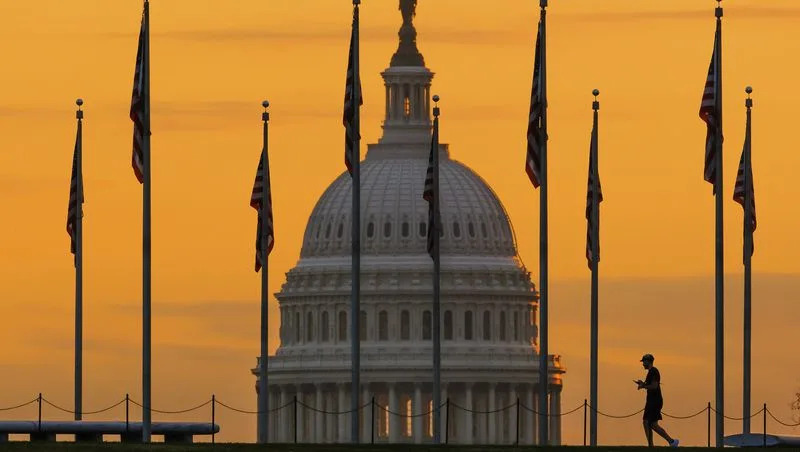
An early morning pedestrian is silhouetted against sunrise as he walks through the American flags on the National Mall with the U..S Capitol Building in the background in Washington on Nov. 7, 2022. | J. David Ake, Associated
 Press

Listen to regular folks in Sweden and Norway and you get an idea about what scares northern Europe.

A woman who specializes in foot care and who spoke Swedish with a Finnish accent came to the house of my wife’s relative in a small Swedish town earlier this month. She was not afraid to tell me how much she dislikes Vladimir Putin. She has relatives in a remote part of northern Russia who, because of Putin’s control over the media, were unaware of the war in Ukraine.

But she also expressed her concerns about politics in the United States.

And yet, she was well aware of how some conservative American politicians favor reducing or ending aid to Ukraine in its war to repel Russian forces, thus strengthening Putin and his threat to the rest of Europe. She also expressed concern about what a second Donald Trump administration might mean for a newly strengthened NATO.

Time and again during a recent family vacation to Scandinavia, I would drop a question or two about global security concerns to strangers. I speak Swedish and Norwegian, making it easier for locals to speak freely. Time and again, I heard the same concerns.

People are acutely aware of American politics and genuinely concerned.

NATO gives Russia’s northern neighbors a strong sense of security. Swedes I spoke with appeared happy to be approaching membership for the first time and to have newly accepted NATO member Finland as a buffer. But they understood that any weakening of that alliance would give a sense of anxiety, instead.

Related

Whether such a weakening would happen is unclear. Certainly, waning right-wing support for Ukraine is real. A recent CNN poll found that 71% of Republican respondents want Congress to end further funding, while 62% of Democrats said the exact opposite.

But future support for NATO seems less uncertain.

In a piece for The Atlantic last year, Tom McTague argued that NATO has come to resemble the type of organization Trump and right-wing Republicans want it to be.

“NATO’s European members are paying more for their own defense, the alliance is more Eastern European in its outlook and positioning, and, for the first time, it is explicitly focused on America’s great-power rivalry with China,” he wrote. This came about more because of the fear of Putin’s belligerence than Trump’s policies as president, he said, but the new shift “signal(s) an important moment for the West, as Europe moves to more closely align itself with American domestic political concerns.”

In contrast to waning support for Ukraine, recent polls show strong American support for NATO.

In the meantime, normally placid Scandinavia seems to be turning into a mini-cauldron of global events, bringing its freedoms and general openness into question.

The nation’s immigration laws have allowed large numbers of Muslims to enter the country in recent years. The influx has strained the nation’s politics and welfare state, even as it has given rise to a right-wing party the Brookings Institution said is attracting Swedes “disgruntled by ‘the establishment’ response to these concerns.”

In recent weeks, several people have burned copies of the Quran as a protest in public places around Stockholm, a practice allowed under the country’s free-expression laws. But the Quran burnings have caught the attention of others around the world. Because of this, the head of the Swedish security service last Thursday announced that the nation was on a level-4 security threat risk, with 5 being the highest.

“We have gone from being considered a legitimate target to a priority target for violent Islamism,” the security chief said.

Reuters reported that Iranian Supreme Leader Ayatollah Ali Khamenei has urged severe punishment for those responsible for the burnings, and that he said Sweden was in battle mode against the Muslim world.

One man told me he found it “ridiculous” that the Swedish government allowed Quran burnings, given what’s at stake. For a time, the Turkish government had threatened to withdraw its support for Sweden’s NATO membership over the burnings, but it has since backed down.

Still a recent Swedish television report said lawmakers are considering changes that would make such public burnings more difficult.

These troubles are, of course, not related to Ukraine or Russian belligerence. They are further evidence, however, of how the outside world is forcing difficult decisions on northern European nations.

In Norway, relatives told me they are slightly amused by outsiders who assume they feel the effects of the war in Ukraine. They don’t. Indeed, the conflict feels as far away from Oslo as it does from the United States.

And yet, below the surface, people know that the world is much closer than ever before. The luxury of feeling secure against Russia will remain so only as long as the United States remains Europe’s closest ally.


NYC
Migrant, homeless advocates demand housing vouchers for undocumented, point to $3 billion in annual savings

Michael Gartland, New York Daily News
Tue, August 22, 2023 


Barry Williams/New York Daily News/TNS

NEW YORK — Advocates are calling on Mayor Eric Adams’ to extend housing vouchers to undocumented immigrants living in New York City — an unprecedented move they say will help alleviate pressure on the city’s homeless shelter system while saving taxpayers $3 billion annually amid the city’s rapidly expanding migrant crisis.

The homeless service provider Win and the New York Immigration Coalition laid out the logic for their demand in a new report exclusively shared with the Daily News that weighs the costs of housing migrants in emergency hotels against an expanded housing voucher. According to their analysis, using figures from the city, academia and the press, it costs $383 a day to house people in hotels versus upwards of $72 per day for funding a more robust housing voucher program.

They contend shifting the cost burden away from more expensive hotel shelters to housing vouchers — which would go toward paying for more permanent housing — could save the city $3 billion a year.

Their proposal comes just weeks after Adams announced that the cost of paying for the migrant crisis could balloon to $12 billion over the next three years.

Christine Quinn, who heads Win and previously served as City Council speaker, said the analysis conducted by her non-profit and the Immigration Coalition shows that expanding housing credits known as City FHEPS vouchers to undocumented is the most practical path forward, both financially and morally.

“Right now, we are moving asylum seekers into shelters or hotels, and they have no way to get out of those shelters or hotels because they don’t have working papers per the federal government and they don’t have any help in paying the rent,” she said. “The emergency hotels are $383 a night. If you gave undocumented people CityFHEPS vouchers it would cost $72 a night. That’s an enormous, enormous difference. That’s where the savings comes in, and that’s where the stabilizing comes in.”

Since April 2022, approximately 100,000 migrants have come to the city, mostly from Latin America countries. Of those, nearly 60,000 remain in the city’s care. In addition to providing shelter and other services for the newly-arrived migrant population, the city is currently housing nearly 83,000 people in its shelter system — most of whom are native New Yorkers. All of it has put an extreme strain on the city’s social safety net, and, as the mayor often points out, at great cost to taxpayers.

Adams has also been calling on the federal government for months to expedite work authorizations for migrants, but so far, the status quo has remained intact. And while that would require federal intervention, Quinn and Murad Awawdeh, executive director of the New York Immigration Coalition, point to expanding FHEPS eligibility as a way the city can act on its own to better address the situation.

Some questions remain about whether the mayor could enact such a policy on his own or if he would require state intervention, said Quinn.

Federal law prohibits certain benefits for the undocumented, but it also allows for states to make exceptions to that overriding legal principle.

Quinn said some interpretations of existing law support the idea that the city can act on its own — without input from the state — but that remains to be seen.

“It’s long past time that the city move out of its emergency response and into a long-term approach that gets people onto their feet,” Awawdeh said. “It’s drastically, significantly cheaper.”

Awawdeh said the idea of expanding FHEPS to undocumented immigrants has been floated at the city level before, but noted that advocates hadn’t been previously armed with data that showed how much the city would save. Quinn said renewed conversations with City Hall are now in the beginning stages.

“I have meetings scheduled in the next couple of weeks with both Deputy Mayor Williams-Isom and Deputy Mayor Torres-Springer to talk about these issues,” she said. “We’ve raised them with different leaders in the City Council who are very open to the idea.”

As Quinn prepares for her temperature-taking excursion to City Hall, the Adams administration has so far remained mum on it.

“We will review the report, but cannot comment directly on its findings without reviewing the underlying methodology,” an Adams spokesman said.

A spokesman for Gov. Hochul did not immediately respond to questions from The News.

The proposal, if rejected by Team Adams, could lead to a dynamic similar to the one that recently played out when the Council passed a law to expand housing voucher eligibility to include tenants who’ve received a written rent demand from a landlord. Adams vetoed the Council’s bill, but that was later overriden thanks to the veto-proof majority secured in the lawmaking body.

A Council spokesman also did not immediately respond to calls. But at least one Council member said he’s against the proposal and questioned the savings outlined in the report from Win and the Immigration Coalition.

“It’s only saving $3 billion in housing costs that they’re making us pay by propping up the right-to-shelter law and sanctuary city status,” said Republican Councilman Joe Borelli, referring to the law that requires the city to provide shelter to anyone who requests it. “This is nothing more than the standard money-grows-on-trees approach from these lefty groups.”

Awawdeh countered that in the long-term the influx of migrants will ultimately benefit the city and state’s workforce.

“This is an opportunity for our workforce needs to be met,” he said. “We have 5,000 agricultural jobs across the state that aren’t being filled, over 5,000 hospitality jobs, thousands of jobs in the healthcare industry — and we need the workforce. This is a golden opportunity for the city and the state, and the city is not seeing it that way.”

_____

Roger Stone's hubris exposes Trump's plan: New video shows lawyers faked distance from Capitol riots

Amanda Marcotte
Wed, August 23, 2023

Roger Stone Joe Raedle/Getty Images


Monday night, "The Beat with Ari Melber" on MSNBC rolled out another set of intriguing videos from "A Storm Foretold," a Danish documentary that follows Donald Trump's close aide and friend Roger Stone, both during the election and through the insurrection of January 6, 2021. Stone is an intriguing character in Trump's plot to overthrow democracy, especially as he's closely connected with the leaders of the Proud Boys and the Oath Keepers. He maintained a group chat called "Friends of Stone," in which many now-convicted insurrection leaders — recently found guilty of leading the Capitol riot, often under severe "seditious conspiracy" charges — kept in communication.

The documentary isn't available in the U.S. and the tapes have not been turned over to American law enforcement, because director Christoffer Guldbrandsen feels it violates journalistic ethics to do so. (Don't be hard on the guy, who was so devoted to this project that he ended up having a heart attack from the stress.) Last week, Melber's show released a video showing Stone detailing the fake electors scheme to his lackeys on November 5, 2020 — before the major news networks called the election. That proves, yet again, that the coup plan predates the election and was not, as Trump apologists claim, merely a reaction to a "sincere" belief that the election was stolen.

Monday's video may be even more damning, but for a moment that passes so quickly nearly all observers have missed the implications. It's yet another clip of Stone ranting, in which he accidentally reveals quite a bit about how, exactly, January 6th came to be. In it, we get a hint both that Trump knew full well that the Capitol riot was in the works — and how Trump managed to keep his fingerprints off any direct planning.

Want more Amanda Marcotte on politics? Subscribe to her newsletter Standing Room Only.

The video captures Stone's aggravation at finding he's been barred from speaking at Trump's January 6th "Stop the Steal" rally at the Ellipse in Washington D.C.

"I don't understand how they want us to lead the march but can't even tell us where to go," Stone whines, adding that he's not speaking directly to Rudy Giuliani or the rest of Trump's inner circle. He complains that it's "very clear that I was never on their list."

"It's just childish and it's amateurish. That's why they lost. They don't know what they're doing," he snipes.

On MSNBC and elsewhere, the coverage has been focused on Stone's admission that Trump lost, adding to the already large pile of evidence that Trump and his co-conspirators never believed the Big Lie. But what struck me in that clip is the part right before it, where Stone indicates he's expected to "lead the march" but that the team directly around Trump has gone incommunicado. Despite Stone's claims that this is "amateurish," it actually suggests Trump and his lawyers were being quite savvy. Cutting off contact in the days before the riot means no traceable communications between them and the people who were going to storm the Capitol that day.

One of the most frustrating aspects of the various investigations into January 6 is nailing down Trump's role in the violence. On one hand, it's obvious that the riot was integral to Trump's "fake electors" plot. He and his co-conspirators wanted to exploit the chaos to argue for substituting fake votes for real ones. He behaved all day like he expected it and his public communications, while draped in plausible deniability, also communicated his expectations of violence to his followers. Plus, as White House aide Cassidy Hutchinson testified during the House hearings about January 6, Trump seemed to have planned to join up with the rioters, and was only thwarted by Secret Service not driving him to the Capitol as he demanded.

On the other hand, no one has turned up any evidence that Trump directly communicated his wishes for a violent insurrection to groups like the Proud Boys or Oath Keepers, who took it upon themselves to lead the charge. All the evidence shows is him riling people up with speeches and tweets, and simply trusting his followers would know what he wanted. Alas, without that direct communication, special prosecutor Jack Smith can't make insurrection charges stick in court, which is likely why he's avoided filing them.

This Stone video suggests this was all very much by design. The people around Trump seemed to know it was of paramount importance to keep many layers of people between him and the people who actually stormed the Capitol. That way, if the insurrection failed, he could plead ignorance of the riot's planning. Which is exactly what he's doing now. That the Secret Service blocked him from physically joining the insurrection, again, shows that the people around Trump knew how he needed this distance, in order to play the whole thing off as a spontaneous riot he had no part in causing.

In recent days, there's been rising discussion of how the Constitution should, in theory, block Trump from being eligible to run for president again. Multiple legal scholars have pointed out that the 14th Amendment bars people from running who have violated an oath of office previously, "either through overt insurrection or by giving aid or comfort to the Constitution's enemies." Notably, the Constitution does not require a formal court conviction on insurrection charges.

By any reasonable measure, of course, this applies to Trump. Even if he insulated himself from direct communication with people convicted of sedition, it's indisputable that he gave aid and comfort, and continues to do so by championing them and promising them pardons. But, of course, the law is not a button you push that automatically turns the clear language on paper into enforcement in real life. Without a mechanism to enforce the law or the political will to enact it, Trump is coasting straight towards a spot on a ballot he should, by law, be barred from having.

If Trump had been indicted outright for sedition or insurrection, of course, then this conversation would suddenly feel less academic and more in the realm of real-world possibility. If he were convicted, it would be hard even for the biggest Trump apologists to claim the plain language of the Constitution doesn't apply. So it ended up mattering quite a bit that  Trump and his inner ring conspirators were careful to keep a firewall between themselves and the people who were orchestrating the riot.

This Stone video is some of the best evidence yet that Trump and his gang both knew that the Capitol riot was coming, but also that they couldn't risk directly communicating with the people leading the charge. As Stone's comments indicate, the downside of this "no direct communication" policy was that Trump and his legal team were taking a gamble, hoping that Trump's followers could take a hint. Unfortunately, it seems that their big bet worked out in most ways. The rioters obviously picked up what Trump was putting down and didn't need explicit commands. Trump has been able to muddy the waters around the question of his responsibility for the riot, to the point where he can't be charged for inciting it, even though we all know that's what he did. And so far, he's been able to keep questions about his eligibility to run at bay, though hopefully this effort to legally bar him will gain momentum.

That's the bad news. The good news is that none of these conspirators were nearly as savvy at hiding the paper trail of the fake electors plot, as demonstrated by the damning evidence compiled by both Smith and Georgia's Fulton County District Attorney Fani Willis. We may never see Trump charged directly for the events of January 6, but he wasn't nearly as clever at hiding his efforts to overthrow democracy as he thinks he was.