How Serbia's government controls much of the media
Sanja Kljajic in Novi Sad
 Aleksandar Vucic on the cover of two tabloid newspapers
The role of public funding
Sejdinovic says that these media are sustained by public money, which is provided through several parallel channels. This has been confirmed by numerous watchdog reports.
The first channel is project co-financing, where public funds are allocated to media outlets through competitive calls to support media content that serves the public interest. According to analyses by BIRN and the Center for Sustainable Communities, around €120 million ($140 million) has been spent on this at the local, regional and state level over the past decade, with the majority going to media outlets that openly support the government.
The second, much larger and less transparent channel is state advertising, which analyses show is also largely directed toward the same pro-government outlets.
A third form of pressure comes from the market. "An atmosphere has been created in which even large private companies avoid advertising in independent media, so as not to damage their relationship with the authorities, and in a deregulated political and economic environment, that is necessary for doing business," said Sejdinovic.
The line between journalism and propaganda
In such a system, the line between journalism and propaganda is almost erased.
Critical voices are delegitimized and demonized, while scandals are reported without context and framed solely through the lens of government officials.
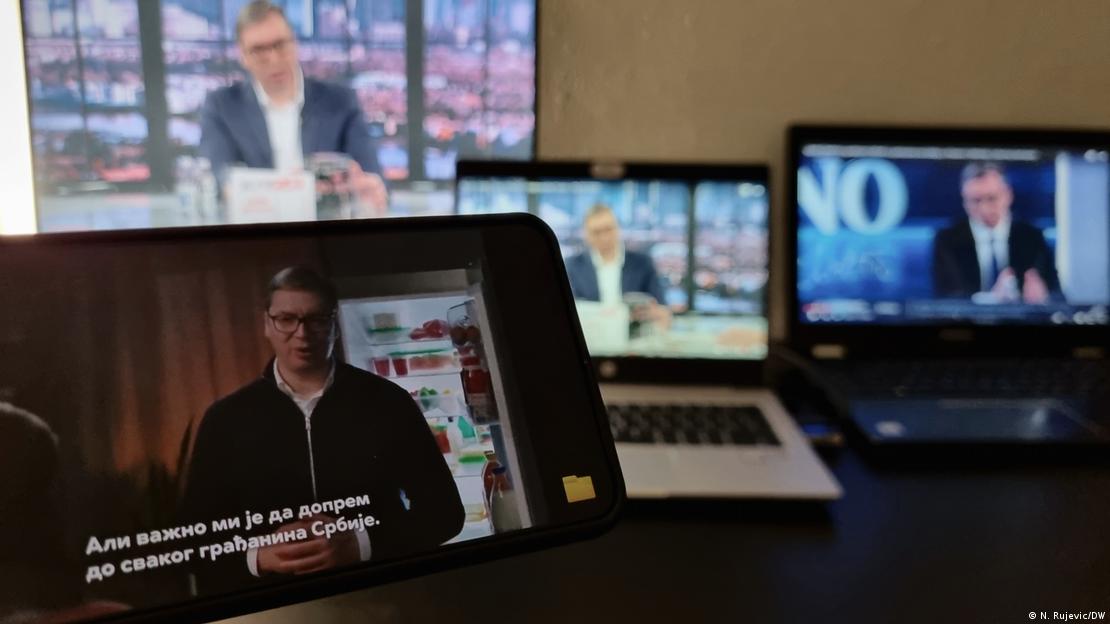
At the same time, the public space is saturated with the presence of President Vucic. His addresses are often broadcast live, interrupting regular TV and radio programs, while party rallies are aired simultaneously across national, regional and local TV stations.
Sanja Kljajic in Novi Sad
DW
April 30, 2026
Since Serbia's ruling SNS party came to power, it has tightened its grip on the media. With an election expected soon, experts fear that authorities will try to eliminate the last pockets of independent reporting.

Image: Rüdiger Rossig/DW
"Backsliding," "pressure," "political influence over editorial policy" — this is how numerous international reports describe the state of the media in Serbia.
Year after year, the international diagnosis of the health of Serbia’s media landscape remains the same: While the space for professional independent media is shrinking, the government's propaganda tools are becoming more developed and sophisticated.
"The main goal of the Serbian Progressive Party (SNS) after coming to power in 2012 was to place the entire media landscape under firm control. And they did this very systematically," journalist and media analyst Nedim Sejdinovic told DW.
The model, he says, was simple: Media outlets willing to cooperate with the authorities received financial and institutional support, while those that refused faced economic and political isolation.
Takeover of local and provincial outlets
One of the first steps was the takeover of the provincial public broadcaster in Vojvodina, where the entire management, along with editors and presenters of news programs, was replaced after the SNS came to power in the region.
"Backsliding," "pressure," "political influence over editorial policy" — this is how numerous international reports describe the state of the media in Serbia.
Year after year, the international diagnosis of the health of Serbia’s media landscape remains the same: While the space for professional independent media is shrinking, the government's propaganda tools are becoming more developed and sophisticated.
"The main goal of the Serbian Progressive Party (SNS) after coming to power in 2012 was to place the entire media landscape under firm control. And they did this very systematically," journalist and media analyst Nedim Sejdinovic told DW.
The model, he says, was simple: Media outlets willing to cooperate with the authorities received financial and institutional support, while those that refused faced economic and political isolation.
Takeover of local and provincial outlets
One of the first steps was the takeover of the provincial public broadcaster in Vojvodina, where the entire management, along with editors and presenters of news programs, was replaced after the SNS came to power in the region.
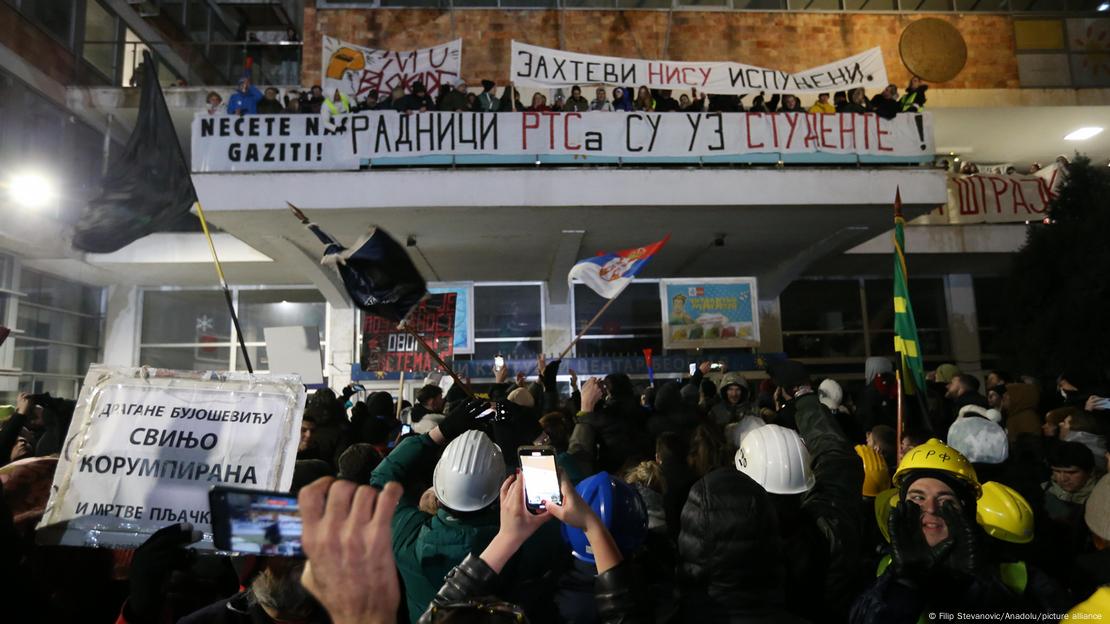
Thousands of Serbs gathered outside the premises of Serbia's public broadcaster RTS in Belgrade in January 2025 to demand objective reporting
Image: Filip Stevanovic/Anadolu/picture alliance
"But one of the most important elements of this media engineering was the purchase of media outlets, especially at the local level, by people who are part of the ruling elite, such as the family of (minister) Bratislav Gasic, or tycoons like Radojica Milosavljevic," said Sejdinovic.
"The result is that around 90% of media outlets are directly or indirectly linked to Aleksandar Vucic's regime," he added.
"But one of the most important elements of this media engineering was the purchase of media outlets, especially at the local level, by people who are part of the ruling elite, such as the family of (minister) Bratislav Gasic, or tycoons like Radojica Milosavljevic," said Sejdinovic.
"The result is that around 90% of media outlets are directly or indirectly linked to Aleksandar Vucic's regime," he added.
The role of public funding
Sejdinovic says that these media are sustained by public money, which is provided through several parallel channels. This has been confirmed by numerous watchdog reports.
The first channel is project co-financing, where public funds are allocated to media outlets through competitive calls to support media content that serves the public interest. According to analyses by BIRN and the Center for Sustainable Communities, around €120 million ($140 million) has been spent on this at the local, regional and state level over the past decade, with the majority going to media outlets that openly support the government.
The second, much larger and less transparent channel is state advertising, which analyses show is also largely directed toward the same pro-government outlets.
A third form of pressure comes from the market. "An atmosphere has been created in which even large private companies avoid advertising in independent media, so as not to damage their relationship with the authorities, and in a deregulated political and economic environment, that is necessary for doing business," said Sejdinovic.
The line between journalism and propaganda
In such a system, the line between journalism and propaganda is almost erased.
Critical voices are delegitimized and demonized, while scandals are reported without context and framed solely through the lens of government officials.
At the same time, the public space is saturated with the presence of President Vucic. His addresses are often broadcast live, interrupting regular TV and radio programs, while party rallies are aired simultaneously across national, regional and local TV stations.
President Aleksandar Vucic is a constant presence on television: His addresses are broadcast live, interrupting regular TV and radio programs
Image: N. Rujevic/DW
Viewers switching channels often encounter the same content: the same face, the same message.
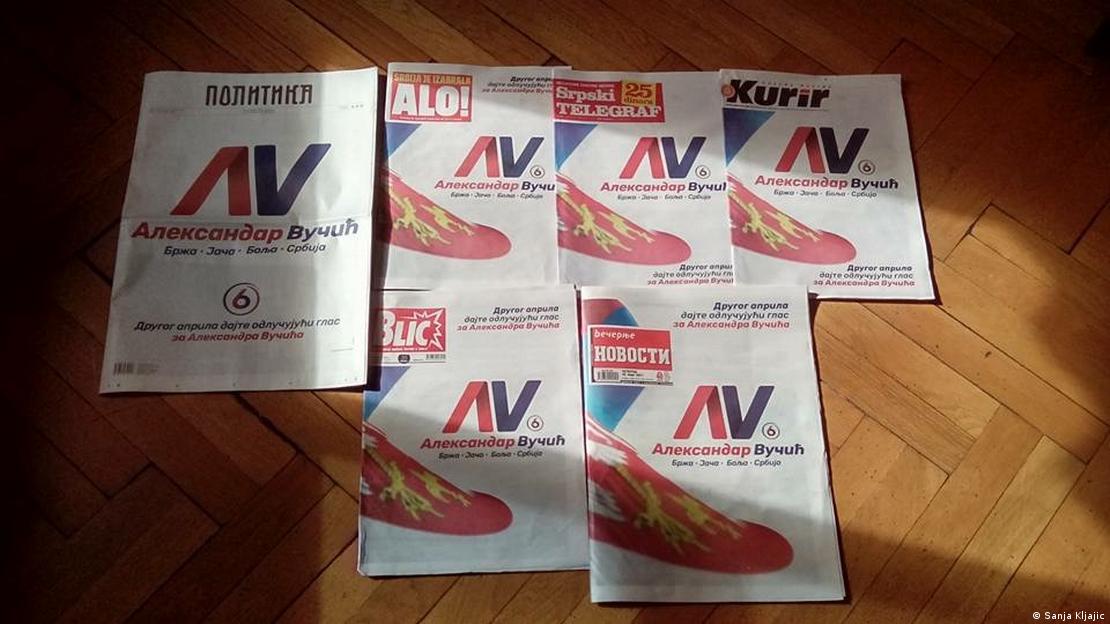
The scale of control was also visible during the 2017 presidential campaign, when almost all daily newspapers carried front-page advertisements for then-Prime Minister Aleksandar Vucic — an unprecedented development in Serbia's modern political history.
The opposition rarely features in regular reporting, and dissenting voices are frequently labeled as "traitors," "foreign mercenaries" or "enemies of the state."
In this environment, the targeting and discrediting of government opponents have become routine.
From loyalists to 'super-loyalists'
Sejdinovic says that as the political crisis deepens, particularly following waves of protests over the past 18 months, control over the media is entering a new phase.
"SNS loyalists are now being replaced with super-loyalists," he explains.
Some pro-government media, he notes, previously limited themselves to positive coverage of the government and ignoring critical voices, but that was obviously not enough.
"Now the goal is to turn all media into a kind of primitive political weapon that will spread the most blatant lies, defame people, use crude language and create an atmosphere of deep political divisions in society," he told DW.
New outlets springing up
This trend is also reflected in the rapid emergence of new media outlets. The Association of Independent Electronic Media (ANEM) in Serbia has noted the registration of 78 new outlets since the beginning of 2026 alone.
Viewers switching channels often encounter the same content: the same face, the same message.
The scale of control was also visible during the 2017 presidential campaign, when almost all daily newspapers carried front-page advertisements for then-Prime Minister Aleksandar Vucic — an unprecedented development in Serbia's modern political history.
The opposition rarely features in regular reporting, and dissenting voices are frequently labeled as "traitors," "foreign mercenaries" or "enemies of the state."
In this environment, the targeting and discrediting of government opponents have become routine.
From loyalists to 'super-loyalists'
Sejdinovic says that as the political crisis deepens, particularly following waves of protests over the past 18 months, control over the media is entering a new phase.
"SNS loyalists are now being replaced with super-loyalists," he explains.
Some pro-government media, he notes, previously limited themselves to positive coverage of the government and ignoring critical voices, but that was obviously not enough.
"Now the goal is to turn all media into a kind of primitive political weapon that will spread the most blatant lies, defame people, use crude language and create an atmosphere of deep political divisions in society," he told DW.
New outlets springing up
This trend is also reflected in the rapid emergence of new media outlets. The Association of Independent Electronic Media (ANEM) in Serbia has noted the registration of 78 new outlets since the beginning of 2026 alone.
During the 2017 presidential campaign, almost all daily newspapers carried front-page advertisements for then-Prime Minister Aleksandar Vucic
Image: Sanja Kljajic
"This is an expansion of the media machinery for spreading government propaganda," said Bojan Cvejic of ANEM. "Their texts are unsigned and almost identical, making them more like pamphlets than journalistic content, used for campaigns against critics," he told DW.
Serbia drops in the rankings
According to the latest World Press Freedom Index published by Reporters Without Borders, Serbia has dropped to 104th place and is now classified among countries with a "difficult situation" for media freedom.
The report highlights that despite some previous fluctuations in ranking, the overall environment for journalists in Serbia continues to deteriorate, marked by increasing political pressure, limited media pluralism and worsening conditions for independent reporting.
President Vucic is expected to call a parliamentary election soon, with many speculating that a poll could be held sometime between June and the end of the year.
Sejdinovic warns that the situation could deteriorate further, with the next phase potentially involving stronger pressure on the digital sphere, following patterns observed in other authoritarian systems.
"The problem of media freedom in Serbia is a political problem," concludes Sejdinovic. "It is difficult to resolve without a change of government, because this government, by its very nature, is essentially an opponent of professional journalism."
Edited by: Aingeal Flanagan

Sanja Kljajic Correspondent for DW's Serbian Service based in Novi Sad, Serbia
"This is an expansion of the media machinery for spreading government propaganda," said Bojan Cvejic of ANEM. "Their texts are unsigned and almost identical, making them more like pamphlets than journalistic content, used for campaigns against critics," he told DW.
Serbia drops in the rankings
According to the latest World Press Freedom Index published by Reporters Without Borders, Serbia has dropped to 104th place and is now classified among countries with a "difficult situation" for media freedom.
The report highlights that despite some previous fluctuations in ranking, the overall environment for journalists in Serbia continues to deteriorate, marked by increasing political pressure, limited media pluralism and worsening conditions for independent reporting.
President Vucic is expected to call a parliamentary election soon, with many speculating that a poll could be held sometime between June and the end of the year.
Sejdinovic warns that the situation could deteriorate further, with the next phase potentially involving stronger pressure on the digital sphere, following patterns observed in other authoritarian systems.
"The problem of media freedom in Serbia is a political problem," concludes Sejdinovic. "It is difficult to resolve without a change of government, because this government, by its very nature, is essentially an opponent of professional journalism."
Edited by: Aingeal Flanagan
Sanja Kljajic Correspondent for DW's Serbian Service based in Novi Sad, Serbia
Daniel Ameri
DW
01/05/2026
For many journalists in Iran, the truth is increasingly being treated as a security threat. Authorities are tightening an already repressive reporting environment, where information is strictly controlled.

Image: AO/Middle East Images/IMAGO
Iran has long ranked among the world's most repressive countries for press freedom. In the 2026 World Press Freedom Index, Reporters Without Borders placed Iran 177th out of 180 countries, below Taliban-ruled Afghanistan, which ranked 175th.
But journalists and media watchdogs say the US-Israel war with Iran has pushed reporting conditions to an even more dangerous point.
Authorities in Iran have long tried to control the public narrative during moments of crisis. But according to journalists inside the country, wartime conditions have made that grip even tighter.
One journalist working for a well-known Iranian outlet told DW that the publication is now being more closely monitored and that editorial instructions are being passed down from above on how coverage should be handled.
According to this journalist, who asked to remain anonymous, the newspaper's website cannot be accessed from outside Iran. Only a limited number of outlets close to the security establishment appear to have reliable access to the global internet.
That account fits a broader pattern described by press freedom groups.
In March, Reporters Without Borders (RSF) reported that journalists in Iran were facing an information blackout at the same time as they were trying to report under dangerous wartime conditions. The group also said some reporters had received threatening phone calls from state-linked institutions.
RSF said access to information inside Iran has been "severely restricted," with reporters working under bombardment while also facing pressure from state institutions.
Iran has long ranked among the world's most repressive countries for press freedom. In the 2026 World Press Freedom Index, Reporters Without Borders placed Iran 177th out of 180 countries, below Taliban-ruled Afghanistan, which ranked 175th.
But journalists and media watchdogs say the US-Israel war with Iran has pushed reporting conditions to an even more dangerous point.
Authorities in Iran have long tried to control the public narrative during moments of crisis. But according to journalists inside the country, wartime conditions have made that grip even tighter.
One journalist working for a well-known Iranian outlet told DW that the publication is now being more closely monitored and that editorial instructions are being passed down from above on how coverage should be handled.
According to this journalist, who asked to remain anonymous, the newspaper's website cannot be accessed from outside Iran. Only a limited number of outlets close to the security establishment appear to have reliable access to the global internet.
That account fits a broader pattern described by press freedom groups.
In March, Reporters Without Borders (RSF) reported that journalists in Iran were facing an information blackout at the same time as they were trying to report under dangerous wartime conditions. The group also said some reporters had received threatening phone calls from state-linked institutions.
RSF said access to information inside Iran has been "severely restricted," with reporters working under bombardment while also facing pressure from state institutions.
Selective internet access
The pressure on journalists has unfolded alongside severe internet restrictions that have sharply limited the flow of information out of Iran.
Reuters news agency reported on April 28 that Iran had entered the third month of an internet blackout, with the authorities introducing limited access for some businesses under a temporary scheme known as "Internet Pro."
According to the report, the blackout first began on January 8, briefly eased in February, and was reimposed after the war began on February 28.
In practice, that has created a two-tier information system. While much of the population has faced little or no normal access to the global internet, some journalists say a small number of media actors and institutions have been given exceptions.
Another Iranian journalist told DW that some colleagues had tried to collect names for access to so-called "white SIM cards," which reportedly allow freer access to the international internet for people approved by security agencies.
She said she refused, believing the arrangement was discriminatory and politically compromising. In her view, the expectation behind such privileges is clear: those who receive access are expected to stay within the boundaries of the state narrative.
Fear, censorship and propaganda
Journalists inside Iran say the pressure extends far beyond internet access. Some describe a climate in which even routine reporting has become risky, especially around sensitive sites or politically charged events.
A journalist based in Tehran told DW that independent reporting has become nearly impossible. In his account, even some credentialed reporters who tried to cover strike locations were briefly detained and had their footage deleted.
DW could not independently verify each of those individual cases, but the broader pattern matches what press freedom groups have described: a wartime environment in which access to information is narrowing and the cost of reporting is rising.
At the same time, state media have continued to frame unauthorized reporting as harmful to national security.
Journalists say domestic outlets are effectively confined to the official version of events and avoid publishing sensitive details from the ground, including the public mood and the full human impact of the war.
Yet some analysts argue that the state's propaganda effort is failing to convince much of the public. Behrouz Turani, a media expert and journalism trainer who has worked with several international outlets, said the Iranian regime's "media propaganda during this war has failed."
Turani told DW the messaging has often appeared clumsy and disconnected from people's lived reality. Rather than persuading the public, he argued, it has exposed the growing gap between official narratives and what many Iranians are experiencing.
Pressure on Iran's diaspora journalists
The crackdown has also extended to exiled journalists and political activists. Reuters reported on March 9 that Tehran had warned Iranians abroad who publicly backed the US and Israel that they could face legal consequences, including the confiscation of their property in Iran.
The report said the warning came from the prosecutor general's office and was directed at members of the diaspora who had expressed support online for the attacks on Iran.
That threat was reinforced later in March, when Iran's judiciary said people accused of spying, cooperating with "hostile states" or helping enemy targeting could face the death penalty and the confiscation of all assets under a law strengthened during the war.
Iranian authorities said the law could also apply to some media-related activity, including sharing images or videos deemed useful to hostile forces.
Iran's information vacuum
Iran's judiciary and security apparatus have for years pursued journalists, media outlets and ordinary citizens over reporting and public commentary. What many reporters describe now is not an entirely new system, but a much harsher version of an old one, leading to an information vacuum.
As independent reporting becomes harder and internet access remains restricted, the space for verified journalism shrinks.
That gives the state more room to promote its own version of events while making it harder for citizens, reporters and the outside world to understand what is really happening on the ground.
Edited by: Wesley Rahn

No comments:
Post a Comment