Thursday, August 24, 2023

John Kerry suggests he disagrees with the UK Government on North Sea oil and gas


Alistair Grant
THE SCOTSMAN
Thu, 24 August 2023 
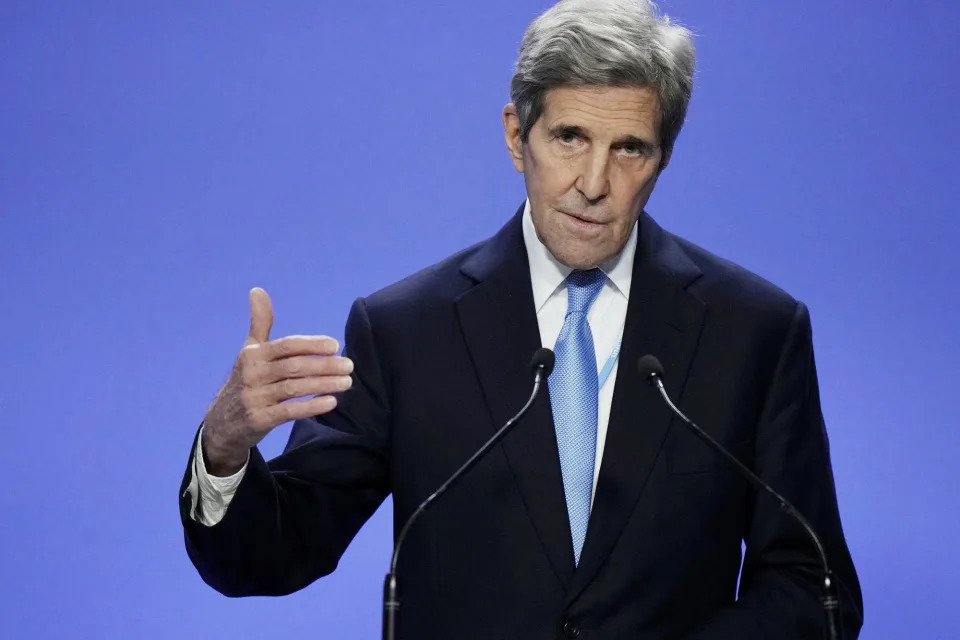
John Kerry. Picture: AP Photo/Alastair Grant

The US climate envoy has suggested he disagrees with the UK Government’s policy on North Sea oil and gas as he cast doubt on whether new drilling will even go ahead.

John Kerry, President Joe Biden’s net zero chief, said the transition away from fossil fuels had to be sped up.

He made the comments after delivering the first in a series of annual lectures taking place during the Edinburgh International Festival, called the “Scottish global dialogues”.


Prime Minister Rishi Sunak previously said he wants to "max out the opportunities" in the North Sea as he confirmed hundreds of new licences for oil and gas extraction will be granted in the UK.

Senator Kerry was asked if he thinks the UK Government is sticking to its climate pledges. He said: “They’re saying at the same time that they’re going to keep on target and they’re going to meet their targets. The UK is deploying a massive amount of wind power, and the more that goes out there the more it’s going to be competitive with fossil fuels.

“Let’s see whether they actually drill. Let’s see what happens. Because I think that dynamic is shifting all over the world. There’s a change in the demand curve and there’s a change in the supply, and we’ll see how this works through.”

Mr Kerry was also asked how the UK policy to "max out" opportunities in the North Sea could possibly align with his own message on the climate crisis.

He initially answered: "It's not my job to be commenting on other countries policies specifically."

However, pushed that his comments did not align with the UK Government's position, he said: "Well then, you've got your answer."

He added: "What I've said, folks, is we have to reduce unabated burning of fossil fuel. We are also - the United States is drilling, because there is a demand level in the marketplace today."

He continued: "This doesn't have to happen by tomorrow. We have to speed up. We have to meet the goal of the Paris Agreement. We have to do what the scientists tell us keeps 1.5C alive. That's our standard in the United States, and that's the standard, I think, of most of Europe, and I think this had been the standard of the UK.

"I don't know how that plays out in terms of what they've said about every last drop, but that's not our policy."

During a visit to Shell’s St Fergus gas plant near Peterhead in July, Mr Sunak said: "My view is we should max out the opportunities that we have here in the North Sea, because that's good for our energy security, it's good for jobs – particularly here in Scotland – but it's also good for the climate because the alternative is shipping energy here from halfway around the world with three or four times the carbon emissions. So any which way you look at it, the right thing to do is to invest and to back our North Sea, and that’s what we’re doing.”



Japan begins releasing treated radioactive water from Fukushima nuclear power plant into Pacific Ocean

Lydia Chantler-Hicks
Thu, 24 August 2023 

Japan begins releasing treated radioactive water from Fukushima nuclear power plant into Pacific Ocean


Japan has begun releasing treated radioactive water from the wrecked Fukushima nuclear power plant into the Pacific Ocean.

The controversial, decades-long project began on Thursday, amid fresh and fierce criticism from China which slammed it as “selfish and irresponsible”.

Approved two years ago by the Japanese government and greenlighted by the UN nuclear watchdog last month, the discharge is a key step in a dauntingly long and difficult process of decommissioning the Fukushima Daiichi plant, including the removal of molten fuel.


The power plant was destroyed in March 2011 when a massive 9.0 magnitude earthquake generated powerful tsunami waves that caused the meltdowns of three of its reactors.

Plant operator Tokyo Electric Power (Tepco) said the release began at 1.03 pm local time (5.03am UK) and it had not identified any abnormalities with the seawater pump or surrounding facilities.

But China reiterated on Thursday its firm opposition to the plan and said the Japanese government had not proved the legitimacy of the water discharge.


South Korean protesters rally against the Japanese government's decision to release treated radioactive water into the Pacific Ocean (Getty Images)

“The Japanese side should not cause secondary harm to the local people and even the people of the world out of its own selfish interests,” China’s foreign ministry said in a statement.

China has said it would also take measures to protect the marine environment and public health, and would step up monitoring of radiation levels in its waters following the discharge.

Tokyo has in turn criticised China for spreading “scientifically unfounded claims.”

It maintains the water release is safe, noting that the International Atomic Energy Agency (IAEA) has also concluded that the impact it would have on people and the environment was “negligible”.

The release of the wastewater has unsettled other countries in the region, with Cook Islands Prime Minister Mark Brown saying that while science supported Japan’s decision, the region may not agree on the “complex” issue.

Japanese fishing groups, hit with years of reputational damage from radiation fears, have long opposed the plan. They fear it will lead to a loss of sales, including from export restrictions to major markets.

Hong Kong and Macau - both Chinese-ruled regions - are set to implement a ban on Japanese seafood from regions including the capital Tokyo and Fukushima starting on Thursday.

South Korean Prime Minister Han Duck-soo said import bans on Fukushima fisheries and food products will stay in place until public concerns were eased.

The process of pumping more than one million tonnes of treated water from the power plant is expected to take decades.


A South Korean university student is detained by police officers during a protest against the move by Japan (Getty Images)

The water will be released in smaller portions initially and with extra checks. The first discharge totalling 7,800 cubic metres - the equivalent of about three Olympic swimming pools of water - will take place over around 17 days.

According to Tepco test results released on Thursday, that water contains about up to 63 becquerels of tritium per litre, below the World Health Organization drinking water limit of 10,000 becquerels per litre. A becquerel is a unit of radioactivity.

Japan will conduct monitoring around the water release area and publish results weekly, the environment minister said.

Tepco expects the process of releasing the wastewater - currently totally more than 1.3 million metric tons - to take about 30 years.

Civic groups have launched protests in Japan and South Korea, although South Korea’s government has said its own assessment found no problems with the scientific and technical aspects of the release.

Ahead of the release, a few dozen protesters gathered in front of Tepco’s headquarters in Tokyo holding signs reading “Don’t throw contaminated water into the sea!”

Japan releases water from Fukushima nuclear plant into Pacific


AFP
Wed, 23 August 2023 

Japan began releasing wastewater from the crippled Fukushima nuclear plant into the Pacific Ocean on Thursday despite angry opposition from China and local fishermen.

The start of the discharge of around 540 Olympic swimming pools' worth of water over several decades is a big step in decommissioning the still highly dangerous site 12 years after one of the world's worst nuclear accidents.

Live video provided by plant operator TEPCO showed two engineers clicking on computer mouses and an official saying -- after a countdown -- that the "valves near the seawater transport pumps are opening".

Monitors from the UN atomic watchdog, which has endorsed the plan, were due to be on site for the procedure, while TEPCO workers were scheduled to take water samples later on Thursday.

Japanese officials have repeatedly insisted the wastewater release is safe.

But China's environment ministry on Thursday blasted Japan as "extremely selfish and irresponsible", saying it would "track and study" the impact of the release on its waters.

Ahead of the operation, about 10 people held a protest near the site and around 100 others gathered outside TEPCO headquarters in Tokyo, AFP journalists said.

"It's like dumping an atomic bomb in the ocean. Japan is the first country that was attacked with an atomic bomb in the world, and the prime minister of the country made this decision," said Kenichi Sato, 68.

- Multiple meltdowns -

With around 1,000 steel containers holding the water, TEPCO has said it needs to clear space for the removal of highly dangerous radioactive nuclear fuel and rubble from the wrecked reactors.

Three of the reactors at the Fukushima-Daiichi facility in northeastern Japan went into meltdown following a massive earthquake and tsunami that killed around 18,000 people in 2011.

Since then, TEPCO has collected 1.34 million cubic metres of water that was contaminated as it cooled the wrecked reactors, along with groundwater and rain that has seeped in.

TEPCO will carry out four releases of the treated water from Thursday until March 2024. The first will last about 17 days, though it is expected to take around 30 years for all of the wastewater to be discharged.

Japan says that all radioactive elements have been filtered out except the tritium, levels of which are harmless and lower than what is discharged by operational nuclear power plants -- including in China.

This is backed by most experts.

"When released into the Pacific, the tritium is further diluted into a vast body of water and would quickly get to a radioactivity level which is not discernibly different from normal seawater," said Tom Scott from the University of Bristol.

- Sushi safety -

Not everyone is convinced, with environmental group Greenpeace saying that the filtration process is flawed, and China and Russia suggesting the water be vaporised and released into the atmosphere instead.

China has accused Japan of treating the Pacific like a "sewer", and even before the release, Beijing banned food imports from 10 out of 47 Japanese prefectures and imposed radiation checks.

Hong Kong and Macau, both Chinese territories, followed suit this week.

Restaurants in Beijing and Hong Kong serving sushi and sashimi are already reeling from the restrictions.

"About 80 percent of the seafood products we use come from Japan," Hong Kong caterer Jasy Choi, who runs a small kitchen for takeaway Japanese food, told AFP.

Analysts said that while China may have genuine safety concerns, its strong reaction is also motivated at least in part by its economic rivalry and frosty relations with Japan.

The South Korean government, which is seeking to improve ties with Japan, has not objected, although many ordinary people are worried and have staged protests.

Social media posts in China and South Korea have included false claims about the release, including doctored images of deformed fish with claims they were linked to Fukushima.

People in the Japanese fishing industry oppose the release, worrying that governments and consumers will shun their seafood.

"I am worried about the future," protestor Ruiko Muto, 70, told AFP in Miharu near the power plant.

"We can't pass on the responsibility of what happened during our generation to the generation of our children and to future generations."

burs-stu/smw
Horrified reaction to climate change denial by candidates at Republican debate

Josh Marcus
Wed, 23 August 2023 

Observers and experts were dismayed as seemingly all but one candidate onstage during the first 2024 Republican presidential primary debate seemed to deny the universal scientific consensus that human behaviour is causing the climate crisis.

“Climate denial is alive and well in the year 2023,” meteorologist Eric Holthaus wrote on X, previously known as Twitter, on Wednesday night.

During the debate in Wisconsin, the candidates fielded a pre-taped question by a youth named Alexander Diaz, who spoke about how the climate crisis is “young people’s number one issue.”

Mike Pence, Ron DeSantis and Vivek Ramaswamy argue during the debate (Getty Images)

“How will you as both president and leader of the Republican Party calm the fear that the Republican party doesn’t care about climate change?” Mr Diaz asked.

The moderators of the debate then asked candidates to raise their hands if they believed in the human origins of the climate crisis.

“We’re not schoolchildren, let’s have the debate,” said Florida governor Ron DeSantis, who later insisted he never raised his hand in affirmation.

Instead of expounding on his views, he lashed out at Joe Biden for his response to the deadly Maui fires, the deadliest wildfire in more than a century in the US, a disaster that was fuelled in part by the climate crisis, according to scientists.

“First of all, one of the reasons our country has declined is because of the way the corporate media treats Republicans versus Democrats,” Mr DeSantis said. “Biden was on the beach while those people were suffering. He was asked about it and said no comment. Are you kidding me? As someone who has handled disasters in Florida, you’ve gotta be activated. You’ve gotta be there. You’ve gotta be present. You’ve gotta be helping people who are doing this.”

Entrepreneur Vivek Ramaswamy then chimed in, to a mix of cheers and boos, and said the “climate change agenda” is a “hoax.”


Scientists say the climate crisis helped fuel the deadly Maui fires

“Let’s be honest, as Republican I’m the only person who isn’t bought and paid for,” he said. “The climate agenda is a hoax... The reality is, the anti-carbon agenda is the wet blanket on our economy. The reality is, more people are dying of and by climate change policies than they are of actual climate change.”

“This isn’t that complicated,” he later said. “Unlock American energy. Drill, frack, burn coal, embrace nuclear. Put people back to work by no longer paying them more to stay at home.”

The only candidate who affirmatively acknowledged the reality of the climate crisis at length was former South Carolina governor Nikki Haley.

“If you want something said, ask a man. If you want something done, ask a woman,” she said, quoting former UK prime minister Margaret Thatcher.

“Climate change is real,” she continued. “Yes, it is. If you want to change the environment, we need to start telling China and India that they have to lower their emissions.”


An aerial view of a maintenance vehicle clearing mud near stranded vehicles along a flooded street after Tropical Storm Hilary floodwaters inundated an area of Cathedral City, California (Getty Images)

Climate experts and politicians were dismayed about the denial onstage, as the climate crisis helped fuel an unprecendented tropical storm in the California desert in recent days.

“Climate change is real, by the way,” Joe Biden wrote on X on Wednesday.

“Vivek calls climate change a hoax,” added the climate-focused Sunrise Movement in a post of their own. “We call bluff that he’s been outside this summer.”

July was the hottest month on record in human history, according to scientists, the latest indicator of the gravity and urgency of the climate crisis.

“Climate change is here. It is terrifying. And it is just the beginning,” United Nations Secretary-General Antonio Guterres said of the record last month.

“The era of global warming has ended; the era of global boiling has arrived.”

US Judge OKs updated Great Lakes fishing agreement between native tribes, state and federal agencies


Thu, August 24, 2023

TRAVERSE CITY, Mich. (AP) — A federal judge on Thursday approved an agreement between four Native American tribes and state and federal regulatory agencies to revise a fishing policy covering parts of three of the Great Lakes.

The deal extends for 24 years a system overseeing commercial and sport fishing in sections of lakes Michigan, Huron and Superior covered by an 1836 treaty. Those areas are entirely within the U.S. and under Michigan’s jurisdiction.

The agreement “respects and promotes tribal fishing rights and opportunities, yet it also preserves the Great Lakes fishery and recognizes the shared nature of the resource,” U.S. District Judge Paul Maloney said in a written opinion.

He overruled objections from the Sault Ste. Marie Tribe of Chippewa Indians — which refused to join the talks because it contends the state has no authority over its fishing operations — and a sport fishing coalition that argued the deal would allow excessive catches of struggling species, particularly whitefish and lake trout.

In addition to the state and federal governments, participants in the deal include the Bay Mills Indian Community, the Grand Traverse Band of Ottawa and Chippewa Indians, the Little River Band of Ottawa Indians and the Little Traverse Bay Bands of Odawa Indians.

The tribes are descended from Odawa and Ojibway nations, described collectively as Anishinaabek, that under the treaty ceded lands comprising nearly 40% of Michigan’s eventual territory. They retained hunting and fishing rights.

Rising tensions between tribal commercial operations and sport anglers led to a fishery management pact in 1985, which was updated in 2000. That version was due to expire two years ago but was extended to allow continued negotiations.

“We look forward to continuing to work with our federal and tribal partners, as well as our constituents, to effectively manage these world class fisheries of the Great Lakes for the benefit of current and future generations,” said Shannon Lott, acting director of the Michigan Department of Natural Resources.

The agreement, like its predecessors, sets zones where tribal fishing crews can operate and areas where commercial fishing is prohibited. It deals with topics such as catch limits and which gear tribal operations can use.

Particularly controversial is tribes’ use of gill nets, an effective tool that hangs in the water like a wall. Critics say they indiscriminately catch and kill too many fish. The new deal let tribes use the nets in more places, with restrictions on depth in the water they’re placed, the times of year they’re used and how much netting is deployed.

“Expanded gill netting now allowed in bays and other areas of the lakes that haven’t had them for more than 40 years will cause social and biological consequences,” said Tony Radjenoivch, president of the Coalition to Protect Michigan Resources.

Under the 2000 pact, Michigan spent more than $14 million paying tribal operations to transition from gill nets to trap nets, which are more selective.

But the latest version continues catch ceilings to keep populations from dropping too low, so the type of net the tribes use is irrelevant, Maloney said in his 139-page opinion.

“Whether they meet that harvest limit quickly by using the efficient method of gill nets, or whether they meet that harvest limit over time by using less efficient means of fishing, the tribes are still subject to the same harvest limits regardless of gear used,” the judge said.

Jim Johnson, a retired Michigan DNR fisheries biologist who submitted an affidavit supporting the sport fishing coalition, said expanded gill netting could cause further drop-offs of whitefish and lake trout. Both have plummeted in recent decades as invasive mussels unraveled Great Lakes food chains, he said.

“We're just going to have to be vigilant and hope the state will intervene in a timely fashion” if numbers fall further, Johnson said.

Although the coalition wasn't allowed to participate in the negotiations, Maloney said they could appeal his ruling. Johnson said they would consider it.

Bill Rastetter, attorney for the Grand Traverse Band, said the agreement “fairly allocates the fishery resource among the competing interests."

It assures that the state, acting on behalf of sport anglers, and tribes "will continue their cooperative fishery management, in contrast to the open warfare of four decades ago,” he said.

John Flesher, The Associated Press
The intergenerational report says climate is a ‘profound’ risk to Australia. But the full picture may be even worse


Peter Hannam
Wed, 23 August 2023 

Photograph: David Gray/Reuters

Climate change and the way the world responds to it “may be the most profound driver of change” for Australia’s economy over coming decades, according to the latest intergenerational report (IGR).

The report is easily the most comprehensive attempt to quantify risks and opportunities, with an entire chapter devoted to climate change and energy. There is a fivefold increase in references to “climate change” versus the 2021 IGR, a similar ratio for “disasters” and triple the naming of “renewable”.

And, as reported on Wednesday, Treasury sought to put a price on costs, such as a loss in productivity amounting to as much as $423bn out to 2063 and falls in crop yields and tourism. But most long-term predictions tend to be unreliable, and this IGR recognises the challenges for projecting global heating’s impacts.

Related: Last decade saw Australia’s lowest productivity growth in 60 years, intergenerational report says

“The future in relation to climate change is highly uncertain,” the report says. “The extent of future climate change, and the risks and opportunities emerging from it, will be affected by many unpredictable factors.”

Treasury notes “global policy cooperation” – read: meeting the 2015 Paris climate commitments to keep warming to “well below 2C” of pre-industrial times – is among the big unknowns.

It warns “as temperature increases approach 2C, the risk of crossing thresholds which cause nonlinear tipping points in the Earth system, with potentially abrupt and not yet well understood impacts, also increases”.

That reference underscores the difficulties in anticipating how different Australian lives will be four decades hence. The report bases its guesses on three scenarios: our planet keeps warming to sub-2C, sub-3C or more than 4C.

Sign up for Guardian Australia’s free morning and afternoon email newsletters for your daily news roundup

Planners assume a comforting gradual uptick in life expectancy, modest changes to taxes paid and a steady value of our terms of trade. Even defence outlays are flat, once they have been adjusted higher for rising “geo-strategic competition in the Indo-Pacific” (mostly from China).

If there are climate-related national security risks, they don’t get a mention. (Efforts to extract from the Office of National Intelligence have likewise proved futile so far.)

Treasury does take a stab at costing the increasing impacts from extreme weather events via its Disaster Recovery Funding Arrangements. Assuming the world is on a 3C warming path, cumulative spending on DRFA will be $130bn in today’s dollars, or 3-3.6 times current levels.

That assessment, however, only assesses four “natural hazards” – bushfires, tropical cyclones, floods and storms – as they presently receive the bulk of spending.

Drought and heatwaves – two perils facing Australia this summer as landscapes dry out and global temperatures nudge record annual levels – are excluded.

Also omitted from any mention (and the previous IGR) is the Great Barrier Reef. Tourism may take a hit in a warming world but at 1C more warming, not many coral reefs are going to make it, with devastating effects on ecosystems and their visitor appeal.

Australia has already warmed 1.47C since 1910, the Bureau of Meteorology estimates (with a +/- 0.24C margin of error).

“Over the next 40 years, under a scenario where global temperatures increase by up to 3C by 2100, Australia’s national average temperature is projected to increase by 1.7C,” the IGR says. Within that, averages in parts of central and northern Western Australia are projected to increase 1.8C, with Tasmania warming “by just 1.3C”, the IGR says.

Regional temperature changes may be among the better understood shifts global heating will deliver. Still, climate researchers such as professor Andy Pitman, director of the Australian Research Council’s Centre of Excellence for Climate Extremes, caution against assuming models have a good handle on how changes will play out locally.

Economists (and others) tend to draw a “linear association between warming temperatures and economic impacts”, Pitman said this week. “It’s the extremes that have the big impact on the economy”.

Related: Australia’s population to grow at slowest rate since federation, intergenerational report forecasts

The report notes correctly technological advances might help minimise damage, such as making crops more drought-resilient. Stronger infrastructure and more fire-proof housing might similarly limit future rebuilding costs.

“But the killer is, where do you build the resilience?” Pitman says. Expect pots of money to be spent unnecessarily while not enough will be outlaid where it’s needed. Climate models can’t tell us that – at least, not yet.

And as for where the funding will come from, the IGR is largely coy about impacts on budgets if coal and fossil gas royalties dive. (“Carbon capture” doesn’t appear in this IGR, compared with three hopeful mentions in 2021.)

“Company tax may be affected by structural or compositional changes in the economy which are not captured by the assumed steady profit share of GDP,” it says.

Coal, oil and gas companies supplied 4% of company tax in 2019-20. “This share is likely to increase in the near term, following recent high commodity prices and decline over time as prices are assumed to return to long-run levels,” it said.

Fossil exports, in other words, are assumed to linger if not expand – unless governments get serious about climate change.
Support for Australia’s UN climate bid should be linked to ceasing fossil fuel expansion, Pacific leaders say

Story by Adam Morton Climate and environment editor •
THE GUARDIAN AUSTRALIA

Photograph: Leon Lord/AFP/Getty Images© Provided by The Guardian

Agroup of Pacific Island elders, including several former national leaders, have taken out a full-page ad in the Fiji Times calling on their countries not to support Australia’s plan to host a UN climate summit until it stops expanding fossil fuels.

The ad on Wednesday by the group the Pacific Elders’ Voice was timed to coincide with a visit to Fiji by the Australian climate change minister, Chris Bowen.

Under a picture of Anthony Albanese and the minister for international development and the Pacific, Pat Conroy, the ad urged Pacific leaders not to quickly back Australia’s request that they join a bid to co-host the Cop31 UN climate conference in 2026.

Related: The Australian government admits its funding is supporting the gas industry. That’s politically risky | Adam Morton

“The Australian government has promised to ‘stand shoulder to shoulder’ with its Pacific family in response to the climate crisis,” the ad said.

“Yet the response to our natural disasters, sea level rise, heat [and] food insecurity has been to pursue more gas and coal projects – the very thing driving the climate crisis.”

The Pacific Elders’ Voice said while the world had moved into what the UN secretary general, António Guterres, called an era of global boiling, Australia was stuck in “the era of fossil fuel expansion”. Its members include former leaders of the Marshall Islands (Hilda Heine), Kiribati (Anote Tong), Tuvalu (Enele Sopoaga) and Palau (Tommy Remengesau).

“We have been clear that standing shoulder to shoulder with us must mean more than expecting to co-host a UN climate change conference in 2026 with us,” they said.

“Australia has ignored our pleas for years. Why then must Pacific leaders be in such a hurry to show support for Cop31? What is the rush?”

Australia is considered well-placed to host Cop31, having won support from several members of the “Western Europe and Others” group that will decide where the meeting is held, but has made clear it wants it to be a joint bid. Bowen has repeatedly emphasised the Pacific’s role.

The climate minister spent three days in the Fijian capital of Suva this week, convening a meeting of Pacific climate change ministers and attending a two-day regional UN climate discussion. Speaking before flying out on Wednesday, Bowen said there was strong support for an Australia-Pacific Cop bid.

“We talked about how we might be able to work together to ensure that this is truly and genuinely a Pacific COP,” he said.

“As I said to the ministers, I want people to leave COP 31, if Australia hosts it, saying ‘Wow, that really was a Pacific COP’. And by that it means a chance to elevate Pacific issues at a time when the Pacific has the world’s attention.”

The Albanese government has been criticised for approving new fossil fuel developments, including the creation of large new gas fields. It has committed $1.5bn to Darwin’s Middle Arm industrial precinct, which a departmental brief to the government described as “a key enabler” for development of the Beetaloo Basin, a potentially large source of gas.

Related: As Pacific islanders, we are leading the way to end the world’s addiction to fossil fuels | Ralph Regenvanu Seve Paeniu

​Speaking in Suva, Bowen said Australia was moving from getting 35% of electricity from renewable energy to 82% in 2030. He said the country “increasingly has become a renewable energy superpower” and was working with its major fossil fuel customer countries, such as Korea and Japan, to help them transition to clean generation.

“They’re on a journey. We’re not going to remove coal and gas tomorrow, nobody really is expecting [that],” he said. “But it’s been a good discussion [with Pacific climate ministers] about how fast the transition in Australia is going, and it’s going very, very fast..”

The Pacific Islands Climate Action Network, a collection of nongovernment groups, said it was concerned about Australia’s eagerness to secure early support for the climate conference bid.

“While we acknowledge Australia’s aspiration to lead in hosting Cop31, Pacific governments must seek tangible evidence of Australia’s dedication to substantial climate action, especially with regard to fossil fuels,” the network said in a statement.

The next major UN climate summit, Cop28, will be held in the United Arab Emirates, starting in late November.

Canada's Corporate Ethics Czar opens forced-labour probes against Walmart, Hugo Boss, Diesel

The Canadian Press
Thu, August 24, 2023


OTTAWA — Canada's corporate-ethics watchdog is investigating if Walmart, Hugo Boss and Diesel have forced labour in their supply chains.

Sheri Meyerhoffer, the Ombudsperson for Responsible Enterprise, issued three reports today saying none of the companies have done enough to demonstrate the products they sell in Canada are free of slave labour.

The Canadian subsidiaries of all three companies are accused of relying on suppliers who source materials from Uyghur people forced to work in China’s Xinjiang region.

Walmart Canada Corp.,Hugo Boss Canada Inc.and Diesel Canada Inc.all say they uphold strong anti-slavery protocols and investigate the source of their products, but Meyerhoffer said none provided enough information about specific allegations.

She said the main challenge is that products from Xinjiang are often processed in other countries, meaning that imports from countries like Vietnam could involve forced Chinese labour if they’re not carefully traced.

Meyehoffer said she's probing Walmart Canada because the company would only say that it avoids forced labour and had removed products made in Xinjiang from its stores. The company did not respond to documented allegations that Walmart is relying on specific clothing and textile firms that operate in that region using forced Uyghur labour.

"While Walmart Canada generally denied the allegations in the complaint, it did not provide a specific response," Meyerhoffer wrote, noting that Walmart opted against a dispute-resolution process.

Meyerhoffer noted that Hugo Boss doesn't seem to use the level of fibre-tracing technology needed to ensure due diligence in a region widely exposed to cotton from Xinjiang.

In its response, the company noted it scrutinizes its "direct suppliers," which concerned Meyerhoffer since its goods from Vietnam or Singapore could rely on various Chinese materials. "Hugo Boss' response does not appear to consider fully the complex nature of the garment supply chain," she wrote.

Hugo Boss also noted a European rights group failed to gather enough evidence to convince German courts to hear allegations the firm had illegally benefited from Uyghur forced labour.

Meanwhile, Meyerhoffer took Diesel to task over what she deemed to be vague statements about its internal reviews of its supply chains, which she said didn’t indicate the timeline, scope or findings of such a review.

She noted the company’s insistence that it doesn’t source cotton from the Xinjiang region isn’t sufficient to ensure suppliers in other countries aren’t using such fibres.

"Diesel Canada provided two brief responses to the complaint, did not provide any response to multiple requests for an initial assessment meeting and did not provide any comments on the draft initial assessment report," reads Meyerhoffer’s report.

"Diesel Canada’s failures to respond … and to engage with the CORE for an initial assessment meeting raise questions about its transparency."

Meyerhoffer said all three companies did not comply in her investigations.

She wrote that Walmart Canada questioned her jurisdiction, and provided general information that didn’t speak to the specific allegations. “The company representatives also questioned what Walmart Canada would have to gain from participating in the process,” Meyerhoffer wrote.

Hugo Boss took issue with an April 2022 media report that named the firm among 14 companies in a complaint alleging the use of forced labour in China. The company claimed that the media report violated the ombudsperson’s rules on confidentiality, and requested the complainants and Meyerhoffer sign a non-disclosure agreement.

The company also took issue with Canada’s freedom-of-information laws, which allow Canadians to learn about the workings of their government but generally exempt confidential corporate information. Hugo Boss “did not respond to multiple requests to meet,” Meyerhoffer wrote.

Her office says Hugo Boss was the only firm she's investigated so far that raised issues with the April 2022 media report, and she said the company refused offers to meet until Meyerhoffer had drafted a report.

The Canadian Press has reached out to all three firms for comment.

A spokeswoman for Walmart Canada noted that none of the subsidiaries named in the complaint "are in our active disclosed supply chain."

"Our policies are diligently enforced," wrote Sarah Kennedy. "Walmart Canada respects CORE’s mandate and will continue to ensure our standards and corporate mandate are being upheld."

Hugo Boss reiterated much of its response to Meyerhoffer, with spokesman Matthias Jekosch noting the company no longer buys from the Chinese supplier cited in the complaint.

"Hugo Boss does not source any goods in its direct supply relationship that originate from the Xinjiang region," he wrote. "As a matter of principle, we do not tolerate forced or compulsory labour or any form of modern slavery."

All seven of the initial assessments the ombudsperson has announced so far relate to accusations of forced labour involving the Uyghur people.

The Chinese embassy in Ottawa maintains that Beijing does not allow modern-day slavery, and that claims otherwise are based on lines meant to constrain China's development.

The United Nations found in mid-2022 that China had committed "serious human rights violations" against Uyghurs and other Muslim communities that "may constitute international crimes, in particular crimes against humanity." Beijing has disputed this report.

This report by The Canadian Press was first published Aug. 24, 2023.

Dylan Robertson, The Canadian Press
Canadians unified on forest protection although wildfire cause divisive: poll

The Canadian Press
Thu, August 24, 2023 


As Canada struggles through its worst fire season in recorded history, a new survey suggests protecting forests remains one issue that unites most Canadians no matter who they are or where they live.

However, other parts of the survey done for Nature Canada and the Natural Resources Defense Council suggests the climate change debate is spilling over into the woods — especially in a season of unprecedented wildfires.

"That is deeply concerning and it does reflect widespread disinformation on climate issues," said Michael Polanyi of Nature Canada.

The two environmental groups commissioned Ekos Research to conduct the survey of more than 1,000 Canadians between July 28 and Aug. 9 on a wide range of forestry and policy issues. The margin of error was three percentage points, 19 times out of 20. Margins of error increase as results are broken down into regional samples.

It found 81 per cent of respondents agreed the federal government should be doing more to protect Canada’s forests and wildlife.


That figure changed little across the country. The lowest support for protection came from Alberta — but even there, 76 per cent were in favour.

Support also held up despite political belief. A majority — 53 per cent — of People's Party of Canada supporters, the most right-wing of Canada's mainstream parties, agreed more protection is needed.

High levels of support continued despite varying household income or education. It also corresponds with similar Ekos polling done last year.

"It is a strong indication of how much Canadians value forests," Polanyi said.

The poll suggests 80 per cent of Canadians want more protection even if it puts limits on the forestry industry. That support held even in British Columbia and Quebec, which both have major logging industries, and across education and income levels.

The survey also asked people what they felt was responsible for Canada's record wildfire surge.

Overall, almost a third of Canadians attributed the increased burning to arson. Almost half of Conservatives and nearly two-thirds of those who support the People's Party said arsonists are the main reason so much forest burned this year.

That cause is widely dismissed by scientists. Yan Boulanger of the Canadian Forest Service said Tuesday that the source of ignition has little to do with the size of the resulting fire.

"It is because of weather conditions that those fires spread and it's not a case of ignition sources," he said.


Right-of-centre political leaders have downplayed connections between wildfires and climate change.

One of Alberta Premier Danielle Smith's responses to that province's fires this summer was to say she'd hire arson investigators. Ontario Premier Doug Ford accused a New Democrat MPP of "politicizing" wildfires when she asked if he accepted a link between them and climate change.


"It does reflect a polarization of views when it comes to climate issues," said Polanyi. "I don't think it helps when leaders are not grounded in or communicating effectively the scientific consensus."

The poll also asked about a wide range of possible conservation policies. It found support for phasing out clear-cutting, ensuring forestry companies report their emissions accurately and following sustainability rules set by countries that import Canadian wood.

Jennifer Skene of the Natural Resources Defense Council said the poll — especially when it comes during a summer that has put such strain on Canadian forests — shows that the federal government needs to step up its protection efforts.

"This is the moment when Canada needs to look inward and adopt the kind of transformative change that will align with a safe, sustainable and viable future. This poll illustrates that is not a theoretical thing, but something that Canadians understand and feel."

Polanyi said the across-the-board support the poll suggests Canadians feel for forest protection could provide common ground for movement on environmental issues.

"Maybe nature offers a way forward in terms of environmental issues, as a way to bring all Canadians together."


This report by The Canadian Press was first published Aug. 24, 2023.

Bob Weber, The Canadian Press

UK Train strikes to hit major events like Reading and Leeds festivals

Daniel Thomas, Jennifer Meierhans and Katy Austin 
- Business reporters and transport correspondent
BBC
Thu, August 24, 2023 

Festival goers

Travellers face major disruption this bank holiday weekend as rail workers across England walk out on Saturday.

Some 20,000 RMT union members at 14 rail companies are striking as part of a long-running dispute over pay.

Thousands will be travelling to events such as the Notting Hill Carnival and the Reading and Leeds festivals.

Separately, a plan to close ticket offices in England has further angered rail unions who warn there will be more strikes if a deal is not reached.

Transport Focus, an independent passenger watchdog, said a public consultation on the plans had received 460,000 responses ahead of the deadline of 1 September.

Train strikes: When is the next action happening?

Saturday's RMT strike, which is its 24th since last summer, will see a reduced timetable in place in much of England, with some journeys into Scotland and Wales also affected.

Around half the usual train services will run and in many areas services will start late and finish much earlier than usual.

The Rail Delivery Group, which represents operators, said the strike was "designed to deliberately target passengers who want to enjoy various sporting events, festivals, and the end of the summer holidays".

The Night Time Industries Association, a trade group, called the walkout "reckless", saying it would leave major events like the Notting Hill Carnival and the Reading & Leeds Festival "in chaos as ticket holders attempt to navigate a limited transport network".

The RMT and train drivers' union Aslef have held a wave of strikes since last summer which have brought much of the rail network to a standstill.

The RMT has said the fresh strike action is happening because it had not received an improved offer, after rejecting the industry's latest proposals in the spring.

Its general secretary, Mick Lynch, told the BBC that union members were targeting Saturdays.

"The strike has to be effective," he said. "We haven't got a plan to disrupt anybody's particular activities but that is the busiest day for the railway and members have decided that's the way they want to go."

The RMT and Aslef have held a wave of strikes since last summer

Further action is planned for the weekend of 1-2 September, with Aslef workers walking out on Friday and RMT members again on the Saturday.

The RMT has a mandate to strike until November, but Mr Lynch told the BBC the union was already preparing to re-ballot workers over further action this autumn and winter.

"We have to keep our campaign up until we get a negotiated settlement on jobs, conditions and pay. There will be more strikes if there's no change," he said.

Aslef is expected to step up its campaign of industrial action in the autumn. It hasn't yet announced details.

Engineering works will add to the disruption over the next few days. Network Rail says more than 7,500 metres of new track and 2,400 sleepers will be installed across the country and almost 15,000 tonnes of ballast will be laid over the long weekend.

Network Rail said the works had been carefully planned to minimise the impact on passengers but added that it was vital to check journeys before travelling.
Ticket office closures

On Wednesday, Aslef boss Mick Whelan hit out at operator plans to close ticket offices, accusing the government of endangering lives by "de-staffing" the railway.

He argued that drivers and passengers felt vulnerable early in the morning and late at night, and having fewer staff on hand could lead to attacks.

The proposals from the train companies, who are backed by the government, have been met by a backlash, including from disability groups.

Transport Focus, which is collecting the public's views on the plans, said that while it had received hundreds of thousands of responses, there was still time for people to have their say.

Over the coming weeks Transport Focus and another watchdog, London TravelWatch, will analyse the proposals and consultation responses before deciding on whether to support or object to the plans.

They will be considering issues such as whether stations will continue to be staffed, accessibility, the alternative options for buying tickets and whether passengers will continue to be able to access station facilities such as lifts, waiting rooms and toilets.

A Rail Delivery Group spokesperson said: "Across the network as a whole, there will be more staff available to give face-to-face help to customers out in stations than there are today [as a result of our ticket office closure plans]."

They added that staff affected by closures would be given a range of options, including moving to new roles or retraining.

The Department for Transport said consultations on ticket offices were ongoing and no final decisions had been made.
Hospital services in the UK come to a standstill as thousands of senior doctors strike again

Thu, August 24, 2023 


LONDON (AP) — Hospital care across England largely came to a standstill on Thursday as senior doctors launch another 48-hour strike amid an ongoing pay dispute between medics and the British government.

Thousands of hospital doctors say they will only provide emergency care, and the National Health Service warned patients to expect major disruption during the two-day strike.

Thursday's action is the latest in a series of strikes staged by doctors, nurses and other clinical staff in recent months and part of a wave of disruptive industrial action by public sector workers to demand better pay amid the U.K.'s cost-of-living crisis.

Julian Hartley, chief executive of NHS Providers, said the latest walkouts are a “massive headache” for the public health service because they are timed just before the late August three-day public holiday weekend, when demand at hospital emergency departments is typically higher. That means many services will in effect be out of action for five days.

The Conservative government has insisted that talks on pay are over after it said senior doctors would receive a 6% pay rise. Health Secretary Steve Barclay said the average annual earnings for senior doctors amount to 134,000 pounds ($169,500) on top of a generous pension.

The British Medical Association, the doctors' union, slammed the increase as “insulting" and said doctors have experienced a 35% pay erosion in real terms over the past 14 years. Many doctors also say that they are compelled to take action to raise awareness of their poor work conditions.

“We would much rather be inside the hospital seeing our patients. But we cannot sit by and watch passively as we are persistently devalued, undermined and forced to watch colleagues leave – much to the detriment of the NHS and patients," said Dr. Vishal Sharma, a union leader.

The British Medical Association said members planned to strike again on Sept. 19-20 and Oct. 2-4 if the government refused to re-enter negotiations.

Meanwhile, tens of thousands of junior doctors — or those medics in the earlier stages of their career — are continuing their pay dispute with the government. Earlier this year the government settled separate disputes with the nurses' unions and other health workers, including ambulance drivers and paramedics.

Strike action over nine months has led to the cancellation of almost 840,000 inpatient and outpatient hospital appointments, figures showed.

In the past 18 months or so, millions of workers including train and bus drivers, airport baggage handlers and teachers across the U.K. have walked off their jobs, calling for wages that keep pace with the skyrocketing cost of living.

Inflation in the U.K. hit a four-decade high of 11.1% last October, driven by sharply rising energy and food costs, before dropping back to 7.8% in July.

Sylvia Hui, The Associated Press