Saturday, February 01, 2025

UN war crimes investigators say Syria ‘rich in evidence’


By AFP
January 31, 2025


The notorious Saydnaya prison complex 'is pretty much emptied of any documents', a UN official says - Copyright AFP PEDRO UGARTE

Despite concerns about the destruction of documents and other indications of serious crimes committed in Syria under Bashar al-Assad’s rule, UN investigators said Friday that plenty of evidence remained unspoiled.

“The country is rich in evidence, and we won’t have huge difficulty in pursuing accountability, criminal justice,” said Hanny Megally of the UN Commission of Inquiry on Syria.

The sudden ousting last month of Assad after decades of dictatorship has seen the commission suddenly gain access to Syria, after striving since the early days of the civil war in 2011 to probe from abroad the vast array of alleged abuses.

“It was amazing to be in Damascus after the whole life of the commission not having access to the country at all,” Megally told the Geneva UN correspondents’ association ACANU after a recent visit to Syria.

With families rushing to former prisons, detention centres and suspected mass graves to find any trace of disappeared relatives, many have expressed concern about safeguarding documents and other evidence.

Describing his visits to prisons in Damascus, Megally acknowledged that “a lot of the evidence seems to have been tampered with, and either it was on the ground and you could see people… had been walking all over it, or had been damaged or destroyed.

“And we’ve all seen the reports of people having taken away documents with them.”


– Evidence destroyed –


The notorious Saydnaya prison complex — the site of extrajudicial executions, torture and forced disappearances that epitomises the atrocities committed against Assad’s opponents — “is pretty much emptied of any documents”, Magally added.

He also said there were clear signs “of deliberate destruction of evidence”, presumably by the Assad authorities before they left.

During his visit, Megally said he had seen “one or two places (with) rooms that looked to me like they were used to deliberately burn documents”.

But he voiced optimism that the Syrian state under Assad was “a system that probably kept duplicates if not triplicates of everything, (so) even if evidence was destroyed, that may exist somewhere else”.

And even in places where documents had clearly been intentionally destroyed, other parts of the building were “intact” and filled with evidence, he said.

“It seemed that there’s still quite a lot of evidence that’s protected now, and we hope can be used in future accountability.”

Megally also said the careless handling of documents seen at the beginning had swiftly been brought to a halt once the calls to protect and preserve evidence went out.

“It was impressive just how quickly it seems people have picked up the fact that even by going and looking and moving things around, you’re potentially risking tampering with evidence that could be used in future accountability processes,” he said.

His colleague Lynn Welchman also said Syria’s new authorities appeared to be “seeking to ensure the preservation of evidence for the future”.

That is essential, she told reporters.

“One of the most important things for the future will be to ensure that what has happened in Syria never happens in Syria again,” she said.

“There’s a lot of work to be done in trying to find out what happened in order for all parts of Syrian society to move forward.”


40 years on, Hama survivors recall horror of Assad-era massacre

By AFP
January 31, 2025

Hayan Hadid (centre) survived the 1982 Hama massacre - Copyright AFP -

Tony Gamal-Gabriel

Hayan Hadid was 18 when soldiers arrested him in his pyjamas and took him for execution in Syria’s Hama in 1982, during one of the darkest chapters of the Assad clan’s rule.

“I’ve never really talked about that, it was a secret. Only my family knew,” said Hadid, now a father of five.

In light of the December 8 ouster of Bashar al-Assad, “we can talk at last”, he said.

On February 2, 1982, amid an information blackout, Assad’s father and then leader Hafez launched a crackdown in Hama in central Syria against an armed Muslim Brotherhood revolt.

The banned movement had tried two years earlier to assassinate Hafez, and his brother Rifaat was tasked with crushing the uprising in its epicentre.

Survivors who witnessed extra-judicial executions told AFP that the crackdown spared no one, with government forces killing men, women and children.

The death toll of the 27 days of violence has never been formally established, though estimates range from 10,000 to 40,000, with some even higher.

“I had no ties with the Muslim Brotherhood, I was at school,” said Hadid, now in his sixties.

But “my father was always very afraid for me and my brother”, he said.

Hadid’s cousin Marwan had been an influential figure in the Fighting Vanguard, an armed offshoot of the Brotherhood.

After days of battles, soldiers turned up in Hadid’s neighbourhood and arrested around 200 men, taking them to a school.

When night fell, around 40 were called by name and forced into trucks, their hands tied behind their backs, he said.

When the vehicles stopped, he realised they were at a cemetery.

“‘That means they are going to shoot us’,” said the person next to him.


– ‘Please, kill me’ –


Blinded by the truck lights as he stood among rows of men for execution, Hadid said he felt a bullet zip past his head.

“I dropped to the ground and didn’t move… I don’t know how, it was an instinctive way to try to escape death,” he said.

A soldier opened fire again, and Hadid heard a wounded man say, “please, kill me”, before more shooting.

Miraculously, Hadid survived.

“I heard gunfire, dogs barking. It was raining,” said the former steelworker, who now runs the family’s dairy shop.

When the soldiers left, he got up and set off, crossing the Orontes River before arriving at his uncle’s house.

“My face was white, like someone who’d come back from the dead,” he said.

Forty-three years later, Bashar al-Assad’s ouster opened the way to gathering testimonies and combing the archives of Syria’s security services.

In 1982, Camellia Boutros worked for Hama’s hospital service, managing admissions.

“The bodies arrived by truck and were thrown in front of the morgue. Dead, dead, and more dead. We were overwhelmed,” said Boutros, now an actor.

Bodies bearing identity cards were registered by name, while others were recorded as “unknown” and classified by neighbourhood, she said.

Some bodies were kept at the morgue, while others were taken to mass graves.

“Hour by hour, the command would call wanting precise figures on how many soldiers, Muslim Brotherhood” and civilians had been killed, she said.

Boutros said the toll was “7,000 soldiers, around 5,000 Muslim Brotherhood” members, and some 32,000 civilians.

“All the relevant authorities” received the statistics, she said, adding that her registers were later taken away.


– ‘Nobody was spared’ –


From her office window, she said she saw people being shot dead in the street.

The Brotherhood is a conservative Sunni Muslim organisation with a presence around the region, while the Assads, who stem from the minority Alawite community, purported to champion secularism.

But not all the victims of the crackdown were Sunni. Boutros said a relative of hers, a Christian, was taken from his home and killed.

“Nobody was spared death in Hama… women, men, children, people young and old, were lined up against the wall and shot,” she said.

Bassam al-Saraj, 79, said his brother Haitham, who was not involved with the Muslim Brotherhood, was “shot in front of his wife and two children” outside the city’s sports stadium.

The retired public servant recalled how the elite Defence Brigades headed by Rifaat al-Assad had moved in on their neighbourhood.

Six months later, authorities detained his other brother, Myassar, rumoured to be a Brotherhood member.

“After two or three hours, they called me in to pick up his body,” Saraj said, but authorities forbade them from holding a funeral.

Over more than half a century of rule, the Assads sowed terror among Syrians, imprisoning and torturing anyone even suspected of dissent.

Mohammed Qattan was just 16 when he took up arms with the Fighting Vanguard. He was arrested in February 1982 and jailed for 12 years.

“The regime’s line was incompatible with the country’s values,” he said, citing mixed education in public schools as one of the policies he opposed.

– ‘Kill everything in sight’ –

Qattan said the authorities “discovered a Brotherhood headquarters” and a plan “to launch coordinated military action” in Hama and Aleppo further north.

After five days of fighting, “we started running out of ammunition and our frontline commanders started falling”, he said.

When government forces retook any area, “it was as if they had orders to kill everything in sight”, he said.

“The streets were littered with bodies of civilians, even women and children.”

Qattan said a dozen relatives, mostly civilians were killed, including his two brothers, one of them a Brotherhood member.

Released from prison in 1993, he became a pharmacist and returned to studying history.

When Bashar al-Assad’s 2011 crackdown on pro-democracy protests sparked war, Qattan joined an armed group, eventually seeking exile in Turkey.

He returned home after Assad’s ouster last month.

What happened in Hama “was a crime that was planned” to bring the population to heel, he said.

“And it worked — the regime hit Hama hard, and all the other cities learnt the lesson.”


Ghosts of past spies haunt London underground tunnels


By AFP
January 31, 2025


Deep beneath the London streets lies a network of disused tunnels, once home to British spies and a secret long-distance telephone exchange -
 Copyright AFP Lillian SUWANRUMPHA


Marie HEUCLIN

Behind a blue door in a narrow London passage lies a little-known network of tunnels deep underground, once home to British spies and a secret long-distance telephone exchange.

Thirty metres (100 feet) below the UK capital’s bustling streets, all that can be heard in the tunnels built to withstand a nuclear attack is the rumble of the London Underground’s Circle Line.

The two main tunnels, five to seven metres in diameter, reached via some steps and then a lift, “were built to defend the British from the Nazis” during World War II, explained Angus Murray, on a guided visit for a small group of journalists.

The Australian-born entrepreneur’s private equity firm bought the little-known Kingsway Exchange Tunnels in September 2023 from British Telecom. The price has not been divulged.

Now Murray hopes to transform the site, which stretches for over a mile (1.6 kilometres), into a major tourist attraction “honouring the history and heritage of London” with a planned opening in 2028.

The complex beneath the Holborn district was built as an air-raid shelter during the early 1940s bombardments known as the Blitz.

– Inspiration for 007 –

The site is now planned to host immersive displays showcasing its distinctive heritage as a World War II bomb shelter and then as the home of the top-secret Special Operations Executive between 1944 and 1945.

The Special Operations Executive was created by then prime minister Winston Churchill earlier in the war to support European resistance movements fighting occupation by Nazi Germany.

Separate from the MI6 foreign intelligence service, it is considered the inspiration for “Q Branch” in Ian Fleming’s James Bond franchise.

After the war, the tunnels were used for storing official documents as well as a possible reserve shelter for war rooms, in case of further conflicts.

The UK government later enlarged the site in the 1950s at the start of the Cold War to host a secure long-distance telephone exchange, shrouding it in official secrecy for decades.

The first transatlantic telephone cable, called TAT-1, was operated from the tunnels, becoming a key cog in the so-called hotline between Moscow and Washington that emerged in the wake of the 1962 Cuban Missile Crisis.

In one of the rooms, visitors catch a glimpse of the large exchange and its plethora of plugs through which the operator could manually connect a caller with the person they were trying to reach.

“Because during the war some of the telecommunications exchanges got bombed, they needed a deep level telecommunications exchange,” said Murray.

– Forgotten offices –


The site, spread over 8,000 square metres (86,000 square feet), accommodated up to 200 staff working deep underground far from any natural light. It also featured a bar, a restaurant with mock windows, and a recreational room with snooker tables.

But by the late 1980s, telecommunications technology had advanced and the complex was decommissioned. British Telecom put the site up for sale in 2008.

Further along a corridor, the visitor finds a series of doors. But they only open onto the tunnel walls.

Huge generators which once powered the secret communications now lie gathering dust.

For years the tunnels lay in darkness, forgotten and disturbed only by some curious explorers. Some graffiti on the walls and empty beer cans dotting the ground remain the only clues to their presence.

That is until Murray, a former Macquarie Group executive who founded his own hedge fund, bought the site, aiming to spend more than £200 million to turn it into an attraction worthy of two million visitors a year.

“I think that we need to respect the people, the men and women that sacrificed themselves to give us all the democratic rights we have today,” he said.


AD Ports to Battle DP World for Cargo Business at Port of Luanda, Angola

Luanda, Angola
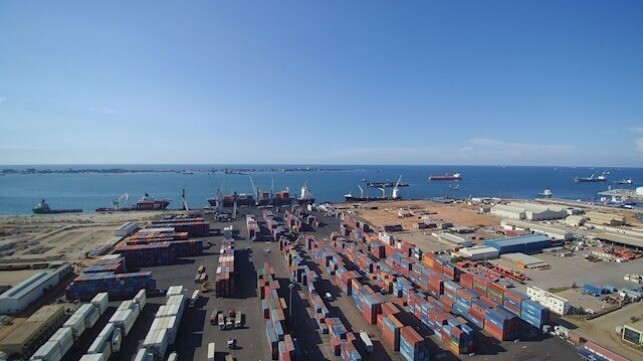
DP World faces new competition in Angola as AD Ports expands into the port (DP World)

Published Jan 31, 2025 8:26 PM by The Maritime Executive


The Port of Luanda in Angola is set to become a battleground of competition for two giant Arab companies after AD Ports officially commenced operations at the port under a long-term concession. AD Ports, the Abu Dhabi-based operator, announced that it has begun the long-term management and development of a major multipurpose terminal and associated logistics business at the port.

The company ventured into Angola in April last year after signing agreements with local firms Unicargas and Multiparques that saw it acquire an 81 percent stake to operate the terminal and a 90 percent shareholding in another logistics business. The company managed to secure a 20-year concession granting it the rights to operate the Noatum Ports Luanda terminal, with an option for a 10-year extension.

AD Ports operations of this terminal set the ground for competition with Dubai-headquartered DP World for cargo business at the port. Since 2021, DP World has been running another multipurpose terminal under a 20-year concession and is investing $190 million to rehabilitate the existing infrastructure and acquire new equipment to improve efficiency.

The two giant operators will now be competing for a bigger share of business at the port, which handles about 76 percent of Angola’s container and general cargo volumes. It also provides maritime access to landlocked neighbors, the Democratic Republic of the Congo and Zambia.

AD Ports hopes that its intended investments amounting to $250 million over the next two years in modernizing the terminal and expanding the logistic facility will be instrumental in attracting business. Over the lifespan of the concession, the company is committing to invest $380 million.

Key investments will go towards upgrading the terminal to a general cargo, container, and roll-on-roll-off (RoRo) terminal, making it the only one with 16 meters (52.5 feet) of depth. This will ensure the terminal is able to handle Super Post Panamax vessels of up to 14,000 TEU. The terminal area spanning 192,000 square meters will also be re-engineered to support high-density and efficient container handling and will be equipped with state-of-the-art equipment and modern IT systems.

AD Ports also plans to install new container handling equipment to boost container capacity from 25,000 TEU to 350,000 TEU and Ro-Ro volumes to over 40,000 vehicles. The company has already ordered three STS cranes and eight hybrid Rubber Tyred Gantry cranes for the terminal.

“With the planned upgrade of Luanda’s multipurpose port terminal, and establishment of an integrated logistics and freight forwarding business, AD Ports is positioned to capture the growth in Angola’s container volumes, which are forecast to rise on average by 3.3 percent annually over the next decade,” said Mohamed Eidha Al Menhali, Regional CEO of AD Ports Group.

The start of operations in Angola by AD Ports is part of its Africa expansion strategy. Over the past three years, the company has announced more than $800 million in planned investments in the maritime and shipping, ports, and logistics sectors in Egypt, the Republic of Congo, Tanzania, and Angola.

Angola’s Oil Sector Making A Comeback After OPEC Exit

By Alex Kimani - Jan 30, 2025

In 2023, Angola officially announced that was leaving OPEC.

Angola's average daily oil production hit 1.134 million barrels in the first three quarters of 2024, good for a 4% increase compared to 2023 production.

Exploration has picked up in Angola following the OPEC-exit.


In 2023, Angola officially announced that it was leaving OPEC amid a disagreement over oil production quotas, ending its 16-year stint in the cartel. Angola, Africa’s second-largest crude producer, became the fourth country to leave OPEC after Indonesia, Qatar and Ecuador left in 2009, 2019 and 2020, respectively.

Relations between the South African country and OPEC came to a head after OPEC gave the green light to the United Arab Emirates to increase its production by 200,000 barrels per day (bpd) to 3.2 million barrels in 2024, but lowered Angola’s quota to 1.1 mb/d, roughly in-line with the country’s declining production.

However, the move did not go down well with Angola,“Our role in the organization was not deemed relevant. It was not a decision made lightly — the time has come,” Angola’s Mineral Resources Minister Diamantino Azevedo said while announcing the withdrawal.

And now it appears that Angola’s recalcitrance is beginning to pay off. Angola's average daily oil production hit 1.134 million barrels in the first three quarters of 2024, good for a 4% increase compared to 2023 production. According to the Angola Press Agency, government stabilization measures have contributed to the uptick in production, with the gains attributed to the commissioning of new oil wells and interventions in various concessions.

Luckily, the country is also witnessing a surge in both onshore and offshore oil and gas discoveries coupled with rising exploratory activity. A few weeks ago, Nigerian multinational energy company Oando PLC was awarded operatorship of Block KON 13 in Angola’s Onshore Kwanza Basin by the Angolan National Agency for Petroleum, Gas, and Biofuels (ANPG). Block KON 13 is located in the prolific Kwanza Onshore Basin with estimated prospective resources of 770 to 1,100 million barrels of oil. With a 45% participating interest, Oando’s subsidiary Oando Energy Resources will lead the development of the block as operator, alongside Effimax (30%) and Sonangol (15%) as co-venturer.

Last September, pan Angola-Brazil focused exploration and production company Corcel announced that its contractor, Metatek Group, has completed the acquisition of data phase of the Enhanced Full Tensor Gradiometry Survey ('eFTG') on Block KON-16. Corcel holds an operated and controlling interest in KON-16, a large (1000 sq km) block in the onshore Kwanza Basin.

Back in 2020, Exxon Mobil Corp. (NYSE:XOM) announced that it has, together with its partners, discovered hydrocarbons in Block 15 off Angola in the Bavuca South prospect. This was the block’s 18th discovery, but the first since 2003. According to Exxon, the Valaris DS-9 drillship drilled the Bavuca South-1 well 365 km northwest from the coast at Luanda in 1,100 m (3,608 ft) of water, encountering 30 m (98 ft) of good-quality, hydrocarbon-bearing sandstone. Exxon owns a 36% interest in the block, with BP Exploration Angola (24%), ENI Angola Exploration (18%), Equinor Angola Block 15 (12%) and Sonangol P&P (10%) being its partners.

Uphill Task

That said, Angola is facing a herculean task in its bid to return to its former glory. The country’s production when it joined OPEC in 2007 clocked in at 1.66 million b/d, peaking at 1.88 mb/d a year later. From there the country’s output somewhat plateaued, dropping slightly to 1.80 mb/d by 2015 before going into a steep decline in the subsequent years. Angola’s major challenge has been a failure to attract enough investments for its aging, deepwater oil fields. Whereas the country’s oil deposits at first drew the attention and deep pockets of corporate majors BP Plc (NYSE:BP), Exxon Mobil Corp. (NYSE:XOM), and Chevron Corp. (NYSE:CVX), its deepwater fields have declined faster than those onshore. Before its exit, Angola repeatedly failed to meet OPEC production quotas. Further, the country’s tax regime has also deterred investment, a situation that worsened when crude prices slumped from 2014 to 2016.

Angola will also be keen to avoid the so-called ‘resource curse’ that has afflicted many resource-rich African nations. To wit, in August, Mozambique officially started exporting liquefied natural gas (LNG) after years of delay thanks to rampant corruption and political instability. Back in 2010, Anadarko Corp. (now a subsidiary of Occidental Petroleum Corp.) and Italian energy giant Eni S.p.A. announced the discovery of approximately 180 trillion cubic feet of natural gas reserves, equivalent to ~29 billion barrels of oil, in Mozambique’s supergiant offshore basin of Rovuma, immediately catapulting the south African nation to a potential global LNG superpower. As you might expect, there was a stampede by oil and gas majors including ExxonMobil (NYSE: XOM), TotalEnergies, Shell (NYSE:SHEL), Eni S.p.A. and China National Petroleum Corp. (NYSE: SNP) coming in to stake their claims.

But it was not long before terrorism and the long tail of the “hidden loans” corruption scandal, in which senior officials had formed state-owned companies that borrowed billions of dollars off-the-books, started to cast a pall on the economy and took a toll on investor confidence.

Mozambique was plagued by a 16-year civil war that ended in 1992, yet resurgent armed conflict remains a major challenge. The root causes, as always, have been underdevelopment and corruption. Over a period spanning more than five years, a notorious terrorist organization that aligned itself with the Islamic State carried out dozens of attacks, especially in the Cabo Delgado province. The insurgency killed more than 1,500 people and displaced another 250,000 in the country’s north.

Thankfully, the country’s current outlook is far more positive than it’s been in decades, with Mozambique having managed to attract significant investments after President Felipe Nyusi was sworn in in 2020.

"The completion of this international venture is a sign of the recognition by the market that Mozambique offers a stable, transparent and predictable environment for the realization of multi-billion investments, where high technology stands out in order to monetize resources in a phase of the energy transition, therefore it must bring pride to all Mozambicans, " President Nyusi said after the first shipment of gas under a long-term purchase and sale contract with British giant BP.


Angola will be looking to Mozambique for some important lessons as the country starts to unlock its gas riches valued at nearly $100 billion.

By Alex Kimani for Oilprice.com


CRIMINAL CAPITALI$M


Trafigura and former executive found guilty of bribing Angolan official

Reuters | January 31, 2025

Mike Wainwright. Credit: Trafigura Group

Switzerland’s top criminal court convicted trading house Trafigura and a former senior executive of corruption on Friday in an unprecedented case over payments made to an Angolan official in exchange for oil contracts.


It ordered Trafigura to pay a fine of 3 million Swiss francs ($3.3 million) and $145.6 million in compensation, and sentenced Trafigura’s former chief operating officer Mike Wainwright to 32 months in prison, of which 12 must be served.


Explaining the verdict, judge Stephan Zenger referred to “organizational failures” and said that it would have been reasonable to expect a company the size of Trafigura to more closely monitor payments to its intermediaries. “The shortcomings noted are not negligible,” he told the court.

Wainwright had indirectly profited from the bribery, Zenger said. His lawyer said he would appeal the verdict, which will place the prison sentence on hold pending the outcome.

The case was the first time in Switzerland that a company was charged at its highest court with corrupting a foreign official, and a very rare instance globally of a former top executive of a trading firm landing in the dock.

“It is a strong signal that reflects the determination of (Swiss prosecutors) to combat all forms of transnational corruption, particularly in the commodities sector,” the Office of the Attorney General of Switzerland said in a statement.


The total payment, which is just shy of the $156 million sought by prosecutors, is a fraction of Trafigura’s earnings which have been boosted by an energy price rally.

Prosecutors alleged that Trafigura and others paid bribes of over $5 million via a network of intermediaries to the Angolan official to win oil deals from 2009 to 2011.

Trafigura lawyer Jean-Francois Ducrest said the Singapore-based commodities trading firm, which has major operations in Geneva, would take stock of the situation.

“It is a first step in a long judicial process,” he said. The company said in a statement it was disappointed by the outcome and that it had invested significant resources strengthening its compliance program over a number of years.

Wainwright, who has also had a successful career as a racing driver, has denied all the allegations against him. “Today’s verdict lacks grounding. The court found Mr. Wainwright guilty based on general assumptions and disregarded key evidence that shows he was not involved in any bribery scheme,” his lawyer Daniel Kinzer said in a statement.

The 51-year-old Briton, now retired, sat in court with his arms crossed as the verdict was read out and declined comment afterwards.

Two other defendants, including the Angolan official, were also found guilty and sentenced to 36 months and 24 months each, with the former sentence partially suspended and the latter fully suspended. Reuters did not name them due to restrictions under Swiss privacy rules. They had denied the charges as well and did not attend the verdict.

During the trial in the southern Swiss city of Bellinzona, the court was shown dozens of pages of documents, memos, emails and messages as supporting evidence.

Some involved an ex-Trafigura employee whom the indictment says was nicknamed “Mr. Non-Compliant” by late Trafigura founder Claude Dauphin because he did things forbidden at the group. Dauphin’s family says he has been singled out unfairly and the family lawyer contests the importance given to the evidence for the nickname.

($1 = 0.9093 Swiss francs)

(By Emma Farge; Editing by Matthias Williams, Mark Heinrich and Mark Potter)


Ottawa announces deferral in implementing capital gains changes, new exemptions


January 31, 2025 


Canada delays capital gains tax change to 2026

VP of advocacy at the CFIB Corinne Pohlmann shares her reac tion to the feds delaying its capital gains tax hike to Jan. 1, 2026 after court challenges forced Trudeau's government to abandon the policy.

The federal government announced it is deferring the implementation of its change to the capital gains inclusion rate from June 25 of this year to Jan. 1 2026.

The government announced the deferral in a press release Friday and said it would “maintain or enhance” existing exemptions and create new incentives for investment.

The tax hike would raise the inclusion rate on capital gains that companies pay to two-thirds from one half. On an individual basis, the changes would apply to those with earnings from capital gains above $250,000.

LeBlanc, the minister of finance and intergovernmental affairs, said in the announcement.

“Given the current context, our government felt that it was the responsible thing to do. I look forward to further conversations with Canadians on how we can ensure Canada’s fiscal policy encourages robust and sustained economic activity in every region of our country.”

Four exemptions highlighted

The government highlighted four exemptions that were being maintained or created.

This included maintaining the principal residence exception to “ensure Canadians do not pay capital gains taxes when selling their home,” the release said.

Ottawa also said it would pair a new $250,000 annual threshold for Canadians effective Jan. 1 2026, with the increase to the lifetime capital gains to “ensure individuals earning modest capital gains” can benefit from the one-half inclusion rate.

“Capital gains, including on the sale of a secondary property, such as a cottage, will be eligible for the $250,000 annual threshold, meaning a couple selling a cottage with a $500,000 capital gain would not pay more tax,” the release reads.

The third exemption listed was a move to increase the lifetime capital gains exemption to $1.25 million, from the current amount of $1,016,836, for the sale of small business shares as well as farming and fishing property. This exemption is effective June 25, 2024, according to the government.

“With this increase, Canadians with eligible capital gains below $2.25 million would pay less tax and be better off, even after the inclusion rate increases on January 1, 2026,” the release said.

Lastly, the government said it is introducing a new Canadian entrepreneurs’ incentive “to encourage entrepreneurship by reducing the inclusion rate to one-third on a lifetime maximum of $2 million in eligible capital gains.”

“This incentive would take effect starting in the 2025 tax year and the maximum would increase by $400,000 each year, reaching $2 million in 2029. Combined with the new $1.25 million lifetime capital gains exemption, when this incentive is fully rolled out, entrepreneurs would pay less tax and be better off on capital gains of up to $6.25 million,” the release said.

The increased inclusion rate on the capital gains tax was initially proposed in the federal government’s budget last April and subsequently introduced in a ways and means motion. The proposed change has not been passed in parliament, which is prorogued until March 24.

The Canada Revenue Agency (CRA) said in a release Friday that as a result of the government’s announcement, it would revert to administering the current capital gains inclusion rate of one half. Meaning that capital gains realized before Jan. 1, 2026 will be subject to the “currently enacted inclusion rate of one-half, unless an exemption applies.”


“The announcement confirms the government’s intention that, effective for dispositions that occur on or after January 1, 2026, the inclusion rate will increase from one-half to two-thirds on capital gains realized in excess of $250,000 annually for individuals and on all capital gains realized by corporations and most types of trusts,” the release said.

The deferral will offer more clarity for individuals and businesses, which were facing some uncertainty.

Earlier this month, the Canada Revenue Agency (CRA) said it would continue to administer the changes to the capital gains tax despite the fact that it wasn’t passed in Parliament.

In a statement to BNNBloomberg.ca earlier this month Jessica Brandon-Jepp, senior director of fiscal and financial services policy at the Canadian Chamber of Commerce, said that some Canadians and businesses had concerns about how the measure would be enforced after the prorogation of Parliament.

“It is inappropriate—and, by our analysis, unprecedented—for a government to continue to implement a tax change solely based on a ‘Ways and Means’ motion, with the clear threat of a non-confidence motion and no clear timeline to table legislation,” Brandon-Jepp said.

“This increased uncertainty compounds the impact of this tax increase in driving away new investment and entrepreneurship from our country at the exact moment we need it most.”

With files from the Canadian Press.


Daniel Johnson
Journalist, BNNBloomberg.ca


CANADA'S  'GREEN'BANKER

If he becomes prime minister, Mark Carney will ‘immediately remove’ the consumer carbon tax

January 31, 2025 

Liberal leadership hopeful Mark Carney says – if he were to become prime minister – his government would “immediately remove” the consumer carbon tax and replace the policy with an incentive program to “reward Canadians for making green choices.”

“It means that you’ll no longer have to pay more to fuel your car or heat your home, but when you choose an energy-efficient appliance or an electric car or home insulation, you will be rewarded, and we will get the big polluters to pay for it,” Carney said during a campaign event Friday in Halifax.

The carbon tax would also be removed for small- and medium-sized businesses.

This marks Carney’s first policy announcement since declaring his intention to run for Liberal leader. The former Bank of Canada governor, who recently worked as a United Nations special envoy for climate action, has previously defended the consumer carbon tax.

Asked about his shifting stance, Carney said the policy has “become very divisive for Canadians,” in part due to misinformation around it.


“We are in this situation, and it’s important that climate policy has brought buy-in. There’s a better way to do things,” Carney said. “We’ve worked on coming up with a better way to do things, which keeps an element of the price on pollution, the most important element, which is the industrial price.”

In a statement, the Conservatives claim Carney will “pause Trudeau’s carbon tax until after the election and then bring in a bigger tax with no rebate.”

“Whatever he tries to tell Canadians now, Carbon Tax Carney has been Justin Trudeau’s Economic Growth Advisor, who has been saying for years not only that he supports consumer carbon taxes but that they need to be even higher,” the statement goes on to say.
How will green incentives work?

Carney says his climate policy will both lower emissions and bring forward new economic measures that will “make Canadian families better off.”

Speaking on Friday, Carney says climate incentives for Canadians would be funded by big polluters “by developing and integrating a new consumer carbon credit market into the industrial pricing system.”

Carney says his government would improve and tighten the output-based pricing system, which has industrial emitters provide compensation if they exceed greenhouse gas limits, and provide more incentive for those companies to reduce emissions.

Consumer rebates would then be packaged as a credit that large industrial emitters can purchase and use against their own emissions.

“We can structure this so that there’s no cost to the taxpayer or recycle some of that money back into other climate action,” Carney said to reporters.

According to Carney’s plan, “specific credit levels” could be used towards appliance and electric vehicle purchases, saying “households are looking at fixed-level, dollar levels of rebates that they will get for taking those steps.”

If elected, Carney also says his government would introduce and improve incentives for home retrofits and subsidies for heat pumps.

Where do other Liberal contenders stand on the consumer carbon tax?

Carney has received the endorsement of multiple cabinet ministers, including Prime Minister Justin Trudeau’s environment and climate change minister Steven Guilbeault, who has been a staunch defender of the policy.

But last week, even Guilbeault conceded that while he believes “the consumer price on pollution is one of the best tools we have to fight climate change,” he admitted “it’s not the only one we have.”

Fellow Liberal leadership contender and Trudeau’s former deputy prime minister Chrystia Freeland has already said she would scrap the consumer carbon tax. Former government House leader Karina Gould – who is also in the race – says she will pause the upcoming April 1 increase.

Meanwhile, former Liberal MP Frank Baylis has said he would fix the carbon price, but did not say how.

The future of the consumer carbon tax — a marquee climate policy from Prime Minister Justin Trudeau’s government — has come under the spotlight during the Liberal leadership race.

The consumer carbon tax came into effect in 2019, under the Trudeau government, and has grown to be unpopular among Canadians.

The Conservatives have used the policy to attack Liberals for years and called for a “carbon tax election.” The tax has also received significant pushback from most premiers, including Liberal Newfoundland and Labrador Premier Andrew Furey, and some Liberal MPs have even expressed a desire to scrap it.

This April, the price on carbon is set to increase to $95 a tonne from $80 a tonne in provinces where the federal backstop applies, costing drivers an extra 3.3 cents per litre at the pump.

The tax is scheduled to increase another $15 each year until it reaches $170 a tonne in 2030. To offset the cost, Canadians who live in regions where the backstop applies will receive a quarterly payment known as the “Canada Carbon Rebate.”

The Liberal party will pick its next leader on March 9.


Stephanie Ha

Supervising Producer, Ottawa News Bureau, CTV News

Price increases, new partners on the table as Canadian businesses prepare for tariffs
January 31, 2025

Jessica Miao is co-founder of Apricotton, a Toronto-based company making bras that grow as their tween and teen wearers develop.

TORONTO — Jessica Miao has been stressed out since November, when U.S. President Donald Trump first threatened to slap 25 per cent tariffs on Canadian goods.

The co-founder of Apricotton, a Toronto-based company making bras for teens, sees the promised tariffs as “a huge threat” to her business, which was due to expand deeper in the highly coveted U.S. market this year.

“The biggest concern that we have is just that (the tariffs) are going to make it more difficult to sell to American customers,” said Miao.

“They might be detracted by the higher prices that they will have to pay if we don’t absorb any of the tariff costs.”

Trump has teased the tariffs could arrive Saturday but has also given U.S. officials until April to consider the matter. He has yet to reveal what industries he may target.


The lack of clarity has left Canadian businesses unsure of what to prepare for and how quickly, but many say they’re not leaving anything to chance.

They have drawn up plans they’re prepared to use to protect themselves — no matter Trump’s whims.

Their readiness has been obvious to Kinaxis — an Ottawa-based company that sells software to businesses including Unilever, Procter & Gamble, Ford and Subaru — as many firms use the software to organize their supply chains and forecast how they will be impacted by future economic, trade and supplier changes.

“The volume of scenarios that are being run the week of Jan. 20 and a few weeks before are at the same level as the scenarios people were creating in the early days of COVID,” said Mark Morgan, Kinaxis’s president of global commercial operations.

“That’s because companies are trying to simulate, ‘OK, what are my options?’”

This kind of “what if planning” has included companies investigating whether they can source products from other countries or wherever they’re headquartered, along with looking at alternative travel routes and pricing that takes tariffs into account.

Kinaxis says it has been most pronounced in the automotive, chemical, oil and gas, and food and consumer goods industries.

Charlene Li is among the Canadian food business owners in preparation mode because she expects tariffs would have a “big impact” on her alcohol-infused popcorn company, Eatable.

The Vaughan, Ont.-based company has been selling to U.S. customers since its inception six years ago, but tariffs would likely make the cost of shipping orders over the border much more expensive.

To avoid some of that cost, Li is considering finding partners in the U.S. who could produce some of the popcorn there and ship it out to American customers.

That idea would help Eatable avoid tariffs, but there are trade-offs.


“Certain ingredients, for example, sugar, actually cost less for us to purchase here in Canada than in the U.S.,” Li said.

Because Eatable won’t have U.S. production up and running soon, she said the company will likely also look at its pricing and margins.

The company may resort to a price increase on some flavours, consider passing off some logistics costs to buyers or changing the thresholds they had for free shipping or discounted deliveries.

Miao has also been thinking about pricing.

Apricotton charges U.S. customers more than Canadians to offset exchange rates, but might stomach some of the tariff costs if American consumers appear more hesitant to buy.

She is also considering onboarding a U.S. fulfilment site or changing how her products ship to customers.

Apricotton bras are designed in Canada, but made in China, where Trump has also floated 60 per cent tariffs.

“Because the China tariffs right now are also up in the air, we might have to reroute the product to an intermediary country,” Miao said.

Despite the uncertainty, she was committed to ensuring tariffs don’t upend Apricotton’s U.S. ambitions.

“We know that the U.S. is a 10 times bigger market than Canada, so we still want to expand there,” she said.

This report by The Canadian Press was first published Jan. 31, 2025.

Tara Deschamps, The Canadian Press
Chrystia Freeland says Canada should target Elon Musk’s Tesla in a tariff fight

By Kyle Duggan, 
The Canadian Press
January 31, 2025 

Elon Musk arrives speaks at an indoor Presidential Inauguration parade event in Washington, Monday, Jan. 20, 2025. THE CANADIAN PRESS/AP/Matt Rourke

Liberal leadership candidate Chrystia Freeland says Ottawa should target Tesla vehicles and U.S. alcohol as part of its tariff retaliation package to send a message that an attack on Canadian trade would not be cost-free for Trump’s allies.

In an interview with The Canadian Press, Freeland said there should be a 100 per cent tariff on all U.S. wine, beer and spirits, and on all Teslas.

“We need to be very targeted, very surgical, very precise,” Freeland said. “We need to look through and say who is supporting Trump and how can we make them pay a price for a tariff attack on Canada.”

The move would target Tesla CEO Elon Musk and other power brokers in Trump’s orbit, along with powerful lobby groups such as Wisconsin dairy farmers.

Tesla’s chief financial officer Vaibhav Taneja warned on an earnings call earlier this week that tariffs could hurt the company’s profitability and pointed out that Tesla relies on parts from all over the world.

Musk, the world’s richest man and social media mogul, has emerged as a close ally of Trump. He attended the president’s swearing-in ceremony this month and played a role in Trump’s election campaign this fall, raising some $200 million US through a political action committee. He has also taken on a role in the new administration aimed at slashing government spending and regulations.

Freeland said Canada needs to deliver the message to Trump’s closest supporters that if you hit Canada, it will hit back — and it will hurt.

“One of the characteristics of the Trump administration is they like to traffic in uncertainty,” she said. “There are lots of reports about there being internal debates in the U.S. (administration), so let’s use that to our advantage. And let’s put some cards on the table and be very clear that if they hit us, we will hit them back.”

Trump suggested Thursday that he still plans to go ahead with his plan to hit Canada and Mexico with 25 per cent across-the-board tariffs on Saturday. Prime Minister Justin Trudeau said Friday that Canada stands ready to respond if Trump acts on his threat.

Freeland repeated her call for the federal government to publish its retaliatory tariff list as soon as possible — and for it to be made larger than Canada’s actual list of tariff targets to drive the point home.

“We need to publish it today because there’s still time,” she said. “This is an existential challenge, and that will be true whether tariffs come on Saturday or whether the threat of tariffs is still hanging over our heads like a sword of Damocles and April 1 is the date.”

While Canada has not yet made public its list of targets for retaliatory tariffs, federal officials have selectively leaked certain items on the shortlist, such as orange juice from Florida.

Former finance minister Freeland — who has prior experience with the first Trump administration and who was until last month tasked with spearheading Canada’s response to Trump 2.0 — has called for the release of a list of $200 billion in retaliatory tariffs to deter Trump.

In her run for the Liberal leadership, Freeland has sought to define herself as the best person to counter Trump by detailing how she would respond to the tariff threat. She has pitched a “Buy Canadian” procurement policy and has promised to rally provincial premiers and other nations threatened by Trump tariffs.

Rival leadership candidate Mark Carney took a different stance in Halifax this morning. He said Canada shouldn’t show any of its cards until the Trump administration actually takes action.

Carney said he doesn’t want to say “anything that undercuts” Canadian government officials in talks with the new U.S. administration.


“We have negotiators literally at the front line,” he said. “We’re not turning over any of our cards face up.”

Several federal cabinet ministers, including Foreign Affairs Minister Mélanie Joly and Public Safety Minister David McGuinty, were in Washington Friday to make a last-ditch push to convince the Trump administration to back away from the tariff threat.

Carney has sought to leverage his economic credentials as a former Bank of Canada governor to present himself as the best economic steward to replace Trudeau as Liberal leader.

Leadership candidate Karina Gould said Thursday her response to Trump would depend on where Canada stands once she becomes leader.

“We need to see where we are,” she said. “I have said very strongly that what we need to do is to be united as a country, and we need to have everything on the table.”

Former Liberal MPs Frank Baylis and Ruby Dhalla are also running for the Liberal leadership. The race ends with a vote on March 9.

This report by The Canadian Press was first published Jan. 31, 2025.

Liberal Cabinet ministers make last-ditch pitch in D.C. to stop Trump tariffs on Canada

By The Canadian PressJanuary 31, 2025 

Minister of Foreign Affairs Mélanie Joly and U.S. Secretary of State Marco Rubio walk towards the Treaty Room at the U.S. State Department, Wednesday, Jan. 29, 2025. (AP / Manuel Balce Ceneta)

WASHINGTON — A trio of federal cabinet ministers is in Washington today making a last-ditch attempt to stop U.S. President Donald Trump from imposing economically devastating tariffs on Canadian imports.

Foreign Affairs Minister Mélanie Joly, Public Safety Minister David McGuinty and Immigration Minister Marc Miller are all in the U.S. capital, making a final diplomatic push to convince Republican lawmakers and Trump’s team to sway the president.

Trump has signalled he’s prepared to slap 25 per cent tariffs on Canadian imports as early as Saturday.

Trump initially claimed his 25 per cent tariff threat was in response to a failure by Canada and Mexico to curb the illegal flow of people and drugs across the border.

Finance Minister Dominic LeBlanc sent a video Thursday describing Canada’s border security efforts to Trump’s nominee for commerce secretary.


Prime Minister Justin Trudeau says if the U.S. does move ahead with tariffs, Canada will respond quickly, and says every option is on the table.

This report by The Canadian Press was first published Jan. 31, 2025.