Thursday, February 13, 2025


The emerging sub-imperial role of the United Arab Emirates in Africa


Published 
FacebookTwitterEmail
artwork UAE

First published at TNI.

Emirates Airlines’ first flight took off on 25 October 1985, flying from Dubai to the Pakistani city of Karachi, using an aircraft leased from Pakistan International Airlines. Today, Emirates has a fleet of more than 260 aircraft, serving over 136 destinations worldwide. In 2023, Dubai International Airport was ranked as the world’s busiest hub for international passengers for the tenth consecutive year.

Jebel Ali Port, located off the coast of Dubai, was inaugurated in 1979, followed by the establishment of the Jebel Ali Free Zone six years later. In 2023, it was the world’s tenth-busiest container port.

Despite being situated on the southern coast of the relatively small and shallow inland sea known as the Arabian Gulf — or Persian Gulf, depending on geographical, historical, or cultural perspectives — Dubai has realised its vision of becoming a central hub in what they describe as a ‘ trade network reaching one-third of humanity’.

Since the turn of the century, Dubai has achieved even more. The city’s brand has become synonymous with luxury, high-end living, and economic growth. It has become a global hub for business, tourism and entertainment, serving as a development model admired and aspired to by politicians, businesspeople and citizens across the Middle East and Africa (MEA) region.

However, it is Abu Dhabi, the more affluent and influential yet less recognised sister emirate of Dubai, that has been the driving force behind the emergence of the United Arab Emirates (UAE) in recent years as a major power in the politics of the region.

The UAE has invested billions of dollars in several African countries across sectors such as mining, oil, infrastructure, logistics and agriculture, gaining control of significant portions of their national economies.

It has also played decisive roles in countries affected by the uprisings and protests collectively referred to as the ‘Arab Spring’, particularly Egypt, Libya, Tunisia and Yemen. Its support for the Ethiopian government has significantly influenced the outcomes of the Tigray War and developments in the Horn of Africa and the Red Sea region. Moreover, the UAE is deeply involved in the ongoing war in Sudan, backing the notorious Rapid Support Forces (RSF) militia, which has been accused of committing war crimes, crimes against humanity, ethnic cleansing and genocide.

Moreover, the UAE has worked closely with militias and employed mercenaries in various conflicts, effectively influencing who governs these countries and how they are governed, thereby positioning itself as the region’s new kingmaker.

The UAE has expanded its economic footprint across Africa through investments in ports, airports and infrastructure projects. These ventures are not solely driven by business interests but also serve as strategic moves to extend its influence. The UAE has substantial investments in agricultural land, renewable energy, mining and telecommunications, as well as extensive military cooperation agreements, making it a significant player in regional geopolitics.

Using the framework of sub-imperialism1, a concept that was introduced by the Brazilian Marxist scholar and activist Ruy Mauro Marini, provides valuable insights for analysing the UAE’s strategies and impacts. It demonstrates how the UAE can simultaneously be both a subject of imperialism and an agent of imperialist practices within its spheres of influence while challenging traditional imperialist actors.

Sub-imperialism, in this context, refers to a phenomenon where a country, while not being a major global imperial power, acts in ways that align with or support the interests of imperial powers and behaves in an imperialist manner within its own region. It is characterised by actions that extend a nation’s political, economic and military influence over other nations or regions, often on behalf of, or in collaboration with, dominant global powers.

The UAE, as a peripheral nation that engages in imperialist practices within its own region while remaining dependent on the United States (US), a core imperialist power, exemplifies the transformation into a sub-imperialist state. Other sub-imperial examples from the Middle East include Israel, Qatar and Saudi Arabia.

Throughout the 2010s, in many ways the sub-imperial ambitions of the UAE and Qatar mirrored the Israeli model. Despite being small in both size and population and situated in a hostile regional environment, they leveraged their wealth and strategic relationships with Western powers to exert influence across the region. Both nations have supported various factions, including mercenaries and insurgents, to advance their national interests and assert regional dominance.

Saudi Arabia, by contrast, significantly larger in size and population, has exhibited features of sub-imperialism since the mid-twentieth century through direct military interventions and political, financial and religious activities that influence the region, while relying on the US for defence and aligning closely with its economy.

The UAE’s regional strategy is widely recognised as being driven by ambitions of economic hegemony, political expansion and countering perceived threats from Islamic political movements and from Iran. An overlooked factor, however, is the regime’s survival instinct and its fear of popular, democratic or revolutionary movements. This aspect is often neglected owing to limited awareness of political activism and movements within the UAE and the broader Gulf region.

Studying the UAE’s sub-imperialist role in Africa is therefore critical to understanding its substantial influence in reshaping regional geopolitics and global capitalism. This analysis helps to shed light on pathways for resistance and justice movements to challenge these power structures effectively.

Humble beginnings

The UAE has come a long way since its formation in December 1971. Initially composed of six emirates, with the seventh joining in 1972, the federation was established following the end of British protection treaties. At its inception, the UAE was a small, vulnerable nation with a population of just 340,000 and minimal signs of modern statehood. Surrounded by powerful neighbours like Iran, which occupied three of its islands on the eve of its formation, and Saudi Arabia, which withheld recognition until a border dispute was settled, the UAE faced significant regional challenges.

Over the next 30 years, under the leadership of its first president, Sheikh Zayed bin Sultan Al-Nahyan, the UAE adopted a low-profile diplomatic approach while embarking on rapid modernisation fuelled by its vast oil and gas reserves. Despite its considerable wealth and high per capita gross domestic product (GDP), the UAE remains an autocratic state with a highly stratified society. The current population of about 11 million includes only one million Emirati nationals, with the rest comprising a diverse mix of resident foreigners and migrants from over 200 nationalities, primarily from Bangladesh, India and Pakistan. Most of these non-citizens lack the right to permanent residency or a path to naturalisation.

The wealth and power within the UAE are concentrated in the ruling families of Abu Dhabi (Al-Nahyan) and Dubai (Al-Maktoum), along with a few closely connected business elites. Abu Dhabi, the country’s capital and the wealthiest emirate, holds most of the political and economic power, while Dubai is known for its economic dynamism and global appeal. The other five emirates have limited resources and influence.2

The Emiratis’ social fabric is also marked by religious and ethnic divisions.3 Although Sunni Muslims dominate, there is a significant minority of Shiite Muslims who often feel marginalised and are viewed with suspicion due to their perceived ties to Iran. Within the Sunni community, Abu Dhabi and Dubai ruling families belong to the Maliki school of thought, while most of the Sunni population follows the Hanbali school. Ethnic distinctions further complicate the social hierarchy, with Bedouin Arab tribes traditionally holding the highest status, followed by coastal Arabs, families of recent Yemeni descent and non-Arab groups (Ajam). At the lowest position are the descendants of enslaved Africans.

The expatriate community is also divided into three main classes: a small, wealthy upper class of business elites; a broad middle class of professionals, employees and businesspeople; and a large lower class of labourers and unskilled workers, predominantly from Southeast Asia and increasingly from Africa.

Before independence, the UAE, like other Gulf states, relied heavily on British support for security against regional threats, eventually transitioning to US dominance. During the 1970s and 1980s, the UAE navigated several significant geopolitical events, including the Arab-Israeli conflict, the Iranian Revolution, the Soviet-Afghan War and the two Gulf Wars, while maintaining a low profile and aligning with Western interests. These events coincided with the emergence of small but notable socialist, Arab nationalist, communist, and Islamist movements, including the Muslim Brotherhood, in the UAE and the broader Gulf region. Although these movements never gained substantial influence owing to the government’s effective suppression and control over political life, the regime has always considered them a threat.

Overall, the UAE’s transformation from a small, vulnerable state to a sub-imperialist power has been marked by strategic use of its wealth and alliances to shape the political landscape of the Middle East and Africa. Its influence is felt through economic investments, military involvement and diplomatic outreach, making it a formidable actor in regional and global affairs.

The UAE’s strategic investments in Africa: Ports, logistics and sub-imperialist ambitions

Over the past decades, the UAE has invested close to $60 billion in African countries, making it the fourth-largest foreign direct investor on the continent, after China, the European Union (EU) and the United States. In the last two years alone, the UAE has pledged $97 billion in new investments in Africa, which is three times more than China’s commitments.

At the core of the UAE’s geopolitical strategy is its focus on acquiring port concessions that encircle the African continent, positioning the UAE to dominate global trade routes around Africa. Along with these port developments, the UAE is building logistical hubs and supply chain infrastructures deep within Africa. The two major players in this strategy are AD Ports Group, whose majority shareholder is the Abu Dhabi Developmental Holding Company (ADQ), a sovereign wealth fund (SWF), and DP World, which is fully owned by the Dubai government through its parent company, Port and Free Zone World FZE.

These companies are currently operating or have signed agreements to build and manage ports across Africa. In Northern Africa on the Mediterranean (Algeria and Egypt); in Western and Southern Africa on the Atlantic Ocean (Angola, Congo, the Democratic Republic of Congo (DRC), Guinea and Senegal); on the Indian Ocean in Eastern Africa (Kenya, Mozambique and Tanzania); and in the Red Sea region, including the Horn of Africa, with projects in Egypt, Puntland and Somaliland. They also have a port in Djibouti, which is subject to a legal dispute with the Djibouti government, and previously had one in Eritrea that was used as a military base. A port deal was also signed in Sudan but was recently scrapped by the de facto government in the light of the ongoing conflict.

In addition to coastal ports, the UAE has invested in dry ports and container hubs in the African interior, with significant hubs located in Morocco, Nigeria, Rwanda, South Africa and Tanzania.

These ports, alongside more than 70 logistical hubs across the African continent, play various roles in the UAE’s broader sub-imperialist strategy. They are positioned to not only facilitate land acquisition and resource extraction across Africa but also to serve the UAE’s military ambitions.

Landgrab: UAE’s African land acquisitions

The UAE has emerged as a significant global land investor, with countries across Africa being a key focus. In recent years, the country has increasingly acquired land in several African nations for food production and carbon-offset projects.

The UAE’s ambitions go beyond producing food for its own population; it seeks to position itself as a global food trade hub. In 2022 its regional and international aggregate food trade amounted to more than $27 billion. Currently, the UAE imports about 90% of its food, and after crises like the 2007-2008 global food price spike, the COVID-19 pandemic, and the Russian invasion of Ukraine, it has aggressively pursued agricultural lands to secure its food supply. These investments are part of a coordinated strategy led by the Emirati government, where the line between public and private interests is blurred. Major Emirati companies, often linked to the ruling families — particularly the Al-Nahyan family of Abu Dhabi and the Al-Maktoum family of Dubai — play key roles.

The main investors are companies owned by sovereign wealth funds, such as ADQ, Mubadala, and International Holding Company (IHC). IHC, chaired by Sheikh Tahnoon Bin Zayed, a brother of the UAE’s President, is Abu Dhabi’s largest listed company. Sheikh Tahnoon also chairs ADQ and the Abu Dhabi Investment Authority (ADIA), and owns Royal Group, a prominent private investment firm.

The UAE has acquired agricultural land in Egypt, Ethiopia, Kenya, Madagascar, Morocco, Namibia, Sierra Leone, Sudan, Uganda and Tanzania. These investments, often extractive in nature, have significant impacts on local populations and ecosystems. In many cases, water-intensive crops such as alfalfa are grown to feed livestock in the UAE and Saudi Arabia, illustrating that these activities constitute not only landgrabs but also water grabs. The large-scale production of crops, fruits, vegetables and livestock often results in the depletion of local resources, leading to food insecurity and environmental degradation for the host countries. Moreover, raw materials imported to the UAE are sometimes processed and sold back to African countries at significantly higher prices.

In some instances, the UAE’s influence in securing food supplies has had broader social and environmental consequences. Notably, the UAE and other Gulf nations have influenced conflicts between farmers and herders in Sudan and Somalia, facilitating the mass export of livestock at the expense of local communities and ecosystems.

The UAE has also acquired vast tracts of land in Africa for use in the emerging carbon economy. After purchasing carbon credits, ostensibly generated from preserving forests, the UAE sells these credits to companies seeking to offset their emissions. Media reports suggested that one Emirati company, owned by a member of Dubai’s ruling family, has purchased significant portions of land in Liberia, Zambia, Tanzania and Zimbabwe. Carbon-offset programmes, such as those pursued by the UAE, have been criticised for being ineffective in reducing carbon emissions, but are often seen as enabling continued pollution by countries and large corporations, a practice often referred to as ‘greenwashing’ or ‘ carbon laundering’.

The UAE has positioned itself as a key player in the carbon economy by establishing carbon exchanges and financing related projects. It has leveraged platforms like the UN Climate Change conferences, particularly COP28 in Dubai in 2023, to advance policies that promote the extension of fossil fuel production while marketing its involvement in carbon offsets. The UAE is involved in all stages of the carbon-offset industry, from generating to purchasing carbon credits, becoming a central player in the global wealth extraction system that exploits African resources while engaging in greenwashing.

While the UAE and its companies often highlight the employment and training opportunities created by their investments (unlike China), in reality the UAE relies heavily on local and foreign workers, as it lacks enough qualified citizens who can work in these regions. In many instances, such as in Liberia and Kenya, the UAE’s land acquisitions in Africa have been linked to human rights violations, including the forced eviction of local populations and allegations of corruption involving local officials.

Mining and gold exploitation

In recent years, the UAE has become increasingly active in securing mining deals across various African countries, particularly in Angola, DRC, Zambia and Zimbabwe. These investments have focused on critical minerals such as cobalt, copper, graphite, lithium and nickel.

The UAE’s involvement in the gold trade has raised significant concerns. Dubai, in particular, serves as the world’s second-largest gold importer and the main destination for gold mined in African countries. Notably, Dubai imports more gold from countries that produce relatively small amounts of the metal, such as Rwanda and Uganda, and reports higher gold import values than are declared as exports(external link) by these countries. This discrepancy has led to allegations that Dubai has become a hub for gold smuggling and money laundering through its gold markets and refineries.

In 2022, the US Treasury Department stated that ‘ more than 90 percent of DRC gold is smuggled to regional states, including Uganda and Rwanda, where it is then often refined and exported to international markets, particularly the UAE’. This suggests that the UAE plays a significant role in the global trade of illicit gold.

Sudan is another prominent example. Much of Sudan’s gold is smuggled to the UAE, even during the ongoing war in the country. Both the RSF and the Sudanese Armed Forces (SAF) have facilitated the production and smuggling of this gold to the UAE, a practice that dates back to when these groups were allied against civilian forces during the transitional period between 2019 and 2021.

These examples illustrate how the UAE’s investments in African ports and logistics align with its broader strategy to exploit natural resources on the continent, enabling the extraction of significant economic value from African nations.

The September meeting between President Biden and the Emirati President, Sheikh Mohammed bin Zayed (MBZ) summed this up, recognising UAE’s ‘leadership in strategic investments globally to ensure reliable access to critical infrastructure including, ports, mines, and logistics hubs through the Abu Dhabi Investment Authority, the Abu Dhabi Developmental Holding Company, Abu Dhabi Ports, and DP World’.

Militarised investments

The UAE has signed a growing number of military cooperation agreements with countries where it has invested in strategic sectors such as ports, logistics hubs, agricultural lands, renewable energy, telecommunications and mining. These agreements often begin with military training and education initiatives and may later expand to include the export of UAE-manufactured arms. In some cases, the UAE has deployed soldiers and provided military equipment for active combat operations, such as those against militant Islamist groups in the Sahel region and Somalia, as well as its participation in the NATO intervention in Libya. The UAE has also supplied drones to the Ethiopian government, playing a critical role in shifting the balance of power in Prime Minister Abiy Ahmed’s favour during the conflict with Tigrayan forces.

The UAE has also established military bases in countries such as Chad, Eritrea, Libya and Somalia (including the Puntland and Somaliland regions), which have been used by UAE forces and affiliated militias in ongoing conflicts, particularly in Libya, Somalia, Sudan and Yemen. In Libya, the UAE has been a key supporter of Haftar’s militia since the onset of the second civil war in 2014, providing political, financial, military and logistical aid. It has violated arms embargoes by supplying Chinese and Russian weapons to the militia and recruiting mercenaries to bolster its forces.

A sub-imperialist in the making

The UAE did not exist when Ruy Mauro Marini introduced the concept of sub-imperialism in the 1960s, focusing on Brazil and Latin America more broadly. In subsequent decades, Marini and other scholars touched on countries such as Egypt, Iran, Israel, Saudi Arabia and Turkey. Over the last 20 years, the region’s geopolitics have shifted significantly, so it is worth analysing the evolving roles of countries like the UAE, Qatar and Saudi Arabia through the lens of the sub-imperialism framework.

In this framework, the UAE exhibits the hallmarks of a sub-imperialist state: a peripheral nation dependent on the US, a core imperialist power, while engaging in imperialist practices within its region. Marini’s theory identifies how such nations concentrate and centralise domestic capital, fostering national monopolies that mirror advanced capitalist economies. These monopolies, like the UAE’s Abu Dhabi National Oil Company (ADNOC) in energy, DP World in global trade and the wealthy SWFs, are emblematic of the UAE’s transition to a sub-imperialist role. Furthermore, these nations actively suppress revolutionary movements, transfer value and surplus value from weaker economies (like those across the African continent), and exploit labour (locally and in dependent regions) — all traits that align with the UAE’s conduct.

The UAE and Saudi Arabia viewed the mass uprisings of the ‘Arab Spring’, which began in late 2010, as a significant threat to their conservative monarchical regimes, particularly as they coincided with the Obama administration’s pursuit of a nuclear agreement with Iran — a development the UAE perceived as an existential threat. Throughout most of the 2010s, the UAE and Saudi Arabia remained close counterrevolutionary allies in confronting the ‘Arab Spring’ popular movements. The UAE’s response to these uprisings largely shaped its long-term geopolitical strategy, which includes economic, political, diplomatic, technological, public relations (PR) and cultural dimensions.

In addition to the UAE’s role in Libya, along with Saudi Arabia it intervened militarily in Bahrain to suppress protests and provided financial aid to Oman to quell unrest. Domestically, the UAE responded to dissent with a strong crackdown, imprisoning 132 Emiratis, many of whom were Islamists, who had petitioned for reforms to the Federal National Council’s electoral process. Both countries launched a devastating war in Yemen, resulting in one of the worst humanitarian catastrophes of the modern era. In Egypt and Tunisia, the UAE supported efforts to undermine democratically elected governments, contributing to coups that reversed democratic transformations.

Qatar, with its own sub-imperialist ambitions, positioned itself on the opposite side of the UAE and Saudi Arabia — not out of support for popular movements or a commitment to democratic progress, but because it backed the Muslim Brotherhood and other political Islamist movements, which in many countries were poised to gain the most from the Arab Spring.

Sub-imperialism in Sudan: A growing role

The UAE’s involvement in Sudan over the past decade reflects its growing sub-imperialist tendencies, particularly in regional dominance, economic exploitation and military intervention. Along with Saudi Arabia, it enlisted Sudanese soldiers from SAF and RSF to fight in the war in Yemen, providing financial support to Al-Bashir until his ousting in April 2019 following the mass protests that began in December 2018 (December Revolution).

Following Al-Bashir’s fall, the UAE and Saudi Arabia, along with Egypt, promoted a liberal peace-building process between Sudan’s civilian forces and military leaders resulting in the formation of a transitional government, which fell short of the aspirations of the Sudanese people. The three countries subsequently undermined the civilian side of the government, bolstering the military leaders with financial aid, military supplies and lobbying to entrench their power. The UAE also pushed Sudan towards normalising relations with Israel through the Abraham Accords, aligning Sudan with UAE-led regional strategies.

In October 2021, the three countries supported a military coup which further consolidated military dominance in Sudan. As tensions grew, the UAE’s backing shifted more decisively towards the RSF, contributing to the outbreak of war on 15 April 2023, which has since escalated into the world’s worst humanitarian crisis.

The UAE has been a hub for RSF financing, logistics, media, PR and political activities. Its covert support included allies like Russia’s (former) Wagner Group of mercenaries, Libya’s Haftar militia, and Chad. It also recruited mercenaries from as far as Colombia to fight alongside the RSF in Sudan. Despite these actions, the UAE publicly denies involvement and claims to be working for peace in Sudan. Countries such as the US and the United Kingdom (UK) have been unwilling to confront the UAE over its role, with reports suggesting they are cautious of provoking its discontent. In April 2024, the UAE cancelled ministerial meetings with the UK reportedly in response to frustration over its reluctance to defend the UAE at a UN Security Council meeting on Sudan. US officials were also reportedly displeased when envoy Tom Perriello supported the US rapper Macklemore cancelling a performance in Dubai to protest against the UAE’s support for the RSF.

However, as the UAE’s support for the RSF became widely known, Sudanese citizens began to question the true motivations behind its actions. While economic interests are a factor, the UAE could probably have secured these through collaboration with its Sudanese allies. It could not simply be because of its opposition to Islamists because the RSF leadership is filled with Islamists from Al-Bashir’s regime, with which it previously collaborated. Its support appears rooted in a broader agenda to oppose popular, revolutionary and democratic movements across the region, shielding its own ruling regime.

The UAE projects an image of a modern, progressive nation, although its actions in Sudan reveal ambitions that align with imperialist practices, inflicting immense suffering on millions of Sudanese citizens without facing significant international reprisals, much as the former imperial powers behaved.

Alignment with imperial powers and regional independence

The UAE’s alignment with the US underscores its dependency and intermediary status. Since the late 1960s, it has increasingly relied on the US for defence. It hosts US troops in military bases and advances US regional interests. It has participated in key events, such as supporting the Afghan Mujahideen against the former Soviets, backing Iraq in its war with Iran, opposing Iraq following Saddam’s invasion of Kuwait, and assisting the US in the Balkan wars, among many other examples. In 2024, the US designated the UAE a Major Defense Partner, a title shared only with India, signalling the depth of their alignment.

At the same time, the UAE exhibits the autonomy typical of sub-imperialist states, leveraging inter-imperialist contradictions to diversify its alliances. For example, while historically investing heavily in the West, the UAE has expanded investments in China, Russia and South Korea. In 2023, a British official, commenting on Saudi Arabia, reflected these dependency dynamics saying ‘ We need them more than they need us’. Although the comment referred to Saudi Arabia, the sentiment captures the shifting dynamics of power in the Gulf, including the UAE’s growing leverage. This is further evidenced by the UAE’s role as the largest export market for US goods in the Middle East and North Africa (MENA) region for 15 years, and its total investments in the US, which amount to $1 trillion.

Politically and strategically, the UAE aligns with the US in its animosity towards Iran and its normalisation of relations with Israel, creating a mutual dependence between the two countries. As one of the key signatories of the Abraham Accords in 2020, the UAE plays a critical role in the US efforts to normalise relations between Israel and Arab nations, especially in the face of widespread popular opposition to US involvement in Israel’s genocidal war in Gaza.

Exploiting vulnerabilities in global power structures

The UAE’s ability to exploit Western institutional vulnerabilities reflects a broader decline in US strategic focus, particularly in Africa. The US State Department’s Africa office and diplomatic missions have historically struggled to attract top diplomats, creating opportunities for states like the UAE, China and Russia to expand their influence.

Simultaneously, the UAE’s relations with China and Russia have deepened. Bilateral trade with China has reached $95 billion, dwarfing its $31 billion trade with the US. A Chinese company has also built and now operates a second terminal at Abu Dhabi’s main port, Khalifa Port, under a 35-year concession. The UAE also joined the BRICS bloc in 2024, an indication of its growing independence. In 2023, it sold liquified natural gas to China in yuan for the first time, challenging the dominance of the US dollar in global trade. The UAE has also become a haven for Russian oligarchs and businesses seeking refuge from Western sanctions following Russia’s invasion of Ukraine.

Militarily, the UAE has diversified its partnerships, signing an $18 billion deal with France for Rafale jets in 2021, acquiring Chinese drones, and collaborating with South Korea on nuclear energy projects, pledging $30 billion in investments there. China has also built a naval base near Abu Dhabi, highlighting the UAE’s complex position as both a US ally and an independent actor.

Lobbying power play

The UAE recognised that it could wield significant influence over the policies of superpowers through borderline legal practices such as lobbying and donating to think tanks and academic institutions. Over the years, the UAE has spent millions of dollars on lobbying, public relations (PR), consultancy and legal firms in the US and the UK to shape foreign policy, enhance its global image, and advance its economic, political and security interests.

These efforts have focused on influencing US and UK positions on regional conflicts, such as supporting the UAE’s stance in the Yemen war and countering Iran’s influence. Furthermore, the UAE aims to counter negative reports about its domestic authoritarian practices, corruption and controversial regional stances, including its support for militias like Haftar’s forces in Libya and the RSF in Sudan.

A significant part of the UAE’s lobbying efforts is dedicated to portraying itself as a beacon of stability, development and modernity in the region. It also works to secure its global economic and trade interests. However, many of these activities straddle the line of legality, often bypassing transparency requirements for lobbying and foreign agency rules. Large sums of money have found their way into the pockets of US and British lawmakers and officials.

The UAE has also contributed to the election campaigns of US politicians, including some presidential campaigns, and has capitalised on the ‘revolving-door’ practice. This involves hiring key personnel from various levels of the US and UK governments, administrations and security sectors as consultants or advisors to the UAE government or Emirati companies. Some were hired after retirement, while others were appointed to key government roles after spending time on the UAE payroll — examples include former British prime ministers Tony Blair and David Cameron, and former CIA Directors David Petraeus and Leon Panetta.

The UAE cultivated strong business relationships with Donald Trump and his children, both before and after his first presidency. Similarly, it made large payments to figures like Bill and Hillary Clinton for public speaking engagements after their terms in office.

Another significant avenue of influence involves the UAE’s generous funding of think tanks, universities and non-government organisations (NGOs) that shape strategic policies in the Middle East and Africa. Institutions like Chatham House in the UK, and the Middle East Institute and Harvard University in the US, are key examples of this strategy.

Activist strategies for UAE accountability

The UAE is primarily a trading nation, with its brand, reputation and image being of utmost importance. In a competitive world where many countries aspire to become hubs for commerce, tourism, finance and technology, the UAE is highly sensitive to anything that could tarnish its image. Negative media coverage is a particular concern.

Numerous examples from the ongoing war in Sudan demonstrate how media scrutiny influences the UAE’s actions and responses. On 4 July 2024, just four days after a flight tracker highlighted an increase in Emirati flights to Amdjarass in Chad, the UAE announced the opening of a hospital there. Similarly, four days after a damning New York Times report on 29 September 2024 revealed the UAE’s covert operation supplying weapons and drones and treating RSF fighters, the UAE’s official news agency reported a visit from the Chadian president, who praised the UAE’s humanitarian efforts. The following day, the Emirati Defense Ministry announced joint military exercises with Chad.

To challenge the UAE’s destructive, sub-imperialist role in the region, international activists and movements have several strategies at their disposal. Exposing the UAE’s actions through both mainstream and social media is crucial. Activists need to build a global, sustained campaign that links the UAE to its atrocities whenever the country is mentioned, including its violations to the rights of its people and the migrant community.

Celebrities can play an influential role by using their platforms to raise awareness about the UAE’s activities. Performers, artists and comedians can refuse to participate in events held in the UAE or sponsored by UAE companies and should publicly announce their refusal to do so, as the US rapper Macklemore did.

Shedding light on the UAE’s ‘sports washing’ practices is equally important. Big-name organisations like the Manchester City football club, owned by Emirati interests, should be called out for unethical practices. Boycotting UAE-hosted sporting events, such as the Dubai and Abu Dhabi Tennis Championships and the Dubai World Cup horse race, is essential, as is pressuring organisers of events sponsored by Emirati companies, such as the Wimbledon Tennis Championship, to cut ties. Activists should also target international sports events held in the UAE, such as the Abu Dhabi Formula 1, and push for their relocation.

To counter the UAE’s lobbying efforts and its influence on policymakers in countries like the US and the UK, activists need to expose these connections and highlight their impact on public officials’ decisions — especially when these decisions go against their own countries’ interests. There need to be efforts also to incorporate the fight against the UAE into broader campaigns against revolving-door practices, political lobbying and foreign influence in domestic politics. Activists should continue to build momentum towards greater transparency in politics, elections and official appointments, pushing for stricter rules on officials’ business activities while in office. They should at the same time pressure Western governments to halt arms sales to the UAE, which fuel conflicts like those in Sudan and Yemen, causing immense civilian suffering. Public campaigns could emphasise how these sales violate international law and democratic values, making it politically costly for governments to continue them. Activists in the US could oppose and pressure to strip the UAE from its recent designation as a Major Defense Partner of the US.

There is a need to oppose normalisation deals between Arab countries and Israel, such as the Abraham Accords, which side-line Palestinian rights and bolster authoritarian regimes. Highlighting the UAE’s hypocrisy in supporting conflicts while presenting itself as a peace-broker could help rally global support against such agreements.

Activists, researchers and journalists could collaborate with independent think tanks and research centres to secure funding for dedicated investigations into abuses of power and influence peddling by the UAE, with a particular focus on documenting the impacts on communities and populations. Similarly, they might also examine the actions of other sub-imperialist powers in the region, such as Israel, Qatar and Saudi Arabia, and explore their interactions with the UAE and with each other. It is essential, however, to avoid assuming that these actors are identical in their behaviour and strategies.

Such campaigns could help activists to hold the UAE accountable and challenge its sub-imperialist actions on the international stage.

Conclusion

The UAE’s transformation into a sub-imperialist power demonstrates how a peripheral state can leverage its wealth, strategic geography and alliances to exert outsized influence on regional and global affairs. Its investments in the infrastructure, agriculture and natural resources of many African nations, combined with military interventions and covert operations, have cemented its role as both a beneficiary and an agent of imperialist practices. At the same time, the UAE’s alignment with dominant powers like the US and its diversification of alliances with China, Russia, and others highlight the intermediary status and strategic autonomy that tend to characterise sub-imperialist states.

Typically, the UAE’s actions come at a significant cost to local populations, environmental sustainability and democratic movements. Its investments and interventions often lead to resource exploitation, human rights violations and destabilisation of the host countries. As the UAE continues to project an image of modernity and progress, it is crucial for activists, researchers and policymakers to expose its sub-imperialist practices and hold it accountable. By understanding the UAE’s role within the sub-imperialism framework, the global community can better challenge its actions and advocate for justice and equity in the regions it influences.

Husam Mahjoub is a co-founder of Sudan Bukra, an independent non-profit TV channel watched by millions of Sudanese viewers. A telecom professional and activist, he holds master’s degrees from the London Business School and Georgia Tech and currently lives in Austin, Texas. He has published articles on politics, human rights, the economy and international and cultural affairs.

  • 1

     Valencia, A.S. (2018) Sub-Imperalism Revisited. Chicago, IL: Haymarket Books.

  • 2

    Hanieh, A. (2018). Money, Markets, and Monarchies. Cambridge: Cambridge University Press.

  • 3

     Halliday, F. (2001) Arabia without sultans. London: Saqi Books.


To defeat the far-right surge in Germany, socialists must defend democracy


Published 

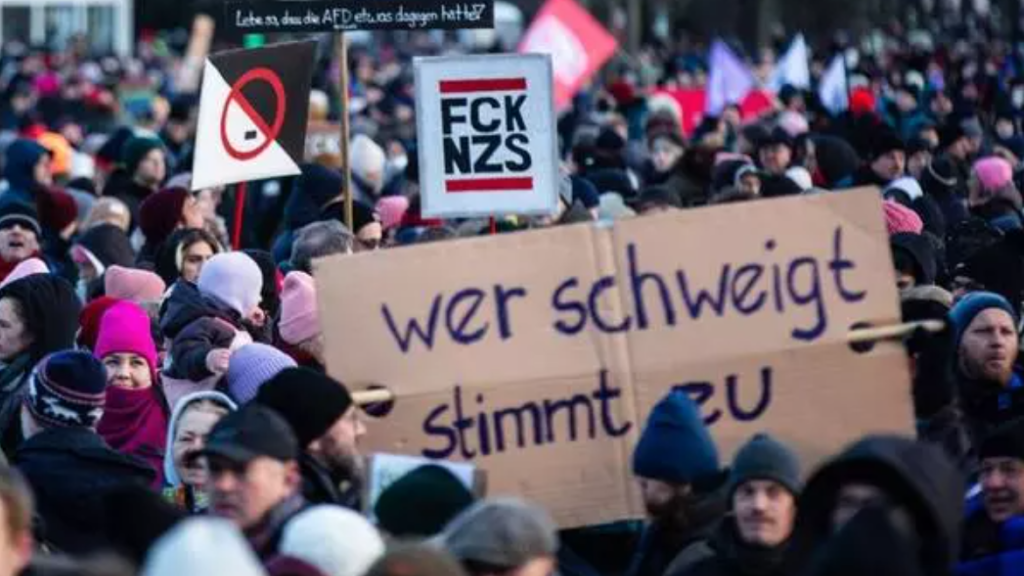
Demonstration against the far right in Berlin, 21 January 2024

First published at Rosa-Luxemburg-Stiftung.

Some things take my breath away. I read that in former East Germany, 37 percent of Germans agree that our country is in danger of being swamped by foreigners. In western Germany, that figure is 23 percent. I read about the abominable way in which Christian Democratic Union (CDU) leader Friedrich Merz whips up resentment of refugees, the wretched of the earth, who he says are receiving dental care under false pretences at the expense of native Germans. He is dividing in the hope of ruling.

I read that Alternative für Deutschland (AfD) members and other far-right figures recently cooked up a plan to deport our fellow citizens by the millions. Five years ago, leading AfD figure Björn Höcke was already saying that, “in addition to protecting our national and European borders, we will have to institute a large-scale re-migration project. And in this context … it will not be possible to avoid a policy of ‘finely tuned cruelty’”. I remember the Nordkreuz and Südkreuz groups, the far-right networks in government bureaucracies, in the police and the armed forces, their hit-lists. But I also read about the complicity of the “traffic light” coalition, which destroys hopes, works hand-in-hand with corporations to attack the weakest, and cuts social benefits. The coalition trampled on those who braved the perilous Mediterranean crossing to reach this place. It pursued a climate policy that exacerbates social divisions and the existential anxieties of the poorer half of society. In this way, it helped to strengthen the Right and undermine support for climate policy.

All of this makes me afraid. We have seen the emergence of a radical nationalist party, the AfD, in which a modernized, barely disguised fascism coexists with right-wing conservatism and authoritarian neoliberalism. What binds these tendencies together is an anti-pluralist conviction that they alone defend the interests of “the people” against treacherous elites (even if it is members of the petty bourgeoisie, managers, and entrepreneurs who set the tone in the party leadership) and their contempt for refugees and migrants, whom they view as a burden, as a threat, and as external and internal enemies.

From this standpoint, “the people” (das Volk) are viewed as a nation: here since time immemorial, united by custom and ancestry, and as in fascism in its classical form, beleaguered by incessant threats against which they must be defended and renewed. The clever ones speak of an “ethno-cultural unity”, the purity and therefore the existence of which is threatened; the less sophisticated talk about “race”.

Why now?

The AfD’s success and the increasing significance of its ideology cannot be explained mechanically. It is not the case that, finding that they have no money, people clap their hands on their bellies and rush to the polls to vote for the Right. Nor is it true that only those who have always been on the right will ever vote for the right or adopt fascist ideas. To understand the AfD’s success, we have to consider the interactions between the processes that shape people and the attitudes they espouse, between the social and political crises of our time, and between the struggles and the creative work of political actors.

Over decades, social scientists have documented the presence of right-wing populist and right-wing extremist attitudes in the German population. Marxists specifically have investigated the interplay of class positions and suffering, on the one hand, and authoritarian, racist, and antisemitic ways of dealing with them on the other (see for example the work of Klaus Dörre). Indeed, neoliberalism has generated a social climate that the New Right can exploit.

Neo- and post-fascist movements can therefore be understood as what Adorno called “wounds” or “scars” of a democracy that exhibits oligarchic characteristics and has undergone authoritarian reconstruction, in which mainstream parties have fostered inequality, poverty, insecurity, and the power of capital, in addition to isolating refugees and promoting economic nationalism. However, researchers have typically warned against explaining political orientations simply on the basis of socially induced suffering. Some precariously situated people may turn to the right when they feel humiliated by their social position — but far from all do.

The post-fascist movement draws its supporters from all classes and social strata; it addresses people far beyond the mass petty bourgeois character of historical fascism. As Michela Muria writes in How to Be a Fascist: A Manual, “A real populist deals with everyone according to their needs: the poor receive some free fish every year; the middle class receive a fridge to store what’s left over; and the upper classes receive the pond where everyone will have to pay to fish.“

Rather than look for a cause, it is more helpful to ask under what conditions racist attitudes find expression in racist opinions and a willingness to take violent action; when it is that things that were once merely thought are now also spoken aloud; how scepticism about migrants can turn into fear. Two things are important in this regard: first, reservoirs of tolerance are depleted in times of crisis and stress. As Helmut Dahmer writes, “In every crisis situation, our tolerance towards that which is different from ourselves shrinks, and the circle of identity draws tighter around us. Things that we were able to tolerate in better days, that even aroused our curiosity and sympathy, fall under an advancing shadow of panicked estrangement.”

Second, parties do not merely represent that which already exists. That also create a mental space of their own, promote certain thoughts and ideas, and push back against others — the simple fact of a party’s success has the effect of confirming its ideology. This ongoing ideological and cultural work has the capacity to change not only everyday consciousness, but also what is conceivable and what is sayable. To paraphrase Gramsci, a party has achieved hegemony when its own arguments are put forward by its opponents. When the old neo-Nazi slogan “the boat is full” is trending across the entire political spectrum in the German asylum debate, uttered no less readily by Sahra Wagenknecht than by the CDU/CSU, then that indicates that the radical nationalist right has become hegemonic.

Fascization?

The AfD has become the mainstay of a radical nationalist camp that is home to a variety of right-wing forces. The party consolidates a bloc that is fighting to bring about an authoritarian, violent, and racist shift; it is a playground for radical conservatives and racist, authoritarian neoliberals such as Alice Weidel. But over the last few years, the AfD — and with it the entire camp — has in general shifted to the right under the influence of the post-fascist, Björn Höcke.

Post-fascists do not claim fidelity to the tradition of classical fascism (unlike, for example, with groups like the Third Way). On the contrary, they attempt, whether plausibly or not, to appropriate other political pedigrees, such as the Conservative Revolution of the Weimar period. Post-fascism is not a transitional phenomenon, but rather an attempt to modernize fascism under twenty first-century conditions. “Blood and soil”, for example, becomes the “cultural community” and “survival space” (Kulturgemeinschaft and Ãœberlebensraum), while open scorn for democracy becomes the promise of achieving (or restoring) popular sovereignty by the radical right. At the same time, the marks of classical fascism — for example, the focus on a movement and militancy, radical anti-socialism, anti-liberalism, and the nationalism by which violence “against others” is legitimated — are present.

Post-fascism propagates a view of the world that, while delusional, also generates meaning. It offers people warmth, belonging, and a deformed kind of solidarity that appears as comradeship. The linchpin is the idea of being a victim of forces that one cannot control and of people who supposedly enjoy unearned advantages — and a revolt against all of these things.

The issues that post-fascists take up are not entirely arbitrary, but they do display a certain flexibility. Their criticisms always serve to highlight the corruption of the republic and to mark out their enemies as enemies. Thus, for instance, they claim that Germans today are victims of the Great Replacement. The idea is that socialist elites are bringing Muslims and other migrants to Germany in order to destroy the nation and its people. Or that an elite that is fixated on ecological ideology is deliberately destroying the prosperity of the German people, its industries, and its way of life.

We are in the midst of a process of fascization, the rapidity of which is difficult to assess. The fascization of the 1920s is not comparable with that of the 2020s, but the elements are there, even if they are not yet fully developed. A sizeable minority of those who make up the popular classes has become deeply estranged from the ruling political elite. Nationalism is whipped up by the CDU/CSU, the Free Democrats, FDP, sections of the Social Democrats (SPD), the Greens, and the new Sahra Wagenknecht Alliance (BSW). It is rooted in the day-to-day consciousness of broad sections of the population. Post-fascists seize on it and intensify it. Their slogans invoking a nation in need of protection from the Great Replacement function like firebombs, as the underbrush is already dry.

In the 1920s, right-wing conservatives and monarchists brought the fascists to power. Today we are witnessing debates within the CDU and CSU over whether they should cooperate with the AfD at the federal or state level; as far as local government is concerned, they have been cooperating for a long time. These debates are crucial: will the AfD manage to ascend the ladder of democracy and take state political power in order then to do away with parliamentary democracy?

The willingness to use violence is there, both on Pegida’s margins and, as a fantasy, at the centre. It is apparent in the hit lists that circulate among conspirators in the armed forces and the police and in the mock gallows from which traffic-light politicians hang in effigy. It is in the arson attacks on refugee accommodation and apartments inhabited by migrants, in the murders in Hanau and Kassel, and in all the places where the republic has failed to protect its citizens.

For a republican antifascism

We thus have no time to lose, and it is therefore good and important that people organize against the Right and take to the streets together against the AfD. We need a republican antifascism that forges broad alliances and even tries to win over CDU/CSU and FDP supporters, that works with them to defend the republic that we socialists find insufficient. We need an antifascism that defends freedom and political and social rights, and that strives to constrain the space of the sayable as far as the far right is concerned.

That presupposes a positive relationship to the republic, a left-wing republicanism. According to Austro-Marxist theoretician Otto Bauer, democracy is the form taken by the rule of the bourgeoisie. And yet it rules under political and legal conditions where the workers’ movement is able to freely organize, evolve, grow, and exert pressure in support of its demands. Under capitalist conditions, a republic is only ever half-way democratic, because the bourgeois form of property inevitably leads to inequality and the concentration of economic power, and thus also of anti-democratic economic power.

For this reason, left republicanism aims to change the existing property relations and structures of wealth. A full democracy and a republic in which the people themselves rule will only become possible with the creation of a welfare state that provides a comprehensive system of social security and strengthens worker power, and with the democratization of the economy. Popular sovereignty in this sense can only exist in a socialist society. This socialist strain of republicanism is centred on the idea of political citizenship as understood by the radical democratic tradition — the citizen as an active human being who has the capacity to shape society, and on the ideal of equality. For this reason, it is also imperative to defend even the half-way democratic republic, given that civil society and bourgeois freedoms — which we criticize as insufficient, but nonetheless wish to preserve — are at risk of being destroyed. It is true that in the fight against the radical right we cannot simply rely on the state, however we must defend existing achievements and make use of the constitutionally enshrined rights that make both a democratic path to socialism and an effective struggle against fascists possible.

Republican antifascism must defend democracy, our citizens who have immigrant backgrounds, the diversity of our ways of life, and the achievements of feminism, the labour movement, and the LGBTQ movement, which the Right so despises. Those who will not fight against the fascists and alongside Social Democrats, Greens, and even Christian Democrats (whose policies we firmly oppose), or those who maintain that their policies are as right-wing as those of the AfD, may well live to feel the pain of the difference when all of us are interned together in post-fascist camps.

I admit that this is not easy. The concerned face of Chancellor Scholz, who participated in the Schröder government at a time when it was pushing millions of people into poverty and social insecurity, may be hard for some to stomach. And who is not disturbed by the thought of demonstrating alongside members of the Bundestag who vote in favour of the so-called “repatriation bills” and continue to hollow out the right to asylum?

Nonetheless, we should keep an eye on the debates among Christian Democrats and within the FDP, the outcomes of which are not predetermined. Hans-Georg Maaßen and Friedrich Merz are not Ruprecht Polenz or liberal CDU municipal councillors who take a public stand against racism. I would prefer not to see any of them in government — but I would like to hinder a rapprochement between the CDU/CSU and the AfD. Whether that can be accomplished is by no means certain.

For a socially progressive antifascism

Republican antifascism is something we ought to breathe life into, but that alone won’t be enough to defeat fascism. Fascism feeds on despair and hatred. For this reason, we must also build a strong, socially progressive antifascist movement that will fight the Right by advocating for a social and ecological transformation — for better wages and decent pensions, for a strong welfare state, for effective, socially responsible climate protection, for humane asylum and immigration policies, against racism, antisemitism, and nationalism, for the rigorous prosecution of right-wing conspirators within government bureaucracies, the police, and the armed forces. Two things need to happen at the same time: the stressful conditions mentioned above, which deplete people’s capacity for tolerance and produce conditions that favour the right, need to be ameliorated in order to simultaneously begin the struggle for genuinely new social and ecological arrangements that will improve the lives of millions.

We ought to place socially progressive antifascism at the heart of our coalition work at both the federal and local levels. This does not mean forgoing participation in broad-based antifascist alliances. However, our republican antifascism must not let itself be co-opted by eco-social-liberal positions such as those espoused by the mainstream parties. On the contrary, our democracy and our republic will only become attractive to those who currently feel insecure, are wavering, or run the risk of going over to the post-fascist camp, once we are in a position to develop an independent movement for a socially progressive and ecological shift. Yes, we must fight for the republic — but for one which drains the low-wage swamp, in which pensioners no longer have to collect empty bottles, which effectively protects the climate, and — yes — allocates enough funding so that local authorities can adequately house and integrate refugees.

It is possible that an antifascist alliance pushing for this kind of socially progressive and ecological transformation could be built up starting from the recent demonstrations; it may need to complement them. It is also conceivable that those who want a socially progressive antifascism could take part in these protests as a distinct bloc. The inclusive debate that we need to have about key turning-points could be one important step.

We will defeat fascism when we initiate a political project that inspires hope and offers a real alternative to both mere eco-liberal crisis management and intensifying post-fascism. It can emerge through a unified struggle for a socially progressive antifascism. Why not initiate a crossover process linking supporters of various parties, trade unionists, and climate activists — all of those who have similar yearnings and goals? That kind of dialogue could give rise to a social movement for a change of political direction.

Of course we have to fight the AfD — but ideally by simultaneously organizing jointly for a genuinely socially progressive and ecological republic in our unions, our cities and villages, in schools and universities, in gardening associations, and at work. It’s easier to fight against something when you also have an inspiring goal. We need the concrete social and ecological utopia that even people who are on the fence would be willing to take to the streets for.

This is also how we will thwart the political game played by those who want to divide insiders from outsiders, making it the top issue in public debate. Of course we will have to explain precisely how people who seek asylum or immigrate are supposed to become part of our society. But ultimately, this is a question of distribution and class — of the provision of resources to kindergartens, schools, and public services, and not least of all of union organizing in the multiethnic working class that already exists in Germany today. Socially progressive antifascism could ensure that we debate the mother of all political problems, instead of debating its symptoms: the grotesquely unequal distribution of wealth and the (extreme) power of corporations and concentrated wealth that undermine our democracy.

For a cultural antifascism

Post-fascists and radicalized conservatives are waging a culture war that many leftists would rather sidestep. The argument: the culture war only serves the Right and (social) liberals and weakens the Left because it raises polarizing moral issues and leads people to stop talking about the funding needed for public services, about policies aimed at fighting poverty, or about wage policy.

On closer inspection, the argument lacks cogency. Rather, it is astounding how post-fascists, conservatives, and the right wing of the SPD manage to talk simultaneously about the labour market, investment policy, domestic security (surveillance and punishment), migration, identity, and lifestyle while appealing simultaneously to both hearts and minds, the intellect and the emotions. Stuart Hall remarked on this capacity of the (then) New Right early on in his analysis of English neoliberalism (Thatcherism).

The Thatcherites did not restrict themselves to discussing the economy but were also virtuosic in talking about moral and cultural issue. People without morality or culture simply do not exist, and thus morality and culture also need to be politicized by the Left. Even — and especially — left-wing antifascism needs to be attractive to people. Only those who present themselves as advocates of the (diverse) majority, rather than as outsiders or representatives of marginal special interests will be able to lead and appeal to wide sections of the population.

In recent years, the Right (and some former leftists), supported by the corporate media, have been very successful at portraying the Left as intolerant, egotistical, out-of-touch elites. They have cannily combined this with talk of “common sense”, hostility towards migrants and refugees, resentment over the supposed laziness of the unemployed, and disgust at ecological moralists.

We will only challenge the post-fascists if we make radical humanism and solidarity tangible, and offer a culture of togetherness and the common good, republican universalism and internationalism, equality and ecological security. Their morality versus ours — we want everybody to be able to be somebody and lead a good life; they want some people to be unable to be anything. We won’t win if we don’t clearly identify the underlying values of post-fascist (as well as conservative and eco-liberal) politics, if we don’t refute them and provide our own answers to the problems they raise. Without a left-wing philosophy of everyday life, the right-wing philosophy will win.

Thomas Goes is a member of the Lower Saxony state executive board of Die Linke and works as a sociologist in Göttingen. This article first appeared in LuXemburg. Translated by Marc Hiatt and Joseph Keady for Gegensatz Translation Collective. 


Ukraine three years after all‑out invasion: Continue solidarity and support


Published 
FacebookEmai
destruction Ukraine

First published at Anti*Capitalist Resistance.

The current phase of the war in Ukraine started on the 24 February 2022, three years ago. Russia invaded and annexed Crimea in 2014, and then attempted for eight years to annex the Donbass. When Putin ordered the large-scale imperialist invasion in February 2024 to “demilitarise” and “denazify” Ukraine, he believed that the Zelenskyy government would fall within a matter of days and that Russian troops would be welcomed. But the Russian troops were pushed back, and three years on, victory for Putin, or at least achieving his war aims, is nowhere near.

For the Ukrainians, their motivation to continue the war remains the same: the liberation of their country from occupation and restoring self-determination. Their resistance to imperialist aggression and for independence is entirely legitimate, as well as is obtaining the arms from wherever they can. Occupation and annexation are crimes, whether they happen in Ukraine or Palestine. Ukrainians voted decisively for independence in 1991 (at the time of the end of the Soviet Union) in the referendum, with 92% voting in favour, on an 84% turnout.

Casualties on both sides during the last three years have been extremely high. The Russians may have lost over 200,000 killed and 600,000 wounded, while Ukraine has lost over 80,000 dead and 400,000 wounded. In addition, over 12,000 Ukrainian civilians have died, with 30,000 wounded. Despite exhaustion from the war, 4 in 10 Ukrainians still want the war to continue until victory, while understandably, half want war to end as soon as possible. Ukraine is a nation with a long history, with its own language and culture. Like for Palestinians and other oppressed peoples, the sentiment for independence, national sovereignty and self-determination goes back a long way.

After three years of this phase of the war, Ukraine is in a difficult position. Russia has stepped up its bombing of civilian areas and infrastructure, and is making slow but steady military advances. Western sanctions against Russia have not hit its economy significantly, and its export of liquified natural gas is at a record high. However, there are strains now emerging in the Russian economy as a result of the war. After a period when the war actually seemed to be benefiting Russia economically (so-called ‘military Keynesianism’) it has now encountered serious resource constraints and increasing inflation. If significant economic problems arise in Russia, this would strengthen the Ukrainian position in any negotiations.

The financial pressure from Trump is dangerous for Ukraine. Biden, before leaving office, committed the US to $5.9 billion in military and budget aid, but Trump may renew this only as a loan if Ukraine agrees to negotiations with Russia in which it makes concessions. After pausing arms supplies for a few days, Trump has suggested aid may continue in exchange for Ukraine supplying the US with rare earth metal s. Trump’s pause in USAid will also affect Ukraine hard: since February 2022, it has received $7.6bn in humanitarian aid from the US.

In Ukraine the war effort is being hit by war-weariness, more difficulty recruiting and the increase in desertions. But more critical is that the government has not instituted a “war economy” with decisive state intervention in critical sectors, from arms manufacture to health and housing. Instead, it has embraced neoliberalism with privatisations and attacks on employment rights. The latest attack on union and labour rights has been pushed back, but the threat remains. Zelensky wants to prove his neoliberal credentials, in particular with his refusal to call for the debt of Ukraine be cancelled. He wants to be a reliable partner with private investors and banks. Cancellation of the debt is crucial to enable a socially just reconstruction. Privatisations have enabled the enrichment of a few and spread corruption, which in turn has damaged morale and trust.

Putin clearly believes that Ukraine will be forced into accepting an imposed “peace” settlement negotiated with Trump behind the backs of the Ukrainians. In a sign that Putin cannot win the war for now, the original war objectives have been watered down. In addition to the annexation of the Donbass, Putin wants Ukraine to reduce its military by 80% and stay out of the EU and NATO. Despite Zelensky conceding negotiating directly with Putin, this has been rejected by Putin, who claims that Zelensky is not legitimate as his term expired and no new elections have been held during wartime. So the Ukrainians have little choice but to fight on and resist as best they can the Russian invasion, the purpose of which is to turn their country into a satellite of Russia.

The war has dragged on because Ukraine has not received weapons in sufficient quantity or quickly enough to defend itself. Western imperialism has always been ambivalent in its support for Ukraine. Some countries would like to see the war end as soon as possible so that “normal” business can resume with Russia, while others would like the war to drag on as long as possible so as weaken Russian imperialism. The West reluctantly supported Ukraine in the name of “defending democracy”. This had the benefit of giving NATO and Western imperialist countries a new coat of paint after their 20-year “war against terrorism” ended in defeat in Afghanistan and Iraq. Their lukewarm support for Ukraine is in stark contrast with their support for genocidal actions of Israel in Gaza and the brutal dictatorship of the House of Saud, providing both of them with an unlimited supply of weapons. Ukraine is of limited geostrategic interest to the West compared to Israel and Saudi Arabia.

Labour leader Keir Starmer has continued the Tory government’s cautious support for Ukraine, carefully avoiding supporting its war aims – the liberation of the country. He only says that Ukraine should be “in the strongest possible position in the coming months” so that any peace deal to end its war with Ukraine “could be achieved through strength”. While he declares that Britain is “standing by Ukraine”, he drags his feet supplying weapons, but recommits Britain to increased military spending. While supporting Ukraine, some on the left have latched on to NATO’s new mission in their belief that Russian imperialism is the gravest danger facing Western democracies, therefore backing Labour’s increases in military budgets. But the West can give Ukraine what it needs without increasing such spending.

The Ukrainians should be supported in their resistance against Russian imperialist invasion despite Zelensky’s neoliberal government. They should also be supported in spite of Western imperialism trying to influence the war aims and the future of Ukraine. The West is using the war to weaken a rival imperialist country, Russia, and ensure a neoliberal reconstruction. For the West, this is more important than the liberation of Ukraine. The neoliberal course of the Zelensky government has to be condemned, and illusions by Ukrainians in the European Union be dispelled. The “structural adjustment” applied by the EU and the European Central Bank on Greece in 2015 for a bail-out of its debt is a lesson for Ukraine. There was an alternative then, and there is an alternative now in Ukraine to extreme neoliberalism. It will come from the left, the trade unions and progressive forces in Ukraine, with international solidarity, fighting for a cancellation of the country’s debt and for a reconstruction based on social, economic and climate justice.

Internationally, supporters of Ukraine must continue solidarity work. This includes education about the oppression being suffered by Ukrainians in territory under Russian occupation. We must challenge any view that the sufferings of Ukrainians will end if they are forced to stop fighting and to surrender. Trump’s plans to allow Putin to annex around 20% of Ukraine will not provide the basis for a long-term settlement to the war. They may lay the basis for further invasion and annexation. In addition to demanding the withdrawal of Russian forces from Ukraine, we must raise demands for return of all Ukrainian prisoners of war and Ukrainian civilians who have been forcibly removed to Russian territory. We must oppose peace talks being held without Ukrainians present or any imposition of a settlement against the will of the Ukrainian people.


Hanna Perekhoda: ‘The fight for freedom in Ukraine is intimately linked to the global struggle against fascist forces’


Published \
Vladimir Kazanevsky l Cartoon Movement

First published at Voxeurop.

Hanna Perekhoda is a historian and researcher at the University of Lausanne – Institute of Political Studies and Centre for International History and Political Studies of Globalisation, specialising in nationalism in the context of the Russian Empire and Soviet Union. Her doctoral research examines the political strategies of the Bolsheviks in Ukraine between 1917 and the 1920s. Perekhoda also studies the historical development of the Russian political imaginary, with a particular focus on the role of Ukraine in Russian state ideology. Perekhoda is also an activist with Sotsialnyi Rukh (‘ Social Movement’), a left-wing Ukrainian political organisation founded by activists and trade unionists in the wake of Euromaidan.

It is now three years since Russia launched its all-out invasion of Ukraine. What is your view of the situation today?

With the return of Donald Trump, it should be clear by now that Russia's impunity is directly fuelling the rise of fascist forces in our own countries – and vice versa. These forces are actively working to dismantle any international structures that limit their ambitions. The fight for freedom in Ukraine is therefore intimately linked to the global struggle against these destructive trends. But it must be clearly stated: the prospects for liberation are shrinking by the minute.

The rise of forces combining authoritarianism and libertarianism in the United States and Europe must be taken very seriously. Capitalist reason, with its cult of unlimited growth and profit, puts profit above all else: from individual life to our collective security. In such a world, if this dynamic is not broken, Ukraine will have no future. But let's be clear: in such a world, nobody will have a future.

Part of the debate in the West, especially but not exclusively on the left, has focused on pacifism on the one hand, and the danger posed by far-right – or even neo-Nazi – forces in Ukraine on the other. What is your view on this?

Imagine looking out of your window and seeing someone being attacked, beaten and raped by an assailant. This person sees you and begs you to help. You have the necessary tools to enable them to defend themselves, but you choose to do nothing, leaving them to die. Regarding an individual person, failing to intervene is obviously tantamount to encouraging the crime and aggravating its consequences. If the witness tried to justify their inaction by claiming their pacifism and opposition to all forms of violence, the argument would be seen as inappropriate or even absurd.

Even if they escape criminal liability, such an attitude is generally considered profoundly immoral. So I ask myself: why does this same attitude suddenly become acceptable when the situation moves from the level of an individual under attack to that of a society under attack? As if by a miracle, the refusal of assistance is transformed into pacifism and has the appearance of a legitimate moral position.

The reality is that a lack of support for victims encourages aggressors. This is obvious at the level of personal relationships, within families, in the workplace or any social institution. But it is also true in international politics. If you abandon the victims of military aggression, you are signalling to all the psychopaths in positions of power that they are now free to solve their legitimacy issues with wars.

The impunity granted to those who advocate the law of the strongest on the international stage inevitably fuels the rise of forces that defend the same principles at home. Forces such as Alternative für Deutschland (AfD) in Germany, the Rassemblement National in France, Donald Trump in the United States and Vladimir Putin in Russia all share the same cult of brute force - in other words, fascism. Ultimately, any aggression, however remote, if normalised, has implications that sooner or later will affect us all.

The argument that the presence of the far right in Ukraine justifies a refusal to send arms is based on a rather blatant error of logic. Refusing to help a people on this pretext is tantamount to punishing an entire society for a reality that exists everywhere. Yes, there are far-right groups in Ukraine, as in many countries. In the elections before 2022, these groups received only minimal votes and failed to win any seats. There are far-right movements in France and Germany that are infinitely more influential than in Ukraine, yet no one would dispute their right to self-defence in the event of aggression. Is this attitude not rather the expression of the Western fantasy of a reactionary and retrograde "East", which persists even when Western societies are themselves at the vanguard of the fascisation against which the left in these countries seems to be completely powerless?

This argument is all the more hypocritical given that many of these same voices on the left do not hesitate to support resistance movements that include actors who are more than problematic. Why demand a purity from Ukraine that no other society is required to show when it has to defend itself?

What is undeniable is that the war, which has lasted for more than ten years, has already helped to strengthen and trivialise nationalist symbols and discourse that were previously marginal. Wars do not make any society better. However, the relationship between the delivery of arms and the strengthening of the far right in Ukraine is inversely proportional.

The weapons sent to Ukraine are used first and foremost to defend society as a whole against an invading army. Ukraine's victory guarantees the very existence of a state in which citizens can freely and democratically choose their future. Conversely, nothing strengthens extreme right-wing movements or terrorist organisations more than military occupation and the systematic oppression that goes with it.

Indeed, if Ukraine obtains peace under Russia's conditions – the peace of the graves – it is more than likely that the radical groups, which will capitalise on the frustration and sense of injustice, will rapidly gain strength, to the detriment of the moderates.

The role of languages (Ukrainian and Russian) is very important in understanding the (often artificial) debates and arguments. Could you help us put things into perspective?

It is indeed useful to place this issue in its historical context. Since the 19th century, the Russian state has sought to marginalise the Ukrainian language by presenting it as an inferior form of Russian. The Russian elites felt that recognising a distinct Ukrainian language would threaten the unity of their nation-state under construction. Under the Soviet Union, Russian was imposed as the only legitimate language of modernity and progress. After Ukrainian independence [in 1991], this linguistic hierarchy persisted.

Until 2014, speaking Ukrainian in the big cities was frowned upon, while Russian remained associated with prestige. So basically, for Ukrainians, the promotion of Ukrainian in the public space is not an attack on Russian speakers, but an attempt to rectify centuries of marginalisation. To see this as evidence of aggressive nationalism is to ignore the (post-)imperial context that underpins these dynamics. This is a context that is often invisible to those who belong to historically imperialist nations and not to culturally oppressed groups.

So the language issue is instrumentalised?

Yes, what is important to consider is the way in which Russia has used the language issue to legitimise its aggression against Ukraine. In 2014, at the time of the annexation of Crimea and the start of the war in the Donbass, the Kremlin justified its actions by claiming that it wanted to protect the Russian-speaking population, who were the alleged victims of "linguistic genocide". While the Ukrainian and Russian languages used to coexist fairly peacefully in everyday life, this use of the linguistic question as a weapon of political manipulation has exacerbated the divisions.

It is crucial to emphasise that speaking Russian in Ukraine does not mean being pro-Russian or pro-Kremlin. We should avoid blindly adopting the narrative imposed by Russian propaganda, which does everything it can to legitimise, in every possible way, the attack on the sovereignty of neighbouring democratic states.

It was only with the Russian aggression of 2014 that the Ukrainian state broke the status quo of relative non-intervention in linguistic affairs. In 2018, the parliament passed a law requiring the use of Ukrainian in most aspects of public life, obliging civil servants and public employees to know the language and use it in their communication. Ukrainian also became compulsory in schools. This did not necessarily lead to radical changes: many people used both Ukrainian and Russian in their daily lives, not to mention those who spoke a mixture of the two. The reality of Ukraine is one of linguistic porosity.

The war and the atrocities committed by the Russians have led many Ukrainians to speak only Ukrainian and to view with suspicion those who continue to speak "the language of the occupier". It is not uncommon for Russian-speaking survivors of the bombings to be accused of a lack of patriotism by Ukrainian-speaking residents of towns far from the fighting. The radical rejection of Russian, which was not an issue in 2014 but was brandished by Putin to legitimise military aggression, has become a self-fulfilling prophecy ten years later.

The problem for Russian speakers in Ukraine is that the state that claims to be protecting their language is using it to spread narratives that deny Ukraine's right to exist. At the moment, Russian speakers have no spokesperson capable of articulating their experience without exploiting it for political ends. If Russia did not exploit language and culture as tools of expansion, and if the presence of a Russian-speaking population were not used to justify political domination and - subsequently - military invasion, the coexistence of these languages would likely pose few problems.

At the same time, Ukraine's self-proclaimed intellectual elite is particularly backward-looking and frankly ridiculous when it tries to construct national identity according to nineteenth century formulas. In reality, it is impossible to fit the contemporary Ukrainian population into either of the obscurantist frameworks offered to them: Ukrainian ethno-linguistic nationalism on the one hand, and Russian imperial nationalism, on the other.

Before 2022, there was still a possibility of building an alternative Russian-speaking culture in Ukraine, one that was not infected by the Russian imperial imaginary and did not depend on the political priorities of the Russian state. The invasion has made this project absolutely impossible. Putin should probably be pleased about this: his main fear is not Ukraine cutting all ties with Russians, but rather Ukraine sharing the Russian language while developing a solid democratic political system, thereby infecting Russians with the virus of freedom.

The European Union is often perceived as "unfashionable" at best, if not "neoliberal" and "undemocratic", by the left and activists in Western Europe. In Eastern Europe, on the other hand, whether in Moldova, Romania, Ukraine or Georgia, citizens mobilise behind the idea... What is the reason for this difference? What does the EU represent in the east of the continent? And particularly in Ukraine?

Seen from the inside, the EU can be seen as a project where market logic takes precedence over social justice; where decisions are often taken behind closed doors; and where the interests of major economic powers like Germany take priority. In this context, it is not surprising that some see the EU as an obstacle to be thrown aside.

But for European countries outside the EU, and particularly for Ukraine, it represents something different. Above all, "Europe" represents an aspiration, the idea of a future where rule of law, individual freedoms and a certain level of prosperity prevail. What is less obvious to Western Europeans is that here the EU represents an alternative to an authoritarian and oppressive model, a model that Russia imposes on its neighbours by force.

So for EU citizens, the EU is first and foremost an economic project. But for those who are not EU citizens, the EU is above all a cultural and civilisational project. Whether they admire it or hate it, its supporters and opponents outside the Union treat it as a primarily political force. Russia, moreover, is explicit in this respect: since at least 2013, it has treated the EU not as an economic competitor, but as a geopolitical and ideological rival.

This dimension became even more obvious in 2014, when Ukrainians literally gave their lives to defend their country's "European" future. It was an act that many Europeans looked upon with incomprehension, even condescension or pity. Yet for these demonstrators, "Europe" was not an economic area, but a symbol of dignity and freedom.

Europeans struggle to recognise that there is indeed substance behind the idea of a politically united Europe, because it seems to be discredited by neoliberal policies. However, like any project born of modernity, the European Union bears contradictory tendencies. To use the words of the philosopher and economist Cornelius Castoriadisthe European Union bears within it both the unlimited expansion of rational mastery of the world, which manifests itself in neoliberalism, and the potential for autonomy and political openness, which takes the form of democracy.

Which trend will prevail? This depends on the political forces that invest in this project. But what is certain is that abandoning the idea of a politically united Europe while legitimately combating the EU's neoliberal policies is to throw the baby out with the bathwater. While Europe was lulled into the illusion of a post-national peace, of prosperity built on Russian hydrocarbons and Chinese goods, the elites of these countries were amassing armies, resources and, above all, resentment. And this resentment is aimed precisely at Europe's democratic imaginary, not its economic liberalism.

It might seem paradoxical...

The paradox is sadly logical: the democratic potential of the European project seems more obvious from the outside. It's a bit like vaccines: the more effective they are, the more they are denigrated. In a country that has only just implemented vaccination, where children are dying of polio on a massive scale, an anti-vaccination movement would seem absurd. In the same way, Europeans who so easily abandon the idea of European unity appear naive in the eyes of those who are confronting an army determined to destroy it.

That said, Ukrainian left-wing activists are not fooled by the economic realities of Europe. They have carefully observed what has happened in Greece, for example. But you have to understand: Ukraine is already a highly neoliberal country, with predatory elites and precarious labour laws. In certain sectors, European legislation could effectively dismantle what remains of social protection. But in others, it could bring standards and regulations that do not exist under unbridled capitalism. So there are no easy answers.

However, for the vast majority of Ukrainians, the details are not so important. "Europe" represents a promise of justice, democracy and emancipation. Facing the abyss of Russian occupation, Ukrainians – like Georgians – are clinging to the only alternative political unity that exists on the continent.

 LIBERTARIAN ANTI-IMPERIALISM


The US Should Not Take Over Gaza


This week, President Trump upended US Middle East policy by announcing that the United States would “take over” war-ravaged Gaza and turn it into “the Riviera of the Middle East.” President Trump also said the Palestinians living in Gaza would be (temporarily?) relocated to Jordan or Egypt.

Kentucky Senator Rand Paul came out strongly against the proposal. Senator Paul pointed out that the plan contradicted the American people’s vote for “America First.” What was more surprising was that South Carolina Senator Lindsey Graham expressed skepticism about sending Americans to take over Gaza. This may be the first time in Senator Graham’s political career that he has opposed sending US troops abroad.

Senator Graham is correct that most South Carolinians are not excited about sending Americans or US tax dollars to take over Gaza. Neither are most other Americans. In fact, polls show that the majority of Americans oppose providing military aid to Israel or other countries.

One of the best comments was made by libertarian scholar and podcaster Tom Woods. He suggested that Trump’s Gaza proposal is the type of wasteful overseas spending that DOGE should be working to eliminate.

Trump’s plan has also been criticized by the government of Saudi Arabia. This could mean that if President Trump follows through with this proposal it will further push Saudi Arabia away from the United States and toward the BRICS alliance.

Some of the BRICS nations want to challenge the dollar’s world reserve currency status. One of the foundations of the dollar’s world reserve currency status is the “petrodollar.” This arose from the deal Henry Kissinger negotiated with Saudi Arabia where the Saudis agreed to use dollars for oil trade in exchange for US support for the Saudi regime. Recently, Saudi Arabia has given signs that it will be willing to use other currencies, such as the Chinese renminbi, for its oil trade.

The loss of the dollar’s world reserve currency status would cause a major US economic crisis. It would force the government to make massive cuts in warfare and welfare spending and could lead to violence and a government crackdown on our liberty.

US “ownership” of Gaza, accompanied by forcible relocation of Palestinians, would cause increased resentment of the US. This could result in increased terror attacks against the US.

Even if a long-term US occupation of Gaza went 100 percent according to plan, the US government, which has an over 36 trillion dollars and growing debt, cannot afford another open-ended overseas military commitment. Instead, President Trump should follow though on his campaign rhetoric about withdrawing from unnecessary military commitments. This, not tariffs, will help make America more competitive on the international economy.

The best thing the United States can do to rebuild Gaza and promote peace in the Middle East is to stop funding Israel’s occupation and blockade of Gaza. Instead, the US should work toward peaceful relations backed by free trade with Israel and its neighbors.

Reprinted from the Ron Paul Institute.