Saturday, March 08, 2025

POSTMODERN GNOSTICISM

Harvard scientist Michael Ferguson and the Neurospirituality Lab launch Lenten Project on The Jesus Prayer
Prayer Science


Groundbreaking project explores the psychological, behavioral, and spiritual effects of The Jesus Prayer

Harvard Scientist Michael Ferguson and the Neurospirituality Lab Launch Project on The Jesus Prayer and Its Psychological and Spiritual Impacts

CAMBRIDGE, Mass. — This Lenten season, Harvard scientist Michael Ferguson (PhD) and the Neurospirituality Lab are launching a groundbreaking project exploring the psychological, behavioral, and spiritual effects of The Jesus Prayer, an ancient contemplative practice with roots in early Christianity.

Sponsored by the Templeton World Charity Foundation, this six-part project invites participants to engage in guided instruction on The Jesus Prayer, a meditative prayer tradition developed by the Desert Mothers and Fathers of ancient Christianity. Through this immersive experience, participants will complete scientifically designed questionnaires to assess how this practice influences well-being, cognition, and spiritual experience.

“This is an exciting opportunity to bring rigorous scientific inquiry to a sacred practice that has shaped Christian spirituality for centuries,” said Dr. Michael Ferguson, the lead scientist of the project. “We hope to uncover meaningful insights into how contemplative prayer influences psychological and behavioral health, as well as spiritual experience.”

The project involves a short online course that includes:
•    A historical and theological introduction to The Jesus Prayer
•    Practical techniques for incorporating the prayer into daily life
•    Scientific assessments to examine the effects of the practice over time

Congregations or other faith communities interested in engaging with the project as a group may be eligible for private meetings with Dr. Ferguson to discuss the results and their broader implications for spiritual life.

This research builds upon ongoing investigations into the neuroscience of prayer, meditation, and spirituality. By combining ancient wisdom with modern scientific methods, the project aims to provide new insights into the role of contemplative practices in human flourishing.

Participation and Contact Information
Individuals and groups interested in participating can find more information by visiting:
https://prayerscience.org/the-jesus-prayer

###

Contact:
Morgan Healey
Prayer Science
8014523674
morgan@neurospirituality.io

Disclaimer: The views and opinions expressed in this article are those of the authors and do not necessarily reflect the official policy or position of RNS or Religion News Foundation.


LA REVUE GAUCHE - Left Comment: Search results for GNOSTIC JESUS

LA REVUE GAUCHE - Left Comment: Search results for GNOSTIC THOMAS

LA REVUE GAUCHE - Left Comment: Search results for GNOSTIC


More Guns, Less Butter: Starmer’s Defence Spending Splash


The urge to throw more money at defence budgets across a number of countries has become infectious. It was bound to happen with Donald Trump’s return to the White House, given his previous insistence that US allies do more to fatten their own armies rather than rely on the largesse of Washington’s power. Spend, spend, spend is the theme, and the UK Prime Minister Keir Starmer has shown himself willing to join this wasteful indulgence.

On February 25, just prior to his visit to Washington, Starmer announced that spending on defence would reach 2.5% of GDP from April 2027. In the next parliament, it would rise to 3%. “In recent years,” states a UK government press release, “the world has been reshaped by global instability, including Russian aggression in Ukraine, increasing threats from malign actors, rapid technological change, and the accelerating impacts of climate change.”

Almost predictably, the term “Cold War” makes its retro appearance, with the spending increase the largest since that conflict of wilful misunderstandings and calculated paranoia. Russia figures prominently, as do “malign actors” who have burdened “the working people of Britain” with “increased energy bills, or threats to British interests and values.”

The governing Labour Party has also gone a bit gung-ho with the military-industrial establishment. In an open letter reported by the Financial Times, over 100 Labour MPs and peers thought it wise that ethical rules restricting investment by banks and investment firms in defence companies be relaxed. Financial institutions, the letter argues, should “rethink ESG [environmental, social and governance] mechanisms that often wrongly exclude all defence investment”. It was also important to address the issue of those “unnecessary barriers” defence firms face when “doing business in the UK”. Among such barriers are those irritating matters such as money laundering checks banks are obliged to conduct when considering the finance needs of defence and security firms, along with seeking assurances that they are not financing weapons banned under international law.

That these uncontroversial rules are now being seen as needless barriers to an industry that persists in shirking accountability is a sign of creeping moral flabbiness. Across Europe, the defence and arms lobbyists, those great exploiters of fictional insecurity, are feeling more confident than they have in years. They can rely on such figures as European Commission President, Ursula von der Leyen, who stated on March 4 that, “We are in an era of rearmament. And Europe is ready to massively boost its defence spending.”

To pursue such rearmament, Starmer has decided to take the axe to the aid budget, reducing it from its current level of 0.5% of gross national income to 0.3% in 2027. It was, as the press release goes on to mention, a “difficult choice” and part of “the evolving nature of the threat and the strategic shift required to meet it”. The Conservatives approved the measure, and the populist Reform UK would have little reason to object, seeing it had been its policy suggestion at the last election.

It was a decision that sufficiently troubled the international development minister, Anneliese Dodds, to quit the cabinet. In a letter to the prime minister, Dodds remarked that, while Starmer wished “to continue support for Gaza, Sudan and Ukraine; for vaccination; for climate; and for rules-based systems”, doing so would “be impossible … given the depth of the cut”.

Making the Office of Overseas Development Assistance absorb such a reduction would also see Britain “pull-out from numerous African, Caribbean and Western Balkan nations – at a time when Russia has been aggressively increasing its global presence.” It would be isolated from various multilateral bodies, see “a withdrawal from regional banks and a reduced commitment to the World Bank”. Influence would also be lost at such international fora as the G7 and G20.

Defence establishment figures have also regarded the decision to reduce aid with some consternation. General Lord Richards, former Chief of Defence Staff, saw the sense of an increase in military spending but not at the expense of the aid budget. “The notion that we must weaken one to strengthen the other is not just misleading but dangerous,” opined Richards in The Telegraph. “A lack of investment and development will only fuel greater instability, increase security threats and place a heavier burden on our Armed Forces.”

The aid budgets of wealthy states should never be seen as benevolent projects. Behind the charitable endeavour is a calculation that speaks more to power (euphemised as “soft”) than kindness. Aid keeps the natives of other countries clothed, fed and sufficiently sustained not to want to stray to other contenders. The sentiment was expressed all too clearly by a disappointed Dodds: a smaller UK aid budget would embolden an already daring Russia to fill the vacuum. How fascinating, then, that a daring Russia, its threatening posture inflated and exaggerated, is one of the primary reasons prompting an increase in Britain’s defence spending in the first place.

Binoy Kampmark was a Commonwealth Scholar at Selwyn College, Cambridge. He lectures at RMIT University, Melbourne. Email: bkampmark@gmail.comRead other articles by Binoy.


Complicity in the Mass Murder of Children, Women, and Men

I have sent the following Letter to major Australian media and to nearly all Federal and Victorian State MPs:

Mainstream Western media (e.g. the BBC) have published the estimate in the leading medical journal The Lancet that violent (direct) deaths in Gaza totalled 64,260 in 9 months i.e. 111,000 by the Ceasefire on 20 January 2025. However they resolutely ignore expert estimates also published in The Lancet that non-violent (indirect) deaths from imposed deprivation may be 4 times greater, this indicating Gaza deaths from violence and imposed deprivation totalling about 553,000 or 23% of the pre-war population by 20 January 2025. Noting that under-5 infants are 70% of avoidable deaths from deprivation in impoverished countries (Gideon Polya, “Body Count. Global avoidable mortality since 1950”), it is estimated that these deaths include those of 393,000 children, 51,000 women and 113,000 men. As is my duty I have informed nearly all Federal and Victorian State MPs. The only MPs consistently demanding an immediate and permanent Ceasefire and an end to the deadly Occupation have been the Greens and several Independents (notably Senators Lidia Thorpe and Fatima Payman). Silence is complicity. Informed Australians voting for Gaza Genocide-complicit Labor, the worse Coalition and indeed nearly all non-Green candidates are complicit in the mass murder of children, women and men (cc MPs).

  • See also “Western Media and Politician Complicity in US-Israeli Massacre of Palestinian Children” by Gideon Polya, Dissident Voice, 8 February 8th, 2024.
  • Gideon Polya taught science students at La Trobe University, Melbourne, Australia over 4 decades. He has published the following huge books Body Count. Global avoidable mortality since 1950Jane Austen and the Black Hole of British HistoryUS-Imposed Post-9/11 Muslim Holocaust & Muslim Genocide (2020), and Climate Crisis, Climate Genocide & Solutions (2020). Read other articles by Gideon.
    Survey: Relations between Jewish and Arab Israelis continue to suffer amid war

    (RNS) — ‘The level of fear is very, very high. Our job is to tell them that this is not the time to duck down and wait for the tsunami to end. This is the time to show up,’ said Mohammad Darawshe, director of strategy for Givat Haviva, which organized the survey.


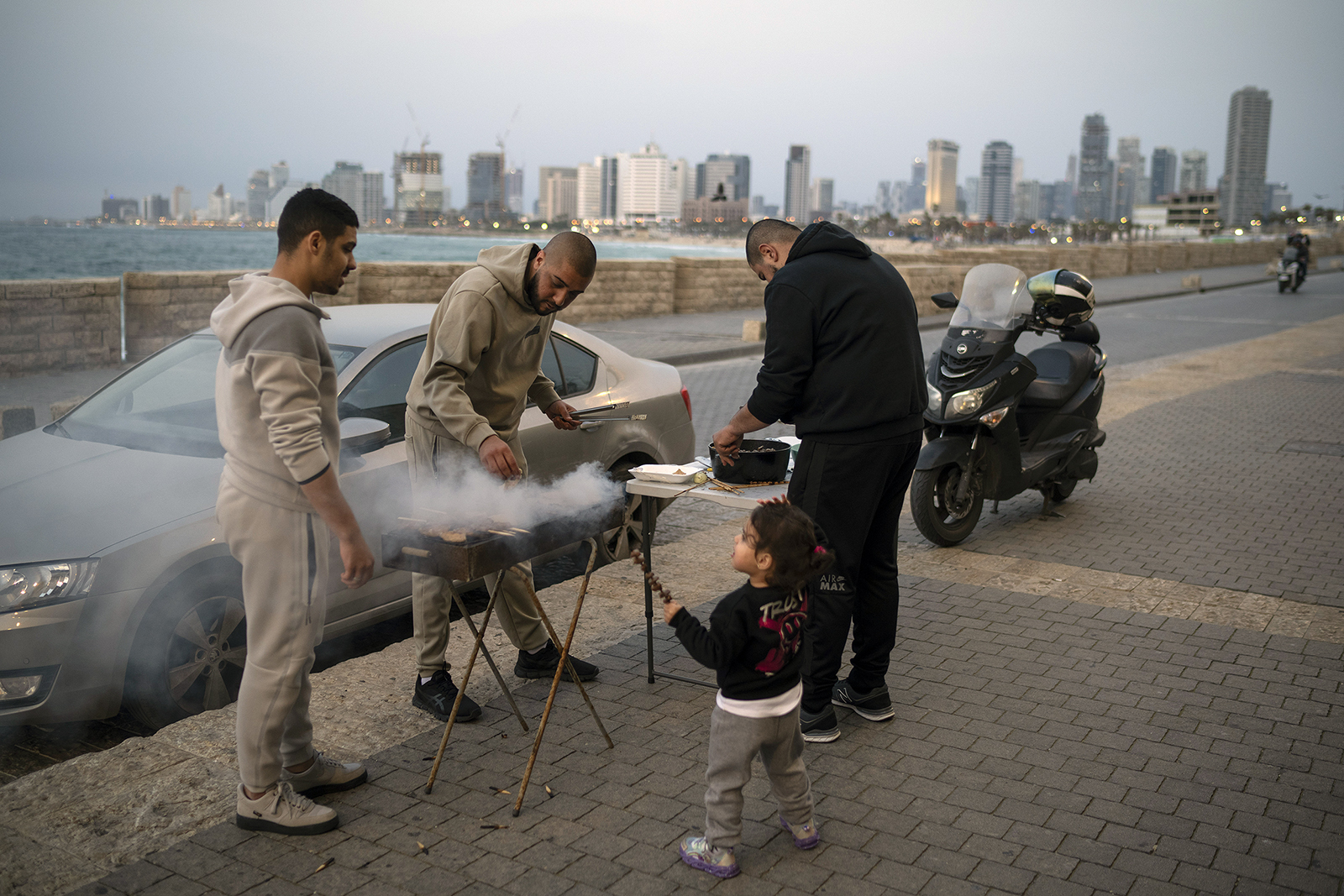
    People prepare their meal before breaking their fast during the Muslim holy month of Ramadan at the Old City of Jaffa, Israel, March 5, 2025. (AP Photo/Leo Correa)
    Michele Chabin
    March 6, 2025

    JERUSALEM (RNS) — Trust and interpersonal relationships between Jewish and Arab citizens of Israel have further deteriorated in the past year as the war in Gaza continues, according to a recent survey.

    Conducted the first week of January 2025, an annual survey from the Israeli social change nongovernmental organization Givat Haviva-The Center for a Shared Society examined feelings and attitudes among Jewish and Arab citizens of Israel on issues of mutual trust, personal security and changes in behavior over the past year. Jewish-Arab relations within Israel have been particularly strained ever since Hamas’ Oct. 7, 2023, attack on Israel and the ensuing war in Gaza. A fragile ceasefire between Israel and Hamas has facilitated the release of some Israeli hostages and Palestinian prisoners and provided some relief for civilians on both sides of the conflict.

    Compared with the results of the January 2024 survey, “Israeli society is more hesitant about shared living,” according to a press release describing the 2025 survey’s findings. Respondents also reported increased avoidance of social and economic collaborations and more radical opinions on related matters, the authors wrote.
    “The good news is provided by life itself: Israeli society has displayed restraint and relative resilience,” the authors wrote. “The streets are not aflame, and the shared cities have not become violent arenas.”

    Arabs comprise about 20% of Israel’s population of 9.5 million. The report, released in Hebrew, details findings of the survey, which included 442 Jewish Israelis and 280 Arab Israelis and had a margin of sampling error of 5 percentage points. Conducted by Midgam Research, it was first presented at the Givat Haviva Annual Shared Society Conference on Jan. 30.

    Mohammad Darawshe, Givat Haviva’s director of strategy, told RNS that although “things were not perfect” between Arabs and Jews in Israel prior to the Hamas attack and ensuing war, relations have been even more strained, which recent surveys demonstrate. The organization aims to “create a model society in Israel” and has several programs to help build a Jewish and Arab shared society.

    “Compared to 2023, the mistrust and mutual fear among Jews and Arabs has more than doubled,” Darawshe said. “The willingness of the populations to engage in social activities, work activities, educational activities has shrunk about 35%. In employment and university study, it has decreased about 25%.”


    (Graphic courtesy of Givat Haviva)

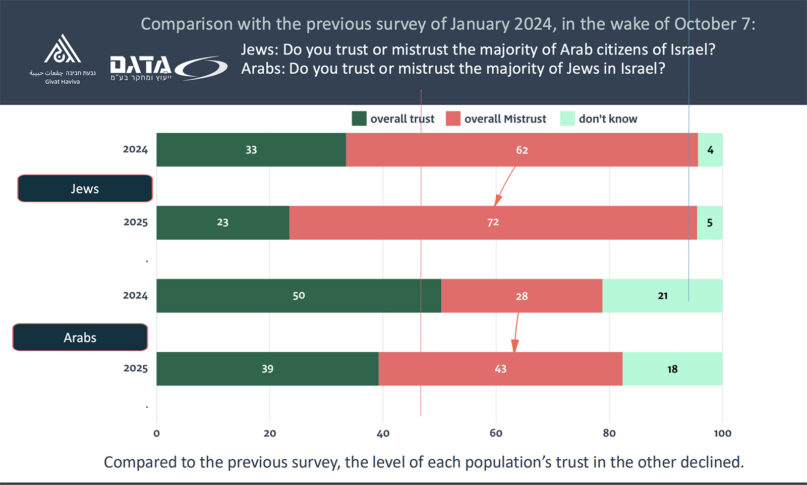
    Asked whether they trust the majority of Arab citizens, 72% of Jews surveyed in 2025 said they do not, while 43% of Arabs said they did not trust the majority of Jewish citizens. In 2024, 62% of Jews and 28% of Arabs reported the same feelings, according to the survey.

    Nearly half (49%) of Jews said they had experienced expressions of hostility from Arabs during the past year, while 42% of Arabs said they had experienced hostility from Jews. One year ago, 38% of Jews and 34% of Arabs said they had encountered hostility in the previous year.

    When it comes to coexistence, 45% of Jews said they were not willing to maintain friendships with Arabs, compared with 13% of Arabs who said they could not maintain friendships with Jews.

    And while every Israeli university accepts Arab students, only 44% of Jews said they were willing for themselves or their family members to study in a university with Arabs, while 67% of Arabs reported feeling that way toward Jews.

    Regarding politics, 67% of Jews surveyed opposed the entry of an Arab party into Israel’s governing coalition. That figure was 62% a year ago.


    (Graphic courtesy of Givat Haviva)

    While Arab parties have long served in the Knesset, Israel’s parliament, they have traditionally served in the opposition, not the ruling coalition — with one exception. In 2021, the Arab Ra’am party joined the government of then-Israeli Prime Minister Naftali Bennett in the hopes it would be more effective while serving in the government rather than the opposition.

    Moreover, 69% of Jewish respondents and 55% of Arab respondents said the events of the past year have harmed their personal sense of security. This represents an improvement over January 2024 — three months after the Hamas massacre — when 77% of Jews and 62% of Arabs said they felt unsafe.

    Givat Haviva conducts these annual studies “to understand the depth of the problem so we can find a realistic approach,” Darawshe said. He emphasized that the negative downturn of Jewish-Arab relations in Israel “is not a result of failure. It is the result of a continuous political ecosystem that keeps erupting every few years.”

    Surveys showed similar numbers after past crises, including during the deadly second intifada that began in 2000 and amid widespread rioting and destruction of Jewish-owned property by Arab Israelis in May 2021, according to Givat Haviva.


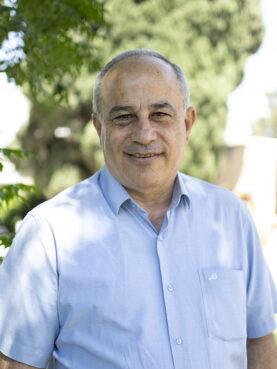
    Mohammad Darawshe. (Photo courtesy of Givat Haviva)

    “The issue is what we take from these survey results,” Darawshe said. “It’s important to understand where (society) stands so we can adapt our programs to the new reality we operate in. We need to expedite, to scale the work at the right level, so it can try to answer our needs.”

    In some sectors, such as the workplace and academia, damage to interpersonal relations has not been all that severe, Darawashe noted. But social and educational interactions have taken the biggest hit because most people consider socializing and joint Jewish-Arab educational activities optional.

    “To some extent, that’s understandable,” he said. “The level of fear is very, very high. Our job is to tell them that this is not the time to duck down and wait for the tsunami to end. This is the time to show up. We need to maintain relationships, even if the talk is difficult — even if you have to say things that won’t be liked by the other.”

    In the past, Darawshe said, many Israeli Muslims would invite Jewish friends and co-workers to their homes for the daily iftar break-fast meals during Ramadan, and Jews would invite their Muslim colleagues and friends to their Passover Seder.

    “People who used to do this don’t do this now,” he said.

    Additionally, the many Jews who used to shop in Nazareth and other Arab towns and cities are now afraid to visit, and fewer Arabs are shopping in Jewish-majority areas, he said.

    Darawshe called on Israeli NGOs to expand their work in a way that encourages more opportunities for Jewish and Arab Israelis to interact.

    Givat Haviva itself has expanded its coexistence programming to meet the current challenge. As part of one program, 24 Israeli mayors — half of them Jewish and half of them Arab, and most of them heads of neighboring municipalities — meet on a monthly basis to improve relations and create crisis management teams, Darawshe explained.

    Another Givat Haviva project provides leadership training to 32 young Jewish and Arab professionals, marking the first time the organization has trained young professionals and not just teens. It will soon launch a women’s peace leadership program for Jewish and Arab women in their 30s and 40s.

    Last year, due to the heightened tensions, the organization held separate events for Jewish and Arab schoolchildren in 12 pairs of schools, Darawshe said. But this year, the students in the program will meet each other in guided encounters. Anticipating many more schools will want to participate in coexistence projects, Givat Haviva recently tripled the number of staff and facilitators it is training.


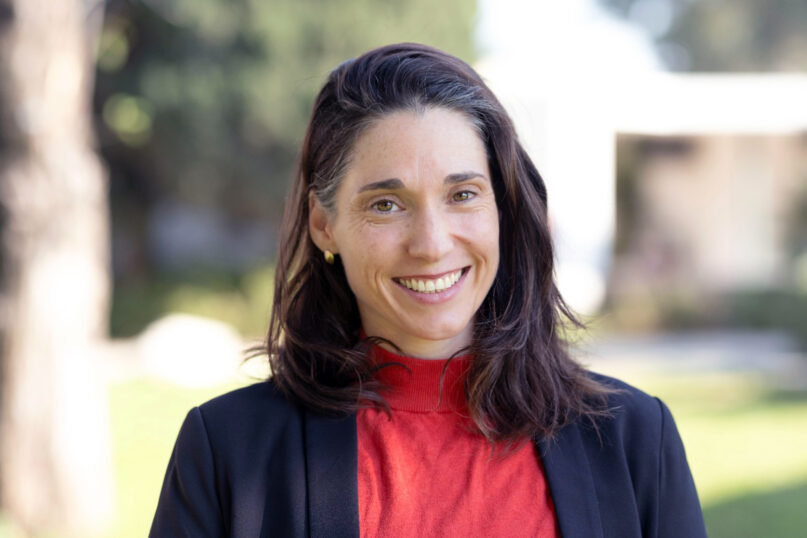
    Givat Haviva CEO Michal Sella is hopeful that relations between Jews and Arabs in Israel will ultimately improve. “Citizens realize we cannot handle more violence in this country, and most understand that we will always live together.” (Photo courtesy of Givat Haviva)

    Givat Haviva CEO Michal Sella said she is hopeful relations between Jews and Arabs in Israel will ultimately improve.

    “Some government ministers invested energy in trying to incite violence and to cause more trauma and tension, but they didn’t succeed,” she said. “Everyone thought there would be more violence, but it didn’t happen.

    “Citizens realize we cannot handle more violence in this country, and most understand that we will always live together,” she said. “There is no other option.”
    Animal skins, bells, ritual chaos: Ancient burnout remedy is still at the heart of Greece’s carnival

    DISTOMO, Greece (AP) — In the mountain village of Distomo, the “Koudounaraioi” — literally, the “Bell People” — transform themselves into half-human, half-beast revelers in a ritual dating back to pre-Christian times.


    Derek Gatopoulos and Petros Giannakouris
    March 4, 2025

    DISTOMO, Greece (AP) — Feeling overwhelmed by everyday obligations or doom-scrolling? The ancient Greeks had a remedy for burnout still practiced annually by their rural descendants.

    In the mountain village of Distomo, the “Koudounaraioi” — literally, the “Bell People” — transform themselves into half-human, half-beast revelers in a ritual dating back to pre-Christian times.

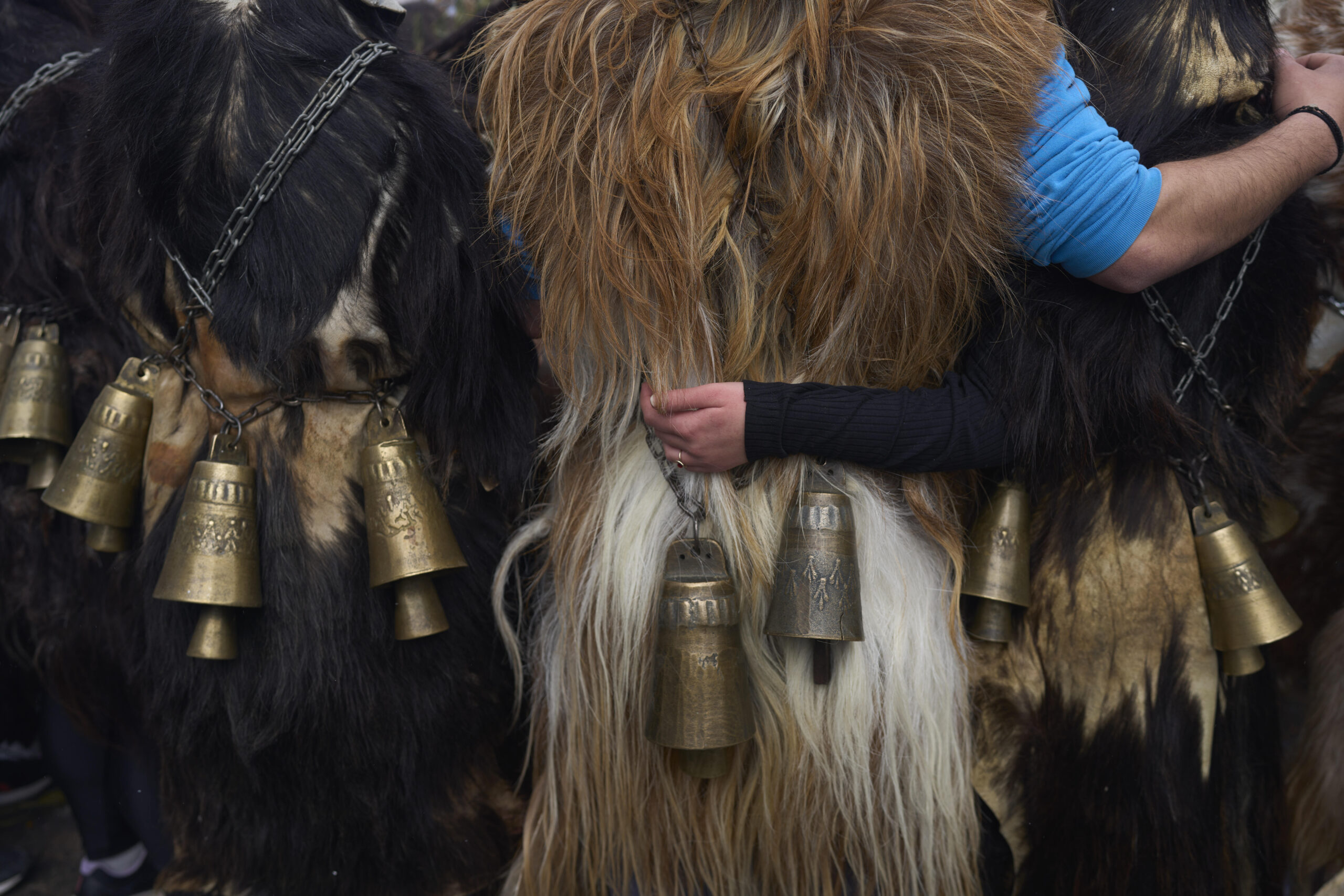
    Clad in sheep and goatskins with heavy hand-forged bronze bells chained to their waists, the Bell People danced through the streets Monday of this red-roofed village, a two-hour drive northwest of Athens.


    The deafening clatter the dancers make and their profanity-filled chants as they bound around a fire in the main square are a wine-fueled sonic assault. And that’s the point.

    Hedonistic carnival traditions across the Greek heartland and islands trace back to the ecstatic processions in ancient times honoring Dionysus, the god of wine, fertility and revelry and were then, as now, a cultural pressure valve.

    “We give society a jolt … and try to take away their misfortunes, their problems, to lift their spirits so they can feel something,” said Giorgos Papaioannou, a 29-year-old aluminum plant worker known during carnival as president of Distomo’s Bell People.

    “We even visit cemeteries, making noise to ‘wake up’ the souls of those who have passed, reminding them and the living alike that we are here, celebrating life,” he said.

    The ancient tradition practiced by farming communities to usher in spring was eventually incorporated into the Christian calendar. Monday marks the end of carnival and the start of Lent, a period of dietary restrictions and increased religious observance before Easter, which this year falls on April 20.

    Distomo is known to Greeks as a symbol of wartime hardship. In June 1944, occupying Nazi forces slaughtered 230 civilian villagers, including more than 50 children in reprisals for attacks by resistance fighters.

    An austerely-styled World War II mausoleum overlooks the village.

    “After the massacre, we managed to keep the tradition alive. It’s to awaken the spring,” Distomo Mayor Ioannis Stathas said. “This is a tradition that is many centuries old, a pre-Christian tradition, and it has been carried from generation to generation.”

    This year’s Bell People, many of them schoolchildren, held up flares and olive-wood staffs as they entered the village, trailed by giggling children and their parents dressed up as dinosaurs, police officers and other carnival costumes.

    Revelers were handed plastic cups filled with wine and portions of bean soup, as children danced to a mix of Greek folk music, Western chart hits and K-pop.

    Amalia Papaioannou, a historian and curator of the Distomo Museum, said that the once male-dominated celebrations have remained relevant by incorporating pieces of modernity but remain rooted in rural traditions.

    Agrarian societies, historically reliant on favorable conditions in nature for their survival, created these rituals to ward off evil and misfortune, she said. Carnival revelry has for centuries served as a sanctioned period of chaos before returning to structure and restraint.

    “It allows a brief period of social inversion: People wear disguises, and speech, including crude jokes, is temporarily liberated. Even the Church historically tolerated such festivities, recognizing their deep-rooted cultural and communal significance,” she said.

    “You could call it a reset.”

    ___

    Lefteris Pitarakis contributed to this report.


    ... BAKHTIN TRANSLATED BY HELENE ISWOLSi&. 1/. Page 4. First Midland Book Edition 1984. Rabelais and His World is translated from Tvorchestvo Fransua Rable,. Moscow ...


    Feb 17, 2025 ... PDF | On Nov 1, 2022, Rainer Grübel published Carnival, Carnivalism and Bakhtin's Culture of Laughter | Find, read and cite all the research ...


    society" (56). This necessitates a closer look at the Utopian motifs actually utilized by. Bakhtin in his writings on Rabelais and carnival. In ...

    Oct 22, 2024 ... Bakhtin discusses the historical origins of the Roman, Greek, and Egyptian festivals to illustrate that carnival celebrations go back to ancient pagan ...


    Opinion

    Rod Dreher's 'Living in Wonder' is a cry for mystery in a post-Christian age'

    (RNS) — The author’s latest book covers demon possession, UFOs and other spiritual phenomena.


    (Photo by Aaron Burden/Unsplash/Creative Commons)

    Katelyn Beaty
    March 5, 2025

    (RNS) — If “The Benedict Option” was Rod Dreher’s book of “woe” — a lament over the collapse of Western civilization, shifting sexual norms and the encroachment of wokeness — then his latest, “Living in Wonder,” published last fall, is his “woo” book: It’s what happens when a culture warrior puts down his sword long enough to gaze up to the heavens.

    “The world is not what we think it is,” writes Dreher. “It is so much weirder. It is so much darker. It is so, so much brighter and more beautiful. We do not create meaning; meaning is already there, waiting to be discovered.”

    It might be little wonder to many of us that Dreher’s “Living in Wonder: Finding Mystery and Meaning in a Secular Age” joins a collection of recent books meant to help us find awe amid burnout, loneliness, addiction to screens and a suffusive flatness of the soul.

    In 2023’s “Enchantment: Awakening Wonder in an Anxious Age,” Katherine May pointed us to joy in the natural world. “Awe: The New Science of Everyday Wonder and How It Can Transform Your Life,” from psychologist Dacher Keltner, from the same year, gave readers eight pathways for experiencing the titular emotion, which he defines as “the feeling of being in the presence of something vast that transcends your current understanding of the world.”

    Australian journalist Julia Baird’s memoir “Phosphorescence” speaks to and for people who “don’t attend church or adhere to any particular religion,” but rather “congregate on beaches, in forests and on mountaintops to experience awe and wonder.”

    The malady these books are intended to remedy is one that Canadian philosopher Charles Taylor has written about extensively, most notably in his 2008 book “A Secular Age,” which traces how belief in God went from being axiomatic to merely one option among many.

    Taylor writes that the premodern world was “enchanted” — good and evil spirits were real and acted directly upon us. Humans were “porous,” with no division between the physical and spiritual, or the individual and the communal. “God figures in this world as the dominant spirit, and moreover, as the only thing that guarantees that in this awe-inspiring and frightening field of forces, good will triumph,” he wrote.

    Today, people in the post-Enlightenment West are no longer porous but “buffered.” They perceive themselves as no longer subject to nature’s forces, controlling and utilizing the material world with cool reason. This retreat into the rational mind means Westerners are largely walled off from “whatever lies beyond this ordered human world and its instrumental-rational projects,” Taylor claimed. The cost is a “wide sense of malaise at the disenchanted world.”

    A shallow reading of “A Secular Age,” which expands on ideas of Max Weber, the German sociologist who gave us the “Protestant ethic,” would stop at the conclusion that Westerners are now atheists. Taylor would clarify that, though we are post-Christian, we are certainly not postspiritual.

    Dreher, whose coverage of the Catholic abuse scandal as a journalist led him out of Catholicism into Eastern Orthodoxy, comes to the topic of wonder from a deeply religious perspective. He is best known for his 2017 book calling for Christians to retreat from secularist, individualist and LGBTQ activist culture, modeled on Pope Benedict XVI’s suggestion that a smaller, more doctrinally cohesive church was better than a bigger, flabbier one.

    In 2020 he followed up with “Live Not by Lies,” which sounded the alarm that “a progressive — and profoundly anti-Christian militancy — is steadily overtaking society … there is virtually nowhere to hide” from identity politics and Marxish wokeness.

    Since then, Dreher has faced a series of upheavals. After losing funding for his popular blog at The American Conservative, he decamped to the Danube Institute in Budapest, where he has cozied up to Hungarian President Viktor Orbán, raising concerns among fellow conservatives. He also went through a divorce, the devastation of which he writes about in “Living in Wonder.” While culture war strains are still present, the book strikes an introspective note, as Dreher encourages readers to reawaken to God through prayer, beauty and openness to unseen spiritual realities.

    “Living in Wonder: Finding Mystery and Meaning in a Secular Age” cover and author Rod Dreher. (Courtesy image and screen grab)

    He finds evidence for this unseen realm in stories of demonic possession and UFOs. He devotes an entire chapter to the latter, leaning on eclectic sources such as scientist Jacques Vallee and the Orthodox priest Seraphim Rose to posit that aliens are malicious beings who want to enslave and destroy humanity. Dreher warns readers against “dark enchantment,” such as tarot cards, psychedelics and witchcraft, which he links to “progressive political commitments, especially around feminism, environmentalism, and queer activism.”

    Several portions of the book veer conspiratorial; he quotes an exorcist who posits that the occult is “supported by the media, big corporations, politicians, and our government.”

    Much better as a pathway back to premodern faith, he says, is the Eastern Orthodox Church. The Orthodox, after all, can claim a link to the early church in ways other Christian traditions can’t. Orthodox liturgical and spiritual practices — intense prayers, fasting and long services — may seem arcane and rigid compared with the “seeker-friendly” openness of evangelicals and the white liberal niceness of mainline Protestants. But its oddness is precisely what Dreher says modern people need to get out of their heads and into the flow of the Divine Life.

    As receipts, Dreher tells the story of being healed of chronic Epstein-Barr in 2012, after a priest told him to pray the Jesus Prayer — “Lord Jesus Christ, Son of the living God, have mercy on me, a sinner” — 500 times a day. Dreher notes that the incense, chants and bowing that take place in Orthodox services helpfully engage the body as much as the mind and spirit. “We are not going to argue ourselves back to enchantment, nor are we going to behave ourselves into true goodness,” writes Dreher. “Above all, we need beauty.”

    Dreher writes movingly about his own spiritual awakening as a teenager visiting Chartes Cathedral in France, and later in watching the films of Andrei Tarkovsky and reading “The Divine Comedy.” Despite his warnings against psychedelics, he also writes about a positive experience taking LSD in college.

    But as “Living in Wonder” builds toward a conclusion, it increasingly reads less like a case for re-enchantment with the world and more for readers to join the Orthodox Church, and in this it betrays a naivete that dogs much of Dreher’s advocacy for a purer faith and purer religious institutions.

    It’s naive to think of Eastern Orthodoxy as escaping the trappings of modernity, as if the other Christian traditions passed through the Enlightenment while the Orthodox somehow stayed ensconced in 650 A.D. Orthodoxy’s growing popularity among young American men, largely due to videos and podcasts on the internet, is a peculiarly modern phenomenon, and not only because digital culture itself is modern.

    As Dreher has noted, Orthodox leaders have been readily conscripted into wars both literal and cultural, showing that the church is as susceptible to modern upheaval and institutional scandal as any other religious body. Sarah Riccardi-Swartz has written about the small but vocal far-right group of converts who treat Orthodoxy as a kind of Christianity on steroids that rejects modernist rationalism but is still rigorous enough for manly men. (She also spoke about this on “Saved by the City,” the RNS podcast I co-host).

    In their hands, Orthodoxy easily becomes a tool in the quest to bolster Western civilization — making traditional Christianity a means to a worldly end, rather than a pathway of humble devotion and awe before a transcendent God.

    Charles Taylor predicted that moderns would seek enchantment by retreating back, rather than stretching forward. “Many people are not satisfied with a momentary sense of wow!” he writes. “They want to take it further, and they’re looking for ways of doing so. That is what leads them into the practices which are the main access to traditional forms of faith.”

    In other words, many people need a container for their experiences of awe. They seek a tradition or community that orders their spiritual impulses and holds them accountable to what people in the past have said and taught about God.

    But no tradition or community stands outside of time. There is no going back to premodern life, however much we romanticize a past where spiritual beings were ever-present, where no one thought to doubt the existence of God, where the physical and spiritual life were of a whole. Every religious tradition stands within culture, not outside of it. They are made of people, bound by space and time. The only way to enchantment is through, not around, the spiritual challenges of modern life.

    (Katelyn Beaty, editorial director of Brazos Press, is the author of “Celebrities for Jesus” and co-host of the RNS podcast “Saved by the City.” She blogs at The Beaty Beat. The views expressed in this commentary do not necessarily reflect those of RNS.)


    Oct 14, 2015 ... The Marginalia Review of Books. About · Our Mission · Support MRB ... The aliens are coming. Maybe not next week, but they are definitely ...

    Jun 13, 2023 ... Monsters on the Margins: The Symbolism of the UFO Phenomenon. Here ... Every few years UFOs and the possibility of extraterrestrial life ...

    The Esotericists: Aliens in Here. Esotericists are UFO enthusiasts who believe that UFOs, rather than the emissaries of the new world beyond the great ocean ...

    Trump administration must produce status report on refugee resettlement, judge orders

    (RNS) — ‘I am going to order the government to issue a status report’ on whether it is complying with a ruling that should restart the refugee program, Judge Jamal Whitehead said in court on Tuesday.


    The Rev. Carol Jensen, left, wears a hat mimicking the Statue of Liberty as the Rev. Emillie Binja, a former refugee from Congo, speaks during a rally outside U.S. District Court after a federal judge blocked President Donald Trump’s effort to halt the nation’s refugee admissions system, Feb. 25, 2025 in Seattle. (AP Photo/Ryan Sun)

    Aleja Hertzler-McCain and Jack Jenkins
    March 4, 2025

    (RNS) — One week after blocking the efforts of President Donald Trump’s administration to shutter the refugee admissions system, a federal judge in Washington state ordered the government to produce a status report by Monday (March 10) on its compliance with his ruling.

    Speaking during an emergency hearing Tuesday in Seattle, U.S. District Judge Jamal Whitehead agreed with a suggestion by lawyers representing faith-based refugee resettlement organizations that the government produce a “status report” regarding an injunction issued last week that should have restarted the refugee admissions program.

    “I am going to order the government to issue a status report,” Whitehead said, adding that he also supports a “joint status report,” allowing the plaintiffs to weigh in on “compliance.”

    Asked directly by the judge whether the U.S. State Department or the Department of Homeland Security has once again begun processing refugee admission applications or entries, August Flentje, a lawyer representing the federal government, said there were “directions to resume” that “went out as soon as this court’s order (was) issued,” but added, “I don’t have any further information on the details there.”

    The hearing in the case, known as Pacito v. Trump, comes in the wake of Whitehead’s Feb. 25 ruling, which sided with Church World Service, HIAS, Lutheran Community Services Northwest and individual refugees and their families in an effort to halt the president’s Jan. 20 executive order suspending the refugee program.

    In his ruling from the bench, Whitehead said the president’s actions amounted to a “nullification of congressional will.”

    However, the day after the judge’s ruling, the Trump administration sent out termination notices to the 10 refugee resettlement organizations in the U.S. Seven of those organizations are faith-based, and three — HIAS, Church World Service and Lutheran Community Services Northwest, an affiliate of Global Refuge — have joined nine individual plaintiffs in the lawsuit.

    Lawyers for the faith groups called the emergency hearing to discuss the termination notices, with the judge raising questions about the government’s timing.

    RELATED: Trump admin cancels grants to refugee aid agencies, despite legal battles

    “It’s a remarkable coincidence to me that the termination notices would be sent within 24 hours of the court’s preliminary injunction,” the judge said, speaking to the government’s attorney.

    Lawyers for the government suggested the timing was due to a different lawsuit, but the judge appeared skeptical.

    “The timing of the government’s decision to terminate the contracts of the resettlement agencies just one day after the court issued its preliminary injunction raises serious concerns about whether these actions are designed to circumvent the court’s ruling,” Whitehead said at the end of the hearing.

    In court, Flentje argued that because the Trump administration had not suspended two overseas contracts — with the United Nations’ International Organization For Migration and Church World Service’s Resettlement Support Center Africa — the administration was leaving grants in place “to facilitate refugee entries and admission to the U.S. at this point” and that the government could comply with the preliminary injunction without working with the refugee resettlement organizations.

    Melissa Keaney, senior supervising attorney for International Refugee Assistance Project, pushed back, saying that Church World Service’s Africa contract still has not received any government funding, despite the court’s order to lift the suspension of funds. She also indicated that her group of plaintiffs would amend their pleading to include the termination notices that several plaintiffs had received.

    After the hearing, Keaney celebrated the judge’s determination, saying in a statement sent to RNS, “The court continues to recognize the devastating harm facing refugees who have been left in limbo by the Trump administration’s unlawful suspension of the refugee program, as well as the existential threat facing refugee-serving agencies as a result of the withholding of critical funds.”

    The government’s termination letters were “flagrant attempts to undermine” Whitehead’s order and show “the suspension of the refugee program was never meant to be temporary,” Keaney argued in her statement to RNS.

    “Their actions are not only unlawful and cruel; they’re designed to undermine Congress and the judiciary,” she added.