Saturday, March 29, 2025

Connecting Women’s Oppression, Capitalism, and Wars


 March 28, 2025
Facebook

International Women’s Day, March 8, was the occasion for reports and commentary on women’s oppression ─ its continuation and its softening, here and there. A lot of the oppression stems from women’s traditional place in society as caretaker, a role often referred to as social reproduction.

Women, more than men, prepare and sustain people at the beginning of their lives and afterwards. Their work involves the birthing, nurturing, feeding, teaching and sheltering of children; service in education and healthcare; and care provided to the sick, disabled, and elderly.

Women taking on these tasks may be vulnerable; the goods, materials, and support systems relied upon for social reproduction may disappear as the result of unstable external circumstances. Disruption leads to added burdens, troubles, and pain.

Meanwhile, women endowed with educational, financial, and political resources are better positioned to weather such storms than those whose lives are precarious.

The object here is to survey women’s oppression in well-endowed, industrialized societies typified by the United States and in far-flung regions dependent on, and yet resisting, the world’s economic centers. Women living in peripheral regions may face oppression that is more severe and different in kind than that experienced by women living in the developed countries.

Our plan is to present commentary in response to International Women’s Day on general aspects of women’s oppression and then to introduce the views of prominent feminist scholar Silvia Federici on dangers disturbing the lives of women worldwide.

Two clarifications are necessary.  First, men can and do perform most of the tasks that make up social reproduction. But often they fall short, and until they are doing more, women are at special risk. As social reproducers, women receive either no pay or reduced pay. In wars and other calamitous situations ─ Gaza is emblematic ─ women and their children suffer and die disproportionally.

Secondly, this report does not deal with male violence against women. Rather, it attempts to shed light on political and economic factors contributing to women’s oppression, this by way of preparation for political action.

Undoubtedly, much male violence stems from psychological aberrations. These may aggravate adverse societal influences affecting men and boys. Our understanding of such processes is not so full, nor so available, as to provide confidence that this major problem will be resolved soon. For optimists at least, the political approach offers promise.


Repression from all sides

Remarkably enough, reports and statements appearing recently in connection with International Women’s Day, and consulted here, are silent on social-class differences as contributing to women’s oppression. Information is presented so haphazardly as to impede reasoning that might reveal class-based dynamics.

The gist of an Amnesty International statement is the complaint that, “Despite significant progress … the world has failed to fully deliver on all the promises. From rape and femicide to coercion, control and assaults on our reproductive rights, violence against women and girls still threatens their safety, happiness and very existence in a multitude of ways.”

The UN-Women organization issued a report marking the 30th anniversary of the 1995 gathering for women’s rights that produced the “Beijing Declaration and Platform for Action.” The Report documents both gains and continuing assaults. With much attention paid to the industrialized countries, it does mention wars, climate-change effects, and poverty affecting women’s lives everywhere.

We learn that, “countries have enacted 1,531 legal reforms advancing gender equality, maternal mortality has dropped by a third and women’s representation in parliaments has more than doubled.”

The Report speaks of “backlash on gender equality” and “weakening of democratic institutions.” It provides scattershot observations such as: conflict-related sexual violence increasing 50% in three years, women being three times more likely to do unpaid work than men, and sexual violence afflicting one third of women during their lifetime.

The Pew Research Center reported on March 4 that information conveyed a year ago is still relevant. The Center had indicated that women made up 47% of U.S. workers, up 30% since 1950; more women than men are college-educated; one third of U.S. workers in the highest paid industries are women; and “Women still lag in top leadership positions in business and government.”

The information seemingly pertains to the lives of politically-attuned women belonging to the middle and upper classes and not so much to the lives of poor, marginalized women.

Anyone expecting the U.S. Census Bureau to supply statistical data arranged according to social class would be disappointed. The Bureau did report poverty rates of women and men in 2023 as 11.9% and 10.2%, respectively. Child poverty that year was 15.3% ─ 16%according to the Annie E Casey Foundation.  But would mothers be less likely than their children to be living in poverty?

According to americanprogress.org, the earning gap between all fulltime male and female U.S. workers widened in 2023; women’s median annual income ended up $11,550 lower than that for men. Also: the male-female gap is greater among parttime workers and “[t]he gender wage gap is significantly larger for most women of color.”

Farther afield

The danger capitalism presents to women’s lives shows dramatically in the larger world, especially as capitalism’s wars and economic sanctions ─ think Cuba ─ aggravate the toll of economic deprivation.

Turning Point magazine provides some perspective:

As we navigate the uncertainties of 2025, women’s rights … face an unprecedented assault … Patriarchy does not exist in isolation. It intersects with and reinforces other systems of oppression, including: capitalism, racism, and colonialism. The economic dimension is particularly stark with at least 400 million women and girls abandoned to extreme poverty by predominantly male policymakers. By 2030, 8% of women globally are expected to subsist on less than $2.15 per day. The exploitation of women’s unpaid labor is a cornerstone of the global economy; underscoring the inseparability of patriarchy and capitalism.

Highlighting the disaster for women that is war, Silvia Federici explores its capitalist origins. Excerpts from her 2023 essay “War, reproduction, and feminist struggles follow:

It is fundamental to speak today of war because it has become a permanent element of capitalist politics at the international level. That there are wars today in a large part of the planet is no accident … [Wars are] a fundamental part of capitalist development, of the expansion of capitalist relations in the world …

[Ours is] an era that begins with the debt crisis, which has been artificially created and which has affected a large part of the countries that were coming out of colonialism … [T]hey have been recolonized, above all through the policies of the World Bank, and of the International Monetary Fund whose structure in itself represents war; it practically forced the governments of the indebted countries to destroy and cut all investment in social reproduction. It has cut education, health, public transport, basic necessities, mass employment, and above all has forced them to change the direction of their economies … This means great impoverishment, and increased mortality.

We women speak from the perspective of the reproduction of daily, social life, the very reproduction war seeks to destroy. So, despite the fact that men make up armies, women are the ones who experience the most devastating effects of war in their bodies, in their lives, in their communities; they have children, are pregnant, and take care of the sick and the elderly. One cannot conceptualize this: the horror of having the responsibility of reproducing life at a time when everything that happens around you is destroying your life. That’s why I think a feminist reading of war is important.

In November 2024, Federici commented on war in Gaza:

At a time of increasing capitalist crisis and inter-capitalist competition, development requires massive clearances, enclosures, the sacking of entire regions, as well as a policy tending to constantly reduce investment in social reproduction, benefits and wages …

The war Israelis carry out in Palestine is especially cruel for women who are responsible for the reproduction of their communities and now are left with nothing – no homes, no food, no means to reproduce, care for and protect their children and their families. …

Evidence has been mounting that capitalist development requires a true war on the means and activities people need to reproduce their lives. Whether by financial interventions or military operations or, more commonly by both, millions are dispossessed from their homes, their lands, their countries, as their lands are being privatized, opened to new investments and extractive ventures by petroleum, mining, agribusiness companies. This is why today, throughout the world, there are massive migratory movements.

The author translated Federici’s 2023 article.


W.T. Whitney Jr. is a retired pediatrician and political journalist living in Maine.


LA REVUE GAUCHE - Left Comment: Search results for FAMILY VALUES


Chick Corea: A Work in Progress


Facebook

  March 28, 2025

Image from A Work in Progress… On Being a Musician: Volume 1, Revised by Chick Corea, used under Fair Use: Commentary.

A Work in Progress… On Being a Musician: Volume 1, Revised

by Chick Corea

Published in 2019 by Chick Corea Productions, Inc.

Oversize paperback, 8½” by 11″, 64 pages, illustrated, no ISBN, no list price.

A Work in Progress is a fitting title for a book with a scant 40 pages of actual text. The pages are oversized at 8½” x 11″, but the type is also oversized, with generous margins and ample line spacing. It almost looks like a children’s book or a book of poetry.

A Work in Progress is closer to a work of poetry. Pianist, composer, and bandleader Chick Corea shares pearls of wisdom polished over decades of performance and groomed through rounds of revision from 1988 to 2019. Corea amassed an amazing 27 Grammy Awards before his death in 2021 at the age of 79.

One of the ways Corea grows a composition is by listening back to recordings of his own playing and fixing the timing on phrases as a piece takes shape. A Work in Progress could similarly be seen as a suite with generous space, graceful transitions, and highly-refined motifs imparting the wisdom of a recognized jazz master.

Corea lists 19 “personal policies” as a musician. Roughly half of them can be summed up as, “Don’t take crap from anybody.” A sample:

Don’t stop.

Don’t compromise.

The audience can respond or not.

To each his own.

The first half of Corea’s list is all tenacity, and the second half is about honesty, ethics, and supporting those who supported you.

A Work in Progress contains a pianist’s view of learning the piano, performing, and composing. Corea highly recommends watching other pianists play, as opposed to listening, studying scores, or reading biographies. He writes about seeing his fingers as drumsticks, and provides sheet music for a riff called “10 Drumsticks.” Corea writes, “I’ve found good control of rhythm to be the single most important element in making good music.”

Corea laments all the time he wasted fighting with bad pianos. He learned to “have a friendly attitude toward [the piano] and try to utilize its best qualities.” When accompanying a soloist, Corea recommends, “leaving big spaces when [the soloist] is making expressive phrases.” He refers to composing as a “musical game,” one Corea finds difficult to play unless driven by the pressure of an upcoming performance or recording.

A final thought on the calligraphic illustrations throughout the short book. I assume they are by Chick Corea, although no credit is given and they are unsigned. After wandering around with A Work in Progress for a couple weeks, I came to see the illustrations as integral to the text. They imply the same lessons in an elegant form.

I recommend A Work in Progress for collectors who are interested in piano instruction or in Chick Corea, or both. For the general public, the book is not an autobiography and lacks any of the usual elements of musical biography one might expect, such as memories of gigs or band members, or even a timeline of Corea’s amazing accomplishments as one of the greatest pianists in the history of jazz.

Steve O’Keefe is the author of several books, most recently Set the Page on Fire: Secrets of Successful Writers, from New World Library, based on over 250 interviews. He is the former editorial director for Loompanics Unlimited.


Trees, Singing and Silent


 March 28, 2025
Facebook
A close-up of a pianoAI-generated content may be incorrect.

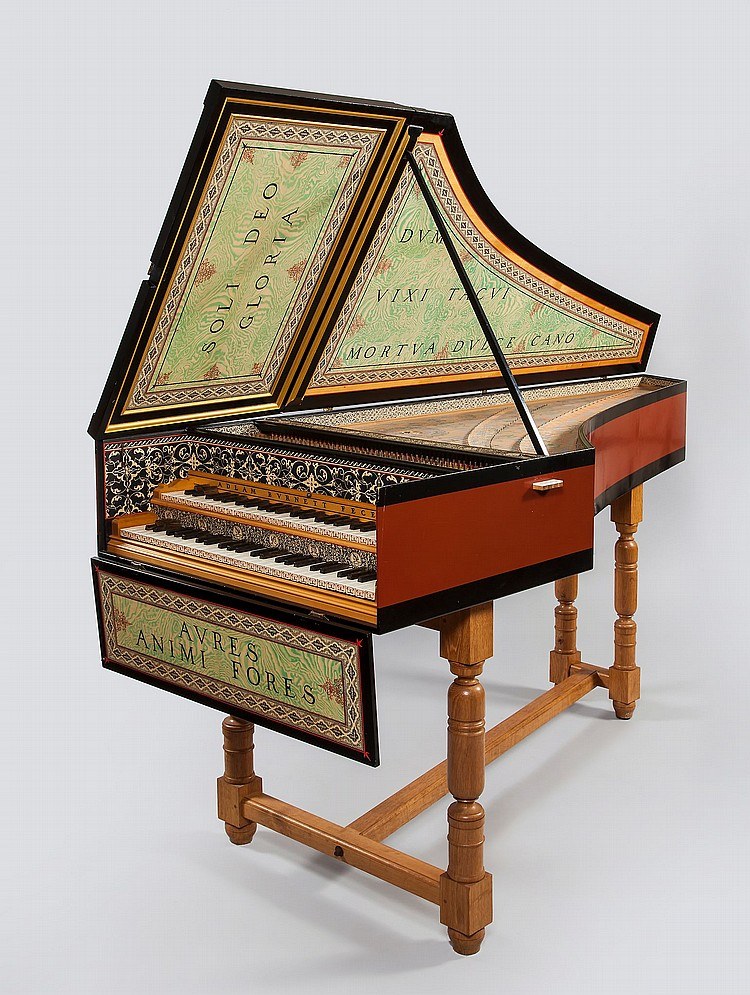
Harpsichord after Andreas Ruckers, Antwerp 1638, built by Adlam Burnett, 1983.

Inscribed on the nameboard of an ottavino spinet (a small tabletop, or even laptop, harpsichord) dated 1710 and now in the Russell Collection of musical instruments at the University of Edinburgh, runs the motto: “Dum vixi tacui: mortua dulce cano” (While living I was silent; dead, I sing sweetly). Nothing is known about the builder, one Petrus Orlandus, although reigning scholarly opinion holds that this Pietro Orlando came from Palermo, the length of Italy (and across the Strait of Messina) from the Val di Fiemme in the mountains of Northern Italy where the spruce soundboard may well have come from. Perhaps the preciousness of the natural material elicited, even if indirectly, the maker’s expression of the resonant truth—and abiding guilt—that a living thing had had to die so that his creation could spring to sounding life.

“Messiah” violin by Antonio Stradivari, Ashmolean Museum, University of Oxford.

Some keyboard instrument builders of the present day, such as the Fazioli piano makers and Bizzi harpsichords) tout the quality of their materials, boasting that their soundboards, the essential element of resonance, are carefully sourced from the Val di Fiemme, rebranded in their advertising copy as the Stradivarius Valley. The prospective buyer dreams that her harpsichord or piano will sing like “The Messiah,” the sobriquet of one of the master violin makers most famous, and perhaps most valuable products, now in the Ashmolean Museum at Oxford University. There this “as new” instrument spends its time in a climate-controlled glass case, visible but silent.

The motto of the Russell Collection ottavino truncates a couplet associated with the 16th-century luthier Kaspar Tieffenbrucker, who was born in from Füssen southern Bavaria in the in the northern shadow of the Alps, 170 miles away from the Val di Fiemme: “Viva fui in sylvis: sum dura occisa securi. Dum vixi tacui: mortua dulce cano” (I was alive in the woods: I was cut down by the hard axe. While living I was silent; dead, I sing sweetly.) (The term “luthier” refers not just to lute makers, as one might initially think, but to skilled craftspeople building stringed musical instruments.)

Tieffenbrucker’s name served as a prop for spuriously “ancient” (but masterfully made) violins counterfeited in the shop of Jean-Baptiste Vuillaume (who, not coincidentally, once owned the Stradivarius “Messiah”) in 19th-century Paris. Tieffenbrucker didn’t even make violins, but mostly guitars, lutes and viols. But they were of wood too, and Tieffenbrucker’s expiatory Latin lines artfully acknowledged the violence that is often hidden behind beauty.

Gasparo Duiffopruggar (aka, Kaspar Tieffenbrucker), engraving by Pierre Woeiriot (1532-1599).

In 2014 Aaron Allen, a scholar helping to shape the subfield of what has come to be known as eco-musicology, published “Fatto di Fiemme’: Stradivari’s violins and the musical trees of the Paneveggio.” The article told a heartening, yet admonitory tale of the power of art and careful stewardship of natural resources to hold off the insatiable human desire for wood. The value of violins trumped the rabid demand for planks and masts for the vast Venetian navy being built a hundred miles southwest of the spruce forests on the Adriatic coast. The “Stradivarius” Valley is now in the Parco Naturale di Paneveggio, some hundred miles northeast of Cremona, the birthplace of the violin and also once part of the Venetian Empire.

Cremonese violins are much smaller than Venetian war galleys. Now, a more recent musical technology requires the harvest of the descendants of the trees used by Stradivari.

The Fazioli company makes concert grand pianos that are the battleships of concert stages and billionaires’ drawing rooms. The family business originally produced upscale office furniture from exotic woods—teak, mahogany, rosewood—but turned to piano-making in 1981 under the leadership of Paolo Fazioli. He is a mechanical engineer but was also trained as a pianist and composer. The firm now makes the most expensive pianos in the world. The price-tag on their 10-foot concert grand approaches $300,000. About 170 pianos of various sizes (all large) are now produced in the Fazioli factory in Sacile, a town halfway between the Val di Fiemme and Venice. With an engineer in the driver’s seat of the firm, it’s not surprising that these instruments handle like Formula 1 race cars—light to the touch and super responsive.

The cast-iron frame was the crucial design and manufacture innovation that allowed the 19th-century piano to increase in power so as to be heard in ever larger concert halls and against ever larger orchestral numbers arrayed for the concerto showpieces of the Romantic repertoire. The German word for this construction is Vollpanzerplatte—full armor plate. “Panzer” conjures images of a battle-ready tank. Without the metal plate, the inexorable force of the high-tension wires would accordion the piano into a heap of splinters.

Buttressed by these armaments is the fine- and straight-grained soundboard from the Val di Fiemme. Fazioli draws on the mystique of Stradivarius and the “Forest of Violins” in the marketing of their pianos.

I have played a Fazioli piano in a San Francisco mansion where the instrument stretches out grandly in the living room. Behind it, a picture window delivers a view of the Gold Gate Bridge so close you feel that if the seven-octave expanse of the keyboard added just a few more notes below its allotment of 88 that the extra keys would rest on the span’s towers so that the piano’s hammers would strike the vertical cables and sound them like strings.

Inside, the massive case is veneered in blond maple that contrasts the with brooding, yet brilliant exterior. To open the piano, one props up the lid on its stick and is amazed that the giant, thin wing does not bow or warp. The visual impression becomes one of interior lightness, sound escaping the forces of gravity that the sheer size and weight of the instrument cannot physically defy.

The action—the ingenious mechanism of wooden (and increasingly, carbon fiber) batons, springs and pins that translates the motion of the fingers to the felt-covered hammers—is exceedingly user-friendly: responsive not only to caresses, but also tothe blows of pianistic heavyweights. The instrument is shaped like the lift-giving limb of a bird. Again, the German word for the grand piano is illuminating—Flügel (wing). Maybe one is meant to feel more like a jet pilot than a race driver, flying above the world firing off missiles of art. The biggest Fazioli model is the F-308, which sounds to me like an American fighter plane of the future.

I found the Fazioli all too perfect: too engineered, the sound lacking in grain, the touch wanting of texture. The piano I’ve played hovering above the Golden Gate is more musical machine than musical instrument.

The Fazioli website trumpets the manufacturer’s commitment to sustainability. The company offers other veneers than just ebony, the default-setting for formal venues: after black on a dealer’s drop-down menu, one can choose blue, macassar, pyramid mahogany, red, tamo, or white. Logged, often illegally in Indonesia, macassar is a threatened species.

The 170 pianos made annually by Fazioli count as a whole fleet of giant crafts launched every year. With respect to the materials sourced from the Val di Fiemme nearer the Fazioli factory than those far-off forests of macassar and mahogany, not every red spruce yields soundboard-quality wood. The vast majority of trees felled there go to other purposes. A true accounting of the environmental impact of piano production has yet to be made on this region. Against stiff competition from luxurious, but still cheaper Steinways made in the U. S. A. and Germany, Yamahas from Japan and a host of newer companies, Fazioli has penetrated the global market, exporting its instrument to places as far as you can get from the source of their soundboards.

Nor has the musical mileage put on these pianos by wealthy buyers been measured. These pianos are prestige objects that come from wood that did not sing when alive and is, I suspect, mostly mute now as furniture, even though the most tuneful wood in the world was killed—by the chainsaw not the hard axe—to make them.

Next week: Musical Instruments, Extreme Weather and Material Acknowledgments.

David Yearsley is a long-time contributor to CounterPunch and the Anderson Valley Advertiser. His latest albums, “In the Cabinet of Wonders” and “Handel’s Organ Banquet” are now available from False Azure Records.