Saturday, March 29, 2025

In the hills of Tennessee, a developer hopes to offer blue state Christians a refuge

Whitleyville, Tenn. (RNS) — The venture, which has involved several prominent conservative voices, has drawn the concern of locals who don't want to see Christian nationalism take over their community.


Overlooking a former farm in Whitleyville, Tenn., on Feb. 14, 2025, that will potentially be developed into an “agrihood.” (RNS photo/Bob Smietana)
Bob Smietana
March 28, 2025

Whitleyville, Tenn. (RNS) — On a sunny morning in mid-February, Josh Abbotoy, who describes himself as a “conservative Christian who does land deals,” drove a 20-year-old Lexus LX470 around a former farm, crossing a creek, squeezing by a run-down barn and driving along one of the farm’s roads in hopes of showing off the view from one of the ridgetops.

But there had been too much rain and the road was muddy, so he parked and hopped out for a 10-minute walk up to the ridgetop, admiring the red cedars and Bois d’Arc trees that line the hillsides.

At the top of the ridge, Abbotoy surveyed the view of the green fields and rolling hills while painting a picture of a community filled with lovely homes and families, looking down over wide fields and a stately church.

A month earlier, RidgeRunner, a real estate company Abbotoy runs, announced it had bought the 448-acre farm, with hopes of developing it into an “agrihood” — with about 30 estate-style homes dotting the farm’s hillsides.

“The fields will be filled with livestock as God intended and as Jackson County remembers,” the RidgeRunner website read in announcing the purchase. “Our goal will be to preserve the sweeping views for those who build and live on the farm’s ridgetops.”

Abbotoy said it’s too early to tell how much lots on the farm will cost but said there will be a premium for ridgetop views. A similar RidgeRunner project in Kentucky, where land prices are lower, has lots priced from $35,000 to $329,000. While the Whitleyville farm has access to city water, high-speed internet and electricity, there’s still a lot of work to do on the property’s infrastructure.
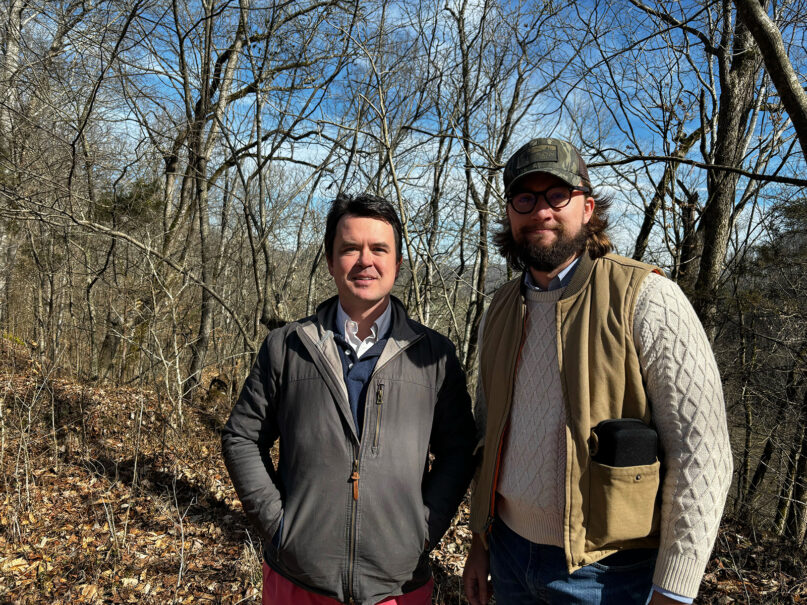

Josh Abbotoy, left, and Patrick Thomas on a farm they hope to develop in Whitleyville, Tenn. (RNS photo/Bob Smietana)

But if all goes to plan, within a few years the former farm property will be filled with conservative Christians who have moved from blue states to this rural corner of the Bible Belt.

It’s the Big Sort as a business opportunity.

A former corporate lawyer turned entrepreneur and Christian publisher, Abbotoy is fond of quoting journalist Bill Bishop’s influential 2009 book about how Americans increasingly live in like-minded clusters.

That trend has accelerated in recent years, fueled by the work-from-anywhere revolution set off by the COVID-19 pandemic and the country’s political polarization.

“It’s happening on all sides,” Abbotoy told Religion News Service during a recent visit to the farm in Whitleyville. “People want to live in communities where they have a better shot of having alignment on some really basic political issues.”

Rural Tennessee communities like Jackson County have begun to attract newcomers in recent years, according to data from the Boyd Center for Business & Economic Research at the University of Tennessee in Knoxville, part of an overall pattern of population growth.


A former farm in Jackson County, Tenn., on Feb. 14, 2025, that will potentially be developed by the RidgeRunner real estate company. (RNS photo/Bob Smietana)

“We’ve seen more migration to rural counties so far this decade than in the entire previous decade,” said Matthew Harris, a professor of health economics who does population projection for the state of Tennessee. For example, in Jackson County, more people left than moved in from 2010 to 2020. That trend has begun to reverse.

“A couple hundred people have moved there this decade,” he said.

Abbotoy, who grew up on a small farm in Hartsville about 40 miles west of Whitleyville, sees RidgeRunner as a chance to become part of a conservative gentrification of central Appalachia, where economic decline and brain drain have left communities just waiting to be revitalized.

“If you’re considering a move out here — maybe you live in Silicon Valley and you want to move out to the country,” Ab0atoy said, “we’ll be your Sherpa.”

RELATED: How a bucolic Tennessee suburb became a hotbed of ‘Christian Nashville-ism’

A graduate of Catholic University and Harvard Law School, Abb0toy lived for a few years in Boston before practicing corporate law in Houston and Dallas — then returning home. He’s now managing director of New Founding, which invests in “American ideals and a positive national vision” — of which RidgeRunner is a project — and the executive director of American Reformer, a digital publication that seeks to “promote a vigorous Christian approach to the cultural challenges of our day.”

As Forbes recently put it, New Founding is part of a growing movement of “anti-woke” venture capitalists hoping “to remake society with a largely MAGA, tech-driven, Christian worldview.”

Standing on one of the farm’s ridgetops, Abbotoy said he’s not a Christian nationalist, adding, “that’s not my project.” He also said he is not going to let anyone tell him who his friends or his customers ought to be.

“I’ve got customers that are more right-wing than me. I’m not going to talk bad about them,” he said. “I like them. They’re my friends. And I don’t screen their religious or political views any more than I would anybody else.”

Federal fair housing law prohibits that anyway, Abbotoy noted, but the presence of a church on the property will be a signal as to the kind of close-knit community he hopes to build here. Folks are also drawn to Jackson County, he said, because of its Bible Belt culture.

AdChoicesSponsored


“Even if they’re not Christians, they like being in a community that feels like it’s culturally Christian,” he said.

The proposed church — or at least its pastor, Andrew Isker — has been a source of controversy among locals. Isker, a podcaster and author, relocated from Minnesota to Tennessee to start Whitleyville Reformation Church, which currently is meeting on an invite-only basis during its start-up phase. The congregation plans to build on the RidgeRunner property.

Isker, co-author of “Christian Nationalism: A Biblical Guide For Taking Dominion and Discipling Nations,” with Gab founder Andrew Torba, as well as the author of “The Boniface Option: A Strategy For Christian Counteroffensive in a Post-Christian Nation,” is known for promoting the idea that Christians should dominate American culture and for his criticism of Jews and other non-Christians.

In a podcast earlier this year with Texas pastor Joel Webbon, Isker rejected the idea of “Judeo-Christian religion” and blamed Jews for the rise of secularism.

“We have to be wary of them,” he said. “We have to not allow them to have power in our culture and destroy Christian culture.”

Isker, who did not respond to repeated requests for an interview, has described his move to Tennessee as a chance to live near friends and “laugh at each other’s jokes on our front porch.” But he has also characterized the move in political terms.

“If you were able to take even a few hundred people that all think the same way and have all the same ideas about common good and politics and so forth, and you can consolidate them in the same place, you can exercise far more political power, even with a few hundred or a few thousand people, than you can on your own, widely dispersed across the entire country,” he said in a video posted on social media by RidgeRunner.


Andrew Isker, left, and C. Jay Engel co-host an episiode of the “Contra Mundum” podcast, which aired on Oct 13, 2023. (Video screen grab)

C. Jay Engel, who co-hosts the “Contra Mundum” podcast with Isker, is a recent transplant to Tennessee from California who hopes to buy property from RidgeRunner.

“We love their understanding of how young American conservative families are finding new opportunities to live peaceably and productively among themselves, and I want to involve my family in this meta-trend,” said Engel, who has described the Civil Rights Act as government overreach.

Engel, who calls himself a “Heritage American” — which he has defined as affirming “the domination and pre-eminence of the European derived peoples, their institutions, and their way of life” — declined a request to discuss his political or social views with RNS.

When Nashville’s News Channel 5 reporter Phil Williams reported on Isker’s and Engel’s political views and their ties to the RidgeRunner project, some residents were outraged — rejecting the prospect of these outsiders taking over their community.

Sean Zearfoss is among those concerned about the RidgeRunner project. Zearfoss, a traveling musician, lives in a house he renovated just off the town square in nearby Gainesboro.

“I like the rural community,” said Zearfoss, who also has a place outside Atlanta. “It’s tight-knit. It’s a nice quiet town, right at the Cumberland River in a really beautiful area.”


Buildings along Main Street on the Town Square in Gainesboro, Tenn. (Photo by Brian Stansberry/Wikimedia/Creative Commons)

Zearfoss, who grew up in a conservative evangelical home, said he is fine with the community’s Bible Belt culture, even though his politics lean more progressive.

But the type of Christian nationalism he sees Isker and Engel promoting is a different thing, said Zearfoss.

“I see it like a steamroller trying to roll into town and roll over these people who want to live quiet conservative lives,” he said.

After the backlash to the Channel 5 report, Travis Thomas, a local Church of Christ preacher, decided to host Engel on his call-in YouTube show, “Truth with Proof.” There Engel got an earful from residents who were upset by what they’d heard.

One caller in particular cited Engel’s call to repeal the Civil Rights Act, which brought an end to Jim Crow laws in the South, and asked if he wanted to return to segregation. Engel said matters of race should have been resolved by the states.

“But I’m not for segregation, and I think it’s very harmful to the soul of a nation to participate in those things,” Engel said.

A river flows near Gainesboro, Tenn., on Feb. 16, 2025. (RNS photo/Bob Smietana)

Thomas, a bi-vocational pastor, said Jackson County is still shaped by the Bible Belt, though folks don’t go to church as much as they used to.

“I think it’s a good thing when people move in, especially if they are going to hold to more biblical principles and morals,” he said. “And from what I’ve seen of the individuals that are buying the land, at least they do hold to some kind of moral principles.”

That’s different, he said, than if a group of extremists were building a compound in the area. It’s not like David Koresh is moving to the community, he said.

Thomas said he has also invited Isker to appear on his YouTube channel to talk about religion — and he had some advice for the newcomer.

“He says some of the craziest stuff on his podcast,” Thomas said. “I’ve even told him, you can’t just get on here and say anything on a podcast, because people are watching you. It sounds ridiculous.”

While he appreciates Christian values, Thomas said you can’t force religion on people. And as far as politics goes, Thomas said it’s good to vote, but the church isn’t going to gain power by politics.

“Even in local politics, you can only do so much,” he said. “It’s not like they can come in and take away your freedom of religion.”

Abbotoy, for his part, worries about the decline of American civil religion. What will bind Americans together, he wonders, in the way that Protestant religion did?

“I think every society, if it’s going to stay together, needs to have one,” he said.

That has led some of his friends — and potential customers — to wonder if America was better off when Christianity was more prominent. There are trade-offs and downsides to that kind of arrangement, he said. But those trade-offs are better than what we have now, he added.

“I think you’re seeing a lot of people who are not personally Christian,” he said, “saying, the arrangement we had where Christianity was dominant public orthodoxy was better than what we have now.”

Abbotoy seems to let most of the criticism roll off his back. RidgeRunner, he said, hopes to sell property to people who want to be good neighbors and not try to impose outside views on the local culture. At the same time, new people will be coming, and that will bring change.

“Change is coming,” he said. “The question is, how do you want to direct that?”

(This story was reported with support from the Stiefel Freethought Foundation.
A group of modern Orthodox Jews is hosting a conference critical of Israel

(RNS) — Orthodox Judaism, both in the United States and Israel, has typically espoused a right-wing political orientation and unconditional support for Israel. These Jews beg to differ.


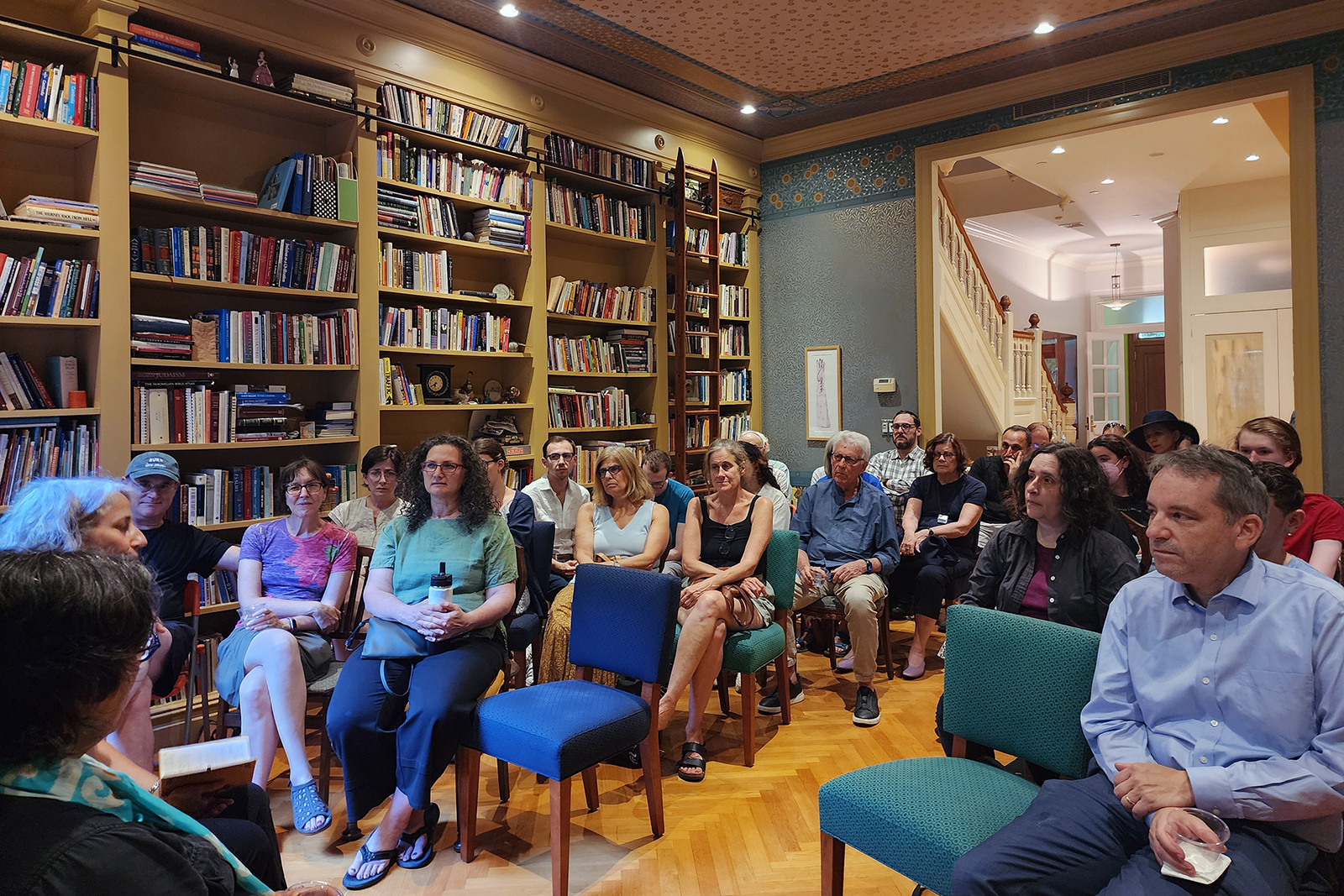
People attend a gathering in a New York City home to discuss Israeli-Palestinian issues in 2024. (Photo courtesy of Smol Emuni)


Yonat Shimron
March 27, 2025

(RNS) — Over the past year, a group of mostly modern Orthodox Jews has met in living rooms on the Upper West Side of Manhattan to discuss Israel’s devastating war in Gaza and to hear from Jews and Palestinians critical of the country’s occupation and government.

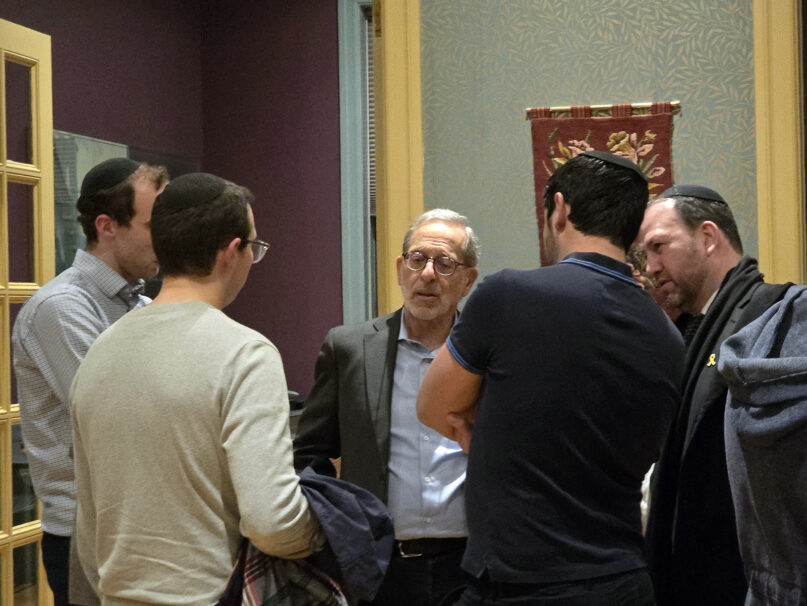
In November, the salonlike gathering invited Rashid Khalidi, the Columbia University Palestinian-American history professor. Some 70 Orthodox or self-described observant Jews attended.

And on Sunday (March 30), the group will host its first daylong conference. At the forum, Israeli, Palestinian and American Jewish speakers will discuss Jewish power, the occupation, U.S. support for Israel and the moral implications of the Gaza war. It will screen a 20-minute clip of the Oscar-winning documentary “No Other Land,” which shows the ongoing destruction of a Palestinian village in the West Bank by Israeli soldiers.

The conference is a noteworthy turn. Orthodox Judaism, both in the United States and Israel, has typically espoused a right-wing political orientation that includes unconditional support for Israel. Orthodox and Haredi Jews in the U.S. generally stand apart from the majority of the American Jewish community in their support for President Donald Trump and his policies regarding Israel. Five of the six parties that make up Israel’s government are either Orthodox or religious Zionist.

But the ongoing war in Gaza has produced a challenge to that status quo. David Myers, a history professor at University of California, Los Angeles, who has spoken at the salon and will speak at the conference, called it a kind of “coming out party.”

“It’s really allowing for an important strand of American Jewish public opinion to be heard,” Myers said. “This voice is not being heard in places where it should be heard — like in our synagogues, which are overwhelmingly flag-waving, and ‘We stand with Israel,’ which means we stand with the Netanyahu government.”

Columbia University history professor Rashid Khalidi, center, talks with attendees during a Nov. 25, 2024, gathering in a New York City home. (Photo courtesy of Smol Emuni)

The conference will take place at B’nai Jeshurun on the Upper West Side. So far, 300 people have registered to attend in person and another 300 online.

The conference is partnering with a small Israeli group called HaSmol HaEmuni, or “the faithful left,” in Hebrew. The group was created in January 2023 in response to the 2022 Israeli election, which brought to power the most right-wing and religiously conservative government in the country’s history.

One of the leaders of that movement, Mikhael Manekin, will speak at the conference.

“We’re religious individuals who see our politics geared towards equality as a manifestation of our religious identity,” Manekin said. “It stems from a larger view, a both religious and political understanding, of the need for the freedom and dignity of human beings.”

The “Smol Emuni US Conference,” as Sunday’s event is called, is not expected to deal with the long-running American Jewish identity dispute pitting Zionists and anti-Zionists against each other. Nor is it intended to herald the start of a nonprofit organization, sources told RNS.

“We have a diversity of opinions within our own group,” said Rachel Landsberg, a Jewish educator who is part of the team planning the conference. “What we think is important is to have open conversations and to be able to challenge and question.”


People attend a salonlike gathering in a New York City home to discuss Israeli-Palestinian issues. (Photo courtesy of Smol Emuni)

Panels include a session on Jews as a “chosen” people and the imperative to treat all human beings in the image of God; a session on how to speak out against Israel; and a session on the political legacy of Yiddish and Arabic. Two Palestinian Israelis will also speak.

Esther Sperber, an Israeli-born architect who now lives in New York City, was one of the founders of the salon. Sperber, who defines herself as observant rather than Orthodox, attends Darkhei Noam, a lay-led congregation on the Upper West Side where much of the group originated, though it now draws observant Jews from across the city and New Jersey, too. Her father, Rabbi Daniel Sperber, is the halakhic adviser to the congregation.

Esther Sperber has been active in campaigns to release the hostages captured from Israel by Hamas on Oct. 7, 2023. Over time, though, she began to feel that part of her Jewish values was not being addressed.

The salonlike meetings and the conference can be seen as an attempt to “rescue” her Judaism, she explained, and to “bring it back to being compassionate — one that loves justice, kindness and humility.”

“There was a central part of my spiritual and religious commitments that was not getting any expression: the beliefs that all human life is sacred, the belief that no people are more worthwhile than other peoples,” she said.
Haitian congregations fight fear as Trump administration seeks deportation for immigrants

(RNS) – 'This is a church of immigrants,' said Pastor Reginald Silencieux of Première Eglise Evangelique Haïtienne in Springfield, Ohio. '... They are very scared.'


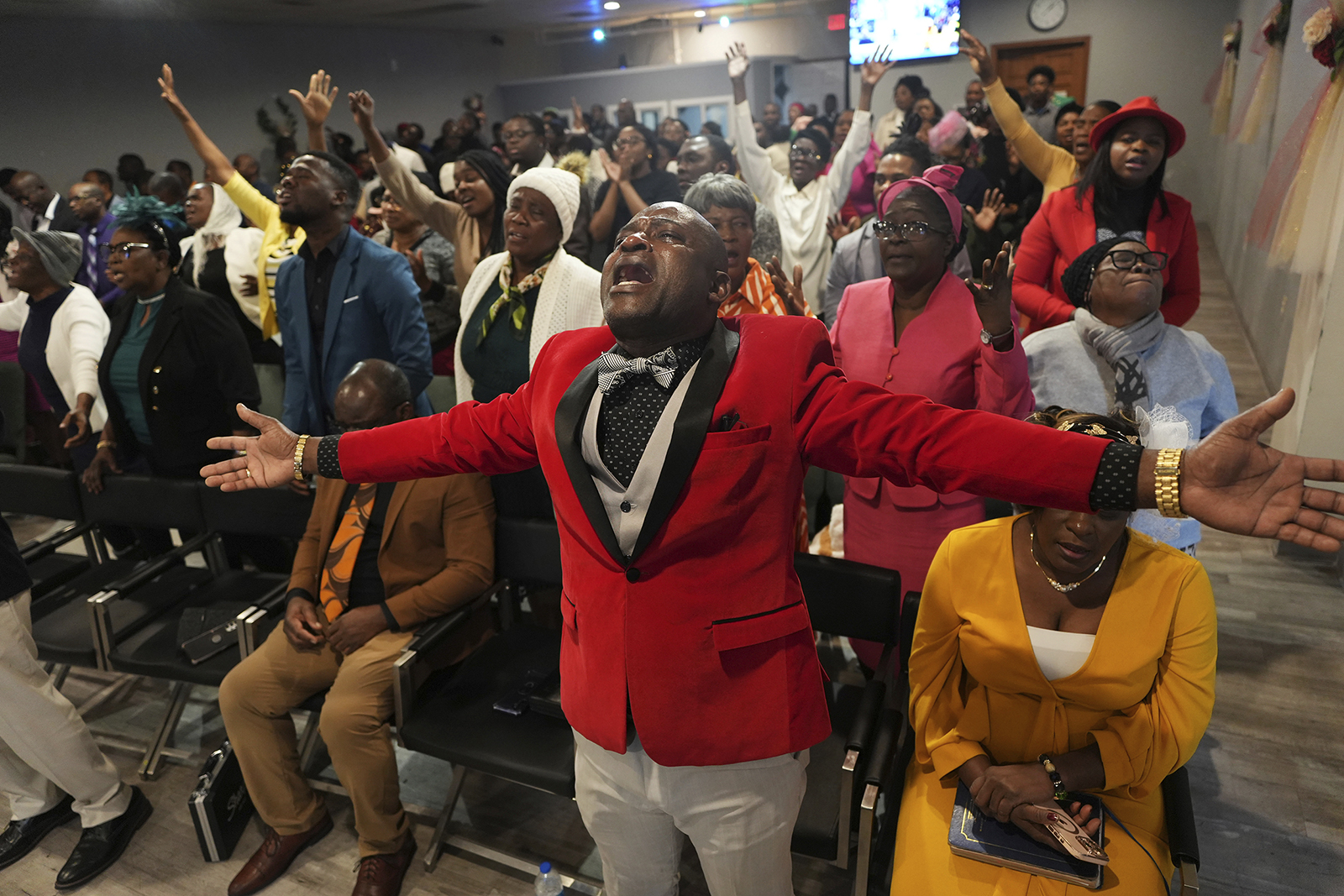
Jean-Michel Gisnel cries out while praying with other congregants at the First Haitian Evangelical Church of Springfield, Sunday, January 26, 2025, in Springfield, Ohio. (AP Photo/Luis Andres Henao)


Fiona André
March 28, 2025

(RNS) — Since President Donald Trump took office in January, congregants of the Voice of the Gospel Tabernacle church in the Mattapan neighborhood of Boston have gathered weekly to pray for a miracle.

Members of the Haitian congregation hope God will soften the hearts of the country’s leaders so they will spare immigrants from deportation, said the church’s lead pastor, Bishop Nicolas Homicil.

“We prayed for God to take control of the White House, to change those people who lead the country now, to talk to them, to let them know Jesus himself was a refugee in Egypt,” Homicil said.

But on Tuesday (March 25), the Department of Homeland Security ended a program that allowed more than half a million nationals of Cuba, Haiti, Nicaragua and Venezuela to remain in the country. The DHS notice said the temporary protected status granted to individuals — many of whom entered under a Biden-era humanitarian parole program called CHNV, an acronym for the four countries — would end on April 24. It urged individuals to self-deport or prepare to face arrest after the deadline.

The news sent a shockwave through the Haitian community, as many immigrants who left the Caribbean island stricken by gang violence benefited from the CHNV program. At the Voice of the Gospel Tabernacle church, 30 members came early on Wednesday to fast and pray for the hundreds of thousands of Haitians who face deportation.

Homicil said they chanted a famous Creole anthem for difficult times: “Nan mitan gwo lanmè ak tanpèt mwen te ye/San sekou m te pèdi, San lafwa, san limyè,” which translates to, “I found myself amid terrible waters and storms/ Without help, I was lost, without faith or light.” The congregation also read portions of Psalm 46, as a reminder of God’s presence.


Bishop Nicolas Homicil. (Courtesy photo)

The Trump administration’s enforcement of stricter immigration policies, Homicil said, has resulted in fear for Boston’s vibrant Haitian community — the third largest in the U.S. — and affected religious life. Service attendance started to drop a few weeks after Trump’s inauguration. On Sundays, 300 people usually attended services. About 100 do now, and many Boston-area congregations face the same problem, he said. He recently met with Muslim and Jewish ministers and Mayor Michelle Wu to discuss the issue.

Some worshippers, Homicil said, are afraid to leave their homes because they fear being arrested by immigration agents. As a result, the church’s food pantry, which serves about 250 people, started delivering food packages to homes because some beneficiaries were too afraid to attend church.

Though the DHS notice mentions “self-deportation,” that’s not an option for members of his community, Homicil said. Haiti’s situation is too fragile for them to consider voluntarily going back. In Port-au-Prince, the nation’s capital, armed gangs have gained control of entire neighborhoods and could soon control the entire city. In 2024, 5,600 people were killed due to gang violence, according to the United Nations.

“Everybody is just trembling. Everybody was deceived, everybody lives in uncertainty because they cannot go back home, because back home, there is a legion of gangs who chase them out,” Homicil said.

In January 2023, the Biden administration introduced the CHNV parole program to curb illegal immigration by creating legal routes. About 532,000 people entered the country through the program and were granted Temporary Protected Status, giving them the right to remain legally in the country, to work and to receive travel authorization.

DHS suspended the CHNV program in August 2024 after an internal report revealed possible sponsorship fraud. In October, the Biden administration announced it was not renewing it. Under that ruling, immigrants would face deportation when their two-year parole grants expired if they did not find another legal pathway, but were eligible to apply for other benefits, like asylum and TPS.

The March 25 DHS notice said the CHNV programs didn’t “serve a significant public benefit, are not necessary to reduce levels of illegal immigration, did not sufficiently mitigate the domestic effects of illegal immigration, are not serving their intended purposes, and are inconsistent with the administration’s foreign policy goals.”

The day before, a first hearing was held at the District Court of Massachusetts in Boston for a lawsuit filed by immigrant advocacy groups against Homeland Security Secretary Kristi Noem, challenging the termination of the CHNV program. The lawsuit was filed by 11 beneficiaries, seven sponsors and organizational plaintiff Haitian Bridge Alliance.

The Justice Action Center, which represents the plaintiffs, also filed a motion for preliminary injunction, asking the court to suspend parole termination while the case is being heard. The next hearings are scheduled for April 7 and April 10.

At the Première Eglise Evangelique Haïtienne (First Haitian Evangelical Church) of Springfield, Ohio, congregants meet three times a week to pray for the Trump administration, pleading to God for a solution in favor of the local Haitian immigrant community, said Pastor Reginald Silencieux.

Last summer, the Haitian community of Springfield faced scrutiny and harassment after then-candidate Trump falsely alleged during a presidential debate that members of the community were eating pets in the city. The comments, and then the recent executive orders targeting immigrants, have taken a toll on the community, Silencieux said.


A weekly English Speakers of Other Languages (ESOL) course, primarily attended by Haitian migrants, meets at First Haitian Evangelical Church of Springfield, Sunday, Sept. 15, 2024, in Springfield, Ohio. (RNS photo/Kathryn Post)

“This is a church of immigrants. The executive order really affects them,” he said. “They have psychological problems right now. They are very scared.”

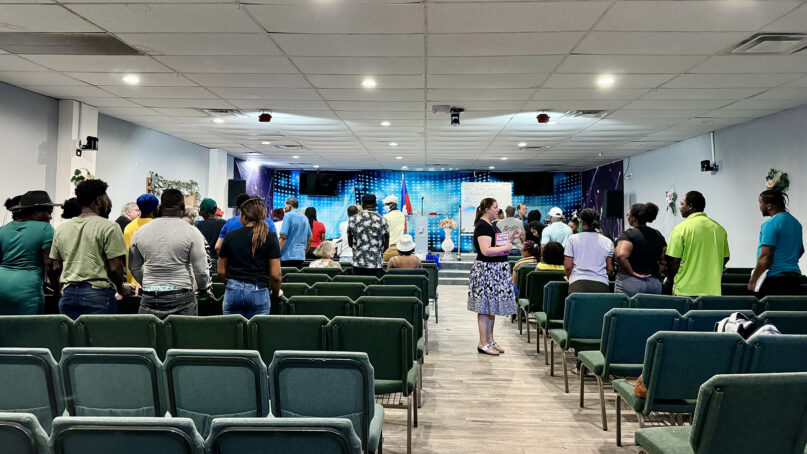
Now, every Sunday when Silencieux looks out at the pews, he sees the effects: the 500-member congregation has considerably shrunk, he said.

As a faith leader, the situation has been overwhelming since January, he said. Many congregants don’t understand why their legal status is being challenged.

“If the system is illegal, we can say, ‘Yes, we are illegal.’ If the system is legal, we are legal because they all went through the system,” Silencieux said.

The Rev. Myrlande DesRosiers, pastor of New England Voice of Hope and Peace Ministries and executive director of the Everett Haitian Community Center in Massachusetts, said the local Haitian community has not only lost its vibrancy but also toned down religious celebrations as fewer people are attending services.


The Rev. Myrlande DesRosiers. (Courtesy photo)

For Lent, the Haitian community reflected on the fragility of life and the events that sometimes shatter one’s faith, DesRosiers said. And local Haitian faith leaders in the community have expressed a desire to dedicate more time to praying about the situation during Sunday services, she said.

“Prayer still works. … When we wholeheartedly cry out to the Lord, He does listen, but we really need to put ourselves together to make it a priority — not just something on the side, just a few minutes, but really concentrate on that and cry out to the Lord,” she said.

DesRosiers also said the situation has taken a toll on faith leaders who lead fearful congregants. “You give pastoral counseling, and you have to deal with the tears, you have to deal with the fears. You have to deal with the sadness that you see,” she said.
RELATED: Christian groups kick off Lent with letters objecting to Trump moves on budget and immigration

The Rev. Manny Daphnis, pastor at Restoration Community Church in Holbrook, Massachusetts, and a member of the Fellowship of Evangelical Haitian Pastors of New England, said his latter organization tries to equip faith leaders with resources to protect worshippers. In light of the immigration policy changes, the fellowship urged churches to designate someone to identify who is entering sanctuaries “so that folks aren’t just welcoming ICE members into the congregation and worship services,” he said.

The group also urged faith leaders to be responsible and to educate congregants on their rights and obligations.

Meanwhile, as the clock ticks for those who will soon face deportation, Homicil plans to host a legal advice event on Saturday (March 29). The church will also continue its weekly prayer meetings for the Trump administration, he said.

“If God doesn’t intervene, I don’t know how this is going to be,” he said. “But God is in control of everything. Mr. Trump is not God. God is God. He’s the one who is in control.”
What does new LDS messaging really say about women in the church?

(RNS) — Women are second-class citizens in The Church of Jesus Christ of Latter-day Saints, guest columnist Emily W. Jensen concludes in analyzing the church's recent efforts to connect better with women.


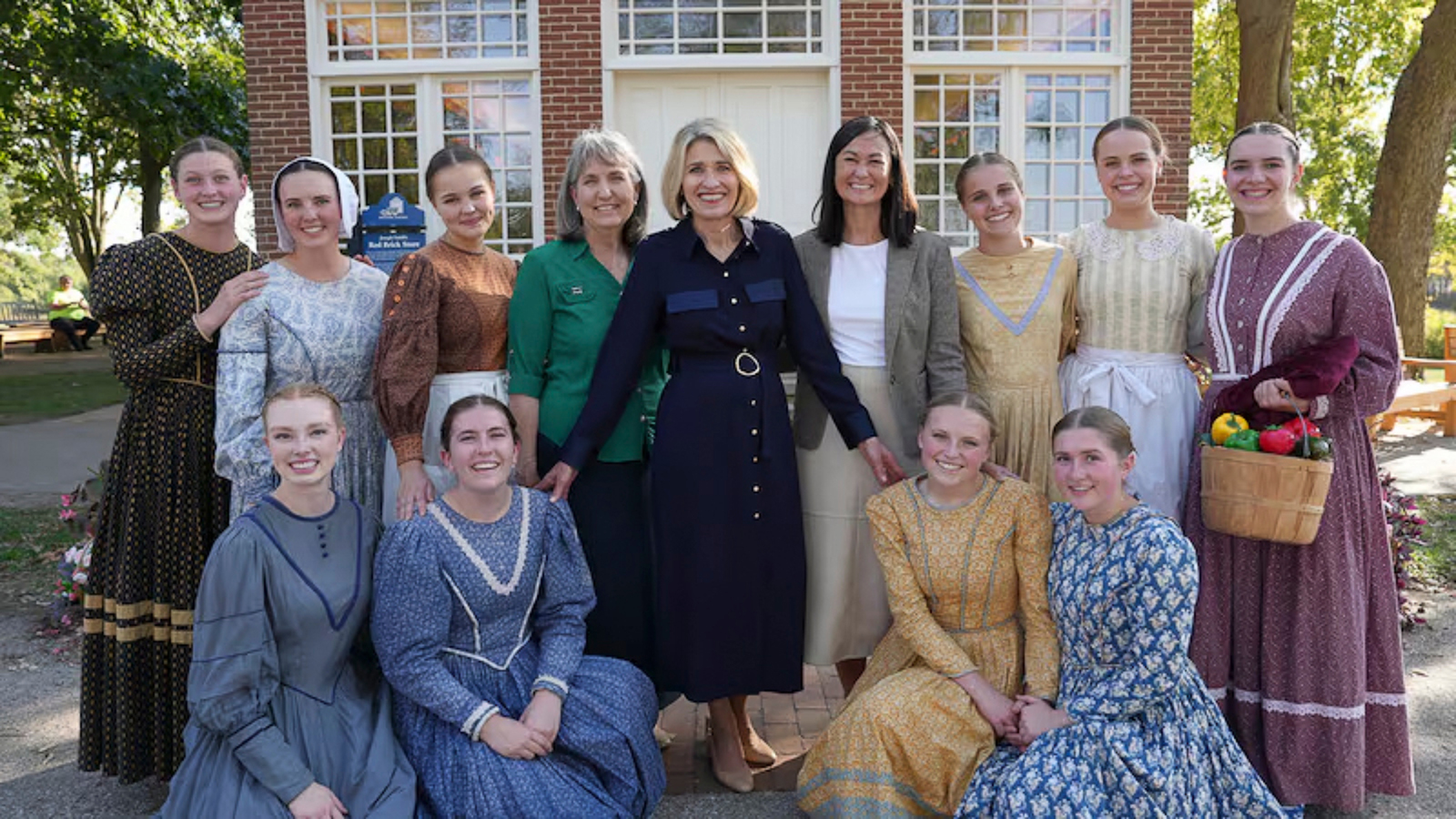
DRESSED IN TRADITIONALANABAPTIST WOMENS CLOTHING

Relief Society General President Camille N. Johnson, center, stands with Sister J. Anette Dennis, first counselor, left, and Sister Kristin M. Yee, second counselor, right, with performing missionaries in Nauvoo, Illinois, during the filming of the Relief Society worldwide devotional, to be broadcast on Sunday, March 16, 2025. (Photo © 2025 by Intellectual Reserve, Inc. All rights reserved.)

Emily W. Jensen
March 24, 2025

(RNS) — As someone who has studied the way women’s voices have been amplified and silenced in The Church of Jesus Christ of Latter-day Saints, especially online, I found it fascinating that three different statements about women and the church shared in the past week all reflected the same theme.

Overall, the church is telling women, “We need you, but stay in your place.”

The first statement came from Elder Dale G. Renlund, who spoke at a women’s conference in Arcadia, California. The second was from the global Relief Society Broadcast, also headlined by Renlund and reflecting views of church leadership. And the third was an official church Gospel Topics essay “Women’s Service and Leadership in the Church.”

What else do these statements tell us about how the church regards women in 2025?

First, we aren’t trusted with our own history.


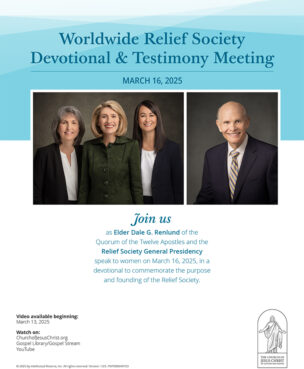
Poster for the recent Worldwide Relief Society Devotional.

In the broadcast, the women of the Relief Society General Presidency — the philanthropic and educational women’s organization within the church — spoke in broad and glowing terms about the organization’s 1842 founding in the Red Brick Store in Nauvoo, Illinois. But they left out how Joseph Smith famously told the first Relief Society sisters, “I turn the key to you.”

This is not the first time that statement has been removed from the church’s official discussions of the founding moments, likely because it might lead some to think Smith was conferring priesthood authority, as priesthood “keys” could imply “authority.”

Similarly, the new Gospel Topics essay tells the story as follows: “In 1842, Joseph Smith organized the Relief Society through divine revelation after the pattern of the priesthood. This gave women authority, sacred responsibilities and official positions within the structure of the church.”

The Relief Society leaders also invoked the care the early sisters offered in helping male church leaders in Nauvoo. While that’s true, another goal of the organization was to discover who among them was participating in polygamy with male leaders. Polygamy caused heartache and rifts in the Relief Society, with some women being excluded from the organization because they were suspected of being plural wives. This conflict would lead to the disbanding of the group under Brigham Young, a hiatus that lasted for two decades. All this conflict is obviously too messy for leaders to discuss.
RELATED: Can the LDS talk honestly about polygamy? A new book could help.

And whenever leaders bring up the Relief Society history, I am reminded of how the society lost its independence in the 20th century. While in the early days it was a side organization to the church, with its own leaders, fundraising and finances, the Relief Society is now run by the church and its male leaders. The new Gospel Topics essay discusses this, but it presents the expansion of male authority in glowing terms:


“The Relief Society once maintained its own programs, raised its own funds and administered its own budget. As the Church grew throughout the world in the 20th century, church leaders received revelation that led in the 1960s and 1970s to greater coordination, standardization and simplification of the church’s programs. This process, known as Correlation, included bringing all church organizations within general and local priesthood lines of authority.”

This narrative totally erases privileges women have lost from not being allowed to oversee their own organization anymore. Even if you argued the Relief Society was within the structure of the church, as the essay does, it is clear the women’s society needed to be “correlated” further under male leaders.

Second, we are expected to redefine historical language to fit the current narrative that diminishes women’s roles.

The Gospel Topics essay fumbles an answer to the question, “I’ve heard that Relief Society presidents were once ordained. Is that true?” The essay claims ordination in this sense — meaning the conferring of priesthood office via prayer and laying on of hands by another who holds a higher priesthood office — meant something different in cases regarding women. It also adds that former President John Taylor later clarified Joseph Smith didn’t mean priesthood ordination.

I laughed at the section in the essay that says women used to prepare the sacrament table “and gave blessings to heal the sick in the name of Jesus Christ but without invoking priesthood authority.” It recounts this history but includes entire paragraphs quoting President Dallin Oaks about how all power in the church is priesthood power.

It’s progress that the essay concedes that women used to have much more of a role in administering the church than women do now. However, it simultaneously insists women don’t have the priesthood and that all of those holy acts are done under the auspices of priesthood power.

Additionally, in Renlund’s Relief Society broadcast address, he said, “You can call on the powers of heaven to receive personal revelation and understand the doctrine of Christ.” This reference to calling on the powers of heaven is used to describe those with priesthood authority. But, leaders argue, it’s not priesthood authority when a woman does it — just priesthood power.

From this, we can infer the church is splitting hairs over definitions to keep women in their place.


That leads to the third and final point, which is that women remain second-class citizens in the church.

All the church’s recent statements offer effusive praise about women, paired with emphatic claims that “we need you.” Renlund said in the Relief Society broadcast that Jesus Christ “needs your influence in His Church. Your efforts to serve God’s children through Relief Society are vital.”

Similarly, Relief Society General President Camille Johnson wrote in the introduction to the new essay: “We hope all women understand that their families, the Church and the world need their inspired wisdom and influence.”

But the broadcast as a whole gives off another message. The women leaders of the Relief Society were the second stringers in their own broadcast, as Renlund gave the headline talk. He is even listed first in the church’s newsroom article about the event, documented as the speaker “joined by” three women.

Meanwhile, the Gospel Topics essay asks, “How can church members help ensure that women’s voices and perspectives are valued and respected?” Even the question itself is directed to men as the members of the church, perpetuating women as second class within the church. And it’s notwithstanding all the deliberate instructions to include women in a patriarchal hierarchy, such as noting the importance of listening to women and making sure they are in your meetings.

RELATED: Mormon leader’s comments about ‘nonconsensual immorality’ draw fire

Unfortunately, until this behavior is modeled in the highest echelons of the church, it’s clear why men aren’t including women at the local level.

The leaders know this is a problem. At the Arcadia meeting, Renlund said, “The reason for the asymmetry between men and women regarding priesthood office ordination has not been revealed.”

Emily W. Jensen. (Photo by Morris A. Thurston)

Part of me wants to shout, “You are the revelators! You are the ones to ask these questions!”

And while he admits church leaders “haven’t done as good a job as I think we can” to address gender imbalances “within the bounds that God has set … so, we’re going to do better,” these three statements together do not give me hope they are going to improve any time soon.

(Emily W. Jensen is the web editor for Dialogue: A Journal of Mormon Thought and co-editor of “A Book of Mormons: Latter-day Saints on a Modern-Day Zion.” The views expressed in this commentary do not necessarily reflect those of Religion News Service.)
'We're more than the worst thing we've done', says spiritual adviser to man executed by firing squad

(RNS) — For United Methodist minister Hillary Taylor, there's a reward in introducing outsiders to someone who is kind and compassionate — 'telling a story that maybe hasn’t been told before.'


Protestors demonstrate outside the scheduled execution of South Carolina inmate Brad Sigmon, Friday, March 7, 2025, in Columbia, S.C. (AP Photo/Chris Carlson)
Elizabeth E. Evans
March 24, 2025


(RNS) — When 67-year-old Brad Sigmon was put to death on March 7 in South Carolina for the murder of his then-girlfriend’s parents, it was the first time in 15 years that an execution in the United States had been carried out by a firing squad.

United Methodist minister Hillary Taylor, Sigmon’s spiritual adviser since 2020, said the multifaceted, months long effort to save Sigmon’s life, and to provide emotional and spiritual support for his legal team, and the aftermath of his execution has been a “whirlwind” said Taylor, the director of South Carolinians for Alternatives to the Death Penalty.

Her organization has advocated for three other death row inmates in the state over the past six months as South Carolina ramps up executions after a 13-year hiatus; the delay was caused in part by legal challenges to the lethal injection method. In 2021, a state bill gave those on death row the simplified options of electrocution or death by firing squad, which has had the effect of expediting executions.

After Sigmon chose the firing squad, suddenly, said Taylor, “I got catapulted into the movement to save his life.” She was introduced to anti-death penalty organizers around the country, and in time what had been a volunteer position with the anti-capital punishment group became a paid position.

Taylor was introduced to the work 10 years ago when she joined an (unsuccessful) campaign to save the life of Kelly Gissendaner, a Georgia prisoner convicted of persuading her lover to kill her husband in 1997. Gissendaner, who had taken theology courses offered by Emory University while on death row, sang “Amazing Grace” on the way to her execution.

Taylor, then a first-year student at Emory University’s Candler School of Theology, learned about Gissendaner while working with women in solitary confinement at Lee Arrendale State Prison, where Gissendaner had spent time before being transferred. Taylor learned that Gissendaner “had sobered up, become a Christian and reconciled to her children.” When other inmates had suicidal episodes, Taylor had heard, they would be placed in a cell next to Gissendaner, who would “literally preach and counsel them back to life.”

The Rev. Hillary Taylor of South Carolinians for Alternatives to the Death Penalty prepares to present a petition to stop the firing squad execution of Brad Sigmon to the South Carolina governor’s office on Thursday, March 6, 2025, in Columbia, S.C. (AP Photo/Jeffrey Collins)

The more Taylor reflected on Gissendaner’s faith, the “more it reminded me of people in my own life who could have ended up on a similar path if they didn’t have access to power and privilege.” Over time, she became convinced that “we’re more than the worst thing we have done, or the worst thing that ever happened to us, and that the worst thing is not the last thing.”

Despite Gissendaner’s execution, Taylor is proud of the faith leaders and others who organized to save her life. “It’s possible not to just say sorry, but to ‘do sorry,’” she said.

When Taylor arrived in South Carolina in 2020 to pastor two UMC congregations, she called a local justice reform organization and asked them if they needed a spiritual adviser or a pen pal for an inmate on death row. A few months later, she was connected to Sigmon, who had taken a Bible College course at Broad River Correctional Institution, where he died.

He “had kind of exhausted the spiritual resources available to him,” she said. “That began our pen pal connection,” recalled Taylor.

Like Gissendaner, she said, Sigmon, who became an “informal chaplain” to other prison inmates, tried to become a different person. After his prison conversion, she said, “he loved to share with people the ways the love of Jesus changed him. His objective was to save the other prisoners, who were like his brothers,” she said. One of his last requests was to share a last meal with his friends. (It was denied.)

In the years before his execution, Sigmon and Taylor only met four times in person but exchanged a multitude of letters. As they got to know one another, said Taylor, she was able to confide in him about the challenges of pastoring two small rural churches during COVID-19, “which was, at the time, a lonely and isolating experience. He was the person who could hold a lot of my fear and my anger. That was a gift I will treasure.”

They teased each other about their affection for rival football teams, Clemson versus South Carolina. “He was always making me laugh,” she said.

She learned from Sigmon, she said, about mercy, compassion and forgiveness, particularly the realization that “even when you are mad, you can come back to a place of kindness, compassion and humanity.”

As the end neared, he was at peace, Taylor said, able to seek reconciliation with some of the people he had harmed.

In her last in-person encounter with Sigmon, on Ash Wednesday (March 5), they both took Communion, and she was able to anoint his head with ashes, the symbol of repentance and mortality many Christians receive on the first day of Lent.

“When I delivered ashes to him, I got to hug him for only the second time.” As she pressed her forehead, already imprinted with ashes, against his, she told him how grateful she was that he knew the power of love in Jesus.

Being a spiritual companion to a condemned person can be traumatic, particularly when the prisoner loses their final appeal. Shane Claiborne, an evangelical Christian anti-death penalty activist, wrote in an email interview, “It is a terrible thing to accompany someone as they are executed,” but added that the only thing worse is being executed without accompaniment. “That’s why we do this holy work, and it is also why we are working so hard for alternatives to the death penalty. The closer you are to the system that executes, the more convinced you become that violence is the problem, not the solution.”

Sister Pamela Smith, a member of the congregation of Saints Cyril and Methodius, has participated in anti-death penalty vigils on the state capitol steps since South Carolina resumed executions.

Smith, who directs the office of ecumenical and inter-religious affairs for the Catholic Diocese of Charleston, is also a board member of South Carolina Alternatives. “I see this as another way of taking public action to try to raise consciousness to help people understand what actually goes on with the death penalty. Because I live in a state where executions are unfortunately becoming commonplace, you know, I have a passion as part of my overall pro-life commitment to try to do something about it.”

Though not directly involved in prison ministry, the nun was on hand when South Carolina’s first execution in more than a decade took place. “You know the clock is approaching the hour, even though you don’t hear something happening. There’s just something chilling about the fact that you’ve got a scheduled time of death for this person for whom you’ve been praying and sending letters and presenting petitions.”

Taylor said the most painful part of her work “is just how ready people are to say things like ‘a firing squad is too merciful for him’ — as though those folks were not victims of somebody else’s violence first, and didn’t have anybody to intervene on their behalf. There are ways we can hold people accountable. That’s part of what rehumanizing is.”


The Rev. Hillary Taylor, executive director of South Carolinians for Alternatives to the Death Penalty, speaks at a news conference before delivering petitions to stop the execution of Freddie Owens at the South Carolina Statehouse in Columbia, S.C., Sept. 19, 2024. (AP Photo/Jeffrey Collins)

There is also, said Taylor, a reward in introducing outsiders to someone who is kind and compassionate — “telling a story that maybe hasn’t been told before.”

Former death row prisoners talk about the powerful effects of spiritual witnesses. Sentenced to death as a 20-year-old for killing a man and wounding another during an armed robbery, the Rev. Jimmy MacPhee was re-sentenced to life with the possibility of parole during a brief national death penalty hiatus in the 1970s. After 45 years in prison, he is now free, ordained and married.

He spends a lot of time on the road sharing his story — and that of Frankie San, the man MacPhee credits with transforming a furious, violent young man into a writer, speaker and mentor and finally a minister. A Japanese immigrant, now in his 90s, San began visiting McPhee when he first arrived in prison.

MacPhee said his personal experience of redemption inspires him to help others to transition back to life outside the cell block: “We all were washed by the blood. There’s none of us beyond the reach of God’s power I know blessed to be one of them. I know the transformative power is Grace, how powerful it can be, and I’ve witnessed it in so many others.”

As it became more likely that the execution would move forward, recalled Taylor, Sigmon told her that if she saw a bird, she would know he was nearby. “That’s too many birds, Brad,” she said. “How about a finch,” he suggested. This week, said Taylor, she is going to go out and buy a bird book.
These US churches offer shelter and sanctuary to vulnerable migrants. Here's why

(NPR) — Under the Trump administration, churches are now thinking more expansively about the concept of sanctuary to include migrants who fear that new policies could suddenly make them vulnerable to arrest or deportation.


Bishop Joseph Tyson, left, and the Rev. Jesús Mariscal, right, of the Yakima Diocese worry about how their parishioners will cope with broad changes to immigration policy, which have had a chilling effect on many religious communities. (Anna King/Northwest News Network)


Patrick Davis, Anna King, and Sarah Ventre
March 25, 2025

(NPR) — The Rev. Jim Rigby has one question on his mind these days: What’s the plan if immigration officers knock on his church’s doors?

“That’s what I’m feverishly trying to figure out — I’m trying to talk to lawyers,” said Rigby, a pastor of St. Andrew’s Presbyterian Church in Austin, Texas.

Since 2016, St. Andrew’s has sheltered Hilda Ramirez and her son Iván, who say they fled Guatemala to escape domestic violence. They reached the U.S. in 2014, when Hilda applied for asylum, but was denied.

Ramirez has talked to NPR in the past, but doesn’t feel safe giving interviews since President Donald Trump, who campaigned on promises of mass deportation, took office in January.

Until recently, churches were considered “sensitive locations” and immigration officers were restricted from taking action there. But on his first full day in office, President Trump rescinded these restrictions, making churches and other houses of worship susceptible to immigration enforcement.

Faith groups have sued the federal government over the change in two separate lawsuits, saying that it infringes on their religious freedom.

In February, a federal judge in Maryland temporarily blocked the Trump administration from sending immigration agents into the Quaker, Baptist and Sikh congregations that sued. But the ruling only applies to their congregations.

Other faith leaders, like Rigby, say the uncertainty has had a chilling effect on their ministries.

“To me, the bottom line is more gospel than it is legal,” said Rigby. “If there is religious liberty, we should have religious liberty to obey scripture and its commandment to treat the immigrant as well as we treat citizens.”

Others at St. Andrew’s are discussing plans about how to deal with a potential immigration raid — and what it means for Ramirez and her son.

“We know that Hilda and Ivan have a target on their back because they have been very outspoken about their situation. We’ve done everything we can to make sure that even though they have that target, they’re safe here,” said the Rev. Babs Miller, a pastor at St. Andrew’s.


The Rev. Babs Miller speaks about how the congregation at St. Andrew’s Presbyterian Church is working to assist Hilda and Iván Ramirez. (Patrick Davis/For NPR)
Expanding the concept of sanctuary

“Jesus himself — before he was born, his parents sought sanctuary,” said Linda Rabben, a professor of anthropology at the University of Maryland who writes about the Sanctuary Movement.

During the 1980s when the Sanctuary Movement started, it was reported that there were more than 400 congregations involved, according to Rabben.

The term “sanctuary” has often meant that the person or family being housed is under immediate threat of deportation.

“So if they (houses of worship) give shelter to somebody, they are not protected by the law to do that,” said Rabben.

Under the Trump administration, churches are now thinking more expansively about the concept of sanctuary to include migrants who fear that new policies could suddenly make them vulnerable to arrest or deportation.

The Rev. Ashley McFaul-Erwin said her Lake View Presbyterian Church in Chicago has stepped up their efforts to aid migrants since Trump’s election.

“We have held multiple trainings for church members — because on Sunday mornings we are a public building and our doors are open. We just feel like it’s best to be prepared.”

These trainings include information about what to do if immigration agents enter the church, and which areas of the church are considered public and private.

Lake View Presbyterian has housed two different families since October 2023, after converting a Sunday school classroom into a studio apartment.

When asked about the family currently living there, McFaul-Erwin said she wanted to keep their details private, because she is reluctant to risk their safety.

When the church is open for worship is when they’re most vulnerable, the pastor said.

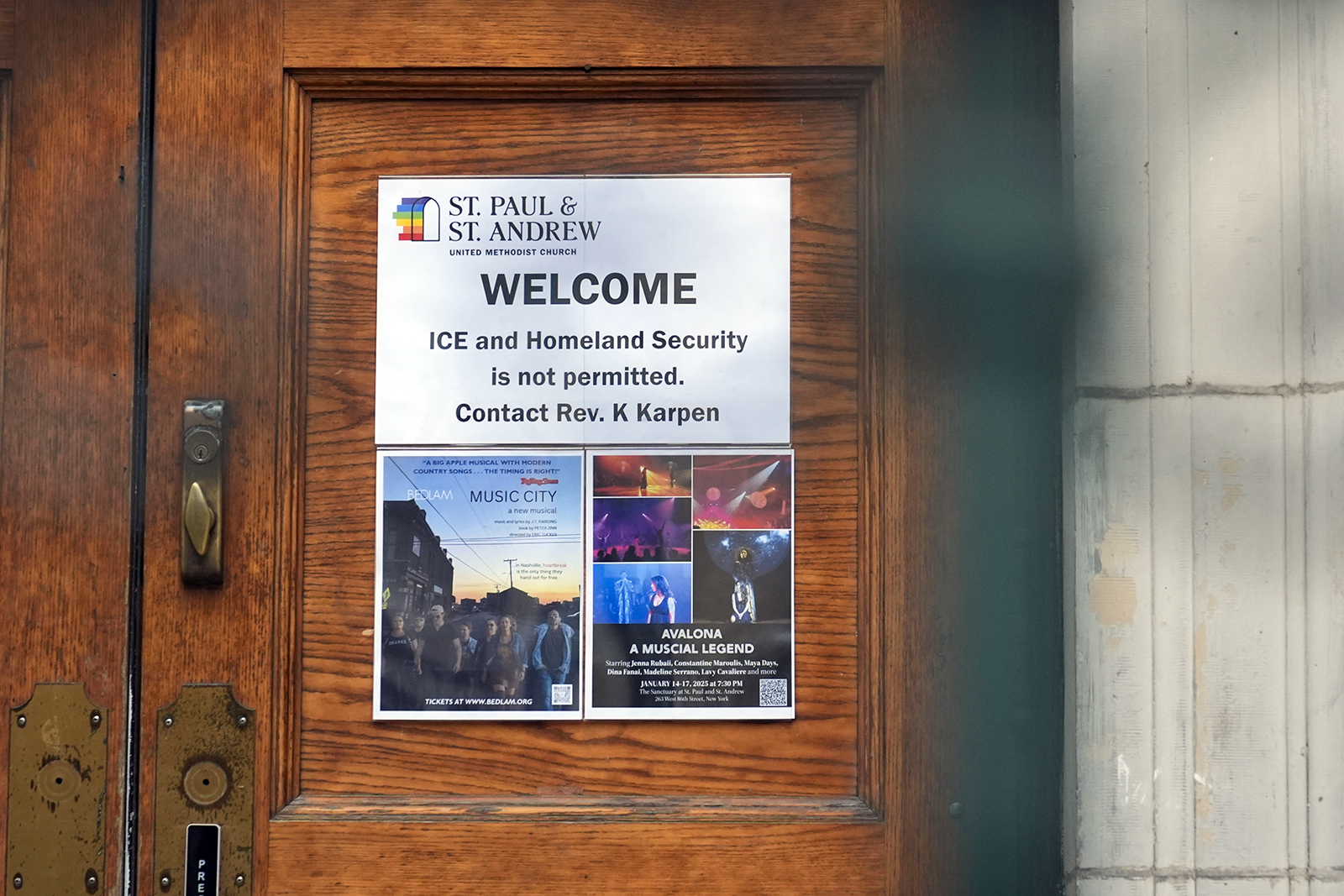
“We now have signs up saying that ICE are not able to enter this space without a signed judicial warrant,” she said.

Asked about the lifting of restrictions on immigration officers entering houses of worship, Department of Homeland Security spokesperson Tricia McLaughlin said that: “Our officers use discretion. Officers would need secondary supervisor approval before any action can be taken in locations such as a church or a school. We expect these to be extremely rare.”


Lake View Presbyterian Church in Chicago has this sign posted outside of their door as part of their effort to protect community members. The church is also doing “know your rights” trainings on Sundays. (Sarah Ventre/NPR)


Sending mixed messages to migrants

In central Washington state, Catholic Bishop Joseph Tyson of Yakima said that he’s worried about how these policies will affect his congregants and their ability to worship. According to him, more than 30% of his parishioners are likely in the U.S. without legal status.

“I’m heartened that we haven’t had a noticeable drop in numbers at our Sunday masses in Spanish,” said Tyson. “Folks are coming.”

Tyson said people should be able to flee violence and poverty, and the United States has sent mixed messages to potential migrants.

“We’re saying, ‘Yeah we need your work. But no, don’t come. But, yes come. But don’t come.’ The goal posts have moved around — a lot,” the bishop said.

The Yakima Diocese isn’t publicly offering sanctuary in their churches, but Catholics from within the diocese are offering legal recommendations, and places to hide for vulnerable migrants.

The Rev. Jesús Mariscal parochial vicar of St. Paul Cathedral in the Yakima diocese, and said that after one service, several of his Anglo parishioners messaged him privately offering to help migrants. One texted, “If ever you know or hear of someone who needs a place to literally hide from ICE, send them to my house. The key is under the front mat.”

Before he became a citizen, Mariscal said, he crossed the border without documentation, at age 12. He said he’s touched to know that there are people in his community who are willing to take risks to offer sanctuary for others.

“I feel like my chest is filled with something, and my mind, and I feel like my brain also, and the blood rushes to my head,” said Mariscal. “And I get goosebumps, and I get watery eyes. That’s the feeling I get when I get the offers from these people.”

This story originally appeared on NPR.org and as an audio feature on All Things Considered and is republished as part of a collaboration between NPR and RNS.


Opinion

In the battle to keep ICE from raiding houses of worship, the grassroots needs to flex more muscle

(RNS) — Fighting for a more equitable America has always been part of faith-based organizations' role, including nonviolent direct action.


A sign that prohibits the entrance of ICE or Homeland Security is posted on a door at St. Paul and St. Andrew United Methodist Church in New York, Tuesday, Jan. 21, 2025.
 (AP Photo/Seth Wenig)


Andre Henry
March 21, 2025

(RNS) — In two separate lawsuits, religious organizations are pushing back against the Trump administration’s attempt to open the way for immigration raids at “sensitive locations,” such as houses of worship. On Capitol Hill, Democratic lawmakers are joining with several religious groups to pass the Protecting Sensitive Locations Act, which would restrict immigration enforcement actions at various “public religious ceremonies.”

But the fact is, faith-based organizations are already among the most equipped institutions to resist Trumpian fascism. To resist I.C.E. raids, they only need to adapt a form of direct action known as civilian-based defense, which uses non-violent means to protect vulnerable groups.

Before explaining civilian-based self-defense, it’s worth noting not only how, but also why houses of worship are the right institutions to assume this responsibility.

The first reason is simply because ICE is knocking at their doors. While no raids have entered a house of worship to detain migrants at prayer, at least two people have been held outside their churches. A Guatemalan man with a standing deportation order was arrested in the parking lot of the family’s Everson, Washington, church in early March, and in late January a registered asylum seeker from Honduras was summoned and taken away by ICE outside Fuente de Vida Church in Atlanta after his ankle bracelet buzzed.

Second, the Trump administration has shown a disregard for the law, meaning such incidents may continue, despite any legislative or legal wins religious organizations may achieve. No cavalry is coming to protect their sacred spaces; they’ll have to do it themselves.

Since Trump’s administration relies heavily on claims of divine mandate, public confrontations with religious organizations could deepen its crisis of legitimacy, which ultimately would weaken its ability to terrorize immigrants and disrespect houses of worship.


A sign regarding the U.S. Immigration and Customs Enforcement is posted on the window of a corner store on the day of President Trump’s Inauguration, Monday, Jan. 20, 2025, in the predominantly Latino Little Village neighborhood of Chicago.
 (AP Photo/Erin Hooley)

Lastly, and most importantly, they should do it because they have the resources to do so. They have buildings where people can plan and train for direct action; spiritual frameworks to activate and sustain their people in nonviolent struggle; and established collective fundraising to support nonviolent campaigns and communication networks. They have trusted leaders who can recruit and motivate movement participants, who are generally sympathetic characters in the local community.

Such resources can be mobilized for civilian-based self-defense.

Civilian-based defense is a form of nonmilitary national defense used to resist an invasion or government overthrow. It’s essentially a nation’s complete refusal to comply with the program of its invaders. The late nonviolence scholar Gene Sharp even theorized that nonviolent civilian-based defense could be organized to replace the military to provide national security, a theory based on historical examples.

During World War II, Norwegians blocked their Nazi occupiers from fully overtaking the educational system through this method: refusing to join the fascist teachers’ union, teaching classes in their homes when the Nazis shut down the schools, writing tens of thousands of letters in protest of the Nazi regime when teachers were jailed and sending teachers the equivalent of their salaries while imprisoned. Their neighbors, the Danes, established 10 commandments of non-cooperation, including refusing to work for the Germans, work slowdowns, strikes, sabotage, boycotting Nazi businesses and even providing slow transport to their occupiers.

During the 1968 Prague Spring, Czechoslovakians pulled down, swapped and altered street signs to confuse their Soviet invaders, staying the threat of takeover for several months.

These spontaneous reactions were in response to foreign invasion, but their successes — however limited — convinced Gene Sharp that civilian-based resistance could be made more effective with planning, training and organization.

Religious organizations might think together about how Trump’s campaign against immigrants depends on their compliance and determine in advance specific ways they can refuse to cooperate. Some houses of worship have taken to posting signs declaring that they are private property and locking their doors once a service has begun. There is nothing illegal in video recording or livestreaming raids to preserve accountability.

Churches may refuse to provide records on possible undocumented members. Local houses of worship may want to organize a teach-in on I.C.E. tactics and strategies and the community’s resources and how the community’s resources can be used to protect immigrants, including distributing information on their rights.

To be sure, lawsuits and legislation have long been vital in the struggle against American racism. But legal battles for a more equitable America have always been part of a larger movement that included nonviolent direct action. The same is true today.

Religious communities have always been on the frontlines of confronting systemic injustice, from Gandhi’s Jainism-inspired freedom movement to the Quakers’ opposition to slavery to the Black Church’s Civil Rights activism. This moment demands they hold the line again.


USCIRF report highlights little progress in religious liberty struggles globally
(RNS) — The religious freedom watchdog urged the new Trump administration to appoint a new ambassador-at-large to address religious restrictions and persecution around the world.

The U.S. Commission on International Religious Freedom 2025 Annual Report cover. (Courtesy image)
Adelle M. Banks
March 25, 2025

(RNS) — The U.S. Commission on International Religious Freedom has issued its annual list of countries it considers to be the most egregious violators of religious liberty and urged the new Trump administration to appoint a new ambassador-at-large for international religious freedom.

The commission’s 2025 report, released on Tuesday (March 25), included a list of countries nearly identical to its 2024 list — a reflection, according to the report, that in most of those countries, things have not improved but often have worsened.

“The administration of President Donald J. Trump faces a complex international environment in which to build on its previous success of centering religious freedom as a cornerstone of foreign policy and global leadership,” reads the report. “Confirming this commitment to advancing freedom of religion or belief will require calibration and joint action with like-minded governments.”

The eight current commissioners of the bipartisan, independent agency asked Congress to halt the visits it receives from representatives of countries designated as the most egregious religious freedom violators.

“Lobbyists paid to represent the interests of governments that kill, torture, imprison, or otherwise persecute their populations because of what religion they practice or what beliefs they hold should not be welcome in the halls of Capitol Hill,” they stated.

The 2025 report also sought a successor to Rashad Hussain, whose ambassador-at-large post ended with the Biden administration. Hussain was recently announced as a distinguished senior fellow at the Institute for Global Engagement, a think tank that seeks to foster partnerships to build religious freedom.


2025 USCIRF Recommendations. (Courtesy image)

“I think what’s critical here is an ambassador who has access, not only to Secretary (of State Marco) Rubio, but has access to the White House directly,” USCIRF Chair Stephen Schneck told RNS in an interview, though he noted that USCIRF does not play a role in the selection process for the ambassador. “It needs to be somebody, I think, of that level, given the surge of, the big uptick in violations of freedom of religion or belief around the world that we’re seeing right now.”

The bipartisan, independent commission, which was reauthorized last year by Congress through September 2026, annually recommends to the State Department a list of countries to designate as “of particular concern” for committing “systematic, egregious, and ongoing” religious freedom violations.

The 2025 report seeks the redesignation of these 12 countries: Burma, China, Cuba, Eritrea, Iran, Nicaragua, North Korea, Pakistan, Russia, Saudi Arabia, Tajikistan and Turkmenistan.

It also seeks designation of four others: Afghanistan, India, Nigeria and Vietnam.

USCIRF sought the same redesignations and designations last year, with a request to add Azerbaijan.

This year, it requested that Azerbaijan remain on the State Department’s second-tier special watch list, along with Algeria.

USCIRF also sought these countries to be added to the special watch list: Egypt, Indonesia, Iraq, Kazakhstan, Kyrgyzstan, Malaysia, Sri Lanka, Syria, Turkey and Uzbekistan.

Schneck, who was appointed by President Joe Biden, said the repetition in its requests about countries of particular concern, or CPCs, reflects the troubled state of religious liberty across the globe.

“It’s become much worse in several places, including Iran, Nicaragua and, frankly, Russia,” he said, adding that key drivers are often authoritarian governments like those, and religious nationalism in countries such as Myanmar (which the report called Burma), India and Turkey. “We’re not seeing progress. In fact, in most of the countries on this list, we’re seeing regress.”

For the second year in a row, the commission also requested that the presidential administration appoint an envoy for Nigeria and the Lake Chad region, as northern portions of Nigeria have seen violence against Christians as well as Muslims.

Schneck said he was disappointed that the State Department did not, as expected, announce its latest designations for its lists of religious liberty violators before the conclusion of the Biden administration, nor since the start of the Trump administration.


USCIRF Chair Stephen Schneck. 
(Photo courtesy USCIRF)

The report noted the Biden administration’s funding of hundreds of millions of dollars of humanitarian aid through the U.S. Agency for International Development for religious groups facing genocide and persecution, such as Muslim Rohingya refugees located in and around Bangladesh and for the people of Syria. But Schneck said those programs are part of the pausing of USAID funds that has occurred since Trump took office.

“As I understand, all of the freezes are still in place that affect those USAID programs,” Schneck said. “We’re very hopeful that the new administration will act quickly to resolve some of these situations, so that some really needed programs to protect religious freedom on the ground in different parts of the world can be funded appropriately,” he said.

Likewise, Schneck said the commission is worried about the plight of refugees whose temporary status in the U.S. is in jeopardy due to recent administration decisions.

“We are concerned about anything that makes it more difficult for refugees to flee from religious persecution to find safe haven,” he said.

In its new report, USCIRF requested its own permanent reauthorization as well as that of the bipartisan Lautenberg Amendment that provides a legal process to resettle religious minorities from Iran and countries in the former Soviet Union.

The commission’s report also includes examples of people who have held to their religious beliefs even amid antisemitism, Islamophobia and other forms of religious hostility.

“One of the most heartening things that we see around the world is the resilience of people to stand up for their faith or their lack of faith, for that matter, their principles,” Schneck said, pointing to young people in Iran and congregants in churches in authoritarian countries. “But the larger picture doesn’t change. We are concerned about what looks like a decaying picture for freedom of religion.”

RELATED: Azerbaijan named among religious freedom violators by religious liberty watchdog
The Last Chapter of the Genocide

What we are witnessing dwarfs all the historical assaults on Palestinians. Israel’s demented genocidal dream — a Palestinian nightmare — is about to be achieved. It will forever shatter the myth that we, or any Western nation, respect the rule of law or are the protectors of human rights, democracy and the so-called “virtues” of Western civilization. Israel’s barbarity is our own. We may not understand this, but the rest of the globe does.

March 26, 2025
Source: ScheerPost


Lord of the Flies – by Mr. Fish


This is the last chapter of the genocide. It is the final, blood-soaked push to drive the Palestinians from Gaza. No food. No medicine. No shelter. No clean water. No electricity. Israel is swiftly turning Gaza into a Dantesque cauldron of human misery where Palestinians are being killed in their hundreds and soon, again, in their thousands and tens of thousands, or they will be forced out never to return.

The final chapter marks the end of Israeli lies. The lie of the two-state solution. The lie that Israel respects the laws of war that protect civilians. The lie that Israel bombs hospitals and schools only because they are used as staging areas by Hamas. The lie that Hamas uses civilians as human shields, while Israel routinely forces captive Palestinians to enter potentially bobby trapped tunnels and buildings ahead of Israeli troops. The lie that Hamas or Palestine Islamic Jihad (PIJ) are responsible — the charge often being errant Palestinian rockets — for the destruction of hospitals, United Nations’ buildings or mass Palestinian casualties. The lie that humanitarian aid to Gaza is blocked because Hamas is hijacking the trucks or smuggling in weapons and war material. The lie that Israeli babies are beheaded or Palestinians carried out mass rape of Israeli women. The lie that 75 percent of the tens of thousands killed in Gaza were Hamas “terrorists.” The lie that Hamas, because it was allegedly rearming and recruiting new fighters, is responsible for the breakdown of the ceasefire agreement.

Israel’s naked genocidal visage is exposed. It has ordered the evacuation of northern Gaza where desperate Palestinians are camped out amid the rubble of their homes. What comes now is mass starvation — the United Nations Relief and Works Agency for Palestine Refugees in the Near East (UNRWA) said on March 21 it has six days of flour supplies left — deaths from diseases caused by contaminated water and food, scores of killed and wounded each day under the relentless assault of bombs, missiles, shells and bullets. Nothing will function, bakeries, water treatment and sewage plants, hospitals — Israel blew up the damaged Turkish-Palestinian hospital on March 21 — schools, aid distribution centers or clinics. Less than half of the 53 emergency vehicles operated by the Palestine Red Crescent Society are functional due to fuel shortages. Soon there will be none.

Israel’s message is unequivocal: Gaza will be uninhabitable. Leave or die.

Since Tuesday, when Israel broke the ceasefire with heavy bombing, over 700 Palestinians have been killed, including 200 children. In one 24 hour period 400 Palestinians were killed. This is only the start. No Western power, including the United States, which provides the weapons for the genocide, intends to stop it. The images from Gaza during the nearly sixteen months of incessant attacks were awful. But what is coming now will be worse. It will rival the most atrocious war crimes of the twentieth century, including the mass starvation, wholesale slaughter and leveling of the Warsaw Ghetto in 1943 by the Nazis.

Oct. 7 marked the dividing line between an Israeli policy that advocated the brutalization and subjugation of the Palestinians and a policy that calls for their extermination and removal from historic Palestine. What we are witnessing is the historical equivalent of the moment triggered by the annihilation of some 200 soldiers led by George Armstrong Custer in June 1876 at the Battle of the Little Bighorn. After that humiliating defeat, Native Americans were slated to be killed with the remnants forced into prisoner of war camps, later named reservations, where thousands died of disease, lived under the merciless gaze of their armed occupiers and fell into a life of immiseration and despair. Expect the same for the Palestinians in Gaza, dumped, I suspect, in one of the world’s hellholes and forgotten.

“Gaza residents, this is your final warning,” Israeli Minister of Defense Israel Katz threatened:


The first Sinwar destroyed Gaza and the second Sinwar will completely destroy it. The Air Force strikes against Hamas terrorists were just the first step. It will become much more difficult and you will pay the full price. The evacuation of the population from the combat zones will soon begin again…Return the hostages and remove Hamas and other options will open for you, including leaving for other places in the world for those who want to. The alternative is absolute destruction.

The ceasefire deal between Israel and Hamas was designed to be implemented in three phases. The first phase, lasting 42 days, would see an end to hostilities. Hamas would release 33 Israeli hostages who were captured on Oct. 7, 2023 — including women, those aged above 50, and those with illnesses — in exchange for upwards of 2,000 Palestinian men, women and children imprisoned by Israel (around 1,900 Palestinian captives have been released by Israel as of March 18). Hamas has released a total of 147 hostages, of whom eight were dead. Israel says there are 59 Israelis still being held by Hamas, 35 of whom Israel believes are deceased.

The Israeli army would pull back from populated areas of Gaza on the first day of the ceasefire. On the seventh day, displaced Palestinians would be permitted to return to northern Gaza. Israel would allow 600 aid trucks with food and medical supplies to enter Gaza daily.

The second phase, which was expected to be negotiated on the sixteenth day of the ceasefire, would see the release of the remaining Israeli hostages. Israel would complete its withdrawal from Gaza maintaining a presence in some parts of the Philadelphi corridor, which stretches along the eight-mile border between Gaza and Egypt. It would surrender its control of the Rafah border crossing into Egypt.

The third phase would see negotiations for a permanent end of the war and the reconstruction of Gaza.

Israel habitually signs agreements, including the Camp David Accords and the Oslo Peace Agreement, with timetables and phases. It gets what it wants — in this case the release of the hostages — in the first phase and then violates subsequent phases. This pattern has never been broken.

Israel refused to honor the second phase of the deal. It blocked humanitarian aid into Gaza two weeks ago, violating the agreement. It also killed at least 137 Palestinians during the first phase of the ceasefire, including nine people, — three of them journalists — when Israeli drones attacked a relief team on March 15 in Beit Lahiya in northern Gaza

Israel’s heavy bombing and shelling of Gaza resumed March 18 while most Palestinians were asleep or preparing their suhoor, the meal eaten before dawn during the holy month of Ramadan. Israel will not stop its attacks now, even if the remaining hostages are freed — Israel’s supposed reason for the resumption of the bombing and siege of Gaza.

The Trump White House is cheering on the slaughter. They attack critics of the genocide as “antisemites” who should be silenced, criminalized or deported while funneling billions of dollars in weapons to Israel.

Israel’s genocidal assault on Gaza is the inevitable denouement of its settler colonial project and apartheid state. The seizure of all of historic Palestine — with the West Bank soon, I expect, to be annexed by Israel — and displacement of all Palestinians has always been the Zionist goal.

Israel’s worst excesses occurred during the wars of 1948 and 1967 when huge parts of historic Palestine were seized, thousands of Palestinians killed and hundreds of thousands were ethnically cleansed. Between these wars, the slow-motion theft of land, murderous assaults and steady ethnic cleansing in the West Bank, including East Jerusalem, continued.

That calibrated dance is over. This is the end. What we are witnessing dwarfs all the historical assaults on Palestinians. Israel’s demented genocidal dream — a Palestinian nightmare — is about to be achieved. It will forever shatter the myth that we, or any Western nation, respect the rule of law or are the protectors of human rights, democracy and the so-called “virtues” of Western civilization. Israel’s barbarity is our own. We may not understand this, but the rest of the globe does.


Chris Hedges
Chris Hedges worked for nearly two decades as a foreign correspondent for The New York Times, National Public Radio and other news organizations in Latin America, the Middle East and the Balkans. He was part of the team of reporters at The New York Times who won a Pulitzer Prize for their coverage of global terrorism. Hedges is a fellow at the Nation Institute and the author of numerous books, including War is a Force That Gives Us Meaning.
The United Nations Is Not a Poker Chip

Today, unfortunately, the US posture seems to reduce the UN and its various agencies and departments to poker chips or lots at auction.
March 26, 2025
Source: Originally published by Z. Feel free to share widely.


Sixteen years after the fateful day the United Nations (UN) charter was promulgated in San Francisco, President John F. Kennedy memorably intoned on a return to that city that the UN “remains mankind’s best hope to conquer war, poverty, and disease.” Across subsequent decades this aspiration has been shared by US presidents from Ronald Reagan, who believed that the UN could help “bring about a new day,” to George H.W. Bush, who recognized the UN system as “poised to historic vision of its founders—a world in which nations recognize the shared responsibility for freedom and justice.”

Today, unfortunately, the US posture seems to reduce the UN and its various agencies and departments to poker chips or lots at auction.

The late President Jimmy Carter emphasized that “[t]he United Nations is the best available institution to support the values and aspirations that the United States shares with other peace-loving nations.” Of course, “best available” does not mean unflawed. The UN is a human-made institution and therefore, fallible. It is incumbent on all those who support effective global governance, human rights, and the rule of law to underscore areas for improvement, while adapting to new polycrises and fresh challenges.

None of this is easy. But, as the leader of an organization that has supported the UN project almost since its inception, I am proud that our members have championed reform efforts while hewing to the vision that guided the UN’s founding.

What is easier is to reduce the UN to a stock to be traded, a poker chip to be gambled, or a lot to be auctioned to the highest bidder. The current US administration uses its time in the General Assembly Hall to disavow goals related to sustainable development, withdraw from human rights commitments, and oppose such basic principles as “peaceful cooperation” and “judicial well-being.” Alarmingly, pundits have jumped on the bandwagon to reduce the project of humankind to a bad real estate deal.

This year, the UN will commemorate its 80th anniversary – slightly ahead of the average US life expectancy projected for 2025 of 79.4 years. Anyone who has visited the Geneva premises lately, where an ongoing liquidity crisis has occasioned desperate measures, like heating cuts, has reason to fear for this octogenarian’s health.

Perhaps the venal attitude is best typified by an opportunistic “independent, non-affiliated initiative,” DOGE-UN, which claims to be a “non-profit organization incorporated in New York State.” According to its website, “It analyzes each institution and the broader geopolitical marketplace on whether to ‘hold, buy or sell’ their stakes in international organizations.” The outfit is indeed incorporated in New York as a business. It is not listed on the New York State Attorney General’s Office public registry of charitable and non-profit organizations. Research indicates it is not affiliated with the federal Department of Government Efficiency (DOGE).

Whatever the tax status of this start-up, the approach it advances of “hold, buy, or sell” fails to recognize that global cooperation is not a zero-sum game. Viruses do not carry passports. Climate disasters do not wait behind velvet ropes. Nuclear reactors are not impressed by border demarcations.

Finally, if altruism fails to inspire global cooperation, perhaps self-interest can. “America first” style critics of the UN frequently fail to note that the United States is the largest recipient of UN contracts – far outstripping our dues. In the words of Peter Yeo, President of the Better World Campaign, “U.S. companies do well and do good by taking part in the UN’s lifesaving work.”

On the UN’s Oak anniversary, we must not take its strength and endurance for granted. Please consider making your voice heard by contacting your legislators and urging support for the UN and its agencies.

As you do, you may remind them that what transpired in San Francisco 80 years ago was not a poker game but a promise to humankind and our planet.


ZNetwork is funded solely through the generosity of its readers. Donate


Rebecca A. Shoot is the Executive Director of Citizens for Global Solutions (CGS), a nonprofit nonpartisan non-governmental organization that supports a peaceful, just, and sustainable world community democratically governed through a united federation of nations. She is also the Convener of the Washington Working Group for the International Criminal Court (WICC).
Protecting the Freedom to Read
March 26, 2025
Source: Originally published by Z. Feel free to share widely.


Image credit: Lansing Library/Flickr | Banned Books: A display of challenged or banned books in the Youth Services department. The reason for the challenge is attached to the fronts of the books.

Many Americans fear that the institutions protecting our democracy are under threat. Democracy originated in the city-states of ancient Greece, where citizens met in open forums to voice their opinions and share ideas. Ever since, the free flow of ideas has been essential to the preservation of democracy, thus it’s now more important than ever to protect our access to all sources of ideas, including books.

Books offer more than entertainment and diversion, they’re portals to new ideas, new worlds, new experiences, new ways of approaching life, new understanding of other people’s realities, and oh so much more. Considering the joys, delights, and benefits of reading, it’s difficult to comprehend why anyone would want to limit our access to books, but that’s what some people want to do.

The First Amendment protects our basic freedoms, including freedom of religion, freedom of assembly, freedom of speech, and freedom of the press. In 1982, the US Supreme Court ruled that the First Amendment protects books from being banned by government officials; however, that ruling is frequently ignored. Despite the fact that the First Amendment prohibits book banning, the number of actual attempts to ban them is increasing dramatically. In the 2023-2024 school year, PEN America counted more than 10,000 book bans in public schools.

To any reasonably open-minded adult, the whole notion of forcing one’s own beliefs on others is preposterous. Probably every book ever written offends someone, somewhere, but hopefully no one wants to ban all books. No matter how innocent a book might seem, someone is bound to be offended. Winnie the Pooh? That honey-obsessed bear clearly has an eating disorder. And talk about eating disorders, The Very Hungry Caterpillar is a field guide to compulsive overeating. Goodnight Moon? That poor kid’s rodent-infested bedroom is disgusting and unsafe. I wish I were being facetious, but I’m not — people have attacked these classic books for the reasons mentioned.

How about Charlotte’s Web? Surely no one could object to such a sweet, heart-warming story. Wrong. It was once banned from a few children’s libraries because a group of parents objected to the book’s “blasphemous” talking animals. There’s got to be an unoffensive book somewhere. I thought I found one: Sesame Street: Ready, Set, Brush! — a pop-up book featuring familiar Sesame Street characters demonstrating proper brushing techniques. Unoffensive? Not to devout Jainists who believe it’s wrong to brush the teeth because the act can harm the microorganisms living in the mouth. Fortunately, Jainists aren’t into book banning, or it’d be adiós Elmo and his toothbrush.

I could go on ad infinitum, but there’s no need. Books contain ideas, and even though some people are going to be offended, the unrestricted discussion of ideas must continue because that is the bedrock of democracy. Authors, librarians, and book lovers don’t want to silence anyone. We want to hear what you think about our books, and if a book offends you, please speak up. Write a letter to the editor, go to PTO and school board meetings, let us know what you think. Just don’t try to ban our books. Let us decide what books we want to read and what books we want our kids to read, and we’ll extend the same respect to you.

Amazingly, only 11 people were behind 60 percent of attempts to ban books in 2021-2022. Obviously, these folks are committed to their obsession, and nothing anyone can say is likely to dissuade them. Our best defense is to enact legislation that prohibits book banning and protects educators and librarians from censorship-related lawsuits.

I live in Rhode Island, and I am a strong supporter of RI Senate Bill 238, the Freedom to Read Act. If enacted, SB 238 will protect against censorship in public and school libraries, and it will protect librarians. Assuming the bill does pass, Rhode Island will become only the fifth state to protect the basic freedom to read (Illinois, Maryland, Michigan, and New Jersey are the other four). If you care about our democracy and you live in one of the states without a Freedom to Read Act, now is the time to speak up.


ZNetwork is funded solely through the generosity of its readers.Donate


Paul Hellweg  is a freelance writer and poet. Samples of his writing can be seen at www.PaulHellweg.com and www.VietnamWarPoetry.com.