Friday, April 11, 2025

Brutal reversals in stocks shows perils of Trump tariff swings


By Bloomberg News
Published: April 10, 2025 at 4:39PM EDT


BNN Bloomberg is Canada’s definitive source for business news dedicated exclusively to helping Canadians invest and build their businesses.

Another day of violent reversals on Wall Street, including one that took the S&P 500 to the brink of tripping circuit breakers, has laid bare the difficulties facing investors trying to navigate one of the least coherent trade policies in modern history.

U.S. stocks sank anew Thursday, 30-year Treasury yields spiked higher, oil tumbled and the dollar fell versus major peers. All of the moves ebbed and flowed in sometimes violent fashion as the session wore on. The S&P 500’s 3.5 per cent drop unwound nearly half the rally after U.S. President Donald Trump paused the harshest tariffs on most trading partners yesterday afternoon. Volatility gauges remained elevated.

The underlying cause of the market’s swings — uncertainty on Trump’s tariff initiatives and an escalating trade spat with China — remained. The White House confirmed Thursday China now faces a 145 per cent levy on all goods it sends to the U.S. Trump officials insisted negotiations with many countries were making progress, the White House offered no details or even the names of the partners involved.

“The root cause of all this turbulence is a deep disdain for U.S. assets across the board because of Trump’s trade policies, with investors revolting against everything,” said Scott Ladner, chief investment officer at Horizon Investment. “Supply chains are being scrambled — intentionally because of the White House — and it’s hitting the economy and profits outlooks for American companies. Yesterday was just a head-fake.”

A swift intraday drop in the S&P 500 took the index within 1 per cent of tripping market-wide circuit breakers that pause trading for 15 minutes. Stocks pared some of the losses, but still closed below session highs. It is down more than 7 per cent since Trump announced harsh tariffs on most of the world April 2 and some 14 per cent from its February record.


“Everyone chased as much as they’ll chase for now and you still have auto tariffs and steel tariffs and Trump reiterated there will be pharma tariffs soon,” said Michael O’Rourke, chief market strategist at JonesTrading. “You’re still looking at huge China tariffs. While we might have avoided a doomsday scenario people have shot their bullets already for the time being.”

For traders, the volatility left many unsure just how to position.

“You can’t have it both ways,” said David Wagner, portfolio manager at Aptus. “People just continue to get caught offside. It seems like that’s happening again, that people are getting caught offside with their positions.”

The S&P 500 surged more than 9 per cent Wednesday - the most in 17 years — marking a fourth straight day of intraday moves that topped 5 per cent. That stock volatility pushed the Cboe’s VIX past 60 at times, and the swings have made American equities more turbulent than Bitcoin.

The violent moves have been a fact of life for traders since Donald Trump’s inauguration in January. Getting steamrolled by a four-day, 12 per cent rout can be career-threatening. Missing a 9 per cent rebound, likewise.

The sharp rallies are especially important to get right. The S&P 500 is up 9.5 per cent a year on average in the past 35 years. Miss the 10 best days, though, and your return falls to a loss of 12.5 per cent, according to data compiled by Ryan Detrick, chief market strategist at Carson Group Holdings LLC.

It’s something that Dylan Bell, chief investment officer at CalBay Investments is grappling with.

“We’re long-term strategic investors, so our mindset is to definitely stay invested, to not miss out on those rebound days,” he said. But, “we’re not just going to sit on our hands and do nothing, we’ve made a couple tactical moves to get out of certain asset classes that we feel might not rebound as much as the rest of the market.”

His firm has trimmed positions in small-cap stocks, which would likely underperform in the event of a recession. It’s also bought into large-cap tech stocks as they led the market lower, especially ones that boast solid fundamentals.

“They’re great companies with lots of cash and good balance sheets, and we feel like we’re still in the early to mid innings of AI,” said Bell.

Investors who foresaw turmoil from Trump’s plans to upend global trading were at the vanguard of a rotation out of Big Tech in the first few months of the year. While that looked good as the Mag 7 plunged more than 25 per cent and the Nasdaq 100 slid into a bear market, anyone still shunning the likes of Nvidia Corp. and Apple Inc. missed Wednesday gains of 19 per cent and 15 per cent, respectively.


“We’re going to get caught off guard if this market goes back up because we’re underweight tech right now, and that’s exactly what we’re seeing,” Wagner said of Wednesday’s moves, adding that the strategy — which had been outperforming — still owned some of the highest-flying megacap names such as Nvidia.

On the other had, not going defensive at the start of the year - meaning rotating into energy, health care and financials - would’ve meant holding losing stocks during a drawdown that took the S&P 500 to the brink of a bear market. Investors have also been shifting positions outside of equities to further offset declines while maintaining income for clients.

“We did not change our positioning this week, but we have been making some changes over the past few months,” said Eric Sterner, chief investment officer at Apollon Wealth, adding that his firm has been shortening the duration of fixed income portfolios in anticipation of interest rate volatility and increasing allocations to alternative investments such as private equity and private credit.

“I was expecting heightened volatility with Trump coming into office and I wanted to increase the diversifications of our portfolios,” Sterner said. In the firm’s equity portfolios, they’ve increased exposure to quality companies with strong balance sheets and a track record of strong cash flows and earnings — ones that could withstand a possible economic downturn.

There’s also reason for optimism as a money manager, especially if equities break their lock-step moves and stock pickers can identify potential winners.

“This is where people who aren’t in our industry start to understand what’s difficult about it,” said Rob Conzo, CEO of The Wealth Alliance. “This is where you earn your stripes.”

--With assistance from Jessica Menton.

Carmen Reinicke and Esha Dey, Bloomberg News

©2025 Bloomberg L.P.
GRIFTER'S MARKET MANIPULATION

Trump’s ‘buy’ tip on social media before his tariffs pause made money for investors who listened

By The Associated Press
Updated: April 10, 2025 
President Donald Trump is displayed on a television on the floor at the New York Stock Exchange in New York, Wednesday, April 9, 2025. (AP Photo/Seth Wenig) (Seth Wenig/AP)

When Donald Trump offered some financial advice Wednesday morning, stocks were wavering between gains and losses.

But that was about to change.

“THIS IS A GREAT TIME TO BUY!!! DJT,” he wrote on his social media platform Truth Social at 9:37 a.m.

Less than four hours later, Trump announced a 90-day pause on nearly all his tariffs. Stocks soared on the news, closing up 9.5% by the end of trading. The market, measured by the S&P 500, gained back about US$4 trillion, or 70%, of the value it had lost over the previous four trading days.S&P 500 market updates here

It was a prescient call by the U.S. president. Maybe too prescient.


“He’s loving this, this control over markets, but he better be careful,” said Trump critic and former White House ethics lawyer, Richard Painter, noting that securities law prohibits trading on insider information or helping others do so.

“The people who bought when they saw that post made a lot of money.”
Calls for an investigation

Democratic senators are calling for investigation.

“Did anyone buy or sell stocks, and profit at the public’s expense?,” said Democratic Sen. Adam Schiff in a post on the platform BlueSky. Added Democratic Sen. Chris Murphy of Connecticut on X, “An insider trading scandal is brewing.”

A key question is, Was Trump already contemplating the tariff pause when he made that post?

“Over the last few days, I’ve been thinking about it,” said Trump himself when asked yesterday directly about when he arrived at his decision, but then added to the confusion, stating, “Fairly early this morning.”

Asked for clarification on the timing in an email to the White House later, a spokesperson didn’t answer directly but defended Trump’s post as part of his job.

“It is the responsibility of the President of the United States to reassure the markets and Americans about their economic security in the face of nonstop media fearmongering,” wrote White House spokesman Kush Desai.

Trump Media shares

Another curiosity of the posting was Trump’s signoff with his initials.

DJT is also the stock symbol for Trump Media and Technology Group, the parent company of the president’s social media platform Truth Social.

It’s not clear if Trump was saying buying stocks in general, or Trump Media in particular. The White House was asked, but didn’t address that either. Trump includes “DJT” on his posts intermittently, typically to emphasize that he has personally written the message.

The ambiguity about what Trump meant didn’t stop people from pouring money into that stock.

Trump Media closed up 22.67%, soaring twice as much as the broader market, a stunning performance by a company that lost $400 million last year and is seemingly unaffected by whether tariffs would be imposed or paused.

Trump’s 53% ownership stake in the company, now in a trust controlled by his oldest son, Donald Trump Jr., rose by $415 million on the day.

Trump Media was bested, albeit by only two-hundreds of a percentage point, by another Trump administration stock pick — Elon Musk’s Tesla.

Last month, Trump held an extraordinary news conference outside the White House praising the company and its cars. That was followed by a Fox TV appearance by his commerce secretary urging viewers to buy the stock.

Tesla’s surge Wednesday added $20 billion to Musk’s fortunes.

Kathleen Clark, a government ethics law expert at Washington University School of Law, says Trump’s post in other administrations would have been investigated, but is not likely to trigger any reaction, save for maybe more Truth Social viewers.

“He’s sending the message that he can effectively and with impunity manipulate the market,” she said, “As in: Watch this space for future stock tips.”

Bernard Condon, The Associated Press
Canadian officials said to plan meeting with U.S. banks after Trump complaints


By Bloomberg News
Published: April 10, 2025 

The Canadian government has invited representatives from U.S. banks including JPMorgan Chase & Co. for a meeting, according to people with knowledge of the matter, after U.S. President Donald Trump complained that American banks have trouble doing business in Canada.

Bank of America Corp. is also among the firms invited, the people said. Details of the meeting with officials from Canada’s Department of Finance, including timing, are still being determined, said the people, who asked not to be identified discussing confidential information.

Representatives for JPMorgan and Bank of America declined to comment, while a finance department spokesperson didn’t provide a comment.

Trump has claimed on a number of occasions, including in a February CNN interview, that American banks aren’t allowed to do business in Canada. That is not the case. More than a dozen U.S. banks currently operate in Canada, including JPMorgan, Bank of America, Goldman Sachs Group Inc. and American Express Co. But Canadian banks dominate in many lines of business, including retail banking.

(Bloomberg)

Canadian banks underwrote 96 per cent of loonie-denominated corporate bonds — a key part of activity in Canadian capital markets — in 2024, according to data compiled by Bloomberg.

In other countries, foreign banks often have larger market share of such deals. U.S. banks accounted for a little over half of U.S.-dollar debt deals, and in Australia, domestic banks accounted for 65 per cent of debt underwriting last year.

The three American banks licensed to receive retail deposits in Canada do not offer a full array of consumer banking services and instead tend to focus on wealth management and services for business.

Banco Santander SA last month won a Canadian banking license, though the bank’s plan for the market is unclear.

The last foreign bank with a significant branch banking operation in the country, HSBC Holdings Plc, sold that operation to Royal Bank of Canada last year. Stifel Financial Corp. closed its Calgary office last year, ending a run in Canada’s energy investment banking sector.

With assistance from Christine Dobby.

Chunzi Xu, Bloomberg News

©2025 Bloomberg L.P.
CRIMINAL CAPITALI$M

TD’s laundering settlement ‘darkest day’ for bank, chair says


By Bloomberg News
Published: April 10, 2025 

Toronto-Dominion Bank experienced the “darkest day” in its 170-year history when it reached a US$3.1 billion settlement over the company’s failure to catch and stop money laundering at numerous U.S. branches, board Chair Alan MacGibbon said Thursday.

MacGibbon’s comments came during the bank’s annual general meeting in Toronto, which marked the first time executives and directors have faced shareholders in person since the October settlement with U.S. law enforcement and regulators.

“I apologize to all investors,” MacGibbon said. The settlements were “extraordinarily painful” for the bank, which has roots dating back to 1855, and Toronto-Dominion is committed to change, he said. MacGibbon cited renewal at the board level, with five directors deciding not to stand for reelection at Thursday’s meeting, and other steps aimed at taking accountability.

The criminal and civil resolutions stemmed from sweeping investigations into multiple criminal money-laundering rings using Toronto-Dominion to launder hundreds of millions of dollars. It became the first bank in the U.S. to plead guilty to conspiracy to commit money-laundering and, on top of the fines, it faces an asset cap on growth in its American retail-banking division.

The company’s annual meeting lasted three hours and was dominated by investor questions about the money-laundering scandal, with one shareholder attracting a round of applause after a series of questions about how the events unfolded and the bank’s response.

MacGibbon himself has said he’ll step down as chair by the end of this year. He’s held the role for just over a year, but has been a board member since 2014.

In the wake of changes at the board and after discussions with the bank, shareholder group Investors for Paris Compliance withdrew an earlier proposal calling for an outside review of board governance and the bank’s criteria for choosing directors.

It was the first annual meeting for Chief Executive Officer Raymond Chun, who took the helm at the bank in February, almost three months earlier than planned. Former CEO Bharat Masrani remains with TD as an adviser through July.

Chun called the money-laundering failures “unacceptable” and said the bank has been decisive in its response. “We are making consistent progress every day, with more work ahead.”

Christine Dobby, Bloomberg News

©2025 Bloomberg L.P.
TC Energy CEO says Canada can become top LNG supplier to Asia

By The Canadian Press
Updated: April 10, 2025

The LNG Canada industrial energy project is seen under construction in Kitimat, B.C., on Wednesday, Sept. 28, 2022.
 THE CANADIAN PRESS/Darryl Dyck

The chief executive of pipeline operator TC Energy says he believes Canada can be the No. 1 exporter of liquefied natural gas to Asia, but political leadership is crucial to making it happen.

“We have the supply, we have a transportation cost advantage and the demand is there for the taking,” François Poirier said in a speech Thursday to Canadian Club Toronto.

“Our leaders need to unite on this ambition and show the world that Canada is back in business.”

Liquefied natural gas, or LNG, is gas that has been chilled into a liquid state, enabling it to be transported overseas in specialized tankers. Gas produced in Western Canada could sell for a much higher price in Asia than if it were to remain landlocked, and advocates say securing new buyers would reduce Canada’s reliance on the United States.

The initial phase of Canada’s first LNG export terminal is set to start up mid-year in Kitimat, B.C. LNG Canada said last week that a ship carrying imported natural gas arrived at the facility for equipment testing.

TC Energy built the pipeline, Coastal GasLink, that ships natural gas across B.C. to Kitimat.

Poirier said for Canada to be a global LNG leader, it will take political will as well as “big and bold” thinking.

“Fifteen years ago, Canada was at the starting blocks with the U.S. in pursuing LNG exports. At one point, Canada had 18 proposed LNG projects off the West Coast of Canada,” he said.

“We had the opportunity then to be No. 1 and now we’re playing catch up. Canada today is commissioning its first LNG facility, while the U.S., well, they’ve become the largest exporter in the world.”

Canada currently sends virtually all of its natural gas exports to the United States. The trade relationship between the two countries has been rattled by U.S. President Donald Trump’s evolving tariffs and musings about annexing Canada.

Poirier is also calling for “hands-on political management” to ensure projects are built on time and on budget. He said whichever party wins the April 28 federal election should ask business leaders for a list of priority projects that government, industry and Indigenous leaders can work together to build with a sense of urgency.

He added that policy certainty over project approval timelines is paramount if Canada is to compete for investment — it can take a decade for projects to come to fruition in this country.

“We risk ceding market share to our competitors, but more importantly we are entrusting our energy future to others and we are losing the opportunity for economic sovereignty that should be standard for a resource-rich country like Canada.”

Michael Sambasivam, a senior analyst with Investors for Paris Compliance who has researched global LNG, said “outdated assumptions” underpin the common view that Asia is an enormous growth area for natural gas demand and that Canada is perfectly suited to fill it.

“The mandate of the Government of Canada should not be to push these projects forward at any cost, which seems to be … the patriotic push right now,” he said.

“LNG has been painted as a bit of a money printer.”


The net-zero shareholder advocacy group published a report in December that noted an overbuild of LNG globally, uncertain demand in emerging markets, high Canadian production costs and political risks.

“We’re late to the game a little bit. And that late-to-the-game aspect is also going to hurt our ability to sell gas because a lot of these projects are contracted out on a multi-year basis,” Sambasivam said.

“Canada is still stuck paying off capital costs on a lot of these brand new LNG projects when the height of LNG demand is likely already in the rear-view window.”

TC’s Poirier was one of 14 energy executives who wrote an open letter to the four main federal party leaders ahead of the election call. In it, they urged Ottawa to invoke unspecified emergency powers to speed key projects deemed in the national interest.

They called for a simplification of regulation and a commitment to firm six-month deadlines for project approvals. They also want an elimination of the federal government’s cap on emissions, the repeal of the federal carbon levy on large emitters and loan guarantees to help Indigenous co-investment opportunities.

In a question-and-answer session with CIBC CEO Victor Dodig following his speech, Poirier said he wants more detail from the two parties leading in the polls.

“Saying you want pipelines to get built is polling well right now, but the reality is we are going to need a sustained level of support to build this infrastructure for five or more years,” Poirier said.

The Conservatives have pledged to take all of the actions the energy CEOs pushed for in their letter and have promised to develop a corridor where projects like pipelines would be pre-approved.

The Liberals have said they would speed up approvals for such projects by establishing a single office for major federal project assessments that would render a decision after just one review.

This report by The Canadian Press was first published April 10, 2025.

Lauren Krugel, The Canadian Press
Doug Ford says he was ‘shocked’ Canada wasn’t included in Trump’s 90-day tariff pause

By Phil Tsekouras
Updated: April 10, 2025 

Ontario Premier Doug Ford speaks to CNN's Wolf Blitzer on April 10, 2025.

Ontario Premier Doug Ford says he was “shocked” Canada wasn’t included in U.S. President Donald Trump’s 90-day tariff pause.

“We were shocked that we weren’t part of the group, per se. And you know, (we’re the United States’) number one customer -- we’re both each other’s number one customer -- and we need to get through this and bring certainty back to the people of the United States and Canada," Ford said in an interview with CNN’s Wolf Blitzer on Thursday.

On Wednesday, Trump pumped the brakes on his so-called “reciprocal” tariffs announced last week, but kept a 10 per cent baseline tax in place for all countries.

While Canada was exempt from those levies, the 25 per cent U.S. tariff on autos, steel and aluminum, and goods non-compliant with the North American trade pact remain in place.

Canada has hit back with its own retaliatory tariffs on $60 billion worth of American goods, and stands prepared to unleash $95 billion more if the U.S. trade war continues.


Ford has said that while he was relieved Canada was left out of the duties announced last week, the tariffs that remain on Canadian goods are unacceptable.

“The reality is, a tariff on Canada is a tax on Americans, and that’s the last thing we want to see (for) the American people,” Ford said Thursday, adding that he still believes the Canadian government would drop its retaliatory tariffs if the U.S. ends the trade war.

At a provincial level, Ford’s government has introduced a suite of retaliatory measures, including pulling U.S, alcohol from LCBO shelves and banning American companies from approximately $30 billion in provincial contracts.

Previously, the Ontario government introduced, and then suspended, a 25 per cent surcharge on the electricity it sends to three U.S. states.

Ford said the trade war is having a chilling effect on a number of industries on both sides of the border, but that tourism is being especially hit hard.

“We know the border traffic’s gone down dramatically. Flights going into the U.S dropped dramatically. And isn’t that unfortunate (for) two countries, two groups of people that love each other,” he said.

In March, one tourism industry monitor reported that the demand for Canada-U.S. flights has “collapsed,” with cross-border bookings down more than 70 per cent for this spring and summer.

Earlier this month, a New York tourism official said he was concerned about a dip in cross-border traffic, and noted that the number of visits from north of the border dropped sharply in February after the trade war began.

Ford made the comments after meeting with Utah Governor Spencer Cox, who has been critical of Trump’s tariffs and served as the chairman of the National Governors Association last year in a role that parallels Ford’s current position as chair of Canada’s Council of the Federation of premiers.

The premier said he thinks Cox will speak “very positively” about his visit to Toronto and expects that the Republican governor will encourage his counterparts to make the trip to Ontario, which Ford said is critically important.

“The governors have massive power down there and the president does listen to the governors,” he told reporters at Queen’s Park.

U.S. stocks dive as euphoria on Wall Street reverts to fear about U.S.-China trade war


By The Associated Press
Updated: April 10, 2025 
Trader John Bishop works on the floor of the New York Stock Exchange, Thursday, April 10, 2025. (AP Photo/Richard Drew) 

NEW YORK — U.S. stocks dove Thursday and surrendered a chunk of their historic gains from the day before as President Donald Trump’s trade war continues to threaten the economy.

The S&P 500 tumbled 3.5%, slicing into Wednesday’s surge of 9.5% following Trump’s decision to pause many of his tariffs worldwide. The Dow Jones Industrial Average dropped 1,014 points, or 2.5%, and the Nasdaq composite tumbled 4.3%.Real-time TSX market updates here

“Trump blinks,” UBS strategist Bhanu Baweja wrote in a report about the president’s decision on tariffs, “but the damage isn’t all undone.”

Trump has focused more on China, raising tariffs on its products to well above 100%. Even if that were to get negotiated down to something like 50%, and even if only 10% tariffs remained on other countries, Baweja said the hit to the U.S. economy could still be large enough to hurt expected growth for upcoming U.S. corporate profits.

The losses for U.S. stocks accelerated Thursday after the White House clarified that the United States will tax Chinese imports at 145%, not the 125% rate that Trump had written about in his posting on Truth Social Wednesday, once other previously announced tariffs were included. The drop for the S&P 500 exceeded 6% at one point.

“Everything is still very volatile, because with Donald Trump, you don’t know what to expect,” said Francis Lun, chief executive of Geo Securities. “This is really big uncertainty in the market. The threat of recession has not faded.”

China, meanwhile, has reached out to other countries around the world in apparent hopes of forming a united front against Trump. The world’s second-largest economy is also ramping up its own countermeasures to Trump’s tariffs.

The stock price of Warner Bros. Discovery, the company behind “A Minecraft Movie,” dropped 12.5% for one of Wall Street’s sharpest losses after China said Thursday it will “appropriately reduce the number of imported U.S. films.” The Walt Disney Co.’s stock sank 6.8%

A spokesperson for the China Film Administration said it is “inevitable” that Chinese audiences would find American films less palatable given the “wrong move by the U.S. to wantonly implement tariffs on China.”

That was after Trump and his Treasury secretary, Scott Bessent, sent a clear message to other countries Wednesday after announcing their pause on tariffs for most countries: “Do not retaliate, and you will be rewarded.”

The European Union said Thursday it will put its trade retaliation measures on hold for 90 days and leave room for a negotiated solution.

Thursday’s swings also hit the bond market, which had been showing encouraging signals earlier in the day that stress may be easing.

The bond market has historically played the role of enforcer against politicians and economic policies it deemed imprudent. It helped topple the United Kingdom’s Liz Truss in 2022, for example, whose 49 days made her Britain’s shortest-serving prime minister. James Carville, adviser to former U.S. President Bill Clinton, also famously said he’d like to be reincarnated as the bond market because of how much power it wields.

Earlier this week, big jumps for U.S. Treasury yields had rattled the market, so much that Trump said Wednesday he had been watching how investors were “getting a little queasy.”

Several reasons could have been behind the sharp, sudden rise in yields. Hedge funds may have sold Treasurys in order to raise cash, and investors outside the United States may be dumping their U.S. government bonds because of the trade war. Regardless of the reasons behind it, higher Treasury yields crank up pressure on the stock market and push rates higher for mortgages and other loans for U.S. households and businesses.


The 10-year Treasury yield had calmed following Trump’s U-turn on tariffs, dropping all the way back to 4.30% shortly after the release of a better-than-expected report on inflation Thursday morning. That’s after it had shot up to nearly 4.50% Wednesday morning from just 4.01% at the end of last week.

As Thursday progressed, though, the 10-year Treasury yield climbed once again and reached 4.40%.

It all demonstrates why many on Wall Street are preparing for more swings in markets, after the S&P 500 at one point nearly dropped into a “bear market” by almost closing 20% below its record.

Often, the market’s whipsaw moves have come not just day to day but also hour to hour. The S&P 500 still remains below where it was when Trump announced his sweeping set of tariffs last week on “Liberation Day.”

All told, the S&P 500 fell 188.85 points Thursday to 5,268.05. The Dow Jones Industrial Average dropped 1,014.79 to 39,593.66, and the Nasdaq composite sank 737.66 to 16,387.31.

In stock markets abroad, indexes rallied across Europe and Asia in their first chances to trade following Trump’s pause on many of his tariffs. Japan’s Nikkei 225 surged 9.1%, South Korea’s Kospi leaped 6.6% and Germany’s DAX returned 4.5%.

By Stan Choe

AP writers Yuri Kageyama, Matt Ott and Huizhong Wu contributed.
As Trump alienates allies with U.S. tariffs, China is poised to exploit the gaps

By The Associated Press
 April 11, 2025 

U.S. flag themed wearables are displayed at the Yiwu International Trade Market in Yiwu, eastern China's Zhejiang province, Thursday, April 10, 2025. (AP Photo/Ng Han Guan)

WASHINGTON — As U.S. President Donald Trump tries to turn his global trade war into a one-on-one showdown with China, he is finding that he has alienated some key U.S. partners who could boost America’s position in a fight between the world’s largest and second-largest economies.

For more than a decade, American leaders, including Trump, have tried to reorient U.S. economic policy, security strategy and alliances to confront China’s rise. Yet nearly three months into his second term, Trump’s “America First” tariffs and budget cutbacks may have provided Beijing its clearest opening yet to escape years of U.S. pressure.

This week, Trump doubled down on China, raising duties on its imports to a staggering 145%, even as he eased off his planned tariffs on much of the world’s goods for 90 days in the face of a stock market meltdown. But the whipsaw of economic threats on American allies and partners has already taken a toll, beyond just upending global trade.

As Trump preaches protectionism, China is sending a starkly different message: Its markets will only open wider, and the world can count on China for much-desired stability.

In its own fight for survival, Beijing — the primary target of Trump’s tariff wrath — is jostling for a position in the global trade reshuffle to pounce at the U.S. isolationism, exploit its lapses and gain greater influences.


“The world must embrace fairness and reject hegemonism,” the Chinese government has declared, in a clear reference to the U.S. It’s an apparent call for unity from countries facing high tariffs from the U.S., as its leaders have held talks with their counterparts from the European Union, South Korea, Japan and more.

“As the second largest economy and second largest market for consumer goods, China is committed to opening even wider to the world, no matter how the international situation changes,” the Chinese government said in a position statement on U.S. tariffs.

US moves cause multiple counter reactions

The blow the Trump administration has dealt to the rest of the world with his tariff agenda has come after he pulled the U.S. from international groups such as the World Health Organization, dismantled the U.S. Agency for International Development and gutted the U.S. Agency for Global Media, raising worries that the U.S. is losing friends and ceding influences to China on several fronts.

“We should be forging stronger coalitions to compete with China. But instead, the Trump Administration is keen on turning our back on the very partnerships that have helped keep the U.S. strong and secure for generations,” Illinois Rep. Raja Krishnamoorthi, the top Democrat on the House Select Committee on the Chinese Communist Party, said shortly after Trump unveiled his tariff plan last week.

But the game also is shifting for Beijing, as evidenced by Trump’s announcing a tariff pause for all nations but China.

“You tried to say that the rest of the world would be moved closer to China, when, in fact, we’ve seen the opposite effect. The entire world is calling the United States of America, not China, because they need our markets,” White House press secretary Karoline Leavitt said after Trump’s announcement.

Yet Commerce Secretary Howard Lutnick said the administration is not interested in coalition-building, which was a hallmark of the Biden administration’s efforts to counter China and extend the U.S agenda abroad.

“The answer is, the president is focused on America,” Lutnick told reporters. ”He’s going to try to negotiate the best deals for America with each of these great countries that are calling us that want to talk. So he’s not trying to build a coalition or any kind of thing like that.”

An opportunity for Beijing?

Trump’s drastic tariff plans have prompted countries to explore new approaches. Beijing has been presented with an opportunity but is not taking advantage of it, said Josh Lipsky, senior director of the Atlantic Council’s GeoEconomics Center,


“With China hitting back the U.S. so hard by their own retaliatory tariffs, and both countries escalating into a trade war between the world’s two largest economies, I think they’re both focused on each other and not focused on the other countries around the world,” he said, adding China’s manufacturing overcapacity would be a challenge to any other market.

Gabriel Wildau, a managing director at the consultancy Teneo, observed in a note that Trump’s tariff suspension “appears to be at least partially an effort to isolate China” and that China now “faces diminished prospects of assembling a broad international coalition to resist US tariffs by forging new trade blocs that exclude the U.S.”

On Wednesday, House Democrats said Trump tariffs — which have since been paused — hurt ties with critical Pacific allies and partners, including Japan, South Korea, Australia and Vietnam, by pushing them away from the United States but closer to China.

“We have launched a trade war against every single one of our partners in the Asia region,” said the panel’s ranking democrat, Rep. Adam Smith, of Washington. And from Rep. Joe Courtney, D-Conn.: “This is driving our allies in the wrong direction.”

Not quite, said Mississippi Rep. Trent Kelly who defended the tariffs. “Being taken advantage of is not how we become strong leaders,” the Republican said.

Shortly after Trump announced the “reciprocal” tariffs on April 2, Krishnamoorthi called the move “a complete capitulation of American global leadership that will only benefit the Chinese Communist Party.”

China navigates the new landscape

As the tariff war with the U.S. intensified, Chinese Premier Li Qiang had a phone conversation with European Commission President Ursula von der Leyen. China, said Li, was “ready to work with the European side to promote the sound and steady development of China-EU relations.” Li said the two are each other’s “most important trading partners”, their economies are ”highly complementary" and their interests “closely intertwined.”

Von der Leyen stressed the responsibility of Europe and China to support a strong reformed trading system “in response to the widespread disruption caused by the U.S. tariffs”. But she also told Li that European businesses need better access to the Chinese market.

Chinese Commerce Minister Wang Wentao, in a video call Thursday, told the trade chief of Malaysia that China was ready to work with trading partners and to resolve respective concerns “in a joint effort to safeguard the multilateral trading system.” Malaysia holds the rotating chair of ASEAN, the regional grouping of 10 Southeast Asian nations.

That same day, the economic ministers of ASEAN countries, in a joint statement, expressed concerns over the unilateral tariffs. “This has caused uncertainty and will bring significant challenges to businesses, especially micro, small and medium enterprises as well as to global trade dynamics,” the statement said.

In late March, Wang also met his counterparts from Japan and South Korea before they issued a statement recognizing the need for cooperation to address “emerging challenges” and pledging to enhance cooperation on supply chains.

But in a sign of the group’s limitations, the meeting produced no agreement on what to do about U.S. tariffs.

___

Associated Press writer Lolita C. Baldor contributed to this report.

Didi Tang And Zeke Miller, The Associated Press
China raises tariffs on U.S. goods to 125% as trade war deepens

By The Associated Press
April 11, 2025 

An aerial view of new cars waiting for shipment at a pier for ro-ro ships in Yantai city in eastern China's Shandong province Sunday, March 30, 2025. (Chinatopix Via AP) CHINA OUT

BEIJING — China announced countermeasures on Friday, raising tariffs on U.S. goods from 84% to 125% starting Saturday.

The U.S. and China have escalated trade war by raising tariffs even as U.S. President Donald Trump hit a pause on tariffs for other countries.

Trump’s universal tariffs on China total 145%. When Trump announced Wednesday that China faced 125% tariffs, he did not include a 20% tariff on China tied to its role in fentanyl production.

“The U.S. alternately raising abnormally high tariffs on China has become a numbers game, which has no practical economic significance, and will become a joke in the history of the world economy,” a Commerce Ministry spokesman said in a statement announcing the countermeasure. “However, if the US insists on continuing to substantially infringe on China’s interests, China will resolutely counter and fight to the end.”

China’s Commerce Ministry said it was filing another lawsuit with the World Trade Organization on the raising of U.S. tariffs.


Importers Begin to Cut Orders After 145 Percent Tariff on China

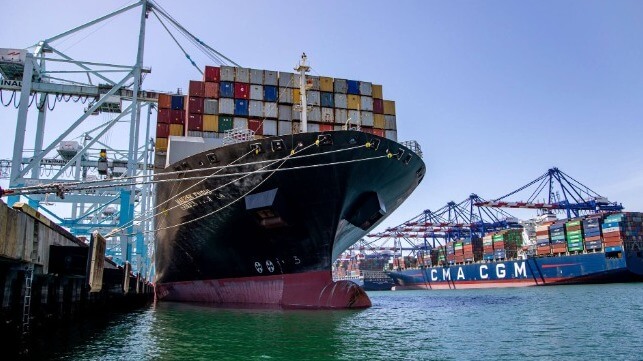
Port of LA boxships
File image courtesy Port of Los Angeles

Published Apr 10, 2025 4:15 PM by The Maritime Executive


American importers are beginning to delay or cancel orders in China due to the White House's new 145 percent tariff on Chinese goods - and some U.S. firms may even abandon import cargo on the dock because they can't afford to pay the extra duties, though the White House has promised an exemption for goods already in transit. 

Even before the latest hike, Chinese manufacturers faced a tariff of 20 percent from earlier White House actions. Many have already discounted their goods to the lowest profitable price in order to offset the effects. "It is a deal breaker," toy factory owner Chen Qingxin told the Wall Street Journal. "No room for doing business anymore, for both sides."

Given the effective doubling of their wholesale costs, American retailers are already beginning to cancel or defer orders. E-commerce giant Amazon began to revoke orders this week, according to Bloomberg, and has already canceled shipments of summer goods like air conditioners, beach chairs and scooters. 

Exporters in China are also adapting to a new reality. "All factory orders are suspended. Any goods that have not been loaded will be cancelled and goods that are already at sea will be re-priced," one manufacturing executive told SCMP. "The loss on each container we ship is now greater than the profit we used to make on two containers." He added that his firm has heard from at least one U.S. client that the goods would be abandoned on the dock when they arrived because the tariffs make them too expensive to sell.

"The major trend we see is shippers looking to not accept their freight," supply chain consultant Joseph Esteves told CNBC. "A lot of these companies are levered financially. They don’t have the working capital requirements and they don’t have the cash. So they simply cannot just take on this [tariff] and hope to see what happens."

The steep tariff on China may force U.S. importers to diversify their supply chains to other alternatives, like Cambodia and Vietnam, already popular options for the "China plus one" diversified sourcing strategy. But there is little chance that more low-end consumer goods will end up being produced in America, some in the supply chain business say. 

"They’re absolutely not going to go back to the United States," said Casey Barnett, president of the American Chamber of Commerce in Cambodia, told CNBC. "I can’t imagine that Americans want to sit down and sew a pair of sweatpants for long hours of the day."

China has also imposed its own retaliatory tariff of 84 percent on U.S. goods, and the increased cost is expected to hit agricultural interests hard, particularly soybean farmers. U.S. manufacturers may also feel the effects of a slowdown. In California, a leading maker of CNC industrial machine tools - Haas Automation - has announced that it is scaling back hiring, production and overtime because of a "dramatic decrease in demand for our machine tools from both domestic and foreign customers."

Canadian Snowbirds face privacy threat from U.S. as hostility to foreigners ramps up: 
Dale Jackson


Opinion
By Dale Jackson
April 11, 2025 

Ottawa’s warning for Canadians to expect extra scrutiny when travelling to the United States extends to snowbirds who spend part of the year south of the border, according to a Calgary-based tax expert who specializes in cross-border tax issues.

“With the Trump administration appearing to be upsetting the status quo on many things, it’s only logical that Canadian snowbirds might be concerned about whether or not the methods that they enter the U.S. will be changing or subject to more scrutiny,” says Kim Moody, CEO of Moodys Tax.

U.S. customs agents have the authority to search phones and electronic devices at border crossings but a 2014 information sharing agreement between the Canada Revenue Agency (CRA) and the U.S. Internal Revenue Services (IRS) could have already exposed more sensitive personal information to a government becoming increasingly hostile to foreigners.

Immigration advocates are currently suing the Trump administration over its upcoming registration requirement for non-U.S. citizens staying longer than 29 days.

“Combine those concerns with the fact that the CRA has been sharing information gathered about U.S. persons who reside in Canada pursuant to an information exchange agreement signed last decade, such concerns get real for Canadian snowbirds who might have U.S. tax and filing obligations that are not up to date,” he says.


The tax treaty attempts to determine which side of the border Canadians fall on for tax purposes through a complicated “substantial presence” formula, but Moody suspects many Canadians are unaware that the IRS has access to their personal information including the location of their permanent home, family members, driver’s license and business activities.

Personal information available to U.S. tax authorities also includes where they vote as well as social, political, cultural or religious affiliations.

In 2016, Canada’s Privacy Commissioner – which provides advice for individuals about protecting personal information under the Federal Privacy Act – expressed concern. The privacy watchdog recommended that the CRA notify impacted individuals when and why their data is provided to the IRS.

Under the Privacy Act, general consent is required for the disclosure of personal information but also includes exemptions that allow for disclosures of personal information without consent.

The Privacy Commissioner says Canadians can contact the CRA directly to find out what information has been shared with U.S. authorities.
‘Substantial presence’ formula

Under the current agreement, snowbirds who spend more than 182 days in the U.S. based on a three-year rolling average can be taxed as U.S. citizens.

Those who fall under the IRS 183-day count and are deemed not “substantially present” would not be obliged to pay U.S. tax, but they must file a “Closer Connection Exemption Statement” (form 8840) with the IRS to establish they are more closely connected to Canada.

Since the tax-pact was penned, a growing number of Canadians – and even their advisors – have been blindsided by unexpected tax bills, penalties, or worse from the IRS.

“If you spend too much time in the states without proper immigration status, you’re considered to be an illegal alien. If you’re caught, you could be permanently banned from the United States,” says Moody.

Snowbirds who aren’t sure where they land on the tax divide should consider speaking with a qualified tax professional.

Crackdown on rental income

Experts say the information sharing agreement was likely prompted by an influx of Canadians buying U.S. rental properties in the wake of the 2008 real estate crash when high oil prices pushed the buying power of the Canadian dollar to over US$1.10.

According to a 2023 snowbirdadvisor.ca report, 85 per cent of the more than one-million Canadians who spend their winters abroad settle in the United States.

The report also found that approximately one half of Canadian snowbirds in the U.S. own real estate.