It’s possible that I shall make an ass of myself. But in that case one can always get out of it with a little dialectic. I have, of course, so worded my proposition as to be right either way (K.Marx, Letter to F.Engels on the Indian Mutiny)
Saturday, May 24, 2025
U.S. Oil Rig Count Plunges Amid Scary Price Environment
The total number of active drilling rigs for oil and gas in the United States came crashing down this week, according to new data that Baker Hughes published on Friday, following a 6-rig decrease last week.
The total rig count in the US fell by 10 to 566 rigs, according to Baker Hughes, down 34 from this same time last year.
The number of oil rigs fell by 8 to 465 after falling by 1 during the previous week—and down by 32 compared to this time last year. The number of gas rigs slipped by 2 this week, to 98 for a loss of 1 active gas rigs from this time last year. The miscellaneous rig count stayed the same at 3.
The latest EIA data showed that weekly U.S. crude oil production rose, from 13.387 million bpd to 13.392 million bpd. The figure is 239,000 bpd down from the all-time high reached during the week of December 6, 2024.
Primary Vision’s Frac Spread Count, an estimate of the number of crews completing wells, fell again during the week of May 16, this time to 193, compared to 195 in the week prior. The count is now 22 below where it was on March 21.
WTI is trading up on the day, but still well below what the Dallas Fed Survey says is the breakeven for Permian players, with drilling activity in the basin falling by 3 for a second week in a row, to 279—a figure that is 33 fewer than this same time last year. The count in the Eagle Ford fell by 4, to 42 active rigs. Rigs in the Eagle Ford are 8 below where they were this time last year.
Chevron’s $53 billion bid for Hess faces arbitration as ExxonMobil and CNOOC claim a contractual right to block the deal.
The outcome is pivotal for Chevron, which urgently needs Hess’s Guyana assets to reverse its declining reserves.
A tribunal ruling is expected by Q3 and could shift the geopolitical balance of oil power in the Western Hemisphere.
A high-stakes arbitration kicks off Monday in London that could make or break Chevron’s $53 billion bid to acquire Hess Corp—and with it, a coveted 30% stake in Guyana’s booming Stabroek Block. ExxonMobil and CNOOC, Hess’s partners in the block, claim they have a right of first refusal on that stake, arguing the Chevron-Hess deal triggers the clause. But Chevron and Hess counter that the right doesn’t apply to full corporate mergers. The outcome rests on contractual fine print, but the implications are massive: Guyana’s Stabroek Block holds over 11 billion barrels of oil equivalent, and output is projected to double by 2030.
For Chevron, this is a make-or-break moment. The company’s reserves replacement ratio (RRR) hit -4% last year, its lowest in a decade. It desperately needs Hess’s Guyana asset to boost its RRR and plug a growing gap in its portfolio. CEO Mike Wirth has already poured over $3 billion into Hess stock and positioned the company to close the deal quickly—if it wins. If not, Chevron walks away, leaving Exxon and CNOOC free to increase their control over one of the world’s hottest oil plays.
The arbitration, led by the International Chamber of Commerce, is expected to move faster than typical, with a ruling anticipated by Q3. Traders are betting big on a Chevron win—about $10 billion worth of Hess shares have been scooped up by merger-arb funds expecting the deal to close, according to Morgan Stanley’s head of Special Situations, Matthew Mitchell, and cited by Bloomberg.
The outcome hinges on the tribunal’s interpretation of a joint operating agreement drafted more than a decade ago.
If Chevron loses, the consequences will ripple far beyond one failed deal, with Exxon largely expected to consolidate its dominance in Guyana. Chevron, meanwhile, would be left scrambling for another big-ticket asset to shore up its future. The tribunal’s ruling could redefine the balance of power in the Western Hemisphere’s most promising oil basin.
By Julianne Geiger for Oilprice.com
Suriname Votes for President Who Will Oversee Newly-Found Oil Wealth
Suriname, the South American nation hoping to replicate Guyana’s oil boom, is voting on Sunday in presidential and general elections to decide who will oversee energy and oil policy in the country over the next five years.
Suriname, a former Dutch colony which gained independence in 1975, has a population of just over 600,000 residents who will choose among five presidential candidates in the May 25 election.
Incumbent President Chan Santokhi seeks a second five-year presidential term against four other contenders. The president’s biggest rival appears to be Jennifer Geerlings-Simons, the leader of the left-leaning National Democratic Party.
Both frontrunners are encouraging more drilling in Suriname’s offshore basin to find more oil and are open to welcoming major international companies to develop projects in the country.
Suriname has been seeing increased investment and exploration in its oil and gas sector, driven by the success of neighboring Guyana and major projects like GranMorgu.
Shell, TotalEnergies, and Petronas are leading exploration efforts offshore Suriname, hoping that the oil treasure trove in neighboring Guyana extends into Surinamese waters.
Oil volumes have been found, and French supermajor TotalEnergies is developing GranMorgu, a $10.5-billion oil project offshore Suriname.
In October, TotalEnergies announced the final investment decision for the GranMorgu development of the fields off the coast of Suriname, which are estimated to hold recoverable reserves of more than 750 million barrels.
First oil is expected in 2028.
The project includes a 220,000 barrels of oil per day Floating Production Storage and Offloading (FPSO) unit.
In 2028, when the project is expected to come on stream, Suriname’s GDP will jump by as much as 55%, the International Monetary Fund (IMF) has predicted.
“In the long term, the oil reserves are not as large as that of Guyana, though Suriname is able to ramp up production rapidly,” the IMF said.
By Charles Kennedy for Oilprice.com
Nornickel says board recommends no dividends for 2024
Russia’s Nornickel, one of the world’s largest producers of nickel and the largest producer of palladium, said on Thursday that its board recommended not to pay dividends for 2024.
The company said the decision was “made in order to maintain financial stability”.
(By Anastasia Lyrchikova and Gleb Bryanski; Editing by Kirsten Donovan)
Poland to cut copper mining tax from 2026, finance minister says
Reuters | May 23, 2025 | Głogów Copper Smelter and refinery – Image courtesy of KGHM
Poland’s copper mining tax will fall from next year under a new system that will provide deductions related to investment spending, Polish finance minister Andrzej Domanski said on Friday.
The tax on mineral extraction, including copper, was introduced in 2012. Poland’s biggest copper miner KGHM paid 3.87 billion zlotys in tax in 2024, according to its annual report.
Domanski said the tax cut and the introduction of investment spending deductions would lower tax revenues by an estimated 10 billion zlotys ($2.66 billion) over ten years and reduce costs for copper producers by the same amount.
“The fact that KGHM is a supplier of about 85% of copper in Europe is absolutely crucial,” minister of state assets Jakub Jaworowski said.
“By taking care of investments in Poland, by taking care of the development of KGHM, we also take care of the collective security of the West and the European Union.”
($1 = 3.7545 zlotys)
(By Karol Badohal and Pawel Florkiewicz; Editing by Jane Merriman)
Column: US aluminum smelters vie with Big Tech for scarce power
It’s forty-five years since anyone built a primary aluminum smelter in the United States.
When Alumax fired up the Mt Holly plant in South Carolina in 1980, the country’s tally of smelters rose to 33 with combined annual capacity of almost five million metric tons of aluminum.
Today that number has shrunk to six. Two are fully curtailed. Two, including Mt Holly, are running below capacity. Annual production has shrunk to 700,000 tons.
Emirates Global Aluminium hopes to reverse the tide with a new plant in Oklahoma. It joins Century Aluminum, which was awarded federal funding by the Joe Biden administration for a new “green” low-carbon smelter somewhere in the Ohio/Mississippi River Basins.
Both projects face the same dilemma. High power prices killed off most of the country’s smelters and a lack of competitively priced power has deterred anyone from building one since the last century.
It doesn’t help that any smelter project must compete for electricity with tech companies willing to pay almost anything for their power-hungry data centres.
No power, no metal
Aluminum compounds have been around since ancient times, used by the Egyptians as a dye-fixer and the Persians for pottery.
But it wasn’t until the early 19th century that anyone worked out how to refine bauxite into metal and even then it remained something of an expensive curiosity. Global production was just two tons in 1869 and aluminum was more valuable than gold.
The solution, discovered independently by Charles Martin Hall in the United States and Paul Héroult in France, was to use electrolysis on an intermediate product called alumina.
The Hall-Héroult process is still the dominant technology in producing a metal that is now ubiquitous in buildings, vehicles and consumer packaging. And it needs a lot of uninterrupted power.
It takes 14,821 kilowatt-hours of electricity to make a ton of aluminum, according to the US Aluminum Association. A modern-size smelter with annual capacity of 750,000 tons needs more power than a city the size of Boston.
That’s a big challenge for any primary aluminum producer in the United States given the Energy Information Administration estimates that the country will be facing an energy deficit of 31 million megawatt-hours by 2030 and 48 million by 2035.
Aluminum versus AI
The power is available right now to build a new US aluminum smelter, according to Matt Aboud, senior vice president of strategy & business development at Century Aluminum.
The problem, he explained at last week’s CRU Aluminium Conference in London, is that it isn’t available at a fixed long-term price, which is what a smelter needs to lock in its profitability and pay back construction costs that will run into the billions of dollars.
The Aluminum Association estimates that a new US smelter would need a minimum 20-year power contract at a price of not more than $40 per MWh to be viable at current aluminum prices.
Any smelter project is in a race with Big Tech, which is on the same hunt for energy to power its next-generation artificial intelligence data centres.
And tech companies “have no limit on what they are prepared to pay for dependable 24/7 electricity”, according to the Aluminum Association’s just-released report on rebuilding US supply chain resilience.
The Association estimates Microsoft conceded $115 per MWh in its deal with Constellation Energy to restart the Three Mile Island nuclear plant in Pennsylvania.
Even reactivating moth-balled aluminum lines will be challenging given the 2023 price of power averaged $73.42 per MWh in the four US states hosting smelters with idle capacity, it warned.
‘Where the wind comes sweeping down the plain’
EGA hasn’t yet signed a power deal for its proposed 600,000-ton-per-year smelter in Oklahoma. Final go-ahead is contingent on an agreed “power solution framework based on a special rate offer from the Public Service Company of Oklahoma,” according to the memorandum of understanding signed by state governor Kevin Stitt.
Oklahoma has the advantage of producing almost three times more energy than it consumes, according to the EIA.
Around half of the state’s electricity generation was sourced from natural gas in 2023, with wind power accounting for another 42%. Indeed, Oklahoma is the third largest wind power state after Texas and Iowa.
Harnessing intermittent wind power to run an aluminum smelter, however, would take a massive amount of grid storage capacity, meaning there would likely have to be some gas in the energy mix for any new smelter.
That’s better than coal but not ideal in an industry which is collectively trying to lower its carbon footprint to produce “green” aluminum.
Don’t chuck it!
Even assuming EGA can get a viable long-term power deal, the $4 billion project will only pour its first hot metal some time near the end of the decade.
By which time, 14 new re-melt facilities will have started up, lifting US demand for recyclable scrap aluminum to 6.5 million tons, according to the Aluminum Association’s projections.
Recycling requires much less power, typically around 5% of that required to produce virgin metal, and comes at a much lower capital cost.
The main constraint on US secondary production growth is a shortage of “scrap”.
The country has an astonishingly low beverage can recycling rate of just 43% and throws away the equivalent of 800,000 tons of aluminum every year.
It also exports huge amounts of end-of-life aluminum scrap. Exports rose by 17% year-on-year to 2.4 million tons in 2024, much of it destined for China, which is increasingly hungry for recyclable raw material.
Capturing more recyclable material at home and sending less of it abroad would be a complementary strategy for reducing import dependency of a metal classified as critical by every US government agency.
It’s also likely to be faster and cheaper than waiting to see if either EGA or Century can win the battle with Big Tech for enough power to build a new primary smelter.
(The opinions expressed here are those of the author, Andy Home, a columnist for Reuters.)
(Editing by Mark Potter)
Rio Tinto’s Chile deal is a bet on unproven tech and lithium price bounce
Reuters | May 22, 2025 | The Maricunga lithium project sits on its namesake salt flat, Chile’s second-largest in terms of reserves. (Image courtesy of Lithium Power International.)
Global miner Rio Tinto will tackle one of the biggest technological challenges in the lithium industry as it takes the lead in Chile’s first major projects involving the battery metal in years, alongside state-run mining companies Codelco and ENAMI.
Codelco’s Maricunga project and ENAMI’s Altoandinos project represent a new pivot in Rio’s lithium ambitions and a turning point for Chile, which for many years had only two companies – Chile’s SQM and US-based Albemarle – extracting the metal that powers electric vehicles.
Rio will spearhead the operational side of both projects, with nearly 50% ownership at Maricunga and 51% at Altoandinos.
As Rio raises its profile in lithium, a major challenge will be deploying new technology, called direct lithium extraction, or DLE, to separate the ultralight metal from salty brine liquid. It is meant to be more environmentally friendly and efficient than conventional methods, industry experts say, but has yet to be proven widely in the industry and has never been used in Chile at commercial scale.
The technical challenge comes against a backdrop of uncertainty for lithium prices, which have fallen nearly 90% since late 2022 due to oversupply and weak demand for EVs.
“Scaling it in line with global demand timelines remains uncertain,” said Nicole Porcile, a partner at mining consulting firm Anagea. “The ability to deliver at scale, efficiently and reliably will be a decisive factor in the project’s competitiveness and investor confidence.”
Rio has a DLE pilot plant at its Rincon project in Argentina, and recently acquired US-based Arcadium, which employs a mix of DLE and traditional extraction methods.
That DLE know-how gave Rio an edge over three final competitors to partner with copper giant Codelco, said a person familiar with the Maricunga deal. Still, Rio and Codelco must now hammer out which kind of DLE will work sustainably and effectively at Maricunga, one of the world’s most lithium-rich salt flats.
“That’s certainly the goal: to develop and operate this in the most environmentally friendly manner possible because Codelco is well aware that they’ll be under the microscope,” the person said.
Codelco’s search for a Maricunga investor attracted Middle Eastern, Chinese and Western companies, the person added, speaking on condition of anonymity because the talks were private. Construction is expected to start in three to five years, once environmental permits are updated.
Codelco has proposed a gradual transition to DLE, but Rio Tinto is aiming to use DLE from the start, with lower costs relative to other DLE projects, said a second person familiar with the matter.
Argentina experience
Rio told Reuters its Argentina experience provided strong footing for future projects.
“We are therefore confident in the application of our technology to Maricunga and potentially to other lithium salt flats in Chile,” a spokesperson said.
Rio will spend up to $900 million at Maricunga, and lead design, construction, operation and sales. At Altoandinos, it plans to initially contribute $425 million to the project to fund studies required before a final investment decision.
Rio is the only major mining company to bet heavily on lithium, accelerating its push with a second deal in six months at a time of low market prices.
“We have not heard from investors that they want to see further investment in lithium,” RBC Capital Markets said in a note.
Codelco hired investment bank Rothschild to scout for candidates for the Maricunga project. And at the same time, it is set to soon close a deal to partner with Chile’s SQM at the Atacama salt flat.
Benchmark Minerals analyst Federico Gay noted that Rio and Codelco will have to carefully prioritize. “Too many fronts (are) open for both companies, in a moment when justifying large investments for lithium is challenging.”
Rio, which could be granted an intellectual property permit if its DLE technology is used for the project, will hold a majority of seats on a technical committee with Codelco, and will move to a 50-50 split once production begins, according to a filing with Chile’s financial regulator.
ENAMI ran its own selection process separately, attracting bids from Chinese electric vehicle maker BYD, French miner Eramet, and South Korean steel group Posco, as well as financing proposals from China’s CNGR Advanced Material Co Ltd and South Korea’s LG Energy Solution.
(By Daina Beth Solomon and Clara Denina; Editing by Rod Nickel and Jamie Freed)
Chile’s ENAMI says lithium venture with Rio Tinto to start production in 2032
Chile’s Atacama region. (Image by LMspencer | Stock Photo.)
Chile’s state-run mining firm ENAMI aims for its new Rio Tinto lithium partnership at Altoandinos to begin production in 2032 with 35,000 metric tons of the battery metal per year, and ramp up over three years to 75,000 tons, ENAMI company chief Ivan Mlynarz said on Friday.
The Altoandinos project, as well as the Maricunga project that Rio Tinto was tapped this week to spearhead alongside state-run copper producer Codelco, will give the global miner a critical role in Chile’s lithium industry alongside long-established players SQM and Albemarle.
Rio Tinto will initially put forward $425 million to the project, which ENAMI said will require a total investment of $3 billion.
ENAMI previously estimated the Altoandinos project capacity to be 60,000 tons a year, before new studies showed more resources than expected, particularly at the La Isla salt flat.
Mlynarz said ENAMI plans for the project to start with direct lithium extraction (DLE), an innovative method that has yet to be used in Chile, and that Rio Tinto is testing at its Rincon project in Argentina.
ENAMI has begun testing DLE options from various companies, and Mlynarz said early results from Rio Tinto’s technology look promising, paving the way for its potential use on the project.
“The results have been encouraging with Rio Tinto, and it has the advantage of having the operator use their own technology,” Mlynarz said.
He added that the partnership needed approval from international regulatory agencies, but that ENAMI in the meantime would continue exploration studies, with the hope that Rio Tinto will take the lead in 2026.
“We need to keep working in the salt flat because both ENAMI and Rio Tinto know that timing is key,” Mlynarz said.
(By Daina Beth Solomon; Editing by Alexander Villegas)
Rio Tinto board looks for new CEO who knows mining better
When Jakob Stausholm took the top job at Rio Tinto Group, his task was to repair the reputation of a company that had just blasted through a 46,000-year-old sacred Aboriginal site and bungled its response. Now the world’s second-largest miner has decided it needs a boss that can lead it into the future.
Then, Stausholm, a sober Dane who came to Rio as chief financial officer after time at AP Moller-Maersk A/S and Shell Plc, stepped into the least desirable job in mining. He has repaired relationships and edged the company toward new investments, including lithium — a battery material most of his rivals have shunned.
But the company, whose board asked Stausholm to stand down, is now looking for a boss that can make the most of Rio’s crucial growth assets, including the Oyu Tolgoi copper and gold mine in Mongolia and the vast Simandou iron ore deposit in Guinea. To set a path for the coming decades will mean prioritizing operational expertise and a track record, according to people familiar with the company.
That could put Simon Trott, head of Rio’s iron ore business, in the running alongside aluminum executive Jérôme Pécresse to replace Stausholm when he leaves later this year, according to the people. They asked not to be named as the conversations are not public.
“It’s not something that you are candidate for, it’s something that you’re eligible” for, Pécresse said Friday in an interview on BNN Bloomberg Television. “It’s for the board to decide who is eligible and who is not.”
Chief commercial officer Bold Baatar, a former investment banker who has been instrumental in bringing Simandou to production after years of delays, is also being considered but is not thought to be a front-runner, the people said.
“Stausholm came on board at a time of crisis and he’s resolved many of the strategic issues that the company was hampered by at the time,” said Rob Stein, a Macquarie Group Ltd. research analyst. “Now the strategic priority appears to be growth, and the new CEO may be a growth-oriented leader — as opposed to Jakob who was a cultural change agent.”
Rio’s ability to run its mines and aluminum smelters significantly improved under Stausholm, but right from the start of his tenure there were tensions with some investors around his lack of technical expertise. By comparison, Stausholm’s peers at BHP Group, Anglo American Plc and Glencore Plc have spent decades in the industry.
As the mining company prepares for its next major push, board members increasingly felt more operational experience was required at the top of Rio. Stausholm’s departure caught the market by surprise, but the people familiar with the firm said the exit was expected.
Trott, who helped repair relationships in Australia after the social responsibility disaster of Juukan Gorge five years ago, is widely seen as having strong relationships and diplomatic skills, the people said.
Pécresse only joined Rio in October 2023, but is credited with turning around the aluminum unit, long a headache for the company.
The miner’s “next five years appear very operation driven,” said Matthew Haupt, portfolio manager at Wilson Asset Management, which holds the company’s stock. “It’s probably a good time for Jakob to find a new challenge.”
As the mining sector begins to shift its focus to expansion and deals, Stausholm took the first step toward bringing Rio back to the fray, with the acquisition of Arcadium Lithium Ltd. last year, and has invested in projects including Rincon in Argentina. It’s a major bet on a commodity, which rivals like BHP Group consider to be too small and geologically abundant, at a time of dismal prices thanks to a persistent global glut.
It was still a first step toward easing the company’s heavy dependence on iron ore, the steelmaking ingredient which accounts for more than 80% of underlying earnings. The commodity has generated billions in cash flow, but its future is less certain as China’s growth plateaus.
Still, Stausholm’s successor will also have to face big questions on Rio’s deal strategy and what role the company will play in any major consolidation.
Stausholm was directly involved in talks about a potential deal with Glencore Plc last year that went on for months, which could have created the world’s biggest miner.
While Rio has never publicly discusses the talks, its willingness to engage with Glencore jolted many in the industry. The deal ultimately fell down with the two sides far apart on valuation, the people said, rather than any strong divisions with Rio on the combination.
In an internal message to Rio Tinto employees, Stausholm said the company expected to announce a successor before third-quarter production results, typically published in October.
(By Paul-Alain Hunt and Thomas Biesheuvel)
South Africa Launches Oil Giant to Revive Energy Sector
South Africa has officially launched the South African National Petroleum Company (SANPC), a new state-owned oil enterprise designed to consolidate and energize the country’s long-stalled hydrocarbons sector. Formed from the merger of PetroSA, iGas, and the Strategic Fuel Fund, SANPC will operate under the Central Energy Fund and is already integrating staff and assets to streamline operations. The aim? Reducing oil imports, bolstering energy security, and tapping into over R95 billion in potential investment.
The move comes just months after South Africa quietly allowed several of its coal-fired plants to exceed emissions limits in a desperate bid to avoid more blackouts. With the country still generating 85% of its electricity from coal and facing a chronic energy shortfall, SANPC represents a dual play: secure domestic energy while positioning itself as a more formidable player on the global stage.
Foreign oil majors are already sniffing around. Shell is offloading downstream assets in South Africa, and traders like Trafigura and NOCs like Aramco and ADNOC are circling. Meanwhile, TotalEnergies and QatarEnergy are pushing ahead with high-risk exploration offshore South Africa, betting that the Orange Basin's oil riches don’t stop at Namibia’s border. Activist lawsuits and bureaucratic messes haven’t stopped them.
South Africa is trying to thread an impossible needle—keeping the lights on, appeasing climate financiers, and luring foreign capital to a regulatory minefield. SANPC might just be the bureaucratic bazooka it needs to start hitting those targets. Or, like the Luiperd gas project before it, it could get tangled in its own red tape.
But as Energy Minister Gwede Mantashe bluntly put it, “We have oil, we have gas, so we must exploit it.” The era of passive potential is over. Now comes the messy business of execution.
By Julianne Geiger for Oilprice.com
SOUTH AFRICA
Sibanye-Stillwater rushes to rescue 260 trapped gold miners
The Kloof operation now consists of three producing vertical shafts, namely No. 1, 7 and 6. (Image courtesy of Sibanye-Stillwater.)
Precious metals producer Sibanye-Stillwater (JSE: SSWJ) (NYSE: SBSW) confirmed Friday that nearly a third of the 260 workers trapped underground at its Kloof gold mine, about 60 km west of Johannesburg, South Africa, have been safely brought to the surface.
The company said the remaining 181 miners are safe, with access to food and water, and are gathered at an underground assembly point within Kloof, one of its deepest operations. Rescue efforts continue and Sibanye is aiming to hoist them out “soon”.
An early investigation found that a sub-shaft rock winder skip door opened unexpectedly at the loading point, damaging Shaft 7 and preventing safe passage.
After a detailed risk assessment, Sibanye determined it was safer for workers to stay at the sub-shaft station than attempt a long walk to the surface.
The National Union of Mineworkers (NUM), which represents workers at the Kloof mine, criticized Sibanye’s handling of the incident.
“We are very concerned because the mine did not even make this incident public until we reported it to the media,” NUM spokesman Livhuwani Mammburu said in a statement.
Mammburu added that the miners have now been underground for nearly 24 hours and that Sibanye has repeatedly changed its timeline for the rescue.
Mining accidents remain a grim reality in South Africa, home to some of the world’s deepest and oldest gold mines. In January, at least 78 bodies were recovered from an illegal mine after police cut off supplies in a crackdown that highlighted the risks of unregulated mining. The government estimates illegal mining cost the country over $3 billion last year.
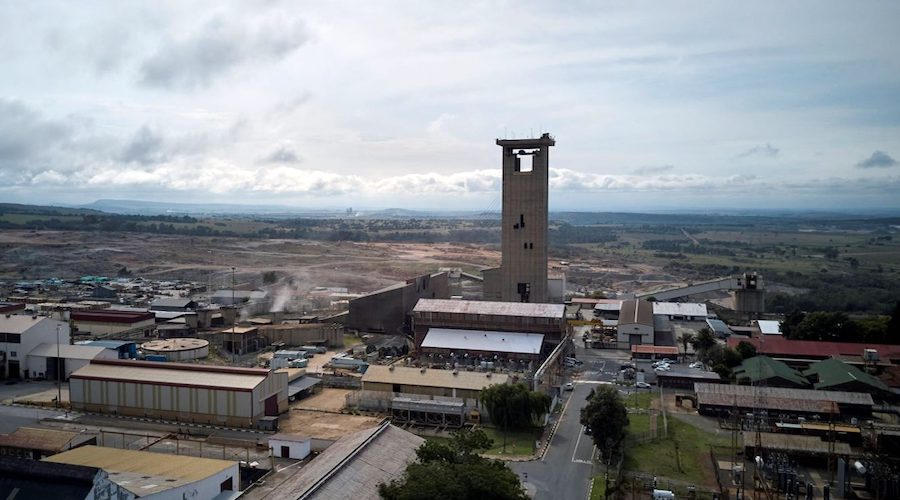
The Kloof mine produces 14% of Sibanye’s total gold output and includes two other active shafts. In 2023, the company closed Shaft 4 due to safety and economic concerns. At year’s end, the mine employed about 8,900 people, including contractors.
Greenland Approves European-Backed Mine in Remote Fjord
Lease area's waterfront access site (red) on Greenland's rugged western coast (Pole Star / NASA)
Greenland's government has issued a new mining lease to a French-Danish consortium for extracting anorthosite, a silicate mineral used for making aluminum and fiberglass. The license covers provisions for shipping, and the area includes a stretch of waterfront that could be used for industrial access at the ultra-remote mine site.
The new lease grants permission for development to Greenland Anorthosite Mining AS, a consortium led by French mining firm Jean Boulle Group. Other participants include state investment funds from Greenland and Denmark; Greenland's public pension fund; and the Danish bank Arbejdernes Landsbank.
The site (63 18 N / 50 07 W) is located south of the capital of Nuuk on Greenland's rugged west coast, inland from the village of Qeqertarsuatsiat. According to the partners, the resource is uniquely large and of "particularly excellent quality" for making E-glass - the high-tensile silicate glass used for fiberglass reinforcement. High-grade anorthosite is a less carbon-intensive feedstock for E-glass than traditional sources, the firm says; it can also be used as an alternative to bauxite for aluminum production.
The site is at the end of a long fjord, and it includes a small stretch of waterfront. The lease agreement anticipates shipping access: it specifies that any vessels used to serve the project (for development or for export) must meet appropriate Polar Code provisions; must carry a properly-licensed local pilot; and must carry insurance from a P&I Group member.
When developed, the lease area will be the second active anorthosite mine in Greenland. Under the lease terms, the partnership has to begin resource exploitation by the end of 2028 or seek an extension. If all terms are met, the lease will last for 30 years.
The lease agreement with a European consortium comes at a time of high tension with the White House over Greenland's mining rights and its continued existence as a sovereign territory. However, this particular application has been in the works with local support since at least 2020, long before the recent tensions began. Greenland Mineral Resources Minister Naaja Nathanielsen told media that despite the well-publicized American interest in the island's minerals, American mining companies have yet to commit to any investment deals - at least, not with the currently-available lease terms. Local rules require up-front investments in development, and it is not as easy in Greenland to acquire a lease and hold it for future use, Aalborg University associate professor Jesper Willaing Zeuthen told Newsweek.
Finland’s Next Generation Corvette is Launched
First corvette moved out of the indoor build hall during the launch process (Rama)
The first multi-purpose corvette built for the Finnish Navy as part of the Squadron 2020 project was launched at the Rauma shipyard in Finland on Wednesday, May 21. The company is highlighting it as a significant milestone in the project to build four of the most capable vessels designed to operate year-round in all weather conditions in the Baltic.
“The building of these corvettes will advance the shipbuilding industry and technological know-how in Finland,” said Mika Nieminen, CEO of Rauma Marine Constructions (RMC). “We have increased the capacity of Rauma shipyard purposefully while strategically implementing significant investments in the shipyard area. Rauma shipyard is now in peak condition.”
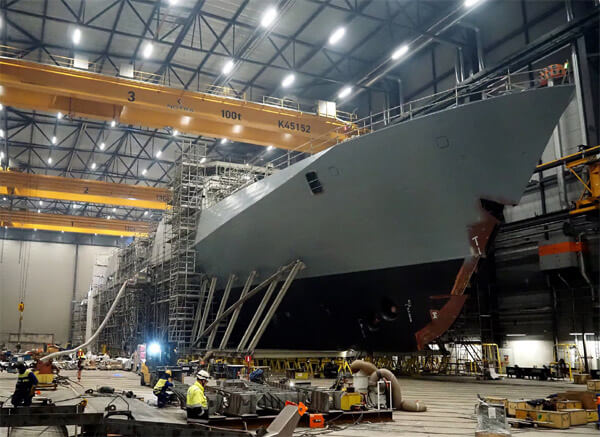
The company notes that significant investments have been made in the Rauma shipyard throughout the 2020s to strengthen the shipyard’s shipbuilding infrastructure and independent production capacity. A new closed multi-purpose hall was completed for the construction of the multi-purpose corvettes to ensure good working conditions, while additional investments have been made in steel production, a launching barge, and heavy transfer ramps. The indoor hall was required for security during the construction.
The hull for the first vessel was completed in February 2025 (Rama)
Work began at the end of October 2023 on the first of the vessels which the yard says will have no counterparts worldwide. Pohjanmaa-class corvettes will be equipped with advanced monitoring capacities for air, surface, and underwater surveillance and will be capable of laying navy mines, performing defense actions against surface vessels, submarines, and various airborne targets, and conducting maritime operations.
The design of the corvettes pays particular attention to shock resistance, noise levels, and stealth technology, highlights RMC. The vessels measure 117 meters in length and will have a crew of 70. They will have a speed of 26 knots.
The keel for the first of the vessels, a block weighing 56 tonnes, was laid in April 2024. Construction began on the second corvette in October 2024 while the hull of the first vessel was completed in February. Keel laying for the second vessel took place on May 8.
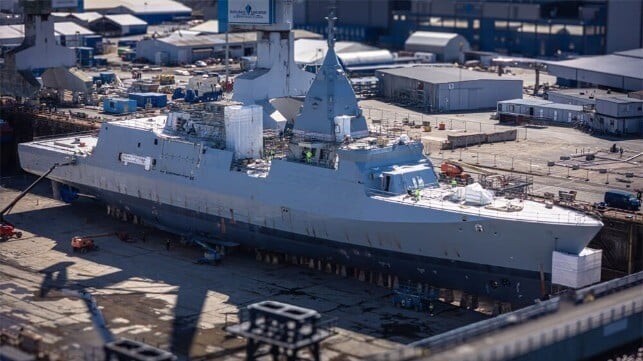
The technical part of the launch process was initiated at the beginning of May when the multi-purpose corvette was moved along the heavy transport ramp to the launching barge and transferred to the harbor. In the harbor, the ship was launched with the help of the barge and then towed to the shipyard’s dry dock for further work, including the mast installation.
“The newly launched vessel is a strong indication of the close and goal-oriented co-operation between the Finnish Government, the Finnish Defence Forces, the Finnish Defence Forces Logistics Institute, the Finnish Navy, Rauma Marine Constructions, Saab and all our industrial partners”, states Timo Ståhlhammar, Project Director of RMC’s Squadron Project.
RMC reports the Squadron 2020 project is proceeding on schedule. The building pace will accelerate as work on the second and subsequent multi-purpose corvettes progresses. The project is scheduled to be completed in 2029.
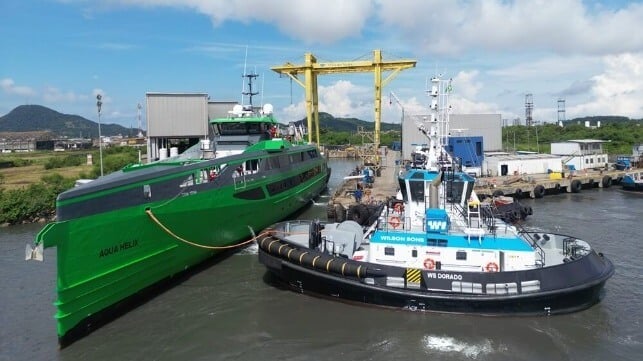
Brazil Green-Lights MSC's Purchase of Maritime Conglomerate Wilson Sons
Brazilian regulators have approved MSC's planned takeover of Wilson Sons, paving the way for the sale's closing.
Last October, MSC announced plans to buy a 56-percent stake in Wilson Sons from Ocean Wilson Holdings, which had been rumored to be considering a sale since at least 2023. At least one other firm considered placing a bid, but MSC ultimately secured a deal at a price of $760 million. Once the purchase is completed, MSC will launch a public tender offer for the remaining shares in the company, bringing the total transaction value to about $1.35 billion.
Wilson Sons has been in business in Brazil's ports and towage industry for more than 180 years, and has interests spanning the full breadth of the nation's maritime sector. It has Brazil's largest tugboat fleet, nearly two dozen offshore vessels through a joint venture, two offshore-industry terminals, two container terminals, a shipyard, a freight logistics division and a shipping agency, among other assets. The purchase would dovetail with MSC's acquisition of Brazilian coastwise carrier Log-In Logistica in 2021, giving it a foothold in Brazil's cabotage trade.
It is one of a string of acquisitions that the Aponte family - owners of MSC and Terminal Investment Limited (TIL) - is looking to add to its global ports portfolio. On Thursday, Hong Kong-based ports giant CK Hutchison confirmed that TIL is leading a consortium to buy out Hutchison's global container terminal network, amounting to more than 40 terminals. The transaction is said to be worth about $23 billion - assuming that Hutchison can overcome opposition from Chinese regulators.