Wednesday, June 04, 2025

Consumer group files complaint against French ministers over Nestlé scandal

The consumer association UFC-Que Choisir announced Tuesday that it has launched several legal actions in response to what it calls the Nestlé mineral water "scandal". It accuses the company of deceiving consumers and has condemned the lack of "action" on behalf of public authorities.


Issued on: 03/06/2025 - RFI

The entrance of the Perrier mineral water factory (Nestlé Waters) in Vergeze, southern France, on 7 February, 2025. AFP - SYLVAIN THOMAS

In a press release on Tuesday, the consumer association announced that it had filed a complaint with the Court of Justice of the Republic against several ministers including the current Minister for Ecological Transition and former Minister Delegate for Industry, Agnès Pannier-Runacher.

Roland Lescure (Industry), Aurélien Rousseau (Health), and Agnès Firmin-le-Bodo (Health) have also been named in the complaint.

UFC-Que Choisir says it wants "the role of the state", and in particular the executive branch, to be "fully analysed" in what has become known as the Nestlé mineral water scandal.

Water safety

The association indicates that it has also filed a criminal complaint against Nestlé Waters for "acts likely to constitute deceptive commercial practices, aggravated falsification, and aggravated deception."

According to a joint investigation by the newspaper Le Monde and the Investigation Unit of Radio France, the scandal of water treatment dates back to 2020 when an employee of Nestlé competitor Sources Alma factory, reported the use of illegal water treatments.

In January 2024, Nestlé Waters admitted to using illegal "food safety" treatments on its products that infringe French law.


Confirming an initial report from business daily Les Echos, the Swiss food group said it had passed some waters, such as Perrier and Vittel through ultraviolet light and active carbon filters "to guarantee food safety".

However, natural mineral water cannot be subjected to any disinfection or treatment that could alter its characteristics.

Nestlé Waters paid a two-million-euro fine in September 2024 to avoid legal action over the use of illegal water sources and filtering. It says the filters it uses now are allowed by the government and that its water is “pure”.

Legal proceedings are already underway in Paris following complaints from consumer protection associations for "deception" targeting Nestlé Waters and Sources Alma brands like Cristaline, St-Yorre, Vichy Célestins.
State concealment

However, the French government has also come under fire, accused of covering up its knowledge of Nestlé's actions.

In February, investigative journalists from Le Monde and Radio France revealed that the services of former prime minister, Elisabeth Borne, and the French presidency allowed Nestlé to continue marketing these waters, despite the health authorities' recommendations for a ban from 2023.

A six-month-long Senate inquiry which wrapped up mid-May concluded that these treatments were indeed the subject of "concealment by the state."

"In addition to Nestle Waters' lack of transparency, it is important to highlight the state's lack of transparency, both towards local and European authorities and towards the French people," the report was quoted as saying.


The report authors said the concealment was part of a "deliberate strategy", that was addressed at the first interministerial meeting on natural mineral waters on 14 October, 2021".

UFC-Que Choisir also claims to have filed an application with the Nanterre District Court for an expedited procedure that allows for summons to appear within a very short timeframe.

This would allow for interim measures such as "product withdrawals and recalls," "a marketing ban," and "an end to the deception surrounding these Perrier waters presented as 'natural minerals'," the group said.

The hearing is scheduled for early July.

(with AFP)
The big blue blindspot: why the ocean floor is still an unmapped mystery

It is the largest habitat on Earth – and also the least explored. As world leaders prepare to meet in Nice for a major UN summit on the ocean's future, scientists say we still know remarkably little about what lies beneath the waves.


Nearly two-thirds of all observations happened within 200 nautical miles of just three countries: the United States, Japan and New Zealand. © AFP
 RFI
Issued on: 04/06/2025

Just 26.1 percent of the global seafloor – including both shallow and deep areas – has been mapped using modern sonar, according to the Seabed 2030 project, which aims to chart the entire ocean floor by the end of the decade.

But mapping from above is not the same as seeing it up close. Scientists estimate that humans have directly observed less than 0.001 percent of the deep seafloor – defined as depths below 200 metres. That’s an area roughly one-tenth the size of Belgium.

That figure comes from a study published this month in Science Advances led by explorer and scientist Katy Croff Bell who, along with colleagues, compiled data from more than 43,000 deep-sea dives carried out since the 1950s.

The results show how lopsided ocean exploration has become. Nearly two-thirds of all observations happened within 200 nautical miles of just three countries: the United States, Japan and New Zealand. Five nations conducted 97 percent of all dives.

This leaves entire regions of the ocean floor completely undocumented – particularly in waters around poorer countries that lack the tools and funding for deep-sea research.

"As we face accelerated threats to the deep ocean – from climate change to potential mining and resource exploitation – this limited exploration of such a vast region becomes a critical problem for both science and policy," Bell, founder of the non-profit Ocean Discovery League, told Scientific American.

Charting the unknown

Some of those gaps are starting to close thanks to new tools.

NASA’s SWOT satellite – short for Surface Water and Ocean Topography – was launched in December 2022 to track changes in water height across oceans, rivers and lakes.

By measuring tiny shifts in sea surface elevation – sometimes just a few centimetres – it helps scientists detect what lies below, including underwater mountains, ridges and deep-sea trenches.

A study published in the journal Science last December found that SWOT delivered clearer images of the seafloor in a single year than earlier satellites achieved in three decades.

“In this gravity map made from merely one year of SWOT data, we can see individual abyssal hills, along with thousands of small uncharted seamounts and previously hidden tectonic structures buried underneath sediments and ice,” said Yao Yu, a postdoctoral researcher at Scripps Institution of Oceanography.

“This map will help us to answer some fundamental questions in tectonics and deep ocean mixing.”

Climate-driven changes to ocean colour fuel urgency ahead of UN summit
Why mapping matters

But maps like these do more than fill scientific gaps. They help pinpoint safe sites for offshore wind farms, guide where to lay submarine cables and flag areas at risk from tsunamis or underwater landslides.

These kinds of insights are becoming central to marine policy – especially as countries look to balance economic development with protecting the ocean.

Still, many scientists say there’s no substitute for a direct look. Visual dives don’t just show topography – they reveal entire ecosystems, offering clues about what species live there, how they interact and how fragile they may be.

“Being able to explore, or at least accelerate, the exploration of the other 99.999 percent of the deep ocean is really going to give us an amazing opportunity to ask new questions we’d never even thought of before,” said Bell.


Eyes on the deep

New expeditions are already pushing into the deep.

This year, the research vessel Nautilus, operated by the Ocean Exploration Trust, is exploring the Mariana Islands – a region dotted with more than 60 underwater volcanoes.

Scientists are using remotely operated vehicles to study hydrothermal vents and collect biological and geological samples from depths of up to 6,000 metres.

Further north, teams led by the US National Oceanic and Atmospheric Administration (NOAA) are surveying the Aleutian Arc off Alaska, where only 38 percent of the seafloor has been mapped. They’re studying deep-sea coral habitats, volcanic formations and possible mineral deposits.

These missions are part of a growing global effort to unlock the secrets of the deep – an environment that helps regulate climate, store carbon and sustain biodiversity.


High-stakes summit

The ocean feeds 3.2 billion people and generates an estimated $2.6 trillion in economic value each year. Yet just 8 percent is formally protected – and only a fraction of that is off-limits to damaging activities.

That disconnect will be centre stage in Nice, where world leaders, scientists and campaigners are meeting for the third UN Ocean Conference (UNOC) from 9 to 13 June.

Co-hosted by France and Costa Rica, the summit follows a string of high-level events already under way.

More than 2,000 scientists are taking part in the One Ocean Science Congress this week, while the Blue Economy and Finance Forum in Monaco this weekend will bring together investors and policymakers to address the multi-billion-dollar funding gap in marine protection.

A public exhibition area called La Baleine has been open since Monday at Nice’s Palais des Expositions, while the Ocean Rise and Coastal Resilience Coalition summit on Saturday will focus on coastal communities affected by rising seas.

The goal in Nice is to secure new voluntary commitments under the Nice Ocean Action Plan – pledges from governments, businesses and civil society to protect marine life and support the sustainable use of the seas.

But for many researchers, it starts with something more basic: actually knowing what’s down there.


Budapest police deny request to hold rainbow parade citing LGBTQ+ march ban

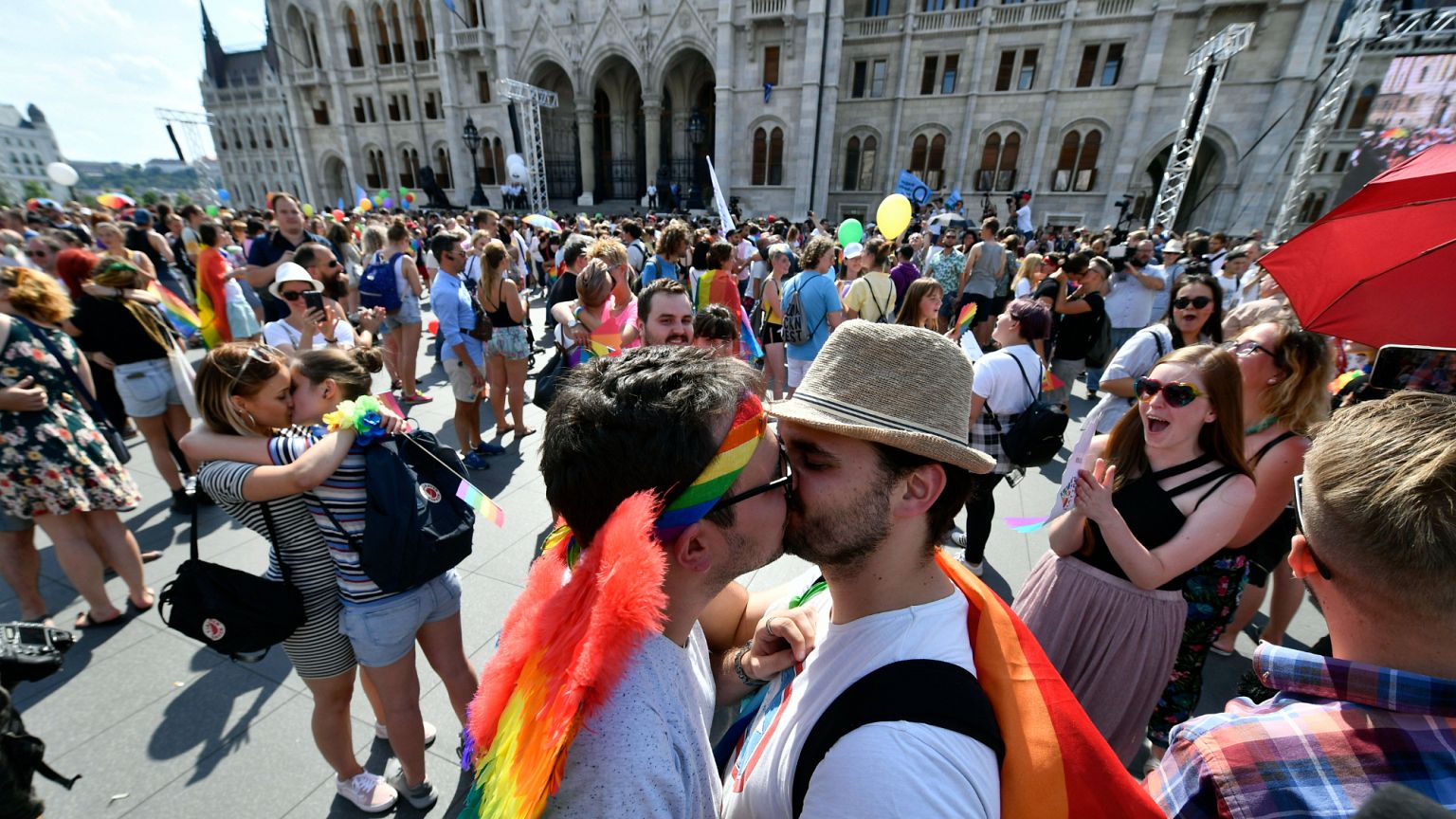
Couples kiss during a flash mob prior to the 24th Budapest Pride in the Hungarian capital, 6 July, 2019
Copyright AP Photo

By Gavin Blackburn with AP
Published on 

The police's decision to prohibit the event planned for later this month came after Hungary's parliament passed legislation in March that allowed the government to ban public events by LGBTQ+ communities.

Police in the Hungarian capital issued an order on Tuesday denying a request to hold an pro-LGBTQ+ event in Budapest, a consequence of recent steps by the right-wing government aimed at banning the popular Budapest Pride march.

The police's decision to prohibit the event planned for later this month came after Hungary's parliament passed legislation in March that allowed the government to ban public events by LGBTQ+ communities.

That was followed a month later by a constitutional amendment banning such events.

Both moves were slammed by legal scholars and critics decried it as another step towards authoritarianism by what they call an autocratic government.

In its justification for prohibiting the Budapest event, which organisers requested to take place on 28 June, the city's police argued that "it cannot be ruled out, or is even inevitable, that a person under the age of 18 will be able to engage in legally prohibited conduct" if attending the proposed march.

People march across the Freedom Bridge during a gay pride parade in Budapest, 24 July, 2021AP Photo

The police also contended that the march could result in "passive victims," who, "because of the assembly's march-like nature, did not wish to attend the assembly but, because of its public nature, nevertheless become a bystander."

In a statement, the organisers called the police decision "a textbook example of tyranny."

"The police did not ban Pride but the rainbow parade that was originally allowed but in our opinion this is legally absurd," Amnesty International spokesperson Áron Demeter, one of the organisers of the march, told the 24.hu news outlet.

The ban on LGBTQ+ events, which the government says ensures children's rights to moral, physical and spiritual development, allows for fines on people organising or taking part in Pride events and the use of facial recognition software to identify them.

Hungary’s contentious "child protection" legislation prohibits the "depiction or promotion" of homosexuality to anyone under the age of 18.

Hungarian officials have given contradictory statements as to whether or not the new policies amount to a full ban on Budapest Pride.


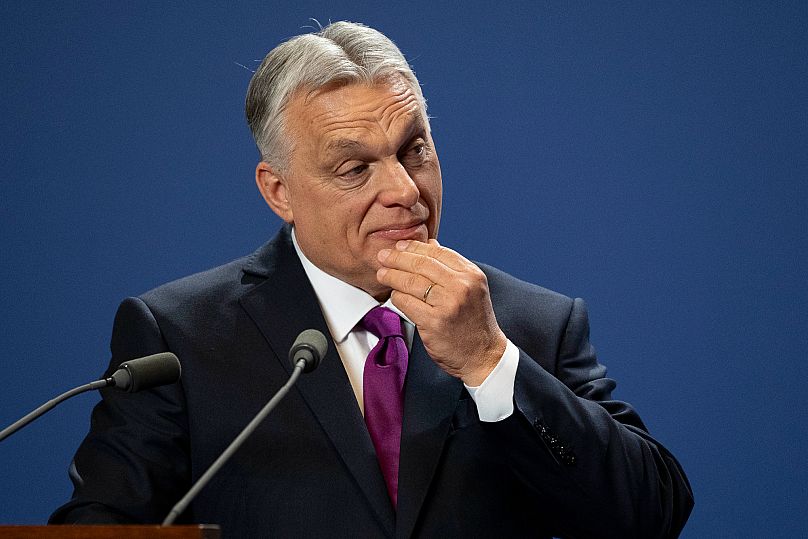
Hungarian Prime Minister Viktor Orbán during a press conference in Budapest, 3 April, 2025AP Photo

In a speech to supporters in February, Prime Minister Viktor Orbán advised organisers "not to bother organising this year's parade," calling it "wasted money and time."

The Budapest Police attached photographs and videos to its statement depicting scenes from previous Budapest Pride events, ostensibly as evidence to corroborate its view that the march was likely to violate the new laws banning public displays of homosexuality.

France, Germany and Spain were among at least 20 European Union nations who last month called on Hungary to revise its legislation banning LGBTQ+ events, expressing concern that it runs contrary to the fundamental values of human dignity, freedom, equality and respect for human rights enshrined in EU treaties.

Organisers of Budapest Pride, which draws tens of thousands annually and is celebrating its 30th anniversary this year, have vowed that the event will go ahead as planned despite the threat of legal sanctions.


Eurozone unemployment drops to record low levels in April

A magnifying glass on a newspaper enlarging the word "jobs".
Copyright Canva

By Indrabati Lahiri
Published on 

Falling energy and input prices helped ease cost pressures for European businesses in April, allowing them to retain more employees.

The Eurozone unemployment rate fell to 6.2% in April from 6.3% in March, matching the record low recorded in December 2024, according to Eurostat.

This decline was mainly driven by easing energy and intermediate input prices as well as stabilising inflation. These developments have given companies greater financial flexibility, reducing the need to lay off workers in order to afford materials and cover bills.

The creation of more job opportunities through the ongoing green and digital transition has also contributed to decline in Eurozone unemployment. 

The number of people without jobs fell by 207,000 in April compared to the previous month, bringing the total to 10.7 million. In the European Union, there were 12.9 million people without a job in April, which was a decrease of 188,000 compared to March 2025. 

Similarly, the youth unemployment rate in the Eurozone, reflecting job seekers under the age of 25, fell to a four-month low of 14.4%, down from 14.8% in March. 

Germany recorded one of the lowest unemployment rates in the Eurozone in April, at 3.6%, while the Netherlands’ unemployment rate was 3.8%. On the other hand, Spain recorded an unemployment rate of 10.9% in April, while Italy’s unemployment rate was 5.9%. The French unemployment rate was 7.1%. 


Exclusive: EU Parliament to lose caterers as workers fear for jobs

Movers transporting canteens from Brussels to Strasbourg
Copyright European Parliament/Melanie WENGER


By Eleonora Vasques & Vincenzo Genovese
Published on 

Contract caterer struggled to remain profitable in wake of pandemic leaving employees with concerns for their future.

The European Parliament's key catering tender holder withdrew because it struggled to make the work profitable, according to sources Euronews has spoken to, leaving essential workers at the institution concerned for the safety of their jobs.

The European Parliament outsources various internal services such as management of cafeterias, canteens and office cleaning to private companies.

But the unprofitability drove the company running Parliament’s food services, Compass Group, to prematurely end its contract. The catering and hospitality multinational will operate until 30 June and hasn't pitched to renew its tender for the main staff canteen, according to three people familiar with the situation. 

Compass has operated within the institution since 2015 and decided not to continue after the Parliament failed to respond to a request for increased subsidies attached to its contract, according to the people.

Food services in the institution are currently outsourced to Compass, but new tenders are divided into three lots: with the main canteen distinct from MEPs catering and bar services.

Compass has pitched for the latter two and winners of new tenders for the three services will be announced this week.

"Since the end of COVID, [Compass] has experienced significant losses as a result of the pandemic, and we’ve had to gradually recover. Things were never quite the same after that. Parliamentary activities also resumed gradually - it wasn’t an immediate return to normal,” a person familiar with the matter said.

“We registered roughly €60,000 of loss per month,” another person familiar with the matter told Euronews, claiming that the main canteen of the European Parliament in Brussels is the most unprofitable service.

New tenders lead to fears among staff

Under Belgian law, contractors taking on the tenders from the outgoing suppliers must employ the previous staff, but may after six months revise their budgets and propose a restructuring citing unprofitability.

Any company taking on the tender must maintain salary levels and food standards under Belgian rules and the terms of the contract, one of the people said, adding that any changes to the menu prices would also require permission from the Parliament.

Two of the people familiar said that new catering contracts could imply some job losses, citing lower tender values and reductions in subsidies offered by the Parliament to contractors, resulting in higher costs for the companies.

“Before the last contract, the arrangement was completely different. The previous contract operated under a mandate, meaning all expenses were re-invoiced and covered by the Parliament, including personnel and freight costs," one of the people said.

“The Parliament is fully committed to maintaining the highest standards of service. National legislation and collective agreements on employment rights, accessibility, environment and food safety are all to be respected meticulously,” the European Parliament press service told Euronews.

"Contracts are awarded to bidders offering the best overall value based on the established evaluation criteria. Quality assessments may take into account social factors such as workforce management, training, staff well-being, and inclusiveness," the press service added.

Cleaning services supplier ISS Nettoyage is also struggling to make the work pay, according to two people familiar with the situation. One of the people said that similar cleaning jobs in the Parliament might have taken twice the time 20 years ago, adding: "Now, our workload has tripled compared to back then, and it’s overwhelming."

ISS’ contract with the European Parliament is due to expire as of August 2026 and it is not confirmed whether it will apply again for the tender.

"We don’t know if we’ll have more work, less work, or even if we’ll still be allowed to do our jobs after the transition. That uncertainty causes a lot of stress and fear in our daily lives,” this person said.

ISS didn't reply to a request for comment.


‘A systemic problem’: Legal action targets EU’s failure to stop bottom trawling in protected areas

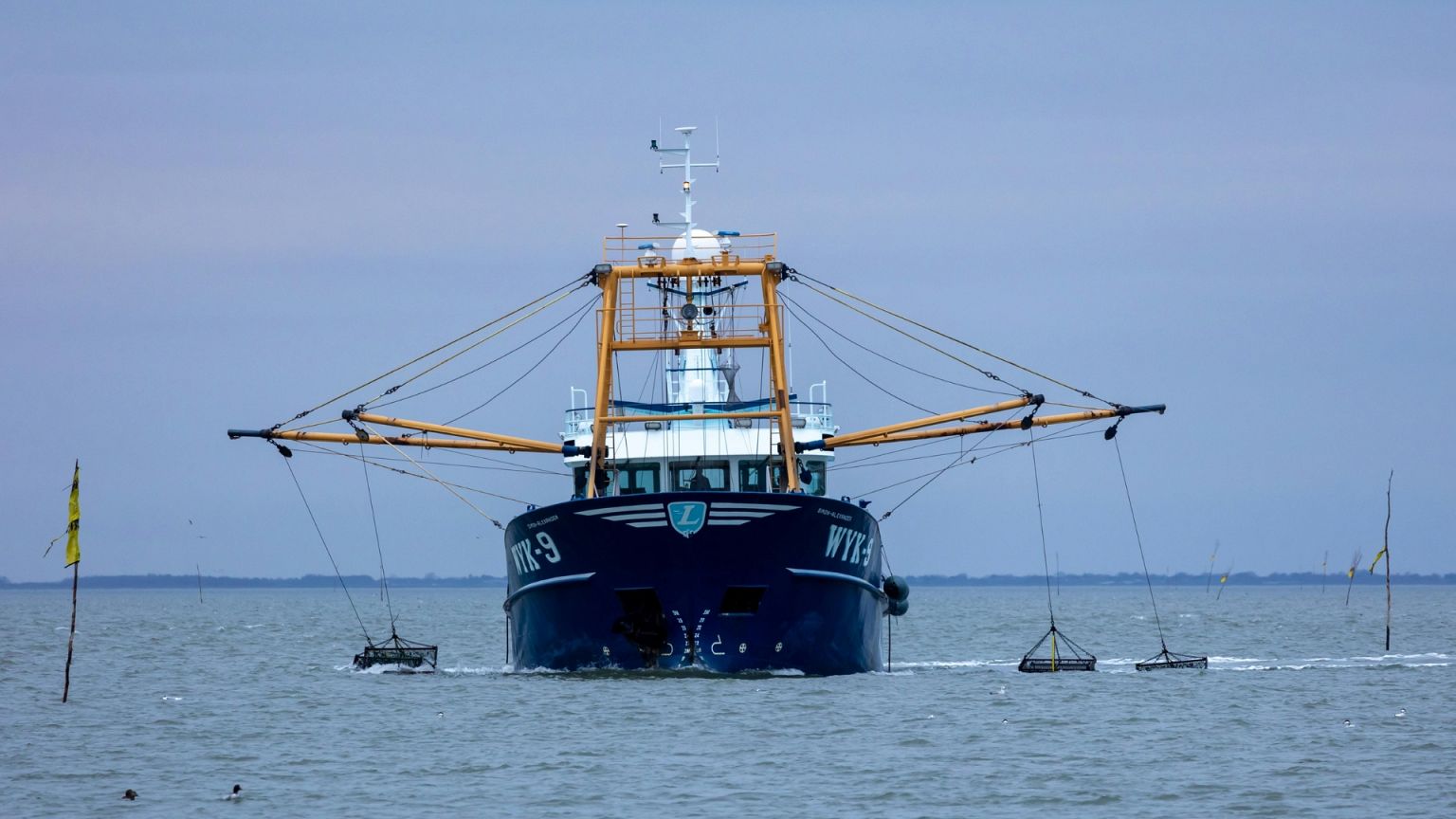
A fishing boat at sea in Hörnum, Sylt.
Copyright Pexels

By Rosie Frost
Published on 

It is the latest in a stream of litigation from all corners of the EU over bottom trawling in protected zones.

EU leaders are facing a fresh legal complaint over widespread destructive fishing practices like bottom trawling in marine protected areas (MPAs).

The lawyers behind it say that continuing to permit this activity goes against the bloc’s core nature laws and puts the ocean and people in grave danger. 

Bottom trawling is a destructive fishing practice which involves dragging a net - some so large it could fit a Boeing 747 plane - across the seafloor to catch fish. It disturbs sediment, destroys marine habitats and far more than just the target species gets caught in these nets.

The complaint is being brought to the European Commission by a coalition of non-profit organisations: ClientEarth, Oceana, Seas at Risk and Danmarks Naturfredningsforening. 

It points out persistent instances of unchallenged bottom trawling in three countries: Denmark, the Netherlands and Spain. The challenge claims that destructive fishing practices in MPAs in these member states flout the EU Habitats Directive and calls on EU officials to launch infringement action against the countries in question. 

The Habitts Directive requires Natura 2000 MPAs - the most important network of marine protected areas in Europe - to be protected from any activity likely to significantly affect the integrity of the site. 

“Legally speaking, bottom trawling in protected areas is not legal, and if policymakers don’t live up to their obligations, we will bring them before court,” says Tobias Troll, marine policy director from Seas at Risk.

ClientEarth ocean lawyer John Condon adds that “urgent action” is needed at the EU level to confirm that bottom trawling is against EU law, alongside an “immediate response” from governments. 

Bottom trawling in protected areas is a ‘systemic problem’

This legal challenge is the latest in a string of litigation across the EU over bottom trawling in MPAs. Individual national cases have so far been launched in France, Spain, the Netherlands, Italy, Sweden and Germany.

In April, another group of NGOs filed a similar legal complaint with the EU, alleging breaches of the EU Habitats Directive by Italy, France and Germany. 

This complaint, and others like it, reveal a systemic problem across Europe and one that member states have failed to address for years now, contrary to their legal obligations under EU law.
 Nicolas Fournier 
Campaign director for marine protection at Oceana in Europe

“This complaint, and others like it, reveal a systemic problem across Europe and one that member states have failed to address for years now, contrary to their legal obligations under EU law,” explains Nicolas Fournier, campaign director for marine protection at Oceana in Europe. 

The new legal challenge also comes hot off the heels of a crucial judgment from the EU’s General Court in May, which confirmed that protected areas must be protected from potentially harmful practices like bottom trawling. 

The Commission concluded that countries have every right under EU law to ban damaging fishing methods like this in vulnerable marine areas. 

Pressure is mounting for action on bottom trawling

Some EU countries, like Greece and Sweden, have already announced plans for national legislation to ban bottom trawling in protected areas within their territories. The EU’s 2023 Marie Action Plan calls on member states to phase out bottom trawling in all MPAs by 2030. 

But recent research from NGOs Oceana, Seas At Risk and ClientEarth revealed that no EU country currently has a comprehensive plan in place to phase out destructive fishing practices in these protected areas. And a study published in March this year by Pristine Seas found that around 60 per cent of these vulnerable marine areas in the EU are currently being trawled. 

With the UN set to host its Ocean Conference in Nice, France, on 9 June and the EU expected to release its strategy to promote a sustainable and competitive blue economy in the next few days, pressure is mounting for more comprehensive ocean protection. 

Campaigns calling for action on destructive fishing practices in the EU have been backed by fishermen and hundreds of thousands of Europeans

“The world is waiting for leaders at UNOC to defend the ocean, and make sure protected genuinely means protected,” adds noted MPA defender and founder of the Mediterranean Conservation Society, Zafer Kızılkaya.

“Fishers depend on it - communities depend on it - the world depends on it.”


France forces TikTok to ban #SkinnyTok but harmful content still persists

FILE - A TikTok logo is shown on a phone in San Francisco, Friday, Jan. 17, 2025.
Copyright Jeff Chiu/Copyright 2025 The AP. All rights reserved


By Sophia Khatsenkova
Published on 

The move comes as European countries sound the alarm on TikTok’s impact on youth mental health. Experts warn the app still hosts dangerous content under different hashtags.

Under pressure from the French government, TikTok has banned the hashtag #SkinnyTok, a controversial trend linked to the glorification of extreme thinness and unhealthy weight-loss advice.

The move comes amid mounting concerns across Europe over the platform’s influence on young users and its role in promoting body image disorders.

The French Ministry for Digital Affairs celebrated the removal as a significant step toward protecting minors online.

“This is a first collective victory,” Digital Minister Clara Chappaz wrote on X on Sunday, adding that she wants to ban social media platforms for minors under 15 years of age

The now-banned hashtag had amassed more than half a million posts, many glamorising extreme thinness, sharing guilt-inducing messages like "you aren't ugly, you are just fat."

The content overwhelmingly featured young women, often filtered to appear thinner, reinforcing toxic body standards for millions of viewers across the world.

However, despite the removal of the hashtag, concerns persist. Typing “SkinnyTok” into the app now redirects users to wellness advice, but similar harmful content still thrives under altered or misspelled hashtags.

For Charlyne Buiges, a nurse specialising in eating disorders who started the petition that helped push the issue into public view, the ban is a moment of validation: “It's a great victory, I was very happy,” she said. “I immediately reinstalled the TikTok application and went to see if it was really real. Once I saw the hashtag was banned, I told myself I didn't do all this for nothing," she told Euronews.

Ella Marouani, a 22-year-old nursing student who has battled an eating disorder that she says was fueled by social media told Euronews she felt frustrated by the lack of action from the platform: “I made several reports to TikTok about videos that were problematic and each time I was told that the rules of the community had not been violated” she said.

Ella’s experience paints a sobering picture of how early - and how easily - such content can shape a young person’s self-image.

“I came across a few #SkinnyTok videos in my algorithm and they made me deeply angry,” she said. “A few years ago, I would have probably believed in these videos so I am deeply angry for the young people who come across this content," she said.

Health professionals have also been sounding the alarm. Lea Tourain, a Paris-based nutritionist, sees firsthand how distorted body ideals impact teenagers.

“I think it's really dangerous, and it scares me because it's becoming more and more fashionable,” she said. “In my consultations, I have young girls who come with an image of themselves, with a filter, or simply with someone they follow on social media, who advocates extreme thinness and they ask me how to achieve the same body. It's very worrying," she explained in an interview with Euronews.

Despite TikTok’s claims that it enforces “strict rules against body shaming and dangerous behaviour related to weight loss,” many say enforcement is either too weak or too slow.

That’s one of the key concerns for French Socialist MP Arthur Delaporte, who leads a parliamentary commission investigating social media’s role in spreading harmful content.

Delaporte is calling for a coordinated European response and tougher penalties for platforms that fail to act. “We need to stop the digital giants from setting up dangerous and flawed algorithms that ultimately aggravate mental disorders,” he said.

“We do need to impose sanctions at European level, sanctions at an international level, fines if need be… at some point we need to bang our fists on the table and consider even banning the platform.”

The European Commission, which launched a formal investigation into TikTok under the Digital Services Act (DSA) in February 2024, remained largely on the sidelines during this latest move.

The absence of the Commission in this decision raised doubts about the EU’s role in enforcing its own tech rules.

Meanwhile, a growing number of European countries, including Belgium and Switzerland, also took their steps against the platform, just as France had done, circumventing Brussels.

Belgium’s Digital Minister Vanessa Matz had filed a formal complaint against TikTok and referred the issue to the Commission.

In Switzerland, lawmakers are exploring ways to regulate the platform, possibly through age restrictions.


Spain spikes contract for missiles built by Rafael in bid to move away from Israeli tech

A SPIKE missile is launched during live-fire drills at Yeonpyeong Island near the maritime border with North Korea, 26 June, 2024
Copyright AP Photo

By Gavin Blackburn with AP
Published on 

The systems would have been developed in Spain by Pap Tecnos, a Madrid-based subsidiary of Israel's Rafael Advanced Defence Systems, local media said.

Spain has cancelled a deal to purchase anti-tank missile systems that were to be manufactured in Madrid by a subsidiary of an Israeli company in a bid to move away from Israeli military technology, the Defence Ministry said on Tuesday.

The decision will affect the license for 168 SPIKE LR2 anti-tank missile systems with an estimated value of €285 million.

The systems would have been developed in Spain by Pap Tecnos, a Madrid-based subsidiary of Israel’s Rafael Advanced Defence Systems, local media said.

"The goal is clear...a total disconnection from Israeli technology," government spokesperson Pilar Alegría told reporters, adding the government is studying "the effects of the cancellation."

Israel's Defence Ministry referred questions on the decision back to Rafael, which declined to comment. Pap Tecnos has not issued a comment either.


Spain's Defence Minister Margarita Robles arrives for a meeting of the Ukraine Defence Contact Group at NATO headquarters in Brussels, 11 April, 2025AP Photo

Spain approved the deal on 3 October 2023 four days before the Hamas-led attack on southern Israel that sparked the war in Gaza.

That attack left around 1,200 people, most of them civilians, dead.

Hamas took 251 people as hostages, and is currently still holding 58 in Gaza, of whom fewer than 24 are believed to still be alive.

Spain's leftist government says it stopped exporting arms to Israel as of 2 October that year, but there where reports some shipments slipped through.

Authorities argued at the time that the systems used by the Spanish forces were obsolete and should be replaced for up-to-date versions like those used by allied armies.

Spain formally recognised a Palestinian state in May 2024 in a coordinated effort with Norway and Ireland.

A month later, Spain became the first European country to ask the top United Nations court, the International Court of Justice, permission to join a case mounted by South Africa that accuses Israel of genocide in Gaza. Israel strongly denies the charge.

There has been growing concern in the west about the Israeli military offensive in Gaza which has to date killed 54,000 Palestinians, according to the Hamas-run Health Ministry whose figures do not distinguish between fighters and civilians.

Last week, Israel's Foreign Ministry accused French President Emmanuel Macron of being on a "crusade against the Jewish state," after he urged the international community to harden its stance towards Israel if the humanitarian situation in Gaza doesn’t improve.

"There is no humanitarian blockade. This is a blatant lie," the ministry said, defending its control over the flow of aid into the enclave.

"But instead of putting pressure on jihadist terrorists, Macron wants to reward them with a Palestinian state. No doubt his national holiday will be October 7," the statement said, referring to the 7 October 2023 militant attack on Israel.


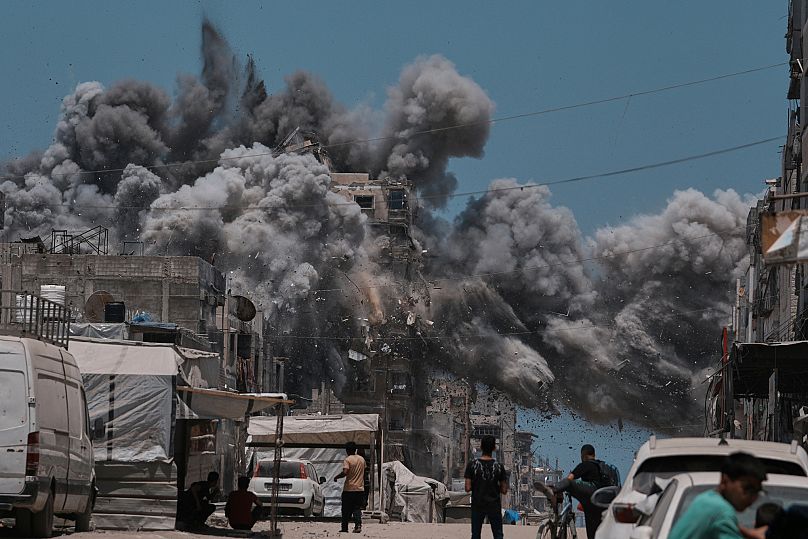
Smoke rises to the sky following an Israeli strike in Gaza City, 1 June, 2025AP Photo

During a three-hour televised interview earlier in May, Macron said Europe should consider sanctioning Israel over the humanitarian situation in Gaza, where hundreds of thousands are thought to be now facing starvation.

And last month, the UK government said it was suspending free trade negotiations with Israel and had introduced new sanctions on settlements in the West Bank as Westminster ramped up its criticism of the ongoing military operation in Gaza.

Foreign Secretary David Lammy said the UK's existing trade agreement with Israel remains in effect but the government couldn't continue discussions with an administration pursuing what he called "egregious" policies in the two territories.

Those remarks followed a joint condemnation he issued on 19 May with Macron and Canadian Prime Minister Mark Carney that marked one of the most significant criticisms by close allies of Israel’s handling of the war in Gaza and its actions in the West Bank.